Home » Articles posted by Lou Agosta (Page 10)
Author Archives: Lou Agosta

A Lazy Person’s Guide to Empathy, the book, now available: Expand empathy in the individual and community today!
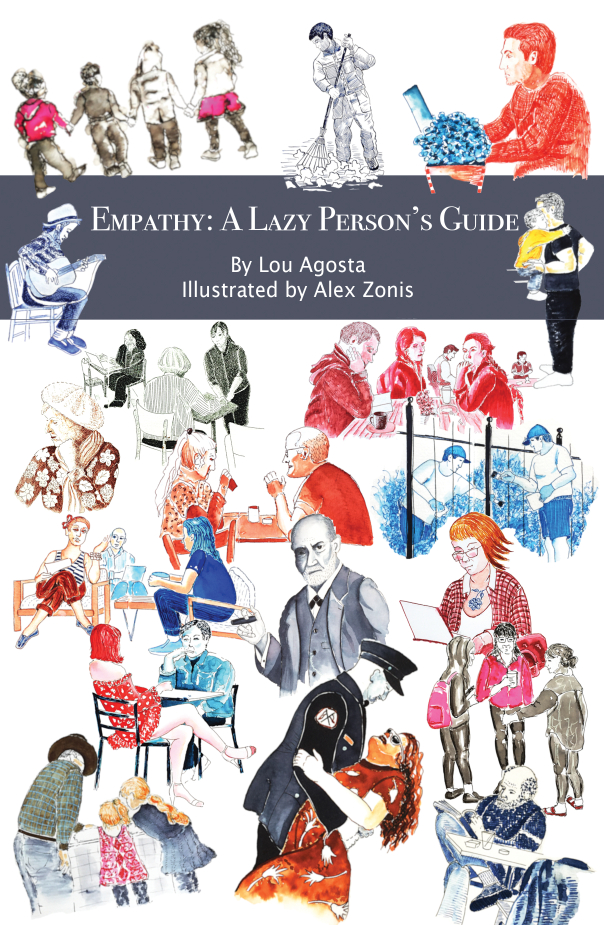
Empathy: A Lazy Person’s Guide is a light-hearted look at a significant and engaging matter: how to expand empathy in the individual and the community – and do so without working too hard. The Guide includes twenty eight illustrations by the celebrated artist Alex Zonis. So if you get tired of reading, look at the pictures! Practically an art book, get a summary in line below and order the book here and now by clicking here: Empathy: A Lazy Person’s Guide.
Given current events (Q2 2020), go straight to the section on applying empathy to soothe anger and rage – and setting empathic limits to drive out bullying, prejudice, and bad behavior. In addition –
A lazy person’s guide to empathy guides you in –
- Performing a readiness assessement for empathy
- Cleaning up your messes one relationship at a time.
- Defining empathy as a multi-dimensional process.
- Empathy in the age of coronavirus – don’t miss it!
- Overcoming the Big Four empathy breakdowns.
- Applying introspection as the royal road to empathy.
- Identifying natural empaths who don’t get enough empathy – and getting them [oneself] the empathy one needs.
- The one-minute empathy training. [No kidding!]
- Compassion fatigue: A radical proposal to overcome it.
- Listening: Hearing what the other person is saying versus your opinion of what she is saying.
- Distinguishing what happened versus what you made it mean.
- Applying empathy to sooth anger and rage.
- Good fences (not walls!) make good neighbors: About boundaries.
- How and why empathy is good for one’s well-being.
- Empathy and humor.Empathy, capitalist tool.
- Empathy: A method of data gathering.
- Empathy: A dial, not an “on-off” switch.
- Assessing your therapist,.
- Applying empathy in every encounter with the other person – and just being with other people without anything else added.
- Empathy as the new love – so what was the old love?
The lazy person’s guide to empathy offers a bold idea: empathy is not an “off-off” switch, but a dial or tuner. The person going through the day on “automatic pilot” needs to “tune up” or “dial up” her or his empathy to expand relatedness and communication with other people and in the community.
Practicing empathy includes finding your sense of balance, especially in relating to people. In a telling analogy, you cannot get a sense of balance in learning to ride a bike simply by reading the owner’s manual. Yes, strength is required, but if you get too tense, then you apply too much force in the wrong direction and you lose your balance. You have to keep a “light touch.” You cannot force an outcome. If you are one of those individuals who seem always to be trying harder when it comes to empathy, throttle back. Hit the pause button. Take a break.
Empathy is about balance: emotional balance, interpersonal balance and community balance. Empathy training is all about practicing balance: You have to strive in a process of trail and error and try again to find the right balance. So “lazy person’s guide” is really trying to say “laid back person’s guide.” The “laziness” is not lack of energy, but well-regulated, focused energy, applied in balanced doses. The risk is that some people – and you know who you are – will actually get stressed out trying to be lazy. Cut that out! Just let it be.
The natural empath – or persons experiencing compassion fatigue – may usefully “tune down” their empathy. But how does one do that?
The short answer is, “set firm boundaries.” Good fences (fences, not walls!) make good neighbors; but there is gate in the fence over which is inscribed the welcoming word “Empathy.”
The longer answer is: The training and guidance provided by this book – as well as the tips and techniques along the way – are precisely methods for adjusting empathy without turning it off and becoming hard-hearted or going overboard and melting down into an ineffective, emotional puddle.
Empathy can break down, misfire, go off the rails in so many ways. Only after empathy breakdowns and misfirings of empathy have been worked out and ruled out – emotional contagion, conformity, projection, superficial agreement in words getting lost in translation – only then does the empathy “have legs”. Find out how to overcome the most common empathy breakdowns and break through to expanded empathy – and enriched humanity – in satisfying, fulfilling relationships in empathy.
Okay – I have read enough – I would like to order the book: click here: Empathy: A Lazy Person’s Guide.
(c) Lou Agosta, PhD and the Chicago Empathy Project

Saint Linehan: Marsha Linehan dishes on what she had to survive to innovate her way to DBT
This is the story, the narrative, of a survivor, Marsha Linehan, an innovator in the treatment of borderline personality disorder (BPD) using a method she and her team

Cover Art: Building a Life Worth Living by Marsha M. Linehan
invented called Dialectical Behavioral Treatment (DBT). Linehan has written a memoir, not a treatment manual (separately available (see references at bottom)). Her memoir contextualizes the diverse interventions used by DBT such as acceptance, distress tolerance, emotional regulation skills, self soothing skills, communication skills, limit setting skills, assertiveness training, and so on. She attempts and largely succeeds in connecting the dots between DBT and its skills and the key events in her life, many of which had not been publicly available.
While courage is needed for someone who has suffered from invalidation all her life to risk further invalidation in some arbitrary book review, dishing on the details of one’s life is definitely trending. Being vulnerable is trending – see Brena Brown who has virtually branded vulnerability – and Linehan succeeds in spades in opening herself up. Linehan’s narrative is by turns spiritually enriching, educational, funny, discouraging, and inspiring.
For those who require an orientation – and at the risk of over-simplification – DBT combines acceptance and tolerance such as one develops in meditation and mindfulness with the specific cognitive behavioral therapy (CBT) skills designed to interrupt the dysfunctional thinking and negative self-talk of anxious and depressed neurotics. I see it as empathic validation plus homework in CBT skills.
More formally, DBT is an evidence-based, team-abed treatment, requiring individual and group work, that is included in clinical practice guidelines for the treatment of BPD, suicidality, and several other “acting out” types of addictive behavior such as substance dependency that have proved resistant to other forms of treatment.
Linehan’s memoir connects the dots between a specific DBT skill back to her experience in life. Often she calls out the instant in which the DBT skill was born, defined, invented, or got “borrowed” from another theory. For example, and once again at the risk of over-simplification, Linehan does a lot work on mindfulness, meditating in the context of Zen Buddhism; the DBT skill of acceptance is born. Another example, in the case of willingness – like, “I am willing to give it a try” – Linehan first encounters it at the Shalem Institute. Willingness is borrowed from the existential psychotherapists Gerald and Rollo May, but given its own special spin when combined with the Zen distinction of acceptance (p. 196).
In reading Linehan’s compelling and engaging narrative, she talks a lot about religion and love. The spiritual dimension is front and center.
William James’ The Varieties of Religious Experience (1902) has nothing on Dr Linehan – she sees the golden bright light at the Cenacle Retreat Center over on Fullerton – possibly at about the time I was living around the corner on Belden Avenue. She has the “blue hydrangea” moment, too. Hence, the title of this review, “Saint Linehan” is not an irreverent joke, in the DBT sense, though it is that, too.
Linehan documents at least two mystical experiences that belong in James’ work. As noted, at the Cenacale Retreat House on Fullerton Avenue, Chicago, she experiences the encompassing, enveloping “bright golden light shimmering all over” (p. 102, p. 200). Then later she has the “blue hydrangea” pantheism experience of God being everywhere at the Shalem Institute of Christina contemplative prayer with a strong admixture of existential therapy from Gerald and Rollo May (p. 196, 201).
Linehan was in psychoanalysis at the time of her “golden light” experience, and, of course, she told her analyst about it. Now one might expect the analysis had read Freud and he would associate to the “oceanic experience” from childhood that Freud so compelling quotes on the first pages of Civilization and Its Discontents. Instead Linehan reports that the analyst said: “Marsha, I’m an atheist, so I have no idea what happened to you. But I can tell you this: you don’t need therapy anymore.” That was that.
Wait a minute! Freud was an avowed atheist, too, which is where this analyst got the idea, though Freud highly valued Jewish culture and Hebrew teachings. It may be deeply cynical, but I wonder that this so-called analyst (Victor Zielinski, MD, who spent a lot of years at Hines – another bad fit (?)) had not been wishing for awhile that this difficult individual would just “go away.” Another breakdown of empathy?
Marsha did not see it that way, she was sooo happy as she left the office. Though I accept the happiness, the accuracy of her insight into the cause of this happiness is what I am a tad skeptical about. She had a narrow escape from yet another invalidating, unempathic environment like her mother’s home growing up. I hasten to add this was prior to Heinz Kohut, MD, and his innovations, which powerfully embrace empathic listening and responsiveness in the psychoanalytically inspired (and based) context of self psychology.
The causes of BPD are still being debated, but the person is vulnerable in three areas. The person must have a biological disposition; the group (society, community, family, and so on) to which she is a part leaves the person feeling they do not fit in; and, most importantly, the person is not given a chance to develop the interpersonal skills needed to relate to others, regulate their emotions, and self sooth. In short, the aetiology requires an invalidating environment. Key term: invalidation.
To me the invalidation environment often looks like one that lacks empathy or one in which the caretakers are significantly “out of tune” empathically with the child. Of course, the environment may also include more obvious adverse or traumatic experiences. I hasten to add that while it is fashionable to dump on the parents, that is inadequate. One can get similar results as extroverted children are born to introverted parents (and vice versa) and so on. See Andrew Solomon’s book, Far From the Tree (2012). The apple never falls far from the tree? Oh yes it does! Marsha fell far from the tree. But that is not all.
In Linehan’s life, the mother is the image of the invalidating environment – Marsha was never quite right – she came within a hair’s breath of inventing self psychology but once she ended up on the inpatient psychiatric unit and had been subjected to the rigors of electro shock “therapy” that game was over – to save herself she had to wok from the outside inwards behaviorally and invent DBT.
So what did Linehan actually have to survive? She was the round peg in the square hole of her family. She was smart, got good grades, was out-spoken, and even popular in her own eccentric way. All the women in the Linehan family are wife line – thin; Marsha is “large-boned” and if she is not caution those bones can acquire adipose tissue. The mother is prim and proper and the model of an executive’s wife. The executive was remote, taking solace in his work, and keeping his distance from the “house wife obsessions” of the mother of his children. He emotionally abandons Marsha. Meanwhile, according to Marsha’s mom, she [Marsha] just couldn’t do anything right.
Marsha needed fixing and no one knew better how to do it than mom. Yet no matter how much Marsha improved, no matter how good she got, Mom consistently found something to criticize. One can only get better for so long; then one has to be good enough.
The sister’s example was always there to be thrown at Marsha. And mom apparently even warned the sister to stay away from Marsha, further isolating her emotionally in the family, as Marsha was apparently a bad example. She was getting good grades and popular – a bad example of what? “Girls were supposed to be demure, sweetly charming, quietly spoken, and not given to expressing strong opinions, especially around men. They should defer to men at all times and in all things” (p, 111). Her mom valued a “girly girl,” who knew her place. This was not going to go well.
Marsha starts living into the devaluing judgments of her close relatives. Marsha gets to adolescence and her “apparent competence,” her skill in maintaining a false self [not Linehan’s term], the good girl, even if a tad eccentric, breaks down. She has some dates, but she never succeeds in getting a steady boy friend in high school. She comes unraveled, beset with acting out in the form of cutting – what would come to be called para suicidal behavior thanks to DBT.
There was an noticeable absence of trauma on Linehan’s life, except those traumas which she eventually inflicts on herself in cutting with a razor and related para suicidal acting out. But invalidation was pervasive. If empathy is like oxygen for the soul (psyche), Linehan was suffocating. She starts flailing about like someone who can’t breathe.
A constant drumbeat occurs of “you are not all right,” of “you are not important,” “you are less than.” Highly destructive to the nuclear self.
Even though Marsha eventually overcomes many of her demons, mom’s behavior never changes in spite of an honest effort. For example, years later, Marsha is getting her doctorate in social psychology, a significant accomplishment under any circumstances. Congratulations? “Mother had made a dress for me for Aline’s [her sister’s] wedding, and on the morning of graduation she was more focused on fitting my dress than she was on my getting a doctorate” (p. 118).
The word “empathy” occurs once in Linehan’s text (p. 94); and, of course, the word itself as a mere word is dispensable in principle. The text and Linehan’s life work is steeped in empathy. Empathy LIVEs in Linehan’s work. But not empathy as emotional contagion or “touchy feely” fragilization. Key word: fragilizing (p. 223). Not you are very fragile and have to be spoken to softly and treated with kid gloves.
There may indeed be moments for a quiet heart-to-heart talk, and such conversations are highly significant, but if a person is carving up their arm with a razor, this person may be a lot of things, but fragile is not exactly one of them. How shall I put it delicately? They are in a lot of pain and suffering and are employing emergency merges to try and survive the moment.
Paradoxically pain and suffering can become a highly uncomfortable “comfort zone” for the client. Personal suffering is ruining the person’s life, but the person is attached to the suffering. This is the case not only with BPD but with most kinds of mental and emotional disorders. This is different than moral masochism, but sometimes not different by that much. The patient has to be motivated to engage the tough work of moving beyond stuckness to have new experiences, which are by no means guaranteed to be immediately rewarding or satisfying. That is where validation comes in.
We have conceptualized invalidation as a cause of the suffering, so Linehan and DBT deliver validation as part of the treatment. But what is validation? A lot of work is done to meet the client where she is. The client says, “My life sucks.” And that is usually the most accurate available description. The person really is miserable and there are good reasons for it. What’s so about life needs to be validated before the individual can consider the possibility of moving forward out of stuckness. The therapist’s validation provides access to the client’s acceptance of their situation. Acceptance of the situation provides an opening for moving beyond the limits of the situation.
The challenge to the treatment is that acceptance and validation provide access to change, but it does not seem that way to the person who is in pain. The challenge is that pain and suffering can be sticky.
“Validation” means you experience your experience. Invalidation is being told – sometimes quire persuasively – you did not experience your experience. How is that even possible? Believe me, it happens a lot. Blaming the victim. Redescribing the experience as caused by the survivor’s own shortcomings. “Don’t you ever talk that way about Uncle John again! He did not pull down your pants” [not an example in Linehan]. Pretty soon the child does not know what he is experiencing.
The client usually likes to be validated. Validation is different than agreement or disagreement. It means the other person “gets who you are.” It means one is responded to as a whole person, not a diagnosis, label, body part, or partial entity. It means one is responded to as the possibility of flourishing and accomplishment, even if, at the moment, one is stuck in emotional misery. For my money, that is an alternative redescription of empathic understanding. For many, validation is itself a new experience and some can’t believe it or be open to it. It takes time, but most people promptly, though not instantaneously, perceive it as authentic, especially when it is authentic.
Then the client can be motivated, leveraged, incented, to practice new skills, take risks interpersonally, and just try stuff out instead of wallowing in a funk of anxiety and depression. The validation is the empathic moment. To get it right requires expanded empathy. Though the word is not much used, as noted, empathy LIVEs in the work Linehan and DBT treatment programs are doing. But then you also have to do the exercises.
Before I read Linehan’s memoir, I knew that she was a survivor. I knew she was a survivor of some of the things for which DBT is a successful treatment. I knew about the “physician, health thyself” aspect of her work and the work at Zen Buddhist retreats – as indeed is often the case with innovators who have to overcome personal demons in order to thrive – Kay Redfield Jameson and Elyn Saks, for example. Indeed Freud and Jung belong on this list – especially Jung.
I digress at this point to point out that Henri Ellenberger (Discovery of the Unconscious (1970)) has the distinction of a “creative illness” – which often has major psychosomatic aspects as the body is the best picture of the human soul/psyche – from which the individual emerges with renewed energies to produce his or her magnum opus or masterpiece. Arguably Linehan’s two years on the inpatient unit were her “creative illness,” though I cannot believe it seemed to her that way at the time.
What I did not know prior to reading the memoir was about the electro convulsive therapy (ECT). Linehan reports she once knew how to play the piano. The ability never returned after the ECT. She got into a pre med program at Loyola in college and found that she had forgotten all her biology and much of her science, once again probably as a result of it having it blasted out of her by ECT and significant does of anti-psychotics – you forget what is bothering you and a whole bunch of other stuff too). So Marsha Linehan is also a survivor of ECT, and not in the best sense of the words.
Need I add that Linehan, with some conditions and qualifications, does not endorse the inpatient treatment of psychiatric disorders? One of her many videos on Youtube makes the distinction between a “life worth living program” and a “suicide prevention program.” I paraphrase Linehan in redescribing suicide to a suicidal client: “It’s good that you see feeling suicidal is a problem; but really suicide is a solution to escape from a messy and painful life; and our job in DBT is to give you a better solution through skills such as self-soothing, distress tolerance, mindfulness, emotional equilibrium training,” By the way, “redescribing” is a DBT skill that has many origins, but most properly credited to the modern philosopher Elizabeth Anscombe.
Linehan’s makes a strength out of a weakness in the memoir as she enrolls important people in her life of giving her an account of publication of what was going on at the time, which she then quotes in the memoir. Still, the number of times is significant that she reports, “I just can’t remember” or “I don’t know why I did this” [or words to that effect].Such statements become an important part of the rhetorical stance of this work. They are also, in their own way, examples of a DBT skill. One does not always need to understand in order to get the result. Understanding has its uses, but also its limitations. If one sits around waiting to understand, it could be a long wait. Get in action. Try something. If it does not work, stop doing that, and try something different.
What I did not know was about the extent and depth of the self-harm. She gets put in isolation, and she launches herself head first off the chair in a frenzy of disequilibrated self-harm. Yes, people were supposed to be watching her, but somehow this kept happening. Traumatic brain injury?
What I did not know is that Linehan, finally on the road to recovery, considered becoming a monk or nun. She took vows of poverty, chastity, and obedience as a Lay Religious person instead. In the irreverent spirit of DBT, I note that her career total was zero for three, though here I am making an educated guess, I believe she honored the spirit of her vows.
Since this is not a softball review, I have critical observations. Linehan learned more from that unempathic psychoanalysis than she realized – she was working on an early version of self psychology. Thus, I have some “tough love” for one of the inventor’s of tough love in the context of treatment. However, the one thing I am not going to do is invalidate Linehan’s experience. Her report of her own experience is whole and complete and perfect in every way. She gets to say.
This business of “wise mind” – a DBT koan – needs work. My intuition is that human beings cannot intentionally “be wise.” Some people may end up being wise as a result of processing their experiences in profound ways. Wisdom comes forth “out of the mouth of babes” in that some individuals get in touch with a “beginner’s mind” and are able to express hard-to-capture distinctions hidden in plain view, about life, relationships, and everything. In that sense, yes, “wisdom happens.” Kant said, “Only God is wise.” Kohut said that a certain wisdom – along with humor and expanded empathy – can be brought forth as the result of a successful analysis of the self; but that wisdom was mostly acceptance of our limitations, suffering, and finitude. So I have NEVER been comfortable or “on board” with the over-simplifications in DBT about “wise mind.”
Linehan is often on a tear – standard behavioral therapy doesn’t work with the most seriously distressed (suicidal) patients and cognitive behavioral therapy has serious issues, too. You have to get a person whose life and all-available-evidence “prove” that “all the good one’s are taken” or “life sucks” to be reasonable and admit that “some of the good ones are not taken” or “life does not have to suck at all times.”
Emotional mind does not acknowledge cognitive penetrability or cognitive impenetrability. Cognitive mind does not acknowledge the emotions display a “logic” of their own, disclosing important aspects of a situation while also concealing other aspects. Cognitive mind can tell you “what’s so,” but cognition lacks the power to motivate you to do anything about it. Abstractions do not move people, emotions do. There is a dialectical encounter between the two – and that is commitment, which tries to find a emotional motivation for what cognition shows to be an authentically valid path forward.
The thing about the iceberg is that it’s the iceberg “all the way down.” The visible part of the iceberg is not a different iceberg than the less visible part submerged beneath the water. The behavior is visible, but the biology is not visible, what the individual had to survive is not visible, how the community reacts to the individual of is not visible. But unlike – or perhaps just like – the iceberg, research treats these all as different siloes. It is true that we all – including Linehan – now speak of the bio-psycho-social individual and express authentic commitment to integration. But the effort required to integrate just shows how dis-integrated the entire phenomenon is.
The tip of the iceberg does not regard itself as distinct from the iceberg. The “tip” is our abstraction. Likewise, with behavior. Linehan demonstrates this compelling as she takes the psychoanalytic distinction of “introject,” operationalizes it, and shows collects evidence that DBT improves measures of introject over against a stricter behavioral intervention. Amazing.
How shall I put it delicately? Like every other individual, Linehan has a privileged access to her own first person experience – the golden light moment, the blue hydrangea moment. She also has many advantages in interpreting what that experience means, since, like every other individual, she knows a lot about her own history that others might or might not know. But as to what the experience “really means,” one individual has as good a chance of getting it right as another once the experience has been captured and reported. At first she says “The golden light means God loves me”; but then, since that experience was like [felt like] her love for Ed [a person who she actually loved deeply], she reinterprets the golden light to mean “I love God.” So she has to continue searching for God’s love for her, which brings us to the blue hydrangea by which time the meaning of God and of love have shifted.
But wait. Her Zen experience will eventually have taught her this is just another Zen koan – it is like the ambiguous Gestalt image the duck-rabbit where the rabbit’s ears and the duck’s bill and the figure spontaneously reverses – perhaps she got it right the first time – “God is God” and “love is love.” In short, Linehan is really slinging it here, and there is nothing wrong with that. It works. Her rhetoric is that of the beginner’s mind after long struggle. She is irreverent, assertive, disruptive within limits (and without), and contrary within limits (and without), innovative, all DBT skills, and we thank you, Marsha, for being Marsha.
References
Marsha M. Linehan. (2020). Building a Life Worth Living: A Memoir. New York: Random House, 384 pp.
Marsha M. Linehan. (1993). Cognitive-Behavioral Treatment of Borderline Personality Disorder. New York: Guilford Press.
Marsha Linehan Interviews Kelly: https://www.youtube.com/watch?v=tgzw50SbokM
© Lou Agosta, PhD and the Chicago Empathy Project

Spike in Domestic Violence (DV) Accompanies Pandemic Shelter-at-Home

The conversation on Spotify (above) is different content – a conversation, not the book review in line below – so to get the complete picture, the reader/listener will want to plan on engaging with both contributions. However, both are significant contributions to what to do about the confronting matter of intimate partner violence (domestic violence) in our communities.
This is a republishing with light editing of a book review from May 19, 2019 on Rachel Louise Snyder’s important work on domestic violence (DV). Difficult situations are further breaking down and becoming intolerable under the stresses of the pandemic.
The short version? Actionable recommendations include the Danger Assessment and the Fatality Review Board (FRB). Police and DV interveners are now being trained to perform a Danger Assessment (Jacquelyn Campbell’s innovation). For example, when the perpetrator strangles the would-be survivor that indicates an increasing risk of homicide. Strangulation often is the next to last abuse by a perpetrator before a homicide. The correlation is strong, very strong. Strangulation is a much more significant marker than, say, a punch or kick that the abuser will escalate to lethal violence. Strangulation dramatically increases the chances of domestic violence homicide (p. 66). No easy answers here, but the details follow on how to interrupt the unfolding tragedy.
The title of Rachel Louise Snyder’s eye-opening, powerful, page-turner of a book, No Visible Bruises, refers to strangulation [No Visible Bruises: What We Don’t Know About Domestic Violence Can Kill Us, New York: Bloomsbury Publishing, 2019: 309 pp, $28(US)].
Some sixty percent of domestic violence (DV) victims are strangled at some point during an abusive relationship (p. 65). Turns out that only some 15% of the victims

Cover Art: No Visible Bruises by Rachel Louise Snyder – a picture of cracked plaster – not only of an enraged fist but of a damaged, fragmented self
in one study had injuries visible enough to photograph for the police report (p. 66).
Most strangulation injuries are internal – hence, the title.
Since 2012 when I completed the 40-hour training in Understanding Domestic Violence (DV) at the community organization ApnaGhar, several important innovations have occurred. Snyder presents the reader with these, including the distinctions of (1) a Fatality Review Board for Domestic Violence; (2) initiatives to provide treatment for the abusers; (3) the Danger Assessment (which leads back to the role of strangulation).
Lack of oxygen to the brain can cause micro-strokes, vision and hearing problems, seizures, ringing ears, memory loss, headaches, blacking out, traumatic brain injury (TBI) (p. 69). As the victim in near death due to strangulation – but so far there would only be red marks around the neck – the nerves in the brain stem lose control over sphincter muscles. So the urination and defecation were not mere signs of fear. They were evidence that the victim was near death (p. 67).
Such victims have poor recall of the event. They may not even be aware that they lost consciousness. In being incoherent in her talk, the victim is not being difficult or drunk. The victim is fighting the consequences of a life-threatening event and may not know it at the moment. Here police training will make a difference.
Even medical professionals may overlook the signs of serious injury by strangulation unless they are altered to the circumstance of the visit to the emergency room. Fact: DV victims are NOT routinely screened for strangulation or brain injury in the emergency room. They are discharged without CT scans or MRIs. The assaults and injuries are not formalized and abusers are prosecuted under lesser charges, say, misdemeanors rather than felonies.
“What researchers have learned from combat soldiers and football players and car accident victims is only now making its way into the domestic violence community: that the poor recall, the recanting, the changing details, along with other markers, like anxiety, hypervigilance, and headaches, can all be signs of TBI” (p. 70).
Now the ultimate confronting fact: Strangulation often is the next to last abuse by a perpetrator before a homicide. The correlation is strong, very strong. Strangulation is a much more significant marker than, say, a punch or kick that the abuser will escalate to lethal violence. Strangulation dramatically increases the chances of domestic violence homicide (p. 66).
This leads directly to an important innovation in the struggle against DV, the Danger Assessment. Jacquelyn Campbell has quantified the Danger Assessment, which is especially effective when combined with a timeline of incident. In addition, to strangulation high risk factors in any combination that portend a potential homicide include: gun ownership, substance abuse, extreme jealousy, threats to kill, forced sex, isolation from friends and family, a child from a different biological parent in the home, an abuser’s threat of suicide or violence during pregnancy, threats to children, destruction of property, and a victim’s attempt to leave anytime within the prior year. Chronic unemployment was the sole economic factor (p. 65). None of these cause DV; but they make a bad situation worse – much worse – and add to the risk of a fatal outcome.
You can see where this is going. First responders, police, medical professionals, family, friends need to ask the tough questions – perform the assessment and have a safety plan ready to implement to get the potential victim out of immediate danger. Hence, the need for Snyder’s important book and its hard-hitting writing and reporting to be better known at all levels of the community.
Snyder reports on a second important innovation in the struggle against DV: the Fatality Review Board (FRB) for DV Homicide. Air travel has become significantly safer thanks to the Federal Aviation Administration commitment to investigate independently every airplane crash. The idea is to find out what sequence of things went wrong without finger pointing. No blame, no shame. The idea is to perform an evidence-based assessment of all aspects of the system – human, administrative, mechanical, procedural.
In a breakdown big enough to cause loss of life, multiple errors, anomalies, and exceptions are likely to have occurred in the system. Rarely is there is single cause of a disaster big enough to cause loss of life. “If systems were more efficient, people less siloed in their offices and tasks, maybe we could reduce the intimate partner homicide rate in the same way the NTSB [National Transportation Safety Board] had made aviation so much safer” (p. 85). The Fatality Review Board is born.
For example, the authorities knew the perpetrator. They had visited the home multiple times. The abuser was released from detention without notifying the potential victim. An order of protection was denied due to a paperwork error, or, if granted, the police could not read the raggedy document that the woman was required to have on her person at all times. The prosecutor was unaware of a parallel complaint by the victim’s mother because it was filed in the same docket and dismissed when the victim recanted in the hope of placating the abuser and saving her own life.
For example, multiple touch points occur at which victims and perpetrators interact with social services, healthcare facilities, community organizations, the veteran’s administration, law enforcement, and the clergy. The FRB is tasked with determining how the fatal outcome could have been avoided.
Chase down all the accidental judgments, missed cues, and blind spots. Talk to everyone able to talk. Gather all the data. Someone knew something, had actionable information that was not acted upon. Formulate recommendations to avoid repeating the mistakes.
That means building formal lines of permissioned communication between administrative siloes. For example, there as a restraining order against the abuser but it was in another state and the local authorities did not know about it.
In the age of the Internet there needs to be a central clearing database that preserves such data. Or, for instance, the shooter had no criminal record, but the victim had expressed fear for her life to the local pastor at church based on his statements. Who can he (or she) call? Who can intervene with a safety plan?
No one single factor can be singled out as causing the fatality; instead a series of relatively small mistakes, missed opportunities, and failed communications. The FRB looks for points where system actors could have intervened and didn’t or could have intervened differently (p. 86). Today more than forty states now have fatality review teams. Though the violence continues, this is progress.
Snyder makes an important contribution in clarifying why the victim does not run leave the abuser and the abusive relationship. Why does she return to the abuser, or recant her testimony in the police report, frustrating the attempt of the prosecution to get a conviction?
Though every situation is unique, Snyder builds a compelling narrative that often the victim is trying to save her own life. The system works much slower than a determined abuser, and the victim knows it. In short, the abuser knows how to work the system; and all-too-often the victim cannot rely on the system to protect her when she most needs protection. In addition, her judgment may be impaired due to being called every name in the book and slapped, punched, or strangled.
As the abuser senses he is losing power and the victim is getting ready to leave, the risk of violence to regain control escalates. The abuser is strangling her, escalating to deadly violence, and yet he is charged with a misdemeanor. He will be out on $500 bail in 24 hours – buying a gun and gasoline to burn down the house after killing her and the children. In fear for her life, the victim is makes up a story about love to try to placate the abuser – she is recanting to try to buy time – while she accumulates enough cash or school credits to escape and have a life. The victim recants her narrative in the police report and says she loves him because she wants to live.
A third major strong point of Snyder’s work is her report on interventions available for abusers. Incarcerating an abuser to protect the community is necessary. But that does not mean the abuser does not need treatment. He does. Absent treatment, jail just makes the abuser worse. The entire middle section of the book is devoted to the dynamics of perpetrator treatment.
At another level I found Snyder’s deep insight to be an extension of Simone de Beauvoir’s assertion circa 1959 that woman is not a mere womb. The enlightened man adds to de Beauvoir’s statement (which is notquoted by Snyder): man is not mere testosterone. In both cases, biology is important, but biology is not destiny. I repeat: biology is not destiny. Some men have not been properly socialized and need to get in touch with and transform their inner uncivilized cave man.
The recovery programs in jails on which Snyder reports sound rather like “boot camp” to me. The emphasis is on “tough love.” This is a function of the close association, if not identification, of masculinity with violence.
In some communities, violence is how masculinity gets expressed. This extends from “big boys don’t cry” and if he hits you, hit him back all the way to a misogynistic gangster mentality that uses devaluing language to describe woman as basically existing for the sadistic sexual satisfaction of men. It may also be common (and justified!?) in a military context. As near as I can figure – and this is an oversimplification – the treatment groups are given lessons in cognitive or dialectical behavioral therapy: skills in emotional regulation, distress tolerance, self-soothing, and interpersonal negotiations.
For those perpetrators, not incarcerated or suffering from post traumatic stress disorder (along with their victims), but rather brought up in relative privilege or affluence, Snyder has less to say. While the poverty, crime, and substance abuse of the inner city can intensify DV, DV is an equal opportunity plague, occurring in affluent neighborhoods too. Only here we are dealing with “snakes in suits” – think: Harvey Weinstein or Bill Crosby (“date rape” drugs) [granted, these individuals were sexual predators, not necessarily DV perpetrators]; perpetrators who are quite sophisticated in using the system to isolate and disempower their victims financially, legally, emotionally as well as physically (violently). This is an incompleteness rather than a flaw in an otherwise compressive study. Another chapter – or book – may usefully be written about DV scenarios among the rich and famous – or at least affluent. DV lives there too.
On a personal note, when I started reading this book, I knew it was not for the faint of heart. I said to myself: “Ouch! This is like the ‘ketchup scene’ in Shakespeare’s Hamlet.” At the end of Hamlet, the entire family gets killed. To deal with something as disturbing (and hope inspiring) as Snyder’s book, I had to go to Shakespeare.
Indeed Hamlet begins with domestic violence. Hamlet’s uncle kills his own brother, Hamlet’s father, to seize the throne by marrying Hamlet’s mother. The latter is not technically DV, but a boundary violation. (This is the original Game of Thrones if there ever was one.) In turn, Hamlet perpetuates verbal and emotional abuse, whether fake insanity or genuine narcissistic rage, against his fiancé, Ophelia. Hurt people, hurt people. Sensitive soul that Ophelia is, she commits suicide. Ophelia’s brother then seeks revenge. Hamlet kills her brother as the brother simultaneously kills Hamlet with a rapier tipped with a deadly poison. The mother drinks the poisoned goblet, intended for Hamlet, and the uncle is run through by Hamlet – also with the poisoned rapier. The point?
Horatio’s provides a summary at the backend of Hamlet which also forms a review of Snyder’s work: “So shall you hear – Of carnal, bloody, and unnatural acts – Of accidental judgments, casual slaughters, – Of deaths put on by cunning and forced cause, – And, in this upshot, purposes mistook, – Fall’n on the inventor’s heads. All this can I truly deliver.” Just so.
All too often the events seemed to me to unfold like a Greek tragedy – or in this case a Shakespearian one. You already know the outcome. The suspense is enormous. You want to jump up on the stage and shout, “Don’t open the door – therein lies perdition!” But everything the actors do to try to avoid the tragic outcome seems to advance the action step-by-step in the direction of its fulfillment.
Snyder provides a compelling narrative – and actionable interventions – on how to interrupt the seeming inevitability of a tragic final scene and create the possibility of survival and even, dare one hope, flourishing.
Further Reading
Update (2026/04/24): Rachel Louise Snyder. (2026). The warning signs were there in Louisiana: Why did we miss them. The New York Times. https://www.nytimes.com/2026/04/24/opinion/the-20-questions-that-can-prevent-domestic-violence-homicide.html
Wilson, K. J. (1996 [2006]). When Violence Begins at Home: A Comprehensive Guide to Understanding and Ending Domestic Abuse, 2ndEdition. Alameda, CA: Hunter House (Publishers Group West).
Websdale, Neil. (1999). Understanding Domestic Homicide. Northeastern University Press.
Campbell, Jacquelyn et al. (2003). “Risk Factors for Femicide in Abusive Relationships: Results from a Multisite Case Control Study. American Journal of Public Health93, no. 7 (July 2003).
Agosta, Lou. (2012). A Rumor of Empathy at Apna Ghar, the Video: https://tinyurl.com/y4yolree [on camera interview with Serena Low, former executive director of Apna Ghar about the struggle against DV]
Agosta, Lou. (2015). Chapter Four: Treatment of Domestic Violence inA Rumor of Empathy: Resistance, Narrative and Recovery in Psychoanalysis and Psychotherapy. London: Routledge.
(c) Lou Agosta, PhD and the Chicago Empathy Project

Illness as Metaphor
Catching up on my reading while “sheltering at home” in Chicago, Susan Sontag’s (1933 – 2004) book length essay, “Illness as Metaphor” (1977) is especially timely in view of the psychological dynamics around the Covid-19 pandemic.
The message of “Illness as Metaphor” is that human beings make things mean things. The

The look: Mayor Lightfoot clears the beaches and parks in Chicago
talent for doing this is metaphor. This means that – this is that.. That is sometimes called “art,” but other times, less inspirationally, it is called “magical thinking.” (“Magical thinking” is when not bringing my umbrella casues it to rain and vice versa.)
For example: Cancer is a death sentence. Tuberculosis (TB) is a source of genius. AIDS (acquired immune deficiency syndrome) is punishment from God. People who get sick have made a mistake – done something wrong, broken a taboo, committed a transgression against morality or community or both. Seems like problem, yes?
Any disease that is not well understood shows up as “The Plague!” and marks the person who has it. It is a stigma – literally, a mark – on the victim. Thus, the tendency of human beings to take a bad situation – and make it worse.
If Sontag were alive today, she would no doubt have something to contribute to the conversation about Covid-19 as another example of illness as metaphor.
Citing examples from literature, Sontag’s commitment is to drain the meaning from illness as a metaphor so that the patient can get treatment entirely independently of magical thinking about “what did I do to deserve this?” Even the victim blames the victim: “What did I do wrong?” Nothing in particular – follow doctor’s orders – take the treatment (if there is any).
Sontag collects diverse and entertaining literary anecdotes about the meaning of illness for the people impacted by it prior to the antibiotics that cure TB or the admittedly rougher chemo- and immuno-interventions that [often] cure cancer – that is, send it into long-term remission.
For example, TB was regarded and written about as the creative artist’s disease, an enhancement of identity. The disease itself becomes the mark of a creative personality. The disease is the source of creative genius. The list is long but Schiller, Chopin, Keats, Shelley, and Kafka top the list of artists whose lives and productivity were shortened by TB. Unlike such disorders as manic-depression where the boundary between productive creativity and uncontrolled acting out can vary problematically (and some of those on the list may have had some of that too), TB is just bad news. But it is not treated that way.
The tubercular character is both passionate and repressed. Literature is filled with romantic characters whose suffering from TB enhances their beauty when they are women – see Mimi in La Bohéme – or their intellectual vitality when they are men – see Hans Castrop in Thomas Mann’s Magic Mountain.
In contrast, according to Sontag, cancer is the metaphor for what is most ferociously energetic (p. 68). The uncontrolled multiplication of cells run riot. There are fewer narrative engagements in literature – see Tolstoy’s The Death of Ivan Illych as a notable exception – but the stigmatization is no less metaphorical. In Mann’s late novel The Black Swan the aging heroine, engaged in a romantic relationship, initially mistakes bleeding as the return of her menses whereas it is a hemorrhage due to cancer.
The link between moral disease and the underlying character is supposedly illustrated by Freud, who communicated brilliantly but was brought low by cancer of the mouth, chomping on his ever-present cigar long before the carcinogens in tobacco were understood. Wittgenstein was a carefully closeted gay person (in the UK where homosexuality was illegal at the time) and died when his prostate cancer spread.
This leads to the discussion of plague literature beginning with the setting for Boccaccio’s Decameron in the pestilence struck Florence of 1348. Thomas Mann’s “The Death in Venice” (1912) has its aging, celebrity hero, Gustav von Aschenbach, metaphorically plagued by an infatuation with a pubertal boy, who looks like Donatello’s statue of David.
The love affair unfolds across ninety pages without the lovers so much as doing more than exchanging an occasional remote glance on the beach across a distance of ten meters, but the animal magnetism on the part of Aschenbach is palpable, the references to Dionysius and Nietzsche compelling, and the ending unpredictable. Aschenbach eats the strawberries, and catches a version of the cholera epidemic that kills him before he so much as feels the slightest need to go to the bathroom. Hmmm. Might not have been cholera. Old age? A broken heart? An unscheduled cerebral event due to a hypertensive crisis brought on by stress?
Fast forward some ten years, in real life, and Sontag is herself a cancer survivor. She was realistic, did not romanticize her illness, did not mistakenly believe that aromatherapy, talk therapy or yoga would cure her cancer. She engaged with the chemotherapy, and lived to fight another day.
In 1989 Sontag updates her work in a separate essay entitled “AIDS and Its Metaphors.” Ten years on (roughly 1987) the AIDS (acquired immune deficiency syndrome) epidemic is in getting going and would continue accelerating until 1995. Antiretroviral treatments would start emerging in 1996 that ultimately would substantially reduce AIDS-related mortality.
Here the stigma of being gay loomed large as the Reagan administration and Evangelical Christians led the way in blaming the victims. Drug addicts who used infected needles also formed a marginalized population that, according to the some versions of the Christian right, did not deserve treatment, never mind the sayings of Jesus of Nazareth about what one does to the least of the brethren one also does to Him.
Never was it truer that we are all related – and the least of the brethren eventually and unwittingly started infecting the heterosexual population. Indeed even the credible threat of such infection was game changing, along with the gay rights growing protests, political power, and the participation of fellow travellers of integrity of diverse persuasions.
What Sontag may not have appreciated as much as we do today (Q1 2020) is that it is a cognitive design defect of human thinking to take responsibility for things for which we have responsibility as well as no responsibility, because it is adaptive to do so from the point of view of survival in the face of the unknown. This “taking responsibility” is “making it mean that I did something = x to cause this.” In turn, this “x” is often “I did something wrong.” Not necessarily – unless you consider “being born” to have been a mistake.
When the solution [or cure] is known one has to shift the responsibility and just take the medicine or when there is no medicine just follow evidence-based doctor’s orders. Thus, Sontag’s self-described mission is to treat disease as disease – not as a curse, embarrassment, punishment, or stigma. “Without meaning.”
It is a design defect of human cognition that in the face of the unknown causes of TB, cancer, AIDS, Ebola, or Covid-19, people’s imaginations ran riot with meaning-making about the causes, expressive value, symbolic portend, possible treatments and cures, and outcome of illness.
The lesson? As Sontag surely appreciated, Psychology 101 teaches us that the most fearsome thing is – the unknown. The unknown is a source of meaning generation as one tries to comprehend it, structure it, control or at least manage it. But meaning making itself has its own risks and break downs.
As of this writing (Q1 2020) we do not know if or how readily the Covid-19 virus can be aerosolized – hang in the air and be contagious – twenty minutes (not so bad?) – twenty hours (no so good!). The rapid spread of the community contagion suggests the coronavirus is more contagious than was at first suspected. Bad news. Yet it is the unknown takes one’s power away and unworkably leaves one with the thought, “Maybe I should hold my breath.”
You know how in the vintage back and white monster movies, once you actually see the guy dressed up as Swamp Thing, it is a lot less scary? The creature may still be disgusting, but it is no longer nearly as scary? The scary part is when the heroine is innocently combing her hair and the swamp thing (which is “off camera” and the audience cannot yet see) is silently sneaking up behind her.
You know that scenario? Well, that’s what we’ve got here with the World Health’s Declaration of a pandemic. I will not further comment on the details as numerous resources are available from WHO and the Center for Disease Controls (CDC), frequently updated as we learn more and more about what to do or not do.
I hasten to add that “following doctor’s orders” does not mean abandoning critical thinking. It means following the light, but it does not mean following the light off a cliff. How to know the difference?
Medical “science” makes mistakes. George Washington got a fever, and bleeding him to reduce the imagined excess of blood contributed to his untimely death. In the 1960s, thalidomide was a horrific episode that lead to the strengthening of the Food and Drug Administration’s (FDA) requirements for validating the uses of medications. Yet in the face of political pressure to “do something” even the FDA bows to the bully pulpit to approve an unproven treatment against malaria for use against Covid-19. Well, at least it doesn’t cause birth defects – we think, we hope.
Sontag does not touch the fraught matter of psychiatric treatments, and some psychiatric treatments that have been applied in certain places and times are indistinguishable from human rights violations, especially seen with the benefit of 20-20 hindsight. For example, the prefrontal lobotomy destroys the personality, rending the acting-out patient compliant and docile – and sometimes incontinent. While some patients have benefited from electro shock therapy (ECT), its use remains controversial, and it has not always been used (as it should be) as a treatment of last resort. (For example, at a time when ECT was the first line treatment because it was arguably the only treatment, see Marsha Linehan’s memoir Building a Life Worth Living of the damage it did to her.)
Medical science makes mistakes. But medical science still makes fewer mistakes than do politicians appearing on TV and pretending to be doctors, touting unproven anecdotal remedies. Alternative facts, half truths, and dangerous nonsense are readily projected onto the unknown.
Thus Albert Camus writes in his novel The Plague (translation by Stuart Gilbert 1947/1948): “The evil that is in the world always comes of ignorance, and good intentions may do as much harm as malevolence, if they lack understanding. On the whole, men are more good than bad; that, however, isn’t the real point. But they are more or less ignorant, and it is this that we call vice or virtue; the most incorrigible vice being that of an ignorance that fancies it knows everything”
The management and overcoming of epidemics is difficult under the best of circumstances. As well as deep medical and public health expertise, it requires leadership, communication, and political skills. Not for the faint of heart.
For example, Albert Camus’s The Plague provides the paradigm structure of an epidemic. The epidemic is a social drama is three acts. The first act contains hints that all is not right. Most of the tourists pack up and leave. No one dares say the word “cholera” or “plague.” The commercial class of businesses and shop-keepers are in denial out of a combination of economic interests and outright fear for their own health and well-being. Then a rising number of illnesses and deaths requires people to confront the fact.
The second act consists in the search for causes. When science does not have the answer (or as in medieval times science is not quite what we mean by “science”), people substitute value judgments for causal accounts. In medieval times, Jewish people and practices were blamed. In our own time with Covid-19, some are pointing a finger at Chinese people, projecting their fears. I hasten to add there are Covid-19 lessons to be learned in the breakdown of the early warning system for disease under diverse political and economic stressors not further analyzed here.
At this point in the drama, act three, the social and political strengths and weaknesses of the community are exposed. The poor suffer disproportionately whereas the rich leverage their access to resources to survive. The ultimate voter suppression opportunity? The ruling class uses the opportunity to thin the ranks of the opposition; though to be sure, the disease is a great equalizer, arbitrarily carrying away rich and poor, indiscriminately.
Other individuals and groups – first responders – step up and perform heroic acts of self-sacrifice for the good of the community. The latter also exposes the weaknesses of the response of the authorities as people are asked to “step up” without adequate personal protective equipment and systems.
Finally, the disease runs its course when it runs out victims susceptible to its action and intervention by the authorities – medical and social – succeeds in stemming its tide.
Sontag is clear. Disease is the result of pathogens such as bacteria, viruses or toxic chemicals such as tobacco and arsenic, so follow doctor’s orders, take the medicine (if available), in our own current predicament, maintain social (physical) distance, shelter in place, and live to fight another day.
By 1977 tuberculosis (TB) had long been curable. Innovative chemo- and immuno-therapies for cancer were supplementing radiation therapy. So cancer no longer equaled a death sentence. But the inertia of thinking, judging, moralizing, politicking is such that TB and cancer were rich sources of metaphor – commentary, comparison, and expressive discourse about relationships, community, and politics. In literature and historical narrative illness is not mere disease, it is metaphor. Illness gathers together, activates, and occasions meaning making about life, death, morality, merit, transgression, finitude, and mortality.
Sontag’s method is based on her breakthrough approach in “Against Interpretation” (1964), which is directed against the accumulations of meaning that stick to modern art. Her recommendation? Instead of trying to figure out what it means, let it be what it is.
This is the existentialist moment in Sontag. Disease is a reminder of human finitude – mortality. That is one of the few things that can be said to be the truth with a capital “T” – no one gets out of this thing – that is, life – alive. Everyone dies – but the manner of coming and going is highly diverse. We humans work mightily to negotiate and postpone the exit – that is called modern medicine. Go back to the top of this post and substitute “modern medicine” for “illness”; and, while that does not change the guidance, it puts in perspective just how much trouble we really are today.
References
David S. Jones, MD PhD History in Perspective – Lessons for Covid-19
https://www.nejm.org/doi/full/10.1056/NEJMp2004361?query=RP
March 12, 2020: March 12, 2020
DOI: 10.1056/NEJMp2004361
Megan Molteni, (3/4/2020), Everything you needed to know about a coronavirus vaccine:
https://www.wired.com/story/everything-you-need-to-know-about-coronavirus-vaccines/
Politico: Coronavirus Will Change the World Permanently. Here’s How (03/19/2020): https://www.politico.com/news/magazine/2020/03/19/coronavirus-effect-economy-life-society-analysis-covid-135579
Note this material is highly time sensitive. All the usual disclaimers apply.
© Lou Agosta, PhD and the Chicago Empathy Project

Alternative facts, dangerous half truths, and complete nonsense
Granted, medical science may sometimes mistakes. But medical science still makes many, many fewer mistakes than do politicians appearing on TV and pretending to be doctors, touting unproven anecdotal remedies. Alternative facts, half truths, and dangerous nonsense are readily projected onto the unknown.
The management and overcoming of a pandemic is difficult under the best of circumstances. Along with deep medical and public health expertise, it requires leadership, communication, and political skills. Not for the faint of heart.
A single fact is worth a thousand opinions. Here is a fact from Emily Landon, MD, Executive Director Infection Prevention and Control, University of Chicago Medical Center (for the complete text see the URL at the end of this post):
“Two cities in America made different choices [in 1918] about how to proceed and when only a few patients were affected. St. Louis shut itself down and sheltered in place. But Philadelphia went ahead with a huge parade to celebrate those going off to war.
“A week later, Philadelphia hospitals were overrun. And thousands were dead, many more than in St. Louis. This is a cautionary tale for our time. Things are already tough in Illinois hospitals, including mine. There is no vaccine or readily available antiviral to help stem the tide.
“Our health care system doesn’t have any slack. There are no empty wards waiting for patients or nurses waiting in the wings. We barely even have enough masks for the nurses that we have. Looking back to the last time, we were–limited tools and having a dangerous infection spread quickly was the beginning of the 1918 pandemic.
“All we have to slow the spread is social distance. And if we let every single patient with this infection infect three more people and then each of them infect two or three more people, there won’t be a hospital bed when my mother can’t breathe very well or when yours is coughing too much.”
[March 20, 2020: https://www.uchicagomedicine.org/forefront/coronavirus-disease-covid-19/emily-landon-speaks-about-covid-19-at-illinois-governors-press-conference ]
The genie seems to be out of the bottle (in this case, not a friendly genie) and to get it back in we need to “shelter in place” and stay home except for necessary trips for groceries, medicine, elder care, nuclear plant maintenance, and a small set of related activities.
Psychologically the most anxiety and fear inspiring thing is the unknown – that one can be infected without realizing it, and, thus, spread the infection without realizing it.
The lesson? My behavior affects you and your behavior affects me. We are all related in community. That’s the empathic moment.
Relatedness creates responsibilities to conduct ourselves in such ways as not to harm others. A lot of innocent activities – going to a restaurant, the theatre, a sporting event, playing cards (?!) – that involve congregating in groups seem less innocent this week than they did last week.
Yet another anxiety-inspiring unknown is that we do not know when we will be engaging in these activities again, though we surely will be doing so. I feel like the little kid who fifteen minutes into a three-day road trip to Florida starts asking, “Are we there yet?” The matter is serious, but we also need to enjoy a lighter moment. Chill, dude!
I am going to keep it short today; and for the to-be-determined weeks ahead – follow Dr Landon’s guidance – follow doctor’s orders – stay home.
See the complete blog post of which this is an update: Empathy in the age of the coronavirus: https://wp.me/pXkOk-aq
Notes
I acknowledge the title of Jeffry Pfeffer and Robert Sutton’s excellent business book, not directly related to this post, which I own and enjoyed reading, Hard Facts, Dangerous Half Truths, and Total Nonsense: Profiting from Evidence-based Management (2006).
Also relevant is a first hand account of the symptoms (March 27, 2020) [once again, not for the faint of heart]:
(c) Lou Agosta, PhD, and the Chicago Empathy Project

Empathy in the age of the coronavirus
What does empathy in the age of coronavirus look like? Two words to get started: social distancing.
Social distancing makes sense and is necessary; but social distancing has a cost and an impact.
No hugs allowed. No shaking hands. Bumping elbows? Questionable. “Hug therapy”? There is such an innovation, as the right kind of hug seems to release endorphins – but it is on the ropes. Not good news, though perhaps only a temporary – months long? – setback.
Do not overlook the obvious good news. Some jobs can be performed remotely using

Follow medical doctor’s orders – keep calm – and wash your hands!
online methods and Skype-like facilities such as Zoom or Signal. Many businesses already operate secure virtual private networks. Many kinds of consulting, coaching, guidance, and talk therapy can occur via telecomm, and, though aspects of empathic relatedness may be lost or stretched thin, good enough results can be attained to make it worthwhile to try. Other situations are more problematic.
The social distancing recommendation is strained to the breaking point when it comes to first responders such as doctors and nurses (police, fire, ambulance drives, and others).
Yes, one can take a throat and nose swab without too much interaction, but it is not going to happen from six feet away. Moreover, one does not know what is the cause of the patient’s symptoms so further “laying on of hands” is often required. Thus, the risk. I acknowledge that it is deeply cynical, but I have to note: “Just because we have a germ phobia does not mean we cannot get sick.” We can – and do.
Here the empathy lesson is that empathy is a two way street and the first responders may require reasonable accommodation – and empathy from the community including the patients. So if the doctor shows up in a HAZMAT [hazardous materials] suit, it is not for lack of empathy, it is due to needing to screen dozens of people and stay healthy to screen even more. See above on the cost of social distancing.
What to do when there are no masks and gowns, or MDs and nurses are asked to wear yesterday’s contaminated stuff, are the tough questions. Some hospitals (and families), who have fabrication (including sewing) skills, are making their own. Others are calling the media and blowing the whistle on this appalling situation of first responders at unnecessary risk. All are madly rushing about trying to close the barn door now that the horses [of the apocalypse?!] have escaped. [Update: paragraph added: 03/21/2020.]
Once again, empathy is about community and responsibility. Here is the empathic moment according to celebrity MD, Sanjay Gupta:
“How I behave affects your health. How you behave affects my health,” Gupta said on the air with CNN. “Never, I think, have we been so dependent on each other, at least not in my lifetime, and we should rise to that occasion.” [Kate Shepard and Allison Chiu reporting The Morning Mix March 18, 2020: ‘I’ve never seen Dr. Sanjay Gupta like this’: Strollers, joggers in locked down San Francisco spark anger on CNN: https://www.washingtonpost.com/nation/2020/03/18/coronavirus-cnn-sanjay-gupta/ ]
UPDATE: March 22, 2020:
University of Chicago Medicine infectious diseases expert Dr. Emily Landon spoke during the Illinois governor’s COVID-19 press conference on March 20, 2020. Hear her explain why the statewide order to stay at home is crucial to protecting everyone.
“Our health care system doesn’t have any slack. There are no empty wards waiting for patients or nurses waiting in the wings. We barely even have enough masks for the nurses that we have. Looking back to the last time, we were– limited tools and having a dangerous infection spread quickly was the beginning of the 1918 pandemic.
“Two cities in America made different choices about how to proceed and when only a few patients were affected. St. Louis shut itself down and sheltered in place. But Philadelphia went ahead with a huge parade to celebrate those going off to war.
“A week later, Philadelphia hospitals were overrun. And thousands were dead, many more than in St. Louis. This is a cautionary tale for our time. Things are already tough in Illinois hospitals, including mine. There is no vaccine or readily available antiviral to help stem the tide.
“All we have to slow the spread is social distance. And if we let every single patient with this infection infect three more people and then each of them infect two or three more people, there won’t be a hospital bed when my mother can’t breathe very well or when yours is coughing too much.” Do your part – follow Dr Landon’s guidance. Meanwhile –
You have got to get the black humor here. The situation in Washington DC (and on CNN) is serious but not hopeless; the situation in Milan, Italy, is hopeless but not serious – people under lock down as the death toll rises are going out onto their balconies and singing.
The mother of an eight grader in New Rochelle, New York, who comes home with a fever, is leaving trays of food outside his bedroom door and everyone is eating off of paper plates. This is what empathy looks like in the age of the coronavirus.
This is not a Saturday Night Live (SNL) skit. Six guys in HAZMAT [hazardous materials] suits descend on the family in New Rochelle and make them sign an agreement to stay home for two weeks. They signed. It could be worse. This too shall pass, and presumably the kid (whose fever is going down) will have enhanced (if not unconditional) immunity and can himself serve as a first responder once he grows up. [See Jason Riley’s Report from New York’s Containment Zone March 17, 2020: https://www.wsj.com/articles/report-from-new-yorks-containment-zone-11584485597?cx_testId=3&cx_testVariant=cx_2&cx_artPos=3#cxrecs_s.%5D
Well and good, except where’s the empathy?
Empathy is all about boundaries and crossing boundaries with understanding, receptivity, responsiveness, respect, dignity, courtesy, humor (when appropriate), affection, affinity, and, at the risk of circular reasoning, empathic relatedness.
So what are the proper boundaries in a coronavirus epidemic? Empathy lessons 101 teach us that the most fearsome thing is the unknown – the Hold that thought. The unknown is stressful. The unknown leaves one feeling isolated. The unknown inspires anxiety. The unknown creates an opening for alternative facts, half truths, and total nonsense.
As noted in this blog previously, you know how in the vintage black and white monster movies, once the audience actually sees the Swamp Thing, which is obviously a guy in a lizard suit, it is a lot less scary? The creature may still be disgusting, but it is no longer nearly as scary. The scary part is when the heroine is innocently combing her hair and the swamp thing (which is “off camera” and the audience cannot yet see) is silently sneaking up behind her.
Doubtful this is the Zombie Apocalypse, but it puts me in mind of that U2 classic “Mysterious Ways”: “We’ll be living underground. Eating from a can. Runnin’ away from what you don’t understand. Love.” [Insert dramatic base line here.]
All right, so we are not yet ready for the Zombie Apocalypse, but some people are acting like it – like Zombies, that is. Especially unfortunate is that a few of them hold high public office or are media personalities. But we have got to work with what we’ve got for the time being. Other people are totally “business as usual.” Both extremes need to cut that out! Instead think! Think: community and responsibility.
I am inspired in this thought – community and responsibility – by Jason Bridges. From a practical point of view, Jason Bridges, a professor of philosophy of mind and of Ludwig Wittgenstein (University of Chicago), writes eloquently in an unpublished but widely circulating email of community and responsibility in the time of coronavirus:
“Crises like this lay bare what is always anyway true: we are all members of community. To belong to a community is to be responsible for it” (Unpublished email 2020).
Though Bridges does not use the word “empathy,” this is the empathic moment. Those of us who are not at an especially high risk may usefully ask: “Is doing this responsible?” (“This” being many forms of in-person social contact we have taken for granted.)
The issue – and conflict – is that empathy is supposed to bring us closer –emotionally and spiritually. However, given the kind of physical embodied creatures that we humans are, emotional and spiritual closeness are often mediated by physical, bodily closeness (though crucially not always). (See above – back to “hug therapy.”)
We seem intrinsically to be a species that likes to congregate and get close to one another, at least on many occasions. Some cultures – Italian, Spanish, French, Southern (?) – seem to do this more so than others – Scandinavian, German, Northern (?). America, China, and Russia are vast and include some of each.
Thus, we return to the crucial issue of social distancing and its impact – and cost – with an illness spreading through community contagion.
By cancelling in person events at church, work, school, sports, theatre, and so on, in order to save lives, one is doing exactly the thing predicted to expand loneliness, isolation, detachment, and risking irrational behavior such as hording and opportunistic price increases. You solve one problem; create another. That’s another reason this is a crisis – the dominoes are still falling.
You see the dilemma? Going to church is not usually regarded as an intrinsically empathic activity, but lots of people do it because the experience of community addresses their need for empathy, to be acknowledged as a whole person, to feel included. Same idea with other community events.
Research shows that loneliness can be as bad for one’s health as smoking cigarettes or obesity (see John Cacioppo, (2008), Loneliness, Human Nature, and the Need for Social Connection, New York: W. W. Norton). Loneliness causes stress, reducing the immune system response, and triggering inflammation. Fear also causes such an immune response decline; and, heaven knows, the unknown – including aspects of the COVID-19 situation – is the most fearsome thing. So here is the rock and here is the hard place – what is one to do?
Just doing some brain storming here. The line at the polling station during the March 17, 2020 election had people waiting six feet apart. The frozen custard shop was reconfiguring its service line with markers on the ground at six-foot intervals. Given that the store is often jammed with children pushing forward, it is going to be interesting to see how that works.
Tips and techniques for maintaining and expanding social contact include: pick up the phone and talk to someone. Do not merely text, but have a conversation. Same idea using video conferencing such as Skype, Zoom, or Signal. Talk with one or two friends a day –once again, talk, not text. Do something for someone. It does not have to be volunteering to get the first coronavirus vaccination human trials, and dealing with the uncertainty whether it will cause your children to be born with tails. Do something small. Make a trip to the store for the senior couple next door. Help with chores, homework, or whatever you can contribute.
Although exercise and mindfulness do not usually require talking with others, they can be done in such a way that social distancing is maintained – for example, running outdoors or sitting indoors in a spacious room. These reduce loneliness and related stress.
I will not further comment on the detailed recommendation as numerous resources are available from WHO and the CDC (other relevant local authorities should be included here), frequently updated as we learn more and more about what to do or not to do. I accept the guidance and so should you, dear reader.
Now I agree events need to be cancelled due to the risk of community contagion. What I am asking is whether, for the time being, people can get their head around sitting two sneezes distance apart (in accordance with present CDC guidelines) and the pastor holds two services – one for seniors and one for those less at risk. More work? Yes, but perhaps doable just the same. (Okay, “two sneezes” means the six
Seems like the right idea to me for so many reason. Artistic activity boosts the immune system? Might be worth a try, though tragically the local Italian newspapers are crowded with obituaries. The hypothesis is that the warm, affectionate, cultural practices of getting in close for conversation and food and Catholic mass and so on, did not work well, rapidly spreading a highly contagious pathogen. No good deed goes unpunished!? Yet good deeds in abundance are many and even more are needed.
So, once again, what does empathy in the time of coronavirus look like?
As noted, it also looks like the Italian people, who are suffering severe fatalities in the pandemic, getting out on their balconies and singing – serenading the neighborhood.
It looks like maintaining a healthy routine of exercise, diet, communicating at arms lengths and with electronic media, keeping calming and carrying on – I mean – washing your hands.
It also looks like young healthy people making grocery shopping runs for senior citizens who are still healthy but reluctant to venture out. It looks like shoppers buying two cartons of eggs and two packages of toilet paper instead of two dozen.(What were these people thinking? Right, they were not thinking – that is the point – as Hannah Arendt noted long ago, not thinking can provide an opening for evil to get a foothold.)
It also looks like employers keeping staff on the payroll even though business is in a downturn.
It looks like insurers forgoing their monopoly rents and agreeing to reimburse first responders for their services in treating all potential patients without condition or qualification.
It also looks like government support for big pharma, which has a chance to shine [for a change!], in developing a vaccine (and anti-viral treatments) on a crash, moon-shot-style basis, which vaccine, in turn, has to be given-away to the planet.
Paraphrasing Jason Bridges, crises like this lay bear the weakness and strengths of the community. It puts me in mind of the kid’s game “The Cooties.” Some seven-year-old yells “You’ve got the cooties!” It is the game of tag. The kids all runs around like crazy playing tag – the opposite of social distancing, yet a transformation of it – because you cannot get close or you might be “tagged.” Fortunately, no one dies of the cooties, unlike COVID-19. Thus the breakdowns of empathy of the community are exposed – hoarding, stigmatizing, opportunistic behavior, boundary violations, beggar thy neighbor behavior.
Never was it truer that good fences (not walls!) make good neighbors; but there is a gate in the fence and over the gate is inscribed the word “Empathy.” Every breakdown, when handled with empathy, has the possibility of a breakthrough – a breakthrough in sustaining and crossing boundaries with expanded understanding, generosity, humor (as appropriate and inappropriate), responsiveness, receptivity, respect, random acts of kindness, dignity, and our shared humanity.
© Lou Agosta, PhD and the Chicago Empathy Project

Online therapy now. This is the time.
If ever there was a time for online (tele/cyber) talk therapy, this is it.
In case you were trekking through Tibet or living in a cave with Buddhist monks, allow me to clarify why. Key term: social distancing.
It is not that anyone who is sick or symptomatic would knowingly go to an in-person

Cover art: Theory and Practice of Online Therapy, eds., Weinberg and Rolnick
therapy session anyway, nor does one have to avoid mass transit or public taxis or garage attendants (who may park one’s auto while coughing on the steering wheel). Reasonable accommodation works well. Yet just because you have a germ phobia or are getting clinically paranoid does not mean you cannot get physically ill!
Therefore, keep calm – and carry on – I mean: wash your hands!
Okay, this is not funny. The lesson? Psychotherapy 101 teaches us that the most fearsome thing is – the unknown.
You know how in the vintage black and white monster movies, once you actually see the guy dressed up as Swamp Thing, it is a lot less scary? The creature may still be disgusting, but it is no longer nearly as scary? The scary part is when the heroine is innocently combing her hair and the swamp thing (which is “off camera” and the audience cannot yet see) is silently sneaking up behind her.
You know that scenario? Well, that’s what we’ve got here with the World Health’s Declaration of a pandemic. I will not further comment on the details as numerous resources are available from WHO and the Center for Disease Controls, frequently updated as we learn more and more about what to do or not do.
Just as many businesses, schools, colleges, universities are working remotely – that is, online – for example, delivering a webcast online, clients and therapist may leverage the convenience and social distancing of online therapy for their therapy sessions. One can also apply the lessons of social distancing in an in-person office setting, but it has to be a reasonably large office (which I do have) about the distance of two sneezes across. However, that is not what I am talking about here. What am I talking about? Download a video telecommunication application (function) such as Zoom (this is just an example, not a product endorsement), which reportedly uses encryption. Then review the instructions or call the Help Desk (which I am not operating for purpose of this post).
I cut to the chase. Here are two lessons learned since I originally published this post about online (cyber) therapy in September 13, 2019.
First, an online session presents new opportunities for the equivalent of slips of the tongue. There was one individual with whom the occurrence of the word “mother” was inevitably followed by the Internet connection freezing up, requiring a restart. You can’t make this stuff up. After I called it out, he stopped messing with the volume controls, which seemed to have occasioned pressing the wrong button. Therefore, in an empathic space of acceptance and toleration, the therapist may reasonably provide understanding, accommodation, and some extra time to reinforce and support relatedness.
Next, I can see many psychiatrists, psychologists, and clinical social workers with contracts with insurance companies getting stressed because insurers generally resist paying [will not pay] for tele-consultation (or will do so only (say) in Alaska where there is no other provider within 200 miles).
That is definitely an issue; and it will not be solved here. It may require an act of Congress to curb expanding monopoly rents on the part of insurers during a national crisis, and I would be in favor of such action. It is true (as far as I know) that one cannot take someone’s blood pressure over Skype, though I would not rule out some innovator coming up with an attachment that connects to the computer’s USB. In any case, I am not holding my breath, and I am continuing to expand my online empathy consulting practice, since – how shall I put it delicately? – my relationship with insurers is actually more than a distance of two sneezes across and, in many cases, breaks down in that an empathy deficiency is not [properly speaking] a medical diagnosis.
Update: March 17, 2020: This just in from The Washington Post: “Medicare expands telemedicine to allow seniors to get virtual care at home” [https://www.washingtonpost.com/world/2020/03/17/coronavirus-latest-news/#link-FAF2A2J73BDH3FH6GUHMGM5OSE] This is progress – and it is about time!
Meanwhile –
Meanwhile –
The following was published on September 13, 2019 and is repeated here as highly relevant to our current wellness challenges.
The genie is out of the bottle. The day that the first therapist invited his one-on-one client (who had an urgent need for a conversation but an inability to get to the office) to put down the phone and dial into Skype, the genie escaped from the bottle.
The reader will recall that in the 1001 Arabian Nights the Genie was very powerful but a trickster and nearly impossible to control. Making wishes is tricky, and if one is not careful, the sausages end up stuck to one’s nose and one must waste the last wish to get them off. In this case, the Genie is Internet technology such as Skype and Google Groups and the emerging conveniences, affordances, complexities, entanglements, and even resistances that it offers.
In the Arabian Nights, the hero, Aladdin, had to trick the Genie to getting back in the bottle by appealing to his narcissism. “You are not all powerful,” Aladdin said. “A large creature like you could not possibly fit in that small bottle!” The Genie’s wounded narcissism caused him to prove that he can indeed fit back in the bottle. Aladdin puts the stopper back on – trapped! However, in the case of the Internet and online communication tools, do not look to be able to turn back the clock.
But there is good news. The human face is an emotional hot spot. It is rich in micro-expressions many of which are available and visible even though the “real estate” on the screen in less rich in detail than an in-person experience. Indeed it is not even clear that the face as presented online is “less rich.” It is the only thing being displayed, and the viewer is led to concentrate on it in detail. But here the trade-off of bodily presence versus the imaginary comes into the foreground.
The criticism fails that the online conversation between persons lacks the reality of the in-person encounter. But this criticism fails, in a surprising way. The criticism fails not because the online media is so real. Rather the criticism fails because the in-person psychotherapy encounter is shot through-and-through with the imaginary, with symbolism, the imaginary and irreality. The “irreal” includes the symbolic, the imagined, the fictional, the part of reality which is distinct from the real but includes the past and the future and the imaginary, which are not really present yet influence reality.
In psychotherapy, the in-person encounter is precisely about the symbolic and the imagined – the transference. The basic definition of “transference” is that the person relives emotionally the relationship to objects (persons) from the past, persons who are not physically present in the room (or in the virtual space online).
What we are calling the “virtuality” of the technology media adds an additional dimension of irreality to the symbolic and imagined transference relationship. Yes, the media is the message (as Marshall McLuhan famously wrote), but with the arrival of online therapy the media is first and foremost the transference. The message now occurs with a strike-through, message.The online technology itself becomes a source and target of transference.
The one thing that immediately occurred to me: Psychotherapy invokes a virtual reality all of its own – even without cyber space. This is especially the case with dynamic psychotherapy that activates forms of transference in which one relates to the therapist “as if” in conversation with a past or future person or reality, the latter not physical present. Indeed, with the exception of being careful not to step in front of a bus while crossing the street on the way to therapy, we are usually over-confident that we know the reality of how our relationships work or what people mean by their communications. This is less the case with certain forms of narrowly focused behavioral therapies, which are nevertheless still more ambiguous than is commonly recognized. Never was it truer that meaning – and emotions such as fear – are generated in the mind of the beholder.
While virtual reality (VR) goggles as such are not a part of any online therapy group process, VR goggles are currently being used in individual psychotherapy with clients who are dealing with phobias and related individual issues.
[See www.psious.com– an engaging start up which is promoting the VR goggles for psychotherapists. The author (Lou Agosta) reports: I have no financial relationship with this company, and I wrote a blog post in 2016: “A Rumor of Empathy at Psious”: https://tinyurl.com/jyuxedq]
For example, it is much easier for someone with a fear of flying to put on a set of VR goggles in the therapist’s office and take a virtual trip to the airport, board an airplane (in VR), and be taxing down the run away (in VR), than it is to do this in the real world. The next step in a group process is to create an avatar that resembles one’s individual physical self, warts and all, and to join the other avatars in an online virtual reality group session. New possibilities are opened up by this form of therapy for dealing with all kinds of emotional and mental issues that are beyond the scope of this article.
Here the point is just to look at how virtual reality (“virtuality”) already lives in the in-person psychotherapy session even as it might have been conducted in 1905. There is a strong sense in which the conversation between a client and a psychodynamic therapist already engages a virtual reality, even when the only “technology” being used is a conversation is English or other natural language.
For example, when Sigmund Freud’s celebrated client, Little Hans, developed a phobia of horses, Freud’s interpretation to Hans’ father was that this symbolized Hans’ fear of the father’s dangerous masculinity in the face of Hans’ unacknowledged competitive hostility towards his much loved father. The open expression of hostility was unacceptable for so many reasons – Hans was dependent on his father to take care of him; Hans loved his father (though he “hated” him, too, in a way as a competitive for his mother’s affection); and Hans was afraid of being punished by his father for being naughty. So Hans’ hostility was displaced onto a symbolic object, the horse. Hans’ symptoms (themselves a kind of indirect, “virtual reality” expression of suffering) actually gave Hans power, since the whole family was then literally running around trying to help him and consulting “The Professor” (Freud) about what was going on. In short, the virtual reality – now remove the quotes – made present in the case is that the horse is not only the horse but is a virtual stand-in for the father and aspects of the latter’s powerful masculinity.
So add one virtual reality of an imagined symbolic relatedness onto another virtual reality of a simulated visual reality (VR) scenario, the latter contained in a headset and a smart phone. Long before VR technology, therapists of all kinds, including behaviorists, used VR by activating the client’s imagination by asking him or her to imagine the getting on the feared airplane. One may try to escape virtual reality by not going online, but the virtuality follows as long as human beings continue to be symbolizing, imagining creatures.
This blog post is an excerpt from: Lou Agosta’s article “Empathy in Cyberspace: The Genie is Out of the Bottle” in Theory and Practice of Online Therapy: Internet-delivered Interventions for Individuals, Groups, Families, and Organizations edited by Haim Weinberg and Arnon Rolnick. London and New York: Routledge: To order the complete book, click here: Theory and Practice of Online Therapy [https://tinyurl.com/yyyp84zc]
(c) Lou Agosta, PhD and the Chicago Empathy Project
The Theory and Practice of Online Therapy: Internet-delivered Interventions for Individuals, Groups, Families, and Organizations, eds., Haim Weinberg and Arnon Rolnick, published by Routledge:
Table of Contents
Acknowledgments
Introduction to the book Haim Weinberg and Arnon Rolnick
Section 1 General considerations for online therapy edited by Haim Weinberg and Arnon Rolnick
Chapter 1 Introduction to the general consideration section: principles of internet-based treatment Arnon Rolnick
Chapter 2 Interview with Lewis Aron and Galit Atlas
Chapter 3 Empathy in Cyberspace: the genie is out of the bottle Lou Agosta
Chapter 4 Sensorimotor psychotherapy from a distance: engaging the body, creating presence, and building relationship in videoconferencing Pat Ogden and Bonnie Goldstein
Chapter 5 The clinic offers no advantage over the screen, for relationship is everything: video psychotherapy and its dynamic Gily Agar
Chapter 6 Cybersupervision in psychotherapy Michael Pennington, Rikki Patton and Heather Katafiasz
Chapter 7 Practical considerations for online individual therapy Haim Weinberg and Arnon Rolnick
Secion 2 Online couple and family therapy edited by Shoshana Hellman and Arnon Rolnick
Chapter 8 Introduction to the online couple and family therapy section Shoshana Hellman and Arnon Rolnick
Chapter 9 Interview with Julie and John Gottman
Chapter 10 Internet-delivered therapy in couple and family work Katherine M. Hertlein and Ryan M. Earl
Chapter 11 Digital dialectics: navigating technology’s paradoxes in online treatment Leora Trub and Danielle Magaldi
Chapter 12 Practical considerations for online couple and family therapy Arnon Rolnick and Shoshana Hellman
Section 3 Online group therapy edited by Haim Weinberg
Chapter 13 Introduction to the online group therapy section Haim Weinberg
Chapter 14 Interview with Molyn Leszcz
Chapter 15 Online group therapy: in search of a new theory? Haim Weinberg
Chapter 16 Transformations through the technological mirror Raúl Vaimberg and Lara Vaimberg
Chapter 17 Practical considerations for online group therapy Haim Weinberg
Section 4 Online organizational consultancy edited by Rakefet Keret-Karavani and Arnon Rolnick
Chapter 18 Introduction to the online organizational consultancy section Rakefet Keret-Karavani and Arnon Rolnick
Chapter 19 Interview with Ichak Kalderon Adizes
Chapter 20 All together, now: videoconferencing in organizational work Ivan Jensen and Donna Dennis
Chapter 21 A reflexive account: group consultation via video conference Nuala Dent
Chapter 22 Practical considerations for online organizational consultancy Rakefet Keret-Karavani and Arnon Rolnick
Epilogue Arnon Rolnick and Haim Weinberg

Book Review: Psychiatry Under the Influence by Whitaker and Cosgrove – Follow the Money
Book Review: Robert Whitaker and Lisa Cosgrove. (2015). Psychiatry Under the Influence: Institutional Corruption, Social Injury, and Prescriptions for Reform. New York and the UK: Palgrave Macmillan. 241 pp. [$33.81 – less if digital]
This is an important book that deserves to be better know, since the consequences of the

Psychicatry Under the Influence by Whitaker and Cosgrove (Cover Art)
self-dealing and conflicts of interest that it documents have not been reversed. This book points powerfully to a post-psychiatry future for individual psychiatric practitioners of integrity, navigating a way carefully between anti-psychiatry and a problematic institutional framework which has failed patients and most providers alike. The authors, Robert Whitaker and Lisa Cosgrove, spent a year at the Harvard Edmund J. Safra Center for Ethics. This work on the American Psychiatric Association (APA) is the result.
Though psychiatric “thought leaders,” principal investigators, researchers, and fellow travellers are now required to disclose the financial fees they receive from pharmaceutical corporations as the result of reforms, the consequences of several decades of self-dealing and conflicts of interests have been embedded in clinical practice guidelines (CPG). Fast forward the five years since this book was originally published and, not withstanding enhanced transparency, the band plays on.
As of this writing (Q1 2020), the APA is still going forward with significant momentum and merely modestly diminished revenues – and, therefore, merely modestly diminished economics of influence and conflicts of interest. The lack of action on the part of health care consumers, insurers, governmental regulators and legislators, indicates that Whitaker and Cosgrove are either being not believed or simply ignored.
My take on it? Whitaker and Cosgrove have a good chance of being prophets like Cassandra, the Trojan visionary and seer. Remember Cassandra was the seer whose curse was to always see and tell the truth but not be believed. Her partners threw a spear against the side of the Trojan Horse – a gift from the Greeks – and it rang hollow – thump – because the bad guys were hiding inside the hollow horse. Cassandra tried to warn her countrymen about Greeks bearing “gifts,” but Cassandra was not believed; and, in the story, a large snake ate her partners [I’m not making this up], so the trick of the Trojan Horse worked; the Greeks breached the impregnable walls of Troy; and Troy was burned to the ground.
I find it hard to accept that anyone who reads Whitaker and Cosgrove’s book would not be persuaded by the detailed marshaling of facts and figures. Therefore, the suspicion is that it is not being read. It is being overlooked. It is not too late to turn that situation around. Hence, this review.
If one were to summarize Whitaker and Cosgrove’s work in a single sentence, it would be: Whitaker and Cosgrove document institutional self-dealing in the form of conflicts of interest and the influence of big money from big pharma, which have decisively and irreversibly compromise the ability of the American Psychiatric Association (APA) to support and promote the health and well-being of patients. (Not to put to fine a point on it, the self-dealing and conflicts of interest are the definition of “corruption.”)
Whitaker and Cosgrove emphasize contextual and systematic explanations rather than bad actors, bad characters, or bad guys. As they say, it is not a matter of bad apples, but the barrel itself has gone bad.
I have searched to see if any of the targets of institutional corruption have tried to answer the charges, which, frankly, I found well-documented, compelling, a source of indignation, and, upon reflection, deeply distressing.
I found only one attempt to answer Whitaker and Cosgrove from D. J. Jaffe who claims the defects of the DSM-5 are widely known and discounted, the errors of the past have been (or are being) corrected, and Whitaker and Cosgrove are distorting and sensationalizing: “For example, the authors spend multiple pages examining the efficacy of a particular class of depression medicines, SSRIs, and find them wanting. But buried in the text is the line it “was only for severely depressed patients…that the SSRIs had provided a benefit.’” (For Jaffe’s review see: https://tinyurl.com/u7jvrmm.)
The quotation Whitaker and Cosgrove is accurate as far as it goes, but Jaffe is not accurate on the use of this data point. It is not ”buried”; but called out multiple times. Nor are the other defects and errors of the past been reversed, though they have been called out a number of times. The ineffectiveness of such denunciations and the anti-psychiatry movement leads Whitaker and Cosgrove to suspect that the problem is not one of a few (or even many) “bad apples.” The problem is an institutional one and must be addressed at that level.
Whitaker and Cosgrove’s point (contra Jaffe) is that the APA, Big Pharma, and selected researchers consulting to them have undertaken a largely successful marketing campaign: the science of medicine now knows the cause of depression (and other mental illnesses) and has a cure.
Most patients still comes in saying, “I feel depressed – I think I have a chemical imbalance – help me.” The doctor is, of course, helpful – with her or his prescription pad. Yet one theory after another has been exposed as “not proven” – the caricature of the Freudian unconscious, inflammatory cytokines, and the chemical imbalance theory.
The prescription for an antidepressant, mood stabilizer, antipsychotic, or anxiolytic, is going to work in far fewer instances – see below about major mental illness – than patients, front line MDs, and most residents in psychiatry have been led to believe. And this is 5 years after the publication. People are not reading this book, though, I submit, they may usefully do so.
The APA – and those who align with the educational (i.e., marketing) program – are not just “over sold.” They are engaging in ethically problematic practices. It is not just a bad apple, the barrel itself has a problem – the barrel itself is bad. After Whitaker and Cosgrove work, the debate is not about whether institutional corruption has occurred – the documentation is both boring and overwhelming – the debate is about what to do about it. No easy answers here.
When Whitaker and Cosgrove write about the “guild interests” of the American Psychiatric Association (APA), I was taken aback. Are the authors making matters sound like the Teamster’s back in the day when Jimmie Hoffa was running the organization? Hmmm. Whitaker and Cosgrove are surgically austere in their citing of facts and figures – which principal psychiatric investigators were also “thought leaders” working for Big Pharma.
Though Whitaker and Cosgrove are not explicit about this, an argument can be made that the APA gives the Teamsters a bad name. The latter has been required to “clean up its act,” thanks to criminal investigations by large governmental organizations. In contrast, most health care consumer remains relatively uninformed (excepts for this book (and a few others like it)) that the APA would expand diagnostic boundaries in a way that served commercial interests. This is called the APA’s “guild interest,” making money for psychiatrists independent of conflicts with the commitment unconditionally to promote patient health and well-being.
This is a particularly tangled issue in the case of psychiatry – as opposed to other medical specialties – in that psychiatry does not have biological markers such as blood tests (and so on) to identify the diseases and disorders it treats.
“In most other medical specialties, diagnoses are bounded by biological markers, and thus outcomes can be more easily quantified. Does a treatment reduce the size of a tumor? Lower blood pressure? Reduce cholesterol? Reduce or eliminate a virus? And so forth. However, in psychiatry, there are no biological markers that separate a patient with a “disease” from someone without, which renders psychiatry more vulnerable to bias, since it relies more heavily on subjective judgments for making diagnoses and assessing symptoms” (p. 139).
This leaves psychiatry vulnerable to commercial influences when making decisions about diagnoses, treatments, and professional relations (p. 115).
Yes, there is a molecular process hypothesized to exist for every disease entity, we just have no determinate, firm scientific idea what it is in the case of schizophrenia, depression, substance abuse, obsession, personality disorders, and so on. Yes, science is expanding our knowledge of brain processes, endocrinology, and biochemistry at an encouraging rate. But we know the cause of diabetes – lack of insulin. We know the cause of tuberculosis – the specific pathogen. Not so with mental illness, though a biological component looms large along with adverse childhood experiences, trauma, issues of poverty, social justice, domestic violence, access (or lack thereof) to education, jobs, housing, and recreation.
Science speculates and hypothesizes that depression (and so on) is determined in important ways by an imbalance of certain neurotransmitters such as serotonin, dopamine, and norepinephrine. Chemicals up, chemicals down – the influence on behavior, symptoms, and reports of human suffering are such that we are still trying to connect the dots. Human beings have different ways of expressing their suffering the symptoms of which have been collected in the Diagnostic and Statistically Manual, now in its 5th edition. That leaves a lot of wiggle room for human beings to be human beings and game the system.
The example I find most telling – and use with my third year medical students – is as follows: medical treatment can cure person if they have pneumonia and are unconscious in a coma; but that is not the case with substance abuse disorder. “Curing” substance abuse is a matter of body and mind. The patient must be conscious and participate like a commitment in the process. (For those who may have been living in a cave, substance abuse is now considered a disease, thus eliminating the stigma of a moral failing and opening the way to an unbiased, evidence-based approach to treatment.)
Another data point that was eye opening and needs to be better known:
“The NIMH [National Institute for Mental Health] also funded a trial that compared Zoloft to Zoloft plus exercise and to exercise alone, and at the end of ten months, 70 percent in the exercise-alone group were well, compared to fewer than 50 percent in either of the groups treated with Zoloft.19 At least in this study, Zoloft appeared to detract from the benefits of exercise” (p. 122).
Gone are the days when, if I feel the need to work out, I will lie down until it passes.
All of the psychiatrists that I know – and I know quite a few because of my empathy consulting – are dedicated, committed and hard working. No exceptions. The challenge arises when the marketing myth that mental illness is caused by a chemical imbalance gets embedded in the clinical practice guidelines (CPG).
Even though many psychiatrists are properly skeptical from an evidence-based perspective about the universality of this narrative, there are perceived medical risks in deviating from the CPG if treatment goes off the rails for unrelated reasons. It is truly a rock and a hard place scenario.
In addition, marginally informed prospective patients come in and say, “Hey, give me the medicine.” They have a sufficiently compelling narrative, sometimes gleaned from searching the diagnostic criteria on Google to validate the checklist. Rarely do they say, “I want to do the hard work it takes to change my life step-by-step, one conversation at a time, one bullet on my resume at a time, one relationship at a time.” It is deeply cynical and elitist but trending, “Show the people the light, and they will follow it anywhere!”
Here “the light” looks like: “It is just a chemical imbalance.” Millions of dollars, heck, maybe billions when the indirect expenses are included, were invested by the APA, Big Pharma, and their fellow travellers, to embed the idea: “It is just a chemical imbalance.”
One cannot just reduce ties with Big Pharma by rules about disclosing financial payments (which still occur) and expect the idea of mental illness as a chemical imbalance spontaneously to evaporate from the community at large where it is well-entrenched.
One needs a equally extensive educational program to challenge, root out, and transform the inaccuracies – but this time actual education, not marketing – to inform people of the complexity, nuances, and values involved. I see no such program in the offing, though it would be useful to require one perhaps as tobacco companies were required to advertise the consequence of smoking. The black box warning on Paxil (paroxetine) and selected other medications that it may induce suicidal ideation in children under 18 years of age is a start, but hardly a solution to the institutional issues documented here.
In section after section, I come away saying the medical literature, press releases, and marketing collateral are just flat out making stuff up. It is fake news before fake news was invented or at least became a top of mind consideration. It was marketing, not science. A sample is useful:
“[…][T]he FDA has assessed the merits of 31 studies for these four drugs [Celexa, Paxil, Prozac, and Zoloft], and even with the FDA’s charitable standards for determining that a study was ‘positive’ – it would often allow the company to sort through the data in a post-hoc analysis, to find a positive outcome – only 14 were positive. There were 14 others that were negative, and three more that were questionable. However, the published literature related to those 31 studies told of 19 positive outcomes and two negative ones” (p. 76)
“The medical literature simply didn’t reflect, in any meaningful way, what clinical trials had revealed about the efficacy of the four drugs, and this was just the tip of the iceberg. Ghostwritten papers from post-marketing studies also filled psychiatric journals, with these repots regularly telling of the drug’s efficacy, and this ghostwriting practice became so accepted that SmithKline Meacham, as it marketed Paxil, organized a campaign called “Case-Study Publications for Peer Review,” which it wittily dubbed CASPPER, mindful of television’s friendly ghost” (p. 76).
Once again, great marketing, but more than a tad short of scientific validity.
The authors go through a similar drill for other classes of medicines – attention deficit medicine, mood stabilizers, and antipsychotics. Though the details are different, the bottom line is similar.
The assessment of the authors? “Within the conceptual framework of institutional corruption, the pharmaceutical industry could be said to have ‘captured’ academic psychiatry and the APA as it tested and marketed the SSI antidepressants” (p. 77).
What was supposed to have been the Gold Standard in determining the efficacy of antidepressant medications produced disappointing results. But these sometimes negative results got embedded in complex statistical tables without explanations. A favorable spin was put on the outcomes using data mining and 20-20 hindsight.
Since this was a National Institute of Mental Health the STAR-D (Sequenced Treatment of Alternatives to Relieve Depression, psychologist Ed Pigott was able to file a “freedom of information” request to get the raw data. Some in the profession suggest this is widely known, but most consumers of psychiatric services do not know it, nor are they informed by their medical doctors (many of whom also do not know it). The results were different than those emphasized in the publications:
“[…] [I]f the protocol had been followed, 38 percent (1,192 out of 3,110) would habe been reported as remitted [free of symptoms] during this acute phase of the study (after all four rounds of treatment) [….] [A]nd if the readers got out their calculators they could discover that 568 of the 1,518 patients who entered the follow-up phase in remission had relapsed. This indicated that 950 patients – or 63 percent – had remained well” (p. 126)
Now we can debate how these data are sliced and diced, but nothing like a 6.3 % long term “cure” rate is EVERdiscussed with patients by providers contemplating SSRIs when quoting this study. That is not because providers are withholding data; it is because the providers do not know about it. It is buried.
John Rush, MD, psychiatrist at Texas Southwestern Medical Center in Dallas, reported his results: “Only 26 percent of the real-world patients responded to the antidepressant during the first year of treatment (meaning their symptoms decreased by at lest 50 percent on a rating scale), and only half of that group had a “sustained response.” Even more dispiriting, only 6 percent of the patients saw their depression fully remit and stay away during the year-long study. These ‘findings reveal remarkably low response and remission rates,’ Rush concluded” (p. 122).
Whitaker and Cosgrove make the case that the APA has been demonstrably unable to self-regulate – “police” itself – over the past three decades. The conclusion is that, therefore, others will have to provide the external regulation that has been missing internally.
The APA is not suddenly going to see the light and start urging its members to clear the schedule and engage in talk therapy with their light or moderately depressed patients instead of summarily reaching for the prescription pad as the default and acting in the face of evidence-based research, the opposite of which, however, has been built into “evidence-based” practices – this time in scare quotes – thanks to an intricate tangle of self-dealing and conflicts of interest spanning decades. It boggles my mind how this mess was created; and it is hard to see any way out, much less an easy one, which is precisely what the APA is counting on.
Thus, I believe that Whitaker and Cosgrove have “given up” on institutional psychiatry (the APA) and with cause:
“[…][T]he APA is already taking steps to ‘re-engage with pharma,’ and is doing so with little apparent appreciation that psychiatry was compromised in a significant way by its close ties to industry. Nor is there any evidence that the APA and academic psychiatry are aware that guild influence have proven to be so corrupting” (p. 199).
Here “guild influences” refer to commitment to expanding the population of diagnosable people – shyness is now “social anxiety,” boisterous kids being kids have “attention deficit,” normal sadness due to life setbacks is “major depression,” more forgetful senior citizens dealing with “mild” neurocognitive disorder, having a diagnosis for every medicine and a medicine for every diagnosis. These issues are supposedly well-know and are being addressed. I have not seen any evidence that is so. It is “baked into” the clinical practice guidelines to offer medications as first line treatments.
Since this is not a softball review, you see the issue. This stuff is dry as dirt and it takes significant effort to disentangle the details. Of course, Whitaker and Cosgrove do that, but it raises the bar on engaging the average health care consumer to expect her or him to follow the argument.
Whitaker’s earlier debunking was equally well documented in its time (see Mad in America), but criticized for being sensational. It was. But it was also accurate. I hasten to add that “sensational” is different than “sensationalism.” Here the conclusions are sensational, too, and they are well-argued, thoroughly documented, and, therefore, all the more dramatic for being understated.
Here the writing is toned-down and befits the neutral, mostly emotionless language of a scientific journal – or the Harvard Edmund J. Safra Center for Ethics. And so the authors get “dinked” with being “boring.” It is truly a case of “no good deed goes unpunished.”
No individual psychiatrist can fix this mess. Having psychiatrists transparently declaring their financial ties to funding organizations as the APA has agreed to do just does not fix the problem, though it does make clear the depth of the influences. Why not? People (and psychiatrists are people) have blind spots and conclude that most other people have a conflict of interest, but the money does not bias me (the psychiatrist in question). Cognitive dissonance causes the individual to make exceptions for themselves.
This is highly ironic because psychiatry was the discipline that promoted the notion in the 1950s through 1980s of the Freudian unconscious as a motivated blind spot. Indeed, even today, if a person takes an implicit bias test as required by many corporate diversity and inclusion programs, virtually everyone is found to have biases – biases against smokers, overweight people, bald people, old people, young people, poor people, rich people, political people, as well as more stereotypical racial and ethnic prejudices. Blind spots are pervasive among human beings as a species. Yet psychiatrists do not have blind spots when it comes to favoring funders who give them money? Hmmm.
Whitaker and Cosgrove conclude that individuals within organized psychiatry are in principle unaware that their behavior has been ethically compromised because such behaviors have become normative – required – within the institution.
Still, there is one instance in which disclosure does work: if it provides the individuals with incentive to free themselves from such ties because of the perceived devaluing cost to one’s societal and professional standing. Don’t hold your breath.
The postpsychiatry future moves beyond the psychiatry versus anti-psychiatry debate. The future belongs to postpsychiatry. Whitaker and Cosgrove conclude that a paradigm shift is required. Take seriously the bio-psycho-social model of the mind and body. Physicians have an important role to play, since biology is involved. We are neurons “all the way down.” However, the neurons then generate consciousness, language, and community.
It is also necessary to include in the team psychologists, social workers, philosophers of mind, and ethicists, that address the kind of life issues that drive people crazy. It is not a conclusion that a medical doctor would be in charge of such a team, outside the biological component of such a group. And that is the conclusion likely to raise hackles and not only at the APA. Ultimately the individual consumer of services is in charge of her- or his own life and well-being. The informed consumer of services – whether medical services, life transformational services, emotional guidance, and so on – needs to be in charge of the team. But in the meantime, as philosopher kings are still in short supply, any adult able to provide grown up supervision will do.
(c) Lou Agosta, PhD and the Chicago Empathy Project

Translation, Bible Stories, and Empathy: The Contribution of George Steiner (1929 – 2020)
George Steiner passed away in the fullness of time at his home in Cambridge, England, at the age of 90. This blog post acknowledges and honors him for his contribution, largely previously unnoted, to the understanding and practice of empathy.
Those who are interested in learning more about his many, many books and the

Tower of Babel: Frans Bruegel, The Elder, 1563, under construction
details of his biography can consult the New York Times obituary cited below – he grew up speaking French, German, and English and claimed not to able to remember which came first and he graduated the University of Chicago after a single year in 1948.
In so far as one of the major breakdowns of empathy is when empathic response gets “lost in translation,” George Steiner’s book After Babel: Aspects of Language and Translation (1975) is devoted to empathy and restoring it in the fact of misunderstanding. This turns out not to require the use of the word “empathy.” What is basically a Bible story and a single paragraph in Genesis turns out to be nuanced enough to sustain a five hundred page plus treatment.
Thus, the story of the Tower of Babel from the Book of Genesis in the Bible (Genesis 11: 1–9) forms the backdrop for one of Steiner’s major contributions and, at the risk of oversimplifying his diverse and multidimensional contribution, may be the single best presentation of his life’s work.
As you may recall, in what is basically a Babylonian, not a Hebrew, myth, which gets included in Genesis, there is a Golden Age. It consists in the earth and the peoples of the earth being “of one language and one speech.” I elaborate the point: Disagreements between people about the meaning of truth, beauty, goodness, utility, or freedom simply do not occur because there is only one language, which everyone shares.
So misunderstandings are impossible on principle in this Golden Age. Not only does this make life very agreeable, it gives the people enormous power. You know the expression “Power to the people!” Well, such is actually the case in this story. The people are one, and the people decide that they are not going to settle for life here on earth, they are going to move into heaven. They start building a tower – the Tower of Babel – because heaven is “up there” and how else would you get there?
Next scene. The Gods are looking down from above, as the tower is getting taller and taller. And it is not like just a few people are coming. They are all coming. The Gods are even getting a tad worried about this development – but not for long. A stratagem is needed to foil this unacceptable and obvious sin of pride. Pride goeth before the fall. The Gods “confuse the tongues,” mix up the languages, of the people. The people now become the peoples with each separate community having its own identity and manner of speaking incomprehensible to its neighbors. Before there was only one language, now there are many.
The one builder says: “Pass me the slab.” But he is now speaking a different language than his coworker, who thinks he is saying, “Pass me the mud” or even worse, thinks he is saying, “You are an idiot.” General chaos breaks out with significant aspects of paranoia, xenophobia, hostility, and aggression. Fistfights break out (not actually in the story, but “off stage”). The work on the tower is halted. The project fails. History begins. The Golden age ends; the people are scattered and become different communities (nations); history as we know it starts.
It is a history of misunderstanding between people and peoples, resulting in border disputes, personal disputes, contractual disputes, inheritance disputes, disputes over disputes. Often attempts are made to settle such disputes with aggression, resulting in more disputes. Thus results the current situation of humanity, in which we are not only separated by different languages but misunderstandings occur even within the same language, which becomes other to itself due to ambiguity and vagueness. Not a pretty picture.
So what has this to do with empathy? In so far as empathy lives within language, this is a story about empathy. The Golden Age was one of perfect understanding – empathic understanding. Much of history consists in human understanding getting lost – lost in translation. The result when misunderstandings occur is the current state of the relations between diverse communities – one of hostility and the risk of aggression.
Enter George Steiner’s work: After Babel: Aspects of Language and Translations. The word “empathy” does not occur in this work, yet it is one permeated by the empathic project of overcoming breakdowns in understanding as meaning gets “lost in translation.”
When we practice translation, we are practicing getting in touch with the world of the other person in its nuances and significance. That is top down, cognitive empathy. When we practice translation, we create a clearing for the experiential dimension of a person’s experience to emerge into a clearing in which the feeling can be communicated. That is bottom up, affective empathy.
After Babel is a work of vast learning in which Steiner makes the case for the study of languages, especially as they occur in Sophocles, Shakespeare, Goethe, Dante, Proust, since that is what humans speak and use and live in, rather than language as such as an ideal abstract system. We quite often succeed in translating, even though our translations are far from perfect, in need of revision, and vulnerable to ambiguities of nuance and significance.
To make the connection between translation and empathy, something that Steiner never explicitly does, we are cast upon the seas of the interrelations between different texts. Jorge Luis Borges is celebrated for his fictions that expose the deep structure of nonfictional reality. Early in After Babel (p. 70), Steiner turns to Borges’ short piece “Pierre Menard, Author of the Quixote” (1939).
The title itself points to what is absurd, even logically alien in Borges’ approach, since everyone knows that Miguel de Cervantes is the author of Don Quixote. Menard’s project was not to compose another Quixote, which would be easy, but the Quixote itself (p. 71).
This is the empathic moment: “Far more interesting was ‘to go on being Pierre Menard and reach the Quixote through the experiences of Pierre Menard’, i.e., to put oneself so deeply in tune with Cervantes’s being, with his ontological form as to re-enact, inevitably, the exact sum of his realizations and statements.
Here empathy is no mere psychological mechanism for the transmission of a contingent feeling, but the foundation of relatedness between persons in time and history.
At this point Steiner quotes Borges’ quoting Cervantes’ and Menard’s texts. They are of course identical quotations from Don Quixote. The reader of Borges’ text (and of Steiner’s use of it) is left scratching his head. But then the punch line:
To write of “history as the mother of truth” at the beginning of the 17th Century when Cervantes was authoring the work was eminently sensible. But to write this way three hundred years later, at the beginning of the 20th Century is a work of towering genius (no pun intended!). When Menard was re-enacting Cervantes’ act of authorship – i.e., transforming Cervantes’ being into his own – Menard did this three hundred years later – after William James has stated that history is not what happened but what we judged to have happened. This a work of supreme and prodigious translation: “The arduousness of the game is dizzying [….] When the translator, negator of time and rebuilder at Babel, comes near succeeding, he passes into that state of mirror [….] He does not know ‘which of us two is writing this page’” (pp. 71, 72–73).
Strictly speaking, this could be seen as a breakdown of empathy, since it implies a merger of the two beings, but the integrity of empathy is restored when the merger turns out to be temporary and transient, preserving the distinction between self and other.
Though Steiner makes the case for comparative literature as the lever of humanization – even while intermittently deploring the state of the humanities as a discipline – in translating back-and-forth, the idea of a logically perfect, ideal language and radical translation are never far away. Radical translation, in turn, puts us in mind of radical empathy – the progressive liberal trying to empathize with the Evangelical Christian and vice versa. How is that going?
Translation is indeed a metaphor for the situation of human understanding, community, and the challenge of expanding empathic relatedness. But in so far as translating is also occurring literally and constantly within a given natural language whenever we ask another person what they are trying to say, even as they say something that seems meaningless, translation is virtually identical with historical existence, our way of being in the world after the fall at Babel.
Granted the matter is devilishly complex, rather than ask what is wrong, point out what is missing – what gets lost in translation? Each of ten thousand distinctions leads to more distinctions and the “fan out” is virtually beyond calculation. Is space available for a space of acceptance and toleration and to resume work, if not on a tower, on a bridge over troubled waters?
References
Christopher Lehmann-Haupt and William Grimes, (2020), George Steiner, prodigious literary critic, dies at 90, February 03, 2020, The New York Times: https://www.nytimes.com/2020/02/03/books/george-steiner-dead.html
Lou Agosta, Empathy Lessons, (2018), Chicago: Two Pears Press: https://www.amazon.com/Lou-Agosta/e/B07Q4XX6PF?ref=sr_ntt_srch_lnk_1&qid=1581278312&sr=1-1-spell
George Steiner, (1975), After Babel: Aspects of Language and Translation, London: Oxford University Press (a Galaxy Book). 507pp, $4.95 (original price): https://www.amazon.com/George-Steiner/e/B000AQ1YD6?ref=sr_ntt_srch_lnk_1&qid=1581278399&sr=1-1
(c) Lou Agosta, PhD and the Chicago Empathy Project

Noted in Passing: Elizabeth Wurtzel, Author, Prozac Nation
Elizabeth Wurtzel (1967–2020) died at the age of 52 on January 7th in New York City of metastatic breast cancer. Wurtzel became a notorious “bad girl,” with a wicked sense of black humor, sparing few, least of all herself, and a disarming “tell all” candor in her break through memoir Prozac Nation.
Full disclosure: I am catching up on my reading. Triggered by Wurtzel’s passing

Elizabeth Wurtzel (her young self): Cover Art: Prozac Nation
away, I had not read her best selling Prozac Nation until earlier this week (01/14/2020). I acknowledge I need to get out more.
Now I am familiar with pathographies – autobiographies and biographies of mental pathology – having read Kay Redfield Jamison’s An Unquiet Mind, Jamison’s “Robert Lowell: Setting the River on Fire: A Study of Genius, Mani, and Character,” and Elyn Saks’ The Center Will Not Hold, all worth reading – as is Prozac Nation. Thus, I bring an innocent reading – and eye – to a work that is anything but innocent.
Wurtzel is credited with putting the funny but self-lacerating memoir on the literary map, with its account of her emotional struggles against the Black Wave of depression, volatile internal conflicts, and acting out in the form of cutting, starting at age eleven. Subsequent attempts to attain emotional equilibrium through substance abuse and volatile relationships with members of the opposite sex, the narrative actually turns into a coming of age story. Some coming; some aging.
Not quite stream of consciousness, but definitely a rapid fire, back-and-forth conversation of Wurtzel with herself, it puts me in mind of the cliché: your mind can be a bad neighborhood; if you go there, you are going to get mugged, albeit in a comical way; mugged by negative self-talk, devaluing self assessments, and rage at the narcissistic slights inflicted by intimates, strangers, and intimate-strangers alike.
Wurtzel’s writing is shot from a cannon. The character sketches are wickedly funny and just as cutting as her own practices of self-injury. One example: “If Archer weren’t so good-looking, I’m not sure he’d exist at all, since he lacks most vital signs [….][H]e is the best opportunity to hang out with a gorgeous man and be certain that there will be no sexual tension whatsoever” (p. 224).
Wurtzel literally calls out the elephant in her family’s living room early in the narrative (p. 58): her parents are fighting, from the time Elizabeth is two years old, when her mom divorces her dad. The parents continue to fight (including in court) throughout her childhood, adolescence, and emerging adulthood, all the while “telling me that their [hostile] feelings for one another shouldn’t affect me,” blaming the victim if she feels affected, making the child an unwitting pawn.
Usually an emotion will shift after a few hours and a depression will shift after a few months, even if no intervention is undertaken other than good rest and good nourishment. To keep the disorder in place, active measure must be undertaken by the person, environment or both. The ongoing family situation is a significant contributor to the extraordinary duration of the distress.
It gets worse. The dad has access to health benefits through a good, albeit low level, corporate job; but it seems that every time the growing Wurtzel gets into an emotional crisis (chronic emergency would be more like it), the dad stops paying for psychotherapy, telling her its nothing personal. The real reason is usually a dust up with the mom.
Queue up the late rock-and-roller Stevie Ray Vaughn: Caught in the cross fire. Elizabeth is. She cannot help but internalize the conflict. Any kid would. This is the way it is. It starts so early and continues so unremittingly, that one must be positively as blind as the parents not to see it: this is an invalidating environment.
Another example of invalidation that might be straight out of Heinz Kohut, MD: “For instance, I’ll walk into her [mom’s] apartment and she’ll just blurt out, Those shoes are so ugly! And I never asked her. And I like my shoes […] The concept of Who asked you? does not exist in my family […] We’re all meshed together” (p. 231). Unremitting, serial breakdowns in empathy, resulting in emotional contagion, conflict, and enmeshment with the toxic self-object and hostile introject. Ouch!
Abandonment comes up early and often. In year-after-year of being sent off to a different camp, depending on which one offers a discount to her and her mom, who are living in a kind of genteel poverty. It induces a real panic about abandonment in the young Wurtzel, resulting in dozens of calls requesting rescue. Having been dutifully rehearsed during latency, this fear takes on a life of its own. “[…] [B]eing alone turns into a terrible fear that I will have no friends” (p. 89).
In several relationships with college BFs (at Harvard College) Wurtzel cries and cries sad tears, angry tears, at the prospect of separation such that the behavior creates the dreaded self-fulfilling prophecy. She goes well beyond “high maintenance” into the land of continuous confrontation, just plain crazy shit, and the bottomless pit of infinite upset all the time. Meanwhile, the guy wants a friend with whom he can go to the movies and party, maybe perform some consensual sex acts between reading about Derrida and Marxism. Enough.
Years later it comes out. The man Elizabeth thought was her dad, who was divorced after two years by the mom, and who also thought he was the dad, is not the biological father. Even though he did not have the DNA data, somehow he was never able to relate to Elizabeth in quite the proper parental way. (See the article by Wurtzel entitled Bastard, cited at the bottom of this post.)
Wurtzel has a gift for zingy one-liners, coming out of the blue, and yet creating their own context instantaneously. As regards the above-cited elephant, “We went to Alaska and we froze to death” (58) – emotionally. More like the abandoning, ice box father and the bonfire mother. Things heat up, especially with her mom: “I come from a family of screamers” (p. 185). Balance is hard to find.
The subtitle is “Young and depressed in America,” and one can sees Wurtzel’s editor’s skillful hand in connecting the dots between individual suffering, of which there is an abundance, and the breakdown of communities, ongoing, whether due to globalization, an opioid epidemic, or the malling / mauling of America.
The reader learns the difference between sadness and negative self-talk and what we might call existential depression: “I’d been expelled from the place where possibility still existed” (p. 60). Depression is the loss of the possibility of possibility. It is not just that I lose love and long for love; I lose the possibility of the possibility of love. This is gonna be tough going.
This is definitely a page-turner. Hard to put down. However, there are also some loose ends. I mean in the narrative, looser than Wurtzel herself.
The title is premised on the interpretation that Wurtzel suffered between the ages of eleven and twenty one from a hard to treat Black Wave. Tons of talk therapy – finally she can’t stop crying for days – and not for the first time – and her shrink prescribes an anti-psychotic – Mellaril [thioridazine] – and its anticholinergic effects promptly dry up her mucus membranes, allowing her “to get a grip on it.” She is able to stop crying.
I am reading this passage and scratching my head. This is an emergency measure, right? Wurtzel is a lot of things, but her reality testing of the everyday is good enough. I know nothing, really, and am not a prescriber. However, I have been know to echo Lou Marinoff’s saying, “Plato, not Prozac!” And yet: An actual antidepressant such as imipramine or disiprimine would have had the same anticholinergic effects, have dried up the tears physiologically, and it might actually also operate as an antidepressant, would it not?!
Perhaps it was because of the unremitting of suicidal ideation that Wurtzel endorsed and expressed that no medical doctor recommended a tricyclic antidepressant. A person can actually hurt themselves with the tricyclic antidepressants, as with any powerful drug, which can cause a fatal heart arrhythmia if consumed contrary to proper guidance and in volume. But if this is supposed to be an emergency measure, a small number of pills in small dosages, closely supervised, would also have been possible would it not? Was Wurtzel getting adequate medical treatment even by advanced 1994 care standards? We may never know.
I am not one noted to value psychiatric labels, seeing them as getting in the way of being fully present with the other person as a possibility. Yet Wurtzel has a breakthrough towards the end of her narrative when she gets one – a label – along with the newly available fluoxetine (Prozac). Her psychiatrist gives her a diagnosis of atypical depression. I would add, demonstrably treatment resistant. “Atypical” because years of talk therapy and first line antipsychotics have barely made a dent in her unremitting self-abuse, inclination to self-medicate with weed, alcohol, and acting out with a series of boy friends, a couple of whom are the target of an intense romantic idealization combined with a neediness calculated eventually to drive them all away. However, at this point, the Prozac seems to work – except that about two weeks after starting to take it, she is feeling a tad better, and her only serious suicide attempt reported in the book occurs. Hold that thought.
One thing lifted Wurtzel’s work head and shoulders above your average narrative of suffering and redemption for me. Wurtzel is working through her invalidating environment and she gets it: “…[M]y addiction to depression …involved the same mental mechanism as someone else’s alcoholism” (p. 23).
Suffering is sticky. The risk of suffering is that it becomes an uncomfortable comfort zone. The body and the mind adapt to chronic pain and chronic stress. Even when the result is still pain, not numbness, the entire messy complex takes on a life of its own and becomes: suffering. If you water the tree of your sorrows, the tree grows. It grows until the suffering becomes the man-eating plant in the back of the Broadway play Little Shop of Horrors. That seems to have been going on here.
Empathy lessons occur in abundance in Prozac Nation, but they are mostly in a privative mode – that is, empathy is conspicuously missing.
Wurtzel is hungry for someone to respond to her as a whole person, writing: “I love you and I support you just the way you are because you’re wonderful just the way you are. They don’t understand that I don’t remember anyone ever saying that to me” (p. 231).
Wurtzel’s mother “loves” her as long as (if) she is brilliant, gets into Harvard, and they can continue intermittently to tear at one another’s guts on special occasions. He dad “loves” her as long as she does not make herself too needy, will pose for his photos, and otherwise leave him alone. Her friends “love” her as long she as is funny and amazing and the life of the party. Her boy friends “love” her as long as she continues to put out, which she does all too casually, leaving her feeling cheap. The impingements come fast and thick; here “love” means acknowledging someone as a whole human being, i.e., empathy; but no one gets her as a possibility.
My take on it? If, at any point, someone would have given her a good sustained listening, something important would have shifted. Nor is it quite so simple. Her suffering would not have been magically disappeared; but it would have been decisively reduced. Once again, we will never know for sure.
Page after page of this page-turner, Wurtzel is explicitly crying out for “love,” and people are trying to love this individual, who seemingly inevitably gets caustically cutting towards others or becomes a needy emotional sponge, an unlovable rag of self-pity, albeit with a sense of humor, driving them away. Thus, Wurtzel’s ultimate test of love: love me even when I am deep down unlovable. It doesn’t work that well.
One can have empathy with the loveable but loving the unlovable is a high bar, by definition impossible. This person needs the firm boundaries of a rigorous and critical empathy. But instead Wurtzel’s friends and counselors efforts are lost in translation and become emotional contagion, projection, and inconsistent efforts to force compliance and conformity.
Finally, Wurtzel does get some empathy from the shrink disguised in the narrative as “Dr Sterling.” She was. Wurtzel writes: “Dr Sterling knew that somewhere in my personality there was a giggly girl who just wanted to have fun, and she thought it was important that I be allowed to express that aspect of myself (pp. 211–212). Predictably the breakdowns and out-of-attunements are frequent. The cutting remits but the acting out – street drugs, sexual misadventures (including the “accidental blow job”), and repetitive, endless phone calls – ramp up.
So what happens? Along comes Prozac [fluoxetine] and Dr Sterling gives it to her. Wurtzel is feeling better as a result of the medicine. But “better” is relative. Wurtzel gets into it with her psychiatrist, and she locks herself in the bathroom and takes the whole bottle of Mellaril [thioridazine], knowing that her shrink is waiting outside the door for her. As Wurtzel feels herself going under from the effects of the drug and she hears her shrink shouting outside the door, she unlocks it.
Now never say that someone who threatens suicide or actually swallows the pills is not suicidal. Never. People have been known to be all-too-unlucky in such situations and succeed where they are using a bad method to try and solve the problem of their suffering. I suggest this was one of those, and arguably as a result of the un-inhibiting effects of the Prozac.
Those are such facts as reported in the narrative. Throughout the book, Wurtzel is plagued by suicidal thoughts, she cuts herself and engages in taking street drugs and crazy sex, but not until she gets the Prozac does she actually take action and make a serious attempt at suicide. Hmmm.
I am not making this up. It is in the book. Has anyone read it since 1994? This is the book entitled “Prozac Nation” and is regarded as some kind of strange endorsement for Prozac. Wurtzel subsequently and consistently denied it was an endorsement of fluoxetine [Prozac], emphasizing her commitment to being self-expressed. That she succeeds in doing in spades. Definitely. What some authors won’t do to move some copy!
I read Wurtzel’s memoir for the first time ever upon learning of her passing on January 7, 2020. We can measure the distance between the publication in 1994 and today in that of all the reviews between then and now no one – not one – mentioned that the fear of abandonment, the invalidating early environment and ongoing invalidating entanglement with the warring parents, the volatile emotions (especially atypical depression), volatile relationships, volatile self-identity, and para suicidal behavior are the check list for borderline personality disorder. I hasten to add checklists are overrated, and I acknowledge I might have missed something.
However, it does put me in mind of a quotation from Marsha Linehan, innovator in Dialectical Behavioral Therapy (DBT), and who, in the video cited below, is talking on camera with permission with an avowedly suicidal patient. Linehan says: “I think it is good that you see it as a problem that you feel suicidal and want to fix that; but suicide is not so much a problem as a solution.” Pause for jaw dropping effect. “People’s lives are so messed up that they want to check out as away of solving the problem. What our program does is help you find a better solution – so it is not really a suicide prevention program so much as a life worth living program.”
Elizabeth Wurtzel succeeded in having one of those lives worth living, even without a formal program and in spite of all the challenges put in her path by accidents of biology, early experience, and her own demons. She had gifts aplenty and she managed to use them to attain a good measure of power, freedom, and full self-expression. Above all, self-expression. We are enriched by Wurtzel’s comet-like trajectory through our post-modern modernity and diminished by her passing. It is truly an ask-not-for-whom-the-bell-tolls moment.
REFERENCES
Elizabeth Wurtzel, (1994) Prozac Nation: Young and Depressed in America, New York: Mariner Books (Houghton Mifflin Harcourt (paperback edition), pp. 339, $16.99.
‘I believe in love’: Elizabeth’s Wurtzel’s final year, in her own words by Elizabeth Wurtzel, https://gen.medium.com/i-believe-in-love-elizabeth-wurtzel-s-final-year-in-her-own-words-e34320e41ee0
Bastard Neither of my parents was exactly who I thought they were by Elizabeth Wurtzel, https://www.thecut.com/2018/12/elizabeth-wurtzel-on-discovering-the-truth-about-her-parents.html
Elizabeth Wurtzel by Liz Phair, June 16, 2017, https://www.interviewmagazine.com/culture/elizabeth-wurtzel
Lou Agosta, (2018), Empathy Lessons, Chicago: Two Pears Press: https://www.amazon.com/Lou-Agosta/e/B07Q4XX6PF/ref=dp_byline_cont_book_1
Marsha Linehan talks with a patient about borderline personality disorder and dialectical behavioral therapy: https://www.youtube.com/watch?v=tgzw50SbokM
© Lou Agosta, PhD and the Chicago Empathy Project

