Home » Articles posted by Lou Agosta (Page 11)
Author Archives: Lou Agosta

Review: The Collected Schizophrenias: Essays by Esmé Weijun Wang
Esmé Weijung Wang’s The Collected Schizophrenias: Essays (Gray Wolf Press, 2019: 210 pp.) are an articulate and clarion cry to bring empathy to an arena in mental health where it has been missing.
My take on it? Ms Wang seems not to have been one of those survivors whose mental disorder is inextricably entangled with her genius. She was already talented and successful, studying at Yale, before her first breakdown.
The disorder was a major curve ball, delivered at high velocity, and hitting her in

Cover Art: The Collected Schizophrenias
the head – and heart. She gets up, dusts herself off, and, with writing that knocks it out of the park, recovers her own humanity with compelling accounts of her experiences, both humorous and heart-rending, thereby enriching ours and expanding our empathy.
At risk of mixing the metaphor, life handed her lemons. By my estimate, about a bushel. She did not merely make lemonade. She has concocted a kind of electric cool-aide. This is a beverage which perhaps will leave one feeling a tad trippy and vertiginous, but one which expands one’s empathy, not only for survivors of mental illness, but for our humanity at large. The rumor of empathy in Wang’s work is no rumor – empathy lives in Wang’s The Collected Schizophrenias.
The celebrated psychiatrist-philosopher Karl Jaspers (1883–1969) wrote in his seminal two volume psychiatric text General Psychopathology (1913/1959) that lack of empathy was diagnostically significant for a diagnosis of schizophrenia. If one is having trouble empathizing with the other person, the diagnosis of schizophrenia is by no means certain, but belongs on the short list.
The doctor and therapist struggle to have empathy for the often-bizarre constellation of symptoms characteristic of schizophrenia – hallucinations, delusions, incoherent “word salad” speech. The care-takers, from their own perspective, experience a lack of out-bound empathy from the patient, whose suffering is thereby aggravated in being further cut off from human connectivity and isolated.
One thing Ms Wang’s memoir of her disorder makes crystal clear is that her empathy is functioning full throttle. Even if her empathy is sometimes inaccurate (as is everyone’s) or misfires (as does everyone’s), Wang’s empathy lives as a commitment to appreciating the other’s point of view and relating to the other with affinity and appropriate affection. Wang fully experiences the dignity violations, lack of respect, and objectifications on the part of the medical system and professionals trying to help her, leaving her alternatingly in despair and enraged.
Paradoxically a dimension of her reality testing continues to function even as she is fearfully hiding in the closet due to psychotic symptoms that demonstrate to her the break down of her reality testing.
While it is true that most sufferers and survivors of the collected schizophrenias do not present as “high functioning” as Ms Wang, growing evidence is available that, even in the acute phase of the disorder, most psychotic persons appreciate that the hallucinated voices and ideas of reference are somehow subtly and significantly distinct from everyday reality. This awareness, however tentative it may be, can be leveraged and made the target of therapeutic conversation. This has clinical significance for cognitive behavioral and emotional interventions in the acute and the survivor phase. This is the empathic moment of which even so celebrated a shrink as Jaspers missed.
“High Functioning” is itself the title of an chapter in which Ms Wang is in recovery. She is giving presentations on mental health to interested citizens and professionals as part of some gig and good work she has landed after her professional career was ruined by the disorder. The reader gets background on Wang’s earlier career as a fashion journalist. We get a reading list of other “high functioning” individuals who have struggled with mental illness and go on to get PhDs, McArthur “Genius” Grants, and endowed chairs in psychiatry at major universities such as Kay Redfield Jameson, Elyn Saks, and other notable authors of “pathographies.” Pathographies are an emerging but not really new category of biographies and memoirs of survivors of mental illness.
This paradox of reality testing within the breakdown of reality testing has also been pointed out by thinkers whose critical inquiries into mental illness need to be better known. I am thinking especially of the work of Louis A. Sass (1) and Matthew Ratcliffe (2), whose books are cited at the bottom of this review. (See also my related blog reviews of Ratcliffe: https://wp.me/pXkOk-8g and Sass: https://wp.me/pGb20-pp.)
There is something for everyone in Ms Wang’s collection.
She acknowledges that she takes her anti-psychotic medications on schedule, and, moreover, the medications that work for her right now are so-called first generation, haloperidol and quetiapine (Seroquel). She argues that the National Alliance on Mental Illness (NAMI) takes positions dear to the heart of the families of the mentally ill (take your meds, allow for involuntary incarceration in an emergency (5150: code for involuntary commitment), be a good “mental patient” conforming to the hierarchy in which psychiatrists are I authority).
At the same time, Wang is an evangelist and a strong advocate for RAISE (Recovery After an Initial Schizophrenia Episode) and the need for autonomy for the mentally ill: “Rarely did I experience such a radical and visceral imbalance of power as I did as a psychiatric inpatient amid clinicians who knew me only as illness in human form (p. 57).
The anti-psychiatry movement will find comfort and is well-represented in Wang’s work. Not only do the mentally ill have to survive the illness, they also have to survive the system that is supposed to help them: “Though nearly all the statements a psychiatric patient can make are not believed, proclamations of insanity are the exception to the rule” (p. 101). Crazy making rules and treatments. If that is not a double bind, I would not know one.
Wang takes a position: “I maintain, years later, that not one of my three involuntary hospitalizations helped me. I believe that being held in a psychiatric ward against my will remains among the most scarring of my traumas” (p. 110). A bold statement of the obvious: That is tragic – and an outrage.
The honest broker, Wang then reports on individuals who committed violent crimes and/or killed themselves while in the grips of psychotic episodes. No easy answers here.
The social justice dimension is not pervasive in Wang’s memoir – perhaps because Wang’s family and husband were able to be supportive enough to arrest her slide into the abyss of insanity just short of the edge – but explicitly surfaces periodically and powerfully: “nearly 1.3 million people with mental illness are incarcerated in state and federals jails and prisons” (Department of Justice) (p. 110). Wang does not say what percentage is getting the treatment they need in accordance with professional diagnostic guidelines. I am going to be optimistic: 25%?
Since this is not a softball review, a point occurred at which I was about to put down the book with the admittedly devaluing, objectifying judgment: This individual is a walking laboratory of psychiatric (and medical) curiosities.
Wang endorses the Cotard delusion, in which the person claims that I part of his

Esmé Weijun Wang, author: The Collected Schizophrenias: Essays
body does not belong to him or that he as a total person is dead and should be disposed of properly. My empathic understanding of this disorder – and this is not the truth with a capital T but consider the possibility – is that the person’s emotional life has been short-circuited. The person is emotionally “dead,” for without emotions and affects we lack vitality and aliveness. Wang’s credibility (with this review) is restored as she reports she was so desperate she was considering ECT (electro shock therapy), but did not go through with it. The disorder spontaneously remits.
In an ongoing and increasingly desperate search to regain her power over the seemingly endless series of (un)related disorders, Wang suspects she may have an autoimmune disorder. Whether late stage Lyme disease is one of those, I do not know.
By this time, Wang is a relatively well-informed professional patient with limited but apparently sufficient resources, and she manages to go on a kinda of new age medical retreat to Santa Fe, New Mexico, for the treatments with a “lyme literate” medical doctor (LLMD).
Always the honest broker, Wang reports the writings of Leslie Jamison, author of The Empathy Exams, in which Wang compares Lyme is to the problematic, hard-to-pin-down, possibly delusional disorder, called having “Morgellons.” Jameson gives an account of the person who has Morgellons, in which the individual experiences worms or worm-like sensations, crawling beneath his flesh, which, apparently, sometimes pops out. Yikes.
At this point, I abandon any skepticism I might have about Wang’s suffering as a medical patient as my own limitations or arrogance. I decide to acknowledge once again there are more things in heaven and earth than are dreamt of in our philosophies (note: “philosophy” meant “natural science” in Shakespeare’s time).
(1) Louis A. Sass, (1994), The Paradoxes of Delusion: Wittgenstein, Schreber, and the Schizophrenic Mind, Ithaca, NY: Cornell University Press.
(2) Matthew Ratcliffe, (2017), Real Hallucinations: Psychiatric Illness, Intentionality, and the Interpersonal World, Cambridge, MA: MIT Press, 290 pp.
(c) Lou Agosta, PhD and the Chicago Empathy Project

Top 10 Trends in Empathy for 2020
10. Empathy is the new love. You know how in fashion gray is the new black? Same idea. Empathy is the new love. What people really want is to be “gotten” for who they authentically are as a possibility. In hoping to be understood for who they really are as a possibility, people are not asking for love; they are asking for empathy. If empathy is the new love, what then was the old love?
According to philosophers and poets, the old love is akin to a kind of madness—sometimes divine madness, sometimes just plain earthly madness. The one who is in love is semi-hypnotically held in bondage by an idealization of the beloved. In one way, love shows up as animal magnetism, a powerful attraction; in another way, in a quasi-hypnotic trance, love idealizes the beloved, and, blindly and madly overlooks the would-be partner’s failings and limitations.

Mountainous empathy paths ahead for 2020 with sign in Rocky Mountain National Park
Folk wisdom, as noted, suggests that love is blind; Bob Dylan, that love is just a four letter word; Plato, that love is a kind of madness. So far, love sounds like tertiary syphilis.
The goal of love is to erase the boundary between the self and other. Merger of one’s mind and body with the beloved’s mind and body is the sought after result. In contrast to love, empathy navigates or transgresses the boundary between oneself and other such that the merger is temporary and the integrity of the self and other are maintained. One has a vicarious experience of the other—but the difference and integrity of the self and other are preserved.
So from the relational perspective of too much or too little merger and engagement with the other person—love shows up as a breakdown in empathy. It is now love versus empathy. In contrast with empathy, love is a boundary transgression, but one that is permissioned, invited, welcomed. Thus in empathy one creates a space of acceptance and toleration in which love lives.
- Empathy and politics: this is an election year in the USA. Politics in this age of polarization is characterized by bullying. How does empathy speak truth to power?
How to deal with bullying without becoming a bully? Set firm limits – set firm boundaries – thus far and no further. Being empathic does NOT mean giving up the right to self defense.
Still, without naming any names, the problem with mud wrestling with a pig is that everyone gets dirty – and the pig likes it! No easy answers here. One modest proposal:
Empathy is the emotional equivalent of jujitsu – use the aggressor’s energy to send him flying the other way. Being empathic does not mean being nice, agreeable, or even being disagreeable. It means knowing what the other person is experiencing because one experiences it too as a sample or trace affect.
As discussed further below in the trending one-minute empathy training, drive out cynicism, aggression, polarization, bullying, and the result is that empathy spontaneously comes forth, expands, and develops.
Power and force are inversely proportional. As the bully’s power goes down, the risk of the use of force [violence] increases. Empathy is powerful, and if necessary it meets force with force. But then it is no longer an empathy; it is empathy in the form of a breakdown of empathy. Empathy consists in restoring the boundaries and integrity to the situation.
- Empathy, capitalist tool: Empathy is the ultimate capitalist tool: No business or enterprise can operate for long, much less flourish, without empathy to facilitate teamwork, coordination between customers and sales persons, employees and employers, leaders and staff, and stake-holders at all levels. Even the cynical sales person understands the value of taking a walk in the customer’s shoes, if only to sell him another pair.
Unfortunately, business leaders lose contact with the human dimension of business in solving legal problems, meeting information technology breakdowns, reacting to the competition, or dealing with the latest accounting crisis.
Yet empathy is never needed more than when it seems there is no time for it.
Sometimes leaders don’t need more data, leaders need expanded empathy. I hasten to add that, ultimately, both empathy and data are on the path to satisfied buyers, employees, and stakeholders. If the product or service is wrappered in empathy, has an empathic component as part of the service level agreement, gets traction in the market, and beats the competition’s less empathic competing offering, then we have the ultimate validation of empathy. “CEO” now means “chief empathy officer.” We do not just have empathy. We have empathy, capitalist tool.
7. Your brain on empathy: “It’s all in your head” is a necessary truth, but not in the sense that you are imagining your experience of joy, fear, anger, pain, or suffering. It’s in your head because it—your experience—is in your brain, that is, your nervous system. We are neurons “all the way down.”
A word of caution. This scientific discovery of mirror neurons and mirroring phenomena should be distinguished from the neurohype occasioned by the application of the functional magnetic resonance imaging machine (fMRI) to issues that extend from the pseudo-disciplines of neuro-law to neuro-aesthetics to neuro-marketing and even neuro-history.
Show a jury in court a picture of a person’s brain and it gives the argument credibility (whether for or against conviction). But it is just a picture. Monitoring the neurological activation of individual brains in response to such conditions as videos of painfully impacted limbs, legal arguments, classic paintings, advertisements, and so on, has reached the point where an alternative point of view is being offered on statistically questionable, “voodoo correlations” in fMRI research.
The debate is whether or not mirror neurons exist in human beings. Even if they do not, mirror neurons in monkeys have completed the work that needs to be completed. Some kind of mirroring system exists. It is highly probable that there is an analogous system, even if more complex and diffuse, in humans that functions in mirroring emotions and behavior and that underlies our relationships in empathic community.
However, what the debate has suggested, entirely independently of the status of mirror neurons, is that human beings are connected biologically in a way, not completely understood, such that we resonate with one another affectively. The debate over whether human beings have mirror neurons in the narrower sense continues. The neuro-hype is dialed down in the year ahead.
- Empathy is good for you health and well-being. Empathy is on a short list of stress reductionpractices including meditation (mindfulness), Tai Chi, and Yoga. Receiving empathyin the form of a gracious and generous listening is like getting a spa treatment for the soul.
The healing powers of stress reduction are formidable. Expanding empathy reduces stress; and reducing stress expands empathy. A positive feedback loop is enacted. Expanding empathy expands well-being. Here empathy is both the end and the means.
A substantial body of evidence-based science indicates that empathy is good for a person’s health. This is not “breaking news” and was not just published yesterday.
We don’t need more data, we need to start applying it: we need expanded empathy. Note: the list of evidence-based articles and peer-reviewed publications is long, not repeated in this short blog post, and can be found in Chapter Four of my Empathy Lessons .
- Online empathy in cyberspace: While nothing can substitute for an in-person conversation, after two people get to know one another, an online conversation is a good option in case of relocation, bad weather, or unpredictable scheduling dynamics. You know that resistant client who just can’t seem to get to his session due to traffic, rain, or other tenuous excuse? The possibility of an online session, which requires a computer and the privacy of a closed door, shows up the resistance for what it is.
Psychotherapy invokes a virtual reality all of its own – even without cyber space. This is especially the case with dynamic psychotherapy that activates forms of transference in which one relates to the therapist “as if” in conversation with a past or future person or reality, the latter not physical present. Indeed, with the exception of being careful not to step in front of a bus while crossing the street on the way to therapy, we are usually over-confident that we know the reality of how our relationships work or what people mean by their communications. This is less the case with certain forms of narrowly focused behavioral therapies, which are nevertheless still more ambiguous than is commonly recognized.
Think about it: Those who complain about the lack of reality in a conversation over Zoom may usefully consider the amount of fiction and fantasy in any psychodynamic conversation, full stop. Never was it truer that meaning – and emotions such as fear – are generated in the mind of the beholder.
(Note: This trend is in part an excerpt from: Lou Agosta’s article “Empathy in Cyberspace: The Genie is Out of the Bottle” in Theory and Practice of Online Therapy: Internet-delivered Interventions for Individuals, Groups, Families, and Organizations edited by Haim Weinberg and Arnon Rolnick. London and New York: Routledge: To order the complete book, click here: Theory and Practice of Online Therapy [https://tinyurl.com/yyyp84zc])
- Empathy and law enforcement: My friends, associates, and colleagues on the police assure me that posters branded with the logo of the local police and a pitch for expanded empathy are showing up in police station locker rooms, break rooms, and behind the scenes facilities. At this point in time, these are for the police, not the public.
Street smart police “get it” that empathy is distinct from compassion or “being nice.” Empathy is a method of data gathering about the experience of the other person. The police officer’s emotional radar has to be out about what the would-be suspect or citizen or fellow officer is experiencing if the officer is to avoid making a potentially bad situation worse.
If the would-be suspect is enraged and about to escalate such a scenario requires a distinct response than if the suspect is afraid and literally shaking in his shoes. Empathy provides valuable and indispensable emotional intelligence about the mental status of the other person. The police are already guided by their common sense, intuition, and gut feeling in approaching other people. Why not provide explicit training in what to do with one’s empathic receptivity, for that is what this “gut feeling” and intuition amount to? Police departments are realizing that practice in empathy lessons can refine and fine tune the intuition and gut feeling so these actually become powerful tools literally in keeping the peace or when necessary minimizing the appropriate use of force.
All this is important and communities will benefit from expanded empathy on the part of the law enforcement. However, there is another reason that indicates this trend has traction. The public does not always hear about the multi-million dollar financial settlements that municipalities are required to pay for wrongful death or excessive use of force, because these agreements come with rigorous confidentiality clauses. Police who lack training turn out to be extraordinarily expensive to the tax payers. In this context, “lack of training” does not mean insufficient time taking target practice. It means the need for practice in putting oneself in the other person’s shoes and considering possibilities for conflict resolution, de-escalation, and community building. In short, empathy is an important part of the gear deployed by law enforcement as the warrior cop, which will still be needed in extreme situations, gives way to community policing. Really, is there any other kind?
- Natural empaths get expanded empathy. This continues the trend from last year. Paradoxically, natural empaths suffer from a lack of empathy. Natural empaths are so sensitive to the pain and suffering of the world that they must isolate themselves, cutting themselves off from the emotional life sustaining recognition and support that people require to flourish and be fully human.
The Natural Empath falls into a double bind, and her suffering seems inevitable. She is swamped by too much openness to the suffering of the other person or overcome by guilt at not living up to her own standards of fellow-feeling and ethics.
But the suffering is not inevitable. Such statements imply that empathy cannot be regulated through training, albeit a training that goes in the opposite direction (from too much empathy in the moment to less empathy) than that required by the majority of people, who are out of touch with their feelings and need to “up regulate” their empathy.
The empathy lesson for the Natural Empath is to “tune down” her empathic receptivity and “tune up” her empathic understanding and interpretation, while being more flexible about her ethical standards. Here “flexible” does not mean be unethical, but rather allow for the possibility that one needs to work on the balance between one’s own well-being and that of others in helping others.
Now please do not jump to conclusions. That does not mean the Natural Empath should become hard-hearted or unkind. That would definitely not expand empathy. In order to overcome the breakdown of empathic receptivity, what does one actually do in order to expand or contract one’s empathic receptivity?
The empathy lesson for such individuals? Practice methods of “down regulating” one’s empathy. For example, focus on mentalizing, top down empathy, placing oneself in the other person’s shoes, rather than imaginatively evoking the vicarious emotions of the other person’s experiences. Perspective-taking exercises—imaginatively putting oneself in the other’s point of view—expand the participant’s empathy during training sessions. Perspective taking incidentally promotes helping, “pro social” behaviors when it indirectly activates pro-social emotions such as compassion.
Instead of complaining about being an overly sensitive, Natural Empath (however accurate that may be) do the work of practicing empathy by “down regulating” one’s empathic receptivity in a given situation, transforming empathic distress into a vicarious experience. Do the work of “up regulating” empathic interpretation whereby one imaginatively puts oneself in the other person’s position and considers the experiences thereby inspired vicariously, reducing the “load” on the emotions. This is different than intellectualizing, compartmentalizing, or distinguishing in thought, but perhaps not different by much. The differences are nuanced, but of the essence.
The recommendation regarding training? Most people need to expand their empathy; some people—Natural Empaths—need to contract (or inhibit) their empathy. Empathy regulation—learning to expand and contract empathy—is the imperative in either case.
- Empathy and psychiatry: The mind engage fixing their own professional house: The psychiatrists with whom I talk advocate a deep and authentic appreciation of the practice of empathy—in order to get the patient to take the medicine. I express agreement—if you are thinking of stepping in front of a bus, don’t! Take the medicine and live to fight another day.
However, this points to the blind spot in psychiatry: A conversation for possibility with another empathic human being also changes one’s neurons and does so in a different but as deep and powerful a way as a psychopharmacological intervention. The mechanism is complex is not fully understood, but neither is the mechanism for lithium salts or antipsychotic medications.
Psychiatrists and many general practitioner MDs are perpetuating a fiction that the drugs they are prescribing are correcting biochemical deficiencies caused by disease, much as (say) a prescription of insulin corrects a biochemical deficiency caused by diabetes (for example see Anne Harrington’s The Mind Fixers, p. 273, which I have found essential in identifying this trend and whose language I paraphrase here). Such rhetoric is badly oversold. No one is saying that the medicines do not help the person tolerate distress, regulate emotions, or self-sooth. Often they do. However, the rhetoric is indefensible and the science is at best a work in progress.
Given the complexity of the scientific challenges, psychiatry need not feel embarrassed. However, neither should it be enthusiastically promoting imminent breakthroughs and revolutions as if it were an adjunct to the popular press or a corporate press release.
The underlying science is not anywhere near the level the neurohype would have us believe. “You have a chemical imbalance” is a marketing position, not a scientifically established truth. “Schizophrenia is like diabetes and you have to take this antipsychotic drug for the rest of your life” is a rhetorical position, not a scientific fact. This is scientism, not science. This is psychiatry’s troubled search for the biological basis of mental illness. The trend being highlighted here is that, as a profession, psychiatry will focus on medical interventions in the context of culture and community.
- The one-minute empathy training is trending: Remove the obstacles to empathy such as cynicism and bullying—and empathy comes forth. Remove the resistances to empathy and empathy naturally and spontaneously expands. Most people are naturally empathic.
Eliminate the obstacles to empathy and a space of acceptance and toleration spontaneously comes froth.
Now do not sufficiently appreciate this: people are born with a deep and natural capacity for empathy, but they are also born needing to learn manners, respect for boundaries, and toilet training. Put the mess in the designated place or the community suffers from diseases. People also need to learn how to read and do arithmetic and communicate in writing. But there is a genuine sense in which learning to conform and follow all the rules does notexpand our empathy or our community. It does not help the cause of expanded empathy that rule-making and the drumbeat of compliance are growing by leaps and bounds.
The work at hand? Remove the blocks to empathy such as dignity violations, devaluing language, gossip, shame, guilt, egocentrism, over-identification, lack of integrity, inauthenticity, hypocrisy, making excuses, finger pointing, jealousy, envy, put downs, being righteous, stress, burnout, compassion fatigue, cynicism, censorship, denial, manipulation, competing to be the biggest victim, insults, injuries to self-esteem, and narcissistic merger—and empathy spontaneously expands, develops, and blossoms. Now that is going to require some work!
Teaching empathy consists in overcoming the obstacles to empathy that people have acquired. When the barriers are overcome, then empathy spontaneously develops, grows, comes forth, and expands. There is no catch, no “gotcha.” That is the one-minute empathy training, pure-and-simple.
Okay – I have read enough and I want to order the book Empathy Lessons to learn more about expanding my empathy: I want to order the book HERE.
(c) Lou Agosta, PhD and the Chicago Empathy Project

Top Ten Empathy Gifts for the Holidays
How is Christmas like a day at the job? Give up? You get to do all the work; and the big guy in the suit gets all the credit. Pause for laugh. [Note: if I have to explain the joke, it is not funny.] ‘Tis the season – to be materialistic and buy and spend. I am exhausted just thinking about it. Therefore, the recommendation?
Give empathy for the holidays. You never need an excuse to be empathic; but during the holidays it just might make sense to slow down and expand one’s listening even more diligently. My approach to this top ten list count down? I am taking off the list material things; but allowing spending [some] money on activities that are empathic or are direct enablers of empathy.
The idea? Give an experience – one worth receiving – whatever that would look like. This is a count-down. For example:
(10) Do not give a food processor; rather make the other person a gourmet meal. Do not give a vacuum cleaner [that would be a disaster]; take over doing a set of chores that need doing for week (or other defined time frame). It makes sense to document this by means of a certificate or diploma, as they say, suitable for framing.
(9) I saw a Restaurant with a sign: “No Wi-Fi – Talk to One another”. That is the right idea. If you like the menu, make the reservation and go there. They do not have a sign? Make your own sign and bring it along, even if the restaurant does have wi-fi.
(8) Sign up the receiver as a member at the local Art Institute and go as a guest with the recipient of the gift. Art is a significant enabler of empathy. But do not take my word for it – according to the celebrated enlightenment philosopher, Immanuel Kant, one of the main moments of the experience of beauty is the communicability of feeling – stage one of empathy.
(7) Sessions in yoga, meditation, Tai Chi, or other spiritual exercises – where you get to do something
(6) Same idea as above, but with a conventional focus – two tickets to the theatre, opera, or dance with time scheduled for conversation both before and after to discuss the experience
(5) A massage or time in a sensory deprivation tank where one is able to relax or expand one’s introspection (a significant enabler of empathy). Caution: This is “product placement” – actually a service – see ChicagoFlotation.com. It’s a trip.
(4) Every MacBook Pro has the technology to make a movie. Make a movie in which you acknowledge and recognize the other person – your partner, boss, employee, colleague, peer, friend, enemy, cousin, grandmother, etc. If you have talent as an aspiring stand up comedian, now is the time. Comedy is closely related to empathy – in both cases a boundary is traversed. In one case, comedy with aggressive or sexual overtones; in the other case, empathy, the focus is on recognition of one’s shared humanity. Remember, you have to create a context in which empathy is made present.
(4a) Same idea as above only … Write a poem or short story in which you are self-expressed about the relationship, what is means to you, how it works, and what it means as a possibility.
(3) If the relationship is an intimate one, then it makes sense to provide an intimate experience. Depending on trends and tastes (and I acknowledge that I need to get out more), this may be easier for her than him. Still, he may usefully concentrate on things she values, already mentioned throughout this post, for example, fixing dinner, time for conversation, demonstrated affection and affinity, and if such has been in short supply for any reason, family time including the children.
(2) There are a set of attitudes and behaviors for which empathy is an enabler, though they are distinct from empathy (this is the opposite of things that enable empathy such as art and relaxation). The consequences of our actions escape us and while stupidity is not a crime, sometimes maybe it ought to be. Therefore, forgiveness was invented. Empathy create a learning for many things – including prosocial behavior. Make a donation in your friend’s name to Doctors Without Borders, Amnesty International, or donate blood to the American Red Cross.
Other things in the same ballpark as forgiveness include compassion and make-a-wish. In surveys on prosocial behaviors, compassion is the phenomena most often mistaken for empathy. Heavens knows, the world needs expanded compassion – and expanded empathy. If you can make someone’s wish come true – and that looks like a puppy – then it is an option, too. Include a pet care service, obedience lessons (for the owner!), or complimentary dog walking.
And the number one gift of empathy for the holidays is
(1) Turn off your smart phone [no texting!], and talk – have a conversation – with the other person.
And a happy holiday to one and all!
(c) Lou Agosta, PhD and the Chicago Empathy Project
Empathy is a dial, not an on-off switch

People treat empathy as if it were an “on-off” switch.
Turn it “on” for friends and family; turn it “off” for the “bad guys”. Turn empathy “on” for coworkers, customers, and insiders; turn empathy “off” for competitors, for compliance, and for efficiency and speed. Turn empathy on for the hometown baseball team, the Cubs or Sox, if you are from Chicago like I am or turn it off for

Empathy is a dial, not an on-off switch
the competition, especially New York teams such as the Mets or Yankees! If you have encountered die-hard fans, then you know that I am only partially joking. However, in business today—as in sports and as in dating with prospective romantic partners—you are competing in the morning and cooperating in the afternoon. Unfortunately, the switch tends to get stuck in the off position.
The guidance? Empathy is a tuner or dial, not an “on-off” switch. Engaging with the issues and sufferings with which people are struggling can leave the would-be empathizer (“empath”) vulnerable and exposed to burnout and “compassion fatigue.” As noted, the risk of compassion fatigue is a clue that empathy is distinct from compassion, and if one is suffering from compassion fatigue, then one’s would-be practice of empathy is off the rails, in breakdown.
Instead of practicing empathy, maybe you are being too compassionate. If you are flooded, maybe—just maybe—you are doing it wrong. In empathy, the listener gets a vicarious experience of the other’s issue or experience, including their suffering. The listener suffers vicariously, but without being flooded and overwhelmed by the other’s experience.
This is not to say that some accounts of trauma would not overwhelm and flood anyone. They would. They do. However, we are here engaging with the example of a committed listener who spends his or her day listening to a series of depressed, anxious, or otherwise upset people.
Empathy is like a dial, lever, or tuner—turn it up or turn it down. If one is overwhelmed by suffering as one listens to the other person’s struggles, one is doing it—practicing empathy—incorrectly, clumsily, and one needs expanded skill training in empathy.
The whole point of a vicarious experience—as distinct from merger or over-identification—is to get a sample or trace of the other’s experience without being inundated by it. Key term: sample the other’s experience. One needs to increase the granularity of one’s empathic receptivity to reduce the emotional or experiential “load.”
Another way of saying the same thing? Empathy is a filter—decrease the granularity and get more of the other’s experience or increase the granularity (i.e., close the pores) and get less.
The empathic professional can expect to have a vicarious experience of the other person’s experience. If the other person is suffering, then he will have a vicarious experience of suffering. He will have a sample of the other person’s suffering. He will have a trace affect of the sadness or grief or anger or fear (and so on) of whatever is a burden to the other person. It will be a toe or an ankle in the water instead of being up to the neck in it. The experience will just be a taste of brine rather than drowning.
The power in distinguishing between empathic receptivity and empathic understanding, empathic interpretation, and empathic responsiveness, is precisely so you can divide and conquer the practice and performance of empathy.
If your “empathic distress” indicates too much openness, do not be “closed off,” but tactically reduce the openness. Increasing the granularity of your empathic receptivity reduces the empathic receptivity and reduces your empathy as a whole. If you are experiencing compassion fatigue, then you need to tune down your compassion and expand your empathy. If you are experiencing burnout, then it is likely that emotional contagion is leading to empathic distress. In this case, you need to tune down one’s empathy.
Interested in more best practices in empathy? Order your copy of Empathy Lessons, the book. Click here.
(c) Lou Agosta PhD and the Chicago Empathy Project

Compassion fatigue: A radical proposal for overcoming it
One of the criticisms of empathy is that is leaves you vulnerable to compassion fatigue. The helping professions are notoriously exposed to burn out and empathic distress. Well-intentioned helpers end up as emotional basket cases. There is truth to it, but there is also an effective antidote: expanded empathy.
For example, evidence-based research shows that empathy peaks in the third year of medical school and, thereafter, goes into steady decline (Hojat, Vergate et al. 2009; Del Canale, Maio, Hojat et al. 2012). While correlation is not causation, the suspicion is that dedicated, committed, hard-working people, who are called to a

Compassion Fatigue: Less compassion, expanded empathy?
life of contribution, experience empathic distress. Absent specific interventions such as empathy training to promote emotional regulation, self-soothing, and distress tolerance, the well-intentioned professional ends up as an emotionally burned out, cynical hulk. Not pretty.
Therefore, we offer a radical proposal. If you are experiencing compassion fatigue, stop being so compassionate! I hasten to add that does not mean become hard-hearted, mean, apathetic, indifferent. That does not mean become aggressive or a bully. That means take a step back, dial it down, give it a break.
The good news is that empathy serves as an antidote to burnout or “compassion fatigue.” Note the language here. Unregulated empathy results in “compassion fatigue.” However, empathy lessons repeatedly distinguish empathy from compassion.
Could it be that when one tries to be empathic and experiences compassion fatigue, then one is actually being compassionate instead of empathic? Consider the possibility. The language is a clue. Strictly speaking, one’s empathy is in breakdown. Instead of being empathic, you are being compassionate, and, in this case, the result is compassion fatigue without the quotation marks. It is no accident that the word “compassion” occurs in “compassion fatigue,” which is a nuance rarely noted by the advocates of “rational compassion.”
Once again, no one is saying, be hard hearted or mean. No one is saying, do not be compassionate. The world needs both more compassion and expanded empathy. Compassion has its time and place—as does empathy. We may usefully work to expand both; but we are saying do not confuse the two.
Empathy is a method of data gathering about the experiences of the other person; compassion tells one what to do about it, based on one’s ethics and values.
Most providers of empathy find that with a modest amount of training, they can adjust their empathic receptivity up or down to maintain their own emotional equilibrium. In the face of a series of sequential samples of suffering, the empathic person is able to maintain his emotional equilibrium thanks to a properly adjusted empathic receptivity. No one is saying that the other’s suffering or pain should be minimized in any way or invalidated. One is saying that, with practice, regulating empathy becomes a best practice.
Interested in more best practices in empathy? Order your copy of Empathy Lessons, the book. Click here.
References / Bibliography
M. Hojat, M. J. Vergate, K. Maxwell, G. Brainard, S. K. Herrine, G.A. Isenberg. (2009). The devil is in the third year: A Longitudinal study of erosion of empathy in medical school, Academic Medicine, Vol. 84 (9): 1182–1191.
Mohammadreza Hojat, Daniel Z. Louis, Fred W. Markham, Richard Wender, Carol Rabinowitz, and Joseph S. Gonnella. (2011). Physicians empathy and clinical outcomes for diabetic patients, Acad Med. MAR; 86(3): 359–64. DOI: 10.1097ACM.0b013e3182086fe1.
Louis Del Canale, V. Maio, X Wang, G Rossi, M. Hojat, and J.S. Gonnella. (2012). The relationship between physician empathy and disease complications: an empirical study of primary care physicians and their diabetic patients in Parma, Italy, Academic Medicine, 2012; 87(9):1243–1249.
(c) Lou Agosta, PhD and the Chicago Empathy Project
![The War for Kindness: Building Empathy in a Fractured World by Jamil Zaki [cover art]](https://louagosta.com/wp-content/uploads/2019/11/zakiempathykindnesscoverart-e1572971004969.jpg?w=120&h=80&crop=1)
Review: The War for Kindness: Building Empathy in a Fractured World by Jamil Zaki
Short review: two thumbs up. Zaki and his work are the real deal. Zaki “gets it” as regards empathy. The most important take-away: empathy is trainable, teachable, malleable, acquirable, and an expandable competence and skill rather than an unchangeable personality trait that one either has or not.
The next most important take-away: the world needs expanded empathy and more kindness. As I read Zaki, empathy and kindness feed into one another in a fundamental way. Empathy provides a clearing within which compassion – which Zaki calls “kindness” – shows up.
The battle for kindness, the title, is a real battle in which people have to decide whether aggression and greed get the upper hand or possibilities of human

Cover art: The War for Kindness: Building Empathy in a Fractured World
flourishing are shared among members of the community. The “battle” – but here is scare quotes – is also about the optimum methods, given limited resources, for expanding empathy itself in the community through education, individual action, and community activism.
The long review: Zaki throws down the gauntlet: “If you wanted to design a system to break empathy, you could scarcely do better than the society we’ve created” (p. 8).
Zaki’s Jeremiad creates a sense of urgency and a call to action by citing tribalism, intolerance, the unintended consequences of social networking such as bullying, fake news, pervasive human aggression, genocide, and the drowned, would-be Syrian migrant child, Alan Kurdi. Heart-breaking. I am already nearly vicariously traumatized.
By the end of Chapter One, the reader is starting to get a sense of the risk of compassion fatigue. Evidence-based research indicates that empathy peaks in the third year of medical school (Hojat et al 2011; Halpern 2001), and absent decisive intervention, the future holds, not expanded empathy but, compassion fatigue, burnout, and empathic distress. The remainder of the book provides the antidote in the context of the issues and ongoing debate about the relevance of empathy.
Zaki’s own evidence-based, peer-reviewed research as a professor of psychology – and his fundamental contribution – focuses on the notion of flexibility, malleability, and plasticity versus fixity of empathy. At the risk of over-simplification, when people believe that working at something makes a difference and when they actually work at it, then they get better at it. The something in question is empathy. In several ingenious experiments, those who have the mindset [key term: mindset] that practicing empathy expands empathy make progress with the empathic skill in question.
No one is saying that one can merely change one’s mind, the way one would rather order fish instead of steak at a restaurant. Not so simple. Work means work; and much of the subsequent debate about empathy – the “battle” in quotes – is about what actually does work: Contact with diverse individuals seems to expand empathy (unless it doesn’t); story telling (and what kind of stories!); reading fictional literature; skill exercises similar to cognitive behavioral therapy; mindfulness meditation; psychodynamic therapy [not one of Zaki’s examples]. Many conditions and qualifications apply. The list is long and not mutually exclusive.
One of the things that most impressed me about Zaki’s evidence-based research into empathy (on which his book is based) is the recognition of the ways in which empathy can misfire, breakdown, or otherwise go off the rails (e.g., Zaki and Ciskara, 2015, Addressing empathic failures, Current Directions in Psychological Science, Vol 24, no. 6: 471–476).
Thus runs the standard critique of empathy that it is too parochial and ends up applying only to the in-group. The solution? To overcome the limitations of empathy, expand one’s empathy. There is nothing inherently limited in empathy such that it cannot be extended to strangers. That it does not automatically occur to many people, including high school students, to do so does not mean they would not be able to do so or even befit from doing so. Hearing the story of the Good Samaritan might incent some. Some communities acknowledge the issue by making a moral imperative to welcome strangers without exception and provide for their well-being when asked. This results in real drama when the stranger who shows up is also otherwise regarded as an enemy.
That empathy can breakdown and misfire is not a problem for empathy as such; that you make arithmetical errors does not invalidate number theory. More likely such a breakdown in empathy means the practitioner of empathy needs more training, experience, and skill applying the relevant distinctions.
That empathy does not automatically extend to the tribe in the valley on the other side of the hill does not mean there is anything wrong with empathy. It just means without training some people suck at being empathic [my term, not Zaki’s]. The solution is simply stated: expanded empathy. This apparent limitation just means the local tribe may usefully expand its empathy. That takes work – which is Zaki’s point.
If these seem like a bold statement of the obvious to you, dear reader, then that is good news, for Zaki’s research is getting traction. However, I can still cite many examples of average citizens, natural empaths, people on the autistic spectrum, or just ordinary citizens, who regard empathy as a fixed personality trait with which they are born or that is fixed in adolescence.
Such a perspective is a subset, though not a logically necessary one, of the view that human nature is static and fixed. For Marxists, people are essentially workers, producing a community; for Freudians people are essentially conflicted containers of sex and aggression striving to love and work; for Max Weber, people are driven by grand ideologies such as the world religions; for authentic Christians, people are sinners, yet God’s children, redeemed by the sacrifice of their Lord; for neo-Darwinians, people are survivalist, gene-producing mechanisms. This is list is long and not complete.
Zaki’s point – that empathy can be expanded, improved – is one that has been around for but not received the attention it has deserved. Empathy is not an “on off” switch, but rather a dial or tuner. Tune it up and tune it down based on circumstances. From that perspective empathy can even provide a filter that provides protection against being overwhelmed by the suffering of others while still remaining engaged with their humanity.
Thus, one has to be careful to believe the hype in the marketing material as regards “a bold new understanding of empathy.” As early as 1971, a man named Heinz Kohut, MD, published extensively that the results of a treatment using self-psychological methods he pioneered produced improved humor, wisdom – and expanded empathy. Thus, a footnote from the history of empathy.
Using what was the prevailing paradigm at the time, psychoanalytic talk therapy, Kohut treated his patients empathically. He gave them a good listening. Just as important as a good listening, when the listening broke down and was restored in a committed empathic relatedness, then the gains in empathy were consolidated and driven into the personality as reliable, repeatable competencies.
Along with Carl Rogers, PhD, of “unconditional positive regard” client-centered fame, and who Kohut apparently never read, separately and together, Kohut and Rogers put empathy on the map. The person’s empathy is expanded by restoring and working through the breakdowns in empathy that seemingly inevitably occurred as two human beings tried to relate to one another. The devil is in the details, but you have got to get empathy, struggle with it, and practice it, in order subsequently to be able to be empathic and use it to relate to other people.
Since this is not a softball review, the controversial issue is engaged: is empathy inherently prosocial or, in the wrong hands, can empathy be used antisocially, harmfully, even diabolically, and under what conditions and qualifications. In short, does empathy have a dark-side and what is it?
Empathy clears away judgments, evaluations, biases, and prejudices and allows one person to respond to another as a whole human being. I assert that is what happened to Tony – one of Zaki’s examples – when, already a broken and isolated individual, Tony discovered the camaraderie of the white supremacists community. They “got him” as a whole person – at least initially – before further filling his head with dehumanizing memes about nonwhites and other marginalized groups. Hmmm.
You see the issue? Humanity is supposed to show up in the clearing created by empathic relatedness. But what if it doesn’t. Human beings are empathic and kind. They are also aggressive and greedy. Human beings are tolerant and accepting. They are also intolerant and biased. Human beings are a clearing for possibilities – some good, others, less so.
The wisdom of Zaki’s guidance: hey, guys, you are gonna have to work at it – i.e., expanding empathy. More problematic is what will happened if you don’t. If you do not do so, then the empathy will contract and the bad guys will misuse what little empathy they do in fact have and probably kill (or enslave) all the good guys before unwittingly blowing themselves up with nuclear bombs, biological weapons, or climate catastrophe(s).
The cure through empathy is exemplified by Zaki’s example of Tony, the racist, fascist, white supremacist, skinhead-type, who (it turns out) created a surface of hatred to cover his shame and loneliness (p. 60). Zaki gives survivors of abuse a bad name, though it is indisputable that Tony was one of those too. Not fitting in for sooo many reasons, Tony finds acceptance and toleration in a community built on hate, the white Aryan resistance.
Fast-forward a couple of years. Tony is now a parent – a life-transforming event in itself. Things are not going well and Tony is about to lose custody of his children, for whom he seems to have the standard parental love, even amidst all the emotional disregulation. Tony gets some empathy from Dov Baron, a trainer that Tony did not realize was Jewish, and Tony gets better. Wouldn’t it be nice? Get some empathy, one gets better. What this misses is that the transformation effects are a function of restoring empathy that has broken down in the relationship. And that is a lot of work (as indeed Zaki has assured us). It is probable that something like that breakdown-restore process is what happened between Dov and Tony.
Empathy reliably de-escalates anger and rage. I hasten to add that I am in favor of creating a space of acceptance and toleration by setting firm empathic boundaries; but the challenge is that, unless one is careful, the bad guys are just going to pump hatred and negativity into the space.
The bottom line for Zaki? Given a cleared space of acceptance and toleration, Zaki aligns with Batson’s and de Waal’s and (perhaps) the folk definition that empathy is inherently prosocial. Basically, empathy includes caring. Empathy includes compassion (see the definition p. 178). People want to reduce the pain and suffering of others. Why? Because people experience a trace of the pain and suffering of others as vicarious experience, shared experience, or emotional contagion (these are not the same thing!).
Even if one allows that the psychopath uses his alleged empathy the better to manipulate his victim, one can argue back that it is a misuse of empathy that is not inherently empathic.
However, an even tougher case, because it hits closer to home regarding the dark-side of empathy, what about the professional hazard of compassion fatigue?
I came away from Zaki’s account of the neonatal intensive care unit experiencing more than a little bit of vicarious suffering. Nothing wrong with that as such, but that is challenge to all the helping professions – and to empathy as such. This is also a credit to Zaki’s ability as a narrator. The story was compelling. The pain and suffering significant.
Reading Zaki reminded me of a radical proposal. If you are experiencing compassion fatigue, regardless of your profession, maybe you are being too compassionate. It is no accident that the term is “compassion fatigue,” not empathy fatigue. I hasten to add that at no point does Zaki say “you are being too compassionate,” but it seems to me to be implied.
No one is saying be unkind or hard-hearted. But if empathy is a dial or stereo tuner (as Zaki notes), not an “on off” switch, then dial it down. The nurse in the neonatal intensive care unit finds herself confronted by innocent suffering and decides to think about her feet rather than the suffering around her. She thinks “this tragedy is not mine” (p. 116) rather than taking on all the emotions of the family of the dying preemie. She dials down the emotion suffering, and lives emotionally to fight the good fight for another day. I repeat: dials empathy down rather than gets overloaded and has to turn it off. People are not necessarily born knowing how to do this, which is why practice is required. This is the world of tips and techniques for those on the front lines.
This is the age of evidence-based everything. In Appendix B, Evaluating the evidence, Zaki lists the claims made in each chapter and evaluates the evidence to support the claim on a 1 to 5 scale. Thus, for those claims for which the evidence is limited (rated 1 to 3), Zaki (and Kari Leibowitz) discuss the limitations. Perhaps this comment is one for the “no good deed goes unpunished fie,” and yet I would have appreciated reading why the positive evidence is so positive (nor do I disagree with the overall assessment).
The thing that is overlooked in an approach that regards evidence as based on people’s report’s of their mindsets is that people are self-deceived, limited in their ability to change perspectives, and just flat out at the effect of significant blind spots, prejudices, biases – i.e., mindsets. The bad guys will try to use empathy to create a space for white supremacy or other distorted, diabolical mischief in the space. Zaki makes a strong case that empathy is at risk of declining precipitously and specific steps such as training and education in empathy, conflict resolution, mindfulness, and other spiritual disciplines can make a profound difference in reversing this worrisome trend.
But this work overlooks resistance to empathy. Empathy is supposed to be like motherhood and apple pie. So why is there so much resistance to it? To use Zaki’s term, so why is there such an intense war for kindness? I am starting to sense that it is just too much work. The mindset is that it is just too hard and what is really needed is a lazy person’s guide to empathy. Who knows what tomorrow may bring?
The issue with Zaki’s approach (and this should be read in the context of the otherwise highest assessment of his contribution), is the single-minded focus on kindness. Empathy creates a clearing [my phrase, not Zaki’s]; and on a good day, we can create the possibility of kindness (and related positive human phenomena) in the space that opens up. All good. No one is saying, be unkind or uncaring. But is caring really a part of the definition of empathy?
Empathic concern is a modification of empathy; but it is just one of many possible empathic responses. Acknowledgement of the other person, recognition of the other’s humanity, giving the other person back his experience in a form that he recognizes it as his own, are arguably the basic empathic responses born of empathic data gathering. We are related. Period. For an evidence-based approach, there is nothing wrong, but what is missing is that empathy is a form of data gathering about the experience of the other person. Empathy falls out of the equation if, regardless of the other’s experience, one should always be kind.
From an empirical perspective, no necessary connection exists between empathy and kindness. It might well be more practical and the line of least resistance to link empathy with human dignity, toleration of diversity, or respect for boundaries. There are some people who just do not feel very charitable or altruistic, but if they behaved so as not to hurt others, respected boundaries, paid their taxes, then the world would still be much better off than it is now. Now one may argue back that such a non-kind [not unkind!] person would be logically inconsistent since he relies on the kindness of strangers (at least indirectly) while not providing such kindness to others in return. Strange to imagine paying taxes as an empathic gesture – and yet perhaps it is one. The debate is joined.
Zaki’s book is fully buzzword-compliant. He gives a shout out to mirror neurons as the neurological infrastructure of empathy; the history of empathy in the work of Adam Smith, Theodor Lipps, and Edith Stein; and Gregory Batson’s experiments that provide evidence that empathy is inherently prosocial, creating (as I like to say) a clearing for altruism to show up.
Less charitable (but not necessarily less empathic) thinkers argue that Batson’s empathy-altruism hypothesis is actually the “no good deed goes unpunished” hypothesis in a world in which ethical conflicts are common. Why? After priming seminary students to commit to giving a lecture on The Parable of the Good Samaritan, they are sent off across campus. They encounter a man flat on his back (actually an actor and confederate in the experiment) at the entrance to the lecture. They have to decide whether to help him or keep their commitment to give the lecture. Never was it truer that the urgent drives out the important. The debate continues.
Zaki’s mindset is basically a product of the enlightenment – however crooked the timber of which mankind is made, we are susceptible of improvement. Agree. Expect people to succeed, they just might do so. Expect them to fail, they start living into one’s low expectations of them. Yet Zaki’s approach also aligns well with the rather negative, post-modern idea that no governing metanarrative exists. (See the stuff on Marx, Freud, and so on for “grand meta narratives.”) Given the examples of human behavior so far, especially in the 20th century, the slide towards the abyss seems to be accelerating. His is a call to action that demands a response – an empathic one.
Zaki shares powerful personal anecdotes, about which I would have liked to have heard more. That’s where the empathy LIVEs. As a kid, between the ages of 8 years old and 12, young Jamil is caught in the cross fire of the years long divorce between his hard charging Pakistani father, working 18 hour a day to escape the poverty and deprivation he survived, and a kinder, gentler, Hispanic mother, who, nevertheless, struggled with her own emotional disregulation.
Zaki credibly asserts that he had to take his own initially limited empathy up a couple of levels to navigate the emotional mine field [and mind field?] of two parents blaming one another and trying to enroll him – the kid – in their perpetrations.
Fast-forward to Zaki’s building a family of his own, and his first-born is born with a condition that has the baby (and the family) in the neonatal intensive care unit. Not for the faint of heart. Zaki subsequently returns to the NICU to do qualitative research on empathy and the risk of burnout and compassion fatigue. I know nothing (really!), but my sense of it all? In a world in which neither empathy nor kindness is particularly abundant, this book is Zaki’s way of creating expanded empathy for himself. Once again, my take? Zaki struggles; the reader – and the community – benefit. Our thanks to Jamil Zaki for his penetrating analysis – and his empathy!
(c) Lou Agosta, PhD and the Chicago Empathy Project

Empathy: The one-minute training [no kidding!]
People want to know: Can empathy be taught? People complain and authentically struggle: I just don’t get it—or have it. In spite of the substantial affirmative evidence already cited, the debate continues.
The short answer is: Yes, empathy can be taught.
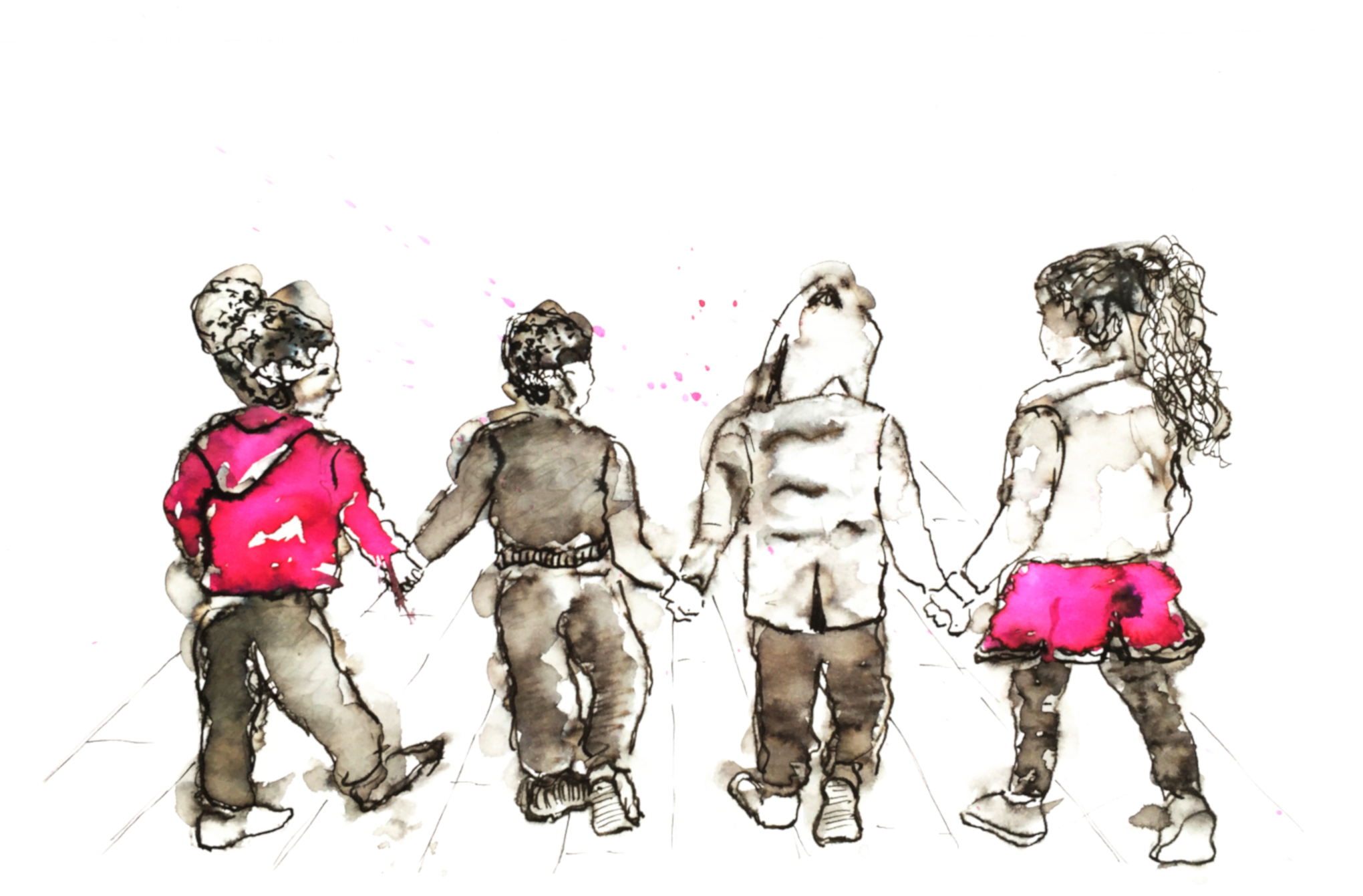
The one-minute empathy training – illustration (c) Alex Zonis
The one minute empathy training is: most people are naturally empathic. Remove the obstacles to empathy and empathy comes forth.
Remove the resistances to empathy and empathy expands.
Eliminate the obstacles to empathy and a space of acceptance and toleration spontaneously comes froth.
What happens is that people unwittingly have been taught to suppress their empathy. People have been taught to conform, follow instructions, and do as they are told. We are taught in first grade to sit in our seats and raise our hands to be called on and speak. And there is nothing wrong with that. It is good and useful at the time. No one is saying, “Leap up and run around yelling” (unless it is summer vacation!). But compliance and conformity are trending; and arguably the pendulum has swung too far from the empathy required for communities to work effectively for everyone, not just the elite and privileged at the top of the food chain.
Now do not misunderstand this: people are born with a deep and natural capacity for empathy, but they are also born needing to learn manners, respect for boundaries, and toilet training. Put the mess in the designated place or the community suffers from diseases. People also need to learn how to read and do arithmetic and communicate in writing. But there is a genuine sense in which learning to conform and follow all the rules does not expand our empathy or our community. It does not help the cause of expanded empathy that rule-making and the drumbeat of compliance are growing by leaps and bounds.
Teaching empathy consists in overcoming the obstacles to empathy that people have acquired. When the barriers are overcome, then empathy spontaneously develops, grows, comes forth, and expands. There is no catch, no “gotcha.” That is the one-minute empathy training, pure-and-simple.
The work at hand? Remove the blocks to empathy such as dignity violations, devaluing language, gossip, shame, guilt, egocentrism, over-identification, lack of integrity, inauthenticity, hypocrisy, making excuses, finger pointing, jealousy, envy, put downs, being righteous, stress, burnout, compassion fatigue, cynicism, censorship, denial, manipulation, competing to be the biggest victim, injuries to self-esteem, and narcissistic merger—and empathy spontaneously expands, develops, and blossoms. Now that is going to require more than a minute!
Studying the Humanities and literature, art and music, rhetoric and languages, opens up areas of the brain that map directly to empathy and powerfully activate empathy. Read a novel. Publish a blog post. Go to the art museum. Participate in theatre. These too are empathy lessons, fieldwork, and training in empathic receptivity.
Reduce or eliminate the need for having the right answer all the time. Dialing down narcissism, egocentrism, entitlement (in the narrow sense), and dialing up questioning, motivating relatedness, encouraging self-expression, inspiring inquiry and contribution, developing character, and, well, expanding empathy.
Yes, empathy can be taught, but it does not look like informational education. It looks like shifting the person’s relatedness to self and others, developing the capacity for empathy, accessing the grain of empathy that has survived the education to conformity. Anything that gets a person in touch with her or his humanness counts as training in empathy.
(Note: Putting the “one minute” into the “one minute training” so that readers would not have to work too hard was hard work. I did the work of reviewing over a hundred publications on empathy training, the two dozen most significant of which are listed here: For evidence-based research on empathy training see the Bibliography and start with this list.
[1] Angera et al. 2006; Antoni et al. 2011; Brunero et al. 2010; Chiu et al. 2011; Coke et al. 1978; Davis et al. 1996; Decety et al. 2012; Del Canale et al. 2012; Golan et al. 2006; Gordon 2005; Hadwin et al. 1997; Halpern 2001; Hojat et al. 2009; Hojat et al. 2011; Levine 2012; Ozcan et al. 2012; PBS 2013; Pace et al. 2009; Pecukonis 1990; Riess 2013; Riess, Kelley et al. 2014; Riess, Kelley et al. 2012; Therrien 1975; Zaki and Cikara 2015 (Note – this required more than one minute!)
For those interested in more than one-minute of training: You do not have to buy the book, Empathy Lessons, to get the research, but if you would like more detail see especially Chapters Four and Six in Empathy Lessons (click here to get EMPATHY Lessons from Amazon). Also of interest: A Rumor of Empathy.
Remove the resistance to empathy and empathy grows, develops, and blossoms. In every instance of resistance to empathy, the empathy training consists in identifying, reducing, or eliminating, the resistance to empathy. When the resistance is reduced, empathy has space to develop, and it does so spontaneously as well as through providing explicit practices, tactics, strategies, and training .
(c) Lou Agosta, PhD and the Chicago Empathy Project

The Evidence: Empathy is good for your health and well-being
Empathy is good for your health and well-being: Empathy is on a short list of stress reduction practices including meditation (mindfulness), Tai Chi, and Yoga. Receiving empathy in the form of a gracious and generous listening is like getting a spa treatment for the soul. But do not settle for metaphors.
For evidence-based research on empathy, empathy and stress reduction, and empathy training you may start by googling: Antoni et al. 2011; Ciaramicoli 2016; Del Canale et al 2012; Farrow et al. 2007; Irwin et al. 2012; Maes 1995, 1999; Pollack et al. 2002; Rakel et al. 2009; Segerstrom and Miller 2004; Slavich et al. 2013 [this list is not complete].
You do not have to buy the book, Empathy Lessons, to get the research, but if you would like more detail see especially Chapters Four and Six in Empathy Lessons (click here to get book from Amazon).
[Also included are chapters on the Top 30 Tips and Techniques for Expanding Empathy, Overcoming Resistance to Empathy, Empathy Breakdowns, Empathy as the New Love, Empathy versus Bullying, and more.]
The healing powers of stress reduction are formidable. Expanding empathy reduces stress; and reducing stress expands empathy. A positive feedback loop is enacted. Expanding empathy expands well-being. Here empathy is both the end and the means.
A substantial body of evidence-based science indicates that empathy is good for a person’s health. This is not “breaking news” and was not just published yesterday. We don’t need more data, we need to start applying it: we need expanded empathy.
Evidence-based research demonstrates the correlation between health care providers who deliver empathy to their patients and favorable healthcare

Well-being rides the wave of empathy: sketch by Alex Zonis (AlexZonisArt.com)
outcomes. What is especially interesting is that some of these evidence-based studies specifically excludepsychiatric disorders and includemainline medical outcomes such as reduced cholesterol, improved type 2 diabetes, and improvement in related “life style” disorders.
Generalizing on this research, a small set of practices such as receiving empathy, meditation (mindfulness), yogic meditation, and Tai Chi, promote well-being by reducing inflammation. These practices are not reducible to empathy (or vice versa), but they all share a common factor: reduced inflammation. These anti-inflammatory interventions have been shown to make a difference in controlled experiments, evidence-based research, and peer-reviewed publications.
Using empathy in relating to people is a lot like using a parachute if you jump out of an airplane or getting a shot of penicillin if one has a bacterial infection. The evidence is overwhelming that such a practice is appropriate and useful in the vast majority of cases. The accumulated mass of decades of experience also counts as evidence in a strict sense. Any so-called hidden or confounding variables will be “washed out” by the massive amount of evidence that parachutes and penicillin produce the desired main effect.
Indeed it would be unethical to perform a double blind test of penicillin at this time, since if a person needed the drug and it were available it would be unethical not to give it to him. Yes, there are a few exceptions – some people are allergic to penicillin. But by far and in large, if you do not begin with empathy in relating to other people, you are headed for trouble.
Empathy is at the top of my list of stress reduction methods, but is not the only item on it. Empathy alongwith mindfulness (a form of meditation), Yoga, Tai Chi, spending time in a sensory deprivation tank (not otherwise discussed here), and certain naturally occurring steroids, need to be better known as interventions that reduce inflammation and restore homeostatic equilibrium to the body according to evidence based research.
The biology has got us humans in a bind, since it did not evolve at the same rate as our human social structures. When bacteria attack the human body, the body’s immune system mounts an inflammatory defense that sends macrophages to the site of the attack and causes “sickness behavior” in the person. The infected person takes to bed, sleeps either too much or too little, has no appetite (or too much appetite), experiences low energy, possibly has a fever, including the “blahs,” body aches, and flu-like symptoms. This response has evolved over millions of years, and is basically healthy as the body conserves its energy and fights off the infection using its natural immune response.
Now fast forward to modern times. This natural response did not envision the stresses of modern life back when we were short stature, proto-humanoids inhabiting the Serengeti Plain and defending ourselves against large predators. Basically, the body responds in the same way to the chronic stressors of modern life—the boss at work is a bully, the mortgage is over-due, the children are acting out, the spouse is having a midlife crisis—and the result is “sickness behavior”—many of the symptoms of which resemble clinical depression—but there is no infection, just inflammation.
The inflammation becomes chronic and the body loses its sensitivity to naturally occurring anti-inflammatory hormones, which would ordinarily kick in to “down regulate” the inflammation after a few days. Peer reviewed papers demonstrate that interventions such as empathy reduce biological markers of inflammation and restore equilibrium. This is also a metaphor. When an angry—“inflamed”—person is listened to empathically—is given a “good listening” as I like to say—the person frequently calms down and regains his equilibrium.
Empathy migrates onto the short list of inflammation reducing interventions. The compelling conclusion is that empathy is good for your well-being.
(c) Lou Agosta, PhD and the Chicago Empathy Project

Online [cyber] therapy: The genie is out of the bottle
The genie is out of the bottle. The day that the first therapist invited his one-on-one client (who had an urgent need for a conversation but an inability to get to the office) to

CoverArt: Theory and Practice of Online Therapy ed. Haim Weinberg and Arnon Rolnick
put down the phone and dial into Skype, the genie escaped from the bottle.
The reader will recall that in the 1001 Arabian Nightsthe Genie was very powerful but a trickster and nearly impossible to control. Making wishes is tricky, and if one is not careful, the sausages end up stuck to one’s nose and one must waste the last wish to get them off. In this case, the Genie is Internet technology such as Skype and Google Groups and the emerging conveniences, affordances, complexities, entanglements, and even resistances that it offers.
In the Arabian Nights, the hero, Aladdin, had to trick the Genie to getting back in the bottle by appealing to his narcissism. “You are not all powerful,” Aladdin said. “A large creature like you could not possibly fit in that small bottle!” The Genie’s wounded narcissism caused him to prove that he can indeed fit back in the bottle. Aladdin puts the stopper back on – trapped! However, in the case of the Internet and online communication tools, do not look to be able to turn back the clock.
But there is good news. The human face is an emotional hot spot. It is rich in micro-expressions many of which are available and visible even though the “real estate” on the screen in less rich in detail than an in-person experience. Indeed it is not even clear that the face as presented online is “less rich.” It is the only thing being displayed, and the viewer is led to concentrate on it in detail. But here the trade-off of bodily presence versus the imaginary comes into the foreground.
The criticism fails that the online conversation between persons lacks the reality of the in-person encounter. But this criticism fails, in a surprising way. The criticism fails notbecause the online media is so real. Rather the criticism fails because the in-person psychotherapy encounter is shot through-and-through with the imaginary, with symbolism, the imaginary and irreality. The “irreal” includes the symbolic, the imagined, the fictional, the part of reality which is distinct from the real but includes the past and the future and the imaginary, which are not really present yet influence reality.
In psychotherapy, the in-person encounter is precisely about the symbolic and the imagined – the transference. The basic definition of “transference” is that the person relives emotionally the relationship to objects (persons) from the past, persons who are not physically present in the room (or in the virtual space online).
What we are calling the “virtuality” of the technology media adds an additional dimension of irreality to the symbolic and imagined transference relationship. Yes, the media is the message (as Marshall McLuhan famously wrote), but with the arrival of online therapy the media is first and foremost the transference. The message now occurs with a strike-through, message.The online technology itself becomes a source and target of transference.
The one thing that immediately occurred to me: Psychotherapy invokes a virtual reality all of its own – even without cyber space. This is especially the case with dynamic psychotherapy that activates forms of transference in which one relates to the therapist “as if” in conversation with a past or future person or reality, the latter not physical present. Indeed, with the exception of being careful not to step in front of a bus while crossing the street on the way to therapy, we are usually over-confident that we know the reality of how our relationships work or what people mean by their communications. This is less the case with certain forms of narrowly focused behavioral therapies, which are nevertheless still more ambiguous than is commonly recognized. Never was it truer that meaning – and emotions such as fear – are generated in the mind of the beholder.
While virtual reality (VR) goggles as such are not a part of any online therapy group process, VR goggles are currently being used in individual psychotherapy with clients who are dealing with phobias and related individual issues. [See www.psious.com– an engaging start up which is promoting the VR goggles for psychotherapists. The author (Lou Agosta) reports: I have no financial relationship with this company, and I wrote a blog post in 2016: “A Rumor of Empathy at Psious”: https://tinyurl.com/jyuxedq]
For example, it is much easier for someone with a fear of flying to put on a set of VR goggles in the therapist’s office and take a virtual trip to the airport, board an airplane (in VR), and be taxing down the run away (in VR), than it is to do this in the real world. The next step in a group process is to create an avatar that resembles one’s individual physical self, warts and all, and to join the other avatars in an online virtual reality group session. New possibilities are opened up by this form of therapy for dealing with all kinds of emotional and mental issues that are beyond the scope of this article.
Here the point is just to look at how virtual reality (“virtuality”) already lives in the in-person psychotherapy session even as it might have been conducted in 1905. There is a strong sense in which the conversation between a client and a psychodynamic therapist already engages a virtual reality, even when the only “technology” being used is a conversation is English or other natural language.
For example, when Sigmund Freud’s celebrated client, Little Hans, developed a phobia of horses, Freud’s interpretation to Hans’ father was that this symbolized Hans’ fear of the father’s dangerous masculinity in the face of Hans’ unacknowledged competitive hostility towards his much loved father. The open expression of hostility was unacceptable for so many reasons – Hans was dependent on his father to take care of him; Hans loved his father (though he “hated” him, too, in a way as a competitive for his mother’s affection); and Hans was afraid of being punished by his father for being naughty.
So Hans’ hostility was displaced onto a symbolic object, the horse. Hans’ symptoms (themselves a kind of indirect, “virtual reality” expression of suffering) actually gave Hans power, since the whole family was then literally running around trying to help him and consulting “The Professor” (Freud) about what was going on. In short, the virtual reality – now remove the quotes – made present in the case is that the horse is not only the horse but is a virtual stand-in for the father and aspects of the latter’s powerful masculinity.
So add one virtual reality of an imagined symbolic relatedness onto another virtual reality of a simulated visual reality (VR) scenario, the latter contained in a headset and a smart phone. Long before VR technology, therapists of all kinds, including behaviorists, used VR by activating the client’s imagination by asking him or her to imagine the getting on the feared airplane. One may try to escape virtual reality by not going online, but the virtuality follows as long as human beings continue to be symbolizing, imagining creatures.
This blog post is an excerpt from: Lou Agosta’s article “Empathy in Cyberspace: The Genie is Out of the Bottle” in Theory and Practice of Online Therapy: Internet-delivered Interventions for Individuals, Groups, Families, and Organizations edited by Haim Weinberg and Arnon Rolnick. London and New York: Routledge: To order the complete book, click here: Theory and Practice of Online Therapy [https://tinyurl.com/yyyp84zc]
(c) Lou Agosta, PhD and the Chicago Empathy Project
The Theory and Practice of Online Therapy: Internet-delivered Interventions for Individuals, Groups, Families, and Organizations, eds., Haim Weinberg and Arnon Rolnick, published by Routledge:
Table of Contents
Acknowledgments
Introduction to the book Haim Weinberg and Arnon Rolnick
Section 1 General considerations for online therapy edited by Haim Weinberg and Arnon Rolnick
Chapter 1 Intoduction to the general consideration section: principles of internet-based treatment Arnon Rolnick
Chapter 2 Interview with Lewis Aron and Galit Atlas
Chapter 3 Empathy in Cyberspace: the genie is out of the bottle Lou Agosta
Chapter 4 Sensorimotor psychotherapy from a distance: engaging the body, creating presence, and building relationship in videoconferencing Pat Ogden and Bonnie Goldstein
Chapter 5 The clinic offers no advantage over the screen, for relationship is everything: video psychotherapy and its dynamic Gily Agar
Chapter 6 Cybersupervision in psychotherapy Michael Pennington, Rikki Patton and Heather Katafiasz
Chapter 7 Practical considerations for online individual therapy Haim Weinberg and Arnon Rolnick
Secion 2 Online couple and family therapy edited by Shoshana Hellman and Arnon Rolnick
Chapter 8 Introduction to the online couple and family therapy section Shoshana Hellman and Arnon Rolnick
Chapter 9 Interview with Julie and John Gottman
Chapter 10 Internet-delivered therapy in couple and family work Katherine M. Hertlein and Ryan M. Earl
Chapter 11 Digital dialectics: navigating technology’s paradoxes in online treatment Leora Trub and Danielle Magaldi
Chapter 12 Practical considerations for online couple and family therapy Arnon Rolnick and Shoshana Hellman
Section 3 Online group therapy edited by Haim Weinberg
Chapter 13 Introduction to the online group therapy section Haim Weinberg
Chapter 14 Interview with Molyn Leszcz
Chapter 15 Oline group therapy: in search of a new theory? Haim Weinberg
Chapter 16 Transformations through the technological mirror Raúl Vaimberg and Lara Vaimberg
Chapter 17 Practical considerations for online group therapy Haim Weinberg
Section 4 Online organizational consultancy edited by Rakefet Keret-Karavani and Arnon Rolnick
Chapter 18 Introduction to the online organizational consultancy section Rakefet Keret-Karavani and Arnon Rolnick
Chapter 19 Interview with Ichak Kalderon Adizes
Chapter 20 All together, now: videoconferencing in organizational work Ivan Jensen and Donna Dennis
Chapter 21 A relexive account: group consultation via video conference Nuala Dent
Chapter 22 Practical considerations for online organizational consultancy Rakefet Keret-Karavani and Arnon Rolnick
Epilogue Arnon Rolnick and Haim Weinberg
This blog and blog post (c) Lou Agosta, PhD and the Chicago Empathy Project

Interpersonal Therapy (IPT) Gets Traction: Dynamic Therapy “Lite”?
Review of: The Guide to Interpersonal Psychotherapy: Updated and Expanded Edition (2007/2018), Myrna M. Weissman, John C. Markowitz, Gerald L. Klerman; Oxford, UK: Oxford University Press, 283 pp. ($34.10 (US$)).
Interpersonal therapy (IPT) is a promising, evidence-based, talk therapy. IPT is the innovative brainchild of Gerald L. Klerman, Myrna M. Weissman, John C. Markowitz, and a team of dedicated professionals. IPT has received expanding  attention since the mid- and late 2000s.
This book is an IPT manual and it emphasizes: It is important to keep IPT grounded in affect. Therapy feels meaningful to the patient when it comes alive with emotions related to important issues in the patient’s life. The IPT sessions focus each meeting on a recent, affectively charged event in the patient’s life. In short, the therapist encourages the patient to talk about what happened in their life during the past week. Sounds familiar?
The novice practitioner – perhaps a resident in psychiatry who has been concentrating on psychopharmacology, because that is the prevailing paradigm – is given helpful scripts (what to say to the patient): “In interpersonal psychotherapy, we work on the connection between your feelings and your life situation. In the next X weeks, we will work on unfulfilled wishes and problematic relationships that are contributing to your depression. You should begin to become more comfortable with your feelings in problematic close relationships and decide how to use them to change the relationship/situation you’re in” (p. 106).
Originally developed as an intervention for depression, IPT has been progressively extended to other disorders including anxiety, trauma, and personality disorders including borderline personality disorder. Also of note, IPT demonstrably does not work for substance abuse, including alcohol.
IPT draws on the insight of dynamic psychotherapy that events in the patient’s life evoke strong feelings (or not) and that the processing of those feelings (or not) contributes to the patient’s behavior in the community. The “deep history” of the work invokes the tradition of Harry Stack Sullivan (1842 – 1949) and the William Alanson White Institute, acknowledging the interaction of the cultural dynamics between the self and the community.
IPT acknowledges that sadness and depressed mood are part of the human condition. Low mood is a nearly universal response to disruption of close interpersonal relations. John Bowlby argued that attachment bonds [key term: attachment] are necessary to survival: the attachment of the helpless infant to the mother helps to preserve the infant’s life and well-being (p. 10).
However, the resemblance between IPT and the anti-psychiatry sometimes characteristic of the Neo-Freudians such as Sullivan or Bowlby is soon dispelled. IPT embraces the medical model, asserting that (e.g.) depression is an illness such as the flu or even an appendicitis. IPT proudly embraces the common factor – something shared by all [or most] forms of psychotherapy – that the role of doctor and patient are essential to the process.
The IPT doctor is active in educating the patient about what to expect and what to do, along with more subtle forms of inspirational guidance and suggestion. While the patient may usefully learn directly from experience as redescribed in the process of therapy, he or she had better do so promptly – as the process is time-limited to some sixteen sessions.
The time-limit is an essential part of IPT, acting as a “forcing function” to cause both patient and doctor – but mostly the patient – to “cut to the chase,” say what is bothering her, and take action to do something about it. Hence, IPT’s strengths – the cost is relatively predictable and insurance payers love that – it is relatively easy to define a comparative process test (say, against CBT or psychopharm) – and grant writers and approvers like that – and its weaknesses – it is time-limited.
One clarification upfront. When the trainers of interpersonal therapy say that it is “interpersonal,” they do not mean that the therapy targets the relationship between the patient and the therapist. “Interpersonal” means that it is about the interpersonal relationships in the patient’s life.
The powerful insight of IPT is that the way the person feels about what is going on in her or his life results in behavior, including symptomatic behavior such as depression and anxiety, that remits if one connects the dots between the two, i.e., between the feelings as called forth in the therapy and the dysfunctional symptoms. IPT is unconcerned about transference or the deep past of childhood and it tries to identify the focal interpersonal problem area in the patient’s current life. “IPT does not interpret the transference, but rather helps the patient to relate emotions to interpersonal interactions in the here and now” (p. 74) – otherwise known as interpreting the transference.
Basically, with some conditions and qualifications, the patient is allowed one problem area, though each of the area is potentially vast and overlapping: grief (e.g., death, loss), role disputes (interpersonal conflict), role transitions (e.g., divorce), and interpersonal deficits of attachment (aloneness, isolation) (p. 11).
According to Weissman and Markowitz, more than 100 clinical trials of IPT (Barth et al., 2013; Cuijpers et al., 2008, 2011, 2016) are available (p. 12). That is what makes IPT so attractive as “dynamic therapy lite”, especially to psychiatrics who find prescribing insufficient to produce wellbeing in their patients.
The meta analysis by Cuijpers et al. (2016 / see the excellent and extensive bibliography in the book), based on eight randomized trials, suggests efficacy for anxiety disorders: “In anxiety disorders, IPT had large effects compared with control groups, and there is no evidence that IPT was less effective than CBT.” No less effective, but perhaps also no more. [P. 187] However, for those entry level therapists who are not comfortable with the over-intellectualizations of CPT, IPT can have an advantage of validating an approach that empathically gets one in touch with emotions and feelings.
A recurring theme in this approach is that IPT talks to patients about how they feel about what is happening or has happened in their lives and invites patients to make the crucial recognition that their interpersonal encounters evoke strong feelings. Then the IPT mantra (at least in this text): that, rather than being “bad” or “dangerous,” feelings provide interpersonal information (e.g., anger means someone is bothering you) they can reflect upon and use to handle their environment.
The instructions to the IPT psychiatrist in training? “Your aim will be to link the patient’s interpersonal situation (a spouse’s affair, a mother’s death, a move to a different city) to the onset of symptoms in a brief contextualizing narrative that makes sense to both the patient and you. [….] Use the initial sessions to ensure that you have focused on a pivotal, emotionally meaningful area for the patient and that you have ruled out surprises that might otherwise arise later in treatment” (p. 36).
So, for example, IPT points out that patients with panic disorder experience their paralyzing physical attacks as coming “out of the blue,” yet most talk therapies, including IPT, suggest that panic is a response to interpersonal events: one study found that three-quarters of panic patients had had an interpersonal loss within six weeks of panic onset (p. 191).
So what happens when, for example, a woman who presents saying, “My children are my big problem” later, as she gets to know you, calls out the more pressing area of distress: her spouse’s extramarital affair? Given the time-limited name of the treatment, what to say? Well, IPT tries to address this typical situation, allowing for “maintenance,” typically once a month extensions. Twice a month? However, somehow extended the duration of the sessions by means of maintenance seems not to be the right answer. A new contract and a new engagement is needed.
IPT is quite explicit about giving patients the Sick Role. This does indeed relieve patients of blame. It is not your fault – you are sick. “The sick role excuses patients from what their illness precludes them from doing, but it carries the responsibility to work as a patient to get better” (p. 115). Definitely. A sensible trade-off.
However, the therapist is then left with the difficulty that the illness in question – depression, anxiety, trauma, personality disorder, and so on – is significantly unlike most other diseases in the world of medicine. Yes, there is an underlying molecular process; but it is just that, in most cases, science has not identified the biomarkers.
The IPT role-playing script (p. 39) suggests telling the patient that depression is no different the appendicitis or the flu. Wow. Don’t call Carl Rogers – page the surgeon! We can cure an appendicitis even if the patient is unconscious. Indeed at a certain point in the treatment it is required. However, that is not the case with a significant mental disorder. You cannot cure an unconscious psychiatric patient. More to the point, today the patient’s intentional participation in the process is required.
I can’t resist. The history of the heroic age of psychiatry does present “the sleep cure.” Stay in bed for about three months, highly sedated, with the doctor on call fulltime, waking the person once every twenty four hours for nourishment and bowel movement, and at the end of three months – voila! – something significant has shifted – the individual no longer feels depressed. This is the reduction to absurdity of the medical model – yet, in its day, it worked!
For example, in the case of complicated grief, treatment is not a sign of disrespect for the deceased – but that respect is the way treatment shows up – LIVES– for the patient. Complicated grief is a form of depression (p. 45). The doctor must truly have a magisterial authority in order to overcome the patient’s commitment to her or his suffering. You see the problem? It says right there in the manual: your grief is really depression. But the patient’s experience is that they cannot live without the other person. Yes, it violates the IPT contract that the person seems unwilling or unable to try. That is the therapy – you are in violation of your therapeutic contract?
Whereas in CBT, a therapist might ask a patient to look at the evidence about an anxious thought, an IPT therapist lets the patient sit with the feelings, pointing out at an opportune moment that guilt is a actually a symptom of the depression. What is the evidence that when your friend does not answer your text message, it is because she or he is cheating on you? Are there any facts here? In IPT rather, let’s talk about your feelings about the relationship: have you ever had any feelings of temptation towards cheating? In short, in IPT the therapy is to talk about the temptation (loss, fear, anger, and so on) and bring forth a catharsis – yes, it says it right there in the manual – catharsis makes you better.
IPT acknowledges the need to manage magical thinking, but IPT does not call it that]: The bereaved person fears that if they recover from the grief (i.e., the depressive episode), it means they did not love the deceased as much as they had believed. To their way of thinking, if they really loved the person, the loss would be so great that they could never recover. The treatment? Acknowledge, validate, and work through the loss by talking about it. In that sense, IPT is a talking cure.
The guidance for those practicing IPT (p. 57)? Ask for the details of the interaction. Often, the patient will come in with in interpretation: “He is a jerk.” Okay, got it; but what did he actually say? : “What did you say? What did he say? How did you feel then? Then what did you say?” and so on. Get in touch with facts and feelings. The reconstruction of interpersonal encounters provides a sense of how the patient functions interpersonally, what may be going wrong in the relationship, and where the patient ignores or suppresses emotional responses to the other party
It is a strong point of IPT’s approach to treatment – get the facts. Freud pointed out long ago – the patient comes in and cannot give a coherent account of his or her life. Freud noted the gaps – repression – but equally important are the distorted communications, interpretations, and positions. “The boss is a jerk.” “Okay – I got that – what did he actually say?”
For those curious as to what is a “role transition”: Moving one’s household, taking a new career or job, leaving home after school or divorce, being diagnosed with a serious medical condition, taking on new responsibilities due to the illness of a family member, or a change (decline) in economic status, are other examples of life role transitions. Refugee status has become a transition problems for significant populations in many countries.
Unlike many descriptions of cognitive behavioral therapy (CBT), IPT focuses on discussing feelings, normalizing them as responses to interpersonal interactions and as useful interpersonal information, and using them to take action to change the patient’s interactions in order to resolve the identified problem area (p. 88). That a person feels angry about a perceived or actual interaction contains valuable information for the person, which is usually overlooked due to over-intellectualization or being overwhelmed by emotions (under-intellectualization).
IPT emphasizes, “depression is a medical vulnerability, sort of like having an ulcer. If you should get depressed in the future, the important thing to remember is that it’s a treatable illness, it’s not your fault, and you just need to return for treatment, the way you would for any other medical problem” (p. 113).
IPT is a sensible, practical approach. The take away is that whatever the intervention one should actively try to solve the problem – working on solving the problem = x drives the therapy. The hidden / confounding variable is that the problem seems to be = x but is actually = y or = (x & y). In that case, the openness of psychodynamic therapy will surface an issue of which IPT remains unaware. Of course, the process will require more time.
There are many applications of IPT – to postpartum depression, depression in adolescents, depression in children of tender age (recommendation: treat the parent(s), depression in senior citizen, – here we go into the weed, there are many studies, and the results are generally favorable – the guidance? If one tries, one gets better.
Since this is not a softball review, the most critical thing I can think to say is that it is not really treating what the DSM describes as depression – it is treating stress – and there is nothing wrong with that – the cytokine theory of depression makes the case that “depression” is “sickness behavior” – this aligns well with the repetition (nearly ad nauseam) to the patient that “depression” is a sickness like the flu or [incredibly] enough an appendicitis. Okay, let’s take this seriously. This is supposed to be a common factor – but you would not hear Carl Rogers say it. You would not hear CBT practitioners say it – rather they would say, “you have a skills deficit – and while that is not your fault, no one ever taught you the skill, we are not “blaming” biology, we are blaming the parent or the early environment
At times and at risk of over-simplification, CBT is committed to how thinking causes, brings forth, determines one’s feelings. IPT emphasizes how one’s emotional experiences cause, bring forth, and determine one’s thinking. “Therapists work hard with […] patients to identify emotions— and particularly negative affect and feelings of competitiveness, anger, and sadness— that arise in everyday situations. The therapist and patient discuss whether such feelings are understandable and warranted. The idea of a transgression— that there are some behaviors that break expected social conduct, warrant anger, and deserve at the least an apology— may be helpful in normalizing such feelings for patients” (see p. 164).
I call out some statements that, strictly speaking, make no sense: “Klerman advocated for research standards in psychotherapy that were comparable to those in pharmacotherapy research” (p. 12). Okay, but: The authors cannot be referring to double blind testing where neither the patient nor the doctor knows what treatment he is delivering. I am giving you CBT versus IPT versus psychopharm, but neither of us knows what it is. Notwithstanding the many useful results provided by IPT practitioners, this points to a significant blind spot.
A silly statement by the authors, in which the authors get carried away with their own greatness: “No other psychotherapies explicitly focus on the IPT problem areas” (p. 106). Really? Counter-examples? Freud’s “Mourning and melancholia”? Life transitions in DBT? Lack of skills in CBT? Role disputes and discrepancies (all of the above)?
Another thing that seems just plain crazy to this author is the approach to trauma, though, once again, trauma survivors have benefited from IPT in evidence-based studies. IPT acknowledges accurately: The trauma explains why the patient is struggling interpersonally, but receives no further direct discussion (p. 195). However, a time occurs in most conversations with trauma survivors (with or without a bit of nudging) when the trauma seems to erupt – spontaneously comes up – and IPT ties the therapist’s hands because she or he cannot engage with it. Why not? It is not part of the definition of IPT? The researchers are doing an evidence-based study and to do so would “confuse” the modality with exposure focused treatments? So much the worse for the evidence ( am inclined to say). If the patient brings up the trauma and is willing – indeed wants and give every evidence of wanting to talk about it – then it would be unethical not to do so. Did anyone think of that?
The ultimate true but trivial statement, apparently now required to be fully buzzword compliant: “Neuroimaging studies have shown that psychotherapy changes your brain chemistry [Brody et al., 2001; Martin et al., 2001 9see the excellent bibliography in the book itself for details)]: it’s a biological treatment” (p. 110). Hey, studying French will change your brain and brain chemistry. Studying French is now a biological treatment?
Time-limits are essential to IPT and are a kind of “good news,” “bad news” sort of practice. Freud himself made use of setting a time limit in the case of Sergei Pankejeff (“the Wolf Man”) when Freud felt, after months and months of work, the treatment was stalled, the patient was living in genteel poverty, burring through his modest fortune, couldn’t pay, and it was time to fish or cut bait (my expression, not Freud’s). It seemed to have worked, or at least worked well enough, as a “forcing function.” However, this parameter on Freud’s part was used on an exception basis. IPT takes the “forcing function” and makes it the rule. In fact, traditional Freudians may see IPT as a case collection of parameters (exceptional practices that are employed in the face of contingencies in treatment) that try to add up to “psychoanalysis lite.”
The risk is that while a medical molecular process may not aware of the clock, the blind spots, self-deceptions, and self-serving behaviors by which people afflict themselves unwittingly are acutely aware of the passage time. Therefore, the “disorder” goes under ground until the time is up. In a telling analogy, the process is like announcing to the local armed insurgency, freedom fighters, or your opponent of choice that the UN expeditionary force is going to pull out in sixteen weeks. The opponent’s strategy strategy going forward is clear. Lay low until the powers-that-be pull out. Then it is back to business as usual.
Meanwhile, once feelings are identified and normalized, role playing is needed to help patients become comfortable with self-assertion or confrontation. “They may never have expressed a wish and almost never have said “no” to anyone. Yet if a patient has a successful experience in one of these situations (e.g., asking for and receiving a raise, confronting a spouse), the patient will have learned a new skill, discover some sense of control over the local environment, and likely feel better” (p. 164).
The IPT text and training repeatedly emphasize that “feelings are powerful, but not dangerous—and in fact, you need them [feelings] to decide whom you can trust. Expressing your feelings to another person may seem risky, but it provides a test of whether the other person is trustworthy or not. If you feel angry and voice it to another person, the other person has the chance either to apologize and change behavior, or to confirm that he or she is uncaring or untrustworthy” (pp. 194 – 195).
Agree – but there is a big “but.” The thing is that for some people feelings ARE dangerous if the feelings threaten to fragment the coherence and integrity of the sense of self. This is especially the case with survivors of trauma. There is it not just an over-feeling, but a feeling “I am gonna die!” One can dismiss this as a “personality disorder,” but I do not believe such dismissal would be fair or accurate. If subjected to strong enough feelings, just about anyone is capable of being shaken to their core. Therefore, methods are for strengthening the person’s self’s sense of stability and equilibrium in the face of strong feelings. Expanded distress tolerance? Expanded emotional regulation? Self-soothing? Working through? Exposure? Transmuting internalization? Suggestion? Encouragement? All of the above?
Having gotten in touch with emotions, patients can proceed to more usual IPT maneuvers, such as solving a role transition. As patients gain comfort with their feelings, they engage interpersonal situations with expanded competence, life feels safer, and they begin spontaneously—without IPT therapist encouragement—to face the situations and traumatic reminders they have been avoiding. In the vast majority of instances, the authors assume the patient is out of touch with his or her feelings. The therapy consists in invoking the feeling so that the patient can get in touch with it. But what about being over-whelmed by one’s feelings? Yes, one can also lose touch with one’s feelings if one is overwhelmed, but it is significantly different mode of losing touch. What about that?
We end on a positive note. IPT is demonstrably effective with borderline personality disorder, though the time-limited aspect is “finessed” by [apparently] doubling the number of sessions to distinguish between establishing trust with the therapist and actually doing the work.
We give the last word to the authors of this engaging, practical text: “The therapist presents BPD to the patient as a poorly named syndrome that has a significant depressive component. A major difference between MDD [major depressive disorder] and BPD [borderline personality disorder] is that while depressed patients often have difficulty expressing any anger, patients with BPD often do the same much of the time but then periodically explode with excessive anger, which reinforces their tendency to avoid expressing anger whenever possible. The goals of treatment are, as is usually the case in IPT, to link mood (including anger) to interpersonal situations, to find better ways of handling such situations, and to build better social supports and skills.” (p. 201).
(c) Lou Agosta, PhD and the Chicago Empathy Project

