
Empathy – a spa treatment for the soul
My first training in stress reduction through empathy came from my dear Grandma Laura. With Grandma Laura the force of empathy was strong. However, she came from a time and place, prior to the Internet, that did not require much formal education.
My Grandma Laura may actually have believed that getting caught in the rain caused upper respiratory infections such as the common cold. She was happy to make the chicken soup to sooth my sneezes and colds, and she endorsed chicken soup as the treatment of choice for the common cold.
Grandma was relying on common sense—and a wisdom that is all-too-rare in our own time. She noted that people who were physically stressed out by exposure to cold and wet weather succumbed to the common cold. She also observed that rest and warm, nourishing liquids—chicken soup—provided relief to the sneezing, sniffling, suffering survivor until the cold had run its natural course.
I acknowledge the book Chicken Soup for the Soul. I stopped counting how many had been published in the series when the number hit eighteen. [i] Keep up the great work! The point here is that chicken soup, delivered in the proper context, reduces stress; and so it reduces the symptoms of inflammation (runny nose and so on) that occur when the immune system fights back against infection.
Thus, empathy is compared to chicken soup. It has also been compared to sinking back into a hot bath, and taking the “healing waters” as part of a spa treatment. We shall work with all these metaphors. We shall also continue the work begun in Chapter Four with evidence-based, peer-reviewed, scientific publications that the benefits of empathy for the recipient are closely related to stress reduction. First, some background.
My Grandma may not actually have had the distinction “immune system.” This distinction provides what we call the “confounding variable” in “Getting caught in the rain causes the common cold.” Of course, the rain does not cause the common cold. The rhino virus causes the common cold. What getting caught in the rain does is reduce the body’s immune system’s defense against viruses such as the rhino virus that already live in the body.
The sneezing, sniffling, and suffering are the inflammation that occur when the body’s immune system is mobilized and fights back against the virus by producing the bodily defenses called “antibodies,” sending them to the site of the infection (i.e., the nose) to disrupt the viral attack. Antibodies are doing battle against the attacking viruses, the antigens. The result, at thirty thousand feet, is that the person experiences all the annoying symptoms of a head cold.
In my case, Grandma was spot on in correlating getting wet and physically exhausted by the storm with coming down with a cold. We forgive her lack of scientific rigor. After all, she was a world class cook, even if an unsung one until now, not a immunologist.
A word of caution. The distinction between “body and mind” is already embedded into our modern science, our thinking, our way of relating to other people, and our way of relating to ourselves.
We are not going to undo centuries of distinguishing mind and body in this book. Still, we may usefully recall one philosopher’s (Ludwig Wittgenstein’s) anecdote: “The human body is the best picture of the soul.”[ii] Keep that in mind.
A small set of practices such as receiving empathy, meditation (mindfulness), Yoga, and Tai Chi Chuan, promote recovery and well-being in reducing inflammation. The solution then is a hot bath? A spa treatment? Don’t laugh. There are many less useful interventions available. The limitation of a spa treatment is that it provides symptom relief, not a long-term solution. After the benefits of the spa treatment wear off in a couple of weeks, the person is right back where she or he started. The difference between empathy and a hot bath—granted that both are relaxing—is that empathy provides for structural change to the person’s personality, expanding resilience, emotional stability, and relatedness. Advantage empathy: empathy is superior to a spa treatment for the soul. How is this so?
Today it is fashionable to say that whatever benefits a person, whether Prozac or mindfulness, rewires the brain. In plain English, practicing empathy, receiving empathy, being empathic, also rewires the brain, that is, it builds new habits.
Empathy builds new habits in relationships—in engaging in listening to the other person, in interacting across personal boundaries, in reducing conflict, in an expanding toleration of upsets in relatedness, and in building a community of engaged neighbors.
Expanding one’s empathy enhances one’s ability to deal with personal dynamics in friendships, intimate relationships, and in groups such as the workplace, school, and community.
Expanding empathy enhances a person’s stability, strength of character, and emotional equilibrium in the face of destabilizing upsets. It enables one to be with people and events that are difficult. Expanding one’s empathy enables one effectively to get results where previously one would have experienced failure and frustration—and the resulting stress.
With acknowledgement to Donald Hebb, “neurons that fire together wire together.” “Rewiring” is the new buzzword for “building habits.”
If the ideas in biology that we explore in this and the following posts are a tad technical, I am unapologetic.
Psychopharmacologists and practitioners of behavioral interventions such as cognitive behavioral therapy (CBT) have been less than charitable in engaging with the status of the evidence on behalf of empathy and empathy-related interventions. “Dismissive” is the word that comes to mind; and yet the evidence-based, peer-reviewed distinctions that are engaged in this engagement with empathy cannot be dismissed. Those with economic and territorial incentives to provide a complex and expensive solution do not necessarily welcome a less complex or less expensive one such as empathy.
The results are now in. Substantial evidence is available of what most people with common sense have appreciated all along, that empathy and being treated empathically are good for people’s health and well-being. Stress reduction works. Empathy works. The work we do in this chapter enables us to expand our understanding of why.
Stress reduction practices such as meditation, Yoga, and Tai Chi do not necessarily work in the same way as empathy. (Full disclosure: I practiced Tai Chi weekly for four years, but have limited experience with the others.)
I hypothesize that all these practices create a distance between one’s experience and one’s cognitive and emotional processes. This distance opens up a place for empathy to expand and authentic relatedness to occur.
When this “distance” between one’s experience and one’s cognitive and emotional responses becomes habitual—today we would say “encoded in the neurons”—then the change is structural and, thus, long lasting and enduring. How does this work?
The answer to the question awaits the next episode, the next post, in this series due out next week. Stand by for update!
Notes
[i] Jack Canfield, Sally Burbank, Terri Elders, and Amy Newmark. (2003). Chicken Soup for the Soul. New York: Soul Publishing (Simon and Shuster).
[ii] Ludwig Wittgenstein. (1951). Philosophical Investigations, tr. E. Anscombe. London: Basil Blackwell, 1968.Blackwell, 1968.
IMAGE CREDIT: Creative Commons Attribution: Logeshwaran Rajendran
(c) Lou Agosta, PhD and the Chicago Empathy Project
Edwin Rutsch interviews Lou Agosta: Empathy Curriculum: Overview of the Empathy Lessons Training Seminar (ETLS)
Empathy Curriculum: Overview of the Empathy Lessons Training Seminar (ELTS): Edwin Rutsch interviews Lou Agosta about the ELTS and Lou’s experiences around empathy
To listen to Edwin’s Rutsch’s interview and conversation with Lou Agosta on Sept 1, 2026.
Play interview by clicking
here: Edwin Rutsch Interviews Lou Agosta
[ https://youtu.be/4jQe9ccVfM8?si=lwVibcPIN8D67v3w]
The following summary was generated by AI by Edwin Rutsch.
Edwin Rutsch interviews philosopher, author, and clinical assistant professor Lou Agosta to explore his 10-week “Empathy Lessons Training Seminar.” The discussion covers the philosophical foundations of empathy, its physiological benefits, methods for diagnosing and repairing empathy breakdowns, and the role of rigorous boundary setting.
“Empathy isn’t drowning in the other person’s ocean of misery – it’s taking a six-ounce pour of their suffering so you can truly understand it without losing yourself.”
10 Week Training Outline
- Session One: The one-minute empathy training
- Session Two: Empathy and brain science – this is your brain on empathy
- Session Three: Empathy breakdowns, breakthroughs and introspection
- Session Four: Resistance to empathy
- Session Five: The Secret underground history of empathy
- Session Six: Empathy and story telling
- Session Seven: Empathy and boundary setting
- Session Eight: Review of the literature that empathy is good for one’s health and well being
- Session Nine: Speaking truth to power – rhetorical empathy in politics
- Session Ten: Empathy is the new love – examining love through empathy
This interview series is part of The Empathy Center’s initiative to develop an open-source Empathy Movement Training Curriculum.Join us in creating it.
Short Meeting Overview
Edwin Rutsch interviews philosopher, author, and clinical assistant professor Lou Agosta to explore his 10-week “Empathy Lessons Training Seminar.” The discussion covers the philosophical foundations of empathy, its physiological benefits in healthcare, methods for diagnosing and repairing empathy breakdowns, and the role of rigorous boundary setting.
Paragraph Meeting Overview
This meeting serves as the inaugural interview in an exploratory series for the Empathy Movement Training Curriculum project, led by Edwin Rutsch, Founding Director of The Empathy Center. Guest Lou Agosta outlines the architecture of his upcoming 10-week training seminar, unpacking a multidimensional definition of empathy that spans receptivity, understanding of possibility, perspective taking, and empathic responsiveness. Agosta shares how his personal background, academic work at the University of Chicago under Heinz Kohut’s circle, and clinical teaching at Ross University Medical School informed his model of a “rigorous and critical empathy.” The dialogue bridges psychological theory and real-world application, detailing how stress reduction, mirror neurons, and repairing empathy breakdowns (e.g., emotional contagion, projection) enable human connection. Finally, both dialogue partners investigate movement-building strategies, discussing the need to articulate the societal value of empathy, embrace assertive public presence (such as the Empathy Tent and potential legislative sit-ins), and synthesize diverse empathy pedagogies into a collaborative, open-source curriculum.
Step-by-Step Outline of the Discussion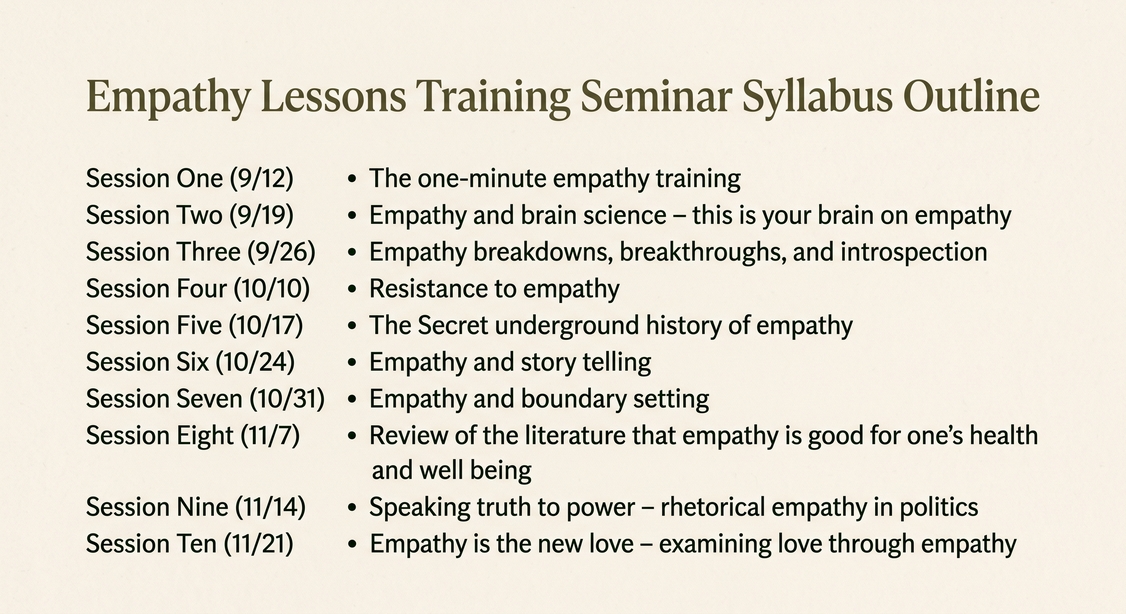
1. Introductions and Seminar Overview
- Time code: [00:02] – [05:46]
- Core Discussion Points:
- Edwin introduces Lou Agosta (author of A Rumor of Empathyand Empathy and Morality) and frames the interview within the Empathy Movement Training Curriculum initiative.
- Lou introduces his background: PhD from the University of Chicago, clinical assistant professor of psychiatry at Ross University Medical School / St. Anthony Hospital in Chicago.
- Lou highlights peer-reviewed clinical research demonstrating that physician empathy measurably improves patient outcomes (e.g., lower cholesterol, improved diabetes markers, reduced stress/inflammation).
- Outcome: Established the academic, clinical, and practical premise of the 10-week Empathy Lessons Training Seminar.
2. Defining Empathy and Philosophical Foundations
- Time code: [05:46] – [13:14]
- Core Discussion Points:
- Lou details the four core aspects of empathy: Receptivity (affective input), Understanding Possibility (recognizing who the person is beyond breakdown), Cognitive Perspective Taking (viewpoint), and Empathic Responsiveness (giving back what was heard for validation).
- Empathy Circles are acknowledged as a foundational gateway practice.
- Lou offers his central philosophical thesis: without empathy, there is no shared humanity (“the zombie apocalypse”). In parenting, teaching, medicine, and business, the other person calls forth the empathy in us.
- Outcome: Grounded the curriculum definition in a four-part relational process rather than a static trait.
3. Theory of Change and Overcoming Empathy Breakdowns
- Time code: [13:14] – [20:25]
- Core Discussion Points:
- Lou presents his “one-minute empathy training”: drive out aggression, bullying, prejudice, and negative politics, allowing empathy to expand naturally.
- Lou argues that “there is enough empathy to go around,” drawing an analogy to global food production (Norman Borlaug and the Green Revolution)-starvation and empathy deficits occur because resources are withheld, weaponized, or blocked.
- Outcome: Framed empathy development around clearing obstacles and blocks rather than manufacturing a scarce resource.
4. Personal Origins, Heinz Kohut, and Rigorous Empathy
- Time code: [20:25] – [33:20]
- Core Discussion Points:
- Lou shares the personal roots of his work: receiving bedtime storytelling empathy from his mother while dealing with a harsh, “boot camp” father.
- Studies at the University of Chicago during the rise of Heinz Kohut’s self psychology; working with colleagues Michael Basch, Arnold Goldberg, and Ernest Wolf.
- Defining “rigorous and critical empathy” (concept from Xavier Remy) as disciplined receptivity, interpretation, and responsiveness rather than sentimental (“kumbaya”) agreement.
- Being deeply listened to (by mentors, his mother, early partners, and psychoanalysts) demonstrated empathy’s life-altering impact.
- Outcome: Connected self-psychology lineage and experiential childhood background to the necessity of structured empathy training.
5. Course Structure, Safety, and Stress Reduction
- Time code: [33:20] – [38:59]
- Core Discussion Points:
- Overview of the course audience: broad applicability for leaders, mediators, educators, and anyone wanting to strengthen their “empathy muscle.”
- The seminar covers approximately 40 distinct empathy lessons across 10 two-hour sessions.
- Theory of change: “Transformation is instantaneous; change is hard work.” Empathy operates as a stress-reduction mechanism-getting heard is “like sinking into a hot bath” (quoting Kohut).
- Establishing safety through explicit agreements and confidentiality so participants can explore vulnerabilities without feeling forced to share.
- Outcome: Defined the seminar pedagogy as alternating 15-20 minute lectures with experiential sharing in a secure environment.
6. Walkthrough of the 10 Sessions (Part 1: Sessions 1-5)
- Time code: [38:59] – [58:49]
- Core Discussion Points:
- Session 1 (Definitions & Mind Reading): Exploring empathic receptivity vs. “mind misreading” (e.g., domestic arguments over toothpaste caps taking on distorted emotional meanings).
- Session 2 (Brain Science): Mirror neurons, stress pathways, and empathy as a non-pharmacological health intervention.
- Session 3 (Empathy Breakdowns): Four primary breakdowns-emotional contagion, conformity, projection, and communication loss. Emphasizing self-empathy as the foundation for repairing breakdowns.
- Session 4 (Resistance & Boundary Setting):Differentiating empathy from empathic distress/burnout. Critiquing Paul Bloom’s Against Empathy, arguing for both empathy and rational compassion. Taking a “six-ounce pour” (data sample) rather than drowning in someone else’s misery.
- Session 5 (Underground History & Aesthetics): Tracing empathy (Einf�hlung) from 19th-century German aesthetics and art history to psychology. Viewing people with the same reverence and care given to masterpieces.
- Outcome: Systematized the first half of the curriculum around scientific mechanisms, psychological pitfalls, and historical roots.
7. Walkthrough of the 10 Sessions (Part 2: Sessions 6-10)
- Time code: [58:49] – [01:13:00]
- Core Discussion Points:
- Session 6 (Storytelling & Spirituality): Exploring empathy through narrative (e.g., the Good Samaritan) and managing the vulnerabilities of the “natural empath.”
- Session 7 (Boundaries & Humor): Distinguishing healthy fences with gates from impassable walls (referencing Robert Frost). Examining how humor discharges tension through boundary-crossing, contrasting aggressive wit with respectful empathy.
- Session 8 (Trainability & Social Healing): Evidence showing empathy is a trainable skill; empathy as an essential social survival tool (“wear a parachute, use penicillin, lead with empathy”).
- Session 9 (Rhetorical Empathy & Speaking): Moving beyond empathic listening into empathic speaking and speaking truth to power. Analyzing Malcolm X (“Plymouth rock landed on you”), Abraham Lincoln, and Barack Obama.
- Session 10 (Empathy and Love / Racism): Examining the spectrum between soothing empathy and “tough love,” reflecting on Edwin’s dialogues with former extremists and Daryl Davis.
- Outcome: Completed the comprehensive overview of the 10 sessions, emphasizing expressive/rhetorical empathy and tough love.
8. Movement Building, Value Perception, and “Occupy Empathy”
- Time code: [01:13:00] – [01:22:30]
- Core Discussion Points:
- Gaps in the empathy ecosystem: Practitioners often hesitate to articulate the monetary and societal value of empathy. While empathy is a common good like clean air or water, professional empathy instruction must be valued.
- Reframing interpersonal conflict: Approaching difficult colleagues, challenging customers, or provocative relatives as one’s personal “empathy trainers.”
- Edwin’s proposal for “Occupy Empathy”: Expanding the Empathy Tent model from street fairs and political rallies to sustained public demonstrations (e.g., occupying legislative capitols until politicians engage in Empathy Circles). Lou expresses enthusiasm and willingness to support public actions.
- Outcome: Concluded with mutual appreciation and an agreement to collaborate on public empathy activism and curriculum development.
Empathy Movement Curriculum Insights
Mapping the concepts from this interview directly to the development modules of the Empathy Movement Curriculum
- Module 4: Definition of Empathy
- Four-Phase Model: Incorporate Lou’s four distinct phases into the curriculum:
- (1) Receptivity (mammalian affective communication),
- (2) Seeing the Person as Possibility,
- (3) Cognitive Perspective Taking, and
- (4) Empathic Responsiveness (testing accuracy: “Did I get it right?”).
- Abundance vs. Scarcity: Adopt the pedagogical stance that empathy is not inherently scarce; like food in the Green Revolution, there is enough to go around. Training should focus on removing systemic and psychological obstacles (aggression, prejudice, bullying) rather than treating empathy as an artificial commodity.
- Four-Phase Model: Incorporate Lou’s four distinct phases into the curriculum:
- Module 5: Deeper Empathy (Carl Rogers, Self Psychology, & Diagnostics)
- Heinz Kohut�s “Hot Bath”: Use the clinical framing that receiving genuine active listening lowers biological stress and soothes the nervous system, functioning as a primary non-pharmacological health intervention.
- Rigorous & Critical Empathy vs. Over-Identification:Teach boundary management via the “six-ounce pour”metaphor. Empathy is data sampling of another person�s experience, not merging or drowning in their distress. This provides facilitators with protection against compassion fatigue.
- Self-Empathy as Breakdown Repair: Embed exercises where participants identify personal triggers (e.g., emotional contagion, projection) and listen to their own internal reactions before attempting to reflect or engage with an external counterpart.
- Module 7: Conflict Resolution & Depolarization
- “Mind Reading” vs. “Mind Misreading”: Design exercises identifying how minor conflicts (e.g., toothpaste caps, household chores) get distorted into existential accusations (“You don’t love me”). Learning to de-escalate involves separating literal content from invented meaning.
- The “Empathy Trainer” Reframe: Train participants to view difficult coworkers, contentious family members, or ideological opponents not as adversaries, but as high-leverage “empathy trainers” for practicing active listening.
- Tough Love Spectrum: Position Empathy Circles along a developmental continuum that includes soothing listening on one end and assertive, boundaried “tough love” on the other when engaging with manipulative or bad-faith actors.
- Curriculum Innovation: Rhetorical Empathy (Empathic Speaking)
- Speaking Truth with Empathy: Expand the curriculum beyond active listening into empathic speaking (Session 9 in Lou�s seminar). Use historical examples (Malcolm X, Lincoln, Obama) to demonstrate how speakers validate audience experiences and cultural metaphors while delivering transformative, challenging truths.
- Movement Building & Public Activism (Occupy Empathy)
- Assertive Action (“Occupy Empathy”): Move beyond passive workshops by taking the Empathy Tent into high-stakes civic arenas. Establish direct-action campaigns (e.g., state capitols, public plazas) facilitating structured Empathy Circles between polarized political factions.
- Articulating Societal & Economic Value: Overcome reluctance around financial valuation. Empathy advocates must clearly articulate the tangible return on investment of empathy training in healthcare, business, and civic life.
- (c) Edwin Rutsch and the Culture of Empathy and Lou Agosta, PhD and the Chicago Empathy Project

