Home » Posts tagged 'Senator Tom Cotton'
Tag Archives: Senator Tom Cotton

Empathy lesson: Take the other person as your empathy trainer
As an exercise, consider that the other person is one’s empathy trainer. The other individual calls forth one’s empathy. If the Other behaves in a challenging way, the challenge is to one’s empathy. If the other person is in an emotional meltdown, the challenge is to one’s empathic receptivity. If the other person is a conformist, the challenge is to one’s empathic understanding.
Listen to this blog post as a podcast. (There may be minor differences in phrasing between the written and spoken versions as this is not a transcript.)
If the other person is accusatory, projecting hostility, or just hard to figure out, the challenge is to one’s empathic interpretation. If the other person’s self-expression is lost in translation, the challenge is to one’s empathic responsiveness.
If the Other is a difficult individual, the challenge is to one’s empathic relatedness. This gives new meaning to the empathy exams. Think of the “secret shopper,” who tests the sales person’s customer service skills, even if the test is just to set boundaries.
This business of taking the other person as one’s empathy trainer is an indirect reference to a wonderful essay (really a memoire-like story) by Leslie Jamison entitled, “The Empathy Exams,” by which this conversation is inspired, is about Jamison’s experiences working as a medical actor. [i] A medical actor is a person who is hired by a medical school to learn a script. The medical actor portrays a person who has a particular disease. Jamison’s narrative about her work as a medical actor is humorously (and movingly) interwoven with an illness of her own with which she is suddenly confronted.
The medical actor’s script contains instructions: “Your first line is: ‘I’m having these seizures and no one knows why’.” The backstory in the script, which the actor must memorize, is that there is nothing physically wrong with the patient. She has a hysterical personality disorder.
The medical student being examined is graded on how close he or she comes to “nailing” the diagnosis through diagnostic questioning. However, more to the point here, the exam is about whether the medical student’s manner of interacting with the patient is warm, cold, energetic, apathetic, authoritarian, indifferent—or empathic.
The empathy exam is included as part of the feedback provided by the medical actor that goes to form the medical student’s grade. Examining someone—giving a person a test—on something implies that the result can be improved by, training, feedback and practice. One looks for areas for improvement—that is the point of education.
The empathy exams that medical students take are a reality. But even before these real-world empathy exams, a celebrated science fiction novella included an empathy exam. A masterpiece ahead of its time, Philip K. Dick’s negative fantasy of the future Do Androids Dream of Electric Sheep (1968) received widespread coverage when made into the movie Blade Runner (1982), starring the young Harrison Ford as the bounty hunter, anti-hero, Rick Deckard. [ii]
In Dick’s celebrated novella, six bioengineered replicants (robots), who are virtually indistinguishable from human beings, have escaped from their assigned location on Mars. They have returned to Earth in an attempt to find their designer, and, force him to postpone their auto-destruction coding. They do not want to be retired—that is, they do not want to have to die. What is the one difference between humans and replicants? The replicants lack empathy.
In the context of the narrative, empathy is detectable by an empathy test, the “Voight-Kampff exam.” No such exam exists. This fictional exam uses a mechanism that is similar to a lie detector as it captures physiological data in response to empathy inspiring questions. For example: “You see a tortoise on its back in the hot sun with its legs flailing helplessly in the air. It cannot turn over without your help. How do you feel?” Or “A little boy shows you his butterfly collection plus the killing jar. What do you feel? What do you say?”
If the individual being interviewed (suspected of being a replicant) produces particular responses—accelerating respiration, blush, heart rate, eye movement, galvanic skin response—then empathy is present. The interviewee is human, not replicant.
Now the narrative twist that elevates Dick’s story above the average science fiction yarn is that, as the story unfolds, the humans become less empathic and the replicants more so. The replicants make a contribution to the community, are altruistic and socially useful, whereas the bounty hunter, who is trying to “retire” them, behaves increasingly aggressively, selfishly, manipulatively, anti-socially, even psychopathically. His conscience and his empathy are in retreat.
What is limiting about Dick’s otherwise visionary account of empathy is that the protagonist and other characters in the narrative believe that empathy is invariable. You either have it or you don’t. However, the development of the plot provides evidence that exactly the contrary is the case. Empathy expands in one case, contracts in another.
Rick Deckard starts out as a human with nuanced emotions. But as he continues killing in his role as bounty hunter, he becomes less empathic, more and more hard-hearted. The replicants, who are attempting to flee from their fate, behave with expanded empathy—and humanity.
The powerful irony is that the replicants end up being more human than the humans. In spite of what some people may believe, based on practices and actions, a person’s empathy expands—or shrinks. This is further evidence that empathy is trainable – one training tip and technique is to take the other person – regard the other person – as one’s empathy trainer.
Now let us take a step back and continue to engage with the empathy lesson. This approach is generalizable. “In any encounter with another, consider the other person as one’s empathy trainer.” The newborn baby trains the parent in how to be empathic; the student trains the teacher; the patient, the doctor; the client, the consultant; the customer, the business person selling the product or service; the neighbor, the stranger; and the audience, the speaker.
This may sound backward and paradoxical. However, by standing things on their head—the customer trains the business person in empathy, the student trains the teacher in empathy, the infant trains the parent in empathy and so on—we get a surprisingly refreshing view of how empathy makes a difference. The survivor is rescued by the Good Samaritan; but the Samaritan is humanized by—gets his humanity from—the survivor, even in addressing the survivor’s temporary loss of humanity as a suffering lump of battered flesh. The baby, the student, the patient, the customer, the neighbor, are the individuals who bring empathy into existence for the parent, the teacher, the business person, the neighbor, respectively.
Note this give new meaning to the term “dialectical” as in Marsha Linehan’s innovative treatment of Dialectical Behavioral Therapy (DBT). “Dialectical” refers to an apparent contradiction – the baby trains the parent, the customer trains the business person – which upon examination is actually a breakthrough in relatedness.
Without the baby, there is no parent. Without the parent, there is no empathy with the baby. The baby calls forth the parent’s spontaneous and natural empathy. The baby creates a clearing for parenting to show up as empathic or non-empathic or something in-between.
Without the customer, there is no business or business person. Without the business person, there is no empathy with the customer. The customer calls forth the business person’s natural and spontaneous empathy. The customer creates a clearing for the encounter with the business to show up as empathic or non-empathic or something in between.
Without the patient, there is no medical practice or medical doctoring. Without the MD, there is not empathy with the patient. The patient calls forth the MD’s natural and spontaneous empathy. The patient creates the clearing for the encounter with the doctor to show up as empathic or non-empathic or something in-between. Likewise, with the teacher and student, client and consultant, and neighors in the community.
However, surely the baby does not give a lecture with a Power Point. The baby needs to be on the receiving end of empathy before she or he can develop an ability to be empathic in an intentional way towards anyone else.
Though the empathic sensitivity of children should not be under-estimated, this is an important consideration. We must be recipients of our parents’ and care-takers’ empathy before we are able to turn around and provide empathy to Others, even as we practice empathy in immature, emerging, and developing ways as we grow up.
Yet even without being self-aware, the baby provides an opportunity and possibility for the parents’ empathy lessons. The baby provides a clearing for empathy lessons for the parents even without meaning to do so. The baby creates the possibility of empathic parenting by the baby’s readiness to become human, which at first shows up as a distinct lack of socialization. The baby cannot feed itself and empties its processed waste into its diapers.
The parent socializes the baby; the baby humanizes the parent, calling the parent not just to its role as parent (though it does that too), but also to its possibility as a human being in a committed relationship to another emerging human (the baby) through trial and error. The baby, by its very existence, gives the parent his humanness, making the parent into an inquirer into what it is to grow up, developing from an immature baby into an adult human.[iii]
Likewise, with the business customer: The customer does not tell the business owner, “I have a need but can’t explain it to you.” Instead, the customer just keeps shopping around. The customer does not tell the business person, “I have a complaint about the service, and I want you to listen to it and make amends.” Instead, the customer just takes his business to the competition.
In each case, the empathy lesson is a challenge to the would-be parent, teacher, sales person, consultant, therapist, nurse, attorney, taxi driver, neighbor, and so on, to expand one’s receptivity, enhance one’s grasp of the possibilities, appreciative different points of view, and practice rapid empathic response.
If each of these persons—parent, teacher, business person, neighbor, and so on—begin in any other way than with empathy, they are headed for trouble. The challenge is straightforward: expand one’s listening to include the other individual in the empathic community or fall back into empathic distress; relate from possibility or get mired in stuckness; work on building community or wander aimlessly in the emotional wilderness.
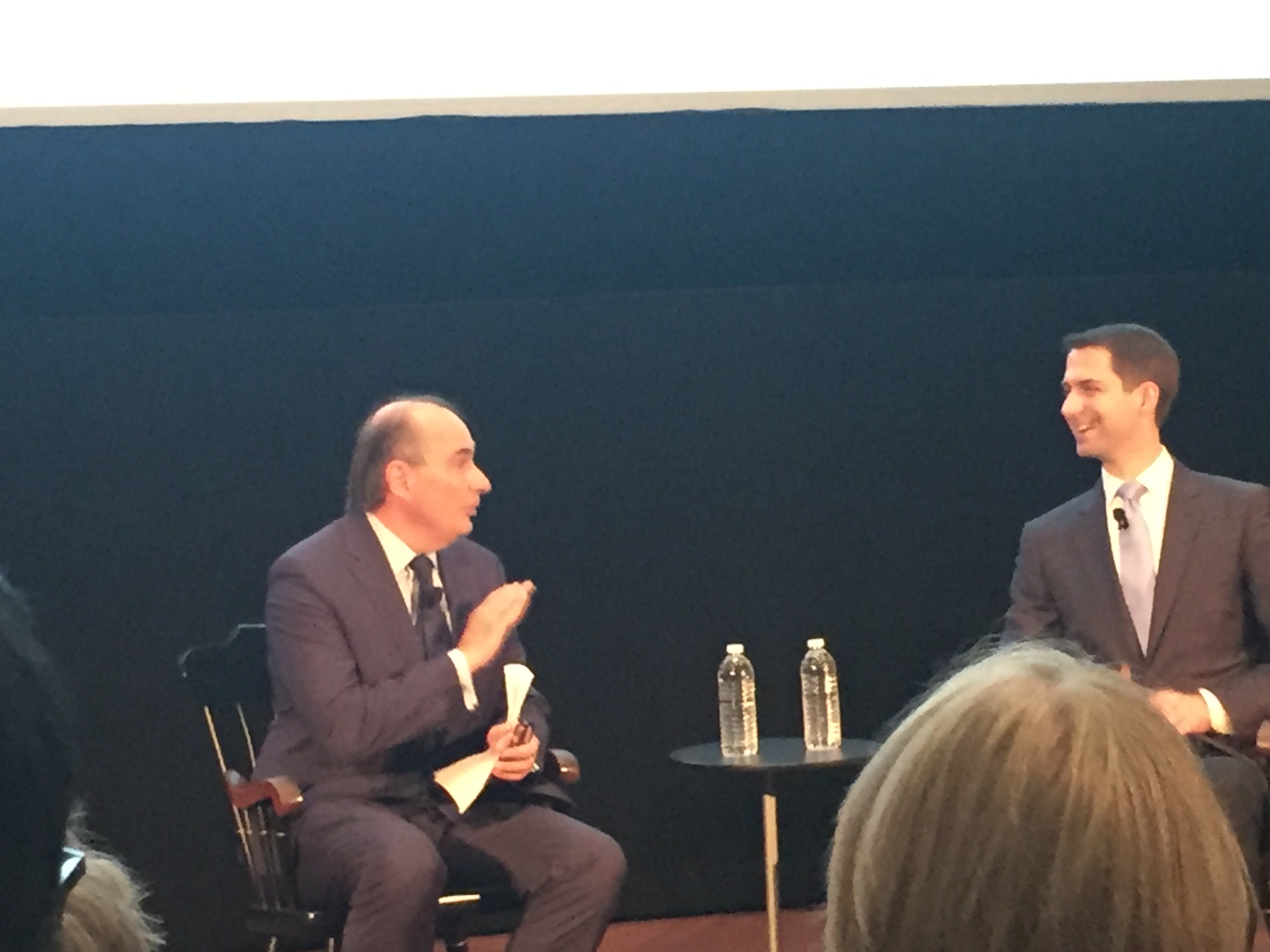
Episode art photo credit: David Axelrod interviews (confronts, debates, talks to) Senator Tom Cotton June 2, 2017 in a photo taken by Lou Agosta at the University of Chicago public debate. As one of the architects of Barack Obama’s presidential program, Ax (as he is affectionately known) would be likely to disagree with many of Senator Cotton’s more-or-less MAGA-oriented views. Take the other person as your empathy trainer! I believe both did!
(c) Lou Agosta, PhD and the Chicago Empathy Project
Notes
[i] Leslie Jamison. (2014). The empathy exams in The Empathy Exams: Essays. Minneapolis: Graywolf Press: 1–27.
[ii] Philip K. Dick. (1968). Do Androids Dream of Electric Sheep? New York: Ballentine Books, 1981.
[iii] Lou Agosta. (2010). Empathy in the Context of Philosophy. London: Palgrave: 60–61.
(c) Lou Agosta, PhD and the Chicago Empathy Project
 Lou Agosta, Ph.D., Listening With Empathy