Home » Posts tagged 'rhetorical empathy'
Tag Archives: rhetorical empathy
Top ten empathy trends in 2026
Here are the top empathy trends for 2026. This is a long read (a half an hour), and the recommendation is to engage with one or two trends a session. Spend the entire first quarter of 2026 with it. In addition, it is a top ten list, but not a “count down.” Therefore, the most important trends—in the sense of new, disruptive, innovative, or provocative—are towards the top.
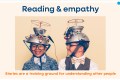
(Image credit: Kids with colander-based “gizmos” as “thinking caps,” www.EmpathyLab.uk—see trend (9) below.)

(1) Automating Empathy and large language models (LLMs): The idea is that you, the client, are going to get empathy from a software bot, app, empathy platform solution, that is able to have a conversation thanks to a so-called a large language model (LLM).
The trend of bringing large language models to empathy and empathic relatedness is a game changer. The question is not whether the generative AI can be empathic, but the extent to which the designers are able to distinguish responsiveness from “stroking one’s ego,” sycophancy (servile flattery), and the extent to which prospective clients decide to engage (both open questions at this date (Q1 2026)).
Thus, the prognosis is mixed. Is automating empathy a silver bullet—or even a good enough lead bullet—to expand empathy for the individual and community and to do so at scale. Key term: “at scale,” which means the service can be “scaled up” to accommodate thousands of people, who are currently “wait listed” for therapy with limited prospects of ever getting off the list. Can the automation address Henry David Thoreau’s “modern mass of men [persons] leading lives of quiet desperation”? Or is the “empathy bot” the cyber age equivalent of a blow-up sex doll for the socially awkward person playing small and resistant to getting out of the person’s comfort zone?
The year ahead promises a proliferation of applications, bots, and services that offer automated conflict resolution, talk therapy, empathy consulting, and companionship. For example: mendful (https://www.mendful.world), empathy.com (bereavement support—that a demo is being offered suggests an app plus services), Google’s conflict resolution app (https://play.google.com/store/apps/details?id=com.tuinfoapps.conflict&pli=1). (This list is far from complete.)
An important question to ask is about an automated empathy bot or app: How readily is an authentic, qualified human being available to engage in an initial or follow-up conversation? At the risk of ending on a cynical note, given the sorry state of human relations as demonstrated in the news of the day, maybe, just maybe, any form of expanded empathy, whether fake or authentic, if properly managed to mitigate harm, is a useful contribution. (Further on empathy and toxic flattery: https://wapo.st/4sndC9O . Also see my blog post from earlier 2025: https://empathylessons.com/2025/11/04/automating-empathy-issues-and-answers/
(2) Suicidal Empathy: This is definitely trending after a certain billionaire provocatively asserted that empathy was a defect of western civilization, even if he did try to take back the assertion. The short version of suicidal empathy is as follows. We are in a lifeboat which is filled to the maximum after our ship sank. You read right—our ship sank. In the water, treading water, surrounding the lifeboat are additional survivors and additional leaky lifeboats at high risk of sinking, leaving the survivors treading water. If the survivors in our still afloat lifeboat are “empathic” and take in the other survivors, then our lifeboat will be swamped, and we will all drown. The conclusion is that in such extreme situations, which are more common than one might imagine, empathy needs to be turned off—or at least dialed down significantly—lest we all perish. This position has been advocated from time-to-time by Elon Musk, Garrett Hardin (1974), and anti-immigration Nativists in one form or another.
Yet even in the face of lifeboat ethics, empathy remains indispensable. How so? If one is in a life-boat, then one is by definition a survivor. Your ship sank! That is a necessary part of the definition of a lifeboat and being in a lifeboat. You were cast into the vast, seemingly boundless sea. Never underestimate the importance of empathy for those in extremis, but even more than empathy, the occupants of the lifeboat need rescue. To be in a lifeboat and not need rescue is a contradiction in terms. If one recognizes the need for rescue, then the whole scenario of lifeboat ethics gets sent back to the drawing board.
The idea of our entire planet (Earth) as a lifeboat is a thought experiment. An imaginary narrative (scenario) designed to generate ideas and intuitions (nod here to the philosopher Daniel Dennett). In this case, the trick is to constrain agency using scarcity of resources (seats in the lifeboat) and see what happens. This exposes the entire lifeboat scenario mechanism for constraining, compromising, and denying agency to the participants in the dilemma. Key term: agency.
The approach of lifeboat ethics is based on a fallacy that the situation of scarcity is an unavoidable one—an inevitable continency. On the contrary, scarcity is being manufactured by bad actors, bad politics, and out-and-out human aggression. As such, the scarcity can and should be undone by actors with better (including empathic) motives in order to restore the community to a benchmark standard human functioning. This is consistent with natural disasters creating local calamities that cause scarcity. It is also consistent with disagreements about what constitutes an emergency. The point is to send in emergency services and (for example) the national guard to deliver or air drop palettes of drinkable water, canvas for tents, and provisions, not to shoot the survivors as a burden to the community (the latter following the logic of the lifeboat to its absurd conclusion).
Returning to the basic metaphor, empathy is no more to blame for overloading the lifeboat than carpentry is to blame for the fact that Roman soldiers used hammer and nails to execute condemned criminal and political enemies by crucifying them. Without practice, empathy can go astray as emotional contagion, projection, conformity, and communications lost in translation.
Being generous to a fault or has never been a requirement for empathy. Altruistic suicide (the soldier falling on the hand grenade to save his comrades) has never been a requirement for empathy. Never. With practice, a rigorous and critical empathy sets boundaries, establishes limits, and creates a whole that is more than the sum of its parts.
A rigorous and critical empathy belongs to a short list of things such as dignity, respect, compassion, neighborliness, and forms of spiritual love, and are not quantifiable as zero-sum phenomena. This is an important idea: more empathy for you does not mean less empathy for me.
For example, if I give you a slice of my chocolate cake, I have less cake. However, if I give you empathy, by giving you a good listening, we both have expanded empathy. Empathy is non-additive—and so empathy is also a non-subtractive, humanizing encounter in which my own humanity is enriched in contributing to another person. A rigorous and critical empathy is not quantifiable like chocolate cake. Granted that our topic is difficult and significant, we can enjoy lighter moment—there is enough food to go around, but definitely not enough chocolate cake! Like food, there is enough empathy to go around, but it does not seem that way, because we have not been effective in driving out the obstacles to empathy such as aggression, hostility, bullying, using food as a weapon, and politics in the negative, pejorative sense. Also see my blog post from earlier 2025:
[https://empathylessons.com/2025/05/22/suicidal-empathy/ ]
(3) Rhetorical empathy: The paradigm, ideal case for rhetorical empathy is exemplified by Malcolm-X’s statement to his colleagues at the founding of the organization of African American Unity, “We are not the pilgrims […] We didn’t land on Plymouth Rock; the rock was landed on us [loud laughter and applause]” (https://youtu.be/3Aq2Z0i8D6A?si=dkYo6QKCrgK2fWXL).
In rhetorical empathy, the speaker’s words address the listening of the audience or other person (“Other”) in such a way as to leave the Other with the experience of having been heard. This must seem counter-intuitive since it is the Other that is doing the listening. The hidden variable is that the speaker knows the Other in the sense that she or he has walked a mile in their shoes (after having taken off her/his own) and can articulate the experience the audience is implicitly harboring in their hearts yet have been unable to express.
For more details on rhetorical empathy, see the separate blog post: post: https://empathylessons.com/2023/04/09/rhetorical-empathy-a-primer/
Also see the peer-reviewed academic article: “Rhetorical empathy in the context of ontology,” Turning Toward Being: The Journal of Ontological Inquiry in Education: (2024) Vol. 2: Issue 1, Article 5. Available at: https://rdw.rowan.edu/joie/vol2/iss1/5
(4) Empathy and autism: Alternative facts, dangerous half-truths, damn lies—and empathy
How shall I express it delicately? The inmates are now in charge of the asylum over at the US Health and Human Services (HHS). Having a worm in one’s brain deservers our empathy; having a worm in one’s thinking does not—see below regarding critical thinking.
Autism is often considered a disorder of empathy—at the risk of oversimplifying, the autistic person is not able to shift perspectives and take the other person’s point of view or do so as readily as neuro-typical persons. Never dismiss empathy. Nor the value in expanding empathy. Never. Yet the matter is a lot more complicated than that.
Public debate about autism and empathy has been scrambled by misinformation about how vaccines may influence the disorder. It is distressing to see what passes for political leadership send children and families down yet another over-simplified and near delusional detour. In a more promising approach using Big Data, scientists at the Flatiron Institute and Princeton have presented evidence that autism presents in four distinct ways or subtypes. Quoting from the Washington Post summary (https://wapo.st/44V7lZb):
- Broadly affected: The smallest group — about 10 percent of participants — faced the steepest challenges, marked by developmental delays, difficulties with communication and social interaction, and repetitive behaviors that touched nearly every part of life.
- Mixed autism with developmental delay: Roughly 19 percent showed early developmental delays but few signs of anxiety, depression or disruptive behavior. Researchers call this group “mixed” because its members vary widely in how strongly they display social or repetitive behaviors.
- Moderate challenges: About a third of participants fell into this group, showing the hallmark traits of autism — social and communication differences and repetitive habits — but in subtler ways and without developmental delays.
- Social and/or behavioral: The largest group, around 37 percent, met early developmental milestones on time yet often grappled with other conditions later on, including ADHD, anxiety, depression or obsessive-compulsive disorder.
For the peer-reviewed paper, which is dense and heavy with computational biology see: https://www.nature.com/articles/s41588-025-02224-z .
These different subtypes suggest a source of much of the confusion in diagnosis and treatment. Parents, medical professionals, and educators and talking past one another because they are addressing the different subtypes.
Naturally, everyone would like a quick fix: Give ‘em vitamin B9—problem solved! Wouldn’t it be nice? (Nor is there anything wrong with vitamin B9—but it ain’t gonna cure autism.) While expanded understanding and diagnostic possibilities point to enhanced treatment interventions, what is less good news is that treatments remain complex, multi-modal, time and labor intensive, and, therefore, expensive. Behavioral interventions are demonstrably effective in improving recognizing social clues and expanding social skills. Selective, limited use of psychopharmacology is effective in addressing attention deficit and hyperactivity, though one must always be concerned in medicating young brains. Working from the inside out, e.g., play therapy is effective in dealing with anxiety and depression. In every case, creating an empathic environment of toleration, limit setting, and meeting the children (and parents) where they are struggling is on the critical path to success.
(4) Empathy versus cruelty and unelected puppet masters in politics: Presumably a statement that “empathy is a weakness” (see above (2)) would be a justification of the unempathic “slash and burn” methods of the “unelected puppet masters” at the US Depart of Doge [pronounce: “dog”], the so-called US Department of Government of Efficiency, showing up at the US IRS and Social Security offices and so on and demanding to see confidential citizen data and/or seemingly randomly sending employees home (“firing” them). While a “controlled burn” of the bureaucratic growth of the federal government forest underbrush might indeed be the empathic thing to do—or at least needed “tough love,” shutting down entire departments and mass layoffs is not an example of it. This is the “uncontrolled burn” (shout out to Garrett Smith for the term).
What Stephen Miller (Deputy White House Chief of Staff) and Russell Vought (Office of Management and Budget / Project 2025) do not point out is that empathy does not work with bullies or abusers, who will take whatever vulnerability you may exhibit and use it against you. This is also the case with anti-social personality disorder, psychopaths, and individuals with an undeveloped or defective conscience, who struggle to tell right from wrong. I hasten to add that without interviewing the individual, one has no way of knowing the individual’s mental status, whether the individual is in integrity or out of it.
Another possibility is that the individual is projecting the individual’s own unreliable, defective empathy onto the community as an empathic defect. Many of those who lack empathy are hungry for it. If ever there was a disqualifying statement by a would-be administrator or leader, Elon Musk’s soundbite about empathy being a defect of civilization would be it. Even if he took it back, I assert that it shows his “true colors”. However, a further agenda lurks nearby.
In the face of bullying, a critical and rigorous empathy sets limits, speaks truth to power, establishes boundaries, pushes back against attempts to control, dominate, and manipulate. One must not overlook the power of top down, cognitive empathy in thinking like one’s opponent in order to overcome him. “Top down,” cognitive empathy is detailed in Mikah Zenko’s Red Team! (Basic Books 2015) according to which taking a walk in the other’s shoes (the folk definition of empathy) provides advantages in relationships, business, politics, and building communities that are thrive on cooperation, communication, coordination, and inclusiveness. Short review: Think like one’s opponents, to come out on top.
If one were looking for a short disqualifying reason to sideline unelected puppet masters such as Musk and fellow traveler Stephen Miller (see more on the latter on the South Poverty Law Project’s report on racism and anti-immigration hate groups), this is it. I leave it to the reader to figure out who is the puppet.
(5) Empathy and immigration and murder most foul: more alternative facts, dangerous half-truths and total nonsense: That these United States of America are a federated nation of immigrants is a cold fact. Most of the people living here would not be here if their parents, grandparents, or great grandparents had not arrived from some land across the sea. To be sure, there are exceptions—and it is an also a fact that if one reads the treaties that the US government made with Native Americans, that Oklahoma really does belong to the Native Americans. Likewise, as Malcolm-X said to a crowd in Harlem to responses of “Amen!” and boisterous laughter, “You did not land on Plymouth rock; Plymouth rock landed on you!” (See (2) above.) Still, residents already living here are not interested in changing the devil they know for the devil they don’t know.
The following quote is not from the “take over” of Venezuela (ongoing), but the action of the border patrol and ICE in Chicago’s Hispanic neighborhood:
“[…] [I]t’s been a parade of nightmares — armed men in balaclavas on the streets, migrants sent to a torture prison in El Salvador, corruption on a scale undreamed of by even the gaudiest third-world dictators and the shocking capitulation by many leaders in business, law, media and academia. Trying to wrap one’s mind around the scale of civic destruction wrought in just 11 months stretches the limits of the imagination, like conceptualizing light-years or black holes.” [https://www.nytimes.com/2025/12/26/opinion/trump-weaker-resistance-stronger.html?unlocked_article_code=1._k8.NEnL.4kvmeqa-xzC4&smid=url-share
It is a breakdown of empathy that a nation of immigrants is flat out persecuting, oppressing, and hounding mostly, but not exclusively, Hispanics and people with brown skin. Demoralizing. Disgraceful. Criminal?
Everyone wants to deport undocumented murderers, rapists, gang members, and bad actors. Everyone. Yet that is not what we saw from ICE/BP actions in Chicago where Hispanic-appearing bus boys in restaurants, day laborers in Home Deport parking lots, nannies at preschools (?!), street vendors selling tacos, block party gatherings in Latino neighborhoods were targeted and where tear gas, flash bang grenades, shots to the head with high-speed paint balls (aimed at peacefully protesting pastors), and other chemicals agents were used without warning. This just in: mother of three shot, killed by ICE/BP: Are you getting the message? Murder most foul![https://www.nytimes.com/2026/01/08/opinion/renee-good-minnesota-shooting-ice.html?unlocked_article_code=1.DlA.y2Fb.N6f9Vobf-Vmv&smid=url-share]
The administration’s narrative (Secretary of Homeland Insecurity Noem, etc) has NEVER matched the actions on the ground in the community neighborhoods. According to the Chicago Tribute—of 624 arrests reported by ICE/BP to the court some 16 persons had criminal records (“worst of the worst”). That is 2.5 percent. Underwhelming, demoralizing, appalling.
The call to action employs empathy to network and build community. Get a whistle and use it. Two short tweets for ICE Spotted—one long one for someone being detained. Build local networks of citizen observers. Urge local law enforcement to arrest anyone who breaks the law, including federal officers acting illegally. No one said this was going to be easy. We Americans have options and resources that were not available to the residents of Weimar Germany in 1933, who were noticeably lacking in whistles. Okay, not funny.
(Update 01/28/2026: https://www.wsj.com/opinion/is-trump-derangement-syndrome-real-a603e4a1?st=AnbPxi&reflink=desktopwebshare_permalink)
(6) Radical empathy and trauma: Cathy Caruth (1996) concisely defines trauma in terms of an experience that is registered but not experienced, a truth or reality that is not available to the survivor as a standard experience. The person (for example) was factually, objectively present when the head on collision occurred, but, even if the person has memories, and would acknowledge the event, paradoxically, the person does not presently experience it as something the person experienced in a way that a person standardly experienced the past event.
The survivor experiences dissociated, repetitive nightmares, flashbacks, and depersonalization. Strictly speaking, the challenge is not only that the would-be empathizer was not with the surviving Other when the survivor experienced the life-threatening trauma, but the survivor was physically present yet did not have the experience in such a way as to experience it. That may sound strange that the survivor did not experience the experience. Once again, one searches for words to capture an experience one did not experience. That is Caruth’s (1996) definition of “unclaimed” experience.
Moral trauma adds a challenging twist to what is traumatic about trauma. What is little recognized is that many survivors are also perpetrators (and vice versa). The survivor may also unwittingly (or even intentionally) become a perpetrator. The incarcerated prisoner of conscience steals a piece of bread from another prisoner, or to save his own life, falsely accuses another. One wants to say: This is tragic in the strict sense. The characters in ancient Greek tragic theater, including Oedipus, Phaedra, Medea, practically the whole House of Atrius, are all both survivors and perpetrators.
Moral trauma is defined as the distressing emotional, behavioral, social, and sometimes spiritual aftermath of exposure to (including participation in) events in which a person’s moral boundaries are violated and in which individuals or groups are gravely injured, killed, or credible threat thereof is enacted (i.e., individuals are physically traumatized). Examples of moral trauma include such things as being put in a situation where “I will kill you if you do not kill this person.”
Generalizing on the latter example, the list includes morally fraught instances of double binds, valid military orders that result in unintentional harm to innocent people, situations in which survivors become perpetrators (and vice versa), soul murder (defined as killing the possibility of empathy and/or killing the possibility of possibility), and the Trolley Car Dilemma (Anonymous Wikipedia Content 2012, Foot 1967, Thomson 1976). In moral trauma people become both perpetrators and survivors, and such an outcome is characteristic of many (though not all) moral traumas.
Here radical empathy comes into its own. A person is asked to make a decision that no one should have to make. A person is asked to make a decision that no one is able to make—and yet the person makes the decision anyway, even if the person does nothing, because doing nothing is making a decision. A person is asked to make a decision that no one is entitled to make, which include most decisions about who should live or die (or be gravely injured). The result is moral trauma—the person is both a perpetrator and a survivor. Now empathize with that. No one said it would be easy.
Hence, the need for radical empathy. Extreme situations—that threaten death or dismemberment—call forth radical empathy. Standard empathy is challenged by extreme situations out of remote, hard-to-grasp experiences to become radical empathy. Radical empathy remains committed to empathizing with the Other in the face of the breakdown of standard empathy as empathic distress. (For further on radical empathy, see the separate blog post: https://empathylessons.com/2025/08/22/a-concise-talk-on-trauma-and-radical-empathy/and see also the Reference Agosta 2025 below.) The treatment or therapy consists of the survivor re-experiencing the trauma vicariously from a place of safety, an empathic space of acceptance and tolerance. In doing so the trauma starts losing its power and when it returns, it does so with less force, eventually becoming a distant unhappy and painful but not overwhelming memory.
(7) Empathy and art: Heinz Kohut, MD, (1971) pointed out that one result of depth psychological therapy with a strong orientation on empathy was an expansion of the individual’s appreciation or art, humor, and practical wisdom. What is the converse were also the case? Engaging with art and music, the Humanities and literature, theatre, rhetoric and languages, opens up areas of the brain that map directly to empathy and powerfully activate empathy.
Relating to the work of art, including literary fiction such as the novel, aesthetically and relating to the Other empathically is an intersection that has been noted by one of the innovators of personality theory, Gordon Allport (1897–1967), He was one of the pioneers of personality theory with his Personality: A Psychological Interpretation (New York: Holt 1937), in which he writes:
It has often been said by the advocates of empathy that the “understanding of a personality is like the understanding of a work of art” (1937: 531).
These advocates of empathy were not anonymous Others but Allport’s teacher, Herbert Langfeld (1879–1958), also a psychologist and president of the American Psychological Association and his colleagues. Langfeld was the author of The Aesthetic Attitude (1920: vi): “the motor theory of mind, namely that to every stimulus which the organism receives from without, it makes a definite response” resulting in the “tendency of the observer to project himself” into objects and body.
As noted, psychologists and health professionals have repeatedly alluded to such benefits of expanded empathy as an increased sense of humor, appreciation for art and music, as well as an enhanced capacity to enjoy life itself. Attention to fine-grained distinctions in an individual’s experience of other individuals is hypothesized to be transferable across domains such as the experience of art, humor, and engaging with others. Expand your empathy—go to the art museum—go to a concert—read immersive fiction, a novel.
(8) Empathy is the new love: People want to be listened to. People want to feel as if they have been heard—people want to be heard. People want to be gotten for they authentically are as a possibility. People want others to appreciate from where they are coming—their point of view. People want to be acknowledged, recognized, appreciated for their contribution. Empathy delivers all these ways of relating and more.
If empathy is the new love, then what is the old love? Folk wisdom suggests that love is blind; Plato, that love is a kind of madness, sometimes divine madness, sometimes just plain ordinary, everyday craziness—the one who is in love is semi-hypnotically held in bondage by an idealized depiction of the beloved, overlooking the partner’s failings and limitations; Bob Dylan, that love is just a four-letter word. So far, love sounds like tertiary syphilis—it makes one mad and causes one to go blind.
Less cynically, no one should have to choose between empathy and love in their positive dimensions. Talking Greek here, love includes eros—the erotic dimension, which gets a lot of attention as romantic relationships and aim-inhibited sexuality; philias—friendship between peers in building a community of fellow travelers; and agape—the spiritual love often attributed to Saint Paul for a higher power towards which humanity strives in its own clumsy and stumbling ways.
A fourth item may usefully be added to the list—the love of a mother, parent, or care-taker for the infant, neonate, or child of tender art. The sound of a crying baby has the power to wake most grown-ups out of the deepest sleep—and that is because we care. Letting the anxious infant merge with the parent’s soothing calmness satisfies criteria for both love and empathy, and may be the common matrix out of which these come forth.
Especially from a romantic perspective, the goal of love is to erase the boundary between the self and Other. (But also see above on the merge of the anxious infant with the calm adult.) Merger of one’s mind and body with the beloved is the aspiration and, at least temporarily, the outcome.
In contrast to love, empathy navigates the boundary between oneself and Other such that the distinction between self and Other is sustained—any merger is temporary and transient—one has a vicarious experience of the Other and the integrity of self and Other are maintained. Thus, love and empathy have a different relationship to the boundary between self and Other. Empathy is committed to a firm, albeit semi-permeable boundary; whereas, especially in its more enthusiastic forms, love celebrates the cancelling of the boundary, though ultimately acknowledging the reality of the distinction self/Other.
(9) Reading and empathizing: “A good book is an empathy engine”—Chris Riddell, UK Children’s Laurate. Many analogies exist between reading a text and empathizing with another person. This is not a mere analogical argument. The practices of empathy and reading are applying the same underlying micro-practices, skills, techniques, and methods. Reading literature (we are not engaging with reading legal contracts or computer documentation) is an empathic practice—not merely analogous to one, though it may be that too.
(Image credit: EmpathyLab (UK): Your brain on empathy reading)

Reading is an empathic practice in that it engages with another person—the Other—and does so at several levels. There are several levels of otherness—the Other of the character in the text is the most readily available—there is the implied Other addressed by the implied author, the Other of the narrator, who collapses into the implied author but often is distinct, and the actual author, who writes the words. Once again, I emphasize—and empathize—these are not merely analogous to acts of the practice of empathy, they are empathic gestures from start to finish, since they bring forth empathy and make it present in the encounter with an Other.
The idea is that one relates to works of art such as a literary text with the same respect, aesthetic disinterest, moral interest as we relate to other human beings. That is also the case when the relationship breaks down. Someone throws cake at the Mona Lisa or tries to spray it with red paint. One is shocked in a way that is different than insulting or attacking a person, yet has strong objections like an appalling boundary violation has occurred.
On the one hand, what empathy does for reading literature is bring it to life as the possibility of a laboratory for human emotions, affections, struggles, dynamics, success, and failure. Conversely, what literature does for empathy is provide a laboratory in which empathic relatedness can be challenged, tested, transformed, discarded, celebrated, explored, and made the object of inquiry.
This is another area where it is hard to say just a little. Quoting from John Guillory (2025: p. 22ftnt 31), in turn, paraphrasing Stanislas Dehaene (Reading in the Brain: The Science and Evolution of a Human Invention (Viking Press 2009)): “…[Dehaene] describes reading as a refunctioning of regions of the brain dedicated to recognizing visual signals of a particular sort, chiefly the edge or corners of object; these forms the basis for inscriptive marks. Although the neurons of the areas that accomplish reading were not evolved for the purpose of reading, the human brain learned reading and writing by developing a new way of correlating visual and aural information in the brain. Dehaene calls this ‘neuronal recycling” (144–148). This is just the start of the neuroscience narrative.
The encounters between empathy and literature, relating as persons to art works and relating as art works to persons, are motivated. One considers how one relates to another person, and how it is the same and different than how one relates to works of art. At first glance, one treats art better than one treats people. One puts art in libraries and museums with air conditioning in the summer and heat in the winter whereas one allows people to go homeless and sleep under bridges in appalling conditions. However, upon reflection one guiltily allows with shame that as a community, one is failing to live up to one’s own best standards. One recognizes one’s failure even as one refuses a trade-off between respect for art and respect for persons.
(10) Empathy and critical thinking: We conclude with a positive proposal: Teach critical thinking. This is the empathic educational moment. Absent a rigorous and critical practice of empathy, I am cautious about engaging current political clichés in a highly polarized political world and “rhetoric” in the negative sense.
Critical thinking includes putting oneself in the place of one’s opponent—the folk definition of empathy—not necessarily to agree with the other individual—but to consider what advantages and disadvantages are included in the opponent’s position. Taking a walk in the Other’s shoes after having taken off one’s own (to avoid the risk of projection) shows one where the shoe pinches. This “pinching” —to stay with the metaphor—is not mere knowledge but a basic inquiry into what the Other considers possible based on how the Other’s world is disclosed experientially. That is what we have attempted to do here by engaging with the most rigorous version of the lifeboat dilemma, instead of a strawman. Critical thinking is a possibility pump designed to get people to start again listening to one another, allowing the empathic receptivity (listening) to come forth.
In our day and age of fake news, deep fake identity theft, not to mention common political propaganda, one arguably needs a course in critical thinking (e.g., Mill 1859; Haber 2020) to distinguish fact and fiction. Nevertheless, I boldly assert that most people, not suffering from delusional disorder or political pathologies of being The True Believer (Hoffer 1953)), are generally able to make this distinction.
A rigorous and critical empathy creates a safe zone of acceptance and tolerance within which people can inquire into what is possible—debate and listen to a wide spectrum of ideas, positions, feelings, and expressions out of which new possibilities can come forth. For example, empathy and critical thinking support maintaining firm boundaries and limits against actors who would misuse social media to amplify and distort communications. Much of what Jürgen Habermas (1984) says about the communicative distortions in mass media, television, and film applies with a multiplicative effect to the problematic, if not toxic, politics occurring on the Internet and social networking.
The extension to issues of politics, climate change, and community struggles follows immediately. Insofar as individuals skeptical of empathy are trying to force a decision between critical thinking and empathy, the choice must be declined. Both empathy and critical thinking are needed; hence, a rigorous and critical empathy is included in the definition of enlarged, critical thinking (and vice versa). (Note that “critical thinking” can mean a lot of things. Here key references include John Stuart Mill 1859; Haber 2020; “enlarged thinking” in Kant 1791/93 (AA 159); Arendt 1968: 9; Habermas 1984; Agosta 2024, 2025.)
In conclusion, a positive alternative to abandoning facts and skipping critical thinking is suggested by Bob Dylan’s song about empathy. One has to push off the shore of certainty and venture forth into the unknown. We give Dylan the last word (1965: 185): “I wish that for just one time / You could stand inside my shoes / And just for that one moment / I could be you” [.]
REFERENCES
Lou Agosta. (2025). Radical Empathy in the Context of Literature. New York: Palgrave Macmillan.
______________. (2024). Empathy Lessons. 2nd Edition. Chicago: Two Pears Press.
______________. (2014). A Rumor of Empathy: Rewriting Empathy in the Context of Philosophy. New York: Palgrave Pivot.
Anonymous Wikipedia Content. (2012). Trolley problem (The trolley dilemma). Wikipedia: https://en.wikipedia.org/wiki/Trolley_problem [checked 2023-06-25]
Arendt, Hannah. (1952/1958). The Origins of Totalitarianism, 2nd Edition. Cleveland and New York: Meridian (World) Publishing, 1958.
Gordon Allport. (19370. Personality: A Psychological Interpretation (New York: Holt 1937).
Cathy Caruth. (1996). Unclaimed Experience: Trauma, Narrative, and History. Baltimore: John Hopkins.
Stanislas Dehaene. (2009). Reading in the Brain: The Science and Evolution of a Human Invention. NEW YORK: Viking Press.
Bob Dylan. (1965). Bob Dylan: The Lyrics: 1961–2012. New York: Simon and Schuster.
Philippa Foot. (1967). The problem of abortion and the doctrine of the double effect. Oxford Review, No. 5. In Foot, 1977/2002, Virtues and Vices and Other Essays in Moral Philosophy. Oxford: Oxford UP, 2002: 19–32. DOI:10.1093/0199252866.001.0001.
John Guillory. (2025). On Close Reading. Annotated bibliography by Scott Newstok. Chicago: University of Chicago press.
Jonathan Haber. (2020). Critical Thinking. Cambridge, MA: The MIT Press.
Jürgen Habermas. (1984). The Theory of Communicative Action, Vol 1, Thomas McCarthy (tr.). Boston: Beacon Press.
Garrett Hardin. (1974). Commentary: Living on a Lifeboat. BioScience, Volume 24, Issue 10, October 1974, Pages 561–568, https://doi.org/10.2307/1296629
Eric Hoffer. (1953). The True Believer. New York: Harper Perennial.
Immanuel Kant. (1791/93). Critique of the Power of Judgment, Paul Guyer and Eric Matthews (trs.). Cambridge: Cambridge UP, 2013.
Heinz Kohut. (1971). The Analysis of the Self. New York: International Universities Press.
Herbert Langfeld. (1920). The Aesthetic Attitude. New York: Harcourt Brace.
Malcolm-X. (1964). “Remarks at the founding of the Organization of African-American Unity.” https://youtu.be/3Aq2Z0i8D6A?si=dkYo6QKCrgK2fWXL [Checked on 03/24/2024]
John Stuart Mill. (1859). On Liberty, Indianapolis: Hackett Publishing.
Judith Jarvis Thomson. (1976). Killing, letting die, and the trolley problem, The Monist, vol. 59: 204–217.
Mikah Zenko. (2015). Red Team! New York: Basic Books.
This blog post, blog and all content were prepared by Lou Agosta without any use of Generative AI. None. The author has been a big fan of the em dash ever since “graduating” from a Smith Corona typewriter to a word processor.
© Lou Agosta, PhD and the Chicago Empathy Project

Top ten trends in empathy for 2025
The idea is to take a position from the perspective of empathy on current trends. What would the empathic response be to the trend in question, especially crises and breakdowns.
1. The world is filled with survivors who are perpetrators (and vice versa). Radical empathy is needed to relate to survivors who are also perpetrators. Radical empathy is the number one trend. What does that mean? The world is a more dangerous, broken place than it was a year ago. The challenge to empathy is that the dangers and breakdowns in the world have expanded dramatically over the long past year such. Standard empathy is no longer sufficient. Radical empathy is required.
Image credit: Jan Steen, 1665, As the old sing, so pipe the young

The short definition of radical empathy: the events that occur are so difficult, complex, and traumatic that standard empathy breaks down into empathic distress and fails. In contrast, with radical empathy, empathic distress occurs, but one’s commitment to the other person is such that one empathizes in the face of empathic distress. One’s empathic commitment to the survivor enables the survivor to recover her/his humanness, integrity, and relatedness. The work of radical empathy engages how the impact and cost of empathic distress affect the different aspects of empathic receptivity, empathic understanding, empathic interpretation, and empathic responsiveness, delivering a breakthrough and transformation in relating to the Other.
An example will be useful. A US soldier gets up in the morning. He is an ordinary GI Joe. He is manning a checkpoint. The sergeant, thinking the approaching car is a car bomb, gives what he believes is a valid military order to shoot at the car. The solider shoots. The car stops. But it was not a car bomb; it was a family rushing to the hospital because the would-be mother (now deceased) was in labor. The military debriefing of the events is perfunctory. Burdened by guilt, the soldier shuts down emotionally, and he stares vacantly ahead into space. Emotionally gutted, he does not respond to orders. He is shipped back to the States and dishonorably discharged. His marriage fails. He becomes homeless. The point? This person is now both a perpetrator and a survivor. The people who were shot experienced trauma by penetrating wounds. The soldier has moral trauma. Key term: moral trauma. He was put in an impossible situation; damned if he did and damned if he didn’t. Let his team be blown up? Disobey what seems to be a valid military order? Hurt people who did not need or deserve to get hurt? His ability to act, his agency, was compromised by being put in an impossible situation. That is why the ancient Greeks invented tragic theatre – except that the double binds happen every day. Radical empathy specializes in empathizing with those who are both survivors and perpetrators. And this is much more common than is generally realized.
Many examples of radical empathy can be found in literature (or in the New York Times), in which the hero or anti-hero of the story is caught in a double bind, damned if one does and damned if one doesn’t. Radical empathy and the literary artwork transfigure the face of trauma, overcoming empathic distress, and allowing radical empathy to enable the fragmented Other to recover her/his integrity. Persons require radical empathy to relate to, process, and overcome bad things happening to good people (for example: moral and physical trauma, double binds, soul murder, and behavior in extreme situations. For further reding on radical empathy, see the book of the same title in the References below.
2. No human being is illegal. Mass deportations pending. Empathy, whether standard or radical, is clear on this trend: no human being is illegal. At the same time, the empathy lesson is acknowledged that empathy is all about firm boundaries and limits between the self and other, while allowing for communications between the two. It is the breakdown of empathy at the US national border – which does not mean wide open borders – is one reason among several for the result of the 2024 election. What if ICE agents (the immigration authorities) show up? Empathy is all about setting boundaries: The empathic response: Let’s see your judicial warrant, officer, please? (See The New York Times, Dana Goldstein, Jan 7, 2025: https://www.nytimes.com/2025/01/07/us/immigration-deportations-ice-schools.html.)
An empathic response would look like a workable Guest Worker Program (such as exist in the European union) that allows essential agricultural and food services workers to earn and send money back home. Yet the proverbial devil is in the detail, and being accused of the crime of shop lifting a sandwich or tube of toothpaste is different than actually committing one. Thus, empathy also looks like Due Process, and an opportunity to face one’s accuser. If one is standing outside a Whole Foods or Trader Joe’s begging for food, it is not because one’s life is going so well. The gesture that any decent customer would make is to buy the person a sandwich. Of course, that is not going to scale up to address the estimated 37 million Americans (the majority not recent immigrants) living in poverty. Continued below under “5. The unworthy poor.”
3. Psychiatry gets empathy (ongoing). Relate to the human being in front of you, not the diagnosis. Empathy teaches de-escalation. Empathy’s coaching to psychiatry as a profession is to do precisely that which psychiatry is least inclined to do, namely, relate to the human being in front of you, not to a diagnosis.
Granted, the human being is a biological system. We are neurons all the way down. Yet emergent properties of our humanity (including empathy) come forth from the proper functioning of the neurons. The neurons generate consciousness, that subtle awareness of our environment that we humans share with other mammals. Consciousness generates relatedness to the environment and one another. Relatedness generates meaning. Meaning generates language. Language generates community, society, and culture. As Dorothy is reported to have said to Toto, “We are no longer in Kansas” – or psychiatry.
So what’s the recommendation from the point of view of empathy? Relate to the human being sitting in front of you not to a diagnosis. That is the empathic moment. To be sure, a diagnosis has its uses in technical communications with colleagues or payers, but as a standalone label, diagnoses are overrated.
Taking a step back, people get into psychiatry (and medicine in general) because they want to relieve pain and suffering, because they want to make a difference. Yet this aspiration is in stark contrast with the report at the American Psychiatric Association meeting that physical restraints were used some 44,000 times last year to constrain patients. (See Ellen Barry, May 21, 2024 In the house of psychiatry, a jarring tale of violence. Thus, The New York Times: https://www.nytimes.com/2024/05/21/health/psychiatric-restraint-forced-medication.html)
“Don’t hurt yourself (or anyone else!)!” is solid guidance; yet the particulars of the situation are challenging. The distance between fight and flight (fear) is narrow. Someone in the throes of an “amygdala hijack” is in an altered state of consciousness. This person literally cannot hear what is being said to him or her. This person is at risk of precipitating a bad outcome, especially if the psychiatrist or staff is also hijacked by an emotional reaction and emotional contagion. If as much effort were devoted to training staff in verbal escalation – talking someone back “off the ledge” – as in training them synch up straps, the outcomes would be less traumatic for all involved. Empathy in all its forms is a basic de-escalation skill that needs to receive expanded training and development.
It would not be fair to confront a psychiatrist with an either/or: “Are you relating to a biological system or to a human being?” because she (or he) is relating to both. Yet the pendulum does seem to have swung too far in the direction of biochemical mechanisms rather than interpersonal meaning, relations, and fulfilment. It is a fact that some 80% of people visit the medical doctor because they are in pain and hope to get medicine to cause them to feel better (and the other 20% have scheduled an annual checkup). That is well and good; and it is true that these psychopharm medicines change the neurons in your brain, but so does studying French and so do new and engaging life experiences; and, here’s the point, so does the committed application of empathy.
3. Violence against women continues to be a plague upon the land and a challenge to empathy.Standard empathy is not enough. This requires a level of radical empathy that has not been much appreciated. This is because many perpetrators are also survivors. (See the above example of the ordinary soldier who becomes both.)
I hasten to add that two wrongs do not make a right. Two wrongs make twice the wrong. Intervention is required to get the woman safe, and recovery from domestic violence begins once the person is secure in their safety. That is not a trivial matter, and Safety Plans and Hot Lines continue to be important resources. One can incarcerate a perpetrator to protect the community (and the women in it), but that does not make him better. He still needs treatment. What are the chances he is going to get it? To cut to the chase: many perpetrators and survivors do not know what a satisfying, healthy relationship looks like. Survivors and perpetrators alike have come up in environments where physical violence is common. Once again, this is not an excuse, and two wrongs do not make a right.
Regarding Peter Hegserth (Cabinet nominee for Defense Secretary): NBC News has reported that Mr. Hegseth’s heavy drinking concerned co-workers at Fox News and that two of them said they smelled alcohol on him more than a dozen times before he went on the air. The New Yorker reported: “A trail of documents, corroborated by the accounts of former colleagues, indicates that Hegseth was forced to step down by both of the two nonprofit advocacy groups that he ran — Veterans for Freedom and Concerned Veterans for America — in the face of serious allegations of financial mismanagement, sexual impropriety, and personal misconduct.” His managerial skills are nowhere near the challenge of running the Pentagon. Meanwhile, according to a 2018 email obtained by the New York Times, Mr. Hegseth’s own mother called him “an abuser of women” as he went through his second divorce. It is particularly concerning to see Senator Joni Ernst (R-Iowa) who had a check box on Domestic violence on her official site accept/excuse/embrace such behavior. Among the many women serving in the US Armed Forces, who can imagine that this candidate has their back? The esteemed Senator Ernst may usefully her from the concerned citizens.
The number one empathy lesson: a grownup man having temper tantrums (and worse) is not what a healthy relationship looks like! In a healthy relationship partners cooperate, help one another, respect boundaries, and if they disagree, they argue and “fight” fairly. Skills training belongs here. A major skill: setting boundaries, limits – pushing back on bullying in all its forms. (In addition, parents of diverse backgrounds and cultures have got to find better ways to set limits to and for their children than “whupping ‘em.”)
Woman have provided the leadership in this struggle for domestic tranquility and will continue to do so. From men’s perspective, this is a failure not only of standard empathy, but a failure of leadership. It calls for radical empathy to include survivors and perpetrates (once again, without making excuses for bad behavior). When powerful men – President Biden (now retiring), Elon Musk, Jeff Bezos, Senators and captains of industry – step up and say “Enough! What are you thinkin’, man?” then the issue will get transformed. These are conversations that are best had by men with men. Even if that sounds sexist, it makes a difference when a man tells another man that his behavior towards women or a woman is out of line and requires correction rather than when a woman says it (though it is equally true in both cases). Even though Jackson Katz’s video has been around for several years, it has never been better expressed: “Violence against women: It’s a men’s problem”: https://youtu.be/ElJxUVJ8blw?si=k8LG0ewnL6ZKlgt9. Please circulate widely.
4. “Abandon reality all ye who enter here!” is inscribed over the sign-in to Facebook. “Facts are overrated.” Yet a rigorous and critical empathy knows that it can be wrong so it is committed to distinguishing facts from fictions. Empathy was never particularly concerned with the reasons why you are in pain, but how to relieve that pain. The corporation Meta (owner of Facebook (FB)) decides to end fact checking regarding posts on its social networking site (https://www.nytimes.com/live/2025/01/07/business/meta-fact-checking). It is hard not to be cynical at this moment.
Many people know “empathy for everyone” is a pipe dream; yet there is no other way to bring it into the world than to work to make it real. The human imagination is a possibility engine, and it is the source of what is possible in the human relations defined by empathy. If the “crazy ideas” on Facebook (and elsewhere) were just that, crazy idea, they might actually be useful in terms of “brain storming.”. However, when non facts such as immigrants are stealing and eating your pets are represented as occurring events in the world, the damage to the community is significant.
This is when radical empathy as “Red Team! Red Team!” comes in (see the references Zenko 2015). Think like the opponent. Take the opponent’s point of view, not to agree or disagree with him; but to get one’s power back over delusional thinking. Prejudice against individuals and groups has many sources – largely projection of one’s own fears and blind spots onto the devalued Other. However, ultimately prejudice is a form of mental illness – delusional thinking – at the community level. From an empathic perspective, FB becomes a site of delusional thinking, noting that even a broken clock gives the correct time twice a day. By the way, the original Pizza-Gate conspirator, who, living in a persistent altered state of consciousness, claimed a popular local pizza parlor was really a nest of satanic pedophilia, was shot and killed by police on January 4, 2025 when he raised a gun during a police traffic stop. https://www.washingtonpost.com/dc-md-va/2025/01/09/edgar-maddison-welch-pizzagate-killed/ Case closed. He was the father of two daughters. Tragically misinformed. Unnecessary. Fact checking saves lives!
5. Help for the unworthy poor. Empathy says the worthy poor need help; but radical empathy asserts that the unworthy poor need even more help(and who is deciding who is “worthy” anyway? See above under “no human being is illegal”).
In a highly entertaining, albeit sexist retelling of the myth of Pygmalion, My Fair Lady – the alcoholic, unemployed father (Alfred) of Liza Doolittle confronts Professor Higgins with a request for money for his permission to subject his daughter to the enculturing “make over” of improving her language that is the main project of the plot. In a comic yet thought-provoking scene, the father notes that many people of means are making financial contributions to help the struggling, worthy impoverished (“the poor”); but who is helping the unworthy poor?! “I don’t deserve the handout. I am lazy and a drunk (in so many words); but give me ten pounds sterling anyway.” An admirably direct argument and not without a certain integrity. Yet if one grew up in poverty and even if the parent was not “whuppin’” everyone in sight or engaging with substances of abuse and neglecting basic education, then high probability one will satisfy the definition of “unworthy poor” – no (limited) motivation to pull oneself up by one’s bootstraps. Yes, by all means, government needs to expand its efficiency and effectiveness, but this might not be an efficient process. Line up and with help from a bureaucrat (which used to mean simply “helpful office holder,” not “unempathic jerk”) fill out the forms. However, one cannot give people money; or rather the risk of doing so is that it is not going to make a difference. Educational vouchers? Financial skills training? Parental training? Food vouchers? Rental vouchers? Food, rent, and education.
Guilt trip, anyone? The rich get richer; the poor get – older. The devil’s advocate says the poor should work harder to pull themselves up by their bootstraps. Empathy says that the devil already has too many advocates. A tax on billionaires’ net worth would generate enough funds in five years to reduce the number of people living in poverty (estimated to be some 37 million as of 2023) by 80%. Radical empathy is required!
6. Empathy is part of the mission of health insurance, not more monopoly rents to insurance corporations. The economics of health insurance are compelling – get everyone into the insurance pool and spread the risk. Risk that is spread is risk contained, managed, and conquered. It is a pathology of capitalism that competition does not function as designed in the matter of such common goods as clean water, clean air, and conditions necessary to health and well-being such as access to medical treatments Healthcare corporations are incented by competition to get rid of sick people (do not do business with them) since sick people reduce profits, even though sickness is why the insurance came into existence. This is madness! And this is why intervention of the federal authorities (and legislation) was needed to prevent corporations from excluding the pre-existing conditions (illnesses). Therefore, the trend is to make empathy a part of the mission of insuring healthcare.
For example, there is an innovative medicine to treat schizophrenia that does not have as many of the undesired, troubling, painful side effects such as tardive dyskinesis of current medicines. However, out of the gate, it costs $1800 a month, and for pharmaceutical companies properly to recoup the staggering costs of development – what are the chances that insurance companies will cover it? Don’t hold your breath. According to the FDA News release about 1% of Americans have this illness and it is responsible for some 20% of disability claims. Think of the benefits for suffering, struggling survivors of this disease. Think of the cost reducing impact of an effective treatment on the federal budget. (For further background see:
7. Radical empathy contradicts the delusional belief that people committed to a suicide mission are going to yield to threats of violence. This theme, which is ongoing from last year, is yet another case for “Red Team! Red Team!” Think like the opponent – which may include thinking like the enemy. This grim empathy lesson was expressed by Fionnuala D. Ní Aoláin (Oct 13, 2023) during Q&A in her talk, “The Triumph of Counter-Terrorism and the Despair of Human Rights” at the University of Chicago Law School. Professor Aoláin draws on the example of the sectarian violence in Northern Ireland, The Troubles, between 1960 and 1998’s Good Friday Agreement. On background, this had all the characteristics of intractable hatred, perpetrations and human rights violations, the British government making every imaginable mistake, the Jan 30, 1972 shooting of 26 unarmed civilians by elite British soldiers, internment without trail, members of the Royal Family (Louis Mountbatten, the Last Viceroy of India, and his teenage grandson (27 Aug 1979)) blown up by an IRA bomb, the IRA (Irish Republican Army) launching a mortar at 10 Downing Street (no politicians were hurt, only innocent by-standers), and many tit-for-tat acts of revenge killing of innocent civilians. It is hard, if not impossible, to generalize as every intractable conflict is its own version of hell—no one listens to the suffering humanity—but what was called The Peace Process got traction as all sides in the conflict became exhausted by the killing and committed to moving forward with negotiations in spite of interruptions of the pauses in fighting in order to attain a sustainable cease fire.
The relevance to ongoing events in the Middle East will be obvious. An organization widely designated in the West as “terrorist” changes the course of history in the Middle East. Hearts are hardened by the boundary violations, atrocities, and killings. The perpetrators lead their people off a cliff into the abyss, and the survivors of the attack defend themselves vigorously and properly, and then, under one plausible redescription, themselves become perpetrators, launching themselves off the cliff, following the perpetrators into the abyss, the bottom of which is not yet in sight. Survivors and perpetrators one and all call for and call forth radical empathy. Negotiate with the people who have killed your family. Empathize with that.
The response requires radical empathy: to empathize in the face of empathic distress, exhausted by all the killing. Though neither the didactic trial in Jerusalem (1961) of Holocaust architect Adolph Eichmann nor the South African Truth and Reconciliation Commission (1995) lived up to their full potentials, they formed parts of processes that presented alternatives to violence and extra judicial revenge killings. In this frame, the survivor is willing to judge if the perpetrator is speaking the truth and expressing what, if any, forgiveness is possible. The radical empathy that empathizes in the face of empathic distress acknowledges that moral trauma includes survivors who are also perpetrators (and vice versa). (See Tutu 1997 in the References for further details.) In a masterpiece of studied ambiguity, radical empathy teaches that two wrongs never make a right; they make at least twice the wrong; and one who sews the wind reaps the whirlwind.
8. Empathy and climate change: you better start swimming or you’ll sink like a stone. Scientists describe global warming as a “wicked problem,” in the sense that so many variables are changing across so many scenarios that it is wicked hard—if not impossible—to conduct a controlled experiment. The readers of this article “know” the planet is warming. This is not just information, but heatstroke, a hurricane blowing the roof off of one’s house, catastrophic fires encroaching on cities, and disastrous flooding. Parts of the planet are becoming uninhabitable by humans because of extreme heat, hurricanes, and rising seas, which are indeed data, but not merely data as these events are lethal to human life. If wetlands, reservoirs, agricultural lands, landfill, tundra, are releasing methane (one of the major “greenhouse gases” contributing to global warming) in rapidly accelerating volumes, faster than ever, one may argue, an even greater effort should be exerted to curb methane from the sources humans can control, like cows, agriculture and fossil fuels (Osaka 2024). Yet what seems obvious in New York City or Chicago does not even get a listening in the mountains of Idaho much less the overcrowded cities of China, India, or Russia. The probable almost certain future comes into view, and there is about as much chance of this trend spontaneously reversing itself as that the San-Ti are going to arrive at light speed from Alpha Centauri and tell earth people how to fix it. What is amazing is that Bob Dylan’s example of rhetorical empathy has been available in his poetry and song since 1965 when, coincidently and on background, President Lyndon Johnson signed the Voting Rights Act, Medicare, Medicaid, into law, and “surged” half a million US soldiers into DaNang, Vietnam. Transformation is at hand, though it requires further parsing. Thus, Dylan’s proposed rhetorical empathy (1965: 81):
Come gather ‘round people / Wherever you roam / And admit that the waters / Around you have grown / And accept it that soon / You’ll be drenched to the bone / If your time to you is worth savin’ / Then you better start swimmin’ or you’ll sink like a stone / For the times they are a-changin’
The relevance of empathy should never be underestimated, and empathy as such is not going to staunch this flood. Nor is empathy going to solve “highly polarized social and political world,” unless citizens of plural persuasions, parties, and global geographies, who have stopped listening to opposing points of view, are willing to start listening to one another again. Key term: willingness. Everyone can think of a person (in-person or on TV) whose opinions—whether cultural, political, or cinematic—really drives one to distraction? That’s the person one should be asking out for a cup of coffee—not to try to persuade her or him, but to listen. The situation is so bad, that most people no longer associate with people with whom they disagree, so they can’t follow this simple recommendation. How then, in the face of such, obstacles is one going to use empathic practices to move the dial (so to speak) in the direction of such reduced polarization and expanded community? This leads to the next trend.
9. Rhetorical empathy is trending: the relationship between empathy and rhetoric has not been much appreciated or discussed – until now! Empathy and rhetoric seem to be at cross purposes. With empathy one’s commitment is to listen to the other individual in a space of acceptance and tolerance to create a clearing for possibilities of overcoming and flourishing. With rhetoric, the approach is to bring forth a persuasive discourse in the interest of enabling the Other to see a possibility for the individual or the community. At the risk of over- simplification, empathy is supposed to be about listening, receiving the inbound message; whereas rhetoric is usually regarded as being about speaking, bringing forth, expressing, and communicating the outbound message. Once again, in the case of empathy, the initial direction of the communication is inbound, in the case of rhetoric, outbound. Yet the practices of empathy and rhetoric are not as far apart as may at first seem to be the case, and it would not be surprising if the apparent contrary directionality turned out to be a loop, in which the arts of empathy and rhetoric reciprocally enabled different aspects of authentic relatedness, community building, and empowering communications.
In rhetorical empathy, the speaker’s words address the listening of the audience in such a way as to leave the audience with the experience of having been heard. As noted, this must seem counter-intuitive since it is the audience that is doing the listening. The hidden variable is that the speaker knows the audience in the sense that she or he has walked a mile in their shoes (after having taken off her/his own), knows where the shoes pinch (so to speak), and can articulate the experience the audience is implicitly harboring in their hearts yet have been unable to express. The paradox is resolved as the distinction between the self and Other, the speaker and the listener, is bridged and a way of speaking that incorporates the Other’s listening into one’s speaking is brought forth and expressed. Rhetorical empathy is a way of speaking that incorporates the Other’s listening into one’s speaking in such a way that the Other is able to hear what is being said. (For further reading see Blankenship 2019; Agosta 2024b.)
10. Empathy becomes [already is] an essential aspect of critical thinking. Teach critical thinking. Critical thinking includes putting oneself in the place of one’s opponent—not necessarily to agree with the other individual—but to consider what advantages and disadvantages are included in the opponent’s position. Taking a walk in the Other’s shoes after having taken off one’s own (to avoid the risk of projection) shows one where the shoe pinches. This “pinching” —to stay with the metaphor—is not mere knowledge but a basic inquiry into what the other person considers possible based on how the other’s world is disclosed experientially. This points to critical thinking as an inquiry into possibility—possible for the individual, the Other, and the community. Critical thinking is a possibility pump designed to get people to start again listening to one another, allowing the empathic receptivity (listening) to come forth.
In our day and age of fake news, deep fake identity theft, not to mention common political propaganda, one arguably needs a course in critical thinking (e.g., Mill 1859; Haber 2020) to distinguish fact and fiction. Nevertheless, I boldly assert that most people, who are not suffering from delusional disorder or political pathologies of being The True Believer (Hoffer 1953)), are generally able to make this distinction. A rigorous and critical empathy creates a safe zone of acceptance and tolerance within which people can inquire into what is possible—debate and listen to a wide spectrum of ideas, positions, feelings, and expressions out of which new possibilities can come forth.
For example, empathy and critical thinking support maintaining firm boundaries and limits against actors who would misuse social media to amplify and distort communications. Much of what Jürgen Habermas (1984) says about the communicative distortions in mass media, television, and film applies with a multiplicative effect to the problematic, if not toxic, politics occurring on the Internet and social networking. The extension to issues of climate change follows immediately. Insofar as individuals skeptical of empathy are trying to force a decision between critical thinking and empathy, the choice must be declined. Both empathy and critical thinking are needed; hence, a rigorous and critical empathy is included in the definition of enlarged, critical thinking (and vice versa). (Note that “critical thinking” can mean a lot of things. Here key references include John Stuart Mill 1859; Haber 2020; “enlarged thinking” in Kant 1791/93 (AA 159); Arendt 1968: 9; Habermas 1984; Agosta 2024.)
In particular, critical thinking encompasses what the poet John Keats (1817) called “Negative Capability.” It enables one to dance in the chaos of the dynamic stresses, struggles, and successes one encounters: “I mean [. . .] when a man [person] is capable of being in uncertainties, mysteries, doubts, without any irritable reaching after fact and reason.” Such Negative Capability is a synonym of and a bridge to empathizing in the broad sense. Giving up certainty enables empathy and critical thinking to establish and maintain a safe zone of acceptance and tolerance for conversation, debate, self-expression. The sinking or swimming that the other poet, Dylan, proposes points to many things (including getting involved), yet it is most of all critical thinking. This is the space of inquiry—of asking what is possible—brainstorming—and calling forth projects and action. This results in a rigorous and critical empathy, nor going forward should any committed empathy advocate refer to empathy in any other way. (For further reading on Rhetorical Empathy see the article listed in the endnotes “Rhetorical empathy in the context of ontology.”)
The poet gets the last example of rhetorical empathy. One has to push off the shore of certainty and venture forth into the unknown possibilities of radical empathy. Bob Dylan (1965: 185) interrupted his climate change advocacy to become an empathy enthusiast. Dylan gets the last word: “I wish that for just one time / You could stand inside my shoes / And just for that one moment / I could be you” [.]
References
Agosta, Lou. (2024). Empathy Lessons. 2nd Edition. Chicago: Two Pears Press.
Arendt, Hannah. (1952/1958). The Origins of Totalitarianism, 2nd Edition. Cleveland and New York: Meridian (World) Publishing, 1958.
__________. (2024b) “Rhetorical empathy in the context of ontology,” Turning Toward Being: The Journal of Ontological Inquiry in Education: Vol. 2: Issue 1, Article 5.
Available at: https://rdw.rowan.edu/joie/vol2/iss1/5
__________. (due out May 2025). Radical Empathy in the Context of Literature. New York: Palgrave Publishing. https://books.google.com/books/about/Radical_Empathy_in_the_Context_of_Litera.html?id=qdDk0AEACAAJ The book does not merely tell the reader about radical empathy in the context of the literary art work; it delivers an experience of radical empathy in context in empathy’s receptivity, understanding, interpretation and responsiveness.
Arendt, Hannah. (1952/1958). The Origins of Totalitarianism, 2nd Edition. Cleveland and New York: Meridian (World) Publishing, 1958.
________________. (1968). Men in Dark Times. New York: Harvest Book (Harcourt Brace).
Blankenship, Lisa. (2019). Changing the Subject: A Theory of Rhetorical Empathy. Logan UT: Utah State University Press.
Dylan, Bob. (1965). Bob Dylan: The Lyrics: 1961–2012. New York: Simon and Schuster.
Haber, Jonathan. (2020). Critical Thinking. Cambridge, MA: The MIT Press.
Habermas, Jürgen. (1984). The Theory of Communicative Action, Vol 1, Thomas McCarthy (tr.). Boston: Beacon Press.
Kant, Immanuel. (1791/93). Critique of the Power of Judgment, Paul Guyer and Eric Matthews (trs.). Cambridge: Cambridge UP, 2013.
Keats, John. (1817). Letter to brothers of December 21, 1817: https://mason.gmu.edu/~rnanian/Keats-NegativeCapability.html [checked on 10/15/2024].
Mill, John Stuart. (1978: 1859). On Liberty, Indianapolis: Hackett Publishing.
Desmond, Tutu. (1997). No Future Without Forgiveness. New York: Random House.
Zenko, Micah. (2015). Red Team: How to Succeed by Thinking Like the Enemy. New York: Basic Books.
© Lou Agosta, PhD and the Chicago Empathy Project

Rhetorical empathy in the context of ontology
The relationship between empathy and rhetoric (the art of speaking well) has not been much appreciated or discussed – until now! Empathy and rhetoric seem to be at cross purposes. With empathy one’s commitment is to listen to the other individual in a space of acceptance and tolerance to create a clearing for possibilities of overcoming and flourishing. With rhetoric, the approach is to bring forth a persuasive discourse in the interest of enabling the Other to see a possibility for the individual or the community. At the risk of over- simplification, empathy is supposed to be about listening, receiving the inbound message; whereas rhetoric is usually regarded as being about speaking, bringing forth, expressing, and communicating the outbound message. Once again, in the case of empathy, the initial direction of the communication is inbound, in the case of rhetoric, outbound. Yet the practices of empathy and rhetoric are not as far apart as may at first seem to be the case, and it would not be surprising if the apparent contrary directionality turned out to be a loop, in which the arts of empathy and rhetoric reciprocally enabled different aspects of authentic relatedness, community building, and empowering communications.
In rhetorical empathy, the speaker’s words address the listening of the audience in such a way as to leave the audience with the experience of having been heard. As noted, this must seem counter-intuitive since it is the audience that is doing the listening. The hidden variable is that the speaker knows the audience in the sense that she or he has walked a mile in their shoes (after having taken off her/his own), knows where the shoes pinch (so to speak), and can articulate the experience the audience is implicitly harboring in their hearts yet have been unable to express. The paradox is resolved as the distinction between the self and Other, the speaker and the listener, is bridged and a way of speaking that incorporates the Other’s listening into one’s speaking is brought forth and expressed. Rhetorical empathy is a way of speaking that incorporates the Other’s listening into one’s speaking in such a way that the Other is able to hear what is being said.
For the complete article (no fee) see: Available at: https://rdw.rowan.edu/joie/vol2/iss1/5
Abstract
This article aspires to elaborate the intersection of empathy and rhetoric with particular reference to empathic responsiveness. The argument regarding rhetorical empathy in the context of ontology proceeds through three phases. First, empathy is distinguished ontologically from a psychological mechanism. Second, the different aspects of empathy are exemplified. What brings forth empathy and makes it present? Heidegger’s hermeneutic phenomenology is usefully appropriated for an ontological account of empathy. The elaboration of the intersection of empathy and rhetoric goes beyond Heidegger; and the argument is made that empathy is incomplete without an empathic response. This empathic response is the opening in which rhetorical empathy comes forth. “Empathic response” is synonymous with “rhetorical empathy.” A rigorous and critical empathy knows that it can be wrong. Finally, diverse examples of rhetorical empathy are provided.
If one defines empathy ontologically, empathy shows up as being fully present with the Other, available to the Other, without anything else such as judgment, prejudice, assessment, or evaluation added. Of course, one can’t completely or perfectly do it—be present with the Other without judgment—because the understanding of who the Other is as a possibility inevitably brings along judgments and prejudices. However, in so far as these judgments are pre-judgments (Gadamer 1998) about the Other that can be made explicit and compartmentalized, one is already not alone, and one is being potentially empathic in relation to and with the Other.
Empathy is an authentic way of being with the other individual after all the inauthentic ways of being have been overcome or at least set aside and quarantined. A reversal takes place, and the empathic way of being is the foundation for the psychological mechanisms. Projection, projective identification, and transient identification are valid and important, but not fundamental. What is fundamental is empathic relatedness, being present with the other person.
One appreciates this “being present with,” which is not about knowledge but about “being with,” most impactfully when one loses the Other through departure or death.
The loss of the Other is experienced by one as the loss of emotionally sustaining relatedness, the loss of one’s humanity. The one who loses (or does not receive) empathy is left lacking in vitality, strength, energy, aliveness—in short, is left depressed. One loses the possibility of relatedness, which possibility enables so many other possibilities. One loses the possibility of possibility (Ratcliffe 2015). It is the Other’s empathizing that gives one one’s humanness, from which, in turn, one takes a sense of vitality and aliveness to get into action and life.
Whenever one encounters the Other, empathizing is also present, even if the empathy occurs as a breakdown in empathy. Quiet and dramatic breakdowns of empathy point to missed opportunities for relatedness. Breakdowns in empathy include emotional contagion, conformity, projection, and communications lost in translations. These are the breakdowns in empathy that, if engaged with rigorous and critical care, point to breakthroughs in empathy. The aspects of empathic responsiveness, embodiment, acknowledgement, recognition, possibility, and validation of the Other’s experience form and inform the listener’s (and reader’s) response to the Other. Amidst the emotional contagion, projection, forcing of conformity with the crowd, and messages lost in translation, the empathy is conspicuous by its absence. What then will make empathy present?
For the detailed answer to that question see: https://rdw.rowan.edu/joie/vol2/iss1/5
Recommended Citation
Agosta, Lou PhD (2024) “Rhetorical empathy in the context of ontology,” Turning Toward Being: The Journal of Ontological Inquiry in Education: Vol. 2: Iss. 1, Article 5.
Available at: https://rdw.rowan.edu/joie/vol2/iss1/5
(c) Lou Agosta, PhD and the Chicago Empathy Project

Rhetorical empathy – a primer
The relationship between empathy and rhetoric has not been much theorized. At first, empathy and rhetoric seem to be at cross purposes. The speaker who lacks empathy cannot expect to be effective or persuasive; and empathic responsiveness needs to find its voice to be effective in making a difference. With empathy one’s commitment is to listen to the other individual in a space of acceptance and tolerance to create a clearing for possibilities of overcoming and flourishing. With rhetoric, the approach is to bring forth a persuasive discourse in the interest of enabling the other to see a possibility for the her- or himself or the community. In the case of empathy, the initial direction of the communication is inbound, in the case of rhetoric, outbound. Yet the practices of empathy and rhetoric are not as far apart as may at first seem to be the case, and it would not be surprising if the apparent contrary directionality turned out to be a loop, and arts of empathy and rhetoric reciprocally enable different aspects of authentic relatedness, community building, and empowering communications. Both empathy and rhetoric are as much arts as theories, in which the theories emerge from the practice(s). In both cases, practice is a basic part of the theory and vice versa.
Let us take a step back and use as a springboard to catalyze further analysis Lisa Blankenship’s Changing the Subject: A Theory of Rhetorical Empathy (Utah State University Press, 2019). The present commentary is not a proper book review, but if it were, the short version would be “two thumbs up!” I learned much from this short text and so will any reader.
Blankenship’s book has a throat-grabbingly powerful beginning. It quotes Eudora Welty’s imaginary account in The New Yorker (see July 6, 1963) of the assassination in 1963 of civil right leader Medgar Evers, in Jackson, Mississippi – from the shooter’s point of view. Welty’s fictional narrative was so compelling and lifelike that many readers took it to be the first-person account of the shooter. This is rhetorical empathy. It takes the other’s point of view. In this case, Welty creates a receptivity to an experience of the hatred (prejudice, racism, etc.) that motivated the shooter, but does so in such a way that the reader has a vicarious experience of the hatred. The reader does not actually become a hater, but gets a taste – a sample – a vicarious experience – of what it is like. It creates an understanding of the possibility – and in this case, actuality – that someone could be so motivated. This may be mind expanding to some – and disconverting to others – or both. And the story itself is an empathic response to the appalling crime that expands the reader’s power to cope with and engage the horror with a view to transforming it.
Blankenship contributes here to one of my own interests in the intersection of empathy and fiction, the rhetorical embedding of a fictional account in a factual one. This is not without its challenges to the integrity of the narrator, for no way exists to know “for sure” what went on in the conscious mind of the shooter – and, arguably, not even the shooter knew what went on in his unconscious mind. Welty’s story is narrated within the frame of a fictional account “as if” she were the shooter. Yet skepticism is not an option – or even required. Courts of law, historical monographs, and therapeutic processes, all ask and engage with the motives of human beings both as specific historical individuals and the ideal type, “human actor.”
A rigorous and critical empathy knows that it can be wrong about the feelings and thoughts of others, and such empathy seeks to check the validity of its empathy in a conversation with the other. Granted in a case such as this, the conversation might include a police interrogation. In addition to be a short story, Welty’s account is a proposal as to what motivated the perpetrator. To validate the account, one would have to talk to the perpetrator – as noted, even interrogate him – or peruse his diary or other (un)published communications. Indeed Welty’s bait of falsehood catches a carp of truth (as Shakespeare’s Polonius famously noted in another context). Given a firm anchoring in the factual details of the case, the way is opened to such alethic – “disclosive” – truths as learning to live with uncertainty, the conflictual dynamics of the human psyche, and acknowledging not knowing what one does not know.
In another context, Blankenship provides a moving narrative of “coming out” queer in a family of evangelical Christians. This is not for the faint of heart. One can’t top it, and I am inspired by it. This cannot have been easy, and shows that she has “matriculated in the college of hard knocks.” She is a survivor, and, as is often the case, survivors are able to make good use of the difficult, even traumatic, experiences they had to endure to inform an expanded empathic sensibility to the radical differences in experiences that empathy is committed to bridging. Blankenship’s other cases are hard-hitting, politically and factually relevant political advocacy for exploited workers, marginalized groups (e.g., LGBTQ), and teaching composition to undergraduates, the career challenging possibilities of which should not be underestimated. By the way, Blankenship capitalizes Other and uses “otherizing” [making into an Other] in a way that resonates with my own thinking.
Blankenship’s work contains and insists on an important caution, which hereafter my own work is committed to acknowledging. When the privileged and powerful call for empathic vulnerability, they must lead by personal example, not call for the powerless to be even more empathically vulnerable. This is obvious to common sense, but our own fractured political and cultural battlefields have long left common sense behind. Therefore, it is necessary explicitly to call out such things. Rhetorical empathy as such is not mere talk, yet it reverses the direction of our traditional understanding of empathy as listening, empathic receptivity, from inbound to the outbound direction of communication (speaking). There is precedent for it, for example, as President Obama’s speaking (and rhetoric) powerfully articulated the value of empathy for the marginalized and under-privileged, calling on the powerful and privileged to be more inclusive. That such a shift is not easy to bring about and is still a work in progress, makes it all the more urgent to further the shift.
Blankenship properly calls out the fundamental acknowledgement that Heidegger gives to Aristotle’s treatment of pathos (emotion, affect, passion) in Book II of his (Aristotle’s) Rhetoric. Her analysis is on target and penetrating. Yet I have one point of disagreement. She attempts to line up “empathy” with some particular pathos in Aristotle such as elos (pity) or clemency. This will not do, and it goes beyond what Blankenship proposes.
Empathy – the phenomenon, not the word – is not a particular emotion, but the form of the receptivity to and understanding of all the emotions – any arbitrary emotion – everything from sadness, anger, fear, and high spirits to subtler emotions such as guilt, jealousy or righteous indignation; and there is no word for that in Aristotle. Aristotle’s use of the term “empatheateros” (εμπαθέστερος) occurs in his treatise On Dreams(460b).[1] In this text, the term and its use do not mean what the tradition understands by “empathy” or what we mean by it today. Rather it means being in a condition of being influenced by one’s emotions. When in a state of emotional excitement, sense-perception is more easily deceived by the imagination than is normally the case. When excited by the emotion of fear, the coward is more likely to think that his enemy is approaching (though it is only a distant figure); or when excited by love, the amorous individual believes it is the beloved one approaching from a distance. This suggests that empathy without adequate interpretation is blind. However, projection is also operating here. The individual perceives the situation in line with his or her pre-given emotional set, and attributes to the object what is merely a function of the individual’s own affective condition. The distortion of empathy emerges along with the possibility of empathy.
At this point, my discussion goes beyond what Blankenship writes, though I believe it is consistent with her position. This discussion is less concerned with the struggle for social justice causes, worthy though it be, than delivering on a neo-Aristotelian account of rhetorical empathy in a way that makes sense out of both empathy and rhetoric.
As one might expect, an Aristotelian account of what is entailed in capturing and responding to the emotions relies on an analysis in terms of what are designated as Aristotle’s “four causes” – formal, final, efficient, and material. With the possible exception of the material cause, what one calls the formal, efficient, and final causes are redescriptions of the same underlying phenomenon in nature according to different aspects of causality. Yet Aristotle lived in a profoundly different world than we inhabit today. Vision consisted of rays reaching out from the eyes to grasp the visible object. As the gypsy and savant Melquiades said, “Things have a life of their own; it is just a matter of waking up their souls.” This can be particularly puzzling if one thinks of causal relations between events in terms used by David Hume, for whom the causality by which one billiard ball impacts another and causes it to move is invisible.[2] One sees the first ball hit the other and the other immediately jumps forward. Nowhere is a separate causal relation to be perceived. In contrast with the modern conception of causality, for Aristotle the principles of change (“causes”) are visible. For Aristotle, only one event is transpiring—a change in a total field of potentiality in which motion is actualized. The carpenter is the efficient cause of the cabinet as is the sculpture of the statue. Objects such as billiard balls are sublunary objects empowered to move at their own level, and are not significant problems requiring attention.
Now shift this analysis in the direction of the emotions. It may be a function of our primitive understanding of the emotions or the subtlety and power of Aristotle’s analysis, but the Aristotelian account of the emotions is a strong contender. In the context of the emotions, for example, the anger aroused by an insult is not separate from that insult, but is part of the processing of the anger in context. In addition to the physiological concomitants (material cause), one elaborates the occasions that arouse the anger (efficient cause), what one is trying to accomplish in expressing anger (final cause), and the process of being angry and expressing the anger (formal cause). One is dealing with the totality of a human interaction and situation.
According to Aristotle, “Anger must be defined as a movement of a body, or of a part or faculty of a body, in a particular state roused by such a cause, with such an end in view” (On the Soul, 403a: 25).[3] The emotion of anger involves “a surging of blood and heat round the heart” (403b: 1) as the material cause. Being in a particular state of emotional upset involving “a craving for retaliation” (403a: 30) is the formal statement of the essence, though the retaliation itself might be redescribed as the final cause, the end in view. It is almost impossible to describe the primary principle of change (“efficient cause”) without falling into a modern, sense of disconnected events such as those described by David Hume when two billiard balls impact, the first being the cause of the second’s motion. Granted, there are certain things which arouse our anger—various insults, slights, disdain, frustration with things and people, spitefulness—Aristotle understands these as being part of the activity of being angry. Nevertheless, if one encounters an person angry, there is no better way than to appreciate the efficient cause – or trigger – of her anger than to ask, “Who perpetrated a dignity violation against the person?” From the perspective of the final cause – the purpose – one’s anger has a certain end in view, a target, which is usually an action directed against a person, that for the sake of which the activity is undertaken, retaliation (“pay back”). So at least one thing is plain: Aristotle makes it clear that the understanding of emotion involves more than knowing what the other person feels like “inside.” Emotion is a complex human activity involving the possibility of redescriptions of the phenomenon of emotionality from the four perspectives of Aristotelian causality.
Having laid out an account of the emotions, we turn to Aristotle’s Rhetoric. The power of the Rhetoric lies in recreating the listening of the audience in the oratorical performance of the speaker. “Recreating the listening of the audience” in the speaker means precisely that what the speaker utters expresses what the listener is experiencing, has experienced, or may usefully consider experiencing going forward. These are not necessarily consistent with one another, and some listeners are only willing to hear what they already believe or of which they are “certain”. That is whether rhetorical techniques and strategies – such as empathy – may be appropriate to persuade or get around defensive certainty to allow the communication to land in way that makes a difference.
Aristotle does not need to call out an explicit term for empathy because his method is informed by empathy from the start. The speaker’s character and how that character is shown in his speaking is responsible for how the speaker’s discourse is received – how the speaking “lands” – in the listening of the individual in the audience. Aristotle’s guidance to the empathic rhetorician is in effect to recreate the way in which the listener is listening to the speaking of the speaker.
© Lou Agosta, PhD and the Chicago Empathy Project
Being an empathic (“good”) orator depends on being a certain kind of person rather than possessing a body of knowledge (see also Eugene Garver, Aristotle’s Rhetoric: An Art of Character (1994)). Persuading the listener means being a certain kind of person – having the depth of character to demonstrate one’s integrity, wholeness, leadership by example – rather than rhetorically providing the best syllogism (though sound and valid reasoning is also important). Providing a gracious and generous response to the listener (audience), the orator forms a vicarious experience that is subject to further empathic processing. In order for the other to be in enrolled in the orator’s speaking, does the orator then have to demonstrate to the listener (audience) that the speaker has listened? The speaker (orator) has to become an empathic rhetorician in the sense that she demonstrates in her speaking to the other that the orator has gotten or captured or understood what is of utmost concern to the listener (audience). This is inevitably complicated by the possibility that the individuals in the audience themselves do not fully appreciate what is that possibility.
This account of the emotions comes into its own in the place where Aristotle gives his most complete account of the emotions, Book II of his Rhetoric.[4] Aristotle’s account of the emotions in other context (e.g., On the Soul) calls out bodily effects such as “blood surging” and accelerated physiological effects. If Aristotle had known of mirror neurons (or a biological mirroring system), then he might well have marshaled these as part of his account of the material cause. As things stand, Aristotle gives his analysis in terms of just three aspects of the emotions in his Rhetoric. He distinguishes the disposition or frame of mind of the emotion, the person with whom or towards whom one feels the emotion, and the occasions which give rise to the emotion (Rhetoric, 1378a: 9-10).
This rational reconstruction of the role of empathy in Aristotle, who did not use the word “empathy” here, is guided by the hypothesis that a speaker without empathy is not going to be effective, persuasive, or successful. Empathy is the reenactment or recreation of the audience’s listening in the orator’s speaking. The choice of arguments and facts to be persuasive must be guided by the speaker’s empathy with the audience. Who are they and what possibilities, potential and actual emotions, and reactions are present in their listening? The speaker who can answer these questions will be most powerful and persuasive.
The really Big Idea here is that the speaker gets his humanness from the audience. Rhetorical empathy invites the audience’s empathic receptivity to the speaker only to give it back to them (the audience) in an empathic responsiveness that validates the audience’s own experience. It is not just that the audience confers on the speaker his (or her) social role as orator but, in the sense that by his character and who he is as a speaker demonstrates empathically that the speaker is part of the community, persuasively carrying the day by an example of leadership.
Consider now an exercise. One may well want to take this Aristotelian analysis a step further and raise a question that did not occur to Aristotle, namely, “What are the four [Aristotelian] causes of empathy?” This did not even occur to Aristotle because, arguably, he lived in an understanding of empathy that was a fundamental part of the dynamics of emotions in practical deliberation and speaking. A brief outline of the answer is worth considering, as a rational reconstruction of what Aristotle might have argued, though it goes beyond Aristotle’s text.
As the material cause of empathy, one may usefully focus on the way in which the betrayal of feeling in another individual arouses corresponding feelings in oneself. So someone yawns. Pretty soon one feels like yawning too. Laughter and tears can frequently be induced in this way as one’s “laugh lines” and “grief muscles” are activated by a kind of contagion at the level of one’s physical organism. The evidence of mirror neuron as a “common coding” scheme at the level of the organism also warrants recognition.[5]
If by formal cause or essence one understands Aristotle’s interpretation in the Rhetoric as disposition or frame of mind, then the subject of empathy would be in a particular state of receptivity or openness. But open to what? Open to different possible ways of being in the relationship to the speaker and the matter being addressed in the speaking. In everyday terms where communications are enacted and delivered through language, the audience would be listening receptively. But this also extends to the speaker. The speaker would be recreating the listening of the audience in his/her own speaking by being responsible for how the message “landed.” Thus, if the speaker was giving a funeral oration, he would be responsible for speaking in such a way as to call forth the loss and sadness of the listener. When ML King iteratively calls out “I have a dream,” describing black and white children holding hands in a community free of racial prejudice (which children of all races generally do anyway unless adults “teach” them prejudice), King’s speaking calls forth in the listener the possibility of overcoming prejudice (and related injustice). Yes, there is art and perhaps even artifice involved, technically called “anaphora,” repeating the same phrase to heighten engagement towards an emotional peak. One may say this form of empathic receptivity is not empathy at all but emotional contagion or infectious feelings, and there is truth to that statement. However, what is missed is that the same underlying function is employed in empathy as in emotional contagion and that a rigorous and critical empathy sets a limit to the contagion, further processing the emotion in empathic understanding, interpretation, and responsiveness. In its rhetorical enactment, the empathic responsiveness, in addition to including acknowledgement and recognition of the listener’s struggle and humanity, usually includes a call to action. If one stops with emotional contagion, the result is unpredictable – one gets a riot. If one further processes the empathic receptivity, one creates a possibility – such as a peaceful demonstration, speaking truth to power, working on oneself and one’s own spiritual development, and so on.
Returning now to the traversal of the four causes, the final cause of empathy is the purpose or end in view of the speaker’s expression of emotion. For example, when Malcolm X, addressing a largely African American audience, says “We didn’t land on Plymouth Rock, the rock was landed on us!” – the applause, laughter, and exclamations of “Amen!” “Right, brother,” indicate the accuracy of the empathic gesture. (Malcolm used this line many time – one example: https://www.youtube.com/watch?v=3Aq2Z0i8D6A .) The final cause of rhetorical empathy is to build a community between the speaker and the listener(s). Another way of saying this in Aristotelian terms is the speaker’s empathic response recognizes the listener’s humanness and recognizes the listener’s struggle or accomplishment. Acknowledgement and recognition are the final causes of empathy in general and empathic rhetoric in particular.
Finally, the efficient cause of empathy would be what immediately releases one’s empathy. This forms a whole that is indistinguishable from the context of emotionality, though, as indicated above, we moderns represent separate, disconnected events. Aristotle’s practical wisdom (phronesis) of the virtuous individual enables the speaker to recognize details of the situation that are suited to the situation (Nichomachean Ethics VI.5). This requires taking the other’s perspective and assessing what is relevant; and doing so with the appropriate emotions. The empathic speaker deploys language to present a case that arouses a vicarious experience of the situation such that the listener is touched by it and is enrolled in – “buys into” – the request for action made by the speaker. The request may be “consider the possiblity,” “let go of prejudice,” “commit to acceptance and tolerance in human relations,” “find the defendant ‘not guilty’,” “buy the product,” “marry me,” “hire me as an employee,” “elect me your representative in the assembly,” and so on. In rhetorical empathy, one tries to imagine what would make one behave, feel, speak or otherwise respond the way the other is behaving or one wishes him to behave. If one’s empathy is not spontaneously released by the here and now, the speaker (or listener) will try to reconstruct the other’s situation imaginatively in order to further his empathy (and vice versa).
Rhetorical empathy is not empathy as traditionally understood. Indeed rhetorical empathy invites the possibility that effective but unethical speakers may misuse empathic methods to control or dominate. This too is a possibility of empathy, available already at the start. The devil may (and does!) quote scripture. The fact that rhetoric can be misused for purposes of manipulation should not blind us to the consequences which Aristotle’s account of the emotions has for empathetic receptivity. This opens up a whole conversation, which cannot be completed here. However, the position of this speaker is that “empathy tells one what the other individual experiencing; one’s morals and good upbringing tell one what to do about it.” One cannot expect one’s empathic receptivity to encompass the depths of another’s emotions unless one lets one’s empathy be informed by the occasion, the object, and the disposition of the person. In a way, the introduction of empathy into the context of rhetoric requires a transformation of the function of the rhetorical speaker into that of the listener. One not only strives to arouse and guide emotions, but rather permits one’s own emotions to be aroused by what the other (the audience) is experiencing, what one would like the audience to experience, what imaginatively one believes the audience is likely to be experiencing, and a rigorous and critical combination of all of these. It is a further challenge to manage or control a rigorous and critical empathy once it is explicitly called forth and that is – the art of rhetorical empathy.
[1] Aristotle, “On dreams” in Loeb Classical Library: Aristotle VIII: On the Soul, Parva Naturalia, On Breath, tr. W.S. Hett, Cambridge, MA: Harvard University Press, 1936: 348f.
[2] Jonathan Lear. (1988). Aristotle: The Desire to Understand, Cambridge, UK: Cambridge University Press, 1988: 31.
[3] Aristotle, “On dreams” in Loeb Classical Library: Aristotle VIII: On the Soul, Parva Naturalia, On Breath, tr. W.S. Hett, Cambridge, MA: Harvard University Press, 1936: 2f.
[4] Aristotle, “Art of Rhetoric” in Loeb Classical Library: Aristotle ‘Art’ of Rhetoric, tr. J. H. Freese. London & Cambridge, MA: William Heinemann &Harvard University Press, 1926: 169f.
[5] Philip L. Jackson, Andrew N. Meltzoff, and Jean Decety. (2005). “How do we perceive the pain of others? A window into the neural processes involved in empathy.” Neuroimage 24 (2005). See also J. Decety & P.L. Jackson. (2004). “The functional architecture of human empathy” in Behavioral and Cognitive Neuroscience Reviews, Vol 3, No. 2, June 2004, 71-100; V. Gallese. (2007). “The shared manifold hypothesis: Embodied simulation and its role in empathy and social cognition” in Empathy and Mental Illness, eds. T. Farrow and P. Woodruff, Cambridge, UK: Cambridge University Press, 2007: 452f. [Editorial note: this material duplicates that cited below in the context of Hume – one of the occurrences should be deleted, assuming the material on Aristotle goes forward.]
(c) Lou Agosta, PhD and the Chicago Empathy Project
 Lou Agosta, Ph.D., Listening With Empathy