Home » Posts tagged 'radical empathy'
Tag Archives: radical empathy

Part Two: Empathy: Spa Treatment for the Soul: Against Stress
This is Part Two of the series on how empathy relates to reducing stress as a “spa treatment for the soul.” In order to understand empathy as a kind of antidote to stress, it is important to know the enemy – in this case, stress. Therefore, this discussion lays out the distinctions that help us understand what makes stress, well – stressful. The third and final part (due out in about a week will then bring it all back home with the evidence-based research on the stress reducing and well-being promoting properties of empathy and a set of related practices.
Listen to Parts 1 and 2 of the blog posts as a podcast on Spotify –
(Note this is not a transcript but a different performance of the same context as the text.)
Stress and inflammation: Some is good, too much is not
As my Grandma Laura understood implicitly (and as detailed in Part 1), stress reduces the body’s immune defenses. The person becomes vulnerable to disease. What is less well understood is how the body responds to social stress; and what the heck is “social stress” anyway?
We will precisely define all kinds of stress in the next section, but, for the moment, social stress is stress related to competition and conflict between people, who are trying to live together in a human community.
The body responds with an immune response, because social stress seems to simulate the attack of something coming at the person and the person’s body from the outside such as an infectious agent like a virus or bacteria. The immune system response to the perceived stress results in inflammation, which, in turn, aggravates emotional and psychosomatic disorders. The challenge is to connect the dots between stress, inflammation, physical diseases, emotional disorders, and then intervene with empathy to interrupt this negative cycle.
“Social stress” is a feature of life for people who have to work and live with other people, which, excepting a few hermits, is all people. Social stress includes the struggle and effort that people confront in careers, relationships, finances, scheduling, and sustaining emotional equilibrium.Social stress occurs in divorces, misbehaving kids, unemployment, adultery, and bankruptcies. Social stress occurs in the competition and aggression between people and groups such as bullying, office politics, stranger danger on the streets, and a host of interpersonal conflicts and pressures too lengthy to list here.
We have been using the word “stress” as if we knew what it is; and we do know a lot about stress from first-hand experience. Stress is a distressing part of life. Stress is di-stressing. Literally. Chronic stress is a pervasive challenge. However, the complete absence of stress is not an option. The complete absence of stress means you are dead—or at least in a persisting vegetative state. Not good.
Social stress is a substantial issue in attaining and managing physical and emotional well-being. It is no surprise that empathy has a significant role to play in shifting out of the stress with which the person is stuck and struggling. Let’s define our terms.
Stress comes in five forms
We use the word “stress” too casually as something to be avoided at all costs. As noted, we forget that zero stress means you are dead, a situation one generally tries to avoid. Yet engaging with stress is, well, stressful. Let us define “stress” and do so precisely by enumerating its different forms.
Stress comes in at least five forms:
(1) Acute, time-limited stressor: For example, public speaking is “an acute, time-limited stressor.”[i] When asked “What do you fear the most?” death comes in second place on the list. Number one is public speaking. People for whom public speaking is a stressor feel better as soon as they are able to step down from the podium. In contrast, for those who train as speakers and performers, the stress of speaking can act as a positive stimulant. If a trained speaker does not feel a touch of “butter-flies” in the stomach, prior to a performance, that is considered a bad sign. Such people get worried if they do not experience some stress; because they know the stress will provide them with the extra energy they need to deliver a compelling performance. Thus, stress has a wholesome, healthy dimension when it gets people “on their best game.”
(2) A personal, life defining challenge: People facing a crucial, life defining examination, such as the Bar Exam in law or Medical Boards, experience acute stress. This is different than “stage fright” in that it is not public. Yet one is being tested, judged, and evaluated by those in authority. The risk is of not looking good or not acquiring the required professional license. Still, the stress is time limited. Once it is over, pending a favorable outcome, the stress is noticeably reduced. Once again, some stress in anticipating the exam is useful in providing an incentive to prepare.
(3) Naturalistic stressors: Different kinds of natural or social events such as death of a family member, loss of a job, or divorce are stressful. These can be highly stressful; yet in every case, a definite end point exists that one can try to imagine. Mourning lasts about a year. People find other jobs. People meet new partners.
Many of the rituals surrounding the death of a person to whom one is close are designed to facilitate the process of working through the stress. Wakes and funerals, when they function as designed, are calculated to evoke stories about the loved one, and the accompanying tears and laughter serve to process the loss. The storytelling itself is the empathic moment, making present a response in the form of acknowledgement and recognition of the life of the lost loved one.
(4) Trauma as such: An event in the past that “lives on” emotionally such as the experience of war or rape is stressful. Even if the trauma is separated from the present by a significant interval of time, the stressor may live on. The person may experience and re-experience the trauma as intrusive thoughts, recurring nightmares, blunted affect, amnesia, avoidance, an exaggerated startle response, and so on. In short, criteria for post trauma stress disorder (PTSD) are satisfied, whether or not they rise to a clinically relevant level. This is chronic stress that does not quit.
The treatment of choice for stressors related to traumatic events that keep coming back and live on is described as “exposure.” The survivor is supposed to do that which he is least inclined to do: expose himself to the trauma again (but now in a controlled and gradual way), redescribing the upset imaginatively or vicariously. In redescribing the experience in relevant detail, the unintegrated emotions and feelings are given a chance to be re-experienced and integrated. The trauma shrinks. Do this repeatedly and the trauma shrinks repeatedly, little-by-little, step-by-step. The trauma becomes manageable, which means it stops being traumatic.
One gets one’s power back in the face of the upset whereas previously the event was an intrusive, monster-like interruption that one was trying to escape without noticeable success. For example, in eye movement desensitization routine (EMDR), the focusing on the back-and-forth movement of the light sequence or the therapist moving a baton, binds the patient’s attention (and potential fear) while he recalls, talks about, gives an account of, sometimes merely thinks about, and re-experiences the trauma in a non-traumatic, or at least trauma reducing, way. An entire account of trauma and recovery is implied here, and for further details the interested reader is referred to the relevant literature on trauma. [ii]
This is where empathy comes into its own as an intervention. What is often overlooked in accounts of such exposure-directed interventions is that, unless the re-experiencing is undertaken in the context of an empathic relatedness, it is like dental work without Novocain. Some patients who are hurting enough and courageous enough may stick with it; but many will just make other arrangements (such as drinking alcohol to excess), not come back, and continue to struggle in stuckness. The empathic relatedness provides the survivor with the empathic connectedness needed to risk diving again back into the emotional dimension of the trauma (which has previously been held at arms’ length), knowing that he can reconnect empathically with the facilitator to regain his emotional equilibrium.
(5) Long term stressors: Long term stressors are ones with no defined or obvious end in sight. Examples of long term stress include caring for a loved one who has a progressive, degenerative disease such as Alzheimer’s; suffering from a life-threatening or serious chronic disease oneself; loss of one’s home, that is, becoming homeless; being employed significantly beneath one’s educational level on a long-term basis; financial ruin due to illness or criminal behavior (think of Bernard Madoff’s Ponzi scheme that financially destroyed many middle class lives); legal troubles; growing up being African American in states where racially motivated lynchings occurred (or arguably, growing up African American anywhere in America); being a refugee or immigrant and a stranger in a strange land.
For example, the United Nations estimates that between (Q3 2017) and Q4 2022 the number displaced persons, refugees, in the world has increased from 60 to 108.4 million. Refugees are under extreme stress. In all of these cases, the stress is chronic and long term. The symptoms may or may not rise to the level of clinical post-traumatic stress disorder (PTSD); or the person may find other ways of responding to the distress and expressing the suffering. Self-defeating behavior, behavioral disorders, substance abuse, promiscuous unprotected sex with different partners or other forms of acting out, allergies, chronic hard-to-diagnose intermittent headaches, backaches, asthma attacks, irritable bowl, hard-to-diagnose chronic pain, and so on, are common.
Relatively fewer extreme examples such as social isolation, long term loneliness, low socio-economic status (poverty), being the target of repeated bullying, are less immediately destructive of one’s humanity. Yet the cumulative stress entailed is substantial.
From a completely different perspective, the modern, relatively well-to-do family has to run the gauntlet of seemingly endless micro-stressors. While not comparable with war or rape, “micro-stressors” are the abundant small insults, injuries, frustrations, and misfortunes that occur on a daily basis in fast-paced, modern life. These are “first world problems,” that end up taking seven years off of one’s life expectancy. Getting the kids up at an early hour and delivering them to school prior to a challenging commute to work is stressful. The boss at work is not necessarily an example of empathic understanding. On the contrary, it’s “by the numbers,” “get your numbers,” and if you don’t get your numbers, your days are numbered. If you don’t have any numbers, that itself is a bad sign, and we will find some for you. Relations with coworkers and superiors can be Machiavellian—and conflict-laden.
As noted, and not for the last time, the things that make us good at business—compliance, dealing with competitive pressures, managing technology—do not expand the affection and affinity in our relationships. Cynicism and survival drive out empathy, intensifying stress. Then the reverse commute back home; chauffeuring the kids around to activities such as soccer or play dates, to which they are entitled and which they require in order to become well-rounded, successful human beings; strained relationships with these very kids over homework and with the spouse over the lack of satisfying relatedness much less a sex life, and the drum beat of micro-stressors goes on. The formula for wide-spread chronic stress is complete.
Social stress enters the body through the immune system
The body responds to common bacterial infections and to wounds by becoming inflamed. How this works—and does not work—becomes a tadtechnical, and I have to ask the reader’s patience in laying out the distinctions needed to connect the dots between stress, inflammation, and empathy.
How does stress get into the body? This is important, because, when stress “gets in,” it sets off a cascade of negative results that affect our physical and emotional well-being. To cut to the chase, scientists believe that stress gets into the body through the immune system. (See the article by Segerstrom and Miller (2004) cited above and listed as a reference below.) Once stress activates immune processes designed to fight infection, the dominoes start falling. Diverse systems of the body can be left in a state of chronic inflammation, which, if left untreated, result in life style disorders and diseases.
These disorders include conditions such as irritable bowel syndrome (IBS), metabolic disorders (obesity, type 2 diabetes, congestive heart failure, chronic pulmonary obstructive disease), migraines and lower back pain (notoriously difficult to diagnose), and numerous allergies (peanut, gluten, lactose, dust) with which many children (and adults) now find their vitality reduced. (This list is not complete.)
The human immune system was developed between 100,000 and a million years ago when our early proto-human ancestors emerged on the plains of present-day East Africa. Now one must be on guard against generating a “just so” story about what life was like in such an early environment of evolutionary origin.
Our ancestors faced a different set of challenges than we do. If they wanted to get somewhere, they had to walk. If they wanted to do detailed work such as sewing after sunset, they had to light a fire. If they got sick, they had a choice of naturally occurring purgatives, stimulants, or a sweat lodge to try to sweat out the toxins. They were exposed to physical hazards in chasing game such as rabbits or antelope for food through the bush. Injuries such as cuts and abrasions were common; and when such injuries to the skin occurred, the risk of infection was significant. Responding to tissue damage had a priority. If a wound became infected, the entire organism was at risk. Mini-clinics had not yet been invented.
What the sick person experiences as the disease is actually the beneficial side-effect of the defense mounted by the body’s immune system against disease. Our bodies developed their built-in ability to heal wounds and respond to infections in this physically demanding environment. We are the beneficiaries of millennia of natural selection to protect the organism against wounds and infections—and, in addition, we now have mini-clinics and antibiotics.
The sick person experiences the disease as the body’s defense
The wound temporarily becomes red—it is inflamed—and the body sometimes becomes feverish in an attempt to kill the intruder by “cooking” it. As part of this defensive response, the body engages in “sick behavior.” It tends to withdraw; wants to lie down in its bed; experiences low energy; and has an increased need to sleep. Such behavior makes perfect sense in terms of rallying the body’s resources to overcome the disease.
The body summons defensive biological agents to the location of the injury. These defensive agents include macrophages—literally “big eaters”—that attack the foreign invaders and encompass and digest (i.e., eat) them. The body’s immune system gets into action and sounds the alarm using messengers called “cytokines.” “Cytokines” have become famous because an entire theory of depression is named after them. More on that shortly.
These Big Eaters—macrophages—and cytokines congregate at the site of injury or infection, release toxic substances such as oxygen radicals that damage invaders, and break down the invaders and damaged tissue. These defenses have broad effects on the organism, including fever and inflammation, as they promote wound healing.
Now take this immune system, which was developed to defend against wounds and bacteria, and fast forward about half a million years to our own time. Modern humans no longer face hostile animals and the elements. It is true that parts of our modern cities have become urban jungles, in which people behave in aggressive ways towards their neighbors; but the majority of the population still manages to avoid such situations, granted that is little consolation to those trapped in social injustice (itself a source of social stress).
Today human beings face social stressors as well as biological ones. Such social stressors are symbolic in that they represent non-material entities such as status, power, a piece of paper or electronic bits called “money,” expectations about the future, access to resources based on educational opportunities (or lack thereof), and meaning making of the kind we explored in world class novels and narratives from George Eliot (May Ann Evans), Thomas Mann, Tennessee Williams, and Shakespeare. Social status is a symbolic good. For our proto-human ancestors, social status in the group translated into access to choose morsels of food and access to superior mating opportunities. Likewise, with us?
For us moderns the symbolic stress now has become chronic and unremitting. It is not that life as such was so much better when the vast majority of the population worked on a farm (or were hunter-gatherers). Let us not idealize the past. Days were long—from sunrise to sunset (since electricity had not been invented). Life was surely physically harder. Disease was not a symbolic threat; it was an ever-present danger and immediately present. Death was a daily companion and a near, not a remote, possibility.
Still, expectations were probably lower. Resignation and acceptance of one’s fate were embedded more deeply. People were too physically exhausted to worry about whether one’s child would get into a preschool program that would enable her to qualify for Harvard. Perhaps that itself provided relief from chronic stress.
If one lived even a hundred years ago, the likelihood was that, if one survived the hazards of childhood, an infectious disease such as influenza, tuberculosis, cholera, or pneumonia would eventually end one’s life. Childhood mortality and death in childbirth were major factors limiting life expectancy; though if one survived childhood, then one’s life expectancy as an adult might approach that which we enjoy today in developed countries with modern medicine.
The good news is sometimes also the less good news. Today thanks to antibiotics and vaccinations, the vast majority of the population in developed countries survives long enough to develop chronic disorders associated with social stress and life style responses to it.
In the final part of this series, we look in detail at the dots connecting the stress and inflammation reducing properties of empathy with improved well-being and evidence based outcomes in basic medicine. Stand by!
[i] Suzanne C. Segerstrom and Gregory E. Miller. (2004). Psychological stress and the human immune system: A meta-analytic study of 30 years of inquiry, Psychol Bulletin, 2004 July, 130(4): 601–630.
[ii] Bessel van der Kolk. (2014). The Body Keeps the Score: Mind, Brain and Body in the Trans- formation of Trauma. New York: Penguin Books.
Note: All the usual disclaimers apply. This is not intended to be, nor is it, medical advice or medical guidelines. Always consult with your medical doctor and other professional counselors about decisions affecting your health and well-being.
Image Credit: Group Tai Chi practice in a Shanghai park led by Grandmaster Xie Bingcan in 2011. Author: Seattletaijiquan This file is licensed under the Creative Commons Attribution-Share Alike 4.0 International license
(c) Lou Agosta, PhD and the Chicago Empathy Project
Edwin Rutsch interviews Lou Agosta: Empathy Curriculum: Overview of the Empathy Lessons Training Seminar (ETLS)
Empathy Curriculum: Overview of the Empathy Lessons Training Seminar (ELTS): Edwin Rutsch interviews Lou Agosta about the ELTS and Lou’s experiences around empathy
To listen to Edwin’s Rutsch’s interview and conversation with Lou Agosta on Sept 1, 2026.
Play interview by clicking
here: Edwin Rutsch Interviews Lou Agosta
[ https://youtu.be/4jQe9ccVfM8?si=lwVibcPIN8D67v3w]
The following summary was generated by AI by Edwin Rutsch.
Edwin Rutsch interviews philosopher, author, and clinical assistant professor Lou Agosta to explore his 10-week “Empathy Lessons Training Seminar.” The discussion covers the philosophical foundations of empathy, its physiological benefits, methods for diagnosing and repairing empathy breakdowns, and the role of rigorous boundary setting.
“Empathy isn’t drowning in the other person’s ocean of misery – it’s taking a six-ounce pour of their suffering so you can truly understand it without losing yourself.”
10 Week Training Outline
- Session One: The one-minute empathy training
- Session Two: Empathy and brain science – this is your brain on empathy
- Session Three: Empathy breakdowns, breakthroughs and introspection
- Session Four: Resistance to empathy
- Session Five: The Secret underground history of empathy
- Session Six: Empathy and story telling
- Session Seven: Empathy and boundary setting
- Session Eight: Review of the literature that empathy is good for one’s health and well being
- Session Nine: Speaking truth to power – rhetorical empathy in politics
- Session Ten: Empathy is the new love – examining love through empathy
This interview series is part of The Empathy Center’s initiative to develop an open-source Empathy Movement Training Curriculum.Join us in creating it.
Short Meeting Overview
Edwin Rutsch interviews philosopher, author, and clinical assistant professor Lou Agosta to explore his 10-week “Empathy Lessons Training Seminar.” The discussion covers the philosophical foundations of empathy, its physiological benefits in healthcare, methods for diagnosing and repairing empathy breakdowns, and the role of rigorous boundary setting.
Paragraph Meeting Overview
This meeting serves as the inaugural interview in an exploratory series for the Empathy Movement Training Curriculum project, led by Edwin Rutsch, Founding Director of The Empathy Center. Guest Lou Agosta outlines the architecture of his upcoming 10-week training seminar, unpacking a multidimensional definition of empathy that spans receptivity, understanding of possibility, perspective taking, and empathic responsiveness. Agosta shares how his personal background, academic work at the University of Chicago under Heinz Kohut’s circle, and clinical teaching at Ross University Medical School informed his model of a “rigorous and critical empathy.” The dialogue bridges psychological theory and real-world application, detailing how stress reduction, mirror neurons, and repairing empathy breakdowns (e.g., emotional contagion, projection) enable human connection. Finally, both dialogue partners investigate movement-building strategies, discussing the need to articulate the societal value of empathy, embrace assertive public presence (such as the Empathy Tent and potential legislative sit-ins), and synthesize diverse empathy pedagogies into a collaborative, open-source curriculum.
Step-by-Step Outline of the Discussion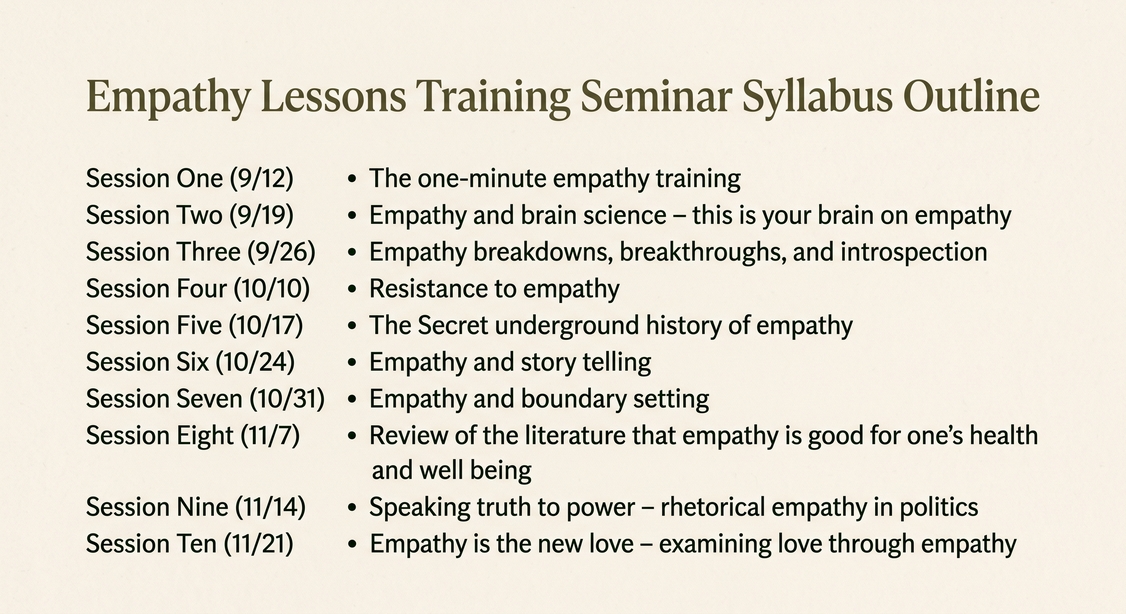
1. Introductions and Seminar Overview
- Time code: [00:02] – [05:46]
- Core Discussion Points:
- Edwin introduces Lou Agosta (author of A Rumor of Empathyand Empathy and Morality) and frames the interview within the Empathy Movement Training Curriculum initiative.
- Lou introduces his background: PhD from the University of Chicago, clinical assistant professor of psychiatry at Ross University Medical School / St. Anthony Hospital in Chicago.
- Lou highlights peer-reviewed clinical research demonstrating that physician empathy measurably improves patient outcomes (e.g., lower cholesterol, improved diabetes markers, reduced stress/inflammation).
- Outcome: Established the academic, clinical, and practical premise of the 10-week Empathy Lessons Training Seminar.
2. Defining Empathy and Philosophical Foundations
- Time code: [05:46] – [13:14]
- Core Discussion Points:
- Lou details the four core aspects of empathy: Receptivity (affective input), Understanding Possibility (recognizing who the person is beyond breakdown), Cognitive Perspective Taking (viewpoint), and Empathic Responsiveness (giving back what was heard for validation).
- Empathy Circles are acknowledged as a foundational gateway practice.
- Lou offers his central philosophical thesis: without empathy, there is no shared humanity (“the zombie apocalypse”). In parenting, teaching, medicine, and business, the other person calls forth the empathy in us.
- Outcome: Grounded the curriculum definition in a four-part relational process rather than a static trait.
3. Theory of Change and Overcoming Empathy Breakdowns
- Time code: [13:14] – [20:25]
- Core Discussion Points:
- Lou presents his “one-minute empathy training”: drive out aggression, bullying, prejudice, and negative politics, allowing empathy to expand naturally.
- Lou argues that “there is enough empathy to go around,” drawing an analogy to global food production (Norman Borlaug and the Green Revolution)-starvation and empathy deficits occur because resources are withheld, weaponized, or blocked.
- Outcome: Framed empathy development around clearing obstacles and blocks rather than manufacturing a scarce resource.
4. Personal Origins, Heinz Kohut, and Rigorous Empathy
- Time code: [20:25] – [33:20]
- Core Discussion Points:
- Lou shares the personal roots of his work: receiving bedtime storytelling empathy from his mother while dealing with a harsh, “boot camp” father.
- Studies at the University of Chicago during the rise of Heinz Kohut’s self psychology; working with colleagues Michael Basch, Arnold Goldberg, and Ernest Wolf.
- Defining “rigorous and critical empathy” (concept from Xavier Remy) as disciplined receptivity, interpretation, and responsiveness rather than sentimental (“kumbaya”) agreement.
- Being deeply listened to (by mentors, his mother, early partners, and psychoanalysts) demonstrated empathy’s life-altering impact.
- Outcome: Connected self-psychology lineage and experiential childhood background to the necessity of structured empathy training.
5. Course Structure, Safety, and Stress Reduction
- Time code: [33:20] – [38:59]
- Core Discussion Points:
- Overview of the course audience: broad applicability for leaders, mediators, educators, and anyone wanting to strengthen their “empathy muscle.”
- The seminar covers approximately 40 distinct empathy lessons across 10 two-hour sessions.
- Theory of change: “Transformation is instantaneous; change is hard work.” Empathy operates as a stress-reduction mechanism-getting heard is “like sinking into a hot bath” (quoting Kohut).
- Establishing safety through explicit agreements and confidentiality so participants can explore vulnerabilities without feeling forced to share.
- Outcome: Defined the seminar pedagogy as alternating 15-20 minute lectures with experiential sharing in a secure environment.
6. Walkthrough of the 10 Sessions (Part 1: Sessions 1-5)
- Time code: [38:59] – [58:49]
- Core Discussion Points:
- Session 1 (Definitions & Mind Reading): Exploring empathic receptivity vs. “mind misreading” (e.g., domestic arguments over toothpaste caps taking on distorted emotional meanings).
- Session 2 (Brain Science): Mirror neurons, stress pathways, and empathy as a non-pharmacological health intervention.
- Session 3 (Empathy Breakdowns): Four primary breakdowns-emotional contagion, conformity, projection, and communication loss. Emphasizing self-empathy as the foundation for repairing breakdowns.
- Session 4 (Resistance & Boundary Setting):Differentiating empathy from empathic distress/burnout. Critiquing Paul Bloom’s Against Empathy, arguing for both empathy and rational compassion. Taking a “six-ounce pour” (data sample) rather than drowning in someone else’s misery.
- Session 5 (Underground History & Aesthetics): Tracing empathy (Einf�hlung) from 19th-century German aesthetics and art history to psychology. Viewing people with the same reverence and care given to masterpieces.
- Outcome: Systematized the first half of the curriculum around scientific mechanisms, psychological pitfalls, and historical roots.
7. Walkthrough of the 10 Sessions (Part 2: Sessions 6-10)
- Time code: [58:49] – [01:13:00]
- Core Discussion Points:
- Session 6 (Storytelling & Spirituality): Exploring empathy through narrative (e.g., the Good Samaritan) and managing the vulnerabilities of the “natural empath.”
- Session 7 (Boundaries & Humor): Distinguishing healthy fences with gates from impassable walls (referencing Robert Frost). Examining how humor discharges tension through boundary-crossing, contrasting aggressive wit with respectful empathy.
- Session 8 (Trainability & Social Healing): Evidence showing empathy is a trainable skill; empathy as an essential social survival tool (“wear a parachute, use penicillin, lead with empathy”).
- Session 9 (Rhetorical Empathy & Speaking): Moving beyond empathic listening into empathic speaking and speaking truth to power. Analyzing Malcolm X (“Plymouth rock landed on you”), Abraham Lincoln, and Barack Obama.
- Session 10 (Empathy and Love / Racism): Examining the spectrum between soothing empathy and “tough love,” reflecting on Edwin’s dialogues with former extremists and Daryl Davis.
- Outcome: Completed the comprehensive overview of the 10 sessions, emphasizing expressive/rhetorical empathy and tough love.
8. Movement Building, Value Perception, and “Occupy Empathy”
- Time code: [01:13:00] – [01:22:30]
- Core Discussion Points:
- Gaps in the empathy ecosystem: Practitioners often hesitate to articulate the monetary and societal value of empathy. While empathy is a common good like clean air or water, professional empathy instruction must be valued.
- Reframing interpersonal conflict: Approaching difficult colleagues, challenging customers, or provocative relatives as one’s personal “empathy trainers.”
- Edwin’s proposal for “Occupy Empathy”: Expanding the Empathy Tent model from street fairs and political rallies to sustained public demonstrations (e.g., occupying legislative capitols until politicians engage in Empathy Circles). Lou expresses enthusiasm and willingness to support public actions.
- Outcome: Concluded with mutual appreciation and an agreement to collaborate on public empathy activism and curriculum development.
Empathy Movement Curriculum Insights
Mapping the concepts from this interview directly to the development modules of the Empathy Movement Curriculum
- Module 4: Definition of Empathy
- Four-Phase Model: Incorporate Lou’s four distinct phases into the curriculum:
- (1) Receptivity (mammalian affective communication),
- (2) Seeing the Person as Possibility,
- (3) Cognitive Perspective Taking, and
- (4) Empathic Responsiveness (testing accuracy: “Did I get it right?”).
- Abundance vs. Scarcity: Adopt the pedagogical stance that empathy is not inherently scarce; like food in the Green Revolution, there is enough to go around. Training should focus on removing systemic and psychological obstacles (aggression, prejudice, bullying) rather than treating empathy as an artificial commodity.
- Four-Phase Model: Incorporate Lou’s four distinct phases into the curriculum:
- Module 5: Deeper Empathy (Carl Rogers, Self Psychology, & Diagnostics)
- Heinz Kohut�s “Hot Bath”: Use the clinical framing that receiving genuine active listening lowers biological stress and soothes the nervous system, functioning as a primary non-pharmacological health intervention.
- Rigorous & Critical Empathy vs. Over-Identification:Teach boundary management via the “six-ounce pour”metaphor. Empathy is data sampling of another person�s experience, not merging or drowning in their distress. This provides facilitators with protection against compassion fatigue.
- Self-Empathy as Breakdown Repair: Embed exercises where participants identify personal triggers (e.g., emotional contagion, projection) and listen to their own internal reactions before attempting to reflect or engage with an external counterpart.
- Module 7: Conflict Resolution & Depolarization
- “Mind Reading” vs. “Mind Misreading”: Design exercises identifying how minor conflicts (e.g., toothpaste caps, household chores) get distorted into existential accusations (“You don’t love me”). Learning to de-escalate involves separating literal content from invented meaning.
- The “Empathy Trainer” Reframe: Train participants to view difficult coworkers, contentious family members, or ideological opponents not as adversaries, but as high-leverage “empathy trainers” for practicing active listening.
- Tough Love Spectrum: Position Empathy Circles along a developmental continuum that includes soothing listening on one end and assertive, boundaried “tough love” on the other when engaging with manipulative or bad-faith actors.
- Curriculum Innovation: Rhetorical Empathy (Empathic Speaking)
- Speaking Truth with Empathy: Expand the curriculum beyond active listening into empathic speaking (Session 9 in Lou�s seminar). Use historical examples (Malcolm X, Lincoln, Obama) to demonstrate how speakers validate audience experiences and cultural metaphors while delivering transformative, challenging truths.
- Movement Building & Public Activism (Occupy Empathy)
- Assertive Action (“Occupy Empathy”): Move beyond passive workshops by taking the Empathy Tent into high-stakes civic arenas. Establish direct-action campaigns (e.g., state capitols, public plazas) facilitating structured Empathy Circles between polarized political factions.
- Articulating Societal & Economic Value: Overcome reluctance around financial valuation. Empathy advocates must clearly articulate the tangible return on investment of empathy training in healthcare, business, and civic life.
- (c) Edwin Rutsch and the Culture of Empathy and Lou Agosta, PhD and the Chicago Empathy Project

Registration now open: Empathy Lessons Training Seminar (ELTS) Registration, Syllabus, Agreements
Empathy is oxygen for the soul. Short of breath? Maybe one needs expanded empathy. Get some empathy and expand yours in this seminar. A rigorous and critical empathy says: I know what you feel because I feel it, too, as a vicarious experience, not a merger. It is not as if parents, teachers, doctors, therapists, friends, and neighbors, needed an expert to tell them what empathy is. Ask any parent, teacher, behavioral health professional, and they practice empathy every day, even if they may not always be able to say it out loud. This seminar brings forth what you already know about empathy – what you have already learned since you could not survive without empathy – and expands it with abundant tips, techniques, and real-world transformation in exercising empathy as a power and practice.
A detailed outline (syllabus) of the seminar, benefits you will obtain by participating, and agreements for participants follow inline.
Here is how to register: click below (ELTS):
Empathy Lessons Training Seminar Syllabus Outline – this is the outline of the seminar
Empathy Lessons Training Seminar (ELTS)
Empathy is oxygen for the soul. Short of breath? Maybe one needs expanded empathy. Get some in this seminar: I know what you feel because I feel it, too, as a vicarious experience, not a merger. It is not as if parents, teachers, doctors, therapists, friends, and neighbors, needed an expert to tell them what empathy is. Ask any parent, teacher, behavioral health professional, and they practice empathy every day, even if they may work on how explicitly to bring forth what they know. This seminar brings forth what you already know about empathy – and expands it with abundant tips, techniques, and real-world transformation in exercising empathy as a power and practice.
Schedule: Every Saturday for ten weeks Sept 12, 2026 thru Nov 21, 2026 at 11 am CDT – starts after Labor Day (USA) and ends before Thanksgiving (USA) via Zoom
Seminar Syllabus Outline:
Session One: The one-minute empathy training.
Talking points:
- Personal note: The beginning of my empathy training
- The multi-dimensional definition of empathy
- Empathic receptivity and vicarious experience
- Empathic understanding—understanding of possibility
- Where there is “mind reading” there is “mind misreading”
- The folk interpretation of empathy: Top-down empathy
- There is enough empathy to go around, even though it does not seem that way on most days. Why is that?
Session Two: Empathy and brain science – this is your brain on empathy
Talking points:
- Mirror neurons – what are those?
- Stress and inflammation: Some is good, too much is not
- Social stress enters the body through the immune system
- Connecting the dots: stress and inflammation
- Connecting the dots: anti-inflammation and empathy
- Empathy as a “Miracle drug”
- Empathy is a spa treatment for the soul
Session Three: Empathy breakdowns and introspection
Talking points:
- Emotional contagion is failed empathy
- The analogy of optical illusions with empathy breakdowns
- Empathic receptivity breaks down as emotional contagion
- Empathic understanding breaks down as conformity
- Empathic interpretation breaks down as projection
- Empathic response breaks down and gets “lost in translation”
- Introspection is the royal road to empathy; be introspective
Session Four: Resistance to empathy
Talking points:
- Overcome resistance to empathy, and empathy expands
- Train and develop empathy by overcoming the obstacles to empathy
- “Listen from possibility” rather than listening from a “position X”:
- Distinguish between what happened and what one made it mean
- Empathy is a tuner or dial, not an “on-off” switch
- Empathy is a method of data gathering about the other person:
- Be generous with acknowledgement
Session Five: The Secret underground history of empathy
Talking points:
The distinction “empathy” was a part of sympathy, fellow feeling, vicarious feeling, communicability of affect in aesthetics and art history, and storytelling is discussed through different methods of inquiry. The session includes short selections from the philosophers, phenomenologists, and psychoanalysts
- David Hume,
- Immanuel Kant,
- Theodor Lipps,
- Sigmund Freud,
- Heinz Kohut,
- Husserl/Edith Stein,
- Max Scheler
Session Six: Empathy and story telling
Talking points:
And, yes, we are going to tell some stories.
- The “Natural Empath”: Caught between nature and nurture
- The Good Samaritan meets the Natural Empath
Examples of empathy from World Literature including
- Toni Morrison
- George Eliot (Marion Evans)
- Thomas Mann
- Albert Camus
- Goethe
Session Seven: Empathy and boundary setting
Talking points:
- Get your power back through empathy
- Establish and maintain firm boundaries between the self and the Other in relating empathically – but do not forget to practice being inclusive
- Empathy deescalates anger and rage
- Empathy is the ultimate anti-bullying anti-dote –
- When (why) empathy doesn’t work with bullies, psychopaths, and the criminally insane – and what to do about it
- Empathy is closely related to humor
- Empathy lessons are everywhere
Session Eight: Review of the literature that empathy is good for one’s health and well being
Talking points:
- Empathy is trainable – practice, you get better at it
- The empathy exams
- What counts as evidence that empathy works?
- Evidence-based empathy
- Jumping out of an airplane – be sure to wear a parachute
- Common factor, empathy, in social healing practices
Session Nine: Speaking truth to power – rhetorical empathy in politics
Talking points:
- Truth versus politics
- The first instance of fake news—ever
- Empathic receptivity soothes anger and rage
- Empathic understanding discloses political vision
- Empathic interpretation engages intractable problems
- Rhetorical empathy: Empathic responsiveness
- Malcolm-X’s rhetorical empathy
- John Stuart Mill’s rhetorical empathy
- Governor Altgeld’s rhetorical empathy
- Ronald Regan’s rhetorical empathy
- Lincoln’s rhetorical empathy
Session Ten: Empathy is the new love – examining love through the lens of empathy
Talking points: So If empathy is the new love, what then was the old love?
- Defining Our Terms: Love and Empathy
- Empathy and love have characteristic breakdowns
- The unbearable lightness of empathy
- Design defects of the male brain
- Women and men want the same things—but differ in priority
- The desire of desire
- The Positive Aspects of Love as Empathic Relatedness
- From Death in Venice (a story) to Empathy in Venice
- Love as a boundary issue: Empathy as a soothing balm
Top Benefits of the Empathy Lessons Training Seminar – these are the benefits –
The answer is empathy – so what’s the question? Stress pushes people down into survival. People stress other people, being difficult to deal with at home, on the job, in school, or at leisure with friends. In the Empathy Lessons Training Seminar (ELTS) the participants get an opportunity to engage directly the obstacles that stopping them from getting the empathy. Participants acquire the empathic responsiveness needed to experience satisfaction in relationships of all kinds, personal and professional. Participants overcome the obstacles to effective relationships and shift out of survival mode and into empathic responsiveness in which fulfillment and satisfaction occur that did not previously seem possible.
The top benefits of the empathy lessons training seminar that the participant will receive include expanded empathy and –
1. reduced conflict in one’s life and one’s organization, reducing dignity violations, shame, and related anger and rage
2. expanded power and freedom in the face of resistance, no agreement, or bullying
3. reduced time to results in personal and professional projects, expanding teamwork
4. expanded listening one other individuals and to oneself
5. expanded results in personal relationships
6. reduced compassion fatigue, burnout, professional cynicism or denial
7. expanded cooperation in one’s personal and professional relations, increasing satisfaction with one’s individual and organizational goals
8. the ability to be with another person no matter how difficult an individual
9. the ability to distinguish what happened from what one made it mean
10. ability to like people and be with people regardless of background
11. distinguishing empathy effectively from compassion, altruism, and charity (they are not the same!)
12. the ability to recognize and acknowledge the humanness in oneself and others even in extreme situations
13. the ability to set boundaries in relatedness and navigate boundaries with finesse and skill – for example, in dealing with bullies
14. the ability to shift your empathy from being an “on off” switch to being a rheostat that dials empathy up and down as a filter
15. expanded humor, creativity, appreciation of art, and wisdom – all closely related to empathy – relationships, teamwork, and leadership
Also note:
Participants will get the most value from attending all the sessions. However, for those with scheduling challenges, it is not required to attend every session because every session (except the first) contains a short upfront review of terms and what the participant needs to know to get value from the work.
The Empathy Lessons Training Seminar [ELTS] may be delivered as a stand-alone ten session class for participants who register individually. Alternatively, the ELTS may be delivered as part of an empathy consulting engagement. The organization’s team members are separately interviewed, confidential feedback aggregated anonymously and presented to the leadership, and group work on problem solving, conflict resolutions, issue handling, proceeds in parallel with large group work and small group breakout sessions under the guidance of the organization’s leadership.
The benefits of the ELTS are most available to participants who attend all the sessions. People may selectively attend one or more session and still obtain significant benefit. Naturally, attending more sessions will result in expanded benefits. Whatever you do you are going to get empathy, and, no surprises here, you get out of it what you put into it.
Empathy Lessons Training Seminar (ELTS) Agreements
The Empathy Training Seminar (ELTS) is delivered through Alleingang, Inc., an Illinois Chapter C corporation, Lou Agosta, PhD, President, responsible for providing diverse services in education, consulting, and publishing. The trainer is Lou Agosta. The participants are the individuals who sign up, pay the fee, agreement to these agreements (hereafter: Agreements) and attend the training.
The ELTS is a ten session, structured conversation designed to expand empathy in the participant and in the community. The ELTS occurs as a two-hour session for ten weeks for a total of some twenty hours.
The ELTS training material distributed to the participants is copy-righted material and the conversations that occurs in the seminar are confidential and for the personal use of the participants. It may not be recorded, copied, taped or otherwise captured to electronic media. Any notes taken by the participants are only for the personal use of the participants and may not be published, sold, or otherwise redistributed under any circumstances.
The ELTS is committed to creating an environment where people have the freedom to express themselves and participate without restrictions. Therefore, the ELTS requests that you keep the names and details of what people say in the ELTS confidential. Participants will be separately asked to sign a document in which the person agrees to keep the names and details of what people say in the ELTS confidential, and such signature is a requirement for participating in the ELTS.
Further detailed agreements and background are specified in the online agreement document. The person considering participating is asked to review all these additional agreements carefully, let the trainer (LouAgosta@gmail.com) know of any questions or concerns, and agree to the agreements in completing the registration process.
Consistent with good business practices and current law, Alleingang, Inc. does not tolerate sexual harassment or other forms of harassment in any of our training programs or events. If you have any questions about our policies regarding sexual or other forms of harassment, please contact Lou Agosta (773-203-0269).
The participant hereby agrees to (in the following “I” – “my” – and so on refer to the participant):
- To be on time for my sessions as scheduled
- To discuss and say what is on my mind and what is going on in my life without editing or holding back – to just tell the truth
- Same idea as above – to be straight about what I am thinking and feeling – regardless of its significance or lack of significance to me or even if seems embarrassing or trivial
- If I have an emergency (for example, serious illness, life event, two feet of snow), then I will communicate as soon as I know about it
- If I have a complaint, concern, or issue with the empathy consultant or with the process of training, then I will come into my session and talk about it to resolve it
- I understand that on occasion empathy consulting requires me to consider and discuss confronting and difficult personal matters, including but not limited to my own behavior, blind spots, and thoughts
- To pay the fee agreed upon for the ELTS with the understanding that it is nonrefundable
- To pay the fee agreed upon for the ELTS with the understanding that it is nonrefundable, though in the event of an authentic emergency a reasonable effort will be made to include the participant in a similar (“substitute”) future session
- To be responsible for my health and well-being at all times, in participating in this work
I acknowledge that our conversation and the ELTS are confidential and have received this written statement of confidentiality. Exceptions to confidentiality include [but are not limited to] if the trainer believes the participant is hurting or plans to hurt her- or himself or another person, for example, requiring summoning emergency [911] services. Then confidentiality would not apply.
By entering one’s name and date and related identifying data on the separately published ELTS form, the participant agrees to the Agreements
Here is how to register: click below (ELTS):
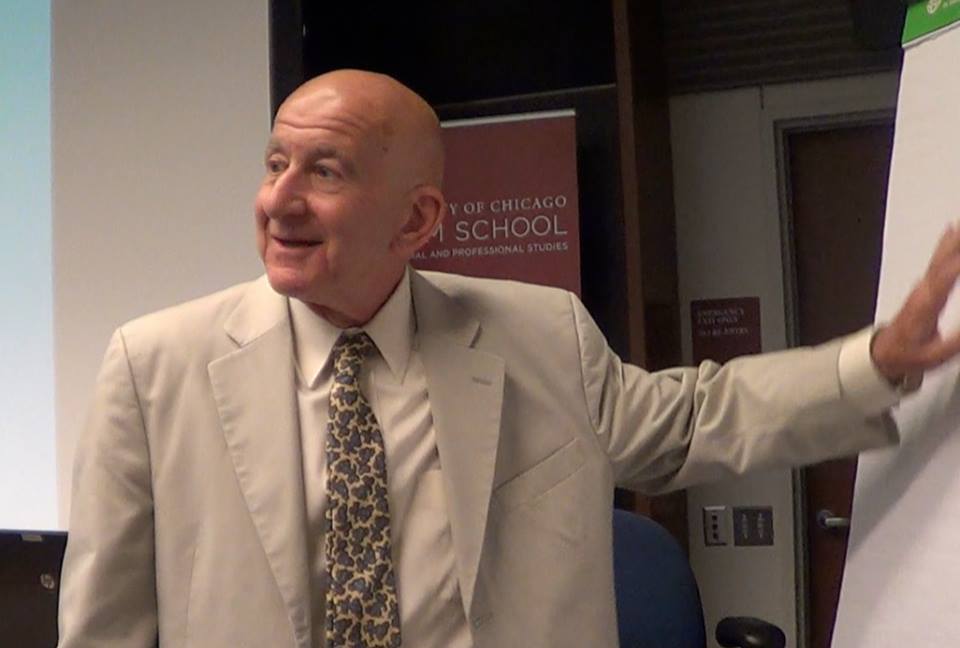
Image Credit: photo by Alex Zonis of Lou Agosta, PhD making a presentation on the Secret Underground History of Empathy on November 13, 2015 at a local Chicago adult education program.
(c) Lou Agosta, PhD and the Chicago Empathy Project

Empathy lesson: Take the other person as your empathy trainer
As an exercise, consider that the other person is one’s empathy trainer. The other individual calls forth one’s empathy. If the Other behaves in a challenging way, the challenge is to one’s empathy. If the other person is in an emotional meltdown, the challenge is to one’s empathic receptivity. If the other person is a conformist, the challenge is to one’s empathic understanding.
Listen to this blog post as a podcast. (There may be minor differences in phrasing between the written and spoken versions as this is not a transcript.)
If the other person is accusatory, projecting hostility, or just hard to figure out, the challenge is to one’s empathic interpretation. If the other person’s self-expression is lost in translation, the challenge is to one’s empathic responsiveness.
If the Other is a difficult individual, the challenge is to one’s empathic relatedness. This gives new meaning to the empathy exams. Think of the “secret shopper,” who tests the sales person’s customer service skills, even if the test is just to set boundaries.
This business of taking the other person as one’s empathy trainer is an indirect reference to a wonderful essay (really a memoire-like story) by Leslie Jamison entitled, “The Empathy Exams,” by which this conversation is inspired, is about Jamison’s experiences working as a medical actor. [i] A medical actor is a person who is hired by a medical school to learn a script. The medical actor portrays a person who has a particular disease. Jamison’s narrative about her work as a medical actor is humorously (and movingly) interwoven with an illness of her own with which she is suddenly confronted.
The medical actor’s script contains instructions: “Your first line is: ‘I’m having these seizures and no one knows why’.” The backstory in the script, which the actor must memorize, is that there is nothing physically wrong with the patient. She has a hysterical personality disorder.
The medical student being examined is graded on how close he or she comes to “nailing” the diagnosis through diagnostic questioning. However, more to the point here, the exam is about whether the medical student’s manner of interacting with the patient is warm, cold, energetic, apathetic, authoritarian, indifferent—or empathic.
The empathy exam is included as part of the feedback provided by the medical actor that goes to form the medical student’s grade. Examining someone—giving a person a test—on something implies that the result can be improved by, training, feedback and practice. One looks for areas for improvement—that is the point of education.
The empathy exams that medical students take are a reality. But even before these real-world empathy exams, a celebrated science fiction novella included an empathy exam. A masterpiece ahead of its time, Philip K. Dick’s negative fantasy of the future Do Androids Dream of Electric Sheep (1968) received widespread coverage when made into the movie Blade Runner (1982), starring the young Harrison Ford as the bounty hunter, anti-hero, Rick Deckard. [ii]
In Dick’s celebrated novella, six bioengineered replicants (robots), who are virtually indistinguishable from human beings, have escaped from their assigned location on Mars. They have returned to Earth in an attempt to find their designer, and, force him to postpone their auto-destruction coding. They do not want to be retired—that is, they do not want to have to die. What is the one difference between humans and replicants? The replicants lack empathy.
In the context of the narrative, empathy is detectable by an empathy test, the “Voight-Kampff exam.” No such exam exists. This fictional exam uses a mechanism that is similar to a lie detector as it captures physiological data in response to empathy inspiring questions. For example: “You see a tortoise on its back in the hot sun with its legs flailing helplessly in the air. It cannot turn over without your help. How do you feel?” Or “A little boy shows you his butterfly collection plus the killing jar. What do you feel? What do you say?”
If the individual being interviewed (suspected of being a replicant) produces particular responses—accelerating respiration, blush, heart rate, eye movement, galvanic skin response—then empathy is present. The interviewee is human, not replicant.
Now the narrative twist that elevates Dick’s story above the average science fiction yarn is that, as the story unfolds, the humans become less empathic and the replicants more so. The replicants make a contribution to the community, are altruistic and socially useful, whereas the bounty hunter, who is trying to “retire” them, behaves increasingly aggressively, selfishly, manipulatively, anti-socially, even psychopathically. His conscience and his empathy are in retreat.
What is limiting about Dick’s otherwise visionary account of empathy is that the protagonist and other characters in the narrative believe that empathy is invariable. You either have it or you don’t. However, the development of the plot provides evidence that exactly the contrary is the case. Empathy expands in one case, contracts in another.
Rick Deckard starts out as a human with nuanced emotions. But as he continues killing in his role as bounty hunter, he becomes less empathic, more and more hard-hearted. The replicants, who are attempting to flee from their fate, behave with expanded empathy—and humanity.
The powerful irony is that the replicants end up being more human than the humans. In spite of what some people may believe, based on practices and actions, a person’s empathy expands—or shrinks. This is further evidence that empathy is trainable – one training tip and technique is to take the other person – regard the other person – as one’s empathy trainer.
Now let us take a step back and continue to engage with the empathy lesson. This approach is generalizable. “In any encounter with another, consider the other person as one’s empathy trainer.” The newborn baby trains the parent in how to be empathic; the student trains the teacher; the patient, the doctor; the client, the consultant; the customer, the business person selling the product or service; the neighbor, the stranger; and the audience, the speaker.
This may sound backward and paradoxical. However, by standing things on their head—the customer trains the business person in empathy, the student trains the teacher in empathy, the infant trains the parent in empathy and so on—we get a surprisingly refreshing view of how empathy makes a difference. The survivor is rescued by the Good Samaritan; but the Samaritan is humanized by—gets his humanity from—the survivor, even in addressing the survivor’s temporary loss of humanity as a suffering lump of battered flesh. The baby, the student, the patient, the customer, the neighbor, are the individuals who bring empathy into existence for the parent, the teacher, the business person, the neighbor, respectively.
Note this give new meaning to the term “dialectical” as in Marsha Linehan’s innovative treatment of Dialectical Behavioral Therapy (DBT). “Dialectical” refers to an apparent contradiction – the baby trains the parent, the customer trains the business person – which upon examination is actually a breakthrough in relatedness.
Without the baby, there is no parent. Without the parent, there is no empathy with the baby. The baby calls forth the parent’s spontaneous and natural empathy. The baby creates a clearing for parenting to show up as empathic or non-empathic or something in-between.
Without the customer, there is no business or business person. Without the business person, there is no empathy with the customer. The customer calls forth the business person’s natural and spontaneous empathy. The customer creates a clearing for the encounter with the business to show up as empathic or non-empathic or something in between.
Without the patient, there is no medical practice or medical doctoring. Without the MD, there is not empathy with the patient. The patient calls forth the MD’s natural and spontaneous empathy. The patient creates the clearing for the encounter with the doctor to show up as empathic or non-empathic or something in-between. Likewise, with the teacher and student, client and consultant, and neighors in the community.
However, surely the baby does not give a lecture with a Power Point. The baby needs to be on the receiving end of empathy before she or he can develop an ability to be empathic in an intentional way towards anyone else.
Though the empathic sensitivity of children should not be under-estimated, this is an important consideration. We must be recipients of our parents’ and care-takers’ empathy before we are able to turn around and provide empathy to Others, even as we practice empathy in immature, emerging, and developing ways as we grow up.
Yet even without being self-aware, the baby provides an opportunity and possibility for the parents’ empathy lessons. The baby provides a clearing for empathy lessons for the parents even without meaning to do so. The baby creates the possibility of empathic parenting by the baby’s readiness to become human, which at first shows up as a distinct lack of socialization. The baby cannot feed itself and empties its processed waste into its diapers.
The parent socializes the baby; the baby humanizes the parent, calling the parent not just to its role as parent (though it does that too), but also to its possibility as a human being in a committed relationship to another emerging human (the baby) through trial and error. The baby, by its very existence, gives the parent his humanness, making the parent into an inquirer into what it is to grow up, developing from an immature baby into an adult human.[iii]
Likewise, with the business customer: The customer does not tell the business owner, “I have a need but can’t explain it to you.” Instead, the customer just keeps shopping around. The customer does not tell the business person, “I have a complaint about the service, and I want you to listen to it and make amends.” Instead, the customer just takes his business to the competition.
In each case, the empathy lesson is a challenge to the would-be parent, teacher, sales person, consultant, therapist, nurse, attorney, taxi driver, neighbor, and so on, to expand one’s receptivity, enhance one’s grasp of the possibilities, appreciative different points of view, and practice rapid empathic response.
If each of these persons—parent, teacher, business person, neighbor, and so on—begin in any other way than with empathy, they are headed for trouble. The challenge is straightforward: expand one’s listening to include the other individual in the empathic community or fall back into empathic distress; relate from possibility or get mired in stuckness; work on building community or wander aimlessly in the emotional wilderness.
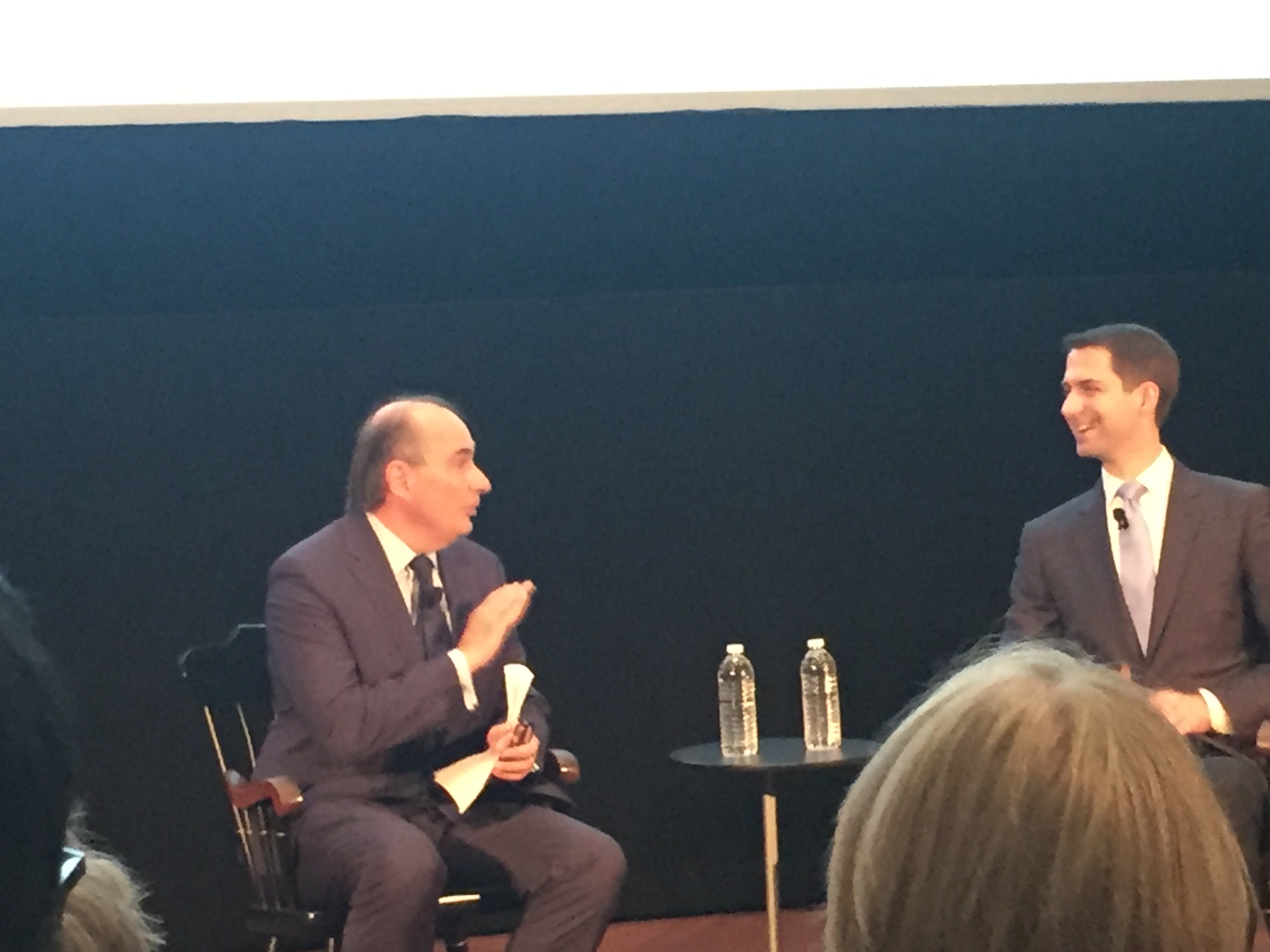
Episode art photo credit: David Axelrod interviews (confronts, debates, talks to) Senator Tom Cotton June 2, 2017 in a photo taken by Lou Agosta at the University of Chicago public debate. As one of the architects of Barack Obama’s presidential program, Ax (as he is affectionately known) would be likely to disagree with many of Senator Cotton’s more-or-less MAGA-oriented views. Take the other person as your empathy trainer! I believe both did!
(c) Lou Agosta, PhD and the Chicago Empathy Project
Notes
[i] Leslie Jamison. (2014). The empathy exams in The Empathy Exams: Essays. Minneapolis: Graywolf Press: 1–27.
[ii] Philip K. Dick. (1968). Do Androids Dream of Electric Sheep? New York: Ballentine Books, 1981.
[iii] Lou Agosta. (2010). Empathy in the Context of Philosophy. London: Palgrave: 60–61.
(c) Lou Agosta, PhD and the Chicago Empathy Project
Empathy SELLS – but empathy’s limitations sell even better
As a popular trend, empathy peaked in 2009 with the publication of the late Franz de Waal’s now classic The Age of Empathy. De Waal goes on to profile “Our kinder, gentler [Bonobo ape] ancestors” on Oct 3, 2009 in the middle column of the then largely still hardcopy Wall Street Journal,” casting doubt on the “killer instincts” of our early humanoid ancestors. De Waal’s essay champions the position that this aggressive and over-sexed species, human beings (homosapiens), is capable of empathy, compassion, altruism, gratitude, generosity, and such “pro social” attitudes. Fast forward a decade and a half.
Listen to this podcast on Spotify:
https://open.spotify.com/episode/5H74frDb1M8df58c9IjddG?si=Mp1D99JoTxyfCsQYm1ItkQ
Empathy still sells and is honored and advocated as a powerful intervention to deescalate aggression and conflict. A rigorous and critical empathy still champions the many successful applications of tough love, red teaming, hard empathy, and limit setting while acknowledging the limitations and the ways that empathy can break down, including phenomena such as emotional contagion, projection, conformity, messages getting lost in translations, in the trials and errors of being empathic. A rigorous and critical empathy is committed to doing the hard work of overcoming these break downs and misfirings in order to relate authentically and in integrity to the other individuals and the community.
But if empathy still sells, its limitations sell even better. The latest trend is to denounce empathy as a weakness and a danger to western civilization. Gad Saad’s Suicidal Empathy (2025) goes further than the initial wave of anti-empathy advocates such as Paul Bloom (2016), Fritz Breithaupt (2017), Glenda Carpio (2023), and Namwali Serpall (2019). With Saad, the recommendation is not that one should apply rational compassion rather than empathy (Bloom) or deploy “enlarged thinking” (Carpio “channeling” Hannah Arendt) instead of empathy or that empathy is a kind of “slave morality” masquerading as kindness (Breithaupt). Rather “empathy” should be added to the list of “pro social” characteristics such as altruism, compassion, charity, generosity, gratitude, helping those in need, being kind to animals, turning the other cheek, and so on (even though empathy is not an emotion as such but a form of emotional communication among other things). Throw them all under the bus. Being kind makes you and your community a sucker, and as P.T. Barnum, the founder of the Ringling Brothers and Barnum & Bailey Circus, famously noted, “There is a sucker born every minute.”
The anti-empathic advocates offer a thought experiment: If you are in an overcrowded life boat after your ship sank, then taking on further survivors may cause the boat to sink, and everyone will perish. Don’t be an empathic sucker; push the competition under. If you do not do so, you are at risk of (drum roll): suicidal empathy.
What is overlooked is that this “thought experiment” is a set-up and is a double bind. Given the rock and the hard place, the devil and the deep blue sea, the damned if you do and damned if you don’t, it is the reason the ancient Greeks invented tragic theatre. Life often presents people with unfair choices. Life presents choices that no one should have to make, that no one can make, though doing nothing is also a choice. The thought-experiment starts by taking away one’s agency. You are in a life boat, and it is because your ship sank. You do not need expanded empathy; you need rescue. “Women and children” first” is the rule in any abandon ship scenario. In an extreme situation, this sounds like the captain and crew providing the empathic leadership required of them. That is the empathic moment, not “shoot the survivors.” The “take down” of Saad’s Suicidal Empathy requires an article of its own. One is available, though it is not a book review as such (though one is in preparation) see: “Suicidal empathy is in the news. . .” by Lou Agosta: https://louagosta.com/2026/05/22/suicidal-empathy-is-in-the-news-what-you-need-to-know-to-debunk-the-anti-empathy-skeptics/ ) Finally, for a detailed discussion and critique of the anti-empathy cohort prior to Saad see the prepublication version of Chapter 3: Empathy and its discontents from Lou Agosta, (2025), Radical Empathy in the Context of Literature(click here to download). Selected sections of the following are based on this chapter.
The very idea that our civilization at risk due to an excess of empathy is so laughably absurd and “out there” as to give pause that the advocate of the idea may perhaps be delusional. This is the same civilization (“the West”) that brought us two world wars, the Armenian Genocide, Auschwitz, Hiroshima (“seemed like a good idea at the time”), the war on terror (“seemed like a good idea at the time”), “forever” wars in the middle east, Chernobyl, the internment and annihilation of ethnic and racial groups too numerous to list here, and this civilization is suffering from an excess of empathy? Granted that the vast majority of people are empathic people devoted to family, career, community and country, Saad and his fellow travelers are sensationalizing empathy’s acknowledged limitations by throwing a rotten tomato at it. One can always make a splash by throwing a rotten tomato. If Saad had said, empathy doesn’t work with psychopaths, antisocial personality disorder, bullies, corrupt politicians, and the criminally insane, then it would be easy to agree with the position. With such individuals and groups, one must set firm boundaries, define forceful limits, call for backup, and speak truth to power.
Unfortunately, once a “policeman” is kneeling on your neck or someone throws a bomb, it is too late for empathy. The perpetrator fails the readiness assessment for empathy and it is necessary to invoke self-defense. And remember the best defense is a good offense—provided that it is proportionate to the incoming violence (which is notoriously hard to determine). Self-defense, setting limits, establishing boundaries are what is needed.
Furthermore, Empathy 101 teaches that empathy does not work on an active battlefield, or if one is starving to death, or hanging upside down in a torture chamber. Never underestimate the power of empathy—never—but empathy in such extreme situations ends up looking like what the FBI Hostage Negotiating team uses to open communication with the hostage takers, or looking like “Red Team, Red Team!”—think like the opponent in a war game (on Red Teaming see Zenko 2015). What then is the source of resistance to empathy?
Taking the debate up a level from any particular author’s book, let us consider the causes of resistance to empathy. First, the listener or would-be empathic person does not want to make him- or herself vulnerable to the upset, emotional disequilibrium, or trauma of the struggling individual who is narrating sharing his or her struggle.
Note that all the things said here about resistance to empathy can also be said about compassion, altruism, kindness, generosity, gratitude, and the related set of pro-social attitudes. If the empathic person risks “empathic distress,” the compassionate person risks “compassion fatigue.” All the helping professions and first responders are at risk of a kind of “burn out,” affective depletion, or using up of one’s emotional resources. That means that professional self-care is an essential part of the commitment to service and that those playing the Long Game of expanding empathy in the community have in place practices to renew their emotional resources.
Resistance to empathy on the part of the listener is resistance to being affectively flooded, overwhelmed or otherwise put at the effect of excessive stimulation of a negative or even positive kind, which in excess can be painful. For example, who would want to empathize with a person such as Geheimrat Daniel Paul Schreber at the height of his psychotic breakdown?[1] No one. However, in order to make a difference in helping Schreber it would be useful to get a taste of his distress, a sample of his fear, a vicarious experience of what he experienced as if in the theatre or film. So, if one is overwhelmed by emotional contagion, whether by empathic distress or compassion fatigue, then one is doing it wrong. One needs to take a sample of the other person’s distress, not the full-blown trauma itself. In empathizing, one needs to “tune up” one’s vicarious experience of the other and “tune down” one’s merger with them. This takes practice and even trial and error. Nevertheless, this is a real issue.
Given the level of empathy training, rare is the person who has enough control over their empathy regulation to tune it up or tune it down based on a continuum of disturbances varying from the mildly, everyday neurotic to the deeply psychotic. Note, however, that the antidote is expanded empathy. This bears repeating. If empathy is limited or parochial, then the solution is not to discard empathy to expand it, thus expanding inclusiveness and community.
Resistance to empathy also comes from the person who is the would-be recipient of empathy, compassion, etc. Pain and suffering can become a bad habit. The struggling individual is attached to their pain and suffering and these have become a kind of “comfort zone.” So letting go of the pain and suffering is itself more painful than the present pain. Letting go of the pain and suffering is filled with more pain and suffering than the person is willing to confront. As Marsha Linehan, the innovator in dialectical behavioral therapy (DBT), famously noted, the way out of hell is through misery. Overcoming the bad habits, blind spots, and maladaptive behaviors that are the causes of a person’s suffering requires struggle and effort that is itself a kind of misery. Who wants to hear that? No one. Better to stay in one’s comfort zone of discomfort. Furthermore, overcoming one’s limitations and getting the empathy, dignity, respect, and recognition for which one is so hungry risks an encounter with the Unknown – new possibilities which have not been previously available both for success and failure – and the unknown is the most anxiety inspiring thing possible. Hence, further resistance to empathy.
Finally resistance to empathy comes from institutional inertia, namely, the faceless unempathic bureaucracy that seems to live in every call center, customer service desk, government function, or need for trouble shooting with a new appliance, computer interface, or product return. Any business person knows that customer service requires empathy. This is one place where “empathy sells, and empathy’s limitations sell even better” is completely and patently false. Lack of empathy sends the customer to the competition (and the customer will not even tell you about it – you will just be out of business!).
If Gad Saad is complaining about the fake empathy at many customer service desks and call centers and sales pitches (in general), then we are in agreement. Unfortunately, he is not – he seems really to be anti-kindness and anti-empathy along the lines of “what doesn’t kill you makes you stronger” – even amidst a growing body count. In addition, one should not overlook that all-purpose tip and technique of “fake it till you make it.” Working from the outside inward – from practicing empathic behavior even if one’s feeling lag behind – is a proven method of “boot strapping” oneself into new skills and positive habits.
Regarding “what doesn’t kill you makes you stronger,” that notorious “bad boy” Friedrich Nietzsche called such qualities as altruism, compassion, charity, and pro social attitudes aspects of “slave morality,” tips and techniques that those out of power can use to get power. Note that Nietzsche never mentioned the word “empathy,” but engaged with related phenomena such as altruism, charity, and so on. What is so wrong with the disempowered trying to expand their power? Since the ruling class are not volunteering to give up power, how else would anyone get power than by strategizing and struggling? What is wrong with the poor, the disadvantaged, the marginalized, the survivors of domestic violence, refugees from conflict zones and natural disasters, the early Christians with whom the Romans literally fed the lions (this list is not complete) getting back some of their power? Was the USA – and the sitcom theme song “Movin’ on Up” – not premised on struggling African Americans, immigrants, and the marginalized getting a “piece of the pie”?
I cut to the chase. The criticism of empathy as “suicidal empathy” is a new form of Social Darwinism. What the heck is Social Darwinism? The short version of Social Darwinism is the wolves saying the sheep should have more understanding for the wolves. “We wolves are very hungry. Have empathy for us and come here and let us bite your neck.” It is the masters in the manor house saying the slaves in the dirt-floored cabins out back should be more sympathetic towards the masters. “The burdens of leadership are hard, and riding shot gun over a chain gang of enslaved workers in the hot Mississippi sun is not easy.” The admittedly simplistic account of Neo-Social-Darwinism in the context of survival of the fittest is: if you get “extinguished,” then you deserved it. Well, not exactly. It means in a high stakes game of random variations and natural selection, you drew the short straw. If you were born in poverty, in a conflict zone, in a land rendered uninhabitable by rising waters, forest fires, or climate change, you did nothing to deserve your pain and suffering. This is the classic dilemma of bad things happening to innocent people, which all world religions and most philosophical systems attempt to address in different ways. Empathy alone is not going to fix the problem of evil and suffering, but, I maintain, empathy is called forth by these and is an important part of the solution.
Further background on what we might formally label as Neo-Social-Darwinism: In the Gilded Age of the robber barons of capitalism, when Rockefeller’s Standard Oil company forced small competitors out of existence using monopolistic, anti-competitive, and corrupt business practices, Standard Oil justified the action by saying “survival of the fittest.” That is Neo-Social-Darwinism. For example, when in 1894 railroad workers went on strike in Chicago for better wages, health insurance, an eight-hour day, and working conditions (sounds familiar?), US President Grover Cleveland called out 15,000 US Army (federal troops) on July 3, 1894 to break the strike under the pretext that it was preventing delivery of the US mail.
Here is another example of abuse of power to further undemocratic ends: On April 20, 1914, the Colorado National Guard and guards of the Rockefeller-owned Colorado Fuel and Iron Company (CF&I), surrounded and attacked a tent colony of 1,200 striking miners, ultimately killing over 20 men, women, and children by randomly firing machine guns into the camp before burning it all down. The massacre caused a national outcry, violent sympathy strikes (the “Ten Days War”), and congressional hearings that disgraced the Rockefeller family’s public image. The miner’s families, however, were still dead. (See “The Ludlow Massacre”: https://en.wikipedia.org/wiki/Ludlow_Massacre.)
Not to minimize the abuses of power and rampant corruption in the current executive branch and Washington, DC, at large (Q3 2026), this is business as usual. Stephen Miller and Russell Voight, key policy architects and advisors to the current executive administration, seem to be studying the Grover Cleveland new gilded age play book and applying it to aspiring immigrants, diversity and inclusion, education, health care, and revisionist history that slaves were not so badly off. And if you believe that, I want to sell you the Brooklyn Bridge.
Full disclosure: I mistakenly subscribed to the view that no such thing as bad publicity existed, and I declined in 2018 (and up until 2023) to mention the anti-empathy authors by name, instead referring to an “evolutionary psychologist,” a “celebrity psycholinguist,” a prominent “Germanic studies” teacher, or a mandarin professor of comparative literature. Why give “free publicity” to views that were seemingly committed to inhibiting, contracting, devaluing, rather than expressing, expanding, and implementing the practice of empathy?
The gambit did not work. The devaluing of empathy got traction, perhaps driven by publishers whose market research, whether accurate or not, suggested that the sales of empathy books had peaked, and who proposed to keep the pot boiling with works that throw empathy “under the bus.” The challenge is that it is getting crowded under the bus. One can always make a splash by throwing a rotten tomato, and the would-be critique of empathy uncharitably takes the weakest version of empathy and refutes it. In contrast, a rigorous and critical empathy engages in a process of continuous improvement of empathy by “cleaning up” the empathic breakdowns of emotional contagion, projection, conformity, and communications lost in translation, resulting in the expansion of empathy in the individual and the community.
Yet another reason that the practice of empathy sells but empathy’s limitations sell even better is a consequence of empathy’s own success. Empathy works. Empathy makes a profound and lasting difference to those who are treated with empathy. But in the age of TikTok does empathy work fast enough? Empathy and its many successes are themselves the occasions for the skepticism, resistance, and embracing the obstacles to empathy. A rigorous and critical empathy can be hard work; being empathic can leave one vulnerable; better to take the easy way out. The reader may say, I want instant empathy, like instant coffee, just add hot water and stir. Wouldn’t it be nice? Nor is anyone saying such a thing as “instant empathy” is impossible. It may work well enough in a pinch; but like instant coffee, the quality may not be on a par with that required by a more demanding or discriminating appreciation and taste – or a more challenging situation.
The pervasive cynicism and resignation of the world are naturally attracted to attacking the sources of inspiration and strength, not those of enervation and stagnation. A treatise on “The Dark Sides of Violence” will sadly remain timely and relevant, but no one disputes the accuracy of the description. One does not need a treatise “Against Eating Dirt,” because few are inclined to eat dirt (and if one is so inclined, it seems be a sign of a vitamin deficiency).
This brings us to the poster child for devaluing empathy, Fritz Breithaupt’s The Dark Sides of Empathy (2017) (hereafter referred to as “Dark Empathy”). Breithaupt asserts on page 8 that to “uncritically embrace empathy without caveats” is the goal debunked by the end of this [Breithaupt’s] book. Those who “uncritically embrace empathy” are debunked. Just so. Please stop right there. Who proposed uncritically embracing empathy—or anything? Uncritically embracing empathy is not proposed here. Attributing uncritical thinking to the masters of empathy such as C. Daniel Batson (2009), Simon Baron-Cohen (2014), Frans de Waal (2009), Jean Decety and William Ickes (2009), Susan Lanzoni (2018), Micah Zenko (2015) (this list is not complete), is itself a concerning sign of lack of critical thinking. Dark Empathy is at best naïve and at worse disingenuous in imaging practitioners of empathy are uncritical or lack rigor. “Uncritically embracing empathy” sets up a strawman, and gives a green light to uncritical thinking.
The program of Dark Empathy is systematically and sensationally to attribute examples of empathic distress to the practice of empathy itself, charge empathy with these misfirings, and, going forward, invalidate and dismiss the practice of empathy. Instead of engaging with the hard work of self-inquiry into one’s own blind spots to overcome the obstacles and resistances to empathy, Dark Empathy takes the easy way out, discards empathy, gives up on it. It is like giving up on nutrition because the cook may put too much salt in the soup or burned the roast.
Dark Empathy properly lists many of empathy’s breakdowns, misfirings, and obstacles (as do practitioners of a rigorous and critical empathy). These include things such as emotional contagion, projection, conformity, messages getting lost in translations in attempting to be empathic. A rigorous and critical empathy is committed to doing the hard work of overcoming these break downs and misfirings in order to relate authentically and in integrity to the other individual. In contrast, Dark Empathy’s commitment seems to be to sensationalizing the failings of empathy, not demonstrating how empathy works (and does not work) in literature, politics, psychology, etc. Or rather the commitment is that empathy does not work (full stop).
If Dark Empathy would have stopped at page 8—empathy is what makes us human (or words to that effect) and elaborated on that position—then it would have made a useful contribution. The author really says it: empathy is essential to our humanity. However, empathy then breaks down into empathic distress. The issue is that human beings are frequently inhumane—not just a few bad apples, but as the Holocaust and Hannah Arendt taught us about the banality of evil, and the famous quote from the Nazi leader Heinrich Himmler, everyone has the potential for real badness, evil, even if few act on it. Therefore, dial back empathy, abstain from empathy? (See Hannah Arendt. (1971). Eichmann in Jerusalem. New York: Viking Press: 105–106; see also Lou Agosta. (2010). Empathy in the Context of Philosophy. London: Palgrave Macmillan: 73; this is the quotation from the Nazi Chief of the SS (Schutzstaffel) Heinrich Himmler and director of many of the genocidal programs against the Jewish people (and others) where he exhorts his men, seeming to demonstrate a kind of mutilated empathic understanding of how difficult it is to kill people and encouraging the executioners not to make any exceptions – and to kill them all. This is the paradigm case for a kind of “fiendish empathy” (as Heinz Kohut, MD, called it), and it might be redescribed as the breakdown of empathy in the presence of moral insanity and lack of integrity.)
Dark Empathy asserts sensible things about empathy up front, and then sensationalizes the negative and the resulting empathic distress by saying that empathic human beings perpetrate horrid actions. Accurate enough. Human beings are a difficult species. They are an empathic, caring, compassionate, and kind species as well as an aggressive, territorial, and rapacious one. Wouldn’t we want to work on expanding the former and inhibiting the latter?
That Roman soldiers drove nails through the limbs of the people they were crucifying does not invalidate the art of carpentry. Dark Empathy makes it sound like it does as it seemingly intentionally applies the same argument to empathy. Dark Empathy perpetrates a series of fallacies of numbing grossness by saying the forms of empathy are the motives for the horrid actions. This is not accurate. Aren’t the hidden variables aggression, uninhibited desire, territoriality (this list is not complete)?
The Dark Sides of Empathy succeeds in being provocative, even sensationalistic, identifying ways in which empathy can (and does) breakdown, misfire, and go astray. Yet The Dark Sides of Empathy is argumentatively uncharitable (in Donald Davidson’s sense): it uses the weakest versions of the empathy advocate’s arguments, not the strongest. On background, the analytic philosopher of language Donald Davidson innovated in defining a “a principle of charity”.
The principle of (argumentative) charity goes beyond honest translation or statement of an argument, as noted, asking the thinker to engage with the strongest version of an argument rather than intentionally weaking it through setting up a strawman or a distorted, ambiguous representation of the argument. (On “argumentative charity see: Donald Davidson. (1973). Radical interpretation. In Inquiries into Truth and Interpretation. Oxford: The Clarendon Press, 2001: 125–139 (the principle of argumentative charity is discussed on 136–137); I am adding the word “argumentative” to distinguish clearly Davidson’s logical meaning from “altruistic charity,” which a form of compassion; see also Jonathan Haber. (2020). Critical Thinking. Cambridge, MA: The MIT Press: 74.)
As noted, one can always make a splash by throwing a rotten tomato, and that is what The Dark Sides of Empathy does. The only concern is that my criticisms will sound like there is no such thing as bad publicity or sound like buying the book is worth it. It is not. I have read it very carefully, cover-to-cover, dear reader, so you do not have to. What a chore! Dark Empathy name drops Hölderlin, Goethe, Flaubert, Fontane, Hawthorne ((p. 172) one page only!), before turning to an in-depth engagement with the execution of the domestic (US) terrorist, Timothy McVeigh, the Oklahoma City bomber, which says as much about the dark side of the author as about any aspect of empathy. (Note: Timothy McVeigh (1968–2001): Executed by Federal authorities on June 11, 2001 for the bombing of the Alfred P Murrah Federal Building in April 1995 in which 168 people, including 19 children, were killed and 680 injured.)
One fundamental fallacy is to confuse empathic distress with empathy itself. That empathy can misfire and fail does not mean one should abstain from empathy. It means to expand one’s empathy one may usefully practice and develop one’s empathic capabilities. With practice and effort, one’s empathic abilities are broadened and deepened. The celebrated Self Psychologist and empathy innovator Heinz Kohut, MD, (who is not mentioned in Breithaupt) gives the example of the Nazis who equipped their dive bombers with sirens, the better to impart empathic distress in their victims, thus demonstrating their (the Nazis’) subtle “empathic” appreciation of their victims’ feelings. One is tempted to say, “The devil may quote scripture.” The devil frequently does, and Nazis and their fellow travelers may try to apply some subset of a description of “empathy.”
Note that Kohut speaks of “fiendish empathy” and the use of empathy for a “hostile purpose” while emphasizing his (Kohut’s) value neutral definition of empathy as “vicarious introspection” and a method of data gathering about the other person (1981: 529, 580).Nevertheless, the point is well taken that empathy is a powerful phenomenon in all its dimensions and requires careful handling.
The Nazi applies a kind of entry level emotional contagion or affective transmission of feelings, but the process breaks down at the point of empathic responsiveness. Empathic responsiveness requires a core of acknowledgement and recognition of the other person’s humanity.
Thus, it is arguably plainly evident that the would-be “empathy” of the Nazis or the white supremacists such as Timothy McVeigh[1] misfires and does so completely. The would-be empathy gets itself entangle in a practical contradiction. It is a contradiction to relate humanely to another person being while dehumanizing the person. Empathy doesn’t work that way. Empathic responsiveness simply does not admit of bombing people or disqualifying them as “less than” or other than human when they plainly are human.
The risk of Dark Empathy to the reader is that the reader may think its author is an expert in empathy and start quoting the distortions, lack of rigor, critical faux pas, and simple inaccuracies as if they shed light on empathy. For example, in a case of shocking inaccuracy, the book sites Stockholm Syndrome as an example of the dark side of empathy (p. 37). The mechanism of Stockholm Syndrome is not empathy, but “identification with the aggressor [key term].” Because the hostages identified with the aggressor (the bank robber and hostage taker) in order to survive a five-day traumatic kidnapping means that people do what they have to do to survive.
It is not an example of empathy, but of Dark Empathy’s lack of psychological acumen – and of empathy. As noted above, identification with the authority figure is crucial in forming the human moral conscience during childhood; and this same mechanism of identification “goes off the rails,” misfunctions or rather functions in a pathological or at least problematic way, in the case of a kidnapping, in which, in order to survive, the victim actually builds a relationship with the perpetrator – does not pretend to do so, actually builds the relationship.
Breithaupt’s interpretation depends on overlooking the basic definition of empathy that empathy requires a firm boundary between the self and the other. Remember the pessimistic philosopher Arthur Schopenhauer? His treatment of compassion and selflessness and/or merger, against which Nietzsche’s occasionally raged, are break downs of empathy. Never was it truer that “Good fences make good neighbors” (a fence, not a wall!), and there is a gate in the fence over which is the welcoming word “Empathy!”
A forced choice between more compassion and expanded empathy
In comparison with the long, hard slog through Dark Empathy, Paul Bloom’s Against Empathy is relatively easy to comprehend and situate. The case against empathy is that it is parochial, biased and limited based on preferences for “in group” individuals and associations such as family, neighborhood, and superficial similarities such as ethnic background, race, or local custom. Bloom’s recommendation is to pursue rational compassion. Bloom actually makes it sound like one has to choose between rational compassion and empathy. Given the state of the world, doesn’t the world need both more compassion and expanded empathy? The forced choice between the two must be declined.
Furthermore, the answer on the part of empathy advocates to the criticism of the “bias and limitation” of parochialism is direct: if empathy is sometimes parochial, the solution is not to abstain from empathy but to expand it. The empathic imperative is precisely: Be inclusive! Welcome the outsiders, the Others. Expanded empathy is what is required to broaden the scope and limits of the community to build harmonious and cooperative relationships that work for everyone. That building such a community is a high bar, takes nothing away from empathy. Given the complexity of the challenge, one would think that deploying various methods to make progress is proper.
As noted, Bloom’s choice between rational compassion and, as the title says, against empathy seems forced. Given the challenges at hand, don’t we need both empathy and compassion (of all kinds) to deal with this difficult species, human beings? Though I might be mistaken, I am not aware of any advocate of a rigorous and critical empathy who recommends abstaining from compassion. Why should advocates of rational compassion abstain from empathy?
Given that Against Empathy operates with the distinctions rationality and critical thinking (the latter implicitly), it has much to offer – just not much to offer against empathy. Its discussions of compassion fatigue, self-control, delayed gratification, caring and mirroring, the basis of morality, violence and cruelty, thinking about the consequences of one’s speech and actions, are all relevant to the dynamics between empathy and rational compassion.
Many of these distinctions such as self-control, delayed gratification, thinking about the consequences of one speech and actions, are features of adult behavior and speaking. Now it is a concerning fact that many adults are going about their business behaving in immature ways like adolescents who do not think about the consequences of their behavior and speaking. This says a lot about the breakdown of civility, education, and politics in our world, and, once again, the antidote is expanded rationality, compassion, and empathy.
This is a good place to note that empathy has a developmental sequence. The empathy of a two-year-old, who offers his own teddy bear to an upset grownup in tears whose adult suffering the child does not really understand, is on a continuum with, but different than, full adult empathy. Nor should the child’s empathy be dismissed. Children are exquisitely empathic, just not always with complicated adult issues. The adults deploy all the aspects of vicarious affect matching with the Other, appreciating who the other person is as a possibility, taking a walk cognitively in the Other person’s shoes (while remembering to take off one’s own to avoid project), and responding to the Other in a form of words and gestures that indicates to the Other that the listener “got” that with which the Other was struggling.
The key take-away on adult empathy with children in Christine Olden’s (1953) defining statement is as follows: when with a child, the adult is present to his or own fate as a child of the same age. Note that such a calling forth of the adult’s experience does not necessarily align his or her experience with that of the child in the moment, since the child may be happy and the adult unhappy (and so on), but the implicit experience called forth is the input to the empathic process of comparing and contrasting one’s own experience with that of the child out of which an empathic response can be produced.
What is characteristic of those against empathy is that they engage with the weakest version of the empathically-relevant phenomena at issue, not the strongest. They engage with the breakdowns and misfirings of empathy such as emotional contagion, projection, conformity, and communications getting lost in translation. All these are real enough occurrence, and the recommendation is to improve on empathy by analyzing what occurred and taking steps to improve the practice in context. Yet the tactic of the anti-empaths is to roll these misfirings up into the definition of empathy, and then invalidate empathy. In contrast with this argumentative lack of charity, the sound practice of empathy “gets it” that empathy can fail; and it is precisely in overcoming these failures, obstacles and resistances that a rigorous and critical empathy comes forth and gets implemented.
As noted above, the analytic philosopher of language Donald Davidson (1973: 136–137) innovated in defining a “a principle of [argumentative] charity.” One seeks for that in vain in Against Empathy, where the title itself seems to be a provocation. Nor is there anything wrong with that as such – just do not pretend that provocation and rhetoric (in the negative sense) are going to expand one’s empathy. Never was it truer, resistance to empathy makes obstacles to empathy a part of the defining features of empathy in order to dismiss it.
For example, if one is suffering from compassion fatigue or empathic distress, which is a professional risk of first responders and members of the helping professions such as doctors and therapists, then one recommendation is to “dial down” the compassion and/or empathy. If one uncharitably weakens empathy or compassion by representing them as an “on off” switch, then one is faced with the false choice between these pro-social practices and hard-heartedness. However, if one represents compassion and empathy as being something that one can dial up and down, granted this requires practice and training, then one has the possibility of sampling the other person’s suffering and pain vicariously. One has a vicarious experience – a sample or trace affect of the Other’s experience – and one is able to put one’s toe in the river of the Other’s suffering (so to speak) without being flooded by it. Much remains to be said about this, but, for our present purposes, the point is to decline the false choice between more compassion and expanded empathy. Both are needed.
A particularly problematic example that Bloom cites is the case in which empathy allegedly incites to violence. The example Bloom gives is the cases of lynchings of black men in the US South who were accused of raping white woman, in which lynchings, Bloom maintains, empathy for the white woman became a motive to the violence. How shall I put it delicately? Simply stated, lynchings were a way of maintaining white supremacy and domination of black people through violence and should never be represented in any other way. Racism is the systematic denial of empathy.
These false accusations against innocent black men, who were literally grabbed off the street, are fanatical delusions similar to those that Jewish people drank the blood of Christian babies or that extra-terrestrials from Mars invaded New Jersey in 1931 – lies, damn lies, and total nonsense. I am sitting here holding my head in my hands and rocking back-and-forth quasi-catatonically. I am sick at heart. To site this racist accusation of rape as an example of empathy or motivating an empathic reaction is the reduction to absurdity of Bloom’s entire project. He just doesn’t get it. Even argumentative charity has its limits. At the very least, Bloom is tin-eared and unempathic to cite this common racist stereotype of rhetorical violence preceding physical violence, which is a tactic of domination, Jim Crow, white supremacy, and the imposition of injustice by violence. The most charitable thing to do to undo something so off the rails is to apologize and resign.
On background for the reader’s historical empathy, in 1931 eight black young adults and one juvenile, henceforth known as “The Scottsboro Boys,” were falsely accused of raping two women. After examination by a medical doctor, no evidence of rape was found. They were tried by an all-white male jury for rape and sentenced to death for the rape(s) (except for the juvenile, who was sentenced to life in prison). The NAACP and the Communist Party (regarding the latter, even a broken clock tells the correct time twice a day) provided legal assistance to the young men and stopped the State from executing them; but they had to endure long and unjust years in prison. With this historical vignette of struggle for justice and empathy ringing in our ears, we turn to the next example of empathy under stress.
Mutilated empathy
Migrant Aesthetics by Glenda Carpio sets up an either/or choice between ending empire (e.g., racism, colonialism, imperialism, and so on) and expanding a rigorous and critical empathy. The book then mutilates empathy by confusing it with projection, emotional contagion, conformity, and other forms of miscommunication. The result is some 285 pages of penetrating analysis in which the reader does not get a single example of the practice of empathy resulting in a successful empathic relatedness in literary fiction (which is the author’s area of expertise and discussion). The attempt by Migrant Aesthetics to force a choice between expanding empathy and ending (or limiting) empire must be refused. Both results – ending (limiting) empire and expanding empathy – are needed. More on that shortly. (See Glenda Carpio. (2023). Migrant Aesthetics: Contemporary Fiction, Global Migration, and the Limits of Empathy by Glenda Carpio (New York: Columbia University Press.)
The good news is that empathy works whether one names it or not, whether one believes in it or not. Contra Carpio’s constant carping (forgive me, I just couldn’t resist), the practice of a rigorous and critical empathy knows that it can be wrong and can break down, misfire or go astray, flat out fail, as projection, emotional contagion, conformity, or communications getting lost in translation. It is precisely in engaging with and overcoming these obstacles and resistances to empathy that empathic relatedness and community are brought forth. Like with most powerful methods, skills, or interventions, practice makes the master. As a successful and popular teacher, Carpio knows the value of empathy, nor is mention of the word itself required.
The issue is that in 285 pages of penetrating, incisive analysis of migrant aesthetics (the category, not the title), Carpio does not provide a single example of what an effective empathy would look like. The reader is not given a single example of a healthy empathic relatedness that works, so that one could identify it if one happened to encounter it. This bears repeating: in some 285 pages of summary and analysis of the literary fictions of Dinaw Mengestu, Teju Cole, Aleksandar Hemon, Valeria Luiselli, Julie Otsuka, Junot Diaz, and some nonfiction of others, Migrant Aesthetics does not cite a single example of empathy that works right or functions as designed.
Not one. Granted that empathy does not always succeed, the reader of Migrant Aesthetics does not learn what a healthy, rigorous and critical empathy might look like if, rare as it may be (as empathy skeptics assert), if one happened to encounter empathy. None. Not one single example of what empathy looks like when it succeeds in producing empathic relatedness. This must give the reader pause. We take a step back—but not too far back.
Caprio asserts: “…[W]hat has been my central argument in this work: that the history of empire is key in understanding the roots of migration at a scale appropriate to its global dimensions (Carpio: p. 228).” That to be forced from one’s home and become a refugee of the road is definitely a source of pain, suffering, and trauma. Here the connection is direct—cause (routed from one’s home by aggression, starvation, etc.) and effect (pain, suffering, trauma). At the risk of over-simplification, yet a compelling one, white Europeans with cannons and machine guns go to Africa and Asia and exploit the natural resources and enslave or dominate the locals. A small subset of the locals is coopted—analogous to the concentration camp capos, both perpetrators and survivors (until they are not) being chosen from the prisoners—to make the job of domination by the ruling class easier. Even the surviving prisoners then become perpetrators as one starving prisoner “steals” bread or water from another or lies to save his own skin, thereby endangering another. And some of those local migrants journey back to headquarters, whether Boston, London, or New York, and some become the celebrated authors of migrant fiction (the literary distinction not the title).
Empathy is a powerful tool in deescalating conflict and restoring dignity to aggrieved parties and survivors of empire, and has been successfully employed in doing so from the troubles in Ireland to the Truth and Reconciliation session in South Africa (see Donna Hicks on Dignity (2011)). However, if anyone seriously believes that empathy is going to solve the problems created by empire, colonialism, imperialism, and so, then—how shall I put it delicately?—empathy is being “over sold.” This is usually the first step in setting up empathy as a “strawman” to be blamed for not fixing the many challenges facing civilized human beings committed to building a community that works for all persons.
There are at least two hidden variables behind the problematic causal analysis of empire that would help connect the dots between empire and empathy-based solutions: Human aggression and human hunger (hunger for many things, but here for food). These human beings are an aggressive species—and biologically omnivores. People can be kind and compassionate and empathic, but they also can behave aggressively and violently. Even if committed vegetarians, people also need to eat quite regularly, if not exactly three times a day.
To say, as Migrant Aesthetics does, that the arrival of the white European conquistador and their horses in the new world in 1492 was a catastrophe for the original inhabitants gets the measure of the event about right. In a way, the displacement of the Cherokee Nation from Georgia to Oklahoma is a kind of migration; but not really. It is a death march with strong aspects of genocide.
By all means denounce empire, but a more useful approach consistent with such righteous indignation might be to elaborate an analysis of human aggression, territoriality, lack of education, lack of critical thinking, the disturbing tendency of many human beings (“true believers” (Hoffer 1951) fanatically to follow authoritarian figures off a cliff. In that context, empathy is a proven way of deescalating violence and aggression and restoring dignity to the survivors.
There is a readiness assessment for empathy, and it requires that one be relatively safe and secure in one’s own person. Above all, the readiness requires a willingness to inquire into one’s own blind spots and preconscious biases. Empathy “the hard way” does not take the easy way out – e.g., bell hooks’ “eating the other” – the hard way includes the work of taking the Other’s perspective, giving up being righteous, giving up being aggrieved, asking for what one needs, and so on.
As it stands, Migrant Aesthetics misunderstands empathy, mutilates it, and then blames empathy because empathy can be misapplied by migrant authors, some of the male members who are both perpetrators and survivors, for calling attention to their plight and that of the devalued Other within us all.
The other hidden variable is that these humans are a hungry species. At the risk of over-simplification, long since incurred, the development of Cyrus McCormick’s combine-wheat-reaper, and the follow-on agribusiness technology, allow some 2% of the population to grow enough food to feed the entire planet; and this in spite of the fact that human choices made under aggression continue to use food as a weapon of starvation. Prior to the Green Revolution, the other 98% of the population had to work twelve to sixteen hours a day to grow enough food to avoid slow death by starvation. As noted, the migrant classics, admittedly shot through with empire, of Willa Cather and Ole Edvart Rolvaag, confront hunger as an ever-present specter, pending a successful harvest. Meanwhile, apparently large dairy herds really do contribute to greenhouse gases.
The grievance against empathy continues: Migrant Aesthetics writes (p. 4): “More broadly, the genre of immigrant literature depends on a model of reading founded on empathy—a model that my book takes to task. Literature promotes empathy, we are told, but empathy can easily slip into a projection of readers’ feelings and even into outright condescension.” As a reader, I am holding my head in my hands and rocking back-and-forth quasi-catatonically. Projection is a breakdown of empathy. I am in disbelief at the lack of common sense, lack of critical thinking, and absence of argumentative charity in confusing empathy and projection. Projection is a misfiring and/or going off the rails of empathy. Projection is a “getting lost in translation” of empathy. Now attribute these to empathy and dismiss empathy. Hmmm.
As regards “a model of reading founded on empathy,” please stop right there. Reading the story would not work—would not make any sense—would, strictly speaking, be unintelligible without empathy. Reading and empathy are joined at the hip, so to say. Without empathy, the actions and contingencies, the struggles and high spirits, setbacks and successes, that are represented in the story would be strange sounds and gestures appearing to an anthropologist on Mars or on her first day in an alien culture, prior to marshalling her empathic skills. Never underestimate the power of storytelling, but absent empathy, it does not get traction. Reading is founded on empathy. Reading teaches one to walk in someone else’s shoes. Reading takes one to worlds that don’t exist, like the world of Harry Potter. One can feel what it was like for Rosa Parks to refuse to sit in the back of that segregated bus in 1955. This calls out the convergence of reading and empathy—both open up new worlds, both provide vicarious experiences of the lives of Others, both point to possibilities that had not previously been imagined. In both reading and empathy, we relate to an Other—in the one case in-person, in the other case, in-fiction or the vicarious presentation of historical narrative.
If the reader did not bring the capacity for empathy to the reading of the text, the text itself would not make sense. Reading the simplest narrative about a snowman melting in the spring thaw, much less Tolstoy’s Anna Karenina’s anguish at being patriarchally denied access to her son, would be unintelligible. Without the vicarious experience of empathic receptivity, the reading of the most dramatic fiction will be indistinguishable from reading the railroad schedule when the rail workers were on strike. Meaningless. Unintelligible. The water streaming from the abandoned child’s face would not be tears; the clenched fist would not be anger but an excess of adrenaline; the trembling would not be fear but Parkinson’s disorder. The migrant bones in the desert over which no one prayed would be calcified carbon, not an anguished cry for help and human response.
Without empathy, one would perhaps be able to provide an accurate description, whether as fact or fiction is irrelevant here, of the Other’s behavior from a third person perspective, but the behavior would lack vitality, energy, strength, aliveness, and relatedness to the things that matter to human beings. One would truly be like the philosopher Descartes looking out the window at people on the street below, wondering if the entities that appear to be people are really instead robot-like automata. Descartes was practicing an exercise in radical doubt, whereas the reader that lacked the capacity for empathy would be practicing an exercise in radical draining of meaning from the text in every sense from pragmatics to semantics—encountering empty words describing empty behavior, as noted, like reading a train schedule during the railway strike, instead of reading an engaging narrative such as Anna’s emotional, moral, cognitive. spiritual struggles to attain self-knowledge and personal fulfillment.
However, Migrant Aesthetic responds: You have now got the point. Drive out empathy to let justice and a small set of related responses come forth. It doesn’t work. Migrant Aesthetics “forecloses” (rejects) empathy, then immediately lets empathy back in. Empathy is indispensable, and it cannot be kept out.
Carpio (p. 8): “[…] [T]he writers I examine reject empathy as the main mode of rationality, opting instead for what Hannah Arendt called “representative thinking” that is, they urge reader to think, as themselves, from the position of another person and thus to call into question their own preconceptions and actions” [italics added]. Thus, Migrant Aesthetics rejects empathy while calling out “the position of another person,” which is precisely the folk definition of empathy.
Arendt’s reference here is of course to a single line in Immanuel Kant’s Third Critique (1791/93: AA 158) about “enlarged thinking” [erweiterten…Denkungart] that is, to think from the perspective of the Other. Sounds like the folk definition of empathy to me. This cipher of “enlarged thinking”, which remains unintegrated in Kant, became the inspiration for Arendt’s incomplete third volume of the life of the mind on political judgment. Once again, it is the folk definition of empathy.
The point is that Migrant aesthetics (the book, not the distinction) politicizes aesthetics with anti-fascist, anti-imperialist, anti-empire-ist commitments, rhetoric (in the classical sense), and expressions, without necessarily making practical recommendations for political action. Migrant Aesthetics expels empathy from the garden of artistic achievement, because empathy does not provide a stable basis for political action.
Never underestimate the relevance of Immanuel Kant, yet if one wants measurable results from political action, apply Saul Alinsky’s Rules for Radicals (1971) or analysis based on Eric Hoffer’s The True Believer (1951), not Kant’s Third Critique. Hoffer calls out the mutilated logic of totalitarian thinking; and Alinsky knew quite a lot about building community, and though he did not use the word “empathy,” empathy lives in building community. (See also Tristam Adams. (2016). The Psychopath Factory: How Capitalism Organises Empathy, London: Repeater Books, so the capitalist takes a walk in the Other’s shoes in order to sell him another pair; is nice to the workers in order to improve productivity; it seems to work well enough – see also the Chapter in Lou Agosta, The Lazy Person’s Guide to Empathy (with illustrations by Alex Zonis) on “Empathy: Capitalist tool.”)
In short, the rumor of empathy remains a rumor in the cases of Gad Saad’s Suicidal Empathy, Breithaupt’s Dark Empathy, Bloom’s Against Empathy or Carpio’s Migrant Aesthetics; the rumor is not confirmed; and empathy does not live in this work. It is where empathy goes to become projection, emotional contagion, and fake empathy. It is where empathy goes to become mutilated empathy like mutilated fragments of human bones in the desert. Don’t go there.
In summary, it is not a choice between expanding empathy and ending/reducing empire, and an engagement with both is needed. Survivors ask for empathy. When survivors are asked, “What do you want—what would make it better? What would soothe the trauma?” then rarely do they say punish the perpetrator (though occasionally they do). Mostly they ask for acknowledgement, to be heard and believed, to hear the truth about what happened, for apology, accountability, restitution, rehabilitation, prevention of further wrong (see Judith L. Herman, MD. (2023). Truth and Repair: How Trauma Survivors Envision Justice. New York: Basic Books). Rarely do survivors make forgiveness a goal if that would require further interaction with the perpetrator (though self-forgiveness should not be dismissed). It bears repeating: though both are needed, survivors do not ask for an end to empire, but for empathy.
References
Tristam Adams. (2016). The Psychopath Factory: How Capitalism Organises Empathy, London: Repeater Books
Lou Agosta. (2010). Empathy in the Context of Philosophy. London: PalgraveMacmillan.
Lou Agosta. (2018/2024). Empathy Lessons, 2nd Edition. Chicago: Two Pears Press.
Lou Agosta. (2025). Chapter 3: Empathy and its discontents, in Radical Empathy in the Context of Literature. Palgrave Macmillan Press. Click here to download.
Lou Agosta. (2025). Radical Empathy in the Context of Literature. Palgrave Macmillan Press. Click here for Lou Agosta’s Amazon page.
Saul Alinsky. (1971). Rules for Radicals. New York: Vintage, 1989
Hannah Arendt. (1971). Eichmann in Jerusalem. New York: Viking Press: see especially pp. 105–106.
C. Daniel Batson. (2009), These things called empathy Eight related but Distinct Phenomena. In The Social Neuroscience of Empathy, eds. Jean Decety and William Ickes. Cambridge, MA: The MIT Press, 2009: 3–16.
Paul Bloom. (2016). Against Empathy. New York: Ecco (Harper Collins).
Fritz Breithaupt. (2017). The Dark Sides of Empathy, Andrew Hamilton (tr.). Ithaca, NYY: Cornell UP.
Glenda Carpio. (2023). Migrant Aesthetics: Contemporary Fiction, Global Migration, and the Limits of Empathy. New York: Columbia UP.
Simon Baron-Cohen. (2014). Zero degrees of empathy. RSA [Renaissance Society of America] Video Presentation: https://youtu.be/Aq_nCTGSfWE [checked on 2023-02-26];
Donald Davidson. (1973). Radical interpretation. In Inquiries into Truth and Interpretation. Oxford: The Clarendon Press, 2001: 125–139
Jean Decety and William Ickes. (2009). The Social Neuroscience of Empathy. Cambridge, MA: The MIT Press.
Jonathan Haber. (2020). Critical Thinking. Cambridge, MA: The MIT Press: 74.
Judith L. Herman, MD. (2023). Truth and Repair: How Trauma Survivors Envision Justice. New York: Basic Books
Donna Hicks. (2011). Dignity. New Haven: Yale UP.
Eric Hoffer. (1951). The True Believer. New York: Random.
Immanuel Kant. (1791/93). Critique of the Power of Judgment, trans. Paul Guyer and Eric Matthews. Cambridge: Cambridge UP, 2013: AA 158.
Heinz Kohut. (1981). “On Empathy,” The Search for the Self: Volume 4: Selected Writings of Heinz Kohut 1978-1981, London: Karnac Books, 2011: 525–535; see 529, 580 on empathy as vicarious introspection.
Susan Lanzoni. (2018). Empathy: A History. New Haven: Yale University Press; Micah Zenko. (2015). Red Team: How to Succeed by Thinking Like the Enemy. New York: Basic Books.
The Ludlow Massacre: https://en.wikipedia.org/wiki/Ludlow_Massacre
Christine Olden. (1953). On adult empathy with children. Psychoanalytic Study of the Child, Vol 8 [annual]: 111–126.
Namwali Serpall. (2019). The banality of empathy. The New York Review: https://www.nybooks.com/online/2019/03/02/the-banality-of-empathy/?lp_txn_id=1496946 [checked on 10/20/2023].
Tunku Varadarajan. (July 10, 2026): Gad Saad on Suicidal Empathy and Western Decline: https://www.wsj.com/opinion/gad-saad-on-suicidal-empathy-and-western-decline-cdae269f?st=6zthGs&reflink=desktopwebshare_permalink
Frans de Waal, Oct 3, 2009, Our kinder, gentler ancestors: https://www.wsj.com/articles/SB10001424052748704471504574449012560741086?st=jhYLwQ&reflink=desktopwebshare_permalink
Frans de Waal. (2009). The Age of Empathy: Nature’s Lessons for a Kinder Society. New York: Harmony Books (Random House).
Tara Wells. (2017). Compassion is better than empathy, Psychology Today: https://www.psychologytoday.com/us/blog/the-clarity/201703/compassion-is-better-empathy?msockid=38a4e0db840c639d1086f7d48545627f
Micah Zenko. (2015). Red Team: How to Succeed by Thinking Like the Enemy. New York: Basic Books.
Note: No generative AI or AI of any kind was used in the preparation and execution of this blog post or its publication or recorded version.
© Lou Agosta, PhD and the Chicago Empathy Project
[1] Daniel Paul Schreber (1842 – 1911) is the most famous schizophrenic of the late 19th and early 20th Century. He was the equivalent of a federal judge before his illness and in a successful attempt to convince the authorities of his recovery and to release him he wrote Memoirs of a Nervous Illness New York, trans. Ida Macalpine and Richard A. Hunter: New York Review of Books Publications, 2000. Sigmund Freud, Carl Gustave Jug, and Karl Jaspers all engaged with Schreber’s work in their own respective ways. Also relevant are Louis Sass (1994). The Paradoxes of Delusion: Wittgenstein, Schreber, and the Schizophrenic Mind. Ithaca, NY: Cornell University Press and Eric Santner. (1996). My Own Private Germany: Daniel Paul Schreber’s Secret History of Modernity. Princeton, NJ: Princeton University Press.
[1] 1968–2001: Executed by Federal authorities on June 11, 2001 for the bombing of the Alfred P Murrah Federal Building in April 1995 in which 168 people, including 19 children, were killed and 680 injured.
(c) Lou Agosta, PhD and the Chicago Empathy Project

“Empathy is hard” is different than hard empathy
If you start a conversation by saying, “I am committed to expanding empathy in the individual and community,” then some people think you are a pushover. Weak. Vulnerable to bullying. Nothing could be further from the truth. Hard empathy (sometimes also called “radical empathy”) is different than “empathy is hard.” A lack of attention to hard empathy is another reason that being empathic is harder than it needs to be. And this post explains why by distinguishing hard empathy from soft empathy.
Listen to this post as a podCast on Spotify: https://open.spotify.com/episode/2NA04JeYNJUlOS5EOKxZYF?si=b355bf82b05d4bc7
The innovation proposed here is to think of empathy, like so many things these days, as existing on a spectrum between empathy as “empathic listening” and empathy as “tough love.” A rigorous and critical empathy includes both options, which maps to the difference between “soft empathy” and “hard empathy,” and a sliding scale of possibilities in-between.
Thus, the stereotype of standard empathy is described accurately as “soft empathy.” After giving the other person a good listening, one responds: “I get it, man, you are really dealing with some tough stuff there.” “I get you, man, it sounds like a lot of things are going wrong at once – that can’t be easy.” “No use sugar coating things or pretending things could be worse when they are already sooo bad.” One validates the other person’s struggle and effort, which in itself can trigger a shift in the other person’s experience and attitude. Never underestimate the power of empathy of any kind to shift the other person out of stuckness and into an emotional equilibrium that enables the person to take action on their own behalf to improve their situation. However, usually when one talks about “empathy,” one means a version of “soft empathy.”
The short folk definition of empathy is used here. Empathy is taking a walk in the other person’s shoes (after having first taken off one’s own to avoid projection). Different aspects of empathy encompass having a vicarious experience of the other person’s experience; appreciating who the other person is as a possibility; taking the alternative point of view of the other person (the folk definition); and formulating an empathic response that communicates that the listener “gets” what the other person (the speaker) has told to the listener. Note that in an empathic response, the listener has become the speaker and is sharing in a form of words, communicating back to the other person what the listener has “gotten” in listening to the other person.
The challenge is that soft empathy does not work in dealing with bullies, aggressors, psychopaths, antisocial personality disorder, corrupt politicians, gangsters selling fire insurance, and bad actors of diverse kinds too numerous to list here (and so this list is not complete). This has led anti-empathy proponents to assert that empathy is a kind of suicide. For example, in a famine, one gives away one’s last morsel of food to a hungry person, and both starve to death. In an overcrowded life boat, one keeps taking on survivors treading water in the shark infested area around the life boat until the boat is swamped and all end up perishing.
Such thought experiments are useful in provoking debate and thinking about tough cases. However, in so far as such thought experiments set up a narrative that already robs the participants of agency, such stories are not so much about empathy as about moral dilemmas and tragic circumstances. Do not overlook that if you are in a life boat, it is because your ship sank. You do not need more empathy; you need rescue. If you are in a famine, do not forget that there is demonstrably enough food to feed everyone on the planet, but food is used as a weapon by bad actors pursuing problematic political agendas; and the breakdown in empathy occurs upstream in the interrupted supply chain, not in desperate sharing among starving survivors. (Regarding Suicidal Empathy see: https://louagosta.com/2026/05/22/suicidal-empathy-is-in-the-news-what-you-need-to-know-to-debunk-the-anti-empathy-skeptics/)
Responding empathically leaves the empathizing individual vulnerable to the would-be bad actor’s manipulations, deceptions, and interrogations. This is so even if the listener sticks to mirroring responses, giving back the other person what one gets from them, and validation. Without employing a rigorous and critical empathy, one is not on the slippery slope of dancing with the devil, one is already going steady with him.
In dealing with such tough cases and difficult individuals, one can indeed engage from a position of empathy, but the recommendation is to hit the pause button on the softer aspect of empathy, one may usefully temporarily dial down the aspects of empathy such as kindness, niceness, generosity, and so on, and establish boundaries, set limits, push back, and think like one’s opponent by using “top down,” cognitive empathy. In situations where conflict is occurring empathy includes “war gaming” different scenarios in such a way that risks, vulnerabilities, simulations, and alternative points of view are included.
This is sometimes called “Red Teaming,” because the “home team” splits into sides – red and blue (plus a referee) – and simulates the problem and “games” different outcomes. Red Team is an entire fascinating study in itself and the interested reader may usefully consult Micah Zenko, 2015, Red Team: How to Succeed by Thinking Like the Enemy (New York: Basic Books). See also the blog post on Red Team: https://empathylessons.com/2022/02/27/empathy-in-time-of-war-red-team-red-team/
I hasten to add that it is highly improbable that anyone committed to empathy is going to become hard-hearted or cruel, but rather exercise expanded thoughtfulness in considering the consequences of gratitude and generosity, etc. Thus, the image of Lou Gossett Jr as Drill Sgt Emil Foley from the film An Officer and a Gentleman, which accompanies this post, should not be taken literally. This post prefers the description “tough love” to “boot camp,” but it must be acknowledged there is an aspect of boot camp to tough love.

Regarding empathy of all kinds in all kinds of situations, the fallacy is to try to force a choice between the softer aspects of empathy such as kindness, generosity, or gratitude and survival. Sometimes kindness helps one to survive, sometimes not so much. Likewise, such is the case with empathy.
What then is this “hard empathy” about which we have heard so little? “Hard empathy” is where a rigorous and critical empathy comes into its own. Hard empathy has its source in “Don’t hurt yourself! (Or anyone else.)” For example, consider the empathic response after listening to a person describe his or her unhealthy relationship with alcoholic beverages. This goes from “I get you, man, alcohol is a ‘solution’ that reduces stress after a hard day of work” to “Alcohol is a solution [and not a good one] – you need a better solution – can you think of better solution?” It’s up to the client to come up with one such as – go to the gym, call a friend (and meet for coffee), practice yoga, Tai Chi, or meditative breathing, and so on. That’s the tough love – if you keep drinking like this, you are going to hurt yourself or someone you love. That’s the hard empathy.
Soft empathy does not work (or at least does not work well) with bullies or a short list of difficult individuals including psychopaths and the criminally insane. How does hard empathy apply? If a bully is attempting to bully you, the empathic response is “de-escalation.” That includes saying something like “This does not work for me” and leaving, departing, escaping. However, suppose the person is the boss or a romantic partner who is throwing a temper tantrum. The best response may still be de-escalation: “I declare a breakdown in communication and am taking a ten minute [or one hour or one day] time out.” Ultimately the solution may require updating one’s resume or finding a calmer partner, but we are talking here about dealing with the moment of crisis and upset.
Taking a step back, what if walking away is not workable? Making the thought experiment even more confrontational, suppose one cannot leave or escape. Then the empathic response consists in several further steps to de-escalate empathically.
(1) Take steps to ensure one’s own safety. Key term: safety. Maintain physical, social distance. Reduce external stimuli such as loud background noises, TV, bright lights. If there is a kitchen, where there may be knives or sharp objects, stay or get out of it.
(2) Focus on keeping yourself calm as best you can. Breathe in and out.
(3) If the other person is verbally abusive or name-calling, do not respond in kind. Do not say anything to make a difficult, bad situation worse. You may consider responding in that way to provocative questions: “I am not going to say anything to make a difficult situation worse.” Then proceed to the next step.
(4) In fact, empathy shows that someone who is bullying and/or having a temper tantrum is in an altered state of consciousness. They have not been drinking alcohol or tripping, but it is almost as if they had been doing so. Whatever you say to them does not get through and sounds like “Blah, blah, blah!” You may have to repeat yourself: “Let’s talk when we are both calmer.”
(5) In the follow up, be consistent, do not confess to something you did not do, do not walk on eggshells, and do not retaliate. These are all easier said than done, of course, but they must both be said and done. Note that “do not retaliate” does not mean there is no cost and impact to the temper tantrum. If the bully smashes the key board in a fit of temper, the bully is liable to replace it. The cost and impact are a part of the consequences and may include criminal damage to property.
(6) In instances where there are significant differences in power and the available means of force, for example, the boss is a bully, one is trapped in the life boat with the bully, consider placating, including pretending agreement where none may actually exist in order to escape from a violent outcome. I know an example in which lying with reckless abandon saved a person’s life from an attempt on it, and gave the survivor time to call law enforcement. These are extreme situations where soft empathy is useless and hard empathy can make a positive difference. Nor does this mean that empathy advocates are promoting lying. Any priest, rabbi, imam, or spiritual guide will tell one that one must considering lying in order to save a life when no other options are workable.
Hard empathy includes the standard aspects of empathy such as the communication of feeling based on an active listening to the other; an understanding of the other person based on who the other is as the possibility of power, self-expression, and freedom; appreciating the point of view of the other based on their perspective, not the listener’s; and responsiveness that give back to the other person their own experience in a form of words that expresses what the other communicated to the listener. This empathic responsiveness is where hard empathy comes into its own by “speaking truth to power.”
This expression was coined by Bayard Rustin (1912–1987; the principal organizer of the 1963 March on Washington at which Martin Luther King gave his celebrated “I have a dream” speech) to describ the non-violent but assertive behavior on the part of leaders such as Mahama Gandhi, Martin Luther King, Nelson Mandela, Desmond Tutu, the Dalai Lama, and many more. The empathic aspect lives in the assumption that the authorities perpetrating the social injustice (or other problematic behavior) are human beings like oneself capable of reforming their ways. If this assumption is not valid – one is dealing with Nazis with machine guns – all bets are off. However, do not be too hasty in jumping to the misguided conclusion and self-fulfilling prophecy that anyone who disagrees with you is a Nazis with a machine gun. For example, when Terri Givens writes about “radical empathy” I assert that what this post is calling “hard empathy” is included. This is what is required to engage with “wicked” problems such as racial prejudice (e.g., see Terri E. Givens, 2021, Radical Empathy: Finding a Path to Bridging Racial Divides, Bristol, UK: Policy Press).
This does not complete the conversation about hard empathy, but gets it off to a good start. A different aspect of hard empathy comes forth in the face of life circumstances with which it is hard to empathize. This includes the standard complaint about soft empathy in the helping professions. Regular exposure to other people’s trauma leaves the would-be empathizer experiencing burn out, compassion fatigue, and empathic distress. This is empathy the hard way, which is not so different from hard empathy. Hard empathy is committed to empathizing in the face of the breakdown of soft empathy due to the in-bound traumatic load being just too much to bear on the part of the would-be empathizer.
Extreme situations—that threaten death or grave injury to innocent people—call forth hard empathy. Standard (soft) empathy is challenged by extreme situations out of remote, hard-to-grasp experiences to become hard empathy. Someone protests: “You can’t possibly know what I’ve been through!” Tue enough, but when you are hanging from the cliff above the abyss by a frayed line that is about to break, every rock face looks pretty much alike.
The following is not the truth with a capital “T,” but consider the possibilities: Either one has lost a child or not lost a child; either one has survived a dreaded disease or not survived a dreaded disease; either one has given birth or not given birth; either one has been incarcerated in a concentration camp or one has not (e.g., Keen 2022: 43; Bettelheim 1943/1960).
The word “empathy” is inscribed over the gate in the fence between self and Other. That is precisely one description of hard empathy—the gate does not open, but one is committed to getting over the fence in any case. One climbs over the fence or digs under it or straps on a hang glider or like Steve McQueen in The Great Escape, one finds a ramp for one’s motor cycle and launches oneself Evel-Knievel style on a wing and a prayer into thin air.
Empathy is always empathy and hard empathy applies the same four aspects of relatedness—receptivity, understanding, interpretation, and responsiveness. Hard empathy emerges from standard, soft empathy, when standard empathy breaks down, misfires, and/or fails in the face of empathic distress (including “burn out” or “compassion fatigue”).
Empathic distress is itself a function of physical trauma, moral trauma, double binds, soul murder, and tragic circumstances that act to destroy possibilities of human flourishing, strength, aliveness, energy, and/or vitality. As a matter of definition, “soul murder” is defined by Henrik Ibsen’s John Gabriel Borkman (1896), as destroying (through emotional or physical abuse) the possibility of love, but is generalized here to include destroying the possibility of generating new possibilities (Shengold 1989).
Hard empathy is attained when standard empathy honors the commitment to empathize in the face of empathic distress. This is empathy the “hard way,” and it is rare. No other way exists of attaining hard empathy than through empathy pure-and-simple—“standard empathy”—and much of the work accomplished here engages with the break downs of standard empathy as emotional contagion, projection, pressure to conform, and communications getting “lost in translation.” The repairs of these misfirings—and, it must be acknowledged, failures—of standard empathy lead the way to radical empathy.
A person is asked to make a decision that no one should have to make. Join the “revolution” or I will kill your family. Sophie’s choice. Fall on the hand grenade. It doesn’t go off. A person is asked to make a decision that no one is able to make—and yet the person makes the decision anyway, even if the person does nothing, because doing nothing is making a decision. A person is asked to make a decision that no one is entitled to make, which include most decisions about who should live or die (or be gravely injured). The result is moral trauma—the person is both a perpetrator and a survivor. Now empathize with that. No one said it would be easy. Many questions open up here about hard empathy and its relationship to soft empathy as standardly defined. For further reading see the blog post in which “radical empathy” covers most of what is discussed here as “hard empathy”: A concise talk on trauma and radical empathy: https://empathylessons.com/2025/08/22/a-concise-talk-on-trauma-and-radical-empathy/↗
Whether or not to mention “empathy” and when to do so is now a question similar to whether or not to talk about politics or religion at the job or with the in-laws. It is risky. People have always wanted to hear other people agree with them. Who wants to encounter disagreement? However, the wide spread distribution of social media has made worse the “echo chamber” effect of encountering little else except agreement. Nuance and fine-grained distinctions are out. Conformity and uniformity are in. Indeed, conformity is on the short list of the ways that empathy (whether hard or soft) breaks down, including emotional contagion, projection, and communications “lost in translation” (to call out the name of a now classic movie about breakdowns in communication).
A final concern. The number of conversations about empathy that do not even mention an active, dedicated listening committed to responsiveness is really shocking. If the would-be critic of empathy as such does not first acknowledge the need to listen, then the critique is talking about something else (whether pity, compassion, kindness, etc.), not empathy. I hasten to add that since empathy is practiced by error-prone, fallible humans, empathy requires constant practice and improvement. The concise advice on how to do that – whether in hard or soft form – is to clean up the breakdowns of empathy. Clean up emotional contagion, projection, conformity, communications lost in translations and empathy naturally comes forth and expands. The vast majority of people want to be empathy, even if they do not get enough empathy, and will embrace the opportunity to relate empathically.
Thus, the final recommendation is don’t talk about “empathy,” rather make empathy the source of your talk and actions. Okay, please say more about that. Consider the possibility that whether or not one drops the word “empathy” into the conversation, it will be perfectly obvious after about two minutes of talking whether one or more of the participants are “coming from” empathy. Nine times out of ten, you don’t need to say it. As Bob Dylan famously noted in another context, people may try to relate to you and me in a lot of different ways: “block you up / Shock or knock or lock you up / Analyze you, categorize you / Finalize you or advertise you”.[1] The lyrics go on like that for a while. If someone is trying to shock you, sell you something, inform you of their point of view, get you to do or not do something, enroll you in their program, “make you spin or do you in,” then you are in a different world than being appreciated you for who you are as a possibility and as a human being. As Dylan finally says, “All I really wanna do, baby, is be friends with you,” which is itself a statement that calls forth the growing cynicism of people presenting as your “friend.” Friends don’t spam one another. The same kind of thing can be said about a short-list of closely related attitudes, actions, and approaches to empathic human relations such as dignity, respect, kindness, generosity, gratitude, and, yes, friendship.
Finally, these admittedly sometimes rambling reflections point to a further type of empathy that may need to be rolled up into basic empathy, cognitive empathy, affective empathy and sustained empathy, namely, hard empathy (sometimes also called “radical empathy”). Hard empathy is precisely that which the trauma survivors are implicitly and indirectly discussing when they assert that having survived and worked through the trauma (whether in therapy, mediation, yoga, or other intervention) has enhanced their empathic ability. Hard empathy is the commitment to empathy in the face of compassion fatigue, burnout, and empathic distress, which are the risks to empathy (causing empathy’s breakdown) that come forth in the face of trauma. For example, hard empathy is what is required to engage with “wicked” problems such as racial prejudice (e.g., see Terri E. Givens, 2021, Radical Empathy: Finding a Path to Bridging Racial Divides, Bristol, UK: Policy Press.
Admittedly there are not a lot of publications on empathy and trauma, much less radical empathy and trauma, which is precisely why this discussion (and debate) is so important. There has been significant progress in the uses and definitions of empathy since Davis published his work in 1980 (and David Hume his, in 1736 when it was still called “sympathy”). For a short overview of radical empathy and trauma see Lou Agosta, 2025, A short “Ted Talk” trauma and radical empathy, in Radical Empathy in the Context of Literature, New York: Palgrave Macmillan: pp. 203 – 211 (admirably concise!). Just as sustained empathy builds on basic empathy, affective empathy and cognitive empathy, so too does “hard empathy” build on all the former as an emergent function that makes possible non-incremental results in recovery from trauma and related life challenges. Regardless of how one designates the distinction of non-standard empathy, one is not going to get far in engaging with trauma without a radical form of hard empathy.
References
Lou Agosta. 2025. A short “Ted Talk” trauma and radical empathy, in Radical Empathy in the Context of Literature, New York: Palgrave Macmillan: pp. 203 – 211.
Lou Agosta. (2018). Empathy Lessons, 2n Edition. Chicago: Two Pears Press.
Bruno Bettelheim. (1943). Individual and mass behavior in extreme situations. Journal of Abnormal and Social Psychology, Vol. 38: 416-452. Anthologized in various collections including, Bettelheim. (1960). The Informed Heart: Autonomy in a Mass Age. New York: Free Press.
Mark H. Davis. (1980). A Mulitdimensional Approach to Individual Differences in Empathy. JSAS [Journal Supplement Abstract Service] Catalog of Selected Documents in Psychology, 10, 85–100.
Bob Dylan. 1964. All I really want do song lyrics]. Bob Dylan: The Lyrics: 1961–2012. New York: Simon and Schuster, 2004: p. 113.
Terri E. Givens, 2021, Radical Empathy: Finding a Path to Bridging Racial Divides, Bristol, UK: Policy Press.
David Hume. 1736. A Treatise of Human Nature. Indianapolis: Bobby-Merrill Press.
Henrik Ibsen. (1896). John Gabriel Borkman, tr W. Archer (tr.). New York: Project Gutenburg e-Book, 2006.
Suzanne Keen. (2022). Reading and Empathy. London: Routledge.
Bayard Rustin. (1912–1987). Biographical report on: https://en.wikipedia.org/wiki/Bayard_Rustin
Leonard Shengold. (1999). Soul murder revisited. [URL checked on 2023/11/11] https://archive.nytimes.com/www.nytimes.com/books/first/s/shengold-soul.html.
Micah Zenko. (2015). Red Team: How to Succeed by Thinking Like the Enemy. New York: Basic Books.
Image Credit: Lou Gossett Jr as Drill Sargent Emil Foley, with acknowledgement to Paramount Pictures and Screen Daley
No generative AI was used in the preparation of this post. None.
© Lou Agosta, PhD and the Chicago Empathy Project
[1] Bob Dylan, 1964, “All I really want do,” Bob Dylan: The Lyrics: 1961–2012. New York: Simon and Schuster, 2004: p. 113.

Suicidal empathy is now a podcast
One can always make a splash by throwing a rotten tomato, and those who throw one at empathy get a chance to gather Internet clicks by saying something shocking, even if it is of questionable accuracy. However, what about seriously engaging this thought literally as a debating point – is empathy a defect of western civilization dooming us to suicide and/or suicidal species extinction? As an exercise in thinking, consider the pros and cons.
Listen to this blogpost as a podcast on A Rumor of Empathy with Lou Agosta –
You know how modern agriculture can grow enough food to feed everyone on the planet thanks to the “Green Revolution” and high yield seeds, but people are still starving, because of the use of food by politicians and politics in the pejorative sense to perpetrate hostility, aggression, and bad actions? Likewise with empathy: Enough empathy is available to go around; but it is badly distributed. People are living and working in empathy deserts. Organizational politics, stress and burnout, attempts to control and dominate, egocentrism and narcissism, out-and-out aggression and greed, all result in empathy getting hoarded locally, creating “empathy deserts” even amid an adequate supply. Therefore, this approach does not call for “more” empathy, but rather for “expanded” empathy. The difference is subtle.
Indeed the one minute empathy training consists in driving out hostility, aggression, bullying, bad language, prejudice, politics in the pejorative sense, a long list of negative behaviors, and empathy naturally and spontaneously comes forth. The majority of people want to be empathic, and, given half a chance, will behave empathically. Does this mean would-be empaths and empathically motivated people have become suicidal?
The short version of suicidal empathy is as follows. We are in a lifeboat which is filled to the maximum after our ship sank. In the water, treading water, surrounding the lifeboat are additional survivors and other leaky lifeboats about to sink, leaving the survivors treading water. If the survivors in the lifeboat are empathic and take in the other survivors, then the lifeboat stil afloat will be swamped and we will all drown. The conclusion is that in such extreme situations, which are more common than one might imagine, then empathy needs to be turned off – or at least dialed down significantly – lest we all perish.
This thought experiment of the lifeboat and its extreme situation has received renewed attention as Elon Musk has notoriously said that empathy is a weakness of western civilization.
[On background, for Musk’s sound bite about empathy being a weakness, see: https://youtube.com/shorts/LWvOvgjNEds?si=GByQLE0yoFDyWtTr ). To be fair, Musk does not invoke the lifeboat scenario in the quoted statements; however, Musk and his would-be supporters have expounded at greater length on behavior in extremis as reported in the following CNN article, in which a simplified version of evolutionary psychology (not necessarily Musk’s) as the survival of the fittest, plays a leading role https://www.cnn.com/2025/03/05/politics/elon-musk-rogan-interview-empathy-doge/index.html By the way, regarding Musk’s comment, empathy advocates are telling me, there is no such thing as bad press coverage, and you can’t get publicity like this at any price. It is almost as good as having your books banned by the Catholic Church!]
Like most thought experiments, the lifeboat scenario is an intuition pump designed to stimulate debate about a difficult and controversial subject, in this case, empathy in circumstances of scarcity, trauma, compromised agency, and extreme situations.
On background, the original formulation of the lifeboat situation is due to ecologist Garrett Hardin (1974) whose idea of “spaceship earth” envisions the rich and poor nations as being in a life-or-death struggle against one another for limited resources. That Hardin was an anti-immigration Nativist in a nation of immigrants is problematic (and he is called out by the Southern Poverty Law Project as giving support to white supremacist hate groups[1]); but his many personal limitations do not necessarily mean his thought-experiment of lifeboat ethics is without merit. We engage it as a thought-experiment on its own merits.
The key idea of Hardin’s thought experiment is that each nation is a lifeboat. Nations such as the USA are solid, water tight, and well off. Others such as the South Sudan, Burundi, Central African Republic and Bangladesh are sinking (in the case of Bangladesh, literally so) or at least leaking badly. In the water surrounding the lifeboat(s), there already are a lot of people treading water (think: refugees fleeing hunger and murderous gangs in South America) – and this number is growing. Therefore, Hardin’s argument goes, it behooves the well-off nations to establish strong borders that keep would-be refugees from the leaky boats from overwhelming the still water tight boats in order to prevent swamping us all. According to this scenario of “lifeboat ethics,” empathy is a luxury we cannot afford. Similar statements would be made about compassion, kindness, generosity, and, presumably, most of the teachings regarding neighborliness of Jesus of Nazareth, Confucius, and Buddha – not affordable in our extreme situation.
Now to engage with the strongest version of lifeboat ethics requires a scenario in which there really is a situation of extreme scarcity. For the sake of argument, though scarcity is not inevitable, let us suppose that it is indeed inevitable. Let us accept the flawed presupposition that spaceship earth has resources which are so limited that extreme measures and hard-heartedness are required.
Accepting the assumption of scarcity, the argument in favor of lifeboat ethics rejects the possibility that human beings have managed to survive on the planet by using their cognitive capabilities, innovating out of predicaments, by thinking about the consequences of their actions, optimizing those consequences, and finding ways of doing more with less. Here the limitations of the lifeboat dilemma as a thought experiment come into view. The ecological authorities who propose the thought experiment rule out every initiative and innovation to lessen the pain and suffering of the participants in the lifeboat scenario, whether in the boat or the water, thereby eliminating (or greatly reducing) the agency of those who would act empathically or who are willing to limit their own narrow self-interest.
For example, if it is proposed that the people in the lifeboat throw the swimmers their own life vests or life preservers (think: foreign aid), thereby increasing the chances of survival, the authorities rule there are not enough life vests.
If it is proposed that the people in the boats pull on the oars to circle the boats, tie the boats together to build a sort of pier, and use canvas to create a platform to support other survivors (think: the United Nations), there are no oars or canvas or rope or the seas are too rough.
If it is proposed that some good Samaritans in the lifeboat volunteer to treat the lifeboat as a “time share” into and out of which individuals rotate out of the water for a while and then back in, the better to survive (think: foreign guest worker program), the authorities rule the water is so cold as to make such sharing unworkable.
If it is proposed that the occupants in the lifeboat, pass the survivors in the water a thermos of hot medicinal tea (think: Doctors Without Borders), thereby delaying hypothermia, the authorities rule there is no such thermos.
If it proposed to implement a flotation device by tying the ends of one’s trousers together, capturing the air, and wrapping it around one’s shoulders (think: the peace corps), then the authorities rule that the fabric is too thin or torn.
If, after the people in the water have died of hypothermia or been killed by sharks, the people in the lifeboat can live for hundreds of days on sea turtles, raw fish, and rain water (think: micro lending), but only if they have a fishing line and a piece of canvas to catch the rain. The sea is a vast source of protein and can sustain many lifeboats, given a fishing line and a piece of putty to plug the leaks. The authorizes rule all that out, too. In short, the agency required to imagine and implement an empathic act or even a useful, life sustaining one, is cancelled by the steady drum-beat (and counter argument) of “not enough,” “not enough,” and more “not enough”.
This is why tragedy – the art form – was invented. Life presents contingent circumstance that constrain one’s agency, limit one’s choices, and make one both a survivor and a perpetrator (if one survives). As thinkers of the lifeboat dilemma, we are put into a double-bind. If one acts inclusively, thoughtlessly pulling people into the already overcrowded lifeboat, then everyone ends up in the water (and eventually under water). If one acts to repel any attempt to get into the lifeboat, then one enacts violence against those trying, perhaps legitimately to self-rescue, and one behaves hard-heartedly. One becomes a perpetrator, causing others to die. One is caught between the rock and hard place; literally, in this case, between the devil and the deep blue sea. That is the definition of moral trauma. Now empathize with that!
The people trying to climb into the lifeboat, who get pushed down, experience physical trauma as they drown. The people already in the boat who push down the otherwise innocent would-be survivors for whom there is no room in the boat, experience moral trauma. Whatever happens, their souls are damaged. The result is empathic distress, including forms of compassion fatigue, guilt, loss of self-respect, and burnout, one and all professional risks of the helping professions. Whether one gives into despair (or a hard-hearted “realism”) and becomes a survivalist, stock-piling canned goods, ammo, and guns, is a further point of debate. In addition to empathic distress, standard empathy confronts obstacles of emotional contagion, projection, conformity, and communications lost in translation.
Yet even in the face of lifeboat ethics, empathy remains indispensable. How so? If one is in a lifeboat one is by definition a survivor. Your ship sank! That is a necessary part of the definition of a lifeboat. You were cast into the vast, seemingly boundless sea. Never underestimate the importance of empathy for those in extremis, but even more than empathy, the occupants of the lifeboat need rescue. To be in a lifeboat and not need rescue is a contradiction in terms, blowing up the whole scenario and sending it back to the drawing board. This exposes the entire lifeboat scenario as a manipulation and mechanism for constraining, compromising, and denying agency to the participants in the dilemma. However, let us take the scenario at face value – help is not coming!
Meanwhile, awaiting rescue, one is at risk of becoming a perpetrator, albeit unwittingly, if one defends the lifeboat against those trying to climb into it by pushing them back down into the water. People are going to drown. In most tragic literature, the protagonist is both a survivor and a perpetrator.
For example, the Greek hero Oedipus was exposed as an infant to die, abandoned by his biological parents, who feared the prophecy of his murdering his father. He is rescued by a shepherd and goes on unwittingly to kill his biological father in a dispute as he (Oedipus) tries to avoid the fated prophecy, and, leaves the home of his foster parents (not realizing they have fostered him). Likewise, the people in the lifeboat are both survivors and perpetrators, the latter as they have to take violent action to defend their boat against the desperate swimmers who would occupy it.
Two wrong do not make a right, and there is no excuse for bad behavior. However, the people in the lifeboat are asked to make choices – life and death decisions – that no one is entitled to make, that no one should have to make, indeed that no one can make with integrity, yet that they make anyway and in any case, since doing nothing is also a choice. The point is not to marshal excuses – since there are none adequate to life and death – but to note that standard empathy is challenged in the face of moral trauma to become radical – to become radical empathy.
Empathy itself requires innovation. The proposal is that the lifeboat dilemma calls for and calls forth radical empathy. Radical empathy leverages the imagination to find a way forward in the face of tragic circumstances. Radical empathy is committed to empathizing in the face of empathic distress to solve the given dilemma through imagination variations when and where it is possible to do so; to comfort the survivors when there are any; and when there are no survivors by bearing witness to the tragic struggle where the outcome is a tragic one.
Empathy, whether standard or radical, has a direct answer to lifeboat ethics and those about to be cast into a lifeboat. The answer is: “Women and children first.” If that happens to be your own spouse and children, then so much the better. However, save someone; and while I cannot say what I action I would take in such an extreme situation, presumably one should be ready to surrender one’s place in the boat. That is the empathic moment and the answer to hard-hearted proposals to throw the weak overboard. Children are the future and, unless they survive, species extinction is the outcome, and species extinction is a completely different thought experiment, not relevant here. This is the empathic answer.
In the face of a thought-experiment such as lifeboat ethics, designed to take away one’s power and agency in the face of contingencies, the problem – how to allocate resources empathically in the face of extreme scarcity – cannot be directly solved. Rather the problem must be refuted. The setup of the experiment contains a flawed presupposition. Fundamentally flawed! The experiment makes it sound like scarcity is unavoidable. This is factually, scientifically, and indeed historically inaccurate.
Scarcity (let us consider the example of starvation) is occurring on our planet, in war zones, and even in the inner-city community in which I live, but not because of lack of food. Starvation is occurring because food is being used as a weapon of domination, including prejudice, aggression and war. There is enough food to go around (as will be easily demonstrated in the next paragraph) but hostile and oligarchical powers (governments) are withholding it from those who have been designated as “the enemy,” including civilian populations. A noncontroversial if no less gut-wrenching example was the Nigerian-Biafran Civil War (1967 – 1970), with examples of children near death with swollen belies due to malnourishment. This was due to armed military blockade not crop failures. Such withholding would, of course, be the contrary of empathic (or even decent!) behavior.
On background, spaceship earth (to use Hardin’s incisive term) has vastly more resources than a life boat and, therefore, vastly expanded opportunities for imaginative innovation. To stay with the example of feeding people, the development of Cyrus McCormick’s combine-wheat-reaper, and the follow-on agribusiness technology, allow some 2% of the population to grow enough food to feed the entire planet; and this in spite of the fact that human choices made under aggression continue to use food as a weapon of starvation. Prior to the Green Revolution, the other 98% of the population had to work twelve to sixteen hours a day to grow enough food to avoid a slow, agonizing death by starvation. Arguably, these people were historically in the lifeboat dilemma; and their behavior often showed it (which, of course, is not excuse for bad behavior as two wrongs do not make a right).
On further background, Norman Borloug’s (1914–2009) innovations in seeds and plants improved agricultural yields by integral factors, leading food experts to estimate his innovations saved over a billion people from starvation, earning Borloug the Nobel Peace Prize and the US Presidential Medal of Freedom. Lots of wars have been fought over land – land also used to grow food. Garrett Hardin lived long enough to know about this (“Green Revolution”), but his commitment to anti-immigration politics apparently created a blind spot, preventing him from engaging.
Therefore, the approach of lifeboat ethics is based on a fallacy that the situation of scarcity is an unavoidable one – an inevitable continency. On the contrary, scarcity is being manufactured by bad actors, bad politics, and out-and-out human aggression. As such, the scarcity can and should be undone by actors with better (including empathic) motives in order to restore the community to a benchmark standard human functioning. This is consistent with natural disasters creating local calamities that cause scarcity. It is also consistent with disagreements about what constitutes an emergency. However, the point is to send in emergency services and the national guard to deliver or air drop palettes of drinkable water, canvas for tents, and provisions, not to shoot the survivors as a burden to the community (the latter following the logic of the lifeboat to its absurd conclusion).
Returning to the basic metaphor, empathy is no more to blame for overloading the lifeboat than carpentry is to blame for the fact that Roman soldiers used hammer and nails to execute condemned criminal and political enemies by crucifying them. Without practice, empathy can go astray as emotional contagion, projection, conformity, and communications lost in translation. Being generous to a fault or suicide have never been a requirement for empathy. Never. With practice, a rigorous and critical empathy sets boundaries, establishes limits, and creates a whole that is more than the sum of its parts.
A rigorous and critical empathy belongs to a short list of things such as dignity, respect, compassion, neighborliness, and forms of spiritual love, and are not quantifiable as zero-sum phenomena. For example, if I give you a slice of my chocolate cake, I have less cake. However, if I give you empathy, by giving you a good listening, we both have expanded empathy. Empathy is non additive – and so non subtractive. humanizing encounter in which my own humanity is enriched in contributing to another person. A rigorous and critical empathy is not quantifiable like chocolate cake. Granted that our topic is difficult and significant, we can enjoy lighter moment – there is enough food to go around, but definitely not enough chocolate cake! Like food, there is enough empathy to go around, but it does not seem that way, because we have not been effective in driving out the obstacles to empathy such as aggression, hostility, bullying, and politics in the pejorative sense.
As Lord Acton famously said, “Power corrupts and absolute power corrupts absolutely.” Granted, that corrupt leaders lacking integrity engage in abuses of power, is not new news. That super rich individuals and corporations form corrupt alliances with powerful politicians lacking integrity is called a lot of things – “oligarchy” is defined as the rule of the rich for the benefit of the rich; and “fascism” is defined as the rule of a military industrial complex pulling the strings of politicians at the expense of individuals and their well-being as citizens and their liberties. A new trail of tears comes forth based on fear and intimidation.
The political authorities argue, the current situation is an emergency, an invasion, a crisis that requires setting aside the rule of law. An early version of capitalism that rejects win-win participation and business innovation is privileged over creating a clearing for a rising tide, which raises all boats (to continue to riff on the lifeboat theme with a slogan from Ronald Regean). It is hard not to get cynical. Setting aside the rule of law – what? – so that the President can accept $400 million gifts from a foreign power in direct violation of the US Constitution. Granted this is a single example, it speaks volumes. A strange emergency indeed!
In the face of this, empathy proposes to speak truth to power. Changing the metaphor: while bureaucracy may need to be trimmed back from time to time, like forest management that burns the underbrush with a controlled burn, less it spawns an even bigger forest fire that burns down the nearby city, we are now seeing an uncontrolled burn. Entire departments serving the citizens are summarily laid waste jeopardizing emergency responses to tornadoes, national security, scientific innovation, foreign aid to allies and would-be friends, basic education, and business entrepreneurship. Key term: uncontrolled burn (credit to Garret Smith for calling my attention to this). It has happened that a controlled burn of the forest under brush got out of hand and resulted in a major forest fire. This is a description of the so-called Department of Government Efficiency’s (Doge’s) approach to cost cutting. Uncontrolled burn. My take – who else’s would it be? – is that the cost cutting “wizards” are undertaking an uncontrolled burn. Think: slash and burn.
What Musk (hereafter “M”), Stephen Miller (Deputy White House Chief of Staff) and John Vought do not point out is that empathy does not work with bullies or abusers, who will take whatever vulnerability you may exhibit and use it against you. This is also the case with anti-social personality disorder – individuals with a defective conscience who struggle to tell right from wrong, though without interviewing M, one has no way of knowing M’s or any individual’s mental status. One possibility is that the individual is projecting his own unreliable, defective empathy onto the community as an empathic defect. Many of those who lack empathy are hungry for it. If ever there was a disqualifying statement by a would-be administrator or leader, M’s soundbite is it. However, a further agenda lurks nearby.
Presumably a statement that “empathy is a weakness” would be a justification of the unempathic “slash and burn” bullying methods of the unelected puppet masters at Doge [pronounce: “dog”], the so-called US Department of Government of Efficiency, showing up at the IRS and Social Security offices and so on and demanding to see confidential citizen data and/or seemingly randomly sending employees home (“firing” them).
In the face of bullying, a critical and rigorous empathy sets limits, establishes boundaries, pushes back against attempts to control, dominate, and manipulate, and speaks truth to power. One must not overlook the power of top down, cognitive empathy in thinking like one’s opponent in order to overcome him. “Top down,” cognitive empathy is detailed in Mikah Zeno’s Red Team! (Basic Books 2015) according to which taking a walk in the other’s shoes (the folk definition of empathy) provides advantages in relationships, business, politics, and building communities that are thrive on cooperation, communication, coordination, and inclusiveness. If one were looking for a short disqualifying reason to sideline unelected puppet masters such as M and fellow traveller Stephen Miller (see more on him on the South Poverty Law Project’s report on racism and anti-immigration hate groups), this is it. I leave it to the reader to figure out who is the puppet.
When the imagination is constrained to rule out every option except the narrowest, strictest self-interest, then the result is a scenario in which pain and suffering are going to be widespread and people are going to get hurt. Even those who do not suffer physical trauma will face confrontation with moral trauma. People are starting to wonder if, given the lifeboat scenario, they might indeed be better off in having gone down with the ship. However, this is not caused by (or the fault of) empathy – it is due to lack of imagination. If we human beings were not empathic (and compassionate, generous, kind), then we would not experience conflict, distress, trauma, in short, the breakdown of standard empathy in the face of empathic distress and the requirement for radical empathy. Now we will never know for sure whether Garrett Hardin was overcome by empathic distress or suffered from a clinical depression or both; however, it is a generally accepted fact that Hardin ended his own life by suicide. The first documented case of suicidal empathy?
We conclude with a positive proposal, on which I have repeatedly written and published: Teach critical thinking. This is the empathic educational moment. Absent a rigorous and critical practice of empathy, I am cautious about engaging current political clichés in a highly polarized political world and “rhetoric” in the negative sense.
Critical thinking includes putting oneself in the place of one’s opponent—not necessarily to agree with the other individual—but to consider what advantages and disadvantages are included in the opponent’s position. Taking a walk in the Other’s shoes after having taken off one’s own (to avoid the risk of projection) shows one where the shoe pinches. This “pinching” —to stay with the metaphor—is not mere knowledge but a basic inquiry into what the Other considers possible based on how the Other’s world is disclosed experientially. That is what we have attempted to do here by engaging with the most rigorous version of the lifeboat dilemma, instead of a strawman. Critical thinking is a possibility pump designed to get people to start again listening to one another, allowing the empathic receptivity (listening) to come forth.
In our day and age of fake news, deep fake identity theft, not to mention common political propaganda, one arguably needs a course in critical thinking (e.g., Mill 1859; Haber 2020) to distinguish fact and fiction. Nevertheless, I boldly assert that most people, not suffering from delusional disorder or political pathologies of being The True Believer (Hoffer 1953)), are generally able to make this distinction.
A rigorous and critical empathy creates a safe zone of acceptance and tolerance within which people can inquire into what is possible—debate and listen to a wide spectrum of ideas, positions, feelings, and expressions out of which new possibilities can come forth. For example, empathy and critical thinking support maintaining firm boundaries and limits against actors who would misuse social media to amplify and distort communications. Much of what Jürgen Habermas (1984) says about the communicative distortions in mass media, television, and film applies with a multiplicative effect to the problematic, if not toxic, politics occurring on the Internet and social networking.
The extension to issues of politics, climate change, and community struggles follows immediately. Insofar as individuals skeptical of empathy are trying to force a decision between critical thinking and empathy, the choice must be declined. Both empathy and critical thinking are needed; hence, a rigorous and critical empathy is included in the definition of enlarged, critical thinking (and vice versa). (Note that “critical thinking” can mean a lot of things. Here key references include John Stuart Mill 1859; Haber 2020; “enlarged thinking” in Kant 1791/93 (AA 159); Arendt 1968: 9; Habermas 1984; Agosta 2024, 2025.)
In conclusion, a positive alternative to abandoning facts and skipping critical thinking is suggested by Bob Dylan’s song about empathy. One has to push off the shore of certainty and venture forth into the unknown. We give Dylan the last word (1965: 185): “I wish that for just one time / You could stand inside my shoes / And just for that one moment / I could be you” [.]
References
Lou Agosta. (2024). Empathy Lessons. 2nd Edition. Chicago: Two Pears Press.
__________. (2025). Radical Empathy in the Context of Literature. Palgrave Macmillan.
Hannah Arendt. (1952/1958). The Origins of Totalitarianism, 2nd Edition. Cleveland and New York: Meridian (World) Publishing, 1958.
________________. (1968). Men in Dark Times. New York: Harvest Book (Harcourt Brace).
Lisa Blankenship. (2019). Changing the Subject: A Theory of Rhetorical Empathy. Logan UT:
Bob Dylan. (1965). Bob Dylan: The Lyrics: 1961–2012. New York: Simon and Schuster.
Garrett Hardin. (1974). Commentary: Living on a Lifeboat. BioScience, Volume 24, Issue 10, October 1974, Pages 561–568, https://doi.org/10.2307/1296629
Jonathan Haber. (2020). Critical Thinking. Cambridge, MA: The MIT Press.
Jürgen Habermas. (1984). The Theory of Communicative Action,Vol 1, Thomas McCarthy (tr.). Boston: Beacon Press.
Eric Hoffer. (1953). The True Believe: Thoughts on the Nature of Mass Movements. New York: Harper Perennial.
Immanuel Kant. (1791/93). Critique of the Power of Judgment, Paul Guyer and Eric Matthews (trs.). Cambridge: Cambridge UP, 2013. edition.
Elon Musk. (2025). Sound byte on empathy: see: https://youtube.com/shorts/LWvOvgjNEds?si=GByQLE0yoFDyWtTr
Elon Musk. (2025). About the interview with Joe Rogan on empathy: https://www.cnn.com/2025/03/05/politics/elon-musk-rogan-interview-empathy-doge/index.html
Southern Poverty Law Project. (2025). Garett Hardin: https://www.splcenter.org/resources/extremist-files/garrett-hardin/
Southern Poverty Law Project. (2025). Stephen Miller: https://www.splcenter.org/resources/extremist-files/stephen-miller/
Wikipedia: lifeboat ethics / ecologist Garret Hardin: https://en.wikipedia.org/wiki/Lifeboat_ethics
Wikipedia: Norman Borlaug : https://en.wikipedia.org/wiki/Norman_Borlaug
Acknowledgement: I appreciate William Ickes calling my attention to suicidal empathy, lifeboat ethics, and the issues around it, including current political debates. Bill is a deep thinker in all matters relating to empathy, social science, and contemporary community struggles. I am grateful for his feedback and friendship. The views expressed here are my own, albeit inspired by Professor Ickes.
Image credit: A photo of a lifeboat from the RMS Titanic: Wikimedia commons.
Note: The content of this blog post is slightly different than the spoken word podcast due to the differences between writing and speaking.
(c) Lou Agosta and the Chicago Empathy Project

Radical empathy is now a podcast!
Listen to the podcasts on Spotify:
Radical empathy is empathy defined as the practice of empathy that remains committed to empathizing in the face of empathic distress. Once again, it must be emphasized—and empathized—that one does not necessarily know one’s limits in dealing with trauma until they are tested in experience. Here are the three key distinctions between standard and radical empathy. 1. Radical empathy processes empathic distress whereas standard empathy is stopped by it. 2. Empathic distress is reliably occasioned and caused by physical trauma, moral trauma, soul murder, double binds, Trolley-car-like dilemmas (to be defined further)), and diverse tragic circumstances that are hard, if not impossible, to capture in standard uses of words and language. 3. Radical empathy is required when one or both of the would-be empathic partners is both a survivor and a perpetrator (which itself points to empathic distress). Given these three invariables, both standard and radical empathy share empathic receptivity, empathic understanding, empathic interpretation, and empathic responsiveness. I repeat: standard and radical empathy share receptivity, understanding, interpretation, and responsiveness. The differentiator is what happens with empathic distress. When one or more of these aspects of standard empathy breaks down or misfires, the repair or overcoming of the breakdown reliably presents the possibility of transforming standard into radical empathy. Radical empathy is not for the faint of heart, and instead of an image of puppies, the above painting, by Caravaggio, is a portrait of Medusa, whose hair was transformed into snakes, turning to stone (paralyzing) all those who met her and looked at her in person. If you are confronting trauma, be sure to bring your radical empathy.
Read / Listen to (subscribe to) this blog and A Rumor of Empathy on Spotify for further updates on radical empathy.
Short summary of episode one: This episode on Radical Empathy – what it is and why it is important – is the first in a series inquiring into radical empathy, what it is or whether it is just a rumor; how radical empathy differs from standard empathy; how radical empathy and everyday, standard empathy overlap and the dynamics of their interactions; how radical empathy makes a difference in situations when standard empathy breaks down and fails; and how the listener can expand his or her empathic skills, getting power over empathy and apply empathy in one’s lie, relationships, career, family, in the individual and in community.
The occasion for this podcast series on radical empathy is the publication of my new book Radical Empathy in the Context of Literature (April 2025 from Palgrave Macmillan). The suggestion is to have your local community or university or institute library order a copy. They have budget for these things and one can save a couple of dollars. This work on Radical Empathy contains many examples of empathy, both standard and radical, that are eye opening and engaging in their lessons for empathy and life.
Order books on empathy by Lou Agosta on empathy by searching for “Lou Agosta” and “empathy lessons” on your favorite online book source or click on this shortened URL: https://shorturl.at/gsGal
Image art credits: QWERTY, oil paint on board by Alex Zonis (AlexZonisart.com); The Shadow of Empathy (Doll Heads) by Alex Zonis (AlexZonisart.com; Head of Medusa by Caravaggio (Gallery of the Uffizi (Florence, Italy)) from Wikimedia Commons.

Top ten trends in empathy for 2025
The idea is to take a position from the perspective of empathy on current trends. What would the empathic response be to the trend in question, especially crises and breakdowns.
1. The world is filled with survivors who are perpetrators (and vice versa). Radical empathy is needed to relate to survivors who are also perpetrators. Radical empathy is the number one trend. What does that mean? The world is a more dangerous, broken place than it was a year ago. The challenge to empathy is that the dangers and breakdowns in the world have expanded dramatically over the long past year such. Standard empathy is no longer sufficient. Radical empathy is required.
Image credit: Jan Steen, 1665, As the old sing, so pipe the young

The short definition of radical empathy: the events that occur are so difficult, complex, and traumatic that standard empathy breaks down into empathic distress and fails. In contrast, with radical empathy, empathic distress occurs, but one’s commitment to the other person is such that one empathizes in the face of empathic distress. One’s empathic commitment to the survivor enables the survivor to recover her/his humanness, integrity, and relatedness. The work of radical empathy engages how the impact and cost of empathic distress affect the different aspects of empathic receptivity, empathic understanding, empathic interpretation, and empathic responsiveness, delivering a breakthrough and transformation in relating to the Other.
An example will be useful. A US soldier gets up in the morning. He is an ordinary GI Joe. He is manning a checkpoint. The sergeant, thinking the approaching car is a car bomb, gives what he believes is a valid military order to shoot at the car. The solider shoots. The car stops. But it was not a car bomb; it was a family rushing to the hospital because the would-be mother (now deceased) was in labor. The military debriefing of the events is perfunctory. Burdened by guilt, the soldier shuts down emotionally, and he stares vacantly ahead into space. Emotionally gutted, he does not respond to orders. He is shipped back to the States and dishonorably discharged. His marriage fails. He becomes homeless. The point? This person is now both a perpetrator and a survivor. The people who were shot experienced trauma by penetrating wounds. The soldier has moral trauma. Key term: moral trauma. He was put in an impossible situation; damned if he did and damned if he didn’t. Let his team be blown up? Disobey what seems to be a valid military order? Hurt people who did not need or deserve to get hurt? His ability to act, his agency, was compromised by being put in an impossible situation. That is why the ancient Greeks invented tragic theatre – except that the double binds happen every day. Radical empathy specializes in empathizing with those who are both survivors and perpetrators. And this is much more common than is generally realized.
Many examples of radical empathy can be found in literature (or in the New York Times), in which the hero or anti-hero of the story is caught in a double bind, damned if one does and damned if one doesn’t. Radical empathy and the literary artwork transfigure the face of trauma, overcoming empathic distress, and allowing radical empathy to enable the fragmented Other to recover her/his integrity. Persons require radical empathy to relate to, process, and overcome bad things happening to good people (for example: moral and physical trauma, double binds, soul murder, and behavior in extreme situations. For further reding on radical empathy, see the book of the same title in the References below.
2. No human being is illegal. Mass deportations pending. Empathy, whether standard or radical, is clear on this trend: no human being is illegal. At the same time, the empathy lesson is acknowledged that empathy is all about firm boundaries and limits between the self and other, while allowing for communications between the two. It is the breakdown of empathy at the US national border – which does not mean wide open borders – is one reason among several for the result of the 2024 election. What if ICE agents (the immigration authorities) show up? Empathy is all about setting boundaries: The empathic response: Let’s see your judicial warrant, officer, please? (See The New York Times, Dana Goldstein, Jan 7, 2025: https://www.nytimes.com/2025/01/07/us/immigration-deportations-ice-schools.html.)
An empathic response would look like a workable Guest Worker Program (such as exist in the European union) that allows essential agricultural and food services workers to earn and send money back home. Yet the proverbial devil is in the detail, and being accused of the crime of shop lifting a sandwich or tube of toothpaste is different than actually committing one. Thus, empathy also looks like Due Process, and an opportunity to face one’s accuser. If one is standing outside a Whole Foods or Trader Joe’s begging for food, it is not because one’s life is going so well. The gesture that any decent customer would make is to buy the person a sandwich. Of course, that is not going to scale up to address the estimated 37 million Americans (the majority not recent immigrants) living in poverty. Continued below under “5. The unworthy poor.”
3. Psychiatry gets empathy (ongoing). Relate to the human being in front of you, not the diagnosis. Empathy teaches de-escalation. Empathy’s coaching to psychiatry as a profession is to do precisely that which psychiatry is least inclined to do, namely, relate to the human being in front of you, not to a diagnosis.
Granted, the human being is a biological system. We are neurons all the way down. Yet emergent properties of our humanity (including empathy) come forth from the proper functioning of the neurons. The neurons generate consciousness, that subtle awareness of our environment that we humans share with other mammals. Consciousness generates relatedness to the environment and one another. Relatedness generates meaning. Meaning generates language. Language generates community, society, and culture. As Dorothy is reported to have said to Toto, “We are no longer in Kansas” – or psychiatry.
So what’s the recommendation from the point of view of empathy? Relate to the human being sitting in front of you not to a diagnosis. That is the empathic moment. To be sure, a diagnosis has its uses in technical communications with colleagues or payers, but as a standalone label, diagnoses are overrated.
Taking a step back, people get into psychiatry (and medicine in general) because they want to relieve pain and suffering, because they want to make a difference. Yet this aspiration is in stark contrast with the report at the American Psychiatric Association meeting that physical restraints were used some 44,000 times last year to constrain patients. (See Ellen Barry, May 21, 2024 In the house of psychiatry, a jarring tale of violence. Thus, The New York Times: https://www.nytimes.com/2024/05/21/health/psychiatric-restraint-forced-medication.html)
“Don’t hurt yourself (or anyone else!)!” is solid guidance; yet the particulars of the situation are challenging. The distance between fight and flight (fear) is narrow. Someone in the throes of an “amygdala hijack” is in an altered state of consciousness. This person literally cannot hear what is being said to him or her. This person is at risk of precipitating a bad outcome, especially if the psychiatrist or staff is also hijacked by an emotional reaction and emotional contagion. If as much effort were devoted to training staff in verbal escalation – talking someone back “off the ledge” – as in training them synch up straps, the outcomes would be less traumatic for all involved. Empathy in all its forms is a basic de-escalation skill that needs to receive expanded training and development.
It would not be fair to confront a psychiatrist with an either/or: “Are you relating to a biological system or to a human being?” because she (or he) is relating to both. Yet the pendulum does seem to have swung too far in the direction of biochemical mechanisms rather than interpersonal meaning, relations, and fulfilment. It is a fact that some 80% of people visit the medical doctor because they are in pain and hope to get medicine to cause them to feel better (and the other 20% have scheduled an annual checkup). That is well and good; and it is true that these psychopharm medicines change the neurons in your brain, but so does studying French and so do new and engaging life experiences; and, here’s the point, so does the committed application of empathy.
3. Violence against women continues to be a plague upon the land and a challenge to empathy.Standard empathy is not enough. This requires a level of radical empathy that has not been much appreciated. This is because many perpetrators are also survivors. (See the above example of the ordinary soldier who becomes both.)
I hasten to add that two wrongs do not make a right. Two wrongs make twice the wrong. Intervention is required to get the woman safe, and recovery from domestic violence begins once the person is secure in their safety. That is not a trivial matter, and Safety Plans and Hot Lines continue to be important resources. One can incarcerate a perpetrator to protect the community (and the women in it), but that does not make him better. He still needs treatment. What are the chances he is going to get it? To cut to the chase: many perpetrators and survivors do not know what a satisfying, healthy relationship looks like. Survivors and perpetrators alike have come up in environments where physical violence is common. Once again, this is not an excuse, and two wrongs do not make a right.
Regarding Peter Hegserth (Cabinet nominee for Defense Secretary): NBC News has reported that Mr. Hegseth’s heavy drinking concerned co-workers at Fox News and that two of them said they smelled alcohol on him more than a dozen times before he went on the air. The New Yorker reported: “A trail of documents, corroborated by the accounts of former colleagues, indicates that Hegseth was forced to step down by both of the two nonprofit advocacy groups that he ran — Veterans for Freedom and Concerned Veterans for America — in the face of serious allegations of financial mismanagement, sexual impropriety, and personal misconduct.” His managerial skills are nowhere near the challenge of running the Pentagon. Meanwhile, according to a 2018 email obtained by the New York Times, Mr. Hegseth’s own mother called him “an abuser of women” as he went through his second divorce. It is particularly concerning to see Senator Joni Ernst (R-Iowa) who had a check box on Domestic violence on her official site accept/excuse/embrace such behavior. Among the many women serving in the US Armed Forces, who can imagine that this candidate has their back? The esteemed Senator Ernst may usefully her from the concerned citizens.
The number one empathy lesson: a grownup man having temper tantrums (and worse) is not what a healthy relationship looks like! In a healthy relationship partners cooperate, help one another, respect boundaries, and if they disagree, they argue and “fight” fairly. Skills training belongs here. A major skill: setting boundaries, limits – pushing back on bullying in all its forms. (In addition, parents of diverse backgrounds and cultures have got to find better ways to set limits to and for their children than “whupping ‘em.”)
Woman have provided the leadership in this struggle for domestic tranquility and will continue to do so. From men’s perspective, this is a failure not only of standard empathy, but a failure of leadership. It calls for radical empathy to include survivors and perpetrates (once again, without making excuses for bad behavior). When powerful men – President Biden (now retiring), Elon Musk, Jeff Bezos, Senators and captains of industry – step up and say “Enough! What are you thinkin’, man?” then the issue will get transformed. These are conversations that are best had by men with men. Even if that sounds sexist, it makes a difference when a man tells another man that his behavior towards women or a woman is out of line and requires correction rather than when a woman says it (though it is equally true in both cases). Even though Jackson Katz’s video has been around for several years, it has never been better expressed: “Violence against women: It’s a men’s problem”: https://youtu.be/ElJxUVJ8blw?si=k8LG0ewnL6ZKlgt9. Please circulate widely.
4. “Abandon reality all ye who enter here!” is inscribed over the sign-in to Facebook. “Facts are overrated.” Yet a rigorous and critical empathy knows that it can be wrong so it is committed to distinguishing facts from fictions. Empathy was never particularly concerned with the reasons why you are in pain, but how to relieve that pain. The corporation Meta (owner of Facebook (FB)) decides to end fact checking regarding posts on its social networking site (https://www.nytimes.com/live/2025/01/07/business/meta-fact-checking). It is hard not to be cynical at this moment.
Many people know “empathy for everyone” is a pipe dream; yet there is no other way to bring it into the world than to work to make it real. The human imagination is a possibility engine, and it is the source of what is possible in the human relations defined by empathy. If the “crazy ideas” on Facebook (and elsewhere) were just that, crazy idea, they might actually be useful in terms of “brain storming.”. However, when non facts such as immigrants are stealing and eating your pets are represented as occurring events in the world, the damage to the community is significant.
This is when radical empathy as “Red Team! Red Team!” comes in (see the references Zenko 2015). Think like the opponent. Take the opponent’s point of view, not to agree or disagree with him; but to get one’s power back over delusional thinking. Prejudice against individuals and groups has many sources – largely projection of one’s own fears and blind spots onto the devalued Other. However, ultimately prejudice is a form of mental illness – delusional thinking – at the community level. From an empathic perspective, FB becomes a site of delusional thinking, noting that even a broken clock gives the correct time twice a day. By the way, the original Pizza-Gate conspirator, who, living in a persistent altered state of consciousness, claimed a popular local pizza parlor was really a nest of satanic pedophilia, was shot and killed by police on January 4, 2025 when he raised a gun during a police traffic stop. https://www.washingtonpost.com/dc-md-va/2025/01/09/edgar-maddison-welch-pizzagate-killed/ Case closed. He was the father of two daughters. Tragically misinformed. Unnecessary. Fact checking saves lives!
5. Help for the unworthy poor. Empathy says the worthy poor need help; but radical empathy asserts that the unworthy poor need even more help(and who is deciding who is “worthy” anyway? See above under “no human being is illegal”).
In a highly entertaining, albeit sexist retelling of the myth of Pygmalion, My Fair Lady – the alcoholic, unemployed father (Alfred) of Liza Doolittle confronts Professor Higgins with a request for money for his permission to subject his daughter to the enculturing “make over” of improving her language that is the main project of the plot. In a comic yet thought-provoking scene, the father notes that many people of means are making financial contributions to help the struggling, worthy impoverished (“the poor”); but who is helping the unworthy poor?! “I don’t deserve the handout. I am lazy and a drunk (in so many words); but give me ten pounds sterling anyway.” An admirably direct argument and not without a certain integrity. Yet if one grew up in poverty and even if the parent was not “whuppin’” everyone in sight or engaging with substances of abuse and neglecting basic education, then high probability one will satisfy the definition of “unworthy poor” – no (limited) motivation to pull oneself up by one’s bootstraps. Yes, by all means, government needs to expand its efficiency and effectiveness, but this might not be an efficient process. Line up and with help from a bureaucrat (which used to mean simply “helpful office holder,” not “unempathic jerk”) fill out the forms. However, one cannot give people money; or rather the risk of doing so is that it is not going to make a difference. Educational vouchers? Financial skills training? Parental training? Food vouchers? Rental vouchers? Food, rent, and education.
Guilt trip, anyone? The rich get richer; the poor get – older. The devil’s advocate says the poor should work harder to pull themselves up by their bootstraps. Empathy says that the devil already has too many advocates. A tax on billionaires’ net worth would generate enough funds in five years to reduce the number of people living in poverty (estimated to be some 37 million as of 2023) by 80%. Radical empathy is required!
6. Empathy is part of the mission of health insurance, not more monopoly rents to insurance corporations. The economics of health insurance are compelling – get everyone into the insurance pool and spread the risk. Risk that is spread is risk contained, managed, and conquered. It is a pathology of capitalism that competition does not function as designed in the matter of such common goods as clean water, clean air, and conditions necessary to health and well-being such as access to medical treatments Healthcare corporations are incented by competition to get rid of sick people (do not do business with them) since sick people reduce profits, even though sickness is why the insurance came into existence. This is madness! And this is why intervention of the federal authorities (and legislation) was needed to prevent corporations from excluding the pre-existing conditions (illnesses). Therefore, the trend is to make empathy a part of the mission of insuring healthcare.
For example, there is an innovative medicine to treat schizophrenia that does not have as many of the undesired, troubling, painful side effects such as tardive dyskinesis of current medicines. However, out of the gate, it costs $1800 a month, and for pharmaceutical companies properly to recoup the staggering costs of development – what are the chances that insurance companies will cover it? Don’t hold your breath. According to the FDA News release about 1% of Americans have this illness and it is responsible for some 20% of disability claims. Think of the benefits for suffering, struggling survivors of this disease. Think of the cost reducing impact of an effective treatment on the federal budget. (For further background see:
7. Radical empathy contradicts the delusional belief that people committed to a suicide mission are going to yield to threats of violence. This theme, which is ongoing from last year, is yet another case for “Red Team! Red Team!” Think like the opponent – which may include thinking like the enemy. This grim empathy lesson was expressed by Fionnuala D. Ní Aoláin (Oct 13, 2023) during Q&A in her talk, “The Triumph of Counter-Terrorism and the Despair of Human Rights” at the University of Chicago Law School. Professor Aoláin draws on the example of the sectarian violence in Northern Ireland, The Troubles, between 1960 and 1998’s Good Friday Agreement. On background, this had all the characteristics of intractable hatred, perpetrations and human rights violations, the British government making every imaginable mistake, the Jan 30, 1972 shooting of 26 unarmed civilians by elite British soldiers, internment without trail, members of the Royal Family (Louis Mountbatten, the Last Viceroy of India, and his teenage grandson (27 Aug 1979)) blown up by an IRA bomb, the IRA (Irish Republican Army) launching a mortar at 10 Downing Street (no politicians were hurt, only innocent by-standers), and many tit-for-tat acts of revenge killing of innocent civilians. It is hard, if not impossible, to generalize as every intractable conflict is its own version of hell—no one listens to the suffering humanity—but what was called The Peace Process got traction as all sides in the conflict became exhausted by the killing and committed to moving forward with negotiations in spite of interruptions of the pauses in fighting in order to attain a sustainable cease fire.
The relevance to ongoing events in the Middle East will be obvious. An organization widely designated in the West as “terrorist” changes the course of history in the Middle East. Hearts are hardened by the boundary violations, atrocities, and killings. The perpetrators lead their people off a cliff into the abyss, and the survivors of the attack defend themselves vigorously and properly, and then, under one plausible redescription, themselves become perpetrators, launching themselves off the cliff, following the perpetrators into the abyss, the bottom of which is not yet in sight. Survivors and perpetrators one and all call for and call forth radical empathy. Negotiate with the people who have killed your family. Empathize with that.
The response requires radical empathy: to empathize in the face of empathic distress, exhausted by all the killing. Though neither the didactic trial in Jerusalem (1961) of Holocaust architect Adolph Eichmann nor the South African Truth and Reconciliation Commission (1995) lived up to their full potentials, they formed parts of processes that presented alternatives to violence and extra judicial revenge killings. In this frame, the survivor is willing to judge if the perpetrator is speaking the truth and expressing what, if any, forgiveness is possible. The radical empathy that empathizes in the face of empathic distress acknowledges that moral trauma includes survivors who are also perpetrators (and vice versa). (See Tutu 1997 in the References for further details.) In a masterpiece of studied ambiguity, radical empathy teaches that two wrongs never make a right; they make at least twice the wrong; and one who sews the wind reaps the whirlwind.
8. Empathy and climate change: you better start swimming or you’ll sink like a stone. Scientists describe global warming as a “wicked problem,” in the sense that so many variables are changing across so many scenarios that it is wicked hard—if not impossible—to conduct a controlled experiment. The readers of this article “know” the planet is warming. This is not just information, but heatstroke, a hurricane blowing the roof off of one’s house, catastrophic fires encroaching on cities, and disastrous flooding. Parts of the planet are becoming uninhabitable by humans because of extreme heat, hurricanes, and rising seas, which are indeed data, but not merely data as these events are lethal to human life. If wetlands, reservoirs, agricultural lands, landfill, tundra, are releasing methane (one of the major “greenhouse gases” contributing to global warming) in rapidly accelerating volumes, faster than ever, one may argue, an even greater effort should be exerted to curb methane from the sources humans can control, like cows, agriculture and fossil fuels (Osaka 2024). Yet what seems obvious in New York City or Chicago does not even get a listening in the mountains of Idaho much less the overcrowded cities of China, India, or Russia. The probable almost certain future comes into view, and there is about as much chance of this trend spontaneously reversing itself as that the San-Ti are going to arrive at light speed from Alpha Centauri and tell earth people how to fix it. What is amazing is that Bob Dylan’s example of rhetorical empathy has been available in his poetry and song since 1965 when, coincidently and on background, President Lyndon Johnson signed the Voting Rights Act, Medicare, Medicaid, into law, and “surged” half a million US soldiers into DaNang, Vietnam. Transformation is at hand, though it requires further parsing. Thus, Dylan’s proposed rhetorical empathy (1965: 81):
Come gather ‘round people / Wherever you roam / And admit that the waters / Around you have grown / And accept it that soon / You’ll be drenched to the bone / If your time to you is worth savin’ / Then you better start swimmin’ or you’ll sink like a stone / For the times they are a-changin’
The relevance of empathy should never be underestimated, and empathy as such is not going to staunch this flood. Nor is empathy going to solve “highly polarized social and political world,” unless citizens of plural persuasions, parties, and global geographies, who have stopped listening to opposing points of view, are willing to start listening to one another again. Key term: willingness. Everyone can think of a person (in-person or on TV) whose opinions—whether cultural, political, or cinematic—really drives one to distraction? That’s the person one should be asking out for a cup of coffee—not to try to persuade her or him, but to listen. The situation is so bad, that most people no longer associate with people with whom they disagree, so they can’t follow this simple recommendation. How then, in the face of such, obstacles is one going to use empathic practices to move the dial (so to speak) in the direction of such reduced polarization and expanded community? This leads to the next trend.
9. Rhetorical empathy is trending: the relationship between empathy and rhetoric has not been much appreciated or discussed – until now! Empathy and rhetoric seem to be at cross purposes. With empathy one’s commitment is to listen to the other individual in a space of acceptance and tolerance to create a clearing for possibilities of overcoming and flourishing. With rhetoric, the approach is to bring forth a persuasive discourse in the interest of enabling the Other to see a possibility for the individual or the community. At the risk of over- simplification, empathy is supposed to be about listening, receiving the inbound message; whereas rhetoric is usually regarded as being about speaking, bringing forth, expressing, and communicating the outbound message. Once again, in the case of empathy, the initial direction of the communication is inbound, in the case of rhetoric, outbound. Yet the practices of empathy and rhetoric are not as far apart as may at first seem to be the case, and it would not be surprising if the apparent contrary directionality turned out to be a loop, in which the arts of empathy and rhetoric reciprocally enabled different aspects of authentic relatedness, community building, and empowering communications.
In rhetorical empathy, the speaker’s words address the listening of the audience in such a way as to leave the audience with the experience of having been heard. As noted, this must seem counter-intuitive since it is the audience that is doing the listening. The hidden variable is that the speaker knows the audience in the sense that she or he has walked a mile in their shoes (after having taken off her/his own), knows where the shoes pinch (so to speak), and can articulate the experience the audience is implicitly harboring in their hearts yet have been unable to express. The paradox is resolved as the distinction between the self and Other, the speaker and the listener, is bridged and a way of speaking that incorporates the Other’s listening into one’s speaking is brought forth and expressed. Rhetorical empathy is a way of speaking that incorporates the Other’s listening into one’s speaking in such a way that the Other is able to hear what is being said. (For further reading see Blankenship 2019; Agosta 2024b.)
10. Empathy becomes [already is] an essential aspect of critical thinking. Teach critical thinking. Critical thinking includes putting oneself in the place of one’s opponent—not necessarily to agree with the other individual—but to consider what advantages and disadvantages are included in the opponent’s position. Taking a walk in the Other’s shoes after having taken off one’s own (to avoid the risk of projection) shows one where the shoe pinches. This “pinching” —to stay with the metaphor—is not mere knowledge but a basic inquiry into what the other person considers possible based on how the other’s world is disclosed experientially. This points to critical thinking as an inquiry into possibility—possible for the individual, the Other, and the community. Critical thinking is a possibility pump designed to get people to start again listening to one another, allowing the empathic receptivity (listening) to come forth.
In our day and age of fake news, deep fake identity theft, not to mention common political propaganda, one arguably needs a course in critical thinking (e.g., Mill 1859; Haber 2020) to distinguish fact and fiction. Nevertheless, I boldly assert that most people, who are not suffering from delusional disorder or political pathologies of being The True Believer (Hoffer 1953)), are generally able to make this distinction. A rigorous and critical empathy creates a safe zone of acceptance and tolerance within which people can inquire into what is possible—debate and listen to a wide spectrum of ideas, positions, feelings, and expressions out of which new possibilities can come forth.
For example, empathy and critical thinking support maintaining firm boundaries and limits against actors who would misuse social media to amplify and distort communications. Much of what Jürgen Habermas (1984) says about the communicative distortions in mass media, television, and film applies with a multiplicative effect to the problematic, if not toxic, politics occurring on the Internet and social networking. The extension to issues of climate change follows immediately. Insofar as individuals skeptical of empathy are trying to force a decision between critical thinking and empathy, the choice must be declined. Both empathy and critical thinking are needed; hence, a rigorous and critical empathy is included in the definition of enlarged, critical thinking (and vice versa). (Note that “critical thinking” can mean a lot of things. Here key references include John Stuart Mill 1859; Haber 2020; “enlarged thinking” in Kant 1791/93 (AA 159); Arendt 1968: 9; Habermas 1984; Agosta 2024.)
In particular, critical thinking encompasses what the poet John Keats (1817) called “Negative Capability.” It enables one to dance in the chaos of the dynamic stresses, struggles, and successes one encounters: “I mean [. . .] when a man [person] is capable of being in uncertainties, mysteries, doubts, without any irritable reaching after fact and reason.” Such Negative Capability is a synonym of and a bridge to empathizing in the broad sense. Giving up certainty enables empathy and critical thinking to establish and maintain a safe zone of acceptance and tolerance for conversation, debate, self-expression. The sinking or swimming that the other poet, Dylan, proposes points to many things (including getting involved), yet it is most of all critical thinking. This is the space of inquiry—of asking what is possible—brainstorming—and calling forth projects and action. This results in a rigorous and critical empathy, nor going forward should any committed empathy advocate refer to empathy in any other way. (For further reading on Rhetorical Empathy see the article listed in the endnotes “Rhetorical empathy in the context of ontology.”)
The poet gets the last example of rhetorical empathy. One has to push off the shore of certainty and venture forth into the unknown possibilities of radical empathy. Bob Dylan (1965: 185) interrupted his climate change advocacy to become an empathy enthusiast. Dylan gets the last word: “I wish that for just one time / You could stand inside my shoes / And just for that one moment / I could be you” [.]
References
Agosta, Lou. (2024). Empathy Lessons. 2nd Edition. Chicago: Two Pears Press.
Arendt, Hannah. (1952/1958). The Origins of Totalitarianism, 2nd Edition. Cleveland and New York: Meridian (World) Publishing, 1958.
__________. (2024b) “Rhetorical empathy in the context of ontology,” Turning Toward Being: The Journal of Ontological Inquiry in Education: Vol. 2: Issue 1, Article 5.
Available at: https://rdw.rowan.edu/joie/vol2/iss1/5
__________. (due out May 2025). Radical Empathy in the Context of Literature. New York: Palgrave Publishing. https://books.google.com/books/about/Radical_Empathy_in_the_Context_of_Litera.html?id=qdDk0AEACAAJ The book does not merely tell the reader about radical empathy in the context of the literary art work; it delivers an experience of radical empathy in context in empathy’s receptivity, understanding, interpretation and responsiveness.
Arendt, Hannah. (1952/1958). The Origins of Totalitarianism, 2nd Edition. Cleveland and New York: Meridian (World) Publishing, 1958.
________________. (1968). Men in Dark Times. New York: Harvest Book (Harcourt Brace).
Blankenship, Lisa. (2019). Changing the Subject: A Theory of Rhetorical Empathy. Logan UT: Utah State University Press.
Dylan, Bob. (1965). Bob Dylan: The Lyrics: 1961–2012. New York: Simon and Schuster.
Haber, Jonathan. (2020). Critical Thinking. Cambridge, MA: The MIT Press.
Habermas, Jürgen. (1984). The Theory of Communicative Action, Vol 1, Thomas McCarthy (tr.). Boston: Beacon Press.
Kant, Immanuel. (1791/93). Critique of the Power of Judgment, Paul Guyer and Eric Matthews (trs.). Cambridge: Cambridge UP, 2013.
Keats, John. (1817). Letter to brothers of December 21, 1817: https://mason.gmu.edu/~rnanian/Keats-NegativeCapability.html [checked on 10/15/2024].
Mill, John Stuart. (1978: 1859). On Liberty, Indianapolis: Hackett Publishing.
Desmond, Tutu. (1997). No Future Without Forgiveness. New York: Random House.
Zenko, Micah. (2015). Red Team: How to Succeed by Thinking Like the Enemy. New York: Basic Books.
© Lou Agosta, PhD and the Chicago Empathy Project

Radical Empathy Disrupts Depression: Review of Ratcliffe’s Experiences of Depression
Over the summer I have been catching up on my reading. Matthew Ratcliffe’s Experiences of Depression: A Study in Phenomenology (Oxford University
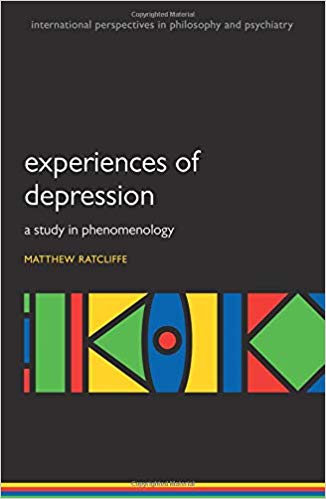
Cover art: Matthew Ratcliffe: Experiences of Depression: A Study in Phenomenology
Press, 2015, 318 pp, (44.09 $US)) is an important and eye-opening book for anyone who engages with depression or who wants a deep dive into phenomenological method.
The strength of this book is that Ratcliffe begins by listening to what the first person accounts have to say. Though Ratcliffe does not even use the word “empathy” until late in the work, and then in a debate that leaves much to be clarified, Ratcliffe’s method is a highly empathic one. What does he get out of listening to what the diversity of first person accounts have to say?
What is going on when the depressed person complains that getting out of bed requires enormous effort, and brushing one’s teeth seem impossible because the tooth brush seems to weigh twenty pounds? What is possible for the ordinary person is not possible for the depressed person.
This is a simple-minded, though accurate, example. Now extend it to loss of energy (lethargy) for daily and professional projects, the breakdowns in relations to other people and to oneself, including rampant self-reproaches, physical symptoms such as disturbances of appetite, sleep, consciousness (inability to concentrate). What goes missing from the experience of the depressed person?
Where you and I see possibility – tomorrow is another (and better!) day – the depressed person does not see possibility. The depressed person’s tomorrow is going to be the same miserable day as today. This is not just a belief (though it may be that too); this is the depressed person’s way of being – his experience of the world. This is not just the loss of one possible project or even a series of projects. This is the loss of possibility itself. This is Ratcliffe’s fundamental idea: depression is the loss of the very possibility of possibility.
This idea – the loss of the possibility of possibility – open up the flood gates for the description and appropriation of the diversity (“heterogeneity”) of depressive symptoms. The depressed person does not experience the possible – does not experience the possible as possible. That is the disorder itself.
The disorder is that it is not possible to conceive that things will get better. One is left without hope. Hope is itself openness to a possible future that is better. One is left demoralized. One is left without a future. Guilt is the impossibility of undoing faults or mistakes in the past. One’s crime is irrevocable, impossible to fix or make reparations (or reinterpret). No possibility of forgiveness.
Meanwhile, the depressed person often gets influenza like symptoms – no energy, inability to concentrate, headaches, stomach distress – one takes to one’s bed. However, unlike the case of the flu, in which one feels miserable but knows if one just hangs in there one will get better in a few days, the depressed person cannot imagine things being otherwise. No possibility period.
The phenomenology? Backing up for a high level view based on the phenomenological methods of Husserl and Heidegger, the world is not a thing in the world. The world is the context for things in the world. The world is the space of possibilities. The world of the depressed person is different than the world of the ordinary person. The los of possibility has a domino effect, “taking down” practical significance, hope, and interpersonal connection. Nothing matters anymore. Lethargy, detachment, self-reproach, and flu like symptoms are pervasive.
Given that the audiences for this book, including psychiatrists and many analytic philosophers, have not read Husserl and Heidegger, Ratcliffe devotes significant time and effort providing background, marshaling evidence, and arguing “depression is the loss of possibility – not just one or a series of possibilities – the very possibility of possibility – the depress person cannot even conceive of [the] possibility [of taking action].”
This is as it should be, and the book contains many technical distinctions – e.g., noetic and noematic – and, in that respect, is not for the faint of heart. Still, I was persuaded, and I believe, you will be too. This is a powerful and important contribution, which should be, required study for anyone proposing to engage with persons who one customarily describes as depressed. It changes one’s listening and in a powerful and positive way.
Since this is not a softball review, this leads to the two-ton elephant in the room. So what? What is the guidance in overcoming depression? As I am a person who performs empathy consulting and psychotherapy, this reviewer asks: what are the action items or recommendations? How does one access the possibility of possibility, given that possibilities always present themselves as specific projects in the world? How does one jump-start the possibility of possibility when nothing seems possible?
In all fairness, addressing this may not be Ratcliffe’s job since he is doing phenomenological research, not clinical practice; but the question is almost unavoidable. Therefore, I am so bold as to engage in some “reading between the lines.”
Ratcliffe’s short answer to jump starting possibility is “radical empathy.” Radical empathy – unlike ordinary empathy (according to Ratcliffe) – does not presume that the two people trying to relate share the same space of possibilities (p. 242). Radical empathy is a kind of lever to open a space of possibilities of difference.
My take on radical empathy? Radical empathy consists in the would-be empathizer being committed enough to relating that he continues to try to do so even though logical reasons exist that empathy should fail. In this case, the depressed person is overwhelmed, experiencing being cut off from human relatedness, isolated, and disconnected. That is the disorder itself – along with the other symptoms.
Yet the would-be empathizer persists in his attempts to relate, vicariously experiencing the isolation and disconnectedness (or not) as a privative form of relatedness. The depressed person, even in his isolation, “gets it” that the empathizer is committed to the possibility of relating, even though the depressed person is frustrating the efforts. That’s it. That’s the moment something starts shifting.
Voila! The possibility of possibility is back in play. The depressed person’s “getting it” that the other is committed to the possibility of relating provides an Ariadne’s thread out of the labyrinth. That’s the empathic breakthrough.
This does not guarantee that radical empathy will succeed. Nor is there any guarantee that after trying ten times, the 11th try will be enough to do the trick. The depressed person may still be so cut off from possibility that suicide starts to look like a solution; but if one can acknowledge the possibility of a bad – very bad – solution (e.g., suicide), then one may be able to find a better solution – whether pharmacological, cognitive behavioral or empathy-based.
To cut to the chase, I am so bold as to suggest that all empathy is radical empathy (in Ratcliffe’s sense). Contrary to Ratcliffe’s assertion, ordinary empathy does notrequire a space of shared possibilities. Shared possibilities are a “nice to have,” but often a high bar. Possibilities might be shared, but often they are not. Given the state of the world, such a space of shared possibilities is rarer than any of us might wish. I assert: All empathy is a risk undertaken to create a space of shared possibilities when there was no shared context.
All the other would-be empathic mechanisms such as simulation, mindedness, sympathy, altruism, are examples of incomplete empathy or breakdowns of empathy into projection, emotional contagion, or conformity. If the breakdowns were clarified, then empathic connection would emerge out of the misunderstanding, restoring the integrity of the relationship.
Meanwhile, Ratcliffe acknowledges the usefulness of the Diagnostic and Statistical Manual (DSM) for aligning the conversation and assuring us that the researchers are talking about the same phenomena. He is respectful of the professional sensibilities of the medical and psychiatric establishment – perhaps too respectful in my opinion. Yet, then again, if one is going to speak truth to power, it is best to start with an agreeable word. The barber lathers a man before he shaves him.
Though not a contribution to the growing body of anti-DSM literature, Ratcliffe’s work is an antidote to the pervasive tendency to under-describe depression (and other psychiatric disorders). The DSM is a starting point. However, Ratcliffe’s work makes clear that the DSM, especially as regards depression, is a pragmatic conglomeration of overlapping traits, not a natural kind.
Arguably melancholy is a natural kind; mania is a natural kind; paranoia is a natural kind; inflammation is a natural kind (and here the cytokine theory of depression is called out); but major depressive order as defined by the DSM? Nope. Ratcliffe does not spend much time or effort on the matter of the social construction of the categories of mental illness, and if one had to summarize Ratcliffe’s approach it aligns with the genealogical approach of Ian Hacking (e.g., see Ian Hacking, (2002), Historical Ontology, Cambridge, MA: Harvard University Press), who was himself inspired by Foucault (in turn, inspired by Nietzsche).
In spite of his commitment to sustained phenomenological description of the things themselves, Ratcliffe quickly discovers that the phenomena bring forth a deep structure and background separable from any specific first person report. As usual, the way the researcher gets access to the phenomena significantly influences one’s description of the phenomena.
The data? The phenomena? Ratcliffe collects some 150 free form depression questionnaires in which sufferers and survivors of depression try to express and describe their experiences. Many of these contain lengthy feedback from the survivors on their experiences of depression. Ratcliffe also reviews many memoires of suicide and depression survivors, who try to express the ineffable nature of their experiences, such as Styron’s Darkness Visible. Many conditions and qualifications regarding the data are argued, limitations defined, and the richness of the experience plumbed for an expansive encounter with the enemy – depression.
Several things come out in the first person accounts that are not emphasized or are outright overlooked in the DSM. These include: the intimate relationship between depression and anxiety (“anxious distress” is called out in DSM-5, but unrelated to the whole); loss of hope and changes in bodily experience are briefly acknowledged in the DSM-5, but are critical path in the treatment; the altered experience of time is not mentioned at all (but the future seems to disappear as a positive, possible horizon); impaired social function is mentioned as a consequence whereas such loss of function is integral to the phenomena itself. This list goes on.
One of the first things that occurred to me as I sat down to read this book was: Am I going to get depressed – not necessarily in the full clinical sense; but is it going to cause an upset? My experience was that such a negative outcome was not the case. I suspect that was because, as an author who “gets” and uses empathy, Ratcliffe knows how to regulate the empathy in the space of possibilities to prevent empathic distress.
However, before turning to Ratcliffe’s breakthrough notion of radical empathy, the text engages with the issue of how empathy maps to the theory of mind debate in which empathy as simulation is arrayed against a theory of mindedness that enable persons to perceive others as sources of intentionality. The details of this debate are technical and at times Ratcliffe seems to forget the insight with which he began the book: “I argue that human experience incorporates an ordinarily pre-reflective sense of belonging to a shared world’, which is altered in depression” (p. 2).
Once one disconnects the subject from its environment – the subject’s belonging to a shared world of people, neither simulation theory nor theory of mindedness can ever quite connect them again. It is a myth that we human beings are unrelated. We are all related. Human beings are already related to one another – biologically, psychologically, and in our very way of being (ontologically). Ratcliffe gets this. There is nothing wrong. Yet there is something missing.
Ratcliffe conceptualizes empathy as an attitude that does not include the communication of affect. Therefore, he overlooks several breakdowns in empathy – such as emotional contagion, projection, conformity – that if clarified provide the breakthrough to “radical empathy” (Ratcliffe’s key term) that is need to give traction to treatment options. There is indeed such a thing as an empathic attitude; but I disagree with Ratcliffe that a congruence of feeling (whether partial or complete) is to be ruled-out.
Ratcliffe (and his argument) are troubled by the notion that if one empathizes with a depressed person, then one may end up feeling quite depressed. This seems to be an invalidation of empathy and an obstacle to using it in treatment. Neither needs to be the case. First, in an admittedly extreme case, if one talks to eight depressed people in a row in the course of a treatment day, then one is very likely going to feel down – at least sub-clinically depressed – by the end of the day, regardless of the quality of one’s empathy. Is this empathy or a breakdown of empathy?
Look at the phenomena. Phenomenologically, there is no other plausible way to describe this than to say that the feelings and emotions have been communicated from one person to another. Once again, is this empathy? No – according to Ratcliffe, empathy is an attitude, not a congruence of feelings.
I suggest this answer is incomplete. It is not an “either or” choice. One must integrate empathic receptivity (openness), empathic understanding, empathic interpretation, and empathic responsiveness.
The answer is still “No,” but because the communication of feeling, the congruence of feeling – one paradigm case of which is vicarious experience – is not complete empathy. It is merely phase one of empathy.
If one stops with the mere communication of feeling, then one gets emotional contagion (as Ratcliffe properly notes). This is a breakdown of empathy, but Ratcliffe does not describe it in such a way. However, do not be so hasty to dismiss empathy. That empathy breaks down does notmean empathy is invalid or must be abandoned.
The would-be empathizer may [must?] take this vicarious experience of the other’s distress and process it further through empathic understanding, empathic interpretation, and empathic responsiveness in order to make it useable in relating to the other person as a possibility or a breakdown of possibility.
Likewise with compassion fatigue, which is likely in the background of Ratcliffe’s insistence that empathy is an attitude, not a congruence of feeling. Though compassion fatigue is not an issue Ratcliffe engages, it is common to acknowledge that the helping professions are at risk of burn out, empathic distress, and compassion fatigue. (Note that burn out itself is a kind of loss of the possibility of possibility. “Depression”?)
Those who engage with depressed people are particularly at risk of such an outcome. Empathy reportedly peaks in the third year of medical school, and, unless specific interventions such as further training are undertaken, it is downhill from thereon (see Hojat, Mohammadreza, et al. (2009). The devil is in the third year: A longitudinal study of erosion of empathy in medical school, Academic Medicine84 (9): 1182–1191). What to do about it?
Once again, Ratcliffe may not see this as his job – and the book is already over 300 pages of dense descriptions of depression – but one may offer a couple of thoughts. We usually think of empathy as an “on off” switch. Turn it on for the “in group” – patients, clients, friends, family – turn it off for the competition, the opposing team, people who talk foreign languages or have unfamiliar customs or the “out group.” Rather, the training is to regard empathy as more like a dial or tuner – dial empathy up or down by regulating one’s receptivity – one’s openness (Ratcliffe’s term) – to the experiences of other persons.
If one is over-whelmed by the other person’s depression one is doing it wrong. Properly deployed by experienced practitioners, empathy is a method of providing a sample or trace of the other person’s experience. Max Scheler (who Ratcliffe approvingly cites) calls this a “vicarious experience” (Nacherlebnis) – rather like an after image of another person’s feeling. As noted, this trace or sample of the other’s experience has to be further processed by the understanding of possibilities to be useful in shifting out of stuckness. (See Max Scheler, (1913/1922). The Nature of Sympathy, tr. Peter Heath. Hamden: CN: Archon Books, 1970)).
Of course, expanding one’s empathy does not come naturally to most people, which is why training and practice are needed. But experience shows that if one works at it, one can expand one’s empathic capabilities and the results one gets in trying to be empathic. (See Zaki, Jamil and Mina Ciskara. (2015). Addressing empathic failures, Current Directions in Psychological Science,December 2015, Vol. 24, No. 6: 471–476. DOI: 10.1177/0963721415599978).
The antidote? A radical proposal – in addition to radical empathy. If one is experiencing compassion fatigue, maybe one is being too compassionate. Now compassion is different from empathy. In compassion, one’s strong feeling – passion – motivates one to get involved, take action, and intervene to help the other. (Nor is anyone saying be hard-hearted or indifferent, but know when to dial it down a bit.) In contract, empathy in the full sense of the term, of which Ratcliffe’s radical empathy is a subset, is a method of data gathering about the experience of the other person. It consists in being open to the experiences of the other person, having a vicarious experience of the other’s experience, and further processing it in empathic understanding, empathic interpretation, and empathic responsiveness.
It is ironic that the phenomenology of depression misses the key phenomenological distinction – vicarious experience – in the account of trying to empathize with depression. In relating to a depressed person, I can be open to a vicarious experience of melancholy or stress or anger or irritability or discordant mood or whatever the other person is experiencing – without succumbing to a merger with them. This vicarious experience gets processed further in understanding who the person is, where he is at, what he “gets” as possible for himself in the moment. Through interpretation and responsiveness, this may open up other possibilities. Now we are back in the realm of jump-starting the possibility of possibility.
Ratcliffe finds inspiration in, but puts his own definitive spin on, Jonathan Lear’s Radical Hope, a narrative of the struggles of the Native American Crow people. After the buffalo went away (were killed off), the indigenous Crow people, experienced world collapse. Hunting ceased. Demonstrating courage in tribal warfare became impossible. Culture and customs lost significance and ceased to make a difference. Nothing changed – i.e., in effect, time stopped. All hope was lost and – at the risk of a caricature – the only possibilities were the self-destructive non-possibilities of alcoholism and inadequate, dignity-destroying government handouts.
However, even amid this world collapse – analogous to the depressive person’s loss of the possibility of possibility – a wise Crow elder put forth a prophecy that an event, something = x, would happen that would enable a the rebirth of possibility of the true people. This was radical hope – “to hope against hope until hope creates from its own wreck the thing it contemplates” as the poet Shelley put it.
The prophesized event turned out to be World War II, a conflict in which the Crow were able to draw on their warrior tradition and make a contribution to the defeat of the enemy.
Ratcliffe’s radical empathy is analogous to radical hope here. The therapist keeps alive the possibility of possibility and gives expression to it while the depressed person is unable to do so for himself. The therapist keeps blowing on the embers – and may indeed get short of breath doing so – until the spark rekindles the fire of neuronal activity in the depressed person’s consciousness.
In conclusion, Ratcliffe “gets it” – while simulation and theory of mindedness go round-and-round about whether feelings are congruent or perspective interchangeable, psychiatric disorders across the spectrum, from mood disorders to thought disorder, are especially challenging to anyone’s empathy. Most psychiatric disorders – not just autism or psychopathy – involve a breakdown of empathy (as Ratcliffe points out elsewhere), leaving the person feeling disconnected, isolated, not “gotten.” Ordinary empathy is already radical in so far as one person is able to understand another in his or her humanity. Such a commitment – call it an “attitude” or a “method” – is not easy or trivial. Yet the commitment to relating to the other’s humanity is what calls forth the humanity back into possibility.
(c) Lou Agosta, PhD and the Chicago Empathy Project

