Home » Posts tagged 'radical empathy'
Tag Archives: radical empathy

Suicidal empathy is now a podcast
One can always make a splash by throwing a rotten tomato, and those who throw one at empathy get a chance to gather Internet clicks by saying something shocking, even if it is of questionable accuracy. However, what about seriously engaging this thought literally as a debating point – is empathy a defect of western civilization dooming us to suicide and/or suicidal species extinction? As an exercise in thinking, consider the pros and cons.
Listen to this blogpost as a podcast on A Rumor of Empathy with Lou Agosta –
You know how modern agriculture can grow enough food to feed everyone on the planet thanks to the “Green Revolution” and high yield seeds, but people are still starving, because of the use of food by politicians and politics in the pejorative sense to perpetrate hostility, aggression, and bad actions? Likewise with empathy: Enough empathy is available to go around; but it is badly distributed. People are living and working in empathy deserts. Organizational politics, stress and burnout, attempts to control and dominate, egocentrism and narcissism, out-and-out aggression and greed, all result in empathy getting hoarded locally, creating “empathy deserts” even amid an adequate supply. Therefore, this approach does not call for “more” empathy, but rather for “expanded” empathy. The difference is subtle.
Indeed the one minute empathy training consists in driving out hostility, aggression, bullying, bad language, prejudice, politics in the pejorative sense, a long list of negative behaviors, and empathy naturally and spontaneously comes forth. The majority of people want to be empathic, and, given half a chance, will behave empathically. Does this mean would-be empaths and empathically motivated people have become suicidal?
The short version of suicidal empathy is as follows. We are in a lifeboat which is filled to the maximum after our ship sank. In the water, treading water, surrounding the lifeboat are additional survivors and other leaky lifeboats about to sink, leaving the survivors treading water. If the survivors in the lifeboat are empathic and take in the other survivors, then the lifeboat stil afloat will be swamped and we will all drown. The conclusion is that in such extreme situations, which are more common than one might imagine, then empathy needs to be turned off – or at least dialed down significantly – lest we all perish.
This thought experiment of the lifeboat and its extreme situation has received renewed attention as Elon Musk has notoriously said that empathy is a weakness of western civilization.
[On background, for Musk’s sound bite about empathy being a weakness, see: https://youtube.com/shorts/LWvOvgjNEds?si=GByQLE0yoFDyWtTr ). To be fair, Musk does not invoke the lifeboat scenario in the quoted statements; however, Musk and his would-be supporters have expounded at greater length on behavior in extremis as reported in the following CNN article, in which a simplified version of evolutionary psychology (not necessarily Musk’s) as the survival of the fittest, plays a leading role https://www.cnn.com/2025/03/05/politics/elon-musk-rogan-interview-empathy-doge/index.html By the way, regarding Musk’s comment, empathy advocates are telling me, there is no such thing as bad press coverage, and you can’t get publicity like this at any price. It is almost as good as having your books banned by the Catholic Church!]
Like most thought experiments, the lifeboat scenario is an intuition pump designed to stimulate debate about a difficult and controversial subject, in this case, empathy in circumstances of scarcity, trauma, compromised agency, and extreme situations.
On background, the original formulation of the lifeboat situation is due to ecologist Garrett Hardin (1974) whose idea of “spaceship earth” envisions the rich and poor nations as being in a life-or-death struggle against one another for limited resources. That Hardin was an anti-immigration Nativist in a nation of immigrants is problematic (and he is called out by the Southern Poverty Law Project as giving support to white supremacist hate groups[1]); but his many personal limitations do not necessarily mean his thought-experiment of lifeboat ethics is without merit. We engage it as a thought-experiment on its own merits.
The key idea of Hardin’s thought experiment is that each nation is a lifeboat. Nations such as the USA are solid, water tight, and well off. Others such as the South Sudan, Burundi, Central African Republic and Bangladesh are sinking (in the case of Bangladesh, literally so) or at least leaking badly. In the water surrounding the lifeboat(s), there already are a lot of people treading water (think: refugees fleeing hunger and murderous gangs in South America) – and this number is growing. Therefore, Hardin’s argument goes, it behooves the well-off nations to establish strong borders that keep would-be refugees from the leaky boats from overwhelming the still water tight boats in order to prevent swamping us all. According to this scenario of “lifeboat ethics,” empathy is a luxury we cannot afford. Similar statements would be made about compassion, kindness, generosity, and, presumably, most of the teachings regarding neighborliness of Jesus of Nazareth, Confucius, and Buddha – not affordable in our extreme situation.
Now to engage with the strongest version of lifeboat ethics requires a scenario in which there really is a situation of extreme scarcity. For the sake of argument, though scarcity is not inevitable, let us suppose that it is indeed inevitable. Let us accept the flawed presupposition that spaceship earth has resources which are so limited that extreme measures and hard-heartedness are required.
Accepting the assumption of scarcity, the argument in favor of lifeboat ethics rejects the possibility that human beings have managed to survive on the planet by using their cognitive capabilities, innovating out of predicaments, by thinking about the consequences of their actions, optimizing those consequences, and finding ways of doing more with less. Here the limitations of the lifeboat dilemma as a thought experiment come into view. The ecological authorities who propose the thought experiment rule out every initiative and innovation to lessen the pain and suffering of the participants in the lifeboat scenario, whether in the boat or the water, thereby eliminating (or greatly reducing) the agency of those who would act empathically or who are willing to limit their own narrow self-interest.
For example, if it is proposed that the people in the lifeboat throw the swimmers their own life vests or life preservers (think: foreign aid), thereby increasing the chances of survival, the authorities rule there are not enough life vests.
If it is proposed that the people in the boats pull on the oars to circle the boats, tie the boats together to build a sort of pier, and use canvas to create a platform to support other survivors (think: the United Nations), there are no oars or canvas or rope or the seas are too rough.
If it is proposed that some good Samaritans in the lifeboat volunteer to treat the lifeboat as a “time share” into and out of which individuals rotate out of the water for a while and then back in, the better to survive (think: foreign guest worker program), the authorities rule the water is so cold as to make such sharing unworkable.
If it is proposed that the occupants in the lifeboat, pass the survivors in the water a thermos of hot medicinal tea (think: Doctors Without Borders), thereby delaying hypothermia, the authorities rule there is no such thermos.
If it proposed to implement a flotation device by tying the ends of one’s trousers together, capturing the air, and wrapping it around one’s shoulders (think: the peace corps), then the authorities rule that the fabric is too thin or torn.
If, after the people in the water have died of hypothermia or been killed by sharks, the people in the lifeboat can live for hundreds of days on sea turtles, raw fish, and rain water (think: micro lending), but only if they have a fishing line and a piece of canvas to catch the rain. The sea is a vast source of protein and can sustain many lifeboats, given a fishing line and a piece of putty to plug the leaks. The authorizes rule all that out, too. In short, the agency required to imagine and implement an empathic act or even a useful, life sustaining one, is cancelled by the steady drum-beat (and counter argument) of “not enough,” “not enough,” and more “not enough”.
This is why tragedy – the art form – was invented. Life presents contingent circumstance that constrain one’s agency, limit one’s choices, and make one both a survivor and a perpetrator (if one survives). As thinkers of the lifeboat dilemma, we are put into a double-bind. If one acts inclusively, thoughtlessly pulling people into the already overcrowded lifeboat, then everyone ends up in the water (and eventually under water). If one acts to repel any attempt to get into the lifeboat, then one enacts violence against those trying, perhaps legitimately to self-rescue, and one behaves hard-heartedly. One becomes a perpetrator, causing others to die. One is caught between the rock and hard place; literally, in this case, between the devil and the deep blue sea. That is the definition of moral trauma. Now empathize with that!
The people trying to climb into the lifeboat, who get pushed down, experience physical trauma as they drown. The people already in the boat who push down the otherwise innocent would-be survivors for whom there is no room in the boat, experience moral trauma. Whatever happens, their souls are damaged. The result is empathic distress, including forms of compassion fatigue, guilt, loss of self-respect, and burnout, one and all professional risks of the helping professions. Whether one gives into despair (or a hard-hearted “realism”) and becomes a survivalist, stock-piling canned goods, ammo, and guns, is a further point of debate. In addition to empathic distress, standard empathy confronts obstacles of emotional contagion, projection, conformity, and communications lost in translation.
Yet even in the face of lifeboat ethics, empathy remains indispensable. How so? If one is in a lifeboat one is by definition a survivor. Your ship sank! That is a necessary part of the definition of a lifeboat. You were cast into the vast, seemingly boundless sea. Never underestimate the importance of empathy for those in extremis, but even more than empathy, the occupants of the lifeboat need rescue. To be in a lifeboat and not need rescue is a contradiction in terms, blowing up the whole scenario and sending it back to the drawing board. This exposes the entire lifeboat scenario as a manipulation and mechanism for constraining, compromising, and denying agency to the participants in the dilemma. However, let us take the scenario at face value – help is not coming!
Meanwhile, awaiting rescue, one is at risk of becoming a perpetrator, albeit unwittingly, if one defends the lifeboat against those trying to climb into it by pushing them back down into the water. People are going to drown. In most tragic literature, the protagonist is both a survivor and a perpetrator.
For example, the Greek hero Oedipus was exposed as an infant to die, abandoned by his biological parents, who feared the prophecy of his murdering his father. He is rescued by a shepherd and goes on unwittingly to kill his biological father in a dispute as he (Oedipus) tries to avoid the fated prophecy, and, leaves the home of his foster parents (not realizing they have fostered him). Likewise, the people in the lifeboat are both survivors and perpetrators, the latter as they have to take violent action to defend their boat against the desperate swimmers who would occupy it.
Two wrong do not make a right, and there is no excuse for bad behavior. However, the people in the lifeboat are asked to make choices – life and death decisions – that no one is entitled to make, that no one should have to make, indeed that no one can make with integrity, yet that they make anyway and in any case, since doing nothing is also a choice. The point is not to marshal excuses – since there are none adequate to life and death – but to note that standard empathy is challenged in the face of moral trauma to become radical – to become radical empathy.
Empathy itself requires innovation. The proposal is that the lifeboat dilemma calls for and calls forth radical empathy. Radical empathy leverages the imagination to find a way forward in the face of tragic circumstances. Radical empathy is committed to empathizing in the face of empathic distress to solve the given dilemma through imagination variations when and where it is possible to do so; to comfort the survivors when there are any; and when there are no survivors by bearing witness to the tragic struggle where the outcome is a tragic one.
Empathy, whether standard or radical, has a direct answer to lifeboat ethics and those about to be cast into a lifeboat. The answer is: “Women and children first.” If that happens to be your own spouse and children, then so much the better. However, save someone; and while I cannot say what I action I would take in such an extreme situation, presumably one should be ready to surrender one’s place in the boat. That is the empathic moment and the answer to hard-hearted proposals to throw the weak overboard. Children are the future and, unless they survive, species extinction is the outcome, and species extinction is a completely different thought experiment, not relevant here. This is the empathic answer.
In the face of a thought-experiment such as lifeboat ethics, designed to take away one’s power and agency in the face of contingencies, the problem – how to allocate resources empathically in the face of extreme scarcity – cannot be directly solved. Rather the problem must be refuted. The setup of the experiment contains a flawed presupposition. Fundamentally flawed! The experiment makes it sound like scarcity is unavoidable. This is factually, scientifically, and indeed historically inaccurate.
Scarcity (let us consider the example of starvation) is occurring on our planet, in war zones, and even in the inner-city community in which I live, but not because of lack of food. Starvation is occurring because food is being used as a weapon of domination, including prejudice, aggression and war. There is enough food to go around (as will be easily demonstrated in the next paragraph) but hostile and oligarchical powers (governments) are withholding it from those who have been designated as “the enemy,” including civilian populations. A noncontroversial if no less gut-wrenching example was the Nigerian-Biafran Civil War (1967 – 1970), with examples of children near death with swollen belies due to malnourishment. This was due to armed military blockade not crop failures. Such withholding would, of course, be the contrary of empathic (or even decent!) behavior.
On background, spaceship earth (to use Hardin’s incisive term) has vastly more resources than a life boat and, therefore, vastly expanded opportunities for imaginative innovation. To stay with the example of feeding people, the development of Cyrus McCormick’s combine-wheat-reaper, and the follow-on agribusiness technology, allow some 2% of the population to grow enough food to feed the entire planet; and this in spite of the fact that human choices made under aggression continue to use food as a weapon of starvation. Prior to the Green Revolution, the other 98% of the population had to work twelve to sixteen hours a day to grow enough food to avoid a slow, agonizing death by starvation. Arguably, these people were historically in the lifeboat dilemma; and their behavior often showed it (which, of course, is not excuse for bad behavior as two wrongs do not make a right).
On further background, Norman Borloug’s (1914–2009) innovations in seeds and plants improved agricultural yields by integral factors, leading food experts to estimate his innovations saved over a billion people from starvation, earning Borloug the Nobel Peace Prize and the US Presidential Medal of Freedom. Lots of wars have been fought over land – land also used to grow food. Garrett Hardin lived long enough to know about this (“Green Revolution”), but his commitment to anti-immigration politics apparently created a blind spot, preventing him from engaging.
Therefore, the approach of lifeboat ethics is based on a fallacy that the situation of scarcity is an unavoidable one – an inevitable continency. On the contrary, scarcity is being manufactured by bad actors, bad politics, and out-and-out human aggression. As such, the scarcity can and should be undone by actors with better (including empathic) motives in order to restore the community to a benchmark standard human functioning. This is consistent with natural disasters creating local calamities that cause scarcity. It is also consistent with disagreements about what constitutes an emergency. However, the point is to send in emergency services and the national guard to deliver or air drop palettes of drinkable water, canvas for tents, and provisions, not to shoot the survivors as a burden to the community (the latter following the logic of the lifeboat to its absurd conclusion).
Returning to the basic metaphor, empathy is no more to blame for overloading the lifeboat than carpentry is to blame for the fact that Roman soldiers used hammer and nails to execute condemned criminal and political enemies by crucifying them. Without practice, empathy can go astray as emotional contagion, projection, conformity, and communications lost in translation. Being generous to a fault or suicide have never been a requirement for empathy. Never. With practice, a rigorous and critical empathy sets boundaries, establishes limits, and creates a whole that is more than the sum of its parts.
A rigorous and critical empathy belongs to a short list of things such as dignity, respect, compassion, neighborliness, and forms of spiritual love, and are not quantifiable as zero-sum phenomena. For example, if I give you a slice of my chocolate cake, I have less cake. However, if I give you empathy, by giving you a good listening, we both have expanded empathy. Empathy is non additive – and so non subtractive. humanizing encounter in which my own humanity is enriched in contributing to another person. A rigorous and critical empathy is not quantifiable like chocolate cake. Granted that our topic is difficult and significant, we can enjoy lighter moment – there is enough food to go around, but definitely not enough chocolate cake! Like food, there is enough empathy to go around, but it does not seem that way, because we have not been effective in driving out the obstacles to empathy such as aggression, hostility, bullying, and politics in the pejorative sense.
As Lord Acton famously said, “Power corrupts and absolute power corrupts absolutely.” Granted, that corrupt leaders lacking integrity engage in abuses of power, is not new news. That super rich individuals and corporations form corrupt alliances with powerful politicians lacking integrity is called a lot of things – “oligarchy” is defined as the rule of the rich for the benefit of the rich; and “fascism” is defined as the rule of a military industrial complex pulling the strings of politicians at the expense of individuals and their well-being as citizens and their liberties. A new trail of tears comes forth based on fear and intimidation.
The political authorities argue, the current situation is an emergency, an invasion, a crisis that requires setting aside the rule of law. An early version of capitalism that rejects win-win participation and business innovation is privileged over creating a clearing for a rising tide, which raises all boats (to continue to riff on the lifeboat theme with a slogan from Ronald Regean). It is hard not to get cynical. Setting aside the rule of law – what? – so that the President can accept $400 million gifts from a foreign power in direct violation of the US Constitution. Granted this is a single example, it speaks volumes. A strange emergency indeed!
In the face of this, empathy proposes to speak truth to power. Changing the metaphor: while bureaucracy may need to be trimmed back from time to time, like forest management that burns the underbrush with a controlled burn, less it spawns an even bigger forest fire that burns down the nearby city, we are now seeing an uncontrolled burn. Entire departments serving the citizens are summarily laid waste jeopardizing emergency responses to tornadoes, national security, scientific innovation, foreign aid to allies and would-be friends, basic education, and business entrepreneurship. Key term: uncontrolled burn (credit to Garret Smith for calling my attention to this). It has happened that a controlled burn of the forest under brush got out of hand and resulted in a major forest fire. This is a description of the so-called Department of Government Efficiency’s (Doge’s) approach to cost cutting. Uncontrolled burn. My take – who else’s would it be? – is that the cost cutting “wizards” are undertaking an uncontrolled burn. Think: slash and burn.
What Musk (hereafter “M”), Stephen Miller (Deputy White House Chief of Staff) and John Vought do not point out is that empathy does not work with bullies or abusers, who will take whatever vulnerability you may exhibit and use it against you. This is also the case with anti-social personality disorder – individuals with a defective conscience who struggle to tell right from wrong, though without interviewing M, one has no way of knowing M’s or any individual’s mental status. One possibility is that the individual is projecting his own unreliable, defective empathy onto the community as an empathic defect. Many of those who lack empathy are hungry for it. If ever there was a disqualifying statement by a would-be administrator or leader, M’s soundbite is it. However, a further agenda lurks nearby.
Presumably a statement that “empathy is a weakness” would be a justification of the unempathic “slash and burn” bullying methods of the unelected puppet masters at Doge [pronounce: “dog”], the so-called US Department of Government of Efficiency, showing up at the IRS and Social Security offices and so on and demanding to see confidential citizen data and/or seemingly randomly sending employees home (“firing” them).
In the face of bullying, a critical and rigorous empathy sets limits, establishes boundaries, pushes back against attempts to control, dominate, and manipulate, and speaks truth to power. One must not overlook the power of top down, cognitive empathy in thinking like one’s opponent in order to overcome him. “Top down,” cognitive empathy is detailed in Mikah Zeno’s Red Team! (Basic Books 2015) according to which taking a walk in the other’s shoes (the folk definition of empathy) provides advantages in relationships, business, politics, and building communities that are thrive on cooperation, communication, coordination, and inclusiveness. If one were looking for a short disqualifying reason to sideline unelected puppet masters such as M and fellow traveller Stephen Miller (see more on him on the South Poverty Law Project’s report on racism and anti-immigration hate groups), this is it. I leave it to the reader to figure out who is the puppet.
When the imagination is constrained to rule out every option except the narrowest, strictest self-interest, then the result is a scenario in which pain and suffering are going to be widespread and people are going to get hurt. Even those who do not suffer physical trauma will face confrontation with moral trauma. People are starting to wonder if, given the lifeboat scenario, they might indeed be better off in having gone down with the ship. However, this is not caused by (or the fault of) empathy – it is due to lack of imagination. If we human beings were not empathic (and compassionate, generous, kind), then we would not experience conflict, distress, trauma, in short, the breakdown of standard empathy in the face of empathic distress and the requirement for radical empathy. Now we will never know for sure whether Garrett Hardin was overcome by empathic distress or suffered from a clinical depression or both; however, it is a generally accepted fact that Hardin ended his own life by suicide. The first documented case of suicidal empathy?
We conclude with a positive proposal, on which I have repeatedly written and published: Teach critical thinking. This is the empathic educational moment. Absent a rigorous and critical practice of empathy, I am cautious about engaging current political clichés in a highly polarized political world and “rhetoric” in the negative sense.
Critical thinking includes putting oneself in the place of one’s opponent—not necessarily to agree with the other individual—but to consider what advantages and disadvantages are included in the opponent’s position. Taking a walk in the Other’s shoes after having taken off one’s own (to avoid the risk of projection) shows one where the shoe pinches. This “pinching” —to stay with the metaphor—is not mere knowledge but a basic inquiry into what the Other considers possible based on how the Other’s world is disclosed experientially. That is what we have attempted to do here by engaging with the most rigorous version of the lifeboat dilemma, instead of a strawman. Critical thinking is a possibility pump designed to get people to start again listening to one another, allowing the empathic receptivity (listening) to come forth.
In our day and age of fake news, deep fake identity theft, not to mention common political propaganda, one arguably needs a course in critical thinking (e.g., Mill 1859; Haber 2020) to distinguish fact and fiction. Nevertheless, I boldly assert that most people, not suffering from delusional disorder or political pathologies of being The True Believer (Hoffer 1953)), are generally able to make this distinction.
A rigorous and critical empathy creates a safe zone of acceptance and tolerance within which people can inquire into what is possible—debate and listen to a wide spectrum of ideas, positions, feelings, and expressions out of which new possibilities can come forth. For example, empathy and critical thinking support maintaining firm boundaries and limits against actors who would misuse social media to amplify and distort communications. Much of what Jürgen Habermas (1984) says about the communicative distortions in mass media, television, and film applies with a multiplicative effect to the problematic, if not toxic, politics occurring on the Internet and social networking.
The extension to issues of politics, climate change, and community struggles follows immediately. Insofar as individuals skeptical of empathy are trying to force a decision between critical thinking and empathy, the choice must be declined. Both empathy and critical thinking are needed; hence, a rigorous and critical empathy is included in the definition of enlarged, critical thinking (and vice versa). (Note that “critical thinking” can mean a lot of things. Here key references include John Stuart Mill 1859; Haber 2020; “enlarged thinking” in Kant 1791/93 (AA 159); Arendt 1968: 9; Habermas 1984; Agosta 2024, 2025.)
In conclusion, a positive alternative to abandoning facts and skipping critical thinking is suggested by Bob Dylan’s song about empathy. One has to push off the shore of certainty and venture forth into the unknown. We give Dylan the last word (1965: 185): “I wish that for just one time / You could stand inside my shoes / And just for that one moment / I could be you” [.]
References
Lou Agosta. (2024). Empathy Lessons. 2nd Edition. Chicago: Two Pears Press.
__________. (2025). Radical Empathy in the Context of Literature. Palgrave Macmillan.
Hannah Arendt. (1952/1958). The Origins of Totalitarianism, 2nd Edition. Cleveland and New York: Meridian (World) Publishing, 1958.
________________. (1968). Men in Dark Times. New York: Harvest Book (Harcourt Brace).
Lisa Blankenship. (2019). Changing the Subject: A Theory of Rhetorical Empathy. Logan UT:
Bob Dylan. (1965). Bob Dylan: The Lyrics: 1961–2012. New York: Simon and Schuster.
Garrett Hardin. (1974). Commentary: Living on a Lifeboat. BioScience, Volume 24, Issue 10, October 1974, Pages 561–568, https://doi.org/10.2307/1296629
Jonathan Haber. (2020). Critical Thinking. Cambridge, MA: The MIT Press.
Jürgen Habermas. (1984). The Theory of Communicative Action,Vol 1, Thomas McCarthy (tr.). Boston: Beacon Press.
Eric Hoffer. (1953). The True Believe: Thoughts on the Nature of Mass Movements. New York: Harper Perennial.
Immanuel Kant. (1791/93). Critique of the Power of Judgment, Paul Guyer and Eric Matthews (trs.). Cambridge: Cambridge UP, 2013. edition.
Elon Musk. (2025). Sound byte on empathy: see: https://youtube.com/shorts/LWvOvgjNEds?si=GByQLE0yoFDyWtTr
Elon Musk. (2025). About the interview with Joe Rogan on empathy: https://www.cnn.com/2025/03/05/politics/elon-musk-rogan-interview-empathy-doge/index.html
Southern Poverty Law Project. (2025). Garett Hardin: https://www.splcenter.org/resources/extremist-files/garrett-hardin/
Southern Poverty Law Project. (2025). Stephen Miller: https://www.splcenter.org/resources/extremist-files/stephen-miller/
Wikipedia: lifeboat ethics / ecologist Garret Hardin: https://en.wikipedia.org/wiki/Lifeboat_ethics
Wikipedia: Norman Borlaug : https://en.wikipedia.org/wiki/Norman_Borlaug
Acknowledgement: I appreciate William Ickes calling my attention to suicidal empathy, lifeboat ethics, and the issues around it, including current political debates. Bill is a deep thinker in all matters relating to empathy, social science, and contemporary community struggles. I am grateful for his feedback and friendship. The views expressed here are my own, albeit inspired by Professor Ickes.
Image credit: A photo of a lifeboat from the RMS Titanic: Wikimedia commons.
Note: The content of this blog post is slightly different than the spoken word podcast due to the differences between writing and speaking.
(c) Lou Agosta and the Chicago Empathy Project

Radical empathy is now a podcast!
Listen to the podcasts on Spotify:
Radical empathy is empathy defined as the practice of empathy that remains committed to empathizing in the face of empathic distress. Once again, it must be emphasized—and empathized—that one does not necessarily know one’s limits in dealing with trauma until they are tested in experience. Here are the three key distinctions between standard and radical empathy. 1. Radical empathy processes empathic distress whereas standard empathy is stopped by it. 2. Empathic distress is reliably occasioned and caused by physical trauma, moral trauma, soul murder, double binds, Trolley-car-like dilemmas (to be defined further)), and diverse tragic circumstances that are hard, if not impossible, to capture in standard uses of words and language. 3. Radical empathy is required when one or both of the would-be empathic partners is both a survivor and a perpetrator (which itself points to empathic distress). Given these three invariables, both standard and radical empathy share empathic receptivity, empathic understanding, empathic interpretation, and empathic responsiveness. I repeat: standard and radical empathy share receptivity, understanding, interpretation, and responsiveness. The differentiator is what happens with empathic distress. When one or more of these aspects of standard empathy breaks down or misfires, the repair or overcoming of the breakdown reliably presents the possibility of transforming standard into radical empathy. Radical empathy is not for the faint of heart, and instead of an image of puppies, the above painting, by Caravaggio, is a portrait of Medusa, whose hair was transformed into snakes, turning to stone (paralyzing) all those who met her and looked at her in person. If you are confronting trauma, be sure to bring your radical empathy.
Read / Listen to (subscribe to) this blog and A Rumor of Empathy on Spotify for further updates on radical empathy.
Short summary of episode one: This episode on Radical Empathy – what it is and why it is important – is the first in a series inquiring into radical empathy, what it is or whether it is just a rumor; how radical empathy differs from standard empathy; how radical empathy and everyday, standard empathy overlap and the dynamics of their interactions; how radical empathy makes a difference in situations when standard empathy breaks down and fails; and how the listener can expand his or her empathic skills, getting power over empathy and apply empathy in one’s lie, relationships, career, family, in the individual and in community.
The occasion for this podcast series on radical empathy is the publication of my new book Radical Empathy in the Context of Literature (April 2025 from Palgrave Macmillan). The suggestion is to have your local community or university or institute library order a copy. They have budget for these things and one can save a couple of dollars. This work on Radical Empathy contains many examples of empathy, both standard and radical, that are eye opening and engaging in their lessons for empathy and life.
Order books on empathy by Lou Agosta on empathy by searching for “Lou Agosta” and “empathy lessons” on your favorite online book source or click on this shortened URL: https://shorturl.at/gsGal
Image art credits: QWERTY, oil paint on board by Alex Zonis (AlexZonisart.com); The Shadow of Empathy (Doll Heads) by Alex Zonis (AlexZonisart.com; Head of Medusa by Caravaggio (Gallery of the Uffizi (Florence, Italy)) from Wikimedia Commons.

Top ten trends in empathy for 2025
The idea is to take a position from the perspective of empathy on current trends. What would the empathic response be to the trend in question, especially crises and breakdowns.
1. The world is filled with survivors who are perpetrators (and vice versa). Radical empathy is needed to relate to survivors who are also perpetrators. Radical empathy is the number one trend. What does that mean? The world is a more dangerous, broken place than it was a year ago. The challenge to empathy is that the dangers and breakdowns in the world have expanded dramatically over the long past year such. Standard empathy is no longer sufficient. Radical empathy is required.
Image credit: Jan Steen, 1665, As the old sing, so pipe the young

The short definition of radical empathy: the events that occur are so difficult, complex, and traumatic that standard empathy breaks down into empathic distress and fails. In contrast, with radical empathy, empathic distress occurs, but one’s commitment to the other person is such that one empathizes in the face of empathic distress. One’s empathic commitment to the survivor enables the survivor to recover her/his humanness, integrity, and relatedness. The work of radical empathy engages how the impact and cost of empathic distress affect the different aspects of empathic receptivity, empathic understanding, empathic interpretation, and empathic responsiveness, delivering a breakthrough and transformation in relating to the Other.
An example will be useful. A US soldier gets up in the morning. He is an ordinary GI Joe. He is manning a checkpoint. The sergeant, thinking the approaching car is a car bomb, gives what he believes is a valid military order to shoot at the car. The solider shoots. The car stops. But it was not a car bomb; it was a family rushing to the hospital because the would-be mother (now deceased) was in labor. The military debriefing of the events is perfunctory. Burdened by guilt, the soldier shuts down emotionally, and he stares vacantly ahead into space. Emotionally gutted, he does not respond to orders. He is shipped back to the States and dishonorably discharged. His marriage fails. He becomes homeless. The point? This person is now both a perpetrator and a survivor. The people who were shot experienced trauma by penetrating wounds. The soldier has moral trauma. Key term: moral trauma. He was put in an impossible situation; damned if he did and damned if he didn’t. Let his team be blown up? Disobey what seems to be a valid military order? Hurt people who did not need or deserve to get hurt? His ability to act, his agency, was compromised by being put in an impossible situation. That is why the ancient Greeks invented tragic theatre – except that the double binds happen every day. Radical empathy specializes in empathizing with those who are both survivors and perpetrators. And this is much more common than is generally realized.
Many examples of radical empathy can be found in literature (or in the New York Times), in which the hero or anti-hero of the story is caught in a double bind, damned if one does and damned if one doesn’t. Radical empathy and the literary artwork transfigure the face of trauma, overcoming empathic distress, and allowing radical empathy to enable the fragmented Other to recover her/his integrity. Persons require radical empathy to relate to, process, and overcome bad things happening to good people (for example: moral and physical trauma, double binds, soul murder, and behavior in extreme situations. For further reding on radical empathy, see the book of the same title in the References below.
2. No human being is illegal. Mass deportations pending. Empathy, whether standard or radical, is clear on this trend: no human being is illegal. At the same time, the empathy lesson is acknowledged that empathy is all about firm boundaries and limits between the self and other, while allowing for communications between the two. It is the breakdown of empathy at the US national border – which does not mean wide open borders – is one reason among several for the result of the 2024 election. What if ICE agents (the immigration authorities) show up? Empathy is all about setting boundaries: The empathic response: Let’s see your judicial warrant, officer, please? (See The New York Times, Dana Goldstein, Jan 7, 2025: https://www.nytimes.com/2025/01/07/us/immigration-deportations-ice-schools.html.)
An empathic response would look like a workable Guest Worker Program (such as exist in the European union) that allows essential agricultural and food services workers to earn and send money back home. Yet the proverbial devil is in the detail, and being accused of the crime of shop lifting a sandwich or tube of toothpaste is different than actually committing one. Thus, empathy also looks like Due Process, and an opportunity to face one’s accuser. If one is standing outside a Whole Foods or Trader Joe’s begging for food, it is not because one’s life is going so well. The gesture that any decent customer would make is to buy the person a sandwich. Of course, that is not going to scale up to address the estimated 37 million Americans (the majority not recent immigrants) living in poverty. Continued below under “5. The unworthy poor.”
3. Psychiatry gets empathy (ongoing). Relate to the human being in front of you, not the diagnosis. Empathy teaches de-escalation. Empathy’s coaching to psychiatry as a profession is to do precisely that which psychiatry is least inclined to do, namely, relate to the human being in front of you, not to a diagnosis.
Granted, the human being is a biological system. We are neurons all the way down. Yet emergent properties of our humanity (including empathy) come forth from the proper functioning of the neurons. The neurons generate consciousness, that subtle awareness of our environment that we humans share with other mammals. Consciousness generates relatedness to the environment and one another. Relatedness generates meaning. Meaning generates language. Language generates community, society, and culture. As Dorothy is reported to have said to Toto, “We are no longer in Kansas” – or psychiatry.
So what’s the recommendation from the point of view of empathy? Relate to the human being sitting in front of you not to a diagnosis. That is the empathic moment. To be sure, a diagnosis has its uses in technical communications with colleagues or payers, but as a standalone label, diagnoses are overrated.
Taking a step back, people get into psychiatry (and medicine in general) because they want to relieve pain and suffering, because they want to make a difference. Yet this aspiration is in stark contrast with the report at the American Psychiatric Association meeting that physical restraints were used some 44,000 times last year to constrain patients. (See Ellen Barry, May 21, 2024 In the house of psychiatry, a jarring tale of violence. Thus, The New York Times: https://www.nytimes.com/2024/05/21/health/psychiatric-restraint-forced-medication.html)
“Don’t hurt yourself (or anyone else!)!” is solid guidance; yet the particulars of the situation are challenging. The distance between fight and flight (fear) is narrow. Someone in the throes of an “amygdala hijack” is in an altered state of consciousness. This person literally cannot hear what is being said to him or her. This person is at risk of precipitating a bad outcome, especially if the psychiatrist or staff is also hijacked by an emotional reaction and emotional contagion. If as much effort were devoted to training staff in verbal escalation – talking someone back “off the ledge” – as in training them synch up straps, the outcomes would be less traumatic for all involved. Empathy in all its forms is a basic de-escalation skill that needs to receive expanded training and development.
It would not be fair to confront a psychiatrist with an either/or: “Are you relating to a biological system or to a human being?” because she (or he) is relating to both. Yet the pendulum does seem to have swung too far in the direction of biochemical mechanisms rather than interpersonal meaning, relations, and fulfilment. It is a fact that some 80% of people visit the medical doctor because they are in pain and hope to get medicine to cause them to feel better (and the other 20% have scheduled an annual checkup). That is well and good; and it is true that these psychopharm medicines change the neurons in your brain, but so does studying French and so do new and engaging life experiences; and, here’s the point, so does the committed application of empathy.
3. Violence against women continues to be a plague upon the land and a challenge to empathy.Standard empathy is not enough. This requires a level of radical empathy that has not been much appreciated. This is because many perpetrators are also survivors. (See the above example of the ordinary soldier who becomes both.)
I hasten to add that two wrongs do not make a right. Two wrongs make twice the wrong. Intervention is required to get the woman safe, and recovery from domestic violence begins once the person is secure in their safety. That is not a trivial matter, and Safety Plans and Hot Lines continue to be important resources. One can incarcerate a perpetrator to protect the community (and the women in it), but that does not make him better. He still needs treatment. What are the chances he is going to get it? To cut to the chase: many perpetrators and survivors do not know what a satisfying, healthy relationship looks like. Survivors and perpetrators alike have come up in environments where physical violence is common. Once again, this is not an excuse, and two wrongs do not make a right.
Regarding Peter Hegserth (Cabinet nominee for Defense Secretary): NBC News has reported that Mr. Hegseth’s heavy drinking concerned co-workers at Fox News and that two of them said they smelled alcohol on him more than a dozen times before he went on the air. The New Yorker reported: “A trail of documents, corroborated by the accounts of former colleagues, indicates that Hegseth was forced to step down by both of the two nonprofit advocacy groups that he ran — Veterans for Freedom and Concerned Veterans for America — in the face of serious allegations of financial mismanagement, sexual impropriety, and personal misconduct.” His managerial skills are nowhere near the challenge of running the Pentagon. Meanwhile, according to a 2018 email obtained by the New York Times, Mr. Hegseth’s own mother called him “an abuser of women” as he went through his second divorce. It is particularly concerning to see Senator Joni Ernst (R-Iowa) who had a check box on Domestic violence on her official site accept/excuse/embrace such behavior. Among the many women serving in the US Armed Forces, who can imagine that this candidate has their back? The esteemed Senator Ernst may usefully her from the concerned citizens.
The number one empathy lesson: a grownup man having temper tantrums (and worse) is not what a healthy relationship looks like! In a healthy relationship partners cooperate, help one another, respect boundaries, and if they disagree, they argue and “fight” fairly. Skills training belongs here. A major skill: setting boundaries, limits – pushing back on bullying in all its forms. (In addition, parents of diverse backgrounds and cultures have got to find better ways to set limits to and for their children than “whupping ‘em.”)
Woman have provided the leadership in this struggle for domestic tranquility and will continue to do so. From men’s perspective, this is a failure not only of standard empathy, but a failure of leadership. It calls for radical empathy to include survivors and perpetrates (once again, without making excuses for bad behavior). When powerful men – President Biden (now retiring), Elon Musk, Jeff Bezos, Senators and captains of industry – step up and say “Enough! What are you thinkin’, man?” then the issue will get transformed. These are conversations that are best had by men with men. Even if that sounds sexist, it makes a difference when a man tells another man that his behavior towards women or a woman is out of line and requires correction rather than when a woman says it (though it is equally true in both cases). Even though Jackson Katz’s video has been around for several years, it has never been better expressed: “Violence against women: It’s a men’s problem”: https://youtu.be/ElJxUVJ8blw?si=k8LG0ewnL6ZKlgt9. Please circulate widely.
4. “Abandon reality all ye who enter here!” is inscribed over the sign-in to Facebook. “Facts are overrated.” Yet a rigorous and critical empathy knows that it can be wrong so it is committed to distinguishing facts from fictions. Empathy was never particularly concerned with the reasons why you are in pain, but how to relieve that pain. The corporation Meta (owner of Facebook (FB)) decides to end fact checking regarding posts on its social networking site (https://www.nytimes.com/live/2025/01/07/business/meta-fact-checking). It is hard not to be cynical at this moment.
Many people know “empathy for everyone” is a pipe dream; yet there is no other way to bring it into the world than to work to make it real. The human imagination is a possibility engine, and it is the source of what is possible in the human relations defined by empathy. If the “crazy ideas” on Facebook (and elsewhere) were just that, crazy idea, they might actually be useful in terms of “brain storming.”. However, when non facts such as immigrants are stealing and eating your pets are represented as occurring events in the world, the damage to the community is significant.
This is when radical empathy as “Red Team! Red Team!” comes in (see the references Zenko 2015). Think like the opponent. Take the opponent’s point of view, not to agree or disagree with him; but to get one’s power back over delusional thinking. Prejudice against individuals and groups has many sources – largely projection of one’s own fears and blind spots onto the devalued Other. However, ultimately prejudice is a form of mental illness – delusional thinking – at the community level. From an empathic perspective, FB becomes a site of delusional thinking, noting that even a broken clock gives the correct time twice a day. By the way, the original Pizza-Gate conspirator, who, living in a persistent altered state of consciousness, claimed a popular local pizza parlor was really a nest of satanic pedophilia, was shot and killed by police on January 4, 2025 when he raised a gun during a police traffic stop. https://www.washingtonpost.com/dc-md-va/2025/01/09/edgar-maddison-welch-pizzagate-killed/ Case closed. He was the father of two daughters. Tragically misinformed. Unnecessary. Fact checking saves lives!
5. Help for the unworthy poor. Empathy says the worthy poor need help; but radical empathy asserts that the unworthy poor need even more help(and who is deciding who is “worthy” anyway? See above under “no human being is illegal”).
In a highly entertaining, albeit sexist retelling of the myth of Pygmalion, My Fair Lady – the alcoholic, unemployed father (Alfred) of Liza Doolittle confronts Professor Higgins with a request for money for his permission to subject his daughter to the enculturing “make over” of improving her language that is the main project of the plot. In a comic yet thought-provoking scene, the father notes that many people of means are making financial contributions to help the struggling, worthy impoverished (“the poor”); but who is helping the unworthy poor?! “I don’t deserve the handout. I am lazy and a drunk (in so many words); but give me ten pounds sterling anyway.” An admirably direct argument and not without a certain integrity. Yet if one grew up in poverty and even if the parent was not “whuppin’” everyone in sight or engaging with substances of abuse and neglecting basic education, then high probability one will satisfy the definition of “unworthy poor” – no (limited) motivation to pull oneself up by one’s bootstraps. Yes, by all means, government needs to expand its efficiency and effectiveness, but this might not be an efficient process. Line up and with help from a bureaucrat (which used to mean simply “helpful office holder,” not “unempathic jerk”) fill out the forms. However, one cannot give people money; or rather the risk of doing so is that it is not going to make a difference. Educational vouchers? Financial skills training? Parental training? Food vouchers? Rental vouchers? Food, rent, and education.
Guilt trip, anyone? The rich get richer; the poor get – older. The devil’s advocate says the poor should work harder to pull themselves up by their bootstraps. Empathy says that the devil already has too many advocates. A tax on billionaires’ net worth would generate enough funds in five years to reduce the number of people living in poverty (estimated to be some 37 million as of 2023) by 80%. Radical empathy is required!
6. Empathy is part of the mission of health insurance, not more monopoly rents to insurance corporations. The economics of health insurance are compelling – get everyone into the insurance pool and spread the risk. Risk that is spread is risk contained, managed, and conquered. It is a pathology of capitalism that competition does not function as designed in the matter of such common goods as clean water, clean air, and conditions necessary to health and well-being such as access to medical treatments Healthcare corporations are incented by competition to get rid of sick people (do not do business with them) since sick people reduce profits, even though sickness is why the insurance came into existence. This is madness! And this is why intervention of the federal authorities (and legislation) was needed to prevent corporations from excluding the pre-existing conditions (illnesses). Therefore, the trend is to make empathy a part of the mission of insuring healthcare.
For example, there is an innovative medicine to treat schizophrenia that does not have as many of the undesired, troubling, painful side effects such as tardive dyskinesis of current medicines. However, out of the gate, it costs $1800 a month, and for pharmaceutical companies properly to recoup the staggering costs of development – what are the chances that insurance companies will cover it? Don’t hold your breath. According to the FDA News release about 1% of Americans have this illness and it is responsible for some 20% of disability claims. Think of the benefits for suffering, struggling survivors of this disease. Think of the cost reducing impact of an effective treatment on the federal budget. (For further background see:
7. Radical empathy contradicts the delusional belief that people committed to a suicide mission are going to yield to threats of violence. This theme, which is ongoing from last year, is yet another case for “Red Team! Red Team!” Think like the opponent – which may include thinking like the enemy. This grim empathy lesson was expressed by Fionnuala D. Ní Aoláin (Oct 13, 2023) during Q&A in her talk, “The Triumph of Counter-Terrorism and the Despair of Human Rights” at the University of Chicago Law School. Professor Aoláin draws on the example of the sectarian violence in Northern Ireland, The Troubles, between 1960 and 1998’s Good Friday Agreement. On background, this had all the characteristics of intractable hatred, perpetrations and human rights violations, the British government making every imaginable mistake, the Jan 30, 1972 shooting of 26 unarmed civilians by elite British soldiers, internment without trail, members of the Royal Family (Louis Mountbatten, the Last Viceroy of India, and his teenage grandson (27 Aug 1979)) blown up by an IRA bomb, the IRA (Irish Republican Army) launching a mortar at 10 Downing Street (no politicians were hurt, only innocent by-standers), and many tit-for-tat acts of revenge killing of innocent civilians. It is hard, if not impossible, to generalize as every intractable conflict is its own version of hell—no one listens to the suffering humanity—but what was called The Peace Process got traction as all sides in the conflict became exhausted by the killing and committed to moving forward with negotiations in spite of interruptions of the pauses in fighting in order to attain a sustainable cease fire.
The relevance to ongoing events in the Middle East will be obvious. An organization widely designated in the West as “terrorist” changes the course of history in the Middle East. Hearts are hardened by the boundary violations, atrocities, and killings. The perpetrators lead their people off a cliff into the abyss, and the survivors of the attack defend themselves vigorously and properly, and then, under one plausible redescription, themselves become perpetrators, launching themselves off the cliff, following the perpetrators into the abyss, the bottom of which is not yet in sight. Survivors and perpetrators one and all call for and call forth radical empathy. Negotiate with the people who have killed your family. Empathize with that.
The response requires radical empathy: to empathize in the face of empathic distress, exhausted by all the killing. Though neither the didactic trial in Jerusalem (1961) of Holocaust architect Adolph Eichmann nor the South African Truth and Reconciliation Commission (1995) lived up to their full potentials, they formed parts of processes that presented alternatives to violence and extra judicial revenge killings. In this frame, the survivor is willing to judge if the perpetrator is speaking the truth and expressing what, if any, forgiveness is possible. The radical empathy that empathizes in the face of empathic distress acknowledges that moral trauma includes survivors who are also perpetrators (and vice versa). (See Tutu 1997 in the References for further details.) In a masterpiece of studied ambiguity, radical empathy teaches that two wrongs never make a right; they make at least twice the wrong; and one who sews the wind reaps the whirlwind.
8. Empathy and climate change: you better start swimming or you’ll sink like a stone. Scientists describe global warming as a “wicked problem,” in the sense that so many variables are changing across so many scenarios that it is wicked hard—if not impossible—to conduct a controlled experiment. The readers of this article “know” the planet is warming. This is not just information, but heatstroke, a hurricane blowing the roof off of one’s house, catastrophic fires encroaching on cities, and disastrous flooding. Parts of the planet are becoming uninhabitable by humans because of extreme heat, hurricanes, and rising seas, which are indeed data, but not merely data as these events are lethal to human life. If wetlands, reservoirs, agricultural lands, landfill, tundra, are releasing methane (one of the major “greenhouse gases” contributing to global warming) in rapidly accelerating volumes, faster than ever, one may argue, an even greater effort should be exerted to curb methane from the sources humans can control, like cows, agriculture and fossil fuels (Osaka 2024). Yet what seems obvious in New York City or Chicago does not even get a listening in the mountains of Idaho much less the overcrowded cities of China, India, or Russia. The probable almost certain future comes into view, and there is about as much chance of this trend spontaneously reversing itself as that the San-Ti are going to arrive at light speed from Alpha Centauri and tell earth people how to fix it. What is amazing is that Bob Dylan’s example of rhetorical empathy has been available in his poetry and song since 1965 when, coincidently and on background, President Lyndon Johnson signed the Voting Rights Act, Medicare, Medicaid, into law, and “surged” half a million US soldiers into DaNang, Vietnam. Transformation is at hand, though it requires further parsing. Thus, Dylan’s proposed rhetorical empathy (1965: 81):
Come gather ‘round people / Wherever you roam / And admit that the waters / Around you have grown / And accept it that soon / You’ll be drenched to the bone / If your time to you is worth savin’ / Then you better start swimmin’ or you’ll sink like a stone / For the times they are a-changin’
The relevance of empathy should never be underestimated, and empathy as such is not going to staunch this flood. Nor is empathy going to solve “highly polarized social and political world,” unless citizens of plural persuasions, parties, and global geographies, who have stopped listening to opposing points of view, are willing to start listening to one another again. Key term: willingness. Everyone can think of a person (in-person or on TV) whose opinions—whether cultural, political, or cinematic—really drives one to distraction? That’s the person one should be asking out for a cup of coffee—not to try to persuade her or him, but to listen. The situation is so bad, that most people no longer associate with people with whom they disagree, so they can’t follow this simple recommendation. How then, in the face of such, obstacles is one going to use empathic practices to move the dial (so to speak) in the direction of such reduced polarization and expanded community? This leads to the next trend.
9. Rhetorical empathy is trending: the relationship between empathy and rhetoric has not been much appreciated or discussed – until now! Empathy and rhetoric seem to be at cross purposes. With empathy one’s commitment is to listen to the other individual in a space of acceptance and tolerance to create a clearing for possibilities of overcoming and flourishing. With rhetoric, the approach is to bring forth a persuasive discourse in the interest of enabling the Other to see a possibility for the individual or the community. At the risk of over- simplification, empathy is supposed to be about listening, receiving the inbound message; whereas rhetoric is usually regarded as being about speaking, bringing forth, expressing, and communicating the outbound message. Once again, in the case of empathy, the initial direction of the communication is inbound, in the case of rhetoric, outbound. Yet the practices of empathy and rhetoric are not as far apart as may at first seem to be the case, and it would not be surprising if the apparent contrary directionality turned out to be a loop, in which the arts of empathy and rhetoric reciprocally enabled different aspects of authentic relatedness, community building, and empowering communications.
In rhetorical empathy, the speaker’s words address the listening of the audience in such a way as to leave the audience with the experience of having been heard. As noted, this must seem counter-intuitive since it is the audience that is doing the listening. The hidden variable is that the speaker knows the audience in the sense that she or he has walked a mile in their shoes (after having taken off her/his own), knows where the shoes pinch (so to speak), and can articulate the experience the audience is implicitly harboring in their hearts yet have been unable to express. The paradox is resolved as the distinction between the self and Other, the speaker and the listener, is bridged and a way of speaking that incorporates the Other’s listening into one’s speaking is brought forth and expressed. Rhetorical empathy is a way of speaking that incorporates the Other’s listening into one’s speaking in such a way that the Other is able to hear what is being said. (For further reading see Blankenship 2019; Agosta 2024b.)
10. Empathy becomes [already is] an essential aspect of critical thinking. Teach critical thinking. Critical thinking includes putting oneself in the place of one’s opponent—not necessarily to agree with the other individual—but to consider what advantages and disadvantages are included in the opponent’s position. Taking a walk in the Other’s shoes after having taken off one’s own (to avoid the risk of projection) shows one where the shoe pinches. This “pinching” —to stay with the metaphor—is not mere knowledge but a basic inquiry into what the other person considers possible based on how the other’s world is disclosed experientially. This points to critical thinking as an inquiry into possibility—possible for the individual, the Other, and the community. Critical thinking is a possibility pump designed to get people to start again listening to one another, allowing the empathic receptivity (listening) to come forth.
In our day and age of fake news, deep fake identity theft, not to mention common political propaganda, one arguably needs a course in critical thinking (e.g., Mill 1859; Haber 2020) to distinguish fact and fiction. Nevertheless, I boldly assert that most people, who are not suffering from delusional disorder or political pathologies of being The True Believer (Hoffer 1953)), are generally able to make this distinction. A rigorous and critical empathy creates a safe zone of acceptance and tolerance within which people can inquire into what is possible—debate and listen to a wide spectrum of ideas, positions, feelings, and expressions out of which new possibilities can come forth.
For example, empathy and critical thinking support maintaining firm boundaries and limits against actors who would misuse social media to amplify and distort communications. Much of what Jürgen Habermas (1984) says about the communicative distortions in mass media, television, and film applies with a multiplicative effect to the problematic, if not toxic, politics occurring on the Internet and social networking. The extension to issues of climate change follows immediately. Insofar as individuals skeptical of empathy are trying to force a decision between critical thinking and empathy, the choice must be declined. Both empathy and critical thinking are needed; hence, a rigorous and critical empathy is included in the definition of enlarged, critical thinking (and vice versa). (Note that “critical thinking” can mean a lot of things. Here key references include John Stuart Mill 1859; Haber 2020; “enlarged thinking” in Kant 1791/93 (AA 159); Arendt 1968: 9; Habermas 1984; Agosta 2024.)
In particular, critical thinking encompasses what the poet John Keats (1817) called “Negative Capability.” It enables one to dance in the chaos of the dynamic stresses, struggles, and successes one encounters: “I mean [. . .] when a man [person] is capable of being in uncertainties, mysteries, doubts, without any irritable reaching after fact and reason.” Such Negative Capability is a synonym of and a bridge to empathizing in the broad sense. Giving up certainty enables empathy and critical thinking to establish and maintain a safe zone of acceptance and tolerance for conversation, debate, self-expression. The sinking or swimming that the other poet, Dylan, proposes points to many things (including getting involved), yet it is most of all critical thinking. This is the space of inquiry—of asking what is possible—brainstorming—and calling forth projects and action. This results in a rigorous and critical empathy, nor going forward should any committed empathy advocate refer to empathy in any other way. (For further reading on Rhetorical Empathy see the article listed in the endnotes “Rhetorical empathy in the context of ontology.”)
The poet gets the last example of rhetorical empathy. One has to push off the shore of certainty and venture forth into the unknown possibilities of radical empathy. Bob Dylan (1965: 185) interrupted his climate change advocacy to become an empathy enthusiast. Dylan gets the last word: “I wish that for just one time / You could stand inside my shoes / And just for that one moment / I could be you” [.]
References
Agosta, Lou. (2024). Empathy Lessons. 2nd Edition. Chicago: Two Pears Press.
Arendt, Hannah. (1952/1958). The Origins of Totalitarianism, 2nd Edition. Cleveland and New York: Meridian (World) Publishing, 1958.
__________. (2024b) “Rhetorical empathy in the context of ontology,” Turning Toward Being: The Journal of Ontological Inquiry in Education: Vol. 2: Issue 1, Article 5.
Available at: https://rdw.rowan.edu/joie/vol2/iss1/5
__________. (due out May 2025). Radical Empathy in the Context of Literature. New York: Palgrave Publishing. https://books.google.com/books/about/Radical_Empathy_in_the_Context_of_Litera.html?id=qdDk0AEACAAJ The book does not merely tell the reader about radical empathy in the context of the literary art work; it delivers an experience of radical empathy in context in empathy’s receptivity, understanding, interpretation and responsiveness.
Arendt, Hannah. (1952/1958). The Origins of Totalitarianism, 2nd Edition. Cleveland and New York: Meridian (World) Publishing, 1958.
________________. (1968). Men in Dark Times. New York: Harvest Book (Harcourt Brace).
Blankenship, Lisa. (2019). Changing the Subject: A Theory of Rhetorical Empathy. Logan UT: Utah State University Press.
Dylan, Bob. (1965). Bob Dylan: The Lyrics: 1961–2012. New York: Simon and Schuster.
Haber, Jonathan. (2020). Critical Thinking. Cambridge, MA: The MIT Press.
Habermas, Jürgen. (1984). The Theory of Communicative Action, Vol 1, Thomas McCarthy (tr.). Boston: Beacon Press.
Kant, Immanuel. (1791/93). Critique of the Power of Judgment, Paul Guyer and Eric Matthews (trs.). Cambridge: Cambridge UP, 2013.
Keats, John. (1817). Letter to brothers of December 21, 1817: https://mason.gmu.edu/~rnanian/Keats-NegativeCapability.html [checked on 10/15/2024].
Mill, John Stuart. (1978: 1859). On Liberty, Indianapolis: Hackett Publishing.
Desmond, Tutu. (1997). No Future Without Forgiveness. New York: Random House.
Zenko, Micah. (2015). Red Team: How to Succeed by Thinking Like the Enemy. New York: Basic Books.
© Lou Agosta, PhD and the Chicago Empathy Project

Radical Empathy Disrupts Depression: Review of Ratcliffe’s Experiences of Depression
Over the summer I have been catching up on my reading. Matthew Ratcliffe’s Experiences of Depression: A Study in Phenomenology (Oxford University
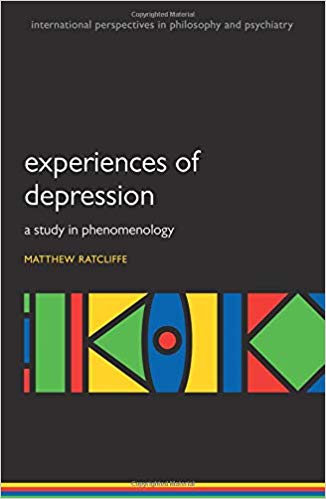
Cover art: Matthew Ratcliffe: Experiences of Depression: A Study in Phenomenology
Press, 2015, 318 pp, (44.09 $US)) is an important and eye-opening book for anyone who engages with depression or who wants a deep dive into phenomenological method.
The strength of this book is that Ratcliffe begins by listening to what the first person accounts have to say. Though Ratcliffe does not even use the word “empathy” until late in the work, and then in a debate that leaves much to be clarified, Ratcliffe’s method is a highly empathic one. What does he get out of listening to what the diversity of first person accounts have to say?
What is going on when the depressed person complains that getting out of bed requires enormous effort, and brushing one’s teeth seem impossible because the tooth brush seems to weigh twenty pounds? What is possible for the ordinary person is not possible for the depressed person.
This is a simple-minded, though accurate, example. Now extend it to loss of energy (lethargy) for daily and professional projects, the breakdowns in relations to other people and to oneself, including rampant self-reproaches, physical symptoms such as disturbances of appetite, sleep, consciousness (inability to concentrate). What goes missing from the experience of the depressed person?
Where you and I see possibility – tomorrow is another (and better!) day – the depressed person does not see possibility. The depressed person’s tomorrow is going to be the same miserable day as today. This is not just a belief (though it may be that too); this is the depressed person’s way of being – his experience of the world. This is not just the loss of one possible project or even a series of projects. This is the loss of possibility itself. This is Ratcliffe’s fundamental idea: depression is the loss of the very possibility of possibility.
This idea – the loss of the possibility of possibility – open up the flood gates for the description and appropriation of the diversity (“heterogeneity”) of depressive symptoms. The depressed person does not experience the possible – does not experience the possible as possible. That is the disorder itself.
The disorder is that it is not possible to conceive that things will get better. One is left without hope. Hope is itself openness to a possible future that is better. One is left demoralized. One is left without a future. Guilt is the impossibility of undoing faults or mistakes in the past. One’s crime is irrevocable, impossible to fix or make reparations (or reinterpret). No possibility of forgiveness.
Meanwhile, the depressed person often gets influenza like symptoms – no energy, inability to concentrate, headaches, stomach distress – one takes to one’s bed. However, unlike the case of the flu, in which one feels miserable but knows if one just hangs in there one will get better in a few days, the depressed person cannot imagine things being otherwise. No possibility period.
The phenomenology? Backing up for a high level view based on the phenomenological methods of Husserl and Heidegger, the world is not a thing in the world. The world is the context for things in the world. The world is the space of possibilities. The world of the depressed person is different than the world of the ordinary person. The los of possibility has a domino effect, “taking down” practical significance, hope, and interpersonal connection. Nothing matters anymore. Lethargy, detachment, self-reproach, and flu like symptoms are pervasive.
Given that the audiences for this book, including psychiatrists and many analytic philosophers, have not read Husserl and Heidegger, Ratcliffe devotes significant time and effort providing background, marshaling evidence, and arguing “depression is the loss of possibility – not just one or a series of possibilities – the very possibility of possibility – the depress person cannot even conceive of [the] possibility [of taking action].”
This is as it should be, and the book contains many technical distinctions – e.g., noetic and noematic – and, in that respect, is not for the faint of heart. Still, I was persuaded, and I believe, you will be too. This is a powerful and important contribution, which should be, required study for anyone proposing to engage with persons who one customarily describes as depressed. It changes one’s listening and in a powerful and positive way.
Since this is not a softball review, this leads to the two-ton elephant in the room. So what? What is the guidance in overcoming depression? As I am a person who performs empathy consulting and psychotherapy, this reviewer asks: what are the action items or recommendations? How does one access the possibility of possibility, given that possibilities always present themselves as specific projects in the world? How does one jump-start the possibility of possibility when nothing seems possible?
In all fairness, addressing this may not be Ratcliffe’s job since he is doing phenomenological research, not clinical practice; but the question is almost unavoidable. Therefore, I am so bold as to engage in some “reading between the lines.”
Ratcliffe’s short answer to jump starting possibility is “radical empathy.” Radical empathy – unlike ordinary empathy (according to Ratcliffe) – does not presume that the two people trying to relate share the same space of possibilities (p. 242). Radical empathy is a kind of lever to open a space of possibilities of difference.
My take on radical empathy? Radical empathy consists in the would-be empathizer being committed enough to relating that he continues to try to do so even though logical reasons exist that empathy should fail. In this case, the depressed person is overwhelmed, experiencing being cut off from human relatedness, isolated, and disconnected. That is the disorder itself – along with the other symptoms.
Yet the would-be empathizer persists in his attempts to relate, vicariously experiencing the isolation and disconnectedness (or not) as a privative form of relatedness. The depressed person, even in his isolation, “gets it” that the empathizer is committed to the possibility of relating, even though the depressed person is frustrating the efforts. That’s it. That’s the moment something starts shifting.
Voila! The possibility of possibility is back in play. The depressed person’s “getting it” that the other is committed to the possibility of relating provides an Ariadne’s thread out of the labyrinth. That’s the empathic breakthrough.
This does not guarantee that radical empathy will succeed. Nor is there any guarantee that after trying ten times, the 11th try will be enough to do the trick. The depressed person may still be so cut off from possibility that suicide starts to look like a solution; but if one can acknowledge the possibility of a bad – very bad – solution (e.g., suicide), then one may be able to find a better solution – whether pharmacological, cognitive behavioral or empathy-based.
To cut to the chase, I am so bold as to suggest that all empathy is radical empathy (in Ratcliffe’s sense). Contrary to Ratcliffe’s assertion, ordinary empathy does notrequire a space of shared possibilities. Shared possibilities are a “nice to have,” but often a high bar. Possibilities might be shared, but often they are not. Given the state of the world, such a space of shared possibilities is rarer than any of us might wish. I assert: All empathy is a risk undertaken to create a space of shared possibilities when there was no shared context.
All the other would-be empathic mechanisms such as simulation, mindedness, sympathy, altruism, are examples of incomplete empathy or breakdowns of empathy into projection, emotional contagion, or conformity. If the breakdowns were clarified, then empathic connection would emerge out of the misunderstanding, restoring the integrity of the relationship.
Meanwhile, Ratcliffe acknowledges the usefulness of the Diagnostic and Statistical Manual (DSM) for aligning the conversation and assuring us that the researchers are talking about the same phenomena. He is respectful of the professional sensibilities of the medical and psychiatric establishment – perhaps too respectful in my opinion. Yet, then again, if one is going to speak truth to power, it is best to start with an agreeable word. The barber lathers a man before he shaves him.
Though not a contribution to the growing body of anti-DSM literature, Ratcliffe’s work is an antidote to the pervasive tendency to under-describe depression (and other psychiatric disorders). The DSM is a starting point. However, Ratcliffe’s work makes clear that the DSM, especially as regards depression, is a pragmatic conglomeration of overlapping traits, not a natural kind.
Arguably melancholy is a natural kind; mania is a natural kind; paranoia is a natural kind; inflammation is a natural kind (and here the cytokine theory of depression is called out); but major depressive order as defined by the DSM? Nope. Ratcliffe does not spend much time or effort on the matter of the social construction of the categories of mental illness, and if one had to summarize Ratcliffe’s approach it aligns with the genealogical approach of Ian Hacking (e.g., see Ian Hacking, (2002), Historical Ontology, Cambridge, MA: Harvard University Press), who was himself inspired by Foucault (in turn, inspired by Nietzsche).
In spite of his commitment to sustained phenomenological description of the things themselves, Ratcliffe quickly discovers that the phenomena bring forth a deep structure and background separable from any specific first person report. As usual, the way the researcher gets access to the phenomena significantly influences one’s description of the phenomena.
The data? The phenomena? Ratcliffe collects some 150 free form depression questionnaires in which sufferers and survivors of depression try to express and describe their experiences. Many of these contain lengthy feedback from the survivors on their experiences of depression. Ratcliffe also reviews many memoires of suicide and depression survivors, who try to express the ineffable nature of their experiences, such as Styron’s Darkness Visible. Many conditions and qualifications regarding the data are argued, limitations defined, and the richness of the experience plumbed for an expansive encounter with the enemy – depression.
Several things come out in the first person accounts that are not emphasized or are outright overlooked in the DSM. These include: the intimate relationship between depression and anxiety (“anxious distress” is called out in DSM-5, but unrelated to the whole); loss of hope and changes in bodily experience are briefly acknowledged in the DSM-5, but are critical path in the treatment; the altered experience of time is not mentioned at all (but the future seems to disappear as a positive, possible horizon); impaired social function is mentioned as a consequence whereas such loss of function is integral to the phenomena itself. This list goes on.
One of the first things that occurred to me as I sat down to read this book was: Am I going to get depressed – not necessarily in the full clinical sense; but is it going to cause an upset? My experience was that such a negative outcome was not the case. I suspect that was because, as an author who “gets” and uses empathy, Ratcliffe knows how to regulate the empathy in the space of possibilities to prevent empathic distress.
However, before turning to Ratcliffe’s breakthrough notion of radical empathy, the text engages with the issue of how empathy maps to the theory of mind debate in which empathy as simulation is arrayed against a theory of mindedness that enable persons to perceive others as sources of intentionality. The details of this debate are technical and at times Ratcliffe seems to forget the insight with which he began the book: “I argue that human experience incorporates an ordinarily pre-reflective sense of belonging to a shared world’, which is altered in depression” (p. 2).
Once one disconnects the subject from its environment – the subject’s belonging to a shared world of people, neither simulation theory nor theory of mindedness can ever quite connect them again. It is a myth that we human beings are unrelated. We are all related. Human beings are already related to one another – biologically, psychologically, and in our very way of being (ontologically). Ratcliffe gets this. There is nothing wrong. Yet there is something missing.
Ratcliffe conceptualizes empathy as an attitude that does not include the communication of affect. Therefore, he overlooks several breakdowns in empathy – such as emotional contagion, projection, conformity – that if clarified provide the breakthrough to “radical empathy” (Ratcliffe’s key term) that is need to give traction to treatment options. There is indeed such a thing as an empathic attitude; but I disagree with Ratcliffe that a congruence of feeling (whether partial or complete) is to be ruled-out.
Ratcliffe (and his argument) are troubled by the notion that if one empathizes with a depressed person, then one may end up feeling quite depressed. This seems to be an invalidation of empathy and an obstacle to using it in treatment. Neither needs to be the case. First, in an admittedly extreme case, if one talks to eight depressed people in a row in the course of a treatment day, then one is very likely going to feel down – at least sub-clinically depressed – by the end of the day, regardless of the quality of one’s empathy. Is this empathy or a breakdown of empathy?
Look at the phenomena. Phenomenologically, there is no other plausible way to describe this than to say that the feelings and emotions have been communicated from one person to another. Once again, is this empathy? No – according to Ratcliffe, empathy is an attitude, not a congruence of feelings.
I suggest this answer is incomplete. It is not an “either or” choice. One must integrate empathic receptivity (openness), empathic understanding, empathic interpretation, and empathic responsiveness.
The answer is still “No,” but because the communication of feeling, the congruence of feeling – one paradigm case of which is vicarious experience – is not complete empathy. It is merely phase one of empathy.
If one stops with the mere communication of feeling, then one gets emotional contagion (as Ratcliffe properly notes). This is a breakdown of empathy, but Ratcliffe does not describe it in such a way. However, do not be so hasty to dismiss empathy. That empathy breaks down does notmean empathy is invalid or must be abandoned.
The would-be empathizer may [must?] take this vicarious experience of the other’s distress and process it further through empathic understanding, empathic interpretation, and empathic responsiveness in order to make it useable in relating to the other person as a possibility or a breakdown of possibility.
Likewise with compassion fatigue, which is likely in the background of Ratcliffe’s insistence that empathy is an attitude, not a congruence of feeling. Though compassion fatigue is not an issue Ratcliffe engages, it is common to acknowledge that the helping professions are at risk of burn out, empathic distress, and compassion fatigue. (Note that burn out itself is a kind of loss of the possibility of possibility. “Depression”?)
Those who engage with depressed people are particularly at risk of such an outcome. Empathy reportedly peaks in the third year of medical school, and, unless specific interventions such as further training are undertaken, it is downhill from thereon (see Hojat, Mohammadreza, et al. (2009). The devil is in the third year: A longitudinal study of erosion of empathy in medical school, Academic Medicine84 (9): 1182–1191). What to do about it?
Once again, Ratcliffe may not see this as his job – and the book is already over 300 pages of dense descriptions of depression – but one may offer a couple of thoughts. We usually think of empathy as an “on off” switch. Turn it on for the “in group” – patients, clients, friends, family – turn it off for the competition, the opposing team, people who talk foreign languages or have unfamiliar customs or the “out group.” Rather, the training is to regard empathy as more like a dial or tuner – dial empathy up or down by regulating one’s receptivity – one’s openness (Ratcliffe’s term) – to the experiences of other persons.
If one is over-whelmed by the other person’s depression one is doing it wrong. Properly deployed by experienced practitioners, empathy is a method of providing a sample or trace of the other person’s experience. Max Scheler (who Ratcliffe approvingly cites) calls this a “vicarious experience” (Nacherlebnis) – rather like an after image of another person’s feeling. As noted, this trace or sample of the other’s experience has to be further processed by the understanding of possibilities to be useful in shifting out of stuckness. (See Max Scheler, (1913/1922). The Nature of Sympathy, tr. Peter Heath. Hamden: CN: Archon Books, 1970)).
Of course, expanding one’s empathy does not come naturally to most people, which is why training and practice are needed. But experience shows that if one works at it, one can expand one’s empathic capabilities and the results one gets in trying to be empathic. (See Zaki, Jamil and Mina Ciskara. (2015). Addressing empathic failures, Current Directions in Psychological Science,December 2015, Vol. 24, No. 6: 471–476. DOI: 10.1177/0963721415599978).
The antidote? A radical proposal – in addition to radical empathy. If one is experiencing compassion fatigue, maybe one is being too compassionate. Now compassion is different from empathy. In compassion, one’s strong feeling – passion – motivates one to get involved, take action, and intervene to help the other. (Nor is anyone saying be hard-hearted or indifferent, but know when to dial it down a bit.) In contract, empathy in the full sense of the term, of which Ratcliffe’s radical empathy is a subset, is a method of data gathering about the experience of the other person. It consists in being open to the experiences of the other person, having a vicarious experience of the other’s experience, and further processing it in empathic understanding, empathic interpretation, and empathic responsiveness.
It is ironic that the phenomenology of depression misses the key phenomenological distinction – vicarious experience – in the account of trying to empathize with depression. In relating to a depressed person, I can be open to a vicarious experience of melancholy or stress or anger or irritability or discordant mood or whatever the other person is experiencing – without succumbing to a merger with them. This vicarious experience gets processed further in understanding who the person is, where he is at, what he “gets” as possible for himself in the moment. Through interpretation and responsiveness, this may open up other possibilities. Now we are back in the realm of jump-starting the possibility of possibility.
Ratcliffe finds inspiration in, but puts his own definitive spin on, Jonathan Lear’s Radical Hope, a narrative of the struggles of the Native American Crow people. After the buffalo went away (were killed off), the indigenous Crow people, experienced world collapse. Hunting ceased. Demonstrating courage in tribal warfare became impossible. Culture and customs lost significance and ceased to make a difference. Nothing changed – i.e., in effect, time stopped. All hope was lost and – at the risk of a caricature – the only possibilities were the self-destructive non-possibilities of alcoholism and inadequate, dignity-destroying government handouts.
However, even amid this world collapse – analogous to the depressive person’s loss of the possibility of possibility – a wise Crow elder put forth a prophecy that an event, something = x, would happen that would enable a the rebirth of possibility of the true people. This was radical hope – “to hope against hope until hope creates from its own wreck the thing it contemplates” as the poet Shelley put it.
The prophesized event turned out to be World War II, a conflict in which the Crow were able to draw on their warrior tradition and make a contribution to the defeat of the enemy.
Ratcliffe’s radical empathy is analogous to radical hope here. The therapist keeps alive the possibility of possibility and gives expression to it while the depressed person is unable to do so for himself. The therapist keeps blowing on the embers – and may indeed get short of breath doing so – until the spark rekindles the fire of neuronal activity in the depressed person’s consciousness.
In conclusion, Ratcliffe “gets it” – while simulation and theory of mindedness go round-and-round about whether feelings are congruent or perspective interchangeable, psychiatric disorders across the spectrum, from mood disorders to thought disorder, are especially challenging to anyone’s empathy. Most psychiatric disorders – not just autism or psychopathy – involve a breakdown of empathy (as Ratcliffe points out elsewhere), leaving the person feeling disconnected, isolated, not “gotten.” Ordinary empathy is already radical in so far as one person is able to understand another in his or her humanity. Such a commitment – call it an “attitude” or a “method” – is not easy or trivial. Yet the commitment to relating to the other’s humanity is what calls forth the humanity back into possibility.
(c) Lou Agosta, PhD and the Chicago Empathy Project
 Lou Agosta, Ph.D., Listening With Empathy