Home » Posts tagged 'psychotherapy'
Tag Archives: psychotherapy

Automating empathy – issues and answers
I saw an advertisement today: “Empathy can’t be automated”
Made me think: What is the evidence pro and con?
The obvious question is “Well, can you?”
The debate is joined. This turns out to be a trick question. The intuition on my part is that one cannot automate empathy, but perhaps one can simulate it, and then the simulation turns out to be something quite like the “automating empathy” of the title.
Defining our terms
However, before further debate, we need to define our terms. “Receiving empathy” is defined in rough-and-ready terms as one person (the speaker expressing/sharing something) “feeling heard” by the other person (the listener). “Feeling heard,” in turn, means the speaker believes he or she has been “understood,” “gotten for who the sharer is as a possibility.” The celebrity psychotherapist Carl Rogers said things about empathy such as getting inside the frame of reference of the other person and experiencing (not just intellectualizing) the other’s point of view: “…to see his [her] private world through his eyes” (Rogers 1961: 34).
If one wants to get a tad more technical about defining empathy, then consider Heinz Kohut’s approach that empathy is “vicarious introspection,” i.e., one knows what the other individual is experiencing, feeling, etc. because one has a vicarious experience of the other’s experience (Kohut 1959). I listen to you and get “the movie of your life.” Less technically, Kohut famously quotes one of his psychoanalytic patients (he was a medical doctor) as saying that being given a good [empathic] listening was like sinking into a warm bath (Kohut 1971; note I will update this post as soon as I can find the exact page). Presumably that meant it was relaxing, de-stressing, emotionally calming.
“Simulation” is producing a functionally similar result using a different means or method. For example, in the history of science, Lord Kelvin, one of the innovators of thermo-dynamics simulated the action of the ocean tides using a mechanism of ropes and pulleys [Kenneth Craik 1943: 51 (“Kelvin’s tide-predictor”)]. Thus, one does not have a social relationship with a bot, one has a “para-social relationship.” According to Sam Altman, some 1% of ChatGPT users had a “deep attachment” to the app – a kind of “rapport” – sounds like an aspect of “empathy” to me. Maybe not a therapist, but how about a “life coach”? (https://www.nytimes.com/2025/08/19/business/chatgpt-gpt-5-backlash-openai.html)
One misunderstanding needs to be cleared up. Entry level empathy is often presented as reflecting back on the part of the would-be empathic listener what the potential recipient of empathy expresses in words (and sometimes also in behavior). Though the value of being able to reflect the words the other person expresses is great, this is a caricature of empathy. For example, that the client comes in and says “I am angry at the boss” and the listener responds “You feel angry.” Pause for cynical laugh.
Now one should never underestimate the value of actually comprehending the words spoken by the speaker. Reflecting or mirroring back what is said, more-or-less literally, is a useful exercise in short-circuiting the internal chatter that prevents a listener from really hearing the words that the other person puts into the interpersonal space of conversation.
The exercise consists in engaging and overcoming the challenge: “I can’t hear you because my opinions of what you are saying are louder than what you are saying; and my opinions drown out your words!” So the empathic commitment is to quiet and quiesce the listener’s internal chatter and be with the other person in a space of nonjudgment, acceptance, and tolerance. In a certain sense, the empathy automaton (“bot”) has an advantage because, while the bot may have a software bug or generate an inappropriate response, it does not have an “internal chatter.”
Entry level empathy automation: repeating, mirroring, reflecting
So far, there is nothing here that cannot be automated
On background, this entry level of empathy was automated – reflect back what was said in at least in a rough-and-ready way – in 1966 by Joseph Weizenbaum’s MIT prototype of a natural language processor, a very primitive “chat-bot,” ELIZA. This was an attempt at natural language processing at a high level and was not restricted to science, therapy, life coaching, business, education, or any random area of conversation. The approach of ELIZA was to reflect, mirror back, repeat the statements made to it (the computer app) by the human participant in the conversation (which used a key board to type the exchange).
Here’s the surprising, unpredicted result: The example of the software ELIZA, which mirrors back what the person says to it, was experienced by users to be comforting and even “therapeutic,” granted in a hard-to-define sense. As far as I know, no attempts at a sustained therapeutic or empathic relationship were ever undertaken, so the data is anecdotal, yet compelling.
Could it be that we persons are designed to attribute “mindedness” – that the other person (or, in this case, participant software) has a human-like mind – based on certain behavioral clues such as responding to the speaker with words and meanings used by the speaker or that support the speaker or even disagree with the speaker in a way that takes the input and provides meaningful feedback? This gets one a caricature of the role of therapist of the school of Carl Rogers (whose many innovative contributions are not to be dismissed), in which the listener mainly reflects back the words of the client and/or asks non-directive questions such as “How do you feel about that?” or “Will you please say more about that?”
In contrast, we find there is more to empathy than mere mirroring and reflection of words. For example, Heinz Kohut (1971, 1977), an empathy innovator, gives the example of meeting a new prospective client who begins the conversation with a long list of the client’s own failings, short comings, and weaknesses, dumping on himself and building a case that he is really a jerk (or words to that effect). The guy is really going full throttle in dumping on himself. The person then pauses and asks, “What do you think of that?” Based on his empathic listening and the feeling that Kohut got in being with the person, he replies “I think you are feeling very lonely.” The man bursts into tears – finally someone has heard him! Now this is just one vignette from a long and complicated process, in which there were many moments of empathic convergence and divergence. The point is this exchange was not a predictable result, nor likely a result to have been produced by mere mirroring; nor is this vignette dismissible by saying that Kohut was merely a master practitioner (which he was), who could not tell what he was doing but just did it. Kohut wrote several books to document his practice, so he tells a lot about what he was doing and how to do it.
In a prescient reflection, which anticipates the current debate by nearly half a century, Kohut wrote:
“…[M]an [people] can no more survive psychologically in a psychological milieu that does not respond empathically to him, than he can survive physically in an atmosphere that contains no oxygen. Lack of emotional responsiveness, silence, the pretense of being an inhuman computer-like machine which gathers data and emits interpretations, do not more supply the psychological milieu for the most undistorted delineation of the normal and abnormal features of a person’s psychological makeup than do an oxygen-free environment…” (Kohut 1977: 253)
Empathy is oxygen for the soul. What Kohut could not appreciate – and which computer science could not even imagine in 1977 – is that large language models would be able to simulate affective responsiveness, chattiness, agreeableness, even humor, that would put to shame the relatively unemotional unresponsiveness of the classic approach to psychoanalysis, in which the analyst is an emotionally neutral (and hence “cold”) screen onto which the client project his issues. It should be noted this classic unresponsiveness is a caricature and stereotype to which few real world psychoanalysts rigidly adhere, rather like the cynical anecdote of the analyst who removes the tissue from his consulting room to prevent indulgent weeping instead of talking.
Granted, one should not assume that a therapeutic bot would (or would not) work as well as a human therapist or empathy consultant; but, for the sake of argument, let us suppose that it does work as well (and work as badly?), either in certain circumstances or new, improved future releases, which are to be anticipated with highly probability.
Fast forward to today’s large language models (LLMs)
Therefore, fast forward these sixty years from Joseph Weizenbaum’s prototype (MIT 1965) to today’s large language models that beat human beings at playing Jeopardy – an elaborate word game requiring natural language – and what then becomes possible? One of the challenges of talk therapy (or empathy consulting, etc.) is that it is powerful and demonstrably effective, but not scalable. It does not scale up to meet the market demands of thousands of people who are struggling with mental illness or those who, while not satisfying criteria for mental illness, would still benefit from a conversation for possibility.
A human therapist (or empathy consultant) has eight hours in a standard workday and if the therapist meets with emotionally upset people during all those hours, then the therapist is at risk of upset, too, confronting compassion fatigue, burn out, or empathic distress in somewhere between two weeks and two years. Hence, the popularity of fifteen-minute medication management session on the part of psychiatrists (MDs), the current dominant practice design, an approach presenting challenges of its own. Medications are powerful and can address disordered mood, anxiety, and pathological thinking, yet often the underlying (individual, social, community, nonbiological) issues remain unaddressed, due to finances and schedule, and so remain unengaged and unresolved.
Hence, the current market of long wait times, high costs, high frustration, challenges to find a good fit between therapist and client, all resulting in suffering humanity – above all suffering humanity. (Note also that, while this article often talks about “therapy,” many of the same things can be said about “life coaching,” “consulting,” “counseling,” and so on; and these latter will not be mechanically repeated, but are implicated.
As regards the market, the problematic scalability of one-on-one talk therapy and the lengthy time needed for professional training and the acquisition of a critical mass of experience, results in a market shortage of competent therapists and related empathy consultants. For the prospective patient (i.e., customer) the question often comes down to: “how desperate are you?” as a client struggling with emotional, spiritual, behavioral health issues. The cynical (and not funny) response is “Pretty near complete panic!” If one is desperate enough – out of work, relationships in breakdown, attracted to unhealthy solutions such as alcohol – then a “good enough bot” just might be something worth trying. Note that all the usual disclaimers apply here – it would be interesting to consider a double-blind test between real human therapists and therapy bots. Unfortunately, the one really un-overcome-able advantage of a human therapist – the ability to be in-person in the same physical space – cannot be double-blinded (at least at the current state of the art) in a test. Having raised the possibility, I have deep reservations about the personal risks of such an approach. That there is a market for such services is different than having such an automated approach imposed on consumers by insurance corporations to expand would-be monopoly profits.
Another possible advantage of automation (albeit with a cynical edge): People who are socially awkward might prefer to get started with a virtual therapy bot. One clever startup has called their prototype platform a “Woebot”. Get it? Not a “robot,” but a “Woebot.” (Note – the Woebot uses a database of best practices, not a large language model.)
Now these socially struggling individuals might be a tad naïve as such an approach would prevent them from engaging with the very issue that is troubling them – interacting with people. On the other hand, one might argue it would be like “exposure therapy,” for example, for the person who has a snake phobia and is presented with a photo or a rubber snake as the first step of therapy. Likewise, in the case of an empathic relationship, one would have to “graduate” to an authentic, non-simulated human presence – the real snake!
What is one trying to automate?
If one is going to automate empathy using a therapy-bot, then presumably one should be able to say what it is that one is trying to automate – that is, simulate. There are four aspects of empathy that require simulation – for the client, (1) the experience (“belief”) that one has been heard – that the meaning of the message has been received and, so to speak, not gotten lost in translation; (2) the communication of affect and emotion – that the listener knows what the speaker is feeling and experiencing because the listener feels it too; (3) who is the other person as a possibility in the context of the standards to which the individual conforms in community; (4) putting oneself in the place of the other person’s perspective (“point of view” (POV)).
Most of these things – taking the other’s point of view, vicarious experience of the other’s experience, engaging with possibilities of relatedness, commitment to clear communication – come naturally to most people, but require practice. Humans seem to be designed spontaneously to assume multiple perspectives – one assumes other people have minds (beliefs, feelings, wants, impulses) like oneself, but then we get caught up in “surviving the day” on “automatic pilot,” and forget the individual is part of the community, throwing away the assumptions and preferring the egocentric one – it’s all about me! It takes commitment to empathy and practice to overcome such limitations. A person experiences a rush of emotions, but then forget it could be coming from the other person and succumb to emotional contagion. Who the other person is as a possibility is not much appreciated in empathy circles, but it an essential part of the process of getting from stuckness to flourishing and requires empathy at every step.
There is nothing described here, once again, that cannot in theory be automated. Indeed human beings struggle with all these aspects of being empathic, and the requirements of automation are non-trivial, but can be improved by trial and error. The over-simplifications required to automate a process end up feeding back and giving the empathy practitioner insight into the empathic process as implemented in the human psychobiological complex, the complete human being.
There is nothing wrong – but there is something missing
Ultimately what is missing from automating empathy is the human body – the chatbot is unable to BE in the space with you in a way that a human being can be with you. The empathy is in the interface. And the empathy for the human being is often the face. The human face is an emotional “hot spot.” The roughly thirty muscles in the human face, some of which are beyond voluntary control, can combine in some 7000 different ways to express an astonishingly wide range of emotions starting with anger, fear, high spirits (happiness), sadness and extending to truly subtle nuances of envy, jealousy, righteous indignation, contempt, curiosity, and so on. The result is facial recognition software of which “emotional recognition” is the next step as implemented by such companies as Affectiva (the corporation) (see Agosta 2015 in references). The software that recognizes the emotions and affects of the speaker based on a calculus of facial expressions (and the underlying muscles) as documented by Paul Ekman (2003). Now combine such an interface with an underling automation of empathy by a not-yet-developed system, and the state-of-the-art advances.
The skeptic may say, but what if the therapist is a psychoanalyst and you are using the couch so that the listener is listening out of sight, hidden behind the client, who is lying comfortably looking at the Jackson Pollack drip painting on the wall in front of him (or her) or at the ceiling? Well, even then, one hears the therapist clear her (or his) throat or one hears the analyst’s stomach gurgle. So the value added of the in-person therapy is gurgling stomachs, farts, and hiccups? Of course, this is the reduction to absurdity of the process (and a joke). Taking a necessary step back, the suspicion is one has missed the point. The point being? The bodily presence of the other person (including but not limited to the face) opens up, triggers, activates, possibilities of relatedness, possibilities of fantasies of love and hate, possibilities of emotional contagion, possibilities of further physical contact including sex, aggression, gymnastics, breaking bread, inhabiting the same space (this list is incomplete) that no virtual connection can as a matter of principle and possibility fulfill at all. This (I assert) is a key differentiator.
The emotional bond between the client and therapist, counselor, or consultant becomes the path to recovery. But why cannot that bond be with a bot? Well, without taking anything back anything said so far in this article, the bond can be a “bot bond,” if that would work well enough for you. Still, arguably, there is nothing wrong, but there is still something missing. Like in the major motion picture Her ((2013) Spike Jonze with a young Joaquin Phoenix), in which the lonely, socially awkward but very nice guy has a relationship with an online bot of a “girlfriend” – and then gets invited out on a double date. It is like the date – the other “person” (and the quotes are required here!) – is on speaker phone. So, if you are okay with that, then the sky, or at least cyber space, is the limit. There is another shoe to drop. It then turns out that the relationship is not exclusive as the software is managing thousands of simultaneous threads of conversations and relationships simultaneously. One essential aspect of empathy is that the one person is fully present with the other person. Even if the empathy consultant has other clients and other relationships, the listener’s commitment at the time and place of the encounter is to be fully present with the other person. For at least this session, I am yours and yours alone. Now that is a differentiator, and even in our multitasking, attention deficit world, I assert such serial exclusiveness (different than but analogous to serial monogamy) is critical path to get value from the empathy, whether authentic or simulated.
Advantage: Rapport
This matter of “exclusivity” suggests that the rapport between the speaker and listener, between the receptivity for empathy and its delivery, is undivided, unshared outside of the empathic pair, complete, whole. The parent has several children, but when she or he is interacting with one of them, that one gets the parent’s undivided attention. The parent is fully present with the child without any distractions. That such a thing is hard to do in the real world, show what a tough job parenting is.
If this analysis of exclusivity is accurate, then that would be a further differentiator between real world human empathy and automated empathy. I may be mistaken, but notwithstanding some people who can manage (“juggle”) multiple simultaneous intimate relationships, the issue of exclusivity of empathy is one reason why most such relationships either fail outright or stabilize as multiple serial “hook-ups” (sexual encounters) without the intimacy aspects of empathy.
On background, this business of the “rapport” invites further attention. “Rapport” is different from empathy, and it would be hard to say which is the high-level category here, but the overlap is significant. “The rapport” first got noticed in the early days when the practice of hypnosis was innovated as an intervention for hysterical symptoms and other hard-to-define syndromes that would today be grouped under “personality disorders” as opposed to major mental illness. The name Anton Mesmer (1734 – 1815) – as in “mesmerism” – is associated with the initial development of “magnetic banquets,” as in “animal magnetism,” the attraction and attachment between people, including but not exclusively sexual attachment. Mesmer had to leave town (Vienna) in a hurry when he was accused of ethical improprieties in the practice of the magnetic banquets.
The rapport of the hypnotic state is different than “being in love,” yet has overlapping aspects – being held in thrall of the other in a “cooperative,” agreeable, even submissive way. (It should be noted that Mesmer started up his practice again in Paris (a fascinating misadventure recounted in Henri Ellenberger The Discovery of the Unconscious (1971)). Today hypnosis is regarded as a valid, if limited, intervention in medicine and dentistry especially for pain reduction, giving up smoking, and overcoming similar unhealthy bad habits. One could still take a course in Hypnosis from Erika (not Eric!) Fromm in Hypnotism in the 1970s at the University of Chicago (Brown and Fromm 1986). (Full disclosure: I audited her (Fromm’s) dream interpretation course (and did all the assignments!), but not the hypnosis one.)
This business of love puts the human body on the critical path once again. Of course, no professional – whether MD, psychologist, therapist, counsel, empathy consultant, and so on – would ethically and in most cases even legally perpetrate the boundary violation of a sexual encounter. Indeed one can shake hands with any client – but hugs are already a boundary issue, if not violation. The power differential between the two roles – provider and client – is such that the client is “one down” in terms of power and cannot give consent.
However, firmly differentiating between thought and action, between fantasy and behavior, what if the mere possibility of a sexual encounter were required to call forth, enable, activate, the underlying emotions that get input to create the interpersonal attachment (the rapport) that occur with empathy? (This is a question.) Then any approach which lacked a human body would not get off the ground. Advantage: human empathy.
Once again, skepticism is appropriate. Is one saying the possibility of a boundary violation is an advantage? Of course not. One is saying that the risk of a boundary violation is a part of having a human body, and that such a risk is on the critical path to calling forth the communication of emotions (many of which may be imaginary) need for full-blown, adult empathic encounter. Note also this is consistent with many easy examples of entry level empathy where empathy is not really challenged. If someone raises their voice and uses devaluing language, one’s empathy is not greatly tested in concluding that the person is angry. Virtual insensitivity will suffice.
In the context of actual emotional distress, the matter is further complicated. Regarding bodily, physical presence, the kind of empty depression, meaninglessness, and lack of aliveness and vitality characteristic of pathological narcissism responds most powerfully and directly to the “personal touch” of another human being who is present in the same physical space. Kohut suggests that the child’s bodily display is responded to by gleam in the parent’s eye, which says wordlessly (“I am proud of you, my boy [or girl]!”). Child and parent are not having an online session here, and, I must insist, any useful and appropriate tele-sessions are predicated on and presupposed a robust relatedness based on being, living, and playing together on the ground in shared physical space. One occasionally encounters traumatic events that impact the client’s sense of cohesive self, if the parent recoils from the child’s body (or cannot tolerate lending the parent’s own body to the child for the child’s narcissistic enjoyment). The risk of the self’s fragmentation occurs (Kohut 1971: 117). So where’s the empathy? The need for the parent’s echoing, approving, and confirming is on the critical path to the recovery of the self. The empathy lives in the conversation for possibility with the other person in the same space of acceptance and tolerance in which we both participate in being together.
Advantage: Embodiment
Another area where humans still have an advantage (though one might argue it is also a disadvantage) is in having a body. Embodiment. You know, that complex organism that enables us to shake hands, requires regular meals, and so on. If further evidence were needed, this time explicitly from the realm of science fiction, the bots actually have a body, indistinguishable from that of standard human beings, in Philip K. Dick’s celebrated “Do Androids Dream of Electric Sheep” (1968), which is the basis for the major motion picture Blade Runner. Regardless of whether the “droids” have empathy or not, they definitely have a body in this sci-fi scenario – and that makes all the difference. That raises the stakes on the Voight-Kampff Empathy Test considerably (the latter rather like a lie detector, actually measuring physiological arousal, not truth or empathy).
And while the production of realistic mechanic-biological robots is an ongoing grand challenge, we have left the narrow realm of computing and into biochemistry and binding bone and tissue to metals and plastics and translating biochemical signals into electrical ones. We are now inside such science fiction films as Blade Runner or Ex Machina. For purposes of this article, we are declaring as “out of scope” why we will soon be able to produce autonomous weapon warriors that shoot guns, but not autonomous automatic empathy applications. (Hint: the former are entropy engines, designed to produce chaos and disorder; whereas empathy requires harmony and order; it is easier to create disorder than to build; and automating empathy is working against a strong entropy gradient as are all humanizing activities.) Along with the movie Ex Machina, this deserves a separate blog post.
The genie is out of the bottle
Leaving all-important early childhood development aside, bringing large language models to empathic relatedness is a game changer. The question is not whether the generative AI can be empathic, but the extent to which the designers want it to function in that way and the extent to which prospective clients decide to engage (both open questions at this date (Q4 2025)).
“The day ChatGPT went cold” is the headline in this case. The reader encounters the protest from some Open AI customers about the new release of Chatbot 5.0. This event was reportedly greeted by a significant number of customers with the complaint that “Open AI broke it!”
The New York Times article (https://www.nytimes.com/2025/08/19/business/chatgpt-gpt-5-backlash-openai.html) tells of a musician who found comfort (not exactly “empathy,” but perhaps close enough) in talking with ChatGPT about childhood trauma, and, as designed, the bot would keep the conversation going, enabling the individual to work through his issues (or, at least, such is the report, which, however, I find credible). Then the new release (5.0) was issued and it went “cold.” The response of the software lacked the previous set of features often associated with empathy such as rapport, warmth, responsiveness, validation, disagreeing in an agreeable way, humor, and so on. Instead the response was emotionally cold: “Here is the issue – here is the recommendation ___. Conversation over.” In particular, customers who were physically challenged as regards their mobility, ability to type (and were using a voice interface), cognitive issues, as well as standard customers who had established a relationship with the software and the interface, complained that the “rapport” was missing.
Human beings often know that they are being deceived, but they selectively embrace the deception. That is the basis of theatre and cinema and even many less formal interpersonal “performances” in social media. In the media, the entire performance is imaginary, even if it represents historical events from the past, but the viewer and listener welcome it, not just for entertainment (though that, too) but because it is enlivening, activating, educational, or inspiring. Same idea with your therapy-bot. The client enters the therapy theatre. You know it is fake the way the Battle of Borodino in Tolstoy’s War and Peace is a fictional representation of a real battle. Yet for those able to deal with the compartmentalization, perhaps the result is good enough. This assumes that the therapeutic action of the bot is “on target,” “effective,” “engaging,” which, it should be noted, is a big assumption, especially given that even in the real world it is hard to produce a good therapeutic result.
This matter of faking empathy opens up a humorous moment (though also a serious one – see below). Here the definition of “fake” is “fake” the way a veggie burger is a substitute for an actual hamburger. That may actually be an advantage for some people, though, obviously, in a profoundly different way in comparing how a hamburger relates to empathy as processed by a human being. The veggie burger influences the lower gastrointestinal tract and the empathy (whether automated or not) influences one’s psyche (the Greek word for “soul”). Not a vegetarian myself, I definitely eat a lot less meat than ten years ago, and, with apologies to the cattle industry (but not to the cattle), applaud the trend. The interesting thing is that by branding the products “veggie burgers” or “turkey Burgers,” the strong inference and implication is that the hamburger still sets the standard regarding the experience and taste that the consumer is trying to capture. Likewise with empathy.
In most cases, the automation of empathy relies on the person’s desire and need for empathy. Empathy is like oxygen for the soul – without it, people suffocate emotionally. Unfortunately, the world is not generous with its empathy, and most people do not get enough of it. Therefore, people are willing systematically, perhaps as a design limitation of the human psyche, to support a blind spot about the source of their empathy. Some will choose the Stephen Stills song: “If you can’t be with the one you love; love the one you’re with!” (1970), which, in this case, will be the bot mandated by the insurance company or the human resources department of the corporation. Deciding not to think about what is in fact the case, namely, this amalgamation of silicon hardware and software has no human body, is not morally responsible, and lacks authentic empathy, the person nonetheless attributes empathy to it because it just feels right; and yet, unless, the bot goes haywire and insults the person, that is often good enough to call forth the experience of having been “gotten,” of “having been heard,” even if there is no one listening.
For all of its power and limitations, psychoanalysis is right about at least one thing: transference is pervasive on the part of human beings. Nor is it restricted merely to other human beings. The chatbot becomes a new transitional object (to use D.W. Winnicott’s term (1953)). To quote Elvis, “Let me be – your teddy bear.” This is “transference,” an imaginary state in which the client imaginatively project, attributes, and/or assigns a belief, feeling, or role to the therapist, which the therapist really does not have. However, the ins-and-outs of transference are not for the faint of heart. What if the therapist really does behave in a harsh manner, thereby inviting the project on the part of the client of unresolved issues around a hard, bullying father figure? The treatment consists precisely in creating an empathic space of acceptance, to “take a beat,” “take a step back,” and talk about it. Of what does this remind you, dear client?” Is this starting to look and sound familiar?
The suggestion is that such features, including transference, can be simulated and iteratively improved in software. However, the risk is that in “simulating” some of these features – and the comparison is crude enough – it is rather like putting on blackface and pretending to be African-American. Don’t laugh or be righteously indignant. Things get “minstrel-ly” – and not in a positive way. There are significant social psychology experiments in which people have “gone undercover,” pretending to be black – in order the better to empathize with the struggles of black people. The result was fake empathy. (See A. Gaines (2017) Black for a Day: White Fantasies of Race and Empathy and L. Agosta (2025) “Empathy and its discontents.”) In the case of automated empathy software, no one is pretending to deliver human empathy (though, concerningly, sometimes it seems that they are!) and the program may usefully deliver the disclaimer that the empathy is simulated, multi-threaded, not exclusive, and not the direct product of biologically based experience of a human organism. To paraphrase a disclosure from the bot in Her, “I am currently talking to 3231 people and am in love 231 of them.”
Ethical limitations of “fake it till you make it”
While one can map these empathic functions one-to-one between human beings in relationship (including therapeutic ones), there is one aspect of the relationship that encompasses all the others and does not apply to the bot. That is the ethical aspect of the relationship. When a person goes to a professional for consultation – indeed whether about the individual’s mental health or the integrity of the individual’s financial portfolio or business enterprise – the relationship is a fiduciary one. (Key term: “fiduciary” = “trust”.) That is, one relies on the commitment to the integrity of the interaction including any transactional aspects. One is not going to get that kind of integrity or, just as importantly, the remedies in case of an integrity outage from a bot. Rather one looks to the designer, the human being, who remains the place where the responsibility lands – if one can figure out who that is “behind the curtain” of the faceless unempathic bureaucracy responsible for the product.
A significant part of the ethical challenge here is that automated neural networks – whether the human brain implemented in the organic “wetware” of the human biocomputer or, alternately, a computer network implemented in the software of silicon chips – seem to have emergent properties that cannot be rigorously predicated in advance. (On this point see Samuel Bowman (2024): Eight things to know about large language models: https://read.dukeupress.edu/critical-ai/article/doi/10.1215/2834703X-11556011/400182/Eight-Things-to-Know-about-Large-Language-Models. Thus, human behavior, which is often predictable, is also often unpredictable. So human communities have instituted ethical standards of which law enforcement and organized religions are examples. Our standards for chatbots and similar platforms are still emerging.
Thus, the prognosis is mixed. Is automating empathy a silver bullet – or even a good enough lead bullet – to expand empathy for the individual and community and to so at scale, for example, for Henry David Thoreau’s “modern mass of men [persons] leading lives of quiet desperation”? Or our cyber age equivalent of a blow-up sex doll for the socially awkward person playing small and resistant to getting out of the person’s comfort zone? At the risk of ending on a cynical note, given the sorry state of human relations as demonstrated in the news of the day, maybe, just maybe, any form of expanded empathy, whether fake or authentic, if properly managed to mitigate harm, is a contribution.
In any case, the key differentiators between automated empathy and humanly (biologically) based empathy are the human body (or lack thereof), the exclusivity of the empathic rapport, and the ethical implications, including the locus of responsibility when things go right (and wrong). We humans will predictably fake it till we make it; and automating empathy does not produce empathy – it produces fake empathy.
References
(in alphabetical order by first name)
Alisha Gaines. (2017). Black for a Day: White Fantasies of Race and Empathy. Chapel Hill: University of North Carolina Press.
Carl Rogers. (1961). On Becoming a Person, intro. Peter Kramer. Boston: Houghton Mifflin, 1995.
Daniel P. Brown & Erika Fromm. Hypnotherapy and hypnoanalysis. Hillsdale, N.J.: L. Erlbaum Associates, 1986.
Donald W. Winnicott. (1953 [1951]). Transitional objects and transitional phenomena. A study of the first not-me possession. International Journal of Psycho-Analysis, 34, 89-97.
Dylan Freedman. (2025/0819). The day ChatGPT went cold. The New York Times:https://www.nytimes.com/2025/08/19/business/chatgpt-gpt-5-backlash-openai.html
Henri Ellenberger. (1971). The Discovery of the Unconscious.
Heinz Kohut. (1959). Introspection, empathy, and psychoanalysis. Journal of the American Psychoanalytic Association, 7: 459–483.
Heinz Kohut. (1971). The Analysis of the Self. New York: IUP Press.
Heinz Kohut. (1977). Restoration of the Self. New York: IUP Press.
Joseph Weizenbaum. (1966). ELIZA – A computer program for the study of natural language communication between men and machines,” Communications of the ACM, 9: 36–45. (See also ELIZA below under Wikipedia.)
Kenneth Craik. (1943). The Nature of Explanation. Cambridge: Cambridge University Press, 1967.
Lisa Bonos (2025/10/23): “Meet the people who dare to say no to artificial intelligence”: https://www.washingtonpost.com/technology/2025/10/23/opt-out-ai-workers-school/
Lou Agosta. (2025). Chapter Three: Empathy and its discontents. In Radical Empathy in the Context of Literature. New York: Palgrave Macmillan: 55 – 82. (https://doi.org/10.1007/978-3-031-75064-9_3 )
Lou Agosta. (2019). Review of The Empathy Effect by Helen Reiss: https://empathylessons.com/2019/01/27/review-the-empathy-effect-by-helen-riess/
Lou Agosta. (2015). A rumor of empathy at Affectiva: Reading faces and facial coding schemes using computer systems: https://empathylessons.com/2015/02/10/a-a-rumor-of-empathy-at-affectiva-reading-faces-and-facial-coding-schemes-using-computer-systems/
Paul Ekman. (2003). Emotions Revealed. New York: Owl Books (Henry Holt).
Philip K. Dick. (1968). Do Androids Dream of Electric Sheep. New York: Ballentine Books.
Samuel Bowman (2024): Eight things to know about large language models: https://read.dukeupress.edu/critical-ai/article/doi/10.1215/2834703X-11556011/400182/Eight-Things-to-Know-about-Large-Language-Models.
Shabna Ummer-Hashim. (Oct 27, 2025). AI chatbot lawsuits and teen mental health: https://www.americanbar.org/groups/health_law/news/2025/ai-chatbot-lawsuits-teen-mental-health/
Spike Jonze. (2013). Her. Major motion picture.
Stephen Stills. (1970). Love one you’re with. Lyrics: https://www.google.com/search?client=safari&rls=en&q=words%3A+love+the+one+you%27re+with&ie=UTF-8&oe=UTF-8 [checked on 2025/10/31]
Wikipedia: “ELIZA: An early natural language processing computer program”: https://en.wikipedia.org/wiki/ELIZA
Zara Abrahams. (2025/03/12): “Using generic AI chatbots for mental health support: A dangerous trend”: https://www.apaservices.org/practice/business/technology/artificial-intelligence-chatbots-therapists
Update (Nov 5, 2025). This article just noted: They fell in love with AI Chatbots: By Coralie Kraft : https://www.nytimes.com/interactive/2025/11/05/magazine/ai-chatbot-marriage-love-romance-sex.html [The comments note that people being self-expressed is generally a good thing, including self-expressed to and with Chatbots; and the individuals may usefully continue to try to find an actual human being with whom to talk and relate. Less charitably, other commentators have said things like “I hope the person gets the help they need.”]
IMAGE Credit: (c) Adler University – “Empathy Can’t Be Automated” republished with kind permission
(c) Lou Agosta, PhD and the Chicago Empathy Project

Noted in passing: Anna Ornstein (1927-2025)
Anna Ornstein, MD, psychiatrist, and psychoanalytic Self Psychologist, is remembered and honored as a Holocaust survivor, having been incarcerated in Auschwitz with her mother in 1944 when the Germans invaded Hungary. Her experiences are narrated in her book, My Mother’s Eyes: Holocaust Memories of Young Girl (2004). Both survived. Anna Ornstein passed away at her home in Brookline, MA at the age of 98 on July 3, 2025 after a rich, challenging, and dynamic life.
Trying to say anything about such searing experiences is perhaps foolish, yet Ornstein’s next major contribution provides the tool to do so in so far as it can be attempted at all. Ornstein is remembered and honored for making empathy central in her clinical practice of psychoanalytic psychotherapy and in her writings on the Self Psychology (more on which shortly). One of the things that empathy teaches us humans is to try to bring words to one’s experiences, no matter how challenging the experiences; try to find words to push back the boundaries of the inexpressible, that which is not to be comprehended. Cognitive understanding should never be underestimated; yet at times cognition is illusive and overrated whereas communication is not, empathy is not, family is not, community is not.

Image / photo credit: Dr. Ornstein in 2018, speaking to high school students in Massachusetts. Credit. Matthew J. Lee/The Boston Globe, via Getty Images
Though starting as a collection of anecdotes and narratives of survival, the title, My Mother’s Eyes, takes the account up a level. As a 17-year-old teenager, incarcerated with her mother and allowed to be together, the survival value of being able to change perspectives – the folk definition of empathy – was critical path to surviving the rigors – the horrors – of death camp life. Even under very challenging circumstances, people are able to support one another emotional regulation by literally being there for another as a comforting presence. The relationship in this extreme situation prefigures the notion of self object, making use of the other person mutually to regulate one another’s emotions. It is the other’s presence that, with a nod to D. W. Winnicott, provides a grounding in the radical possibility of going on being.
This essay is in the nature of an intellectual biography and personal anecdote, rather than an obituary proper. For those interested in how Anna née Brünn met Paul Ornstein and become Anna Ornstein, how all three of their children became psychiatrists, the New York Times articles provides the personal details and a happy, though by no means simple, ending to the catastrophe of the Holocaust and World War II.[1]
On a personal note, my path and that of Anna Ornstein intersected with what can best be described as an existential encounter in 2009. Something called “Self Psychology” was disrupting classic psychoanalysis and innovating around the constraints of Freudian ego psychology. The Self Psychology Conference was in Chicago that year (2009, the full title “International Assoc for Psychoanalytic Self Psychology”).[2] In any case, there were many high points to the Conference including Dr. Arnold Goldberg’s presentation and those of other Self Psychology innovators such as Ernest Wolf, Anna and Paul Ornstein, the Kohut Memorial Lecture, the many spirited exchanges.
The highest of the high points of the Conference came for me in having a one-on-one conversation with Anna Ornstein. There she was between presentations, and I introduced myself as working on a book about empathy, which did indeed get her attention. In a naïve, misguided attempt on my part to establish common ground, I mentioned that I had attended the lectures at the UChicago on the life of the mind by the political theorist Hannah Arendt. I also quoted Arendt to the effect that since the consequences of our human actions escape us, Jesus of Nazareth had innovated in the matter of forgiveness. Star struck, what was I thinking? This was clumsy and naïve on my part, and it got a reaction which was perhaps more than I had bargained for. In the course of the conversation, Ornstein took my hand animatedly and held it as she was making her point, basically that Arendt had gotten matters wrong, very wrong. When I say “took my hand,” I mean she grabbed it and shook it back and forth, not exactly like shaking hands, but like she would wrestle me to the ground. To be sure, it was good natured enough, but intense. The take-away? I got to hold hands with Anna Ornstein! Notwithstanding my clumsiness, that was special. I cherish the encounter.
Now in a short piece such as this, doing justice to Anna Ornstein’s innovations in self psychology (the method not the label), especially the treatment of children, is no simple task. People want to read about tips and technique, and many are available. However, context is required.
On background, Heinz Kohut, MD, was the innovator who put self psychology and empathy on the map starting in the early 1970s (though see Kohut 1959). Kohut was cautious about defining the self formally, implicitly characterizing the self as a comparative experience—a near experience psychoanalytic abstraction, that is central to all human experience since it contains the person’s nuclear ambitions and ideals which are amalgamated to the sense of continuity (Winnicott’s “going on being”), the well-being and cohesion of (our) body and mind (Ornstein 1976: 29ftnt).
Thus, the self oscillates dynamically between ideals and coherence, both of which are needed for a sense of aliveness, vitality, and an actual ability to be productive in contributing to community and relationships with others. Kohut’s (1959) definition of empathy as “vicarious introspection” adds significantly to the folk definition of taking a walk in the other person’s shoes, the better to appreciate the other’s struggles and successes as the person experiences them. (For further on Kohut’s innovation see the book (and chapter devoted to Kohut) to which I referred in my conversation with Ornstein in our encounter (Agosta 2010).)
While firmly founded in Freudian dynamics, Self Psychology called out how parenting environments that delivered unreliable empathy – not total lack of empathy, but unreliable, hit-or-miss empathy – resulted in structural deficits in self-esteem, self-confidence, productivity, feelings of emptiness, lack of aliveness and vitality, in children as well as the adults into which they grow. This was a deficit model rather than – or in addition to – a conflict model. Instead of conflicts between the conscience (superego) and sexual and aggressive drives, something was missing that left the person’s personality at a disadvantage in the face of which the person compensated with arrogance, superiority, coldness, withdrawal, empty depression (rather than melancholia), and poor productivity and superficial relations.
When the self experiences narcissistic injuries – did not get the dignity, respect, empathy – to which it was entitled or felt entitled (eventually a key distinction, but not at this point), then aggressive and sexually fragmented behavior was the result. In short, maladaptive sexual behavior and hostility are reactions to a stressed-out self rather than primary instinctual drives. So if you encounter a person who is enraged, ask yourself, who hurt that person’s feelings? Who did not give her or him the dignity, respect, empathy, they feel they deserve? Thus, self psychology does not so much reject Freud’s approach as re-describe and incorporate it.
Thus the New York Times article is accurate enough when it writes “Dr. Kohut disagreed with Freud’s theory that personality disorders were rooted in the unconscious mind, driven by guilt, sex and aggression” (Gabriel 2025), provided that one takes “rooted” and “unconscious” in the proper sense. In that sense, the dynamics of Freudian pathology becomes a special case of a fragmented self that has not received the empathy, which, as Kohut famously said, is oxygen for the soul: “The child that is to survive psychologically is born into an empathic-responsive human milieu [. . .] just as he [or she] is born into an atmosphere that contains an optimal amount of oxygen” (Kohut 1977: 85; see also 253). Just as the body goes into rapid decline and arrest without oxygen, so to the human psyche (the Greek word for soul) struggles and cannot sustain itself outside of a context of empathic relations at least somewhere in its life.
For example, the classic Freudian family drama of the child (son) who wants to “kill” the father and “marry” the mother, is redescribed as aggressive and sexual fragments of a self that has experienced unreliable empathy and been the recipient of seductive behavior on the part of the mother and aggressive (defensive) behavior on the part of the father. (For the inverse scenario of father daughter, which deserves attention, too, see Kulish and Holtzman 2008, which, strictly speaking is not self psychology but inspired thereby). In a healthy family dynamic, the father welcomes the young son’s competitiveness, knowing that he (the father) is not threatened by the youngster’s competitiveness. It is only when the father is himself insecure and narcissistically vulnerable that he retaliates punitively, giving way to a reactive hatred on the part of the offspring that Freud projected back into the primal scene as the death drive. For Kohut and Ornstein, aggression and hatred are not primary drives, as with Freud’s death drive, but aggressive and hatred live as reactions to failure of empathy, dignity, and respect. Likewise, the mother welcomes the young boy’s affection and ineffective childish romancing, knowing that the childish behavior is not a serious sexual advance. It is only when the mother, unsecure in herself and her own sexuality, behaves seductively towards the youngster that over arousal of sexuality, over stimulation, boundary issues, family drama, and emotional dis-equilibrium are risked. In the inverse scenario, the father welcomes the young daughter’s affection and childish romancing, appreciating and delighting in the child’s development and growth. This is not a serious seduction – unless the father has unresolved issues. When the father is insecure in his own sexuality and responds seductively to the pretend seduction that the risk of over arousal and real and imaginary boundary violation can occur. The complicating factor in the daughter-mother relationship is that the daughter needs the mother to take care of her – unlike with the son where the hostility between father and son is a purer example of competition – as well as wanting to replace her, resulting in an ongoing ambivalence and competitiveness that is not mirrored in the son’s simple desire to “cancel” the father.
Now shift this conversation in the direction of adult empathy with children, which happens to be the title of a famous article by Christine Olden (1956). When one is in the presence of a child, whether of tender age or teenager, one is present to, aware of, one’s own fate as a child. And since one’s own fate may have little or nothing to do with that which this particular child in this pace and time is experiencing and struggling, that is precisely the point at which expanding the parents’ empathy is on the critical path.
“The parent’s ability to become therapeutic may not have always been optimally utilized in the treatment of children. This is in large part due to a rather pervasive attitude among mental health professionals in which the parents are usually considered at fault, primarily for lacking sensitivity relative to their children’s developmental needs. Anger and depreciation for having failed their children precludes any effort on the therapist’s part to understand the reasons why the parents may not have been able to develop empathic capacities. The explanation for this can usually be found in the parents’ own backgrounds. In addition to the parent’s original difficulties to be in empathic tune with the child, the child’s current difficulties create guilt, anger, and disappointment in the parent(s) which further interfere with whatever parental empathy may have otherwise been available” (Ornstein 1976: 18).
In an example of what not to do, Ornstein cites the following case, in which the empathy toward both parent and child is conspicuous by its absence:
“A young mother had regularly taken her 6-yr-old son to bed with her after the sudden death of her husband. When the boy became enuretic she visited the clinic and was told that the boy had to get out of her bed-since this was the cause of his problem. The mother followed through on the recommendation which meant nightly tearful battles with the child. However, since her own affective state was not “treated,” she could not remove him from her bed without ambivalence. The enuresis continued, and in addition, mother and son became increasingly more irritable with each other. As the mother’s depression deepened, the child developed further symptoms; he had become provocative and inattentive at school” (Ornstein 1976; 18).
Given we have an example of what not to do, what is the recommendation of what one should do in this case? As Ornstein explains (1976: 18), recognize and acknowledge the mother’s grief for her husband and the longing for closeness with the boy. You do not have to lie back on a coach to talk about it, but one might consider doing so! The ability to tolerate the separation between mother and son may usefully have been expanded by a gradual, phased introduction of the separate sleeping arrangements. Having agreed to letting the boy in, summarily throwing him out is surely asking for trouble; yet the co-sleeping cannot continue. Don’t forget that applying common sense parenting is consistent with advanced training and credentials. Many parents have an in-bed “cuddle time” with children of tender age, including a bedtime story, prior to each retiring to his or her own respective nest. “Story time” – whether read or from life – is one possible empathic moment between parent and child in the context of an empathic relationship as the adventures and stresses of the day are empathic quiesced in a narrative before the passive overcoming of going to sleep.
By the way, in the world of behavioral interventions, wise parents know to set the clock for a 2 am trip to “go number one,” which will reduce the stress on child and parent, enabling them to address the underlying issues of loss and separation in a calmer, even if not stress free, context of relatedness.
Often when a therapist meets a family, the family is not on a slippery slope, they are at the bottom of it. The narcissistic slights, emotional injuries, blind spots, shame, guilt, boundary issues, and grievances present a tangle that represents a challenge even to the most astute and empathic therapist. People are motivated to reduce the suffering and struggle, and empathy includes many ways to de-escalate conflict. Ornstein points out:
“To enhance the parents’ therapeutic potentials does not mean to give recommendations as to how to interrupt or actively discourage the child’s disturbing behavior. Particularly destructive are recommendations which ask for changed parental behavior without an appreciation for the parents’ difficulty to comply; such recommendations are “grafted” onto the parents’ pathology. Finding themselves unable to follow the therapist’s recommendations, they become more guilty and less able to effect changes in themselves in relation to the child” (Ornstein 1976: 18).
In the world of tips and techniques, Ornstein did not say “treat the parent; the child gets better”; make bedtime stories an empathic encounter for children of tender age; get inside the world of the child for whom the tooth fairy and boogeyman are real, setting boundaries and soothing in tandem; but she strongly implied them (nor is that the complete solution since the child, too, requires treatment (1976: 18)). One can try and force an outcome; but it is not going to stick; and framing boundary setting in an empathic milieu of acceptance has a much greater probability of producing a positive outcome. This report is acknowledged to be incomplete and further reading can be found in the References.
One caveat must also be offered. It is the same world of limited empathy and human success and suffering today (Q3 2025) as when Anna Ornstein published her innovative work in 1976. However, ours is also a different world. Empathy is a key ingredient, and indeed the foundation, of individual well-being, mental health, and flourishing communities. Yet ours is a world in which we have gone from a President Obama who considered empathy a criterion for appointment to the US Supreme Court to one whose billionaire friends (or “frenemies”) consider empathy a defect of civilization. Empathy and its power should never be underestimated. Never. However, one has to be empathic in a context of acceptance and toleration. It does not work to make oneself empathically vulnerable in the presence of bullies, concentration camp guards, or wanton aggression. This is obvious, but a reminder is useful that in such predicaments empathy sets boundaries, defines limits, pushes back, and, if politically possible without getting deported, speaks truth to power using rhetorical empathy (which is not much engaged in therapeutic or psychiatric circles). Carrying forward the work of Anna Ornstein? An example of rhetorical empathy? “No human being is illegal.” However, that starts a new thread – an empathic one.
References
Lou Agosta. (2010). Chapter Six: Empathy as vicarious introspection in psychoanalysis. In Empathy in the Context of Philosophy, by Lou Agosta. London: Palgrave Macmillan.
Trip Gabriel (July 4, 2025), Anna Ornstein, Psychoanalyst who survived the Holocaust, dies at 98 New York Times obituary: https://www.nytimes.com/2025/07/04/health/anna-ornstein-dead.html?unlocked_article_code=1.Vk8.dfZz.8YyxtXebGoP1&smid=url-share
Heinz Kohut. (1959). Introspection, empathy, and psychoanalysis: An examination of the relationship between mode of observation and theory. Journal of the American Psychoanalytic Association, 7, 459–483. https://doi.org/10.1177/000306515900700304
Heinz Kohut. (1977). Restoration of the Self. New York: International Universities Press.
Nancy Kulish and Deanna Holtzman. (2008). A Story of Her Own: The Female Oedipus Complex Reexamined and Renamed. Lanham: Jason Aronson.
Olden, C. (1953). On Adult Empathy with Children. The Psychoanalytic Study of the Child, 8(1), 111–126. https://doi.org/10.1080/00797308.1953.11822764
Anna Ornstein. (2004). My Mother’s Eyes: Holocaust Memories of a Young Girl. Cincinnati, OH: Clarisy Press.
Anna Ornstein. (1976). Making contact with the inner world of the child. Toward a theory of psychoanalytic psychotherapy with children. Comprehensive Psychiatry. 1976 Jan-Feb;17(1):3-36. doi: 10.1016/0010-440x(76)90054-7. PMID: 1248241.
Sam Roberts. (Jan 31, 2017). Paul Ornstein, psychoanalyst and Holocaust survivor, dies. New York Times obituary: https://www.nytimes.com/2017/01/31/us/paul-ornstein-dead-self-psychologist.html
[1] Trip Gabriel (July 4, 2025), Anna Ornstein, Psychoanalyst who survived the Holocaust, dies at 98 New York Times obituary: https://www.nytimes.com/2025/07/04/health/anna-ornstein-dead.html?unlocked_article_code=1.Vk8.dfZz.8YyxtXebGoP1&smid=url-share
[2] I have found the “splash page” for the International Association of Psychoanalytic Self Psychology (IAPSP) Conference of 2009 in my archives (though not the complete program) whereas Google’s Artificial Intelligence bot says there was no such conference. In addition, I was there.
Image / photo credit: Dr. Ornstein in 2018, speaking to high school students in Massachusetts. Credit. Matthew J. Lee/The Boston Globe, via Getty Images
(c) Lou Agosta, PhD and the Chicago Empathy Project
Empathy: A Lazy Person’s Guide is now an ebook – and the universe is winking at us in approval!
The release of the ebook version of Empathy: A Lazy Person’s Guide coincides with a major astronomical event – a total solar eclipse that traverses North America today, Monday April 8, 2024. The gods are watching and wink at us humans to encourage expanding our empathic humanism!
My colleagues and friends are telling me, “Louis, you are sooo 20th Century – no one is reading hard copy books anymore! Electronic publishing is the way to go.” Following my own guidance about empathy, I have heard you, dear reader. The electronic versions of all three books, Empathy: A Lazy Person’s Guide, Empathy Lessons, and A Critical Review of a Philosophy of Empathy – drum roll please – are now available.
A lazy person’s guide to empathy guides you in –
- Performing a readiness assessment for empathy. Cleaning up your messes one relationship at a time.
- Defining empathy as a multi-dimensional process.
- Overcoming the Big Four empathy breakdowns.
- Applying introspection as the royal road to empathy.
- Identifying natural empaths who don’t get enough empathy – and getting the empathy you need.
- The one-minute empathy training.
- Compassion fatigue: A radical proposal to overcome it.
- Listening: Hearing what the other person is saying versus your opinion of what she is saying.
- Distinguishing what happened versus what you made it mean. Applying empathy to sooth anger and rage.
- Setting boundaries: Good fences (not walls!) make good neighbors: About boundaries. How and why empathy is good for one’s well-being. Empathy and humor.
- Empathy, capitalist tool.
- Empathy: A method of data gathering.
- Empathy: A dial, not an “on-off” switch.
- Assessing your empathy therapist. Experiencing a lack of empathic responsiveness? Get some empathy consulting from Dr Lou. Make the other person your empathy trainer.
- Applying empathy in every encounter with the other person – and just being with other people without anything else added. Empathy as the new love – so what was the old love?
Okay, I’ve read enough – I want to order the ebook from the author’s page: https://tinyurl.com/29rd53nt
Advertisements
https://c0.pubmine.com/sf/0.0.7/html/safeframe.html
REPORT THIS AD
Practicing empathy includes finding your sense of balance, especially in relating to people. In a telling analogy, you cannot get a sense of balance in learning to ride a bike simply by reading the owner’s manual. Yes, strength is required, but if you get too tense, then you apply too much force in the wrong direction and you lose your balance. You have to keep a “light touch.” You cannot force an outcome. If you are one of those individuals who seem always to be trying harder when it comes to empathy, throttle back. Hit the pause button. Take a break. However, if you are not just lazy, but downright inert and numb in one’s emotions – and in that sense, e-motionless – then be advised: it is going to take something extra to expand your empathy. Zero effort is not the right amount. One has actually to practice and take some risks. Empathy is about balance: emotional balance, interpersonal balance and community balance.
Empathy training is all about practicing balance: You have to strive in a process of trial and error and try again to find the right balance. So “lazy person’s guide” is really trying to say “laid back person’s guide.” The “laziness” is not lack of energy, but well-regulated, focused energy, applied in balanced doses. The risk is that some people – and you know who you are – will actually get stressed out trying to be lazy. Cut that out! Just let it be.
The lazy person’s guide to empathy offers a bold idea: empathy is not an “off-off” switch, but a dial or tuner. The person going through the day on “automatic pilot” needs to “tune up” or “dial up” her or his empathy to expand relatedness and communication with other people and in the community. The natural empath – or persons experiencing compassion fatigue – may usefully “tune down” their empathy. But how does one do that?
The short answer is, “set firm boundaries.” Good fences (fences, not walls!) make good neighbors; but there is gate in the fence over which is inscribed the welcoming word “Empathy.”
The longer answer is: The training and guidance provided by this book – as well as the tips and techniques along the way – are precisely methods for adjusting empathy without turning it off and becoming hard-hearted or going overboard and melting down into an ineffective, emotional puddle. Empathy can break down, misfire, go off the rails in so many ways. Only after empathy breakdowns and misfirings of empathy have been worked out and ruled out – emotional contagion, conformity, projection, superficial agreement in words getting lost in translation – only then does the empathy “have legs”. Find out how to overcome the most common empathy breakdowns and break through to expanded empathy – and enriched humanity – in satisfying, fulfilling relationships in empathy.
Order from author’s page: Empathy: A Lazy Person’s Guide: https://tinyurl.com/29rd53nt
Order from author’s page: Empathy Lessons, 2nd Edition: https://tinyurl.com/29rd53nt
Read a review of the 1st edition of Empathy Lessons – note the list of the Top 30 Empathy Lessons is now (2024) expanded to the Top 40 Empathy Lessons: https://tinyurl.com/yvtwy2w6
Read a review of A Critical Review of a Philosophy of Empathy: https://tinyurl.com/49p6du8p
Order from author’s page: A Critical Review of Philosophy of Empathy: https://tinyurl.com/29rd53nt
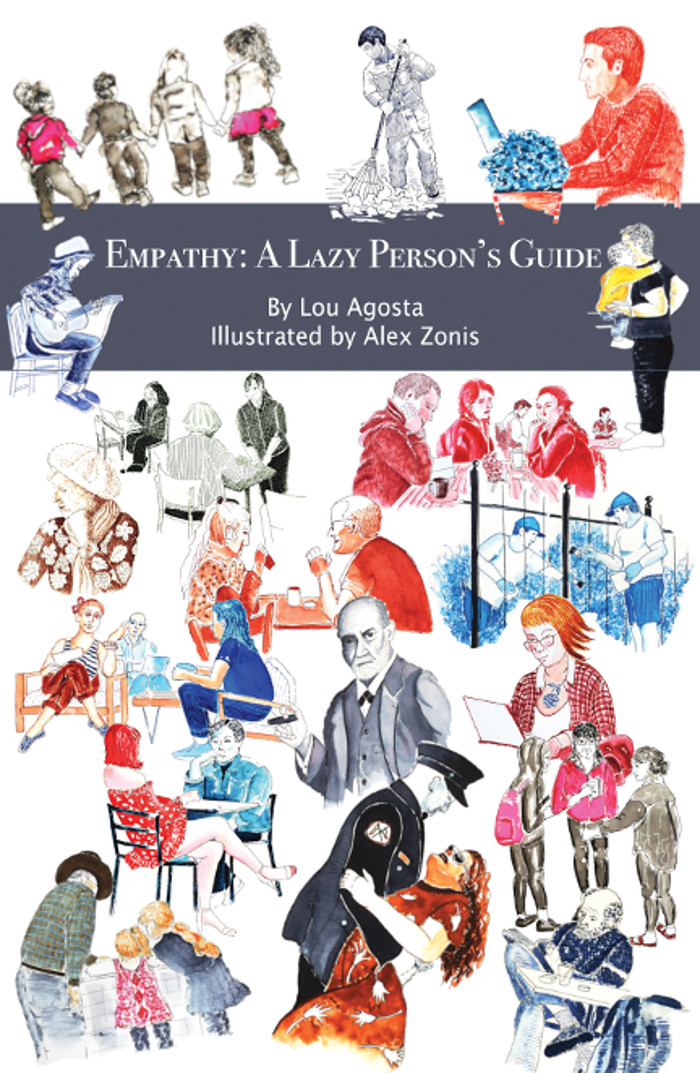
Order from author’s page: Empathy Lessons, 2nd Edition: https://tinyurl.com/mfb4xf4f
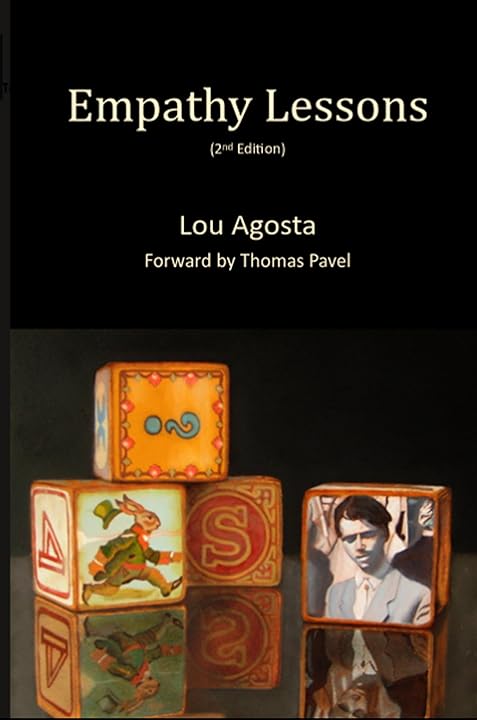
Above: Cover art: Empathy Lessons, 2nd Edition, illustration by Alex Zonis
Advertisements
https://c0.pubmine.com/sf/0.0.7/html/safeframe.html
REPORT THIS AD
Order from author’s page: A Critical Review of a Philosophy of Empathy: https://tinyurl.com/mfb4xf4f

Above: Cover art: A Critical Review of a Philosophy of Empathy, illustration by Alex Zonis
Finally, let me say a word on behalf of hard copy books – they too live and are handy to take to the beach where they can be read without the risk of sand getting into the hardware, screen glare, and your notes in the margin are easy to access. Is this a great country or what – your choice of pixels or paper!?!
(c) Lou Agosta, PhD and the Chicago Empathy Project
Review: Empathy and Mental Health by Arthur J. Clark
Empathy and Mental Health: An Integral Model for Developing Therapeutic Skills in Counseling and Psychotherapy. London: Routledge 2022 Electronic Version
As a young man, Arthur J. Clark heard Carl Rogers speak and was inspired to devote his life’s work to applying empathy in education, counseling, and talk therapy. This book is the distillation of years of experience and learning, and we, the readers, are enriched and even enlightened in this original synthesis of existing ideas on empathy. It is fully buzz word compliant, diligently calls out the limitations and risks of empathy, and guides the readers in expanding their empathy to make a difference in overcoming suffering and mental illness. It takes a lot of empathy to produce a book on empathy, and empathy is evident in abundance in Clark’s work.
As noted, Clark’s academic background is in education, as was Carl Rogers’, but the reader soon discovers Clarks’ work with empathy to be generously informed by Freud, Ferenczi, and Adlerian psychoanalysis. Thus Clark quotes [Alfred] Adler (1927): “Empathy occurs in the moment one individual speaks with another. It is impossible to understand another individual if it is impossible at the same time to identify oneself with him” (Clark: 20). At this same time this reviewer was enlivened by the application of distinctions to be found in the Self Psychology of Heinz Kohut and the latter’s colleagues Michael Basch and Arnold Goldberg. This brilliant traversal of the practice and conceptual landscape of empathy inspired Clark’s life work, and is on display here.
The book is filled with short segments of transcripts of encounters between counselor/therapist and client. To the point that empathy is much broader than reflecting feeling and meanings, examples are provided of empathic encouragement, empathic being in the here and now (immediacy), empathic silence, empathic self-disclosure, empathic confrontation, empathic reframing, empathic cognitive restricting, empathic interpretation. Clark’s work with empathic reframing, cognitive restructuring, and interpretation are particularly useful (Clark: 105 – 106).
“Empathy” is not so much a substantive as a modifier – a manner of being that applies across a diversity of ways of relating to the other individual. (It is a further question, not addressed by Clark, as to the status of these vignettes. Are they disguised, permissioned, ideal types, some combination thereof? Just curious. In any case, they work well and remind me of M. F. Basch’s vignettes in the latter’s Doing Psychotherapy.)
Clark makes reference to the celebrated video (e.g., widely available on Youtube) of Carl Rogers, interviewing the real-world patient “Gloria” about her relationship with her nine-year-old daughter “Pammy.” Rogers’ empathic listening skillfully turns the focus from Gloria’s presenting dilemma of how much information about sex to share with her inquisitive nine-year-old daughter, Pammy, into a willingness on the part of Gloria’s to call out her own blind spots and conflicts over sex. Rogers’ empathic responsiveness shows the way for Gloria to recapture her own integrity around adult sexuality so that she can provide Pammy with the appropriate sex education the child needs, regardless of the details that may be relevant only to the adults. And Rogers does this in about twenty minutes, not months of therapy.
At this point, it is useful to give Rogers’ definition of empathy (p. 11): “To perceive the internal frame of reference of another with accuracy and with the emotional components and meanings which pertain thereto as if one were the person, but without ever losing the ‘as if’ condition.” Rogers was definite about excluding the perspectives of the practitioner in conceptualizing empathy in his person-centered approach to therapy. In this regard, he stated, “For the time being you lay aside the views and values you hold for yourself in order to enter another’s world without prejudice.”
Clark’s integration of the diversity of approaches to empathy in history, theory, and practice distinguishes subjective, object and interpersonal empathy: “Subjective empathy encompasses a practitioner’s internal capacities of identification, imagination, intuition, embodiment that resonate through treatment interactions with a client and empathically reflect the individual’s experiencing. Objective empathy pertains to the deliberate use of a therapist’s conceptual knowledge and data-informed reasoning in the service of empathically understanding a client in a relational climate. Interpersonal empathy relates to comprehending and conveying an awareness of a client’s phenomenological experiencing and pursuing constructive and purposeful change through the application of a range of interventions” (Clark: xiv).
Clark started out as a school counselor and he gives the example of the student who comes in and says “I hate school!” The reflection is proposed to be something like “You are feeling angry about school.” This demonstrates just how important the tone in which a statement is made can be. This could indeed be an angry statement, which takes “hate” is a literal way. However, it could also be an expression of contempt, disgust, cynicism, resignation, sadness, or even fear (say, since the student is being bullied). The empathy is precisely to acknowledge that the listener is far from certain that he does knows what is going on with the student and to ask for more data. “Sounds like you are struggling with school – can you say more about that?”
Not afraid of controversy or tough topics, Clark’s contribution is thick with quotations from the founding father of psychoanalysis – Adler and Freud and the literature Freud has been reading such as Theodor Lipps, to whom we owe the popularization in Freud’s time of the term “empathy [Einfühlung]. The subsequent generation of ego psychoanalysts is also well represented Ralph Greenson, T. Reik, Jacob Arlow (and Beres).
Clark credits and recruits Ralph Greenson’s distinction of the therapist’s inner working model of the patient and uses it to enrich Rogers’ contribution to empathic understanding. “As empathic understandings evolve through therapeutic exchanges and assessment interactions, a model of an individual emerges that becomes increasingly refined and expansive. In turn, by ways of empathically knowing a client, the framework facilitates sound treatment interventions through the engagement of interpersonal empathy” (Clark: 88). Note that Clark aligns with the view that the countertransference is distorting/pathological as opposed to the total response of the therapist. There are many tips and techniques guiding the therapist diligently to monitor and control the countertransference neurosis.
Since this is not a softball review, I note some issues for productive debate. For example, if Clark had allowed that countertransference included the therapist’s entire reaction to the client, including personal reactions which are not necessarily conflicted or neurotic (on the part of the therapist), then Clark would have been constrained to spend more ink on his own individual responses, empathic and otherwise. Such disclosure, which Clark otherwise separately validates as appropriate in context (and if not this context, then which?), would have enriched a text which otherwise reads like a textbook (and perhaps that was the editorial and marketing guidance).
Also useful is the therapist’s being sensitive to cultural differences and dynamics. In a brief transcript of an interaction between a privileged white school counselor and an African American 8th grader attending the college prep private school (Clark: 42), we are supposed to see objective cross-cultural empathy based on the counselor’s reading of some articles (not specified) on cultural differences.
By all means, read up on cultural differences. However, I just see a rigorous and critical empathy (my term, not Clark’s), plain and simple. The counselor “gets it.” The student is afraid of being seriously injured or even killed by the criminal element in his neighborhood as he waits for the school bus. Is this breakdown of policing in the inner city really in the cultural article? The counselor also “gets it” that the student’s feelings are hurt by being laughed at by his more privileged classmates because his mom is a house cleaner rather than an executive or doctor or lawyer. It is the counselor’s empathic response based on her empathic understanding of the student’s specific fear and hurt feelings that enables the student to deescalate from his problematic acting out. Even though, like most 8th graders, the student would be the last to admit he has been emotionally “touched,” he was. Thus, Clark’s empathy shines through in spite of his style-deadening need to accommodate behavioral protocols, evidence-based everything, and the plodding style of delivery consistent with training in schools of professional social work and psychology.
“Objective empathy” may seem like “jumbo shrimp,” an oxymoron. Nor is it clear how dream work, with which Clark productively engages, falls into the “objective” rubric. Yet it is a highly positive feature that Clark emphasizes and explores in detail the value of dream work.
Let one’s empathy be informed by the context: “Consider, for instance, what are the daily struggles like for a client who meets the diagnostic criteria for a bipolar disorder or attention deficit [. . . .] When giving consideration to such challenges through a framework of empathic understanding, a practitioner calls upon reputable data and a spectrum of work with individuals from diverse backgrounds in order to generate a more inclusive and accurate way of knowing a client” (Clark: 35).
And yet this precisely misses the individual who is superficially described according to labels, but has his own experience of bipolar or attention deficit. Empathy is precisely the anti-essentialist dimension, the dimension that is so pervasive in psychiatry and schools of professional psychology that replace struggling humanity with “You meet criteria for – [insert label].”
While Kohut is properly quoted by Clark as one of the innovators in empathy and Kohut’s concise definition glossing empathy as “vicarious introspection” is acknowledged, Kohut’s other definition of empathy as a method of data gathering about the other individual is overlooked. However, it aligns nicely with Clark’s description of “objective empathy.” Maybe my close reading missed something but why not just say “taking the other person’s perspective” is “objective empathy” as opposed to vicarious introspection (“subjective empathy”)?
The subtitle promises “An integrative model for developing therapeutic skills [. . . ]” Clark substantiates the need for work in critiquing all those training program that model the skill of repeating back to the client words similar to those the client expressed. “In a meta-analysis of direct empathy training, Lam et al. (2011) found that the majority of 29 studies did not clearly conceptualize or define empathy, some did not describe training delivery methods, and almost all of the initiatives failed to present evidence demonstrating individuals’ propensity to behave more empathically after training” (Clark: 140). Clark’s discussion of reframing, cognitive restructuring, and empathic interpretation are relevant and useful in overcoming what amount to a scandal in psychotherapy training.
What Clark is trying to say is this: You think you are being empathic. Think again. A rigorous and critical empathy (my phrase, not Clark’s) is skeptical about its own empathy. That does not mean being dismissive either of one’s own empathy or the struggle of the other person. It means being rigorous and critical. Empathy is made to shine in the refiner’s fire of self-criticism and a radical inquiry into one’s own blind spots.
Clark does not escape unscathed from the behavioral and observation protocol dead end. The reader will seek in vain for self-criticism or inquiry into Clark’s own blind spots – instead the reader is awash in the extensive behavioral, cognitive behavioral therapy (CBT) attempts, albeit empathically deployed, to capture therapeutic encounters in a behaviorally observable or reportable protocol. Nor I am saying there is anything wrong with that as such. Yet might not the behavioral and observation protocol swamp precisely be the blind spot where the self-deception lives against which Rogers frequently denounces? To gather the honey of self-knowledge and empathic understanding one must risk the stings of distortion and disguise.
Clark’s would be a different work entirely if he explored the college of hard knocks in which he forged the empathic integration. He is trying to make what is largely an artistic practice into a rule-governed scientific algorithm. It is worth a try and the reader must judge the extent to which Clark succeeds. Spending a lifetime preparing articles for peer-reviewed publications in education, psychology, etc., does not generally bring life and vitality to one’s practice, manner of engagement, or writing style. However, Clark’s richness of material, wealth of distinctions related to empathy, and organizing virtually every aspect of empathic research and published references goes a long way towards compensating for Clark’s work not necessarily being a “page turner.” Clark’s writing reminds the reader more of the Diagnostic and Statical Manual (DSM) – Ouch! – more than (for example) of D. W. Winnicot, Christopher Bollas, Arnold Goldberg, Freud, who was an expert stylist (granted much is lost in translation), or even Carl Rogers himself.
Thus, Clark’s integrated approach calls for “a diagnosis [as from the DSM] that represents the lived experience of the individual.” Agree. Clark gives an example where the therapist is interviewing Omar who has low energy, lethargy, lack of motivation, and hopelessness about the future. The diagnosis encapsulates and integrates a lot of Omar’s experience, and, though Clark does not say so, Omar may even be relieved to hear/learn that he (Omar) is not to blame for his disordered emotions (“major depression”); and Omar should stop making a bad situation worse by negative self-talk, verbally “beating himself up” in his own mind. The treatment consists in getting Omar to do precisely what the depressed person is least inclined to do – take action in spite of being unmotivated. If one is waiting to be motivated, absent a miracle, it is going to be a long wait. Maybe the empathic response is precisely saying this to the client, acknowledging how hard it is (and may continue to be for a while) to get into action on one’s own behalf.
This is all well and good. However, narrowly or expansively empathy is defined it is the anti-DSM (diagnostic and statistical manual). The DSM has many uses, especially in aligning terminology such that the community is talking about the same set of criteria when it uses the word “generalized anxiety disorder.” It also has uses in requesting insurance reimbursements. In short, there is nothing wrong with the DSM-5 (2013) or any version – but there is something missing – empathy. In the case of empathy, the recommendation is to relate to the struggling human being who presents himself in therapy, not to a diagnostic label.
Thus, Clark makes the case in his own terms: “From a humanistic perspective with central tenets focusing on respect for the individuality and uniqueness of a person, employing the DSM to categorize clients through a labeling procedure is thought to impede the growth of authentic relationships and empathic understandings of a deeper nature. In this regard, in a human encounter, perceiving a client through categorical frames of reference and symptomatic functioning hinders an attunement with the individual’s lived experiences and personal meanings. Moreover, applying a label to a client possibly influences a practitioner to shape preconceptions that are objectifying and forecloses a mutual and open-minded exploration of the contextual existence of the individual” (Clark: 27).
Though Clark does not say so, almost every major mental illness involves a breakdown of empathy. The patient experience isolation. “No one ‘gets’ me.” “No one understands what I am going through.” This is the case with most mood disorders, thought disorders, as well as those disorders typically described as “disorders of empathy” such as some versions of autism spectrum and anti-social personality disorders.
One matter of editing detail may be noted, a consistent misspelling of the name of celebrated primate researcher, philosopher, and empathy scholar Frans de Waal. There are no “Walls” in de Waal’s name – or in his empathy! We will charge this wordo to the editors who otherwise perform an admirable job.
Returning to a positive register, one of the most important takeaways from engaging with Clark’s work is that short therapy in which empathy is the driving force is powerful and effective. Clark does not specify the elapsed treatment in most cases, but I did not find one that was explicitly called out as being longer than fourteen weeks.
The emphasis is on the use of empathy in relatively brief psychotherapy – which is a powerful and positive approach that pushes back against the assertion that one needs cognitive behavioral therapy for relatively time-constrained encounters. Empathy produces quick results when skillfully applied. It is true that one of the great empathy innovators, Heinz Kohut, had some famous long and multi-year psychoanalyses; but these individuals were significantly more disturbed than Clark’s example of Anna, whose presenting behaviors were largely social awkwardness.
A strong point of Clark’s work is his debunking of the caricature of Rogers definition of empathy (and indeed of empathy itself) as merely reflecting (i.e., repeating) back to the speaker the words that the speaker has said to the listener. There is nothing wrong as such with reflecting what the other person has said, especially if the statement is relevant or well expressed. However, the mere words are pointers to the other person’s experience and are not reducible to the mere words. This is not a mere behavioral skill of reflecting back language, but a “being with” the other in the complexity and depth of the other’s experience as refined in the therapist’s own experience, and that is something one can best learn in years of one’s own dynamic therapy. Additional processing of the other person’s experience is encapsulated by and captured in the other person’s words, but not reducible to the words. The aspects of empathic responsiveness, embodiment, acknowledgement, recognition, encouragement, immediacy, possibility, clarification, and validation of the other’s experience form and inform the empathic response and the reply to the other.
A rumor of empathy is no rumor in the case of Clark’s work – empathy lives in his contribution to integrating the diverse and varied aspects of empathy.
Edwin Rutsch interviews the author Arthur J. Clark:
(c) Lou Agosta, PhD and the Chicago Empathy Project

Left stranded when the music stops: What to do about the shortage of talk therapists actually available
An article in the Washington Post by Lenny Bernstein: “This is why it is so hard to find mental health counseling right now” (March 6, 2022) struck a chord with many readers.[1]
The article begins by describing an individual in the Los Angeles area who said she was willing to pay hundreds of dollars per session and called some twenty-five therapists in the area but was unable to find an opening. The person willingly shared her name in the article. Be careful not to blame the survivor or victim – the report is credible – and she maintained a spreadsheet!
One of the main points of the article is that after several years of pandemic stress prospective clients and patients are at the end of their emotional rope and providers (therapists) are over-scheduled and burned out too. No availability.
The problem is systemic. There seems to be no bottom in sight as regards the opportunistic behavior of insurance companies, the lack of behavioral health resources, and the suffering of potential patients. The WP article goes on to document other potential patients with significantly less resources who cannot even get on a wait list. The article documents third party insurance payers whose “in network” providers are unwilling to see prospective patients due to thin

reimbursements from the payer – once again, the individual is unable to get on a wait list or get help urgently needed; supply side shortages are over the top in the programs that train psychiatrists, a specialty in medicine. Psychiatrists, when available, are most often interested in lucrative fifteen-minute medication management sessions, but unless they are “old school” and were psychoanalytically trained in the “way back,” they are rarely available for conversations. This all adds up to a crisis in the availability of behavioral health services.
This leads to my punch line. Often time depression, anxiety and emotional upset are accompanied by negative self-talk, shaky or low self-esteem. One reaches out and asks for help but instead has an experience of powerlessness that is hard to distinguish from the original emotional disequilibrium. The conversation spins in a tight circle – “maybe I deserve it – no I don’t – this sucks – I suck – help!” The person resigns himself to alife of gentile poverty, thinking she or he is not worthy of financial well-being. The prospective patient is left aggrieved. This grievance is accurate and real enough in context, but it is hard to identify what or who can make a difference. Nevertheless, there is no power in being aggrieved. One still has to do the thing the person in distress or with shaky self-esteem is least inclined to do – invest in oneself because one is worth it!
I have spoken with numerous potential and actual clients who pay a lot of money for health insurance. However, when they want to use the insurance for behavioral health services, they find the insurance is not workable. Not usable. The service level agreement is hard to understand, and having a deductible of a couple of thousand dollars is hard to distinguish from having no insurance at all. If the client goes “in network,” the therapists are unresponsive or inexperienced. If the client goes out of network, the therapists are often more experienced and able to help, but onerous deductibles and copays rear their heads. Why don’t the experienced therapists go in network? There are many reasons but one of them is that the insurer often insists the therapist accept thirty cents on the dollar in compensation, and some therapists find it hard to make ends meet that way. In short, as a potential patient, you think you have insurance, but when it comes to behavioral health, you really don’t.
My main point is to provide guidance as to some things you can do to get the help you need with emotional or behavioral upset and do so in a timely way. Turns out one has to give an informal tutorial on using insurance as well as on emotional well-being. I hasten to add that “all the usual disclaimers apply.” This is not legal advice, medical advice, insurance advice, cooking advice or any kind of advice. This is a good faith, best efforts to share some brain storming and personal tips and techniques earned in the “college of hard knocks” in dealing with these issues. Your mileage may vary.
Nothing I say in this article should be taken as minimizing or dismissing the gravity of your suffering or the complexity of this matter. If you are looking for a therapist or counselor, it is because you need a therapist or counselor, not a breach of contract action against an insurance company. You want a therapist not a legal case or participation in a class action law suit, even if the insurance contract has plenty of “loop holes.” For the moment, the latter is a rhetorical point only.
When a person is anxious or depressed or struggling with addiction or other emotional upset, being an informed assertive consumer of behavioral health services is precisely the thing the person is least able to do. “I need help now! Shut up and talk to me!”
Notwithstanding my commitment to expanding a rigorous and critical empathy, here’s the tough love. Without minimizing your struggle and suffering, the thing you least want to do is what you are going to have to try to do. If one is emotionally upset, the least thing you want to do is be an assertive consumer of services designed to get you back your power in the face of emotional upset or whatever upsetting issues you are facing.
The recommendation is to speak to truth to power and assertively demand an “in network” provider from the insurance company or invest in yourself and pay the private fee for an experienced therapist whom you find authentically empathic, then you already be well on the way to getting your power back in the face of whatever issues you are facing.
If your issue is that you really don’t have enough money (and who does?), then you may need to get the job and career coaching that will enable you to network your way forward. An inexpensive place to start is The Two Hour Job Search by Steve Dalton. Highly recommended. Note the paradox here – the very thing you do not want to do keeps coming up. You definitely need someone to talk to. Once again, the very things with which you need help are what re stopping you from getting help
The bureaucratic indifference of insurance companies is built into the system. The idea of an insurance is a company committed to making money by spreading risk between predictable outcomes and a certain number of “adverse” [“bad risk”] events. It is not entirely fair (or even accurate) but by becoming depressed or anxious (and so on), you are already an adverse event or bad risk waiting to happen. You may expect to be treated as such by most insurance companies.
In a health insurance context, the traditional model for the use of services is a broken arm or an appendicitis (these are just two examples among many). You definitely want to have major medical insurance against such an unfortunate turn of events. Consider the possibility: Buy major medical only – and invest the difference saved in your therapy and therapist of choice.
But note these adverse medical events are relatively self-contained events – page the surgeon, perform the operation, take a week to recover or walk around in a sling for awhile. The insurance company pays the providers (doctors and hospitals) ten grand to thirty grand. That’s it. With lower back pain, headaches, irritable bowel syndrome, autoimmune disorders, it is a different story. These are notoriously difficult to diagnose and treat. Yet, modern medicine has effective imaging and treatment resources that often successfully provide significant relief if not always complete cures for the patient’s distress in these more complex cases.
Consider similar cases in behavioral health. Start by talking to your family doctor. Okay, that is advice – talk to your family doctor for starters. Front line family doctors have the authority – and most have the basic training – needed to prescribe modern antidepressants (so called SSRIs), which also are often effective against anxiety, to treat simple forms of depression and anxiety due to life stresses such as an ongoing pandemic, job loss, relationship setbacks.
Even though I am one of the professionals who has consistently advocated “Plato not Prozac,” I acknowledge the value of such psychopharmacological interventions from a medical doctor to get a person through a rough patch until the person can engage in a conversation for possibility and get at the underlying cause of the emotional disequilibrium. Note this implies the person wants to look for or at the underlying dynamics. This leads us to the uncomfortable suggestion that it is going to take something on the part of the client to engage and overcome the problem, issue, upset, which is stopping the client from moving forward in her or his life.
There is a large gray area in life in which people struggle with relationship issues, finances, career, education, pervasive feelings of emptiness, chronic emotional upset, self-defeating behavior in the use of substances such as alcohol and cannabis (this list is not complete).
A medical doctor or other astute professional may even provide a medical diagnosis when the interaction of the person’s personality with the person’s life falls into patterns of struggle, upset, and failure. Insurance companies require a medical diagnosis. One thinks of such codable disorders as adjustment disorder or personality disorders (PD) such as narcissistic, histrionic, schizoid, antisocial, or borderline PD. These are labels which can be misleading and even dangerous to apply without talking to the person and getting to know them over a period of time. It’s not like the Psychology Today headline – top three ways to know if you are dating a narcissist. I am calling “BS” on that approach.
Nevertheless, if after a thorough process of inquiry, some such label is appropriate (however useless the label may otherwise be except for insurance purposes), then the cost will be right up there with “fixing” an appendicitis – only you won’t be able to do it in a single day – and it won’t be that kind of “fix”. An extended effort and of hard to predict duration must be anticipated, lasting from months even to years. This is not good news, but there are options.
My commitment is to expanding a rigorous and critical empathy in the individual and the community. I consider that I am an empathy consultant, though at times that is hard to distinguish from a therapeutic process and inquiry into the possibilities of health and behavioral well-being. Therefore, and out of this commitment, I have a sliding scale fee structure for my consulting and related empathy services. People call me up and say “I make a lot of money, and want to pay you more.” Of course, that is a joke. I regularly hear from prospective clients whose first consideration is financial. They do not have enough money. I take this assertion seriously, and I discuss finances with them. Between school debt and the economic disruptions of three years of pandemic, people are hurting in many ways including financially. One must be careful NEVER to blame the victim or survivor.
The best way for such financially strapped individuals to go froward is to find an “in network” provider. Key term: in network. But we just read the Washington Post article that furnishes credible evidence such networks are tapped out, in breakdown, not working. Those that are working well enough often deal with the gray area of emotional upset and life challenges by moving the behavioral health component to a separate corporate subsidy at a separate location to deal with all aspects of behavioral health. (See above on “bad risk.”) When I had such an issue years ago, I had to search high and low to get the phone number, web site, or US postal address. You can’t make this stuff up. This is because ultimately, the issues that come up are nothing like an appendicitis or even hard to diagnose migraines. Moving the paying entity to a corporate subsidy is also a way that the insurance company can impose a high deductible and/or copay by carving out that section of the business and claims processing. There are other reasons, too, but basically, they are financial.
You may be starting to appreciate that many health insurance contracts are not really designed to provide behavioral health services (e.g., therapy) the way they are designed to address a broken leg or appendicitis. There is a way forward, but it is more complex (and expensive in terms of actual dollar, though not necessarily time and effort). I will address this starting in the paragraph after next, because, sometimes in the case of behavioral health, people who have insurance do not really have useable, workable behavioral health insurance. For all intents and purposes, they think they have insurance, but, in this specific regard, they have a piece of paper and a phone number that is hard to find. I hasten to add I am not recommending going without major medical health insurance, inadequate though it may be in certain respects.
This brings us to those individuals who decide to go without insurance. What about them? Such individuals choose to take the risk. They are living dangerously because if they do break an arm or incur an appendicitis, then they are going to have another $30K in medical debt [this number is approximate and probably low], along with a mountain of school debt, credit card debt, and bad judgment debt (this list is not complete). These good people need insurance, not so much to get therapy – because, as the accumulating evidence indicates, it really doesn’t work that way – as to be insured against a major medical accident. Many people are not clear on this distinction, but I would urge them to consider the possibility.
I spoke with this one prospective client who began with a long and authentically moving narrative that she did not have enough money and could not afford therapy. This is common and not particularly confidential or sensitive. As part of a no fee first interview to establish readiness for therapy, I acknowledged her courage in strength in reaching out to someone she did not really know to get help with her problems. I acknowledged that one of her problems was she did not have enough money. A bold statement of the obvious. I asked if there was anything else she wanted to work on. It turns out that she was a survivor of a number of difficult situations and would benefit from both empathy consulting, and talk therapy – and I might add job coaching. Here’s the thing – when a person is hurting emotionally, they do not want to look for another job – or a better job that pays more money. But one just might have to do that, at least over the short term, with someone who can provide that kind of guidance to those who are willing. I encouraged her to be assertive with her insurance company and I heard she found someone in network at a low rate.
And if you are a therapist who believes such job coaching compromises the purity or neutrality of the therapy, I would agree. However, never say never. In the aftermath of World War I, when the victorious allies maintained a starvation blockage on Germany and Austria even into 1919, Freud (that would be Sigmund) was reportedly seeing a client in exchange for a substantial bag of potatoes. I have no facts – none – but I find it hard to believe they were discussing matters pertinent to individual and collective survival. So far no one has offered me a bag of potatoes (I am holding out for a quantity of olive oil and basil to make pesto), but see the above cited article from the Washington Post.
We circle back to where we started. If the individual named in the Washington Post article has not yet found a therapist, then I believe there are many in the Chicago area would welcome the opportunity to make a difference for her. She has a budget for therapy, she says. If you have a budget, the work goes forward. It can be confronting and difficult to contemplate, but if you were buying a car, you would look at your budget. If you were planning a vacation, you would think about your vacation budget. If you were thinking of going back to school, you would look at your education budget. You get the idea. What is your budget for empathy consulting, counseling, talk therapy, cognitive retraining, life coaching, or medication management services (this are all distinct interventions, appropriate in different circumstances)? Zero may not be the right number. Just saying. Of course, if the client is in LA and the empathy consultant is in Chicago, it would be a conversation over Zoom. That starts a new thread so I may usefully clarify that I prefer to meet with people in person – the empathy is expanded in person – but the genie is out of the bottle and online can be good enough in some circumstance. (See my peer reviewed article “The Genie is Out of the Bottle”: https://bit.ly/37vxJ0L.)
The insurance system is broken as regards behavioral health (as evidenced by the WP article). There is a vast gray area of people with modest emotional disregulation who genuinely need help. These are not only the “worried well,” but people whose understandable lack of assertiveness in navigating an indifferent (and it must be said unempathic) bureaucracy leaves them high and dry with their moderate but worsening emotional, spiritual, and behavioral upsets. These people deserve help, and are entitled to it even under the specific terms of their insurance contracts. Indeed they are entitled to help even if they do not have insurance, though the revenue model is simpler in that case, though not less costly.
The insurance company has been unable to make money off of this gray area – therefore, the insurance company does what it does best – it turns to making money off of you. But you need health insurance against a major medical event or accident. You want a therapist, not a breach of contract case in small claims court (where the small claim often goes up to $100k). Therefore, it does little good to document having called ten or twenty-five in network providers with no result. Or does it? You – or a class action attorney firm – have a case for breach of contract. Go out of network and forward the invoices to the payer by mail with a tracking number, requesting that the full therapy fees be treated “in network” for purposes of reimbursement, and, therefore, no or low deductible and copay. Of course, one would have to have funds for that upfront, and lack of money is where this circle started. Back to expanding one’s job search skills?
This is crazy – and crazy making behavior – though only as a function of a system that is crazy. You see the problem. I’ll bet dollars to donuts that the insurance payer, when confronted with an actual summons to small claims court, would then find you a therapist – of course, the therapist might be relatively inexperienced or someone who (how shall I put it delicately?) is less motivated than one might hope. Thwarted again!
As I wrap up this post, it occurs to that while it would be crazy for an individual to seek legal redress – it might even be “acting out,” there might be a basis for an enterprising law firm to establish a system wide “class action” for breach of contract. This will not solve your problem of getting help in the next two weeks, but it might be a necessary step to benefit the community. You know the insurance company has the money!
As noted above, your grievance over being sold unworkable behavioral health insurance may be [is] accurate and real. Nevertheless, I am sticking to my story: the guidance: there is no power in being aggrieved. You still have to do the thing the person in upset or with shaky self-esteem is least inclined to do – dig down, including into your pockets, and find self-confidence – or enough self-confidence for the moment – and invest in yourself because you are worth it!
The one minute empathy training – runtime is actually five minutes, but a personal introduction is included: https://youtu.be/747OiV-GTx4
[1] https://www.washingtonpost.com/health/2022/03/06/therapist-covid-burnout/
Update (12/12/2025): Legislation to inspire better access to behavioral healthcare services: https://digitaledition.chicagotribune.com/shortcode/CHI785/edition/d8ea77df-580d-4bc9-915b-3f1592ac9778?page=74db2eb7-1233-4d50-94eb-67777298f953&

The Brain that Changes Itself: A Powerful Message of Hope – and Hard Work!
I have been catching up on my reading.
Norman Doidge’s book, The Brain that Changes Itself (Penguin, 427pp. ($18)), was published in 2007, now some twelve years ago. This publication occurred towards

Cover Art: The Brain That Changes Itself by Norman Doidge
the beginning of the era of neuro-hype that now has us choking on everything from neuroaesthetics to neurohistory, from neuromarketing to neurozoology. So pardon my initial skepticism.
However, this book is the real deal. To those suffering from a variety of neurological disorders or issues, extending from major strokes to learning disabilities or emotional disorders, Doidge’s narratives offer hope that hard work pays off. If more authors and editors would have read (and understood!) it, today’s neuro-hype would be a lot less hyped.
Let me explain. There is neural science aplenty in Doidge’s exposition and defense of the flexibility – key term: plasticity – of the brain. There are also plentiful high tech devices (prostheses) that make for near science fiction innovation, except that they are engineering interventions, not fictions.
However, what distinguishes Norman Doidge’s contribution is that, in every case without exception, the neural science “breakthrough” on the part of the patient is preceded by substantial – in some cases a year or more – of hard work on the patient’s behalf to regain lost neural functionality.
Yes, from the point of view of our everyday expectations of what can be attained in six weeks of twice a week rehabilitation, the results are “miraculous”; but upon closer inspection the “miracle” turns out to be 99% perspiration and 1% inspiration.
I hasten to add that the exact distribution of effort varies. But the point is that, while the “miraculous” is supposed to be uncaused, lots of hard work on the part of the patient, properly directed, is a key determining factor. This in no way detracts from the authentic innovations and corresponding effort on the part of the neural scientists and engineers engaging in the rehabilitation process.
The woman who lost her sense of balance tells of a woman (Cheryl) whose ability to orient herself in space is “taken out” by an allergic reaction to an antibiotic (gentamicin) administered to treat an unrelated condition. Balance is sometimes considered a sixth sense, for without it the person literally looses her balance and falls over. Thus, Cheryl became the woman perpetually falling. She becomes a “Wobbler.”
While such a condition does not cause a person to die, unless the fall proves fatal, but it destroys the ability to engage in the activities of daily living. Enter Paul Bach-y-Rita, MD, and Yuri Danilov (biophysicist) (p. 3), who design a helmet that transmits orientation data to Cheryl through an ingenious interface that she can hold on her tongue like a small tongue depressor. It transmits a tingling sensation towards the front of the stick if she is bending forward, towards the back of the stick if she is bending backwards, and so on. Who would have thought it? Turns out that the tongue is a powerful brain-machine interface.
After some basic training as Cheryl wore it, she was able to orient herself and not fall over. After awhile, she took the helmet off and found that the ability to orient herself lasted a few minutes. There was a residual effect. With more training, the persistence of the after effect was extended. Finally, after a year of work, she was able to dispense with the helmet. She had “magically” regained her sense of balance. The neural circuits that had been damaged were in effect by-passed and the functionality taken over by other neural areas in the brain based on the training. Cheryl was no longer a Wobbler.
This is the prelude to the narrative of the dramatic recovery of Bach-y-Rita’s own father, the Catalan poet Pedro Bach-y-Rita, who has a massive disabling stroke, leaving him paralyzed in half his body and unable to speak.
After four weeks of rehabilitation based on pessimistic theories that the brain could not benefit from extended treatment, the father, Pedro, was literally a basket case. Enter brother George – Pedro’s other son. Now George did not know that rehab was supposed to be impossible, and took the father home to the house in Mexico. They got knee pads and taught him to crawl – because it is useful to crawl before one walks, which Pedro eventually did again after a year of effort. Speech and writing also returned after much effort copying and practicing phonetics.
Pedro returned to teaching full time at City College in New York (p. 22) until he retires years later. After Pedro’s death, a routine autopsy of his brain in 1965, showed “that my father [Pedro] had had a huge lesion from his stroke and that it had never healed, even though he recovered all these functions” (p. 23).
The take-away? What modern neural science means when it asserts that nerve cells do not heal is accurate. But “plasticity” means that the brain is able to produce alternative means of performing the same messaging and functional activity. “The bridge is out,” so plasticity invents a detour around the damaged area. Pedro walks and talks again and returns to teaching.
Conventional rehab usually lasts for an hour and sessions are three times a week for (say) six weeks. Edward Taub has patients drill six hours a day, for ten to fifteen days straight. Patients do ten to twelve tasks a day, repeating each task ten times apiece. 80 percent of stroke patients who have lost arm functionality improve substantially (p. 147). Research indicates the same results may be available with only three hours a day of dedicated work.
In short, thanks to plasticity, recovery from debilitating strokes is possible but – how shall I put it delicately? – it is not for the faint of heart. Turn off the TV! Get out your knee pads?
So when doctors or patients say that the damage is permanent or cannot be reversed, what they are really saying is that they lack the resources to support the substantial but doable effort to retrain the brain to relearn the function in question – and are unwilling to do the work. The question for the patients is: How hard are you willing to work?
The next case opens the diverse world of learning disabilities. Barbara Arrowsmith looms large, who as a child had a confusing set of learning disabilities in spatial relationships, speaking, writing, and symbolization. Still, she had a demonstrable talent for reading social clues. She was not autistic, but seemingly “retarded” – cognitively impaired. She had problems with symbolic relationships, including telling time.
With the accepting and tolerant environment provided by her parents, who seemed really not to “get” what was going on, Barbara set about to cure herself. She (and her parents) invented a series of exercises for herself that look a lot like what “old style” school used to be: A lot of repetitive exercises, rote memorization, copying, and structure. Flash cards to learn how to tell time. There is nothing wrong with the Montessori-inspired method of letting the inner child blossom at her or his own rapid rate of learning, except it does not work for some kids. Plasticity demonstrates that “one size fits all” definitely does notfit all.
The result? The Arrowsmith School was born, featuring a return to a “classical” approach:
“[…] [A] classical education often included rote memorization of long poems in foreign languages which strengthen the auditory memory […] and an almost fanatical attention to handwriting, which probably helped strengthen motor capacities […] add[ing] speed and fluency to reading and speaking” (pp. 41–42).
This also provides the opportunity to take a swipe at “the omnipresent PowerPoint presentation – the ultimate compensation for a weak premotor cortex.” Well said.
Without having anything wrong with their learning capabilities as such, some children have auditory cortex neurons that are firing too slowly. They could not distinguish between two similar sounds – e.g., “ba” and “da” – or which sound was first and which second if the sounds occurred close together (p. 69):
“Normally neurons, after they have processed a sound, are ready to fire again after about a 30-millesecond rest. Eighty percent of language-impaired children took at least three times that length, so that they lost large amounts of language information” (p. 69).
The solution? Exploit brain plasticity to promote the proliferation of aural dendrites that distinguish relevant sounds and sounds, in effect speeding up processing by making the most efficient use of available resources.
Actually, the “solution” looks like a computer game with flying cows and brown bears making phonetically relevant noises. Seems to work. Paula Tallal, Bill Jenkins, and Michael Merzenich get honorable mentions, and their remarkable results were published in the journal Science(January 1996). Impressive.
Though not developed to treat autism spectrum disorders, such exercises have given a boost to children whose sensory processing left them over-stimulated – and over-whelmed, resulting in withdrawal and isolation. Improved results with school work – the major “job” of most children – leads, at least indirectly, to improved socialization, recognition by peers and family, and integration into the community (p.75). Once again, it seems to work.
As a psychoanalytically trained medical doctor, one of Doidge’s interests is in addiction in its diverse forms, including alcohol and Internet pornography. For example, Doidge approvingly quotes Eric Nestler, University of Texas, for showing “how addictions cause permanent changes in the brains of animals” (p. 107). This comes right after quoting Alcoholics Anonymous that there are “no former addicts” (p. 106). Of course, the latter might just be rhetoric – “don’t let your guard down!” Since this is not a softball review, I note that “permanent changes in the dopamine system” are definitely notplasticity. A counter-example to Doidge’s?
Doidge gets high marks for inspirational examples and solid, innovative neural science reporting. But consistency?
A conversation for possibility – that is, talk therapy – which evokes the issues most salient to being human – relationships, work, tastes, and loves – activate BNGF [brain-derived neural growth factor], leading to a proliferation or pruning back of neural connections. This is perhaps the point to quote another interesting factoid: “Rats given Prozac [the famous antidepressant fluoxatine] for three weeks had a 70 percent increase in the number of cells in their hippocampus” [the brain area hypothesized to be responsible for memory translation in humans] (p. 241). This is all good news, especially for the rats (who unfortunately did not survive the experiment), but the devil, as usual, is in the details.
On a positive note, Freud was a trained neurologist, though he always craved recognition from the psychiatric establishment [heavens knows why – perhaps to build his practice]. In a separate chapter including a psychoanalytic case (“On Turning Our Ghosts into Ancestors,” an unacknowledged sound byte from Hans Loewald, psychoanalyst), Doidge’s points out in a footnote that having a conversation with a therapist changes one’s neurons too. The evidence is provided by fMRI studies before and after therapy (p. 379). This is the real possibility for – get ready, welcome to – neuropsychoanalysis.
Like most addictions – alcohol, street drugs, gambling, cutting – Internet porn is a semi-self-defeating way of regulating one’s [dis-regulated] emotions. The disregulated individual may usefully learn expanded ways of regulating his emotions, including how to use empathy with other people to do so. Meanwhile, the plasticity of addictive behavior turns out to be more sticky and less flexible than the optimistic neuro-plasticians (if I may coin a term) might have hoped.
Doidge has an unconventional, but plausible, hypothesis that “we have two separate pleasure systems in our brains, one that has to do with exciting pleasure and one with satisfying pleasure” (p. 108). Dopamine versus endorphins? Quite possibly. Yet one doesn’t need neuropsychoanalysis to appreciate this.
Plato’s dialogue Gorgias makes the same point quite well (my point, not Doidge’s). Satisfying one’s appetites puts one in the hamster’s wheel of endless spinning whereas attaining an emotional-cognitive balance through human relations, contemplation, meditation, or similar stress reducing activities provide enduring satisfaction. The tyrant may be able to steal your stuff – your property, freedom, and even your life – but the tyrant is the most miserable of men. The cycle of scratching the itch, stimulating the need further to scratch the itch, is a trap – and a form of suffering. Suffering is sticky, and Freud’s economic problem of masochisms looms large and still has not been solved.
Doidge interweaves an account of a breakthrough psychoanalysis with a 50 plus year old gentleman with a narrative of Eric Kandel’s Nobel Prize winning research. Kandel and his team published on protein synthesis and the growth of neural connections needed to transform short- into long-term memory. While it is true that humans are vastly more complicated than the mollusks in Kandel’s study, the protein synthesis is not.
Thus, another neural mechanism is identified by which Talk Therapy changes your brain. Mark Solms – founding neuropsychoanalyst – and Oliver Turnbull translate Freud’s celebrated statement “where id was ego shall be” into neural science: “The aim of the talking cure […] from the neurobiological point of view [is] to extend the functional sphere of the influence of the prefrontal loves” (p. 233).
Even if we are skirting close to the edges of neuro-hype here, it is an indisputable factoid that Freud, the neurologist, draws a picture of a neuronal synapse in 1895 (p. 233). At the time, such a diagram was a completely imaginative and speculative hypothesis. Impressive. Freud also credibly anticipates Hebb’s law (“neurons that fire together wire together”), but then again, in this case, so did David Hume (in 1731) with his principle of association.
Meanwhile, back to the psychoanalysis with the 50-something gentleman who has suffered from a smoldering, low order depression for much of his life. Due to age, this is not considered a promising case. But that was prior to the emerging understanding of plasticity.
This provides Doidge with the opportunity to do some riffing, if not free associating, of his own about trauma, Spitz’s hospitalism, and psychopharmacology. “Trauma in infancy appears to lead to a supersensitization – a plastic alteration – of the brain neurons that regulate glucocorticoids” (p. 241). “Depression, high stress, and childhood trauma all release glucocorticoids and kill cells in the hippocampus, leading to memory loss” (p. 241). The result? The depressed person cannot give a coherent account of his life.
The ground breaking work of Rene Spitz on hospitalism – of children confined to minimum care hospitals (anticipating the tragic results in the Rumanian orphanages after the fall of the USSR) – is invoked as evidence of the damage that can occur. When the early environment is sufficient to keep the baby alive biologically but lacks the human (empathic) responsiveness required to promote the emotional well-being of the whole person, the result is similar to acquired autism – an overwhelmed, emotionally stunted person, struggling to survive in what seems to the individual to be a strange and unfriendly milieu.
I summarize the lengthy course of hard work required to produce the result of Doidge’s successful psychoanalysis. The uncovering of older, neural pathway gets activated and reorganized in the process of sustained free association, dream work, and the conversation for possibility in the psychoanalytic “talking cure”. Through an elaborate and lengthy process of working through, the patient regains his humanity, his lifelong depression lifts, and he is able to enjoy his retirement.
So far neural plasticity has been a positive phenomenon and a much needed source of hope and inspiration to action. However, plasticity also has a dark side. For example, if one loses a limb due to an amputation, the brain takes over what amounts to the now available neuronal space on the neural map. One’s physical anatomy has changed, but the brain seems plastically committed to reusing the neural map of the body for other purposes.
The limb is no longer there, but it hurts, cramps, burns, itches, because the neural map has not been amputated. However, the patient suffers – sometimes substantially – because one cannot massage or scratch a limb that does not exist. Yet the pain LIVEs in the neural system – and that makes it real.
Pain is the dark side of plasticity. Pain is highly useful and important for survival. It protects living creatures from dangers to life and limb such as fire or noxious substances. We have a painful experience and learn to avoid that which caused the pain.
Yet pain can take on a life of its own. Anticipating pain can itself be painful. Once pain is learned it is almost literally burned into the neurons and it takes considerable work (and ingenuity) to unlearn – to extinguish – the pain.
“Our pain maps get damaged and fire incessant false alarms” (p. 180). V. S. Ramachandran has performed remarkable work with understanding that most recalcitrant of phenomena, phantom limb pain. Ramachandran’s is deservedly famous for many reasons. But his simple innovation of the mirror box really requires an illustration. It is literally done with a mirror.

Illustrating mirror box therapy with an intact limb being reflected so as to create the appearance that the amputated limb is present: the individual experiences the presence of his missing limb
The subject with the missing hand is presented with a reflected image of the good, intact hand, which in reflection looks just like the missing hand. The subject experiences the limb as being a part of his body. (That in itself is a remarkable effect – the neural “socket” is still there.) In effect, the individual gets the hand back as something he owns. He is able to experience closing his missing hand by closing the good hand. This relieves cramps and stiffness.
In other experiments, the lights are turned off and various areas of the body are touched. The area that was once the [now missing] hand is used to map sensations on another area of the body, for example, one’s face. Scratching an itch on the phantom limb by scratching just the right spot on one’s face becomes possible because the neural map of the missing limb has been taken over and is now being used to map a different part of the anatomy
Doidge ends with a flourish:
“V. S. Ramachandra, the neurological illusionist, had become the first physician to perform a seemingly impossible operation: the successful amputation of a phantom limb” (p. 187). He did this by changing the brain – in effect deconditioning (deleting) the representation of the phantom limb from the brain. Thus, the promise and paradox of plasticity.
(c) Lou Agosta, PhD and the Chicago Empathy Project
Empathy, Stress (Reduction), and Brain Science – Fall Program
The image depicts a mirror neuron – the neurological basis for empathy – admiring itself in the mirror. But do mirror neurons even exist? If not, what is the underlying neural  implementation mechanism for empathy? At another level of analysis, how is empathy like oxygen for the soul, reducing stress and enabling possibility? Find out more here …
To register or for more info call Elizabeth Oller: 1-312-935-4245 or email: JosephPalomboCenter@icws.edu
Empathy, Stress Reduction, and Brain Science
A famous person once said: “Empathy is oxygen for the soul.” So if one is feeling shortness of breath, maybe one needs expanded empathy! This course will connect the dots between empathy and neuroscience (“brain science”). For example, empathic responsiveness releases the compassion hormone oxytocin, which blocks the stress hormone cortisol. Reduced stress correlates to reduced risk of such life style disorders as cardiovascular disease, diabetes, weak immune system, depression, and the common cold.
We will engage each of the following modules in the discussion segment, including suggested readings. Except for the first two topics, we can take them in any order and the participants will get to select:
- This is your mind on neuroscience – mirror neurons: do they exist, and if not, so what?
- Sperry on the split brain: the information is in the system: how to get at it
- The neuroscience of trauma – and how empathy gives us access to it
- MRI research: as when Galileo looked through the telescope, a whole new world opens
Presenter: Lou Agosta, PhD, is the author of three scholarly, academic books on empathy, including A Rumor of Empathy: Resistance, Narrative, Recovery (Routledge 2015). He has taught empathy in history and systems of psychology at the Illinois School of Professional Psychology at Argosy University and offered a course in the Secret Underground Story of Empathy at the University of Chicago Graham School of Continuing Education. He is a psychotherapist (and empathy consultant) in private practice in “on the forward edge in the Edgewater Community” in Chicago.
Date: Saturday December 03, 2016
Time: 9 AM – noon
Registration Fee: $35
Location: to be provided upon registration: at or near ICSW at 401 S. State St Chicago, IL
Registration: Call Elizabeth Oller: 312 935 4245 or email: JosephPalomboCenter@icsw.edu
Virtual Reality Goggles for Treating Phobias: A Rumor of Empathy at Psious
Virtual reality (VR) is coming to psychotherapy. Based on a briefing on July 08, 2016, a company named “Psious” provides VR technology. Psious’ collaboration agreement, available temporarily to Chicago-area mental health professionals, includes training for

An Actor Depicts a Confronting Situation [Therapist is present, but not shown]
The one thing that immediately occurred to me: Psychotherapy invokes a virtual reality all its own – even without goggles. This is especially the case with dynamic psychotherapy that activates forms of transference in which one relates to the therapist “as if” in conversations with a past or future person or reality. Indeed, with the exception of being careful not to step in front of a bus while crossing the street on the way to therapy, we are usually over-confident that we know the reality of how our relationship work or what people mean by their communications. This is less the case with certain forms of narrowly focused behavioral therapies, which are nevertheless still more ambiguous than is commonly recognized. Never was it truer that meaning – and fear – are generated in the mind of the beholder.
Positioning an intervention that exploits VR in any psychotherapy clinical practice raises numerous issues that must be engaged, and the economics of virtual reality mean the time is now. Flight simulators in which airplane pilots train still cost millions of dollars. The initial “one off” VR goggles used to cost hundreds of thousands of dollars. Psious brings the goggles, plus the necessary software subscription for a compelling price of $1299 a year not including the hardware (Samsung Gear VR goggles and Samsung Galaxy smartphone), the platform on which the software operates). Hardware bought on Amazon for about $700 is discounted to $259 with an annual subscription. The total cost is about $1558 a year for access and ownership of the hardware. At current rates for psychotherapy that is about ten session to break even.
The therapist has a display on his computer of what is being presented in the Goggles to the client. For example, in the scenario in which the patient is dealing with fear of public speaking, one is presented with a “speaker’s eye view” of an audience. Controls allow the therapist to incorporate the patient’s expectations and feedback on what he is ready to confront. The therapist controls different scenarios – a member of the audience gets up and walks out, members of the audience are audibly talking with one another and not listening to the speaker, applause, booing, questions are shouted out (e.g.) “What is the weakness in your proposal?” The list goes on. Close coordination is required between the therapist operating the controls and the subject of the therapy in order for this simulated speaking experience not to become re-traumatizing. Of course, even the latter could become a therapeutic opportunity if the patient is flooded but is enabled to recover his equilibrium thanks to an empowering conversation with the therapist at the moment of the upset.
Modules are currently available for fear of flying, needles, heights, public speaking, animals/insects, driving, claustrophobia, agoraphobia, social anxiety, and generalized anxiety. Given that as soon as one is confronted with fear the intervention also involves imagining or activating a “safe place” from which to function in the face of fear, positive modules are available that provide coaching in breathing exercise, mindfulness, and Jacobsen Relaxation (progressive muscle relaxation).
While the VR technology is innovative and disruptive in many ways, a moment’s reflection suggestion continuity between VR technology and the “virtual reality” of the transference in classic psychodynamic therapy. There is a strong sense in which the conversation between a client and a psychodynamic therapist already engages a virtual reality, even when the only “technology” being used in a conversation is English or other natural language. For example, when Sigmund Freud’s celebrated client, Little Hans, developed a phobia of horses, Freud’s interpretation to Hans’ father was that this symbolized Hans’ fear of his father’s dangerous masculinity in the face of Hans’ unacknowledged competitive hostility towards his much loved father. The open expression of hostility was unacceptable for so many reasons – Hans was dependent on his father to take care of him, Hans loved his father (though he “hated” him, too, in a way as a competitive for his mother’s affection), Hans was afraid of being punished by his father for being naughty – so the hostility was displaced onto a symbolic object. Hans’ symptoms (themselves a kind of indirect, virtual expression of suffering) actually gave Hans power, since the whole family was now literally running around trying to help and consulting The Professor (Freud) about what was going on. In short, the virtual reality made present in the case is that the horse is not only the horse but is a virtual stand-in for the father and aspects of the latter’s powerful masculinity. So add one virtual reality of an imagined symbolic relatedness onto another virtual reality of a simulated visual reality (VR) scenario, the latter contained in a headset and a smart phone.
Psious was founded in 2013 in Barcelona, Spain. It has operations in Barcelona, and is opening a branch in Chicago, which is where I met with Scott Lowe. Psious has about 50 employees worldwide and some 400 clients using the technology in a clinical or closely related setting.
Psious’ claim is that virtual reality based therapy (VRBT) is superior to CBT alone, when the latter uses merely the patient’s imagination [see references to peer-reviewed articles at the end]. For example, if one is so afraid of flying that one is unable to do one’s job because it requires travelling on an airplane for business, one is sitting there in the therapist’s office imagining boarding an airplane and taxiing towards the runway for takeoff. Instead of closing one’s eyes and imaging a trip to the airport, put on the VRBT goggles and find oneself sitting in a seat in coach. For someone seriously stressed by such a situation, the person’s pulse is accelerating, sweat is breaking out, fear is escalating faster than the airplane, and comfort is in free fall until one wants to jump up and run screaming down the aisle and try to open the emergency exit. Not good.
Presumably one would work with the therapist to adjust, adapt, and accommodate to the environment in small steps during which the client’s comfort level is monitored in an on-going conversation with the therapist (and the available biofeedback tool, a galvanic skin sensor). First, are you willing to put on the headset and sit in the airplane seat? Close the cabin door? Taxi towards the runway. Rev up the engines? Start rolling down the runway? Picking up speed? Nose wheel off the ground? Wheels up? Vibration in the cabin as the plane gains altitude? Shaking from side-to-side as the plane ascends through turbulence? Big bump as the plane picks up and enters the jet stream? While the headset provides compelling visual and sound clues, the seat does not vibrate. Still, up until now, if one wanted to confront one’s fear of flying (in an airplane), one had to charter an airplane, time in a flight simulator, or use one’s imagination. It’s a whole new world with Psious.
Let me say up front that I have gone to the demo for the fear of heights, heard the presentation, put on the headset, and I am inclined to say that this technology has legs. At the risk of paradox, virtual reality therapy is the real deal. However, as the Psious people make clear, it is not a replacement for a therapist, it is a tool that can augment the process of confronting and engaging one’s fears under the guidance of a therapist. Why? Because the virtual reality goggles put the client back in a simulated situation that is most calculated to arouse the anxiety that requires treatment. The conventional wisdom is that one cannot overcome one’s fear without engaging with it. However, the engagement must find a stretch to the client’s comfort zone, no matter how narrow, that does not result in retraumatization. In short, the kid gloves are on. The head set should not cause the patient to run screaming from the room as he or she did from the spider or public bathroom. This scenario motivates the need for fine-grained controls as well as training the therapist in how to use them and how to talk the client through an empowering – or at least survivable – experience with the fearful.
The knock against individual dynamic psychotherapy has been that it does not scale. It is highly individual, one size definitely does not fit all, and a third of the population would have to be therapists in order to treat all the members of the armed forces who are suffering from some significant measure of PTSD. If one could define a process that enabled the wounded warrior to bring CBT tips and techniques such as interrupting the pathogenic thought and going to his or her “safe place” while confronting the trauma, perhaps initially in a diminished presentation, then it just might make a scalable difference in treating significant numbers of clients using a method that really works (presumably as opposed to medications with substances that may be addictive).
The fear of horses that manifest itself in Little Hans’ fear of going out onto the street (due, in turn, to fear of encountering a horse) was actual fear. Hans was not faking. He was really terrified. However, his fear was inauthentic in that it masked his unexpressed hostility and ambivalence toward his father and his new baby sister. He was not afraid of horses; he was afraid of being punished for wishing to do away with his new sister. “The stork should take it back.” “Throw it down the drain (that is, the sister).” Remember has was only four years old. However, it is in the nature of an emotion such as fear to glom (“adhere”) onto an available object. This binds the fear to a specific target that may be able to be avoided or otherwise managed in a survival drill rather than have free-floating fear paralyze the entire organism, endangering the survival of the whole. There may even some objects such as spiders, snakes, and thorns that we humans are biologically and evolutionarily predisposed to experience as automatically and inevitably arouse fear. What then of the technology?
The Psious technology is still relevant to address the delta between one’s ordinary uneasiness towards a spider that allows one to take a napkin and remove it from the kitchen and someone else extreme distress that causes them to hyperventilate and, as noted, run screaming from the room. True, they may just have an intensified biological disposition, but they may also be adding expanded meaning based on their individual experience. As far as I can tell, the scenarios are useful in evoking the feared object regardless of the cause, but the therapy still has to intervene with a narrative to shift the fear in the direction of a manageable de-escalation of the fear. Whether the narrative is a CBT one that send the individual to his “safe place by the calming waters” or one that deconstructs the fear as a transference displacement from one’s reaction to one’s father’s scary masculinity, is independent of the technology. It remains a function of the therapeutic intervention.
I am excited by these developments for three reasons. First, the scenarios presented in the goggles are compelling. I have climbed mountains and I regularly fly on airplanes, but I still have a lurking fear of heights. When I put on the goggles and found myself near the glass bottomed sky deck, I was literally unable to step forward over the visual cliff. Amazingly enough, it did not even help when I closed my eyes – since I still vividly imagined being in the scenario. However, taking off the goggles worked just fine in interrupting the process. I do not know if the other scenarios are as compelling. However, I do not have a fear of any of the other things quite as visceral as my fear of heights, or more properly speaking, the visual cliff.
Second and more importantly, this technology may enable individuals who are unable to be helped any other way (“treatment resistant”) to get the treatment they require. We can debate whether or not it is the best treatment; but I am persuaded that if someone is suffering, then a treatment that works is one worth engaging. If a person is so confronted that they are unwilling or unable to imagine a scenario in which they encounter their fear, this technology gives the client an opportunity, with his permission, to puts himself in the fear arousing situation – which, if I am any judge, can be “tuned down” to a significant degree such that a gradual “on ramp” is available to client with the encounter.
Third, some individuals who need help but do not value a conversation for possibility with another person (such as a therapist) may be persuaded to engage by using the goggles as a kind of lever to open up access to their upset. The same people who are fascinated by the technology of the functional magnetic imaging (fMRI) apparatus that shows what area of the brain lights up as they are empathizing with the pain of another will be able to engage in a conversation with the therapist while in the process of using the goggles. Some may say it is a “gimmick”; but I say if this be gimmickry, make the most of it. The provisioning of a virtual reality platform provides an “on ramp” to the virtual reality of a transference conversation in which displacement, symbolization, and interpretation can be marshaled above and beyond the VR scenarios.
Frankly, the most engaging scenario is one that Psious does not have available. As the result of the wars in Afghanistan and Iraq, the US and its allies has many soldiers suffering from diverse forms of post traumatic stress disorder. Worse yet, the diagnosis of PTSD does not even encompass the forms of moral trauma (see further the work of John Mundt, Ph.D., Jesse Brown, VA Center, Chicago) from which many service men and women are suffering. For example, In Iraq a car with four occupants is speeding towards a check point containing multiple passage, ignoring warnings to stop, zig sagging around the barriers. A suicide bomber? The sergeant orders the gunner to fire. The family was rushing to the hospital with a pregnant woman giving birth. One of the now orphaned children survives. The gunner cannot forgive himself, but this does not qualify as PTSD under current rules unless all the criteria are satisfied. The VR technology offers rich possibilities for reenacting the scenario with diverse outcomes, enabling an empowering conversation about what the soldier experienced, what it meant to him, and how to work through his suffering and guilt. Note at this point this is all “brain storming” and “blue sky,” but the possibilities are significant and deserve the urgent attention of software innovators, Veteran Affairs decision makers, politicians, psychotherapists, and survivors alike.
Issues include whether in what sense the hardware is a medical device. What sense, if any, does it make to certify it as health insurance compliant? There are so many rules and regulations around health care that I am not even clear that I know how to ask the right questions. Does a therapist using this device as an adjunct or augmenter to CBT or dynamic psychotherapy need to call it out in her or his coding of the insurance claim, and what sense would it make to try to do so? Presumably Psious will be engaging with these issues over the next year.
References: A selection of publications:
Chapman, L. K., & DeLapp, R. C. (2013). Nine session treatment of a blood–injection–injury phobia with manualized cognitive behavioural therapy: An adult case example. Clinical Case Studies. Retrieved October 26, 2014, from http://ccs.sagepub.com/content/early/2013/10/28/1534650113509304
Wiederhold, B.K., Mendoza, M., Nakatani, T. Bulinger, A.H. & Wiederhold, M.D. (2005). VR for blood-injection-injury phobia. Annual Review of CyberTherapy and Telemedicine, 3, 109-116.
Botella, C., Osma, J., García-Palacios, A., Quero, S. & Baños, R.M. (2004). Treatment of Flying Phobia using Virtual Reality: Data from a 1-Year Follow-up using a Multiple Baseline Design. Clinical Psychology & Psychotherapy, 11(5), 311-323.
Da Costa, R.T., Sardinha, A. & Nardi, A.E. (2008). Virtual reality exposure in the treatment of fear of flying. Aviation, Space, and Environmental Medicine, 79(9), 899-903.
Wallach, H.S. & Bar-Zvi, M. (2007). Virtual-reality-assisted treatment of flight phobia. Israel Journal of Psychiatry and Related Sciences, 44(1), 29-32.
Emmelkamp, P., Krijn, M., Hulsbosch, A. M., De Vries, S., Schuemie, M. J. & Van der Mast, C. (2002). Virtual reality treatment versus exposure in vivo: A comparative evaluation in acrophobia. Behaviour Research and Therapy. Vol. 40, 509-516.
Botella, C., García-Palacios, A., Villa, H., Baños, R., Quero, S., Alcañiz, M., & Riva, G. (n.d.). Virtual Reality Exposure In The Treatment Of Panic Disorder And Agoraphobia: A Controlled Study. Clinical Psychology & Psychotherapy, 164-175.
Cárdenas, G., Muñoz, S., González, M., & Uribarren, G. (n.d.). Virtual Reality Applications to Agoraphobia: A Protocol. CyberPsychology & Behavior, 248-250.
J., C. (n.d.). A Randomized Controlled Study of Virtual Reality Exposure Therapy and Cognitive-Behaviour Therapy in Panic Disorder with Agoraphobia. Frontiers in Neuroengineering.
Anderson, P.L., Price, M., Edwards, S.M., Obasaju, M.A., Mayowa, A., Schmertz, S.K., Zimand, E. & Calamaras, M.R. (2013). Virtual reality exposure therapy for social anxiety disorder: A randomized controlled trial. Journal of Consulting and Clinical Psychology, 81(5), 751.760.
Moldovan, R. & David, D. (2014). One session treatment of cognitive and behavioral therapy and virtual reality for social and specific phobias. Preliminary results from a randomized clinical trial. Journal of Evidence-Based Psychotherapies, 14(1), 67-83.
Safir, M.P., Wallach, H.S. & Bar-Zvi, M. (2012). Virtual reality cognitive-behavior therapy for public speaking anxiety: One-year follow-Up. Behavior Modification, 36(2), 235-246.
Da Costa, R.T., de Carvalho, M.R. & Nardi, A.E. (2010). Virtual reality exposure therapy in the treatment of driving phobia. Psicologia: Teoria e Pesquisa, 26(1), 131-137.
Wald, J. & Taylor, S. (2000). Efficacy of virtual reality exposure therapy to treat driving phobia: A case study. Journal of Behaviour Therapy and Experimental Psychiatry, 31(3-4), 249-257.
Wald, J. & Taylor, S. (2003). Preliminary research on the efficacy of virtual reality exposure therapy to treat driving phobia. CyberPsychology & Behaviour, 6(5), 459-465.
Wald, J. (2004). Efficacy of virtual reality exposure therapy for driving phobia: A multiple baseline across-subjects design. Behaviour Therapy, 35(3), 621-635.
Botella, C.M., Juan, M.C., Baños, R.M., Alcañiz, M., Guillén, V. y Rey, B. (2005) Mixing Realities? An Application of Augmented Reality for the Treatment of Cockroach Phobia. Cyberpsychology and Behaviour, 8(2), 162-171.
Spira, J.L., Pyne, J.M., Wiederhold, B., Wiederhold, M., Graap, K. & Rizzo, A. (2006). Virtual reality and other experiential therapies for combat-related posttraumatic stress disorder. Primary Psychiatry, 13(3), 58-64. http://www.researchgate.net/profile/James_Spira/publication/228387636_Virtual_reality_and_other_experiential_therapies_for_combat-related_posttraumatic_stress_disorder/links/00463518c81d4ac9d1000000.pdf
(c) Lou Agosta, PhD

The Big Four Empathy Breakdowns and how to Transform Them into Breakthroughs…

Empathy breaks down into emotional contagion. Empathy breaks down in conformity and the closing off of possibilities for flourishing. Empathy breaks down in projection. Empathy breaks down in devaluing and cynical language, in which our humanity  literally gets lost in translation. These are not the only ways that empathy fails, but they are the Big Four. How to overcome them?
Break throughs in empathy arise from working through the breakdowns of empathy. Empathic receptivity breaks down into emotional contagion, suggestibility, and being over-stimulated by the inbound communication of the other person’s strong feelings. If one stops in the analysis of empathy with the mere communication of feelings, then empathy collapses into emotional contagion. This and the other breakdowns of empathy are summarized in Figure: How empathy fails, breaks down, misfires.
These breakdowns (and how to overcome them) are considered in detail in Chapter Two of the book Empathy Lessons. To order the book click here: Empathy Lessons.) Read on for more details –
If one takes emotional contagion—basically the communication of emotions, feelings, affects, and experiences—as input to further empathic processing, then emotional contagion (communicability of affect) makes a contribution to empathic understanding.
A vicarious experience of emotion differs from emotional contagion in that one knows that the other person is the source of the emotion. That makes all the difference. I feel anxious or sad or high spirits, because I am with another person who is having such an experience, and I “pick it up” from him. I can then process the vicarious experience, unpacking it for what is so and what is possible in the relationship. This returns empathy to the positive path of empathic understanding, enabling a break through in “getting” what the other person is experiencing. Then the one person can contribute to the other person regulating and mastering the experience.
Or instead of empathic understanding grasping possibility for flourishing and relatedness, empathic understanding can break down in conformity. Humans live and flourish in possibilities; and empathic understanding breaks down as “no possibility,” “stuckness,” and the suffering of “no exit” (one definition of hell in a famous play of the same name by Sartre). One follows the crowd; one does what “one does”; one validates feelings and attitudes according to what “they say”; and, with apologies to Thoreau, lives the life of “quiet desperation” of the “modern mass of men.”
Almost inevitably, when someone is stuck, experiencing shame, guilt, upset, emotional disequilibrium, and so on, the person is fooling himself—has a blind spot—about what is possible. This does not mean that it is easy to be in the person’s situation or for the person to see what is missing. Far from it. But we live in possibilities that we allow to define our constraints and limitations—for example, see the above-cited friend who was married and divorced three times. At the risk of being simple-minded, dear friend, have you considered the alternative—cohabitation? Though this might not be a “silver bullet,” it points to a break through in empathic understanding. If one acknowledges that the things that get in the way of our relatedness are the very rules we make up about our relationships and what is possible within them, then we get freedom to relate to the rules and possibilities precisely as possibilities, not absolute “shoulds.” We stop “shoulding” on ourselves.
For example, if cohabitation is unacceptable due to personal or community standards, then let’s have a conversation for possibility about that (and so on). This brings us to the next break down—the break down in empathic interpretation.
This is the aspect of empathy that corresponds most exactly to the folk definition of empathy—taking a walk in the other person’s shoes. But in the break down of empathic interpretation, one takes that walk with one’s own foot size. This is also called “projection.” Now that can sometimes tell you something useful, because human beings have many things in common; but most times—and especially with most of the tough cases—empathy is going to run off the path. Imaginatively elaborating the metaphor, the other person is literally flat footed, whereas I have a high arch on my foot; the other person is an amputee, a “blade runner” with a high tech prosthesis—a different kind of “feet.” I am a “duck” and have webbed, duck feet; the other person is a “rabbit” and has furry, rabbit feet.
The recommendation? Own your projections. Take back the attributions of your own inner conflicts onto other people. One gets one’s power back along with one’s projections. Stop making up meaning about what is going on with the other person; or, since one probably cannot stop, at least distinguish the meaning—split it off, quarantine it, take distance from it, so that its influence is limited. Absent a sustained conversation with the other person, be humble that you have any idea what is going on with the other person.
Having worked through vicarious experiences, possibilities for overcoming conformity and stuckness, and taken back one’s projections, one is ready to attempt to communicate to the other person one’s sense of their experience. One is going to try to say to the other what one gets from what they told you, giving back to the other one’s sense of their experience. And what happens? Sometimes it works; but other times something gets “lost in translation.”
The breakdown of empathic response occurs within language as one fails to express oneself satisfactorily. I believed that I empathized perfectly with the other person’s struggle and effort, but (in this example) I failed completely to communicate to the other person what I got from listening to her. My empathy remains a tree in the forest that falls without anyone being there. My empathy remains silent, inarticulate, uncommunicative. I get credit for a nice empathic try (assuming that I really have tried); but the relatedness between the persons is not an empathic one. If the other person is willing, then go back to the start and iterate. Learn from one’s mistakes. Try again.
The fact that one failed does not mean that the commitment to empathy is any less strong; just that one did not succeed this time; and one needs to keep trying. It takes practice. Empathy lessons are useful. The exchange in questions was one of them. Learn from one’s mistakes.
Often understanding emerges out of misunderstanding. What I say is clumsy and creates a misunderstanding (in a given context). But when the misunderstanding is clarified and cleaned up, then empathy occurs. In a world that is lacking in empathy, the empathic person is a non-conformist. Be a non-conformist. Break throughs in empathy emerge out of breakdowns. So whenever a breakdown in empathy shows up, do not be discouraged; rather be glad, for a break through is near.
Bibliography / Further Readings on Empathy by Lou Agosta
Click here to order: A Rumor of Empathy: Resistance, Narrative and Recovery in Psychotherapy
Those interested in the history of empathy – the distinction, not just the word – will want to check out:
Click here to order: A Rumor of Empathy: Rewriting Empathy in the Context of Philosophy
Those into a Heideggerian account of empathy with further work in Searle’s speech act approach, Husserl, and Kohut will want to check out:
Click here to order: Empathy in the Context of Philosophy
In empathy one person is quite simply in the presence of another human being. Empathy is supposedly like apple pie and motherhood. What’s not to like? Yet being empathic can be confronting and anxiety inspiring because one has to dispense with evaluations, filters, diagnostic labels, and egocentrism and be with the other person as a way of being. Empathy arouses subtle and pervasive resistances. A Rumor of Empathy engages such resistances to overcome them. People are naturally empathic and given half a chance empathy will come forth, but it is inhibited by limited natural endowment, individual deprivations, and organizational conformity. Classic interventions can themselves represent resistances to empathy, such as the unexamined life; over-medication, and the application of devaluing diagnostic labels to expressions of suffering. Agosta explores how empathy is distinguished as a unified multidimensional clinical engagement, encompassing receptivity, understanding, interpretation and narrative. When all the resistances have been engaged, defenses analyzed, diagnostic categories applied, prescriptions written, and interpretive circles spun out, in empathy one is quite simply in the presence of another human being.
Lou Agosta, Ph.D., is one of the premier empathy consultants, psychotherapists, and educators in the community. He is the author of three books on empathy including the book that is the subject of this announcement and A Rumor of Empathy: Rewriting Empathy in the Context of Philosophy (Palgrave 2014), a short history of empathy in Hume, Kant, Lipps, Freud, Scheler, and Husserl; Empathy in the Context of Philosophy (Palgrave 2010), a Heideggerian interpretation of empathy with follow on results in Searle, Husserl, and Kohut. For further details on empathy therapy, consulting, and education see www.aRumorOfEmpathy.com
(c) Lou Agosta, Ph.D. and the Chicago Empathy Project
What to look for in selecting a psychotherapist…
Three criteria are front and center in selecting a psychotherapist: cost, schedule, and empathy. These are not the only variables. For example, academic degrees and diplomas, professional certifications or equivalent publications and experience, insurance benefits, location, and Internet reputation (say, on Facebook or LinkedIn) are also criteria. Okay, I am just kidding about Facebook; but don’t laugh too hard, we are heading in that direction. In addition, it is increasingly common for psychotherapists to call out the therapeutic agreement explicitly, sometimes in writing, managing the expectations and defining the boundaries of the situation. In general, not a bad thing if it is handled with care – and empathy. The challenge faced by most prospective patients or clients, who are searching for a therapist, is that once they are in an emotional emergency, there is no time to interview several prospective psychotherapists to find a good fit. This is a case for having a periodic emotional check up just as one would have a physical check up in order to establish a relationship against a possible future crisis. However, this level of planning rarely occurs. From a negotiating perspective, the individual seeking help is “one down” in terms of leverage. Of course, reputable professionals will bend over backwards to be accommodating. In any case, the patient/client is still responsible for making his or her own best case and being a powerful self-advocate. Once again, no easy answer here if your issue is low self esteem and loss of power. Still, while acknowledging that the variables of negotiating flexibility, schedule, and cost are on the critical path, they are not the focus of this article. That leaves the criteria of empathy. Without empathy, nothing else works.
The short definition of empathy is that it is the capacity to know what an other individual is experiencing because (speaking in the first person for emphasis) I experience it too, not as a merger but as a trace affect or experience that samples the other’s experience. Thus, if one is overwhelmed by the other’s trauma and re-traumatized, one is not using one’s empathy properly. Simply stated, you are doing it wrong. Optimally, I experience a trace, a sample, a virtual vicarious representation of the other’s experience of suffering or joy or indifference so that I “get it” experientially and emotionally as well as cognitively. The boundary between self and other is firmly maintained, but the boundary is permeable in one limited sector, the communicability of affect, sensation, experience. In a larger context, empathy is the capacity that enables the other person to humanize the one by recognizing and acknowledging the possibilities for growth, transformation, and recovery in the one.
Empathy is different than interpersonal chemistry – that certain something = X that just clicks between two people such that they know they can work together. Yet empathy is the basis for this chemistry and fans out into multiple forms of relatedness and possibilities of understanding. As the author of three professional books on empathy, I work with behavioral (mental) health professionals on burnout, compassion fatigue, and related dis-orders of empathy in their lives and practices, and my own client interactions benefit from this depth of expertise and experience.
To cut to the chase, look for a psychotherapist that is genuine and authentic in relating, providing a gracious and generous – that is, empathic – listening. If the individual you are talking with does not provide the empathy you require, keep looking. Absent a warm, empathic listening, the process of psychotherapy is indistinguishable from dental work. It can be painful, granted that many individuals seeking a therapist are already suffering from significant emotional pain. Even in the best of situations, it is not that there are zero challenges even with empathy. The process does not work unless one goes up to the edge of one’s comfort zone and goes through the boundary, pressing beyond it. That takes courage – going forward in spite of being afraid (“anxious”).The more the therapist can be authentic in the relationship, the more powerful he (or she) can be in facilitating transformation in the direction of health and well-being on the part of the patient. This is true even when the attitudes that the therapist experiences are not ones that he would endorse if he lived up to all his ideals. A simple example: if I am approached for services by a person with self-esteem issue [low] who is also obese, my attitude towards the perceived extra weight is going to be front and center. Since the person struggling with low self-esteem and an (un)related weigh issue may not endorse such a view himself, it is important to recognize that there is nothing wrong with people coming in all shapes and sizes. Even if I would not endorse such an admittedly edgy slogan as “fat is beautiful”, it is still essential to be in touch with my own ambivalence (given that such exists). It is essential for the therapist to be intimately in touch with his own feelings and attitudes, generally as a result of his own work in psychotherapy or psychoanalysis as a patient. He must be willing to make the call – “the chemistry is just [not] right here and it is me” – otherwise, it just will not work out. The point is that none of this will work without a deep empathy for the experience of the world of the other individual.
What to look for is a therapist who can provide the kind of empathic relatedness that recognizes the humanity of the other, even amidst the effort and struggle of dealing with unattractive, challenging symptoms, not all of which the patient is even willing to share at first due to doubt, shame, or previous unhappy experiences and outcomes. Sometimes it is necessary for a prospective patient to “burn through” several therapists until he finds someone that he can trust. This doesn’t means that the other therapists were “wrong and bad,” though it might mean the mismatch between patient expectations and therapists’ services took awhile to converge on market availability. In short, look for a therapist who can provide the kind of relationship that the patient/client is able to use to overcome obstacles, jump start growth, and facilitate transformation in the direction of positive possibilities.
The key term here is actually “usability,” not in the sense of mis-use but in the proper and powerful sense of a means to guide the person back to naturally occurring development. The differentiator between use and mis-use is – you guessed it – empathy. The more the patient recognizes the therapist’s empathy, the more the patient will naturally restart the process of growth away from rigid, fixed, apathetic, shut down emotional functioning toward a way of being that is alive, vital, dynamic, full of feeling, engaged for better or worse with the issues that promise to provide satisfaction and fulfillment. Full disclosure: as I write this, I do so as someone who has been on both sides of the therapist/patient interface as well as the therapist/client one. It is going to sound a tad like bragging here at the backend but … additional qualifications for commenting on what to look for is that my works on empathy are footnotes in Goldberg, Wolf, and Basch (see bibliography below). This list of what to look for is not complete nor is my knowledge and experience; all the usual disclaimers apply; so your feedback, criticism, experiences, impertinent remarks, and comments are hereby requested. Please let me hear from you.
Bibliography
Agosta, Lou. (2010). Empathy in the Context of Philosophy.London: Palgrave/ Macmillan.
__________. (1984). “Empathy and intersubjectivity,” Empathy I, ed. J. Lichtenberg et al.Hillsdale,NJ: Lawrence Erlbaum Press.
__________. (1980). “The recovery of feelings in a folktale,” Journal of Religion and Health, Vol. 19, No. 4, Winter 1980: 287-97.
__________. (1976). “Intersecting language in psychoanalysis and philosophy,” International Journal of Psychoanalytic Psychotherapy, Vol. 5, 1976: 507-34.
Basch, Michael F. (1983). “Empathic understanding: a review of the concept and some theoretical considerations,” Journal of the American Psychoanalytic Association, Vol. 31, No. 1: 101-126. (See p. 114.) .
Gehrie, Mark (2011). “From archaic narcissism to empathy for the self: the evolution of new capacities in psychoanalysis,” Journal of the American Psychoanalytic Association, Vol. 59, No. 2: 313-333.
Goldberg, Arnold. (2011). “The enduring presence of Heinz Kohut: empathy and its vicissitudes,” Journal of the American Psychoanalytic Association, Vol. 59, No. 2: 289-311. (See pp. 296, 309.) .
Kohut, Heinz. (1984). How Does Analysis Cure? Chicago: University of Chicago Press.
Wolf, Ernest S. (1988). Treating the Self.New York: TheGuilford Press. (See pp. 17, 171.)
This post and all contents of this site (c) Lou Agosta, Ph.D. and the Chicago Empathy Project
 Lou Agosta, Ph.D., Listening With Empathy