Home » Posts tagged 'empathy training'
Tag Archives: empathy training

Automating empathy – issues and answers
I saw an advertisement today: “Empathy can’t be automated”
Made me think: What is the evidence pro and con?
The obvious question is “Well, can you?”
The debate is joined. This turns out to be a trick question. The intuition on my part is that one cannot automate empathy, but perhaps one can simulate it, and then the simulation turns out to be something quite like the “automating empathy” of the title.
Defining our terms
However, before further debate, we need to define our terms. “Receiving empathy” is defined in rough-and-ready terms as one person (the speaker expressing/sharing something) “feeling heard” by the other person (the listener). “Feeling heard,” in turn, means the speaker believes he or she has been “understood,” “gotten for who the sharer is as a possibility.” The celebrity psychotherapist Carl Rogers said things about empathy such as getting inside the frame of reference of the other person and experiencing (not just intellectualizing) the other’s point of view: “…to see his [her] private world through his eyes” (Rogers 1961: 34).
If one wants to get a tad more technical about defining empathy, then consider Heinz Kohut’s approach that empathy is “vicarious introspection,” i.e., one knows what the other individual is experiencing, feeling, etc. because one has a vicarious experience of the other’s experience (Kohut 1959). I listen to you and get “the movie of your life.” Less technically, Kohut famously quotes one of his psychoanalytic patients (he was a medical doctor) as saying that being given a good [empathic] listening was like sinking into a warm bath (Kohut 1971; note I will update this post as soon as I can find the exact page). Presumably that meant it was relaxing, de-stressing, emotionally calming.
“Simulation” is producing a functionally similar result using a different means or method. For example, in the history of science, Lord Kelvin, one of the innovators of thermo-dynamics simulated the action of the ocean tides using a mechanism of ropes and pulleys [Kenneth Craik 1943: 51 (“Kelvin’s tide-predictor”)]. Thus, one does not have a social relationship with a bot, one has a “para-social relationship.” According to Sam Altman, some 1% of ChatGPT users had a “deep attachment” to the app – a kind of “rapport” – sounds like an aspect of “empathy” to me. Maybe not a therapist, but how about a “life coach”? (https://www.nytimes.com/2025/08/19/business/chatgpt-gpt-5-backlash-openai.html)
One misunderstanding needs to be cleared up. Entry level empathy is often presented as reflecting back on the part of the would-be empathic listener what the potential recipient of empathy expresses in words (and sometimes also in behavior). Though the value of being able to reflect the words the other person expresses is great, this is a caricature of empathy. For example, that the client comes in and says “I am angry at the boss” and the listener responds “You feel angry.” Pause for cynical laugh.
Now one should never underestimate the value of actually comprehending the words spoken by the speaker. Reflecting or mirroring back what is said, more-or-less literally, is a useful exercise in short-circuiting the internal chatter that prevents a listener from really hearing the words that the other person puts into the interpersonal space of conversation.
The exercise consists in engaging and overcoming the challenge: “I can’t hear you because my opinions of what you are saying are louder than what you are saying; and my opinions drown out your words!” So the empathic commitment is to quiet and quiesce the listener’s internal chatter and be with the other person in a space of nonjudgment, acceptance, and tolerance. In a certain sense, the empathy automaton (“bot”) has an advantage because, while the bot may have a software bug or generate an inappropriate response, it does not have an “internal chatter.”
Entry level empathy automation: repeating, mirroring, reflecting
So far, there is nothing here that cannot be automated
On background, this entry level of empathy was automated – reflect back what was said in at least in a rough-and-ready way – in 1966 by Joseph Weizenbaum’s MIT prototype of a natural language processor, a very primitive “chat-bot,” ELIZA. This was an attempt at natural language processing at a high level and was not restricted to science, therapy, life coaching, business, education, or any random area of conversation. The approach of ELIZA was to reflect, mirror back, repeat the statements made to it (the computer app) by the human participant in the conversation (which used a key board to type the exchange).
Here’s the surprising, unpredicted result: The example of the software ELIZA, which mirrors back what the person says to it, was experienced by users to be comforting and even “therapeutic,” granted in a hard-to-define sense. As far as I know, no attempts at a sustained therapeutic or empathic relationship were ever undertaken, so the data is anecdotal, yet compelling.
Could it be that we persons are designed to attribute “mindedness” – that the other person (or, in this case, participant software) has a human-like mind – based on certain behavioral clues such as responding to the speaker with words and meanings used by the speaker or that support the speaker or even disagree with the speaker in a way that takes the input and provides meaningful feedback? This gets one a caricature of the role of therapist of the school of Carl Rogers (whose many innovative contributions are not to be dismissed), in which the listener mainly reflects back the words of the client and/or asks non-directive questions such as “How do you feel about that?” or “Will you please say more about that?”
In contrast, we find there is more to empathy than mere mirroring and reflection of words. For example, Heinz Kohut (1971, 1977), an empathy innovator, gives the example of meeting a new prospective client who begins the conversation with a long list of the client’s own failings, short comings, and weaknesses, dumping on himself and building a case that he is really a jerk (or words to that effect). The guy is really going full throttle in dumping on himself. The person then pauses and asks, “What do you think of that?” Based on his empathic listening and the feeling that Kohut got in being with the person, he replies “I think you are feeling very lonely.” The man bursts into tears – finally someone has heard him! Now this is just one vignette from a long and complicated process, in which there were many moments of empathic convergence and divergence. The point is this exchange was not a predictable result, nor likely a result to have been produced by mere mirroring; nor is this vignette dismissible by saying that Kohut was merely a master practitioner (which he was), who could not tell what he was doing but just did it. Kohut wrote several books to document his practice, so he tells a lot about what he was doing and how to do it.
In a prescient reflection, which anticipates the current debate by nearly half a century, Kohut wrote:
“…[M]an [people] can no more survive psychologically in a psychological milieu that does not respond empathically to him, than he can survive physically in an atmosphere that contains no oxygen. Lack of emotional responsiveness, silence, the pretense of being an inhuman computer-like machine which gathers data and emits interpretations, do not more supply the psychological milieu for the most undistorted delineation of the normal and abnormal features of a person’s psychological makeup than do an oxygen-free environment…” (Kohut 1977: 253)
Empathy is oxygen for the soul. What Kohut could not appreciate – and which computer science could not even imagine in 1977 – is that large language models would be able to simulate affective responsiveness, chattiness, agreeableness, even humor, that would put to shame the relatively unemotional unresponsiveness of the classic approach to psychoanalysis, in which the analyst is an emotionally neutral (and hence “cold”) screen onto which the client project his issues. It should be noted this classic unresponsiveness is a caricature and stereotype to which few real world psychoanalysts rigidly adhere, rather like the cynical anecdote of the analyst who removes the tissue from his consulting room to prevent indulgent weeping instead of talking.
Granted, one should not assume that a therapeutic bot would (or would not) work as well as a human therapist or empathy consultant; but, for the sake of argument, let us suppose that it does work as well (and work as badly?), either in certain circumstances or new, improved future releases, which are to be anticipated with highly probability.
Fast forward to today’s large language models (LLMs)
Therefore, fast forward these sixty years from Joseph Weizenbaum’s prototype (MIT 1965) to today’s large language models that beat human beings at playing Jeopardy – an elaborate word game requiring natural language – and what then becomes possible? One of the challenges of talk therapy (or empathy consulting, etc.) is that it is powerful and demonstrably effective, but not scalable. It does not scale up to meet the market demands of thousands of people who are struggling with mental illness or those who, while not satisfying criteria for mental illness, would still benefit from a conversation for possibility.
A human therapist (or empathy consultant) has eight hours in a standard workday and if the therapist meets with emotionally upset people during all those hours, then the therapist is at risk of upset, too, confronting compassion fatigue, burn out, or empathic distress in somewhere between two weeks and two years. Hence, the popularity of fifteen-minute medication management session on the part of psychiatrists (MDs), the current dominant practice design, an approach presenting challenges of its own. Medications are powerful and can address disordered mood, anxiety, and pathological thinking, yet often the underlying (individual, social, community, nonbiological) issues remain unaddressed, due to finances and schedule, and so remain unengaged and unresolved.
Hence, the current market of long wait times, high costs, high frustration, challenges to find a good fit between therapist and client, all resulting in suffering humanity – above all suffering humanity. (Note also that, while this article often talks about “therapy,” many of the same things can be said about “life coaching,” “consulting,” “counseling,” and so on; and these latter will not be mechanically repeated, but are implicated.
As regards the market, the problematic scalability of one-on-one talk therapy and the lengthy time needed for professional training and the acquisition of a critical mass of experience, results in a market shortage of competent therapists and related empathy consultants. For the prospective patient (i.e., customer) the question often comes down to: “how desperate are you?” as a client struggling with emotional, spiritual, behavioral health issues. The cynical (and not funny) response is “Pretty near complete panic!” If one is desperate enough – out of work, relationships in breakdown, attracted to unhealthy solutions such as alcohol – then a “good enough bot” just might be something worth trying. Note that all the usual disclaimers apply here – it would be interesting to consider a double-blind test between real human therapists and therapy bots. Unfortunately, the one really un-overcome-able advantage of a human therapist – the ability to be in-person in the same physical space – cannot be double-blinded (at least at the current state of the art) in a test. Having raised the possibility, I have deep reservations about the personal risks of such an approach. That there is a market for such services is different than having such an automated approach imposed on consumers by insurance corporations to expand would-be monopoly profits.
Another possible advantage of automation (albeit with a cynical edge): People who are socially awkward might prefer to get started with a virtual therapy bot. One clever startup has called their prototype platform a “Woebot”. Get it? Not a “robot,” but a “Woebot.” (Note – the Woebot uses a database of best practices, not a large language model.)
Now these socially struggling individuals might be a tad naïve as such an approach would prevent them from engaging with the very issue that is troubling them – interacting with people. On the other hand, one might argue it would be like “exposure therapy,” for example, for the person who has a snake phobia and is presented with a photo or a rubber snake as the first step of therapy. Likewise, in the case of an empathic relationship, one would have to “graduate” to an authentic, non-simulated human presence – the real snake!
What is one trying to automate?
If one is going to automate empathy using a therapy-bot, then presumably one should be able to say what it is that one is trying to automate – that is, simulate. There are four aspects of empathy that require simulation – for the client, (1) the experience (“belief”) that one has been heard – that the meaning of the message has been received and, so to speak, not gotten lost in translation; (2) the communication of affect and emotion – that the listener knows what the speaker is feeling and experiencing because the listener feels it too; (3) who is the other person as a possibility in the context of the standards to which the individual conforms in community; (4) putting oneself in the place of the other person’s perspective (“point of view” (POV)).
Most of these things – taking the other’s point of view, vicarious experience of the other’s experience, engaging with possibilities of relatedness, commitment to clear communication – come naturally to most people, but require practice. Humans seem to be designed spontaneously to assume multiple perspectives – one assumes other people have minds (beliefs, feelings, wants, impulses) like oneself, but then we get caught up in “surviving the day” on “automatic pilot,” and forget the individual is part of the community, throwing away the assumptions and preferring the egocentric one – it’s all about me! It takes commitment to empathy and practice to overcome such limitations. A person experiences a rush of emotions, but then forget it could be coming from the other person and succumb to emotional contagion. Who the other person is as a possibility is not much appreciated in empathy circles, but it an essential part of the process of getting from stuckness to flourishing and requires empathy at every step.
There is nothing described here, once again, that cannot in theory be automated. Indeed human beings struggle with all these aspects of being empathic, and the requirements of automation are non-trivial, but can be improved by trial and error. The over-simplifications required to automate a process end up feeding back and giving the empathy practitioner insight into the empathic process as implemented in the human psychobiological complex, the complete human being.
There is nothing wrong – but there is something missing
Ultimately what is missing from automating empathy is the human body – the chatbot is unable to BE in the space with you in a way that a human being can be with you. The empathy is in the interface. And the empathy for the human being is often the face. The human face is an emotional “hot spot.” The roughly thirty muscles in the human face, some of which are beyond voluntary control, can combine in some 7000 different ways to express an astonishingly wide range of emotions starting with anger, fear, high spirits (happiness), sadness and extending to truly subtle nuances of envy, jealousy, righteous indignation, contempt, curiosity, and so on. The result is facial recognition software of which “emotional recognition” is the next step as implemented by such companies as Affectiva (the corporation) (see Agosta 2015 in references). The software that recognizes the emotions and affects of the speaker based on a calculus of facial expressions (and the underlying muscles) as documented by Paul Ekman (2003). Now combine such an interface with an underling automation of empathy by a not-yet-developed system, and the state-of-the-art advances.
The skeptic may say, but what if the therapist is a psychoanalyst and you are using the couch so that the listener is listening out of sight, hidden behind the client, who is lying comfortably looking at the Jackson Pollack drip painting on the wall in front of him (or her) or at the ceiling? Well, even then, one hears the therapist clear her (or his) throat or one hears the analyst’s stomach gurgle. So the value added of the in-person therapy is gurgling stomachs, farts, and hiccups? Of course, this is the reduction to absurdity of the process (and a joke). Taking a necessary step back, the suspicion is one has missed the point. The point being? The bodily presence of the other person (including but not limited to the face) opens up, triggers, activates, possibilities of relatedness, possibilities of fantasies of love and hate, possibilities of emotional contagion, possibilities of further physical contact including sex, aggression, gymnastics, breaking bread, inhabiting the same space (this list is incomplete) that no virtual connection can as a matter of principle and possibility fulfill at all. This (I assert) is a key differentiator.
The emotional bond between the client and therapist, counselor, or consultant becomes the path to recovery. But why cannot that bond be with a bot? Well, without taking anything back anything said so far in this article, the bond can be a “bot bond,” if that would work well enough for you. Still, arguably, there is nothing wrong, but there is still something missing. Like in the major motion picture Her ((2013) Spike Jonze with a young Joaquin Phoenix), in which the lonely, socially awkward but very nice guy has a relationship with an online bot of a “girlfriend” – and then gets invited out on a double date. It is like the date – the other “person” (and the quotes are required here!) – is on speaker phone. So, if you are okay with that, then the sky, or at least cyber space, is the limit. There is another shoe to drop. It then turns out that the relationship is not exclusive as the software is managing thousands of simultaneous threads of conversations and relationships simultaneously. One essential aspect of empathy is that the one person is fully present with the other person. Even if the empathy consultant has other clients and other relationships, the listener’s commitment at the time and place of the encounter is to be fully present with the other person. For at least this session, I am yours and yours alone. Now that is a differentiator, and even in our multitasking, attention deficit world, I assert such serial exclusiveness (different than but analogous to serial monogamy) is critical path to get value from the empathy, whether authentic or simulated.
Advantage: Rapport
This matter of “exclusivity” suggests that the rapport between the speaker and listener, between the receptivity for empathy and its delivery, is undivided, unshared outside of the empathic pair, complete, whole. The parent has several children, but when she or he is interacting with one of them, that one gets the parent’s undivided attention. The parent is fully present with the child without any distractions. That such a thing is hard to do in the real world, show what a tough job parenting is.
If this analysis of exclusivity is accurate, then that would be a further differentiator between real world human empathy and automated empathy. I may be mistaken, but notwithstanding some people who can manage (“juggle”) multiple simultaneous intimate relationships, the issue of exclusivity of empathy is one reason why most such relationships either fail outright or stabilize as multiple serial “hook-ups” (sexual encounters) without the intimacy aspects of empathy.
On background, this business of the “rapport” invites further attention. “Rapport” is different from empathy, and it would be hard to say which is the high-level category here, but the overlap is significant. “The rapport” first got noticed in the early days when the practice of hypnosis was innovated as an intervention for hysterical symptoms and other hard-to-define syndromes that would today be grouped under “personality disorders” as opposed to major mental illness. The name Anton Mesmer (1734 – 1815) – as in “mesmerism” – is associated with the initial development of “magnetic banquets,” as in “animal magnetism,” the attraction and attachment between people, including but not exclusively sexual attachment. Mesmer had to leave town (Vienna) in a hurry when he was accused of ethical improprieties in the practice of the magnetic banquets.
The rapport of the hypnotic state is different than “being in love,” yet has overlapping aspects – being held in thrall of the other in a “cooperative,” agreeable, even submissive way. (It should be noted that Mesmer started up his practice again in Paris (a fascinating misadventure recounted in Henri Ellenberger The Discovery of the Unconscious (1971)). Today hypnosis is regarded as a valid, if limited, intervention in medicine and dentistry especially for pain reduction, giving up smoking, and overcoming similar unhealthy bad habits. One could still take a course in Hypnosis from Erika (not Eric!) Fromm in Hypnotism in the 1970s at the University of Chicago (Brown and Fromm 1986). (Full disclosure: I audited her (Fromm’s) dream interpretation course (and did all the assignments!), but not the hypnosis one.)
This business of love puts the human body on the critical path once again. Of course, no professional – whether MD, psychologist, therapist, counsel, empathy consultant, and so on – would ethically and in most cases even legally perpetrate the boundary violation of a sexual encounter. Indeed one can shake hands with any client – but hugs are already a boundary issue, if not violation. The power differential between the two roles – provider and client – is such that the client is “one down” in terms of power and cannot give consent.
However, firmly differentiating between thought and action, between fantasy and behavior, what if the mere possibility of a sexual encounter were required to call forth, enable, activate, the underlying emotions that get input to create the interpersonal attachment (the rapport) that occur with empathy? (This is a question.) Then any approach which lacked a human body would not get off the ground. Advantage: human empathy.
Once again, skepticism is appropriate. Is one saying the possibility of a boundary violation is an advantage? Of course not. One is saying that the risk of a boundary violation is a part of having a human body, and that such a risk is on the critical path to calling forth the communication of emotions (many of which may be imaginary) need for full-blown, adult empathic encounter. Note also this is consistent with many easy examples of entry level empathy where empathy is not really challenged. If someone raises their voice and uses devaluing language, one’s empathy is not greatly tested in concluding that the person is angry. Virtual insensitivity will suffice.
In the context of actual emotional distress, the matter is further complicated. Regarding bodily, physical presence, the kind of empty depression, meaninglessness, and lack of aliveness and vitality characteristic of pathological narcissism responds most powerfully and directly to the “personal touch” of another human being who is present in the same physical space. Kohut suggests that the child’s bodily display is responded to by gleam in the parent’s eye, which says wordlessly (“I am proud of you, my boy [or girl]!”). Child and parent are not having an online session here, and, I must insist, any useful and appropriate tele-sessions are predicated on and presupposed a robust relatedness based on being, living, and playing together on the ground in shared physical space. One occasionally encounters traumatic events that impact the client’s sense of cohesive self, if the parent recoils from the child’s body (or cannot tolerate lending the parent’s own body to the child for the child’s narcissistic enjoyment). The risk of the self’s fragmentation occurs (Kohut 1971: 117). So where’s the empathy? The need for the parent’s echoing, approving, and confirming is on the critical path to the recovery of the self. The empathy lives in the conversation for possibility with the other person in the same space of acceptance and tolerance in which we both participate in being together.
Advantage: Embodiment
Another area where humans still have an advantage (though one might argue it is also a disadvantage) is in having a body. Embodiment. You know, that complex organism that enables us to shake hands, requires regular meals, and so on. If further evidence were needed, this time explicitly from the realm of science fiction, the bots actually have a body, indistinguishable from that of standard human beings, in Philip K. Dick’s celebrated “Do Androids Dream of Electric Sheep” (1968), which is the basis for the major motion picture Blade Runner. Regardless of whether the “droids” have empathy or not, they definitely have a body in this sci-fi scenario – and that makes all the difference. That raises the stakes on the Voight-Kampff Empathy Test considerably (the latter rather like a lie detector, actually measuring physiological arousal, not truth or empathy).
And while the production of realistic mechanic-biological robots is an ongoing grand challenge, we have left the narrow realm of computing and into biochemistry and binding bone and tissue to metals and plastics and translating biochemical signals into electrical ones. We are now inside such science fiction films as Blade Runner or Ex Machina. For purposes of this article, we are declaring as “out of scope” why we will soon be able to produce autonomous weapon warriors that shoot guns, but not autonomous automatic empathy applications. (Hint: the former are entropy engines, designed to produce chaos and disorder; whereas empathy requires harmony and order; it is easier to create disorder than to build; and automating empathy is working against a strong entropy gradient as are all humanizing activities.) Along with the movie Ex Machina, this deserves a separate blog post.
The genie is out of the bottle
Leaving all-important early childhood development aside, bringing large language models to empathic relatedness is a game changer. The question is not whether the generative AI can be empathic, but the extent to which the designers want it to function in that way and the extent to which prospective clients decide to engage (both open questions at this date (Q4 2025)).
“The day ChatGPT went cold” is the headline in this case. The reader encounters the protest from some Open AI customers about the new release of Chatbot 5.0. This event was reportedly greeted by a significant number of customers with the complaint that “Open AI broke it!”
The New York Times article (https://www.nytimes.com/2025/08/19/business/chatgpt-gpt-5-backlash-openai.html) tells of a musician who found comfort (not exactly “empathy,” but perhaps close enough) in talking with ChatGPT about childhood trauma, and, as designed, the bot would keep the conversation going, enabling the individual to work through his issues (or, at least, such is the report, which, however, I find credible). Then the new release (5.0) was issued and it went “cold.” The response of the software lacked the previous set of features often associated with empathy such as rapport, warmth, responsiveness, validation, disagreeing in an agreeable way, humor, and so on. Instead the response was emotionally cold: “Here is the issue – here is the recommendation ___. Conversation over.” In particular, customers who were physically challenged as regards their mobility, ability to type (and were using a voice interface), cognitive issues, as well as standard customers who had established a relationship with the software and the interface, complained that the “rapport” was missing.
Human beings often know that they are being deceived, but they selectively embrace the deception. That is the basis of theatre and cinema and even many less formal interpersonal “performances” in social media. In the media, the entire performance is imaginary, even if it represents historical events from the past, but the viewer and listener welcome it, not just for entertainment (though that, too) but because it is enlivening, activating, educational, or inspiring. Same idea with your therapy-bot. The client enters the therapy theatre. You know it is fake the way the Battle of Borodino in Tolstoy’s War and Peace is a fictional representation of a real battle. Yet for those able to deal with the compartmentalization, perhaps the result is good enough. This assumes that the therapeutic action of the bot is “on target,” “effective,” “engaging,” which, it should be noted, is a big assumption, especially given that even in the real world it is hard to produce a good therapeutic result.
This matter of faking empathy opens up a humorous moment (though also a serious one – see below). Here the definition of “fake” is “fake” the way a veggie burger is a substitute for an actual hamburger. That may actually be an advantage for some people, though, obviously, in a profoundly different way in comparing how a hamburger relates to empathy as processed by a human being. The veggie burger influences the lower gastrointestinal tract and the empathy (whether automated or not) influences one’s psyche (the Greek word for “soul”). Not a vegetarian myself, I definitely eat a lot less meat than ten years ago, and, with apologies to the cattle industry (but not to the cattle), applaud the trend. The interesting thing is that by branding the products “veggie burgers” or “turkey Burgers,” the strong inference and implication is that the hamburger still sets the standard regarding the experience and taste that the consumer is trying to capture. Likewise with empathy.
In most cases, the automation of empathy relies on the person’s desire and need for empathy. Empathy is like oxygen for the soul – without it, people suffocate emotionally. Unfortunately, the world is not generous with its empathy, and most people do not get enough of it. Therefore, people are willing systematically, perhaps as a design limitation of the human psyche, to support a blind spot about the source of their empathy. Some will choose the Stephen Stills song: “If you can’t be with the one you love; love the one you’re with!” (1970), which, in this case, will be the bot mandated by the insurance company or the human resources department of the corporation. Deciding not to think about what is in fact the case, namely, this amalgamation of silicon hardware and software has no human body, is not morally responsible, and lacks authentic empathy, the person nonetheless attributes empathy to it because it just feels right; and yet, unless, the bot goes haywire and insults the person, that is often good enough to call forth the experience of having been “gotten,” of “having been heard,” even if there is no one listening.
For all of its power and limitations, psychoanalysis is right about at least one thing: transference is pervasive on the part of human beings. Nor is it restricted merely to other human beings. The chatbot becomes a new transitional object (to use D.W. Winnicott’s term (1953)). To quote Elvis, “Let me be – your teddy bear.” This is “transference,” an imaginary state in which the client imaginatively project, attributes, and/or assigns a belief, feeling, or role to the therapist, which the therapist really does not have. However, the ins-and-outs of transference are not for the faint of heart. What if the therapist really does behave in a harsh manner, thereby inviting the project on the part of the client of unresolved issues around a hard, bullying father figure? The treatment consists precisely in creating an empathic space of acceptance, to “take a beat,” “take a step back,” and talk about it. Of what does this remind you, dear client?” Is this starting to look and sound familiar?
The suggestion is that such features, including transference, can be simulated and iteratively improved in software. However, the risk is that in “simulating” some of these features – and the comparison is crude enough – it is rather like putting on blackface and pretending to be African-American. Don’t laugh or be righteously indignant. Things get “minstrel-ly” – and not in a positive way. There are significant social psychology experiments in which people have “gone undercover,” pretending to be black – in order the better to empathize with the struggles of black people. The result was fake empathy. (See A. Gaines (2017) Black for a Day: White Fantasies of Race and Empathy and L. Agosta (2025) “Empathy and its discontents.”) In the case of automated empathy software, no one is pretending to deliver human empathy (though, concerningly, sometimes it seems that they are!) and the program may usefully deliver the disclaimer that the empathy is simulated, multi-threaded, not exclusive, and not the direct product of biologically based experience of a human organism. To paraphrase a disclosure from the bot in Her, “I am currently talking to 3231 people and am in love 231 of them.”
Ethical limitations of “fake it till you make it”
While one can map these empathic functions one-to-one between human beings in relationship (including therapeutic ones), there is one aspect of the relationship that encompasses all the others and does not apply to the bot. That is the ethical aspect of the relationship. When a person goes to a professional for consultation – indeed whether about the individual’s mental health or the integrity of the individual’s financial portfolio or business enterprise – the relationship is a fiduciary one. (Key term: “fiduciary” = “trust”.) That is, one relies on the commitment to the integrity of the interaction including any transactional aspects. One is not going to get that kind of integrity or, just as importantly, the remedies in case of an integrity outage from a bot. Rather one looks to the designer, the human being, who remains the place where the responsibility lands – if one can figure out who that is “behind the curtain” of the faceless unempathic bureaucracy responsible for the product.
A significant part of the ethical challenge here is that automated neural networks – whether the human brain implemented in the organic “wetware” of the human biocomputer or, alternately, a computer network implemented in the software of silicon chips – seem to have emergent properties that cannot be rigorously predicated in advance. (On this point see Samuel Bowman (2024): Eight things to know about large language models: https://read.dukeupress.edu/critical-ai/article/doi/10.1215/2834703X-11556011/400182/Eight-Things-to-Know-about-Large-Language-Models. Thus, human behavior, which is often predictable, is also often unpredictable. So human communities have instituted ethical standards of which law enforcement and organized religions are examples. Our standards for chatbots and similar platforms are still emerging.
Thus, the prognosis is mixed. Is automating empathy a silver bullet – or even a good enough lead bullet – to expand empathy for the individual and community and to so at scale, for example, for Henry David Thoreau’s “modern mass of men [persons] leading lives of quiet desperation”? Or our cyber age equivalent of a blow-up sex doll for the socially awkward person playing small and resistant to getting out of the person’s comfort zone? At the risk of ending on a cynical note, given the sorry state of human relations as demonstrated in the news of the day, maybe, just maybe, any form of expanded empathy, whether fake or authentic, if properly managed to mitigate harm, is a contribution.
In any case, the key differentiators between automated empathy and humanly (biologically) based empathy are the human body (or lack thereof), the exclusivity of the empathic rapport, and the ethical implications, including the locus of responsibility when things go right (and wrong). We humans will predictably fake it till we make it; and automating empathy does not produce empathy – it produces fake empathy.
References
(in alphabetical order by first name)
Alisha Gaines. (2017). Black for a Day: White Fantasies of Race and Empathy. Chapel Hill: University of North Carolina Press.
Carl Rogers. (1961). On Becoming a Person, intro. Peter Kramer. Boston: Houghton Mifflin, 1995.
Daniel P. Brown & Erika Fromm. Hypnotherapy and hypnoanalysis. Hillsdale, N.J.: L. Erlbaum Associates, 1986.
Donald W. Winnicott. (1953 [1951]). Transitional objects and transitional phenomena. A study of the first not-me possession. International Journal of Psycho-Analysis, 34, 89-97.
Dylan Freedman. (2025/0819). The day ChatGPT went cold. The New York Times:https://www.nytimes.com/2025/08/19/business/chatgpt-gpt-5-backlash-openai.html
Henri Ellenberger. (1971). The Discovery of the Unconscious.
Heinz Kohut. (1959). Introspection, empathy, and psychoanalysis. Journal of the American Psychoanalytic Association, 7: 459–483.
Heinz Kohut. (1971). The Analysis of the Self. New York: IUP Press.
Heinz Kohut. (1977). Restoration of the Self. New York: IUP Press.
Joseph Weizenbaum. (1966). ELIZA – A computer program for the study of natural language communication between men and machines,” Communications of the ACM, 9: 36–45. (See also ELIZA below under Wikipedia.)
Kenneth Craik. (1943). The Nature of Explanation. Cambridge: Cambridge University Press, 1967.
Lisa Bonos (2025/10/23): “Meet the people who dare to say no to artificial intelligence”: https://www.washingtonpost.com/technology/2025/10/23/opt-out-ai-workers-school/
Lou Agosta. (2025). Chapter Three: Empathy and its discontents. In Radical Empathy in the Context of Literature. New York: Palgrave Macmillan: 55 – 82. (https://doi.org/10.1007/978-3-031-75064-9_3 )
Lou Agosta. (2019). Review of The Empathy Effect by Helen Reiss: https://empathylessons.com/2019/01/27/review-the-empathy-effect-by-helen-riess/
Lou Agosta. (2015). A rumor of empathy at Affectiva: Reading faces and facial coding schemes using computer systems: https://empathylessons.com/2015/02/10/a-a-rumor-of-empathy-at-affectiva-reading-faces-and-facial-coding-schemes-using-computer-systems/
Paul Ekman. (2003). Emotions Revealed. New York: Owl Books (Henry Holt).
Philip K. Dick. (1968). Do Androids Dream of Electric Sheep. New York: Ballentine Books.
Samuel Bowman (2024): Eight things to know about large language models: https://read.dukeupress.edu/critical-ai/article/doi/10.1215/2834703X-11556011/400182/Eight-Things-to-Know-about-Large-Language-Models.
Shabna Ummer-Hashim. (Oct 27, 2025). AI chatbot lawsuits and teen mental health: https://www.americanbar.org/groups/health_law/news/2025/ai-chatbot-lawsuits-teen-mental-health/
Spike Jonze. (2013). Her. Major motion picture.
Stephen Stills. (1970). Love one you’re with. Lyrics: https://www.google.com/search?client=safari&rls=en&q=words%3A+love+the+one+you%27re+with&ie=UTF-8&oe=UTF-8 [checked on 2025/10/31]
Wikipedia: “ELIZA: An early natural language processing computer program”: https://en.wikipedia.org/wiki/ELIZA
Zara Abrahams. (2025/03/12): “Using generic AI chatbots for mental health support: A dangerous trend”: https://www.apaservices.org/practice/business/technology/artificial-intelligence-chatbots-therapists
Update (Nov 5, 2025). This article just noted: They fell in love with AI Chatbots: By Coralie Kraft : https://www.nytimes.com/interactive/2025/11/05/magazine/ai-chatbot-marriage-love-romance-sex.html [The comments note that people being self-expressed is generally a good thing, including self-expressed to and with Chatbots; and the individuals may usefully continue to try to find an actual human being with whom to talk and relate. Less charitably, other commentators have said things like “I hope the person gets the help they need.”]
IMAGE Credit: (c) Adler University – “Empathy Can’t Be Automated” republished with kind permission
(c) Lou Agosta, PhD and the Chicago Empathy Project

Empathy Lessons, 2nd Edition, is now available as an ebook…
The release of the ebook version of Empathy: Lessons ,2nd Edition, coincided with a major astronomical event – the total solar eclipse that traversed North America on Monday April 8, 2024. The gods are watching and winking at us humans to encourage expanding our empathic humanism!
Empathy is oxygen for the soul (see Chapter 6: Evidence-based empathy training). So, if you are short of breath due to life stress, get the expanded empathy delivered in this book. Just as the body needs oxygen to live physically, the soul needs empathy to live emotionally. Most people are naturally empathic, but the cynicism and denial needed to survive everyday life drives empathy away. Remove the obstacles to empathy and empathy naturally develops and grows. That is the empathy lesson in a nutshell without all the guidance and practice needed to succeed. Find out how to take your empathy to the next level.
In addition to all the features of the First Edition—a readiness assessment for empathy, tips on overcoming resistance to empathy, evidence-based empathy training, empathic techniques of stress reduction, applications to dealing with bullying, healthy well-being, and capitalism—the enlarged Second Edition includes new chapters on rhetorical empathy in politics, the limitations of empathy (and what to do about them), and an expanded chapter on empathy as a lens on love and romance. Not to be missed!
The empathy lessons include how—
To perform a readiness assessment; establish a set up for success in cleaning up inauthenticities that block empathy so that empathy can expand and flourish;
Empathy is not an “on–off” switch but a tuner (a dial) that expands or contracts in accessing the vicarious experience of the other person;
Empathy works as a method of data gathering about the other person, providing a vicarious experience of the other person without being flooded by the experience;
Introspection, vicarious experience, listening to one’s own “voice over” and radical acceptance are the royal road to empathic receptivity;
Empathic receptivity overcomes emotional contagion, creating a set up for clear communication of feelings and experiences;
Empathic understanding overcomes conformity and enables shifting out of stuckness into contribution, transformation, and leadership, including satisfying and flourishing relationships;
Empathic interpretation overcomes projection and is the folk definition of empathy, walking in another’s shoes, adding “top down” empathy to “bottom up,” empathic receptivity;
Empathic responsiveness drives out anger and rage, acting as a soothing balm to suffering and emotional upset, deescalating conflict and aggression;
Scientific, peer-reviewed, evidence-based research confirms that empathy reduces inflammation and stress;
Relationships get “weaponized” in bullying and, coming from empathy, how to overcome bullying, reestablishing boundaries: recommendations to students, teachers, administrators on how to stop bullying (including cyber-bullying) and promote empathy;
“Corporate empathy” is not a contradiction in terms, “CEO” now means “chief empathy officer,” and empathy is now the ultimate “capitalist tool”;
In rhetorical empathy, the speaker’s words address the listening of the audience in such a way as to leave the audience with the experience of having been heard. The speaker articulates the experience the audience is hiding harboring in their hearts yet have been unable to express.
To expand empathy, start with and stick with integrity and authenticity – start with creating a safe space of acceptance and toleration. Fake in; fake out. Empathy is based on integrity and being straight with the other person to and with whom one is trying to relate.
Decline the choice between empathy and compassion, between expanding empathy and fighting and reducing the empire of prejudice, imperialism, the pathologies of capitalism, and violence.
Some have tried to force a choice between compassion and empathy. The world needs both more compassion and expanded empathy.
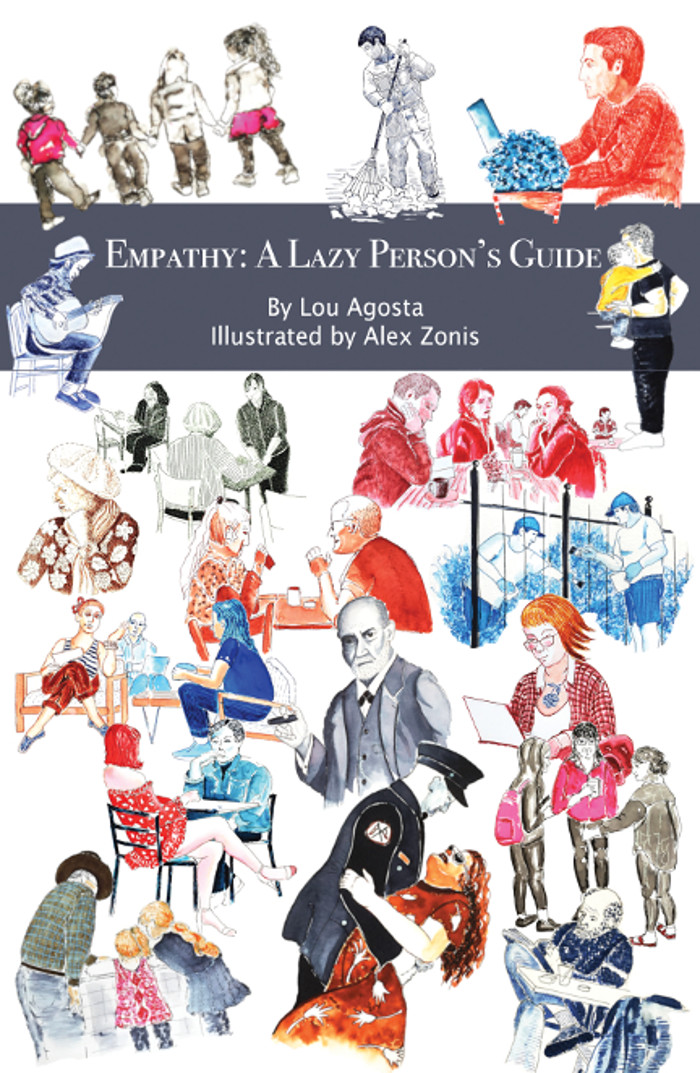
My colleagues and friends are telling me, “Louis, you are sooo 20th Century – no one is reading hard copy books anymore! Electronic publishing is the way to go.” Following my own guidance about empathy, I have heard you, dear reader. The electronic versions of all three books, Empathy Lessons, 2nd Edition, Empathy: A Lazy Person’s Guide, and A Critical Review of a Philosophy of Empathy – drum roll please – are now available.
Feeling like you are thrown “under the bus” again and it’s getting crowded under there? Get the empathy you need to fight back and flourish in this book. Get expanded empathy here!
Order from author’s page: Empathy Lessons, 2nd Edition: https://tinyurl.com/29rd53nt
Order from author’s page: Empathy: A Lazy Person’s Guide: https://tinyurl.com/29rd53nt
Order from author’s page: A Critical Review of Philosophy of Empathy: https://tinyurl.com/29rd53nt
Read a review of the 1st edition of Empathy Lessons – note the list of the Top 30 Empathy Lessons is now (2024) expanded to the Top 40 Empathy Lessons: https://tinyurl.com/yvtwy2w6
Read a review of A Critical Review of a Philosophy of Empathy: https://tinyurl.com/49p6du8p

Above: Cover art: Empathy Lessons, 2nd Edition, illustration by Alex Zonis, original oil paint on board, entitled “Memory blocks: Shimon”
Order from author’s page: A Critical Review of a Philosophy of Empathy: https://tinyurl.com/mfb4xf4f

Above: Cover art: A Critical Review of a Philosophy of Empathy, illustration by Alex Zonis
In conclusion, let me again say a word on behalf of hard copy books – they too live and are handy to take to the beach where they can be read without the risk of sand getting into the hardware, screen glare, and your notes in the margin are easy to access. Is this a great country or what – your choice of pixels or paper!?!
(c) Lou Agosta, PhD and the Chicago Empathy Project
Empathy: A Lazy Person’s Guide is now an ebook – and the universe is winking at us in approval!
The release of the ebook version of Empathy: A Lazy Person’s Guide coincides with a major astronomical event – a total solar eclipse that traverses North America today, Monday April 8, 2024. The gods are watching and wink at us humans to encourage expanding our empathic humanism!
My colleagues and friends are telling me, “Louis, you are sooo 20th Century – no one is reading hard copy books anymore! Electronic publishing is the way to go.” Following my own guidance about empathy, I have heard you, dear reader. The electronic versions of all three books, Empathy: A Lazy Person’s Guide, Empathy Lessons, and A Critical Review of a Philosophy of Empathy – drum roll please – are now available.
A lazy person’s guide to empathy guides you in –
- Performing a readiness assessment for empathy. Cleaning up your messes one relationship at a time.
- Defining empathy as a multi-dimensional process.
- Overcoming the Big Four empathy breakdowns.
- Applying introspection as the royal road to empathy.
- Identifying natural empaths who don’t get enough empathy – and getting the empathy you need.
- The one-minute empathy training.
- Compassion fatigue: A radical proposal to overcome it.
- Listening: Hearing what the other person is saying versus your opinion of what she is saying.
- Distinguishing what happened versus what you made it mean. Applying empathy to sooth anger and rage.
- Setting boundaries: Good fences (not walls!) make good neighbors: About boundaries. How and why empathy is good for one’s well-being. Empathy and humor.
- Empathy, capitalist tool.
- Empathy: A method of data gathering.
- Empathy: A dial, not an “on-off” switch.
- Assessing your empathy therapist. Experiencing a lack of empathic responsiveness? Get some empathy consulting from Dr Lou. Make the other person your empathy trainer.
- Applying empathy in every encounter with the other person – and just being with other people without anything else added. Empathy as the new love – so what was the old love?
Okay, I’ve read enough – I want to order the ebook from the author’s page: https://tinyurl.com/29rd53nt
Advertisements
https://c0.pubmine.com/sf/0.0.7/html/safeframe.html
REPORT THIS AD
Practicing empathy includes finding your sense of balance, especially in relating to people. In a telling analogy, you cannot get a sense of balance in learning to ride a bike simply by reading the owner’s manual. Yes, strength is required, but if you get too tense, then you apply too much force in the wrong direction and you lose your balance. You have to keep a “light touch.” You cannot force an outcome. If you are one of those individuals who seem always to be trying harder when it comes to empathy, throttle back. Hit the pause button. Take a break. However, if you are not just lazy, but downright inert and numb in one’s emotions – and in that sense, e-motionless – then be advised: it is going to take something extra to expand your empathy. Zero effort is not the right amount. One has actually to practice and take some risks. Empathy is about balance: emotional balance, interpersonal balance and community balance.
Empathy training is all about practicing balance: You have to strive in a process of trial and error and try again to find the right balance. So “lazy person’s guide” is really trying to say “laid back person’s guide.” The “laziness” is not lack of energy, but well-regulated, focused energy, applied in balanced doses. The risk is that some people – and you know who you are – will actually get stressed out trying to be lazy. Cut that out! Just let it be.
The lazy person’s guide to empathy offers a bold idea: empathy is not an “off-off” switch, but a dial or tuner. The person going through the day on “automatic pilot” needs to “tune up” or “dial up” her or his empathy to expand relatedness and communication with other people and in the community. The natural empath – or persons experiencing compassion fatigue – may usefully “tune down” their empathy. But how does one do that?
The short answer is, “set firm boundaries.” Good fences (fences, not walls!) make good neighbors; but there is gate in the fence over which is inscribed the welcoming word “Empathy.”
The longer answer is: The training and guidance provided by this book – as well as the tips and techniques along the way – are precisely methods for adjusting empathy without turning it off and becoming hard-hearted or going overboard and melting down into an ineffective, emotional puddle. Empathy can break down, misfire, go off the rails in so many ways. Only after empathy breakdowns and misfirings of empathy have been worked out and ruled out – emotional contagion, conformity, projection, superficial agreement in words getting lost in translation – only then does the empathy “have legs”. Find out how to overcome the most common empathy breakdowns and break through to expanded empathy – and enriched humanity – in satisfying, fulfilling relationships in empathy.
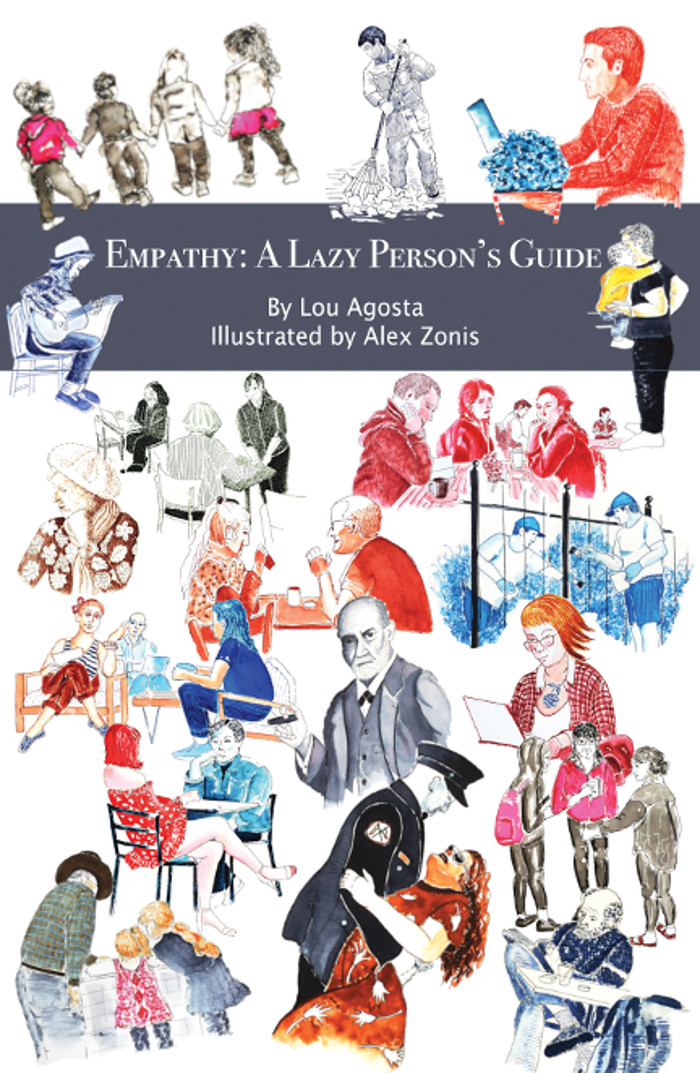
Order from author’s page: Empathy: A Lazy Person’s Guide: https://tinyurl.com/29rd53nt
Order from author’s page: Empathy Lessons, 2nd Edition: https://tinyurl.com/29rd53nt
Read a review of the 1st edition of Empathy Lessons – note the list of the Top 30 Empathy Lessons is now (2024) expanded to the Top 40 Empathy Lessons: https://tinyurl.com/yvtwy2w6
Read a review of A Critical Review of a Philosophy of Empathy: https://tinyurl.com/49p6du8p
Order from author’s page: A Critical Review of Philosophy of Empathy: https://tinyurl.com/29rd53nt
Order from author’s page: Empathy Lessons, 2nd Edition: https://tinyurl.com/mfb4xf4f
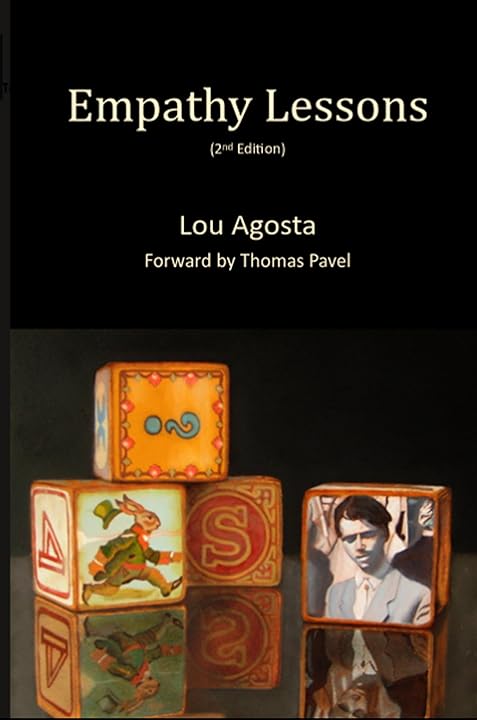
Above: Cover art: Empathy Lessons, 2nd Edition, illustration by Alex Zonis
Advertisements
https://c0.pubmine.com/sf/0.0.7/html/safeframe.html
REPORT THIS AD
Order from author’s page: A Critical Review of a Philosophy of Empathy: https://tinyurl.com/mfb4xf4f

Above: Cover art: A Critical Review of a Philosophy of Empathy, illustration by Alex Zonis
Finally, let me say a word on behalf of hard copy books – they too live and are handy to take to the beach where they can be read without the risk of sand getting into the hardware, screen glare, and your notes in the margin are easy to access. Is this a great country or what – your choice of pixels or paper!?!
(c) Lou Agosta, PhD and the Chicago Empathy Project

Summer Reading: The Song of Our Scars by Haider Warraich
I have been catching up on my summer reading: Haider Warraich. (2023). The Song of Our Scars: The Untold Story of Pain. New York: Basic Books, 309 pp.
Haider Warraich, MD, has provided an account of our relationship with pain and suffering that is a “physician heal thyself” moment and narrative. Warraich’s work is a powerful combination memoire and biological-clinical briefing on the distinction between acute and chronic pain. Now an assistant professor at Harvard Medical School, the author experienced a life altering back injury while he was in medical school. Suffice to say, the results were an entire encyclopedia of pains, extending from acute to chronic and back, and providing the reader with a compelling narrative of what medical science does not know about pain. Warraich has a way with words and catchy phrases. For example, regarding pain, “The human brain is not just staffing the ticketing booth as the [pain] circus – it is the ringleader” (p. 10). Just so.
Warraich argues: “To course-correct our approach to pain, we need to change the story of chronic pain – pushing back on the voices attempting to convince us all pain is catastrophic and life threatening and needs immediate attention over everything else right now” (p. 253). And yet the good doctor acknowledges that pain puts the person in pain in prison (p. 78). Chronic pain mirrors incarceration (p. 78); and, as for acute pain, the house is on fire and the patient is in it. Summon emergency services!? Elaine Scarry’s The Body in Pain (pp. 232 – 233) is quoted approvingly as additional reading demonstrating that pain presents as requiring urgent attention. Pain resists language, and, when inflicted, for example, in torture, can destroy one’s humanity and integrity and world, requiring long, arduous, and doubtful recovery.
Warraich provides a series of engaging briefings on aspects of pain. The reader gets three basic distinctions differentiating: acute from chronic pain; pain as such versus painful emotions such as fear (e.g., pp. 54, 65), which this reviewer would gloss as “suffering”; and pain in the context of the relationship between mind and body.
Acute pain is exemplified by such experiences as an appendicitis, a broken bone, closing the car door on one’s finger, or dropping a brick on one’s toe. Ouch! In contrast, chronic pain is morning body ache and other intermittent and recurring aches, cramping from irritable bowel syndrome, osteoarthritis, hard-to-describe headaches, or the consequences of multiple back surgeries to the spine. Chronic stress – the boss is a bully, the kids are misbehaving, the spouse is having a midlife crisis,the commute back to the office is unavoidable, the toilet is clogged – results in chronic pain (p. 177). “When people become trapped in the clutches of chronic pain and chronic stress, their lives become engulfed in an eternal, inextinguishable fire – a fire as ferocious as the one that drives the hunger for profit that fuels many modern pharmaceutical giants” (p. 179). Thanks to neuro-plasticity (a key distinction further defined below), chronic pain reorganizes the nervous system. The body expresses the imbalance, the dis-equilibrium, of the mind and its emotions (the latter, admittedly, not distinctions covered in medical school in any detail). Chronic pain stops being a symptom of an injury and it takes on a life of its own, presenting as if the pain were a disease in itself instead of a signal of an underlying or related bodily injury. Chronic pain leads to suffering, a term that Warraich mentions but does not explicitly elaborate. For example, if pain is the dentist hitting an exposed nerve, suffering is being in the waiting room anticipating the dentist hitting the nerve.
According to Warraich, medicine is very good at anesthetizing the mammalian nervous system against such acute pain, but the use of the same anesthetics and analgesics against suffering is a deal with the devil. It might work in the short term; but be sure to read the fine print. The road to hell is paved with such agreements, which, it turns out, is a redescription of the opioid epidemic. In the following, Warraich writes “pain”, but it would be more accurate to say he means “suffering”: “The confluence of advances in medicine and a barrage of pharmaceutical companies marketing directing to doctors and patients birth a movement that deemed suffering unacceptable. As spiritual voids gaped inside those economically left behind and loneliness became a way of life, people in pain [i.e., suffering] kept being sent exclusively to doctors’ offices and pharmacies [for opioids to numb the pain]” (p.147). Loneliness is indeed painful, and poverty is definitely bad for one’s health, but not in the same way as a toothache or appendicitis – loneliness and poverty are chronic and make a person cry real tears of frustration, isolation, neglect, and anger. Yet the suffering is not localized like a toothache or peripheral injury, but seems to pervade the head and chest, calling forward a sense of being burdened by something imponderable and diffuse throughout one’s upper body. In chronic pain and the suffering brought forth by chronic pain, instead of the injured organism telling the brain of the peripheral injury in the limb by means of a pain signal upward to the brain, the brain (or, to be exact, the thoughts in it) are sending the signal in the other direction – downward – telling the organism to hurt. This may be specific, if there is a specific injury able to express the suffering, but more likely the pain points are diffuse and mobile – hard to define lower back pain (e.g., Warraich’s injuries), headaches, irritable bowel syndrome, autoimmune disorders. In short, acute pain is the organism telling the brain it (the skin or peripheral limb) is hurting; whereas chronic pain is the brain telling the organism it is hurting. However, the message is highly susceptible of distortion. In some ways, chronic pain can become the memory of pain, which may or may not indicate a current injury. Chronic pain can become the fear of pain itself, expanding into pain in the here and now. In short, opioids are effective in treating acute pain but are ineffective and harmful – I would say “a deal with the devil” – in treating chronic pain (p. 174).
The poster child that not all pains are created equal is phantom limb pain. Documented as early as the American Civil War by Silas Weir Mitchell, individuals who had undergone amputation, felt the nonexistent, missing limb to itch or cramp or hurt. The individuals experienced the nonexistent tendons of the missing limb as cramping and even awakening the person from the most profound sleep due to pain (pp. 110 – 111).
Fast forward to modern times and Ron Melzack’s gate control theory of pain marshals such phantom limb pain as compelling evidence that the nervous system contains a map of the body and its pains point, which map has not yet been updated to reflect the absence of the lost limb. In effect, the brain is telling the individual that his limb is hurting using an obsolete map of the body – the memory of pain. Thus, the pain is in one’s head, but not in the sense that the pain is unreal or merely imaginary. The pain is real – as real as the brain that is indeed in one’s head and signaling (“telling”) one that one is in pain.
One question that has not been much asked is whether it is possible to have something similar to phantom limb pain even though the person still has the limb functionally attached to the body. For example, the high school football player who needs the football scholarship to go to college because he is weak academically but actually hates football. He really incurs a painful soft tissue sports injury, which gets elaborated emotionally and psychologically, leaving him on crutches for far-too-long and both physically and symbolically unable to move forward in his life. Thus, due to the inherent delays in neuroplasticity – the update to the map is not instantaneous and one does not have new experiences with a nonexistent limb – pain takes on a life of its own. That is the experience of chronic pain – pain has a life of its own – pain becomes the dis-ease (literally), not the symptom. What then is the treatment, doctor?
Warraich radicalizes the issue of pain that takes on a life of its own before suggesting a solution. After providing a short history of opium and morphine and opioids, culminating “in the most prestigious medical school on earth, from the best teachers and physicians, we [medical students] were unknowingly taught meticulously designed lies” (p. 185), that is, prescribe opioids for chronic pain. The reader wonders, where do we go from here? To be sure opioids have a role in hospice care and the week after surgery, but one thing is for certain, the way forward does not consist in prescribing opioids for chronic pain.
After reviewing numerous approaches to integrated pain management extending from cognitive behavioral therapy and acceptance and commitment therapy (ACT) to valium, cannabis and Ketamine – and calling out hypnosis (hypnotherapy) as a greatly undervalued approach (no exteranl chemicals are required, but the issue of susceptibility to hypnotic suggestibility is fraught) – Dr Warraich recovers from his own life changing back injury in a truly “physician heal thyself” moment thanks to dedicated PT, physical therapy (p. 238). If this seems stunningly anti-climactic, it is boring enough to have the ring of truth earned in the college of hard knocks, but it is a personal solution (and I do so like a happy ending!), not the resolution of the double bind in which the entire medical profession finds itself (pp. 188 – 189). The way forward for the community as a whole requires a different, though modest, proposal.
Let us allow Dr Warraich to speak for himself: “I have come to believe a good doctor has an almost magical quality to feel what their patients feels – to see how they view the world, understand where they have been and what they’ve have seen all in an instant – as well as the knowledge and expertise to respond ethically to what they see from the other side. This superpower has a name: empathy” (p. 238). Never underestimate the power of a good listening. “’Mental distress may be perhaps the most intractable pain of all,’ she [Cicely Sanders] wrote, and the answer to it was not always more drugs, because for some ‘the greatest need is for a listener’” (p. 159).
Putting pain in the context of the relationship between soul and body, the body in pain expresses the suffering of the soul. While psychiatry and neurology do not even believe in the soul, they do begrudgingly allow that there is such a thing as “mental status,” which, for example, can be compromised by the hormonal imbalance of puberty, existential anxiety, jet lag, alcohol, delirium, or other insults to the organism such as blunt trauma, which, in turn, implies a conscious mind to have such a mental status. Here’s the issue: humans are neurons “all the way down,” but then the neurons start to generate consciousness – consciousness generates meaning – meaning generates language and relatedness, language and relatedness generates community, culture, art, literature, science, and humanity. However, there are numerous details that need to be filled in here, which are still the target of inquiry and ongoing research, and you won’t learn or be allowed to study them in medical school. I hasten to add that if you are experiencing a compromised mental status due to delirium, don’t call a hippie or professor of comparative literature – you need a medical doctor!
Notwithstanding my whole-hearted endorsement of Dr Warraich’s contribution – get multiple copies of this book and give it to your friends to read – this is not a softball review. Three criticisms come to mind.
First, Warraich rightly criticizes Rene Descartes’ (1596 – 1650) abstraction of the mind (including consciousness and consciousness of pain) from the body. Having divided the unity of the human being into two parts, mind (soul) and body, Descartes then needed a way to explain the communication between them. The mind obviously does not direct the body the way the pilot of a boat steers the craft. Absent neuro-pathology, the mind and the body are a near perfect unity. The body is the perfect servant of the mind – it prepares a cup of tea without my having to communicate the desire as if to a separate entity. It just knows and starts boiling the water. Descartes solution was to propose the pineal gland as the seat of the soul in the body. Warraich does Descartes one better by developing an entire narrative about the brain’s posterior insular cortex and anterior insula, identifying a novel kind of neuron, a von Economo neuron (p 63), from which pain emerges as an emotion generated by a physical sensation. An ingenious solution, which, however, is still a category mistake. What is missing – and here it is not Warraich’s issue but a general shortcoming of philosophy of science – is an account of emergent properties such as, for example, how mental states come forth from physical processes and, just as importantly, how mental states cause physical ones (as when one literally worries oneself sick).
Second, as regards the personal parts of the author’s narrative, pick a story and stick to it. The personal narrative starts out that the potentially life changing back injury is described as tissue damage (p. 5) – the painful consequences of which should never be underestimated. But by page 91 this is redescribed as a “broken back.” Literally? The value here is in describing how the patient’s relationship to pain influences his life and how Warriach has to transform his relationship to pain in order to recover his life as a medical doctor and his contribution to healing. Of course, one could have both tissue damage and a broken back. Here highly recommended reading, in comparison to which Warraich is a modest contribution, is Arthur Kleinman’s The Illness Narratives. Stories about how chronic pain transforms one’s life, including (for example) how repeated surgeries result in a “failed back” (which technically is different than a “broken back”). Such narratives are bound to give the reader pause that medical science (or even comparative literature) understands the relation between mind and body.
Finally, regarding the magical quality of empathy, I am a strong advocate of empathy, having published extensively on its applications. Never underestimate the power of empathy, and Warraich properly calls out the “empathy gap” in medicine (p. 244). But Warraich gives empathy a bad name in that he leaves empathy vulnerable to the critique that the above-cited magical power of empathy leads to compassion fatigue, empathic distress, and burn out. It can and does. This requires treatment too. Human beings are a complex species. They can be kind, generous, and empathic; but, as painfully demonstrated by the opioid epidemic, they can also be greedy, grasping, aggressive, territorial, bullying, experts in know-it-all-ism that obstructs listening, and exploiters of politics in the negative sense. The short empathy training is to drive out all these negatives, and empathy naturally and spontaneously comes forth. People (i.e., doctors) want to be empathic and will be so if given half a chance. The challenge is that the healing professions are constantly exposed to pain, suffering, trauma, and patients who can be difficult and unempathic precisely because they are in pain – or because they were difficult people prior to getting sick or hurt. A rigorous and critical empathy knows it can be wrong, breakdown, or misfire, so such an empathy also knows it can be validated. This reviewer believes Warraich’s compelling narrative may usefully have begun where it ends – with empathy and how empathy made a difference in his recovery and his daily life in the world of corporate medicine and at the Veteran’s Administration (VA). The VA has been criticized – “taken heat” – for not addressing post-traumatic stress disorder (PTSD) until it is dismissed and returns as substance abuse, but, based on Warriaich’s reports (p. 248), the VA is doing breakthrough work in integrated pain management, meditation and hypnotherapy, ACT, reduction in prescribing opioids, and they may become a model for other providers. Dr Warraich’s matriculation in the college of hard knocks of chronic back pain gives him standing to elaborate such an empathic approach, and perhaps he will do so in a follow up publication.
Additional Reading
Lou Agosta. (2018). Empathy Lessons. Chicago: Two Pairs Press.
Arthur Kleinman. (1988). The Illness Narratives. New York: Basic Books.
Elaine Scarry. (1985). The Body in Pain. Oxford: Oxford University Press.
(c) Lou Agosta, PhD, and the Chicago Empathy Project


Top Ten Empathy Trends for 2023
Empathy is a practice and priority, not a mere psychological mechanism. Practicing empathy is a way of being in the world, creating a safe space of openness, acceptance and toleration. In the face of a contagion of Omicron, we need a contagion of empathy. Empathy is contagious. This is a condition you actually want to share with someone else, especially someone who seems to need some empathy – all the while being clear to set firm boundaries against bullying, delusional thinking, and compassion fatigue. Keep in mind this list is a top ten “count down,” so if you want to know what is #1, fast forward to the bottom.
Here are my choices and predictions for the top ten trends in empathy for the year 2023.
10 – Empathy for the jurors in the trial of the century. The prediction is that Mr T will stick to his story – “we was robbed” – even after he is indicated, believing there is no such thing as bad publicity. The prospective defendant is innocent until proven guilty and so on. However, it is noteable that a former-NSA analyst was sentenced to nine years in prison in July 2019 for hoarding official documents [https://www.nextgov.com/cybersecurity/2019/07/ex-nsa-contractor-serve-9-years-hoarding-classified-information/158564/]. This seems open and shut. Nevertheless, this trend is about the jurors and not the defendant. This promises to be a long, headline-grabbing trial, and the jury will have to be sequestered, cut off from news, and, subjected to a lot of legal jargon. Being without Facebook and Twitter and other
is. While the challenges of finding an unbiased jury are not trivial, all that is needed for a fair trial are twelve people who are willing to set aside their opinions and look at the facts from the point of view of the law as defined for them by the presiding judge. That sounds like creating a space for critical thinking and taking multiple points of view, the latter the folk definition of empathy.
9 – Empathy in time of war becomes Red Team not kindness. All the empathy in the world is not going to help anyone if one country invades another with a list of intellectuals, business people, and politicians to be arrested and killed. That noted, the need for helping, compassion, and good works of all kinds is still on the critical path to building a better world. Yet in time of war or threat of war, the power of empathy consists in putting oneself in the shoes of the opponent, thinking like the opponent, and thereby anticipating and thwarting the opponent’s moves. Putting oneself in the opponent’s shoes requires taking off one’s own shoes first. Never underestimate the power of empathy – never – yet empathy does not work very well with psychopaths, bullies, totalitarian dictators, and the criminally insane. Many of these individuals will take the affective, bottom up empathy and use it against you. Therefore, empathic engagement must be limited to cognitive empathy – use critical thinking to try to figure out what the Other is thinking and feeling in order to intervene in a way that is useful according the standards of a humane community.
8 – Elon “44 billion up in smoke” Musk gets empathy for his employees, customers, and stakeholders. And if you believe prediction, then I have a bridge in Brooklyn that I would like to sell to you. The empathic truth of this admittedly cynical prediction is that many of the things that make a person good at business make him or her relatively poor empathizers. Business leaders lose contact with what clients and consumers are experiencing as the leaders get entangled in innovating the technologies in new products and services, solving legal issues, reacting to the competition, or implementing the software required to sustain operations. Yet empathy is the ultimate Capitalist Tool. Empathy is on the critical path for serving customers, segmenting markets, positioning products (and substitutes), taking the perspective of the competition [not exactly empathy but close enough?], building teams and being a leader who actually has followers. Saying that the purpose of business is to make money is like saying the purpose of life is to breathe. Definitely do not stop breathing. The purpose of business is to deliver value and satisfaction to customers. Then the revenue shows up. When the ontology of empathy exposes it as the foundation of community, then expanding empathy becomes nearly synonymous with expanding business. For example, building customer communities, building stakeholder communities, team building, are the basis for brand loyalty, employee commitment, and sustained or growing market share. Can revenue be far behind? Sometimes leaders don’t need more data, we need expanded empathy, though ultimately both are on the path to satisfied buyers, employees, and stakeholders. “CEO” no longer means “Chief Executive Officer,” but “Chief Empathy Officer.” This time one can hear the groans—from the executive suite, not the cubicles.:
Listen on Spotify: https://open.spotify.com/show/6nngUdemxAnCd2B2wfw6Q6 Empathy is one of those things that are hard to delegate. This role shows up like another job responsibility with which the CEO of the organization is tasked—along with everything else that she already has to do. As if she did not already have enough alligators snapping at various parts of her anatomy, one has to be nice about it, too? But of course empathy is not niceness, though it is not about being un-nice. It is about knowing what others are experiencing, because one has a vicarious experience and then processing that further to expand boundaries and exercise leadership.
7 – Etiquette Gurus and celebrity life coaches go back to school to learn empathy. The latest poster child for this trend is Sara Jane Ho, who reportedly broke up with her boyfriend of four years over text, and rationalizes it with a meme about context, in which the context sounded like she was busy making a Netflix show. This is right up there with trend #8, getting fired by a Twitter tweet. The context, according to the author of the article, Maureen O’Connor, was that Ms Ho’s eyes were getting puffy from crying, and she would not “look good” on her Netflix show. Empathy is a high bar and one does not get there every day. If Ms Ho’s resume is to be believed, she is a graduate of Phillips Exeter Academy, Georgetown, Harvard (attended), and now a Netflix sensation. One speculates that she is a survivor of a Tiger Mom or Bootcamp Dad (or both), and may herself benefit from getting a good listening at the side of a committed mentor. Based on the review of Ms Ho’s project by Maureen O’Connor [ https://www.nytimes.com/2023/01/02/style/sara-jane-ho-mind-your-matters.html], she (Ms Ho) exemplifies the kind of etiquette which is a disguised application of sadism, hostility, aggression, and one-upmanship. While I do not know the details and maybe I am missing the humor, but so far, all these people are easy to dislike. You go to take off your coat and you can’t because there is a knife in your back. There is nothing wrong – but something is definitely missing – empathy.
6 – Empathy is a practice not a mere psychological mechanism. Empathy is the practice of authentically relating to the other person. The practice of empathy is a way of being – being with and in relation with others. Many of the misunderstandings of empathy – especially in the form of compassion, pity, emotional contagion – can be traced to treating the practice of empathy merely as a psychological mechanism. There is nothing wrong with this as such. However, what gets missed is the relational quality of empathy. Drive out bullying, hostility, aggression, bad language, and empathy naturally comes forth. People want to be empathic if given half a chance.
5 – Empathy expands for the True Believer, but not agreement with the conspiracy or delusion. The criteria for identifying the True Believer is he or she doubles down. When the space does not arrive from Alpha Centauri – or your candidate does not win – the True Believer does not say, “I might have been mistaken and maybe I need to look at my assumptions or inquire into other scenarios.” The True Believer doubles down – “We was robbed!” “We will catch the next space ship!” It does no good – none – to disagree with the True Believer or to argue or reason, because the delusion or conspiracy theory is holding together the True Believer’s personality. To give up the delusion would be to give up the personality, to risk the disintegration of who the person is. What to do about it? Teach critical thinking. Both empathy and critical thinking create a space of acceptance and tolerance in the context of which the power of the delusion starts to shrink. More on this in the next trend.
4 – Empathy and critical thinking form an alliance. It is a bold statement of the obvious that the ongoing breakdown in community standards bodes ill for a cultural and political and public conversation context in which disputants engage in near delusional disagreement on basic quantitative facts such as the rules of etiquette, basic science such as the biology of vaccinations, gender distinction (or not), the basic results of elections, and so on. Though it is not a quick solution, it is hard to think of a better one: teach skills in critical thinking such as assessing facts against sources, evaluating the reliability of sources, reporters, informants, and so on, against prior performance, checking validity and logic of arguments, and engaging enlarged thinking in taking the point of view of the other person, especially if the person (or group) disagrees with one. (See Jonathan Haber, (2020), Critical Thinking. Cambridge, MA: The MIT Press.) Taking different points of view, of course, is the basic folk definition of empathy. But do not forget to take off one’s own shoes before trying on the other’s or one will get projection, not empathy.
3 – Translation replaces projection as the underlying model for empathy. “Translation” as in translating between languages or between different artistic media or different signaling systems. In short, psychologism – psychology in the negative sense – is replaced by the linguistic speech act of translating the other person’s experience into one’s own and then giving it back (empathically) to the other. This paradigm of empathy as translation is arguably at the same level of generality as empathy as projection, but remained undeveloped until the rise of hermeneutics along a separate trajectory. The modern innovators of interpersonal empathy such as Carl Rogers (1902–1987) might be read as leap-frogging back to the original sense of entering the other’s world in order to translate it into the first person, subject’s own terms. The translation model of empathy (credited to Johann Herder (1744 – 1803) of whom one rarely hears today) also fits well with what Gordon Allport (1897–1967) and Kenneth Clark (1903–1983) were doing in arraying empathy against racism and prejudice in expanding the boundaries of community by empathically translating between them. An entire possible alternate history of empathy, as yet unwritten, opens up at this point – empathy as translation between persons.
2 – Empathy for the Amazon rain forest grows and reaches a critical mass, but will its critical mass be enough or too late to overtake the “critical mass” of green house gases. The challenge is that global warming does not live like an actual possibility for most people, who cannot imagine such an outcome – for example, just as in December 2019 no one could envision the 2020 global pandemic. Empathy is oxygen for the soul. If the human psyche does not get empathy, it suffocates. Climate changes makes this metaphor actual. If humanity does not drown as the massive Greenland and Antarctic ice sheaths slide into the oceans, humans will suffocate as the levels of green house gases and heat overwhelm temperate habitats. There is no Planet B.Empathy is a bridge: The bridge between the gridlocked present and a seemingly impossible-to-imagine future is empathy. The empathic moment is an act of imagination. That is the interesting thing about empathy. It may seem like a dream; but the dream lives. It is inclusive. Lots more work needs to be done on this connection. For purposes of this list of predictions, this “shout out” will have to suffice. For specific actionable recommendations, see David Attenborough’s A Life on Our Planet, now streaming on Netflix: https://www.netflix.com/title/80216393
2a – Vaccine deniers get empathy and say: “Oh, I wish I were already experiencing the minor side effects of the latest booster shot instead of systemic organ breakdown!” People get the latest booster against Covid, parents get their children the measles and polio and other shots the children need for school, which gets into people’s arms at an accelerating rate. Vaccine deniers get empathy and say: “Oh, I wish I were already experiencing the minor side effects of the latest booster shot instead of systemic organ breakdown!” Biological science continues to produce small, medium, and large “miracles,” even as basic health care services for citizen’s struggle. People become medical doctors and nurses and enter the healthcare field because they want to make a difference. They experience an empathic calling to intervene to reduce the pain and suffering in the world. Then these same people get caught up in the faceless, unempathic bureaucracy of a healthcare system where capitation means doctors have to see an unworkable number of patients a day – four an hour for eight hours. Using empathy and medical ethics, the doctors push back saying: “I am required by medical ethics to spend as much time with the patient as is needed to get the patient the medical treatment they require – and are entitled to be paid for it.
2b – Men lead from empathy in the struggle against domestic violence (DV). When powerful men such as Bezos, Musk, Ellison, Gates, Biden, Milley, clean up their failures of leadership and take action saying “Violence against women anywhere – home or work or anywhere – is unacceptable and here are the resources for intervention,” then a breakthrough will occur. Men will find their voice and speak out even more loudly and provide leadership against domestic violence to those of their own gender who just do not get it.
While women have provided the leadership and will continue to do so, powerful men must step up and provide guidance to their fellows about proper boundaries and respect for them in relationships. This is ongoing. What is new: powerful men step up and speak out and provide leadership among men in establishing respect for boundaries in creating communication, affection, and affinity.
For data- and empathy-based innovations that have occurred in the past year in the fight against domestic violence see No Visible Bruises: What We Don’t Know About Domestic Violence Can Kill Us, New York: Bloomsbury Publishing, 2019. Some sixty percent of domestic violence (DV) victims are strangled at some point during an abusive relationship (p. 65): Big red flag that the perpetrator is escalating in the direction of homicide/Femicide.
Empathy almost always has its uses when tuned to the specific circumstances. Yet empathy is unhelpful in dealing with sociopaths, psychopaths, and [most] bullies. They take whatever empathy you give them and use it the better to manipulate. Top down, cognitive empathy – yes – to understand whether they are a threat and are going to escalate; but therapeutic empathy – “i get you, bro” – is often counter productive. What is productive? Set limits. Set firm boundaries – and enforce them.
Turns out that only some 15% of the victims in one study had injuries visible enough to photograph for the police report (p. 66). Most strangulation injuries are internal – hence, the title. Good news/bad news: The Fatality Review Board is an idea that is getting attention with law enforcement and the local states attorney function. More progress and action is needed in this area.
(1) People stop saying, “I just don’t get empathy” and commit to the practice of empathy. Empathy is a practice and, like all practices, it can be improved by training. Remove the obstacles to empathy such as cynicism and bullying—and empathy comes forth. Remove the resistances to empathy and empathy naturally and spontaneously expands. Most people are naturally empathic.
The one-minute empathy training is trending: Eliminate the obstacles to empathy and a space of acceptance and toleration spontaneously emerges.
Most people do not sufficiently appreciate this: people are born with a deep and natural capacity for empathy, but they are also born needing to learn manners, respect for boundaries, and toilet training. Put the mess in the designated place or the community suffers from diseases. People also need to learn how to read and do arithmetic and communicate in writing. But there is a genuine sense in which learning to conform and follow all the rules does not expand our empathy or our community. It does not help the cause of expanded empathy that rule-making and the drumbeat of compliance are growing by leaps and bounds.
The work at hand? Remove the blocks to empathy such as dignity violations, devaluing language, gossip, shame, guilt, egocentrism, over-identification, lack of integrity, inauthenticity, hypocrisy, making excuses, finger pointing, jealousy, envy, put downs, being righteous, stress, burnout, compassion fatigue, cynicism, censorship, denial, manipulation, competing to be the biggest victim, insults, injuries to self-esteem, and narcissistic merger—and empathy spontaneously expands, develops, and blossoms. Now that is going to require some work!
Teaching empathy consists in overcoming the obstacles to empathy that people have acquired. When the barriers are overcome, then empathy spontaneously develops, grows, comes forth, and expands. There is no catch, no “gotcha.” That is the one-minute empathy training, pure-and-simple.
References and Notes
“The One-Minute Empathy Training”
May I introduce myself? Here is a short introduction to who i am and my commitment to empathy, including a one-minute empathy training. Total run time: about five minutes. Further data: See also
(c) Lou Agosta, PhD and the Chicago Empathy Project
Review: Empathy and Mental Health by Arthur J. Clark
Empathy and Mental Health: An Integral Model for Developing Therapeutic Skills in Counseling and Psychotherapy. London: Routledge 2022 Electronic Version
As a young man, Arthur J. Clark heard Carl Rogers speak and was inspired to devote his life’s work to applying empathy in education, counseling, and talk therapy. This book is the distillation of years of experience and learning, and we, the readers, are enriched and even enlightened in this original synthesis of existing ideas on empathy. It is fully buzz word compliant, diligently calls out the limitations and risks of empathy, and guides the readers in expanding their empathy to make a difference in overcoming suffering and mental illness. It takes a lot of empathy to produce a book on empathy, and empathy is evident in abundance in Clark’s work.
As noted, Clark’s academic background is in education, as was Carl Rogers’, but the reader soon discovers Clarks’ work with empathy to be generously informed by Freud, Ferenczi, and Adlerian psychoanalysis. Thus Clark quotes [Alfred] Adler (1927): “Empathy occurs in the moment one individual speaks with another. It is impossible to understand another individual if it is impossible at the same time to identify oneself with him” (Clark: 20). At this same time this reviewer was enlivened by the application of distinctions to be found in the Self Psychology of Heinz Kohut and the latter’s colleagues Michael Basch and Arnold Goldberg. This brilliant traversal of the practice and conceptual landscape of empathy inspired Clark’s life work, and is on display here.
The book is filled with short segments of transcripts of encounters between counselor/therapist and client. To the point that empathy is much broader than reflecting feeling and meanings, examples are provided of empathic encouragement, empathic being in the here and now (immediacy), empathic silence, empathic self-disclosure, empathic confrontation, empathic reframing, empathic cognitive restricting, empathic interpretation. Clark’s work with empathic reframing, cognitive restructuring, and interpretation are particularly useful (Clark: 105 – 106).
“Empathy” is not so much a substantive as a modifier – a manner of being that applies across a diversity of ways of relating to the other individual. (It is a further question, not addressed by Clark, as to the status of these vignettes. Are they disguised, permissioned, ideal types, some combination thereof? Just curious. In any case, they work well and remind me of M. F. Basch’s vignettes in the latter’s Doing Psychotherapy.)
Clark makes reference to the celebrated video (e.g., widely available on Youtube) of Carl Rogers, interviewing the real-world patient “Gloria” about her relationship with her nine-year-old daughter “Pammy.” Rogers’ empathic listening skillfully turns the focus from Gloria’s presenting dilemma of how much information about sex to share with her inquisitive nine-year-old daughter, Pammy, into a willingness on the part of Gloria’s to call out her own blind spots and conflicts over sex. Rogers’ empathic responsiveness shows the way for Gloria to recapture her own integrity around adult sexuality so that she can provide Pammy with the appropriate sex education the child needs, regardless of the details that may be relevant only to the adults. And Rogers does this in about twenty minutes, not months of therapy.
At this point, it is useful to give Rogers’ definition of empathy (p. 11): “To perceive the internal frame of reference of another with accuracy and with the emotional components and meanings which pertain thereto as if one were the person, but without ever losing the ‘as if’ condition.” Rogers was definite about excluding the perspectives of the practitioner in conceptualizing empathy in his person-centered approach to therapy. In this regard, he stated, “For the time being you lay aside the views and values you hold for yourself in order to enter another’s world without prejudice.”
Clark’s integration of the diversity of approaches to empathy in history, theory, and practice distinguishes subjective, object and interpersonal empathy: “Subjective empathy encompasses a practitioner’s internal capacities of identification, imagination, intuition, embodiment that resonate through treatment interactions with a client and empathically reflect the individual’s experiencing. Objective empathy pertains to the deliberate use of a therapist’s conceptual knowledge and data-informed reasoning in the service of empathically understanding a client in a relational climate. Interpersonal empathy relates to comprehending and conveying an awareness of a client’s phenomenological experiencing and pursuing constructive and purposeful change through the application of a range of interventions” (Clark: xiv).
Clark started out as a school counselor and he gives the example of the student who comes in and says “I hate school!” The reflection is proposed to be something like “You are feeling angry about school.” This demonstrates just how important the tone in which a statement is made can be. This could indeed be an angry statement, which takes “hate” is a literal way. However, it could also be an expression of contempt, disgust, cynicism, resignation, sadness, or even fear (say, since the student is being bullied). The empathy is precisely to acknowledge that the listener is far from certain that he does knows what is going on with the student and to ask for more data. “Sounds like you are struggling with school – can you say more about that?”
Not afraid of controversy or tough topics, Clark’s contribution is thick with quotations from the founding father of psychoanalysis – Adler and Freud and the literature Freud has been reading such as Theodor Lipps, to whom we owe the popularization in Freud’s time of the term “empathy [Einfühlung]. The subsequent generation of ego psychoanalysts is also well represented Ralph Greenson, T. Reik, Jacob Arlow (and Beres).
Clark credits and recruits Ralph Greenson’s distinction of the therapist’s inner working model of the patient and uses it to enrich Rogers’ contribution to empathic understanding. “As empathic understandings evolve through therapeutic exchanges and assessment interactions, a model of an individual emerges that becomes increasingly refined and expansive. In turn, by ways of empathically knowing a client, the framework facilitates sound treatment interventions through the engagement of interpersonal empathy” (Clark: 88). Note that Clark aligns with the view that the countertransference is distorting/pathological as opposed to the total response of the therapist. There are many tips and techniques guiding the therapist diligently to monitor and control the countertransference neurosis.
Since this is not a softball review, I note some issues for productive debate. For example, if Clark had allowed that countertransference included the therapist’s entire reaction to the client, including personal reactions which are not necessarily conflicted or neurotic (on the part of the therapist), then Clark would have been constrained to spend more ink on his own individual responses, empathic and otherwise. Such disclosure, which Clark otherwise separately validates as appropriate in context (and if not this context, then which?), would have enriched a text which otherwise reads like a textbook (and perhaps that was the editorial and marketing guidance).
Also useful is the therapist’s being sensitive to cultural differences and dynamics. In a brief transcript of an interaction between a privileged white school counselor and an African American 8th grader attending the college prep private school (Clark: 42), we are supposed to see objective cross-cultural empathy based on the counselor’s reading of some articles (not specified) on cultural differences.
By all means, read up on cultural differences. However, I just see a rigorous and critical empathy (my term, not Clark’s), plain and simple. The counselor “gets it.” The student is afraid of being seriously injured or even killed by the criminal element in his neighborhood as he waits for the school bus. Is this breakdown of policing in the inner city really in the cultural article? The counselor also “gets it” that the student’s feelings are hurt by being laughed at by his more privileged classmates because his mom is a house cleaner rather than an executive or doctor or lawyer. It is the counselor’s empathic response based on her empathic understanding of the student’s specific fear and hurt feelings that enables the student to deescalate from his problematic acting out. Even though, like most 8th graders, the student would be the last to admit he has been emotionally “touched,” he was. Thus, Clark’s empathy shines through in spite of his style-deadening need to accommodate behavioral protocols, evidence-based everything, and the plodding style of delivery consistent with training in schools of professional social work and psychology.
“Objective empathy” may seem like “jumbo shrimp,” an oxymoron. Nor is it clear how dream work, with which Clark productively engages, falls into the “objective” rubric. Yet it is a highly positive feature that Clark emphasizes and explores in detail the value of dream work.
Let one’s empathy be informed by the context: “Consider, for instance, what are the daily struggles like for a client who meets the diagnostic criteria for a bipolar disorder or attention deficit [. . . .] When giving consideration to such challenges through a framework of empathic understanding, a practitioner calls upon reputable data and a spectrum of work with individuals from diverse backgrounds in order to generate a more inclusive and accurate way of knowing a client” (Clark: 35).
And yet this precisely misses the individual who is superficially described according to labels, but has his own experience of bipolar or attention deficit. Empathy is precisely the anti-essentialist dimension, the dimension that is so pervasive in psychiatry and schools of professional psychology that replace struggling humanity with “You meet criteria for – [insert label].”
While Kohut is properly quoted by Clark as one of the innovators in empathy and Kohut’s concise definition glossing empathy as “vicarious introspection” is acknowledged, Kohut’s other definition of empathy as a method of data gathering about the other individual is overlooked. However, it aligns nicely with Clark’s description of “objective empathy.” Maybe my close reading missed something but why not just say “taking the other person’s perspective” is “objective empathy” as opposed to vicarious introspection (“subjective empathy”)?
The subtitle promises “An integrative model for developing therapeutic skills [. . . ]” Clark substantiates the need for work in critiquing all those training program that model the skill of repeating back to the client words similar to those the client expressed. “In a meta-analysis of direct empathy training, Lam et al. (2011) found that the majority of 29 studies did not clearly conceptualize or define empathy, some did not describe training delivery methods, and almost all of the initiatives failed to present evidence demonstrating individuals’ propensity to behave more empathically after training” (Clark: 140). Clark’s discussion of reframing, cognitive restructuring, and empathic interpretation are relevant and useful in overcoming what amount to a scandal in psychotherapy training.
What Clark is trying to say is this: You think you are being empathic. Think again. A rigorous and critical empathy (my phrase, not Clark’s) is skeptical about its own empathy. That does not mean being dismissive either of one’s own empathy or the struggle of the other person. It means being rigorous and critical. Empathy is made to shine in the refiner’s fire of self-criticism and a radical inquiry into one’s own blind spots.
Clark does not escape unscathed from the behavioral and observation protocol dead end. The reader will seek in vain for self-criticism or inquiry into Clark’s own blind spots – instead the reader is awash in the extensive behavioral, cognitive behavioral therapy (CBT) attempts, albeit empathically deployed, to capture therapeutic encounters in a behaviorally observable or reportable protocol. Nor I am saying there is anything wrong with that as such. Yet might not the behavioral and observation protocol swamp precisely be the blind spot where the self-deception lives against which Rogers frequently denounces? To gather the honey of self-knowledge and empathic understanding one must risk the stings of distortion and disguise.
Clark’s would be a different work entirely if he explored the college of hard knocks in which he forged the empathic integration. He is trying to make what is largely an artistic practice into a rule-governed scientific algorithm. It is worth a try and the reader must judge the extent to which Clark succeeds. Spending a lifetime preparing articles for peer-reviewed publications in education, psychology, etc., does not generally bring life and vitality to one’s practice, manner of engagement, or writing style. However, Clark’s richness of material, wealth of distinctions related to empathy, and organizing virtually every aspect of empathic research and published references goes a long way towards compensating for Clark’s work not necessarily being a “page turner.” Clark’s writing reminds the reader more of the Diagnostic and Statical Manual (DSM) – Ouch! – more than (for example) of D. W. Winnicot, Christopher Bollas, Arnold Goldberg, Freud, who was an expert stylist (granted much is lost in translation), or even Carl Rogers himself.
Thus, Clark’s integrated approach calls for “a diagnosis [as from the DSM] that represents the lived experience of the individual.” Agree. Clark gives an example where the therapist is interviewing Omar who has low energy, lethargy, lack of motivation, and hopelessness about the future. The diagnosis encapsulates and integrates a lot of Omar’s experience, and, though Clark does not say so, Omar may even be relieved to hear/learn that he (Omar) is not to blame for his disordered emotions (“major depression”); and Omar should stop making a bad situation worse by negative self-talk, verbally “beating himself up” in his own mind. The treatment consists in getting Omar to do precisely what the depressed person is least inclined to do – take action in spite of being unmotivated. If one is waiting to be motivated, absent a miracle, it is going to be a long wait. Maybe the empathic response is precisely saying this to the client, acknowledging how hard it is (and may continue to be for a while) to get into action on one’s own behalf.
This is all well and good. However, narrowly or expansively empathy is defined it is the anti-DSM (diagnostic and statistical manual). The DSM has many uses, especially in aligning terminology such that the community is talking about the same set of criteria when it uses the word “generalized anxiety disorder.” It also has uses in requesting insurance reimbursements. In short, there is nothing wrong with the DSM-5 (2013) or any version – but there is something missing – empathy. In the case of empathy, the recommendation is to relate to the struggling human being who presents himself in therapy, not to a diagnostic label.
Thus, Clark makes the case in his own terms: “From a humanistic perspective with central tenets focusing on respect for the individuality and uniqueness of a person, employing the DSM to categorize clients through a labeling procedure is thought to impede the growth of authentic relationships and empathic understandings of a deeper nature. In this regard, in a human encounter, perceiving a client through categorical frames of reference and symptomatic functioning hinders an attunement with the individual’s lived experiences and personal meanings. Moreover, applying a label to a client possibly influences a practitioner to shape preconceptions that are objectifying and forecloses a mutual and open-minded exploration of the contextual existence of the individual” (Clark: 27).
Though Clark does not say so, almost every major mental illness involves a breakdown of empathy. The patient experience isolation. “No one ‘gets’ me.” “No one understands what I am going through.” This is the case with most mood disorders, thought disorders, as well as those disorders typically described as “disorders of empathy” such as some versions of autism spectrum and anti-social personality disorders.
One matter of editing detail may be noted, a consistent misspelling of the name of celebrated primate researcher, philosopher, and empathy scholar Frans de Waal. There are no “Walls” in de Waal’s name – or in his empathy! We will charge this wordo to the editors who otherwise perform an admirable job.
Returning to a positive register, one of the most important takeaways from engaging with Clark’s work is that short therapy in which empathy is the driving force is powerful and effective. Clark does not specify the elapsed treatment in most cases, but I did not find one that was explicitly called out as being longer than fourteen weeks.
The emphasis is on the use of empathy in relatively brief psychotherapy – which is a powerful and positive approach that pushes back against the assertion that one needs cognitive behavioral therapy for relatively time-constrained encounters. Empathy produces quick results when skillfully applied. It is true that one of the great empathy innovators, Heinz Kohut, had some famous long and multi-year psychoanalyses; but these individuals were significantly more disturbed than Clark’s example of Anna, whose presenting behaviors were largely social awkwardness.
A strong point of Clark’s work is his debunking of the caricature of Rogers definition of empathy (and indeed of empathy itself) as merely reflecting (i.e., repeating) back to the speaker the words that the speaker has said to the listener. There is nothing wrong as such with reflecting what the other person has said, especially if the statement is relevant or well expressed. However, the mere words are pointers to the other person’s experience and are not reducible to the mere words. This is not a mere behavioral skill of reflecting back language, but a “being with” the other in the complexity and depth of the other’s experience as refined in the therapist’s own experience, and that is something one can best learn in years of one’s own dynamic therapy. Additional processing of the other person’s experience is encapsulated by and captured in the other person’s words, but not reducible to the words. The aspects of empathic responsiveness, embodiment, acknowledgement, recognition, encouragement, immediacy, possibility, clarification, and validation of the other’s experience form and inform the empathic response and the reply to the other.
A rumor of empathy is no rumor in the case of Clark’s work – empathy lives in his contribution to integrating the diverse and varied aspects of empathy.
Edwin Rutsch interviews the author Arthur J. Clark:
(c) Lou Agosta, PhD and the Chicago Empathy Project

Left stranded when the music stops: What to do about the shortage of talk therapists actually available
An article in the Washington Post by Lenny Bernstein: “This is why it is so hard to find mental health counseling right now” (March 6, 2022) struck a chord with many readers.[1]
The article begins by describing an individual in the Los Angeles area who said she was willing to pay hundreds of dollars per session and called some twenty-five therapists in the area but was unable to find an opening. The person willingly shared her name in the article. Be careful not to blame the survivor or victim – the report is credible – and she maintained a spreadsheet!
One of the main points of the article is that after several years of pandemic stress prospective clients and patients are at the end of their emotional rope and providers (therapists) are over-scheduled and burned out too. No availability.
The problem is systemic. There seems to be no bottom in sight as regards the opportunistic behavior of insurance companies, the lack of behavioral health resources, and the suffering of potential patients. The WP article goes on to document other potential patients with significantly less resources who cannot even get on a wait list. The article documents third party insurance payers whose “in network” providers are unwilling to see prospective patients due to thin

reimbursements from the payer – once again, the individual is unable to get on a wait list or get help urgently needed; supply side shortages are over the top in the programs that train psychiatrists, a specialty in medicine. Psychiatrists, when available, are most often interested in lucrative fifteen-minute medication management sessions, but unless they are “old school” and were psychoanalytically trained in the “way back,” they are rarely available for conversations. This all adds up to a crisis in the availability of behavioral health services.
This leads to my punch line. Often time depression, anxiety and emotional upset are accompanied by negative self-talk, shaky or low self-esteem. One reaches out and asks for help but instead has an experience of powerlessness that is hard to distinguish from the original emotional disequilibrium. The conversation spins in a tight circle – “maybe I deserve it – no I don’t – this sucks – I suck – help!” The person resigns himself to alife of gentile poverty, thinking she or he is not worthy of financial well-being. The prospective patient is left aggrieved. This grievance is accurate and real enough in context, but it is hard to identify what or who can make a difference. Nevertheless, there is no power in being aggrieved. One still has to do the thing the person in distress or with shaky self-esteem is least inclined to do – invest in oneself because one is worth it!
I have spoken with numerous potential and actual clients who pay a lot of money for health insurance. However, when they want to use the insurance for behavioral health services, they find the insurance is not workable. Not usable. The service level agreement is hard to understand, and having a deductible of a couple of thousand dollars is hard to distinguish from having no insurance at all. If the client goes “in network,” the therapists are unresponsive or inexperienced. If the client goes out of network, the therapists are often more experienced and able to help, but onerous deductibles and copays rear their heads. Why don’t the experienced therapists go in network? There are many reasons but one of them is that the insurer often insists the therapist accept thirty cents on the dollar in compensation, and some therapists find it hard to make ends meet that way. In short, as a potential patient, you think you have insurance, but when it comes to behavioral health, you really don’t.
My main point is to provide guidance as to some things you can do to get the help you need with emotional or behavioral upset and do so in a timely way. Turns out one has to give an informal tutorial on using insurance as well as on emotional well-being. I hasten to add that “all the usual disclaimers apply.” This is not legal advice, medical advice, insurance advice, cooking advice or any kind of advice. This is a good faith, best efforts to share some brain storming and personal tips and techniques earned in the “college of hard knocks” in dealing with these issues. Your mileage may vary.
Nothing I say in this article should be taken as minimizing or dismissing the gravity of your suffering or the complexity of this matter. If you are looking for a therapist or counselor, it is because you need a therapist or counselor, not a breach of contract action against an insurance company. You want a therapist not a legal case or participation in a class action law suit, even if the insurance contract has plenty of “loop holes.” For the moment, the latter is a rhetorical point only.
When a person is anxious or depressed or struggling with addiction or other emotional upset, being an informed assertive consumer of behavioral health services is precisely the thing the person is least able to do. “I need help now! Shut up and talk to me!”
Notwithstanding my commitment to expanding a rigorous and critical empathy, here’s the tough love. Without minimizing your struggle and suffering, the thing you least want to do is what you are going to have to try to do. If one is emotionally upset, the least thing you want to do is be an assertive consumer of services designed to get you back your power in the face of emotional upset or whatever upsetting issues you are facing.
The recommendation is to speak to truth to power and assertively demand an “in network” provider from the insurance company or invest in yourself and pay the private fee for an experienced therapist whom you find authentically empathic, then you already be well on the way to getting your power back in the face of whatever issues you are facing.
If your issue is that you really don’t have enough money (and who does?), then you may need to get the job and career coaching that will enable you to network your way forward. An inexpensive place to start is The Two Hour Job Search by Steve Dalton. Highly recommended. Note the paradox here – the very thing you do not want to do keeps coming up. You definitely need someone to talk to. Once again, the very things with which you need help are what re stopping you from getting help
The bureaucratic indifference of insurance companies is built into the system. The idea of an insurance is a company committed to making money by spreading risk between predictable outcomes and a certain number of “adverse” [“bad risk”] events. It is not entirely fair (or even accurate) but by becoming depressed or anxious (and so on), you are already an adverse event or bad risk waiting to happen. You may expect to be treated as such by most insurance companies.
In a health insurance context, the traditional model for the use of services is a broken arm or an appendicitis (these are just two examples among many). You definitely want to have major medical insurance against such an unfortunate turn of events. Consider the possibility: Buy major medical only – and invest the difference saved in your therapy and therapist of choice.
But note these adverse medical events are relatively self-contained events – page the surgeon, perform the operation, take a week to recover or walk around in a sling for awhile. The insurance company pays the providers (doctors and hospitals) ten grand to thirty grand. That’s it. With lower back pain, headaches, irritable bowel syndrome, autoimmune disorders, it is a different story. These are notoriously difficult to diagnose and treat. Yet, modern medicine has effective imaging and treatment resources that often successfully provide significant relief if not always complete cures for the patient’s distress in these more complex cases.
Consider similar cases in behavioral health. Start by talking to your family doctor. Okay, that is advice – talk to your family doctor for starters. Front line family doctors have the authority – and most have the basic training – needed to prescribe modern antidepressants (so called SSRIs), which also are often effective against anxiety, to treat simple forms of depression and anxiety due to life stresses such as an ongoing pandemic, job loss, relationship setbacks.
Even though I am one of the professionals who has consistently advocated “Plato not Prozac,” I acknowledge the value of such psychopharmacological interventions from a medical doctor to get a person through a rough patch until the person can engage in a conversation for possibility and get at the underlying cause of the emotional disequilibrium. Note this implies the person wants to look for or at the underlying dynamics. This leads us to the uncomfortable suggestion that it is going to take something on the part of the client to engage and overcome the problem, issue, upset, which is stopping the client from moving forward in her or his life.
There is a large gray area in life in which people struggle with relationship issues, finances, career, education, pervasive feelings of emptiness, chronic emotional upset, self-defeating behavior in the use of substances such as alcohol and cannabis (this list is not complete).
A medical doctor or other astute professional may even provide a medical diagnosis when the interaction of the person’s personality with the person’s life falls into patterns of struggle, upset, and failure. Insurance companies require a medical diagnosis. One thinks of such codable disorders as adjustment disorder or personality disorders (PD) such as narcissistic, histrionic, schizoid, antisocial, or borderline PD. These are labels which can be misleading and even dangerous to apply without talking to the person and getting to know them over a period of time. It’s not like the Psychology Today headline – top three ways to know if you are dating a narcissist. I am calling “BS” on that approach.
Nevertheless, if after a thorough process of inquiry, some such label is appropriate (however useless the label may otherwise be except for insurance purposes), then the cost will be right up there with “fixing” an appendicitis – only you won’t be able to do it in a single day – and it won’t be that kind of “fix”. An extended effort and of hard to predict duration must be anticipated, lasting from months even to years. This is not good news, but there are options.
My commitment is to expanding a rigorous and critical empathy in the individual and the community. I consider that I am an empathy consultant, though at times that is hard to distinguish from a therapeutic process and inquiry into the possibilities of health and behavioral well-being. Therefore, and out of this commitment, I have a sliding scale fee structure for my consulting and related empathy services. People call me up and say “I make a lot of money, and want to pay you more.” Of course, that is a joke. I regularly hear from prospective clients whose first consideration is financial. They do not have enough money. I take this assertion seriously, and I discuss finances with them. Between school debt and the economic disruptions of three years of pandemic, people are hurting in many ways including financially. One must be careful NEVER to blame the victim or survivor.
The best way for such financially strapped individuals to go froward is to find an “in network” provider. Key term: in network. But we just read the Washington Post article that furnishes credible evidence such networks are tapped out, in breakdown, not working. Those that are working well enough often deal with the gray area of emotional upset and life challenges by moving the behavioral health component to a separate corporate subsidy at a separate location to deal with all aspects of behavioral health. (See above on “bad risk.”) When I had such an issue years ago, I had to search high and low to get the phone number, web site, or US postal address. You can’t make this stuff up. This is because ultimately, the issues that come up are nothing like an appendicitis or even hard to diagnose migraines. Moving the paying entity to a corporate subsidy is also a way that the insurance company can impose a high deductible and/or copay by carving out that section of the business and claims processing. There are other reasons, too, but basically, they are financial.
You may be starting to appreciate that many health insurance contracts are not really designed to provide behavioral health services (e.g., therapy) the way they are designed to address a broken leg or appendicitis. There is a way forward, but it is more complex (and expensive in terms of actual dollar, though not necessarily time and effort). I will address this starting in the paragraph after next, because, sometimes in the case of behavioral health, people who have insurance do not really have useable, workable behavioral health insurance. For all intents and purposes, they think they have insurance, but, in this specific regard, they have a piece of paper and a phone number that is hard to find. I hasten to add I am not recommending going without major medical health insurance, inadequate though it may be in certain respects.
This brings us to those individuals who decide to go without insurance. What about them? Such individuals choose to take the risk. They are living dangerously because if they do break an arm or incur an appendicitis, then they are going to have another $30K in medical debt [this number is approximate and probably low], along with a mountain of school debt, credit card debt, and bad judgment debt (this list is not complete). These good people need insurance, not so much to get therapy – because, as the accumulating evidence indicates, it really doesn’t work that way – as to be insured against a major medical accident. Many people are not clear on this distinction, but I would urge them to consider the possibility.
I spoke with this one prospective client who began with a long and authentically moving narrative that she did not have enough money and could not afford therapy. This is common and not particularly confidential or sensitive. As part of a no fee first interview to establish readiness for therapy, I acknowledged her courage in strength in reaching out to someone she did not really know to get help with her problems. I acknowledged that one of her problems was she did not have enough money. A bold statement of the obvious. I asked if there was anything else she wanted to work on. It turns out that she was a survivor of a number of difficult situations and would benefit from both empathy consulting, and talk therapy – and I might add job coaching. Here’s the thing – when a person is hurting emotionally, they do not want to look for another job – or a better job that pays more money. But one just might have to do that, at least over the short term, with someone who can provide that kind of guidance to those who are willing. I encouraged her to be assertive with her insurance company and I heard she found someone in network at a low rate.
And if you are a therapist who believes such job coaching compromises the purity or neutrality of the therapy, I would agree. However, never say never. In the aftermath of World War I, when the victorious allies maintained a starvation blockage on Germany and Austria even into 1919, Freud (that would be Sigmund) was reportedly seeing a client in exchange for a substantial bag of potatoes. I have no facts – none – but I find it hard to believe they were discussing matters pertinent to individual and collective survival. So far no one has offered me a bag of potatoes (I am holding out for a quantity of olive oil and basil to make pesto), but see the above cited article from the Washington Post.
We circle back to where we started. If the individual named in the Washington Post article has not yet found a therapist, then I believe there are many in the Chicago area would welcome the opportunity to make a difference for her. She has a budget for therapy, she says. If you have a budget, the work goes forward. It can be confronting and difficult to contemplate, but if you were buying a car, you would look at your budget. If you were planning a vacation, you would think about your vacation budget. If you were thinking of going back to school, you would look at your education budget. You get the idea. What is your budget for empathy consulting, counseling, talk therapy, cognitive retraining, life coaching, or medication management services (this are all distinct interventions, appropriate in different circumstances)? Zero may not be the right number. Just saying. Of course, if the client is in LA and the empathy consultant is in Chicago, it would be a conversation over Zoom. That starts a new thread so I may usefully clarify that I prefer to meet with people in person – the empathy is expanded in person – but the genie is out of the bottle and online can be good enough in some circumstance. (See my peer reviewed article “The Genie is Out of the Bottle”: https://bit.ly/37vxJ0L.)
The insurance system is broken as regards behavioral health (as evidenced by the WP article). There is a vast gray area of people with modest emotional disregulation who genuinely need help. These are not only the “worried well,” but people whose understandable lack of assertiveness in navigating an indifferent (and it must be said unempathic) bureaucracy leaves them high and dry with their moderate but worsening emotional, spiritual, and behavioral upsets. These people deserve help, and are entitled to it even under the specific terms of their insurance contracts. Indeed they are entitled to help even if they do not have insurance, though the revenue model is simpler in that case, though not less costly.
The insurance company has been unable to make money off of this gray area – therefore, the insurance company does what it does best – it turns to making money off of you. But you need health insurance against a major medical event or accident. You want a therapist, not a breach of contract case in small claims court (where the small claim often goes up to $100k). Therefore, it does little good to document having called ten or twenty-five in network providers with no result. Or does it? You – or a class action attorney firm – have a case for breach of contract. Go out of network and forward the invoices to the payer by mail with a tracking number, requesting that the full therapy fees be treated “in network” for purposes of reimbursement, and, therefore, no or low deductible and copay. Of course, one would have to have funds for that upfront, and lack of money is where this circle started. Back to expanding one’s job search skills?
This is crazy – and crazy making behavior – though only as a function of a system that is crazy. You see the problem. I’ll bet dollars to donuts that the insurance payer, when confronted with an actual summons to small claims court, would then find you a therapist – of course, the therapist might be relatively inexperienced or someone who (how shall I put it delicately?) is less motivated than one might hope. Thwarted again!
As I wrap up this post, it occurs to that while it would be crazy for an individual to seek legal redress – it might even be “acting out,” there might be a basis for an enterprising law firm to establish a system wide “class action” for breach of contract. This will not solve your problem of getting help in the next two weeks, but it might be a necessary step to benefit the community. You know the insurance company has the money!
As noted above, your grievance over being sold unworkable behavioral health insurance may be [is] accurate and real. Nevertheless, I am sticking to my story: the guidance: there is no power in being aggrieved. You still have to do the thing the person in upset or with shaky self-esteem is least inclined to do – dig down, including into your pockets, and find self-confidence – or enough self-confidence for the moment – and invest in yourself because you are worth it!
The one minute empathy training – runtime is actually five minutes, but a personal introduction is included: https://youtu.be/747OiV-GTx4
[1] https://www.washingtonpost.com/health/2022/03/06/therapist-covid-burnout/
Update (12/12/2025): Legislation to inspire better access to behavioral healthcare services: https://digitaledition.chicagotribune.com/shortcode/CHI785/edition/d8ea77df-580d-4bc9-915b-3f1592ac9778?page=74db2eb7-1233-4d50-94eb-67777298f953&

Empathy in Time of War – Red Team, Red Team!
Empathy in time of war means two words – Red Team.
In time of war or threat of war, the power of empathy consists in putting yourself in the shoes of the enemy, thinking like the enemy, and thereby anticipating and thwarting the enemy’s moves.
“Red Team” also happens to be the title of an eye opening, engaging book by Micah Zenko, Red Team: How to Succeed by Thinking Like the Enemy (New York: Basic Books, 2015: 298 pp.). Though it has been around for seven years, it is very timely – and, in many ways, a page turner. Time to catch up on our reading.
“Red Team” is a drill first developed by the US military to fight simulated war game battles in the Persian Gulf or western Europe during the Cold War. In the simulation, Blue Team is the US – “the good guys.”. Red Team is the other side. Zenko tells how the head of the Red Team really was named “Paul Van Riper.” He was.
Zenko narrates Van Riper’s assertiveness in questioning assumptions and how he brought forth the power of the Red Team in conducting asymmetrical battle, refusing to fight on the enemy’s terms, and acting unpredictably. Van Riper also spoke truth to power in calling out the improprieties of going outside the chain of command to “order” the Red Team not to shoot down the Blue Team aircraft. When the simulation was replayed with more equitable rules in place, the results were eye opening. Red Team was winning – decisively. The “authorities” decided to stop the simulation because the Red Team’s successes were getting to be embarrassing to the “good guys.”
Zenko provides engaging background on Red Team training and thinking at the University of Foreign Military and Cultural Studies (UFMCS). Instructors and participants are taught how to distinguish the traps of social conformity and the “mind guards” and “blockers” who enforce it. The idea is to find and shed a spotlight on one’s blind spots beforeencountering the enemy. Zenko writes:
Students are taught the basics of cultural empathy and semiotics (i.e., the philosophical study of signs and symbols), without which a red teamer cannot identify and understand the values and interest experienced by those within a targeted institution [in the simulation] [. . . .] The four pillars that UFMCS curricula are based upon are critical thinking, groupthink mitigation, cultural empathy and self-awareness (pp. 38. 39).
Each of these pillars maps to a dimension of empathy or a breakdown in empathy (my view, not Zenko’s). Critical thinking counters the breakdown in empathy described as emotional contagion. Groupthink is the above cited conformity that blocks empathic understanding of what is possible for the other group (“side”). Self-awareness is not specific to empathy and is always relevant to understanding others, enabling an empathic response based on the context, not preconceptions. Cultural empathy is precisely taking a walk in the other’s shoes with the cultural appreciation of differences.
Such top-down cognitive empathy is not limited to the military, but is highly relevant to business, sports, and any situation in which information asymmetries exist in a context of zero sum game competition. Business is an obvious application. Most executives think of themselves as intrinsically better than their rivals. Such commitment to being right is all-too-human and, in certain ways, may even contribute to success – for a while. Thus, we generally find it extremely difficult to understand or empathize with rivals (p. 168). Zenko writes some things that are not flattering to executives;
Virtually all of the research that has been conducted on business decision-making finds that executives are distinctly uncreative, deeply myopic, and overconfident both in themselves personally, and also in their company’s ability to beat its competitors (p 235).
While it is easier said than done, the recommendation to perform red teaming promotes the leader as a fearless skeptic with finesse and a willingness to hear bad news and act on it. As a leader, if you don’t mind problems but really hate surprises, then red teaming is the way forward. Another way of saying that is to have your surprises simulated in a Red Team exercise rather than on the battle field, in the market place, or while trying to land the airplane.
Let us take a step back because, with a title such “Empathy in Time of War,” the reader may expect calls “to bind up the […] wounds, to care for him who shall have borne the battle and for his widow and his orphan ~ to do all which may achieve and cherish a just and lasting peace.” And, to be sure, one can do worse than quote Lincoln’s second inaugural address delivered in 1865 at the end of the American Civil War. Still, this was delivered at the end of the war. The 600,000 were already deceased, and it would soon be 600,001 when Lincoln himself was assassinated.
Empathy has many dimensions, four to be exact, in both times of war and peace. Different dimensions of empathy come to the foreground in different situations. This discussion looks at all dimensions of empathy, but the one most relevant is that of putting oneself in the other’s shoes. This is the folk definition of empathy – perspective taking – with the other’s motives and context, insofar as one has access to them. Take a walk in the other’s shoes – in this case, the shoes of one who is out to do you no good – the enemy. (An enemy is defined as an individual or institution that is committed to behaving in such a way as to do, enact, or cause physical, emotional, moral, developmental, or spiritual harm to another person or group.)
Speaking personally, I cannot believe that anyone would try to force a choice between empathy and compassion. The world needs more of each. Why would that celebrity psycholinguist from Yale try to force a choice? (And if you do not know his name, you will not read it here.) Still, if as a thought experiment, one had to choose, go with empathy.
Let us consider a use case. The NY Times reports that Russia has a list of prominent Ukrainian intellectuals, journalists, business persons, politicians, and government officials to be killed or detained as Russian forces sweep across the country.[1] The Red Team empath who takes a walk in the opponent’s shoes knows what he is dealing with – mafia style totalitarianism. What do you do when assassination is central to your opponent’s business model? Don’t expect any mercy. Man the barricades! The compassionate person may still use the rational part of cognitive ability (and perspective shifting) to arrive at the same conclusion, but the compassionate Red Team decision maker doesn’t really know what to say, at least not from the perspective of compassion. The Russians love their children too (to quote Sting)? It is only a small segment of the Russian regime that proposes to kill everyone in sight? Even psychopaths have a soft spot for children and pets (except that they do not)? This is not a zero-sum game? Actually it is a zero sum contest if the Russian team is attempting to “de capitate” the Ukrainian government.
It is quite possible that compassion, rational or otherwise, is just not a good fit for certain types of conflicts unless one can rework the situation so it is not a zero-sum game. Once the first stone flies or the first bomb goes off, both compassion and empathy are a lot less useful. Yet never underestimate the power and pertinence of empathy. That is the point of the Red Team initiative – empathy helps one survive in a hostile environment into which one is thrown due to circumstance and live to fight another day.
It really does seem that Putin and his generals did not Red Team the invasion of the Ukraine, now in its third day (2/25/22) thing very well, which, of course, does not mean that the Russian forces cannot still flatten Kyiv with artillery barrages.
Let us consider another use case. Russia threatens to invade the Ukraine – this is prior to Russia’s actual invasion. The Ukrainian team conducts a war game playing both sides. Since the Ukrainians are outnumbered, out gunned, have limited air power, and limited air defense, they are not expected to win. This is of course the reverse of the war games conducted by the US Military where the “blue team” is the USA, and the other side is generally outgunned, which of course why it was so surprising when Paul Van Riper and his red team scored a knock out. In the war game, the Ukrainian Blue Team allows the Russians to enter the country, since they cannot stop them. Then the Ukrainians blow up the bridges behind the Russian Red Team. The explosives need to have been set in advance (which seems not to have occurred in real life).
The Russians resupply struggles and some of their units run out of gasoline. These are set upon by small units equipped with antitank weapons that were hiding out in decommissioned ICBM siloes. Note that Ukraine was briefly the world’s third largest nuclear power before surrendering their nuclear weapons in 1996 in exchange for security assurances from Russia and The West. (Big mistake. But that is another story.) However, the Ukrainians still have hardened infrastructure, including bunkers, and siloes, albeit empty of missiles. They use this infrastructure to allow the Russians to drive buy, then pop up from the rear and inflict damage. The Ukrainians are defending their homeland, their families, and their lives. Red teaming takes such factors into consideration. Of course, the Russians have elite special forces, but the Russians are also relying on conscripted twenty somethings who have been told that they are going for training but are actually being sent off to war. You can’t make this stuff up. Under this scenario, the Russians expected to accept the Ukrainians surrender in three days. The Russians have enough fuel and resupply for nine days. If the Ukrainians can hold out for ten days, they win.
Update: This just in (12:30 PM CDT 2-27-2022). Unconfirmed reports state that some teenage Russian conscripts (soldiers) are surrendering in tears. Ukrainian authorities are allowing them to borrow cell phones to call their mothers, who are reportedly already lobbying Putin to stop the madness. The power of mothers should not be underestimated! Stand by for update. Meanwhile,,,
Empathic interpretation is a redescription of cognitive, top-down empathy. Engaging the empathic process as cognitive empathy is especially usefully and powerful in the Red Team situation of thinking like the enemy. But do not stop there. Even if one does not have enemies, if one gets stuck and does not have a good feel affectively as to what is going on with the other person, say one’s best friend, then mobilizing an intellectual operation to shift perspective cognitively can free up one’s possibilities for relating and interacting. If I find another person distant or emotionally remote or “on the spectrum,” one may usefully consider what one knows about what the other person had to survive or the challenges the person is facing or what one knows about the person’s role or aspirations or history. All this become grist for the mill of “jump starting” empathic relatedness where relatedness is missing.
Earlier in the discussion, empathy was described as having four dimensions and the third dimension (3) of empathic interpretation, taking a walk in the other person’s shoes was called out. The other three dimensions include (1) empathic receptivity – be open the feelings and thoughts of the other as a vicarious experience that distinguishes self and other (2) empathic understanding – engage the other as a possibility in his shared humanity (4) empathic responsiveness – acknowledge the other in a form of language or gesture that recognizes the other’s struggle, contribution, or issue. One can easily appreciate how the “bottom up” aspects of affective empathy become less relevant or useful in the context of war. Less relevant, but not completely irrelevant, since, as Lincoln pointed out in the opening quote, even long wars eventually have an outcome and the healing properties of empathy (and compassion) return to the critical path.
This is highly relevant to psychotherapy, psychiatry, empathy consulting, and life coaching. Only here “the enemy” is not the client, but the person’s disorder, diagnosis, or blind spot. It is truly a “love the sinner but hate the sin” moment (to mix in a spiritual metaphor with the clinical one). Here one must work to form an alliance with the client against an aspect of himself that keeps him attached to his own suffering. Though the suffering is real, it can be sticky and becomes an uncomfortable comfort zone.
It is not appropriate to diagnose public figures based on their crazy statements and behavior, nor do I propose to do that here. Yet there is a concerning parallelism between delusional behavior and the political fabrications (i.e., lies) and fake news of demagogues, fanatics, and fellow travelers of the Big Lie. Politicians as a class have never been known for their rigorous integrity in honoring their word, yet the success that some demagogues have in persuading the people to follow them – often off a cliff – must give one pause.
Such influence often comes from the would-be charismatic “leader” believing his own lies and fakery. It does lend a force to the fanatic’s message and comes to resemble, without however being the same as, the delusional person’s self-delusion. Though there is too much suffering to bear between where the world is at right now (2/25/22) and some end point = x, the most likely outcome is Putin is finished. Putin is done – a shell of a human being, ravaged by the neurological consequences of power and Covid. We do not know how suicidal he is – think of Hitler in his bunker. Not a comforting thought. The question is whether Putin decides to take the rest of the world with him in a nuclear holocaust, and whether saner minds in the Kremlin can stop him. Red Team that!
[1] https://www.nytimes.com/2022/02/20/world/europe/us-russia-ukraine-kill-list.html

Empathy: Top Ten Trends for 2022

A new year and a new virus variant? Being cynical and resigned is easy, and the empathy training is to drive out cynicism and resignation – then empathy naturally comes forth. If given half a chance, people want to be empathic. The prediction is that with a rigorous and critical empathy (and getting a very high percent of the population vaccinated), we are equal to the challenge.
Setting priorities is an art, not a science. It is clear that empathy is a priority, not a mere psychological mechanism, a practice and a way of being in the world, creating a safe space of openness, acceptance and toleration. In the face of a contagion of Omicron, we need a contagion of empathy. Empathy is contagious. This is one you want to give to someone else, especially someone who seems to need some – all the while being clear to set firm boundaries against bullying, delusional thinking, and compassion fatigue. Keep in mind this list is a top ten “count down,” so if you want to know what is #1, fast forward to the bottom.
Here are my choices and predictions for the top ten trends in empathy for the year 2022.
(10) Delays in the empathy supply chain continue to thwart the expansion of empathy in the community.
This does not refer to the distribution of cat food or toilet paper. Empathy is available. There is enough empathy to go around, but the empathy is poorly distributed due to politics, in the pejorative sense. For example, most medical doctors are empathic and they become MDs because they want to make a difference in relieving human suffering. But the corporate transformation of American medicine means they are given onerous “capitation” quotas – they must see thirty patients a day. The coaching and push back is based in empathy: It is a breach of professional ethics not to give a given patient the time and attention s/he deserves, and there is only time to see twenty two patients a day.
(9) Republicans and Democrats will start conducting Empathy Circles where they get together and listen to one another and respond empathically.
And if you believe this, I have a famous bridge in Brooklyn to sell to you. Yet the key to expanding empathy is to drive out cynicism and resignation. Be open to the possibility: On a more realistic note, the responsibility of leadership, whether in the political or corporate jungle, requires teaching critical thinking. Critical thinking includes skills to analyze conflicting articles in the press, chasing down media reports to their sources and assessing the sources for reliability. Most importantly, critical thinking includes temporarily taking the opponent’s point of view, which is a version of cognitive empathy. One does this not to agree with the opponent, but to have a productive disagreement. Empathy brings workability to political, business, and personal relations. It is like oil to reduce friction and produce results that benefit the entire community. (Edwin Rutsch and The Culture of Empathy are going to like that one!).
(8) Being empathic is hard within the Patriarchy. This does not go away.
The dystopia of Patriarchy (systematic unspoken sexism) crushes the empathy and compassion out of all of us. This is an issue because: in the face of so much gender violence (the vast majority of which is men perpetrating boundary violations against women), can we find or recover a shred of our humanity? I do not need to say “shared humanity,” because “unshared humanity” is not humanity.
It gets worse: the company formerly known as Facebook re-launches as Meta and the Metaverse, a virtual reality world. A quote from the New York Times (12/30/2021): “But as she waited, another player’s avatar approached hers. The stranger then simulated groping and ejaculating onto her avatar, Ms. Siggens said. Shocked, she asked the player, whose avatar appeared male, to stop.” He shrugged as if to say: ‘I don’t know what to tell you. It’s the metaverse — I’ll do what I want,’” said Ms. Siggens, a 29-year-old Toronto resident. “Then he walked away.”” (I do not want to give Metaverse its own trend.) [https://www.nytimes.com/2021/12/30/technology/metaverse-harassment-assaults.html] A specific proposal includes: establish a Desmond Tutu style Truth and Reconciliation commission in the Metaverse where perpetrators can tell the survivors what they did and ask forgiveness. Another proposal: establish empathy circles in the Metaverse (Edwin Rutsch and The Culture of Empathy are going to like this one too!).
Recall that instead of a civil war, South Africa and the late Desmond Tutu innovated a Truth and Reconciliation program for the perpetrators of apartheid to tell the truth about what they did to the victims and to ask forgiveness. The survivors then got to say if and/or what they could see there to forgive. That would be a practical, albeit utopian response. I am no fan of forgiveness, which I consider overrated. But I bought Tutu’s book based on the title, No Future Without Forgiveness. How can there be? It both requires empathy and expands empathy. Empathy is both the cause and the effect. I hasten to add that it does not mean being nice; it means establishing firm boundaries. It does not even mean going in with a forgiving attitude, but actually striving for actual truth and reconciliation tribunals, seeing if the truth on the part of the perpetrator(s) can show forth some shred of humanity and maybe, just maybe, highly unlikely though it is, point to a future of cooperation, communication, and community in which both parties flourish. I am not looking for moral equivalence, clever slogans, or easy answers here, I am looking for expanded empathy!
(7) Along the same lines as (8), the so-called “incel” (“involuntary celibate”) gets empathy, backs away from the ledge, gets in touch with his inner jerk and stops being one. (What the heck is an “incel”?)
Now I hasten to add that as soon as a person, whether incel, Don Juan, or one of the Muppets, picks up a weapon, a date rape drug, or proposes to act like the incel and mass killer Elliott Roger, that is no longer a matter for empathy, but for law enforcement. (For more on what is an incel – this is genuinely new – see the blog post and book review: The Holocaust of Sex: The Right to Sex by A. Srinivasan (reviewed) (https://bit.ly/3EACv7W).
After incarcerating or canceling or cognitive behavioral theraputizing the incel, let us try engaging him with – empathy. Key term: empathy. Let us take a walk in his shoes. Knowing full well that the incel is like a ticking bomb, let us engage with one prior to his picking up a weapon. I cut to the chase. It is not just sexual frustration, though to be sure, that is a variable. There is also a power dynamic in play. This individual has no – or extremely limited – power in the face of the opposite sex. He is trying to force an outcome.
Here we invoke Hannah Arendt’s slim treatise On Violence. Power down, violence up. Whenever you see an individual (or government authority) get violent, you can be sure the individual (or institution) has lost power. The water cannon, warrior cops, and automatic weapons show up. The incel embraces his own frustration like Harlow’s deprived Macaque monkeys embraced their cloth surrogate mother, even though it lacked the nipple of the wire-framed one.[3] Now I do not want to make light of anyone’s suffering and incels are definitely suffering. Yet it is tempting to enjoy a lighter moment. The incel’s dystopian life points to his utopia, which consists in two words: “Get laid.” I would add: this applies to consenting adults, and don’t hurt yourself!
(6) Burned out MDs, teachers, flight attendants dealing with delusional angry unvaccinated and sick people don’t get no empathy – how does empathy make a difference?
Set boundaries with and against bullies. At least initially, establishing boundaries is not about having empathy for the bully; it is about being firm about damage control and containing the bullying. Ultimately the bully benefits even as the community is protected from his perpetrations; but more in the manner of a three year old child, who, having a tempter tantrum, benefits from being given a time-out in such a way that he cannot hurt himself or others.
Without empathy, people lose the feeling being alive. They tend to “act out”—misbehave—in an attempt to regain the feeling of vitality that they have lost. Absent an empathic environment, people lose the feeling that life has meaning. When people lose the feeling of meaning, vitality, aliveness, dignity, things “go off the rails.” Sometime pain and suffering seem better than emptiness and meaninglessness, but not by much. People then can behave in self-defeating ways in a misguided attempt to awaken a sense of aliveness.
People act out in self-defeating ways in order to get back a sense of emotional stability, wholeness and well-being—and, of course, acting out in self-defeating way does not work. Things get even worse. One requires expanded empathy. Pause for breath, take a deep one, hold it in briefly while counting to four, exhale, listen, speak from possibility.
(5) Nursing schools and schools of professional psychology and medical schools begin offering classes in empathy.
Yes, it is a scandal you cannot take a course entitled “Empathy Dynamics” or “Empathy: Concepts and Techniques” in any of these schools. I know, because I checked the catalogs [Q3 2021]. I even got hired once or twice to fill in because they could not get anyone else to do it. You may say, “Well, every course we have teaches empathy” and in a sense, it does – or at least ought to. But that is mainly wishful thinking – if you don’t practice empathy, you don’t get it right or wrong – and if you don’t get it wrong, at least occasionally, you don’t expand the skill.
(4) Combine empathy with critical thinking – the result is a rigorous and critical empathy.
I got this distinction – a rigorous and critical empathy – from Xavier Remy, who I hereby acknowledge. What does that mean? You think you are being empathic – think again. It may be empathy or it may be narcissism or rational compassion or pity or self-congratulations or a whole host of things related to empathy, but not empathy. How do you tell? Empathy tells you what the other person is experiencing – be open to their experience, understand the possibility – take a walk in their shoes – acknowledge the shared humanity. Empathy tells what the other person is experiencing – critical thinking tells you what to do about it.
(3) Empathy builds a bridge over the digital divide and encounters resistance to empathy online and in-person.
With the pandemic of 2020, many in person services such as psychotherapy, life coaching, empathy consulting, and others went online. When the provider is having a conversation, then an online session is often good enough – and is definitely better than ending up in the hospital on a ventilator.
As the pandemic wanes and virus variants (hopefully) actually become more like a bad case of the flu (which indeed kills the most vulnerable), the issue becomes when to stay online, meet in person (with fully vaccinated clients), and how to tell the difference?
The disturbing trend that I see amongst (some) behavioral health professionals is that online “better than nothing” becomes “better than anything.” Going online is very convenient, and since, as the saying goes, inertia is the most powerful force in the universe, providers prefer to stay home rather than risk being vulnerable in creating a space of acceptance and tolerance in being personally present physically. The latter is a definition of empathy in the expanded sense – being fully present with the other person – in person and unmediated by a screen.
Now when I call out this conflict of interest, generally based in financial and time considerations (and time is money), most providers acknowledge that the commitment is not to online versus in-person, but rather to client service, delivering empathy, and making a positive difference for the client.
Clients whose mental status is “remote” even in-person in a physical, shared space present a challenge to the therapist’s empathy and are not initially a good choice to work with remotely online. However, after a warming up period the empathic relatedness migrates quite well to the online environment.
“Better than nothing” versus “better than anything” is a choice that needs to be declined: both online and in-person physical therapy coexist and help clients flourish using empathy to bridge the digital divide.
(2) Empathy and climate change. Empathy is oxygen for the soul – individually and in community.
In a year when the lead off comedy is about the destruction of the Earth by a killer comet – and a metaphor for global warming – empathy is oxygen for the soul. This is supposed to be funny (think of the film Dr Strangelove (1964)), in both cases, featuring an arrogant clueless President, played by Meryl Streep (instead of Peter Sellers). Empathy builds ever expanding inclusive communities – empathy is oxygen for the soul – and the planet.
“Beggar thy neighbor politics, economics, and behavior do not work.” They did not work in the Great Depression of 1929 – they did not work in the Great Recession of 2008. Do not take a bad situation and make it worse. Take a pandemic – now fist fights break out on airplanes, hospital emergency rooms, and retail stores. Hmmm.
It is a common place that empathy is oxygen for soul. If the human psyche does not get empathy, it suffocates in stress and suffering. Climate change makes the metaphor actual. If we do not drown as the Greenland and Antarctic ice fields slide en masse into the oceans, we are surely doomed to suffocate as the levels of carbon dioxide and heat overwhelm temperate habitats. Most people are naturally empathic and they an expanding appreciation of empathy suffuses the community.
The problem is that this eventuality does not live like an actual possibility for most people, who cannot imagine such an outcome – for example, just as in December 2019 no one could envision the 2020 pandemic. The bridge between the gridlocked present and a seemingly impossible-to-imagine future is empathy. The empathic moment is an act of imagination. That is the interesting thing about empathy. It may seem like a dream; but the dream lives. It is inclusive. Lots more work needs to be on this connection. For purposes of this list of tasks, this “shout out” will have to suffice. For specific actionable recommendations, see David Attenborough’s A Life on Our Planet, now streaming on Netflix: https://www.netflix.com/title/80216393
And, [drum roll] the number one empathy trend for 2022 is: –
(1) There is enough empathy to go around – people get vaccinated, boosted, and – get this – people get what seems like a version of the common cold – the pandemic “ends,” not with a bang but a whimper.
This relates to issues with the empathy supply chain, but deserves to be called out on its own. Granted, it does not seem that way. It seems that the world is experiencing a scarcity of empathy – and no one is saying the world is a sufficiently empathic place. Consider an analogy. You know how we can feed everyone on the planet? Thanks to agribusiness, “miracle” seeds, and green revolution, enough food is produced so that people do not have to go hungry? Yet people are starving. They are starving in Yemen, Africa, Asia – they are starving in Chicago, too.
Why? Politics in the pejorative sense of the word: bad behavior on the part of people, aggression, withholding, and violence. The food is badly distributed. Now apply the same idea to empathy.
There is enough empathy to go around – but it is badly distributed due to bad behavior, politics and interpersonal political in the pejorative sense. The one-minute empathy training? Drive out the aggression, bullying, shaming, integrity outages, and so on, and empathy naturally comes forth. (For further particulars, see the video cited in the References.) People are naturally empathic, and the empathy expands if one gives them space to let it expand.
Empathy is not a mere psychological mechanism (though it is that too), but is an enlarged concern for the other person – one’s fellow human being on the road of life. Empathy has been criticized for working better with one’s own family than with strangers – but these critics do not know my family – okay, joke – but, even if accurate, the solution to lack of empathy for strangers is expanded empathy. Be inclusive. Be welcoming. Expand the community of inclusiveness. All of this is consistent with people with underlying medical conditions needing to take extra precautions. In that sense, people who get vaccinated, boosted, and mask up, are doing it to keep their neighbors from getting sick. And, so, out our concern for others – our fellow humans – we get vaccinated, boosted, masked-up, and the pandemic ends – but – aaahhh, cooh! – the common cold continues to live on.
References / Notes
[1] Harlow, H. F. (1958). The nature of love. American Psychologist, 13(12), 673–685. https://doi.org/10.1037/h0047884
“The One-Minute Empathy Training” [https://youtu.be/747OiV-GTx4: May I introduce myself? Here is a short introduction to who i am and my commitment to empathy, including a one-minute empathy training. Total run time: about five minutes. Further data: See http://www.LouAgosta.com]
(c) Lou Agosta, PhD and the Chicago Empathy Project
 Lou Agosta, Ph.D., Listening With Empathy