Home » Posts tagged 'empathy and tragedy'
Tag Archives: empathy and tragedy

Empathy and Greek Tragedy – Connecting the Dots
I can hear the laughter at the back of the auditorium – and indeed in the first row – a new definition of tragedy? You have got to be kidding!? Okay, maybe George Steiner (1963) or Christoph Menke (2009) already covered it – so send me the reference – in which case I modify my assertion to “an aspect of tragedy that may usefully be highlighted, foregrounded, and made the subject of further inquiry.”
If one thinks about the characters in tragic dramas such as Oedipus, Creon, Agamemnon, Antigone, Jocasta, Orestes, and Electra, they do not seem to be particularly cowardly or slavish. The representation in theatre of the latter qualities of cowardice, etc. caused Plato to ban (“censor”) theatre from his ideal city-state in The Republic; but maybe something was lost in translation and cowardice is really hamartia (the fatal flaw(s) of the tragic hero).
What does represent a common thread is that the protagonists (“heroes”) are survivors who become perpetrators (or vice versa) and they are brought low not only by the usual theatrical information asymmetries, boundary violations, and fatal acts of revenge, but by moral trauma. Moral trauma is someone who seems to have no other choice than to commit an integrity or boundary violation.
What has been overlooked is the role of moral trauma. Moral trauma is defined as the distressing emotional, behavioral, social, and sometimes spiritual aftermath of exposure to (including participation in) events in which a person’s moral boundaries are violated and in which individuals or groups are gravely injured, killed, or credible threat thereof is enacted (i.e., individuals are physically traumatized) (Litz et al 2009; Shay 2014).) The agent, is put in a double-bind, in which, whatever the action, innocent people are going to suffer and die.
The double bind is created in diverse was. The double bind is created by information asymmetries (Oedipus does not know his biological parents, etc.); by conflicting laws of the family versus political authority in which Antigone is caught; by a curse in the form of sexual desire on the part of Phaedra for her step son, which, when revealed, even as a fantasy, represents a proposed boundary violation so immoral that the suggestion as thought itself requires punishment; by the commitment to a life of crime in support of Jason on the part of Medea that, once unleashed, is unstoppable (“might be hung for stealing a sheep as well as a lamb”); whether the best way to right a wrong inflicted on someone (Philoctetes), whose good will has now turned out to be indispensable, is to tell the aggrieved party the truth and risk rejection or try to trick the party into cooperating thereby performing a further perpetration; not knowing the future, an escaped slave about to be returned to slavey kills her baby to prevent her from being raised in slavey and is thwarted from then killing herself (Morrison’s Beloved). More pedestrianly, one decided on a last-minute change of plans and did not get on the airplane—or trolley car—that crashed–or, due to a last-minute change of plans, one did. The irreparability and irreversibility of catastrophe is a feature of a world infused with contingency. In literature this has a name. It is called “tragedy.” In such a world, radical empathy is an indispensable constituent in the project of finding one’s way forward through the fog of suffering to reconciliation and transfiguration of empathic distress into community and the possibility of fulfillment and satisfaction.
On further background for those who may need a review of the narrative, Oedipus is a survivor who is abandoned as a baby to die by his biological father but is rescued by a kindly shepherd, who foster him. Survivor. Learning of the Oracle that he will kill his father, Oedipus leaves home and unwittingly meets the biological father on his path of exile. An altercation occurs and Oedipus unwittingly kills the biological father, thus fulfilling the Oracle; but more significantly, the survivor now becomes a perpetrator. In the case of Antigone, the “double bind” is that she must either violate the laws of the family that require one bury one’s next-of-kin or violate the laws of the city that require one be a team player and defend the home-team against it’s enemies (who also happen to be next of kin). In moral trauma one is caught between a rock and a hard place – the devil and the deep blue sea.
Clytemnestra and her boyfriend, Aegisthus. may be more problematic cases—and they initially show up like villains in their adultery and homicide and treachery. Yet Clytemnestra is a survivor. Agamemnon killed Clytemnestra’s first husband Tantalus and then married her, the distinction “consent” apparently not being readily available at the time. Tough crowd. Agamemnon had adulterous adventures while he was away at war, but his wife, Clytemnestra, firmly oppressed in the patriarchy, should not? This leads naturally, by way of free association, to the equally tough case of Medea. Medea is a kind of monster, though, I assert contra Plato, not a particularly cowardly one. One wonders what tragic spectacles Plato was attending. Even if these spectacles were the same ones with which the tradition makes one familiar, the argument can be made that denial is not the only and perhaps not even the optimal method of educational. Even if one swallows all the anachronistic refinements of a society built on slavery prohibiting the representation of slavery as subversive (of course it is, but for different reasons), there have still got to be better educational methods than denial.
The confrontation with errancy (hamartia) on the part of individuals with whom one can imagine identifying—perhaps in one’s wildest dreams—and taking their place, leads to being grabbed by the throat and having one ‘s heart ripped out in pity and fear. The “fatal flaw” is usually not thought of as being both a survivor and a perpetrator, but it turns out to mean that too. That is the educational moment—that is the training—that is the therapy, if one may say so. It is rather like a spa treatment where one takes the healing waters and then drinks a double dose of a powerful purgative. One has to hold one’s nose as one’s bowels are loosened. Catharsis is different than preparation for a colonoscopy, but perhaps not by much. It is not a rational process—it is an educational and therapeutic one. The monstrous has an unexpected healing power (The Birth of Tragedy quoted in Schmidt (2001: 218))—if one survives the literary encounter with it in the literary artwork without succumbing to empathic distress.
This points immediately to Nietzsche’s answer to Plato’s banning of tragic poetry from the just city (the Republic), namely, that humans cannot bear so much truth (1883: §39):
Indeed, it might be a basic characteristic of existence, that those who would know it completely would perish, in which case the strength of a person’s spirit would then be measured by how much ‘truth’ he could barely still endure, or to put it more clearly, to what degree one would require it to be thinned down, shrouded, sweetened, blunted, falsified.
And again, with admirable conciseness, Nietzsche (1888/1901: Aphorism 822): “We have art, lest we perish of the truth.” Here “truth” is not a semantic definition such as Davidson’s (1973, 1974) use of Tarksi (loosely a correspondence between language and world), but the truth that life is filled with struggle and effort—not fair—that not only are people who arrive early and work hard all day in the vineyard paid a full day’s wages, but so are people who arrive late and barely work also get paid a full day’s wages; that, according to the Buddha, pain is an illusion, but when one is sitting in the dentist chair, the pain is a very compelling illusion; not only old people get sick and die, but so do children. While the universe may indeed by a well-ordered cosmos, according to the available empirical evidence, the planet Earth seems to be in a local whorl in its galaxy where chaos predominates; power corrupts and might makes right; good guys do not always finish last, but they rarely finish first, based alone on goodness.
So much for Nietzsche’s response. The answer of the tragic poets (e.g., Aeschylus, Agamemnon 173–181) provided even before the question is posed by Plato, is “learning through suffering” (pathei mathos). Note well this is consistent with Plato’s guidance not to celebrate examples (whether in Epic or in Tragedy) of cowardly, slavish, or devaluing actions (which Socrates famously denounces (Republic: 395a–396b)). But we humans seem to learn the hard way—in the college of hard knocks. The suffering takes on a life of its own. Literary fiction is the phantom-limb-pain of life.
The learner is a survivor, who is in pain, but no corresponding reality of the missing limb exists, which limb, in being amputated, has become fictional. If the suffering is fictional, so perhaps is the therapy—write a poem, a tragedy, or tell a story. Life mutilates the individual, and, even if one gets through life relatively unscathed, one dies and the “celebrants” throw dirt in one’s face. Creon says “Alas. I have learned, unhappy as I am” (Antigone 1271–1272); but at that point Antigone is dead and Creon’s life is a ruin. The lesson is not for Creon, but for the audience (or reader).
Yet this is not informational learning. The tragic protagonists (e.g., Antigone) cannot learn from her error, since she is crushed by it—yet the audience can. A hard lesson indeed. The double bind—disrespect the state or disrespect one’s ancestors—is to be caught between the proverbial rock and the hard place. That so many antidotes and answers to the pain and suffering are proposed, is itself evidence that the latter can readily slip loose from one’s mastery and control, which are predictably tentative and temporary, and ruin one’s day, if not life. For the audience knows the outcome, or at least sees it coming ahead of the protagonist. Yet the audience cannot use the knowledge to produce a different factual result—hence the need for alternative fictional methods. It is not like some specific error occurs that could be corrected through better intelligence or information—check the brakes on the Trolley so that they do not fail inopportunely—it is rather that no matter how much one knows, how carefully one assesses the risks of one’s action, the outcome is still uncertain and may even be disastrous.
What kind of knowledge is that? The one certain piece of knowledge—death awaits. Yet it could be that from the audience’s perspective—the lesson is to dance in the chaos—dance in the uncertainty (so to speak)—between now and the ultimate un-over-comeable end of possibility. One double-checks the brakes, knowing full well there no guarantee exists, but that the checking is an expansion of control over uncertainty. With 20-20 hindsight, contingency starts to look like fate—that which, by definition, cannot be avoided; and yet daily counter-examples abound. A man named “John Silber” (1926–2012) is born with a birth defect—a mis-formed right arm that ended in an appendage like a thumb. Fate or rather contingency? Silber goes on to become a celebrated educator, University President, Kant scholar (which is how I got to know him), profiled on the front page of The Wall Street Journal (in the days of print journalism), and candidate for governor of Massachusetts. This was not a predictable result. Fate starts to look less constraining. The power to begin something new— “natality” as Hannah Arendt called it—new possibilities show a way forward.
The double bind is the source of tragedy, but is not alone sufficient to generate tragedy. For if one remains with the double bind, one gets “ruin and wreck,” not tragedy. For if one stays with the double bind, one gets “empathic distress.” One gets a form of insanity, not tragedy. One becomes a Philoctetes abandoned in pain and suffering, alone on an island for ten years before the return of Odysseus, Neoptolemus, and Hercules. The double bind presents a conflict but then requires that one not question the contingent framework of the conflict. Thus, the double bind is often kept in place, spinning in a tight unproductive circle, by a lack of imagination. Antigone does not think to act to claim sanctuary in the Temple of Hestia, virgin goddess of the family (which, of course, would be a different drama). The lesson? Write a poem—tell a story—use one’s imagination to brainstorm alternative possibilities—decline the constraining “set up” —embrace radical hope: “To hope till Hope creates from its own wreck the thing it contemplates” (Shelley 1820: 153; see also Lear 2008).
In moral trauma one is no longer an agent in the full sense, which is one of the key hidden variable in classic tragedy—loss of agency. One’s agency is compromised by information asymmetries. Oedipus does not know who are his biological parents and he does not know that he does not know! One’s agency is compromised by inconsistent standards of behavior between the family and the political community, in which “cross fire” Antigone (and her family) are brought low. Now act! One is required to choose in the face of moral trauma—a choice one cannot make, that one ought not to have to make, but that, in any case, one is required to make.
Our empathy for the agent starts out requiring a decision that no one should have to make. In classic tragedy, the individual is forced to make a decision that neither the agent nor anyone else is authorized to make. But that agent has to make it anyway. Doing nothing is also a decision, and people are going to die. This is the definition of a double bind—damned if one does, and damned if one doesn’t.
Empathy is always empathy and radical empathy applies the same four aspects of relatedness—receptivity, understanding, interpretation, and responsiveness. Radical empathy emerges from standard empathy, when standard empathy breaks down, misfires, and/or fails in the face of empathic distress (including “burn out” or “compassion fatigue”). Empathic distress is itself a function of physical trauma, moral trauma, double binds, soul murder, and tragic circumstances that act to destroy possibilities of human flourishing, strength, aliveness, energy, and/or vitality. As a matter of definition, “soul murder” is defined by Henrik Ibsen’s John Gabriel Borkman (1896), as destroying (through emotional or physical abuse) the possibility of love, but is generalized here to include destroying the possibility of generating new possibilities (Shengold 1989).
Radical empathy is attained when standard empathy honors the commitment to empathize in the face of empathic distress – the reaction on the part of audiences to circumstances in which tragic protagonists become entangled.This is empathy the “hard way,” and it is rare. However, no other way exists of attaining radical empathy than through empathy pure-and-simple—“standard empathy”—and much of the work accomplished here engages with the break downs of standard empathy as emotional contagion, projection, pressure to conform, and communications getting “lost in translation.” The repairs of these misfirings—and, it must be acknowledged, failures—of standard empathy lead the way to radical empathy. The transfiguration of moral trauma, double binds, and so on, by classic tragedies, work to overcome empathic distress, and, is on the critical path to performing and attaining radical empathy.
Without standard empathy, the audience does not experience the pain and suffering of the struggling humanity in the story of the runaway trolley. Even if the experiences are vicarious ones, there is no pity and fear without empathy in witnessing the unavoidable conflict that tears apart the protagonists. However, if the viewer (reader) is able to sustain one’s commitment to empathy in the face of the breakdown of standard empathy into empathic distress, then the possibility of radical empathy opens up. Radical empathy has much to contribute here.
A short description is that radical empathy relates empathically to that which causes empathic distress. Radical empathy relates to those decisions that no human being has the right to make, can make, or should have to make, but then ends up making anyway. Radical empathy reveals that one can be both a perpetrator and a survivor. Hence, the definition: the theatrical representation of moral trauma, double binds, and compromised agency, occasioning empathic distress, that calls forth the overcoming or amelioration of empathic distress by means of radical empathy for the survivor/perpetrator. Empathizing with such individuals and circumstances is why tragedy was invented.
References
Donald Davidson. (1973). Radical interpretation. In Inquiries into Truth and Interpretation. Oxford: The Clarendon Press, 2001: 125–139.
___________________. (1974). On the very idea of a conceptual scheme. In Inquiries into Truth and Interpretation. Oxford: The Clarendon Press, 2001: 183–198.
Henrik Ibsen. (1896). John Gabriel Borkman, tr W. Archer. New York: Project Gutenburg e-Book, 2006.
Jonathan Lear. (2008). Radical Hope. Cambridge, MA: 2008.
B. T. Litz, Stein N, Delaney E, Lebowitz L, Nash WP, Silva C, Maguen S. Moral injury and moral repair in war veterans: a preliminary model and intervention strategy. Clin Psychol Rev. 2009 Dec;29(8):695-706. doi: 10.1016/j.cpr.2009.07.003. Epub 2009 Jul 29. PMID: 19683376.
Christoph Menke,, (2009). Tragic Play., tr James Phillips. New York: Columbia University Press.
Friedrich Nietzsche. (1883). Thus Spoke Zarathustra, R. J. Hollingdale (tr.). Baltimore: Penguin Press, 1961.
________________. (1888/1901). The Will to Power, R. J. Hollingdale (tr.). New York: Vintage, 1968.
Dennis Schmidt. (2001). On Germans and Other Greeks. Bloomington: Indian UP.
J. Shay, (2014). Moral injury. Psychoanalytic Psychology, 31(2), 182-191. https://doi.org/10.1037/a0036090
Leonard Shengold. (1989). Soul Murder Revisited: Thoughts About Therapy, Hate, Love, and Memory. Hartford: Yale UP.
Percy Bysshe Shelley. (1820). Prometheus Unbound in Selected Poetry: Percy Bysshe Shelley, Harold Bloom (ed.). New York: Houghton-Mifflin (Signet Classic Poetry), 1968: 120–212.
George Stein. (1963). The Death of Tragedy. New York: Alfred Knopf.
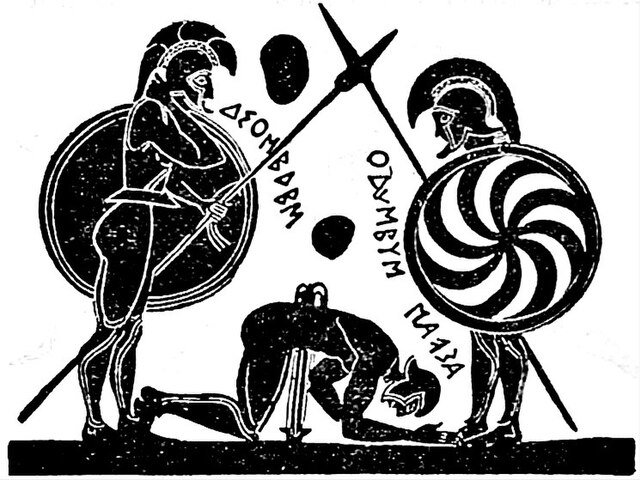
IMAGE Credit: Wikimedia: Painting from an ancient Corinthian vase. Ajax falls on his sword in the presence of his colleagues, Odysseus and Diomedes. The short stature of Odysseus is a well-known Homeric feature. These vases are black-figured; the heroes are painted in silhouette on the red ground of the vases. Their names are appended in archaic Greek letters. Artist from ancient Corinth; public domain; between circa 800 and circa 480 B.C.; drawing published 1911.
(c) Lou Agosta, PhD and the Chicago Empathy Project
 Lou Agosta, Ph.D., Listening With Empathy