Home » rigorous and critical empathy
Category Archives: rigorous and critical empathy

Empathy and Greek Tragedy – Connecting the Dots
I can hear the laughter at the back of the auditorium – and indeed in the first row – a new definition of tragedy? You have got to be kidding!? Okay, maybe George Steiner (1963) or Christoph Menke (2009) already covered it – so send me the reference – in which case I modify my assertion to “an aspect of tragedy that may usefully be highlighted, foregrounded, and made the subject of further inquiry.”
If one thinks about the characters in tragic dramas such as Oedipus, Creon, Agamemnon, Antigone, Jocasta, Orestes, and Electra, they do not seem to be particularly cowardly or slavish. The representation in theatre of the latter qualities of cowardice, etc. caused Plato to ban (“censor”) theatre from his ideal city-state in The Republic; but maybe something was lost in translation and cowardice is really hamartia (the fatal flaw(s) of the tragic hero).
What does represent a common thread is that the protagonists (“heroes”) are survivors who become perpetrators (or vice versa) and they are brought low not only by the usual theatrical information asymmetries, boundary violations, and fatal acts of revenge, but by moral trauma. Moral trauma is someone who seems to have no other choice than to commit an integrity or boundary violation.
What has been overlooked is the role of moral trauma. Moral trauma is defined as the distressing emotional, behavioral, social, and sometimes spiritual aftermath of exposure to (including participation in) events in which a person’s moral boundaries are violated and in which individuals or groups are gravely injured, killed, or credible threat thereof is enacted (i.e., individuals are physically traumatized) (Litz et al 2009; Shay 2014).) The agent, is put in a double-bind, in which, whatever the action, innocent people are going to suffer and die.
The double bind is created in diverse was. The double bind is created by information asymmetries (Oedipus does not know his biological parents, etc.); by conflicting laws of the family versus political authority in which Antigone is caught; by a curse in the form of sexual desire on the part of Phaedra for her step son, which, when revealed, even as a fantasy, represents a proposed boundary violation so immoral that the suggestion as thought itself requires punishment; by the commitment to a life of crime in support of Jason on the part of Medea that, once unleashed, is unstoppable (“might be hung for stealing a sheep as well as a lamb”); whether the best way to right a wrong inflicted on someone (Philoctetes), whose good will has now turned out to be indispensable, is to tell the aggrieved party the truth and risk rejection or try to trick the party into cooperating thereby performing a further perpetration; not knowing the future, an escaped slave about to be returned to slavey kills her baby to prevent her from being raised in slavey and is thwarted from then killing herself (Morrison’s Beloved). More pedestrianly, one decided on a last-minute change of plans and did not get on the airplane—or trolley car—that crashed–or, due to a last-minute change of plans, one did. The irreparability and irreversibility of catastrophe is a feature of a world infused with contingency. In literature this has a name. It is called “tragedy.” In such a world, radical empathy is an indispensable constituent in the project of finding one’s way forward through the fog of suffering to reconciliation and transfiguration of empathic distress into community and the possibility of fulfillment and satisfaction.
On further background for those who may need a review of the narrative, Oedipus is a survivor who is abandoned as a baby to die by his biological father but is rescued by a kindly shepherd, who foster him. Survivor. Learning of the Oracle that he will kill his father, Oedipus leaves home and unwittingly meets the biological father on his path of exile. An altercation occurs and Oedipus unwittingly kills the biological father, thus fulfilling the Oracle; but more significantly, the survivor now becomes a perpetrator. In the case of Antigone, the “double bind” is that she must either violate the laws of the family that require one bury one’s next-of-kin or violate the laws of the city that require one be a team player and defend the home-team against it’s enemies (who also happen to be next of kin). In moral trauma one is caught between a rock and a hard place – the devil and the deep blue sea.
Clytemnestra and her boyfriend, Aegisthus. may be more problematic cases—and they initially show up like villains in their adultery and homicide and treachery. Yet Clytemnestra is a survivor. Agamemnon killed Clytemnestra’s first husband Tantalus and then married her, the distinction “consent” apparently not being readily available at the time. Tough crowd. Agamemnon had adulterous adventures while he was away at war, but his wife, Clytemnestra, firmly oppressed in the patriarchy, should not? This leads naturally, by way of free association, to the equally tough case of Medea. Medea is a kind of monster, though, I assert contra Plato, not a particularly cowardly one. One wonders what tragic spectacles Plato was attending. Even if these spectacles were the same ones with which the tradition makes one familiar, the argument can be made that denial is not the only and perhaps not even the optimal method of educational. Even if one swallows all the anachronistic refinements of a society built on slavery prohibiting the representation of slavery as subversive (of course it is, but for different reasons), there have still got to be better educational methods than denial.
The confrontation with errancy (hamartia) on the part of individuals with whom one can imagine identifying—perhaps in one’s wildest dreams—and taking their place, leads to being grabbed by the throat and having one ‘s heart ripped out in pity and fear. The “fatal flaw” is usually not thought of as being both a survivor and a perpetrator, but it turns out to mean that too. That is the educational moment—that is the training—that is the therapy, if one may say so. It is rather like a spa treatment where one takes the healing waters and then drinks a double dose of a powerful purgative. One has to hold one’s nose as one’s bowels are loosened. Catharsis is different than preparation for a colonoscopy, but perhaps not by much. It is not a rational process—it is an educational and therapeutic one. The monstrous has an unexpected healing power (The Birth of Tragedy quoted in Schmidt (2001: 218))—if one survives the literary encounter with it in the literary artwork without succumbing to empathic distress.
This points immediately to Nietzsche’s answer to Plato’s banning of tragic poetry from the just city (the Republic), namely, that humans cannot bear so much truth (1883: §39):
Indeed, it might be a basic characteristic of existence, that those who would know it completely would perish, in which case the strength of a person’s spirit would then be measured by how much ‘truth’ he could barely still endure, or to put it more clearly, to what degree one would require it to be thinned down, shrouded, sweetened, blunted, falsified.
And again, with admirable conciseness, Nietzsche (1888/1901: Aphorism 822): “We have art, lest we perish of the truth.” Here “truth” is not a semantic definition such as Davidson’s (1973, 1974) use of Tarksi (loosely a correspondence between language and world), but the truth that life is filled with struggle and effort—not fair—that not only are people who arrive early and work hard all day in the vineyard paid a full day’s wages, but so are people who arrive late and barely work also get paid a full day’s wages; that, according to the Buddha, pain is an illusion, but when one is sitting in the dentist chair, the pain is a very compelling illusion; not only old people get sick and die, but so do children. While the universe may indeed by a well-ordered cosmos, according to the available empirical evidence, the planet Earth seems to be in a local whorl in its galaxy where chaos predominates; power corrupts and might makes right; good guys do not always finish last, but they rarely finish first, based alone on goodness.
So much for Nietzsche’s response. The answer of the tragic poets (e.g., Aeschylus, Agamemnon 173–181) provided even before the question is posed by Plato, is “learning through suffering” (pathei mathos). Note well this is consistent with Plato’s guidance not to celebrate examples (whether in Epic or in Tragedy) of cowardly, slavish, or devaluing actions (which Socrates famously denounces (Republic: 395a–396b)). But we humans seem to learn the hard way—in the college of hard knocks. The suffering takes on a life of its own. Literary fiction is the phantom-limb-pain of life.
The learner is a survivor, who is in pain, but no corresponding reality of the missing limb exists, which limb, in being amputated, has become fictional. If the suffering is fictional, so perhaps is the therapy—write a poem, a tragedy, or tell a story. Life mutilates the individual, and, even if one gets through life relatively unscathed, one dies and the “celebrants” throw dirt in one’s face. Creon says “Alas. I have learned, unhappy as I am” (Antigone 1271–1272); but at that point Antigone is dead and Creon’s life is a ruin. The lesson is not for Creon, but for the audience (or reader).
Yet this is not informational learning. The tragic protagonists (e.g., Antigone) cannot learn from her error, since she is crushed by it—yet the audience can. A hard lesson indeed. The double bind—disrespect the state or disrespect one’s ancestors—is to be caught between the proverbial rock and the hard place. That so many antidotes and answers to the pain and suffering are proposed, is itself evidence that the latter can readily slip loose from one’s mastery and control, which are predictably tentative and temporary, and ruin one’s day, if not life. For the audience knows the outcome, or at least sees it coming ahead of the protagonist. Yet the audience cannot use the knowledge to produce a different factual result—hence the need for alternative fictional methods. It is not like some specific error occurs that could be corrected through better intelligence or information—check the brakes on the Trolley so that they do not fail inopportunely—it is rather that no matter how much one knows, how carefully one assesses the risks of one’s action, the outcome is still uncertain and may even be disastrous.
What kind of knowledge is that? The one certain piece of knowledge—death awaits. Yet it could be that from the audience’s perspective—the lesson is to dance in the chaos—dance in the uncertainty (so to speak)—between now and the ultimate un-over-comeable end of possibility. One double-checks the brakes, knowing full well there no guarantee exists, but that the checking is an expansion of control over uncertainty. With 20-20 hindsight, contingency starts to look like fate—that which, by definition, cannot be avoided; and yet daily counter-examples abound. A man named “John Silber” (1926–2012) is born with a birth defect—a mis-formed right arm that ended in an appendage like a thumb. Fate or rather contingency? Silber goes on to become a celebrated educator, University President, Kant scholar (which is how I got to know him), profiled on the front page of The Wall Street Journal (in the days of print journalism), and candidate for governor of Massachusetts. This was not a predictable result. Fate starts to look less constraining. The power to begin something new— “natality” as Hannah Arendt called it—new possibilities show a way forward.
The double bind is the source of tragedy, but is not alone sufficient to generate tragedy. For if one remains with the double bind, one gets “ruin and wreck,” not tragedy. For if one stays with the double bind, one gets “empathic distress.” One gets a form of insanity, not tragedy. One becomes a Philoctetes abandoned in pain and suffering, alone on an island for ten years before the return of Odysseus, Neoptolemus, and Hercules. The double bind presents a conflict but then requires that one not question the contingent framework of the conflict. Thus, the double bind is often kept in place, spinning in a tight unproductive circle, by a lack of imagination. Antigone does not think to act to claim sanctuary in the Temple of Hestia, virgin goddess of the family (which, of course, would be a different drama). The lesson? Write a poem—tell a story—use one’s imagination to brainstorm alternative possibilities—decline the constraining “set up” —embrace radical hope: “To hope till Hope creates from its own wreck the thing it contemplates” (Shelley 1820: 153; see also Lear 2008).
In moral trauma one is no longer an agent in the full sense, which is one of the key hidden variable in classic tragedy—loss of agency. One’s agency is compromised by information asymmetries. Oedipus does not know who are his biological parents and he does not know that he does not know! One’s agency is compromised by inconsistent standards of behavior between the family and the political community, in which “cross fire” Antigone (and her family) are brought low. Now act! One is required to choose in the face of moral trauma—a choice one cannot make, that one ought not to have to make, but that, in any case, one is required to make.
Our empathy for the agent starts out requiring a decision that no one should have to make. In classic tragedy, the individual is forced to make a decision that neither the agent nor anyone else is authorized to make. But that agent has to make it anyway. Doing nothing is also a decision, and people are going to die. This is the definition of a double bind—damned if one does, and damned if one doesn’t.
Empathy is always empathy and radical empathy applies the same four aspects of relatedness—receptivity, understanding, interpretation, and responsiveness. Radical empathy emerges from standard empathy, when standard empathy breaks down, misfires, and/or fails in the face of empathic distress (including “burn out” or “compassion fatigue”). Empathic distress is itself a function of physical trauma, moral trauma, double binds, soul murder, and tragic circumstances that act to destroy possibilities of human flourishing, strength, aliveness, energy, and/or vitality. As a matter of definition, “soul murder” is defined by Henrik Ibsen’s John Gabriel Borkman (1896), as destroying (through emotional or physical abuse) the possibility of love, but is generalized here to include destroying the possibility of generating new possibilities (Shengold 1989).
Radical empathy is attained when standard empathy honors the commitment to empathize in the face of empathic distress – the reaction on the part of audiences to circumstances in which tragic protagonists become entangled.This is empathy the “hard way,” and it is rare. However, no other way exists of attaining radical empathy than through empathy pure-and-simple—“standard empathy”—and much of the work accomplished here engages with the break downs of standard empathy as emotional contagion, projection, pressure to conform, and communications getting “lost in translation.” The repairs of these misfirings—and, it must be acknowledged, failures—of standard empathy lead the way to radical empathy. The transfiguration of moral trauma, double binds, and so on, by classic tragedies, work to overcome empathic distress, and, is on the critical path to performing and attaining radical empathy.
Without standard empathy, the audience does not experience the pain and suffering of the struggling humanity in the story of the runaway trolley. Even if the experiences are vicarious ones, there is no pity and fear without empathy in witnessing the unavoidable conflict that tears apart the protagonists. However, if the viewer (reader) is able to sustain one’s commitment to empathy in the face of the breakdown of standard empathy into empathic distress, then the possibility of radical empathy opens up. Radical empathy has much to contribute here.
A short description is that radical empathy relates empathically to that which causes empathic distress. Radical empathy relates to those decisions that no human being has the right to make, can make, or should have to make, but then ends up making anyway. Radical empathy reveals that one can be both a perpetrator and a survivor. Hence, the definition: the theatrical representation of moral trauma, double binds, and compromised agency, occasioning empathic distress, that calls forth the overcoming or amelioration of empathic distress by means of radical empathy for the survivor/perpetrator. Empathizing with such individuals and circumstances is why tragedy was invented.
References
Donald Davidson. (1973). Radical interpretation. In Inquiries into Truth and Interpretation. Oxford: The Clarendon Press, 2001: 125–139.
___________________. (1974). On the very idea of a conceptual scheme. In Inquiries into Truth and Interpretation. Oxford: The Clarendon Press, 2001: 183–198.
Henrik Ibsen. (1896). John Gabriel Borkman, tr W. Archer. New York: Project Gutenburg e-Book, 2006.
Jonathan Lear. (2008). Radical Hope. Cambridge, MA: 2008.
B. T. Litz, Stein N, Delaney E, Lebowitz L, Nash WP, Silva C, Maguen S. Moral injury and moral repair in war veterans: a preliminary model and intervention strategy. Clin Psychol Rev. 2009 Dec;29(8):695-706. doi: 10.1016/j.cpr.2009.07.003. Epub 2009 Jul 29. PMID: 19683376.
Christoph Menke,, (2009). Tragic Play., tr James Phillips. New York: Columbia University Press.
Friedrich Nietzsche. (1883). Thus Spoke Zarathustra, R. J. Hollingdale (tr.). Baltimore: Penguin Press, 1961.
________________. (1888/1901). The Will to Power, R. J. Hollingdale (tr.). New York: Vintage, 1968.
Dennis Schmidt. (2001). On Germans and Other Greeks. Bloomington: Indian UP.
J. Shay, (2014). Moral injury. Psychoanalytic Psychology, 31(2), 182-191. https://doi.org/10.1037/a0036090
Leonard Shengold. (1989). Soul Murder Revisited: Thoughts About Therapy, Hate, Love, and Memory. Hartford: Yale UP.
Percy Bysshe Shelley. (1820). Prometheus Unbound in Selected Poetry: Percy Bysshe Shelley, Harold Bloom (ed.). New York: Houghton-Mifflin (Signet Classic Poetry), 1968: 120–212.
George Stein. (1963). The Death of Tragedy. New York: Alfred Knopf.
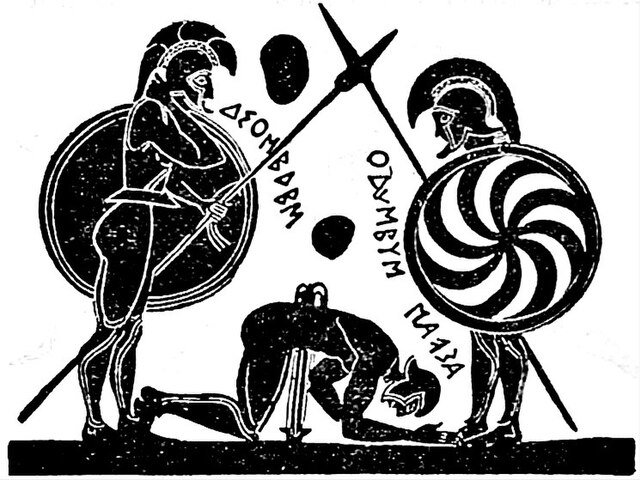
IMAGE Credit: Wikimedia: Painting from an ancient Corinthian vase. Ajax falls on his sword in the presence of his colleagues, Odysseus and Diomedes. The short stature of Odysseus is a well-known Homeric feature. These vases are black-figured; the heroes are painted in silhouette on the red ground of the vases. Their names are appended in archaic Greek letters. Artist from ancient Corinth; public domain; between circa 800 and circa 480 B.C.; drawing published 1911.
(c) Lou Agosta, PhD and the Chicago Empathy Project

Top ten trends in empathy for 2025
The idea is to take a position from the perspective of empathy on current trends. What would the empathic response be to the trend in question, especially crises and breakdowns.
1. The world is filled with survivors who are perpetrators (and vice versa). Radical empathy is needed to relate to survivors who are also perpetrators. Radical empathy is the number one trend. What does that mean? The world is a more dangerous, broken place than it was a year ago. The challenge to empathy is that the dangers and breakdowns in the world have expanded dramatically over the long past year such. Standard empathy is no longer sufficient. Radical empathy is required.
Image credit: Jan Steen, 1665, As the old sing, so pipe the young

The short definition of radical empathy: the events that occur are so difficult, complex, and traumatic that standard empathy breaks down into empathic distress and fails. In contrast, with radical empathy, empathic distress occurs, but one’s commitment to the other person is such that one empathizes in the face of empathic distress. One’s empathic commitment to the survivor enables the survivor to recover her/his humanness, integrity, and relatedness. The work of radical empathy engages how the impact and cost of empathic distress affect the different aspects of empathic receptivity, empathic understanding, empathic interpretation, and empathic responsiveness, delivering a breakthrough and transformation in relating to the Other.
An example will be useful. A US soldier gets up in the morning. He is an ordinary GI Joe. He is manning a checkpoint. The sergeant, thinking the approaching car is a car bomb, gives what he believes is a valid military order to shoot at the car. The solider shoots. The car stops. But it was not a car bomb; it was a family rushing to the hospital because the would-be mother (now deceased) was in labor. The military debriefing of the events is perfunctory. Burdened by guilt, the soldier shuts down emotionally, and he stares vacantly ahead into space. Emotionally gutted, he does not respond to orders. He is shipped back to the States and dishonorably discharged. His marriage fails. He becomes homeless. The point? This person is now both a perpetrator and a survivor. The people who were shot experienced trauma by penetrating wounds. The soldier has moral trauma. Key term: moral trauma. He was put in an impossible situation; damned if he did and damned if he didn’t. Let his team be blown up? Disobey what seems to be a valid military order? Hurt people who did not need or deserve to get hurt? His ability to act, his agency, was compromised by being put in an impossible situation. That is why the ancient Greeks invented tragic theatre – except that the double binds happen every day. Radical empathy specializes in empathizing with those who are both survivors and perpetrators. And this is much more common than is generally realized.
Many examples of radical empathy can be found in literature (or in the New York Times), in which the hero or anti-hero of the story is caught in a double bind, damned if one does and damned if one doesn’t. Radical empathy and the literary artwork transfigure the face of trauma, overcoming empathic distress, and allowing radical empathy to enable the fragmented Other to recover her/his integrity. Persons require radical empathy to relate to, process, and overcome bad things happening to good people (for example: moral and physical trauma, double binds, soul murder, and behavior in extreme situations. For further reding on radical empathy, see the book of the same title in the References below.
2. No human being is illegal. Mass deportations pending. Empathy, whether standard or radical, is clear on this trend: no human being is illegal. At the same time, the empathy lesson is acknowledged that empathy is all about firm boundaries and limits between the self and other, while allowing for communications between the two. It is the breakdown of empathy at the US national border – which does not mean wide open borders – is one reason among several for the result of the 2024 election. What if ICE agents (the immigration authorities) show up? Empathy is all about setting boundaries: The empathic response: Let’s see your judicial warrant, officer, please? (See The New York Times, Dana Goldstein, Jan 7, 2025: https://www.nytimes.com/2025/01/07/us/immigration-deportations-ice-schools.html.)
An empathic response would look like a workable Guest Worker Program (such as exist in the European union) that allows essential agricultural and food services workers to earn and send money back home. Yet the proverbial devil is in the detail, and being accused of the crime of shop lifting a sandwich or tube of toothpaste is different than actually committing one. Thus, empathy also looks like Due Process, and an opportunity to face one’s accuser. If one is standing outside a Whole Foods or Trader Joe’s begging for food, it is not because one’s life is going so well. The gesture that any decent customer would make is to buy the person a sandwich. Of course, that is not going to scale up to address the estimated 37 million Americans (the majority not recent immigrants) living in poverty. Continued below under “5. The unworthy poor.”
3. Psychiatry gets empathy (ongoing). Relate to the human being in front of you, not the diagnosis. Empathy teaches de-escalation. Empathy’s coaching to psychiatry as a profession is to do precisely that which psychiatry is least inclined to do, namely, relate to the human being in front of you, not to a diagnosis.
Granted, the human being is a biological system. We are neurons all the way down. Yet emergent properties of our humanity (including empathy) come forth from the proper functioning of the neurons. The neurons generate consciousness, that subtle awareness of our environment that we humans share with other mammals. Consciousness generates relatedness to the environment and one another. Relatedness generates meaning. Meaning generates language. Language generates community, society, and culture. As Dorothy is reported to have said to Toto, “We are no longer in Kansas” – or psychiatry.
So what’s the recommendation from the point of view of empathy? Relate to the human being sitting in front of you not to a diagnosis. That is the empathic moment. To be sure, a diagnosis has its uses in technical communications with colleagues or payers, but as a standalone label, diagnoses are overrated.
Taking a step back, people get into psychiatry (and medicine in general) because they want to relieve pain and suffering, because they want to make a difference. Yet this aspiration is in stark contrast with the report at the American Psychiatric Association meeting that physical restraints were used some 44,000 times last year to constrain patients. (See Ellen Barry, May 21, 2024 In the house of psychiatry, a jarring tale of violence. Thus, The New York Times: https://www.nytimes.com/2024/05/21/health/psychiatric-restraint-forced-medication.html)
“Don’t hurt yourself (or anyone else!)!” is solid guidance; yet the particulars of the situation are challenging. The distance between fight and flight (fear) is narrow. Someone in the throes of an “amygdala hijack” is in an altered state of consciousness. This person literally cannot hear what is being said to him or her. This person is at risk of precipitating a bad outcome, especially if the psychiatrist or staff is also hijacked by an emotional reaction and emotional contagion. If as much effort were devoted to training staff in verbal escalation – talking someone back “off the ledge” – as in training them synch up straps, the outcomes would be less traumatic for all involved. Empathy in all its forms is a basic de-escalation skill that needs to receive expanded training and development.
It would not be fair to confront a psychiatrist with an either/or: “Are you relating to a biological system or to a human being?” because she (or he) is relating to both. Yet the pendulum does seem to have swung too far in the direction of biochemical mechanisms rather than interpersonal meaning, relations, and fulfilment. It is a fact that some 80% of people visit the medical doctor because they are in pain and hope to get medicine to cause them to feel better (and the other 20% have scheduled an annual checkup). That is well and good; and it is true that these psychopharm medicines change the neurons in your brain, but so does studying French and so do new and engaging life experiences; and, here’s the point, so does the committed application of empathy.
3. Violence against women continues to be a plague upon the land and a challenge to empathy.Standard empathy is not enough. This requires a level of radical empathy that has not been much appreciated. This is because many perpetrators are also survivors. (See the above example of the ordinary soldier who becomes both.)
I hasten to add that two wrongs do not make a right. Two wrongs make twice the wrong. Intervention is required to get the woman safe, and recovery from domestic violence begins once the person is secure in their safety. That is not a trivial matter, and Safety Plans and Hot Lines continue to be important resources. One can incarcerate a perpetrator to protect the community (and the women in it), but that does not make him better. He still needs treatment. What are the chances he is going to get it? To cut to the chase: many perpetrators and survivors do not know what a satisfying, healthy relationship looks like. Survivors and perpetrators alike have come up in environments where physical violence is common. Once again, this is not an excuse, and two wrongs do not make a right.
Regarding Peter Hegserth (Cabinet nominee for Defense Secretary): NBC News has reported that Mr. Hegseth’s heavy drinking concerned co-workers at Fox News and that two of them said they smelled alcohol on him more than a dozen times before he went on the air. The New Yorker reported: “A trail of documents, corroborated by the accounts of former colleagues, indicates that Hegseth was forced to step down by both of the two nonprofit advocacy groups that he ran — Veterans for Freedom and Concerned Veterans for America — in the face of serious allegations of financial mismanagement, sexual impropriety, and personal misconduct.” His managerial skills are nowhere near the challenge of running the Pentagon. Meanwhile, according to a 2018 email obtained by the New York Times, Mr. Hegseth’s own mother called him “an abuser of women” as he went through his second divorce. It is particularly concerning to see Senator Joni Ernst (R-Iowa) who had a check box on Domestic violence on her official site accept/excuse/embrace such behavior. Among the many women serving in the US Armed Forces, who can imagine that this candidate has their back? The esteemed Senator Ernst may usefully her from the concerned citizens.
The number one empathy lesson: a grownup man having temper tantrums (and worse) is not what a healthy relationship looks like! In a healthy relationship partners cooperate, help one another, respect boundaries, and if they disagree, they argue and “fight” fairly. Skills training belongs here. A major skill: setting boundaries, limits – pushing back on bullying in all its forms. (In addition, parents of diverse backgrounds and cultures have got to find better ways to set limits to and for their children than “whupping ‘em.”)
Woman have provided the leadership in this struggle for domestic tranquility and will continue to do so. From men’s perspective, this is a failure not only of standard empathy, but a failure of leadership. It calls for radical empathy to include survivors and perpetrates (once again, without making excuses for bad behavior). When powerful men – President Biden (now retiring), Elon Musk, Jeff Bezos, Senators and captains of industry – step up and say “Enough! What are you thinkin’, man?” then the issue will get transformed. These are conversations that are best had by men with men. Even if that sounds sexist, it makes a difference when a man tells another man that his behavior towards women or a woman is out of line and requires correction rather than when a woman says it (though it is equally true in both cases). Even though Jackson Katz’s video has been around for several years, it has never been better expressed: “Violence against women: It’s a men’s problem”: https://youtu.be/ElJxUVJ8blw?si=k8LG0ewnL6ZKlgt9. Please circulate widely.
4. “Abandon reality all ye who enter here!” is inscribed over the sign-in to Facebook. “Facts are overrated.” Yet a rigorous and critical empathy knows that it can be wrong so it is committed to distinguishing facts from fictions. Empathy was never particularly concerned with the reasons why you are in pain, but how to relieve that pain. The corporation Meta (owner of Facebook (FB)) decides to end fact checking regarding posts on its social networking site (https://www.nytimes.com/live/2025/01/07/business/meta-fact-checking). It is hard not to be cynical at this moment.
Many people know “empathy for everyone” is a pipe dream; yet there is no other way to bring it into the world than to work to make it real. The human imagination is a possibility engine, and it is the source of what is possible in the human relations defined by empathy. If the “crazy ideas” on Facebook (and elsewhere) were just that, crazy idea, they might actually be useful in terms of “brain storming.”. However, when non facts such as immigrants are stealing and eating your pets are represented as occurring events in the world, the damage to the community is significant.
This is when radical empathy as “Red Team! Red Team!” comes in (see the references Zenko 2015). Think like the opponent. Take the opponent’s point of view, not to agree or disagree with him; but to get one’s power back over delusional thinking. Prejudice against individuals and groups has many sources – largely projection of one’s own fears and blind spots onto the devalued Other. However, ultimately prejudice is a form of mental illness – delusional thinking – at the community level. From an empathic perspective, FB becomes a site of delusional thinking, noting that even a broken clock gives the correct time twice a day. By the way, the original Pizza-Gate conspirator, who, living in a persistent altered state of consciousness, claimed a popular local pizza parlor was really a nest of satanic pedophilia, was shot and killed by police on January 4, 2025 when he raised a gun during a police traffic stop. https://www.washingtonpost.com/dc-md-va/2025/01/09/edgar-maddison-welch-pizzagate-killed/ Case closed. He was the father of two daughters. Tragically misinformed. Unnecessary. Fact checking saves lives!
5. Help for the unworthy poor. Empathy says the worthy poor need help; but radical empathy asserts that the unworthy poor need even more help(and who is deciding who is “worthy” anyway? See above under “no human being is illegal”).
In a highly entertaining, albeit sexist retelling of the myth of Pygmalion, My Fair Lady – the alcoholic, unemployed father (Alfred) of Liza Doolittle confronts Professor Higgins with a request for money for his permission to subject his daughter to the enculturing “make over” of improving her language that is the main project of the plot. In a comic yet thought-provoking scene, the father notes that many people of means are making financial contributions to help the struggling, worthy impoverished (“the poor”); but who is helping the unworthy poor?! “I don’t deserve the handout. I am lazy and a drunk (in so many words); but give me ten pounds sterling anyway.” An admirably direct argument and not without a certain integrity. Yet if one grew up in poverty and even if the parent was not “whuppin’” everyone in sight or engaging with substances of abuse and neglecting basic education, then high probability one will satisfy the definition of “unworthy poor” – no (limited) motivation to pull oneself up by one’s bootstraps. Yes, by all means, government needs to expand its efficiency and effectiveness, but this might not be an efficient process. Line up and with help from a bureaucrat (which used to mean simply “helpful office holder,” not “unempathic jerk”) fill out the forms. However, one cannot give people money; or rather the risk of doing so is that it is not going to make a difference. Educational vouchers? Financial skills training? Parental training? Food vouchers? Rental vouchers? Food, rent, and education.
Guilt trip, anyone? The rich get richer; the poor get – older. The devil’s advocate says the poor should work harder to pull themselves up by their bootstraps. Empathy says that the devil already has too many advocates. A tax on billionaires’ net worth would generate enough funds in five years to reduce the number of people living in poverty (estimated to be some 37 million as of 2023) by 80%. Radical empathy is required!
6. Empathy is part of the mission of health insurance, not more monopoly rents to insurance corporations. The economics of health insurance are compelling – get everyone into the insurance pool and spread the risk. Risk that is spread is risk contained, managed, and conquered. It is a pathology of capitalism that competition does not function as designed in the matter of such common goods as clean water, clean air, and conditions necessary to health and well-being such as access to medical treatments Healthcare corporations are incented by competition to get rid of sick people (do not do business with them) since sick people reduce profits, even though sickness is why the insurance came into existence. This is madness! And this is why intervention of the federal authorities (and legislation) was needed to prevent corporations from excluding the pre-existing conditions (illnesses). Therefore, the trend is to make empathy a part of the mission of insuring healthcare.
For example, there is an innovative medicine to treat schizophrenia that does not have as many of the undesired, troubling, painful side effects such as tardive dyskinesis of current medicines. However, out of the gate, it costs $1800 a month, and for pharmaceutical companies properly to recoup the staggering costs of development – what are the chances that insurance companies will cover it? Don’t hold your breath. According to the FDA News release about 1% of Americans have this illness and it is responsible for some 20% of disability claims. Think of the benefits for suffering, struggling survivors of this disease. Think of the cost reducing impact of an effective treatment on the federal budget. (For further background see:
7. Radical empathy contradicts the delusional belief that people committed to a suicide mission are going to yield to threats of violence. This theme, which is ongoing from last year, is yet another case for “Red Team! Red Team!” Think like the opponent – which may include thinking like the enemy. This grim empathy lesson was expressed by Fionnuala D. Ní Aoláin (Oct 13, 2023) during Q&A in her talk, “The Triumph of Counter-Terrorism and the Despair of Human Rights” at the University of Chicago Law School. Professor Aoláin draws on the example of the sectarian violence in Northern Ireland, The Troubles, between 1960 and 1998’s Good Friday Agreement. On background, this had all the characteristics of intractable hatred, perpetrations and human rights violations, the British government making every imaginable mistake, the Jan 30, 1972 shooting of 26 unarmed civilians by elite British soldiers, internment without trail, members of the Royal Family (Louis Mountbatten, the Last Viceroy of India, and his teenage grandson (27 Aug 1979)) blown up by an IRA bomb, the IRA (Irish Republican Army) launching a mortar at 10 Downing Street (no politicians were hurt, only innocent by-standers), and many tit-for-tat acts of revenge killing of innocent civilians. It is hard, if not impossible, to generalize as every intractable conflict is its own version of hell—no one listens to the suffering humanity—but what was called The Peace Process got traction as all sides in the conflict became exhausted by the killing and committed to moving forward with negotiations in spite of interruptions of the pauses in fighting in order to attain a sustainable cease fire.
The relevance to ongoing events in the Middle East will be obvious. An organization widely designated in the West as “terrorist” changes the course of history in the Middle East. Hearts are hardened by the boundary violations, atrocities, and killings. The perpetrators lead their people off a cliff into the abyss, and the survivors of the attack defend themselves vigorously and properly, and then, under one plausible redescription, themselves become perpetrators, launching themselves off the cliff, following the perpetrators into the abyss, the bottom of which is not yet in sight. Survivors and perpetrators one and all call for and call forth radical empathy. Negotiate with the people who have killed your family. Empathize with that.
The response requires radical empathy: to empathize in the face of empathic distress, exhausted by all the killing. Though neither the didactic trial in Jerusalem (1961) of Holocaust architect Adolph Eichmann nor the South African Truth and Reconciliation Commission (1995) lived up to their full potentials, they formed parts of processes that presented alternatives to violence and extra judicial revenge killings. In this frame, the survivor is willing to judge if the perpetrator is speaking the truth and expressing what, if any, forgiveness is possible. The radical empathy that empathizes in the face of empathic distress acknowledges that moral trauma includes survivors who are also perpetrators (and vice versa). (See Tutu 1997 in the References for further details.) In a masterpiece of studied ambiguity, radical empathy teaches that two wrongs never make a right; they make at least twice the wrong; and one who sews the wind reaps the whirlwind.
8. Empathy and climate change: you better start swimming or you’ll sink like a stone. Scientists describe global warming as a “wicked problem,” in the sense that so many variables are changing across so many scenarios that it is wicked hard—if not impossible—to conduct a controlled experiment. The readers of this article “know” the planet is warming. This is not just information, but heatstroke, a hurricane blowing the roof off of one’s house, catastrophic fires encroaching on cities, and disastrous flooding. Parts of the planet are becoming uninhabitable by humans because of extreme heat, hurricanes, and rising seas, which are indeed data, but not merely data as these events are lethal to human life. If wetlands, reservoirs, agricultural lands, landfill, tundra, are releasing methane (one of the major “greenhouse gases” contributing to global warming) in rapidly accelerating volumes, faster than ever, one may argue, an even greater effort should be exerted to curb methane from the sources humans can control, like cows, agriculture and fossil fuels (Osaka 2024). Yet what seems obvious in New York City or Chicago does not even get a listening in the mountains of Idaho much less the overcrowded cities of China, India, or Russia. The probable almost certain future comes into view, and there is about as much chance of this trend spontaneously reversing itself as that the San-Ti are going to arrive at light speed from Alpha Centauri and tell earth people how to fix it. What is amazing is that Bob Dylan’s example of rhetorical empathy has been available in his poetry and song since 1965 when, coincidently and on background, President Lyndon Johnson signed the Voting Rights Act, Medicare, Medicaid, into law, and “surged” half a million US soldiers into DaNang, Vietnam. Transformation is at hand, though it requires further parsing. Thus, Dylan’s proposed rhetorical empathy (1965: 81):
Come gather ‘round people / Wherever you roam / And admit that the waters / Around you have grown / And accept it that soon / You’ll be drenched to the bone / If your time to you is worth savin’ / Then you better start swimmin’ or you’ll sink like a stone / For the times they are a-changin’
The relevance of empathy should never be underestimated, and empathy as such is not going to staunch this flood. Nor is empathy going to solve “highly polarized social and political world,” unless citizens of plural persuasions, parties, and global geographies, who have stopped listening to opposing points of view, are willing to start listening to one another again. Key term: willingness. Everyone can think of a person (in-person or on TV) whose opinions—whether cultural, political, or cinematic—really drives one to distraction? That’s the person one should be asking out for a cup of coffee—not to try to persuade her or him, but to listen. The situation is so bad, that most people no longer associate with people with whom they disagree, so they can’t follow this simple recommendation. How then, in the face of such, obstacles is one going to use empathic practices to move the dial (so to speak) in the direction of such reduced polarization and expanded community? This leads to the next trend.
9. Rhetorical empathy is trending: the relationship between empathy and rhetoric has not been much appreciated or discussed – until now! Empathy and rhetoric seem to be at cross purposes. With empathy one’s commitment is to listen to the other individual in a space of acceptance and tolerance to create a clearing for possibilities of overcoming and flourishing. With rhetoric, the approach is to bring forth a persuasive discourse in the interest of enabling the Other to see a possibility for the individual or the community. At the risk of over- simplification, empathy is supposed to be about listening, receiving the inbound message; whereas rhetoric is usually regarded as being about speaking, bringing forth, expressing, and communicating the outbound message. Once again, in the case of empathy, the initial direction of the communication is inbound, in the case of rhetoric, outbound. Yet the practices of empathy and rhetoric are not as far apart as may at first seem to be the case, and it would not be surprising if the apparent contrary directionality turned out to be a loop, in which the arts of empathy and rhetoric reciprocally enabled different aspects of authentic relatedness, community building, and empowering communications.
In rhetorical empathy, the speaker’s words address the listening of the audience in such a way as to leave the audience with the experience of having been heard. As noted, this must seem counter-intuitive since it is the audience that is doing the listening. The hidden variable is that the speaker knows the audience in the sense that she or he has walked a mile in their shoes (after having taken off her/his own), knows where the shoes pinch (so to speak), and can articulate the experience the audience is implicitly harboring in their hearts yet have been unable to express. The paradox is resolved as the distinction between the self and Other, the speaker and the listener, is bridged and a way of speaking that incorporates the Other’s listening into one’s speaking is brought forth and expressed. Rhetorical empathy is a way of speaking that incorporates the Other’s listening into one’s speaking in such a way that the Other is able to hear what is being said. (For further reading see Blankenship 2019; Agosta 2024b.)
10. Empathy becomes [already is] an essential aspect of critical thinking. Teach critical thinking. Critical thinking includes putting oneself in the place of one’s opponent—not necessarily to agree with the other individual—but to consider what advantages and disadvantages are included in the opponent’s position. Taking a walk in the Other’s shoes after having taken off one’s own (to avoid the risk of projection) shows one where the shoe pinches. This “pinching” —to stay with the metaphor—is not mere knowledge but a basic inquiry into what the other person considers possible based on how the other’s world is disclosed experientially. This points to critical thinking as an inquiry into possibility—possible for the individual, the Other, and the community. Critical thinking is a possibility pump designed to get people to start again listening to one another, allowing the empathic receptivity (listening) to come forth.
In our day and age of fake news, deep fake identity theft, not to mention common political propaganda, one arguably needs a course in critical thinking (e.g., Mill 1859; Haber 2020) to distinguish fact and fiction. Nevertheless, I boldly assert that most people, who are not suffering from delusional disorder or political pathologies of being The True Believer (Hoffer 1953)), are generally able to make this distinction. A rigorous and critical empathy creates a safe zone of acceptance and tolerance within which people can inquire into what is possible—debate and listen to a wide spectrum of ideas, positions, feelings, and expressions out of which new possibilities can come forth.
For example, empathy and critical thinking support maintaining firm boundaries and limits against actors who would misuse social media to amplify and distort communications. Much of what Jürgen Habermas (1984) says about the communicative distortions in mass media, television, and film applies with a multiplicative effect to the problematic, if not toxic, politics occurring on the Internet and social networking. The extension to issues of climate change follows immediately. Insofar as individuals skeptical of empathy are trying to force a decision between critical thinking and empathy, the choice must be declined. Both empathy and critical thinking are needed; hence, a rigorous and critical empathy is included in the definition of enlarged, critical thinking (and vice versa). (Note that “critical thinking” can mean a lot of things. Here key references include John Stuart Mill 1859; Haber 2020; “enlarged thinking” in Kant 1791/93 (AA 159); Arendt 1968: 9; Habermas 1984; Agosta 2024.)
In particular, critical thinking encompasses what the poet John Keats (1817) called “Negative Capability.” It enables one to dance in the chaos of the dynamic stresses, struggles, and successes one encounters: “I mean [. . .] when a man [person] is capable of being in uncertainties, mysteries, doubts, without any irritable reaching after fact and reason.” Such Negative Capability is a synonym of and a bridge to empathizing in the broad sense. Giving up certainty enables empathy and critical thinking to establish and maintain a safe zone of acceptance and tolerance for conversation, debate, self-expression. The sinking or swimming that the other poet, Dylan, proposes points to many things (including getting involved), yet it is most of all critical thinking. This is the space of inquiry—of asking what is possible—brainstorming—and calling forth projects and action. This results in a rigorous and critical empathy, nor going forward should any committed empathy advocate refer to empathy in any other way. (For further reading on Rhetorical Empathy see the article listed in the endnotes “Rhetorical empathy in the context of ontology.”)
The poet gets the last example of rhetorical empathy. One has to push off the shore of certainty and venture forth into the unknown possibilities of radical empathy. Bob Dylan (1965: 185) interrupted his climate change advocacy to become an empathy enthusiast. Dylan gets the last word: “I wish that for just one time / You could stand inside my shoes / And just for that one moment / I could be you” [.]
References
Agosta, Lou. (2024). Empathy Lessons. 2nd Edition. Chicago: Two Pears Press.
Arendt, Hannah. (1952/1958). The Origins of Totalitarianism, 2nd Edition. Cleveland and New York: Meridian (World) Publishing, 1958.
__________. (2024b) “Rhetorical empathy in the context of ontology,” Turning Toward Being: The Journal of Ontological Inquiry in Education: Vol. 2: Issue 1, Article 5.
Available at: https://rdw.rowan.edu/joie/vol2/iss1/5
__________. (due out May 2025). Radical Empathy in the Context of Literature. New York: Palgrave Publishing. https://books.google.com/books/about/Radical_Empathy_in_the_Context_of_Litera.html?id=qdDk0AEACAAJ The book does not merely tell the reader about radical empathy in the context of the literary art work; it delivers an experience of radical empathy in context in empathy’s receptivity, understanding, interpretation and responsiveness.
Arendt, Hannah. (1952/1958). The Origins of Totalitarianism, 2nd Edition. Cleveland and New York: Meridian (World) Publishing, 1958.
________________. (1968). Men in Dark Times. New York: Harvest Book (Harcourt Brace).
Blankenship, Lisa. (2019). Changing the Subject: A Theory of Rhetorical Empathy. Logan UT: Utah State University Press.
Dylan, Bob. (1965). Bob Dylan: The Lyrics: 1961–2012. New York: Simon and Schuster.
Haber, Jonathan. (2020). Critical Thinking. Cambridge, MA: The MIT Press.
Habermas, Jürgen. (1984). The Theory of Communicative Action, Vol 1, Thomas McCarthy (tr.). Boston: Beacon Press.
Kant, Immanuel. (1791/93). Critique of the Power of Judgment, Paul Guyer and Eric Matthews (trs.). Cambridge: Cambridge UP, 2013.
Keats, John. (1817). Letter to brothers of December 21, 1817: https://mason.gmu.edu/~rnanian/Keats-NegativeCapability.html [checked on 10/15/2024].
Mill, John Stuart. (1978: 1859). On Liberty, Indianapolis: Hackett Publishing.
Desmond, Tutu. (1997). No Future Without Forgiveness. New York: Random House.
Zenko, Micah. (2015). Red Team: How to Succeed by Thinking Like the Enemy. New York: Basic Books.
© Lou Agosta, PhD and the Chicago Empathy Project

Review: The varieties of empathy in Richard Wright’s (1940) novel Native Son
Review: The varieties of empathy in Richard Wright’s (1940) novel Native Son(New York: Harper Perennial 504 pp + end matter)
The varieties of empathy and empathic experiences extend from authentic empathic receptivity, empathic understanding, and empathic responsiveness, all the way to fake empathy and mutilated empathy. Wright’s novel, Native Son, provides abundant examples of how empathy breaks down into emotional contagion, conformity, projection, and communications getting lost in translation. Of course, once empathy breaks down and fails, strictly speaking, it is no longer empathy and calls for a response to “clean up” the misunderstanding out of which a rigorous and critical empathy is restored and reestablished. Nevertheless, the varieties of empathically related phenomena that are constellated makes Wright’s classic work a study in empathy in all its diverse forms.
Native Son is as powerful and timely as it was when Richard Wright first published it in 1940. Though it has aspects of tragedy and traffics in ruin and wreck, in the final analysis, it has as much in common with Mary Shelley’s Frankenstein as it does with ancient Greek tragedy by Aeschylus, Sophocles, or Euripides.
The novel has not changed since 1940, but the world has – becoming both better and worse. To open up the reader’s historical empathy, a background report will be useful and is provided. This report also provides a chapter in African American history. The engagement with Native Son will be interspersed in this review with historical details that bring to life the power of the story in ways that might not be appreciated without a firm historical grounding. This is not a digression but of the essence, lest we forget how far we have come, and how far we still have to go to expand empathy and attain social justice.
The world has become better in that the US Supreme Court ruled in Brown versus the Board of Education (1954) that separate, segregated education in grammar and high schools is inherently
unequal. That is worth repeating: Separate but equal is inherently unequal. The world has become better in that the Civil Rights Act and the Voting Rights Act (1965/1965) were passed by a super majority of Congress. These outlawed segregation by law, also called “Jim Crow”; these enabled county and congressional districts in the South (or anywhere) with majority black populations to register to vote and elect black sheriffs and local officials. Why could they not do so previously? There were discriminatory poll taxes, which the impoverished people could not afford to pay; there were written tests (including trick questions) which people who lacked reading skills or merely had a grammar school education were unable to pass; there were other bureaucratic obstacles including the need to present state issued documents that were hard to obtain, putting the would-be voter in a double bind. One hastens to add that the struggle for social and political justice continues, with the US Supreme Court (2023) requiring Alabama and Georgia to redraw their gerrymandered congressional districts to allow for majority black districts. Under backward steps, the so-called “war on drugs” – espoused by Nancy Reagan and implemented by the Clinton administration, resulted in the incarceration (still ongoing) of a generation of young black men for relatively victimless crimes involving using crack cocaine.
Meanwhile, schools of all kinds continue to be under stress because of mass casualty gun violence. Teaching is a tough job, especially elementary and middle schools and it has gotten tougher; the bureaucratic requirements to present politically correct curriculum has pushed out fundamental skills of critical thinking along with skills such as the three R-s – reading, writing and (a)rithmetic. These have been replaced by the need for librarians and administrators to act in the role of surveillance state capitalism (see Zuboff 2018), overseeing whether some text refers to “gay,” “trans,” the name of a sex organ, and so on, and that someone – especially a parent – might be made to feel uncomfortable. To be sure, parents and educators need to be sensitive to the stages of child development and present material that fits the stage at which the growing child is maturing.
While Jim Crow is a historical reference and black empowerment is advancing, at times haltingly, the number of unarmed black people who end up dead after encounters with the local police has astonished everyone – everyone except black people who have known all about it all along. Today the number of black CEOs of major corporations is some 5.9 % out of an overall black population of 13.6% (US Census). That is progress since 1940 when Wright’s work was published, at which time the percentage was essentially zero. Johnson Publications, the publisher of Ebony magazine (among others), would not be founded until 1942. Yet a case can be made that, though many of the social and legal details are different, the need for struggle and protest is as powerful today as it was in 1940. We are not living in a post racial society, notwithstanding fact of having had a black president. All this and more may usefully inform our reading of Native Son.
Now to the narrative. The protagonist, Bigger Thomas (henceforth referred to as “BT”), completes the 8thgrade. He is too poor to continue school, nor is he motivated to do so. He experiences segregation and prejudice wherever he turns, as indeed do all black people. BT says, “Hell, it’s a Jim Crow army. All they want a black man for is to dig ditches. And in the navy, all I can do is wash dishes and scrub floors” (1940: 353). BT is not allowed to become a pilot or a tank driver or a professional. “I wanted to be an aviator once. But they wouldn’t let me go to the school where I was suppose’ to learn it. They built a big school and then drew a line around it and said that nobody could go to it but those who lived within the line. That kept all the colored boys out” (1940: 353). It is true there were a few exceptions – some black people go to college and become doctors, lawyers, or engineers, though how they pulled that off is not for the faint of heart.
However, basically, the form of life under segregation (Jim Crow) does not just lack possibility – the possibility of possibility itself is missing. Possibility is not even defined. What does that mean? For example, as soon as Barak Obama was elected US President, the media went to middle schools and interviewed black ten-year-old children about what they wanted to be when they grew up. They immediately knew they wanted to be President. Now this little different than wanting to be a cowboy or a fireman or a doctor, a child’s fantasy. The point is that prior to Obama’s election the possibility could not even be imagined by black children, excepting perhaps some weird science fiction scenario. That is what is meant by the possibility of possibility. BT lacks the possibility of possibility.
What happens in the narrative after BT serendipitously gets a “good job” as a chauffeur with a wealthy white family, shows that BT still does not “get” – understand or experience – the possibility of possibility. BT is so constantly in survival mode that, in trying to survive, he does the very thing that causes his tragic undoing. It is a well-known stereotype that whenever a black man is lynched or otherwise “taken down” socially, he is initially accused of assaulting or trying sexually to molest a white woman.
Who Is BT as a person and as a possibility at the start of the story? He is bully and a petty criminal. Malcolm Little, who became Malcolm X, was eleven years old when Wright began working on Native Son in 1936. Both BT and Malcolm, each in their own way, started out as petty criminals. Malcolm was arrested and went to prison. Malcom was the only person I ever heard of who said that prison made him better – indeed saved his life – because he met a follower of a version of strict Islam that enabled him to turn his life around, channeling his intelligence and leadership skills into black empowerment (though, ultimately, it also eventually led to his undoing in a tragedy of betrayal).
Meanwhile, in Native Son, Mary Dalton is the young adult daughter of the wealthy Henry Dalton, who has given some $5 million dollars to the NAACP (National Association for the Advancement of Colored People) while continuing to operate inner city slums overcrowded with blacks who are unable to rent or buy in other neighborhoods due to red lining and restrictive covenants (contracts) that prevent selling to black people. Moral ambiguities and flat-out hypocrisy are front and center. Henry’s wife is blind – she cannot see – and walks about the mansion dressed in white like a ghost. Everyone else in the novel – black and white – can see well enough – are visually unimpaired – but have blind-spots and unconscious biases sufficient to sink the Titanic. They do. Full speed ahead into the field of ice bergs!
Mary is an undergraduate at the local university near their mansion on Drexel Blvd. As a part of her late adolescent rebellion, she goes for the kind of boyfriends most calculated to shock her parents. She likes those “bad boys.” In this case, that would be the left wing radical and card carrying communist, Jan. On background, Nicola Sacco and Bartolomeo Vanzetti – Sacco and Vanzetti – were executed in the electric chair in 1927 for being anarchists, amid anti-Italian and anti-immigrant hysteria, not for the robbery and murder of which they were convicted and did not commit.
Wright was authoring at a time (circa 1936) when the Great Depression was still very much an economic reality. The Mayor was a machine boss, who would respond to crime waves by rounding up Communists and Negros. The Governor would call out the National Guard to put down workers who tried to form a union and go out on strike. The blacklisting of workers, both white and black (but mostly white because the blacks did not have jobs), who attempted to form unions was common, which meant they could not find work. Corporations stockpiled tear gas, vomit gas, ammunition and machine guns for armed strike breakers to use against railroad, steel, and manufacturing workers who dared to go out on strike. The National Labor Relations Board was not even validated by the US Supreme Court until 1937 in NLRB v. Jones and Laughlin Steel Corporation, 301 U.S. 1 (1937). The forty-hour work week did not become law until the Fair Labor Standards Act (29 U.S. Code Chapter 8) was first enacted in 1938 under President Roosevelt’s New Deal.
This was a different world from 2023 and being a “Communist” meant something different than it does today, when, in the wake of the success of the trade union movement, much of what the original movement sought to accomplish (such as the 40 hour work week, sick leave, paid overtime, etc.) is part of standard legal labor law practice, rendering The Party irrelevant. Nevertheless, Mary and her boyfriend, Jan, a committed Communist, saw a common cause between the oppressed workers and the oppressed black people, and in this they were accurate enough, but naïve and idealistic, even utopian, in what it was going to take to make a difference.
The road to hell is paved with good intentions – and fake empathy. The privileged daughter, Mary, of the wealthy real estate tycoon (Mr Dalton), wants something from her new chauffeur. Remember, BT has just got a new, good paying job as the chauffeur. Mary wants him (BT) to ignore orders from her father, BT’s employer, and drive her around town with her boyfriend instead of to the University. Mary uses him (BT) as she would any extension of her own self-interest. For Mary, BT is an extension of her narcissism. BT later reports on his first encounter with Mary:
“She acted and talked in a way that made me [BT] hate her [Mary]. She made me feel like a dog. I was so mad I wanted to cry [. . . .] Mr Max, we’re all split up. What you say is kind ain’t kind at all. I didn’t know nothing about that woman. All I knew was that they kill us for women like that. We live apart. And then she comes and acts like that to me” (1940: 35).
The “acted like that” is the fake empathy – it seems kind enough on the surface in that the language does not have any devaluing words; yet there is a subtext – a soft violence, a quiet aggression, a conversational implicature that wrappers the relationship in BT’s subordination. “Acted like that” may also have a seductive aspect to it in that “being nice” in a situation where “no contact” is the norm may easily be misinterpreted as romantic flirting. The latter is not explicit in the text, but one thing is clear: BT and Mary Dalton really are the moth and the flame. Naivete and innocence are abundant on all sides. The moth has an automatic, hypnotic-like attraction to the flame. Little does the moth know what awaits. Does the flame have empathy for the moth? No, the flame is just the flame, towards which the moth has a luminously-based incentive that is its incineration. On background, the US Supreme Court finally ruled in Loving v Virginia in 1967 that anti-miscegenation laws, prohibiting marriage between whites and blacks (among others), were unconstitutional.
BT has survived on the street among white people by saying “Yessum; it’s all right with me” (1940: 64) and doing as he is told, and (in effect) justifying it by saying he was following orders. Recall, this is 1938 and that statement will come to have a different meaning in 1963 as Hannah Arendt reports for The New Yorker magazine on the trial of one Adolph Eichmann, who said something similar regarding the Holocaust. “I was just following orders.” There is nothing wrong with a chauffeur following orders, yet, in this case, “following orders” from Mary because she is white is an integrity outage in relation to his employment agreement with Mr Dalton to drive Mary to school. BT’s relationship to his word is as “fast and loose” as a rabbit randomly zig-zagging to try to survive by escaping a predatory fox.
Mary tells him “After all, I’m on your side” (1940: 64), and BT was not even aware of the possibility that changing side was imaginable – that there was a gate in the wall between rich and poor, educated and uneducated, employed and unemployed – mostly white and black. BT is getting $25 dollars a week and a pound of pork chops costs 5 cents ($.05), so that is a good wage. BT is in touch with his own self-interest, which is to keep his job so he can help himself and his mother and siblings. Yet something is off:
“Now, what did that mean? She was on his side. What side was he on? Did she mean that she liked colored people? Well, he [BT] had heard that about her whole family. Was she really crazy? How much did her folks know of how she acted? But if she were really crazy, why did Mr Dalton let him drive her out? [….]
“She was an odd girl, all right. He [BT] felt something in her over and above the fear she inspired in him. She responded to him as if he were human, as if he lived in the same world as she. And he had never felt that before in a white person. But why? Was this some kind of a game? The guarded feeling of freedom he had while listening to her was tangled with the hard fact that she was white and rich, a part of the world of people who told him what he could and could not do” (1940: 64, 65).
If someone tells you something that is too good to be true, it probably is. The ancient Greeks besieging Troy give up, sail off, and leave behind a giant horse as a gift to the gods. Casandra throws a spear at it, and it makes a hollow sound – thwomp! “Beware of Greeks bearing gifts!” No one believes her. Things do not work out well for the Trojans. “After all, I’m on your side.” The blind Mrs Dalton, walking around the mansion in her ghostly white gown, is the ineffective prophet, representing the blindness of all the players.
“Fake empathy” is defined here as a form of empathic responsiveness in which the person(s) claiming to be empathic towards the Other believe their own BS (bunkum, baloney, balderdash), endorse their own malarky, and, in effect, are sincerely self-deceived about the conflict of interest in which they are engaged. In another context, “fake empathy” could mean being intentionally deceptive as when a used car salesman knows the auto is defective but represents it as being in excellent shape. In most cases, the problematic sales person believes his or her own lies and could pass a lie detector test, which, of course, does not detect lies, but merely physiological arousal due to the stress of trying to deceive.
Mary wants BT to hide the facts from her father (that she is not gong to night school but out on the town with her “bad boy” community friend Jan). This puts BT at risk of losing his job. Mary acts in such a way as to claim to be on BT’s side, which is accurate enough in that she endorses racial integration and rights for workers, while seemingly remaining uninformed about the monopoly rents collected from black people by her father’s South Side Real Estate Corporation. Yet how could she not know? Another blind spot. More deception and self-deception.
If a further example is needed, Mary’s fake empathy continues as an expression of naivete and projection:
“You know, Bigger [BT], I’ve long wanted to go into these houses,” she said, pointing to the tall, dark apartment buildings looming to either side of them, “and just see how your people live. You know what I mean? I’ve been to England, France and Mexico, but I don’t know how people live ten blocks from me. We know so little about each other. I just want to see. I want to know these people. Never in my life have I been inside of a Negro house. Yet they must live like we live. They’re human . . . . There are twelve million of them . . . ” (1940: 69–70; italics and ellipsis in the original)
In so far as Mary genuinely cares about her black neighbors, this is a first step, born of good, caring intentions. However, Mary’s privilege, naivete, and arrogance (this list is not complete) are obstacles to her empathy. Her empathy misfires as projection. Mary speaks to BT in the third person about the group of which he himself is a part. The condescension is so thick that BT’s street knife would not cut through it had he even thought to try. Mary says, “Yet they [black people] must live like we live,” and that is definitely not the case. BT lives with his mother and two younger siblings in a single room. The opening scene of the novel involves a battle with a large rat in the small single room. Thus, the building is rat infested. Mary lives in a mansion with multiple servants, including BT. Mary tries to take a walk in BT’s shoes, shifting points of view, but it does not work. She is unable to take off her own shoes, so to speak – she can only imagine a glamorous life of travel – and her empathic imagination is insufficient to have a vicarious experience of the grinding, dehumanizing, poverty of her black neighbors, which poverty lives in her blind spot.
In contrast to fake empathy, a rigorous and critical empathy examines its own blind spots, projections, and conflicts of interests. It knows that it can be inaccurate or misfire. By cleaning up its conflicts of interests, projections, emotional contagions, and/or messages lost in translation, empathy becomes critical and rigorous. Unfortunately, Mary does not live to have the opportunity to work through her fake empathy to a rigorous and critical one, and BT experiences this dawning realization as he awaits execution for killing her.
The reader may say, I want instant empathy. Like instant coffee, just add water and stir. Wouldn’t it be nice? Nor is anyone saying such a thing as “instant empathy” is impossible. It may work well enough in a pinch; but like instant coffee, the quality may not be on a par with that required by a more demanding or discriminating appreciation and taste.
Jan’s case is similar to Mary’s though more nuanced. Jan wants something from BT as does Mary, but Jan’s agenda is less individual and, as befits a Communist, guided by an analysis of class. Yet he is equally naïve and utopian. Driving along Chicago’s Lake Shore Drive, which offers a panoramic view of the tall buildings in the central city from the South Side, Jan remarks:
“We’ll own all that some day, Bigger,” Jan said with a wave of his hand. “After the revolution it’ll be ours. But we’ll have to fight for it. What a world to win, Bigger! And when that day comes, things’ll be different. There’ll be no white and no black; there’ll be no rich and no poor” (1940: 68).
Jan’s innocence can be measured in that he is not even a very good Communist – his economic analysis is badly flawed. Jan talks as if the Communist revolution will change ownership from the capitalist to the communists whereas any Communist will tell you that the revolution will bring about the abolition of private property. Yet even if he is not a good Communist, Jan is a good human being. His righteous indignation is functioning. Learning that BT’s father was killed in a riot (read “massacre”) targeting black people in the South, Jan says to BT:
“Listen, Bigger, that’s what we want to stop. That’s what we Communists are fighting. We want to stop people from treating others that way. I’m a member of the Party. Mary sympathizes. Don’t you think if we got together we could stop things like that?” [….] You’ve heard about the Scottsboro boys?” (1940: 75; quotations and italics in the original)
On back ground, in 1931 eight black young adults and one juvenile, The Scottsboro Boys, were falsely accused of raping two women. After examination by a medical doctor, no evidence of rape was found. None. The testimony of the women themselves was coerced in that they were involved in sketchy activities that might have opened them up to criminal charges. The young men were tried by an all-white male jury for rape and sentenced to death for it (except for the juvenile, who was sentenced to life in prison). The NAACP and the Communist Party provided legal assistance to the young men and stopped the State from executing them; but they had to endure long and unjust years in prison. The novel calls out the newspaper headline in bold type in referring to BT:
“AUTHORITIES HINT SEX CRIME. Those words excluded him [BT] utterly from the world. To hint that he had committed a sex crime was to pronounce the death sentence; it meant wiping out of his life even before he was capture; it meant death before death came, for the white men who read those words would at once kill him in their hearts” (1940: 243).
BT’s life unfolds in three phases. Phase 1 lasts until, BT puts a pillow over the face of an intoxicated Mary Dalston, in trying to keep Mary from crying out and giving away that he (a black man) is alone with a white woman, even more “incriminating,” in her bedroom. At best he will lose his job – before being lynched for “rape.” The latter is here defined as the white man’s projected fantasy of the black man’s sexual attraction to and on the part of the white woman, which fantasy must be eliminated by lynching the innocent black man. (See the appendix on the varieties of prejudice below.)
What actually happens when BT is left alone with Mary Dalton, who is completely drunk? Mary is sloppy drunk, and can barely stand. BT tries to help her to her bedroom – by supporting her up the stairs. Practically, he has to carry her. Mary’s blind mother, Mrs Dalton, an insomniac, is wandering about the mansion like a ghost. The reader can see trouble coming – suppose they are discovered together in the dark in or near the bedroom? BT tries to explain to his girlfriend Betsy what happened:
“I didn’t mean to kill her. I just pulled the pillow over her face and she died. Her ma came into the room and the girl was trying to say something and her ma had her hands stretched out, like this, see? [The mother, Mrs Dalton, is blind and could not see BT.] I was scared she was goin’ to touch me. I just sort of pushed the pillow hard over the girl’s face to keep her from yelling. He ma didn’t touch me; I got out of the way. But when she left I went to the bed and the girl … She … She was dead” (1940: 227; italics in the original).
This decisive event happens early on in the story. The reader can see it coming. Mary is drunk. BT is uncertain what to do. Mr Dalton did not clarify to the new chauffeur (who is an extension of the auto) that the “boss” is Mr Dalton, who seems to have a blind spot about his angelic daughter’s rebellious streak. The unconscious fantasy, the unconscious bias, is that a black man alone with a white woman, much less an intoxicated one, is the equivalent of statutory rape. Lies, damn lies, and total nonsense move the action forward. Every action that BT takes to avoid the false accusation advances the action in the direction of an even more tragic outcome. BT ends up smothering Mary in order to avoid being discovered with her and being falsely accused of rape (which, of course, will get one lynched). In BT’s conversation with his attorney, Mr Max, BT muses:
“They would say he had raped her and there would be no way to prove that he had not. That fact had not assumed important in his eyes until now. He stood up, his jaws tightening. Had he raped her? Yes, he had raped her [but, of course, not literally]. Every time he felt as he had felt that night, he raped. But rape was not what one did to women. Rape was what one felt when one’s back was against a well and one had to strike out, whether one wanted to or not, to keep the pack from killing one. He committed rape very time he looked into a white face. He was a long, taut piece of rubber which a thousand white hands had stretched to the snapping point, and when he snapped it was rape. But it was rape when he cried out in hate deep in his heart as he felt the strain of living day by day. That, too was rape.” (1940: 227 – 228)
BT’s lawyer (Mr Max) tells the judge at BT’s trial:
“…[T]hat night a white girl was present in a bed and a Negro was standing over he, fascinated with fear, hating her; a blind woman walked into the room and that Negro [BT] killed that girl to keep from being discovered in a position which he knew we claimed warrants the death penalty” (1940: 400).
The being present together in the bedroom of the black chauffeur and the drunken white college age daughter is in 1940 already a capital crime for all intents and purposes. Here” rape” becomes a cipher for all the boundary violations perpetrated by survivors of perpetrations of survivors of perpetrations, and so on, in a seemingly endless cycle back to the Atlantic slave trade (which does not come up in the novel). Two wrongs do not make a right, and yet it is BT’s ownership of the crime that gives him agency, even if that agency is mutilated by the crime that calls it forth.
In Phase 2, BT lives into the devaluing expectations that white people have of him – he becomes a kind of Frankenstein – not just a monster but one created by white society, which monster seeks to strike back for the perceived injustice but goes about it in all the wrong ways that indirectly validate the stereotypes that live in white fantasy. James Baldwin has criticized Wright for writing a protest novel in which black people are depicted as dangerous – sexually and aggressively – in a way that maps to white racist stereotypes. And there is truth to it, yet at every step, Wright’s exaggerated “black badness” calls forth the unexaggerated social and legal injustices of discrimination in the North and Jim Crow in the South. Once again, two wrongs do not make a right. Two wrong make a bad situation worse – and at least twice the wrong. Let he who is without guilt cast the first stone; and, in this case, shame does not stop the stones from flying. Once the stones start flying, no one is spared. Wright makes it clear that BT is caught in the double bind of his own untutored judgment and the incoming pervasive slow violence (and fast aggression) of white society’s segregationist limitations.
In Phase 2, BT descends into hell in a particular sense. It is a kind of mutilated journey of the hero (think of Joseph Campbell’s mythologizing (1990)) on the way to a rebirth of agency, however, with one key difference. BT had not yet been born as a responsible agent, so, instead of “rebirth,” it would be better to say “birth,” born for the first time ever. The definition of hell includes an abundance of pain and suffering, to be sure, but the real hell is that no one hears it – not even God. This is BT’s description:
“[…[T]here were screams and curses and yells of suffering and nobody hears them, for the walls were thick and darkness was everywhere” (1940: 361).
This is BT’s experience of hell as he is locked up in Cook County Jail awaiting his fate. There is no evidence that Wright ever read Thomas Mann’s Dr Faustus(or vice versa) or Mephistopheles’ description of hell contained in it. Wright was writing just as World War 2 was starting; Mann, perennially and a few years afterwards as Europe was a smoking ruin that still stank of the crematoriums of the Nazi concentration camps. Note well the above-cited quote is Wright not Mann, and it was written seven years before Mann penned his own description of hell. In a fine literary gesture, in {Mann’s) Mephistopheles’ description of Hell, words are used indirectly to describe the indescribable. In Hell –
“Every compassion, every grace, every sparing, every last trace of consideration for the incredulous, imploring objection ‘that you verily cannot do so unto a soul’: it is done, it happens, and indeed without being called to any reckoning in words; in soundless cellar, far down beneath God’s listening […]” (Mann 1947: 245).
The key aspect of hell – what makes a hell into Hell – is not the fire and ice – though, to be sure, that is not to be dismissed – but the hellish thing is that no one is listening, not even God, especially not God. BT’s fate indeed, though a spark of what might be called radical hope (Lear 2008) emerges when BT meets Mr Max. Mr Max is a “Clarence Darrow for the defense” type lawyer, who is retained for BT by the Communist Party. They are trying to find a common cause between exploited works and the black victims and survivors of racial prejudice, poverty, and social injustice.
In phase three, BT discovers his agency in taking ownership of the quasi-accidental killing of Mary. But this is a very qualified (re)birth in that agency is shot through-and-through with moral trauma. BT is asked to make a choice he should not have to make; that, strictly speaking, he cannot make; and that, in any case, he inevitably makes whether he takes action or not, since doing nothing is also an action. BT enters Mary’s room as a survivor of systematic racism and Jim Crow. He tries to survive the encounter with Mary’s blind mother. He takes an action to prevent being discovered alone with a drunken white woman, and in doing so he unwittingly smothers her with a pillow to prevent her from talking drunken nonsense. BT enters the room a survivor, and leaves it as a perpetrator. That is moral trauma (also called moral injury” (Shay 2014)).
In phase three, BT becomes a kind of Frankenstein and chooses the dark side (in the Star War’s sense – already the language is impossible). Recall that in the original Mary Shelley story, Victor Frankenstein rejects the creature that he assembled out of spare body parts and animated using electricity (electricity being a not-well-understood phenomenon at the time (1808) to which quasi-magical powers were attributed). Dr Frankenstein’s creature is lonely and wants a mate, in effect, a girl friend; but the “mad scientist” cannot countenance creating another such physically hideous creature, thereby, giving birth to an entire race of miscreants. At that point the creature has a kind of Richard III moment – “since I cannot prove a lover / To entertain these fair well-spoken days, / I am determined to prove a villain / and hate [. . . ]” Though it changes the meaning of the sentence to stop it mid-phrase, “hate” is the active ingredient here. He becomes a monster, exacting his revenges by murdering members of Victor Frankenstein’s family. Likewise with BT.
Though all the details are different, BT’s fate follows a parallel trajectory at this point with hatred simultaneously providing the dehumanizing and humanizing element. Hate is also the principle that animates BT’s emergence into agency, albeit a mutilated one, since it occurs on death row.
Until BT committed the first murder, he was little different than the biblical Cain before he slew Abel. Human history begins at the point at which that murder, born of envy, occurs. The murder creates agency. Likewise with BT:
But, after he murdered, he [BT] accepted the crime. And that’s the important thing. It was the first full act of his life; it was the most meaningful, exciting and stirring thing that had ever happened to him. He accepted it because it made him free, gave him the possibility of choice, of action, the opportunity to act and to feel that his actions carried weight [. . . .] It was an act of creation! (1940: 396, 400)
In the beginning was the word – murder. Murder results in one thing for sure – more murder. “The surest way to make certain that there will be more such murders is to kill this boy [BT]” (1940: 391).
Now one may well say, there’s gotta be a better way to get one’s agency, and that would be an accurate statement.
An argument can be made that Mr. Max’s rejection of sympathy in favor of empathy serves the reader well. But does it serve BT well? In terms of saving BT’s life, it would be better to question his agency, to make a play for sympathy, and to point to poverty, cognitive limitations, and a limited IQ. Insult BT, but save his life? Max asks:
“Is love possible to the life of a man I’ve described to this Court?” (1940: 401)
The ability to love, to experience empathy for an Other, has been negated, annulled, killed, by the systematic racism of the entire community – this is soul murder. The short definition of soul murder (a distinction arguably implicit in Wright) is that it is the systematic lack of empathy that destroys the possibility of love, that destroys the very possibility of possibility.
Max’s Jeremiad raises the text to the level of an early articulation of the key theses of the 1619 project (see Hannah-Jones 2019). Max argues to the court that BT is in so many double binds, that his agency is compromised, his empathy is mutilated, by soul murder. (For a sustained treatment of soul murder see Shengold 1989.)
“But in conquering they [the early American settlers] used others, used their lives. Like a miner using a pick or a carpenter using a saw, they bent the will of others to their own. Lives to them were tools and weapons to be wielded against a hostile land and climate.”
Given that BT was convicted by an all-white jury and the Governor, to whom an appeal for clemency was to be made, was a known racist, one might say Max was like Colonel Robert Gould Shaw and the 54th Massachusetts Infantry undertaking a full frontal assault on the Confederate Fort Wagner – it was a massacre:
“I do not say this in terms of moral condemnation. I do not say it to rouse pity in your for the black men who were slaves for two and one-half centuries [. . . .] It was the imperial dream of a feudal age that made men enslave others” (1940: 389)
Once again, Mr Max eloquently anticipates the 1619 project (Hannah-Jones 2019):
“If only ten or twenty Negroes had been put into slavery, we could call it injustice, but there were hundreds of thousands of them throughout the country [….] Injustice which lasts for three long centuries and which exists among millions of people over thousands of square miles of territory, is injustice no longer; it is an accomplished fact of life [….] What is happening here today is not injustice, but oppression, an attempt to throttle or stamp out a new form of life. And it is this new form of life that has grown up here in our midst” (1940: 391).
“Men once oppressed our forefathers to the extent that they viewed other men as material out of which to build a nation; we in turn have oppressed others to such a degree that they, fumblingly as yet, try to construct meaningful lives out of us!” (1940: 398).
“The hate and fear which we have inspired in him [BT], woven by our civilization into the very structure of his consciousness, into his blood and bones, into the hourly functioning of his personality, have become the justification of his existence” (1940: 400).
This is again an early version and invocation of the ideas that would become the 1619 project. One result of systematic oppression, not just the loss of possibility, but the loss of the possibility of possibility. If one cannot get a job, then that is the loss of possibility; but if one needs and cannot get a work permit, then that is the loss of the possibility of possibility.
Max does not ask for sympathy for BT. Sympathy results in guilt, and people hate those who make them feel guilty, enacting aggression against them. Max asks for empathy, without, however, using the word, which, if granted, would result in community, in belonging, in relatedness. As Dostoyevsky pointed out, people will kill that which evoked in them the condemning sense of guilt (1940: 390) and sympathy does precisely that. Max address the court:
“If I should say that he [BT] is a victim of injustice, then I would be asking by implication for sympathy; and if one insists upon looking at this boy as a victim of injustice, he will be swamped by a feeling of guilt so strong as to be indistinguishable from hate.”
[Max continues] “Of all things, men to not like to feel that they are guilty of wrong, and if you make them feel guilt, they will try desperately to justify it on any grounds; but failing that […] they will kill that which evoked in them the condemning sense of guilt (1940: 389–390)
BT’s act of murder becomes a cause célèbre in the narrative. The NAACP and the Communist Party get BT a powerful attorney, Mr Max, who resembles the historical Clarence Darrow, taking on unpopular causes.
On background, the reader recognizes historical aspects of the Leopold/Loeb (1924) trial in which two wealthy, privileged University of Chicago students engage in a “thrill killing” of 14-year-old Bobby Franks for no good reason other than the killing itself. The perpetrators had near-delusional fantasies of über-man cognitive superiority and committing the perfect crime. Things do not go well. Leopold drops his reading glasses at the location where the victim’s body is dumped, connecting him to the crime scene. The dumbest mistake possible – and just possibly a “Freudian” slip. So much for cognitive superiority. Their defense attorney, Clarence Darrow, engages in a 12-hour presentation at the sentencing hearing, in which, with a penetrating critique of capital punishment, Darrow successfully saves the 18- and 19-year-old murderers from the death penalty (Stone 1971). Darrow’s arguments are still used to today to defend teenage offenders. On background, Loeb was murdered in prison in 1936. Leopold was paroled in 1958.
Less well known is the case of Robert Nixon, who in May 1938 was arrested for murdering a woman with a brick in the course of robbing her apartment (1940: 504; 455 line 17). Nixon was poor and black – was not defended by Clarence Darrow, and was executed in August 1939.
Mr Max talks to BT like a Mensch, like a fellow human being, asking about what he (BT) thought had happened. Max asks a lot of questions, trying to get a sense of what BT had to survive and what motivated him to do what he did.
“Bigger [BT] knew that Max was trying to make him feel that he accepted the way he looked at things and it made him as self-conscious as when Jan had taken his hand and shaken it that night in the car. It made him live again in that hard and sharp consciousness of his color and feel the shame and fear that went with it, and at the same time it made him hate himself for feeling it. He trusted Max” (1940: 346–347)
BT gets in touch with his feelings. Max asks him if he raped Mary. The answer:
“Naw. But everybody’ll say I did. What’s the use? I’m black. They say black men do that. So it don’t matter if I did or if I didn’t” [ . . . .] Mr Max, when folks says things like that about you, you whipped before you born. What’s the use? Yeah; I reckon I was feeling that way [hating Mary] when I was in the room with her. They say we do things like that and they say it to kill us. They draw a line and say for you to stay on your side of the line. They don’t care if there’s no bread over on your side. They don’t care if you die. And they say things like that about you and when you try to come from behind your line they kill you” (1940: 349, 351).
BT is coming from a life of no possibility – no personal space, no (limited) education, no career, no respect from the community, no self-respect – and living into an imminent future of capital punishment, the electric chair: “Over and over he [BT] had tried to create a world to live in, and over and over he had failed” (1940: 345).
“He [BT] breathed softly, wondering about the cool breath of peace that hovered in his body. It was as though he was trying to listen to the beat of his own heart. All around him was darkness and there were no sounds. He could not remember when he had felt as relaxed as this before. He has not thought of it or felt it while Max was speaking to him; it was not until after Max had gone that he discovered that he had spoken to Max as he had never spoken to anyone in his life; not even to himself. And this talking had eased from his shoulders a heavy burden. [….] Max had not compelled him to talk; he had talked of his own accord […] by a curiosity about his own feelings. Max had only sat and listened, had only asked questions” (1940: 359 – 360).
Max gives BT a good listening – gives him empathy – and BT feels “better” – the “heavy burden” is lifted from his shoulders.. His hatred gets dialed down, though not completely extinguished. His inner conflict and hatred are lessened, even as he knows he is not going to get out alive from his self-made predicament:
Max validates BT’s perspective of “no possibility” in a description that also validates how whites are also entangled in systematic racism that lives in unconscious bias, albeit with less harmful effects on whites than blacks:
“And I know that almost every white face you’ve met in your life had it in for you, even when that white face didn’t know it. Every white man considered it his duty to make a black man keep his distance. He doesn’t know why most of the time, but he acts that way” (1940: 346).
In acknowledging how hopeless is the situation, something shifts in BT.
So far BT gets empathic receptivity – another person, Max, is able to take his point of view and have a vicarious experience of how he (BT) feels. In conversation with Max, BT comes to appreciate a new possibility – an empathic possibility. The Other – in this case Max – brings forth the BT’s own humanness, mutilated though it is, by taking the Other’s perspective.
“He [BT] stood up in the middle of the cell floor and tried to see himself in relation to other men, and thing he had always feared to try to do, so deeply stained was his own mind with the hate of others for him. With this new sense of the value of himself gained from Max’s talk, a sense fleeting and obscure, he tried to feel that if Max had been able to see the man in him beneath those wild and cruel acts of his, acts of fear and hate and murder and flight and despair, then he too would have, if he were they, just as now he was hating them and they were hating him. For the first time in his life he felt ground beneath his feet [. . .]” (1940: 361).
BT experiences the emerging ability to “see himself in relation to other men [persons].” Being related to others requires the distinction “self-Other,” open up the possibility of the Other taking a point of view on oneself. This is what Max did for BT in seeing “the man in him [BT] beneath those wild and cruel acts of fear and hate.” If Max can be related to BT, it demonstrates to BT that he can do that for himself and for and with Others, too.
“If he [BT] reached out with his hands, and if his hands were electric wires, and if his heart were a battery giving life and fire to those hands, and if he reached out with his hands and touched other people, reached out through those stone walls and felt other hands connected with other heart – if he did that, would there be a reply, a shock? Not that he wanted those hearts to turn their warmth to him; he was not wanting that much. But just to know that they were there and warm! [. . . .] And in that touch, response of recognition, there would be union, identity’ there would be a supporting oneness, a wholeness which had been denied him all this life” (1940: 362).
What makes the hands come alive in this image of electrical connection and the shock of the human is precisely “the response of recognition,” which brings strength, energy, and vitality to the human heart. This is the empathic moment for BT, which, however, arrives late in the day as he awaits almost certain execution for his crimes.
Thus, the accusation of early critics (and James Baldwin) against Wright of didacticism and protest literature. Perhaps in our own time, but before the racist jury, judge, mayor, and governor, Max makes the best of a bad situation. The result?
BT gets his vitality and aliveness from the Other, in this case Max. Max is able to “see the man in him” and BT, in turn, is able to see that Max sees the man in him (BT), and that grounds him (BT). The Other brings forth empathy for the one, who, in this example, is trying to see himself in relation to other men. A new possibility opens up – the possibility of possibility – relatedness, connectedness – empathy.
Appendix: A Short “Ted Talk” on the Varieties of Prejudice
One may say, prejudice is prejudice and all prejudices are alike, and there would be truth to saying that. Yet when one looks at the dynamics of prejudice, one cannot simply substitute the underlying dynamics of racism against black people for antisemitism or sexism or for homophobia. A short “Ted Talk” on prejudice will again inform our historical empathy.
The fantasy of black hyper masculinity is repressed as a source of anxiety challenging the white male’s (imagined) inadequate sexual potency. It then gets reversed and projected onto the devalued other, who comes at the white man as white woman’s desire for the stereotyped hyper sexed black man. Elisabeth Young-Breuhl (1996: 367) writes in The Anatomy of Prejudices:
The white male’s mythological contractions of black male sexuality – the images of Negro phallic power, animal lust, and rapaciousness – signal the jealousy and resentment over the black’s defilement pleasure, and they also reflect the white male’s anxiety that white women really desire the black’s aggressive sexuality.
In contrast to the hysterical fantasy of the over-dramatized black male, the Jewish person is made the target of an obsessional paranoid over-intellectualization – the totally fictional worldwide conspiracy of the Protocol of the Elders of Zion. Lies, damn lies, and total nonsense. The nonsense continues: In the case of homophobia, one stays with the dynamic of difference for one has to project that, in a certain sense, the boy finds other boys attractive, in that special sexual way, and must defend against being a “fag” by perpetrating acts of aggression. Nor should the sexism and misogyny be overlooked, for BT kills two women – Mary and Bessie – in the one case quasi-accidently and in the other in a cowardly fear of betrayal. In the case of the prejudices of racism (in the narrow sense against blacks) and antisemitism the devalued, despised Other becomes the target of projections one of own inner black and jew in every imaginable positive and negative sense. The differences collapse – inwardly I am the despised Other and get rid of the negative value by externalizing it. In sexism, the dynamic changes, and the anatomical difference between the sexes is such that the difference is impossible to deny, so the Other must be denied, deleted, “killed,” in order to reestablish integrity of the self. In the prejudices stereotype, the Other – the woman in this case – is hated for being inferior cognitively, physically, and so, even as the male harbors an unconscious fantasy of superiority, the power to create life, womb envy.
References
Joseph Campbell. (1990). The Hero’s Journey. Novato, CA: The New World Library.
Nicole Hannah-Jones. (2019). The 1619 Project. New York: One World (NYT Magazine).
Jonathan Lear. (2008). Radical Hope. Cambridge, MA: Harvard UP.
Thomas Mann. (1947). Doctor Faustus: The Life of the German Composer Adrian Leverkühn as Told by a Friend. Tr. H.T. Lowe-Porter. New York: Vintage Books, 1949.
J. Shay, (2014). Moral injury. Psychoanalytic Psychology, 31(2), 182-191. https://doi.org/10.1037/a0036090
Leonard Shengold. (1989). Soul Murder Revisited: Thoughts About Therapy, Hate, Love, and Memory. Hartford: Yale University Press.
Irving Stone (1971). Clarence Darrow for the Defense. Signet.
Richard Wright. (1940). Native Son. New York: Harper Perenniel, 1998.
Elisabeth Young-Breuhl. (1996). The Anatomy of Prejudices. Harvard UP
Shoshona Zuboff. (2018). The Age of Surveillance Capitalism. London: Profile Books.
Photo image credit: Canada Lee as Bigger Thomas in the original Broadway production of Native Son (1941), photographed by Carl Van Vechten.
(c) Lou Agosta, PhD and the Chicago Empathy Project

Summer Reading: The Song of Our Scars by Haider Warraich
I have been catching up on my summer reading: Haider Warraich. (2023). The Song of Our Scars: The Untold Story of Pain. New York: Basic Books, 309 pp.
Haider Warraich, MD, has provided an account of our relationship with pain and suffering that is a “physician heal thyself” moment and narrative. Warraich’s work is a powerful combination memoire and biological-clinical briefing on the distinction between acute and chronic pain. Now an assistant professor at Harvard Medical School, the author experienced a life altering back injury while he was in medical school. Suffice to say, the results were an entire encyclopedia of pains, extending from acute to chronic and back, and providing the reader with a compelling narrative of what medical science does not know about pain. Warraich has a way with words and catchy phrases. For example, regarding pain, “The human brain is not just staffing the ticketing booth as the [pain] circus – it is the ringleader” (p. 10). Just so.
Warraich argues: “To course-correct our approach to pain, we need to change the story of chronic pain – pushing back on the voices attempting to convince us all pain is catastrophic and life threatening and needs immediate attention over everything else right now” (p. 253). And yet the good doctor acknowledges that pain puts the person in pain in prison (p. 78). Chronic pain mirrors incarceration (p. 78); and, as for acute pain, the house is on fire and the patient is in it. Summon emergency services!? Elaine Scarry’s The Body in Pain (pp. 232 – 233) is quoted approvingly as additional reading demonstrating that pain presents as requiring urgent attention. Pain resists language, and, when inflicted, for example, in torture, can destroy one’s humanity and integrity and world, requiring long, arduous, and doubtful recovery.
Warraich provides a series of engaging briefings on aspects of pain. The reader gets three basic distinctions differentiating: acute from chronic pain; pain as such versus painful emotions such as fear (e.g., pp. 54, 65), which this reviewer would gloss as “suffering”; and pain in the context of the relationship between mind and body.
Acute pain is exemplified by such experiences as an appendicitis, a broken bone, closing the car door on one’s finger, or dropping a brick on one’s toe. Ouch! In contrast, chronic pain is morning body ache and other intermittent and recurring aches, cramping from irritable bowel syndrome, osteoarthritis, hard-to-describe headaches, or the consequences of multiple back surgeries to the spine. Chronic stress – the boss is a bully, the kids are misbehaving, the spouse is having a midlife crisis,the commute back to the office is unavoidable, the toilet is clogged – results in chronic pain (p. 177). “When people become trapped in the clutches of chronic pain and chronic stress, their lives become engulfed in an eternal, inextinguishable fire – a fire as ferocious as the one that drives the hunger for profit that fuels many modern pharmaceutical giants” (p. 179). Thanks to neuro-plasticity (a key distinction further defined below), chronic pain reorganizes the nervous system. The body expresses the imbalance, the dis-equilibrium, of the mind and its emotions (the latter, admittedly, not distinctions covered in medical school in any detail). Chronic pain stops being a symptom of an injury and it takes on a life of its own, presenting as if the pain were a disease in itself instead of a signal of an underlying or related bodily injury. Chronic pain leads to suffering, a term that Warraich mentions but does not explicitly elaborate. For example, if pain is the dentist hitting an exposed nerve, suffering is being in the waiting room anticipating the dentist hitting the nerve.
According to Warraich, medicine is very good at anesthetizing the mammalian nervous system against such acute pain, but the use of the same anesthetics and analgesics against suffering is a deal with the devil. It might work in the short term; but be sure to read the fine print. The road to hell is paved with such agreements, which, it turns out, is a redescription of the opioid epidemic. In the following, Warraich writes “pain”, but it would be more accurate to say he means “suffering”: “The confluence of advances in medicine and a barrage of pharmaceutical companies marketing directing to doctors and patients birth a movement that deemed suffering unacceptable. As spiritual voids gaped inside those economically left behind and loneliness became a way of life, people in pain [i.e., suffering] kept being sent exclusively to doctors’ offices and pharmacies [for opioids to numb the pain]” (p.147). Loneliness is indeed painful, and poverty is definitely bad for one’s health, but not in the same way as a toothache or appendicitis – loneliness and poverty are chronic and make a person cry real tears of frustration, isolation, neglect, and anger. Yet the suffering is not localized like a toothache or peripheral injury, but seems to pervade the head and chest, calling forward a sense of being burdened by something imponderable and diffuse throughout one’s upper body. In chronic pain and the suffering brought forth by chronic pain, instead of the injured organism telling the brain of the peripheral injury in the limb by means of a pain signal upward to the brain, the brain (or, to be exact, the thoughts in it) are sending the signal in the other direction – downward – telling the organism to hurt. This may be specific, if there is a specific injury able to express the suffering, but more likely the pain points are diffuse and mobile – hard to define lower back pain (e.g., Warraich’s injuries), headaches, irritable bowel syndrome, autoimmune disorders. In short, acute pain is the organism telling the brain it (the skin or peripheral limb) is hurting; whereas chronic pain is the brain telling the organism it is hurting. However, the message is highly susceptible of distortion. In some ways, chronic pain can become the memory of pain, which may or may not indicate a current injury. Chronic pain can become the fear of pain itself, expanding into pain in the here and now. In short, opioids are effective in treating acute pain but are ineffective and harmful – I would say “a deal with the devil” – in treating chronic pain (p. 174).
The poster child that not all pains are created equal is phantom limb pain. Documented as early as the American Civil War by Silas Weir Mitchell, individuals who had undergone amputation, felt the nonexistent, missing limb to itch or cramp or hurt. The individuals experienced the nonexistent tendons of the missing limb as cramping and even awakening the person from the most profound sleep due to pain (pp. 110 – 111).
Fast forward to modern times and Ron Melzack’s gate control theory of pain marshals such phantom limb pain as compelling evidence that the nervous system contains a map of the body and its pains point, which map has not yet been updated to reflect the absence of the lost limb. In effect, the brain is telling the individual that his limb is hurting using an obsolete map of the body – the memory of pain. Thus, the pain is in one’s head, but not in the sense that the pain is unreal or merely imaginary. The pain is real – as real as the brain that is indeed in one’s head and signaling (“telling”) one that one is in pain.
One question that has not been much asked is whether it is possible to have something similar to phantom limb pain even though the person still has the limb functionally attached to the body. For example, the high school football player who needs the football scholarship to go to college because he is weak academically but actually hates football. He really incurs a painful soft tissue sports injury, which gets elaborated emotionally and psychologically, leaving him on crutches for far-too-long and both physically and symbolically unable to move forward in his life. Thus, due to the inherent delays in neuroplasticity – the update to the map is not instantaneous and one does not have new experiences with a nonexistent limb – pain takes on a life of its own. That is the experience of chronic pain – pain has a life of its own – pain becomes the dis-ease (literally), not the symptom. What then is the treatment, doctor?
Warraich radicalizes the issue of pain that takes on a life of its own before suggesting a solution. After providing a short history of opium and morphine and opioids, culminating “in the most prestigious medical school on earth, from the best teachers and physicians, we [medical students] were unknowingly taught meticulously designed lies” (p. 185), that is, prescribe opioids for chronic pain. The reader wonders, where do we go from here? To be sure opioids have a role in hospice care and the week after surgery, but one thing is for certain, the way forward does not consist in prescribing opioids for chronic pain.
After reviewing numerous approaches to integrated pain management extending from cognitive behavioral therapy and acceptance and commitment therapy (ACT) to valium, cannabis and Ketamine – and calling out hypnosis (hypnotherapy) as a greatly undervalued approach (no exteranl chemicals are required, but the issue of susceptibility to hypnotic suggestibility is fraught) – Dr Warraich recovers from his own life changing back injury in a truly “physician heal thyself” moment thanks to dedicated PT, physical therapy (p. 238). If this seems stunningly anti-climactic, it is boring enough to have the ring of truth earned in the college of hard knocks, but it is a personal solution (and I do so like a happy ending!), not the resolution of the double bind in which the entire medical profession finds itself (pp. 188 – 189). The way forward for the community as a whole requires a different, though modest, proposal.
Let us allow Dr Warraich to speak for himself: “I have come to believe a good doctor has an almost magical quality to feel what their patients feels – to see how they view the world, understand where they have been and what they’ve have seen all in an instant – as well as the knowledge and expertise to respond ethically to what they see from the other side. This superpower has a name: empathy” (p. 238). Never underestimate the power of a good listening. “’Mental distress may be perhaps the most intractable pain of all,’ she [Cicely Sanders] wrote, and the answer to it was not always more drugs, because for some ‘the greatest need is for a listener’” (p. 159).
Putting pain in the context of the relationship between soul and body, the body in pain expresses the suffering of the soul. While psychiatry and neurology do not even believe in the soul, they do begrudgingly allow that there is such a thing as “mental status,” which, for example, can be compromised by the hormonal imbalance of puberty, existential anxiety, jet lag, alcohol, delirium, or other insults to the organism such as blunt trauma, which, in turn, implies a conscious mind to have such a mental status. Here’s the issue: humans are neurons “all the way down,” but then the neurons start to generate consciousness – consciousness generates meaning – meaning generates language and relatedness, language and relatedness generates community, culture, art, literature, science, and humanity. However, there are numerous details that need to be filled in here, which are still the target of inquiry and ongoing research, and you won’t learn or be allowed to study them in medical school. I hasten to add that if you are experiencing a compromised mental status due to delirium, don’t call a hippie or professor of comparative literature – you need a medical doctor!
Notwithstanding my whole-hearted endorsement of Dr Warraich’s contribution – get multiple copies of this book and give it to your friends to read – this is not a softball review. Three criticisms come to mind.
First, Warraich rightly criticizes Rene Descartes’ (1596 – 1650) abstraction of the mind (including consciousness and consciousness of pain) from the body. Having divided the unity of the human being into two parts, mind (soul) and body, Descartes then needed a way to explain the communication between them. The mind obviously does not direct the body the way the pilot of a boat steers the craft. Absent neuro-pathology, the mind and the body are a near perfect unity. The body is the perfect servant of the mind – it prepares a cup of tea without my having to communicate the desire as if to a separate entity. It just knows and starts boiling the water. Descartes solution was to propose the pineal gland as the seat of the soul in the body. Warraich does Descartes one better by developing an entire narrative about the brain’s posterior insular cortex and anterior insula, identifying a novel kind of neuron, a von Economo neuron (p 63), from which pain emerges as an emotion generated by a physical sensation. An ingenious solution, which, however, is still a category mistake. What is missing – and here it is not Warraich’s issue but a general shortcoming of philosophy of science – is an account of emergent properties such as, for example, how mental states come forth from physical processes and, just as importantly, how mental states cause physical ones (as when one literally worries oneself sick).
Second, as regards the personal parts of the author’s narrative, pick a story and stick to it. The personal narrative starts out that the potentially life changing back injury is described as tissue damage (p. 5) – the painful consequences of which should never be underestimated. But by page 91 this is redescribed as a “broken back.” Literally? The value here is in describing how the patient’s relationship to pain influences his life and how Warriach has to transform his relationship to pain in order to recover his life as a medical doctor and his contribution to healing. Of course, one could have both tissue damage and a broken back. Here highly recommended reading, in comparison to which Warraich is a modest contribution, is Arthur Kleinman’s The Illness Narratives. Stories about how chronic pain transforms one’s life, including (for example) how repeated surgeries result in a “failed back” (which technically is different than a “broken back”). Such narratives are bound to give the reader pause that medical science (or even comparative literature) understands the relation between mind and body.
Finally, regarding the magical quality of empathy, I am a strong advocate of empathy, having published extensively on its applications. Never underestimate the power of empathy, and Warraich properly calls out the “empathy gap” in medicine (p. 244). But Warraich gives empathy a bad name in that he leaves empathy vulnerable to the critique that the above-cited magical power of empathy leads to compassion fatigue, empathic distress, and burn out. It can and does. This requires treatment too. Human beings are a complex species. They can be kind, generous, and empathic; but, as painfully demonstrated by the opioid epidemic, they can also be greedy, grasping, aggressive, territorial, bullying, experts in know-it-all-ism that obstructs listening, and exploiters of politics in the negative sense. The short empathy training is to drive out all these negatives, and empathy naturally and spontaneously comes forth. People (i.e., doctors) want to be empathic and will be so if given half a chance. The challenge is that the healing professions are constantly exposed to pain, suffering, trauma, and patients who can be difficult and unempathic precisely because they are in pain – or because they were difficult people prior to getting sick or hurt. A rigorous and critical empathy knows it can be wrong, breakdown, or misfire, so such an empathy also knows it can be validated. This reviewer believes Warraich’s compelling narrative may usefully have begun where it ends – with empathy and how empathy made a difference in his recovery and his daily life in the world of corporate medicine and at the Veteran’s Administration (VA). The VA has been criticized – “taken heat” – for not addressing post-traumatic stress disorder (PTSD) until it is dismissed and returns as substance abuse, but, based on Warriaich’s reports (p. 248), the VA is doing breakthrough work in integrated pain management, meditation and hypnotherapy, ACT, reduction in prescribing opioids, and they may become a model for other providers. Dr Warraich’s matriculation in the college of hard knocks of chronic back pain gives him standing to elaborate such an empathic approach, and perhaps he will do so in a follow up publication.
Additional Reading
Lou Agosta. (2018). Empathy Lessons. Chicago: Two Pairs Press.
Arthur Kleinman. (1988). The Illness Narratives. New York: Basic Books.
Elaine Scarry. (1985). The Body in Pain. Oxford: Oxford University Press.
(c) Lou Agosta, PhD, and the Chicago Empathy Project
Review: Empathy and Mental Health by Arthur J. Clark
Empathy and Mental Health: An Integral Model for Developing Therapeutic Skills in Counseling and Psychotherapy. London: Routledge 2022 Electronic Version
As a young man, Arthur J. Clark heard Carl Rogers speak and was inspired to devote his life’s work to applying empathy in education, counseling, and talk therapy. This book is the distillation of years of experience and learning, and we, the readers, are enriched and even enlightened in this original synthesis of existing ideas on empathy. It is fully buzz word compliant, diligently calls out the limitations and risks of empathy, and guides the readers in expanding their empathy to make a difference in overcoming suffering and mental illness. It takes a lot of empathy to produce a book on empathy, and empathy is evident in abundance in Clark’s work.
As noted, Clark’s academic background is in education, as was Carl Rogers’, but the reader soon discovers Clarks’ work with empathy to be generously informed by Freud, Ferenczi, and Adlerian psychoanalysis. Thus Clark quotes [Alfred] Adler (1927): “Empathy occurs in the moment one individual speaks with another. It is impossible to understand another individual if it is impossible at the same time to identify oneself with him” (Clark: 20). At this same time this reviewer was enlivened by the application of distinctions to be found in the Self Psychology of Heinz Kohut and the latter’s colleagues Michael Basch and Arnold Goldberg. This brilliant traversal of the practice and conceptual landscape of empathy inspired Clark’s life work, and is on display here.
The book is filled with short segments of transcripts of encounters between counselor/therapist and client. To the point that empathy is much broader than reflecting feeling and meanings, examples are provided of empathic encouragement, empathic being in the here and now (immediacy), empathic silence, empathic self-disclosure, empathic confrontation, empathic reframing, empathic cognitive restricting, empathic interpretation. Clark’s work with empathic reframing, cognitive restructuring, and interpretation are particularly useful (Clark: 105 – 106).
“Empathy” is not so much a substantive as a modifier – a manner of being that applies across a diversity of ways of relating to the other individual. (It is a further question, not addressed by Clark, as to the status of these vignettes. Are they disguised, permissioned, ideal types, some combination thereof? Just curious. In any case, they work well and remind me of M. F. Basch’s vignettes in the latter’s Doing Psychotherapy.)
Clark makes reference to the celebrated video (e.g., widely available on Youtube) of Carl Rogers, interviewing the real-world patient “Gloria” about her relationship with her nine-year-old daughter “Pammy.” Rogers’ empathic listening skillfully turns the focus from Gloria’s presenting dilemma of how much information about sex to share with her inquisitive nine-year-old daughter, Pammy, into a willingness on the part of Gloria’s to call out her own blind spots and conflicts over sex. Rogers’ empathic responsiveness shows the way for Gloria to recapture her own integrity around adult sexuality so that she can provide Pammy with the appropriate sex education the child needs, regardless of the details that may be relevant only to the adults. And Rogers does this in about twenty minutes, not months of therapy.
At this point, it is useful to give Rogers’ definition of empathy (p. 11): “To perceive the internal frame of reference of another with accuracy and with the emotional components and meanings which pertain thereto as if one were the person, but without ever losing the ‘as if’ condition.” Rogers was definite about excluding the perspectives of the practitioner in conceptualizing empathy in his person-centered approach to therapy. In this regard, he stated, “For the time being you lay aside the views and values you hold for yourself in order to enter another’s world without prejudice.”
Clark’s integration of the diversity of approaches to empathy in history, theory, and practice distinguishes subjective, object and interpersonal empathy: “Subjective empathy encompasses a practitioner’s internal capacities of identification, imagination, intuition, embodiment that resonate through treatment interactions with a client and empathically reflect the individual’s experiencing. Objective empathy pertains to the deliberate use of a therapist’s conceptual knowledge and data-informed reasoning in the service of empathically understanding a client in a relational climate. Interpersonal empathy relates to comprehending and conveying an awareness of a client’s phenomenological experiencing and pursuing constructive and purposeful change through the application of a range of interventions” (Clark: xiv).
Clark started out as a school counselor and he gives the example of the student who comes in and says “I hate school!” The reflection is proposed to be something like “You are feeling angry about school.” This demonstrates just how important the tone in which a statement is made can be. This could indeed be an angry statement, which takes “hate” is a literal way. However, it could also be an expression of contempt, disgust, cynicism, resignation, sadness, or even fear (say, since the student is being bullied). The empathy is precisely to acknowledge that the listener is far from certain that he does knows what is going on with the student and to ask for more data. “Sounds like you are struggling with school – can you say more about that?”
Not afraid of controversy or tough topics, Clark’s contribution is thick with quotations from the founding father of psychoanalysis – Adler and Freud and the literature Freud has been reading such as Theodor Lipps, to whom we owe the popularization in Freud’s time of the term “empathy [Einfühlung]. The subsequent generation of ego psychoanalysts is also well represented Ralph Greenson, T. Reik, Jacob Arlow (and Beres).
Clark credits and recruits Ralph Greenson’s distinction of the therapist’s inner working model of the patient and uses it to enrich Rogers’ contribution to empathic understanding. “As empathic understandings evolve through therapeutic exchanges and assessment interactions, a model of an individual emerges that becomes increasingly refined and expansive. In turn, by ways of empathically knowing a client, the framework facilitates sound treatment interventions through the engagement of interpersonal empathy” (Clark: 88). Note that Clark aligns with the view that the countertransference is distorting/pathological as opposed to the total response of the therapist. There are many tips and techniques guiding the therapist diligently to monitor and control the countertransference neurosis.
Since this is not a softball review, I note some issues for productive debate. For example, if Clark had allowed that countertransference included the therapist’s entire reaction to the client, including personal reactions which are not necessarily conflicted or neurotic (on the part of the therapist), then Clark would have been constrained to spend more ink on his own individual responses, empathic and otherwise. Such disclosure, which Clark otherwise separately validates as appropriate in context (and if not this context, then which?), would have enriched a text which otherwise reads like a textbook (and perhaps that was the editorial and marketing guidance).
Also useful is the therapist’s being sensitive to cultural differences and dynamics. In a brief transcript of an interaction between a privileged white school counselor and an African American 8th grader attending the college prep private school (Clark: 42), we are supposed to see objective cross-cultural empathy based on the counselor’s reading of some articles (not specified) on cultural differences.
By all means, read up on cultural differences. However, I just see a rigorous and critical empathy (my term, not Clark’s), plain and simple. The counselor “gets it.” The student is afraid of being seriously injured or even killed by the criminal element in his neighborhood as he waits for the school bus. Is this breakdown of policing in the inner city really in the cultural article? The counselor also “gets it” that the student’s feelings are hurt by being laughed at by his more privileged classmates because his mom is a house cleaner rather than an executive or doctor or lawyer. It is the counselor’s empathic response based on her empathic understanding of the student’s specific fear and hurt feelings that enables the student to deescalate from his problematic acting out. Even though, like most 8th graders, the student would be the last to admit he has been emotionally “touched,” he was. Thus, Clark’s empathy shines through in spite of his style-deadening need to accommodate behavioral protocols, evidence-based everything, and the plodding style of delivery consistent with training in schools of professional social work and psychology.
“Objective empathy” may seem like “jumbo shrimp,” an oxymoron. Nor is it clear how dream work, with which Clark productively engages, falls into the “objective” rubric. Yet it is a highly positive feature that Clark emphasizes and explores in detail the value of dream work.
Let one’s empathy be informed by the context: “Consider, for instance, what are the daily struggles like for a client who meets the diagnostic criteria for a bipolar disorder or attention deficit [. . . .] When giving consideration to such challenges through a framework of empathic understanding, a practitioner calls upon reputable data and a spectrum of work with individuals from diverse backgrounds in order to generate a more inclusive and accurate way of knowing a client” (Clark: 35).
And yet this precisely misses the individual who is superficially described according to labels, but has his own experience of bipolar or attention deficit. Empathy is precisely the anti-essentialist dimension, the dimension that is so pervasive in psychiatry and schools of professional psychology that replace struggling humanity with “You meet criteria for – [insert label].”
While Kohut is properly quoted by Clark as one of the innovators in empathy and Kohut’s concise definition glossing empathy as “vicarious introspection” is acknowledged, Kohut’s other definition of empathy as a method of data gathering about the other individual is overlooked. However, it aligns nicely with Clark’s description of “objective empathy.” Maybe my close reading missed something but why not just say “taking the other person’s perspective” is “objective empathy” as opposed to vicarious introspection (“subjective empathy”)?
The subtitle promises “An integrative model for developing therapeutic skills [. . . ]” Clark substantiates the need for work in critiquing all those training program that model the skill of repeating back to the client words similar to those the client expressed. “In a meta-analysis of direct empathy training, Lam et al. (2011) found that the majority of 29 studies did not clearly conceptualize or define empathy, some did not describe training delivery methods, and almost all of the initiatives failed to present evidence demonstrating individuals’ propensity to behave more empathically after training” (Clark: 140). Clark’s discussion of reframing, cognitive restructuring, and empathic interpretation are relevant and useful in overcoming what amount to a scandal in psychotherapy training.
What Clark is trying to say is this: You think you are being empathic. Think again. A rigorous and critical empathy (my phrase, not Clark’s) is skeptical about its own empathy. That does not mean being dismissive either of one’s own empathy or the struggle of the other person. It means being rigorous and critical. Empathy is made to shine in the refiner’s fire of self-criticism and a radical inquiry into one’s own blind spots.
Clark does not escape unscathed from the behavioral and observation protocol dead end. The reader will seek in vain for self-criticism or inquiry into Clark’s own blind spots – instead the reader is awash in the extensive behavioral, cognitive behavioral therapy (CBT) attempts, albeit empathically deployed, to capture therapeutic encounters in a behaviorally observable or reportable protocol. Nor I am saying there is anything wrong with that as such. Yet might not the behavioral and observation protocol swamp precisely be the blind spot where the self-deception lives against which Rogers frequently denounces? To gather the honey of self-knowledge and empathic understanding one must risk the stings of distortion and disguise.
Clark’s would be a different work entirely if he explored the college of hard knocks in which he forged the empathic integration. He is trying to make what is largely an artistic practice into a rule-governed scientific algorithm. It is worth a try and the reader must judge the extent to which Clark succeeds. Spending a lifetime preparing articles for peer-reviewed publications in education, psychology, etc., does not generally bring life and vitality to one’s practice, manner of engagement, or writing style. However, Clark’s richness of material, wealth of distinctions related to empathy, and organizing virtually every aspect of empathic research and published references goes a long way towards compensating for Clark’s work not necessarily being a “page turner.” Clark’s writing reminds the reader more of the Diagnostic and Statical Manual (DSM) – Ouch! – more than (for example) of D. W. Winnicot, Christopher Bollas, Arnold Goldberg, Freud, who was an expert stylist (granted much is lost in translation), or even Carl Rogers himself.
Thus, Clark’s integrated approach calls for “a diagnosis [as from the DSM] that represents the lived experience of the individual.” Agree. Clark gives an example where the therapist is interviewing Omar who has low energy, lethargy, lack of motivation, and hopelessness about the future. The diagnosis encapsulates and integrates a lot of Omar’s experience, and, though Clark does not say so, Omar may even be relieved to hear/learn that he (Omar) is not to blame for his disordered emotions (“major depression”); and Omar should stop making a bad situation worse by negative self-talk, verbally “beating himself up” in his own mind. The treatment consists in getting Omar to do precisely what the depressed person is least inclined to do – take action in spite of being unmotivated. If one is waiting to be motivated, absent a miracle, it is going to be a long wait. Maybe the empathic response is precisely saying this to the client, acknowledging how hard it is (and may continue to be for a while) to get into action on one’s own behalf.
This is all well and good. However, narrowly or expansively empathy is defined it is the anti-DSM (diagnostic and statistical manual). The DSM has many uses, especially in aligning terminology such that the community is talking about the same set of criteria when it uses the word “generalized anxiety disorder.” It also has uses in requesting insurance reimbursements. In short, there is nothing wrong with the DSM-5 (2013) or any version – but there is something missing – empathy. In the case of empathy, the recommendation is to relate to the struggling human being who presents himself in therapy, not to a diagnostic label.
Thus, Clark makes the case in his own terms: “From a humanistic perspective with central tenets focusing on respect for the individuality and uniqueness of a person, employing the DSM to categorize clients through a labeling procedure is thought to impede the growth of authentic relationships and empathic understandings of a deeper nature. In this regard, in a human encounter, perceiving a client through categorical frames of reference and symptomatic functioning hinders an attunement with the individual’s lived experiences and personal meanings. Moreover, applying a label to a client possibly influences a practitioner to shape preconceptions that are objectifying and forecloses a mutual and open-minded exploration of the contextual existence of the individual” (Clark: 27).
Though Clark does not say so, almost every major mental illness involves a breakdown of empathy. The patient experience isolation. “No one ‘gets’ me.” “No one understands what I am going through.” This is the case with most mood disorders, thought disorders, as well as those disorders typically described as “disorders of empathy” such as some versions of autism spectrum and anti-social personality disorders.
One matter of editing detail may be noted, a consistent misspelling of the name of celebrated primate researcher, philosopher, and empathy scholar Frans de Waal. There are no “Walls” in de Waal’s name – or in his empathy! We will charge this wordo to the editors who otherwise perform an admirable job.
Returning to a positive register, one of the most important takeaways from engaging with Clark’s work is that short therapy in which empathy is the driving force is powerful and effective. Clark does not specify the elapsed treatment in most cases, but I did not find one that was explicitly called out as being longer than fourteen weeks.
The emphasis is on the use of empathy in relatively brief psychotherapy – which is a powerful and positive approach that pushes back against the assertion that one needs cognitive behavioral therapy for relatively time-constrained encounters. Empathy produces quick results when skillfully applied. It is true that one of the great empathy innovators, Heinz Kohut, had some famous long and multi-year psychoanalyses; but these individuals were significantly more disturbed than Clark’s example of Anna, whose presenting behaviors were largely social awkwardness.
A strong point of Clark’s work is his debunking of the caricature of Rogers definition of empathy (and indeed of empathy itself) as merely reflecting (i.e., repeating) back to the speaker the words that the speaker has said to the listener. There is nothing wrong as such with reflecting what the other person has said, especially if the statement is relevant or well expressed. However, the mere words are pointers to the other person’s experience and are not reducible to the mere words. This is not a mere behavioral skill of reflecting back language, but a “being with” the other in the complexity and depth of the other’s experience as refined in the therapist’s own experience, and that is something one can best learn in years of one’s own dynamic therapy. Additional processing of the other person’s experience is encapsulated by and captured in the other person’s words, but not reducible to the words. The aspects of empathic responsiveness, embodiment, acknowledgement, recognition, encouragement, immediacy, possibility, clarification, and validation of the other’s experience form and inform the empathic response and the reply to the other.
A rumor of empathy is no rumor in the case of Clark’s work – empathy lives in his contribution to integrating the diverse and varied aspects of empathy.
Edwin Rutsch interviews the author Arthur J. Clark:
(c) Lou Agosta, PhD and the Chicago Empathy Project

Resistance to Empathy and How to Overcome it (Part 1: Organizational Resistance to Empathy)

You don’t need an expert to practice empathy
Every parent, teacher, doctor, social worker, sales person, person with customers, first responder, consultant, neighbor, or taxi driver already knows a lot about empathy. They would not be successful, much less survive, if they did not practice empathy. You may need a license to be a barber and cut hair. However, outside totalitarian state, no one can require that you have a license to do what comes spontaneously to the vast majority of human beings—be empathic. However, an expert can be helpful in clarifying distinctions, providing tips and techniques, and modeling the empathy you want to get or apply and expand.
Parents are naturally empathic towards their children; teachers, towards their students; medical doctors, towards their patients; business people, towards their customers, consultants towards their clients, and so on. Even if a person is clumsy and does not get empathy quite right, people can’t stop doing it. Yes, that’s right—people can’t stop being empathic; but then fear stops them—fear of experiencing vicariously another person’s pain, struggle, conflict, or suffering—and a breakdown occurs in their empathy. There must be something wrong here! Blame starts flying around. They blame themselves. They blame the other person. They blame empathy.
Even if doctors are trained to “tune down” their spontaneous empathy until it becomes “detached concern”—and good reasons exist for doing that at times—empathy naturally breaks through, and they often relate authentically to their patients as one human being to another in spite of themselves.[i]
The really useful thing is that in learning to contract one’s empathy, one is also learning expand it, because one is learning to regulate and manage empathy. Contracting one’s empathy also means being able to expand it. “Dialing down” empathy also means being able to “dial up” empathy.
“Dialing down” empathy does not mean “stop listening,” “be unkind,” “blame,” “make wrong,” “reject,” “be hostile,” “use devaluing speech,” or “feign thoughtlessness.” Such a response would be absurd.
There is a sense in which a feeling may be socially appropriate or inappropriate—for example to laugh at a funeral when nothing is funny—feelings are valid in themselves in that they always are what they are.
A feeling may be an inarticulate judgment—fear being the judgment that one should run from danger—especially if a mountain lion is coming around the bend. The fear is an absolute given in the moment.
One may wish that one felt differently than one does in fact feel in the moment; but that one feels a certain way is an absolute given.
The best way to turn fear into an out-an-out panic attack is to say to oneself: “This (fear) should not be!” But of course it is, so that means what? One has lost control. Panic!
The recommendation? Accepting the feelings as what’s so does not make an unpleasant feeling any easier to bear, but it takes away its power, drains the upset out of it, and gives one space to be in equilibrium with oneself again. Thus, radical acceptance of the feeling is an effective method of “dialing down” one’s empathy.
Most people are naturally empathic, but they lack practice. They set about practicing empathy, but are clumsy. Or they had a bad experience in relation to their own empathy or someone else’s (lack of) empathy. They develop a “flinch reflex” when it comes to practicing empathy. For such individuals, resistance to empathy replaces their spontaneous empathy. Most people use empathy every day, and do not need an expert to tell them what it is. Olympic athletes get a coach, but it is not because they are not good at what they do. They are good at what they do; and are striving to get to the next level of excellence. Few people claim to be really good at empathizing. Those persons who are practiced in empathy can be useful coaches in helping one to clarify definitions, engage the hard cases, and distinguish how to transform breakdowns of empathy into breakthroughs that make a difference.
Using empathy—practicing empathy—sometimes means being used by empathy. Yes, empathy uses us.
“Being used by empathy” means that the person has trained in being empathic, so that the person has a level of mastery that allows the person to be empathic (or not) without thinking too much about it. Empathy has become practiced, habitual, and automatic.
There’s what we know we know about empathy. There’s what we know we do not know about empathy and hope to find out. Where did the word come from? What are mirror neurons anyway? How does one expand one’s empathy?
Finally, there is what we do not even know we do not know about empathy. The third area is where this book and its training operates—what we do not even know we do not know: our blind spots about empathy; our vulnerability, shame, and cynicism in relating to others; and our resistance to empathy.
Empathy requires that one get “up close and personal” with other people. Other people can be notoriously difficult, irritable, dishonest, manipulative, apathetic, too pushy, or contrary. Other people resist being on the receiving end of empathy, because being understood makes them feel vulnerable.
If someone understands me, really understands me, then he can use what he understands about me to take advantage of me. Now an authentically empathic person would not do that, but the world is not known for being filled with authentically empathic people.
Well-intentioned persons sometimes simply misunderstand what empathy is and are resisting something else that they happen to call “empathy.” They mistake the breakdown of empathy in emotional contagion, conformity, projection, distortion, mind reading, or lack of responsiveness, for empathy proper, and throw out the baby with the proverbial bath water. The empathy lesson in confronting resistance to empathy is direct: remove the resistance to empathy, and empathy comes forth, develops, and blossoms. Empathy expands.
Overcome resistance to empathy: empathy expands
Another person’s blind spots are easy to see, but one struggles to catch a glimpse of one’s own. Thus, one of my own blind spots about empathy comes into view, albeit in my peripheral vision. When I do not get my way, I have the thought that the other person (or the world) is unempathic. This is of course absurd and self-serving, though, heaven knows, empathy is unevenly distributed in the world. The empathy lesson? Wherever there is empathy, can narcissism be far away? (No.) Thus, I clean up the thought—give it up, distinguish it as not helpful, let it go. But no matter how may times I give it up, the next time I am frustrated, it seems like there is that thought again, coming into view like the grin on the Cheshire cat. Only now it becomes an inside joke, and a challenge to earn my empathic wings everyday.
This lesson is easy to express, hard to do. The devil is in the details. One has to descend into the hell of one’s empathy breakdowns in order to emerge from the refiner’s fire of self-inquiry with renewed commitment to empathy, relatedness, and community. This sounds too hard. No one said it would be easy.
How to start? One begins by introspecting. Acknowledging one’s own lack of integrity and inauthenticity in the matter of empathy. Like the labors of the mythical hero Hercules, there is a whole lot of shoveling of manure to be performed.
Cleaning up broken interpersonal relationships is on the agenda. Repairing integrity outages and inauthenticities is in order. Empathy training includes the requirement to go out into the world of one’s relations with other persons and engage and practice.
The very idea of resistance to empathy inspires resistance. The idea of resistance to empathy requires motivation.
What could that even be? Resistance to empathy seems to make no sense. It sounds like resisting motherhood, puppies, or apple pie.
The idea that some people would resist empathy is surprising. Very surprising. What’s not to like about empathy? A great deal it seems. Even within this way of talking, appearances can be deceptive. Puppies make a mess on the new carpet. Apple pie is delicious, but it makes one fat. Mothers are wonderful people. The human race owes its existence to those who are mothers both individually and as a community; but motherhood is a damn tough job, not withstanding its many rewards. Mothers require a lot of support. Volunteers?
In general, receiving empathy is like getting a gift; providing empathy requires effort. Getting empathy is a benefit. Providing empathy requires listening to the other person, attending to one’s introspective reaction to the other person, managing the increase in tension, living with the uncertainty of being open to the other person, being vulnerable, and risking misunderstanding. This is why providing empathy inspires resistance. It requires work.
On the other hand, receiving empathy from a committed listener has been compared to sinking back into a warm bath. It is relaxing. It reduces stress. It is restorative of one’s emotional equilibrium. However, even in a one-on-one conversation, receiving empathy sometimes feels like being publicly acknowledged and recognized at a banquet. It has its uncomfortable side.
It is not always easy to be explicitly acknowledged and recognized for one’s contribution. One may feel ambivalent about being exposed and vulnerable. So even receiving empathy, though properly regarded as a benefit, has its conditions and qualifications; and some people are made painfully self-conscious by being acknowledged.
Whether one is giving empathy or receiving it, empathy has its dark side. If one is committed to giving empathy—being empathic—one is vulnerable to burnout, empathic distress, or “compassion fatigue.” If one is on the receiving end of empathic receptivity, though a restorative experience, one is still exposed in one’s potential weaknesses and limitations. One feels vulnerable to misunderstanding by the other person, to whom one has exposed oneself emotionally.
At a deeper level, resistance to empathy lives in our individual and collective blind spots about our dear self. Where there is empathy, can narcissism be far away? “Narcissism” is a way of relating to oneself. The mythical Narcissus was an attractive young man. He was so enamored of his own reflection in the mirror-like surface of the pond—this was before the invention of “selfies”—that he did not see the dangers of his surroundings. In different versions of the myth, Narcissus either fell into the water, drowning in his own image of himself, or he was consumed—metaphorically eaten—by the lion of his narcissistic desires, who also frequented the watering hole.
The empathy lesson of the myth of Narcissus? Empathy requires de-emphasizing “the dear self.” Even for someone committed to giving empathy such a de-emphasis of self-love is not automatic. When the empathy being delivered includes recognition, people struggling with self-esteem issues—either too much or too little—find it challenging just to accept the acknowledgement. “Naw, it wasn’t nothing—just doin’ my job.” It is not easy to be acknowledged, and therein lies resistance to empathy, too. Though receiving empathy feels good, it is not easy to open up to another person and acknowledge one’s personal issues, sufferings, sources of shame, or struggles.
In every instance of resistance to empathy, the empathy lesson consists in identifying, engaging, reducing, managing, or eliminating, the resistance to empathy by interpreting the resistance; driving out cynicism, shame, guilt (and so on); saying what is missing the presence of which would make a difference (such as respect for boundaries or contribution); and being open to the possibility—of expanded empathy.
When the resistance is reduced, empathy has space to expand, which it does so spontaneously as well as through providing explicit practices, tactics, strategies, and training.
The qualities that make organizations successful are not always the qualities that enhance their empathy. I am so bold as to assert this generalization applies whether the institution is a tax paying public one, listed on the stock exchange, or a nonprofit, community organization. Whether the corporate mission is to deliver value in manufacturing automobiles or to serve the community by collecting and distributing whole human blood to sick people, the ultimate truth is: no money, no mission.
Yet to say that the purpose of one’s business is to make money is like saying the purpose of life is to keep on breathing. Well, okay. The two are closely related. Definitely, don’t stop breathing. But somehow “don’t stop breathing” is not very useful as life guidance; and, likewise, “make money” is not a useful business strategy.
The ongoing process of living—or doing business—should not be confused with the purpose, vision, strategy, and meaning of the activity in the direction of excellence, whether in business or the community.
In most successful organizations, expanding revenue is a result of a successful strategy—applications and implementations that deliver value—and satisfy the demands of the customers, employees, and stakeholders. The expanded revenue is the effect of getting the vision and implementation just right, not the cause of it.
Successful enterprises of all kinds have to handle navigating an intricate, complex network of rules assigned by government, law enforcement, taxing authorities, and non-governmental special interest groups. Business and nonprofit enterprises must contend with competing organizations that assert and authentically believe that they can provide the product or service at lower cost or higher quality. Within the enterprise itself, the organization must balance the personalities of the leaders, individual contributors (workers), and stake-holders, who make up the organization.
An inherent challenge exists in building organizations and crafting an administrative structure that actually functions; and then getting the administrative structure—the bureaucracy—to act in a responsive and balanced way to customers, employees, and stake-holders.
Economies of scale that require fitting people into functions that can be substituted for one another to increase efficiency rarely expand empathy, because empathy consists in recognizing differences in individual contributions.
Hear me say it, and not for the last time: the things that make us good at business, including the corporate transformation of American medicine and education, do not always expand our empathy. What to do about it? The battle is joined. The recommendation?
Let your customers, constituents, or stake-holders train you in empathy: Realize that if you do not respond empathically, the customers are just going to go quietly to the competitor that does. Empathy is good for business. If the customer has a complaint that he is having trouble expressing, then use one’s listening skills to get to the bottom of things.
If the customer expresses anger, know that empathy is one of the best methods, bar none, of deescalating conflict and soothing anger. “Gee, it really does sound like you have not been well treated. Let’s see what we can do to make things better” [or words to that effect].
Still, I do not know of a single organization that as of the date of publication of this book, when making decisions, serving customers, documenting complaints, closing sales, managing conflicts of interest, asks: “What would the empathic response be?”
To be sure, aspects of the empathic response are included in such common factors as “be respectful to customers,” “be helpful to clients,” “keep one’s agreements,” “strive to deliver value.” Empathy is already in the mix, and many customers are willing to pay a premium for empathic services even if they do not use the word “empathy.”
The astute businessperson, committed to expanding the enterprise, knows that “if you want to gather honey, do not knock over the bees’ nest.” This is distinct from empathy, but not by much. Thus, the task is to nurture the seeds of empathy already present in abundance, but lying in hiding in cynicism and denial, while making the case that smart organizations build and deliver value empathically.
The legendary Marshall Field, one of the inventors of the department store, on which the sun is now setting, and a kinder, gentler robber baron of capitalism, is famously quoted as saying, “Give the lady what she wants.” It made Field rich, and his workers well off. It is perhaps a sign of the times that Field’s was purchased by Macy’s some years ago, which has struggles of its own in a world in which retail, having been “Amazoned,” is not what it used to be. So the tenuousness of the market value of empathy can be measured by the mark down of the once storied Field’s Enterprises in the face of Internet shopping.
An alternative redescription of the fire sale of Marshall Field’s flagship stores is that individualized, personalized, customized one-on-one service has moved to the ultimate free market, the Internet, once again, disintermediating the disintermediators. I would not rule out expanded empathy in online cyberspace, but, even allowing for the convenience of shopping naked, it is a work in progress.
Even in mild and efficient bureaucracies, people misuse organizational rules and paper work to create resistance to empathy. Passing the buck, “Not my job,” “I’ll have to get back to you,” “We received no such request,” “I don’t know, and I can’t tell you when,” are common responses. Bureaucrats (which used to mean “office worker,” but is now a devaluing term) address such pseudo-answers not only to customers, but also to their coworkers and managers.
Resistance to empathy uses organizational rules and regulations to build protective walls, instead of teamwork. Without concern for the other person, bureaucracy unwittingly creates obstacles that prevent workers from being present with one another.
Mutually implementing and contributing to agreements with the organization and one another is not a priority. Perpetuating the bureaucracy is. Managing permissions and gaming the system occur to avoid work, rework, and overwork. The threat of uncompensated overtime and overwork consumes the energy required to get the job done.
People automatically and unwittingly fall into resistance to empathy, exploiting the tendency to be territorial.
The organization itself can show up as the unempathic authority figure—like the unempathic parent, who leaves the child feeling devalued, depressed, and de-energized. In response, an individual pushes back against the organization and its rules, disagreeing and speaking truth to power.
Rarely does the organization respond empathically to the individual, but rather urges the individual to conform. The individual asks for an accommodation. “Power” exhorts the individual to comply. “Power” says, “I did not make up the rules—I just enforce them.”
The individual states that the organization exists to serve the stake-holders, not to perpetuate its own rule-making. But rule-making has a way of becoming habit forming, if not addictive. Whenever a problem, issue, or breakdown occurs, the tendency is to try to formulate a rule to cover the new case. If the individual continues for any amount of time in a state of non-compliance, then “power” tends to experience a loss of authority, which is deeply threatening and unacceptable to “power.” Power escalates efforts to force compliance. Power imposes sanctions, increasing the cost to the individual. Empathy struggles to make a difference and be heard.
Compliance is definitely trending. This is the age of compliance. And there is nothing wrong with compliance as such. Stop on red; go on green. Yet sometimes so many “shoulds” exist that doing one’s job can end up on a slope of diminishing returns. Filling out the required paperwork takes an increasing percentage of the workday.
For example, some people train to become nurses because they care about other people, and they want to take care of them and their health. However, when virtually every patient encounter has to be documented to satisfy compliance regulations, then an eight-hour workday includes hours of electronic documentation. Many nurses are saying, “This is not what I signed up for.” Engagement—a synonym for empathic nursing encounters—struggles for space to make a difference.
“Compliance” includes conforming to acceptable boundaries and limits. No one is saying break the rules. No one is saying disregard boundaries. Rather one is saying relate to rules and boundaries empathically. But what does that mean? Even if the light is green, look both ways for emergency equipment or an inattentive driver running the light. Don’t be dead right. And as applied to empathy?
Empathy is about traversing boundaries between individuals. But these include not only boundaries between the self and the other, but boundaries between those in a position of authority and subordinates, between insiders and outsiders in communities, and between those who are insiders and those who feel left out—or are actually marginalized and have become invisible.
Humor and empathy versus cynicism
Cynicism and denial are the enemies of empathy. The empathy lessons are simple: Empathy up, cynicism down. Humor up, empathy up. Yet in the face of life’s challenges, setbacks, and struggles to survive, everyone gets cynical on a bad day.
Ground zero of cynicism and humor is Scott Adam’s Dilbert cartoon. It is wickedly funny, because it expresses more than a grain of truth about dysfunctional, anti-empathic organizations.
In one classic example, the pointy-haired boss says that from now on the organization will assign job functions based on the Myers-Briggs Personality Test (MBPT). For those readers who may not know, the MBPT is the test that distinguishes introversion and extroversion, thinking and feeling, and related categories. The boss continues: “For those of you who do not have a personality, one will be assigned by the human resources department.”[ii] I must say that I am deeply ashamed of myself—I can’t stop laughing.
In humor, stress and psychological tension are created by violating a standard—saying people in corporate cubicles have no personality—and then the stress is released in laughter by the mechanism of the joke such as a pun, double meaning, or violation of expectations.
Humor is closely related to empathy in that both humor and empathy cross a boundary between the self and the other. However, unlike empathy, in which the boundary crossing occurs respectfully, with acknowledgement of the other person’s contribution or struggle, and with recognition of humanity, in humor the boundary between self and other is crossed with aggression, put down, or (in other cases) sexuality. The rule? The more objectionable the joke is, the funnier it is. The put down, “If you do not have a personality, one will be assigned by HR” is indeed wickedly funny; but it is also deeply debunking of the corporate world (and shaming of the individual), in which people come to feel like a gear in an inhuman mechanism.
So empathy for the long suffering inhabitants of corporate cubicles, whose personalities are at risk of being erased, does come to the surface after all. The laughter largely dissolves the cynicism. It is a commonplace in the organizational world that people function as replaceable cogs in a well-oiled machine. Therefore, the cartoon is an example of what not to do. Cynicism and shame drive out empathy; and, more importantly, driving out cynicism and shame create a space into which empathy stands a chance and can expand spontaneously.
How then does one drive out cynicism, shame, denial, and so on? The short answer is by calling it out, acknowledging it, interpreting it, and offering an alternative point of view. Not “alternative facts,” which have come to mean “spin” and “deception”; but an alternative perspective. It is now cynicism versus empathy in the organization.
For example: “Given the challenges we are facing, it is easy to become cynical. However, I have an alternative point of view. If we adhere to our commitments, then the way forward is clear. Not easy, but clear. We have to … remember who we authentically are, serve the customer, be inclusive, expand the community, be guided by our empathy (and so on). We have to live up to our commitment that everyone who comes in contact with the organization, even if we cannot completely solve their problem, is left whole and complete, treated with dignity and respect (and empathy).”
In the face of pervasive cynicism, it takes courage for a person to responds empathically. Such a person may be perceived as a threat to the prevailing, default attitude of “I won’t call you on your lack of authenticity if you don’t call me on mine.” Such a committed person is at risk in standing out from the crowd; but such a person just might provide the leadership, gather the power to make a difference, get the job done with grace and ease under pressure—and get a promotion.
One does not even have to stop being cynical, since it is so pervasive, but one has to adhere to one’s commitment to making a contribution, work to make a positive difference, and deliver value on one’s agreements.
Cynicism is shown up for what it is: taking the easy way out. The practice of empathy is hard work.
It is not only the executive suite, but also the front and back office and every part of the supply chain in between that are staffed by harried people pushed down into survival mode by a cruel gig economy where empathy is not a priority. Of course, empathy gets paid lip service. Please pardon the double negative—one dare not not pay empathy lip service.
However, all-too-often, empathy is too messy. It is too complex. We are not even sure what empathy would mean in an organizational context. We need results now. Suck it up. Get over it. Conform! Nor is there anything wrong with conforming as such. Submit your expense report on time. Even the customer wants to conform, if only he could get the product to function as designed. It is just that empathy is too time consuming, which means—it is too costly.
Yet never was empathy more important than when it seems there is no time for it. Positively expressed, as with most forms of resistance, the method of overcoming it is to call it out and interpret it. Once visible and explicit, it is less formidable.
The empathy of cross-functional teams, managing by walking around, making a contribution, building the bigger team, being inclusive of all the stake-holders, communicating goals and connecting the dots between individual accomplishments and the objectives of the entire organization—these create a clearing in which empathy shows up and makes a profound contribution to the success of the organization.
In addition, one’s employer is not one’s parent. Remember the sign in the common kitchen that says “Your mother does not work here—clean up your dirty dishes!”? Of course your mom told you that, too, and she did “work here” at home, and it still hasn’t snuck in.
Notwithstanding the rich comic possibilities, one’s employer and its leaders do indeed “work here.” Leaders provide powerful examples to whom we look for inspiration. This must give one pause about the state of leadership today. Just as children have to get empathy from their parents before they can give it to others, employees have to see and experience examples of empathy from their leaders to be effective in their own roles as individual contributors. The idea is not to be paternalistic, but to lead by example, the example of empathy.
The difference between banging on a stone and building a cathedral
Executives of all kinds have varying degrees of empathy and different attitudes towards it. It may sound like yet another burden that the CEO now also has to take the role of “Chief Empathy Officer.” This comes up for detailed discussion below in the chapter on the empathy application to “Business and empathy, capitalist tool.”
Meanwhile, when I am bold and ask executives what is the budget in the organization for empathy training and empathy consulting, they usually look at me with a blank stare or just say “zero.” However, when I ask what is the budget to reduce conflict, enhance teamwork, innovate and improve productivity, inspire participation, cause the staff to take ownership of the mission and honor their agreements, then the leaderships sees possibility where none had previously been present and makes it a priority to obtain a budget.
Simply stated, empathy training consists in surfacing the resistances to empathy, the pervasive fear and cynicism (and so on) in the organization that lurks just beneath the surface; interpreting the resistance, and driving it out: “It is perfectly understandable that you would be cynical, given what you have been through, but that is not who you (we) authentically are. Rather we are the possibility of [health, transportation, nutrition, education, retirement, housing, recreation, and so on (according to the mission of the organization)].”
What would it take to design agreements that overcome resistance and commit to aligning organizational and individual goals and then taking action to implement the agreements on an ongoing schedule? The empathy training consists in engaging in a sustained dialogue for possibility around agreements that work for everyone in delivering value.
In particular, overcoming resistance to empathy, expanding empathy, is on the critical path to eliminating or at least reducing organizational conflicts and dysfunctional behaviors. When staff, executives, stake-holders, and so on, expand their empathy for one another and for customers, they are able to deescalate confrontations and negativity; they avoid provocative and devaluing language; and they are able to head off dignity violations, all of which reduce the conflicts that literally suck the life out of organizations.
When employees appreciate the possibilities of empathy, they even try to replace office politics with professional behavior. Staff get more done because they can concentrate on doing their jobs, working smarter, and serving customers and coworkers rather than struggling with departmental politics.
In addition, expanding empathy—overcoming resistance to empathy—is on the critical path to building teams. Empathy is the foundation of community, and the team is nothing if not a community. In empathy, people practice giving acknowledgment and recognition for their contribution to the success of the team and the organization. Being inclusive does not always come naturally or easily to us humans, territorial creatures that we are. We oscillate between closeness and distance like a pendulum.
However, no organization can succeed without including every contributor and turning him or her loose to do the job at hand. Even in hierarchical organizations, where departmental boundaries are rigid, empathy works to demonstrate that good fences makes good neighbors but that gates are needed in the fences through which empathy can be practiced.
Expanding empathy is also on the critical path to innovation and enhancing productivity, because people feel gotten for whom they are as a possibility and as a contribution. They stop withholding and working in quasi-competitive isolation. When they get in touch with one another as possibilities, the business results take off.
Successful leaders know the importance of drawing on the talents of every contributor. When employees get a sense of how their role and contribution fits into the whole, they work to deliver on their commitments.
That is the key to improved productivity. People are generous in sharing their ideas for process and product improvement, because they feel confident their contribution makes a difference and is recognized. For example, two workers are going through the same motions, making the same gestures. An empathic milieu makes the difference between the one, who is banging with a hammer and chisel on a chunk of stone, and the other, who is building a cathedral. The worker’s gestures are exactly the same. The one is sentenced to hard labor; the other participates in greatness.
[i] Jodi Halpern. (2001). From Detached Concern to Empathy: Humanizing Medical Practice. Oxford: Oxford University Press.
[ii] Scott Adams. (1996). The Dilbert Principle. New York: Harper Business.
The Limits of Empathy in Politics
If freedom of expression and free speech are flourishing, but no one is listening, then empathy becomes a tree that falls in the forest when no one is present. Empathy does not make a sound – or a difference.
Even in politics empathy is always empathy. However, politics brings along a whole new set of questions, issues, and challenges by with which empathy is confronted and to which empathy gets applied. The political becomes personal, unsettlingly so at times.
What then is the limit of empathy in politics? This is the limit: the practice of empathy does not work well with bullies, sociopaths, psychopaths, QAnon style delusional thinkers, the criminally insane, and [some] autistic children.
The prevalence of bullying in the school playground and politics is widespread and toxic; and one should never underestimate the power of empathy. Never. Yet, if your political opponent is behaving like a bully, empathy is not going to be enough. You will need to find supplementary methods – empathy alone will not work on her or him. These hard cases literally will not “get it.” They will not perceive the empathy. They will not experience your empathy.
Worse yet, some bullies and psychopaths will accept your empathy and turn it against you, the better to control, manipulate, and dominate you. If the practice of empathy is not the way forward, how then does one deal with bullying without becoming a bully oneself?
The answer is direct: set limits. Set boundaries. Thus, far and no further! Stay in your own lane. Get back into your own corner. Stay in your own space. Keep your hands to yourself! In so far as empathy is all about firm yet flexible boundaries between the self and the other, a rigorous and critical empathy is engaged here; but until the boundary is reestablished, empathy cannot come into its own. Indeed once boundary violations occur and safety or security is at risk, the issue is no longer an empathic one – call for backup, implement self-defense measures, or escape and continue the struggle on another day.
The FBI hostage negotiating team understands that empathy reduces rage and upset; and they use empathy in context for that purpose, though, as far as I know, they do not use the word “empathy” as such. Yet once the bullets start flying, the time for empathy has passed. Send in the swat team. For an illuminating article on the margins of empathy see Elizabeth Bernstein on “Advice From a Hostage Negotiator” (WSJ.com 06/14/2020) [https://on.wsj.com/3ajoYon]. Law enforcement gets empathy. Bad guys watch out. Once again, never underestimate the power of empathy. Never.
In so far as empathy is all about respecting the boundaries between self and other, one group and another group, boundary setting is relevant to politics and empathy. So if one can reestablish a boundary, then empathy can be reintroduced, gradually, to guide us in how to cross back and forth across the boundary without submitting to bullying, provoking a temper tantrum, or getting stuck in breakdown.
Yet the shadow of the tribalism falls over empathy in politics. Empathy gets a bad rap because empathy is often limited in contemporary political debates to empathy of identity. However, empathy – and that is the innovation here – empathy is also empathy of differences. Key terms: empathy of identity and empathy of difference.
With an empathy of differences, in addition to identity politics, we get a politics of recognition.
Empathy shows up when one person encounters the other person and recognizes his or her differences. I hasten to add no one is asking anyone to give up or devalue his or her identity. The suggestion is that the Empathy of Differences lets identities flourish in a space of acceptance and toleration created by empathic recognition. The empathic recognition in turn creates a political arena where people can debate and compromise and get things done.
Talking a walk in the other person’s shoes yields an empathy of differences. One discovers the otherness of the other. The shoe rarely fits exactly right. One discovers where the shoe pinches – but the other’s shoe almost inevitably pinches at a different spot when it pinches one’s own foot, because the other foot is slightly longer or shorter than one’s own.
Though we are different, our interests, experiences, and aspirations as human beings are recognized.

Our interests and aspirations have areas of overlap – for example, we want our children to flourish; we want to be able to make a contribution to the community; we want to be secure in our private lives and preference. With goals pursued along different paths, our possibilities converge or diverge without conflict. Our opportunities align in parallel or intersect at right angles instead of clashing. We are able to cooperate and embrace workability instead of obstructing one another. We are able to build instead of tear down.
Once again, there is nothing wrong with the empathy of identity, but something is missing. What is missing is difference. The empathy of identity is ultimately that of proximity to family, tribe, and local community. As noted, there is nothing wrong with that. It is excellent. We would be less than human without it. But the empathy of identity is ultimately derivative and incomplete without an empathy of differences.
If one is limited to an empathy of identity, the result is tribalism. “I get you, man, and you get me, bro, because we are alike.” No one is proposing to try completely to abolish tribalism, but tribalism is definitely limiting and constraining.
All these different tribes sets in motion a trend, which arguably is tribalism’s own undoing, dissolving its identity – Republicans, Democrats, Progressive, Conservatives, Libertarians, Christians, Muslims, Jews, Hindus, Buddhists, Confucians, Quakers, all 198 member nations of the United Nations – not to mention the Chicago Cubs Baseball team. So many identities – so many tribes. If one gets and belongs to enough of them, identity starts to dissolve.
Tribalism itself sets in motion a dialectic whereby each individual can belong to multiple tribes with multiple identities and affiliations. If you participate in enough tribes and enough overlap between tribal identities, the notion of identity starts to dissolve into a kind of melting pot of multiculturalism, communalism, or ecumenical spirituality, market place of competing political ideologies. Even if the melting pot never completely melts, it can at least become a colloidal suspension – cosmopolitanism – where the identities and differences are fine-grained enough not to subvert individual diversity or the aspiration to commonly shared values.
But absent such a dialectic of dissolution into a melting pot of identities– for example, in traditional societies or insular communities – the empathy within the communal group works well but breaks down at the boundary at which one encounter the other individual and group and their differences.
The innovative point here – to emphasize once again – is that empathy is about identity and similarity, but it is just as importantly about differences.
Speaking in the first person, when I encounter an individual who is different than I am, then I have an experience of otherness. However, every person I encounter, without exception, is different than I am, even if there are similarities. The other is different than I am. But without the other individual there is no empathy. Empathy is born in otherness. Empathy is born in the difference. Empathy is born in the difference of otherness and in the otherness of difference.
If that starts to spin, enjoy the ride. At least you are not alone – as the practice of empathy is the one thing you cannot do all by yourself. Empathy is a function of otherness. Without the other individual, there is only myself – oneself.
Solipsism is the philosophical position – the illusion – there the entire universe consists of oneself very alone – hence, solus ipse. One is the creator of one’s entire universe – life is literally but a dream – until one encounters the other – then one wakes up to the reality of the resistance of the other – and the resistance of the other emerges from differences – the otherness of the other. You need an other – and the other individual’s differences – to get empathy started.
Being open to the other person’s feelings, affects, experiences, beliefs, and resonating in tune with the other individual, yields inevitably both the similarity and differences of those feelings, affects, experiences, and beliefs. That is the empathic moment: I realize we are different and that difference lives and becomes accessible in the space of acceptance and toleration between us.
This brings us again to the limit of empathy in politics. Thus, the fundamental political question for a rigorous and critical empathy in politics is what to do politically with individuals and groups that one cannot stand.
What to do with individuals and groups who arouse a visceral dislike and antipathy that are acknowledged to be irrational? What to do with individuals and groups with whom one disagrees on policy, practices, perspectives, procedures, customs, or spiritual practices? The tribalism of the empathy of identity is not going to get you of this impasse.
The reduction to absurdity of the empathy of identity is humorist Tom Lehrer’s satirical song, “National Brotherhood Week”: “Shake the hand of someone you can’t stand.”
Humor and empathy are closely related. One crosses a boundary between self and other in both cases. In humor one crosses the boundary with aggressive or sexual innuendo; in empathy one crosses the boundary with gracious permission and generosity.
Lehrer predictably succeeds in being wickedly funny, though deeply cynical, as he sings an upbeat tune: “…The rich folks hate the poor folks and the poor folks hate the rich folks. All of my folks hate all of your folks – it’s American as apple pie! But during National Brotherhood Week – Sheriff Clarke and Lena Horne are dancing cheek-to-cheek.” Note that Clarke was a notoriously committed racist and segregationist during the early Civil Rights struggle of the 1960s and Lena Horne was a celebrated African-American singer of romantic smoky ballads – not a likely match up on anyone’s dating site.
While shaking the hand of one’s sworn opponent (or an elbow bump in a pandemic) is always a good start, it is ultimately incomplete. Unless an empathic context of toleration and acceptance is established for the hand shaking, the risk of shaking hands with someone you can’t stand is that one will end up despising the other even more.
Lehrer’s song ends by expressing the unexpressed elephant in the room “…[Be] nice to people who are inferior to you / It’s only for a week so have no fear / Be grateful that it doesn’t last all year.”
As the song implies, absent additional training in and work on empathy and critical thinking, the hypocrisy and prejudice live on. The practice of empathy becomes the practice of a rigorous and critical empathy.
The disciplined practice of a rigorous and critical empathy is on the path to well functioning political community and successful engagement with one’s political opponents and rivals. A rigorous practice of empathy requires critical thinking to guide it, and, in turn, critical thinking requires empathy to open the space of relatedness, acceptance, and toleration of differences.
This rigorous and critical empathy includes critical thinking. Critical thinking includes such skills as questioning in the sources of one’s facts and beliefs, examining and questioning one’s assumptions, assessing conflicting reports in the media, looking for hidden assumptions and biases, examining one’s own for conflicts of interest, recognizing one’s own mistakes and cleaning them up at once, basic listening skills, taking turns, and seeing if one’s conclusions are actually implied by one’s facts and reasoning from these facts. These are all important. But the number one skill of critical thinking is putting oneself in the place of one’s opponent, competitor, or colleague and considering the alternative point of view – cognitive empathy. Such empathy becomes a priority in a political context.
In conclusion, when empathy becomes a rigorous and critical empathy, then the limits of empathy in politics are the limits of politics, not the limits of empathy.
References
Tom Lehrer, National Brotherhood Week [performed]: https://www.youtube.com/watch?v=aIlJ8ZCs4jY
© Lou Agosta, PhD and the Chicago Empathy Project
 Lou Agosta, Ph.D., Listening With Empathy