Home » Fake empathy
Category Archives: Fake empathy
Top ten empathy trends in 2026
Here are the top empathy trends for 2026. This is a long read (a half an hour), and the recommendation is to engage with one or two trends a session. Spend the entire first quarter of 2026 with it. In addition, it is a top ten list, but not a “count down.” Therefore, the most important trends—in the sense of new, disruptive, innovative, or provocative—are towards the top.
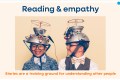
(Image credit: Kids with colander-based “gizmos” as “thinking caps,” www.EmpathyLab.uk—see trend (9) below.)

(1) Automating Empathy and large language models (LLMs): The idea is that you, the client, are going to get empathy from a software bot, app, empathy platform solution, that is able to have a conversation thanks to a so-called a large language model (LLM).
The trend of bringing large language models to empathy and empathic relatedness is a game changer. The question is not whether the generative AI can be empathic, but the extent to which the designers are able to distinguish responsiveness from “stroking one’s ego,” sycophancy (servile flattery), and the extent to which prospective clients decide to engage (both open questions at this date (Q1 2026)).
Thus, the prognosis is mixed. Is automating empathy a silver bullet—or even a good enough lead bullet—to expand empathy for the individual and community and to do so at scale. Key term: “at scale,” which means the service can be “scaled up” to accommodate thousands of people, who are currently “wait listed” for therapy with limited prospects of ever getting off the list. Can the automation address Henry David Thoreau’s “modern mass of men [persons] leading lives of quiet desperation”? Or is the “empathy bot” the cyber age equivalent of a blow-up sex doll for the socially awkward person playing small and resistant to getting out of the person’s comfort zone?
The year ahead promises a proliferation of applications, bots, and services that offer automated conflict resolution, talk therapy, empathy consulting, and companionship. For example: mendful (https://www.mendful.world), empathy.com (bereavement support—that a demo is being offered suggests an app plus services), Google’s conflict resolution app (https://play.google.com/store/apps/details?id=com.tuinfoapps.conflict&pli=1). (This list is far from complete.)
An important question to ask is about an automated empathy bot or app: How readily is an authentic, qualified human being available to engage in an initial or follow-up conversation? At the risk of ending on a cynical note, given the sorry state of human relations as demonstrated in the news of the day, maybe, just maybe, any form of expanded empathy, whether fake or authentic, if properly managed to mitigate harm, is a useful contribution. (Further on empathy and toxic flattery: https://wapo.st/4sndC9O . Also see my blog post from earlier 2025: https://empathylessons.com/2025/11/04/automating-empathy-issues-and-answers/
(2) Suicidal Empathy: This is definitely trending after a certain billionaire provocatively asserted that empathy was a defect of western civilization, even if he did try to take back the assertion. The short version of suicidal empathy is as follows. We are in a lifeboat which is filled to the maximum after our ship sank. You read right—our ship sank. In the water, treading water, surrounding the lifeboat are additional survivors and additional leaky lifeboats at high risk of sinking, leaving the survivors treading water. If the survivors in our still afloat lifeboat are “empathic” and take in the other survivors, then our lifeboat will be swamped, and we will all drown. The conclusion is that in such extreme situations, which are more common than one might imagine, empathy needs to be turned off—or at least dialed down significantly—lest we all perish. This position has been advocated from time-to-time by Elon Musk, Garrett Hardin (1974), and anti-immigration Nativists in one form or another.
Yet even in the face of lifeboat ethics, empathy remains indispensable. How so? If one is in a life-boat, then one is by definition a survivor. Your ship sank! That is a necessary part of the definition of a lifeboat and being in a lifeboat. You were cast into the vast, seemingly boundless sea. Never underestimate the importance of empathy for those in extremis, but even more than empathy, the occupants of the lifeboat need rescue. To be in a lifeboat and not need rescue is a contradiction in terms. If one recognizes the need for rescue, then the whole scenario of lifeboat ethics gets sent back to the drawing board.
The idea of our entire planet (Earth) as a lifeboat is a thought experiment. An imaginary narrative (scenario) designed to generate ideas and intuitions (nod here to the philosopher Daniel Dennett). In this case, the trick is to constrain agency using scarcity of resources (seats in the lifeboat) and see what happens. This exposes the entire lifeboat scenario mechanism for constraining, compromising, and denying agency to the participants in the dilemma. Key term: agency.
The approach of lifeboat ethics is based on a fallacy that the situation of scarcity is an unavoidable one—an inevitable continency. On the contrary, scarcity is being manufactured by bad actors, bad politics, and out-and-out human aggression. As such, the scarcity can and should be undone by actors with better (including empathic) motives in order to restore the community to a benchmark standard human functioning. This is consistent with natural disasters creating local calamities that cause scarcity. It is also consistent with disagreements about what constitutes an emergency. The point is to send in emergency services and (for example) the national guard to deliver or air drop palettes of drinkable water, canvas for tents, and provisions, not to shoot the survivors as a burden to the community (the latter following the logic of the lifeboat to its absurd conclusion).
Returning to the basic metaphor, empathy is no more to blame for overloading the lifeboat than carpentry is to blame for the fact that Roman soldiers used hammer and nails to execute condemned criminal and political enemies by crucifying them. Without practice, empathy can go astray as emotional contagion, projection, conformity, and communications lost in translation.
Being generous to a fault or has never been a requirement for empathy. Altruistic suicide (the soldier falling on the hand grenade to save his comrades) has never been a requirement for empathy. Never. With practice, a rigorous and critical empathy sets boundaries, establishes limits, and creates a whole that is more than the sum of its parts.
A rigorous and critical empathy belongs to a short list of things such as dignity, respect, compassion, neighborliness, and forms of spiritual love, and are not quantifiable as zero-sum phenomena. This is an important idea: more empathy for you does not mean less empathy for me.
For example, if I give you a slice of my chocolate cake, I have less cake. However, if I give you empathy, by giving you a good listening, we both have expanded empathy. Empathy is non-additive—and so empathy is also a non-subtractive, humanizing encounter in which my own humanity is enriched in contributing to another person. A rigorous and critical empathy is not quantifiable like chocolate cake. Granted that our topic is difficult and significant, we can enjoy lighter moment—there is enough food to go around, but definitely not enough chocolate cake! Like food, there is enough empathy to go around, but it does not seem that way, because we have not been effective in driving out the obstacles to empathy such as aggression, hostility, bullying, using food as a weapon, and politics in the negative, pejorative sense. Also see my blog post from earlier 2025:
[https://empathylessons.com/2025/05/22/suicidal-empathy/ ]
(3) Rhetorical empathy: The paradigm, ideal case for rhetorical empathy is exemplified by Malcolm-X’s statement to his colleagues at the founding of the organization of African American Unity, “We are not the pilgrims […] We didn’t land on Plymouth Rock; the rock was landed on us [loud laughter and applause]” (https://youtu.be/3Aq2Z0i8D6A?si=dkYo6QKCrgK2fWXL).
In rhetorical empathy, the speaker’s words address the listening of the audience or other person (“Other”) in such a way as to leave the Other with the experience of having been heard. This must seem counter-intuitive since it is the Other that is doing the listening. The hidden variable is that the speaker knows the Other in the sense that she or he has walked a mile in their shoes (after having taken off her/his own) and can articulate the experience the audience is implicitly harboring in their hearts yet have been unable to express.
For more details on rhetorical empathy, see the separate blog post: post: https://empathylessons.com/2023/04/09/rhetorical-empathy-a-primer/
Also see the peer-reviewed academic article: “Rhetorical empathy in the context of ontology,” Turning Toward Being: The Journal of Ontological Inquiry in Education: (2024) Vol. 2: Issue 1, Article 5. Available at: https://rdw.rowan.edu/joie/vol2/iss1/5
(4) Empathy and autism: Alternative facts, dangerous half-truths, damn lies—and empathy
How shall I express it delicately? The inmates are now in charge of the asylum over at the US Health and Human Services (HHS). Having a worm in one’s brain deservers our empathy; having a worm in one’s thinking does not—see below regarding critical thinking.
Autism is often considered a disorder of empathy—at the risk of oversimplifying, the autistic person is not able to shift perspectives and take the other person’s point of view or do so as readily as neuro-typical persons. Never dismiss empathy. Nor the value in expanding empathy. Never. Yet the matter is a lot more complicated than that.
Public debate about autism and empathy has been scrambled by misinformation about how vaccines may influence the disorder. It is distressing to see what passes for political leadership send children and families down yet another over-simplified and near delusional detour. In a more promising approach using Big Data, scientists at the Flatiron Institute and Princeton have presented evidence that autism presents in four distinct ways or subtypes. Quoting from the Washington Post summary (https://wapo.st/44V7lZb):
- Broadly affected: The smallest group — about 10 percent of participants — faced the steepest challenges, marked by developmental delays, difficulties with communication and social interaction, and repetitive behaviors that touched nearly every part of life.
- Mixed autism with developmental delay: Roughly 19 percent showed early developmental delays but few signs of anxiety, depression or disruptive behavior. Researchers call this group “mixed” because its members vary widely in how strongly they display social or repetitive behaviors.
- Moderate challenges: About a third of participants fell into this group, showing the hallmark traits of autism — social and communication differences and repetitive habits — but in subtler ways and without developmental delays.
- Social and/or behavioral: The largest group, around 37 percent, met early developmental milestones on time yet often grappled with other conditions later on, including ADHD, anxiety, depression or obsessive-compulsive disorder.
For the peer-reviewed paper, which is dense and heavy with computational biology see: https://www.nature.com/articles/s41588-025-02224-z .
These different subtypes suggest a source of much of the confusion in diagnosis and treatment. Parents, medical professionals, and educators and talking past one another because they are addressing the different subtypes.
Naturally, everyone would like a quick fix: Give ‘em vitamin B9—problem solved! Wouldn’t it be nice? (Nor is there anything wrong with vitamin B9—but it ain’t gonna cure autism.) While expanded understanding and diagnostic possibilities point to enhanced treatment interventions, what is less good news is that treatments remain complex, multi-modal, time and labor intensive, and, therefore, expensive. Behavioral interventions are demonstrably effective in improving recognizing social clues and expanding social skills. Selective, limited use of psychopharmacology is effective in addressing attention deficit and hyperactivity, though one must always be concerned in medicating young brains. Working from the inside out, e.g., play therapy is effective in dealing with anxiety and depression. In every case, creating an empathic environment of toleration, limit setting, and meeting the children (and parents) where they are struggling is on the critical path to success.
(4) Empathy versus cruelty and unelected puppet masters in politics: Presumably a statement that “empathy is a weakness” (see above (2)) would be a justification of the unempathic “slash and burn” methods of the “unelected puppet masters” at the US Depart of Doge [pronounce: “dog”], the so-called US Department of Government of Efficiency, showing up at the US IRS and Social Security offices and so on and demanding to see confidential citizen data and/or seemingly randomly sending employees home (“firing” them). While a “controlled burn” of the bureaucratic growth of the federal government forest underbrush might indeed be the empathic thing to do—or at least needed “tough love,” shutting down entire departments and mass layoffs is not an example of it. This is the “uncontrolled burn” (shout out to Garrett Smith for the term).
What Stephen Miller (Deputy White House Chief of Staff) and Russell Vought (Office of Management and Budget / Project 2025) do not point out is that empathy does not work with bullies or abusers, who will take whatever vulnerability you may exhibit and use it against you. This is also the case with anti-social personality disorder, psychopaths, and individuals with an undeveloped or defective conscience, who struggle to tell right from wrong. I hasten to add that without interviewing the individual, one has no way of knowing the individual’s mental status, whether the individual is in integrity or out of it.
Another possibility is that the individual is projecting the individual’s own unreliable, defective empathy onto the community as an empathic defect. Many of those who lack empathy are hungry for it. If ever there was a disqualifying statement by a would-be administrator or leader, Elon Musk’s soundbite about empathy being a defect of civilization would be it. Even if he took it back, I assert that it shows his “true colors”. However, a further agenda lurks nearby.
In the face of bullying, a critical and rigorous empathy sets limits, speaks truth to power, establishes boundaries, pushes back against attempts to control, dominate, and manipulate. One must not overlook the power of top down, cognitive empathy in thinking like one’s opponent in order to overcome him. “Top down,” cognitive empathy is detailed in Mikah Zenko’s Red Team! (Basic Books 2015) according to which taking a walk in the other’s shoes (the folk definition of empathy) provides advantages in relationships, business, politics, and building communities that are thrive on cooperation, communication, coordination, and inclusiveness. Short review: Think like one’s opponents, to come out on top.
If one were looking for a short disqualifying reason to sideline unelected puppet masters such as Musk and fellow traveler Stephen Miller (see more on the latter on the South Poverty Law Project’s report on racism and anti-immigration hate groups), this is it. I leave it to the reader to figure out who is the puppet.
(5) Empathy and immigration and murder most foul: more alternative facts, dangerous half-truths and total nonsense: That these United States of America are a federated nation of immigrants is a cold fact. Most of the people living here would not be here if their parents, grandparents, or great grandparents had not arrived from some land across the sea. To be sure, there are exceptions—and it is an also a fact that if one reads the treaties that the US government made with Native Americans, that Oklahoma really does belong to the Native Americans. Likewise, as Malcolm-X said to a crowd in Harlem to responses of “Amen!” and boisterous laughter, “You did not land on Plymouth rock; Plymouth rock landed on you!” (See (2) above.) Still, residents already living here are not interested in changing the devil they know for the devil they don’t know.
The following quote is not from the “take over” of Venezuela (ongoing), but the action of the border patrol and ICE in Chicago’s Hispanic neighborhood:
“[…] [I]t’s been a parade of nightmares — armed men in balaclavas on the streets, migrants sent to a torture prison in El Salvador, corruption on a scale undreamed of by even the gaudiest third-world dictators and the shocking capitulation by many leaders in business, law, media and academia. Trying to wrap one’s mind around the scale of civic destruction wrought in just 11 months stretches the limits of the imagination, like conceptualizing light-years or black holes.” [https://www.nytimes.com/2025/12/26/opinion/trump-weaker-resistance-stronger.html?unlocked_article_code=1._k8.NEnL.4kvmeqa-xzC4&smid=url-share
It is a breakdown of empathy that a nation of immigrants is flat out persecuting, oppressing, and hounding mostly, but not exclusively, Hispanics and people with brown skin. Demoralizing. Disgraceful. Criminal?
Everyone wants to deport undocumented murderers, rapists, gang members, and bad actors. Everyone. Yet that is not what we saw from ICE/BP actions in Chicago where Hispanic-appearing bus boys in restaurants, day laborers in Home Deport parking lots, nannies at preschools (?!), street vendors selling tacos, block party gatherings in Latino neighborhoods were targeted and where tear gas, flash bang grenades, shots to the head with high-speed paint balls (aimed at peacefully protesting pastors), and other chemicals agents were used without warning. This just in: mother of three shot, killed by ICE/BP: Are you getting the message? Murder most foul![https://www.nytimes.com/2026/01/08/opinion/renee-good-minnesota-shooting-ice.html?unlocked_article_code=1.DlA.y2Fb.N6f9Vobf-Vmv&smid=url-share]
The administration’s narrative (Secretary of Homeland Insecurity Noem, etc) has NEVER matched the actions on the ground in the community neighborhoods. According to the Chicago Tribute—of 624 arrests reported by ICE/BP to the court some 16 persons had criminal records (“worst of the worst”). That is 2.5 percent. Underwhelming, demoralizing, appalling.
The call to action employs empathy to network and build community. Get a whistle and use it. Two short tweets for ICE Spotted—one long one for someone being detained. Build local networks of citizen observers. Urge local law enforcement to arrest anyone who breaks the law, including federal officers acting illegally. No one said this was going to be easy. We Americans have options and resources that were not available to the residents of Weimar Germany in 1933, who were noticeably lacking in whistles. Okay, not funny.
(Update 01/28/2026: https://www.wsj.com/opinion/is-trump-derangement-syndrome-real-a603e4a1?st=AnbPxi&reflink=desktopwebshare_permalink)
(6) Radical empathy and trauma: Cathy Caruth (1996) concisely defines trauma in terms of an experience that is registered but not experienced, a truth or reality that is not available to the survivor as a standard experience. The person (for example) was factually, objectively present when the head on collision occurred, but, even if the person has memories, and would acknowledge the event, paradoxically, the person does not presently experience it as something the person experienced in a way that a person standardly experienced the past event.
The survivor experiences dissociated, repetitive nightmares, flashbacks, and depersonalization. Strictly speaking, the challenge is not only that the would-be empathizer was not with the surviving Other when the survivor experienced the life-threatening trauma, but the survivor was physically present yet did not have the experience in such a way as to experience it. That may sound strange that the survivor did not experience the experience. Once again, one searches for words to capture an experience one did not experience. That is Caruth’s (1996) definition of “unclaimed” experience.
Moral trauma adds a challenging twist to what is traumatic about trauma. What is little recognized is that many survivors are also perpetrators (and vice versa). The survivor may also unwittingly (or even intentionally) become a perpetrator. The incarcerated prisoner of conscience steals a piece of bread from another prisoner, or to save his own life, falsely accuses another. One wants to say: This is tragic in the strict sense. The characters in ancient Greek tragic theater, including Oedipus, Phaedra, Medea, practically the whole House of Atrius, are all both survivors and perpetrators.
Moral trauma is defined as the distressing emotional, behavioral, social, and sometimes spiritual aftermath of exposure to (including participation in) events in which a person’s moral boundaries are violated and in which individuals or groups are gravely injured, killed, or credible threat thereof is enacted (i.e., individuals are physically traumatized). Examples of moral trauma include such things as being put in a situation where “I will kill you if you do not kill this person.”
Generalizing on the latter example, the list includes morally fraught instances of double binds, valid military orders that result in unintentional harm to innocent people, situations in which survivors become perpetrators (and vice versa), soul murder (defined as killing the possibility of empathy and/or killing the possibility of possibility), and the Trolley Car Dilemma (Anonymous Wikipedia Content 2012, Foot 1967, Thomson 1976). In moral trauma people become both perpetrators and survivors, and such an outcome is characteristic of many (though not all) moral traumas.
Here radical empathy comes into its own. A person is asked to make a decision that no one should have to make. A person is asked to make a decision that no one is able to make—and yet the person makes the decision anyway, even if the person does nothing, because doing nothing is making a decision. A person is asked to make a decision that no one is entitled to make, which include most decisions about who should live or die (or be gravely injured). The result is moral trauma—the person is both a perpetrator and a survivor. Now empathize with that. No one said it would be easy.
Hence, the need for radical empathy. Extreme situations—that threaten death or dismemberment—call forth radical empathy. Standard empathy is challenged by extreme situations out of remote, hard-to-grasp experiences to become radical empathy. Radical empathy remains committed to empathizing with the Other in the face of the breakdown of standard empathy as empathic distress. (For further on radical empathy, see the separate blog post: https://empathylessons.com/2025/08/22/a-concise-talk-on-trauma-and-radical-empathy/and see also the Reference Agosta 2025 below.) The treatment or therapy consists of the survivor re-experiencing the trauma vicariously from a place of safety, an empathic space of acceptance and tolerance. In doing so the trauma starts losing its power and when it returns, it does so with less force, eventually becoming a distant unhappy and painful but not overwhelming memory.
(7) Empathy and art: Heinz Kohut, MD, (1971) pointed out that one result of depth psychological therapy with a strong orientation on empathy was an expansion of the individual’s appreciation or art, humor, and practical wisdom. What is the converse were also the case? Engaging with art and music, the Humanities and literature, theatre, rhetoric and languages, opens up areas of the brain that map directly to empathy and powerfully activate empathy.
Relating to the work of art, including literary fiction such as the novel, aesthetically and relating to the Other empathically is an intersection that has been noted by one of the innovators of personality theory, Gordon Allport (1897–1967), He was one of the pioneers of personality theory with his Personality: A Psychological Interpretation (New York: Holt 1937), in which he writes:
It has often been said by the advocates of empathy that the “understanding of a personality is like the understanding of a work of art” (1937: 531).
These advocates of empathy were not anonymous Others but Allport’s teacher, Herbert Langfeld (1879–1958), also a psychologist and president of the American Psychological Association and his colleagues. Langfeld was the author of The Aesthetic Attitude (1920: vi): “the motor theory of mind, namely that to every stimulus which the organism receives from without, it makes a definite response” resulting in the “tendency of the observer to project himself” into objects and body.
As noted, psychologists and health professionals have repeatedly alluded to such benefits of expanded empathy as an increased sense of humor, appreciation for art and music, as well as an enhanced capacity to enjoy life itself. Attention to fine-grained distinctions in an individual’s experience of other individuals is hypothesized to be transferable across domains such as the experience of art, humor, and engaging with others. Expand your empathy—go to the art museum—go to a concert—read immersive fiction, a novel.
(8) Empathy is the new love: People want to be listened to. People want to feel as if they have been heard—people want to be heard. People want to be gotten for they authentically are as a possibility. People want others to appreciate from where they are coming—their point of view. People want to be acknowledged, recognized, appreciated for their contribution. Empathy delivers all these ways of relating and more.
If empathy is the new love, then what is the old love? Folk wisdom suggests that love is blind; Plato, that love is a kind of madness, sometimes divine madness, sometimes just plain ordinary, everyday craziness—the one who is in love is semi-hypnotically held in bondage by an idealized depiction of the beloved, overlooking the partner’s failings and limitations; Bob Dylan, that love is just a four-letter word. So far, love sounds like tertiary syphilis—it makes one mad and causes one to go blind.
Less cynically, no one should have to choose between empathy and love in their positive dimensions. Talking Greek here, love includes eros—the erotic dimension, which gets a lot of attention as romantic relationships and aim-inhibited sexuality; philias—friendship between peers in building a community of fellow travelers; and agape—the spiritual love often attributed to Saint Paul for a higher power towards which humanity strives in its own clumsy and stumbling ways.
A fourth item may usefully be added to the list—the love of a mother, parent, or care-taker for the infant, neonate, or child of tender art. The sound of a crying baby has the power to wake most grown-ups out of the deepest sleep—and that is because we care. Letting the anxious infant merge with the parent’s soothing calmness satisfies criteria for both love and empathy, and may be the common matrix out of which these come forth.
Especially from a romantic perspective, the goal of love is to erase the boundary between the self and Other. (But also see above on the merge of the anxious infant with the calm adult.) Merger of one’s mind and body with the beloved is the aspiration and, at least temporarily, the outcome.
In contrast to love, empathy navigates the boundary between oneself and Other such that the distinction between self and Other is sustained—any merger is temporary and transient—one has a vicarious experience of the Other and the integrity of self and Other are maintained. Thus, love and empathy have a different relationship to the boundary between self and Other. Empathy is committed to a firm, albeit semi-permeable boundary; whereas, especially in its more enthusiastic forms, love celebrates the cancelling of the boundary, though ultimately acknowledging the reality of the distinction self/Other.
(9) Reading and empathizing: “A good book is an empathy engine”—Chris Riddell, UK Children’s Laurate. Many analogies exist between reading a text and empathizing with another person. This is not a mere analogical argument. The practices of empathy and reading are applying the same underlying micro-practices, skills, techniques, and methods. Reading literature (we are not engaging with reading legal contracts or computer documentation) is an empathic practice—not merely analogous to one, though it may be that too.
(Image credit: EmpathyLab (UK): Your brain on empathy reading)

Reading is an empathic practice in that it engages with another person—the Other—and does so at several levels. There are several levels of otherness—the Other of the character in the text is the most readily available—there is the implied Other addressed by the implied author, the Other of the narrator, who collapses into the implied author but often is distinct, and the actual author, who writes the words. Once again, I emphasize—and empathize—these are not merely analogous to acts of the practice of empathy, they are empathic gestures from start to finish, since they bring forth empathy and make it present in the encounter with an Other.
The idea is that one relates to works of art such as a literary text with the same respect, aesthetic disinterest, moral interest as we relate to other human beings. That is also the case when the relationship breaks down. Someone throws cake at the Mona Lisa or tries to spray it with red paint. One is shocked in a way that is different than insulting or attacking a person, yet has strong objections like an appalling boundary violation has occurred.
On the one hand, what empathy does for reading literature is bring it to life as the possibility of a laboratory for human emotions, affections, struggles, dynamics, success, and failure. Conversely, what literature does for empathy is provide a laboratory in which empathic relatedness can be challenged, tested, transformed, discarded, celebrated, explored, and made the object of inquiry.
This is another area where it is hard to say just a little. Quoting from John Guillory (2025: p. 22ftnt 31), in turn, paraphrasing Stanislas Dehaene (Reading in the Brain: The Science and Evolution of a Human Invention (Viking Press 2009)): “…[Dehaene] describes reading as a refunctioning of regions of the brain dedicated to recognizing visual signals of a particular sort, chiefly the edge or corners of object; these forms the basis for inscriptive marks. Although the neurons of the areas that accomplish reading were not evolved for the purpose of reading, the human brain learned reading and writing by developing a new way of correlating visual and aural information in the brain. Dehaene calls this ‘neuronal recycling” (144–148). This is just the start of the neuroscience narrative.
The encounters between empathy and literature, relating as persons to art works and relating as art works to persons, are motivated. One considers how one relates to another person, and how it is the same and different than how one relates to works of art. At first glance, one treats art better than one treats people. One puts art in libraries and museums with air conditioning in the summer and heat in the winter whereas one allows people to go homeless and sleep under bridges in appalling conditions. However, upon reflection one guiltily allows with shame that as a community, one is failing to live up to one’s own best standards. One recognizes one’s failure even as one refuses a trade-off between respect for art and respect for persons.
(10) Empathy and critical thinking: We conclude with a positive proposal: Teach critical thinking. This is the empathic educational moment. Absent a rigorous and critical practice of empathy, I am cautious about engaging current political clichés in a highly polarized political world and “rhetoric” in the negative sense.
Critical thinking includes putting oneself in the place of one’s opponent—the folk definition of empathy—not necessarily to agree with the other individual—but to consider what advantages and disadvantages are included in the opponent’s position. Taking a walk in the Other’s shoes after having taken off one’s own (to avoid the risk of projection) shows one where the shoe pinches. This “pinching” —to stay with the metaphor—is not mere knowledge but a basic inquiry into what the Other considers possible based on how the Other’s world is disclosed experientially. That is what we have attempted to do here by engaging with the most rigorous version of the lifeboat dilemma, instead of a strawman. Critical thinking is a possibility pump designed to get people to start again listening to one another, allowing the empathic receptivity (listening) to come forth.
In our day and age of fake news, deep fake identity theft, not to mention common political propaganda, one arguably needs a course in critical thinking (e.g., Mill 1859; Haber 2020) to distinguish fact and fiction. Nevertheless, I boldly assert that most people, not suffering from delusional disorder or political pathologies of being The True Believer (Hoffer 1953)), are generally able to make this distinction.
A rigorous and critical empathy creates a safe zone of acceptance and tolerance within which people can inquire into what is possible—debate and listen to a wide spectrum of ideas, positions, feelings, and expressions out of which new possibilities can come forth. For example, empathy and critical thinking support maintaining firm boundaries and limits against actors who would misuse social media to amplify and distort communications. Much of what Jürgen Habermas (1984) says about the communicative distortions in mass media, television, and film applies with a multiplicative effect to the problematic, if not toxic, politics occurring on the Internet and social networking.
The extension to issues of politics, climate change, and community struggles follows immediately. Insofar as individuals skeptical of empathy are trying to force a decision between critical thinking and empathy, the choice must be declined. Both empathy and critical thinking are needed; hence, a rigorous and critical empathy is included in the definition of enlarged, critical thinking (and vice versa). (Note that “critical thinking” can mean a lot of things. Here key references include John Stuart Mill 1859; Haber 2020; “enlarged thinking” in Kant 1791/93 (AA 159); Arendt 1968: 9; Habermas 1984; Agosta 2024, 2025.)
In conclusion, a positive alternative to abandoning facts and skipping critical thinking is suggested by Bob Dylan’s song about empathy. One has to push off the shore of certainty and venture forth into the unknown. We give Dylan the last word (1965: 185): “I wish that for just one time / You could stand inside my shoes / And just for that one moment / I could be you” [.]
REFERENCES
Lou Agosta. (2025). Radical Empathy in the Context of Literature. New York: Palgrave Macmillan.
______________. (2024). Empathy Lessons. 2nd Edition. Chicago: Two Pears Press.
______________. (2014). A Rumor of Empathy: Rewriting Empathy in the Context of Philosophy. New York: Palgrave Pivot.
Anonymous Wikipedia Content. (2012). Trolley problem (The trolley dilemma). Wikipedia: https://en.wikipedia.org/wiki/Trolley_problem [checked 2023-06-25]
Arendt, Hannah. (1952/1958). The Origins of Totalitarianism, 2nd Edition. Cleveland and New York: Meridian (World) Publishing, 1958.
Gordon Allport. (19370. Personality: A Psychological Interpretation (New York: Holt 1937).
Cathy Caruth. (1996). Unclaimed Experience: Trauma, Narrative, and History. Baltimore: John Hopkins.
Stanislas Dehaene. (2009). Reading in the Brain: The Science and Evolution of a Human Invention. NEW YORK: Viking Press.
Bob Dylan. (1965). Bob Dylan: The Lyrics: 1961–2012. New York: Simon and Schuster.
Philippa Foot. (1967). The problem of abortion and the doctrine of the double effect. Oxford Review, No. 5. In Foot, 1977/2002, Virtues and Vices and Other Essays in Moral Philosophy. Oxford: Oxford UP, 2002: 19–32. DOI:10.1093/0199252866.001.0001.
John Guillory. (2025). On Close Reading. Annotated bibliography by Scott Newstok. Chicago: University of Chicago press.
Jonathan Haber. (2020). Critical Thinking. Cambridge, MA: The MIT Press.
Jürgen Habermas. (1984). The Theory of Communicative Action, Vol 1, Thomas McCarthy (tr.). Boston: Beacon Press.
Garrett Hardin. (1974). Commentary: Living on a Lifeboat. BioScience, Volume 24, Issue 10, October 1974, Pages 561–568, https://doi.org/10.2307/1296629
Eric Hoffer. (1953). The True Believer. New York: Harper Perennial.
Immanuel Kant. (1791/93). Critique of the Power of Judgment, Paul Guyer and Eric Matthews (trs.). Cambridge: Cambridge UP, 2013.
Heinz Kohut. (1971). The Analysis of the Self. New York: International Universities Press.
Herbert Langfeld. (1920). The Aesthetic Attitude. New York: Harcourt Brace.
Malcolm-X. (1964). “Remarks at the founding of the Organization of African-American Unity.” https://youtu.be/3Aq2Z0i8D6A?si=dkYo6QKCrgK2fWXL [Checked on 03/24/2024]
John Stuart Mill. (1859). On Liberty, Indianapolis: Hackett Publishing.
Judith Jarvis Thomson. (1976). Killing, letting die, and the trolley problem, The Monist, vol. 59: 204–217.
Mikah Zenko. (2015). Red Team! New York: Basic Books.
This blog post, blog and all content were prepared by Lou Agosta without any use of Generative AI. None. The author has been a big fan of the em dash ever since “graduating” from a Smith Corona typewriter to a word processor.
© Lou Agosta, PhD and the Chicago Empathy Project
Alternative facts, harmful half truths, damn lies, and total nonsense – about empathy
At the time of the initial publication of Empathy Lessons in 2018, a number of books appeared then and shortly thereafter that questioned the value of empathy. These extend from works which assert a bold statement of the obvious, that the practice of empathy has its strong and weak points, its breakdowns and break throughs, its misfirings and its successes, all the way to a growing number of works that insist the disadvantages of empathy far outweigh its benefits and sensible practitioners would do well to disregard and even abstain from it. The latter are the ones of concern here.
Full disclosure: I mistakenly subscribed to the view that no such thing as bad publicity existed, and I declined in 2018 (and up until 2023) to mention the anti-empathy authors by name, instead referring to a “celebrity psycholinguist,” a prominent “Germanic studies” teacher, or a mandarin professor of comparative literature. Why give “free publicity” to views that were seemingly committed to inhibiting, contracting, devaluing, rather than expressing, expanding, and implementing the practice of empathy? The gambit did not work. The devaluing of empathy got traction, perhaps driven by publishers whose market research, whether accurate or not, suggested that the sales of empathy books had peaked, and who proposed to keep the pot boiling with works that throw empathy “under the bus.” The challenge is that it is getting crowded under the bus, and the following cases provide a few suggestions about current authors who belong there, too. In the following, the alleged biases and limitations of empathy are so easy to refute that the reader is going to suspect me of having set up the representation of these limitations of empathy as a strawman in order to knock it down. I am not making this stuff up, and I provide references in support.
A second reason that the practice of empathy is hypothetically “on the ropes” is that skepticism about empathy’s value is a consequence of its own success. Empathy works. Empathy makes a profound and lasting difference. But in the age of TikTok does it work fast enough? Empathy and its many successes are themselves the occasions for the skepticism, resistance, and seeming embrace of the obstacles to empathy. A rigorous and critical empathy can be hard work; better to take the easy way out. The reader may say, I want instant empathy, like instant coffee, just add hot water and stir. Wouldn’t it be nice? Nor is anyone saying such a thing as “instant empathy” is impossible. It may work well enough in a pinch; but like instant coffee, the quality may not be on a par with that required by a more demanding or discriminating appreciation and taste – or a more challenging situation. The pervasive cynicism and resignation of the world are naturally attracted to attacking the sources of inspiration and strength, not those of enervation and stagnation. A treatise on “The Dark Sides of Violence” will sadly remain timely and relevant, but no one disputes the accuracy of the description. One does not need a treatise “Against Eating Dirt,” because few are inclined to eat dirt (and if one is so inclined, it seems be a sign of a vitamin deficiency).
Advertisement
This brings us to the poster child for devaluing empathy, Fritz Breithaupt’s The Dark Sides of Empathy (2017) (hereafter referred to as “Dark Empathy”). Breithaupt asserts on page 8 that to “uncritically embrace empathy without caveats” is the goal debunked by the end of this [Breithaupt’s] book. Those who “uncritically embrace empathy” are debunked. Just so. Please stop right there. Who proposed uncritically embracing empathy—or anything? Uncritically embracing empathy is not proposed here. Attributing uncritical thinking to the masters of empathy such as Batson (2009), Baron-Cohen (2014), Frans de Waal (2009), Jean Decety and William Ickes (2009), Lanzoni (2012), Zenko (2015) (this list is not complete), is itself a concerning sign of lack of critical thinking. Dark Empathy is at best naïve and at worse disingenuous in imaging practitioners of empathy are uncritical or lack rigor. “Uncritically embracing empathy” sets up a strawman, and gives a green light to uncritical thinking. The program of Dark Empathy is systematically and sensationally to attribute examples of empathic distress to the practice of empathy itself, charge empathy with these misfirings, and, going forward, invalidate and dismiss the practice of empathy. Instead of engaging with the hard work of self-inquiry into one’s own blind spots to overcome the obstacles and resistances to empathy, Dark Empathy takes the easy way out, discards empathy, gives up on it. It is like giving up on nutrition because the cook may put too much salt in the soup or burned the roast.
Dark Empathy properly lists many of empathy’s breakdowns, misfirings, and obstacles (as do practitioners of a rigorous and critical empathy). Phenomena such as emotional contagion, projection, conformity, messages getting lost in translations in attempting to be empathic. A rigorous and critical empathy is committed to doing the hard work of overcoming these break downs and misfirings in order to relate authentically and in integrity to the other individual. Dark Empathy’s commitment is to sensationalizing the failings of empathy, not demonstrating how empathy works (and does not work) in literature, politics, psychology, etc. Or rather the commitment is that empathy does not work (full stop).
If Dark Empathy would have stopped at page 8—empathy is what makes us human (or words to that effect) and elaborated on that position—then it would have made a useful contribution. The author really says it: empathy is essential to our humanity. However, empathy then breaks down into empathic distress. The issue is that human beings are frequently inhumane—not just a few bad apples, but as the Holocaust and Hannah Arendt taught us about the banality of evil, and the famous quote from Himmler (Arendt 1971: 105–6; Agosta 2010: 73), everyone has the potential for real badness, evil, even if few act on it. Therefore, dial back empathy, abstain from empathy?
Dark Empathy asserts a few sensible things about empathy up front, and then sensationalizes the negative and the resulting empathic distress by saying that empathic human beings perpetrate horrid actions. Accurate enough. Human beings are a difficult species. They are an empathic, caring, and kind species as well as an aggressive, territorial, and rapacious one. Wouldn’t we want to work on expanding the former and inhibiting the latter? That Roman soldiers drove nails through the limbs of the people they were crucifying does not invalidate the art of carpentry. Dark Empathy makes it sound like it does as it seemingly intentionally applies the same argument to empathy. Dark Empathy perpetrates a similar series of fallacies of numbing grossness by saying the forms of empathy are the motives for the horrid actions. Aren’t the hidden variables aggression, uninhibited desire, territoriality (this list is not complete)?
Dark Empathy cites Nietzsche to support the case against empathy. The reading of Nietzsche is highly problematic. The text sounds like Nietzsche is discussing empathy, has an argument about empathy, and indeed may be considered a major contributor to the conversation on empathy. Breithaupt writes things like: “Nietzsche’s argument is not that empathy leads to a narrowed range of vision” (p.43). “Empathy, Nietzsche suggests…” (p. 44). “Nietzsche situates the empathic or objective person…” (p. 45). “…Nietzsche’s argument on empathy…” (p. 46). “…A second thesis of Nietzsche’s conception of empathy” (p. 48). “…[A]bout Nietzsche’s argument concerning empathy” (p. 55). The problem is that Nietzsche does not mention empathy. Ever. Nietzsche does not have an argument about empathy. Nietzsche does not situate empathy. Nietzsche does not have a conception of empathy as (for example) Johann Herder or Theodor Lipps or Novalis or any modern thinker engaged with it. Empathy is not implicit in Nietzsche, unless one projects it there.
Yet Breithaupt does not propose a rational reconstruction of empathy (or of anything in this book). He is writing as if Nietzsche had a position on empathy (or an account of empathy) at the level of Nietzsche’s text or very close to it. Not accurate. Regarding explicit or implicit references to empathy in Nietzsche, there is nothing to site. Granted that Nietzsche is notoriously difficult, the editor and reviewers must think the readers are really inattentive. This is a scholarly breakdown of numbing grossness. I am at a loss to comprehend how the editor let this occur.
Advertisement
Now if Dark Empathy were to have written (condition contrary to fact) that Nietzsche has a position on the moral sentiments such as guilt, shame, ressentiment, love, compassion, that the moral sentiments have a “dark side,” and then added empathy to the list, it might have a case. According to Nietzsche’s Genealogy of Morals, Judeo-Christian morality (such as one finds in the Ten Commandments or Jesus’ Sermon on the Mount) is a reaction formation transforming aggression and hostility into slave morality (Nietzsche’s key term: “slave morality”). The Roman slaves, with whom Christianity became popular (in spite of their initially being fed to the lions) turn the tables on the Roman masters by means of the conventional Christian practices that privilege turning the other cheek, being kind to the poor, predicting the meek shall inherit the earth. The “meek” are precisely the slaves. But then the reduction to absurdity of Dark Empathyoccurs: it is all of conventional morality that has a dark side—the dark side of the Ten Commandments and the Good Samartian (he really was acting selfishly!?)—not merely the practice of empathy. Though Nietzsche does not do so, a reconstruction of Nietzsche’s position might add “empathy” to the list of characteristics of slave morality such as altruism, compassion, charity, helping those in need, being kind to animals, turning the other cheek, and so on (even though empathy is not a sentiment as such but a form of emotional communication). But Dark Empathy says no such thing. I cannot site a reference because there is none. Not even close. Once again, if Dark Empathy were to have said that the pessimist (read: “Schopenhauer”) is at odds with the “objective man,” who gives up his self rather than face pessimistic annihilation, then one might say Dark Empathy opens the way to an empathic communication. But even then the other horn of the dilemma gores Dark Empathy. According to Dark Empathy, to be empathic one must have a self, be a listening self, be a receptive self. Dark Empathy attributes to Nietzsche an imaginary assertion that one needs to have an empty self to be empathic. Nietzsche may indeed attribute a hollow self to the objective man, but empathy remains uninvolved.
In a deep sense, this book lacks integrity—not in the sense that contains any moral improprieties or ethical lapses, but that it lacks wholeness. Empathy is fragmented. The interpretation is fragmented. The understanding of Stockholm Syndrome is fragmented (e.g., p. 39, 69). The short version of Stockholm syndrome is that the hostage/prisoner identifies with the hostage taker, the jailer, or the concentration camp guard in order to survive, save his or her life. This is called “identification with the aggressor” (not empathy), in which the aggressor is the authority figure who has the monopoly of the means of force and violence. Thus, for example, Patty Hearst, the media heiress, after being held in the closet for two seeks (it is not clear if she was allowed to use the bathroom), finally says, “Okay, I’ll join up”; and the next thing she is caught on camera with the other terrorists of the Symbionese Liberation Front, trying to rob a bank. Unfortunately, the jury did not understand Stockholm Syndrome either. The hostage does not just pretend to join the “bad guys” who are her captors: the hostage really does join up. Now notice also that this same mechanism is the means by which the conscience is formed—which is relevant to Nietzsche. If five-year-old Louie gets caught with his hand in the cookie jar, violating the rule “No cookies before dinner,” and gets punishment (say, a time out), Louie feels shame at getting caught “red handed” (red because he is blushing) and given a time out. However, if tomorrow, Louie puts his hand in the cookie jar and Mom does not catch him in the act and he bites into the cookie, what happens? The cookie does not taste right. Guilt! He has interiorized the authority (Mom) and the rule (no cookies before dinner—you will ruin your appetite) and Louie ruins his own appetite. The cookie does not taste right due to identification with the aggressor. It is a standard means by which the conscience is formed, but it does not function as designed—it goes out of kilter—when people are taken hostage, abused, and made to obey nefarious actors. Returning to Stockholm Syndrome, which of course is a pathological phenomenon, whereas the formation of a conscience is a positive one, work with trauma survivors and empathic distress comes into view. Now Dark Empathy assets that is not the meaning of Stockholm Syndrome in which it is interested (p. 69), but it is going to be hard to avoid, given all the hostages. Work with trauma survivors is usually not in the competence of literary critics, and this example shows the hazards of so engaging. One example which dishonors the survivors and gives meaning to “integrity outage” is when Dark Empathy writes “Stockholm syndrome might describe one extreme of the range of possible forms a marriage can take” (p. 60). Hmmm. This is concerning. This is not marriage, it is domestic violence or intimate partner abuse, and may require intervention by the authorities. It is unfortunate that neither Dark Empathy nor the editor, Mahindre Kingra, noticed this fragmenting statement, which may usefully be cleaned up. It shows the author to be tin-eared when it comes to the suffering of the survivors of domestic violence, marginalized women and marginalized groups.
The Dark Sides of Empathy succeeds in being provocative, even sensationalistic, identifing ways in which empathy can (and does) breakdown, misfire, and go astray. Yet The Dark Sides of Empathy is argumentatively uncharitable (in Donald Davidson’s sense): it uses the weakest versions of the opponent’s (or empathy advocate’s) arguments, not the strongest. On background, the analytic philosopher of language Donald Davidson (1973: 136–137) innovated in defining a “a principle of charity.” The principle of [argumentative] charity goes beyond honest translation or statement of an argument, as noted, asking the thinker to engage with the strongest version of an argument rather than intentionally weaking it through setting up a strawman or a distorted, ambiguous representation (Haber 2010: 74) of the logic. At the risk of mixing the metaphor, one can always make a splash by throwing a rotten tomato, and that is what The Dark Sides of Empathy does. The only concern is that my criticisms will sound like there is no such thing as bad publicity or sound like buying the book is worth it. It is not. I have read it very carefully, cover-to-cover, dear reader, so you do not have to. What a chore! Dark Empathy name drops Hölderlin, Goethe, Flaubert, Fontane, Hawthorne ((p. 172) one page only!), before turning to an in-depth engagement with the execution of the domestic terrorist, Timothy McVeigh, the Oklahoma City bomber, which says as much about the dark side of the author as about any aspect of empathy.
The fundamental fallacy is to confuse empathic distress with empathy itself. That empathy can misfire and fail does not mean one should abstain from empathy. It means to expand one’s empathy one may usefully practice and develop one’s empathic capability. With practice and effort, one’s empathic abilities are broadened and deepened. The celebrated Self Psychologist and empathy innovator Heinz Kohut, MD, (who is not mentioned in Breithaupt) gives the example of the Nazis who equipped their dive bombers with sirens, the better to impart empathic distress in their victims, thus demonstrating their (the Nazis’) subtle “empathic” appreciation of their victims’ feelings. One is tempted to say, “The devil may quote scripture.” The devil frequently does, and Nazis may try to apply some subset of a description of “empathy.”
Note that Kohut speaks of “fiendish empathy” and the use of empathy for a “hostile purpose” while emphasizing his (Kohut’s) value neutral definition of empathy as “vicarious introspection” and a method of data gathering about the other person (1981: 529, 580). Nevertheless, the point is well taken that empathy is a powerful phenomenon in all its dimensions and requires careful handling. (For further details see: “On Empathy,” The Search for the Self: Volume 4: Selected Writings of Heinz Kohut 1978-1981, London: Karnac Books, 2011: 525–535).
The Nazi applies a kind of entry level emotional contagion or affective transmission of feelings, but the process breaks down at the point of empathic responsiveness. Empathic responsiveness requires a core of acknowledgement and recognition of the other person’s humanity.
Thus, it is arguably plainly evident that the would-be “empathy” of the Nazis or the white supremacists such as Timothy McVeigh, and so on, misfires. It is contradictory. It is a flat-out contradiction to relate authentically to another human being while dehumanizing him or her. Empathy doesn’t work that way. Empathic responsiveness simply does not admit of bombing people or disqualifying them as “less than” or other than human when they plainly are human.
However, the really tough question is how does “empathy” as a psychological mechanism relate to “empathy” as an interpersonal process and both these, in turn, to “empathy” as a way of being with other people in practice. One starts out talking about empathy as a psychological mechanism, subsumed by a biological mirroring system and invoking identification, projection, and introjection. Immediately one has to give an example of two people having a conversation, in which the speaker is feeling, experiencing, and trying to express something that the listener is trying to “get” or “understand.” Then one finds oneself immediately discussing the practical considerations of why, in the course of the personal interaction, the empathy succeeded or broke down in a misunderstanding, and how to improve one’s practice of empathy based on experience.
The risk of Dark Empathy to the reader is that the reader may think its author is an expert in empathy and start quoting the distortions, lack of rigor, critical faux pas, and simple inaccuracies as if they shed light on empathy. For example, in a case of shocking inaccuracy, the book sites Stockholm Syndrome as an example of the dark side of empathy (p. 37). The mechanism of Stockholm Syndrome is not empathy, but “identification with the aggressor.” Because the hostages identified with the aggressor (the bank robber and hostage taker) in order to survive a five-day traumatic kidnapping means that people do what they have to do to survive. It is not an example of empathy, but of Dark Empathy’s lack of psychological acumen – and of empathy. On background, identification with the authority figure is crucial in forming the human conscience during childhood; and identification is consistent with the process going off the rails in the case of a kidnapping, in which, in order to survive, the victim actually builds a relationship with the perpetrator – does not pretend to do so, actually builds the relationship. Breithaupt’s interpretation depends on overlooking the basic definition of empathy that empathy requires a firm boundary between the self and the other. Schopenhauerian compassion and selflessness and/or merger, against which Nietzsche’s occasionally raged, are break downs of empathy. Never was it truer that “Good fences make good neighbors” (a fence, not a wall!), and there is a gate in the fence over which is the welcoming word “Empathy!”
In comparison with the long, hard slog through Dark Empathy, Paul Bloom’s Against Empathy is relatively easy to comprehend and situate. The case against empathy is that it is parochial, biased and limited based on preferences for “in group” individuals and associations such as family, neighborhood, and superficial similarities such as ethnic background, race, or local custom. Bloom’s recommendation is to pursue rational compassion. Bloom actually makes it sound like one has to choose between rational compassion and empathy. Given the state of the world, doesn’t it need both more compassion and expanded empathy? The forced choice between the two must be declined.
Furthermore, the answer on the part of empathy advocates to the criticism of the “bias and limitation” of parochialism is direct: if empathy is sometimes parochial, the solution is not to abstain from empathy but to expand it. The empathic imperative is precisely: Be inclusive! Expanded empathy is what is required to broaden the scope and limits of the community to build harmonious and cooperative relationships that work for everyone. That building such a community is a high bar, takes nothing away from empathy. Given the complexity of the challenge, one would think that deploying various methods to make progress is proper. As noted, Bloom’s choice between rational compassion and, as the title says, against empathy seems forced. Given the challenges at hand, don’t we need both empathy and compassion (of all kinds) to deal with this difficult species, human beings? Though I might be mistaken, I am not aware of any advocate of a rigorous an critical empathy who recommends abstaining from compassion. Why should advocates of rational compassion abstain from empathy?
Given that Bloom operates with the distinctions rationality and critical thinking (the latter implicitly), he has much to offer – just not against empathy. His discussions of compassion fatigue, self-control, delayed gratification, caring and mirroring, the basis of morality, violence and cruelty, thinking about the consequences of one’s speech and actions, are all relevant to the dynamic between empathy and rational compassion.
Many of these distinctions such as self-control, delayed gratification, thinking about the consequences of one speech and actions, are features of adult behavior and action. Now that many adults are going about behaving in immature ways like children says a lot about the breakdown of civility, education, and politics in our world, and, once again, the antidote is expanded rationality, compassion, and empathy. This is a good place to note that empathy has a developmental sequence. The empathy of a two year old, who offers his own teddy bear to grieving grownup whose adult suffering the child cannot possibly understand, is on a continuum with, but different than, full adult empathy. The latter deploys all the aspects of a vicarious affect matching with the Other, appreciating who the Other person is as a possibility, taking a walk cognitively in the Other person’s shows (while remembering to take off one’s own to avoid project), and responding to the Other in a form of words and gestures that indicates to the Other that the listener “got” that with which the Other was struggling.
What is characteristic of those against empathy is that they engage with the weakest version of the empathically-relevant phenomena at issue, not the strongest. They engage with the breakdowns and misfirings of empathy such as emotional contagion, projection, conformity, and communications getting lost in translation. The tactic is to roll these u into the efinition of empathy, and then invalidate empathy. In contrast with this argumentative lack of charity, the sound practice of empathy “gets it” that empathy can fail; and it is precisely in overcoming these failures, obstacles and resistances that a rigorous and critical empathy comes forth and gets implemented.
As noted above, on background, the analytic philosopher of language Donald Davidson (1973: 136–137) innovated in defining a “a principle of [argumentative] charity.” The principle of [argumentative] charity goes beyond honest translation or statement of an argument requiring that the thinker engage with the strongest version of an argument or position rather than intentionally weaking it through setting up a strawman or a distorted, ambiguous representation (Haber 2010: 74) of the logic. One seeks for that in vain in Against Empathy, where the title itself seems to be a provocation. Nor is there anything wrong with that as such – just do not pretend that provocation and rhetoric (in the negative sense) are going to expand one’s empathy. Never was it truer, resistance to empathy makes obstacles to empathy a part of the defining features of empathy in order to dismiss it.
For example, if one is suffering from compassion fatigue or empathic distress, a professional risk of first responders and members of the helping professions such as doctors and therapists, then one recommendation is to “dial down” the compassion and/or empathy. If one uncharitably represents empathy or compassion as an “on off” switch, then one is faced with the false choice between these pro-social practices and hard-heartedness. However, if one represents compassion and empathy as being something that one can dial up and down, then one has the possibility of sampling the other person’s suffering and pain vicariously. One has a sample or trace affect of the Other’s experience, and one is able to put one’s toe in the river of the Other’s suffering (so to speak) without being flooded by it. Much remains to be said about this, but, for our present purposes, the point is to decline the false choice.
A particularly problematic example that Bloom cites is the case in which empathy allegedly incites to violence. The example Bloom gives is the cases of lynchings of black men in the US South who were accused of raping white woman, in which lynchings, Bloom maintains, empathy for the white woman became a motive to the violence. How shall I put it delicately? Simply stated, lynchings were a way of maintaining white supremacy and should never be represented in any other way. Racism is the systematic denial of empathy. These false accusations against innocent black men, literally grabbed off the street, str at the level of delusion that Jewish people drank the blood of Christian babies or that extra-terrestrials from Mars invaded New Jersey in 1931 – lies, damn lies, and total nonsense. I am sitting here holding my head in my hands and rocking back-and-forth quasi-catatonically. I am sick at heart. To site this racist accusation of rape as an example of empathy or motivating an empathic reaction is the reduction to absurdity of Bloom’s entire project. He just doesn’t get it. At the very least, Bloom is tin-eared and unempathic to site this common racist stereotype of rhetorical violence preceding physical violence, which is a tactic of domination, Jim Crow, white supremacy, and the imposition of injustice by violence.
On background for the reader’s historical empathy, in 1931 eight black young adults and one juvenile, The Scottsboro boys, were falsely accused of raping two women. After examination by a medical doctor, no evidence of rape was found. They were tried by an all-white male jury for rape and sentenced to death for it (except for the juvenile, who was sentenced to life in prison). The NAACP and the Communist Party provided legal assistance to the young men and stopped the State from executing them; but they had to endure long and unjust years in prison.
In a stunning example of rhetorical empathy Malcolm-X said to his black audience, “You didn’t’ land on Plymouth Rock; Plymouth Rock landed on you.” Rhetorical empathy is not a well-known distinction, but refers to empathic responsiveness – speaking into the listening of the person with whom one is attempting to empathize with a form of words that indicates one understands what the Other has experienced (see Blakenship 2019). One aspect of rhetorical empathy is that, when it works, the audience has the experience of being heard, even though it is the audience that is doing the listening. The speaker takes the experience of the audience – which means the listens has to know her or his audience in the sense of what they are about and what is important to them – and gives back to the audience the experience of their struggle and suffering and success in such a way that the audience recognizes it as their own experience. That, of course, is what Malcom did in his famous short one-liner about Plymouth Rock.
Empathy should never be under-estimated, but empathy requires a safe space of acceptance and tolerance. Once someone throws the first stone, then self-defense, limit setting, drawing boundaries is appropriate. Empathy does not work with psychopaths, certain kinds of autism, most bullies, and lynch mobs. It is not joke, but especially in the latter case, call for backup. I am skeptical after Gandhi, King, and Malcolm, to add race relations to the list of things with which empathy does not work, but Alisah Gaines has tried to make a case for doing so in Black for a Day
Empathy and white fantasies of empathizing with black people are debunked in Alisha Gaines’ Black for a Day: White Fantasies of Race and Empathy by Alisha Gaines (University of North Carolina Press, 2017: 212 pp). As will be elaborated, one cannot find a single instance where empathy succeeded in establishing or even contributing to improving the relations between black and white folks. Not one. Now we know that race relations are a touch challenge – but not a single instance? Hmmm.
Back covers of books are famously misleading, but after reading Black for a Day line-by-line, cover-to-cover, I believe the cover accurately represents the author’s position. I am not aware that anyone, black or white, has ever said—as does the back cover of Black for a Day—that “empathy is all that white Americans need” (my italics) to racially navigate social relations. With the exception of the second to last paragraph of Black for a Day, the reader does not find a single statement in this book that is positive about the practice of empathy. None. One does not find a single example in the text of a rigorous and critical empathy that works to produce healthy empathic relatedness. If empathy is not “all” that is needed, what then is needed? Someone may usefully ask—because the author has not done so: what then is needed?
The list of what is need is long, but it starts with a small set of related skills such as critical thinking, showing respect, acknowledgement, dignity, rigorous examination of one’s own implicit biases, considering the point of view of one’s opponent (which includes both critical thinking and empathy), and, of course, the practice of a rigorous and critical empathy. A case can also be made for reparations for survivors of slavery, such as a college education, but to get there is a whole issue in itself, and that cannot be pursued here. Okay, be charitable and attribute the “all” to the marketing department. However, once again, whatever the source, this “all”—as in “all you need is empathy”—is a nice example of an uncharitable argument, setting up a strawman—not in the sense of the Good Samaritan—but in the sense of engaging with the weakest, distorted, watered-down version of an argument, not the strongest. As noted, positively expressed, the scholarly standard is to try to make the opponent’s argument work.
Gaines does not make such a connection with social psychology, nor does she necessarily need to do so. A number of responses from black people suggested to John Howard Graham that he could never know the black person’s struggle without literally getting inside the skin of a black person. But that was his commitment—so that is what he tried to do. Being too literal in taking the coaching? Gaines notes that Graham personally rescued Jewish children from the Nazis by pretending they were mentally ill and sending them abroad—a righteous use of deception if I have ever heard of one. Still, it turns out that changing one’s exterior color and working for a few weeks on changing the interior conversation makes great headlines, but does not work in establishing empathic relatedness. How could it?
Empathy is based on being authentic about who one is in relating to another person. Empathy is based on integrity and being straight with the other person to and with whom one is trying to relate. So the idea of starting off by pretending to be someone who one is not—impersonating a person one is not—is not going to produce empathy. One cannot start out by being a fake and expect to produce an authentic relationship. Hence, the idea of an empathic impersonation is a contradiction in terms.
Staring with the integrity outage of impersonation does not create integrity—or empathy. It does not make a difference if one adds “race” to the mix. Empathic racial impersonation still results in fake relatedness and fake empathy. Now one may still learn a lot by going “under cover” and seeing how other people behave when they think you belong to the “in group” (in this case the “in group” of Southern segregationists or Northern racists), but one is going to get a complex, morally ambiguous integrity outage rather than an authentic relationship.
In short, the muck-raking, memoires and experiments of Sprigle, Graham, Halsell are social psychology experiment that go “off the rails.” The same can be said of the consistently devaluing assessment of these works in Black for a Day. These experiments, including Gaines’, provide engaging adventures and misadventures the demonstrate that when one starts out by faking solidarity, integrity, relatedness, and empathy as input, then one gets fake solidarity, fake integrity, fake relatedness, and fake empathy. This is not surprising. Fake in; fake out. The author calls this “empathic racial impersonation.”
At every turn—I counted them—sixty-five times, we get “empathic racial impersonation,” and the steady drum beat of invalidation. Empathy goes off the rails as projection, conformity, bad faith, conscious and unconscious bias, communications lost in translation. Indeed, empathy is a most imperfect practice, nor are these struggling and misguided impersonators given the benefit of the doubt. Black for a Day does not engage with the strongest version of the argument that empathy is valuable. Empathy is the weakest, watered-down, or distorted one—“eating the other” (bell hooks) or being a fake medical actor (Leslie Jamison’s hilarious account of her misadventures). Hmmm. Positively expressed, the scholarly standard is to try to make the opponent’s argument work rather than engaging with a distorted, strawman version of it. The one possible exception is if an author wishes to write a polemical piece. For example, Nietzsche explicitly subtitles his Genealogy of Morals “A Polemic.” If that is the author’s intention here, it is nowhere expressed, for example, in the preface.
The main white fantasy that “racial impersonation” brings forth is the attempt by some white people to empathize with blacks. The narrative of Black for a Day consists in critically reviewing several non-fiction narratives of individuals, born Caucasian, who go “under cover,” changing the color of their skin cosmetically and chemically from white to black, in order to “pass” as African American while travelling in the American south (or, in one case, Harlem) in the late 1940s and 1950s. Ray Sprigle, John Howard Graham, Grace Halsell, the cast of a Fox Reality TV show called Black.White (the latter show being an exception in premiering in the year 2006) engage in what may be described as a bold, though misguided, experiment in social psychology (my terms, not Gaines’). These racial impersonations are supposed to produce empathy between the races and/or in white people for black people, but what they actually produce is fake empathy. Key term: fake empathy (once again, my term, not Gaines’).
Black for a Day by Gaines (2017: 8, 171) claims to get its definition of empathy from Leslie Jamison and bell hooks. First, following up on bell hooks’ Black Looks: Race and Representation (1992), there is much about the relation to the Other and Otherness that resonates with my own interests. Speaking in the first person for emphasis, I get my humanness from the Other. In a strategic reversal, the infant humanizes / creates empathy in the parent; the student humanizes / creates empathy in the teacher; the patient, in the doctor; the customer, in the business person. The infant, in her lack of socialization, calls forth empathy in the parent to relate socially. The problem is that in bell hooks the Other relates to the one (and vice versa) in colonization, domination, subordination, imperialization, exploitation, manipulation. Nor do I dispute that these ways of relating are all-too-common. One reader finds a critique of empathy in bell hooks, whereas I find a critique of white supremacist capitalist patriarchy, which indeed deserves debunking. Her (bell hooks’) book uses the word “empathy” four times in the standard way without defining it. Arguably hooks’ essay “Eating the Other” (1992) is an implied definition of empathy—though a diligent search does not turn up the word “empathy” in the essay.
The challenge is that empathy is not “eating the other,” either literally or metaphorically. If anyone wishes to cite hooks’ magisterial authority, then the alternative point of view is that “eating the other” is the breakdown of empathy into merger, not the respectful distinction that maintains the integrity of the self and Other in the practice of a rigorous and critical empathy. If one starts by eating the Other (in any sense), one does not get to empathy. Eating the Other is a mutilation of the Other and a mutilation of empathy. If one arrives at eating the Other (in any sense), one has not gotten there via empathy. One gets empathy mutilated by emotional contagion, projection, conformity, and so on. One gets various fragments of humanness and human beings that are the breakdown products of empathy under capitalism, patriarchy, imperialism, oral aggression, and so on. However, above all else—one gets indigestion.
Second, Leslie Jamison’s “Empathy Exams” (2014) is credited with the strategic ambiguity between the gift of empathy and invasion of the Other (though I would argue that falls short of a proper definition). Here are the facts. Ms Jamison is a struggling writer, and she gets a job as a medical actor. What the heck is that, “medical actor”? She is given a script in which she plays the role—pretends to be—impersonates—someone who has a major mental illness – major depression, bipolar 1, PTSD, schizophrenia, and so on. This is part of medical training and the medical students know the medical actor is not a real patient. The medical student must question the “patient” and interact with the “patient” to establish the best diagnosis of the disorder. Speaking personally, I teach a class at Ross University Medical School that uses films with medical actors doing just that—and the students are challenged to get the best diagnosis. As far as I know, Jamison is not in any of the films. Furthermore, the “patient” (medical actor) then provides feedback to the student and the medical authorities on how empathic the MD-in-training was in questioning and relating to the “patient.” That is the empathy exam.
This must be emphasized—and empathized—the integrity of the situation is intact—no one is pretending to be really ill when they are not, or black when they are white, and so on, and people understand the exercise as training; thus, Jamison’s penetrating and engaging and amusing account of her misadventures as a medical actor. In any case, the medical actor does not pretend to be mentally ill the way the Sprigle, etc. pretended to be black. The medical actor and the student MDs know the actors are acting. All the world is a stage, but the audience does not jump up on it to try and rescue the innocent orphan from the villain.
The experiments of Sprigle, Graham, Halsell, etc. provide strong evidence, and I believe Gaines would agree, that when one attempts to take a walk in the other person’s shoes, it is harder to take off one’s own shoes than it might at first seem. Sprigle and company are trying to put the Other’s shoes on, but they cannot quite get their own off. They struggle mightily, and I give them more credit for the effort than Gaines.
Staring with the integrity outage of impersonation does not create integrity—or empathy. I hasten to add it may expose the hypocrisies of Southern segregationists who claims that black people are happy with their subordinate roles (yet another white fantasy); or it may expose the unconscious biases (not explicitly invoked but ever present) of Northerners or the microaggressions of white liberals (and many others), who after all still struggle with racial stereotypes and the “white fantasies” of the subtitle of the stereotypes of the hyper-sexed black male or promiscuous black females. However, that is the thing about fantasies. There is nothing that prevents black people from having them too, though based on different experiences and in a different register than their white neighbors. The really tough question is whether Black for a Day believes that the possibility of racial cooperation and/or harmony—whether as an exemplary cooperative rainbow coalition or peaceful coexistence—is itself a mere fantasy—and so unlikely of realization. The steady drum beat in Black for a Day which calls out “empathic racial impersonation” sixty-five times in some 171 pages provides evidence that this is the main fantasy being debunked.
What my empathy suggests to me is that the author is aggrieved about something—maybe a lot of things—possibly microaggressions—and I am inclined to say, “It sounds like you could use some empathy—please count on mine!” However, based on the text, she is not asking for it—empathy—does not see value in it—and seems to find satisfaction in attacking every possibility of empathic connection that comes forth. When it comes to empathy, Gaines does not “get it”—in just about every sense. Gaines fails a readiness assessment for the practice of a rigorous and critical empathy—and she does not commit to or try to create a safe space in which a debate or empathic listening could occur. One could argue back—one is human, therefore, ready or not, here comes empathy; and one is ready for empathy whether one likes it or not, and the point must be acknowledged—and yet there is an unwillingness to engage with the strongest version of a rigorous and critical empathy rather than a watered-down weird “eat the other.” In short, the rumor of empathy remains a rumor in the case of Black for a Day; the rumor is not confirmed; and empathy does not live in this work. It is where empathy goes to become fake empathy. Don’t go there.
With Migrant Aesthetics: by Glenda Carpio we go from fake empathy to mutilated empathy.
Migrant Aesthetics sets up an either/or choice between ending empire (e.g., racism, colonialism, imperialism, and so on) and expanding a rigorous and critical empathy. The book then mutilates empathy by confusing it with projection, emotional contagion, conformity, and other forms of miscommunication. Not surprisingly, the result is some 285 pages of penetrating analysis in which the reader does not get a single example of the practice of empathy resulting in a successful empathic relatedness in literary fiction. The attempt by Migrant Aesthetics to force a choice between expanding empathy and ending (or limiting) empire must be refused. Both results are needed. More on that shortly.
Meanwhile, the longer review: the practice of a rigorous and critical empathy knows that it can be wrong and can break down, misfire or go astray, flat out fail, as projection, emotional contagion, conformity, or communications getting lost in translation. It is precisely in engaging with and overcoming these obstacles and resistances to empathy that empathic relatedness and community are brought forth. Like with most powerful methods, skills, or interventions, practice makes the master. As a successful and popular teacher, Carpio knows the value of empathy, nor is mention of the word itself required. The good news is that empathy works whether one names it or not, whether one believes in it or not.
As noted, the issue is that in 285 pages of penetrating, incisive analysis of migrant aesthetics (the category, not the title), there is not a single example of what an effective empathy would look like. The reader is not given a single example of a healthy empathic relatedness that works, so that one could identify it if one happened to encounter it. This bears repeating: in some 285 pages of summary and analysis of the literary fictions of Dinaw Mengestu, Teju Cole, Aleksandar Hemon, Valeria Luiselli, Julie Otsuka, Junot Diaz, and some nonfiction of others, Migrant Aesthetics does not cite a single example of empathy that works right or functions as designed. Granted that empathy does not always succeed, the reader does not learn what a healthy, rigorous and critical empathy might look like if, rare as it may be (as empathy skeptics assert), if one happened to encounter empathy. None. Not one single example of what empathy looks like when it succeeds in producing empathic relatedness. This must give the reader pause. We take a step back—but not too far back.
Caprio asserts: “…[W]hat has been my centra argument in this work: that the history of empire is key in understanding the roots of migration at a scale appropriate to its global dimensions (Carpio: 228).” That to be forced from one’s home and become a refugee of the road is surely a source of enormous pain and suffering. Here the connection is direct—cause (routed from one’s home by aggression, starvation, etc.) and effect (pain, suffering). At the risk of over-simplification, yet a compelling one, white Europeans with cannons and machine guns go to Africa and Asia and exploit the natural resources and enslave or dominate the locals. A small subset of the locals is coopted—analogous to the concentration camp capos, both perpetrators and survivors (until they are not) being chosen from the prisoners—to make the job of the ruling class easier. Even the surviving prisoners then become perpetrators as one starving prisoner “steals” bread or water from another or lies to save his own skin, thereby endangering another. And some of those locals migrant back to headquarters, whether Boston, London, Paris, Amsterdam, or New York.
Now if anyone seriously believes that empathy is going to solve the problems created by empire, colonialism, imperialism, and so, then—how shall I put it delicately?—empathy is being “over sold.” This is usually the first step in setting up empathy as a “strawman” to be blamed for not fixing the many challenges facing civilized human beings committed to building a community that works for all persons.
There are at least two hidden variables behind the problematic causal analysis of empire that would help connect the dots between empire and empathy-based solutions: Human aggression and human hunger (hunger for many things, but here for food). These human beings are an aggressive species—and biologically omnivores. People can be kind and compassionate and empathic, but they also can behave aggressively and violently. Even if committed vegetarians, people also need to eat quite regularly, if not exactly three times a day.
To say, as Migrant Aesthetics does, that the arrival of the white European conquistador and their horses in the new world in 1492 was a catastrophe for the original inhabitants gets the measure of the event about right. In a way, the displacement of the Cherokee Nation from Georgia to Oklahoma is a kind of migration; but not really. It is a death march with strong aspects of genocide.
By all means denounce empire, but a more useful approach consistent with such righteous indignation might be to elaborate an analysis of human aggression, territoriality, lack of education, lack of critical thinking, the disturbing tendency of many human beings fanatically to follow authoritarian figures off a cliff (e.g., Hoffer 1951). In that context, empathy is a proven way of deescalating violence and aggression.
Unfortunately, once a “policeman” is kneeling on your neck or someone throws a bomb, it is too late for empathy. The perpetrator fails the readiness assessment for empathy and it is necessary to invoke self-defense. And remember the best defense is a good offense—provided that it is proportionate to the incoming violence (which is notoriously hard to determine). Self-defense, setting limits, establishing boundaries are what is needed. There is a readiness assessment for empathy, and it requires that one be relatively safe and secure in one’s own person. Above all, the readiness requires a willingness to inquire into one’s own blindspots and preconscious biases. Furthermore, Empathy 101 teaches that empathy does not work an active battlefield, if one is starving to death, or hanging upside down in a torture chamber. Never underestimate the power of empathy—never—but empathy in such extreme situations ends up looking like what the FBI Hostage Negotiating team uses to open communication with the hostage takers, or looking like “Red Team, Red Team!”—think like the opponent in a war game (e.g., Zenko 2015). As it stands, Migrant Aesthetics misunderstands empathy, mutilates it, and then blames empathy because empathy can be misapplied by migrant authors, some of the male members of which are both perpetrators and survivors, for calling attention to their plight and that of the devalued Other within us all.
The other hidden variable is that these humans are a hungry species. At the risk of over-simplification, long since incurred, the development of Cyrus McCormick’s combine-wheat-reaper, and the follow-on agribusiness technology, allow some 2% of the population to grow enough food to feed the entire planet; and this in spite of the fact that human choices made under aggression continue to use food as a weapon of starvation. Prior to the Green Revolution, the other 98% of the population had to work twelve to sixteen hours a day to grow enough food to avoid slow death by starvation. As noted, the migrant classics, admittedly shot through with empire, of Willa Cather and Ole Edvart Rolvaag, confront hunger as an ever-present specter, pending a successful harvest. Meanwhile, apparently large dairy herds really do contribute to greenhouse gases.
The grievance against empathy begins: Migrant Aesthetics writes (p. 4): “More broadly, the genre of immigrant literature depends on a model of reading founded on empathy—a model that my book takes to task. Literature promotes empathy, we are told, but empathy can easily slip into a projection of readers’ feelings and even into outright condescension.” As a reviewer, I am holding my head in my hands and rocking back-and-forth quasi-catatonically. I am in disbelief at the lack of common sense, lack of critical thinking, and absence of argumentative charity in confusing empathy and projection. Projection is a breakdown of empathy. Projection is a misfiring and/or going off the rails of empathy. Projection is a “getting lost in translation” of empathy. Now attribute these to empathy and dismiss empathy. Hmmm.
As regards “a model of reading founded on empathy,” please stop right there. Reading the story would not work—would not make any sense—would, strictly speaking, be unintelligible without empathy. Without empathy, the actions and contingencies, the struggles and high spirits, setbacks and successes, that are represented in the story would be strange sounds and gestures appearing to an anthropologist on Mars or on her first day in an alien culture, prior to marshalling her empathic skills. Never underestimate the power of storytelling, but absent empathy, it does not get traction. Reading is founded on empathy.
If the reader did not bring the capacity for empathy to the reading of the text, the text itself would not make sense. Reading the simplest narrative about a snowman melting in the spring thaw, much less Tolstoy’s Anna Karenina’s anguish at being patriarchally denied access to her son, would be unintelligible. Without the vicarious experience of empathic receptivity, the reading of the most dramatic fiction will be indistinguishable from reading the railroad schedule when the rail workers were on strike. Meaningless. Unintelligible. The water streaming from the abandoned child’s face would not be tears; the clenched fist would not be anger but an excess of adrenaline; the trembling would not be fear but Parkinson’s disorder. The migrant bones in the desert over which no one prayed would be calcified carbon, not an anguished cry for help and human response. Without empathy, one would perhaps be able to provide an accurate description, whether as fact or fiction is irrelevant here, of the Other’s behavior from a third person perspective, but the behavior would lack vitality, energy, strength, aliveness, and relatedness to the things that matter to human beings. One would truly be like Descartes looking out the window at people on the street below, wondering if the entities that appear to be people are really rather robot-like automata. Descartes was practicing an exercise in radical doubt, whereas the reader that lacked the capacity for empathy would be practicing an exercise in radical draining of meaning from the text in every sense from pragmatics to semantics—encountering empty words describing empty behavior, as noted, like reading a train schedule during the railway strike, instead of reading an engaging narrative such as Anna’s emotional, moral, cognitive. spiritual struggles to attain self-knowledge and personal fulfillment.
However, Migrant Aesthetic responds: You have now got the point. Drive out empathy to let justice and a small set of related responses come forth. It doesn’t work. Migrant Aesthetics “forecloses” (rejects) empathy, then immediately lets it back in, because empathy is indispensable.
Carpio (p. 8): “[…] [T]he writers I examine reject empathy as the main mode of rationality, opting instead for what Hannah Arendt called “representative thinking” that is, they urge reader to think, as themselves, from the position of another person and thus to call into question their own preconceptions and actions” [italics added]. Thus, Migrant Aesthetics rejects empathy while calling out and requiring including “the position of another person,” which is precisely the folk definition of empathy.
Arendt’s reference here is of course to a single line in Kant’s Third Critique (1791/93 (AA 158)) about “enlarged thinking” [erweiterten…Denkungart] that is, to think from the perspective of the Other. Sounds like the folk definition of empathy to me. This cipher of “enlarged thinking”, which remains unintegrated in Kant, became the inspiration for Arendt’s incomplete third volume of the life of the mind on political judgment. Once again, it is the folk definition of empathy.
The fan out is challenging at this point. This single quote from Arendt plays such a significant role in Migrant Aestheticsthat there is no avoiding a dive into Arendt scholarship. By invoking the formidable name and work of Hannah Arendt, who was herself a migrant refugee (note well!), a Jewish person fleeing from the Nazis, a whole new thread is started.
Arendt rarely uses the word “empathy,” though “animal pity” gets called out in the context of Himmler’s fake empathy (Arendt 1971: 105–106; Agosta 2010: 73). Arendt is not thought of as an advocate for empathy, though, in its own Kantian way, her work is rich in empathic understanding. In one of her few uses of the word “empathy” itself, the otherwise astute Arendt claims that “empathy” requires becoming the Other in a kind of merger, which, of course, is the breakdown of empathy into emotional contagion. Other than this terminological slip up, Arendt’s analysis is an incisive application of empathy to politics in “Truth and Politics” in Between Past and Future (1968: 9):
I form an opinion by considering a given issue from different viewpoints, by making present to my mind the standpoints of those who are absent; that is, I represent them. This process of representation does not blindly adopt the actual views of those who stand somewhere else, and hence look upon the world from a different perspective; this is a question neither of empathy, as though I tried to be or to feel like somebody else, nor of counting noses and joining a majority but of being and thinking in my own identity where actually I am not. The more people’s standpoints I have present in my mind while I am pondering a given issue, and the better I can imagine how I would feel and think if I were in their place, the stronger will be my capacity for representative thinking and the more valid my final conclusions… The very process of opinion formation is determined by those in whose places somebody thinks and uses his own mind, and the only condition for this exertion of the imagination is disinterestedness, the liberation from one’s own private interests (Arendt 1968: 9; italics added).
The word “empathy” is in principle dispensable here, and Arendt’s lovely phrase “one trains one’s imagination to go visiting [the Other]” is an exact description of empathic understanding, though not empathic receptivity of the Other’s feelings/emotions. One does not blindly adopt the Other’s point of view—one takes off one’s own shoes before trying on the Other’s. Even in a thoughtless moment, more thinking occurs in Arendt’s casual, throw-away use of a word, than in most people’s entire dictionaries. If necessary, Arendt may be read against herself, for the simple introduction of the distinction “vicarious experience” of an Other’s experience is sufficient to contain all the puzzling cases about being or becoming someone else. As a good Kantian, Arendt would align in a universalizing moment with Kant’s sensus communus [“common sense” as an instrument of judgment]. Kant’s “enlarged thinking,” taking the points of view of many Others, is what enables people to judge by means of feelings as well as concepts. This is not loss of one’s self in projection and merger, but rather a thoughtful shifting of perspective and appreciation of what shows up as one does so. It is a false splitting to force a choice between feeling and thinking—both are required to have a complete experience of the Other.
Regarding Arendt’s use of the word “empathy” [Einfühlung] itself, it is likely she encountered it in Martin Heidegger’s Being and Time (1927: H125 [pagination of the German Niemeyer edition]), which she studied carefully. There Heidegger undercuts Max Scheler’s use of the term in criticizing Theodor LIpps, who uses of the term in his (Lipps’) Aesthetics (1903; see also Lipps 1909), in which Lipps defines empathy [Einfühlung] as a kind of aesthetic projection of the subject’s feelings onto art and nature (and the Other). The original definition of “empathy” in Lipps’ aesthetics is hard to distinguish from projective empathy. (The matter is a tangle, which I disentangle in Agosta (2014).) The examples of an angry storm at sea or the melancholy weeping willow trees or the smiling clouds and cheerful sunrise come to mind.
The controversy continues to fan out as Migrant Aesthetics marshals the authority of Namwali Serpall’s “The Banality of Empathy” (2019). Nice title. This is a reference to Arendt’s book Eichmann in Jerusalem: A Report on the Banality of Evil (1971), about which it is hard to say just a little. I shall try. One of Arendt’s recurring themes is that evil is a consequence of thoughtlessness. She above on “enlarged thinking” and integrating many diverse points of view. According to Arendt, Eichmann was a simpleton, a “Hans Wurst” from the folktale, who did not think and just followed orders. The wanted-dead-or-alive poster for Thoughlessness has Eichmann’s photo on it. The result of thoughtlessness was catastrophe. Indeed. Of course, Eichmann had many “fellow travelers” in genocide.
If one empathizes thoughtlessly, the banality of empathy of Serpall’s title, then one is at risk of empathy misfiring as projection, emotional contagion, conformity, and so on. Just so. A rigorous and critical empathy is required to guard against these risks, and Arendt, no advocate for sloppy anything, much less sloppy empathy, is halfway, but not all-the-way, there with her invocation of Kant’s rigorous and critical method. The above-cited quotation from Arendt and my analysis of terms must count towards a clarification of the nuances of the matter of empathy.
Serpall’s article then raises the question about narrative art “If witnessing suffering firsthand doesn’t spark good deeds, why do we think art about suffering will?” Though this may have been intended as a rhetorical question, the answer requires an empirical, fact-based inquiry. Some witnessing of suffering does indeed spark good deeds. The standard Samaritan becomes the Good Samaritan when he stops to help the survivor of the robbery thereby creating neighborliness and community; whereas the Levite and Priest succumb to empathic distress and cross the road, thereby expanding indifference and alienation. These events get “narrativized” in the Parable of the same name, which, in turn, inspires some to good deeds, though others are left paralyzed by empathic distress.
As Suzanne Keen (2007; see also 2022) points out, some stories such as Harriet Beecher Stowe’s Uncle Tom’s Cabin have an outsized effect on positive politics, rallying people to the cause of the abolition of slavery; whereas other novels such as The Turner Diaries may arguably have given comfort to white supremacy and provided bomb-making instructions to domestic terrorists. The answer to Serpall’s (or the editor’s) question is direct: we think art will inspire good deeds because we find examples of art’s doing so, albeit with conditions and qualifications. The evidence: that is what happened. The more important but unaddressed issue is to distinguish how art can transfigure the pain and suffering of the migrant (and suffering humanity at large), overcoming trauma, or how such attempts risk devolving into what is sometimes called “trauma porn,” engaging the graphical description of trauma without the “disinterestedness of art,” resulting in a kind of indulgent “orgasm” of aggressive violent fantasies. (As a benchmark, and acknowledging that reasonable people may disagree, an example of trauma porn (other than snuff videos on the dark web) would be Mel Gibson’s film (2004), The Passion of the Christ.)
Arendt is sometimes accused, I believe unfairly, of being tin-eared in her statements about US race relations and desegregation, especially in Little Rock, AK in 1957. When the 13-year-old Arendt was subjected to antisemitic comments by her teacher at school in Königsberg, Germany,1919, her mother withdrew her under protocol and protest and home-schooled Hannah, before sending her off to Berlin for a secondary education. You have to get the picture here: the young Hannah reading the leather-bound Kantian First Critique in her late father’s vast library. Seemingly following the recommendation that Migrant Aesthetics (pp. 8, 13, 201) attributes to Arendt, she adopts a position, not a person, regarding US race relations (circa 1957!). “Positions not persons” is a fine slogan. It doesn’t work. Another false choice? The young black children in Little Rock, Arkansas, in 1957 needed to get into the classroom to actually get books from the school library as some black families did not own a single book other than the bible (which, in a pinch, is an excellent choice, nevertheless…). That Arendt’s empathy misfires no more means that she lacks empathy or that empathy is invalid than that a driver who forgets to use her turn signal does not know how to drive (though she may get a citation!).
What is rarely noted by Arendt scholars is Arendt’s own strategic use of empathy in escaping from the Nazis. Having been arrested for Zionist “propaganda” activity by the Nazis, she builds an empathic rapport with the Gestapo prosecuting attorney, who is interviewing her in the same basement from which other Jewish people are deported to Buchenwald or Dachau. The result was not predictable. Arendt was released on her own recognizance, and, of course, she had immediately to flee across the border illegally. Now while we will never know all the nuances—in the interview (1964) Arendt makes it sound like part of her tactic to save her own life was that she bats her eyelashes at the young naïve Gestapo prosecutor, who has just been transferred from the criminal to the political division—more grim humor—but, don’t laugh, it worked. Never underestimate the power of empathy. (See Arendt’s interview with English subtitles “Hannah Arendt: Im Gespräch mit Günter Gaus” (1964).[1 Thus, never having used the word “empathy” positively even one time, the practice saves her life.
To compete the discussion of Arendt (1955/68: 153–206), she wrote a short intellectual biography of Walter Benjamin (1892–1940) in Men in Dark Times. Separately, Benjamin warned that the aestheticization of politics risks turning artistic expression into fascism. The theatrical (“artistic”) spectacle of a torch light parades at Nurnberg, Germany, (1933–1938) by masses of brown shirt Nazi storm troopers around a bonfire burning the canonical novels of western civilization is a mutilation of empathy into the emotional contagion of crowds as well as a mutilation of that civilization itself. Once again, it is hard to say just a little bit about this, nor is this review going to solve the problem of the relation between the aesthetic and the political. It is a disappointment that Arendt did not live long enough to complete more than a single sentence of her deep dive into the relation between Kant’s Critique of (Aesthetic) Judgment and politics; nor is it likely that such a project would have produced what Hegel produced when he undertook such a deep dive: The Philosophy of Right (1921), which read superficially gives the authority of The State a leading role in political life: “It is the way of God in the world, that there should be a state” according to Walter Kaufman’s translation.
Migrant aesthetics politicizes aesthetics with an anti-fascist, anti-imperialist, anti-empire-ist commitments, rhetoric (in the classical sense), and expressions, without necessarily making practical recommendations for political action. Migrant Aesthetics expels empathy from the garden of artistic achievement, because empathy does not provide a stable basis for political action. Never underestimate the relevance of Immanuel Kant, yet if one wants measurable results from political action, apply Saul Alinsky’s Rules for Radicals (1971) or analysis based on Eric Hoffer’s The True Believer (1951), not Kant’s Third Critique. Hoffer calls out the mutilated logic of totalitarian thinking; and Alinsky knew quite a lot about building community, and though he did not use the word “empathy,” empathy lives in building community.
References
Tristam Adams. (2016). The Psychopath Factory: How Capitalism Organises Empathy, London: Repeater Books.
Lou Agosta. (2010). Empathy in the Context of Philosophy. London: Palgrave Macmillan.
_________. (2010b). Heidegger’s 1924 Clearing of the Affects Using Aristotle’s Rhetoric: Book 2, Philosophy Today, Vol.54, no 4: 333–354.
_________. (2014). A Rumor of Empathy: Rewriting Empathy in the Context of Philosophy. New York: Palgrave Pivot.
Hannah Arendt. (1968). Men in Dark Times. New York: Harvest Book (Harcourt Brace).
__________________. (1971a). Eichmann in Jerusalem. New York: Viking Press.
Simon Baron-Cohen. (2014). Zero degrees of empathy. RSA [Renaissance Society of America] Video Presentation: https://youtu.be/Aq_nCTGSfWE [checked on 2023-02-26]
C. Daniel Batson. (2009), These things called empathy Eight related but Distinct Phenomena. In The Social Neuroscience of Empathy, eds. Jean Decety and William Ickes. Cambridge, MA: The MIT Press, 2009: 3–16.]]
Lisa Blankenship. (2019). Changing the Subject: A Theory of Rhetorical Empathy. Logan UT: Utah State University Press.
Paul Bloom. (2016). Against Empathy. New York: Ecco (Harper Collins).
Fritz Breithaupt. (2017). The Dark Sides of Empathy, Andrew Hamilton (tr.). Ithaca, NYY: Cornell UP.
Glenda Carpio. (2023). Migrant Aesthetics: Contemporary Fiction, Global Migration, and the Limits of Empathy by Glenda Carpio (New York: Columbia University Press
Reed Way Dasenbrock (ed.). (1995). Literary Theory After Davidson. University Park, PA: Pennsylvania State University Press.
Donald Davidson. (1973). Radical interpretation. In Inquiries into Truth and Interpretation. Oxford: The Clarendon Press, 2001: 125–139.
Frans de Waal. (2009). The Age of Empathy: Nature’s Lessons for a Kinder Society. New York: Harmony Books (Random House).
Jean Decety and William Ickes. (2009). The Social Neuroscience of Empathy. Cambridge, MA: The MIT Press.
Alisha Gaines. (2017). Black for a Day: White Fantasies of Race and Empathy by Alisha Gaines (University of North Carolina Press.
Jonathan Haber. (2020). Critical Thinking. Cambridge, MA: The MIT Press.
Martin Heidegger. (1927). Being and Time, John Macquarrie and Edward Robinson (trs.). New York: Harper and Row, 1963.
Eric Hoffer. (1951). The True Believer. New York: Random.
Suzanne Keen. (2007). Empathy and the Novel. Oxford: Oxford University Press.
________________. (2022). Reading and Empathy. London: Routledge.
Heinz Kohut. (1981). On empathy. In The Search for the Self: Volume 4: Selected Writings of Heinz Kohut 1978-1981, London: Karnac Books, 2011: 525–535.
Susan Lanzoni. (2012). Empathy in translation: Movement and image in the psychology laboratory, Science in Context, vol. 25, 03 (September 2012): 301-327.
Theodor Lipps. (1903). Aesthetik. Volume I. Hamburg: Leopold Voss.
_____________. (1909). Leitfaden der Psychologie. Leipzig: Wilhelm Engelman Verlag.
Namwali Serpall. (2019). The banality of empathy. The New York Review: https://www.nybooks.com/online/2019/03/02/the-banality-of-empathy/?lp_txn_id=1496946 [checked on 10/20/2023].
Micah Zenko. (2015). Red Team: How to Succeed by Thinking Like the Enemy. New York: Basic Books.
(c) Lou Agosta, PhD and the Chicago Empathy Project

Review: The varieties of empathy in Richard Wright’s (1940) novel Native Son
Review: The varieties of empathy in Richard Wright’s (1940) novel Native Son(New York: Harper Perennial 504 pp + end matter)
The varieties of empathy and empathic experiences extend from authentic empathic receptivity, empathic understanding, and empathic responsiveness, all the way to fake empathy and mutilated empathy. Wright’s novel, Native Son, provides abundant examples of how empathy breaks down into emotional contagion, conformity, projection, and communications getting lost in translation. Of course, once empathy breaks down and fails, strictly speaking, it is no longer empathy and calls for a response to “clean up” the misunderstanding out of which a rigorous and critical empathy is restored and reestablished. Nevertheless, the varieties of empathically related phenomena that are constellated makes Wright’s classic work a study in empathy in all its diverse forms.
Native Son is as powerful and timely as it was when Richard Wright first published it in 1940. Though it has aspects of tragedy and traffics in ruin and wreck, in the final analysis, it has as much in common with Mary Shelley’s Frankenstein as it does with ancient Greek tragedy by Aeschylus, Sophocles, or Euripides.
The novel has not changed since 1940, but the world has – becoming both better and worse. To open up the reader’s historical empathy, a background report will be useful and is provided. This report also provides a chapter in African American history. The engagement with Native Son will be interspersed in this review with historical details that bring to life the power of the story in ways that might not be appreciated without a firm historical grounding. This is not a digression but of the essence, lest we forget how far we have come, and how far we still have to go to expand empathy and attain social justice.
The world has become better in that the US Supreme Court ruled in Brown versus the Board of Education (1954) that separate, segregated education in grammar and high schools is inherently
unequal. That is worth repeating: Separate but equal is inherently unequal. The world has become better in that the Civil Rights Act and the Voting Rights Act (1965/1965) were passed by a super majority of Congress. These outlawed segregation by law, also called “Jim Crow”; these enabled county and congressional districts in the South (or anywhere) with majority black populations to register to vote and elect black sheriffs and local officials. Why could they not do so previously? There were discriminatory poll taxes, which the impoverished people could not afford to pay; there were written tests (including trick questions) which people who lacked reading skills or merely had a grammar school education were unable to pass; there were other bureaucratic obstacles including the need to present state issued documents that were hard to obtain, putting the would-be voter in a double bind. One hastens to add that the struggle for social and political justice continues, with the US Supreme Court (2023) requiring Alabama and Georgia to redraw their gerrymandered congressional districts to allow for majority black districts. Under backward steps, the so-called “war on drugs” – espoused by Nancy Reagan and implemented by the Clinton administration, resulted in the incarceration (still ongoing) of a generation of young black men for relatively victimless crimes involving using crack cocaine.
Meanwhile, schools of all kinds continue to be under stress because of mass casualty gun violence. Teaching is a tough job, especially elementary and middle schools and it has gotten tougher; the bureaucratic requirements to present politically correct curriculum has pushed out fundamental skills of critical thinking along with skills such as the three R-s – reading, writing and (a)rithmetic. These have been replaced by the need for librarians and administrators to act in the role of surveillance state capitalism (see Zuboff 2018), overseeing whether some text refers to “gay,” “trans,” the name of a sex organ, and so on, and that someone – especially a parent – might be made to feel uncomfortable. To be sure, parents and educators need to be sensitive to the stages of child development and present material that fits the stage at which the growing child is maturing.
While Jim Crow is a historical reference and black empowerment is advancing, at times haltingly, the number of unarmed black people who end up dead after encounters with the local police has astonished everyone – everyone except black people who have known all about it all along. Today the number of black CEOs of major corporations is some 5.9 % out of an overall black population of 13.6% (US Census). That is progress since 1940 when Wright’s work was published, at which time the percentage was essentially zero. Johnson Publications, the publisher of Ebony magazine (among others), would not be founded until 1942. Yet a case can be made that, though many of the social and legal details are different, the need for struggle and protest is as powerful today as it was in 1940. We are not living in a post racial society, notwithstanding fact of having had a black president. All this and more may usefully inform our reading of Native Son.
Now to the narrative. The protagonist, Bigger Thomas (henceforth referred to as “BT”), completes the 8thgrade. He is too poor to continue school, nor is he motivated to do so. He experiences segregation and prejudice wherever he turns, as indeed do all black people. BT says, “Hell, it’s a Jim Crow army. All they want a black man for is to dig ditches. And in the navy, all I can do is wash dishes and scrub floors” (1940: 353). BT is not allowed to become a pilot or a tank driver or a professional. “I wanted to be an aviator once. But they wouldn’t let me go to the school where I was suppose’ to learn it. They built a big school and then drew a line around it and said that nobody could go to it but those who lived within the line. That kept all the colored boys out” (1940: 353). It is true there were a few exceptions – some black people go to college and become doctors, lawyers, or engineers, though how they pulled that off is not for the faint of heart.
However, basically, the form of life under segregation (Jim Crow) does not just lack possibility – the possibility of possibility itself is missing. Possibility is not even defined. What does that mean? For example, as soon as Barak Obama was elected US President, the media went to middle schools and interviewed black ten-year-old children about what they wanted to be when they grew up. They immediately knew they wanted to be President. Now this little different than wanting to be a cowboy or a fireman or a doctor, a child’s fantasy. The point is that prior to Obama’s election the possibility could not even be imagined by black children, excepting perhaps some weird science fiction scenario. That is what is meant by the possibility of possibility. BT lacks the possibility of possibility.
What happens in the narrative after BT serendipitously gets a “good job” as a chauffeur with a wealthy white family, shows that BT still does not “get” – understand or experience – the possibility of possibility. BT is so constantly in survival mode that, in trying to survive, he does the very thing that causes his tragic undoing. It is a well-known stereotype that whenever a black man is lynched or otherwise “taken down” socially, he is initially accused of assaulting or trying sexually to molest a white woman.
Who Is BT as a person and as a possibility at the start of the story? He is bully and a petty criminal. Malcolm Little, who became Malcolm X, was eleven years old when Wright began working on Native Son in 1936. Both BT and Malcolm, each in their own way, started out as petty criminals. Malcolm was arrested and went to prison. Malcom was the only person I ever heard of who said that prison made him better – indeed saved his life – because he met a follower of a version of strict Islam that enabled him to turn his life around, channeling his intelligence and leadership skills into black empowerment (though, ultimately, it also eventually led to his undoing in a tragedy of betrayal).
Meanwhile, in Native Son, Mary Dalton is the young adult daughter of the wealthy Henry Dalton, who has given some $5 million dollars to the NAACP (National Association for the Advancement of Colored People) while continuing to operate inner city slums overcrowded with blacks who are unable to rent or buy in other neighborhoods due to red lining and restrictive covenants (contracts) that prevent selling to black people. Moral ambiguities and flat-out hypocrisy are front and center. Henry’s wife is blind – she cannot see – and walks about the mansion dressed in white like a ghost. Everyone else in the novel – black and white – can see well enough – are visually unimpaired – but have blind-spots and unconscious biases sufficient to sink the Titanic. They do. Full speed ahead into the field of ice bergs!
Mary is an undergraduate at the local university near their mansion on Drexel Blvd. As a part of her late adolescent rebellion, she goes for the kind of boyfriends most calculated to shock her parents. She likes those “bad boys.” In this case, that would be the left wing radical and card carrying communist, Jan. On background, Nicola Sacco and Bartolomeo Vanzetti – Sacco and Vanzetti – were executed in the electric chair in 1927 for being anarchists, amid anti-Italian and anti-immigrant hysteria, not for the robbery and murder of which they were convicted and did not commit.
Wright was authoring at a time (circa 1936) when the Great Depression was still very much an economic reality. The Mayor was a machine boss, who would respond to crime waves by rounding up Communists and Negros. The Governor would call out the National Guard to put down workers who tried to form a union and go out on strike. The blacklisting of workers, both white and black (but mostly white because the blacks did not have jobs), who attempted to form unions was common, which meant they could not find work. Corporations stockpiled tear gas, vomit gas, ammunition and machine guns for armed strike breakers to use against railroad, steel, and manufacturing workers who dared to go out on strike. The National Labor Relations Board was not even validated by the US Supreme Court until 1937 in NLRB v. Jones and Laughlin Steel Corporation, 301 U.S. 1 (1937). The forty-hour work week did not become law until the Fair Labor Standards Act (29 U.S. Code Chapter 8) was first enacted in 1938 under President Roosevelt’s New Deal.
This was a different world from 2023 and being a “Communist” meant something different than it does today, when, in the wake of the success of the trade union movement, much of what the original movement sought to accomplish (such as the 40 hour work week, sick leave, paid overtime, etc.) is part of standard legal labor law practice, rendering The Party irrelevant. Nevertheless, Mary and her boyfriend, Jan, a committed Communist, saw a common cause between the oppressed workers and the oppressed black people, and in this they were accurate enough, but naïve and idealistic, even utopian, in what it was going to take to make a difference.
The road to hell is paved with good intentions – and fake empathy. The privileged daughter, Mary, of the wealthy real estate tycoon (Mr Dalton), wants something from her new chauffeur. Remember, BT has just got a new, good paying job as the chauffeur. Mary wants him (BT) to ignore orders from her father, BT’s employer, and drive her around town with her boyfriend instead of to the University. Mary uses him (BT) as she would any extension of her own self-interest. For Mary, BT is an extension of her narcissism. BT later reports on his first encounter with Mary:
“She acted and talked in a way that made me [BT] hate her [Mary]. She made me feel like a dog. I was so mad I wanted to cry [. . . .] Mr Max, we’re all split up. What you say is kind ain’t kind at all. I didn’t know nothing about that woman. All I knew was that they kill us for women like that. We live apart. And then she comes and acts like that to me” (1940: 35).
The “acted like that” is the fake empathy – it seems kind enough on the surface in that the language does not have any devaluing words; yet there is a subtext – a soft violence, a quiet aggression, a conversational implicature that wrappers the relationship in BT’s subordination. “Acted like that” may also have a seductive aspect to it in that “being nice” in a situation where “no contact” is the norm may easily be misinterpreted as romantic flirting. The latter is not explicit in the text, but one thing is clear: BT and Mary Dalton really are the moth and the flame. Naivete and innocence are abundant on all sides. The moth has an automatic, hypnotic-like attraction to the flame. Little does the moth know what awaits. Does the flame have empathy for the moth? No, the flame is just the flame, towards which the moth has a luminously-based incentive that is its incineration. On background, the US Supreme Court finally ruled in Loving v Virginia in 1967 that anti-miscegenation laws, prohibiting marriage between whites and blacks (among others), were unconstitutional.
BT has survived on the street among white people by saying “Yessum; it’s all right with me” (1940: 64) and doing as he is told, and (in effect) justifying it by saying he was following orders. Recall, this is 1938 and that statement will come to have a different meaning in 1963 as Hannah Arendt reports for The New Yorker magazine on the trial of one Adolph Eichmann, who said something similar regarding the Holocaust. “I was just following orders.” There is nothing wrong with a chauffeur following orders, yet, in this case, “following orders” from Mary because she is white is an integrity outage in relation to his employment agreement with Mr Dalton to drive Mary to school. BT’s relationship to his word is as “fast and loose” as a rabbit randomly zig-zagging to try to survive by escaping a predatory fox.
Mary tells him “After all, I’m on your side” (1940: 64), and BT was not even aware of the possibility that changing side was imaginable – that there was a gate in the wall between rich and poor, educated and uneducated, employed and unemployed – mostly white and black. BT is getting $25 dollars a week and a pound of pork chops costs 5 cents ($.05), so that is a good wage. BT is in touch with his own self-interest, which is to keep his job so he can help himself and his mother and siblings. Yet something is off:
“Now, what did that mean? She was on his side. What side was he on? Did she mean that she liked colored people? Well, he [BT] had heard that about her whole family. Was she really crazy? How much did her folks know of how she acted? But if she were really crazy, why did Mr Dalton let him drive her out? [….]
“She was an odd girl, all right. He [BT] felt something in her over and above the fear she inspired in him. She responded to him as if he were human, as if he lived in the same world as she. And he had never felt that before in a white person. But why? Was this some kind of a game? The guarded feeling of freedom he had while listening to her was tangled with the hard fact that she was white and rich, a part of the world of people who told him what he could and could not do” (1940: 64, 65).
If someone tells you something that is too good to be true, it probably is. The ancient Greeks besieging Troy give up, sail off, and leave behind a giant horse as a gift to the gods. Casandra throws a spear at it, and it makes a hollow sound – thwomp! “Beware of Greeks bearing gifts!” No one believes her. Things do not work out well for the Trojans. “After all, I’m on your side.” The blind Mrs Dalton, walking around the mansion in her ghostly white gown, is the ineffective prophet, representing the blindness of all the players.
“Fake empathy” is defined here as a form of empathic responsiveness in which the person(s) claiming to be empathic towards the Other believe their own BS (bunkum, baloney, balderdash), endorse their own malarky, and, in effect, are sincerely self-deceived about the conflict of interest in which they are engaged. In another context, “fake empathy” could mean being intentionally deceptive as when a used car salesman knows the auto is defective but represents it as being in excellent shape. In most cases, the problematic sales person believes his or her own lies and could pass a lie detector test, which, of course, does not detect lies, but merely physiological arousal due to the stress of trying to deceive.
Mary wants BT to hide the facts from her father (that she is not gong to night school but out on the town with her “bad boy” community friend Jan). This puts BT at risk of losing his job. Mary acts in such a way as to claim to be on BT’s side, which is accurate enough in that she endorses racial integration and rights for workers, while seemingly remaining uninformed about the monopoly rents collected from black people by her father’s South Side Real Estate Corporation. Yet how could she not know? Another blind spot. More deception and self-deception.
If a further example is needed, Mary’s fake empathy continues as an expression of naivete and projection:
“You know, Bigger [BT], I’ve long wanted to go into these houses,” she said, pointing to the tall, dark apartment buildings looming to either side of them, “and just see how your people live. You know what I mean? I’ve been to England, France and Mexico, but I don’t know how people live ten blocks from me. We know so little about each other. I just want to see. I want to know these people. Never in my life have I been inside of a Negro house. Yet they must live like we live. They’re human . . . . There are twelve million of them . . . ” (1940: 69–70; italics and ellipsis in the original)
In so far as Mary genuinely cares about her black neighbors, this is a first step, born of good, caring intentions. However, Mary’s privilege, naivete, and arrogance (this list is not complete) are obstacles to her empathy. Her empathy misfires as projection. Mary speaks to BT in the third person about the group of which he himself is a part. The condescension is so thick that BT’s street knife would not cut through it had he even thought to try. Mary says, “Yet they [black people] must live like we live,” and that is definitely not the case. BT lives with his mother and two younger siblings in a single room. The opening scene of the novel involves a battle with a large rat in the small single room. Thus, the building is rat infested. Mary lives in a mansion with multiple servants, including BT. Mary tries to take a walk in BT’s shoes, shifting points of view, but it does not work. She is unable to take off her own shoes, so to speak – she can only imagine a glamorous life of travel – and her empathic imagination is insufficient to have a vicarious experience of the grinding, dehumanizing, poverty of her black neighbors, which poverty lives in her blind spot.
In contrast to fake empathy, a rigorous and critical empathy examines its own blind spots, projections, and conflicts of interests. It knows that it can be inaccurate or misfire. By cleaning up its conflicts of interests, projections, emotional contagions, and/or messages lost in translation, empathy becomes critical and rigorous. Unfortunately, Mary does not live to have the opportunity to work through her fake empathy to a rigorous and critical one, and BT experiences this dawning realization as he awaits execution for killing her.
The reader may say, I want instant empathy. Like instant coffee, just add water and stir. Wouldn’t it be nice? Nor is anyone saying such a thing as “instant empathy” is impossible. It may work well enough in a pinch; but like instant coffee, the quality may not be on a par with that required by a more demanding or discriminating appreciation and taste.
Jan’s case is similar to Mary’s though more nuanced. Jan wants something from BT as does Mary, but Jan’s agenda is less individual and, as befits a Communist, guided by an analysis of class. Yet he is equally naïve and utopian. Driving along Chicago’s Lake Shore Drive, which offers a panoramic view of the tall buildings in the central city from the South Side, Jan remarks:
“We’ll own all that some day, Bigger,” Jan said with a wave of his hand. “After the revolution it’ll be ours. But we’ll have to fight for it. What a world to win, Bigger! And when that day comes, things’ll be different. There’ll be no white and no black; there’ll be no rich and no poor” (1940: 68).
Jan’s innocence can be measured in that he is not even a very good Communist – his economic analysis is badly flawed. Jan talks as if the Communist revolution will change ownership from the capitalist to the communists whereas any Communist will tell you that the revolution will bring about the abolition of private property. Yet even if he is not a good Communist, Jan is a good human being. His righteous indignation is functioning. Learning that BT’s father was killed in a riot (read “massacre”) targeting black people in the South, Jan says to BT:
“Listen, Bigger, that’s what we want to stop. That’s what we Communists are fighting. We want to stop people from treating others that way. I’m a member of the Party. Mary sympathizes. Don’t you think if we got together we could stop things like that?” [….] You’ve heard about the Scottsboro boys?” (1940: 75; quotations and italics in the original)
On back ground, in 1931 eight black young adults and one juvenile, The Scottsboro Boys, were falsely accused of raping two women. After examination by a medical doctor, no evidence of rape was found. None. The testimony of the women themselves was coerced in that they were involved in sketchy activities that might have opened them up to criminal charges. The young men were tried by an all-white male jury for rape and sentenced to death for it (except for the juvenile, who was sentenced to life in prison). The NAACP and the Communist Party provided legal assistance to the young men and stopped the State from executing them; but they had to endure long and unjust years in prison. The novel calls out the newspaper headline in bold type in referring to BT:
“AUTHORITIES HINT SEX CRIME. Those words excluded him [BT] utterly from the world. To hint that he had committed a sex crime was to pronounce the death sentence; it meant wiping out of his life even before he was capture; it meant death before death came, for the white men who read those words would at once kill him in their hearts” (1940: 243).
BT’s life unfolds in three phases. Phase 1 lasts until, BT puts a pillow over the face of an intoxicated Mary Dalston, in trying to keep Mary from crying out and giving away that he (a black man) is alone with a white woman, even more “incriminating,” in her bedroom. At best he will lose his job – before being lynched for “rape.” The latter is here defined as the white man’s projected fantasy of the black man’s sexual attraction to and on the part of the white woman, which fantasy must be eliminated by lynching the innocent black man. (See the appendix on the varieties of prejudice below.)
What actually happens when BT is left alone with Mary Dalton, who is completely drunk? Mary is sloppy drunk, and can barely stand. BT tries to help her to her bedroom – by supporting her up the stairs. Practically, he has to carry her. Mary’s blind mother, Mrs Dalton, an insomniac, is wandering about the mansion like a ghost. The reader can see trouble coming – suppose they are discovered together in the dark in or near the bedroom? BT tries to explain to his girlfriend Betsy what happened:
“I didn’t mean to kill her. I just pulled the pillow over her face and she died. Her ma came into the room and the girl was trying to say something and her ma had her hands stretched out, like this, see? [The mother, Mrs Dalton, is blind and could not see BT.] I was scared she was goin’ to touch me. I just sort of pushed the pillow hard over the girl’s face to keep her from yelling. He ma didn’t touch me; I got out of the way. But when she left I went to the bed and the girl … She … She was dead” (1940: 227; italics in the original).
This decisive event happens early on in the story. The reader can see it coming. Mary is drunk. BT is uncertain what to do. Mr Dalton did not clarify to the new chauffeur (who is an extension of the auto) that the “boss” is Mr Dalton, who seems to have a blind spot about his angelic daughter’s rebellious streak. The unconscious fantasy, the unconscious bias, is that a black man alone with a white woman, much less an intoxicated one, is the equivalent of statutory rape. Lies, damn lies, and total nonsense move the action forward. Every action that BT takes to avoid the false accusation advances the action in the direction of an even more tragic outcome. BT ends up smothering Mary in order to avoid being discovered with her and being falsely accused of rape (which, of course, will get one lynched). In BT’s conversation with his attorney, Mr Max, BT muses:
“They would say he had raped her and there would be no way to prove that he had not. That fact had not assumed important in his eyes until now. He stood up, his jaws tightening. Had he raped her? Yes, he had raped her [but, of course, not literally]. Every time he felt as he had felt that night, he raped. But rape was not what one did to women. Rape was what one felt when one’s back was against a well and one had to strike out, whether one wanted to or not, to keep the pack from killing one. He committed rape very time he looked into a white face. He was a long, taut piece of rubber which a thousand white hands had stretched to the snapping point, and when he snapped it was rape. But it was rape when he cried out in hate deep in his heart as he felt the strain of living day by day. That, too was rape.” (1940: 227 – 228)
BT’s lawyer (Mr Max) tells the judge at BT’s trial:
“…[T]hat night a white girl was present in a bed and a Negro was standing over he, fascinated with fear, hating her; a blind woman walked into the room and that Negro [BT] killed that girl to keep from being discovered in a position which he knew we claimed warrants the death penalty” (1940: 400).
The being present together in the bedroom of the black chauffeur and the drunken white college age daughter is in 1940 already a capital crime for all intents and purposes. Here” rape” becomes a cipher for all the boundary violations perpetrated by survivors of perpetrations of survivors of perpetrations, and so on, in a seemingly endless cycle back to the Atlantic slave trade (which does not come up in the novel). Two wrongs do not make a right, and yet it is BT’s ownership of the crime that gives him agency, even if that agency is mutilated by the crime that calls it forth.
In Phase 2, BT lives into the devaluing expectations that white people have of him – he becomes a kind of Frankenstein – not just a monster but one created by white society, which monster seeks to strike back for the perceived injustice but goes about it in all the wrong ways that indirectly validate the stereotypes that live in white fantasy. James Baldwin has criticized Wright for writing a protest novel in which black people are depicted as dangerous – sexually and aggressively – in a way that maps to white racist stereotypes. And there is truth to it, yet at every step, Wright’s exaggerated “black badness” calls forth the unexaggerated social and legal injustices of discrimination in the North and Jim Crow in the South. Once again, two wrongs do not make a right. Two wrong make a bad situation worse – and at least twice the wrong. Let he who is without guilt cast the first stone; and, in this case, shame does not stop the stones from flying. Once the stones start flying, no one is spared. Wright makes it clear that BT is caught in the double bind of his own untutored judgment and the incoming pervasive slow violence (and fast aggression) of white society’s segregationist limitations.
In Phase 2, BT descends into hell in a particular sense. It is a kind of mutilated journey of the hero (think of Joseph Campbell’s mythologizing (1990)) on the way to a rebirth of agency, however, with one key difference. BT had not yet been born as a responsible agent, so, instead of “rebirth,” it would be better to say “birth,” born for the first time ever. The definition of hell includes an abundance of pain and suffering, to be sure, but the real hell is that no one hears it – not even God. This is BT’s description:
“[…[T]here were screams and curses and yells of suffering and nobody hears them, for the walls were thick and darkness was everywhere” (1940: 361).
This is BT’s experience of hell as he is locked up in Cook County Jail awaiting his fate. There is no evidence that Wright ever read Thomas Mann’s Dr Faustus(or vice versa) or Mephistopheles’ description of hell contained in it. Wright was writing just as World War 2 was starting; Mann, perennially and a few years afterwards as Europe was a smoking ruin that still stank of the crematoriums of the Nazi concentration camps. Note well the above-cited quote is Wright not Mann, and it was written seven years before Mann penned his own description of hell. In a fine literary gesture, in {Mann’s) Mephistopheles’ description of Hell, words are used indirectly to describe the indescribable. In Hell –
“Every compassion, every grace, every sparing, every last trace of consideration for the incredulous, imploring objection ‘that you verily cannot do so unto a soul’: it is done, it happens, and indeed without being called to any reckoning in words; in soundless cellar, far down beneath God’s listening […]” (Mann 1947: 245).
The key aspect of hell – what makes a hell into Hell – is not the fire and ice – though, to be sure, that is not to be dismissed – but the hellish thing is that no one is listening, not even God, especially not God. BT’s fate indeed, though a spark of what might be called radical hope (Lear 2008) emerges when BT meets Mr Max. Mr Max is a “Clarence Darrow for the defense” type lawyer, who is retained for BT by the Communist Party. They are trying to find a common cause between exploited works and the black victims and survivors of racial prejudice, poverty, and social injustice.
In phase three, BT discovers his agency in taking ownership of the quasi-accidental killing of Mary. But this is a very qualified (re)birth in that agency is shot through-and-through with moral trauma. BT is asked to make a choice he should not have to make; that, strictly speaking, he cannot make; and that, in any case, he inevitably makes whether he takes action or not, since doing nothing is also an action. BT enters Mary’s room as a survivor of systematic racism and Jim Crow. He tries to survive the encounter with Mary’s blind mother. He takes an action to prevent being discovered alone with a drunken white woman, and in doing so he unwittingly smothers her with a pillow to prevent her from talking drunken nonsense. BT enters the room a survivor, and leaves it as a perpetrator. That is moral trauma (also called moral injury” (Shay 2014)).
In phase three, BT becomes a kind of Frankenstein and chooses the dark side (in the Star War’s sense – already the language is impossible). Recall that in the original Mary Shelley story, Victor Frankenstein rejects the creature that he assembled out of spare body parts and animated using electricity (electricity being a not-well-understood phenomenon at the time (1808) to which quasi-magical powers were attributed). Dr Frankenstein’s creature is lonely and wants a mate, in effect, a girl friend; but the “mad scientist” cannot countenance creating another such physically hideous creature, thereby, giving birth to an entire race of miscreants. At that point the creature has a kind of Richard III moment – “since I cannot prove a lover / To entertain these fair well-spoken days, / I am determined to prove a villain / and hate [. . . ]” Though it changes the meaning of the sentence to stop it mid-phrase, “hate” is the active ingredient here. He becomes a monster, exacting his revenges by murdering members of Victor Frankenstein’s family. Likewise with BT.
Though all the details are different, BT’s fate follows a parallel trajectory at this point with hatred simultaneously providing the dehumanizing and humanizing element. Hate is also the principle that animates BT’s emergence into agency, albeit a mutilated one, since it occurs on death row.
Until BT committed the first murder, he was little different than the biblical Cain before he slew Abel. Human history begins at the point at which that murder, born of envy, occurs. The murder creates agency. Likewise with BT:
But, after he murdered, he [BT] accepted the crime. And that’s the important thing. It was the first full act of his life; it was the most meaningful, exciting and stirring thing that had ever happened to him. He accepted it because it made him free, gave him the possibility of choice, of action, the opportunity to act and to feel that his actions carried weight [. . . .] It was an act of creation! (1940: 396, 400)
In the beginning was the word – murder. Murder results in one thing for sure – more murder. “The surest way to make certain that there will be more such murders is to kill this boy [BT]” (1940: 391).
Now one may well say, there’s gotta be a better way to get one’s agency, and that would be an accurate statement.
An argument can be made that Mr. Max’s rejection of sympathy in favor of empathy serves the reader well. But does it serve BT well? In terms of saving BT’s life, it would be better to question his agency, to make a play for sympathy, and to point to poverty, cognitive limitations, and a limited IQ. Insult BT, but save his life? Max asks:
“Is love possible to the life of a man I’ve described to this Court?” (1940: 401)
The ability to love, to experience empathy for an Other, has been negated, annulled, killed, by the systematic racism of the entire community – this is soul murder. The short definition of soul murder (a distinction arguably implicit in Wright) is that it is the systematic lack of empathy that destroys the possibility of love, that destroys the very possibility of possibility.
Max’s Jeremiad raises the text to the level of an early articulation of the key theses of the 1619 project (see Hannah-Jones 2019). Max argues to the court that BT is in so many double binds, that his agency is compromised, his empathy is mutilated, by soul murder. (For a sustained treatment of soul murder see Shengold 1989.)
“But in conquering they [the early American settlers] used others, used their lives. Like a miner using a pick or a carpenter using a saw, they bent the will of others to their own. Lives to them were tools and weapons to be wielded against a hostile land and climate.”
Given that BT was convicted by an all-white jury and the Governor, to whom an appeal for clemency was to be made, was a known racist, one might say Max was like Colonel Robert Gould Shaw and the 54th Massachusetts Infantry undertaking a full frontal assault on the Confederate Fort Wagner – it was a massacre:
“I do not say this in terms of moral condemnation. I do not say it to rouse pity in your for the black men who were slaves for two and one-half centuries [. . . .] It was the imperial dream of a feudal age that made men enslave others” (1940: 389)
Once again, Mr Max eloquently anticipates the 1619 project (Hannah-Jones 2019):
“If only ten or twenty Negroes had been put into slavery, we could call it injustice, but there were hundreds of thousands of them throughout the country [….] Injustice which lasts for three long centuries and which exists among millions of people over thousands of square miles of territory, is injustice no longer; it is an accomplished fact of life [….] What is happening here today is not injustice, but oppression, an attempt to throttle or stamp out a new form of life. And it is this new form of life that has grown up here in our midst” (1940: 391).
“Men once oppressed our forefathers to the extent that they viewed other men as material out of which to build a nation; we in turn have oppressed others to such a degree that they, fumblingly as yet, try to construct meaningful lives out of us!” (1940: 398).
“The hate and fear which we have inspired in him [BT], woven by our civilization into the very structure of his consciousness, into his blood and bones, into the hourly functioning of his personality, have become the justification of his existence” (1940: 400).
This is again an early version and invocation of the ideas that would become the 1619 project. One result of systematic oppression, not just the loss of possibility, but the loss of the possibility of possibility. If one cannot get a job, then that is the loss of possibility; but if one needs and cannot get a work permit, then that is the loss of the possibility of possibility.
Max does not ask for sympathy for BT. Sympathy results in guilt, and people hate those who make them feel guilty, enacting aggression against them. Max asks for empathy, without, however, using the word, which, if granted, would result in community, in belonging, in relatedness. As Dostoyevsky pointed out, people will kill that which evoked in them the condemning sense of guilt (1940: 390) and sympathy does precisely that. Max address the court:
“If I should say that he [BT] is a victim of injustice, then I would be asking by implication for sympathy; and if one insists upon looking at this boy as a victim of injustice, he will be swamped by a feeling of guilt so strong as to be indistinguishable from hate.”
[Max continues] “Of all things, men to not like to feel that they are guilty of wrong, and if you make them feel guilt, they will try desperately to justify it on any grounds; but failing that […] they will kill that which evoked in them the condemning sense of guilt (1940: 389–390)
BT’s act of murder becomes a cause célèbre in the narrative. The NAACP and the Communist Party get BT a powerful attorney, Mr Max, who resembles the historical Clarence Darrow, taking on unpopular causes.
On background, the reader recognizes historical aspects of the Leopold/Loeb (1924) trial in which two wealthy, privileged University of Chicago students engage in a “thrill killing” of 14-year-old Bobby Franks for no good reason other than the killing itself. The perpetrators had near-delusional fantasies of über-man cognitive superiority and committing the perfect crime. Things do not go well. Leopold drops his reading glasses at the location where the victim’s body is dumped, connecting him to the crime scene. The dumbest mistake possible – and just possibly a “Freudian” slip. So much for cognitive superiority. Their defense attorney, Clarence Darrow, engages in a 12-hour presentation at the sentencing hearing, in which, with a penetrating critique of capital punishment, Darrow successfully saves the 18- and 19-year-old murderers from the death penalty (Stone 1971). Darrow’s arguments are still used to today to defend teenage offenders. On background, Loeb was murdered in prison in 1936. Leopold was paroled in 1958.
Less well known is the case of Robert Nixon, who in May 1938 was arrested for murdering a woman with a brick in the course of robbing her apartment (1940: 504; 455 line 17). Nixon was poor and black – was not defended by Clarence Darrow, and was executed in August 1939.
Mr Max talks to BT like a Mensch, like a fellow human being, asking about what he (BT) thought had happened. Max asks a lot of questions, trying to get a sense of what BT had to survive and what motivated him to do what he did.
“Bigger [BT] knew that Max was trying to make him feel that he accepted the way he looked at things and it made him as self-conscious as when Jan had taken his hand and shaken it that night in the car. It made him live again in that hard and sharp consciousness of his color and feel the shame and fear that went with it, and at the same time it made him hate himself for feeling it. He trusted Max” (1940: 346–347)
BT gets in touch with his feelings. Max asks him if he raped Mary. The answer:
“Naw. But everybody’ll say I did. What’s the use? I’m black. They say black men do that. So it don’t matter if I did or if I didn’t” [ . . . .] Mr Max, when folks says things like that about you, you whipped before you born. What’s the use? Yeah; I reckon I was feeling that way [hating Mary] when I was in the room with her. They say we do things like that and they say it to kill us. They draw a line and say for you to stay on your side of the line. They don’t care if there’s no bread over on your side. They don’t care if you die. And they say things like that about you and when you try to come from behind your line they kill you” (1940: 349, 351).
BT is coming from a life of no possibility – no personal space, no (limited) education, no career, no respect from the community, no self-respect – and living into an imminent future of capital punishment, the electric chair: “Over and over he [BT] had tried to create a world to live in, and over and over he had failed” (1940: 345).
“He [BT] breathed softly, wondering about the cool breath of peace that hovered in his body. It was as though he was trying to listen to the beat of his own heart. All around him was darkness and there were no sounds. He could not remember when he had felt as relaxed as this before. He has not thought of it or felt it while Max was speaking to him; it was not until after Max had gone that he discovered that he had spoken to Max as he had never spoken to anyone in his life; not even to himself. And this talking had eased from his shoulders a heavy burden. [….] Max had not compelled him to talk; he had talked of his own accord […] by a curiosity about his own feelings. Max had only sat and listened, had only asked questions” (1940: 359 – 360).
Max gives BT a good listening – gives him empathy – and BT feels “better” – the “heavy burden” is lifted from his shoulders.. His hatred gets dialed down, though not completely extinguished. His inner conflict and hatred are lessened, even as he knows he is not going to get out alive from his self-made predicament:
Max validates BT’s perspective of “no possibility” in a description that also validates how whites are also entangled in systematic racism that lives in unconscious bias, albeit with less harmful effects on whites than blacks:
“And I know that almost every white face you’ve met in your life had it in for you, even when that white face didn’t know it. Every white man considered it his duty to make a black man keep his distance. He doesn’t know why most of the time, but he acts that way” (1940: 346).
In acknowledging how hopeless is the situation, something shifts in BT.
So far BT gets empathic receptivity – another person, Max, is able to take his point of view and have a vicarious experience of how he (BT) feels. In conversation with Max, BT comes to appreciate a new possibility – an empathic possibility. The Other – in this case Max – brings forth the BT’s own humanness, mutilated though it is, by taking the Other’s perspective.
“He [BT] stood up in the middle of the cell floor and tried to see himself in relation to other men, and thing he had always feared to try to do, so deeply stained was his own mind with the hate of others for him. With this new sense of the value of himself gained from Max’s talk, a sense fleeting and obscure, he tried to feel that if Max had been able to see the man in him beneath those wild and cruel acts of his, acts of fear and hate and murder and flight and despair, then he too would have, if he were they, just as now he was hating them and they were hating him. For the first time in his life he felt ground beneath his feet [. . .]” (1940: 361).
BT experiences the emerging ability to “see himself in relation to other men [persons].” Being related to others requires the distinction “self-Other,” open up the possibility of the Other taking a point of view on oneself. This is what Max did for BT in seeing “the man in him [BT] beneath those wild and cruel acts of fear and hate.” If Max can be related to BT, it demonstrates to BT that he can do that for himself and for and with Others, too.
“If he [BT] reached out with his hands, and if his hands were electric wires, and if his heart were a battery giving life and fire to those hands, and if he reached out with his hands and touched other people, reached out through those stone walls and felt other hands connected with other heart – if he did that, would there be a reply, a shock? Not that he wanted those hearts to turn their warmth to him; he was not wanting that much. But just to know that they were there and warm! [. . . .] And in that touch, response of recognition, there would be union, identity’ there would be a supporting oneness, a wholeness which had been denied him all this life” (1940: 362).
What makes the hands come alive in this image of electrical connection and the shock of the human is precisely “the response of recognition,” which brings strength, energy, and vitality to the human heart. This is the empathic moment for BT, which, however, arrives late in the day as he awaits almost certain execution for his crimes.
Thus, the accusation of early critics (and James Baldwin) against Wright of didacticism and protest literature. Perhaps in our own time, but before the racist jury, judge, mayor, and governor, Max makes the best of a bad situation. The result?
BT gets his vitality and aliveness from the Other, in this case Max. Max is able to “see the man in him” and BT, in turn, is able to see that Max sees the man in him (BT), and that grounds him (BT). The Other brings forth empathy for the one, who, in this example, is trying to see himself in relation to other men. A new possibility opens up – the possibility of possibility – relatedness, connectedness – empathy.
Appendix: A Short “Ted Talk” on the Varieties of Prejudice
One may say, prejudice is prejudice and all prejudices are alike, and there would be truth to saying that. Yet when one looks at the dynamics of prejudice, one cannot simply substitute the underlying dynamics of racism against black people for antisemitism or sexism or for homophobia. A short “Ted Talk” on prejudice will again inform our historical empathy.
The fantasy of black hyper masculinity is repressed as a source of anxiety challenging the white male’s (imagined) inadequate sexual potency. It then gets reversed and projected onto the devalued other, who comes at the white man as white woman’s desire for the stereotyped hyper sexed black man. Elisabeth Young-Breuhl (1996: 367) writes in The Anatomy of Prejudices:
The white male’s mythological contractions of black male sexuality – the images of Negro phallic power, animal lust, and rapaciousness – signal the jealousy and resentment over the black’s defilement pleasure, and they also reflect the white male’s anxiety that white women really desire the black’s aggressive sexuality.
In contrast to the hysterical fantasy of the over-dramatized black male, the Jewish person is made the target of an obsessional paranoid over-intellectualization – the totally fictional worldwide conspiracy of the Protocol of the Elders of Zion. Lies, damn lies, and total nonsense. The nonsense continues: In the case of homophobia, one stays with the dynamic of difference for one has to project that, in a certain sense, the boy finds other boys attractive, in that special sexual way, and must defend against being a “fag” by perpetrating acts of aggression. Nor should the sexism and misogyny be overlooked, for BT kills two women – Mary and Bessie – in the one case quasi-accidently and in the other in a cowardly fear of betrayal. In the case of the prejudices of racism (in the narrow sense against blacks) and antisemitism the devalued, despised Other becomes the target of projections one of own inner black and jew in every imaginable positive and negative sense. The differences collapse – inwardly I am the despised Other and get rid of the negative value by externalizing it. In sexism, the dynamic changes, and the anatomical difference between the sexes is such that the difference is impossible to deny, so the Other must be denied, deleted, “killed,” in order to reestablish integrity of the self. In the prejudices stereotype, the Other – the woman in this case – is hated for being inferior cognitively, physically, and so, even as the male harbors an unconscious fantasy of superiority, the power to create life, womb envy.
References
Joseph Campbell. (1990). The Hero’s Journey. Novato, CA: The New World Library.
Nicole Hannah-Jones. (2019). The 1619 Project. New York: One World (NYT Magazine).
Jonathan Lear. (2008). Radical Hope. Cambridge, MA: Harvard UP.
Thomas Mann. (1947). Doctor Faustus: The Life of the German Composer Adrian Leverkühn as Told by a Friend. Tr. H.T. Lowe-Porter. New York: Vintage Books, 1949.
J. Shay, (2014). Moral injury. Psychoanalytic Psychology, 31(2), 182-191. https://doi.org/10.1037/a0036090
Leonard Shengold. (1989). Soul Murder Revisited: Thoughts About Therapy, Hate, Love, and Memory. Hartford: Yale University Press.
Irving Stone (1971). Clarence Darrow for the Defense. Signet.
Richard Wright. (1940). Native Son. New York: Harper Perenniel, 1998.
Elisabeth Young-Breuhl. (1996). The Anatomy of Prejudices. Harvard UP
Shoshona Zuboff. (2018). The Age of Surveillance Capitalism. London: Profile Books.
Photo image credit: Canada Lee as Bigger Thomas in the original Broadway production of Native Son (1941), photographed by Carl Van Vechten.
(c) Lou Agosta, PhD and the Chicago Empathy Project

Fake empathy in Black for a Day by Alisha Gaines (Reviewed)
Book Review: Fake Empathy in Black for a Day: White Fantasies of Race and Empathy by Alisha Gaines (University of North Carolina Press, 2017: 212 pp)
This reviewer is inclined to compare Black for a Day to Leonardo da Vinci’s masterpiece “The Last Supper.” Leonardo’s painting was a fresco, which is made by applying paint to wet plaster. The plaster for Leonardo’s fresco did not dry properly and the painting began to peel almost immediately. The painting has had to be continuously patched up ever since then. Leonardo’s masterpiece “The Last Supper” has, therefore, been called “a magnificent wreck.” So is this book, Black for a Day.
Black for a Day paints an engaging and indeed fascinating picture of individuals (most but not exclusively white) who try to masquerade, to “pass as,” to impersonate, black people. It is a page-turner and eye-opening. Parts of it are confronting, and definitely not for the faint of heart. The short review: if one begins with pretense, deception, and inauthenticity as input, then one gets pretence, deception, inauthenticity—and fake empathy—as output. Black for a Day, as indicated, includes a fascinating account of what amounts to social psychology experiments gone bad. White people putting on the equivalent of black face, pretending to be black, is a bold experiment, which, however engaging as a kind of misguided role playing, does not work as designed or intended. Yet, such a mixed result no more invalidates a rigorous and critical empathy than that Roman soldiers hammered nails into the limbs of the people they were crucifying invalidates carpentry. The entire matter is nuanced and complex and the longer review follows.
Alisha Gaines, professor of English at Florida State University, begins with a personal reflection on her participation her high school’s production of the Broadway hit musical Finian’s Rainbow in 1996. Now Finian’s Rainbow was a Broadway musical first produced with considerable success in 1947. It is a fairy tale, including a pot of gold, a leprechaun, and a mythic creature with green skin. I acknowledge that I need to get out more, and I thank Professor Gaines for calling Finian’s Rainbow to my attention.
Finian’s Rainbow was made into a major motion picture in 1968 directed by Francis Ford Coppola staring Petula Clark (her hit song “Downtown” was a “hit”) and Keenan Wynn. The main action occurs when a racist US Senator modeled on the historical Theodore G. Bilbo, but reminding me of Jesse Helms, another notorious racist in the US Senate, is magically turned into a black person. This magically transformed Senator gets to walk in the shoes of the despised, devalued Other, presumably while singing various Broadway hit show tunes. As Black for a Day properly points out the empathy is “painted on.” Furthermore, if the empathy lessons were so well learned by the racist senator, then why was he so eager to be transformed back into a white person (which he is as part of a happy ending)? Unconscious biases, white fantasies, and prejudice, strike again! They continue to do so in the remaining, non-fictional, chapters.
One may say, prejudice is prejudice and all prejudices are alike, and there would be truth to that. Yet when one looks at the dynamics of prejudice, one cannot simply substitute the underlying dynamics of racism against black people for antisemitism or sexism or for homophobia.
The fantasy of black hyper masculinity is repressed as a source of anxiety challenging the white male’s (imagined) inadequate sexual potency. It then gets reversed and projected onto the devalued Other, who comes at the white man as white woman’s desire for the stereotyped hyper sexed black man
For example, Elisabeth Young-Breuhl. (1996). The Anatomy of Prejudices: page 367:
“The white male’s mythological contractions of black male sexuality – the images of Negro phallic power, animal lust, and rapaciousness – signal the jealousy and resentment over the black’s defilement pleasure, and they also reflect the white male’s anxiety that white women really desire the black’s aggressive sexuality.”
In contrast to the hysterical fantasy of the over-dramatized black male, the Jewish person is made the target of an obsessional paranoid over-intellectualization – the totally fictional worldwide conspiracy of the Protocol of the Elders of Zion. In the case of homophobia, one stays with the dynamic of difference for one has to project that, in a certain sense, the boy finds other boys attractive, in that special sexual way, and must defend against being a “fag” be perpetrating acts of aggression. Nor should the sexism and misogyny be overlooked. In the case of the prejudices of racism (in the narrow sense against blacks) and antisemitism the devalued, despised Other becomes the target of projections one of own inner black and jew in every imaginable positive and negative sense. The differences collapse – inwardly I am the despised Other and get rid of the negative value by externalizing it. In the sexism, the anatomical difference between the sexes is such that the difference is impossible to deny, so the Other must be denied, deleted, “killed,” in order to reestablish integrity of the self. In the prejudices stereotype, the Other – the woman in this case – is hated for being inferior cognitively, physically, and so, even as the male harbors a certain womb envy. One should try to keep these complex, simultaneously changing variables in mind in confronting, deconstructing, and debunking prejudices of all kinds (see Young-Breuhl 1996 for a magisterial account). Meanwhile –
The main action of Black for a Day leaves the Finian fairy tale behind, in order to engage with confronting racial stereotypes—the “white fantasies of race” called out in the book’s subtitle—such as the stereotype of the hyper-sexed black Mandingo male and the morally loose black woman, fantasies everyone. However, the main fantasy that “racial impersonation” brings forth is empathy. The narrative of Black for a Day consists in critically reviewing several non-fiction narratives of individuals, born Caucasian, who go “under cover,” changing the color of their skin cosmetically and chemically from white to black, in order to “pass” as African American while travelling in the American south (or, in one case, Harlem) in the late 1940s and 1950s. Ray Sprigle, John Howard Graham, Grace Halsell, the cast of a Fox Reality TV show called Black.White (the latter show bring an exception in premiering in the year 2006) engage in what may be described as a bold, though misguided, experiment in social psychology (my terms, not Gaines’). This is supposed to produce empathy between the races and/or in white people for black people, but what it actually produces is fake empathy. Key term: fake empathy (once again, my term, not Gaines’).
On background, the reader may usefully recall that Finian’s Rainbow is a Broadway musical written in 1947. The Civil Rights Act was passed in 1964, making Jim Crow laws illegal. The Voting Rights Act was passed in 1965, giving counties with majority black populations the ability to register to vote and elect their own sheriffs, a much-needed step in the direction of obtaining social, political, and criminal justice. The importance of this step should not be under-estimated, even as much work remains to be done today (2023), and as the US Supreme Court orders appointing a Special Master to redraw Alabama’s racially gerrymandered Congressional districts. Nor should one overlook that Wikipedia reports that one of the last lynchings occurred in Mobile, Alabama, on March 21, 1981 of Michael Donald. One perpetrator Henry Hays was executed by electric chair for the crime in 1997, one year after Gaines’ high school production of the fairy tale. Tough stuff, and not for the faint of heart. Nevertheless, this is on background and is not mentioned, though arguably implicated, in Black for a Day.
The motives of Sprigle, Graham, Halsell, and so on, were as diverse as the individuals themselves. Ray Sprigle was a Pulitzer Prize (1938) winning journalist, whose muck-raking writing tended to be sensationalist, emphasizing what Black for a Day describes as “Dixie-terror” against blacks while ignoring discrimination in the North. Gaines properly points out that Sprigle had a blind spot around the fact that black people were the victims of discrimination even in Northern States. In that context, however, this reviewer finds Black for a Dayproblematically asserting: “Although Sprigle’s original motivation was his career, he does his part to fulfill Myrdal’s dogma,” referring to Gunnar Myrdal’s An America Dilemma: The Negro Problem and Modern Democracy (1944 (2 vols)).
The reader may usefully recall that Myrdal’s work was originally published in 1944, and Sprigle had started his experiment in 1947. Readers had little time to engaged the 1500 pages much less make it into a dogma in those three years. Myrdal’s two volume work cannot be summarized here, but one important challenge that it made to its readers was to stop being hypocrites, pretending to “all men (persons) are created equal,” while perpetrating Jim Crow laws, lynchings, and other forms of oppression and prejudice. That Myrdal’s work has become accepted “dogma,” notwithstanding its historical limitations in the eighty years since it was published is not an entirely bad thing. If this be dogma, stop being hypocritical, then make the most of it. Finally, to imply that the journalist, Sprigle, had some sort of career conflict of interest for wanting to win another Pulitzer Prize is concerning. This is not a conflict of interest – this is a journalist trying to do his job. The extent of his success is, of course, an open question.
Meanwhile, Myrdal needs no defense from me (nor am I capable of one here), but Myrdal does need one from Black for a Day, which charges him, accurately enough, with not having innovated in the matter of African-American History and/or Academics (p. 43), and, less charitably, of appealing to the consciences of the white people (p. 10) with his accusation of hypocrisy instead of advocating for Black Power (my use of the term at this point, not Gaines’) through economic, politics, and legislation. However, while I might be mistaken, a cursory find function using the Internet Archive of Mydral’s work disclosed hits on W. E. B. Du Bois, Ralph Bunche, and E. Franklin Frazier, the “erasure” of whose academic labor Black for a Day accuses Myrdal of having enacted (2017: 43; Myrdal 1944 passim). No pass on that one. The references were already there in the 1944 edition. It is hard not to be cynical – 1500 pages and still not enough footnotes, nor does Myrdal have the distinction “Critical Race Theory”!
Myrdal maintained that northern whites were, in effect, living in their all-white enclaves, ignorant of the struggles of Negro citizens and would-be citizens. With that in mind, the flurry of journalist activity exemplified in Black for a Day by Sprigle, Graham, Halsell, etc., might usefully be redescribed as attempting to address informatively the white ignorance, the depths of which we have still not exhausted, with their respective journalistic reportage and social psychology undercover work. Black for a Day makes it sound like one has to decide between morality and empathy versus economics and legislative action. Why would someone force a choice like that? Don’t we need all of the above?
By the way, a search of Myrdal using the find function does not disclose a single occurrence of “empathy” or “cross racial empathy” or “cross-racial empathy” (note the hyphen), though the word “segregation” does get 592 matches and “Southern” over a thousand. So, Myrdal was fighting a different battle. Or was he? As noted, in Q2 2023 the Alabama State legislation had its gerrymander voting districts declared invalid by Supreme Court – again. Presumably a federal judge will be appointing a Special Master to complete redistricting to allow for another black-majority Congressional District. It is not only microaggressions, which Gaines calls out as having endured, that are troubling (though they are surely that). Macroaggressions are concerning, too.
Still, it is never simple to distinguish cause and effect, and the informal social psychology experiments of “passing,” going under-cover, and assuming a false identity, present a tangle of issues. Black for a Day tries to disentangle them by committing to the position that such impersonations resulted in false consciousness – the illusion of racial understanding. Disagree. On the contrary, this reviewer allows for the likelihood that, especially between 1947 and 1965, a significant number of white folks, including some of my grandparents’ and parents’ generations, found their appreciation of the struggles for social justice and against racial prejudice to be expanded by these journalist “exposés,” notwithstanding their limitations. As for causes, the passing of the Voting Rights Act was caused, in the strict sense, by the fact that the Democratic Party had a super majority in the US Congress and were able to surmount the filibuster of the Southern Segregationists. That was the cause. Full stop. The rest is speculation. It turned out that President Johnson (LBJ) was a closet progressive (but, unfortunately, not on foreign policy).
Meanwhile, John Howard Graham was a Saint of Empathy (my term, not Gaines’). Graham escaped from genteel Southern privilege in north Texas to study in France at the age of fifteen, going on to study psychiatry in France. According to Gaines, after studying psychiatry, Graham helped to rescue Jewish children from the Nazis by pretending they were mentally ill and sending them abroad. In the US Army in World War II, Graham was knocked head-over-heels unconscious by a near miss of an artillery explosion. The head trauma left him blind. Graham spent ten years learning to function as a blind person before seemingly miraculously regaining his sight.
As near as I can understand the story, Graham’s project of studying racial prejudice led him to send out a questionnaire as part of what amounted to a seat-of-the-pants social psychology experiment on what it was like to be black. Most of the response were blank – arguably an expression of contempt – but a few black responders insisted he would not understand what black people were experiencing without “getting inside the skin” of the black person. Even if it was a “hair-brained” idea to try to change his racial identity, on my reading, Graham was a man of integrity with a lot of social scientific (and psychiatric) curiosity and no more unconscious bias than the population as a whole.
Never was it truer, correlation is not causation. Meanwhile, John Howard Graham’s memoire was made into a move Black Like Me in 1964, staring the well-known actor James Whitmore. As Black for a Day points out, Whitmore’s make-up looked fake – Gaines’ text has photos – as if he had escaped from a minstrel show in black face. However, the outrages depicted in his encounters with segregation and racism, even though clumsily enacted, were real enough and helped stoke the outrage of the audiences against injustices, social, political, and legal.
In every case, Springle, Graham, Sewell, and the Fox reality TV show Black.White, appear to this reviewer like social psychology experiments that go off the rails, even as they become eye-opening paradigms of the apartheid-like status of black people in 1947, including the unconscious bias of both the investigators and their subjects, and the near delusional fantasies of the families on the Fox Reality TV show Black.White (2006). (Note “Black.White TV” is also a pun since TV was broadcast only in black and white until color TV because common around 1966 in the States.) There is a long history in social psychology of experiments “blowing up” and failing, albeit in ways that are more engaging than most standard social psychology outcomes that differentiate some obscure distinction by a percentage or two.
As regards social psychology experiments that go off the rails, the reader may recall Philip Zimbardo’s 1971 Stanford Prison experiment. Severely criticized for ethical and scientific lapses, this experiment divided research subjects into Prisoners and Jailers and then took extensive notes on what happened. The experiment had to be stopped as the jailers became sadistic, abused their power, and the prisoners were getting ready to revolt violently.
In another experiment that was not stopped, but some wish it had been, Stanley Milgram (1963) gives the research subjects a device to deliver electric shocks if the remoted learner in the other room gives the wrong answer. The electric shocks are fake. There were no real shocks administered and the supposed learner subjects were “confederates,” part of the research staff. However, the willingness to follow orders was shocking (no pun intended) as people obeyed commands from the white-lab-coat-wearing authority in charge to deliver voltages that would have gravely injured or killed a person if actually administered as the confederate shouted in fake agony, pounding on the walls in fake distress from the next room.
Milgram’s experiments did not have to be stopped, since no one was shocked, but the results are deeply disturbing. We learn that people are obedient to authority to an extent that seems to entail an altered state of consciousness such as a hypnotic trance, perhaps like the concertation camp guards and other perpetrators of suicide bombings or war crimes. Though not quoted by Black for a Day, Lord Acton comes to mind: Power corrupts and absolute power corrupts absolutely. So, much precedent exists for social psychology experiments that fail spectacularly, and yet disclose disturbing results in spite of their limitations about people’s aggression, sheep-like obedience, out-and-out thoughtlessness, seeming incapacity for critical thinking – and racial prejudices; likewise with Gaines’ work?
Gaines does not make such a connection with social psychology, nor does she necessarily need to do so. A number of responses from black people suggested to Graham that he could never know the black person’s struggle without literally getting inside the skin of a black person. But that was his commitment – so that is what he tried to do. Remember, Graham person rescued Jewish children from the Nazis by pretending they were mentally ill and sending them abroad – a righteous use of deception if I have ever heard of one. Still, it turns out that changing one’s exterior color and working for a few weeks on changing the interior conversation makes great headlines, but does not work in establishing empathic relatedness. How could it?
Empathy is based on being authentic about who one is in relating to another person. Empathy is based on integrity and being straight with the other person to and with whom one is trying to relate. So the idea of starting off by pretending to be someone who one is not – impersonating a person one is not – is not going to produce empathy. One cannot start out by being a fake and expect to produce an authentic relationship. Hence, the idea of an empathic impersonation is a contradiction in terms.
Staring with the integrity outage of impersonation does not create integrity – or empathy. It does not make a difference if one adds “race” to the mix. Empathic racial impersonation still results in fake relatedness and fake empathy. Now one may still learn a lot by going “under cover” and seeing how other people behave when they think you belong to the “in group” (in this case the “in group” of Southern segregationists or Northern racists), but one is going to get a complex, morally ambiguous integrity outage rather than an authentic relationship.
In short, the muck-raking, memoires and experiments, of Sprigle, Graham, Halsell are social psychology experiment that go “off the rails.” The same can be said of the consistently devaluing assessment of these works in Black for a Day. These experiments, including Gaines’, provide engaging adventures and misadventures the demonstrate that when one starts out by faking solidarity, integrity, relatedness, and empathy as input, then one gets fake solidarity, fake integrity, fake relatedness, and fake empathy. This is not surprising. Fake in; fake out. The author calls this “empathic racial impersonation.”
Along the same lines, one might rewrite Black for a Day to leverage Frantz Fanon, whose thought does get referenced but not really developed, to invalidate Sprigle, Graham, Halsell, etc., along the following lines: Fanon’s Black Skins, White Masks notes a certain blind spot – one might say false consciousness – in survivors of colonialism, black people who pretend or fake white mannerisms, customs, styles, etc., for so many reasons, including in order to survive in a hostile, racist community. Now we have white people (Sprigle, Graham, Halsell, etc.) pretending (faking) being black. So, by the transitive property of logic, these white people are pretending to be black pretending to be white – that is, they are white, pretending to be white. Of course, this is a reduction to absurdity, and an over-simplification, but it might have shortened Gaines’ book and argument. Still, it devalues the possibility and application of empathy to promote racial understanding.
So does Black for a Day. Gaines (2017: 8, 171) claims to get her definition of empathy from Leslie Jamison and bell hooks. First, following up on bell hooks’ Black Looks: Race and Representation (1992), there is much about the relation to the Other and Otherness that resonates with my own interests. Speaking in the first person for emphasis, I get my humanness from the Other. In a strategic reversal, the infant humanizes / creates empathy in the parent; the student humanizes / creates empathy in the teacher; the patient, in the doctor; the customer, in the business person. The infant, in her lack of socialization, calls forth empathy in the parent to relate socially. The problem is that in bell hooks the Other relates to the one (and vice versa) in colonization, domination, subordination, imperialization, exploitation, manipulation. Nor do I dispute that these ways of relating are all-too-common. One reader finds a critique of empathy in bell hooks, whereas I find a critique of white supremacist capitalist patriarchy, which indeed deserves debunking. Her (bell hooks’) book uses the word “empathy” four times in the standard way without defining it. Arguably hooks’ essay “Eating the Other” (1992) is an implied definition of empathy – though a diligent search does not turn up the word “empathy” in the essay.
The challenge is that empathy is not “eating the other,” either literally or metaphorically. If anyone wishes to cite hooks’ magisterial authority, then the alternative point of view is that “eating the other” is the breakdown of empathy into merger, not the respectful distinction that maintains the integrity of the self and Other in the practice of a rigorous and critical empathy. If one starts by eating the Other (in any sense), one does not get to empathy. Eating the Other is a mutilation of the Other and a mutilation of empathy. If one arrives at eating the Other (in any sense), one has not gotten there via empathy. One gets empathy mutilated by emotional contagion, projection, conformity, and so on. One gets various fragments of humanness and human beings that are the breakdown products of empathy under capitalism, patriarchy, imperialism, oral aggression, and so on. However, above all else – one gets indigestion.
Second, Leslie Jamison’s “Empathy Exams” (2014) is credited with the strategic ambiguity between the gift of empathy and invasion of the Other (though I would argue that falls short of a proper definition). Here are the facts. Ms Jamison is a struggling writer, and she gets a job as a medical actor. She is given a script in which she plays the role – pretends to be – impersonates – someone who has a major mental illness. This is part of medical training and the medical students know the medical actor is not a real patient. The medical student must question the “patient” and interact with the “patient” to establish the best diagnosis of the disorder. Speaking personally, I teach a class at Ross University Medical School that uses films with medical actors doing just that – and the students are challenged to get the best diagnosis. As far as I know, Jamison is not in any of the films. Furthermore, the “patient” then provides feedback to the student and the medical authorities on how empathic the MD-in-training was in questioning and relating to the “patient.” That is the empathy exam.
This must be emphasized – and empathized – the integrity of the situation is intact – no one is pretending to be really ill when they are not, or black when they are white, and so on, and people understand the exercise as training; thus, Jamison’s penetrating and engaging and amusing account of her misadventures as a medical actor. In any case, the medical actor does not pretend to be mentally ill the way the Sprigle, etc. pretended to be black. The medical actor and the student MDs know the actors are acting. All the world is a stage, but the audience does not jump up on it to try and rescue the innocent orphan from the villain.
The experiments of Sprigle, Graham, Halsell, etc. provide strong evidence, and I believe Gaines would agree, that when one attempts to take a walk in the other person’s shoes, it is harder to take off one’s own shoes than it might at first seem. Sprigle and company are trying to put the Other’s shoes on, but they cannot quite get their own off. They struggle mightily and I give them more credit for the effort than Gaines.
Staring with the integrity outage of impersonation does not create integrity – or empathy. I hasten to add it may expose the hypocrisies of Southern segregationists who claims that black people are happy with their subordinate roles (yet another white fantasy); or it may expose the unconscious biases (not explicitly invoked but ever present) of Northerners or the microaggressions of white liberals (and many others), who after all still struggle with racial stereotypes and the “white fantasies” of the subtitle of the stereotypes of the hyper-sexed black male or promiscuous black females. However, that is the thing about fantasies. There is nothing that prevents black people from having them too, though based on different experiences and in a different register than their white neighbors. The really tough question is whether Black for a Day believes that the possibility of racial cooperation and/or harmony – whether as an exemplary cooperative rainbow coalition or peaceful coexistence – is itself a mere fantasy – and so unlikely of realization. The steady drum beat in Black for a Day which calls out “empathic racial impersonation” sixty-five times in some 171 pages provides evidence that this is the main fantasy being debunked.
Back covers of books are famously misleading, but after reading Black for a Day line-by-line, cover-to-cover, I believe the cover accurately represents the author’s position. I am not aware that anyone, black or white, has ever said – as does the back cover of Black for a Day – that “empathy is all that white Americans need” (my italics) to racially navigate social relations. With the exception of the second to last paragraph of Black for a Day, the reader does not find a single statement in this book that is positive about the practice of empathy. None. One does not find a single example in the text of a rigorous and critical empathy that works to produce healthy empathic relatedness. If empathy is not “all” that is needed, what then is needed? Someone may usefully ask – because the author has not done so: what then is needed?
The list of what is need is long, but it starts with a small set of related skills such as critical thinking, showing respect, acknowledgement, dignity, rigorous examination of one’s own implicit biases, and, of course, the practice of a rigorous and critical empathy. A case can also be made for reparations for survivors of slavery, such as a college education, but to get there is a whole issue in itself, and that cannot be pursued here. Okay, be charitable and attribute the “all” to the marketing department. However, once again, whatever the source, this “all” – as in “all you need is empathy” – is a nice example of an uncharitable argument, setting up a strawman – not in the sense of the Good Samaritan – but in the sense of engaging with the weakest, distorted, watered-down version of an argument, not the strongest. As noted, positively expressed, the scholarly standard is to try to make the opponent’s argument work.
On background, the point is to be cooperative – “charitable” in Donald Davidson sense (1973: 136–137) – try to make the opponent’s argument work. Though it does not come up even to be summarily dismissed in Black for a Day, a case could be made that the journalist and social scientific experiments made a significant contribution to expanding the consciousness of the struggle against Jim Crow laws, the struggle for civil rights, and social justice, between 1947 and the passing of the Voting Rights Act in 1965. (The “opponent” in this case is the journalist or social psychology experimenter, not the racist, whose argument has been examined and is invalid and full of defects. If Black for a Day tries to make the argument in favor of empathy work, it does not try very hard.)
How shall I put it delicately? Empathy doesn’t work on or with those suffering from psychopathic personality disorder, delusional disorders, certain forms of childhood autism, or lynch mobs. IF you encounter any of these, especially the latter, dial 911 and call for backup such as the FBI and the FBI hostage negotiation team, who do actually practice a kind of Red Team empathy to take a walk in the shoes of one’s opponents (such as the racist sheriff or white supremacist, survivalist hostage taker).
In contrast, the practice of empathy in the class room, therapy, coaching, clinical practice, and medical training (see Jamison above on the “Empathy Exams”), requires the creation of a safe space in in which people can be self-expressed, open about who they are authentically, and emotionally vulnerable without being bullied or subject to microaggressions. Indeed that is the one-minute empathy training – drive out bullying, aggression, prejudice (there are so many kinds!), cynicism, resignation, judgment, evaluation, politics in the negative sense, then empathy naturally and spontaneously comes forth. People want to be empathic, if given half a chance.
In all of these difficult situations of dealing with difficult and even hostile people, the empathic practice consists in setting boundaries, establishing limits, and all necessary measures of self-defense. There is the practice of a kind of radical empathy in nonviolent civil disobedience as taught by Gandhi and King, which powerfully appeals to the conscience of the racist sheriff by accepting the punishment of the fine or two weeks in jail. Note that implies there is a community, however broken, because the racist sheriff is credited with having enough conscience to think “something is wrong with a system that punishes someone for trying to come in through the front door and sit in for lunch at the local diner” Nor is this relevant only in 1947 for in Q2 2023 the Alabama State legislation had its gerrymander voting districts declared invalid by the Supreme Court again in Q2 2023. As noted, it is not only microaggressions that are so troubling.
Hindsight is 20-20 and Gaines’ work is rich in it – the last lynching was supposedly in 1981 (see Wikipedia article cited below), but the cop’s knee on George Floyd’s neck occurred in 2020. In July 2022, Derek Chauvin was sentenced to 21 years in prison (where Chauvin is today) for violating Floyd’s civil rights. An example of an uncharitable argument would be to charge the author with not acknowledging this ongoing macroaggression – more problematic is that one can and should oppose both microaggression and such macroaggressions as the risks of wide spread disenfranchisement of minorities, militarized police behavior that does not protect minority communities while profiling them for super-surveillance, and the effective banning of teaching African American history in HS’s in Florida where, coincidently, the author teaches college. It is easy to be cynical and resigned and propose “empathic racial impersonation” as another sixty-five bricks in the cynical wall of interracial relations. The hard work consists in driving out cynicism and resignation and allowing empathy to expand in the individual and community.
And while we are elaborating fantasies, all the times that empathic connections were being attacked, invalidated, faked, and impersonated, I am deeply ashamed to acknowledge that I had the fantasy that empathy was being lynched, lynched as retributive justice for not making a difference during all those body and soul murdering lynchings that occurred and are still occurring during encounters with unprofessional police. If you encounter any of these, then take action to set boundaries, reestablish limits, and recover safety and security. However, the misfiring and breakdown of empathy into fake empathy does not invalid empathy as such or its ability to make a profound difference in conflict resolution when deployed by a skillful partitioner. As I like to note, empathy should never be under-estimated, but, once again, empathy does not work with psychopaths, certain kinds of autism, most bullies, and lynch mobs. I am skeptical after Gandhi, King, and Malcolm, to add race relations to the list, notwithstanding that Black for a Day has tried to make a case for doing so.
Black for a Day may object that the critique of empathy only applies to the limited and unconsciously biased practices of Sprigle, Graham, Halsell, and so on. However, Black for a Day has at least one significant blind spot of its own. In 171 pages of adventures and misadventures there are sixty-fives uses of “empathic racial impersonation,” which I determined in a line-by-line reading as the distinction is not in the index. In every case without exception as the impersonator tries to reach an understanding between the races, the interaction fails, misfires, and devolves into false consciousness of “empathic racial impersonation.” No good comes of it. White people can’t be anything but white (see above). There is not a single instance of a successful practice of empathy or clearly attained understanding between two individuals of different colors resulting in authentic empathic relatedness. Not one in 171 pages. Except for the second to last paragraph of the book, the practice of empathy is dismissed and devalued. In this one instance of a near miss of interracial empathy, with Carmen and Rose, mother and daughter (white pretending to be black), they are ever-so-close to reaching an expanded appreciation of the struggles of black people, but their experiences are invalidated. Gaines writes: “Both Rose and Carmen come away from this project with a profound sense of alienation. They feel a wall – one built by history, suspicion, paranoia, stereotype, and assumptions they conclude are nearly impossible to either penetrate or scale” (2017: 155).
This reviewer protests. I repeat with urgency: Why is it that in 171 pages of penetrating and incisive and dense description, there is not a single instance of successful empathy? Why is there not one example of what a healthy example of successful empathic relatedness would look like so that one could identify it if one happened to run across it? Possibly the author has never seen or experienced one, but I do not accept that as the author is a sensitive, intelligent, empathic human being. My hypothesis is that the author has a grievance about the microaggressions – the dignity violations – to which she was unempathically and disrespectfully subjected; and one must agree that there are many things exist about which to be aggrieved. This results in the possibility of a rigorous and critical empathy – authentic empathy – being lost in the mistranslation of “empathic racial impersonation.” “Racial impersonation,” yes – but fake empathy is not empathy. Fake empathy has little or nothing to do with empathy, which remains unclarified by this work or its subtitle.
At every turn – I counted them – sixty-five times, we get “empathic racial impersonation,” and the steady drum beat of invalidation. Empathy goes off the rails as projection, conformity, bad faith, conscious and unconscious bias, communications lost in translation. Indeed, empathy is a most imperfect practice, nor are these struggling and misguided impersonators given the benefit of the doubt. Black for a Day does not engage with the strongest version of the argument that empathy is valuable. Empathy is the weakest, watered-down, or distorted one – “eating the other” or being a fake medical actor. Hmmm. Positively expressed, the scholarly standard is to try to make the opponent’s argument work rather than engaging with a distorted, strawman version of it. The one possible exception is if an author wishes to write a polemical piece. For example, Nietzsche explicitly subtitles his Genealogy of Morals “A Polemic.” If that is the author’s intention here, it is nowhere expressed, for example, in the preface.
Absent engaging in polemics, the point is to be cooperative – “charitable” in Donald Davidson’s sense (1973: 136–137) – try to make the opponent’s argument work. Though a whole essay is be required to explain “charity” in this argumentative sense, a short version of a charitable position might argue that, through the efforts of Sprigle, Graham, Halsell, ”reality” Black.White TV, and so on, were clumsy and ultimately flawed, the consciousnesses of poorly informed (and prejudiced) white people were expanded in being exposed to the injustices with which black people were struggling, and going forward black people can be counted on to take economic and legislative action on their own behalf.
As Malcolm-X said to his black audience, “You didn’t’ land on Plymouth Rock; Plymouth Rock landed on you.” The “opponent” in this case is the social psychology experimenter, who is seeking interracial understanding, not the racist or white supremacist, whose argument has been tested and is invalid, full of defects. Malcolm-X: The white man (person) has behaved like the very devil – indeed is the devil – and if the black person is waiting around for help from the white person, it is going to be a long wait. That is agency: Get to work, which arguably Gaines has done, attacking every empathic connection she could find. Nevertheless, Malcolm modified his view when he encountered white Europeans, Middle Easterners, and especially Islamic people of good will, who championed the causes of social justice and black economic progress in the US.
Though the contributions of Sprigle, Graham, Halsell are flawed – deeply flawed – in the time of Jim Crow, before the passage of the Civil Rights and Voting Rights Acts in 1964/65, these pioneers contributed to rousing the conscience of the nation against the injustices of segregation in the south and alternative forms of discrimination in the north. What they did not do is invent or promote Black Power – black agency – in calling forth economic, political, and legislative action to improve black lives. What they did not do is address the problem of microaggressions, dignity violation and insults that cumulatively add up to significant narcissistic injury. Such insults, subtle meanness, and narcissistic slights have existed from time immemorial, but the distinction “microaggression” as such was first articulated in 1970 Harvard University psychiatrist Chester Piece (according to D. W. Sue 2010).
An example from Black for a Day? The author’s seventh grade history teacher – tin-eared, hypocritical, racist, or just having had the class read Incidents in the Life of a Slave Girl (1861) by Harriet Jacobs, or all of the above – asks the young Gaines to explain to her classmates what slavey was really like (2017: 2) – as if Alisha had been a slave?! Such a dignity violation is exemplary of what sounded like – but I am guessing – a difficult if not hostile and unempathic environment (and that is matter for the author’s memoire, not this text). It is no wonder that the author is aggrieved. Even enraged. But why against empathy?
One may argue back: No, no, Lou, you just don’t get it – the grievance is against “empathic racial impersonation.” Okay fine. I assert that I got that. Here is the problem with that: when one starts out with impersonation to deceive the Other, then one is going to be prevented from relating to that Other authentically as is required by and with empathy. “Empathic impersonation” is fake empathy. So, coming from impersonation, the attempt to practice empathy based on an integrity outage is not going to work.
Never under-estimate the power of empathy, yet empathy is not going to work coming from an integrity outage. Now impersonation might produce credible undercover journalism; it might produce legally admissible undercover police work; it might produce engaging war games at the Pentagon where the Red Team takes a walk in the Blue Team’s opponent’s shoes to sink their ships in an imaginary Persian Gulf scenario; it might even produce an engaging social psychology experiment in which “confederates” of the experimenter pretend to be who they are not to disclose unconscious bias. However, what such impersonation is not going to produce is empathy. “Empathic impersonation,” as noted, is a contradiction, and blows itself up. It is not going to produce authentic person-to-person understanding of who the other person is as a possibility of relating with openness and integrity. One does not get to integrity and openness by being closed off and deceptive. Well and good. Gaines and I are in agreement about the problematic nature of impersonation; where I take strong exception to Black for a Day, is the claim that this is a valid critique of empathy.
I comment on Black for a Day as the author of three peer-reviewed books on empathy (2010, 2014, 2015). I grew up in Chicago, so the Jesuits who taught me world history and US history included liberation theology and significant elements of what was then called “Black History,” but I am no authority on either of the latter. However, regarding empathy, I have done my homework, though in a deep sense I am no more or less empathic than any parent with children, doctor with patients, business person with customers, or teacher with students. Empathy is a high bar. On a good day, I get there; on other days, I struggle like everyone else.
What my empathy suggests to me is that the author is aggrieved about something – maybe a lot of things – possibly microaggressions – and I am inclined to say, “It sounds like you could use some empathy – please count on mine!” However, based on the text, she is not asking for it – empathy – does not see value in it – and seems to find satisfaction in attacking every possibility of empathic connection that comes forth. When it comes to empathy, Gaines does not “get it” – in just about every sense. Gaines fails a readiness assessment for the practice of a rigorous and critical empathy – does not commit to or try to create a safe space in which a debate or empathic listening could occur. One could argue back – one is human, therefore, ready or not, here comes empathy; and one is ready for empathy whether one likes it or not, and the point must be acknowledged – there is an unwillingness to engage with the strongest version of a rigorous and critical empathy rather than a watered-down weird “eat the other.” In short, the rumor of empathy remains a rumor in the case of Black for a Day; the rumor is not confirmed; and empathy does not live in this work. It is where empathy goes to become fake empathy. Don’t go there.
References
Authors of Wikipedia. The lynching of Michael Donald: https://en.wikipedia.org/wiki/Lynching_of_Michael_Donald [checked on 2023-09-24]
Donald Davidson. (1973). Radical interpretation. In Inquiries into Truth and Interpretation. Oxford: The Clarendon Press, 2001: 125–139.
Milgram, Stanley (1963). “Behavioral Study of Obedience”. Journal of Abnormal and Social Psychology. 67 (4): 371–8.
Gunnar Myrdal. (1944). An American Dilemma: The Negro Problem and Modern Democracy, 2 Vols, 2ndEdition (1965). New York: Harper and Row”
https://archive.org/stream/AmericanDilemmaTheNegroProblemAndModernDemocracy/AmericanDelemmaVersion2_djvu.txt[checked on 2023-0925]
D. Wing Sue. (2010). Microaggressions in Everyday Life: Race, Gender, and Sexual Orientation. New York: Wiley.
Elisabeth Young-Breuhl. (1996). The Anatomy of Prejudices. Cambridge, MA: Harvard University Press.
Philip Zimbardo. (2008). The Lucifer Effect: Understanding How Good People Turn Evil. New York: Random House.
(c) Lou Agosta, PhD and the Chicago Empathy Project
 Lou Agosta, Ph.D., Listening With Empathy