Home » empathy of differences
Category Archives: empathy of differences

Empathy lesson: Take the other person as your empathy trainer
As an exercise, consider that the other person is one’s empathy trainer. The other individual calls forth one’s empathy. If the Other behaves in a challenging way, the challenge is to one’s empathy. If the other person is in an emotional meltdown, the challenge is to one’s empathic receptivity. If the other person is a conformist, the challenge is to one’s empathic understanding.
Listen to this blog post as a podcast. (There may be minor differences in phrasing between the written and spoken versions as this is not a transcript.)
If the other person is accusatory, projecting hostility, or just hard to figure out, the challenge is to one’s empathic interpretation. If the other person’s self-expression is lost in translation, the challenge is to one’s empathic responsiveness.
If the Other is a difficult individual, the challenge is to one’s empathic relatedness. This gives new meaning to the empathy exams. Think of the “secret shopper,” who tests the sales person’s customer service skills, even if the test is just to set boundaries.
This business of taking the other person as one’s empathy trainer is an indirect reference to a wonderful essay (really a memoire-like story) by Leslie Jamison entitled, “The Empathy Exams,” by which this conversation is inspired, is about Jamison’s experiences working as a medical actor. [i] A medical actor is a person who is hired by a medical school to learn a script. The medical actor portrays a person who has a particular disease. Jamison’s narrative about her work as a medical actor is humorously (and movingly) interwoven with an illness of her own with which she is suddenly confronted.
The medical actor’s script contains instructions: “Your first line is: ‘I’m having these seizures and no one knows why’.” The backstory in the script, which the actor must memorize, is that there is nothing physically wrong with the patient. She has a hysterical personality disorder.
The medical student being examined is graded on how close he or she comes to “nailing” the diagnosis through diagnostic questioning. However, more to the point here, the exam is about whether the medical student’s manner of interacting with the patient is warm, cold, energetic, apathetic, authoritarian, indifferent—or empathic.
The empathy exam is included as part of the feedback provided by the medical actor that goes to form the medical student’s grade. Examining someone—giving a person a test—on something implies that the result can be improved by, training, feedback and practice. One looks for areas for improvement—that is the point of education.
The empathy exams that medical students take are a reality. But even before these real-world empathy exams, a celebrated science fiction novella included an empathy exam. A masterpiece ahead of its time, Philip K. Dick’s negative fantasy of the future Do Androids Dream of Electric Sheep (1968) received widespread coverage when made into the movie Blade Runner (1982), starring the young Harrison Ford as the bounty hunter, anti-hero, Rick Deckard. [ii]
In Dick’s celebrated novella, six bioengineered replicants (robots), who are virtually indistinguishable from human beings, have escaped from their assigned location on Mars. They have returned to Earth in an attempt to find their designer, and, force him to postpone their auto-destruction coding. They do not want to be retired—that is, they do not want to have to die. What is the one difference between humans and replicants? The replicants lack empathy.
In the context of the narrative, empathy is detectable by an empathy test, the “Voight-Kampff exam.” No such exam exists. This fictional exam uses a mechanism that is similar to a lie detector as it captures physiological data in response to empathy inspiring questions. For example: “You see a tortoise on its back in the hot sun with its legs flailing helplessly in the air. It cannot turn over without your help. How do you feel?” Or “A little boy shows you his butterfly collection plus the killing jar. What do you feel? What do you say?”
If the individual being interviewed (suspected of being a replicant) produces particular responses—accelerating respiration, blush, heart rate, eye movement, galvanic skin response—then empathy is present. The interviewee is human, not replicant.
Now the narrative twist that elevates Dick’s story above the average science fiction yarn is that, as the story unfolds, the humans become less empathic and the replicants more so. The replicants make a contribution to the community, are altruistic and socially useful, whereas the bounty hunter, who is trying to “retire” them, behaves increasingly aggressively, selfishly, manipulatively, anti-socially, even psychopathically. His conscience and his empathy are in retreat.
What is limiting about Dick’s otherwise visionary account of empathy is that the protagonist and other characters in the narrative believe that empathy is invariable. You either have it or you don’t. However, the development of the plot provides evidence that exactly the contrary is the case. Empathy expands in one case, contracts in another.
Rick Deckard starts out as a human with nuanced emotions. But as he continues killing in his role as bounty hunter, he becomes less empathic, more and more hard-hearted. The replicants, who are attempting to flee from their fate, behave with expanded empathy—and humanity.
The powerful irony is that the replicants end up being more human than the humans. In spite of what some people may believe, based on practices and actions, a person’s empathy expands—or shrinks. This is further evidence that empathy is trainable – one training tip and technique is to take the other person – regard the other person – as one’s empathy trainer.
Now let us take a step back and continue to engage with the empathy lesson. This approach is generalizable. “In any encounter with another, consider the other person as one’s empathy trainer.” The newborn baby trains the parent in how to be empathic; the student trains the teacher; the patient, the doctor; the client, the consultant; the customer, the business person selling the product or service; the neighbor, the stranger; and the audience, the speaker.
This may sound backward and paradoxical. However, by standing things on their head—the customer trains the business person in empathy, the student trains the teacher in empathy, the infant trains the parent in empathy and so on—we get a surprisingly refreshing view of how empathy makes a difference. The survivor is rescued by the Good Samaritan; but the Samaritan is humanized by—gets his humanity from—the survivor, even in addressing the survivor’s temporary loss of humanity as a suffering lump of battered flesh. The baby, the student, the patient, the customer, the neighbor, are the individuals who bring empathy into existence for the parent, the teacher, the business person, the neighbor, respectively.
Note this give new meaning to the term “dialectical” as in Marsha Linehan’s innovative treatment of Dialectical Behavioral Therapy (DBT). “Dialectical” refers to an apparent contradiction – the baby trains the parent, the customer trains the business person – which upon examination is actually a breakthrough in relatedness.
Without the baby, there is no parent. Without the parent, there is no empathy with the baby. The baby calls forth the parent’s spontaneous and natural empathy. The baby creates a clearing for parenting to show up as empathic or non-empathic or something in-between.
Without the customer, there is no business or business person. Without the business person, there is no empathy with the customer. The customer calls forth the business person’s natural and spontaneous empathy. The customer creates a clearing for the encounter with the business to show up as empathic or non-empathic or something in between.
Without the patient, there is no medical practice or medical doctoring. Without the MD, there is not empathy with the patient. The patient calls forth the MD’s natural and spontaneous empathy. The patient creates the clearing for the encounter with the doctor to show up as empathic or non-empathic or something in-between. Likewise, with the teacher and student, client and consultant, and neighors in the community.
However, surely the baby does not give a lecture with a Power Point. The baby needs to be on the receiving end of empathy before she or he can develop an ability to be empathic in an intentional way towards anyone else.
Though the empathic sensitivity of children should not be under-estimated, this is an important consideration. We must be recipients of our parents’ and care-takers’ empathy before we are able to turn around and provide empathy to Others, even as we practice empathy in immature, emerging, and developing ways as we grow up.
Yet even without being self-aware, the baby provides an opportunity and possibility for the parents’ empathy lessons. The baby provides a clearing for empathy lessons for the parents even without meaning to do so. The baby creates the possibility of empathic parenting by the baby’s readiness to become human, which at first shows up as a distinct lack of socialization. The baby cannot feed itself and empties its processed waste into its diapers.
The parent socializes the baby; the baby humanizes the parent, calling the parent not just to its role as parent (though it does that too), but also to its possibility as a human being in a committed relationship to another emerging human (the baby) through trial and error. The baby, by its very existence, gives the parent his humanness, making the parent into an inquirer into what it is to grow up, developing from an immature baby into an adult human.[iii]
Likewise, with the business customer: The customer does not tell the business owner, “I have a need but can’t explain it to you.” Instead, the customer just keeps shopping around. The customer does not tell the business person, “I have a complaint about the service, and I want you to listen to it and make amends.” Instead, the customer just takes his business to the competition.
In each case, the empathy lesson is a challenge to the would-be parent, teacher, sales person, consultant, therapist, nurse, attorney, taxi driver, neighbor, and so on, to expand one’s receptivity, enhance one’s grasp of the possibilities, appreciative different points of view, and practice rapid empathic response.
If each of these persons—parent, teacher, business person, neighbor, and so on—begin in any other way than with empathy, they are headed for trouble. The challenge is straightforward: expand one’s listening to include the other individual in the empathic community or fall back into empathic distress; relate from possibility or get mired in stuckness; work on building community or wander aimlessly in the emotional wilderness.
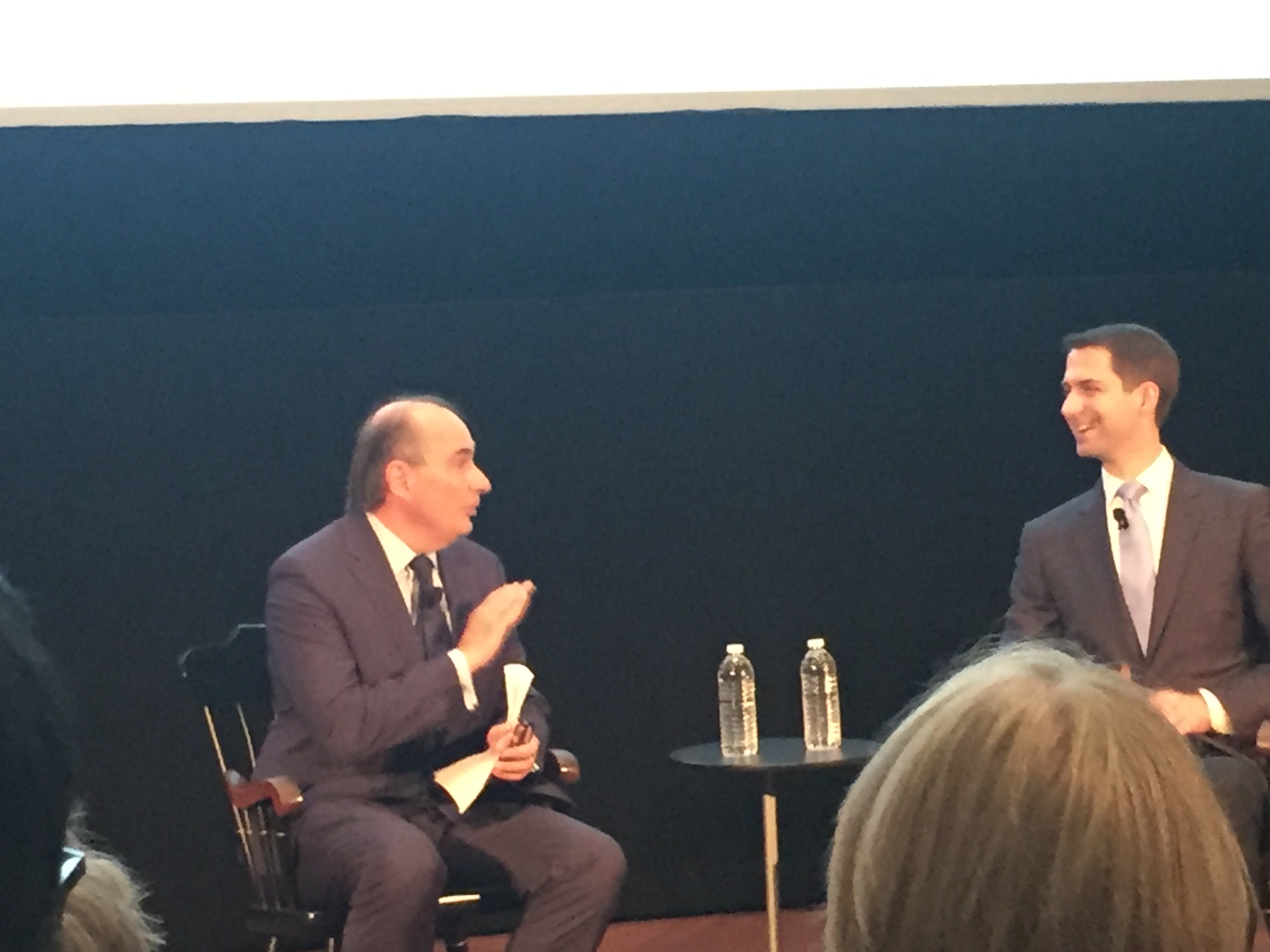
Episode art photo credit: David Axelrod interviews (confronts, debates, talks to) Senator Tom Cotton June 2, 2017 in a photo taken by Lou Agosta at the University of Chicago public debate. As one of the architects of Barack Obama’s presidential program, Ax (as he is affectionately known) would be likely to disagree with many of Senator Cotton’s more-or-less MAGA-oriented views. Take the other person as your empathy trainer! I believe both did!
(c) Lou Agosta, PhD and the Chicago Empathy Project
Notes
[i] Leslie Jamison. (2014). The empathy exams in The Empathy Exams: Essays. Minneapolis: Graywolf Press: 1–27.
[ii] Philip K. Dick. (1968). Do Androids Dream of Electric Sheep? New York: Ballentine Books, 1981.
[iii] Lou Agosta. (2010). Empathy in the Context of Philosophy. London: Palgrave: 60–61.
(c) Lou Agosta, PhD and the Chicago Empathy Project
Review: Politics of Empathy by Anthony Clohesy
The Politics of Empathy by Anthony M. Clohesy is a compellingly original and innovative engagement with empathy in a political context.
[Anthony M. Clohesy. (2013). Politics of Empathy: Ethics, Solidarity, Recognition. Oxon, UK: Routledge. 160 pp.]
I begin by expressing my admiration and enthusiasm for Clohesy’s contribution. Encountering this straight up, occasionally understated, frequently dense, work was thrilling. For me it was a page turner, albeit in a scholarly way. I saw old things in new ways. This book changed my thinking. At the risk of a military metaphor, Clohesy’s work is like two inbound cruise missiles: the first blows off the door of conventional political thinking, the second, blows up the bunker. Not for the faint of heart.
Clohesy’s big idea is that empathy is about identity and similarity, but it is just as fundamentally about differences. Key term: empathy of differences. This provides a powerful angle on that vexing issue of empathy and ethics, which has the frustrating aspect of being a chicken and egg dilemma. Does empathy found ethics, which seems too “touchy feely”; does ethics found empathy, leaving us with the counter-intuitive sense that the “bad guys” sometimes use empathy; or do empathy and ethics develop separately, leaving us with a non-empathic ethics or a non-ethical empathy? The matter starts to spin.
Clohesy’s idea (continued): the challenging relation between ethics and empathy is that they both emerge

simultaneously in the encounter with difference – the encounter with the other individual – and the result is – politics.
I now try to motivate the discussion of this innovation of an empathy of difference and recognition from an eventual encounter with the other individual. Key term: the event of an encounter.
Speaking in the first person, when I encounter an individual who is different than I am, then I have an experience of otherness. However, every person I encounter, without exception, is different than I am, even if there are many similarities between us. The other is different. Period. And, here is the punchline, without the other individual there is no empathy. Empathy is born in otherness. Empathy is a function of otherness. Empathy emerges from and in otherness. Without the other individual there is only myself – oneself – all alone. Empathy is the one thing you cannot do all alone.
The empathy of differences emerges in encountering the other individual, who resists one’s spontaneity, initiative, and one’s action, pure and simple. This resistance creates a boundary between self and what is other. The attempt to traverse this boundary and overcome the resistance requires an expenditure of effort, force, energy. This dynamic of effort and resistance, strictly speaking, is different than violence, but resembles the “violence” of Sisyphus pushing that boulder up the hill (in the myth), only to have it slide down again.
Clohesy does not use the term “resistance” and he may not agree with it, but I find I need to get to the key role in Clohesy of “violence,” which is not standard violence. This expenditure of effort, energy, or reaction to resistance, is experienced as a kind of violence.
As I read Clohesy – and he is extremely subtle on this point – the encounter with otherness inevitably turns violent in some metaphysical and even mystical sense. Or more precisely was already violent. The encounter with otherness thus entails a struggle with otherness. Otherness shows up as resistance to my will.
Clohesy denies that he uses “violence” in the ordinary sense of the word as to kill someone: “My use of the term “violence” should not be misunderstood. It does not refer to how we kill and oppress each other [….] Rather, it refers to how the fragile interiority of our lives is constituted and sustained by power” (p. 85).
Clohesy writes: “My central claim is that empathy is important, not because it can eradicate our inherited capacity for violence and cruelty, or reconfigure the deep structural forces that inhibit a transition to a more ethical world, but because it can make us more aware of our violence and cruelty. Thinking of empathy in this way is important because it allows for the emergence of a space in which more ethical relationships between us can develop” (p. 67).
I agree and align: empathy expands our awareness. But if that is all, then we are in even more trouble than we imagine because we humans are an aggressive species, highly territorial, intermittently over- or under-sexed, now armed with weapons of mass destruction. Heavily armed. Absent an intervention, this is not going to go well – indeed it is not going well. Where to go from here?
Clohesy comes into his own with an empathy of recognition. With an empathy of difference, instead of identity politics, we get a politics of recognition. Though we are different, our interests, experiences, and aspirations as human beings are recognized. Our possibilities converge instead of conflict. Our opportunities align instead of clash. We are able to cooperate instead of obstruct one another. We are able to build instead of tear down.
Talking a walk in the other person’s shoes yields an empathy of differences. One discovers the otherness of the other. The shoes rarely fit right. One discovers where the shoe pinches – but the other’s shoe almost inevitably pinches at a different spot than it pinches one’s own foot, because the other foot is slightly different – longer or shorter than one’s own.
Clohesy traces the empathy of identity and difference (recognition) through nature, religion, and culture. He invokes and critiques “otherising”: the act of essentializing the identity of others. He cites Kathleen Taylor: we are hardwired for contamination – to experience contamination or a sense thereof from contact with the othered other (p. 8).
According to Clohesy, empathic experience of difference allows us to recognize others. This is the encounter with difference: feeling into the life of another person as culture (p. 30).
On a good day, the way we engage with “others” is sufficiently empathic to understand the reasons why their values, norms and practices are often so different from our own. Clohesy is clear that “understanding” is not confused with “condoning” or “agreeing” or “approving.” We must deploy a rigorous and critical empathy that challenges practices and values with which we have issue or divergences.
Nature brings with it an empathy of identity – essentializing differences which makes them difficult if not impossible to overcome.
With nature, the shadow of tribalism falls over politics – and empathy. The empathy of identity is ultimately that of proximity to family, tribe, local community. There is nothing wrong with that. It is excellent. We would be less than human without it. But it is ultimately derivative and incomplete without an empathy of difference.
Empathy of identity gives us communalism, which provides a strong internal empathy towards family and friends and those near and dear, but does not recognize the otherness of those remote – does not acknowledge the otherness of those not proximal (those who are remote) – they are not other – they are invisible – pre-other – we may think of them but we think of them in the way of not thinking of them
Clohesy properly cites evolutionary psychology as to how our first instinct is to favor those of our own tribe, those we see as ‘our own’ (p. 47). Yet when seen in the context of empathy, the violence of nature requires that we humans must engage with strangers in a spirit of recognition and solidarity, rather than distancing ourselves from them. Clohesy does not cite Martin Luther Kind but I do: “Learn to live together as brothers or perish together as fools.” Easier said than done.
Perhaps religion can help. Regarding transcendence, Clohesy’s argument is that we can and should recognize the importance of religion without necessarily having conventional beliefs about it. He makes good use of Karen Armstrong: Religion “works” when it is appreciated in the context of myth or when it is seen in the context of unknowing. Logos could not undo, assuage, or cure human grief or find meaning in life’s suffering. For that, people turned to mythos or myth.
What then of myths? Clohesy’s is a slim volume with limited word count, but the religious and political myths are legion – mostly as echoes and allusions. The time of the mythical violence of Hobbes’s “war of all against all” or Rousseau’s State of Nature or Rawls’ Original Position. The struggle of Hegel’s master-slave dialectic, Freud’s band of brothers murdering the tyrant father and inventing an early version of the blessed Eucharist, Cain and Abel, are one-and-all echoed mystically.
Then there is the matter of The Event. One needs an encounter with The Other to get empathy started. This encounter takes on the quality of a logical reconstruction and even mythical Event. It is like the Big Bang in cosmology. It does not make sense to ask what happened before this Event, because the before/after distinction itself did not exist prior to the Big Bang, which is when time itself emerged, time being the source of the before/after distinction. Clohesy has a lot to say about the Event in the context of empathy and politics (cosmology does NOT come up, but maybe it should).
It’s not like there is a temporal sequence at this point. The other already has always been a synchronous aspect of oneself. If there is a myth, it is that human beings are unrelated. We are always already related. Definitely.
At this point, we (and Clohesy) are in mystical or metaphysical time (as near as I can figure out). Empathy is one thing one cannot an individual cannot do all alone. One may be the creator of one’s entire universe – life is literally but a dream – until one encounters the other – then one wakes up to the reality of the resistance of the other – the otherness of the other. I would rewrite certain passages using “resistance” rather than “violence,” but I do not claim this is the truth with a capital “T.”
For many people, life is experienced as pushing a boulder up a hill at which point the boulder slides down and has to be pushed up again (think about Camus and the Myth of Sisyphus). One works all month to put food on the table for the family and pay the rent, then next month one has to start over and do it again. For people who are born rich life is easier, and yet at some point everyone has the experience of pushing that boulder up the hill.
When pushing the boulder up the hill, it is hard to empathize with the boulder. It is easy to hate the boulder. But that hatred is already a form of negative empathy with the boulder. But in a mythical context one might discover that the boulder was made by the other or is itself the ultimate other.
Though Clohesy does not explicitly say so, I believe he would agree that empathy is the foundation of community, that is, the political community. But it is an empathy of difference, not one of identity. If you go with an empathy of identity, the result is tribalism. “I get you, man, and you get me, bro, because we are [mostly] alike.” But then there are all these different tribes – Democrats, Republicans, Progressive, Conservatives, Christians, Muslims, Jews, Hindus, Buddhists, Confucians, Quakers, all 193 member nations of the United Nations – not to mention the Chicago Cubs Baseball team.
Once again, though Clohesy does not explicitly say so, tribalism itself sets in motion a dialectic whereby each individual can belong to multiple tribes with multiple identities and affiliations. Even you get enough tribes and enough overlap between tribal identities, the notion of identity starts to dissolve into a kind of melting pot of multiculturalism or ecumenical spirituality or market place of competing political ideologies. Even if the melting pot never completely melts, it can at least become a colloidal suspension – cosmopolitanism – where the identities and differences are fine-grained enough not to subvert individual diversity or the aspiration to universally shared values.
But absent such a dialectic – for example, in traditional societies or insular communities – the empathy within the communal group works well enough but breaks down at the boundaries.
Clohesy’s response to the breakdown of the empathy of identity? He asserts that the protection of culture and the recognition of difference require an account of cosmopolitanism (informed by an empathy of difference). In turn, cosmopolitanism “is able to subvert essentialist conceptions of difference … the most toxic enemy of the politics of recognition” (p. 43).
Clohesy endorses a cosmopolitanism that recognizes others as equals and opposes committing arbitrary violence against others in a context of values disclosed to us by the empathic experience of difference (p. 44). Presumably non–arbitrary violence would be a police man stopping a home invasion by the bad guys. Presumably non-arbitrary violence would align with Max Weber’s definition of the state as having a monopoly over the legitimate use of force.
The mythico-metaphysical ontological aspects of Clohesy’s contribution emerges with his innovative application of Alain Badiou’s distinction of the Event, itself perhaps inspired by Heidegger’s Vom Ereignis. “Or, to put it differently, our constitution as ethical subjects requires experience of an Event in the form of the empathic encounter with difference” (p. 92). “…[E]mpathy is important in this respect because the experience of difference it makes possible to give form to our ethical lives by allowing us to emerge as beings aware of our finitude, but also aware that we are condemned to commit violence to realize that which is impossible” (p. 93). What could be clearer or more transparent?
Since this is not a softball review, it msut be said, this is as clear as mud – and yet there is something extremely original and powerful going on here. I can make some sense out of it in terms of a rational reconstruction of the encounter of the self and other, in which the other offers resistance to the self thereby bringing the intersubjective world of conditional possibilities and impossibilities into existence.
Another word of caution: Clohesy’s is work of significant scholarship, and merely well-educated readers without an academic background may find parts of it to be a challenging read, though a valuable one. I think Clohesy has read everything – okay, almost everything, relevant to politics and empathy. An impressive accomplishment.
My most significant concern is with his use of the term “violence.” As quoted above, Clohesy does not mean “killing” – I believe he means a kind of struggle or resistance or encounter with the otherness of the other than deteriorates into the violence that creates what Hegel called the butcher bench of history.
Clohesy writes of arbitrary violence. Presumably when Cain slays Abel it is arbitrary violence, but when David slays Goliath that is nonarbitrary? When Pharaoh or King Herod slaughter the First Born that is arbitrary violence? But when Yahweh takes the first born Egyptians that is non arbitrary? How about when Burnham Wood come to Dunsinane, and McDuff kills Macbeth, the tyrant? How about when the posse chases down the John Wilkes Booth, the assassin of Abraham Lincoln, and burn down the barn in which he is hiding?
In this regard, Clohesy might have done well to deploy Hannah Arendt’s fundamental distinction between violence and power. When political power of a state or regime goes down, then out come the riot police, the tear gas, the rubber (and lead) bullets. “Power down, violence up” – Arendt’s proposal – is as predictable as night following day.
In conclusion, Clohesy asserts his use of empathy opens the articulation of an account of politics that promotes and reflects a sustainable vision of the good life. He claims that the relationship between empathy and politics can and should be understood in the context of reciprocity or as elements within a virtuous circle. Clohesy further claims that, because empathy provides use with a sense of our duties to others, it allows us to see politics as something that is enabling, necessary, noble and ethical (102).
References
Anthony M. Clohesy. (2013). Politics of Empathy: Ethics, Solidarity, Recognition. Oxon, UK: Routledge. 160 pp.
© Lou Agosta, PhD and the Chicago Empathy Project

