Home » empathy as stress reduction
Category Archives: empathy as stress reduction

Empathy alone is not going to fix this thing, and it might help you get into action: empathic defects, unelected puppet masters, and the uncontrolled burn
That little voice inside that is quietly telling you “You do not make a difference” is not your friend. High probability that voice is a hostile introject based on whatever it is that you had to survive – unreliable empathy, bullying teachers, problematic parenting, or out-and-out boundary violations and trauma. It must be the first target of transformation – that is, a conversation for possibility with a trusted other, including, but not limited to, a therapist. However, it (the voice) could also just be a bad habit. Don’t believe everything you think!
The recommendations in a world of tips and techniques for dealing with dis-regulated emotions and feelings of anxiety after looking at the news, include:
- Give up: “My actions do not make a difference.” This a copout and got us into this mess in the first place. Here is the ultimate criteria: what would it take, if the political situation really deteriorates and the USA becomes a third world dictatorship (unlikely but possible) for you to be able to say that you at least had done something against the flood tide of troubles? What would it take?
- Dial down the guilt, and yet: You had not even written your Congressman or donated ten dollars to your preferred political party or representative. You had not even voted (?), and if you’d don’t vote, then you don’t get to complain about the result. Of course, that does not stop the complaining! Make a resolution to do better – and follow through. Put a reminder in your scheduler!
- Step back from the news temporarily – that is why the off button was invented – check the headlines at most twice a day and not after (say) 8 pm if one goes to bed at 10 pm – if the world ends we are gonna hear about it – the news one needs finds you.
- Take some action – attend a town hall, express your concern in a civil way over coffee about community (including political) developments to your friends and frenemies of varying views – write congress – write every senator (as I did) using the web form (https://www.senate.gov/senators/senators-contact.htm) – or at least call or write the Senators and Representatives from your home state – donate to a worthy cause of interest – whether on the left or right. Whether your action makes a difference or not, one result is you will feel better [high probability].
- Put your stress and struggle into your day job – hopefully you still have one! Put your suffering into your work – expand your productivity.
- Other stress reduction activities – spa treatments (cost money) such as massage, time in a sensory deprivation tank, swimming, yoga, tai chi, martial arts. Notice that what many of these things have in common is that they are activities that get one out of one’s head, have a calming effect on the body, and leave person feeling good, enhancing mood and spirit. Note that empathy is also on the short list of stress reducers, including getting a good listening form a committed listener who is able to provide a gracious and attentive ear.
- You may say that the previous two bullets do not make a difference to the community’s predicament. However, they do. One cannot be effective if one is too anxious to take action. Whether or not your action is a silver bullet and produces a breakthrough in the community, as noted above, one result of your action is that you will feel better and that you have done something to make a difference (high probability).
- With practice, one gets good at rhetorical empathy: speaking truth to power. The best short example of this I can find is Malcom-X’s statement to the mostly African American audience around Thanksgiving: “You did not land on Plymouth Rock; Plymouth Rock landed on you!” Malcolm’s zinger got a lot a Amens and knowing laughter, for it concisely expressed and gave back to the listeners the experience of struggle and accomplishment of the community.
- A longer example of rhetorical empathy (Blankenship 2019) is Bob Dylan’s early comments on climate change: “Come gather ‘round people / Wherever you roam / And admit that the waters / Around you have grown / And accept it that soon / You’ll be drenched to the bone / If your time to you is worth savin’ / Then you better start swimmin’ or you’ll sink like a stone / For the times they are a-changin’”(1965: 81)
Defective empathy: A certain multi-billionaire advisor to the White House (hereafter known as “M”:) says empathy is a defect of western civilization. Key term: defect. Presumably we should cancel it to avoid becoming uncivilized? (For the sound byte see: https://youtube.com/shorts/LWvOvgjNEds?si=GByQLE0yoFDyWtTr ). Of course, lack of empathy is a short definition of “uncivilized,” and more on that shortly. This is a sound byte; however, M has expounded at greater length as reported in the following CNN article:
https://www.cnn.com/2025/03/05/politics/elon-musk-rogan-interview-empathy-doge/index.html
What M did not point out is that empathy does not work with bullies or abusers, who will take whatever vulnerability you may exhibit and use it against you. This is also the case with anti-social personality disorder – individuals with a defective conscience who struggle to tell right from wrong, though without interviewing M, one has no way of knowing M’s or any individual’s mental status. One possibility is that the individual is projecting his own defective, unreliable empathy onto the community as an empathic defect. If ever there was a disqualifying statement by a would-be administration, M’s soundbite is it.
Presumably a statement that “empathy is a defect” would be a justification of the unempathic “slash and burn” bullying methods of the unelected puppet masters at Doge [pronounce: “dog”], showing up at the IRS and Social Security offices and so on and demanding to see confidential citizen data and/or seemingly randomly sending employees home (“firing” them).
In addition, one must not overlook the power of top down, cognitive empathy in thinking like one’s opponent in order to overcome him. “Top down,” cognitive empathy is detailed in Mikah Zeno’s Red Team! (Basic Books 2015) according to which taking a walk in the other’s shoes (the folk definition of empathy) provides advantages in relationships, business, politics, and building communities that are thrive on inclusiveness. Notwithstanding M’s assertions of support for humanity, empathy is usually interpersonal, one-on-one, and, according to the report on CNN and Joe Rogan interview, we are unlikely to get any empathy from this guy. If one were looking for a short disqualifying reason to sideline unelected puppet masters such as M and fellow traveller Stephen Miller (see more on him below), this is it. I leave it to the reader to figure out who is the puppet.
To say that empathy is defective is like saying that carpentry is defective because Roman soldiers used hammers and nails to execute criminals and political prisoners by crucifying them. Like every human knowledge and capacity, empathy can breakdown, go astray, and go off the rails as projection, emotional contagion, conformity. communications getting lost in translation. You wouldn’t be any good at mental arithmetic if you didn’t practice it. Though vastly different than arithmetic, empathy requires practice and improvements based on learning from one’s mistakes.
Unelected puppet masters: As regards Stephen Miller, a common name, the reference is to the Deputy White House Chief of Staff. According to the Southern Poverty Law Project, which tracks hate groups: “Stephen Miller is credited with shaping the racist and draconian immigration policies of President Trump, which include the zero-tolerance policy, also known as family separation, the Muslim ban and ending the Deferred Action for Childhood Arrivals (DACA) program. Miller has also “purged” government agencies of civil servants who are not entirely loyal to his extremist agenda, according to a report in Vanity Fair” [. . . .] In response to seeing photos of children being separated from their parents at the U.S. border with Mexico as a result of the zero-tolerance policy, an external White House adviser, in a Vanity Fair report, said, “Stephen actually enjoys seeing those pictures at the border” (see: https://www.splcenter.org/resources/extremist-files/stephen-miller/). On further background, in case you haven’t heard of the Southern Poverty Law Project, these are the guys (attorneys) who were wearing bullet proof vests while going to the trial(s) that bankrupted the KKK (granted hatred is a many-headed monster and some version was reborn).
The uncontrolled burn: What are you talking about? This is a description an approach to cost cutting. As in forestry, the forest rangers sometimes undertake a “controlled burn” to clear away the underbrush that accumulates and might result in a truly catastrophic forest fire – for example, an uncontrolled forest fire that burns down a whole town or suburb. It has rarely happened that a controlled burn got out of hand and resulted in a major forest fire. This is a description of the so-called Department of Government Efficiency’s (Doge’s) approach to cost cutting. Uncontrolled burn. My take – who else’s would it be? – is that the cost cutting “wizards” are undertaking an uncontrolled burn. Think: slash and burn.
It will be purely accidental if major damage does not occur before a combination of judicial, legislative, and law enforcement actions puts the brakes on this run away trolley car (which seems to have lost its brakes). In other words, what we are seeing in the daily drumbeat of extralegal, illegal, and provocative executive orders is an uncontrolled burn. Unfortunately, unless the citizens step up and communicate with their legislators at a volume and degrees we have not yet seen, we will know the burn is uncontrolled when social security checks to get deposited/mailed; a major terrorist attack (God forbid!) on the scale of Sept 11 occurs because law enforcement is chasing undocumented workers with families who have lived here for decades; another pandemic due to gutting the CDC and FDA. Another negative scenario (please do not shoot the messenger) is that worldwide tariffs contribute significantly to triggering another Great Depression as occurred with the Smoot-Hawley tariffs of 1930. I am cynical enough to think that is what some misguided individuals in the current administration in Washington, DC, are trying to accomplish for their own misguided reasons. [The trade fight worsens: https://www.wsj.com/economy/trade/trade-war-explodes-across-world-at-pace-not-seen-in-decades-0b6d6513?mod=hp_lead_pos3 ]
Regarding Social Security Administration (SSA), it is widely know (but perhaps not widely enough) that social security is a self-funded retirement plan operated by the US Government. People pay money into the trust fund in the form of social security taxes on their earnings; and the same people are entitled to get money out at retirement age. So no one is giving anyone charity or welfare here. It is a further challenge that the fund has become something of a political football through creative accounting, which has used it to subsidize the overall budget. Though I hope a breakdown of the SSA does not occur, if it does, and payments are missed, the howls across this nation will be loud enough to hear in the deepest bunker in government. We seem to be heading in that direction: https://tinyurl.com/2v85hwdr [SSA under stress – a lot of stress]
The challenge with social networking (e.g., Facebook (FB)) is that an inaccurate statement gets multiplied a hundred times, a thousand times, a hundred thousand times and a million times. Back in the days (1776-ish) of Sam Adams Committees of Correspondence, it took five days for a letter to to get from New York to Philadelphia. One had time to think about the consequences of one’s proposed actions.If one said “The British are combining!” and they were not coming, then one had time to correct one’s errors and minimize the damage.
With social networking, there is something about the anonymity, fake neutrality, and misleading disinterestedness that stand in strong contrast to previous media channels. Radio and television as used by FDR (President Franklin D Roosevelt) and Hitler (master-minded the killing of millions of people; the good guy and the bad guy!), but, when a falsehood was stated, one could eventually figure out who uttered it. With the proliferating fake identities of social media, the entire context becomes fake. As Mark Zuckerberg is reported to have said of FB: “We are no longer fact checking.” I take that to mean: A new sign over the Facebook portal: “Abandon facts all ye who enter here”? Like the inscription over the entrance to Dante’s version of hell.
Critical thinking going forward: Let us conclude with a positive proposal: Teach critical thinking. This is the empathic educational moment. Absent a rigorous and critical practice of empathy, I am cautious about engaging current political clichés in a highly polarized political world and “rhetoric” in the negative sense.
Critical thinking includes putting oneself in the place of one’s opponent—not necessarily to agree with the other individual—but to consider what advantages and disadvantages are included in the opponent’s position. Taking a walk in the Other’s shoes after having taken off one’s own (to avoid the risk of projection) shows one where the shoe pinches. This “pinching” —to stay with the metaphor—is not mere knowledge but a basic inquiry into what the Other considers possible based on how the Other’s world is disclosed experientially. Critical thinking is a possibility pump designed to get people to start again listening to one another, allowing the empathic receptivity (listening) to come forth.
In our day and age of fake news, deep fake identity theft, not to mention common political propaganda, one arguably needs a course in critical thinking (e.g., Mill 1859; Haber 2020) to distinguish fact and fiction. Nevertheless, I boldly assert that most people, not suffering from delusional disorder or political pathologies of being The True Believer (Hoffer 1953)), are generally able to make this distinction.
A rigorous and critical empathy creates a safe zone of acceptance and tolerance within which people can inquire into what is possible—debate and listen to a wide spectrum of ideas, positions, feelings, and expressions out of which new possibilities can come forth. For example, empathy and critical thinking support maintaining firm boundaries and limits against actors who would misuse social media to amplify and distort communications. Much of what Jürgen Habermas (1984) says about the communicative distortions in mass media, television, and film applies with a multiplicative effect to the problematic, if not toxic, politics occurring on the Internet and social networking.
The extension to issues of politics, climate change, and community struggles follows immediately. Insofar as individuals skeptical of empathy are trying to force a decision between critical thinking and empathy, the choice must be declined. Both empathy and critical thinking are needed; hence, a rigorous and critical empathy is included in the definition of enlarged, critical thinking (and vice versa). (Note that “critical thinking” can mean a lot of things. Here key references include John Stuart Mill 1859; Haber 2020; “enlarged thinking” in Kant 1791/93 (AA 159); Arendt 1968: 9; Habermas 1984; Agosta 2024.)
In conclusion, a positive alternative to abandoning facts and skipping critical thinking is suggested by Bob Dylan’s song about empathy. One has to push off the shore of certainty and venture forth into the unknown. We give Dylan the last word (1965: 185) : “I wish that for just one time / You could stand inside my shoes / And just for that one moment / I could be you” [.]
References
Lou Agosta. (2024). Empathy Lessons. 2nd Edition. Chicago: Two Pears Press.
Hannah Arendt. (1952/1958). The Origins of Totalitarianism, 2nd Edition. Cleveland and New York: Meridian (World) Publishing, 1958.
________________. (1968). Men in Dark Times. New York: Harvest Book (Harcourt Brace).
Lisa Blankenship. (2019). Changing the Subject: A Theory of Rhetorical Empathy. Logan UT:
Bob Dylan. (1965). Bob Dylan: The Lyrics: 1961–2012. New York: Simon and Schuster.
Jonathan Haber. (2020). Critical Thinking. Cambridge, MA: The MIT Press.
Jürgen Habermas. (1984). The Theory of Communicative Action, Vol 1, Thomas McCarthy (tr.). Boston: Beacon Press.
Eric Hoffer. (1953). The True Believe: Thoughts on the Nature of Mass Movements. New York: Harper Perennial.
Immanuel Kant. (1791/93). Critique of the Power of Judgment, Paul Guyer and Eric Matthews (trs.). Cambridge: Cambridge UP, 2013. edition.
(c) Lou Agosta and the Chicago Empathy Project
Image Credit: Wikimedia: Peter Trimming: ‘The Scream’ – geograph.org.uk – 3200603.jpg / Creative Commons Attribution-Share Alike 2.0

How I changed my relationship with pain
Expanded power over pain is a significant result that may usefully be embraced by all human beings who experience pain – which describes just about everyone at some time or another. Acute pain communicates an urgent need for intervention; chronic pain is demoralizing and potentially life changing. Intervention required!
People who do not experience standard amounts of pain are at risk of hurting themselves. Dr. James Cox, senior lecturer at the Wolfson Institute for Biomedical Research at University College London, notes, “Pain is an essential warning system to protect you from damaging and life-threatening events” (Jacquelyn Corley (Stat2019)). Admittedly not experiencing pain is a rare and concerning condition from which few of us suffer. Hence the practical approach considered here for the rest of humanity.
I changed my relationship to pain by working on the relationship. The result is that less pain occurs in my life and the pain that I do experience does not dominate my life. If one is completely pain-free, one is probably dead, which has different issues.
The following behaviors made a difference. Regular exercise, healthy diet, spiritual discipline (I have trained extensively in Tai Chi, but Yoga and/or meditation encompass the same results), consultations with professionals of one’s choice including medical doctors; and, here is the wild card, the purpose of this post: education in the different types of pain, including but not limited to acute pain versus chronic pain. The reader may say, “Holy cow! That’s too much work!” However, if the reader is in enough pain, then consider the possibility. What’s the alternative? Continue to suffer? Medically assisted suicide (where legal)? Opioids? The latter in particular have a place in hospice (end of life scenarios), in the week after surgery, but otherwise they are a deal with the devil. And, in any deal with the devil, be sure to read the fine print. “At a time when about 130 American die daily from opioid overdoses, scientists and drug companies are actively pursuing alternative non-opioid medications for acute and chronic pain” (Jacquelyn Corley (Stat 2019)).
An example will be useful. I changed my relationship to pain, following my MDs guidance, by taking a double dose of NSAIDs – non steroidal anti-inflammatory “pain killers”. The idea is to “kill” the pain without killing the patient. This is no joke because NSAIDs such as Aleve can damage the mucous membranes of the gastro intestinal track (e.g., stomach), leading to ulcer-like conditions and the accompanying risks (not detailed here), which is why, even though they are over-the-counter, consultation with a medical doctor is important.
Doing Tai Chi changed my relationship to pain. Your mileage may vary, but I started to see results after ten weeks of dedicated daily work. My Tai Chi training has continued with one lengthy interruption for six years. My experience was the practice moved the pain threshold up. That is, I did not experience pain as acutely and when I did experience pain, it did not bother me as much. This can be a double-edged consideration. For example, the Tai Chi exercise of “holding the ball” is a stress position. One really needs a picture to see what this is.

One stands there with one’s arms encompassing a large ball at about the level of one’s chest with one’s hips tucked slightly as if sitting back. One’s whole body is engaged and conditioned. After about ten minutes one starts to heat up and after about fifteen minutes one starts to sweat. This is Tai Chi, not Yoga, but Mircea Eliade discusses similar stress positions that generate Shamanic Heat (Eliade, (1964), Shamanism, translated Willard Trask. Princeton University Press (Bollingen)).
Now a word of caution regarding the pain threshold. I went for a dermatological treatment and I got burned, literally, (fortunately, not too seriously), because I did not say “Stop – it hurts!” Granted that most people want to experience less pain, it is important to not extinguish pain completely, because pain in its acute presentation is trying to tell one something – in this case, injury to one’s skin due to heat.
Here is another example. A colleague has an inflamed ankle. It throbs. It hurts. It is not fractured but imaging shows it is enflamed, stressed out. The thing is that this is not just the person’s sprained ankle – it is his whole life. Since he needs to lose weight, he needs to get exercise. Because he cannot get sufficient exercise, he cannot lose weight. The extra weight contributes to the ankle continuing to be stressed. Double-bind! Rock and the hard place. How is this individual going to break out of this tight loop? Now I know this is going to sound crazy, but here it is: Follow doctor’s orders! Go to the physical therapy! If you have got to wear “the boot” for a couple of weeks, do so. Start low (with the number of repetitions of exercises) – go slow. If the person had access to a swimming pool, that would be ideal, but that might not be workable for many people. SPA-like treatments, soaks in Epsom salts in sensory deprivation pods have value.
Many parallel examples can be cited in which a person knows exactly what she has to do (don’t even worry about the doctor) – why is the person not doing it? Many reasons exist, but one of them is that suffering becomes a comfort zone. Suffering is sticky. “Yes, I am miserable,” the individual says, but it is a familiar misery. Suffering has become an uncomfortable comfort zone. What would it take to give that up? Once one realizes, “This is what crazy looks like,” it becomes easier to give up the suffering. This is not a deep dive into the psychology of the unconscious, yet this is not merely a physical challenge. Yes, the ankle hurts – objectively, there is even an image that shows inflammation, albeit hazy and faint. However, even if there weren’t evidence of an injury – and soft tissue damage often escapes imaging, the emotional issue – ambivalence about one’s body image (“weight”) – gets entangled with the person’s whole life. In this case, a struggle with unhealthy excess weight – and the person’s emotions run with the ball – elaborate the injury psychologically. This is also a form of catastrophizing or awfulizing (made famous by cognitive behavioral therapy (CBT)), but CBT did not invent it.
I gave the example of an inflamed ankle, but it might also apply to lower back pain, headaches, asthma, irritable bowel syndrome (IBS), which are notoriously difficult to diagnose medically. Speaking personally, I want a quick fix. We all do. However, after a while, if the “fix” does not occur, there is no in principle limit on the amount of time and effort one can spend trying to find a quick fix. After a certain time, one gets a sense that one might put the time and effort into incremental progress – finding whatever moves the dial – whatever shifts the stuckness. Here’s what I did not want to hear: This is gonna take some work. After a time, one decides to roll up the sleeves and do the hard work need to get one’s power back. Healthy diet and a well-defined exercise program are important components. Finding an MD and/or health care provider including physical therapist where the interpersonal chemistry works is on the critical path to dialing down the suffering. Here “interpersonal chemistry” is another description for empathy. Look for someone whose empathy is open enough to encompass one’s pain and suffering without being coopted by it. This is the critical path to recovery.
The distinction between acute pain and chronic pain needs to be better understood by the average citizen. An excerpt from Neurology 101 may be useful. In acute pain, the peripheral nervous system in the body’s appendages such as one’s toes reports via neural connections to the central nervous system (e.g., the brain in one’s head). The impact of a heavy object such as a large brick with my toe releases neurotransmitters at the nociceptors (we are not talking Greek and “nocio” means “pain”). The mechanics are such that a message is delivered from the periphery to the center that what is in effect a boundary violation – an injury – has occurred. The brain then tells the toe to hurt – “Ouch!” The message is delivered seamlessly to the conscious person to whom the toe “belongs” in the neural map that associates the body with conscious experience unfolding in the person’s awareness. The toe which had quietly been doing its job in helping the person walk, balance, be mobile now makes a lot of “noise” – it starts throbbing. This is what acute pain feels like.
With chronic pain the scenario gets complicated. If the injury is subjected to other stressors, slow to heal, reinjured, or otherwise neglected, then the pain may continue across a period of days or weeks and become habitual. In effect, the pain signal becomes a bad habit. The pain takes on a life of its own. What does that even mean? What starts out as a way of reminding the person to attend to the injury gets stuck on “repeat”. Like the marketing company that keeps sending your notices even after you specify “Do not solicit!” The messaging is not just from the toe to the brain, from the periphery to the center, but it gets reversed. The messaging is from the center to the periphery, from the brain to the body part. The brain tells the periphery to hurt. Chronic pain becomes a source of suffering. Here “suffering” expands to include worry that anticipates and/or expects pain, which gets further reinforced when the pain actually shows up.
The poster child for chronic pain is phantom limb pain. Not all pains are created equal. Phantom limb pain provides compelling evidence that pain is “in one’s head” only in the sense that pain is in the brain and the brain is in one’s head. Only in that limited sense is pain in one’s head. Yet the pain is not imaginary. Documented as early as the American Civil War by Silas Weir Mitchell, individuals who had undergone amputation, felt the nonexistent, missing limb to itch or cramp or hurt. The individuals experienced the nonexistent tendons and muscles of the missing limb as cramping and even awakening the person from the most profound sleep due to pain (As noted, further in Haider Warraich. (2023). The Song of Our Scars: The Untold Story of Pain. New York: Basic Books, pp. 110 – 111).
Fast forward to modern times and Ron Melzack’s gate control theory of pain marshals such phantom limb pain as compelling evidence that the nervous system contains a map of the body and the body’s pains point, which map has not yet been updated to reflect the absence of the lost limb. In effect, the brain is telling the individual that his limb is hurting using an obsolete map of the body – the memory of pain. Thus, the pain is in one’s head, but not in the sense that the pain is unreal or merely imaginary. The pain is real – as real as the brain that is indeed in one’s head and signaling (“telling”) one that one is in pain. (R. Melzack, (1974), The Puzzle of Pain. Basic Books.)
Whatever the level of pain, stress is probably going to make it feel worse. Therefore, stress reduction methods such as meditation, Tai Chi, Yoga, time spent soaking in a sensory deprivation pod, and SPA-like stress reduction methods are going to be beneficial in moving the pain dial downward.
One question that has not even occurred to scientists is whether it is possible to have the functional equivalent of phantom limb pain, even though the person still has the limb functionally attached to the body. This sounds counter-intuitive, but think about it. If there is a map of the body’s pain points in the central nervous system (the brain), there is nothing that says “phantom” pains cannot occur even if an appendage still exists. For example, the high school football player who needs the football scholarship to go to college because he is weak academically; he is not good at baseball, but actually hates football. He incurs a soft tissue sports injury, which gets elaborated due to emotional conflict about his ambivalent relationship with football, leaving him on crutches for far-too-long and both physically and symbolically unable to move forward in his life. As if the only three life choices are football, baseball, and academics?! Note that the description of the injury “painful soft tissue” already opens and shuts approaches to treatment. That is the devilish thing – what is the actual and accurate description? Thus, due to the inherent delays in neuroplasticity – the update to the brain’s map of the body is not instantaneous and one does not have new experiences with a nonexistent limb – pain takes on a life of its own.
Though an oversimplification, the messaging between the peripheral and central nervous systems is reversed. Instead of the peripheral limb telling the brain of a “hurt,” the brain develops a “bad habit” of signaling pain and tells the limb to hurt. That is the experience of chronic pain – pain has a life of its own – pain becomes the dis-ease (literally), not the symptom. What then is the treatment, doctor? Physical therapy (PT) – exercises to strengthen the knee and, in effect, teach him to walk again.
Chronic pain is discouraging, demoralizing, fatiguing, exhausting, negatively impacting one’s mental status. I have been cagey about my own experience of pain in this post, but it is a matter of record that I have osteoarthritis, a progressive deterioration of the cartilage in joints such as occurs in people who are getting older and who are long term runners. The person understandably and properly continuously asks himself – what am I experiencing? And does it include pain? No one is saying the “cure” is don’t think about it (pain), don’t worry about it. No one is saying “play hurt”? “Playing hurt” is a bad idea for so many reasons, including one is going to make a bad injury worse. Professional athletes who “play hurt” may indeed get a bunch of money, but they also often dramatically shorten their careers – and that costs them money.
While distraction from one’s pain can be useful in the short term, it is not a sustainable solution. Rather when, after medical determination of the sources of pain are determined to be unable to be completely extinguished or eliminated, one is saying undertake an inquiry into what one is really experiencing. Rather than react to the uncomfortable twinges and twitches, bumps and thumps, prodding and pokes, that one encounters, ask what one is really feeling. Undertake an inquiry into what one is experiencing. If, upon consideration, the answer is “The pain is acute going from 4 to 8 to 9 on the 10 point scale,” then stop and call for backup, including taking pain killers such as NSAIDS as recommended by an MD.
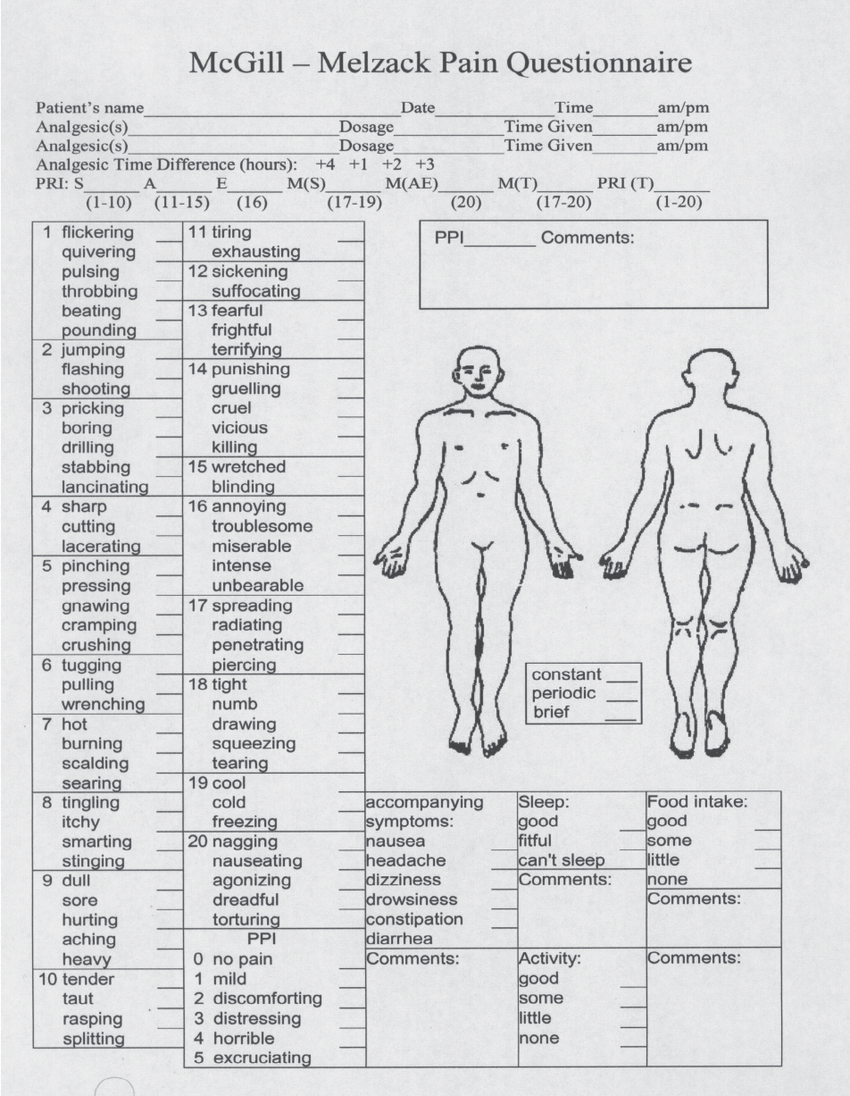
Here the vocabulary of pain is relevant. See Melzack’s McGill pain chart. [List the vocabulary]
Further background information will be useful. Haider Warraich, MD, in The Song of Our Scars: The Untold Story of Pain (Basic Books, 2023) radicalizes the issue of pain that takes on a life of its own before suggesting a solution. After providing a short history of opium and morphine and opioids, culminating “in the most prestigious medical school on earth, from the best teachers and physicians, we [medical students] were unknowingly taught meticulously designed lies” (p. 185), that is, prescribe opioids for chronic pain. The reader wonders, where do we go from here? To be sure opioids have a role in hospice care and the week after surgery, but one thing is for certain, the way forward does not consist in prescribing opioids for chronic pain.
After reviewing numerous approaches to integrated pain management extending from cognitive behavioral therapy and acceptance and commitment therapy (ACT) to valium, cannabis and Ketamine – and calling out hypnosis (hypnotherapy) as a greatly undervalued approach (no external chemicals are required, but the issue of susceptibility to hypnotic suggestibility is fraught) – Dr Warraich recovers from his own life changing back injury in a truly “physician heal thyself” moment thanks to dedicated PT, physical therapy (p. 238). If this seems stunningly anti-climactic, it is boring enough to have the ring of truth earned in the college of hard knocks, but it is a personal solution (and I do so like a happy ending!), not the resolution of the double bind in which the entire medical profession finds itself (pp. 188 – 189). The way forward for the community as a whole requires a different, though modest, proposal. The patient signs up for and completes physical therapy (PT), a custom set of exercises tailed to his pain condition and mobility issues.
The philosopher Ludwig Wittgenstein wrote, “The body is the best picture of the soul.” The default since René Descartes is to distinguish physical pain from psychic pain – what used to be called the difference between “body” and “soul” before science “proved” that the soul did not exist. (Once again, we are talking Greek “psyche” is the Greek word for “souI.”) Nevertheless, in spite of the “proof” that the soul does not exist, soul-like phenomena keep showing up. For example, if the person’s “soul” is regularly subjected to negative verbal feedback from those in authority, the person becomes physically ill – ulcers, headaches, lower back pain, irritable bowel syndrome (IBS). As noted, these are notoriously difficult to diagnoses. The adverse childhood experience survey (ACE) provides solid evidence that psychic and moral injuries correlate significantly with major medical disorders (e.g., Felitti 2002).
One big issue is that we (science and scientists) lack a coherent, effective account of emergent properties. One with neurons. The alternative is the current reductive paradigm according to which, in spite of contrary assertions, on has trouble explaining that things really are what they seem to be – that table are tables andmade of microscopic components such as atoms. We start with neurons. We are neurons “all the way down.” Neurons generate stimuli; stimuli generate sensations/experiences; experiences generate [are] responses; responses form patterns; patterns generate meaning; meaning generates language. With the emergence of language, things really start to get interesting. Organized life reaches “take off” speed. Language generates community; community generates – or rather is functionally equivalent to – culture, art, poetry, science, technology, and the world as we know it.
What about individuals who are put in a double-bind by circumstances as when someone in authority makes a seemingly impossible demand? For example, the army Sargent gives what seems to be a valid military order to the corporeal to shoot at the rapidly approaching auto, thinking it is a suicide car bomb, but it is really an innocent family. The soldier, thinking the order is valid and that he is protecting his team, follows the order. The solider is now both a perpetrator and a survivor. People have gotten hurt who ought not to have been hurt. Moral inquiry. Moral trauma has occurred. Tai Chi is not going to save this guy. This take the form of guilt – which is aggression – hostile feeling and anger – turned against one self. The individual’s agency – the individual’s power as an agent to choose – is compromised by contingent circumstance, including the individual’s unavoidable choice in the circumstance, since taking no action is also a choice.
This is why the ancient Greeks invented tragedy. A careful reading of the Greek tragedies, which cannot be adequately canvassed here, shows that virtually every tragic hero has the compromised agency characteristic of a double bind. Oedipus is a powerful agent, yet compromised and brought low by inadequate information. Information asymmetries! Antigone’s agency is bound, doubly, by the conflict between the imperatives of politics and the integrity of family. Agamemnon’s agency is compromised by the negative aspect of honor and pride and an overweening narcissism. Iphigenia’s agency is compromised by literally being bound and gagged (admittedly a limit case). Double-binds have also been hypothesized to contribute to the causation of major mental illness (Bateson 1956). Contradictory messages from parents, explicit versus implicit, spoken versus unspoken, are particularly challenging. Here the fan out to related issues is substantial.
I changed my relationship to pain and suffering by reading all thirty existing Greek tragedies. One might say if something is worth doing, it is worth over-doing, and the reader might try starting with just one. Examples of pain and suffering occur in abundance: acute pain – Hercules puts on the poisoned cloak, which burns his flesh; chronic pain – Philoctetes has a wound that will not heal and throbs periodically with painful sensations; and suffering – Oedipus is misinformed about who is his birth mother and after having children with her he suffers so from his awareness of his violation of family standards that he mutilates himself, tearing his eyes out. The latter would, of course, be acute pain, but the cause, the trigger, is thinking about what he has done in relation to the expectations of the community, namely, violating the incest taboo.
Now, according to Aristotle, the representation of such catastrophes is supposed to evoke pity and fear in the audience (viewer) of the classic theatrical spectacle. Indeed, such spectacles – even though the violence usually happens “off stage” and is reported – are not for the faint of heart. We seem to want to identify with the characters in a narrative, which, in turn, activates our openness to their experiences in an entry level empathy that communicates a vicarious experience of the character’s struggle and suffering. Advanced empathy also gets engaged in the form of appreciation of who is the character as a possibility in relation to which the viewer (audience) considers what is possible in her of his own life. One takes a walk in the other’s shoes, after having taken off one’s own. Other examples of similar experiences include why (some) people like to see horror movies. One does not run screaming from the theatre, but conventionally appreciates that the experience is a vicarious one – an “as if” or pretend experience. Likewise, with “tear jerker” style movies – one gets a “good cry,” which has the effect of an emotional purging or cleansing.
Now I am not a natural empath, and I have had to work at expanding my empathy. In contrast, the natural empath is predisposed, whether by biology or upbringing (or both), to take on the pain and suffering of the world. Not surprisingly this results in compassion fatigue and burn out. The person distances him- or herself from others and displays aspects of hard-heartedness, whereas they are actually kind and generous but unable to access these “better angles.” It should be noted that empathy opens one up to positive emotions, too – joy and high spirits and gratitude and satisfaction – but, predictably, the negative ones get a lot of attention.
“Suffering” is the kind of thing where what one thinks and feels does make a difference. Now no one is saying that Oedipus should have been casual about his transgressions – “blown it off” (so to speak); and the enactment does have a dramatic point – Oedipus finally begins to “see” into his blind spot as he loses his sight. Really it would be hard to know what to say. Still, the voice of reality would council alternatives – other ways are available of making amends – making reparations – perhaps more than two “Our Fathers” and two “Hail Marys” as penance – what about community service or fasting? “Suffering” is not just a conversation one has with oneself about future expectations. It is also a conversation one has with oneself about one’s own inadequacies and deficiencies (whether one is inadequate or not). For example, unkind words from another are hurtful. In such cases what kind of “pain” is the hurt? We get a clue from the process of trying to manage such a hurt. The process consists in setting boundaries, setting limits, not taking the words personally (even though inevitably we do). The hurt lives in language and so does the response. Therefore, in an alternative scenario, one takes the bad language in and turns it against oneself. One anticipates a negative outcome. One gets guilt (once again, regardless of whether one has does something wrong or not).
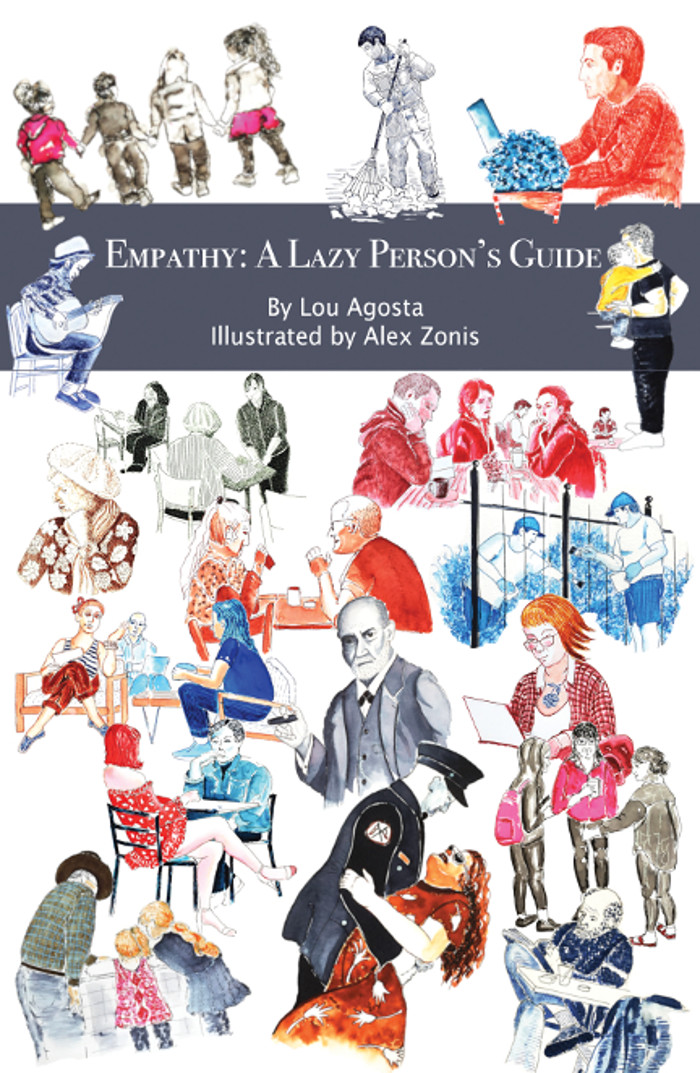
The coaching? If you are suffering from compassion fatigue, then dial down the compassion. This does not mean become hard-hearted or mean. Far from it. This means do not confuse a vicarious experience of pain and suffering with jumping head over heels into the trauma itself. What may usefully be appreciated is that practices such as empathy, compassion, altruism are not “on off” switches. They are not all or nothing. Skilled executioners of these practices are able to expand and contract their application to suit the circumstances. To be sure, that takes practice. The result is expanded power over vicariously shared pain and suffering. One gets power back and is able to assist the other in recovering their power too. (Further tips and techniques on how to change one’s thinking and expand one’s empathy are available in my Empathy: A Lazy Person’s Guide (with 24 full color illustrations by Alex Zonis), also available as an ebook.)
Before concluding, I remind the reader that “all the usual disclaimers.” This is a personal reflection. The only data is my own experience and bibliographical references that I found thought provoking. “Your mileage may vary.” If you are in pain (which, at another level and for many spiritual people, is one definition of the human condition) or if you are in the market for professional advice, start with your family doctor. If you do not have one, get one. Talk to a spiritual advisor of your own choice. Above all, “Don’t hurt yourself!” This is not to say that I am not a professional. I am. My PhD is in philosophy (UChicago) with a dissertation entitle Empathy and Interpretation. I have spent over 10K hours researching and working on empathy and how it makes a difference. So if you require expanded empathy, it makes sense to talk to me. A conversation for possibility about empathy can shift one’s relationship with pain.
Bibliography
Bateson, G., Jackson, D. D., Haley, J. & Weakland, J., 1956, Toward a theory of schizophrenia. Behavioral Science, Vol. 1, 251–264.
Corley, Jacquelyn. (2019). The Case of a Woman Who Feels Almost No Pain Leads Scientists to a New Gene Mutation. Scientific American. March 30, 2019. Reprinted with permission from STAT. https://www.scientificamerican.com/article/the-case-of-a-woman-who-feels-almost-no-pain-leads-scientists-to-a-new-gene-mutation/
Eliade, Mircea. (1964). Shamanism. Princeton University Press (Bollingen).
Felitti VJ. (2002). The Relation Between Adverse Childhood Experiences and Adult Health: Turning Gold into Lead. The Permanente Journal (Perm J). 2002 Winter;6(1):44-47. doi: 10.7812/TPP/02.994. PMID: 30313011; PMCID: PMC6220625.
Melzack, R. (1974). The Puzzle of Pain. New York: Basic Books.
(c) Lou Agosta, PhD and the Chicago Empathy Project

Empathy Lessons, 2nd Edition, is now available as an ebook…
The release of the ebook version of Empathy: Lessons ,2nd Edition, coincided with a major astronomical event – the total solar eclipse that traversed North America on Monday April 8, 2024. The gods are watching and winking at us humans to encourage expanding our empathic humanism!
Empathy is oxygen for the soul (see Chapter 6: Evidence-based empathy training). So, if you are short of breath due to life stress, get the expanded empathy delivered in this book. Just as the body needs oxygen to live physically, the soul needs empathy to live emotionally. Most people are naturally empathic, but the cynicism and denial needed to survive everyday life drives empathy away. Remove the obstacles to empathy and empathy naturally develops and grows. That is the empathy lesson in a nutshell without all the guidance and practice needed to succeed. Find out how to take your empathy to the next level.
In addition to all the features of the First Edition—a readiness assessment for empathy, tips on overcoming resistance to empathy, evidence-based empathy training, empathic techniques of stress reduction, applications to dealing with bullying, healthy well-being, and capitalism—the enlarged Second Edition includes new chapters on rhetorical empathy in politics, the limitations of empathy (and what to do about them), and an expanded chapter on empathy as a lens on love and romance. Not to be missed!
The empathy lessons include how—
To perform a readiness assessment; establish a set up for success in cleaning up inauthenticities that block empathy so that empathy can expand and flourish;
Empathy is not an “on–off” switch but a tuner (a dial) that expands or contracts in accessing the vicarious experience of the other person;
Empathy works as a method of data gathering about the other person, providing a vicarious experience of the other person without being flooded by the experience;
Introspection, vicarious experience, listening to one’s own “voice over” and radical acceptance are the royal road to empathic receptivity;
Empathic receptivity overcomes emotional contagion, creating a set up for clear communication of feelings and experiences;
Empathic understanding overcomes conformity and enables shifting out of stuckness into contribution, transformation, and leadership, including satisfying and flourishing relationships;
Empathic interpretation overcomes projection and is the folk definition of empathy, walking in another’s shoes, adding “top down” empathy to “bottom up,” empathic receptivity;
Empathic responsiveness drives out anger and rage, acting as a soothing balm to suffering and emotional upset, deescalating conflict and aggression;
Scientific, peer-reviewed, evidence-based research confirms that empathy reduces inflammation and stress;
Relationships get “weaponized” in bullying and, coming from empathy, how to overcome bullying, reestablishing boundaries: recommendations to students, teachers, administrators on how to stop bullying (including cyber-bullying) and promote empathy;
“Corporate empathy” is not a contradiction in terms, “CEO” now means “chief empathy officer,” and empathy is now the ultimate “capitalist tool”;
In rhetorical empathy, the speaker’s words address the listening of the audience in such a way as to leave the audience with the experience of having been heard. The speaker articulates the experience the audience is hiding harboring in their hearts yet have been unable to express.
To expand empathy, start with and stick with integrity and authenticity – start with creating a safe space of acceptance and toleration. Fake in; fake out. Empathy is based on integrity and being straight with the other person to and with whom one is trying to relate.
Decline the choice between empathy and compassion, between expanding empathy and fighting and reducing the empire of prejudice, imperialism, the pathologies of capitalism, and violence.
Some have tried to force a choice between compassion and empathy. The world needs both more compassion and expanded empathy.
My colleagues and friends are telling me, “Louis, you are sooo 20th Century – no one is reading hard copy books anymore! Electronic publishing is the way to go.” Following my own guidance about empathy, I have heard you, dear reader. The electronic versions of all three books, Empathy Lessons, 2nd Edition, Empathy: A Lazy Person’s Guide, and A Critical Review of a Philosophy of Empathy – drum roll please – are now available.
Feeling like you are thrown “under the bus” again and it’s getting crowded under there? Get the empathy you need to fight back and flourish in this book. Get expanded empathy here!
Order from author’s page: Empathy Lessons, 2nd Edition: https://tinyurl.com/29rd53nt
Order from author’s page: Empathy: A Lazy Person’s Guide: https://tinyurl.com/29rd53nt
Order from author’s page: A Critical Review of Philosophy of Empathy: https://tinyurl.com/29rd53nt
Read a review of the 1st edition of Empathy Lessons – note the list of the Top 30 Empathy Lessons is now (2024) expanded to the Top 40 Empathy Lessons: https://tinyurl.com/yvtwy2w6
Read a review of A Critical Review of a Philosophy of Empathy: https://tinyurl.com/49p6du8p

Above: Cover art: Empathy Lessons, 2nd Edition, illustration by Alex Zonis, original oil paint on board, entitled “Memory blocks: Shimon”
Order from author’s page: A Critical Review of a Philosophy of Empathy: https://tinyurl.com/mfb4xf4f

Above: Cover art: A Critical Review of a Philosophy of Empathy, illustration by Alex Zonis
In conclusion, let me again say a word on behalf of hard copy books – they too live and are handy to take to the beach where they can be read without the risk of sand getting into the hardware, screen glare, and your notes in the margin are easy to access. Is this a great country or what – your choice of pixels or paper!?!
(c) Lou Agosta, PhD and the Chicago Empathy Project

Empathy is good for your health and well-being (The evidence)

Empathy is good for your health and well-being: Empathy is on a short list of stress reduction practices including meditation (mindfulness), Tai Chi, and Yoga. Receiving empathy in the form of a gracious and generous listening is like getting a spa treatment for the soul. But do not settle for metaphors.
For evidence-based research on empathy, empathy and stress reduction, and empathy training you may start by googling: Antoni et al. 2011; Ciaramicoli 2016; Del Canale et al 2012; Farrow et al. 2007; Irwin et al. 2012; Maes 1995, 1999; Pollack et al. 2002; Rakel et al. 2009; Segerstrom and Miller 2004; Slavich et al. 2013 [this list is not complete].
You do not have to buy the book, Empathy Lessons, to get the research, but if you would like more detail see especially Chapters Four and Six in Empathy Lessons (click here to get book from Amazon).
[Also included are chapters on the Top 30 Tips and Techniques for Expanding Empathy, Overcoming Resistance to Empathy, Empathy Breakdowns, Empathy as the New Love, Empathy versus Bullying, and more.]
The healing powers of stress reduction are formidable. Expanding empathy reduces stress; and reducing stress expands empathy. A positive feedback loop is enacted. Expanding empathy expands well-being. Here empathy is both the end and the means.
A substantial body of evidence-based science indicates that empathy is good for a person’s health. This is not “breaking news” and was not just published yesterday. We don’t need more data, we need to start applying it: we need expanded empathy.
Evidence-based research demonstrates the correlation between health care providers who deliver empathy to their patients and favorable healthcare

outcomes. What is especially interesting is that some of these evidence-based studies specifically exclude psychiatric disorders and include mainline medical outcomes such as reduced cholesterol, improved type 2 diabetes, and improvement in related “life style” disorders.
Generalizing on this research, a small set of practices such as receiving empathy, meditation (mindfulness), yogic meditation, and Tai Chi, promote well-being by reducing inflammation. These practices are not reducible to empathy (or vice versa), but they all share a common factor: reduced inflammation. These anti-inflammatory interventions have been shown to make a difference in controlled experiments, evidence-based research, and peer-reviewed publications.
Using empathy in relating to people is a lot like using a parachute if you jump out of an airplane or getting a shot of penicillin if one has a bacterial infection. The evidence is overwhelming that such a practice is appropriate and useful in the vast majority of cases. The accumulated mass of decades of experience also counts as evidence in a strict sense. Any so-called hidden or confounding variables will be “washed out” by the massive amount of evidence that parachutes and penicillin produce the desired main effect.
Indeed it would be unethical to perform a double blind test of penicillin at this time, since if a person needed the drug and it were available it would be unethical not to give it to him. Yes, there are a few exceptions – some people are allergic to penicillin. But by far and in large, if you do not begin with empathy in relating to other people, you are headed for trouble.
Empathy is at the top of my list of stress reduction methods, but is not the only item on it. Empathy alongwith mindfulness (a form of meditation), Yoga, Tai Chi, spending time in a sensory deprivation tank (not otherwise discussed here), and certain naturally occurring steroids, need to be better known as interventions that reduce inflammation and restore homeostatic equilibrium to the body according to evidence based research.
Biology has got us humans in a bind, since the biology did not evolve at the same rate as our human social structures. When bacteria attack the human body, the body’s immune system mounts an inflammatory defense that sends macrophages to the site of the attack and causes “sickness behavior” in the person. The infected person takes to bed, sleeps either too much or too little, has no appetite (or too much appetite), experiences low energy, possibly has a fever, including the “blahs,” body aches, and flu-like symptoms. This response has evolved over millions of years, and is basically healthy as the body conserves its energy and fights off the infection using its natural immune response.
Now fast forward to modern times. This natural response did not envision the stresses of modern life back when we were short stature, proto-humanoids inhabiting the Serengeti Plain and defending ourselves against large predators. Basically, the body responds in the same way to the chronic stressors of modern life—the boss at work is a bully, the mortgage is over-due, the children are acting out, the spouse is having a midlife crisis—and the result is “sickness behavior”—many of the symptoms of which resemble clinical depression—but there is no infection, just inflammation.
The inflammation becomes chronic and the body loses its sensitivity to naturally occurring anti-inflammatory hormones, which would ordinarily kick in to “down regulate” the inflammation after a few days. Peer reviewed papers demonstrate that interventions such as empathy reduce biological markers of inflammation and restore equilibrium. This is also a metaphor. When an angry—“inflamed”—person is listened to empathically—is given a “good listening” as I like to say—the person frequently calms down and regains his equilibrium.
Empathy migrates onto the short list of inflammation reducing interventions. The compelling conclusion is that empathy is good for your well-being.
Bibliography, References, and Additional Reading
Adams, Tristam Vivian. (2016). The Psychopath Factory: How Capitalism Organises Empathy. London: Repeater Books.
Agosta, Lou. (1976). Intersecting languages in psychoanalysis and philosophy, International Journal of Psychoanalytic Psychotherapy, Vol. 5, 1976: 507–534.
____________. (1977). Empathy and Interpretation. Ph.D. Dissertation. Philosophy Department. University of Chicago.
____________. (1980). The recovery of feelings in a folktale, Journal of Religion and Health, Vol. 19, No. 4, Winter 1980: 287–297.
____________. (1984). Empathy and intersubjectivity in Empathy I, ed. J. Lichtenberg et al. Hillsdale, NJ: Lawrence Erlbaum Press.
____________. (2010). Empathy in the Context of Philosophy. London: PalgraveMacmillan.
_____________. (2011). Empathy and sympathy in ethics, The Internet Encyclopedia of Philosophy, a peer reviewed online resource: www.iep.utm.edu/emp-symp/[checked 01/19/2018].
_____________. (2013). A rumor of empathy in psychology (the movie): http://empathyinthe contextofphilosophy.com/2013/04/28/a-rumor-of-empathy-in-psychology/ [checked 2018-01-20 (caution: an extract space may be inserted due to line break(s))].
____________. (2014). A Rumor of Empathy: Rewriting Empathy in the Context of Philosophy. New York: Palgrave Pivot.
____________. (2014a). A delicacy of empathy: The many meanings of ‘sympathy’ in Hume, Psicologia em Pesquisa, 8 (1): 3–14. DOI: 10.5327/Z1982-12472014000 10002.
_____________. (2014b). A rumor of empathy: Reconstructing Heidegger’s contribution to empathy and empathic clinical practice, Medicine, Healthcare, and Philosophy, 17 (2): 281–292. DOI: 10.1007/s11019-013-9506-0.
______________. (2015). A Rumor of Empathy: Resistance, Narrative, Recovery in Psychoanalysis and Psychotherapy. London: Routledge.
____________ . (2016). Radio Empathy: Empathy: What It Is and Why It Is Important With David Howe: https://youtu.be/nUefHF2dt_Y [checked on 11/11/2017].
Angera, J. and E. Long. (2006). Qualitative and quantitative evaluations of an empathy training program for couples in marriage and romantic relationship. Journal of Couple & Relationship Therapy, 5(1): 1–26.
Antoni, M. H., Lutgendorf, S. K., Blomberg, B. (2011). Cognitive-behavioral stress management reverses anxiety-related leukocyte transcriptional dynamics, Biological Psychiatry, 2011, 15: 366–372.
Axelrod, David. (2015). Believer: My Forty Years in Politics. New York: Penguin Books.
Babiak, Paul and Robert D. Hare. (2006). Snakes in Suits: When Psychopaths Go To Work. New York: Harper Publishing.
Baron-Cohen, Simon. (1995). Mindblindness: An Essay on Autism and Theory of Mind. Cambridge, MA: MIT Press.
______________________. (2011). The Science of Evil: On Empathy and the Origins of Cruelty. New York: Basic Books (Perseus).
Basch, Michael Franz. (1983). Empathic understanding: a review of the concept and some theoretical considerations, Journal of the American Psychoanalytic Association, Vol. 31, No. 1: 101–126.
Batson, C. Daniel. (2012). The empathy-altruism hypothesis: Issues and implications in Jean Decety, ed. (2012). Empathy: From Bench to Bedside. Cambridge, MA: MIT Press: 41–54.
Battarbee, Katja and Jane Fulton Suri, and Suzanne Gibbs Howard. (2012). Empathy on the edge: Scaling and sustaining a human-centered approach in the evolving practice of design, IDEO: http://fliphtml5.com/gqbv/uknt/basic %5Bchecked on 11/31 /2017].
Bazelon, Emily. (2012). Sticks and Stones: Defeating the Culture of Bullying and Rediscovering the Power of Character and Empathy. New York: Random House.
Black, David S., Steve W. Cole, Michael R. Irwin, Elizabeth Breen, Natalie M. St. Cyr, Nora Nazarian, Dharma S. Khalsa, and Helen Lavretsky. (2013). Yogic meditation reverses NF-kB and IRF-related transcriptome dynamics in leukocytes of family dementia caregivers in a randomized controlled trial, Psychoneuroendocrinology, 2013 March 38(3): 348–355.
Boyd, Robyn. (2008). Do people only use 10% of their brains? Scientific American, Feb. 8, 2008: https://www.scientificamerican.com/article/do-people-only-use-10-percent-of-their-brains/ [checked on 12/14/2017].
Breggin, Peter R. (1991). Toxic Psychiatry: Why Therapy, Empathy, and Love Must Replace the Drugs, Electroshock, and Biochemical Theories of the ‘New Psychiatry.’ New York: St. Martin’s Press.
Brunero, Scott, Scott Lamont and Melissa Coates. (2010). A Review of empathy education in nursing, Nursing Inquiry: Vol. 17, No.1, March 2010: 65–74.
Canfield, Jack, Sally Burbank, Terri Elders, and Amy Newmark. (2003). Chicken Soup for the Soul. New York: Soul Publishing (Simon and Shuster).
Carnegie, Dale. (1936). How to Win Friends and Influence People. New York; Simon and Schuster, 1981.
Carruthers, Peter and Peter K. Smith, eds. (1996). Theories of Theories of Mind. Cambridge: Cambridge University Press
Chiu, Tony, Ming Lam, Klodiana Kolomitro, and Flanny C. Alamparambil. (2011). Empathy training: Methods, evaluation practices, and validity, Journal of MultiDisciplinary Evaluation, Vol. 7, No. 16: 162–200.
Ciaramicoli, Arthur. (2016). The Stress Solution. Novato, CA: New World Library.
Cohen, Ted. (1999). Jokes: Philosophical Thoughts on Joking Matters. Chicago: University of Chicago Press.
Coke, Jay S., Gregory Batson, and Katherine McDavis. (1978). Empathic mediation of helping: A two-stage model, Journal of Personality and Social Psychology36(7):752–766. DOI: 10.1037/ 0022-3514.36.7.752.
Davis, Mark H., Laura Conklin, Amy Smith, and Carol Luce. (1996). Effect of perspective taking on the cognitive representation of persons: A merging of self and other, Journal of Personality and Social Psychology, Vol. 70, No. 4, Apr 1996: 713–726.
Darwin, Charles. (1872). The Expression of the Emotions in Man and Animals. Chicago: University of Chicago Press, 1965.
Decety, Jean, ed. (2012). Empathy: From Bench to Bedside. Cambridge: MIT Press .
Decety, Jean and P.L. Jackson. (2004). The functional architecture of human empathy, Behavioral and Cognitive Neuroscience Reviews, Vol. 3, No. 2, June 2004, 71–100.
Decety, Jean, Chenyi Chen, Carla Harenski, and Kent A. Kiehl. (2013). An fMRI study of affective perspective taking in individuals with psychopathy: Imagining another in pain does not evoke empathy, Frontiers in Human Neuroscience, 2013; 7: 489; published online 2013 September 24. DOI: 10.3389/fnhum.2013.00489.
Dennett, Daniel. (1978). Beliefs about beliefs, Behavioral and Brain Sciences, 1, 568–570.
_________________. (1987). The Intentional Stance. Cambridge, MA: MIT Press.
de Waal, Frans B. M. (2009). The Age of Empathy. New York: Harmony Books (Random House).
Del Canale, Louis, V. Maio, X Wang, G Rossi, M. Hojat, and J.S. Gonnella. (2012). The relationship between physician empathy and disease complications: An empirical study of primary care physicians and their diabetic patients in Parma, Italy, Academic Medicine 2012, 87(9):1243–1249.
Dick, Philip K. (1968). Do Androids Dream of Electric Sheep? New York: Ballentine Books, 1981.
Doyle, Arthur Conan. (1890a). The Resident Patient in Sherlock Holmes: The Complete Novels and Stories: Volume I. New York: Bantam Books, 1986: 578–591.
__________________. (1890b). The Adventure of the Abbey Grange in Sherlock Holmes: The Complete Novels and Stories: Volume I. New York: Bantam Books, 1986: 881–890.
Dreger, Alice. (2016). Galileo’s Middle Finger: Heretics, Activists, and One Scholar’s Search for Social Justice. New York: Penguin Books.
Editors of the Encyclopaedia Britannica. (2013). Henry Havelock Ellis. Britannica On-Line: https://www.britannica.com/biography/Havelock-Ellis [checked on 11/-06/2017].
Ekman, Paul. (1985). Telling Lies: Clues to Deceit in the Marketplace, Politics, and Marriage, New York, W.W. Norton; (2003); (2003).
__________. (2003). Emotions Revealed: Recognizing Faces and Feelings to Improve Communi-cation and Emotional Life, New York: Henry Holt.
___________. (2008). Conversations With History: Paul Ekman. YouTube:
http://- http://www.youtube.com/watch?v=IA8nYZg4VnI %5Bchecked on 12/14/2017].
Ellenberger, Henri. (1970). The Discovery of the Unconscious. New York: Basic Books.
Ellis, Havelock. (1897/1915). Studies in the Psychology of Sex, Vol. II: Sexual Inversion, 3rd ed., Philadelphia, (1st Engl. ed., London, 1897).
Farrow, Tom and P. Woodruff, eds. (2007). Empathy and Mental Illness. Cambridge, UK: Cambridge University Press.
Forster, Michael N. (2010), After Herder: Philosophy of Language in the German Tradition. Oxford, UK: Oxford University Press.
Frank, Jerome D. and Julia B. Frank. (1961). Persuasion and Healing: A Comparative Study of Psychotherapy. 3rd ed. Baltimore: John Hopkins University Press, 1993.
Freud, S. The Standard Edition of the Complete Psychological Works of Sigmund Freud, XXIV Volumes. Translated under the guidance of James Strachey. Hereafter abbreviated as SE.
______. (1905). Three Essays on the Theory of Sexuality. SE, Vol. VII: 123–246.
______. (1912). On the universal tendency to debasement in the sphere of love (Contributions to the Psychology of Love II). SE, Vol. XI: 177–190.
______. (1912b). Recommendations to physicians practicing psycho-analysis: The dynamics of transference. SE, Vol. XII: 109–120.
______. (1913a). On beginning the treatment (further recommendations on the technique of psycho-analysis). SE, Vol. XII: 121–144.
______. (1913b). Zur Einleitung der Behandlung, Gesammelte Werke, VIII. London: Imago Press, 1955: 454–478.
Gallese, Vittorio. (2001). The ‘shared manifold’ hypothesis: From mirror neurons to empathy, Journal of Consciousness Studies, Vol. 8, No. 5-7, (2001): 30–50.
________________. (2007). The shared manifold hypothesis: Embodied simulation and its role in empathy and social cognition in Empathy and Mental Illness, eds. T. Farrow and P. Woodruff. UK, Cambridge University Press.
Gallese, Vittorio and Valentina Cuccio. (2015). The paradigmatic body: Embodied simulation, intersubjectivity, the bodily self, and language in Open MIND 14(T), T. Metzinger and J. M. Windt, eds. MIND Group. Frankfurt am Main: DOI: 10.15502/9783958570269.
Garbarino, James and Ellen deLara. (2002). And Words Can Hurt Forever: How to Protect Adolescents from Bullying, Harassment, and Emotional Violence. New York: the Free Press (Simon and Shuster).
Gentry, William. (2016). Rewards multiply with workplace empathy, Businessolver: http://www.washingtonpost.com/sf/brand-connect/businessolver/rewards-multiply-with-workplace-empathy/%5Bchecked 12/14/2017 ].
Gentry, William and Todd J. Weber, Golnaz Sadri. (2007). Empathy in the workplace: A tool for effective leadership, Washingtonpost.com: http:// http://www.ccl.org/wpcontent/uploads/ 2015/04/EmpathyInTheWorkplace.pdf [checked on 03/31/2017].
Gladwell, Malcolm. (2008). Outliers. New York: Little Brown.
Golan, Ofer and Simon Baron-Cohen. (2006). Systemizing empathy: Teaching adults with Asperger syndrome or high-functioning autism to recognize complex emotions using interactive multimedia, Development and Psychopathology 18, 2006: 591–617. DOI: 10.10170S0954579406060305.
Goldberg, Arnold. (2011). The enduring presence of Heinz Kohut: empathy and its vicissitudes, Journal of the American Psychoanalytic Association, Vol. 59, No. 2: 289–311.
Gordon, Mary. (2005). The Roots of Empathy: Changing the World Child by Child. New York/Toronto: The Experiment (Thomas Allen Publishers).
Grandin, Temple. (1995). Thinking in Pictures. New York: Viking Press, 2006.
Gregory, Richard. (1968). Visual illusions in Perception: Mechanisms and Models: Readings from Scientific American, eds. Richard Held and Whitman Richards. New York: W.H Freeman: 241–251.
Gropnik, Alison, Andrew Meltzhof, and Patricia Kuhl. (2000) The Scientist in the Crib: What Early Learning Tells Us About the Mind. New York: William Morrow Paperback.
Hacking, Ian. (1995). Rewriting the Soul: Multiple Personality and the Sciences of Memory. Princeton, NJ: Princeton University Press.
___________. (1999). The Social Construction of What? Cambridge, MA: Harvard University Press.
Hadwin, J., Simon Baron-Cohen, P. Howlin, and K. Hill. (1997). Does teaching theory of mind have an effect on the ability to develop conversation in children with autism? Journal of Autism and Developmental Disorders, 27: 519–537. DOI:10.1023/A:1025826009731.
Halpern, Jodi. (2001). From Detached Concern to Empathy: Humanizing Medical Practice. Oxford: Oxford University Press.
Harcourt, Bernard E. (2015). Exposed: Desire and Disobedience in the Digital Age. Cambridge, MA: Harvard University Press.
Harley, Willard J. (nd). Marriage Builders: http://marriagebuilders.com/index.html [checked on 11/02/2017]
Harlow, Harry F. (1958). The nature of love, American Psychologist, 13, 673–685.
Hatfield, E., J. Cacioppo, and R. Rapson. (1994). Emotional Contagion. Cambridge: Cambridge University Press.
Heidegger, Martin. (1927). Being and Time, trs. John Macquarrie and Edward Robinson, New York: Harper Row, 1962. [Note: “H” refers to pagination in the original Niemeyer German edition.]
Hickok, Gregory. (2014). The Myth of Mirror Neurons. New York: W.W. Norton.
Hobson, Peter. (2002). The Cradle of Thought: Exploring the Origins of Thinking. New York: Macmillan.
____________. (2005). What puts the jointness into joint attention? in Joint Attention: Communication and Other Minds: Issues in Philosophy and Psychology, N. Eilan, C. Hoerl, T. McCormack, and J. Roessler, eds. Oxford: Clarendon Press: 185–204.
Hojat, Mohammadreza, M. J. Vergate, K. Maxwell, G. Brainard, S.K. Herrine, and G. A. Isenberg. (2009). The devil is in the third year: A longitudinal study of erosion of empathy in medical school, Academic Medicine 84 (9): 1182–1191.
____________________, Daniel Z. Louis, Fred W. Markham, Richard Wender, Carol Rabinowitz, and Joseph S. Gonnella. (2011), Physicians empathy and clinical outcomes for diabetic patients, Academic Medicine Mar, 86(3): 359–64. DOI: 10.1097ACM.0b013e3182086fe1
Howe, David. (2012). Empathy: What It Is and Why It Is Important. London: Palgrave.
Howick, Jeremy. (2011). The Philosophy of Evidence-Based Medicine, Wiley-Blackwell, 2011.
Iacoboni, M. (2005). Understanding others: Imitation, language, and empathy in Perspectives on Imitation: From Neuroscience to Social Science, eds. S. Hurly and N. Chater, Vol. 1: 76–100. Cambridge, MA: MIT Press.
_________. (2007). Existential empathy: The intimacy of self and other in Empathy and Mental Illness, eds. Tom Farrow and Peter Woodruff. Cambridge, UK: Cambridge University Press.
Irwin, Michael R. and Richard Olmstead. (2012). Mitigating cellular inflammation in older adults: A randomized controlled trial of Tai Chi Chih, American Journal of Geriatric Psychiatry, 2012 September, 20(9): 764–722.
Isaac, Mike and Scott Shane. (2017). Facebook’s Russia-linked ads came in many disguises, The New York Times, Oct 2, 2017: https://www.nytimes.com/2017/10/02/technology/face book-russia-ads-.html [checked on Oct 15, 2017].
Jackson, Philip L., Andrew N. Meltzoff, and Jean Decety. (2005). How do we perceive the pain of others? A window into the neural processes involved in empathy, Neuroimage 24 (2005): 771–779.
Kahneman, Daniel. (2011). Thinking, Fast and Slow. New York: Farrar, Straus, and Giroux.
Kantor, Jodi and David Streitfeld. (2015). Inside Amazon: Wrestling big ideas in a bruising workplace: The company is conducting an experiment in how far it can push white-collar workers to get them to achieve its ever-expanding ambitions, The New York Times, August 15, 2015: https://nyti.ms/1TFqcOG [checked on 06/30/2017].
Katz, Jackson.(2013). Violence against women: It’s a men’s issue, YouTube: http://www.you tube.com/watch?v=KTvSfeCRxe8 [checked 01/23/2016].
Kaufman, David and Mark Milstein. (2013). Clinical Neurology for Psychiatrists, 7th ed. London: Elsevier.
Kohut, Heinz. (1959). Introspection, empathy, and psychoanalysis, The Journal of the American Psychoanalytic Association 7 (July 1959): 459–483.
___________. (1971). The Analysis of the Self. New York: International Universities Press. 1971.
___________. (1972). Thoughts on narcissism and narcissistic rage, Psychoanalytic Study of the Child, 27: 360–400.
___________. (1977). The Restoration of the Self. International Universities Press. 1977.
___________. (1982). Introspection, empathy, and the semi-circle of mental health, International Journal of Psycho-Analysis, 63: 395–407.
___________. (1984). How Does Analysis Cure? Chicago: University of Chicago Press.
Kramer, Peter. (1993). Listening to Prozac: The Landmark Book about Anti- depressants and the Remaking of the Self. Revised edition. New York: Penguin, 1997.
Krumie, Matt. (2016). Ten companies putting empathy into action, Cornerstone On Demand: https://www.cornerstoneondemand.com/rework/10-companies-putting -empathy-action [checked on 07/03/2017].
Krznaric, Roman. (2014). Empathy: Why It Matters, and How to Get It. New York: Perigree Book (Penguin).
Kundera, Milan. (1984). The Unbearable Lightness of Being, tr. Michael Henry Heim. New York: Harper Perennial.
Lear, Jonathan. (2006). Radical Hope: Ethics in the Face of Cultural Devastation. Cambridge, MA: Harvard University Press.
Lerner, Claire and Rebecca Parlakian. (2016). How to help your child develop empathy, Zero to Three: Early Connections Last a Lifetime: https://www.zerotothree- .org/resources/5-how-to-help-your-child-develop-empathy [checked on 06/26/20 17].
Levine, Madeline. (2012). Teach Your Children Well: Why Values and Coping Skills Matter More than Grades, Trophies, or ‘Fat Envelopes’. New York: Harper Perennial.
Maes, M. (1995). Evidence for an immune response in major depression: A review and hypothesis, Progress in Neuro-Psychopharmaclogy and Biological Psychiatry19: 11–38.
_______. (1999). Major depression and activation of the inflammatory response system, Advances in Experimental Medicine and Biology 461: 25–46.
Mann, Thomas. (1902). Buddenbrooks, tr. H.T. Lowe-Porter. New York: Vintage Books, 1961.
_______________. (1912). Der Tod in Venedig in Der Tod in Venedig und Andere Erzaehlungen. Frankfurt am Main: Fischer Bucherei.
______________. (1912a). Death in Venice, tr. Stanley Appelbaum. New York: Dover.
Marcopolos, Harry. (2010). No One Would Listen. New York: Wiley.
Marinoff, Lou. (2000). Plato, Not Prozac! New York: Quill.
McKee, Annie. (2016). If you can’t empathize with your employees, you’d better learn to, Harvard Business Review, November 16, 2016.
Milgram, Stanley. (1963). Behavioral study of obedience, Journal of Abnormal and Social Psychology. Vol. 67, No. 4: 371–378. DOI:10.1037/h0040525.
Miller, Geoffrey. (2000). The Mating Mind: How Sexual Choice Shaped the Evolution of Human Nature. New York: Anchor Books (Random House).
Morrison, James. (2014). DSM-5 Made Easy: The Clinician’s Guide to Diagnosis. New York: The Guilford Press.
National Geographic Staff. (2004). The Genographic Project, The National Geographic Society: https://genographic.nationalgeographic.com %5Bchecked 06/27/2017].
Nelson, Katherine, ed. (1989/2006). Narratives from the Crib. Cambridge, MA: Harvard University Press.
Olden, Christine. (1953). On adult empathy with children, Psychoanalytic Study of the Child, Vol. 8 [annual]: 111–126.
Olweus, Dan. (1973/1993). Bullying in School: What We Know and What We Can Do. London: Wiley/Blackwell.
Ozcan, C. T., F. Oflaz, and B. Bakir. (2012). The effect of a structured empathy course on the students of a medical and a nursing school, International Nursing Review, Vol. 59, Issue 4, December 2012: 532–538. DOI: 10.1111/j.1466-7657.2012.01019.x.
Pace, Thaddeus W.W., Lobsang Tenzin Negi, Daniel D. Adame, Steven P. Cole, Teresa I. Sivilli, Timothy D. Brown, Michael J. Issa, and Charles L. Raison. (2009). Effect of compassion meditation on neuroendocrine, innate immune and behavioral responses to psychosocial stress, Psychoendocrinology, 2009, Jan: 34(1): 87–98.
Kathleen Parker. (2017). Welcome to the year of the groper, The Washington Post, November 17, 2017.
Parmar, Belinda. (2014), The Empathy Era: Woman, Business and the New Pathway to Profit, London: Lady Geek Press.
_________________. (2016). The most empathetic companies: 2016. Harvard Business Review, December 20, 2016: https://hbr.org/2016/12/the-most-and-least-empathetic-companies-2016 [checked on 06/30/2017].
Pavel, Thomas. (1985). Fictional Worlds. Cambridge, MA: Harvard University Press.
PBS staff reporter. (2013). Using babies to decrease aggression and prevent bullying, PBS News Hour: http://www.pbs.org/newshour/rundown/using-babies-to-decrease-aggress- ion-prevent- bullying/ [checked 12/12/2017].
Pecukonis, E. V. (1990). A cognitive/affective empathy training program as a function of ego development in aggressive adolescent females, Adolescence, 25: 59–76.
Pigman, G.W. (1995). Freud and the history of empathy, International Journal of Psycho-Analysis, 76: 237–256.
Piper, Mary. (1994). Reviving Ophelia: Saving the Selves of Adolescent Girls. New York: Ballentine.
Plato. (no date (nd)).). Apology in Plato: The Collected Dialogues, ed. Edith Hamilton, Princeton: Princeton University Press (Bollingen Series): 3–26.
_____. (nd). Symposium in Plato: The Collected Dialogues, ed. Edith Hamilton, Princeton: Princeton University Press (Bollingen Series): 526–574.
_____. (nd). Theaetetus in Plato: The Collected Dialogues, ed. Edith Hamilton, Princeton: Princeton University Press (Bollingen Series): 845–919.
Prum, Richard O. (2017). The Evolution of Beauty: How Darwin’s Forgotten Theory of Mate Choice Shapes the Animal World – and Us. New York: Doubleday.
Prinz, W. (1990). A common coding approach to perception and action in O. Neuman and W. Prinz, eds., Relationships between Perception and Action: Current Approaches. Berlin: Springer-Verlag: 167–201.
Pollak, Yehuda and Raz Yirmiya. (2002). Cytokine-induced changes in mood and behaviour: Implications for ‘depression due to a general medical condition’, immunotherapy and antidepressive treatment, International Journal of Neuropsycho- pharmacology, (2002), 5: 389–399. DOI: 10.1017/S1461145702003152.
Rakel, David P., Theresa J. Hoeft, Bruce P. Barrett, Betty A. Chewning, Benjamin M. Craig, and Min Niu. (2009). Practitioner empathy and the duration of the common cold, Family Medicine , Vol. 41(7): 494–501.
Rasmus, Daniel W. with Rob Salkowitz. (2009). Listening to the Future, Hoboken, NJ: John Wiley Press.
Riess, Helen. (2013). The power of empathy, TEDxMiddlebury: https://www.youtube .com /watch?v=baHrcC8B4WM [checked on 03/23/2017].
____________, John M. Kelley, Gordon Kraft-Todd, Lidia Schapira, and Joe Kossowsky. (2014). The influence of the patient-clinician relationship on healthcare outcomes: A systematic review and meta-analysis of randomized controlled trials, PLOS, Vol. 9, No. 4 | e94207: 1–7: https://doi.org/10. 1371/journal.pone.0094207.
____________, John M. Kelley, Robert W. Bailey, Emily J. Dunn and Margot Phillips. (2012). Empathy training for resident physicians: A randomized controlled trial of a neuroscience-informed curriculum, Journal General Internal Medicine, 2012 Oct; 27(10): 1280–1286. DOI: 10.1007/s11606-012-2063-z.
Rizzolatti, G. and M. Gentilucci. (1998). Motor and visual-motor functions of the premotor cortex in P. Rakic and W. Singer, eds., in Neurobiology of Neocortex. New York, Wiley.
Sandler, J. (1960). The background of safety, International Journal of Psycho-Analysis, 41: 352–356.
Satel, Sally and Scott O. Lilienfeld. (2013). Brainwashed: The Seductive Appeal of Mindless Neuroscience. New York: Basic Books (Perseus).
Segerstrom, Suzanne C. and Gregory E. Miller. (2004). Psychological stress and the human immune system: A meta-analytic study of 30 years of inquiry, Psychol Bulletin. 2004 July; 130(4): 601–630.
Selyuk, Alynia. (2017). Uber CEO apologizes over video of dispute with Uber driver. National Public Radio (NPR) All Things Considered: http://www.npr.org/2017/03/ 01/517988142/ uber-ceo-apologizes-over-video-of-dispute-with-driver [checked on 07/02/2017].
Slavich, George M. and Steven W. Cole. (2013). The emerging field of human social genomics, Clinical Psychol Science, 2013 Jul; 1(3): 331–348.
Spinelli, Ernesto. (2005). The Interpreted World: An Introduction to Phenomenological Psych- ology, 2nd Edition. London: Sage Publications.
______________. (2016). On existential therapy: A personal reflection on its defining features: https://www.youtube.com/watch?v=B 4rCuHpa5hE [checked on 12/10/2017].
Stolorow, Robert D. (2007). Trauma and Human Existence: Autobiographical, Psychoanalytic, and Philosophical Reflections. New York: Taylor and Francis.
________________. and George E. Atwood. (1992). Contexts of Being: The Intersubjective Foundations of Psychological Life. New York: The Analytic Press (Taylor and Francis).
Therrien, Mark E. (1979). Evaluating empathy skill training for parents, Social Work, Vol. 24, No. 5 (Sep 1979): 417–19.
Titchener, Edward Bradford. (1909). Lectures on the Experimental Psychology of the Thought-Processes. New York: Macmillan.
Tomasello, Michael. (2014). A Natural History of Human Thinking. Cambridge, MA: Harvard University Press.
Tutu, Desmond. (1999). No Future Without Forgiveness. New York: Doubleday.
van der Kolk, Bessel. (2014). The Body Keeps the Score: Mind, Brain and Body in the Transformation of Trauma. New York: Penguin Books.
Von Bergen, Jr., C.W. and Robert E. Shealy. (1982). How’s your empathy? Training and Development Journal, November 1982: 22–28.
Vul, Edward, Christine Harris, Piotr Winkielman, and Harold Pashler. (2009). Puzzlingly high correlations in fMRI studies of emotions, personality, and social cognition, Perspective on Psychological Science, Vol.4, No. 3 (2009): 274–290.
Vygotsky, Lev S. (1934). Thought and Language, tr. E. Hanfmann and G. Vakar. Cambridge, MA: MIT Press, 1963.
Wikipedia Contributors. (no date (nd)). Barack Obama supreme court candidates, Wikipedia: https://en.wikipedia.org/wiki/Barack_Obama_Supreme_Court_candidates [checked on 06/12/17].
Wimsatt, William C. (2007). Re-Engineering Philosophy for Limited Beings. Cambridge, MA: Harvard University Press.
Wittgenstein, Ludwig. (1951). Philosophical Investigations, tr. E. Anscombe. London: Basil Blackwell, 1968.
Zaffron, Steve and Dave Logan. (2009). The Three Laws of Performance: Rewriting the Future of Your Organization and your Life. San Francisco: Jossey-Base.
Zaki, Jamil and Mina Ciskara. (2015). Addressing empathic failures, Current Directions in Psych-ological Science, December 2015, Vol. 24, No. 6: 471–476. DOI: 10.1177/0963721415599978.
Zaki, Jamil. (2016). Does empathy help or hinder moral action, The New York Times, December 29, 2016: http://tinyurl.com/gwmfpxp [checked on 01/06/20Zimbardo, Philip. G., C. Haney, W. C. Banks. (1973). Interpersonal dynamics in a simulated prison, International Journal of Criminology and Penology, Vol. 1: 69–97.
(c) Lou Agosta, PhD and the Chicago Empathy Project
Empathy, Brain Science, Stress Reduction – the Video
Here is the short, half day course on Empathy, Stress (Reduction) and Neural Science delivered at the Joe Palombo Center for Neuroscience at the Institute for Clinical Social Work. The image depicted is the punchline to a Richard Feynman (physicist) joke about the cosmos – “It’s turtles all the way down” – in the case of neuroscience “It is neurons all the way down!” Granted that the joke is not funny if one has to explain it, the video provides all the background you need to laugh (one way or the other!)
You can also watch directly on Youtube by cutting and pasting into your command line without the dash
-https://youtu.be/bdZo5EaweJc
A famous person once said: “Empathy is oxygen for the soul.” So if one is feeling shortness of breath, maybe one needs expanded empathy! This course will connect the dots between empathy and neuroscience (“brain science”). For example, empathic responsiveness releases the compassion hormone oxytocin, which blocks the stress hormone cortisol. [This is an over-simplification, but a compelling one.] Reduced stress correlates to reduced risk of such life style disorders as cardiovascular disease, diabetes, weak immune system, depression, and the common cold.
The session engages each of the following modules in the discussion segment, including suggested readings. Except for the first two topics, we can take them in any order and the participants will get to select:
- This is your mind on neuroscience – mirror neurons: do they exist, and if not, so what?
- Sperry on the split brain: the information is in the system: how to get at it
- The neuroscience of trauma – and how empathy gives us access to it
- MRI research: as when Galileo looked through the telescope, a whole new world opens
Image: The punch line is “turtles – all the way down” – well, likewise – “neurons – all the way down.”
Presenter: Lou Agosta, PhD, is the author of three scholarly, academic books on empathy, including A Rumor of Empathy: Resistance, Narrative, Recovery (Routledge 2015). He has taught empathy in history and systems of psychology at the Illinois School of Professional Psychology at Argosy University and offered a course in the Secret Underground Story of Empathy at the University of Chicago Graham School of Continuing Education. He is an empathy consultant in private practice in “on the forward edge in the Edgewater Community” in Chicago. If you need some empathy and want to get a good listening, talk to Dr Lou.
(c) Lou Agosta, PhD and the Chicago Empathy Project

Empathy and humor – resistance to empathy?
Humor and empathy are closely related. We start with an example that includes both. Caution: Nothing escapes debunking, including empathy. My apologies in advance about any ads associated with the video.
Both empathy and humor create and expand community. Both empathy and humor cross the boundary between self and other. Both empathy and humor relieve stress and reduce tension.
However, empathy crosses the boundary between self and other with respect, recognition, care, finesse, artistry, affinity, delicacy, appreciation, and acknowledgement, whereas humor crosses the boundary between individuals with aggression, sexuality, or a testing of community standards.
If you have to explain the joke, it is not funny – nevertheless, here goes.
The community standard made the target of satire in the SNL skit is that people are supposed to be empathic. The husband claims he wants to understand social justice issues but when given a chance to improve his understanding – drinking the empathy drink by pitched by the voice over – he resists. He pushes back. He pretends to drink, but does not even take off the bottle cap. When pressured, he even jumps out the window rather than drink the drink.
The wife does not do much better. She resists expanding her empathy too, by pretending that, as a woman, she already has all the empathy needed. Perhaps, but perhaps not. People give lip service to empathy – and social justice – but do not want to do the hard word to create a community that is empathic and works for all.
The satire surfaces our resistance to empathy, our double standard, and our tendency to be fake about doing the tough work – including a fake empathy drink. If only it were so easy!
Therefore, be careful. Caution! The mechanism of humor presents sex or aggression in such a way that it creates tension by violating social standards, morals, or conventions. This occurs to a degree that causes stress in the listener just short of eliciting a counter-aggression against the teller of the story or joke. Then the “punch line” relieves the tension all at once in a laugh.
Another sample joke? This one is totally non controversial, so enables one to appreciate the structure of the joke.
A man is driving a truck in the back of which are a group of penguins. The man gets stopped for speeding by a police officer. Upon consideration, the officer says: “I will let you off with a warning this time, but be sure to take those penguins to the zoo.” The next day the same man is driving the same truck with the exact same penguins. Only this time, the penguins are wearing sunglasses. The same police officer pulls the driver over again and says: “I thought I told you to take those penguins to the zoo!” The man replies: “I did. Yesterday we went to the zoo. Today we are going to the beach!” Pause for laugh.
The point is that humor, among many things, is a way in which one speaks truth to power—and gets away with it. In this case, one disobeys the police officer. One is technically in the wrong, though vindicated. Penguins in sunglasses are funny. More specifically, the mechanism of the joke is the ambiguous meaning of “takes someone to the zoo.” One can go to the zoo as a visitor to look at the animals or one can be incarcerated there, as are the animals on display.
Instead of a breakdown in relating such as “you are under arrest!” the relationship is enhanced. The driver is following the officer’s guidance after all, granted the interpretation was ambiguous.
You get a good laugh—and a vicarious trip to the beach added to the bargain. Empathy is the foundation of community in a deep way, for without empathy we would be unable to relate to other people. Humor and jokes also create a community between the audience and storyteller as the tension is dispelled in the laughter (see also Ted Cohen on Joking Matters (1999)).
The story creates a kind of verbal optical illusion, a verbal ambiguity that gets expressed in laughter. In empathy perhaps one gets a vicarious hand shake, hug, “high five,” pat on the back, or tissue to dry a tear, expressing itself in recognition of our related humanity, while affirming and validating the self-other distinction.
Featured image of laughing carrousel horses (c) Alex Zonis
(c) Lou Agosta, PhD and the Chicago Empathy Project

Empathy in the age of the coronavirus
What does empathy in the age of coronavirus look like? Two words to get started: social distancing.
Social distancing makes sense and is necessary; but social distancing has a cost and an impact.
No hugs allowed. No shaking hands. Bumping elbows? Questionable. “Hug therapy”? There is such an innovation, as the right kind of hug seems to release endorphins – but it is on the ropes. Not good news, though perhaps only a temporary – months long? – setback.
Do not overlook the obvious good news. Some jobs can be performed remotely using

Follow medical doctor’s orders – keep calm – and wash your hands!
online methods and Skype-like facilities such as Zoom or Signal. Many businesses already operate secure virtual private networks. Many kinds of consulting, coaching, guidance, and talk therapy can occur via telecomm, and, though aspects of empathic relatedness may be lost or stretched thin, good enough results can be attained to make it worthwhile to try. Other situations are more problematic.
The social distancing recommendation is strained to the breaking point when it comes to first responders such as doctors and nurses (police, fire, ambulance drives, and others).
Yes, one can take a throat and nose swab without too much interaction, but it is not going to happen from six feet away. Moreover, one does not know what is the cause of the patient’s symptoms so further “laying on of hands” is often required. Thus, the risk. I acknowledge that it is deeply cynical, but I have to note: “Just because we have a germ phobia does not mean we cannot get sick.” We can – and do.
Here the empathy lesson is that empathy is a two way street and the first responders may require reasonable accommodation – and empathy from the community including the patients. So if the doctor shows up in a HAZMAT [hazardous materials] suit, it is not for lack of empathy, it is due to needing to screen dozens of people and stay healthy to screen even more. See above on the cost of social distancing.
What to do when there are no masks and gowns, or MDs and nurses are asked to wear yesterday’s contaminated stuff, are the tough questions. Some hospitals (and families), who have fabrication (including sewing) skills, are making their own. Others are calling the media and blowing the whistle on this appalling situation of first responders at unnecessary risk. All are madly rushing about trying to close the barn door now that the horses [of the apocalypse?!] have escaped. [Update: paragraph added: 03/21/2020.]
Once again, empathy is about community and responsibility. Here is the empathic moment according to celebrity MD, Sanjay Gupta:
“How I behave affects your health. How you behave affects my health,” Gupta said on the air with CNN. “Never, I think, have we been so dependent on each other, at least not in my lifetime, and we should rise to that occasion.” [Kate Shepard and Allison Chiu reporting The Morning Mix March 18, 2020: ‘I’ve never seen Dr. Sanjay Gupta like this’: Strollers, joggers in locked down San Francisco spark anger on CNN: https://www.washingtonpost.com/nation/2020/03/18/coronavirus-cnn-sanjay-gupta/ ]
UPDATE: March 22, 2020:
University of Chicago Medicine infectious diseases expert Dr. Emily Landon spoke during the Illinois governor’s COVID-19 press conference on March 20, 2020. Hear her explain why the statewide order to stay at home is crucial to protecting everyone.
“Our health care system doesn’t have any slack. There are no empty wards waiting for patients or nurses waiting in the wings. We barely even have enough masks for the nurses that we have. Looking back to the last time, we were– limited tools and having a dangerous infection spread quickly was the beginning of the 1918 pandemic.
“Two cities in America made different choices about how to proceed and when only a few patients were affected. St. Louis shut itself down and sheltered in place. But Philadelphia went ahead with a huge parade to celebrate those going off to war.
“A week later, Philadelphia hospitals were overrun. And thousands were dead, many more than in St. Louis. This is a cautionary tale for our time. Things are already tough in Illinois hospitals, including mine. There is no vaccine or readily available antiviral to help stem the tide.
“All we have to slow the spread is social distance. And if we let every single patient with this infection infect three more people and then each of them infect two or three more people, there won’t be a hospital bed when my mother can’t breathe very well or when yours is coughing too much.” Do your part – follow Dr Landon’s guidance. Meanwhile –
You have got to get the black humor here. The situation in Washington DC (and on CNN) is serious but not hopeless; the situation in Milan, Italy, is hopeless but not serious – people under lock down as the death toll rises are going out onto their balconies and singing.
The mother of an eight grader in New Rochelle, New York, who comes home with a fever, is leaving trays of food outside his bedroom door and everyone is eating off of paper plates. This is what empathy looks like in the age of the coronavirus.
This is not a Saturday Night Live (SNL) skit. Six guys in HAZMAT [hazardous materials] suits descend on the family in New Rochelle and make them sign an agreement to stay home for two weeks. They signed. It could be worse. This too shall pass, and presumably the kid (whose fever is going down) will have enhanced (if not unconditional) immunity and can himself serve as a first responder once he grows up. [See Jason Riley’s Report from New York’s Containment Zone March 17, 2020: https://www.wsj.com/articles/report-from-new-yorks-containment-zone-11584485597?cx_testId=3&cx_testVariant=cx_2&cx_artPos=3#cxrecs_s.%5D
Well and good, except where’s the empathy?
Empathy is all about boundaries and crossing boundaries with understanding, receptivity, responsiveness, respect, dignity, courtesy, humor (when appropriate), affection, affinity, and, at the risk of circular reasoning, empathic relatedness.
So what are the proper boundaries in a coronavirus epidemic? Empathy lessons 101 teach us that the most fearsome thing is the unknown – the Hold that thought. The unknown is stressful. The unknown leaves one feeling isolated. The unknown inspires anxiety. The unknown creates an opening for alternative facts, half truths, and total nonsense.
As noted in this blog previously, you know how in the vintage black and white monster movies, once the audience actually sees the Swamp Thing, which is obviously a guy in a lizard suit, it is a lot less scary? The creature may still be disgusting, but it is no longer nearly as scary. The scary part is when the heroine is innocently combing her hair and the swamp thing (which is “off camera” and the audience cannot yet see) is silently sneaking up behind her.
Doubtful this is the Zombie Apocalypse, but it puts me in mind of that U2 classic “Mysterious Ways”: “We’ll be living underground. Eating from a can. Runnin’ away from what you don’t understand. Love.” [Insert dramatic base line here.]
All right, so we are not yet ready for the Zombie Apocalypse, but some people are acting like it – like Zombies, that is. Especially unfortunate is that a few of them hold high public office or are media personalities. But we have got to work with what we’ve got for the time being. Other people are totally “business as usual.” Both extremes need to cut that out! Instead think! Think: community and responsibility.
I am inspired in this thought – community and responsibility – by Jason Bridges. From a practical point of view, Jason Bridges, a professor of philosophy of mind and of Ludwig Wittgenstein (University of Chicago), writes eloquently in an unpublished but widely circulating email of community and responsibility in the time of coronavirus:
“Crises like this lay bare what is always anyway true: we are all members of community. To belong to a community is to be responsible for it” (Unpublished email 2020).
Though Bridges does not use the word “empathy,” this is the empathic moment. Those of us who are not at an especially high risk may usefully ask: “Is doing this responsible?” (“This” being many forms of in-person social contact we have taken for granted.)
The issue – and conflict – is that empathy is supposed to bring us closer –emotionally and spiritually. However, given the kind of physical embodied creatures that we humans are, emotional and spiritual closeness are often mediated by physical, bodily closeness (though crucially not always). (See above – back to “hug therapy.”)
We seem intrinsically to be a species that likes to congregate and get close to one another, at least on many occasions. Some cultures – Italian, Spanish, French, Southern (?) – seem to do this more so than others – Scandinavian, German, Northern (?). America, China, and Russia are vast and include some of each.
Thus, we return to the crucial issue of social distancing and its impact – and cost – with an illness spreading through community contagion.
By cancelling in person events at church, work, school, sports, theatre, and so on, in order to save lives, one is doing exactly the thing predicted to expand loneliness, isolation, detachment, and risking irrational behavior such as hording and opportunistic price increases. You solve one problem; create another. That’s another reason this is a crisis – the dominoes are still falling.
You see the dilemma? Going to church is not usually regarded as an intrinsically empathic activity, but lots of people do it because the experience of community addresses their need for empathy, to be acknowledged as a whole person, to feel included. Same idea with other community events.
Research shows that loneliness can be as bad for one’s health as smoking cigarettes or obesity (see John Cacioppo, (2008), Loneliness, Human Nature, and the Need for Social Connection, New York: W. W. Norton). Loneliness causes stress, reducing the immune system response, and triggering inflammation. Fear also causes such an immune response decline; and, heaven knows, the unknown – including aspects of the COVID-19 situation – is the most fearsome thing. So here is the rock and here is the hard place – what is one to do?
Just doing some brain storming here. The line at the polling station during the March 17, 2020 election had people waiting six feet apart. The frozen custard shop was reconfiguring its service line with markers on the ground at six-foot intervals. Given that the store is often jammed with children pushing forward, it is going to be interesting to see how that works.
Tips and techniques for maintaining and expanding social contact include: pick up the phone and talk to someone. Do not merely text, but have a conversation. Same idea using video conferencing such as Skype, Zoom, or Signal. Talk with one or two friends a day –once again, talk, not text. Do something for someone. It does not have to be volunteering to get the first coronavirus vaccination human trials, and dealing with the uncertainty whether it will cause your children to be born with tails. Do something small. Make a trip to the store for the senior couple next door. Help with chores, homework, or whatever you can contribute.
Although exercise and mindfulness do not usually require talking with others, they can be done in such a way that social distancing is maintained – for example, running outdoors or sitting indoors in a spacious room. These reduce loneliness and related stress.
I will not further comment on the detailed recommendation as numerous resources are available from WHO and the CDC (other relevant local authorities should be included here), frequently updated as we learn more and more about what to do or not to do. I accept the guidance and so should you, dear reader.
Now I agree events need to be cancelled due to the risk of community contagion. What I am asking is whether, for the time being, people can get their head around sitting two sneezes distance apart (in accordance with present CDC guidelines) and the pastor holds two services – one for seniors and one for those less at risk. More work? Yes, but perhaps doable just the same. (Okay, “two sneezes” means the six
Seems like the right idea to me for so many reason. Artistic activity boosts the immune system? Might be worth a try, though tragically the local Italian newspapers are crowded with obituaries. The hypothesis is that the warm, affectionate, cultural practices of getting in close for conversation and food and Catholic mass and so on, did not work well, rapidly spreading a highly contagious pathogen. No good deed goes unpunished!? Yet good deeds in abundance are many and even more are needed.
So, once again, what does empathy in the time of coronavirus look like?
As noted, it also looks like the Italian people, who are suffering severe fatalities in the pandemic, getting out on their balconies and singing – serenading the neighborhood.
It looks like maintaining a healthy routine of exercise, diet, communicating at arms lengths and with electronic media, keeping calming and carrying on – I mean – washing your hands.
It also looks like young healthy people making grocery shopping runs for senior citizens who are still healthy but reluctant to venture out. It looks like shoppers buying two cartons of eggs and two packages of toilet paper instead of two dozen.(What were these people thinking? Right, they were not thinking – that is the point – as Hannah Arendt noted long ago, not thinking can provide an opening for evil to get a foothold.)
It also looks like employers keeping staff on the payroll even though business is in a downturn.
It looks like insurers forgoing their monopoly rents and agreeing to reimburse first responders for their services in treating all potential patients without condition or qualification.
It also looks like government support for big pharma, which has a chance to shine [for a change!], in developing a vaccine (and anti-viral treatments) on a crash, moon-shot-style basis, which vaccine, in turn, has to be given-away to the planet.
Paraphrasing Jason Bridges, crises like this lay bear the weakness and strengths of the community. It puts me in mind of the kid’s game “The Cooties.” Some seven-year-old yells “You’ve got the cooties!” It is the game of tag. The kids all runs around like crazy playing tag – the opposite of social distancing, yet a transformation of it – because you cannot get close or you might be “tagged.” Fortunately, no one dies of the cooties, unlike COVID-19. Thus the breakdowns of empathy of the community are exposed – hoarding, stigmatizing, opportunistic behavior, boundary violations, beggar thy neighbor behavior.
Never was it truer that good fences (not walls!) make good neighbors; but there is a gate in the fence and over the gate is inscribed the word “Empathy.” Every breakdown, when handled with empathy, has the possibility of a breakthrough – a breakthrough in sustaining and crossing boundaries with expanded understanding, generosity, humor (as appropriate and inappropriate), responsiveness, receptivity, respect, random acts of kindness, dignity, and our shared humanity.
© Lou Agosta, PhD and the Chicago Empathy Project

Top Ten Empathy Gifts for the Holidays
How is Christmas like a day at the job? Give up? You get to do all the work; and the big guy in the suit gets all the credit. Pause for laugh. [Note: if I have to explain the joke, it is not funny.] ‘Tis the season – to be materialistic and buy and spend. I am exhausted just thinking about it. Therefore, the recommendation?
Give empathy for the holidays. You never need an excuse to be empathic; but during the holidays it just might make sense to slow down and expand one’s listening even more diligently. My approach to this top ten list count down? I am taking off the list material things; but allowing spending [some] money on activities that are empathic or are direct enablers of empathy.
The idea? Give an experience – one worth receiving – whatever that would look like. This is a count-down. For example:
(10) Do not give a food processor; rather make the other person a gourmet meal. Do not give a vacuum cleaner [that would be a disaster]; take over doing a set of chores that need doing for week (or other defined time frame). It makes sense to document this by means of a certificate or diploma, as they say, suitable for framing.
(9) I saw a Restaurant with a sign: “No Wi-Fi – Talk to One another”. That is the right idea. If you like the menu, make the reservation and go there. They do not have a sign? Make your own sign and bring it along, even if the restaurant does have wi-fi.
(8) Sign up the receiver as a member at the local Art Institute and go as a guest with the recipient of the gift. Art is a significant enabler of empathy. But do not take my word for it – according to the celebrated enlightenment philosopher, Immanuel Kant, one of the main moments of the experience of beauty is the communicability of feeling – stage one of empathy.
(7) Sessions in yoga, meditation, Tai Chi, or other spiritual exercises – where you get to do something
(6) Same idea as above, but with a conventional focus – two tickets to the theatre, opera, or dance with time scheduled for conversation both before and after to discuss the experience
(5) A massage or time in a sensory deprivation tank where one is able to relax or expand one’s introspection (a significant enabler of empathy). Caution: This is “product placement” – actually a service – see ChicagoFlotation.com. It’s a trip.
(4) Every MacBook Pro has the technology to make a movie. Make a movie in which you acknowledge and recognize the other person – your partner, boss, employee, colleague, peer, friend, enemy, cousin, grandmother, etc. If you have talent as an aspiring stand up comedian, now is the time. Comedy is closely related to empathy – in both cases a boundary is traversed. In one case, comedy with aggressive or sexual overtones; in the other case, empathy, the focus is on recognition of one’s shared humanity. Remember, you have to create a context in which empathy is made present.
(4a) Same idea as above only … Write a poem or short story in which you are self-expressed about the relationship, what is means to you, how it works, and what it means as a possibility.
(3) If the relationship is an intimate one, then it makes sense to provide an intimate experience. Depending on trends and tastes (and I acknowledge that I need to get out more), this may be easier for her than him. Still, he may usefully concentrate on things she values, already mentioned throughout this post, for example, fixing dinner, time for conversation, demonstrated affection and affinity, and if such has been in short supply for any reason, family time including the children.
(2) There are a set of attitudes and behaviors for which empathy is an enabler, though they are distinct from empathy (this is the opposite of things that enable empathy such as art and relaxation). The consequences of our actions escape us and while stupidity is not a crime, sometimes maybe it ought to be. Therefore, forgiveness was invented. Empathy create a learning for many things – including prosocial behavior. Make a donation in your friend’s name to Doctors Without Borders, Amnesty International, or donate blood to the American Red Cross.
Other things in the same ballpark as forgiveness include compassion and make-a-wish. In surveys on prosocial behaviors, compassion is the phenomena most often mistaken for empathy. Heavens knows, the world needs expanded compassion – and expanded empathy. If you can make someone’s wish come true – and that looks like a puppy – then it is an option, too. Include a pet care service, obedience lessons (for the owner!), or complimentary dog walking.
And the number one gift of empathy for the holidays is
(1) Turn off your smart phone [no texting!], and talk – have a conversation – with the other person.
And a happy holiday to one and all!
(c) Lou Agosta, PhD and the Chicago Empathy Project
Compassion fatigue: A radical proposal for overcoming it
One of the criticisms of empathy is that is leaves you vulnerable to compassion fatigue. The helping professions are notoriously exposed to burn out and empathic distress. Well-intentioned helpers end up as emotional basket cases. There is truth to it, but there is also an effective antidote: expanded empathy.
For example, evidence-based research shows that empathy peaks in the third year of medical school and, thereafter, goes into steady decline (Hojat, Vergate et al. 2009; Del Canale, Maio, Hojat et al. 2012). While correlation is not causation, the suspicion is that dedicated, committed, hard-working people, who are called to a

Compassion Fatigue: Less compassion, expanded empathy?
life of contribution, experience empathic distress. Absent specific interventions such as empathy training to promote emotional regulation, self-soothing, and distress tolerance, the well-intentioned professional ends up as an emotionally burned out, cynical hulk. Not pretty.
Therefore, we offer a radical proposal. If you are experiencing compassion fatigue, stop being so compassionate! I hasten to add that does not mean become hard-hearted, mean, apathetic, indifferent. That does not mean become aggressive or a bully. That means take a step back, dial it down, give it a break.
The good news is that empathy serves as an antidote to burnout or “compassion fatigue.” Note the language here. Unregulated empathy results in “compassion fatigue.” However, empathy lessons repeatedly distinguish empathy from compassion.
Could it be that when one tries to be empathic and experiences compassion fatigue, then one is actually being compassionate instead of empathic? Consider the possibility. The language is a clue. Strictly speaking, one’s empathy is in breakdown. Instead of being empathic, you are being compassionate, and, in this case, the result is compassion fatigue without the quotation marks. It is no accident that the word “compassion” occurs in “compassion fatigue,” which is a nuance rarely noted by the advocates of “rational compassion.”
Once again, no one is saying, be hard hearted or mean. No one is saying, do not be compassionate. The world needs both more compassion and expanded empathy. Compassion has its time and place—as does empathy. We may usefully work to expand both; but we are saying do not confuse the two.
Empathy is a method of data gathering about the experiences of the other person; compassion tells one what to do about it, based on one’s ethics and values.
Most providers of empathy find that with a modest amount of training, they can adjust their empathic receptivity up or down to maintain their own emotional equilibrium. In the face of a series of sequential samples of suffering, the empathic person is able to maintain his emotional equilibrium thanks to a properly adjusted empathic receptivity. No one is saying that the other’s suffering or pain should be minimized in any way or invalidated. One is saying that, with practice, regulating empathy becomes a best practice.
Interested in more best practices in empathy? Order your copy of Empathy Lessons, the book. Click here.
References / Bibliography
M. Hojat, M. J. Vergate, K. Maxwell, G. Brainard, S. K. Herrine, G.A. Isenberg. (2009). The devil is in the third year: A Longitudinal study of erosion of empathy in medical school, Academic Medicine, Vol. 84 (9): 1182–1191.
Mohammadreza Hojat, Daniel Z. Louis, Fred W. Markham, Richard Wender, Carol Rabinowitz, and Joseph S. Gonnella. (2011). Physicians empathy and clinical outcomes for diabetic patients, Acad Med. MAR; 86(3): 359–64. DOI: 10.1097ACM.0b013e3182086fe1.
Louis Del Canale, V. Maio, X Wang, G Rossi, M. Hojat, and J.S. Gonnella. (2012). The relationship between physician empathy and disease complications: an empirical study of primary care physicians and their diabetic patients in Parma, Italy, Academic Medicine, 2012; 87(9):1243–1249.
(c) Lou Agosta, PhD and the Chicago Empathy Project

The Evidence: Empathy is good for your health and well-being
Empathy is good for your health and well-being: Empathy is on a short list of stress reduction practices including meditation (mindfulness), Tai Chi, and Yoga. Receiving empathy in the form of a gracious and generous listening is like getting a spa treatment for the soul. But do not settle for metaphors.
For evidence-based research on empathy, empathy and stress reduction, and empathy training you may start by googling: Antoni et al. 2011; Ciaramicoli 2016; Del Canale et al 2012; Farrow et al. 2007; Irwin et al. 2012; Maes 1995, 1999; Pollack et al. 2002; Rakel et al. 2009; Segerstrom and Miller 2004; Slavich et al. 2013 [this list is not complete].
You do not have to buy the book, Empathy Lessons, to get the research, but if you would like more detail see especially Chapters Four and Six in Empathy Lessons (click here to get book from Amazon).
[Also included are chapters on the Top 30 Tips and Techniques for Expanding Empathy, Overcoming Resistance to Empathy, Empathy Breakdowns, Empathy as the New Love, Empathy versus Bullying, and more.]
The healing powers of stress reduction are formidable. Expanding empathy reduces stress; and reducing stress expands empathy. A positive feedback loop is enacted. Expanding empathy expands well-being. Here empathy is both the end and the means.
A substantial body of evidence-based science indicates that empathy is good for a person’s health. This is not “breaking news” and was not just published yesterday. We don’t need more data, we need to start applying it: we need expanded empathy.
Evidence-based research demonstrates the correlation between health care providers who deliver empathy to their patients and favorable healthcare

Well-being rides the wave of empathy: sketch by Alex Zonis (AlexZonisArt.com)
outcomes. What is especially interesting is that some of these evidence-based studies specifically excludepsychiatric disorders and includemainline medical outcomes such as reduced cholesterol, improved type 2 diabetes, and improvement in related “life style” disorders.
Generalizing on this research, a small set of practices such as receiving empathy, meditation (mindfulness), yogic meditation, and Tai Chi, promote well-being by reducing inflammation. These practices are not reducible to empathy (or vice versa), but they all share a common factor: reduced inflammation. These anti-inflammatory interventions have been shown to make a difference in controlled experiments, evidence-based research, and peer-reviewed publications.
Using empathy in relating to people is a lot like using a parachute if you jump out of an airplane or getting a shot of penicillin if one has a bacterial infection. The evidence is overwhelming that such a practice is appropriate and useful in the vast majority of cases. The accumulated mass of decades of experience also counts as evidence in a strict sense. Any so-called hidden or confounding variables will be “washed out” by the massive amount of evidence that parachutes and penicillin produce the desired main effect.
Indeed it would be unethical to perform a double blind test of penicillin at this time, since if a person needed the drug and it were available it would be unethical not to give it to him. Yes, there are a few exceptions – some people are allergic to penicillin. But by far and in large, if you do not begin with empathy in relating to other people, you are headed for trouble.
Empathy is at the top of my list of stress reduction methods, but is not the only item on it. Empathy alongwith mindfulness (a form of meditation), Yoga, Tai Chi, spending time in a sensory deprivation tank (not otherwise discussed here), and certain naturally occurring steroids, need to be better known as interventions that reduce inflammation and restore homeostatic equilibrium to the body according to evidence based research.
The biology has got us humans in a bind, since it did not evolve at the same rate as our human social structures. When bacteria attack the human body, the body’s immune system mounts an inflammatory defense that sends macrophages to the site of the attack and causes “sickness behavior” in the person. The infected person takes to bed, sleeps either too much or too little, has no appetite (or too much appetite), experiences low energy, possibly has a fever, including the “blahs,” body aches, and flu-like symptoms. This response has evolved over millions of years, and is basically healthy as the body conserves its energy and fights off the infection using its natural immune response.
Now fast forward to modern times. This natural response did not envision the stresses of modern life back when we were short stature, proto-humanoids inhabiting the Serengeti Plain and defending ourselves against large predators. Basically, the body responds in the same way to the chronic stressors of modern life—the boss at work is a bully, the mortgage is over-due, the children are acting out, the spouse is having a midlife crisis—and the result is “sickness behavior”—many of the symptoms of which resemble clinical depression—but there is no infection, just inflammation.
The inflammation becomes chronic and the body loses its sensitivity to naturally occurring anti-inflammatory hormones, which would ordinarily kick in to “down regulate” the inflammation after a few days. Peer reviewed papers demonstrate that interventions such as empathy reduce biological markers of inflammation and restore equilibrium. This is also a metaphor. When an angry—“inflamed”—person is listened to empathically—is given a “good listening” as I like to say—the person frequently calms down and regains his equilibrium.
Empathy migrates onto the short list of inflammation reducing interventions. The compelling conclusion is that empathy is good for your well-being.
(c) Lou Agosta, PhD and the Chicago Empathy Project
 Lou Agosta, Ph.D., Listening With Empathy
