Home » empathy and moral trauma
Category Archives: empathy and moral trauma
Top ten empathy trends in 2026
Here are the top empathy trends for 2026. This is a long read (a half an hour), and the recommendation is to engage with one or two trends a session. Spend the entire first quarter of 2026 with it. In addition, it is a top ten list, but not a “count down.” Therefore, the most important trends—in the sense of new, disruptive, innovative, or provocative—are towards the top.
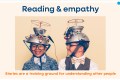
(Image credit: Kids with colander-based “gizmos” as “thinking caps,” www.EmpathyLab.uk—see trend (9) below.)

(1) Automating Empathy and large language models (LLMs): The idea is that you, the client, are going to get empathy from a software bot, app, empathy platform solution, that is able to have a conversation thanks to a so-called a large language model (LLM).
The trend of bringing large language models to empathy and empathic relatedness is a game changer. The question is not whether the generative AI can be empathic, but the extent to which the designers are able to distinguish responsiveness from “stroking one’s ego,” sycophancy (servile flattery), and the extent to which prospective clients decide to engage (both open questions at this date (Q1 2026)).
Thus, the prognosis is mixed. Is automating empathy a silver bullet—or even a good enough lead bullet—to expand empathy for the individual and community and to do so at scale. Key term: “at scale,” which means the service can be “scaled up” to accommodate thousands of people, who are currently “wait listed” for therapy with limited prospects of ever getting off the list. Can the automation address Henry David Thoreau’s “modern mass of men [persons] leading lives of quiet desperation”? Or is the “empathy bot” the cyber age equivalent of a blow-up sex doll for the socially awkward person playing small and resistant to getting out of the person’s comfort zone?
The year ahead promises a proliferation of applications, bots, and services that offer automated conflict resolution, talk therapy, empathy consulting, and companionship. For example: mendful (https://www.mendful.world), empathy.com (bereavement support—that a demo is being offered suggests an app plus services), Google’s conflict resolution app (https://play.google.com/store/apps/details?id=com.tuinfoapps.conflict&pli=1). (This list is far from complete.)
An important question to ask is about an automated empathy bot or app: How readily is an authentic, qualified human being available to engage in an initial or follow-up conversation? At the risk of ending on a cynical note, given the sorry state of human relations as demonstrated in the news of the day, maybe, just maybe, any form of expanded empathy, whether fake or authentic, if properly managed to mitigate harm, is a useful contribution. (Further on empathy and toxic flattery: https://wapo.st/4sndC9O . Also see my blog post from earlier 2025: https://empathylessons.com/2025/11/04/automating-empathy-issues-and-answers/
(2) Suicidal Empathy: This is definitely trending after a certain billionaire provocatively asserted that empathy was a defect of western civilization, even if he did try to take back the assertion. The short version of suicidal empathy is as follows. We are in a lifeboat which is filled to the maximum after our ship sank. You read right—our ship sank. In the water, treading water, surrounding the lifeboat are additional survivors and additional leaky lifeboats at high risk of sinking, leaving the survivors treading water. If the survivors in our still afloat lifeboat are “empathic” and take in the other survivors, then our lifeboat will be swamped, and we will all drown. The conclusion is that in such extreme situations, which are more common than one might imagine, empathy needs to be turned off—or at least dialed down significantly—lest we all perish. This position has been advocated from time-to-time by Elon Musk, Garrett Hardin (1974), and anti-immigration Nativists in one form or another.
Yet even in the face of lifeboat ethics, empathy remains indispensable. How so? If one is in a life-boat, then one is by definition a survivor. Your ship sank! That is a necessary part of the definition of a lifeboat and being in a lifeboat. You were cast into the vast, seemingly boundless sea. Never underestimate the importance of empathy for those in extremis, but even more than empathy, the occupants of the lifeboat need rescue. To be in a lifeboat and not need rescue is a contradiction in terms. If one recognizes the need for rescue, then the whole scenario of lifeboat ethics gets sent back to the drawing board.
The idea of our entire planet (Earth) as a lifeboat is a thought experiment. An imaginary narrative (scenario) designed to generate ideas and intuitions (nod here to the philosopher Daniel Dennett). In this case, the trick is to constrain agency using scarcity of resources (seats in the lifeboat) and see what happens. This exposes the entire lifeboat scenario mechanism for constraining, compromising, and denying agency to the participants in the dilemma. Key term: agency.
The approach of lifeboat ethics is based on a fallacy that the situation of scarcity is an unavoidable one—an inevitable continency. On the contrary, scarcity is being manufactured by bad actors, bad politics, and out-and-out human aggression. As such, the scarcity can and should be undone by actors with better (including empathic) motives in order to restore the community to a benchmark standard human functioning. This is consistent with natural disasters creating local calamities that cause scarcity. It is also consistent with disagreements about what constitutes an emergency. The point is to send in emergency services and (for example) the national guard to deliver or air drop palettes of drinkable water, canvas for tents, and provisions, not to shoot the survivors as a burden to the community (the latter following the logic of the lifeboat to its absurd conclusion).
Returning to the basic metaphor, empathy is no more to blame for overloading the lifeboat than carpentry is to blame for the fact that Roman soldiers used hammer and nails to execute condemned criminal and political enemies by crucifying them. Without practice, empathy can go astray as emotional contagion, projection, conformity, and communications lost in translation.
Being generous to a fault or has never been a requirement for empathy. Altruistic suicide (the soldier falling on the hand grenade to save his comrades) has never been a requirement for empathy. Never. With practice, a rigorous and critical empathy sets boundaries, establishes limits, and creates a whole that is more than the sum of its parts.
A rigorous and critical empathy belongs to a short list of things such as dignity, respect, compassion, neighborliness, and forms of spiritual love, and are not quantifiable as zero-sum phenomena. This is an important idea: more empathy for you does not mean less empathy for me.
For example, if I give you a slice of my chocolate cake, I have less cake. However, if I give you empathy, by giving you a good listening, we both have expanded empathy. Empathy is non-additive—and so empathy is also a non-subtractive, humanizing encounter in which my own humanity is enriched in contributing to another person. A rigorous and critical empathy is not quantifiable like chocolate cake. Granted that our topic is difficult and significant, we can enjoy lighter moment—there is enough food to go around, but definitely not enough chocolate cake! Like food, there is enough empathy to go around, but it does not seem that way, because we have not been effective in driving out the obstacles to empathy such as aggression, hostility, bullying, using food as a weapon, and politics in the negative, pejorative sense. Also see my blog post from earlier 2025:
[https://empathylessons.com/2025/05/22/suicidal-empathy/ ]
(3) Rhetorical empathy: The paradigm, ideal case for rhetorical empathy is exemplified by Malcolm-X’s statement to his colleagues at the founding of the organization of African American Unity, “We are not the pilgrims […] We didn’t land on Plymouth Rock; the rock was landed on us [loud laughter and applause]” (https://youtu.be/3Aq2Z0i8D6A?si=dkYo6QKCrgK2fWXL).
In rhetorical empathy, the speaker’s words address the listening of the audience or other person (“Other”) in such a way as to leave the Other with the experience of having been heard. This must seem counter-intuitive since it is the Other that is doing the listening. The hidden variable is that the speaker knows the Other in the sense that she or he has walked a mile in their shoes (after having taken off her/his own) and can articulate the experience the audience is implicitly harboring in their hearts yet have been unable to express.
For more details on rhetorical empathy, see the separate blog post: post: https://empathylessons.com/2023/04/09/rhetorical-empathy-a-primer/
Also see the peer-reviewed academic article: “Rhetorical empathy in the context of ontology,” Turning Toward Being: The Journal of Ontological Inquiry in Education: (2024) Vol. 2: Issue 1, Article 5. Available at: https://rdw.rowan.edu/joie/vol2/iss1/5
(4) Empathy and autism: Alternative facts, dangerous half-truths, damn lies—and empathy
How shall I express it delicately? The inmates are now in charge of the asylum over at the US Health and Human Services (HHS). Having a worm in one’s brain deservers our empathy; having a worm in one’s thinking does not—see below regarding critical thinking.
Autism is often considered a disorder of empathy—at the risk of oversimplifying, the autistic person is not able to shift perspectives and take the other person’s point of view or do so as readily as neuro-typical persons. Never dismiss empathy. Nor the value in expanding empathy. Never. Yet the matter is a lot more complicated than that.
Public debate about autism and empathy has been scrambled by misinformation about how vaccines may influence the disorder. It is distressing to see what passes for political leadership send children and families down yet another over-simplified and near delusional detour. In a more promising approach using Big Data, scientists at the Flatiron Institute and Princeton have presented evidence that autism presents in four distinct ways or subtypes. Quoting from the Washington Post summary (https://wapo.st/44V7lZb):
- Broadly affected: The smallest group — about 10 percent of participants — faced the steepest challenges, marked by developmental delays, difficulties with communication and social interaction, and repetitive behaviors that touched nearly every part of life.
- Mixed autism with developmental delay: Roughly 19 percent showed early developmental delays but few signs of anxiety, depression or disruptive behavior. Researchers call this group “mixed” because its members vary widely in how strongly they display social or repetitive behaviors.
- Moderate challenges: About a third of participants fell into this group, showing the hallmark traits of autism — social and communication differences and repetitive habits — but in subtler ways and without developmental delays.
- Social and/or behavioral: The largest group, around 37 percent, met early developmental milestones on time yet often grappled with other conditions later on, including ADHD, anxiety, depression or obsessive-compulsive disorder.
For the peer-reviewed paper, which is dense and heavy with computational biology see: https://www.nature.com/articles/s41588-025-02224-z .
These different subtypes suggest a source of much of the confusion in diagnosis and treatment. Parents, medical professionals, and educators and talking past one another because they are addressing the different subtypes.
Naturally, everyone would like a quick fix: Give ‘em vitamin B9—problem solved! Wouldn’t it be nice? (Nor is there anything wrong with vitamin B9—but it ain’t gonna cure autism.) While expanded understanding and diagnostic possibilities point to enhanced treatment interventions, what is less good news is that treatments remain complex, multi-modal, time and labor intensive, and, therefore, expensive. Behavioral interventions are demonstrably effective in improving recognizing social clues and expanding social skills. Selective, limited use of psychopharmacology is effective in addressing attention deficit and hyperactivity, though one must always be concerned in medicating young brains. Working from the inside out, e.g., play therapy is effective in dealing with anxiety and depression. In every case, creating an empathic environment of toleration, limit setting, and meeting the children (and parents) where they are struggling is on the critical path to success.
(4) Empathy versus cruelty and unelected puppet masters in politics: Presumably a statement that “empathy is a weakness” (see above (2)) would be a justification of the unempathic “slash and burn” methods of the “unelected puppet masters” at the US Depart of Doge [pronounce: “dog”], the so-called US Department of Government of Efficiency, showing up at the US IRS and Social Security offices and so on and demanding to see confidential citizen data and/or seemingly randomly sending employees home (“firing” them). While a “controlled burn” of the bureaucratic growth of the federal government forest underbrush might indeed be the empathic thing to do—or at least needed “tough love,” shutting down entire departments and mass layoffs is not an example of it. This is the “uncontrolled burn” (shout out to Garrett Smith for the term).
What Stephen Miller (Deputy White House Chief of Staff) and Russell Vought (Office of Management and Budget / Project 2025) do not point out is that empathy does not work with bullies or abusers, who will take whatever vulnerability you may exhibit and use it against you. This is also the case with anti-social personality disorder, psychopaths, and individuals with an undeveloped or defective conscience, who struggle to tell right from wrong. I hasten to add that without interviewing the individual, one has no way of knowing the individual’s mental status, whether the individual is in integrity or out of it.
Another possibility is that the individual is projecting the individual’s own unreliable, defective empathy onto the community as an empathic defect. Many of those who lack empathy are hungry for it. If ever there was a disqualifying statement by a would-be administrator or leader, Elon Musk’s soundbite about empathy being a defect of civilization would be it. Even if he took it back, I assert that it shows his “true colors”. However, a further agenda lurks nearby.
In the face of bullying, a critical and rigorous empathy sets limits, speaks truth to power, establishes boundaries, pushes back against attempts to control, dominate, and manipulate. One must not overlook the power of top down, cognitive empathy in thinking like one’s opponent in order to overcome him. “Top down,” cognitive empathy is detailed in Mikah Zenko’s Red Team! (Basic Books 2015) according to which taking a walk in the other’s shoes (the folk definition of empathy) provides advantages in relationships, business, politics, and building communities that are thrive on cooperation, communication, coordination, and inclusiveness. Short review: Think like one’s opponents, to come out on top.
If one were looking for a short disqualifying reason to sideline unelected puppet masters such as Musk and fellow traveler Stephen Miller (see more on the latter on the South Poverty Law Project’s report on racism and anti-immigration hate groups), this is it. I leave it to the reader to figure out who is the puppet.
(5) Empathy and immigration and murder most foul: more alternative facts, dangerous half-truths and total nonsense: That these United States of America are a federated nation of immigrants is a cold fact. Most of the people living here would not be here if their parents, grandparents, or great grandparents had not arrived from some land across the sea. To be sure, there are exceptions—and it is an also a fact that if one reads the treaties that the US government made with Native Americans, that Oklahoma really does belong to the Native Americans. Likewise, as Malcolm-X said to a crowd in Harlem to responses of “Amen!” and boisterous laughter, “You did not land on Plymouth rock; Plymouth rock landed on you!” (See (2) above.) Still, residents already living here are not interested in changing the devil they know for the devil they don’t know.
The following quote is not from the “take over” of Venezuela (ongoing), but the action of the border patrol and ICE in Chicago’s Hispanic neighborhood:
“[…] [I]t’s been a parade of nightmares — armed men in balaclavas on the streets, migrants sent to a torture prison in El Salvador, corruption on a scale undreamed of by even the gaudiest third-world dictators and the shocking capitulation by many leaders in business, law, media and academia. Trying to wrap one’s mind around the scale of civic destruction wrought in just 11 months stretches the limits of the imagination, like conceptualizing light-years or black holes.” [https://www.nytimes.com/2025/12/26/opinion/trump-weaker-resistance-stronger.html?unlocked_article_code=1._k8.NEnL.4kvmeqa-xzC4&smid=url-share
It is a breakdown of empathy that a nation of immigrants is flat out persecuting, oppressing, and hounding mostly, but not exclusively, Hispanics and people with brown skin. Demoralizing. Disgraceful. Criminal?
Everyone wants to deport undocumented murderers, rapists, gang members, and bad actors. Everyone. Yet that is not what we saw from ICE/BP actions in Chicago where Hispanic-appearing bus boys in restaurants, day laborers in Home Deport parking lots, nannies at preschools (?!), street vendors selling tacos, block party gatherings in Latino neighborhoods were targeted and where tear gas, flash bang grenades, shots to the head with high-speed paint balls (aimed at peacefully protesting pastors), and other chemicals agents were used without warning. This just in: mother of three shot, killed by ICE/BP: Are you getting the message? Murder most foul![https://www.nytimes.com/2026/01/08/opinion/renee-good-minnesota-shooting-ice.html?unlocked_article_code=1.DlA.y2Fb.N6f9Vobf-Vmv&smid=url-share]
The administration’s narrative (Secretary of Homeland Insecurity Noem, etc) has NEVER matched the actions on the ground in the community neighborhoods. According to the Chicago Tribute—of 624 arrests reported by ICE/BP to the court some 16 persons had criminal records (“worst of the worst”). That is 2.5 percent. Underwhelming, demoralizing, appalling.
The call to action employs empathy to network and build community. Get a whistle and use it. Two short tweets for ICE Spotted—one long one for someone being detained. Build local networks of citizen observers. Urge local law enforcement to arrest anyone who breaks the law, including federal officers acting illegally. No one said this was going to be easy. We Americans have options and resources that were not available to the residents of Weimar Germany in 1933, who were noticeably lacking in whistles. Okay, not funny.
(Update 01/28/2026: https://www.wsj.com/opinion/is-trump-derangement-syndrome-real-a603e4a1?st=AnbPxi&reflink=desktopwebshare_permalink)
(6) Radical empathy and trauma: Cathy Caruth (1996) concisely defines trauma in terms of an experience that is registered but not experienced, a truth or reality that is not available to the survivor as a standard experience. The person (for example) was factually, objectively present when the head on collision occurred, but, even if the person has memories, and would acknowledge the event, paradoxically, the person does not presently experience it as something the person experienced in a way that a person standardly experienced the past event.
The survivor experiences dissociated, repetitive nightmares, flashbacks, and depersonalization. Strictly speaking, the challenge is not only that the would-be empathizer was not with the surviving Other when the survivor experienced the life-threatening trauma, but the survivor was physically present yet did not have the experience in such a way as to experience it. That may sound strange that the survivor did not experience the experience. Once again, one searches for words to capture an experience one did not experience. That is Caruth’s (1996) definition of “unclaimed” experience.
Moral trauma adds a challenging twist to what is traumatic about trauma. What is little recognized is that many survivors are also perpetrators (and vice versa). The survivor may also unwittingly (or even intentionally) become a perpetrator. The incarcerated prisoner of conscience steals a piece of bread from another prisoner, or to save his own life, falsely accuses another. One wants to say: This is tragic in the strict sense. The characters in ancient Greek tragic theater, including Oedipus, Phaedra, Medea, practically the whole House of Atrius, are all both survivors and perpetrators.
Moral trauma is defined as the distressing emotional, behavioral, social, and sometimes spiritual aftermath of exposure to (including participation in) events in which a person’s moral boundaries are violated and in which individuals or groups are gravely injured, killed, or credible threat thereof is enacted (i.e., individuals are physically traumatized). Examples of moral trauma include such things as being put in a situation where “I will kill you if you do not kill this person.”
Generalizing on the latter example, the list includes morally fraught instances of double binds, valid military orders that result in unintentional harm to innocent people, situations in which survivors become perpetrators (and vice versa), soul murder (defined as killing the possibility of empathy and/or killing the possibility of possibility), and the Trolley Car Dilemma (Anonymous Wikipedia Content 2012, Foot 1967, Thomson 1976). In moral trauma people become both perpetrators and survivors, and such an outcome is characteristic of many (though not all) moral traumas.
Here radical empathy comes into its own. A person is asked to make a decision that no one should have to make. A person is asked to make a decision that no one is able to make—and yet the person makes the decision anyway, even if the person does nothing, because doing nothing is making a decision. A person is asked to make a decision that no one is entitled to make, which include most decisions about who should live or die (or be gravely injured). The result is moral trauma—the person is both a perpetrator and a survivor. Now empathize with that. No one said it would be easy.
Hence, the need for radical empathy. Extreme situations—that threaten death or dismemberment—call forth radical empathy. Standard empathy is challenged by extreme situations out of remote, hard-to-grasp experiences to become radical empathy. Radical empathy remains committed to empathizing with the Other in the face of the breakdown of standard empathy as empathic distress. (For further on radical empathy, see the separate blog post: https://empathylessons.com/2025/08/22/a-concise-talk-on-trauma-and-radical-empathy/and see also the Reference Agosta 2025 below.) The treatment or therapy consists of the survivor re-experiencing the trauma vicariously from a place of safety, an empathic space of acceptance and tolerance. In doing so the trauma starts losing its power and when it returns, it does so with less force, eventually becoming a distant unhappy and painful but not overwhelming memory.
(7) Empathy and art: Heinz Kohut, MD, (1971) pointed out that one result of depth psychological therapy with a strong orientation on empathy was an expansion of the individual’s appreciation or art, humor, and practical wisdom. What is the converse were also the case? Engaging with art and music, the Humanities and literature, theatre, rhetoric and languages, opens up areas of the brain that map directly to empathy and powerfully activate empathy.
Relating to the work of art, including literary fiction such as the novel, aesthetically and relating to the Other empathically is an intersection that has been noted by one of the innovators of personality theory, Gordon Allport (1897–1967), He was one of the pioneers of personality theory with his Personality: A Psychological Interpretation (New York: Holt 1937), in which he writes:
It has often been said by the advocates of empathy that the “understanding of a personality is like the understanding of a work of art” (1937: 531).
These advocates of empathy were not anonymous Others but Allport’s teacher, Herbert Langfeld (1879–1958), also a psychologist and president of the American Psychological Association and his colleagues. Langfeld was the author of The Aesthetic Attitude (1920: vi): “the motor theory of mind, namely that to every stimulus which the organism receives from without, it makes a definite response” resulting in the “tendency of the observer to project himself” into objects and body.
As noted, psychologists and health professionals have repeatedly alluded to such benefits of expanded empathy as an increased sense of humor, appreciation for art and music, as well as an enhanced capacity to enjoy life itself. Attention to fine-grained distinctions in an individual’s experience of other individuals is hypothesized to be transferable across domains such as the experience of art, humor, and engaging with others. Expand your empathy—go to the art museum—go to a concert—read immersive fiction, a novel.
(8) Empathy is the new love: People want to be listened to. People want to feel as if they have been heard—people want to be heard. People want to be gotten for they authentically are as a possibility. People want others to appreciate from where they are coming—their point of view. People want to be acknowledged, recognized, appreciated for their contribution. Empathy delivers all these ways of relating and more.
If empathy is the new love, then what is the old love? Folk wisdom suggests that love is blind; Plato, that love is a kind of madness, sometimes divine madness, sometimes just plain ordinary, everyday craziness—the one who is in love is semi-hypnotically held in bondage by an idealized depiction of the beloved, overlooking the partner’s failings and limitations; Bob Dylan, that love is just a four-letter word. So far, love sounds like tertiary syphilis—it makes one mad and causes one to go blind.
Less cynically, no one should have to choose between empathy and love in their positive dimensions. Talking Greek here, love includes eros—the erotic dimension, which gets a lot of attention as romantic relationships and aim-inhibited sexuality; philias—friendship between peers in building a community of fellow travelers; and agape—the spiritual love often attributed to Saint Paul for a higher power towards which humanity strives in its own clumsy and stumbling ways.
A fourth item may usefully be added to the list—the love of a mother, parent, or care-taker for the infant, neonate, or child of tender art. The sound of a crying baby has the power to wake most grown-ups out of the deepest sleep—and that is because we care. Letting the anxious infant merge with the parent’s soothing calmness satisfies criteria for both love and empathy, and may be the common matrix out of which these come forth.
Especially from a romantic perspective, the goal of love is to erase the boundary between the self and Other. (But also see above on the merge of the anxious infant with the calm adult.) Merger of one’s mind and body with the beloved is the aspiration and, at least temporarily, the outcome.
In contrast to love, empathy navigates the boundary between oneself and Other such that the distinction between self and Other is sustained—any merger is temporary and transient—one has a vicarious experience of the Other and the integrity of self and Other are maintained. Thus, love and empathy have a different relationship to the boundary between self and Other. Empathy is committed to a firm, albeit semi-permeable boundary; whereas, especially in its more enthusiastic forms, love celebrates the cancelling of the boundary, though ultimately acknowledging the reality of the distinction self/Other.
(9) Reading and empathizing: “A good book is an empathy engine”—Chris Riddell, UK Children’s Laurate. Many analogies exist between reading a text and empathizing with another person. This is not a mere analogical argument. The practices of empathy and reading are applying the same underlying micro-practices, skills, techniques, and methods. Reading literature (we are not engaging with reading legal contracts or computer documentation) is an empathic practice—not merely analogous to one, though it may be that too.
(Image credit: EmpathyLab (UK): Your brain on empathy reading)

Reading is an empathic practice in that it engages with another person—the Other—and does so at several levels. There are several levels of otherness—the Other of the character in the text is the most readily available—there is the implied Other addressed by the implied author, the Other of the narrator, who collapses into the implied author but often is distinct, and the actual author, who writes the words. Once again, I emphasize—and empathize—these are not merely analogous to acts of the practice of empathy, they are empathic gestures from start to finish, since they bring forth empathy and make it present in the encounter with an Other.
The idea is that one relates to works of art such as a literary text with the same respect, aesthetic disinterest, moral interest as we relate to other human beings. That is also the case when the relationship breaks down. Someone throws cake at the Mona Lisa or tries to spray it with red paint. One is shocked in a way that is different than insulting or attacking a person, yet has strong objections like an appalling boundary violation has occurred.
On the one hand, what empathy does for reading literature is bring it to life as the possibility of a laboratory for human emotions, affections, struggles, dynamics, success, and failure. Conversely, what literature does for empathy is provide a laboratory in which empathic relatedness can be challenged, tested, transformed, discarded, celebrated, explored, and made the object of inquiry.
This is another area where it is hard to say just a little. Quoting from John Guillory (2025: p. 22ftnt 31), in turn, paraphrasing Stanislas Dehaene (Reading in the Brain: The Science and Evolution of a Human Invention (Viking Press 2009)): “…[Dehaene] describes reading as a refunctioning of regions of the brain dedicated to recognizing visual signals of a particular sort, chiefly the edge or corners of object; these forms the basis for inscriptive marks. Although the neurons of the areas that accomplish reading were not evolved for the purpose of reading, the human brain learned reading and writing by developing a new way of correlating visual and aural information in the brain. Dehaene calls this ‘neuronal recycling” (144–148). This is just the start of the neuroscience narrative.
The encounters between empathy and literature, relating as persons to art works and relating as art works to persons, are motivated. One considers how one relates to another person, and how it is the same and different than how one relates to works of art. At first glance, one treats art better than one treats people. One puts art in libraries and museums with air conditioning in the summer and heat in the winter whereas one allows people to go homeless and sleep under bridges in appalling conditions. However, upon reflection one guiltily allows with shame that as a community, one is failing to live up to one’s own best standards. One recognizes one’s failure even as one refuses a trade-off between respect for art and respect for persons.
(10) Empathy and critical thinking: We conclude with a positive proposal: Teach critical thinking. This is the empathic educational moment. Absent a rigorous and critical practice of empathy, I am cautious about engaging current political clichés in a highly polarized political world and “rhetoric” in the negative sense.
Critical thinking includes putting oneself in the place of one’s opponent—the folk definition of empathy—not necessarily to agree with the other individual—but to consider what advantages and disadvantages are included in the opponent’s position. Taking a walk in the Other’s shoes after having taken off one’s own (to avoid the risk of projection) shows one where the shoe pinches. This “pinching” —to stay with the metaphor—is not mere knowledge but a basic inquiry into what the Other considers possible based on how the Other’s world is disclosed experientially. That is what we have attempted to do here by engaging with the most rigorous version of the lifeboat dilemma, instead of a strawman. Critical thinking is a possibility pump designed to get people to start again listening to one another, allowing the empathic receptivity (listening) to come forth.
In our day and age of fake news, deep fake identity theft, not to mention common political propaganda, one arguably needs a course in critical thinking (e.g., Mill 1859; Haber 2020) to distinguish fact and fiction. Nevertheless, I boldly assert that most people, not suffering from delusional disorder or political pathologies of being The True Believer (Hoffer 1953)), are generally able to make this distinction.
A rigorous and critical empathy creates a safe zone of acceptance and tolerance within which people can inquire into what is possible—debate and listen to a wide spectrum of ideas, positions, feelings, and expressions out of which new possibilities can come forth. For example, empathy and critical thinking support maintaining firm boundaries and limits against actors who would misuse social media to amplify and distort communications. Much of what Jürgen Habermas (1984) says about the communicative distortions in mass media, television, and film applies with a multiplicative effect to the problematic, if not toxic, politics occurring on the Internet and social networking.
The extension to issues of politics, climate change, and community struggles follows immediately. Insofar as individuals skeptical of empathy are trying to force a decision between critical thinking and empathy, the choice must be declined. Both empathy and critical thinking are needed; hence, a rigorous and critical empathy is included in the definition of enlarged, critical thinking (and vice versa). (Note that “critical thinking” can mean a lot of things. Here key references include John Stuart Mill 1859; Haber 2020; “enlarged thinking” in Kant 1791/93 (AA 159); Arendt 1968: 9; Habermas 1984; Agosta 2024, 2025.)
In conclusion, a positive alternative to abandoning facts and skipping critical thinking is suggested by Bob Dylan’s song about empathy. One has to push off the shore of certainty and venture forth into the unknown. We give Dylan the last word (1965: 185): “I wish that for just one time / You could stand inside my shoes / And just for that one moment / I could be you” [.]
REFERENCES
Lou Agosta. (2025). Radical Empathy in the Context of Literature. New York: Palgrave Macmillan.
______________. (2024). Empathy Lessons. 2nd Edition. Chicago: Two Pears Press.
______________. (2014). A Rumor of Empathy: Rewriting Empathy in the Context of Philosophy. New York: Palgrave Pivot.
Anonymous Wikipedia Content. (2012). Trolley problem (The trolley dilemma). Wikipedia: https://en.wikipedia.org/wiki/Trolley_problem [checked 2023-06-25]
Arendt, Hannah. (1952/1958). The Origins of Totalitarianism, 2nd Edition. Cleveland and New York: Meridian (World) Publishing, 1958.
Gordon Allport. (19370. Personality: A Psychological Interpretation (New York: Holt 1937).
Cathy Caruth. (1996). Unclaimed Experience: Trauma, Narrative, and History. Baltimore: John Hopkins.
Stanislas Dehaene. (2009). Reading in the Brain: The Science and Evolution of a Human Invention. NEW YORK: Viking Press.
Bob Dylan. (1965). Bob Dylan: The Lyrics: 1961–2012. New York: Simon and Schuster.
Philippa Foot. (1967). The problem of abortion and the doctrine of the double effect. Oxford Review, No. 5. In Foot, 1977/2002, Virtues and Vices and Other Essays in Moral Philosophy. Oxford: Oxford UP, 2002: 19–32. DOI:10.1093/0199252866.001.0001.
John Guillory. (2025). On Close Reading. Annotated bibliography by Scott Newstok. Chicago: University of Chicago press.
Jonathan Haber. (2020). Critical Thinking. Cambridge, MA: The MIT Press.
Jürgen Habermas. (1984). The Theory of Communicative Action, Vol 1, Thomas McCarthy (tr.). Boston: Beacon Press.
Garrett Hardin. (1974). Commentary: Living on a Lifeboat. BioScience, Volume 24, Issue 10, October 1974, Pages 561–568, https://doi.org/10.2307/1296629
Eric Hoffer. (1953). The True Believer. New York: Harper Perennial.
Immanuel Kant. (1791/93). Critique of the Power of Judgment, Paul Guyer and Eric Matthews (trs.). Cambridge: Cambridge UP, 2013.
Heinz Kohut. (1971). The Analysis of the Self. New York: International Universities Press.
Herbert Langfeld. (1920). The Aesthetic Attitude. New York: Harcourt Brace.
Malcolm-X. (1964). “Remarks at the founding of the Organization of African-American Unity.” https://youtu.be/3Aq2Z0i8D6A?si=dkYo6QKCrgK2fWXL [Checked on 03/24/2024]
John Stuart Mill. (1859). On Liberty, Indianapolis: Hackett Publishing.
Judith Jarvis Thomson. (1976). Killing, letting die, and the trolley problem, The Monist, vol. 59: 204–217.
Mikah Zenko. (2015). Red Team! New York: Basic Books.
This blog post, blog and all content were prepared by Lou Agosta without any use of Generative AI. None. The author has been a big fan of the em dash ever since “graduating” from a Smith Corona typewriter to a word processor.
© Lou Agosta, PhD and the Chicago Empathy Project

Radical empathy is now a podcast!
Listen to the podcasts on Spotify:
Radical empathy is empathy defined as the practice of empathy that remains committed to empathizing in the face of empathic distress. Once again, it must be emphasized—and empathized—that one does not necessarily know one’s limits in dealing with trauma until they are tested in experience. Here are the three key distinctions between standard and radical empathy. 1. Radical empathy processes empathic distress whereas standard empathy is stopped by it. 2. Empathic distress is reliably occasioned and caused by physical trauma, moral trauma, soul murder, double binds, Trolley-car-like dilemmas (to be defined further)), and diverse tragic circumstances that are hard, if not impossible, to capture in standard uses of words and language. 3. Radical empathy is required when one or both of the would-be empathic partners is both a survivor and a perpetrator (which itself points to empathic distress). Given these three invariables, both standard and radical empathy share empathic receptivity, empathic understanding, empathic interpretation, and empathic responsiveness. I repeat: standard and radical empathy share receptivity, understanding, interpretation, and responsiveness. The differentiator is what happens with empathic distress. When one or more of these aspects of standard empathy breaks down or misfires, the repair or overcoming of the breakdown reliably presents the possibility of transforming standard into radical empathy. Radical empathy is not for the faint of heart, and instead of an image of puppies, the above painting, by Caravaggio, is a portrait of Medusa, whose hair was transformed into snakes, turning to stone (paralyzing) all those who met her and looked at her in person. If you are confronting trauma, be sure to bring your radical empathy.
Read / Listen to (subscribe to) this blog and A Rumor of Empathy on Spotify for further updates on radical empathy.
Short summary of episode one: This episode on Radical Empathy – what it is and why it is important – is the first in a series inquiring into radical empathy, what it is or whether it is just a rumor; how radical empathy differs from standard empathy; how radical empathy and everyday, standard empathy overlap and the dynamics of their interactions; how radical empathy makes a difference in situations when standard empathy breaks down and fails; and how the listener can expand his or her empathic skills, getting power over empathy and apply empathy in one’s lie, relationships, career, family, in the individual and in community.
The occasion for this podcast series on radical empathy is the publication of my new book Radical Empathy in the Context of Literature (April 2025 from Palgrave Macmillan). The suggestion is to have your local community or university or institute library order a copy. They have budget for these things and one can save a couple of dollars. This work on Radical Empathy contains many examples of empathy, both standard and radical, that are eye opening and engaging in their lessons for empathy and life.
Order books on empathy by Lou Agosta on empathy by searching for “Lou Agosta” and “empathy lessons” on your favorite online book source or click on this shortened URL: https://shorturl.at/gsGal
Image art credits: QWERTY, oil paint on board by Alex Zonis (AlexZonisart.com); The Shadow of Empathy (Doll Heads) by Alex Zonis (AlexZonisart.com; Head of Medusa by Caravaggio (Gallery of the Uffizi (Florence, Italy)) from Wikimedia Commons.

Juneteenth: Beloved in the Context of Radical Empathy
For those who may require background on this new federal holiday, June 19th – Juneteenth – it was the date in 1865 that US Major General Gordon Granger proclaimed freedom for enslaved people in Texas some two and a half years after Lincoln’s Emancipation Proclamation. Later, the Thirteenth Amendment to the US Constitution definitively established this enshrining of freedom as the law of the land and, in addition, the 14th Amendment extended human rights to all people, especially formerly enslaved ones. This blog post is not so much a book review of Beloved as a further inquiry into the themes of survival, transformation, liberty, trauma – and empathy. (By is a slightly updated version of an article that was published on June 27, 2023.)
“Beloved” is the name of a person. Toni Morrison builds on the true story of Margaret Garner, an enslaved person, who escaped with her two children even while pregnant with a third, succeeding in reaching freedom across the Ohio River in 1854. However, shortly thereafter, slave catchers (“bounty hunters”) arrived with the local sheriff under the so-called fugitive slave act to return Margaret and her children to slavery. Rather than submit to re-enslavement, Margaret tried to kill the children, also planning then to kill herself. She succeeded in killing one, before being overpowered. The historical Margaret received support from the abolitionist movement, even becoming a cause celebre. The historical Margaret is named Sethe in the novel. The story grabs the reader by the throat – at first relatively gently but with steadily increasing compression – and then rips the reader’s guts out. The story is complex, powerful, and not for the faint of heart.
The risks to the reader’s emotional equilibrium of engaging with such a text should not be underestimated. G. H. Hartman is not intentionally describing the challenge encountered by the reader of Beloved in his widely-noted “Traumatic Knowledge and Literary Studies,” but he might have been:
“The more we try to animate books, the more they reveal their resemblance to the dead who are made to address us in epitaphs or whom we address in thought or dream. Every time we read we are in danger of waking the dead, whose return can be ghoulish as well as comforting. It is, in any case, always the reader who is alive and the book that is dead, and must be resurrected by the reader” (Hartman 1995: 548).
Waking the dead indeed! Though technically Morrison’s work has a gothic aspect – it is a ghost story – yet it is neither ghoulish nor sensational, and treats supernatural events rather the way Gabriel Garcia Marquez does – as a magical or miraculous realism. Credible deniability or redescription of the returned ghost as a slave who escaped from years-long sexual incarceration is maintained for a hundred pages (though ultimately just allowed to fade away). Morrison takes Margaret/Sethe’s narrative in a different direction than the historical facts, though the infanticide remains a central issue along with how to recover the self after searing trauma and supernatural events beyond trauma. The murdered infant had the single word “Beloved” chiseled on her tombstone, and even then the mother had to compensate the stone mason with non-consensual sex. An explanation will be both too much and too little; but the minimal empathic response is to try to say something that will advance the conversation in the direction of closure, the integration of unclaimed experience (to use Cathy Carruth’s incisive phrase), and recovery from trauma. Let us take a step back.
Morrison is a master of conversational implicature. What is that? “Conversational implicature” is an indirect speech act that suggests an idea or thought, even though the thought is not literally expressed. Conversational implicature lets the empathy in – and out – to be expressed. Such implicature expands the power and provocation of communication precisely by not saying something explicitly but hinting at what happened. The information is incomplete and the reader is challenged to feel her/his way forward using the available micro-expressions, clues, and hints. Instead of saying “she was raped and the house was haunted by a ghost,” one must gather the implications. One reads: “Not only did she have to live out her years in a house palsied by the baby’s fury at having its throat cut, but those ten minutes she spent pressed up against dawn-colored stone studded with star chips, her knees wide open as the grave, were longer than life, more alive, more pulsating than the baby blood that soaked her fingers like oil” (Morrison 1987: 5–6). Note the advice above about “not for the faint of heart.”
The reader does a double-take. What just happened? Then a causal conversation resumes in the story about getting a different house as the reader tries to integrate what just happened into a semi-coherent narrative. Yet why should a narrative of incomprehensibly inhumane events make more sense than the events themselves? No good reason – except that humans inevitably try to make sense of the incomprehensible.“Not a house in the country ain’t packed to its rafters with some dead Negro’s grief” (1987: 6). One of the effects is to get the reader to think about the network of implications in which are expressed the puzzles and provocations of what really matters at a fundamental level. (For more on conversational implicature see Levinson 1983: 9 –165.)
In a bold statement of the obvious, this reviewer agrees with the Nobel Committee, who awarded Morrison the Novel Prize in 1988 for this work. This review accepts the high literary qualities of the work and proposes to look at three things. These include: (1) how the traumatic violence, pain, suffering, inhumanity, drama, heroics, and compassion of the of the events depicted (consider this all one set), interact with trauma and are transformed into moral trauma; (2) how the text itself exemplifies empathy between the characters, bringing empathy forth and making it present for the reader’s apprehension; (3) the encounter of the reader with the trauma of the text transform and/or limit the practice of empathizing itself from standard empathy to radical empathy.
So far as I know, no one has brought Morrison’s work into connection with the action of the Jewish Zealots at Masada (73 CE). The latter, it may be recalled, committed what was in effect mass suicide rather than be sold into slavery after being militarily defeated and about-to-be-taken-prisoner by the Roman army. The 960 Zealots drew lots to kill one another and their wives and children, since suicide technically was against the Jewish religion.
On further background, after the fall of Jerusalem as the Emperor Titus put down the Jewish rebellion against Rome in 73 CE, a group of Jewish Zealots escaped to a nearly impregnable fortress at Masada on the top of a steep mountain. (Note Masada was a television miniseries starring Peter O’Toole (Sagal 1981).) Nevertheless, Roman engineers built a ramp and siege tower and eventually succeeding in breaching the walls. The next day the Roman soldiers entered the citadel and found the defenders and their wives and children all dead at their own hands. Josephus, the Jewish historian, reported that he received a detailed account of the siege from two Jewish women who survived by hiding in the vast drain/cistern – in effect, tunnels – that served as the fortress’ source of water.
The example of the Jewish resistance at Masada provides a template for those facing enslavement, but it does not solve the dilemma that killing one’s family and then committing suicide is a leap into the abyss at the bottom of which may lie oblivion or the molten center of the earth’s core, a version of Dante’s Inferno. So all the necessary disclaimers apply. This reviewer does not claim to second guess the tough, indeed impossible, decisions that those in extreme situations have to make. One is up against all the debates and the arguments about suicide.
Here is the casuistical consideration – when life is reduced from being a human being to being a slave who is treated as a beast of burden and whose orifices are routinely penetrated for the homo- and heteroerotic pleasure of the master, then one is faced with tough choices. No one is saying what the Zealots did was right – and two wrongs do not make a right – but it is also not obvious that what they did was wrong in the way killing an innocent person is wrong, who might otherwise have a life going about their business gardening, baking bread, or fishing. This is the rock and the hard place, the devil and deep blue sea, the frying pan or the fire, the Trolley Car dilemma (see https://en.wikipedia.org/wiki/Trolley_problem). This is Field Marshal Erwin Rommel, the Desert Fox, who after the unsuccessful attempt in June 1944 to assassinate Hitler (of which Rommel apparently had knowledge but took no action), was allowed by the Nazi authorities to take the cyanide pill. This is Colonel George Armstrong Custer with one bullet left surrounded by angry Dakota warriors who would like to slow cook him over hot coals. Nor as far as I know is the bloody case of Margaret Garner ever in the vast body of criticism brought into connection with the suicides of Cicero and Seneca (and other Roman Stoics) in the face of mad perpetrations of the psychopathic Emperor Nero. This is a decision that no one should have to make; a decision that no one can make; and yet a decision that the individual in the dilemma has to make, for doing nothing is also a decision. In short, this is moral trauma.
A short Ted Talk on trauma theory is appropriate. Beloved is so dense with trauma that a sharp critical knife is needed to cut through it. In addition to standard trauma and complex trauma, Beloved points to a special kind of trauma, namely, moral trauma or as it sometimes also called moral injury, that has not been much recognized (though it is receiving increasing attention in the context of war veterans (e.g. Shay 2014)). “Moral trauma (injury)” is not in the Diagnostic and Statistical Manual (DSM), any edition, of the American Psychiatric Association, nor is it even clear that it belongs there, since the DSM is not a moral treatise. Without pretending to do justice to the vast details and research, “trauma” is variously conceived as an event that threatens the person’s life and limb, making the individual feel he or she is going to die or be gravely injured (which would include rape). The blue roadside signs here in the USA that guide the ambulance to the “Trauma Center” (emergency department that has staff on call at all times), suggest an urgent emergency, in this case usually but not always, a physical injury.
Cathy Caruth (1996) concisely defines trauma in terms of an experience that is registered but not experienced, a truth or reality that is not available to the survivor as a standard experience, “unclaimed experience.”The person (for example) was factually, objectively present when the head on collision occurred, but, even if the person has memories, and would acknowledge the event, paradoxically, the person does not experience it as something the person experienced. The survivor experiences dissociated, repetitive nightmares, flashbacks, and depersonalization. At the risk of oversimplification, Caruth’s work aligns with that of Bessel van der Kolk (2014). Van der Kolk emphasizes an account that redescribes in neuro-cognitive terms a traumatic event that gets registered in the body – burned into the neurons, so to speak, but remains sequestered – split off or quarantined – from the person’s everyday going on being and ordinary sense of self. For both Caruth and van der Kolk, the survivor is suffering from an unintegrated experience of self-annihilating magnitude for which the treatment – whether working through, witnessing, or (note well) artistic expression – consists in reintegrating that which was split off because it was simply too much to bear.
For Dominick LaCapra (1999), the historian, “trauma” means the Holocaust or Apartheid (add: enslavement to the list). LaCapra engages with how to express in writing such confronting events that the words of historical writing and literature become inadequate. The words breakdown, fail, seem fake no matter how authentic. And yet the necessity of engaging with the events, inadequately described as “traumatic,” is compelling and unavoidable. Thus, LaCapra (1999: 700) notes: “Something of the past always remains, if only as a haunting presence or revenant.” Without intending to do so, this describes Beloved, where the infant of the infanticide is literally reincarnated, reborn, in the person named “Beloved.” For LaCapra, working through such traumatic events is necessary for the survivors (and the entire community) in order to get their power back over their lives and open up the possibility of a future of flourishing. This “working through” is key for it excludes denial, repression, suppression, and, in contrast, advocates for positive inquiry into the possibility of transformation in the service of life. Yet the attempt at working through of the experiences, memories, nightmares, and consequences of such traumatic events often result in repetition, acting out, and “empathic unsettlement.” Key term: empathic unsettlement. From a place of safety and security, the survivor has to do precisely that which she or he is least inclined to do – engage with the trauma, talk about it, try to integrate and overcome it. Such unsettlement is also a challenge and an obstacle for the witness, therapist, or friend providing a gracious and generous listening.
LaCapra points to a challenging result. The empathic unsettlement points to the possibility that the vicarious experience of the trauma on the part of the witness leaves the witness unwilling to complete the working through, lest it “betray” the survivor, invalidate the survivor’s suffering or accomplishment in surviving. “Those traumatized by extreme events as well as those empathizing with them, may resist working through because of what might almost be termed a fidelity to trauma, a feeling that one must somehow keep faith with it” (DeCapra 2001: 22). This “unsettlement” is a way that empathy may breakdown, misfire, go off the rails. It points to the need for standard empathy to become radical empathy in the face of extreme situations of trauma, granted what that all means requires further clarification.
For Ruth Leys (2000) the distinction “trauma” itself is inherently unstable oscillating between historical trauma – what really happened, which, however, is hard if not impossible to access accurately – and, paradoxically, historical and literary language bearing witness by a failure of witnessing. The trauma events are “performed” in being written up as history or made the subject of an literary artwork. But the words, however authentic, true, or artistic, often seem inadequate, even fake. The “trauma” as brought forth as a distinction in language is ultimately inadequate to the pain and suffering that the survivor has endured, which “pain and suffering” (as Kant might say) are honored with the title of “the real.” Yet the literary or historical work is a performance that may give the survivor access to their experience.
The traumatic experience is transformed – even “transfigured” – without necessarily being made intelligible or sensible by reenacting the experience in words that are historical writing or drawing a picture (visual art) or dancing or writing a poem or bringing forth a literary masterpiece such as Beloved. The representational gesture – whether a history or a true story or fiction – starts the process of working through the trauma, enabling the survivor to reintegrate the trauma into life, getting power back over it, at least to the extent that s/he can go on being and becoming. In successful instances of working through, the reintegrated trauma becomes a resource to the survivor rather than a burden or (one might dare say) a cross to bear. To stay with the metaphor, the cross becomes an ornament hanging from a light chain of silver metal on one’s neck rather than the site of one’s ongoing torture and execution. Much work and working through is required to arrive at such an outcome.
Though Beloved has generated a vast amount of critical discussion, it has been little noted that the events in Belovedrapidly put the reader in the presence of moral trauma (also called “moral injury”). Though allusion was made above to the DSM, the devil is in the details. Two levels of trauma (and the resulting post-traumatic stress disorder (PTSD)) are concisely distinguished (for example by the Diagnostic and Statistical Manual(5th edition) of the American Psychiatric Association (2013). There is standard trauma – one survives a life changing railroad or auto accident and has nightmares and flashbacks (and a checklist of other symptoms of post-traumatic stress disorder (PTSD)). There is repeated trauma, trauma embedded in trauma, double-bind embedded in double bind. One is abused – and it happens multiple times over a course of months or years and, especially, it may happen before one has an abiding structure for cognition such as a stable acquisition of language (say to a two-year-old) or happens in such a way or such a degree that words are not available as the victim is blamed while being abused – resulting in complex trauma and the corresponding complex PTSD.
But this distinction, standard versus complex trauma (and the correlated PTSD), is inadequate in the case of moral trauma, where the person is both a survivor and a perpetrator.
Thus, an escaped slave makes it to freedom. One Margaret Garner is pursued and about to be apprehended under the Fugitive Slave Act. She tries to kill herself and her children rather than be returned to slavey. She succeeds in killing one of the girls. Now this soldier’s choice is completely different than the choice faced by Margaret/Sethe, and rather like the inverse of it, dependent on not enough information rather than a first-hand, all-too-knowledgeable acquaintance with the evils of enslavement from having survived it (so far). Yet the structural similarities are striking. Morrison says of Sethe/Margarent might also said of the soldier, “[…][S]he could do and survive things they believed she should neither do nor survive […]” (Morrison 1987: 67). Yet one significant difference between the soldier and Sethe (and the Jewish Zealots) is their answer to the question when human life ceases to be human. A casuistical clarification is in order. If human life is an unconditional good, then, when confronted with an irreversible loss of the humanness, life itself may not be an unconditional good. Life versus human life. The distinction dear to Stoic philosophy, that worse things exist than death, gets traction – worse things such as slavery, cowardice in the face of death, betraying one’s core integrity. The solder is no stoic; Sethe is. Yet both are suffering humanity.
However, one may object, even if one’s own human life may be put into play, it is a flat-out contradiction to improve the humanity of one’s children by ending their humanity. The events are so beyond making sense, yet one cannot stop oneself from trying to make sense of them. So far, we are engaged with the initial triggering event, the infanticide. No doubt a traumatic event; and arguably calling forth moral trauma. But what about trauma that is so traumatic, so pervasive, that it is the very form defining the person’s experiences. Trauma that it is not merely “unclaimed, split off” experience (as Caruth says). For example, the person who grows up in slavery – as did Sethe – has never known any other form of experience – this is just the way things are – things have always been that way – and one cannot imagine anything else (though some inevitably will and do). This is soul murder. So we have moral trauma in a context of soul murder. Soul murder is defined by Shengold (1989) as loss of the ability to love, though the individuals in Beloved retain that ability, however fragmented and imperfect it may be. Rather the proposal here is to expand the definition of soul murder to include the loss of the power spontaneously to begin something new – the loss of the possibility of possibility of the self, leaving the self without boundaries and without aliveness, vitality, an emotional and practical Zombie. In addition, as a medical professional, Shengold (1989) makes an important note: “Soul murder is a crime, not a diagnosis.” Though Morrison does not say so, and though she might or might not agree, enslavement is soul murder.
Beloved contains actual murders. Once again this is not for the fainto of heart. For example, Sethe’s friend and slave Sixo from the time of their mutual enslavement is about to be burned alive by the local vigilantes, and he gets the perpetrators to shoot him (and kill him) by singing in a loud, happy, annoying voice. He fakes “not givin’ a damn,” taking away the perpetrators’ enjoyment of his misery. It works well enough in the moment. His last. Nor is it like one murder is better (or worse) than another. However, in a pervasive context of soul murder, Sethe’s infanticide is an action taken by a person whose ability to choose -sometime called “agency” – is compromised by extreme powerlessness. Yet in that moment of decision her power is uncompromised by all the compromising circumstances and momentarily retored – whether for the better is that about which we are debating, bodly assuming the matter is debateable. One continues to try and justify and/or make sense out of what cannot have any sense. Sethe is presented with a choice (read it again – and again) that no one should have to make – that no one can make (even though the person makes the choice because doing nothing is also a choice). This is the same situation that the characters in classic Greek tragedy face, though a combination of information asymmetries, personal failings, and double-binds. Above all – double-binds. This is why tragedy was invented (which deserves further exploration, not engaged here).
Now bring empathy to moral trauma in the context of soul murder. Anyone out there in the reading audience experiencing “empathic unsettlement” (as LaCapra incisively put it)? Anyone experiencing empathic distress? If the reader is not, then that itself is concerning. “Empathic unsettlement” is made present in the reader’s experience by the powerful artistry deployed by Beloved. Yet this may be an instance in which empathy is best described, not as an on-off switch, but as a dial that one can dial up or down in the face of one’s own limitations and humanness. This is tough stuff, which deserves to be read and discussed. If one is starting to break out in a sweat, if one’s mouth is getting dry, if the pump in one’s chest is starting to accelerate its pumping, and one is thinking about putting the book down, rather than become hard-hearted, the coaching is temporarily to dial down one’s practice of empathy. While one is going to experience suffering and pain in reading about the suffering and pain of another, it will inevitably and by definition be a vicarious experience – a sample – a representation – a trace affect – not the overwhelming annihilation that would make one a survivor. Dial the empathy down in so far as a person can do that; don’t turn it off. Admittedly, this is easier said than done, but with practice, the practitioner gets expanded power over the practice of empathizing.
As noted, Morrison is a master of conversational implicature. Conversational implicature allows the empathy to get in – become present in the text and become present for the reader engaging with the text. The conversational implicature expresses and brings to presence the infanticide without describing the act itself by which the baby is killed. Less is more, though the matter is handled graphically enough. The results of the bloody deed are described – “a “woman holding a blood soaked child to her chest with one hand” (Morrison 1987: 124) – but not the bloody action of inflicting the fatal wound itself. “Writing the wound” sometimes dances artistically around expressing the wound, sometimes, not.
Returning to the story itself, Morrison describes the moment at which the authorities arrive to attempt to enforce the fugitive slave act: “When the four horsemen came – schoolteacher, one nephew, one slave catcher and a sheriff – the house on Bluestone Road was so quiet they thought they were too late” (Morrison 1987: 124). Conversational implicature meets intertextuality in the Book of Revelation of the New Testament. The four horsemen of the apocalypse herald the end of the world as we know it and the end of the world is what comes down on Sethe at this point. Perhaps not unlike the Zealots at Masada, she makes a fatal decision. Literally. As Hannah Arendt (1970) pointed out in a different political context, power and force (violence) stand in an inverse relation: when power is reduced to zero, then force – violence – comes forth. The slaves power is zero, if not a negative number. Though Sethe tries to kill all the children, she succeeds only in one instance. In the fictional account, the boys recover from their injuries and, in the case of Denver (Sethe’s daughter named after Amy Denver, the white girl who helped Sethe), Sethe’s hand is stayed at the last moment.
Beloved is a text rich in empathy. This includes exemplifications of empathy in the text, which in turn call forth empathy in the reader. The following discussion now joins the standard four aspects of standard empathy – empathic receptivity, empathic understanding, empathic interpretation, and empathic responsiveness. The challenge to the practice of empathy is that with a text and topic such as this one, does the practice of standard empathy need to be expanded, modified, or transformed from standard to radical empathy? What would that even mean? Empathy is empathy. A short definition of radical empathy is proposed: Empathy is committed to empathizing in the face of empathic distress, even if the latter is incurred, and empathy, even in breakdown, acknowledges the commitment to expanding empathy in the individual and the community.
We start with a straightforward example of empathic receptivity – affect matching. No radical empathy is required here. An example of standard empathic receptivity is provided in the text, and the dance between Denver and Beloved is performed (1987: 87 – 88):
“Beloved took Denver’s hand and place another on Denver’s shoulder. They danced then. Round and round the tiny room and it may have been dizziness, or feeling light and icy at once, that made Denver laugh so hard. A catching laugh that Beloved caught. The two of them, merry as kittens, swung to and fro, to and fro, until exhausted they sat on the floor. “
The contagious laughter is entry level empathic receptivity. Empathy degree zero, so to speak. This opening between the two leads to further intimate engagement with empathic possibility. But the possibility is blocked of further empathizing in the moment is blocked by a surprising discovery. At this point, Denver “gets it” – that Beloved is from the other side – she has died and come back – and Denver asks her, “What’s it like over there, where you were before?” But since she was killed as a baby, the answer is not very informative: “I’m small in that place. I’m like this here.” (1987: 88) Beloved, the person who returns to haunt the family, is the age she would have been had she lived.
The narrative skips in no particular order from empathic receptivity to empathic understanding. “Understanding” is used in the extended sense of understanding of possibilities for being in the world (e.g., Heidegger 1927: 188 (H148); 192 (H151)): “In the projecting of the understanding, beings [such as human beings] are disclosed in their possibility.” Empathic understanding is the understanding of possibility. What does the reader’s empathy make present as possible for the person in her or his life and circumstance? What is possible in slavery is being a beast of burden, pain, suffering, and early death – the possibility of no possibility of human flourishing. In contrast, when Paul D (a former slave who knew Sethe in enslavement) makes his way to the house of Sethe and Denver (and, unknown to him, the ghost of the baby), the possibility of family comes forth. In the story, there’s a carnival in town and Paul D, who knew Sethe before both managed to escape from the plantation (“Sweet Home”), takes her and Denver to the carnival. “Having a life” means many things. One of them is family. The possibility of family is made present in the text and the reader. That is the moment of empathic understanding of possibility:
“They were not holding hands, but their shadows were. Sethe looked to her left and all three of them were gliding over the dust hold hands. Maybe he [Paul D] was right. A life. Watching their hand-holding shadows [. . . ] because she could do and survive things they believed she should neither do nor survive [. . . .] [A]ll the time the three shadows that shot out of their feet to the left held hands. Nobody noticed but Sethe and she stopped looking after she decided that it was a good sign. A life. Could be.” (Morrison 1987: 67)
Within the story, Sethe has her own justification for her bloody deed. She is rendering her children safe and sending them on ahead to “the other side” where she will soon join them. “I took and put my babies where they’d be safe” (Morrison 1987: 193). The only problem with this argument, if there is a problem with it, is that it makes sense out of what she did. Most readers are likely to align with Paul D (a key character in the story and a “romantic” interest of Sethe’s), who at first does not know about the infanticide. Paul D learns the details of Sethe’s act from Stamp Paid, the person who is the former underground rail road coordinator, who knows just about everything that goes on, because he was a hub for the exchange of all-manner of information in helping run-away and would-be run-away slaves to survive.
Stamp feels that Paul D ought to know, though he later regrets his decision. Stamp tells Paul D about the infanticide – showing him the newspaper clipping as evidence and explaining the words that Paul D (who is illiterate) cannot read. Paul D is overwhelmed. He cannot handle it. He denies that the sketch (or photo) is Sethe, saying it does not look like her – the mouth does not match. Stamp tries to convince Paul D: “She ain’t crazy. She love those children. She was trying to out hurt the hurter” (1987: 276). Paul D asks Sethe about the infanticide reported in the news clipping, and she provides her justification (see above). Paul D is finally convinced that she did what she did, yet unconvinced it was the thing to do and a thunderhead of judgment issues the verdict: “You got two feet, Sethe, not four […] and right then a forest sprung up between them trackless and quiet” (1987: 194).[1] Paul D experiences something he cannot handle.
Standard empathy misfires as empathic distress. Standard empathy chokes on moral judgment. Paul D moves out of the house where he is living with Sethe, Denver, and Beloved. Standard empathy does not stretch into radical empathy. In a breakdown of empathic receptivity, Paul D takes on Sethe’s shame, and instead of a decision to talk about the matter with her, perhaps agreeing to exit the relationship for cause, Paul D runs away from both Sethe and his own emotional and moral conflicts, making an escape. Stamp blames himself for driving Paul D away by disclosing the infanticide to him (of which he had been unaware), and tries to go to explain it to Sethe. Seeking the honey of self-knowledge results in the stings of enraged distortion and disguise. Paul D finds the door is closed and locked against him. Relationships are in breakdown.
At this point the isolation of the women – Sethe, Denver, Beloved – inspires a kind of “mad scene” – or at least a carnival of emotion. Empathic interpretation occurs as dynamic and shifting points of view. The rapid-fire changing of perspectives occurs in the three sections beginning, “Beloved, she my daughter”; “Beloved is my sister”; “I am Beloved and she is mine” (Morrison 1987: 236; 242; 248). These express the hunger for relatedness, healing, and family that each of the women experience. For this reader, encountering the voices has the rhythmic effect of Virginia Woolf’s The Waves. The voices are disembodied, though they address one another rather than the reader (as was also the case in Woolf). The first-person reflections slip and slide into a free verse poem of call and response. The rapid-fire, dynamic changing of perspectives results in the merger of the selves, which, strictly speaking, is a breakdown of empathic boundaries. There is no punctuation in the text of Beloved’s contribution to the back-and-forth, because Beloved is a phantom, albeit an embodied one, without the standard limits of boundaries in space/time such as are provided by standard punctuation.
This analysis has provided examples of empathic receptivity, understanding, and interpretation. One aspect of the process of empathy remains. In a flashback of empathic responsiveness: Sethe is on the run, having escaped enslavement at Sweet Home Plantation. She is far along in her pregnancy, alone, on foot, barefoot, and is nearly incapacitated by labor pains. A white girl comes along and they challenge one another. The white girl is named Amy Denver, though the reader does not learn that at first, and she is going to Boston (which becomes a running joke). What is not a joke is that Sethe and Amy Denver are two lost souls on the road of life if there ever were any. Amy is barely more safe or secure than Amy, though she has the distinct advantage that men with guns and dogs are not in hot pursuit of her. Sethe dissembles about her own name, telling Amy it is “Lu.” It is as if the Good Samaritan – in this case, Amy – had also been waylaid by robbers, only not beaten as badly as the man going up to Jerusalem, who is rescored by the Samaritan. Amy is good with sick people, as she notes, and practices her arts on Sethe/Lu. Sethe/Lu is flat on her back and in attempt to help her stand up, Amy massages her feet. But Sethe/Lu’s back hurts. In a moment of empathic responsiveness, Amy describes to Sethe/Lu the state of her (Sethe’s) back, which has endured a whipping with a raw hide whip shortly before the plan to escape was executed. Amy tells her:
“It’s a tree, Lu. A chokecherry tree. See, here’s the trunk – it’s red and spit wide open, full of sap, and this here’s the parting for the branches. You got a mighty lot of branches. Leaves, too, look like, and dern if these ain’t blossoms. Tiny little cherry blossoms, just as white. Your back got a whole tree on it. In bloom. What god have in mind I wonder, I had me some whippings, but I don’t remember nothing like this” (1987: 93).
This satisfies the definition of empathic responsiveness – in Amy’s description to Lu of what Amy sees on Lu’s back, Amy gives to Lu her (Amy’s) experience of the state of Lu’s back. Amy’s response to her (Lu) allows / causes Lu to “get” that Amy has experienced what her (Lu’s) experience is. Lu (Sethe) of course cannot see her own back and the result of the rawhide whipping which is being described to her. On background, early in the story, Sethe tells Paul D: “Them boys found out I told on em. Schoolteacher [actually a teacher, but mostly a Simon Legree type slave owner, and the brother of Mrs Garner’s late husband] made one open up my back, and when it closed it made a tree. It grows there still” (1987:20). The reader wonders, What is she talking about? “Made a tree”? The conversational implicature – clear to the participants in the story, but less so to the reader – lets the suspense – and the empathy – come out. The “tree” finally becomes clear in the above-cited passage. One has to address whether this attempt succeeds artistically to transform the trauma of the whipping into an artistic integration and transfiguration of pain and suffering. Nothing is lacking from Morrison’s artistry, yet the description gave this reader a vicarious experience of nausea, empathic receptivity, especially with the white puss. Once again, not for the faint of heart. This a “transfiguring” of the traumatic.
A further reflection on “transfiguring” is required. If one takes the term literally – transforming the figure into another form without making it more or less meaningful, sensible, or significant, then one has a chance of escaping the aporias and paradoxes into a state of masterful and resonant ambiguity. For example, in another context, when the painter Caravaggio (1571–1610) makes two rondos of Medusa, the Gorgon with snakes for hair, whose sight turns the viewer to stone, was he not transfiguring something horrid and ugly into a work or art? The debate is joined. The inaccessible trauma – what happened cannot be accurately remembered, though it keeps appearing in nightmares and flashback – is the inaccessible real, like Kant’s thing in itself. The performing of the trauma, the work of art – Caravaggio’s self-portrait as the Medusa[2] or the encounter of Amy and Sethe/Lu or Morrison’s Beloved in its entirety – renders the trauma accessible, expressible, and so able to be worked through, integrated, and transformed into a resource that at least allows one to keep going on being and possibly succeed in recovery and flourishing. Once again, the intention is a transfiguring of the traumatic. However, the myth of the Medusa itself suggests a solution, albeit a figurative one. In the face of soul murder embedded within moral trauma, the challenge to standard empathy is to expand, unfold, develop, into radical empathy. That does not add another feature to empathy in addition to receptivity, understanding, interpretation, and responsiveness, but it raises the bar (so to speak) on the practice of all of these. Radical empathy is committed to the practice of empathizing in the face of empathic distress. What does empathic distress look like? It looks like the reaction to the traumatic vision of the snake-haired Gorgon that turns to stone the people who encounter it. It looks like the tree on Sethe/Lu’s back, the decision that Sethe/Margarent should not have to make, but that she nevertheless makes, staring into her image of the Medusa, who show up as the four horsemen. This is to chase the trauma upstream in the opposite direction from the would-be artistic transfiguration. A
This points immediately to Nietzsche’s answer to Plato’s banning of tragic poetry from the just city (the Republic), namely, that humans cannot bear so much truth (1883: §39):
“Indeed, it might be a basic characteristic of existence, that those who would know it completely would perish, in which case the strength of a person’s spirit would then be measured by how much ‘truth’ he could barely still endure, or to put it more clearly, to what degree one would require it to be thinned down, shrouded, sweetened, blunted, falsified.“
And again, with admirable conciseness, Nietzsche (1888/1901: Aphorism 822): “We have art, lest we perish of the truth.” Here “truth” is not a semantic definition such as Davidson’s (1973, 1974) use of Tarksi (loosely a correspondence between language and world), but the truth that life is filled with struggle and effort—not fair—that not only are people who arrive early and work hard all day in the vineyard paid a full day’s wages, but so are people who arrive late and barely work also get paid a full day’s wages; that, according to the Buddha, pain is an illusion, but when one is sitting in the dentist chair, the pain is a very compelling illusion; not only old people get sick and die, but so do children. While the universe may indeed be a well-ordered cosmos, according to the available empirical evidence, the planet Earth seems to be in a local whorl in its galaxy where chaos predominates; power corrupts and might makes right; good guys do not always finish last, but they rarely finish first, based alone on goodness.
On background, the reader may recall that the hero Perseus succeeded in defeating this Medusa without looking at her. Anyone who sees the Medusa straight on is turned to stone. Perseus would have been traumatized by the traumatic image and rendered an emotional zombie – lacking in aliveness, energy, strength, or vitality – turned to stone. Beyond empathic unsettlement and empathic distress, moral trauma (moral injury) and soul murder stop one dead – not necessarily literally but emotionally, cognitively and practically. That is the challenge of the paradox and seeming contradiction: how to continue empathizing in the face of empathic distress. Is there a method of continuing to practice empathizing in the face of such distressing unsettlement? At least initially, the solution is a narrative proposal. Recall that Perseus used a shield, which was also a magic reflective mirror, indirectly to see the Medusa as a reflection without being turned to stone and, thus seeing her, being able to fight and defeat her. The shield acted as a defense against the trauma represented by the Medusa, enabling Perseus to get up close and personal without succumbing to the toxic affects and effects. There is no other way to put it – the artistic treatment of trauma is the shield of Perseus. It both provides access to the trauma and defends against the most negative consequences of engaging with it. The shield does not necessarily render the trauma sensible or meaningful in a way of words, yet the shield takes away the power of the Gorgon/trauma, rending it unable to turn one to stone. In the real-world practice of trauma therapy, this means rendering the trauma less powerful. The real world does not have the niceness of the narrative, where the Gorgon is decapitated – one and done! One gradually – by repeated working through – gets one’s power back as the trauma shrinks, gets smaller, without, however, completely disappearing. The trauma no longer controls the survivor’s life.
The question for this inquiry into Beloved is what happens when one brings literary language, refined language, artistic language, beautiful language, to painful events, appalling events, ugly events, dehumanizing events, traumatic events? The literary language has to dance around the traumatic event, which is made precisely present with expanded power by avoiding being named, leaving an absence. The traumatic events that happened were such that the language of witnessing includes the breakdown of the language of witnessing. As Hartman notes in his widely quoted study:
It is interesting that in neoclassical aesthetic theory what Aristotle called the scene of pathos (a potentially traumatizing scene showing extreme suffering) was not allowed to be represented on stage. It could be introduced only through narration (as in the famous recits [narrative] of Racinian tragedy) (Hartman 1995: 560 ftnt 30).
The messenger arrives and narrates the awful event, which today in a streaming series would be depicted in graphic detail using special effects and enhanced color pallet. One might say that Sophocles lacked special effects, but it is that he really “got it” – less is more. The absence of the most violent defining moment increases its impact. Note this does not mean – avoid talking about it (the trauma). It means the engagement is not going to be a head on encounter and attack, but a flanking movement. In the context of narrative, this does not prevent the reader from engaging with the infanticide. On the contrary, it creates a suspense that hooks the reader like a fish with the rest of the narrative reeling in the reader. The absence makes the engagement a challenge, mobilizing the reader’s imagination to fill in the blank in such a way that it recreates the event as a palpable vicarious event. It is necessary to raise the ghost prior to exorcising it, and the absentee implication does just that.
If this artistic engagement with trauma is not “writing trauma” in LaCapra’s sense, then I would not know it:
“Trauma indicates a shattering break or caesura in experience which has belated effects. Writing trauma would be one of those telling after-effects in what I termed traumatic and post-traumatic writing (or signifying practice in general). It involves processes of acting out, working over, and to some extent working through in analyzing and ‘giving voice’ to [it] [. . . ] – processes of coming to terms with traumatic ‘experiences,’ limit events, and their symptomatic effects that achieve articulation in different combinations and hybridized forms. Writing trauma is often seen in terms of enacting it, which may at times be equated with acting (or playing) it out in performative discourse or artistic practice” (LaCapra 2001: 186–187).
If the writing (and reading) of the traumatic events is a part of working through the pain and suffering of the survivors (and acknowledging the memory of the victims), then the result for the individual and the community is expanded well-being, expanded possibilities for aliveness, vitality, relatedness, and living a life of satisfaction and fulfillment. Instead of being ruled by intrusive flashbacks and nightmares, the survivor expands her/his power over the events that were survived. This especially includes the readers engaging with the text who are survivors of other related traumatic events, dealing with their own personal issues, which may be indistinguishable from those of fellow-travelers in trauma. That is the situation at the end of Beloved when Paul D returns to Sethe and Denver (Sethe’s daughter) after the community has exorcised the ghost of Beloved. It takes a village – a community – to bring up a child; it also takes a village to exorcise the ghost of one.
References
Anonymous. (2012). Trolley problem (The trolley dilemma). Wikipedia: https://en.wikipedia.org/wiki/Trolley_problem [checked on 2023-06-25]
Hannah Arendt. (1970). On Violence. New York: Harcourt, Brace, Jovanovich.
Caty Caruth. (1996). Unclaimed Experience: Trauma, Narrative, and History. Baltimore: John Hopkins University Press.
Donald Davidson. (1974). On the very idea of a conceptual scheme. In Inquiries into Truth and Interpretation. Oxford: The Clarendon Press, 2001: 183–198.
Geoffrey H Hartman. (1995). On Traumatic Knowledge and Literary Studies New Literary History , Summer, 1995, Vol. 26, No. 3, Higher Education (Summer, 1995): 537 – 563 .
Martin Heidegger. (1927). Being and Time, John Macquarrie and Edward Robinson (trs.). New York: Harper and Row, 1963.s
Albert R. Jonsen and Stephen Toulmin. (1988). The Abuse of Casuistry. Berkeley: University of California Press.
Dominick LaCapra. (1999). Trauma, absence, loss. Critical Inquiry, Summer, 1999, Vol. 25, No. 4 (Summer, 1999): 696–727
Dominick LaCapra. (2001). Writing History, Writing Trauma. Baltimore, John Hopkins Unviersity Press.
Stephen Levinson. (1983). Pragmatics. Cambridge: Cambridge University Press.
Toni Morrison. (1987). Beloved. New York: Vintage Int.
Friedrich Nietzsche. (1883). Thus Spoke Zarathustra, R. J. Hollingdale (tr.). Baltimore: Penguin Press, 1961.
________________. (1888/1901). The Will to Power, R. J. Hollingdale (tr.). New York: Vintage, 1968.
Ruth Leys. (2000). Trauma: A Genealogy. Chicago: The University of Chicago Press.
Boris Sagal, Director. (1981). Masade. https://en.wikipedia.org/wiki/Masada_(miniseries) [checked on 2023-06-25).
J. Shay, (2014). Moral injury. Psychoanalytic Psychology, 31(2), 182-191. https://doi.org/10.1037/a0036090
Leonard Shengold. (1989). Soul Murder Revisited: Thoughts About Therapy, Hate, Love, and Memory. Hartford: Yale University Press.
Bessel van der Kolk. (2014). The Body Keeps the Score. New York: Penguin.
[1] For those readers wondering how Sethe regained her freedom after being arrested for murder (infanticide), Beloved provides no information as to the sequence. During the historical trial an argument was made that as a free woman, Margaret Garner should be tried and convicted of murder, so that the Abolitionist governor of Ohio could then pardon her, returning here to freedom. Something like that needs to be understood in the story, though it is a fiction. It is a fiction, since in real life, Garner and her children were indeed returned to slavery under the Fugitive Slave Act. Moral trauma within soul murder indeed.
[2] Caravaggio was a good looking fellow, and he uses himself as a model for the face of the Medusa. This does not decide anything. Arguably, Caravaggio was arguably memorializing – transfiguring – his own life traumas, which were many and often self-inflicted as befits a notorious manic-depressive.
© Lou Agosta, PhD and the Chicago Empathy Project

Review: The varieties of empathy in Richard Wright’s (1940) novel Native Son
Review: The varieties of empathy in Richard Wright’s (1940) novel Native Son(New York: Harper Perennial 504 pp + end matter)
The varieties of empathy and empathic experiences extend from authentic empathic receptivity, empathic understanding, and empathic responsiveness, all the way to fake empathy and mutilated empathy. Wright’s novel, Native Son, provides abundant examples of how empathy breaks down into emotional contagion, conformity, projection, and communications getting lost in translation. Of course, once empathy breaks down and fails, strictly speaking, it is no longer empathy and calls for a response to “clean up” the misunderstanding out of which a rigorous and critical empathy is restored and reestablished. Nevertheless, the varieties of empathically related phenomena that are constellated makes Wright’s classic work a study in empathy in all its diverse forms.
Native Son is as powerful and timely as it was when Richard Wright first published it in 1940. Though it has aspects of tragedy and traffics in ruin and wreck, in the final analysis, it has as much in common with Mary Shelley’s Frankenstein as it does with ancient Greek tragedy by Aeschylus, Sophocles, or Euripides.
The novel has not changed since 1940, but the world has – becoming both better and worse. To open up the reader’s historical empathy, a background report will be useful and is provided. This report also provides a chapter in African American history. The engagement with Native Son will be interspersed in this review with historical details that bring to life the power of the story in ways that might not be appreciated without a firm historical grounding. This is not a digression but of the essence, lest we forget how far we have come, and how far we still have to go to expand empathy and attain social justice.
The world has become better in that the US Supreme Court ruled in Brown versus the Board of Education (1954) that separate, segregated education in grammar and high schools is inherently
unequal. That is worth repeating: Separate but equal is inherently unequal. The world has become better in that the Civil Rights Act and the Voting Rights Act (1965/1965) were passed by a super majority of Congress. These outlawed segregation by law, also called “Jim Crow”; these enabled county and congressional districts in the South (or anywhere) with majority black populations to register to vote and elect black sheriffs and local officials. Why could they not do so previously? There were discriminatory poll taxes, which the impoverished people could not afford to pay; there were written tests (including trick questions) which people who lacked reading skills or merely had a grammar school education were unable to pass; there were other bureaucratic obstacles including the need to present state issued documents that were hard to obtain, putting the would-be voter in a double bind. One hastens to add that the struggle for social and political justice continues, with the US Supreme Court (2023) requiring Alabama and Georgia to redraw their gerrymandered congressional districts to allow for majority black districts. Under backward steps, the so-called “war on drugs” – espoused by Nancy Reagan and implemented by the Clinton administration, resulted in the incarceration (still ongoing) of a generation of young black men for relatively victimless crimes involving using crack cocaine.
Meanwhile, schools of all kinds continue to be under stress because of mass casualty gun violence. Teaching is a tough job, especially elementary and middle schools and it has gotten tougher; the bureaucratic requirements to present politically correct curriculum has pushed out fundamental skills of critical thinking along with skills such as the three R-s – reading, writing and (a)rithmetic. These have been replaced by the need for librarians and administrators to act in the role of surveillance state capitalism (see Zuboff 2018), overseeing whether some text refers to “gay,” “trans,” the name of a sex organ, and so on, and that someone – especially a parent – might be made to feel uncomfortable. To be sure, parents and educators need to be sensitive to the stages of child development and present material that fits the stage at which the growing child is maturing.
While Jim Crow is a historical reference and black empowerment is advancing, at times haltingly, the number of unarmed black people who end up dead after encounters with the local police has astonished everyone – everyone except black people who have known all about it all along. Today the number of black CEOs of major corporations is some 5.9 % out of an overall black population of 13.6% (US Census). That is progress since 1940 when Wright’s work was published, at which time the percentage was essentially zero. Johnson Publications, the publisher of Ebony magazine (among others), would not be founded until 1942. Yet a case can be made that, though many of the social and legal details are different, the need for struggle and protest is as powerful today as it was in 1940. We are not living in a post racial society, notwithstanding fact of having had a black president. All this and more may usefully inform our reading of Native Son.
Now to the narrative. The protagonist, Bigger Thomas (henceforth referred to as “BT”), completes the 8thgrade. He is too poor to continue school, nor is he motivated to do so. He experiences segregation and prejudice wherever he turns, as indeed do all black people. BT says, “Hell, it’s a Jim Crow army. All they want a black man for is to dig ditches. And in the navy, all I can do is wash dishes and scrub floors” (1940: 353). BT is not allowed to become a pilot or a tank driver or a professional. “I wanted to be an aviator once. But they wouldn’t let me go to the school where I was suppose’ to learn it. They built a big school and then drew a line around it and said that nobody could go to it but those who lived within the line. That kept all the colored boys out” (1940: 353). It is true there were a few exceptions – some black people go to college and become doctors, lawyers, or engineers, though how they pulled that off is not for the faint of heart.
However, basically, the form of life under segregation (Jim Crow) does not just lack possibility – the possibility of possibility itself is missing. Possibility is not even defined. What does that mean? For example, as soon as Barak Obama was elected US President, the media went to middle schools and interviewed black ten-year-old children about what they wanted to be when they grew up. They immediately knew they wanted to be President. Now this little different than wanting to be a cowboy or a fireman or a doctor, a child’s fantasy. The point is that prior to Obama’s election the possibility could not even be imagined by black children, excepting perhaps some weird science fiction scenario. That is what is meant by the possibility of possibility. BT lacks the possibility of possibility.
What happens in the narrative after BT serendipitously gets a “good job” as a chauffeur with a wealthy white family, shows that BT still does not “get” – understand or experience – the possibility of possibility. BT is so constantly in survival mode that, in trying to survive, he does the very thing that causes his tragic undoing. It is a well-known stereotype that whenever a black man is lynched or otherwise “taken down” socially, he is initially accused of assaulting or trying sexually to molest a white woman.
Who Is BT as a person and as a possibility at the start of the story? He is bully and a petty criminal. Malcolm Little, who became Malcolm X, was eleven years old when Wright began working on Native Son in 1936. Both BT and Malcolm, each in their own way, started out as petty criminals. Malcolm was arrested and went to prison. Malcom was the only person I ever heard of who said that prison made him better – indeed saved his life – because he met a follower of a version of strict Islam that enabled him to turn his life around, channeling his intelligence and leadership skills into black empowerment (though, ultimately, it also eventually led to his undoing in a tragedy of betrayal).
Meanwhile, in Native Son, Mary Dalton is the young adult daughter of the wealthy Henry Dalton, who has given some $5 million dollars to the NAACP (National Association for the Advancement of Colored People) while continuing to operate inner city slums overcrowded with blacks who are unable to rent or buy in other neighborhoods due to red lining and restrictive covenants (contracts) that prevent selling to black people. Moral ambiguities and flat-out hypocrisy are front and center. Henry’s wife is blind – she cannot see – and walks about the mansion dressed in white like a ghost. Everyone else in the novel – black and white – can see well enough – are visually unimpaired – but have blind-spots and unconscious biases sufficient to sink the Titanic. They do. Full speed ahead into the field of ice bergs!
Mary is an undergraduate at the local university near their mansion on Drexel Blvd. As a part of her late adolescent rebellion, she goes for the kind of boyfriends most calculated to shock her parents. She likes those “bad boys.” In this case, that would be the left wing radical and card carrying communist, Jan. On background, Nicola Sacco and Bartolomeo Vanzetti – Sacco and Vanzetti – were executed in the electric chair in 1927 for being anarchists, amid anti-Italian and anti-immigrant hysteria, not for the robbery and murder of which they were convicted and did not commit.
Wright was authoring at a time (circa 1936) when the Great Depression was still very much an economic reality. The Mayor was a machine boss, who would respond to crime waves by rounding up Communists and Negros. The Governor would call out the National Guard to put down workers who tried to form a union and go out on strike. The blacklisting of workers, both white and black (but mostly white because the blacks did not have jobs), who attempted to form unions was common, which meant they could not find work. Corporations stockpiled tear gas, vomit gas, ammunition and machine guns for armed strike breakers to use against railroad, steel, and manufacturing workers who dared to go out on strike. The National Labor Relations Board was not even validated by the US Supreme Court until 1937 in NLRB v. Jones and Laughlin Steel Corporation, 301 U.S. 1 (1937). The forty-hour work week did not become law until the Fair Labor Standards Act (29 U.S. Code Chapter 8) was first enacted in 1938 under President Roosevelt’s New Deal.
This was a different world from 2023 and being a “Communist” meant something different than it does today, when, in the wake of the success of the trade union movement, much of what the original movement sought to accomplish (such as the 40 hour work week, sick leave, paid overtime, etc.) is part of standard legal labor law practice, rendering The Party irrelevant. Nevertheless, Mary and her boyfriend, Jan, a committed Communist, saw a common cause between the oppressed workers and the oppressed black people, and in this they were accurate enough, but naïve and idealistic, even utopian, in what it was going to take to make a difference.
The road to hell is paved with good intentions – and fake empathy. The privileged daughter, Mary, of the wealthy real estate tycoon (Mr Dalton), wants something from her new chauffeur. Remember, BT has just got a new, good paying job as the chauffeur. Mary wants him (BT) to ignore orders from her father, BT’s employer, and drive her around town with her boyfriend instead of to the University. Mary uses him (BT) as she would any extension of her own self-interest. For Mary, BT is an extension of her narcissism. BT later reports on his first encounter with Mary:
“She acted and talked in a way that made me [BT] hate her [Mary]. She made me feel like a dog. I was so mad I wanted to cry [. . . .] Mr Max, we’re all split up. What you say is kind ain’t kind at all. I didn’t know nothing about that woman. All I knew was that they kill us for women like that. We live apart. And then she comes and acts like that to me” (1940: 35).
The “acted like that” is the fake empathy – it seems kind enough on the surface in that the language does not have any devaluing words; yet there is a subtext – a soft violence, a quiet aggression, a conversational implicature that wrappers the relationship in BT’s subordination. “Acted like that” may also have a seductive aspect to it in that “being nice” in a situation where “no contact” is the norm may easily be misinterpreted as romantic flirting. The latter is not explicit in the text, but one thing is clear: BT and Mary Dalton really are the moth and the flame. Naivete and innocence are abundant on all sides. The moth has an automatic, hypnotic-like attraction to the flame. Little does the moth know what awaits. Does the flame have empathy for the moth? No, the flame is just the flame, towards which the moth has a luminously-based incentive that is its incineration. On background, the US Supreme Court finally ruled in Loving v Virginia in 1967 that anti-miscegenation laws, prohibiting marriage between whites and blacks (among others), were unconstitutional.
BT has survived on the street among white people by saying “Yessum; it’s all right with me” (1940: 64) and doing as he is told, and (in effect) justifying it by saying he was following orders. Recall, this is 1938 and that statement will come to have a different meaning in 1963 as Hannah Arendt reports for The New Yorker magazine on the trial of one Adolph Eichmann, who said something similar regarding the Holocaust. “I was just following orders.” There is nothing wrong with a chauffeur following orders, yet, in this case, “following orders” from Mary because she is white is an integrity outage in relation to his employment agreement with Mr Dalton to drive Mary to school. BT’s relationship to his word is as “fast and loose” as a rabbit randomly zig-zagging to try to survive by escaping a predatory fox.
Mary tells him “After all, I’m on your side” (1940: 64), and BT was not even aware of the possibility that changing side was imaginable – that there was a gate in the wall between rich and poor, educated and uneducated, employed and unemployed – mostly white and black. BT is getting $25 dollars a week and a pound of pork chops costs 5 cents ($.05), so that is a good wage. BT is in touch with his own self-interest, which is to keep his job so he can help himself and his mother and siblings. Yet something is off:
“Now, what did that mean? She was on his side. What side was he on? Did she mean that she liked colored people? Well, he [BT] had heard that about her whole family. Was she really crazy? How much did her folks know of how she acted? But if she were really crazy, why did Mr Dalton let him drive her out? [….]
“She was an odd girl, all right. He [BT] felt something in her over and above the fear she inspired in him. She responded to him as if he were human, as if he lived in the same world as she. And he had never felt that before in a white person. But why? Was this some kind of a game? The guarded feeling of freedom he had while listening to her was tangled with the hard fact that she was white and rich, a part of the world of people who told him what he could and could not do” (1940: 64, 65).
If someone tells you something that is too good to be true, it probably is. The ancient Greeks besieging Troy give up, sail off, and leave behind a giant horse as a gift to the gods. Casandra throws a spear at it, and it makes a hollow sound – thwomp! “Beware of Greeks bearing gifts!” No one believes her. Things do not work out well for the Trojans. “After all, I’m on your side.” The blind Mrs Dalton, walking around the mansion in her ghostly white gown, is the ineffective prophet, representing the blindness of all the players.
“Fake empathy” is defined here as a form of empathic responsiveness in which the person(s) claiming to be empathic towards the Other believe their own BS (bunkum, baloney, balderdash), endorse their own malarky, and, in effect, are sincerely self-deceived about the conflict of interest in which they are engaged. In another context, “fake empathy” could mean being intentionally deceptive as when a used car salesman knows the auto is defective but represents it as being in excellent shape. In most cases, the problematic sales person believes his or her own lies and could pass a lie detector test, which, of course, does not detect lies, but merely physiological arousal due to the stress of trying to deceive.
Mary wants BT to hide the facts from her father (that she is not gong to night school but out on the town with her “bad boy” community friend Jan). This puts BT at risk of losing his job. Mary acts in such a way as to claim to be on BT’s side, which is accurate enough in that she endorses racial integration and rights for workers, while seemingly remaining uninformed about the monopoly rents collected from black people by her father’s South Side Real Estate Corporation. Yet how could she not know? Another blind spot. More deception and self-deception.
If a further example is needed, Mary’s fake empathy continues as an expression of naivete and projection:
“You know, Bigger [BT], I’ve long wanted to go into these houses,” she said, pointing to the tall, dark apartment buildings looming to either side of them, “and just see how your people live. You know what I mean? I’ve been to England, France and Mexico, but I don’t know how people live ten blocks from me. We know so little about each other. I just want to see. I want to know these people. Never in my life have I been inside of a Negro house. Yet they must live like we live. They’re human . . . . There are twelve million of them . . . ” (1940: 69–70; italics and ellipsis in the original)
In so far as Mary genuinely cares about her black neighbors, this is a first step, born of good, caring intentions. However, Mary’s privilege, naivete, and arrogance (this list is not complete) are obstacles to her empathy. Her empathy misfires as projection. Mary speaks to BT in the third person about the group of which he himself is a part. The condescension is so thick that BT’s street knife would not cut through it had he even thought to try. Mary says, “Yet they [black people] must live like we live,” and that is definitely not the case. BT lives with his mother and two younger siblings in a single room. The opening scene of the novel involves a battle with a large rat in the small single room. Thus, the building is rat infested. Mary lives in a mansion with multiple servants, including BT. Mary tries to take a walk in BT’s shoes, shifting points of view, but it does not work. She is unable to take off her own shoes, so to speak – she can only imagine a glamorous life of travel – and her empathic imagination is insufficient to have a vicarious experience of the grinding, dehumanizing, poverty of her black neighbors, which poverty lives in her blind spot.
In contrast to fake empathy, a rigorous and critical empathy examines its own blind spots, projections, and conflicts of interests. It knows that it can be inaccurate or misfire. By cleaning up its conflicts of interests, projections, emotional contagions, and/or messages lost in translation, empathy becomes critical and rigorous. Unfortunately, Mary does not live to have the opportunity to work through her fake empathy to a rigorous and critical one, and BT experiences this dawning realization as he awaits execution for killing her.
The reader may say, I want instant empathy. Like instant coffee, just add water and stir. Wouldn’t it be nice? Nor is anyone saying such a thing as “instant empathy” is impossible. It may work well enough in a pinch; but like instant coffee, the quality may not be on a par with that required by a more demanding or discriminating appreciation and taste.
Jan’s case is similar to Mary’s though more nuanced. Jan wants something from BT as does Mary, but Jan’s agenda is less individual and, as befits a Communist, guided by an analysis of class. Yet he is equally naïve and utopian. Driving along Chicago’s Lake Shore Drive, which offers a panoramic view of the tall buildings in the central city from the South Side, Jan remarks:
“We’ll own all that some day, Bigger,” Jan said with a wave of his hand. “After the revolution it’ll be ours. But we’ll have to fight for it. What a world to win, Bigger! And when that day comes, things’ll be different. There’ll be no white and no black; there’ll be no rich and no poor” (1940: 68).
Jan’s innocence can be measured in that he is not even a very good Communist – his economic analysis is badly flawed. Jan talks as if the Communist revolution will change ownership from the capitalist to the communists whereas any Communist will tell you that the revolution will bring about the abolition of private property. Yet even if he is not a good Communist, Jan is a good human being. His righteous indignation is functioning. Learning that BT’s father was killed in a riot (read “massacre”) targeting black people in the South, Jan says to BT:
“Listen, Bigger, that’s what we want to stop. That’s what we Communists are fighting. We want to stop people from treating others that way. I’m a member of the Party. Mary sympathizes. Don’t you think if we got together we could stop things like that?” [….] You’ve heard about the Scottsboro boys?” (1940: 75; quotations and italics in the original)
On back ground, in 1931 eight black young adults and one juvenile, The Scottsboro Boys, were falsely accused of raping two women. After examination by a medical doctor, no evidence of rape was found. None. The testimony of the women themselves was coerced in that they were involved in sketchy activities that might have opened them up to criminal charges. The young men were tried by an all-white male jury for rape and sentenced to death for it (except for the juvenile, who was sentenced to life in prison). The NAACP and the Communist Party provided legal assistance to the young men and stopped the State from executing them; but they had to endure long and unjust years in prison. The novel calls out the newspaper headline in bold type in referring to BT:
“AUTHORITIES HINT SEX CRIME. Those words excluded him [BT] utterly from the world. To hint that he had committed a sex crime was to pronounce the death sentence; it meant wiping out of his life even before he was capture; it meant death before death came, for the white men who read those words would at once kill him in their hearts” (1940: 243).
BT’s life unfolds in three phases. Phase 1 lasts until, BT puts a pillow over the face of an intoxicated Mary Dalston, in trying to keep Mary from crying out and giving away that he (a black man) is alone with a white woman, even more “incriminating,” in her bedroom. At best he will lose his job – before being lynched for “rape.” The latter is here defined as the white man’s projected fantasy of the black man’s sexual attraction to and on the part of the white woman, which fantasy must be eliminated by lynching the innocent black man. (See the appendix on the varieties of prejudice below.)
What actually happens when BT is left alone with Mary Dalton, who is completely drunk? Mary is sloppy drunk, and can barely stand. BT tries to help her to her bedroom – by supporting her up the stairs. Practically, he has to carry her. Mary’s blind mother, Mrs Dalton, an insomniac, is wandering about the mansion like a ghost. The reader can see trouble coming – suppose they are discovered together in the dark in or near the bedroom? BT tries to explain to his girlfriend Betsy what happened:
“I didn’t mean to kill her. I just pulled the pillow over her face and she died. Her ma came into the room and the girl was trying to say something and her ma had her hands stretched out, like this, see? [The mother, Mrs Dalton, is blind and could not see BT.] I was scared she was goin’ to touch me. I just sort of pushed the pillow hard over the girl’s face to keep her from yelling. He ma didn’t touch me; I got out of the way. But when she left I went to the bed and the girl … She … She was dead” (1940: 227; italics in the original).
This decisive event happens early on in the story. The reader can see it coming. Mary is drunk. BT is uncertain what to do. Mr Dalton did not clarify to the new chauffeur (who is an extension of the auto) that the “boss” is Mr Dalton, who seems to have a blind spot about his angelic daughter’s rebellious streak. The unconscious fantasy, the unconscious bias, is that a black man alone with a white woman, much less an intoxicated one, is the equivalent of statutory rape. Lies, damn lies, and total nonsense move the action forward. Every action that BT takes to avoid the false accusation advances the action in the direction of an even more tragic outcome. BT ends up smothering Mary in order to avoid being discovered with her and being falsely accused of rape (which, of course, will get one lynched). In BT’s conversation with his attorney, Mr Max, BT muses:
“They would say he had raped her and there would be no way to prove that he had not. That fact had not assumed important in his eyes until now. He stood up, his jaws tightening. Had he raped her? Yes, he had raped her [but, of course, not literally]. Every time he felt as he had felt that night, he raped. But rape was not what one did to women. Rape was what one felt when one’s back was against a well and one had to strike out, whether one wanted to or not, to keep the pack from killing one. He committed rape very time he looked into a white face. He was a long, taut piece of rubber which a thousand white hands had stretched to the snapping point, and when he snapped it was rape. But it was rape when he cried out in hate deep in his heart as he felt the strain of living day by day. That, too was rape.” (1940: 227 – 228)
BT’s lawyer (Mr Max) tells the judge at BT’s trial:
“…[T]hat night a white girl was present in a bed and a Negro was standing over he, fascinated with fear, hating her; a blind woman walked into the room and that Negro [BT] killed that girl to keep from being discovered in a position which he knew we claimed warrants the death penalty” (1940: 400).
The being present together in the bedroom of the black chauffeur and the drunken white college age daughter is in 1940 already a capital crime for all intents and purposes. Here” rape” becomes a cipher for all the boundary violations perpetrated by survivors of perpetrations of survivors of perpetrations, and so on, in a seemingly endless cycle back to the Atlantic slave trade (which does not come up in the novel). Two wrongs do not make a right, and yet it is BT’s ownership of the crime that gives him agency, even if that agency is mutilated by the crime that calls it forth.
In Phase 2, BT lives into the devaluing expectations that white people have of him – he becomes a kind of Frankenstein – not just a monster but one created by white society, which monster seeks to strike back for the perceived injustice but goes about it in all the wrong ways that indirectly validate the stereotypes that live in white fantasy. James Baldwin has criticized Wright for writing a protest novel in which black people are depicted as dangerous – sexually and aggressively – in a way that maps to white racist stereotypes. And there is truth to it, yet at every step, Wright’s exaggerated “black badness” calls forth the unexaggerated social and legal injustices of discrimination in the North and Jim Crow in the South. Once again, two wrongs do not make a right. Two wrong make a bad situation worse – and at least twice the wrong. Let he who is without guilt cast the first stone; and, in this case, shame does not stop the stones from flying. Once the stones start flying, no one is spared. Wright makes it clear that BT is caught in the double bind of his own untutored judgment and the incoming pervasive slow violence (and fast aggression) of white society’s segregationist limitations.
In Phase 2, BT descends into hell in a particular sense. It is a kind of mutilated journey of the hero (think of Joseph Campbell’s mythologizing (1990)) on the way to a rebirth of agency, however, with one key difference. BT had not yet been born as a responsible agent, so, instead of “rebirth,” it would be better to say “birth,” born for the first time ever. The definition of hell includes an abundance of pain and suffering, to be sure, but the real hell is that no one hears it – not even God. This is BT’s description:
“[…[T]here were screams and curses and yells of suffering and nobody hears them, for the walls were thick and darkness was everywhere” (1940: 361).
This is BT’s experience of hell as he is locked up in Cook County Jail awaiting his fate. There is no evidence that Wright ever read Thomas Mann’s Dr Faustus(or vice versa) or Mephistopheles’ description of hell contained in it. Wright was writing just as World War 2 was starting; Mann, perennially and a few years afterwards as Europe was a smoking ruin that still stank of the crematoriums of the Nazi concentration camps. Note well the above-cited quote is Wright not Mann, and it was written seven years before Mann penned his own description of hell. In a fine literary gesture, in {Mann’s) Mephistopheles’ description of Hell, words are used indirectly to describe the indescribable. In Hell –
“Every compassion, every grace, every sparing, every last trace of consideration for the incredulous, imploring objection ‘that you verily cannot do so unto a soul’: it is done, it happens, and indeed without being called to any reckoning in words; in soundless cellar, far down beneath God’s listening […]” (Mann 1947: 245).
The key aspect of hell – what makes a hell into Hell – is not the fire and ice – though, to be sure, that is not to be dismissed – but the hellish thing is that no one is listening, not even God, especially not God. BT’s fate indeed, though a spark of what might be called radical hope (Lear 2008) emerges when BT meets Mr Max. Mr Max is a “Clarence Darrow for the defense” type lawyer, who is retained for BT by the Communist Party. They are trying to find a common cause between exploited works and the black victims and survivors of racial prejudice, poverty, and social injustice.
In phase three, BT discovers his agency in taking ownership of the quasi-accidental killing of Mary. But this is a very qualified (re)birth in that agency is shot through-and-through with moral trauma. BT is asked to make a choice he should not have to make; that, strictly speaking, he cannot make; and that, in any case, he inevitably makes whether he takes action or not, since doing nothing is also an action. BT enters Mary’s room as a survivor of systematic racism and Jim Crow. He tries to survive the encounter with Mary’s blind mother. He takes an action to prevent being discovered alone with a drunken white woman, and in doing so he unwittingly smothers her with a pillow to prevent her from talking drunken nonsense. BT enters the room a survivor, and leaves it as a perpetrator. That is moral trauma (also called moral injury” (Shay 2014)).
In phase three, BT becomes a kind of Frankenstein and chooses the dark side (in the Star War’s sense – already the language is impossible). Recall that in the original Mary Shelley story, Victor Frankenstein rejects the creature that he assembled out of spare body parts and animated using electricity (electricity being a not-well-understood phenomenon at the time (1808) to which quasi-magical powers were attributed). Dr Frankenstein’s creature is lonely and wants a mate, in effect, a girl friend; but the “mad scientist” cannot countenance creating another such physically hideous creature, thereby, giving birth to an entire race of miscreants. At that point the creature has a kind of Richard III moment – “since I cannot prove a lover / To entertain these fair well-spoken days, / I am determined to prove a villain / and hate [. . . ]” Though it changes the meaning of the sentence to stop it mid-phrase, “hate” is the active ingredient here. He becomes a monster, exacting his revenges by murdering members of Victor Frankenstein’s family. Likewise with BT.
Though all the details are different, BT’s fate follows a parallel trajectory at this point with hatred simultaneously providing the dehumanizing and humanizing element. Hate is also the principle that animates BT’s emergence into agency, albeit a mutilated one, since it occurs on death row.
Until BT committed the first murder, he was little different than the biblical Cain before he slew Abel. Human history begins at the point at which that murder, born of envy, occurs. The murder creates agency. Likewise with BT:
But, after he murdered, he [BT] accepted the crime. And that’s the important thing. It was the first full act of his life; it was the most meaningful, exciting and stirring thing that had ever happened to him. He accepted it because it made him free, gave him the possibility of choice, of action, the opportunity to act and to feel that his actions carried weight [. . . .] It was an act of creation! (1940: 396, 400)
In the beginning was the word – murder. Murder results in one thing for sure – more murder. “The surest way to make certain that there will be more such murders is to kill this boy [BT]” (1940: 391).
Now one may well say, there’s gotta be a better way to get one’s agency, and that would be an accurate statement.
An argument can be made that Mr. Max’s rejection of sympathy in favor of empathy serves the reader well. But does it serve BT well? In terms of saving BT’s life, it would be better to question his agency, to make a play for sympathy, and to point to poverty, cognitive limitations, and a limited IQ. Insult BT, but save his life? Max asks:
“Is love possible to the life of a man I’ve described to this Court?” (1940: 401)
The ability to love, to experience empathy for an Other, has been negated, annulled, killed, by the systematic racism of the entire community – this is soul murder. The short definition of soul murder (a distinction arguably implicit in Wright) is that it is the systematic lack of empathy that destroys the possibility of love, that destroys the very possibility of possibility.
Max’s Jeremiad raises the text to the level of an early articulation of the key theses of the 1619 project (see Hannah-Jones 2019). Max argues to the court that BT is in so many double binds, that his agency is compromised, his empathy is mutilated, by soul murder. (For a sustained treatment of soul murder see Shengold 1989.)
“But in conquering they [the early American settlers] used others, used their lives. Like a miner using a pick or a carpenter using a saw, they bent the will of others to their own. Lives to them were tools and weapons to be wielded against a hostile land and climate.”
Given that BT was convicted by an all-white jury and the Governor, to whom an appeal for clemency was to be made, was a known racist, one might say Max was like Colonel Robert Gould Shaw and the 54th Massachusetts Infantry undertaking a full frontal assault on the Confederate Fort Wagner – it was a massacre:
“I do not say this in terms of moral condemnation. I do not say it to rouse pity in your for the black men who were slaves for two and one-half centuries [. . . .] It was the imperial dream of a feudal age that made men enslave others” (1940: 389)
Once again, Mr Max eloquently anticipates the 1619 project (Hannah-Jones 2019):
“If only ten or twenty Negroes had been put into slavery, we could call it injustice, but there were hundreds of thousands of them throughout the country [….] Injustice which lasts for three long centuries and which exists among millions of people over thousands of square miles of territory, is injustice no longer; it is an accomplished fact of life [….] What is happening here today is not injustice, but oppression, an attempt to throttle or stamp out a new form of life. And it is this new form of life that has grown up here in our midst” (1940: 391).
“Men once oppressed our forefathers to the extent that they viewed other men as material out of which to build a nation; we in turn have oppressed others to such a degree that they, fumblingly as yet, try to construct meaningful lives out of us!” (1940: 398).
“The hate and fear which we have inspired in him [BT], woven by our civilization into the very structure of his consciousness, into his blood and bones, into the hourly functioning of his personality, have become the justification of his existence” (1940: 400).
This is again an early version and invocation of the ideas that would become the 1619 project. One result of systematic oppression, not just the loss of possibility, but the loss of the possibility of possibility. If one cannot get a job, then that is the loss of possibility; but if one needs and cannot get a work permit, then that is the loss of the possibility of possibility.
Max does not ask for sympathy for BT. Sympathy results in guilt, and people hate those who make them feel guilty, enacting aggression against them. Max asks for empathy, without, however, using the word, which, if granted, would result in community, in belonging, in relatedness. As Dostoyevsky pointed out, people will kill that which evoked in them the condemning sense of guilt (1940: 390) and sympathy does precisely that. Max address the court:
“If I should say that he [BT] is a victim of injustice, then I would be asking by implication for sympathy; and if one insists upon looking at this boy as a victim of injustice, he will be swamped by a feeling of guilt so strong as to be indistinguishable from hate.”
[Max continues] “Of all things, men to not like to feel that they are guilty of wrong, and if you make them feel guilt, they will try desperately to justify it on any grounds; but failing that […] they will kill that which evoked in them the condemning sense of guilt (1940: 389–390)
BT’s act of murder becomes a cause célèbre in the narrative. The NAACP and the Communist Party get BT a powerful attorney, Mr Max, who resembles the historical Clarence Darrow, taking on unpopular causes.
On background, the reader recognizes historical aspects of the Leopold/Loeb (1924) trial in which two wealthy, privileged University of Chicago students engage in a “thrill killing” of 14-year-old Bobby Franks for no good reason other than the killing itself. The perpetrators had near-delusional fantasies of über-man cognitive superiority and committing the perfect crime. Things do not go well. Leopold drops his reading glasses at the location where the victim’s body is dumped, connecting him to the crime scene. The dumbest mistake possible – and just possibly a “Freudian” slip. So much for cognitive superiority. Their defense attorney, Clarence Darrow, engages in a 12-hour presentation at the sentencing hearing, in which, with a penetrating critique of capital punishment, Darrow successfully saves the 18- and 19-year-old murderers from the death penalty (Stone 1971). Darrow’s arguments are still used to today to defend teenage offenders. On background, Loeb was murdered in prison in 1936. Leopold was paroled in 1958.
Less well known is the case of Robert Nixon, who in May 1938 was arrested for murdering a woman with a brick in the course of robbing her apartment (1940: 504; 455 line 17). Nixon was poor and black – was not defended by Clarence Darrow, and was executed in August 1939.
Mr Max talks to BT like a Mensch, like a fellow human being, asking about what he (BT) thought had happened. Max asks a lot of questions, trying to get a sense of what BT had to survive and what motivated him to do what he did.
“Bigger [BT] knew that Max was trying to make him feel that he accepted the way he looked at things and it made him as self-conscious as when Jan had taken his hand and shaken it that night in the car. It made him live again in that hard and sharp consciousness of his color and feel the shame and fear that went with it, and at the same time it made him hate himself for feeling it. He trusted Max” (1940: 346–347)
BT gets in touch with his feelings. Max asks him if he raped Mary. The answer:
“Naw. But everybody’ll say I did. What’s the use? I’m black. They say black men do that. So it don’t matter if I did or if I didn’t” [ . . . .] Mr Max, when folks says things like that about you, you whipped before you born. What’s the use? Yeah; I reckon I was feeling that way [hating Mary] when I was in the room with her. They say we do things like that and they say it to kill us. They draw a line and say for you to stay on your side of the line. They don’t care if there’s no bread over on your side. They don’t care if you die. And they say things like that about you and when you try to come from behind your line they kill you” (1940: 349, 351).
BT is coming from a life of no possibility – no personal space, no (limited) education, no career, no respect from the community, no self-respect – and living into an imminent future of capital punishment, the electric chair: “Over and over he [BT] had tried to create a world to live in, and over and over he had failed” (1940: 345).
“He [BT] breathed softly, wondering about the cool breath of peace that hovered in his body. It was as though he was trying to listen to the beat of his own heart. All around him was darkness and there were no sounds. He could not remember when he had felt as relaxed as this before. He has not thought of it or felt it while Max was speaking to him; it was not until after Max had gone that he discovered that he had spoken to Max as he had never spoken to anyone in his life; not even to himself. And this talking had eased from his shoulders a heavy burden. [….] Max had not compelled him to talk; he had talked of his own accord […] by a curiosity about his own feelings. Max had only sat and listened, had only asked questions” (1940: 359 – 360).
Max gives BT a good listening – gives him empathy – and BT feels “better” – the “heavy burden” is lifted from his shoulders.. His hatred gets dialed down, though not completely extinguished. His inner conflict and hatred are lessened, even as he knows he is not going to get out alive from his self-made predicament:
Max validates BT’s perspective of “no possibility” in a description that also validates how whites are also entangled in systematic racism that lives in unconscious bias, albeit with less harmful effects on whites than blacks:
“And I know that almost every white face you’ve met in your life had it in for you, even when that white face didn’t know it. Every white man considered it his duty to make a black man keep his distance. He doesn’t know why most of the time, but he acts that way” (1940: 346).
In acknowledging how hopeless is the situation, something shifts in BT.
So far BT gets empathic receptivity – another person, Max, is able to take his point of view and have a vicarious experience of how he (BT) feels. In conversation with Max, BT comes to appreciate a new possibility – an empathic possibility. The Other – in this case Max – brings forth the BT’s own humanness, mutilated though it is, by taking the Other’s perspective.
“He [BT] stood up in the middle of the cell floor and tried to see himself in relation to other men, and thing he had always feared to try to do, so deeply stained was his own mind with the hate of others for him. With this new sense of the value of himself gained from Max’s talk, a sense fleeting and obscure, he tried to feel that if Max had been able to see the man in him beneath those wild and cruel acts of his, acts of fear and hate and murder and flight and despair, then he too would have, if he were they, just as now he was hating them and they were hating him. For the first time in his life he felt ground beneath his feet [. . .]” (1940: 361).
BT experiences the emerging ability to “see himself in relation to other men [persons].” Being related to others requires the distinction “self-Other,” open up the possibility of the Other taking a point of view on oneself. This is what Max did for BT in seeing “the man in him [BT] beneath those wild and cruel acts of fear and hate.” If Max can be related to BT, it demonstrates to BT that he can do that for himself and for and with Others, too.
“If he [BT] reached out with his hands, and if his hands were electric wires, and if his heart were a battery giving life and fire to those hands, and if he reached out with his hands and touched other people, reached out through those stone walls and felt other hands connected with other heart – if he did that, would there be a reply, a shock? Not that he wanted those hearts to turn their warmth to him; he was not wanting that much. But just to know that they were there and warm! [. . . .] And in that touch, response of recognition, there would be union, identity’ there would be a supporting oneness, a wholeness which had been denied him all this life” (1940: 362).
What makes the hands come alive in this image of electrical connection and the shock of the human is precisely “the response of recognition,” which brings strength, energy, and vitality to the human heart. This is the empathic moment for BT, which, however, arrives late in the day as he awaits almost certain execution for his crimes.
Thus, the accusation of early critics (and James Baldwin) against Wright of didacticism and protest literature. Perhaps in our own time, but before the racist jury, judge, mayor, and governor, Max makes the best of a bad situation. The result?
BT gets his vitality and aliveness from the Other, in this case Max. Max is able to “see the man in him” and BT, in turn, is able to see that Max sees the man in him (BT), and that grounds him (BT). The Other brings forth empathy for the one, who, in this example, is trying to see himself in relation to other men. A new possibility opens up – the possibility of possibility – relatedness, connectedness – empathy.
Appendix: A Short “Ted Talk” on the Varieties of Prejudice
One may say, prejudice is prejudice and all prejudices are alike, and there would be truth to saying that. Yet when one looks at the dynamics of prejudice, one cannot simply substitute the underlying dynamics of racism against black people for antisemitism or sexism or for homophobia. A short “Ted Talk” on prejudice will again inform our historical empathy.
The fantasy of black hyper masculinity is repressed as a source of anxiety challenging the white male’s (imagined) inadequate sexual potency. It then gets reversed and projected onto the devalued other, who comes at the white man as white woman’s desire for the stereotyped hyper sexed black man. Elisabeth Young-Breuhl (1996: 367) writes in The Anatomy of Prejudices:
The white male’s mythological contractions of black male sexuality – the images of Negro phallic power, animal lust, and rapaciousness – signal the jealousy and resentment over the black’s defilement pleasure, and they also reflect the white male’s anxiety that white women really desire the black’s aggressive sexuality.
In contrast to the hysterical fantasy of the over-dramatized black male, the Jewish person is made the target of an obsessional paranoid over-intellectualization – the totally fictional worldwide conspiracy of the Protocol of the Elders of Zion. Lies, damn lies, and total nonsense. The nonsense continues: In the case of homophobia, one stays with the dynamic of difference for one has to project that, in a certain sense, the boy finds other boys attractive, in that special sexual way, and must defend against being a “fag” by perpetrating acts of aggression. Nor should the sexism and misogyny be overlooked, for BT kills two women – Mary and Bessie – in the one case quasi-accidently and in the other in a cowardly fear of betrayal. In the case of the prejudices of racism (in the narrow sense against blacks) and antisemitism the devalued, despised Other becomes the target of projections one of own inner black and jew in every imaginable positive and negative sense. The differences collapse – inwardly I am the despised Other and get rid of the negative value by externalizing it. In sexism, the dynamic changes, and the anatomical difference between the sexes is such that the difference is impossible to deny, so the Other must be denied, deleted, “killed,” in order to reestablish integrity of the self. In the prejudices stereotype, the Other – the woman in this case – is hated for being inferior cognitively, physically, and so, even as the male harbors an unconscious fantasy of superiority, the power to create life, womb envy.
References
Joseph Campbell. (1990). The Hero’s Journey. Novato, CA: The New World Library.
Nicole Hannah-Jones. (2019). The 1619 Project. New York: One World (NYT Magazine).
Jonathan Lear. (2008). Radical Hope. Cambridge, MA: Harvard UP.
Thomas Mann. (1947). Doctor Faustus: The Life of the German Composer Adrian Leverkühn as Told by a Friend. Tr. H.T. Lowe-Porter. New York: Vintage Books, 1949.
J. Shay, (2014). Moral injury. Psychoanalytic Psychology, 31(2), 182-191. https://doi.org/10.1037/a0036090
Leonard Shengold. (1989). Soul Murder Revisited: Thoughts About Therapy, Hate, Love, and Memory. Hartford: Yale University Press.
Irving Stone (1971). Clarence Darrow for the Defense. Signet.
Richard Wright. (1940). Native Son. New York: Harper Perenniel, 1998.
Elisabeth Young-Breuhl. (1996). The Anatomy of Prejudices. Harvard UP
Shoshona Zuboff. (2018). The Age of Surveillance Capitalism. London: Profile Books.
Photo image credit: Canada Lee as Bigger Thomas in the original Broadway production of Native Son (1941), photographed by Carl Van Vechten.
(c) Lou Agosta, PhD and the Chicago Empathy Project

Beloved on Juneteenth in the context of empathy
I am catching up on my summer reading. I finished Toni Morrison’s transfiguring classic Beloved on Juneteenth. Since another week was required to write the review, a belated joyous Juneteenth to one and all! I hasten to publish before the 4th of July. For those who may require background on this new federal holiday, June 19th – Juneteenth – it was the date in 1865 that US Major General Gordon Granger proclaimed freedom for enslaved people in Texas some two and a half years after Lincoln’s Emancipation Proclamation. Later, the Thirteenth Amendment to the US Constitution definitively established this enshrining of freedom as the law of the land and, in addition, the 14th Amendment extended human rights to all people, especially formerly enslaved ones. This blog post is not so much a book review of Beloved as a further inquiry into the themes of survival, transformation, liberty, trauma – and empathy.
“Beloved” is the name of a person. Toni Morrison builds on the true story of Margaret Garner, an enslaved person, who escaped with her two children even while pregnant with a third, succeeding in reaching freedom across the Ohio River in 1854. However, shortly thereafter, slave catchers (“bounty hunters”) arrived with the local sheriff under the so-called fugitive slave act to return Margaret and her children to slavery. Rather than submit to re-enslavement, Margaret tried to kill the children, also planning then to kill herself. She succeeded in killing one, before being overpowered. The historical Margaret received support from the abolitionist movement, even becoming a cause celebre. The historical Margaret is named Sethe in the novel. The story grabs the reader by the throat – at first relatively gently but with steadily increasing compression – and then rips the reader’s guts out. The story is complex, powerful, and not for the faint of heart.
The risks to the reader’s emotional equilibrium of engaging with such a text should not be underestimated. G. H. Hartman is not intentionally describing the challenge encountered by the reader of Beloved in his widely-noted “Traumatic Knowledge and Literary Studies,” but he might have been:
The more we try to animate books, the more they reveal their resemblance to the dead who are made to address us in epitaphs or whom we address in thought or dream. Every time we read we are in danger of waking the dead, whose return can be ghoulish as well as comforting. It is, in any case, always the reader who is alive and the book that is dead, and must be resurrected by the reader (Hartman 1995: 548).
Though technically Morrison’s work has a gothic aspect – it is a ghost story – yet it is neither ghoulish nor sensational, and treats supernatural events rather the way Gabriel Garcia Marquez does – as a magical or miraculous realism. Credible deniability or redescription of the returned ghost as a slave who escaped from years-long sexual incarceration is maintained for a hundred pages (though ultimately just allowed to fade away). Morrison takes Margaret/Sethe’s narrative in a different direction than the historical facts, though the infanticide remains a central issue along how to recover the self after searing trauma and event even beyond trauma. The murdered infant had the single word “Beloved” chiseled on her tombstone, and even then the mother had to compensate the stone mason with non-consensual sex. An explanation is required. Let us take a step back.
Morrison is a master of conversational implicature. “Implicature” is an indirect speech act that suggests an idea, even though the thought is not literally expressed. Conversational implicature lets the empathy in – and out – to be expressed. Such implicature expands the power and provocation of communication precisely by not saying something explicitly but hinting at what happened. The information is incomplete and the reader is challenged to feel her/his way forward using the available micro-expressions, clues, and hints. Instead of saying “she was raped and the house was haunted by a ghost,” one must gather the implications. One reads: “Not only did she have to live out her years in a house palsied by the baby’s fury at having its throat cut, but those ten minutes she spent pressed up against dawn-colored stone studded with star chips, her knees wide open as the grave, were longer than life, more alive, more pulsating than the baby blood that soaked her fingers like oil” (Morrison 1987: 5 – 6). Then a causal conversation resumes about getting a different house as the reader tries to figure out what just happened. “Not a house in the country ain’t packed to its rafters with some dead Negro’s grief” (1987: 6). One of the effects is to get the reader to think about the network of implications in which are expressed the puzzles and provocations of what really matters at fundamental level. (For more on conversational implicature see Levinson 1983: 97 – 165.)
In a bold statement of the obvious, this reviewer agrees with the Nobel Committee, who awarded Morrison the Novel Prize in 1988 for this work. This review accepts the high literary qualities of the work and proposes to look at three things. These include: (1) how the traumatic violence, pain, suffering, and inhumanity as well as drama, heroics, and compassion of the of the events depicted, interact with trauma and transform into moral trauma; (2) how the text itself exemplifies empathy between the characters, bringing empathy forth and making it present for the reader’s apprehension; (3) the encounter of the reader with the trauma of the text transform and/or limit the practice of empathizing itself from standard empathy to radical empathy.
So far as I know, no one has brought Morrison’s work into connection with the action of the Jewish Zealots at Masada (73 CE). The latter, it may be recalled, committed what was in effect mass suicide rather than be sold into slavery by the Roman army. The 960 Zealots drew lots to kill one another and their wives and children, since suicide technically was against the Jewish religion. On brief background, after the fall of Jerusalem as the Emperor Titus put down the Jewish rebellion against Rome in 73 CE, a group of Jewish Zealots escaped to a nearly impregnable fortress at Masada on the top of a steep mountain. (Note Masade was a television miniseries starring Peter O’Toole (Sagal 1981).) Nevertheless, Roman engineers built a ramp and siege tower and eventually succeeding in breaching the walls. The next day the Roman soldiers entered the citadel and found the defenders and their wives and children all dead at their own hands. Josephus, the Jewish historian, reported that he received a detailed account of the siege from two Jewish women who survived by hiding in the vast drain/cistern that served as the fortress’ source of water.
The example of the Jewish resistance at Masada provides a template for those facing enslavement, but it does not solve the dilemma that killing one’s family and then committing suicide is a leap into the abyss at the bottom of which may lie oblivion or the molten center of the earth’s core. So all the necessary disclaimers apply. This reviewer does not claim to second guess the tough, indeed impossible, decisions that those in extreme situations have to make. One is up against all the debates and the arguments about suicide. Here is the casuistical consideration – when life is reduced from being a human being to being a slave who is treated as a beast of burden and whose orifices are routinely penetrated for the homo- and heteroerotic pleasure of the master, then one is faced with tough choices. No one is saying what the Zealots did was right – and two wrongs do not make a right – but it is also not obvious that what they did was wrong in the way killing an innocent person is wrong, who might otherwise have a life going about their business gardening, baking hallah bread, or fishing. This is the rock and the hard place, the devil and deep blue sea, the frying pan or the fire, the Trolley Car dilemma (see https://en.wikipedia.org/wiki/Trolley_problem). This is Field Marshal Erwin Rommel, the Desert Fox, who after the unsuccessful attempt in June 1944 to assassinate Hitler (of which Rommel apparently had knowledge but took no action), was allowed by the Nazi authorities to take the cyanide pill. This is Colonel Custer with one bullet left surrounded by angry Dakota warriors who would like to slow cook him over hot coals. Nor as far as I know is the case of Margaret Garner ever in the vast body of criticism brought into connection with the suicides of Cicero and Seneca (and other Roman Stoics) in the face of mad perpetrations of the mad Emperor Nero. This is a decision that no one should have to make; a decision that no one can make; and yet a decision that the individual in the dilemma has to make, for doing nothing is also a decision. In short, this is moral trauma.
A short Ted Talk on trauma theory is appropriate. Beloved is so dense with trauma that a sharp critical knife is needed to cut through it. In addition to standard trauma and complex trauma, Beloved points to a special kind of trauma, namely,moral trauma or as it sometimes also called moral injury, that has not been much recognized (though it is receiving increasing attention in the context of war veterans (e.g. Shay 2014)). Without pretending to do justice to the vast details and research, “trauma” is variously conceived as an event that threatens the person’s life and limb, making the individual feel he or she was going to die or be gravely injured (which would include rape). The blue roadside signs here in the USA that guide the ambulance to the “Trauma Center” (emergency department that has staff on call at all times), suggest an urgent emergency, in this case usually but not always, a physical injury. Cathy Caruth (1996) concisely defines trauma in terms of an experience that is registered but not experienced, a truth or reality that is not available to the survivor as a standard experience. The person (for example) was factually, objectively present when the head on collision occurred, but, even if the person has memories, and would acknowledge the event, paradoxically, the person does not experience it as something the person experienced. The survivor experiences dissociated, repetitive nightmares, flashbacks, and depersonalization. At the risk of oversimplification, Caruth’s work aligns with that of Bessel van der Kolk (2014). Van der Kolk emphasizes an account that redescribes in neuro-cognitive terms a traumatic event that gets registered in the body – burned into the neurons, so to speak, but remains sequestered from the person’s everyday sense of self. For both Caruth and van der Kolk, the survivor is suffering from an unintegrated experience of self-annihilating magnitude for which the treatment – whether working through, witnessing, or (note well) artistic expression – consists in reintegrating that which was split off because it was simply too much to bear.
For Dominick LaCapra (1999), the historian, “trauma” means the Holocaust or Apartheid (add: enslavement to the list). LaCapra engages with how to express in writing such confronting events that the words of historical writing and literature become inadequate, breakdown, fail, seem fake not matter how authentic. And yet the necessity of engaging with the events, inadequately described as “traumatic,” is compelling and unavoidable. Thus, LaCapra (1999: 700) notes: “Something of the past always remains, if only as a haunting presence or revenant.” Without intending to do so, this describes Beloved, where the infant of the infanticide is literally reincarnated, reborn, in the person named “Beloved.” For LaCapra, working through such traumatic events is necessary for the survivors (and the entire community) in order to get their power back over their lives and open up the possibility of a future of flourishing. This “working through” is key for it excludes denial, repression, suppression, and advocates for positive inquiry into the possibility of transformation in the service of life. Yet the working through of the experiences, memories, nightmares, and consequences of such traumatic events result in repetition, acting out, and “empathic unsettlement.” Key term: empathic unsettlement. The empathic unsettlement points to the possibility that the vicarious experience of the trauma on the part of the witness leaves the witness unwilling to complete the working through, lest it “betray” the survivor, invalidate the survivor’s suffering or accomplishment in surviving. “Those traumatized by extreme events as well as those empathizing with them, may resist working through because of what might almost be termed a fidelity to trauma, a feeling that one must somehow keep faith with it” (DeCapra 2001: 22). This “unsettlement” is a way that empathy may breakdown, misfire, go off the rails. It points to the need for standard empathy to become radical empathy in the face of extreme situations of trauma, granted what that all means requires further clarification.
For Ruth Leys (2000) the distinction “trauma” itself is inherently unstable oscillating between historical trauma – what really happened, which, however, is hard if not impossible to access accurately – and, paradoxically, historical and literary language bearing witness by a failure of witnessing. The trauma events are “performed” in being written up as history or made the subject of an literary artwork. But the words, however authentic, true, or artistic, often seem inadequate, even fake. The “trauma” as brought forth as a distinction in language is ultimately inadequate to the pain and suffering that the survivor has endured, (“the real”). Yet the literary or historical work is a performance that may give the survivor access to their experience. The traumatic experience is transformed – even “transfigured” – without necessarily being made intelligible or sensible by reenacting the experience in words that are historical writing or drawing a picture (visual art) or dancing or writing a poem or a literary masterpiece such as Beloved. The representational gesture – whether a history or a true story or fiction – starts the process of working through the trauma, enabling the survivor to reintegrate the trauma into life, getting power back over it, at least to the extent that s/he can go on being and becoming. In successful instances of working through, the reintegrated trauma becomes a resource to the survivor rather than a burden or (one might dare say) a cross to bear. To stay with the metaphor, the cross becomes an ornament hanging from a light chain on one’s neck rather than the site of one’s ongoing torture and execution. Much work and working through is required to arrive at the former.
Though Beloved has generated a vast amount of critical discussion, it has been little noted that the events in Belovedrapidly put the reader in the presence of moral trauma (also called “moral injury”). Two levels of trauma (and the resulting post-traumatic stress disorder (PTSD)) are concisely distinguished (for example by the Diagnositic and Statistical Manual(5th edition) of the American Psychiatric Association (2013). There is standard trauma – one survives a life changing railroad or auto accident and has nightmares and flashbacks (and a checklist of other symptoms of post-traumatic stress disorder (PTSD)). There is repeated trauma, trauma embedded in trauma, double-bind embedded in double bind. One is abused – and it happens multiple times over a course of months or years and, especially, it may happen before one has an abiding structure for cognition such as a stable acquisition of language (say to a two-year-old) or happens in such a way or such a degree that words are not available as the victim is blamed while being abused – resulting in complex trauma and the corresponding complex PTSD.
But this distinction, standard versus complex trauma (and the correlated PTSD), is inadequate in the case of moral trauma, where the person is both a survivor and a perpetrator. For example, in a Middle East War zone, the sergeant sees an auto racing towards the check point manned by US soldiers. The sergeant thinks the auto is loaded with explosives – a car bomb. The sergeant gives the order to fire at the auto. After the auto is stopped by the fusillade, it turns out to contain family rushing to the hospital because the wife is giving birth. The now orphaned children are treated for their grave injuries in a military hospital. The result may indeed be like standard PTSD – nightmares, flashback. The resulting loss of their parents may result in complex trauma and complex PTSD. Meanwhile, the private who pulled the trigger believed he was following a valid military order, which if he did not obey would result in he and his platoon being blown up by a car bomb (and a court marshal for disobeying a valid order), but in obeying the order has catastrophic consequences. The private is not physically injured. Yet he shuts down emotionally, and is dishonorably discharged. He ends up wordlessly abandoning his family, living on the street, and no one knows what is bothering him. The military authorities ask him, but he has no words. “Moral trauma.” With no time to gather additional data, the soldier was put in an impossible situation – a double-bind. So he decided to follow orders (why shouldn’t he? he was under attack) and deeply enshrouded in the fog of war on a clear day, technicaly speaking, he committed a war crime, killing innocent civilians. Little did he know in the moment of the classic, tragic double-bind, “damned if you do and damned if you don’t”; the rock and the hard place; the devil and the deep blue. The soldier is now damned – he is a perpetrator. He was forced to make a decision that no one should have to make; that no one can (really) make; and yet that he did make. This perpetrator is also a now a survivor. Moral trauma.
Another example of moral trauma? An escaped slave makes it to freedom. One Margaret Garner is pursued and about to be apprehended under the Fugitive Slave Act. She tries to kill herself and her children rather than be returned to slavey. She succeeds in killing one of the girls. Now this soldier’s choice is completely different than the choice faced by Margaret/Sethe, and rather like the inverse of it, dependent on not enough information rather than an all-too-knowledgeable acquaintance with the evils of enslaement. Yet the structural similarities are striking. One significant difference between the soldier and Sethe (and the Jewsih Zealots) is their answer to the question when human life ceases to be human. A clarification is in order. If human life is an unconditional good, then, when confronted with an irreversible loss of the humanness, life itself may not be an unconditional good. Life versus human life. The distinction dear to Stoic philosophy, that worse things exist than death, gets traction – slavery, cowardice in the face of death, betraying one’s core integrity. The solder is no stoic; Sethe is. Yet both are suffering humanity.
However, one may object, even if one’s own human life may be put into play, it is a flat out contradiction to improve the humanity of one’s children by ending their humanity. The events are so beyond making sense, yet one cannot stop oneself from trying to make sense. So far, we are engaged with the initial triggering event, the infanticide. No doubt a traumatic event; and arguably calling forth moral trauma. But what about trauma that is so traumatic, so pervasive, that it is the very form defining the person’s experiences. Trauma that it is not merely “unclaimed, split off” experience (as Caruth says). For example, the person who grows up in slavery – as did Sethe – has never known any other form of experience – this is just the way things are – things have always been that way – and one cannot imagine anything else (though some inevitably will and do). This is soul murder. So we have moral trauma in a context of soul murder. Soul murder is defined by Shengold (1989) as loss of the ability to love, though the individuals in Beloved retain that ability, however fragmented and imperfect it may be. Rather soul murder is defined as the loss of the power spontaneously to begin something new – the loss of the possibility of possibility of the self, leaving the self without boundaries and without aliveness, vitality, an emotional and practical Zombie. By the way, Shengold (1989) notes, “Soul murder is a crime, not a diagnosis.” Though Morrison does not say so, and though she might or might not agree, enslavement is soul murder.
Beloved contains actual murders. For example, the friend and slave Sixo is about to be burned alive by the local vigilantes, and he gets the perpetrators to shoot him (and kill him) by singing in a loud, happy, annoying voice. He fakes “not givin’ a damn,” taking away the perpetrators’ enjoyment of his misery. It works well enough in the moment. His last. Nor is it like one murder is better (or worse) than another. However, in a pervasive context of soul murder, Sethe’s infanticide is an action taken by a person whose ability to choose is compromised by extreme powerlessness. Yet in that moment of decision her power is uncompromised. Note one continues to try and justify or make sense out of what cannot have any sense. Sethe is presented with a choice (read it again – and again) that no one should have to make – that no one can make (even though the person makes the choice because doing nothing is also a choice). This is the same situation that the characters in classic Greek tragedy face, though a combination of information asymmetries, personal failings, and double-binds. Above all – double-binds. This is why tragedy was invented (which deserves further exploration, not engaged here).
Now bring empathy to moral trauma in the context of soul murder. Anyone out there in the reading audience experiencing “empathic unsettlement” (as LaCapra put it)? Anyone experiencing empathic distress? If the reader is not, then that itself is concerning. “Empathic unsettlement” is made present in the reader’s experience by the powerful artistry deployed by Beloved. Yet this may be an instance in which empathy is best described, not as an on-off switch, but as a dial that one can dial up or down in the face of one’s own limitations and humanness. This is tough stuff, which deserves to be read and discussed. If one is starting to break out in a sweat and thinking about putting the book down, rather than become hard-hearted, the coaching is temporarily to dial down one’s practice of empathy. While one is going to experience suffering and pain in reading about the suffering and pain of another, it should be a vicarious experience – a sample – a representation – a trace affect – not the overwhelming annihilation that would make one a survivor. Dial the empathy down in so far as a person can do that; don’t turn it off. Admittedly, this is easier said than done, but with practice, the practitioner gets expanded power over the practice of empathizing.
As noted, Morrison is a master of conversational implicature. Conversational implicature allows the empathy to get in – become present in the text and become present for the reader engaging with the text. The conversational implicature expresses and brings to presence the infanticide without describing the act itself by which the baby is killed. Less is more, though the matter is handled graphically enough. The results of the bloody deed are described – “a “woman holding a blood soaked child to her chest with one hand” (Morrison 1987: 124) – but not the bloody action of inflicting the fatal wound itself. “Writing the wound” sometimes dances artistically around expressing the wound, sometimes, not.
Returning to the story itself, the moment at which the authorities arrive to attempt to enforce the fugitive slave act is described: “When the four horsemen came – schoolteacher, one nephew, one slave catcher and a sheriff – the house on Bluestone Road was so quiet they thought they were too late” (Morrison 1987: 124). Conversational implicature meets intertextuality in the Book of Revelation of the New Testament. The four horsemen of the apocalypse herald the end of the world as we know it and that is what comes down on Sethe at this point. Perhaps not unlike the Zealots at Masade, she makes a fatal decision. Literally. As Hannah Arendt (1970) pointed out in a different political context, power and force (violence) stand in an inverse relation: when power is reduced to zero, then force – violence – comes forth. The slaves power is zero, if not a negative number. Though Sethe tries to kill all the children, she succeeds only in one instance. The boys recover from their injuries and, in the case of Denver (Sethe’s daughter named after Amy Denver, the white girl who helped Sethe), Sethe’s hand is stayed at the last moment.
Beloved is a text rich in empathy. This includes exemplifications of empathy in the text, which in turn call forth empathy in the reader. The following discussion now joins the standard four aspects of empathy – empathic receptivity, empathic understanding, empathic interpretation, and empathic responsiveness. The challenge to the practice of empathy is that with a text and topic such as this one, does the practice of standard empathy need to be expanded, modified, or transformed from standard to radical empathy? What would that even mean? Empathy is empathy. A short definition of radical empathy is proposed: Empathy is committed to empathizing in the face of empathic distress, even if the latter is incurred, and empathy, even in breakdown, acknowledges the commitment to expanding empathy in the individual and the community.
We start with a straightforward example of empathic receptivity – affect matching. Now radical empathy is required here. An example of standard empathic receptivity is provided in the text, and the dance between Denver and Beloved is performed (1987: 87 – 88):
“Beloved took Denver’s hand and place another on Denver’s shoulder. They danced then. Round and round the tiny room and it may have been dizziness, or feeling light and icy at once, that made Denver laugh so hard. A catching laugh that Beloved caught. The two of them, merry as kittens, swung to and fro, to and fro, until exhausted they sat on the floor. “
The contagious laughter is entry level empathic receptivity. Empathy degree zero, so to speak. This opening between the two leads to further intimate engagement with empathic possibility. But the possibility is blocked of further empathizing in the moment is blocked by a surprising discovery. At this point, Denver “gets it” – that Beloved is from the other side – she has died and come back – and Denver asks her, “What’s it like over there, where you were before?” But since she was killed as a baby, the answer is not very informative: “I’m small in that place. I’m like this here.” (1987: 88) Beloved is the age she would have been had she lived.
The narrative skips in no particular order from empathic receptivity to empathic understanding. “Understanding” is used in the extended sense of understanding of possibilities for being in the world (e.g., Heidegger 1927: 188 (H148); 192 (H151)): “In the projecting of the understanding, beings [such as human beings] are disclosed in their possibility.”Empathic understanding is the understanding of possibility. What does the reader’s empathy make present as possible for the person in her or his life and circumstance? What is possible in slavery is being a beast of burden, pain, suffering, and early death – the possibility of no possibility of human flourishing. In contrast, when Paul D makes his way to the house of Sethe and Denver (and, unknown to him, the ghost of the baby), the possibility of family comes forth. In the story, there’s a carnival in town and Paul D, who knew Sethe before both managed to escape from the plantation (Sweet Home), takes her and Denver to the carnival. “Having a life” means many things. One of them is family. The possibility of family is made present in the text and the reader
“They were not holding hands, but their shadows were. Sethe looked to her left and all three of them were gliding over the dust hold hands. May be he [Paul D] was right. A life. Watching their hand-holding shadows [. . . ] because she could do and survive things they believed she should neither do nor survive [. . . .] [A]ll the time the three shadows that shot out of their feet to the left held hands. Nobody noticed but Sethe and she stopped looking after she decided that it was a good sign. A life. Could be.” (Morrison 1987: 67)
Within the story, Sethe has her own has a justification for her deed. She is rendering her children safe and sending them on ahead to “the other side” where she will soon join them. “I took and put my babies where they’d be safe” (Morrison 1987: 193). The only problem with this argument, if there is a problem with it, is that it makes sense out of what she did. Most readers are likely to align with Pau D, who at first does not know about the infanticide. Paul D learns the details of Sethe’s act from Stamp Paid, the former underground rail road coordinator, who knows just about everything that goes on, because he was a hub for the exchange of all-manner of information. Stamp feels that Paul D ought to know, though he later regrets his decision. Stamp tells Paul D about the infanticide – showing him the newspaper clipping as evidence and explaining the words that Paul D (who is liberate) cannot read. Paul D is overwhelmed. He cannot handle it. He denies that the sketch (or photo) is Sethe, saying it does not look like her mouth. Stamp tries to convince Paul D: “She ain’t crazy. She love those children. She was trying to out hurt the hurter” (1987: 276). Paul D asks Sethe about the infanticide reported in the news clipping, and she provides her justification. Paul D is finally convinced that she did what she did, yet unconvinced it was the thing to do and a thunderhead of judgment issues the verdict: “You got two feet, Sethe, not four […] and right then a forest sprung up between them trackless and quiet” (1987: 194).[1] Paul D experiences something he cannot handle, whether it is empathic distress or choking on moral judgment or all of the above, and he moves out of the house where he was living with Sethe, Denver, and Beloved. In a breakdown of empathic receptivity, Paul D takes on Sethe’s shame, and instead of a decision to exit the relationship for cause, he runs away, makes an escape. Stamp blames himself for driving Paul D away by disclosing the infanticide to him (of which he had been unaware), and tries to go to explain it to Sethe. But the door is closed and locked against him.
At this point the isolation of the woman inspires a kind of mad scene – or at least a carnival of emotion. Empathic interpretation occurs as dynamic and shifting points of view. The rapid-fire changing of perspectives occurs in the three sections beginning, “Beloved, she my daughter”; “Beloved is my sister”; “I am Beloved and she is mine” (Morrison 1987: 236; 242; 248). These express the hunger for relatedness, healing, and family that each of the women experience. For the reader, encountering the voices has the rhythmic effect of Virginia Woolf’s The Waves. The voices are disembodied, though they address one another rather than the reader (as is often the case in Woolf). The first-person reflections slip and slide into a free verse poem of call and response. The rapid-fire, dynamic changing of perspectives results in the merger of the selves, which, strictly speaking, is a breakdown of empathic boundaries. There is no punctuation in the text of Beloved’s contribution to the back-and-forth, because Beloved is a phantom, albeit an embodied one, without the standard limits of boundaries in space/time.
In a flashback of empathic responsiveness: Sethe is on the run, having escaped enslavement at Sweet Home Plantation. She is far along in her pregnancy, alone, on foot, barefoot, and is nearly incapacitated by labor pains. A white girl comes along and they challenge one another. The white girl is named Amy Denver, though the reader does not learn that at first, and she is going to Boston (which becomes a running joke). These are two lost souls on the road of life if there ever were any. Amy is barely more safe or secure than Amy, though she has the distinct advantage that men with guns and dogs are not in hot pursuit of her. Sethe dissembles about her own name, telling Amy it is “Lu.” It is as if the Good Samaritan had also been waylaid by robbers, only not beaten as badly as the man going up to Jerusalem, who is rescured by the Samaritan. Amy is good with sick people, as she notes, and practices her arts on Sethe/Lu. Sethe/Lu is flat on her back and in attempt to help her stand up, Amy massages her feet. But Sethe/Lu’s back hurts. In a moment of empathic responsiveness, Amy describes to Sethe/Lu the state of her back, which has endured a whipping with a raw hide whip shortly before the plan to escape was executed. Amy tells her:
“It’s a tree, Lu. A chokecherry tree. See, here’s the tunk – it’s red and spit wide open, full of sap, and this here’s the parting for the branches. You go a mighty lot of branches. Leaves, too, look like, and dern if these ain’t blossoms. Tiny little cherry blossoms, just as white. Your back got a whole tree on it. In bloom. What god have in mind I wonder, I had me some whippings, but I don’t remember nothing like this” (1987: 93).
This satisfies the definition of empathic responsiveness – in Amy’s description to Lu of what Amy sees on Lu’s back, Amy gives to Lu her (Amy’s) experience of the state of Lu’s back. Amy’s response to her (Lu) allows / causes Lu to “get” that Amy has experienced what her (Lu’s) experience is. Lu (Sethe) of course cannot see her own back and the result of the rawhide whipping which is being described to her. On background, early in the story, Sethe tells Paul D: “Them boys found out I told on em. Schoolteacher [actually a teacher, but mostly a Simon Legre type slave owner, and the brother of Mrs Garner’s late husband] made one open up my back, and when it closed it made a tree. It grows there still” (1987:20). The reader wonders, What is she talking about? “Made a tree”? The conversational implicature – clear to the participants in the story, but less so to the reader – lets the suspense – and the empathy – come out. The “tree” finally becomes clear in the above-cited passage. Nothing is lacking from Morrison’s artistry, yet the description gave this reader a vicarious experience of nausea, empathic receptivity, especially with the white puss. Once again, not for the faint of heart. This a “transfiguring” of the traumatic.
A further reflection on “transfiguring” is required. If one takes the term literally – transforming the figure into another form without making it more or less meaningful, sensible, or significant, than one has a chance of escaping the aporias and paradoxes into a state of masterful and resonant ambiguity. For example, in another context, when the painter Caravaggio (1571 – 1610) makes two rondos of Medusa, the Gorgon with snakes for hair, whose sight turns the view to stone, was he not transfiguring something horrid and ugly into a work or art? The debate is joined. The inaccessible trauma – what happened cannot be accurately remembered, though it keeps appearing in nightmares and flashback – is the inaccessible real, like Kant’s thing in itself. The performing of the trauma, the work of art – Caravaggio’s self-portrait as the Medusa[2] or the encounter of Amy and Sethe/Lu or Morrison’s Beloved in its entirety – renders the trauma accessible, expressible, and so able to be worked through.
However, the myth of the Medusa itself suggests a solution, albeit a figurative one. In the face of soul murder embedded within moral trauma (and vice versa), the challenge to standard empathy is to expand, unfold, develop, into radical empathy. That does not add another feature to empathy in addition to receptivity, understanding, interpretation, and responsiveness, but it raises the bar (so to speak) on the practice of all of these. Radical empathy is committed to the practice of empathizing in the face of empathic distress. What does empathic distress look like? It looks like the reaction to the traumatic vision of the snake-haired Gorgon that turns to stone the people who encounter it. A clarification will be useful
The reader may recall that the hero Perseus succeeded in defeating this Medusa without looking at her. (Remember, had he seen the Medusa straight on, it would have turned him to stone too.) Perseus would have been traumatized by the traumatic image and rendered an emotional zombie – lacking in aliveness and vitality. Beyond empathic unsettlement and empathic distress, moral trauma (moral injury) and soul murder stop one dead – not necessarily literally but emotionally, cognitively and practically. Is there a method of continuing to practice empathizing in the face of such unsettlement? Recall that Perseus used a shield, which was also a magic reflective mirror, indirectly to see the Medusa as a reflection without being turned to stone and, thus, defeat her. The shield acted as a defense against the trauma represented by the Medusa, enabling him to get up close and personal without succumbing to the toxic affects and effects. There is no other way to put it – the artistic treatment of trauma is the shield of Perseus. It both provides access to the trauma and defends against the most negative consequences of engaging with it. The shield does not necessarily render the trauma sensible or meaningful in a way of words, yet the shield takes away the power of the Gorgon/trauma, rending it unable to turn one to stone. In the real-world practice of trauma therapy, this means rendering the trauma less powerful. The trauma no longer controls the survivor’s life. One gradually – by repeated working through – gets one’s power back as the trauma shrinks, gets smaller, without, however, completely disappearing.
The question for this inquiry into Beloved is what happens when one brings literary language, refined language, artistic language, beautiful language, to painful events, appalling events, ugly events, dehumanizing events, traumatic events? The literary language has to dance around the traumatic event, which is made precisely present with expanded power by avoiding being named, leaving an absence. The traumatic events that happened were such that the language of witnessing includes the breakdown of the language of witnessing. As Hartman notes in his widely quoted study:
It is interesting that in neoclassical aesthetic theory what Aristotle called the scene of pathos (a potentially traumatizing scene showing extreme suffering) was not allowed to be represented on stage. It could be introduced only through narration (as in the famous recits [narrative] of Racinian tragedy) (Hartman 1995: 560 ftnt 30).
Once again, less is more. The absence of the most violent defining moment increases its impact. Note this does not mean – avoid talking about it (the trauma). It means the engagement is not going to be a head on attack, but a flanking movement. In the context of narrative, this does not prevent the reader from engaging with the infanticide. On the contrary, it creates a suspense that hooks the reader like a fish with the rest of the narrative reeling in the reader. The absence makes the engagement a challenge, mobilizing the reader’s imagination to fill in the blank in such a way that it recreates the event as a palpable vicarious event. It is necessary to raise the ghost prior to exorcising it, and this does just that.
If this artistic engagement with trauma is not “writing trauma” in LaCapra’s sense, then I would not know it:
“Trauma indicates a shattering break or caesura in experience which has belated effects. Writing trauma would be one of those telling after-effects in what I termed traumatic and post-traumatic writing (or signifying practice in general). It involves processes of acting out, working over, and to some extent working through in analyzing and ‘giving voice’ to [it] [. . . ] – processes of coming to terms with traumatic ‘experiences,’ limit events, and their symptomatic effects that achieve articulation in different combinations and hybridized forms. Writing trauma is often seen in terms of enacting it, which may at times be equated with acting (or playing) it out in performative discourse or artistic practice” (LaCapra 2001: 186–187).
If the writing (and reading) of the traumatic events is a part of working through the pain and suffering of the survivors (and acknowledging the memory of the victims), then the result for the individual and the community is expanded well-being, expanded possibilities for aliveness, vitality, relatedness, and living a life of satisfaction and fulfillment. Instead of being ruled by intrusive flashbacks and nightmares, the survivor expands her/his power over the events that were survived. This especially includes the readers engaging with the text who are survivors of other related traumatic events, dealing with their own personal issues, which may be indistinguishable from those of fellow-travelers in trauma. That is the situation at the end of Beloved when Paul D returns to Sethe and Denver (Sethe’s daughter) after the community has exorcised the ghost of Beloved. It takes a village – a community – to bring up a child; it also takes a village to exorcise the ghost of one.
References
Anonymous. (2012). Trolley problem (The trolley dilemma). Wikipedia: https://en.wikipedia.org/wiki/Trolley_problem [checked on 2023-06-25]
Hannah Arendt. (1970). On Violence. New York: Harcourt, Brace, Jovanovich.
Caty Caruth. (1996). Unclaimed Experience: Trauma, Narrative, and History. Baltimore: John Hopkins University Press.
Geoffrey H Hartman. (1995). On Traumatic Knowledge and Literary Studies New Literary History , Summer, 1995, Vol. 26, No. 3, Higher Education (Summer, 1995): 537 – 563 .
Martin Heidegger. (1927). Being and Time, John Macquarrie and Edward Robinson (trs.). New York: Harper and Row, 1963.
Toni Morrison. (1987). Beloved. New York: Vintage Int.
Dominick LaCapra. (1999). Trauma, absence, loss. Critical Inquiry, Summer, 1999, Vol. 25, No. 4 (Summer, 1999): 696–727
Dominick LaCapra. (2001). Writing History, Writing Trauma. Baltimore, John Hopkins Unviersity Press.
Stephen Levinso. (1983). Pragmatics. Cambridge: Cambridge University Press.
Ruth Leys. (2000). Trauma: A Genealogy. Chicago: The University of Chicago Press.
Boris Sagal, Director. (1981). Masade. https://en.wikipedia.org/wiki/Masada_(miniseries) [checked on 2023-06-25).
J. Shay, (2014). Moral injury. Psychoanalytic Psychology, 31(2), 182-191. https://doi.org/10.1037/a0036090
Leonard Shengold. (1989). Soul Murder Revisited: Thoughts About Therapy, Hate, Love, and Memory. Hartford: Yale University Press.
Bessel van der Kolk. (2014). The Body Keeps the Score. New York: Penguin.
[1] For those readers wondering how Sethe regained her freedom after being arrested for murder (infanticide), Beloved provides no information as to the sequence. During the historical trial an argument was made that as a free woman, Margaret Garner should be tried and convicted of murder, so that the Abolitionist governor of Ohio could then pardon her, returning here to freedom. Something like that needs to be understood in the story, though it is a fiction. It is a fiction, since in real life, Garner and her children were indeed returned to slavery under the Fugitive Slave Act. Moral trauma within soul murder indeed.
[2] Caravaggio was a good looking fellow, and he uses himself as a model for the face of the Medusa. This does not decide anything. Arguably, Caravaggio was arguably memorializing – transfiguring – his own life traumas, which were many and often self-inflicted as befits a notorious manic-depressive.
© Lou Agosta, PhD and the Chicago Empathy Project
 Lou Agosta, Ph.D., Listening With Empathy