Home » empathy and humor
Category Archives: empathy and humor
Empathy: A Lazy Person’s Guide is now an ebook – and the universe is winking at us in approval!
The release of the ebook version of Empathy: A Lazy Person’s Guide coincides with a major astronomical event – a total solar eclipse that traverses North America today, Monday April 8, 2024. The gods are watching and wink at us humans to encourage expanding our empathic humanism!
My colleagues and friends are telling me, “Louis, you are sooo 20th Century – no one is reading hard copy books anymore! Electronic publishing is the way to go.” Following my own guidance about empathy, I have heard you, dear reader. The electronic versions of all three books, Empathy: A Lazy Person’s Guide, Empathy Lessons, and A Critical Review of a Philosophy of Empathy – drum roll please – are now available.
A lazy person’s guide to empathy guides you in –
- Performing a readiness assessment for empathy. Cleaning up your messes one relationship at a time.
- Defining empathy as a multi-dimensional process.
- Overcoming the Big Four empathy breakdowns.
- Applying introspection as the royal road to empathy.
- Identifying natural empaths who don’t get enough empathy – and getting the empathy you need.
- The one-minute empathy training.
- Compassion fatigue: A radical proposal to overcome it.
- Listening: Hearing what the other person is saying versus your opinion of what she is saying.
- Distinguishing what happened versus what you made it mean. Applying empathy to sooth anger and rage.
- Setting boundaries: Good fences (not walls!) make good neighbors: About boundaries. How and why empathy is good for one’s well-being. Empathy and humor.
- Empathy, capitalist tool.
- Empathy: A method of data gathering.
- Empathy: A dial, not an “on-off” switch.
- Assessing your empathy therapist. Experiencing a lack of empathic responsiveness? Get some empathy consulting from Dr Lou. Make the other person your empathy trainer.
- Applying empathy in every encounter with the other person – and just being with other people without anything else added. Empathy as the new love – so what was the old love?
Okay, I’ve read enough – I want to order the ebook from the author’s page: https://tinyurl.com/29rd53nt
Advertisements
https://c0.pubmine.com/sf/0.0.7/html/safeframe.html
REPORT THIS AD
Practicing empathy includes finding your sense of balance, especially in relating to people. In a telling analogy, you cannot get a sense of balance in learning to ride a bike simply by reading the owner’s manual. Yes, strength is required, but if you get too tense, then you apply too much force in the wrong direction and you lose your balance. You have to keep a “light touch.” You cannot force an outcome. If you are one of those individuals who seem always to be trying harder when it comes to empathy, throttle back. Hit the pause button. Take a break. However, if you are not just lazy, but downright inert and numb in one’s emotions – and in that sense, e-motionless – then be advised: it is going to take something extra to expand your empathy. Zero effort is not the right amount. One has actually to practice and take some risks. Empathy is about balance: emotional balance, interpersonal balance and community balance.
Empathy training is all about practicing balance: You have to strive in a process of trial and error and try again to find the right balance. So “lazy person’s guide” is really trying to say “laid back person’s guide.” The “laziness” is not lack of energy, but well-regulated, focused energy, applied in balanced doses. The risk is that some people – and you know who you are – will actually get stressed out trying to be lazy. Cut that out! Just let it be.
The lazy person’s guide to empathy offers a bold idea: empathy is not an “off-off” switch, but a dial or tuner. The person going through the day on “automatic pilot” needs to “tune up” or “dial up” her or his empathy to expand relatedness and communication with other people and in the community. The natural empath – or persons experiencing compassion fatigue – may usefully “tune down” their empathy. But how does one do that?
The short answer is, “set firm boundaries.” Good fences (fences, not walls!) make good neighbors; but there is gate in the fence over which is inscribed the welcoming word “Empathy.”
The longer answer is: The training and guidance provided by this book – as well as the tips and techniques along the way – are precisely methods for adjusting empathy without turning it off and becoming hard-hearted or going overboard and melting down into an ineffective, emotional puddle. Empathy can break down, misfire, go off the rails in so many ways. Only after empathy breakdowns and misfirings of empathy have been worked out and ruled out – emotional contagion, conformity, projection, superficial agreement in words getting lost in translation – only then does the empathy “have legs”. Find out how to overcome the most common empathy breakdowns and break through to expanded empathy – and enriched humanity – in satisfying, fulfilling relationships in empathy.
Order from author’s page: Empathy: A Lazy Person’s Guide: https://tinyurl.com/29rd53nt
Order from author’s page: Empathy Lessons, 2nd Edition: https://tinyurl.com/29rd53nt
Read a review of the 1st edition of Empathy Lessons – note the list of the Top 30 Empathy Lessons is now (2024) expanded to the Top 40 Empathy Lessons: https://tinyurl.com/yvtwy2w6
Read a review of A Critical Review of a Philosophy of Empathy: https://tinyurl.com/49p6du8p
Order from author’s page: A Critical Review of Philosophy of Empathy: https://tinyurl.com/29rd53nt
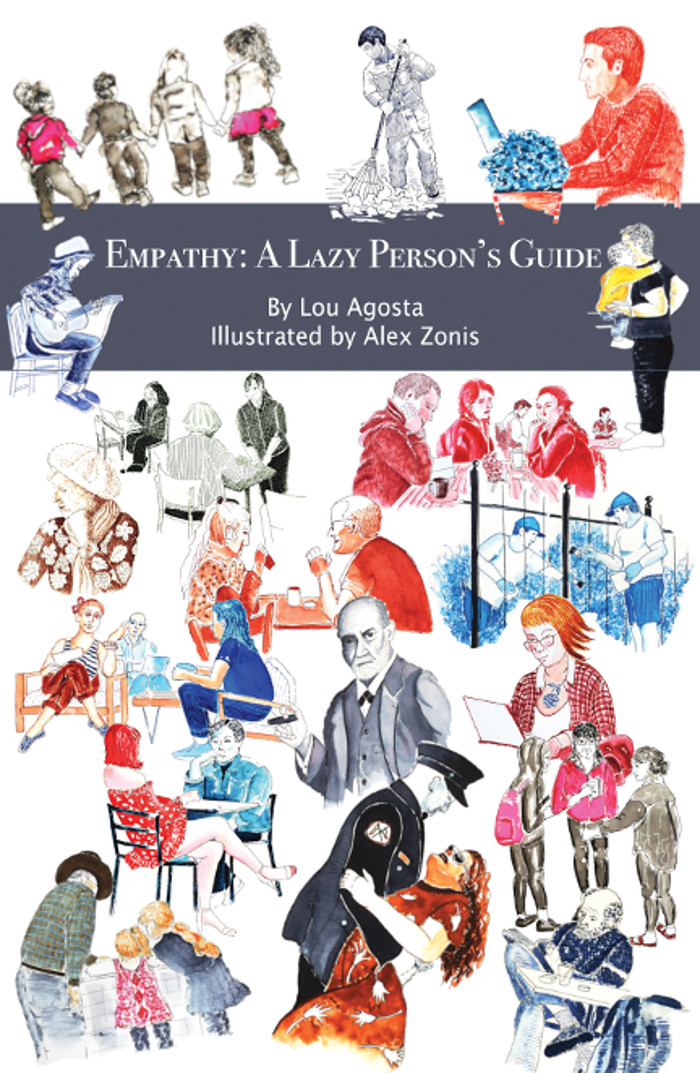
Order from author’s page: Empathy Lessons, 2nd Edition: https://tinyurl.com/mfb4xf4f
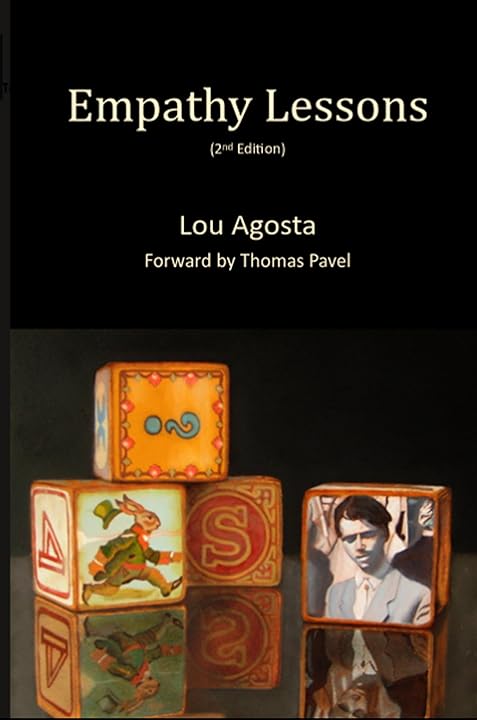
Above: Cover art: Empathy Lessons, 2nd Edition, illustration by Alex Zonis
Advertisements
https://c0.pubmine.com/sf/0.0.7/html/safeframe.html
REPORT THIS AD
Order from author’s page: A Critical Review of a Philosophy of Empathy: https://tinyurl.com/mfb4xf4f
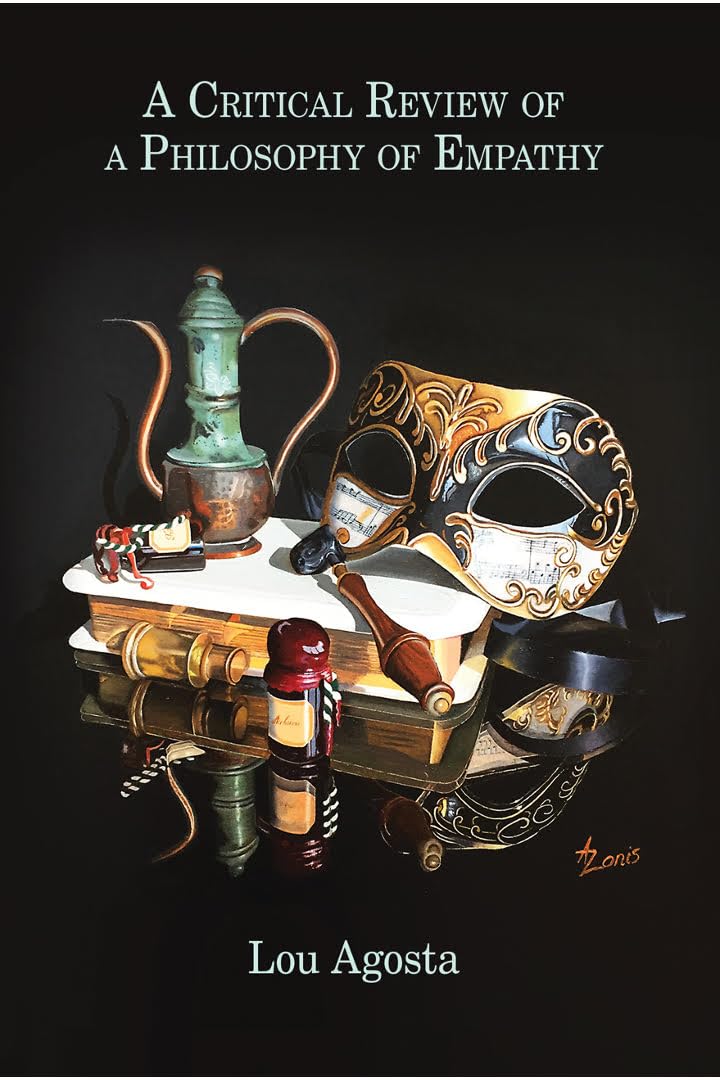
Above: Cover art: A Critical Review of a Philosophy of Empathy, illustration by Alex Zonis
Finally, let me say a word on behalf of hard copy books – they too live and are handy to take to the beach where they can be read without the risk of sand getting into the hardware, screen glare, and your notes in the margin are easy to access. Is this a great country or what – your choice of pixels or paper!?!
(c) Lou Agosta, PhD and the Chicago Empathy Project

Mutilated empathy in MIGRANT AESTHETICS by Glenda Carpio
Review: Mutilated empathy in spite of itself in Migrant Aesthetics: Contemporary Fiction, Global Migration, and the Limits of Empathy by Glenda Carpio (New York: Columbia University Press, 223, 285pp.)
Glenda R. Carpio is well-known for her work Laughing Fit to Kill: Black Humor in the Fictions of Slavery (Oxford 2008). This work succeeds in a high-wire balancing act in transforming racial stereotypes meant to devalue into humor that liberates, humanizes, and transfigures as only the artform of jokes can do.
There is almost nothing that can be said about making jokes about race that cannot be distorted or misunderstood. The entire field of humor is fraught, and the more edgy and confrontational the joke or skit, the funnier it is—until it isn’t. Someone gets their feelings hurt and the potential laughter mutates into rage. Therefore, I am not going to tell a joke. I am going to make a generalization, which is definitely not as much fun. Acknowledging that reasonable people may disagree, I note the close relationship between humor/jokes and empathy.
For purposes of this review, the folk definition of empathy will suffice—take a walk in the Other’s shoes after first taking off one’s own to guard against the misfiring of empathy as projection. In empathy one navigates the firm boundary between self and Other with dignity, respect, recognition, and acknowledgement, in creating a community of self and Other. A rigorous and critical empathy maintains firm boundaries between self and Other, guarding against merger, emotional contagion, projection, and other common ways that empathic relating can misfire or go astray. Good fences make good neighbors, as the poet said, but there is a gate in the fence, and over the gate is inscribed the word “empathy.” In contrast with empathy, in joking one crosses the boundary between self and Other with aggression, insulting remarks, sexual suggestions or other violations of community standards—but it is all okay—why?—because it is a joke! Pause for laughter. One jumps over the wall—takes a prat fall backwards over the boundary between self and Other, and if joke works, then the speech act of the joke creates a community in the shared laughter. (On the joke as a speech act that creates community see Cohen 1999; one may say the same thing, it creates community, about storytelling as the speech act corresponding to empathic receptivity Agosta 2010; also of note Wisse 2013.)
The connection of empathy with Carpio’s next work is evident in the title: Migrant Aesthetics: Contemporary Fiction, Global Migration, and the Limits of Empathy (Columbia UP 2023, 285 pp.). Now it is a bold statement of the obvious that empathy has its limits. A naïve merger with victimhood results in pity and sentimentality rather than taking a stand for social justice and positive politics in a productive sense. Nothing wrong as such with having a good cry, but that is already arguably a breakdown of would-be empathy. On the other hand, if one’s eyes get a bit moist that is another matter. Empathy is so fundamental an aspect of one’s being human, that lack of empathy can be seen as being inhuman (e.g., Keen 2008: 6; Blankenship 2019: 38).
The short review of Migrant Aesthetics is that it sets up an either/or choice between ending empire (e.g., colonialism, imperialism, racism, and so on) and expanding a rigorous and critical empathy. Then mutilates empathy by confusing it with projection, emotional contagion, conformity, and other forms of miscommunication. Not surprising, the result is some 285 pages of penetrating analysis in which the reader does not get a single example of the practice of empathy resulting in a successful empathic relatedness in literary fiction. The forced choice between expanding empathy and ending (or limiting) empire must be refused. Both results are needed. More on that shortly.
Meanwhile, the longer review: the practice of a rigorous and critical empathy knows that it can be wrong and can break down, misfire or go astray, flat out fail, as projection, emotional contagion, conformity, or communications getting lost in translation. It is precisely in engaging with and overcoming these obstacles and resistances to empathy that empathic relatedness and community are brought forth. Like with most powerful methods, skills, or interventions, practice makes the master. As a successful and popular teacher, Carpio knows the value of empathy, nor is mention of the word itself required. The good news is that empathy works whether one names it or not, whether one believes in it or not.
As noted, the issue is that in 285 pages of penetrating, incisive analysis of migrant aesthetics (the category, not the title), there is not a single example of what an effective example of successful empathy. The reader is not given a single example of what healthy empathic relatedness would look like, so that one could identify it if one happened to encounter it. This bears repeating: in some 285 pages of summary and analysis of the literary fictions of Dinaw Mengestu, Teju Cole, Aleksandar Hemon, Valeria Luiselli, Julie Otsuka, Junot Diaz, and some nonfiction of others, Migrant Aesthetics does not cite a single example of empathy that works right or functions as designed. Granted that empathy does not always succeed, the reader does not learn what a healthy, rigorous and critical empathy might look like if, rare as it may be, one happened to encounter empathy. None. Not one single example of what empathy looks like when it succeeds in producing empathic relatedness. This must give the reader pause. We take a step back—but not too far back.
If truth is the first casualty of war—try substituting one of Carpio’s key words “empire” for “war”—then empathy is a close second. In an astute and penetrating analysis, consistently engaging and controversial, Migrant Aesthetics periodically pauses to “foreclose empathy” or the possibility of an empathic response. The steady drumbeat of foreclosing, undercutting, invalidating, or dismissing empathy occurs like a recurring rhythm that, to this reviewer, suggests an editorial decision or personal commitment or both.
Now I might be wrong but I understand “foreclose” as used in Migrant Aesthetics, not the Lacanian/Hegelian sense of “aufgehoben,” cancel and preserve, but what one does when one can’t pay the mortgage—hand over the property, abandoning it in lieu of payment. You wouldn’t want to be aufgehoben would you? In any case, the term is used in a devaluing way—like it is a bad thing to empathize at the point of foreclosure.
There are many things about which to be aggrieved in a world inheriting the violent outcomes (still ongoing) of colonialism, imperialism, prejudice, summarized as “empire,” but Migrant Aesthetics’ main grievance is reserved for empathy. I hasten to add that I am against pain and suffering of all kinds including that caused by empire, imperialism, colonialism, and prejudice. I do not carry water for the pathologies of capitalism and call out the distortions of empathy under capitalism. The boss is “empathic” towards the wage slaves in their cubicles—in order to expand productivity. Happy workers work harder and are more productive. The salesman takes a walk in the shoes of the customer—in order to sell him or her another pair!
Granted, Michael Jordan reportedly said that even Republicans (people in the political party) buy athletic sneakers (see also Adams 2016), implying he was happy to sell them while disagreeing politically. Under empire one gets mutilated empathy.
That empathy can be distorted, misused, and pathologized—mutilated—no more invalidates empathy than that Roman soldiers drove spikes into the limbs of the people they were crucifying invalidates carpentry. Admittedly an extreme example, but it does make the point that carpentry is a wholesome and useful practice – and so is empathizing.
In Migrant Aesthetics, the problems of empire are so complex, messy, intractable, one has to blame something—let’s blame empathy—for example, instead of pointing to human aggression as a variable hidden in plain view. Empathy did not and does not succeed in solving these problems, though empathy is a proven method of deescalating violence in situations of conflict. However, note well, there is a readiness assessment for empathy—the parties must be willing to try.
The critique of empire, colonialism, prejudice, and so on, is indispensably committed to empathy for another reason that does not seem to occur to Migrant Aesthetics. Whenever a great injustice is about to be perpetrated, the first step is to deny, suspend, cancel, the empathy of the proposed devalued Other, the soon-to-be-victim. Thus, the comparison of about-to-be-victims to insects, with whom we humans notoriously have trouble empathizing; and thus, the required wearing of the yellow star prior to deportation; and parallel methods of alienation. The perpetrators apply mutilated empathy to the intended victims. No good comes of it.
Migrant Aesthetics does not “get it” regarding empathy, and, strangely enough, risks incurring the aesthetic reeducation that gives comfort to certain forms of fascist thinking that begin by driving out critical thinking, empathy, and, above all, a rigorous and critical empathy. We shall recur frequently to the empathic blind spots of the mutilated empathy of migrant aesthetics (the category, not merely the book) in this review. I hasten to add, this review is long, and engaging with this book has been vexing, albeit an empathic labor of love, but the review is still a lot shorter than the book, thereby sparing you, dear reader, who will not need further to engage after this thorough discussion.
Meanwhile, at the risk of being cynical, consistency is over-rated: Migrant Aesthetics makes significant use of standard empathy, though unacknowledged. The simplest narrative would be unintelligible and would read like the railroad schedule unless one brings empathy to the narrative. One can engage in producing “impassable” distances “between the reader and the text” (p. 39) and a “forceful rejection of readerly empathy” (p. 148), but, having done so, one should not be surprised that the narrative is drained of vitality, strength, energy, and aliveness. And sometimes that is the point as in Ronald Barthes (1953) “writing degree zero,” a “colorless writing, freed from all bondage to a pre-ordained state of language.” Less is more. (For example, see the rediscovery of “writing degree zero” without acknowledging the phrase (Carpio: 11).)
In addition, though reasonable people may disagree, Barthes asserts that in writing degree zero the author is collective and group-oriented. The distinction “choral” as used in Migrant Aesthetics had not been invented yet, but the idea is the various authors “pass around” the manifesto, literary artwork, or press release on which they are working. The sun sets on the individual author’s voice, who, even if she is not dead, joins the FBI witness protection program and goes underground (Barthes 1968).
My assertion is that empathy is indispensable even when employing distancing methods of alienation (think of Berthold Brecht’s Epic Theatre). Perspective taking, taking a walk in the Other’s shoes after first taking off one’s own (the folk definition of empathy), is a necessary condition for making sense out of the story as the occurrence of human events. Indeed a minimalist approach often lets the empathy emerge more forcefully, for example, in Virginia Woolf,’s Nathalie Sarraute’s, or Albert Camus’ writings. Of Migrant Aesthetics’ favorite authors, Teju Cole, Julie Otsuka and Valeria Luiselli are towards the top of the “less is more” in writing list.
A possible way forward (not called out by Migrant Aesthetics), in which, in spite of the resistances and obstacles of empire, empathy and literary fiction intersect productively, is invoking the speech act of conversational implicative. This, as noted, brings forth the didactic alienation effect of Brecht’s epic theatre. “Conversational implicature” is an indirect speech act that suggests an idea or thought, even though the thought is not literally expressed. Conversational implicature creates distance between the reader and the text, which is more like a tenuous suspension bridge of rope over the river rapids in the jungle than a highway on the interstate. Conversation implicature lets the empathy in—and out—to be expressed without the psychological mechanisms of emotional contagion, projection, conformity, and so on, which result in mutilated empathy. Such implicature expands the power and provocation of empathy precisely by not saying something explicitly but hinting at what happened. This distinction (conversational implicature) seems to live in the empathic blind spot of migrant aesthetics. The information is incomplete, the context unclarified, and the reader is challenged to feel her/his way forward using the available micro-expressions, clues, and hints. Instead of saying “she was raped and the house was haunted by a ghost,” one must gather the implications. In an example, not in Carpio, from Toni Morrison’s Beloved, one reads:
Not only did she have to live out her years in a house palsied by the baby’s fury at having its throat cut, but those ten minutes she spent pressed up against dawn-colored stone studded with star chips, her knees wide open as the grave, were longer than life, more alive, more pulsating than the baby blood that soaked her fingers like oil (Morrison 1987: 5–6).
The reader does a double-take. What just happened? Then the casual conversation resumes about getting a different place to live, which one had been having when this erupted, as the reader tries to integrate what just happened into a semi-coherent narrative. Yet why should a narrative of incomprehensibly inhumane events make more sense than the events themselves? When the event are inhumane perhaps the empathic receptivity consists precisely in being with their inhumanity without doing something “human” like weeping or rending one’s garments. No good reason – except that humans inevitably try to make sense of the incomprehensible. “Not a house in the country ain’t packed to its rafters with some dead Negro’s grief” (1987: 6). One of the effects and empathy lessons is to get the reader to think about the network of implications in which are expressed the puzzles and provocations of what really matters at fundamental level. (For more on conversational implicature see Levinson 1983: 9 –165.)
For example, at the end of Berthold Brecht’s Mother Courage, all her children are dead—but she continues to follow the soldiers, selling them gun powder and provisions, more dedicated to her commercial (read: “capitalist”) enterprises than to her children. No catharsis of pity and fear here, and the viewer’s empathy is not mutilated by emotional upset, projection, conformity, and so on. The viewer’s empathy is left with pent up emotional upset that may usefully be directed into changing the social and economic conditions that allow such a possibility. Any maybe that is the point. However, even in this case the distancing does not work without a “top down,” cognitive empathy that gets one to think.
There is nothing wrong as such with Migrant Aesthetics. But there is something missing. The reader (audience) does not find out what a healthy relationship looks like. As for Morrison, she discovers the hope of wholeness and integrity elsewhere in the text, pointing to an example of one as the shadows of the characters are holding hands, indicating the possibility of family (Morrison 1987: 67). Otherwise, migrant aesthetics is littered with limbs and fragments of human beings—both the bones of dead refugees in the desert and emotional trauma—not a whole person in sight anyway. The author may argue back: “You have now got the point—thus, the consequences of empire!” Point taken, yet—the issue is that one is not on the slippery slope to the aestheticization (and anesthetization) of violence, trauma porn, and moral trauma, one is at the bottom of it. The empathy is as mutilated by projection, emotional contagion, conformity, and so on, as the desperate lives of the migrants wandering in the wilderness of empire. Heavens knows, empathy has its limitations, but not one single example of a healthy, robust, effective application of empathy?
As an exercise, the reader is invited to find an example of an empathic relationship in the writings of Dinaw Mengestu, Teju Cole, Junot Diaz, exemplified in Migrant Aesthetics. Once again, there is nothing wrong as such with the roll call of traumatic outrages perpetrated by bad actors and the survivors themselves—yet one must be a tad masochistic to engage with the outcomes of so much toxicity, violence, and aggressive masculinity—so much empire. Tragedy—the artform, not merely today’s news—is rich in examples of survivors who become perpetrators (and vice versa (e.g., 9, 19, 30, 43, 167)) but, without empathy, the result is just catastrophe, wreck, and ruin.
The choice between expanding empathy and ending empire is a false choice. It must be declined. Both are worthy objectives. In two cases, the migrant authors with whom Migrant Aesthetics is engaging get close to a successful application of empathy, but then fall short. The short coming (I assert) is not in Edwidge Danticat or in Karla Carnejo Villavicencio, but in Migrant Aesthetics’ misreadings of their contribution to a rigorous and critical empathy, a misreading that seems designed uncharitably to make sure that empathy is not credited with making a difference.
First, in the case of Edwidge Danticat’s Brother, I’m Dying (which, however, is a memoir not fiction), the author comes close to endorsing the use of Danticat’s work empathically to train U.S. custom officers and immigration workers, directly quoting Danticat: “[…] [F]or if ‘they can only remember that they are dealing with human beings at possibly the worst moments of their lives and not mere numbers or so-called ‘aliens,’ then they would do a better job” (Carpio 2023: 218). But then Migrant Aesthetics pulls back and forcloses the empathy as providing a handbook for welcoming migrants instead of part of systemic empire, for example, that aligns the U.S. imperialism of the invasion of Haiti with the invasion of Iraq. What I can’t figure out is why one has to choose between welcoming those migrants, whether using an empathic “handbook” or not, and further debunking the by now well-known and appalling mistakes of the so-called war on terrorism? Doesn’t the world need both expanded empathy and political action against the abuses of the war on terrorism and imperialism?
Second, Carpio credits Karla Cornejo Villavicencio with being motivated by the belief that literature can create productive empathy, or at least compassion (Carpio: 234), quoting Karla:
Art allows us to feel for the pain of others who have or will experience pain we cannot imagine or cannot ever happen to us. Even if we cannot feel it, or imagine it, that’s just human limitation. A failure of imagination can be compensated by the construction of a sturdy enough bridge of artistic articulation of that pain, and if it’s honest enough, we may not feel it—though in some cases we may—but we will feel for our fellow humans, and that is the job of the artist (Carpio: 234)
However, then Migrant Aesthetics undercuts this quote by detecting “ambivalence” in Villavicencio. Heavens to Murgatroyd! If Villavicencio were not ambivalent about vicariously feeling the pain of Others, one would have to dismiss her as being unempathic. And Migrant Aesthetics actually does something like that as it again tries to force a choice where none is warranted between struggling human beings, the unnamed migrants over whose graves no one has prayed, and contingent forces (including empire, etc.) that force them to migrate and become refugees. Migrant Aesthetics devalues Villavicencio’s empathy for struggling humanity—she almost gets there—but then she does not—and ends on a note of haunting and shame. This steady drum beat of the devaluing of empathy must give one pause. There’s another agenda here with the constant rhythm of dozens of mentions of various forms of empathy, and not a positive productive application of empathy in sight. What’s going on here?
Caprio asserts: “…[W]hat has been my centra argument in this work: that the history of empire is key in understanding the roots of migration at a scale appropriate to its global dimensions (Carpio: 228).” That to be forced from one’s home and become a refuse of the road is surely a source of enormous pain and suffering. Here the connection is direct—cause (routed from one’s home by aggression, starvation, etc.) and effect (pain, suffering). At the risk of over-simplification, yet a compelling one, white Europeans with cannons and machine guns go to Africa and Asia and exploit the natural resources and enslave or dominate the locals. A small subset of the locals is coopted—analogous to the concentration camp capos, both perpetrators and survivors (until they are not) being chosen from the prisoners—to make the job of the ruling class easier. Even the prisoners then become perpetrators as one starving persons “steals” bread or water from another or lies to save his own skin, thereby endangering another. And some of those locals migrant back to headquarters, whether London, Paris, Amsterdam, Berlin, London, New York or Paris.
Now if anyone seriously believes that empathy is going to solve the problems created by empire, colonialism, imperialism, and so, then—how shall I put it delicately?—empathy is being “over sold.” This is usually the first step in setting up empathy as a “strawman” to be blamed for not fixing the many challenges facing civilized human beings committed to building a community that works for all persons.
There are at least two hidden variables behind the problematic causal analysis of empire that would help connect the dots: Human aggression and human hunger (hunger for many things, but here for food). These human beings are an aggressive species—and biologically omnivores. People can be kind and compassionate and empathic, but they also can behave aggressively and violently. Even if committed vegetarians, people also need to eat quite regularly, if not exactly three times a day.
To say, as Migrant Aesthetics does, that the arrival of the white European conquistador and their horses in the new world in 1492 was a catastrophe for the original inhabitants gets the measure of the event about right. In a way, the displacement of the Cherokee Nation from Georgia to Oklahoma is a kind of migration; but not really. It is a death march with strong aspects of genocide.
By all means denounce empire, but a more useful approach consistent with it might be to elaborate an analysis of human aggression, territoriality, lack of education, lack of critical thinking, the disturbing tendency of many human beings fanatically to follow authoritarian figures off a cliff. In that context, empathy is a proven way of deescalating violence and aggression.
Unfortunately, once a “policeman” is kneeling on your neck or someone throws a bomb, it is too late for empathy. The perpetrator fails the readiness assessment for empathy and it is necessary to invoke self-defense. And remember the best defense is a good offense—provided that it is proportionate to the incoming violence (which is notoriously hard to determine). Self-defense, setting limits, establishing boundaries are what is needed. There is a readiness assessment for empathy, and it requires that one be relatively safe and secure in one’s own person. Empathy 101 teaches that empathy does not work an active battlefield, if one is starving to death, or hanging upside down in a torture chamber. Never underestimate the power of empathy—never—but empathy in such extreme situations ends up looking like what the FBI Hostage Negotiating team uses to open communication with the hostage takers, or looking like “Red Team, Red Team!”—think like the opponent in a war game (e.g., Zenko 2015). As it stands, Migrant Aesthetics misunderstands empathy, mutilates it, and then blames empathy because empathy can be misapplied by migrant authors, some of the male members of which are both perpetrators and survivors, for calling attention to their plight and that of the devalued Other within us all.
The dialectic of unanticipated consequences marches on. The “classic” traditional migrant fictions of Willa Cather’s My Ántonia (1918) and Upton Sinclair’s The Jungle (1906) are noticeably absent in streets paved with gold, though one recurring, invariable constant among immigrants, refugees, and migrants is that they all express motivation to make a better life for their children. The Lithuanian migrants in The Jungle claw their way to a conclusion in which they are learning to speak socialist truth to power, having adopted a progressive socialist program that is today considered unradical because it is the law of the land. Sinclair joked: “I aimed at the public’s heart and by accident I hit it in the stomach” as citizens insisted on the Meat Inspection Act the Pure Food and Drug act. The folks in My Ántonia are trying to grow crops in Nebraska, which in the first map of North American was designed as “the great American desert.” In Ole Edvart Rolvaag’s Giants in the Earth(1927), set in South Dakota, also part of the Great American Desert, no mention is made of the original inhabitants, who have already been buried at Wounded Knee, and the main action is the battle against a ferocious climate: snow storms, locusts who ravage the crops, hunger, isolation, cultural alienation of the children, and the stereotypical mad scene of the heroine prior to a Christian-based recovery of spirituality. Though the sustainability of the Ogalala Aquifer continues to be a concern, the migrants succeed in getting the desert to bloom.
The other hidden variable is that these humans are a hungry species. At the risk of over-simplification, long since incurred, the development of Cyrus McCormick’s combine-wheat-reaper, and the follow-on agribusiness technology, allow some 2% of the population to grow enough food to feed the entire planet; and this in spite of the fact that human choices made under aggression continue to use food as a weapon of starvation. Prior to the Green Revolution, the other 98% of the population had to work twelve to sixteen hours a day to grow enough food to avoid slow death by starvation. As noted, the migrant classics, admittedly shot through with empire, of Willa Cather and Ole Edvart Rolvaag, in which hunger is an ever-present specter, pending a successful harvest. Meanwhile, apparently large dairy herds really do contribute to greenhouse gases.
It is hard not to be a tad cynical: quit one’s day job as a Mandarin professor pronouncing ex cathedra or a highly compensated empathy consultant and spend twelve hours a day growing one’s own food. “We are star dust, we are billion-year-old carbon – get back to the land and get your soul free”? The melting of the polar ice cap at the north pole and the opening of the long-sought “northwest passage” is evidence of global warming that, absent delusional thinking, is hard-to-dispute. Nor is it a contradiction that both human-made greenhouses gases the earth’s procession of the equinox work together multiplicatively toward the trend of global warming. On background, the procession of the equinoxes is the tilt of the planet earth that causes an arrow pointing upward from the north pole towards the North Star to spin around the North Star rather than directly at it in a 25K year cycle, resulting in a regular measurable tilt toward and away from the sun that arguably is enough to contribute significantly to global cycles of warming and cooling. Splitting—either human’s hunger for meat versus the continency of a wobbly planet—offers a false choice and must be declined.
The grievance against empathy continues: Migrant Aesthetics writes (p. 4): “More broadly, the genre of immigrant literature depends on a model of reading founded on empathy—a model that my book takes to task. Literature promotes empathy, we are told, but empathy can easily slip into a projection of readers’ feelings and even into outright condescension.” As a reviewer, I am holding my head in my hands and rocking back-and-forth quasi-catatonically. I am in disbelief at the lack of common sense, lack of critical thinking, and absence of argumentative charity in confusing empathy and projection. Projection is a breakdown of empathy. Projection is a misfiring and/or going off the rails of empathy. Projection is a “getting lost in translation” of empathy. Now attribute these to empathy and dismiss empathy. Hmmm.
As regards “a model of reading founded on empathy,” please stop right there. Reading the story would not work—would not make any sense—would, strictly speaking, be unintelligible without empathy. The story would sound like reading the bus schedule when the public transit was on strike. Nonsense. Mumbo-jumbo. Without the empathic ability to translate the thoughts and feedings enacted in the story into actions and conditions that matter to the reader, the story would be empty and meaningless, lacking vitality, energy, strength or aliveness. Without empathy, the actions and contingencies, the struggles and high spirits, setbacks and successes, that are represented in the story would be strange sounds and gestures appearing to an anthropologist on Mars or on her first day in an alien culture, prior to marshalling her empathic skills. Never underestimate the power of storytelling, but absent empathy, it does not get traction. All reading is founded on empathy.
Migrant Aesthetics “forecloses” (rejects) empathy, then immediately lets it back in, because empathy is indispensable. Carpio (p. 8): “[…] [T]he writers I examine reject empathy as the main mode of rationality, opting instead for what Hannah Arendt called “representative thinking” that is, they urge reader to think, as themselves, from the position of another person and thus to call into question their own preconceptions and actions.” Thus, Migrant Aesthetics rejects empathy while calling out including “the position of another person,” which is precisely the folk definition of empathy.
Arendt’s reference here is of course to a single line in Kant’s Third Critique (1791/93 (AA 158)) about “enlarged thinking” [erweiterten…Denkungart] that is, to think from the perspective of the Other. Sounds like the folk definition of empathy to me. This cipher of “enlarged thinking”, which remains unintegrated in Kant, became the inspiration for Arendt’s incomplete third volume of the life of the mind on political judgment. Once again, it is the folk definition of empathy.
The fan out is challenging at this point. This single quote from Arendt plays such a significant role in Migrant Aesthetics that there is no avoiding a dive into Arendt scholarship. By invoking the formidable name and work of Hannah Arendt, who was herself a migrant refugee (note well!), a Jewish person fleeing from the Nazis, a whole new thread is started.
Arendt rarely uses the word “empathy,” though “animal pity” gets called out in the context of Himmler’s fake empathy (Arendt 1971: 105–106; Agosta 2010: 73). Arendt is not thought of as an advocate for empathy, though, in its own Kantian way, her work is rich in empathic understanding. In one of her few uses of the word “empathy” itself, the otherwise astute Arendt claims that “empathy” requires becoming the Other in a kind of merger, which, of course, is the breakdown of empathy into emotional contagion. Other than this terminological slip up, Arendt’s analysis is an incisive application of empathy to politics in “Truth and Politics” in Between Past and Future (1968: 9):
I form an opinion by considering a given issue from different viewpoints, by making present to my mind the standpoints of those who are absent; that is, I represent them. This process of representation does not blindly adopt the actual views of those who stand somewhere else, and hence look upon the world from a different perspective; this is a question neither of empathy, as though I tried to be or to feel like somebody else, nor of counting noses and joining a majority but of being and thinking in my own identity where actually I am not. The more people’s standpoints I have present in my mind while I am pondering a given issue, and the better I can imagine how I would feel and think if I were in their place, the stronger will be my capacity for representative thinking and the more valid my final conclusions… The very process of opinion formation is determined by those in whose places somebody thinks and uses his own mind, and the only condition for this exertion of the imagination is disinterestedness, the liberation from one’s own private interests (Arendt 1968: 9; italics added).
The word “empathy” is in principle dispensable here, and Arendt’s lovely phrase “one trains one’s imagination to go visiting [the Other]” is an exact description of empathic understanding, though not empathic receptivity of the Other’s feelings/emotions. One does not blindly adopt the Other’s point of view—one takes off one’s own shoes before trying on the Other’s. Even in a thoughtless moment, more thinking occurs in Arendt’s casual, throw-away use of a word, than in most people’s entire dictionaries. If necessary, Arendt may be read against herself, for the simple introduction of the distinction “vicarious experience” of an Other’s experience is sufficient to contain all the puzzling cases about being or becoming someone else. As a good Kantian, Arendt would appreciate in a universalizing moment that Kant’s sensus communus [“common sense” as an instrument of judgment] is what enables people to judge by means of feelings as well as concepts, but that it is a false splitting to force a choice between feeling and thinking—both are required to have a complete experience of the Other.
Regarding Arendt’s use of the word “empathy” [Einfühlung] itself, it is likely she encountered it in Martin Heidegger’s Being and Time (1927: H125 [pagination of the German Niemeyer edition]), which she studied carefully. There Heidegger undercuts Max Scheler’s use of the term in criticizing Theodor LIpps, who uses of the term in his (Lipps’) Aesthetics (1903; see also Lipps 1909), in which Lipps defines empathy [Einfühlung] as a kind of aesthetic projection of the subject’s feelings onto art and nature (and the Other). The examples of an angry storm at sea or the melancholy weeping willow trees or the smiling clouds and cheerful sunrise come to mind. The matter is a tangle, which I disentangle in Agosta (2014).
The controversy continues to fan out as Migrant Aesthetics marshals the authority of Namwali Serpall’s “The Banality of Empathy” (2019). Nice title. This is a reference to Arendt’s book Eichmann in Jerusalem: A Report on the Banality of Evil (1971), about which it is hard to say just a little. I shall try. One of Arendt’s recurring themes is that evil is a consequence of thoughtlessness. Eichmann was a simpleton, a “Hans Wurst” from the folktale, who did not think and just followed orders. The wanted-dead-or-alive poster for Thoughlessness has Eichmann’s photo on it. The result of thoughtlessness was catastrophe. Indeed. Of course, Eichmann had many fellow travelers in genocide.
If one empathizes thoughtlessly, the banality of empathy of Serpall’s title, then one is at risk of empathy misfiring as projection, emotional contagion, conformity, and so on. Just so. A rigorous and critical empathy is required to guard against these risks, and Arendt, no advocate for sloppy anything, much less sloppy empathy, is halfway, but not all-the-way, there with her invocation of Kant’s rigorous and critical method. The above-cited quotation from Arendt and my analysis of terms must count towards a clarification of the nuances of the matter.
Serpall’s article then raises the question about narrative art “If witnessing suffering firsthand doesn’t spark good deeds, why do we think art about suffering will?” Though this may have been intended as a rhetorical question, the answer requires an empirical, fact-based inquiry. Some witnessing of suffering does indeed spark good deeds. The typical Samaritan becomes the Good Samaritan when he stops to help the survivor of the robbery thereby creating neighborliness and community; whereas the Levite and Priest succumb to empathic distress and cross the road, thereby expanding indifference and alienation. These events get “narrativized” in the Parable of the same name, which, in turn, inspires some to good deeds, though others are left paralyzed by empathic distress.
As Suzanne Keen (2007) points out, some stories such as Harriet Beecher Stowe’s Uncle Tom’s Cabin have an outsized effect on positive politics, rallying people to the cause of the abolition of slavery; whereas other novels such as The Turner Diaries may arguably have given comfort to white supremacy and provided bomb-making instructions to domestic terrorists. The answer to Serpall’s (or the editor’s) question is direct: we think art will inspire good deeds because we find examples of art’s doing so, albeit with conditions and qualifications. The evidence isthat’s what happened. The more important issue is to distinguish how art can transfigure the pain and suffering of the migrant (and suffering humanity at large), overcoming trauma, or how such attempts risk devolving into what is sometimes called “trauma porn,” engaging the graphical description of trauma without the “disinterestedness of art,” resulting in a kind of indulgent “orgasm” of aggressive violent fantasies. (As a benchmark, and acknowledging that reasonable people may disagree, an example of trauma porn (other than snuff videos on the dark web) would be Mel Gibson’s film (2004), The Passion of the Christ.)
Arendt is sometimes accused, I believe unfairly, of being tin-eared in her statements about US race relations and desegregation, especially in Little Rock, AK in 1957. When the 13-year-old Arendt was subjected to antisemitic comments by her teacher at school in the late 1920s, her mother withdrew her under protocol and protest and home-schooled Hannah. You have to get the picture here: the young Hannah reading the leather-bound Kantian First Critique in her late father’s vast library. Seemingly following the recommendation that Migrant Aesthetics (pp. 8, 13, 201) attributes to Arendt, she adopts a position, not a person, regarding US race relations (circa 1957!). “Positions not persons” is a fine slogan. It doesn’t work. Another false choice? The young black children in Little Rock, Arkansas, in 1957 needed to get into the classroom to actually get books from the school library as some black families did not own a single book other than the bible (which, in a pinch, is an excellent choice, nevertheless…). That Arendt’s empathy misfires no more means that she lacks empathy or that empathy is invalid than that a driver who forgets to use her turn signal does not know how to drive (though she may get a citation!).
What is rarely noted by Arendt scholars is Arendt’s own strategic use of empathy in escaping from the Nazis. Having been arrested for Zionist “propaganda” activity by the Nazis, she builds an empathic rapport with the Gestapo prosecuting attorney, who is interviewing her in the same basement from which other Jewish people are deported to Buchenwald or Dachau. The result was not predictable. Arendt was released on her own recognizance, and, of course, she had immediately to flee across the border illegally. Now while we will never know all the nuances—in the interview (1964) she makes it sound like part of her tactic to save her own life was that she bats her eyelashes at the young naïve Gestapo prosecutor, who has just been transferred from the criminal to the political division—more grim humor—but, don’t laugh, it worked. Never underestimate the power of empathy. (See Arendt’s interview with English subtitles “Hannah Arendt: Im Gespräch mit Günter Gaus” (1964).[1]
Resuming the main line of the argument, Migrant Aesthetics continues the devaluation of empathy. It is choral. Migrant Aesthetics paraphrases the novelist, professor, and celebrity migrant [Viet Thanh] Nguyen (p. 31): “Nguyen argues that empathy, while being necessary for human connection, cannot be relied upon as the basis of political action because it is selective and unstable; it can easily morph into solipsism and escapism.” Wait a minute! Empathy “being necessary for human connection,” please stop right there! Take away empathy, the requirement for human connection is cancelled and—solipsism and escapism are the result. How shall I put it delicately? By their own words, they shall be exposed; looks like a solid case of the emperor’s new clothes, to quote the late Sinéad O’Connor. Once again, I am sitting here holding my head in my hands, rocking back and forth semi-catatonically, amazed that the breakdown of connectedness such as solipsism and escapism should be made an essential part of empathy’s defining features. Take away human connection, which empathy brings forth, pathological forms of domination occur such as “the structural inequities of a settler colonial state.” Ouch! It is like invalidating carpentry because an apprentice carpenter hits his thumb with the hammer (we will leave that other example behind for now). It is a problem that empathy is sometimes selective (parochial) and unstable like the human beings who try to apply it. The solution is expanded empathy. Unstable indeed. So far, the only thing stable about Migrant Aesthetics’ argument is its devaluing of empathy.
Nor is this necessarily an accurate representation of Nguyen position, who (I suggest) sees himself as an educator not a political infighter. Two wrongs do not make a right. The commitment to human rights is worth sustaining even in the face of the inhumanity of empire, which presents false choices between empathy and conformity. Human beings are a kind and empathic species, as noted, and they are also an aggressive and hungry one. Nguyen: “Art is one of the things that can keep our minds and hearts open, that can help us see beyond the hatred of war, that can make us understand that we cannot be divided into the human versus the inhuman because we are, all of us, human and inhuman at the same time” (quoted in Goldberg 2023). Nor is this to endorse the inhumane behavior of many humans. Once again, Nguyen knows one does not have to choose between ending empire and expanding empathy.
To compete the discussion of Arendt (1955/68: 153–206), she wrote a short intellectual biography of Walter Benjamin (1892–1940) in Men in Dark Times. Separately, Benjamin warned that the aestheticization of politics risks turning artistic expression into fascism. The theatrical (“artistic”) spectacle of a torch light parades at Nurnberg, Germany, (1933–1938) by masses of brown shirt storm troopers around a bonfire burning the canonical novels of western civilization is a mutilation of empathy into the emotional contagion of crowds as well as a mutilation of that civilization itself. Once again, it is hard to say just a little bit about this, nor is this review going to solve the problem of the relation between the aesthetic and the political. It is a disappointment that Arendt did not live long enough to complete more than a single sentence of her deep dive into the relation between Kant’s Critique of (Aesthetic) Judgment and politics; nor is it likely that such a project would have produced what Hegel produced when he undertook such a deep dive: The Philosophy of Right (1921), which read superficially gives the authority of The State a leading role in political life: “It is the way of God in the world, that there should be a state” according to Walter Kaufman’s translation. Migrant aesthetics politicizes aesthetics with an anti-fascist, anti-imperialist, anti-empire-ist commitments, rhetoric (in the classical sense), and expressions, without necessarily making practical recommendations for political action. Migrant Aesthetics expels empathy from the garden of artistic achievement, because empathy does not provide a stable basis for political action. Never underestimate the relevance of Immanuel Kant, yet if one wants measurable results from political action, apply Saul Alinsky’s Rules for Radicals (1971) or analysis based on Eric Hoffer’s The True Believer (1951), not Kant’s Third Critique. Hoffer calls out the mutilated logic of totalitarian thinking; and Alinsky knew quite a lot about building communities, and though he did not use the word “empathy,” empathy lives in building community.
Migrant Aesthetics cites the eight definitions of empathy, or, more exactly, empathically-relevant phenomena, starting from C. Daniel Batson (2012). Migrant Aesthetics is also conversant with Susan Lanzoni’s (2018) magisterial account Empathy: A History, which includes many more definitions. Martha Nussbaum’s (and other’s) argument is cited that “the belief that reading fiction improves individuals’ empathic power” (Carpio: 11). However, on the latter position, see Suzanne Keen’s above-cited point about this requiring an empirical, fact-based inquiry. Those who bring an ounce of empathy to quality literature, often come away with a pound of empathy; but bad actors who, for example, bring white supremacy to their reading come away with further bad actions. If a slave owner had read Uncle Tom’s Cabin, it is probable that he would have come away saying, as regards the beating death, “That slave had it comin!’ Was exactly what he deserved!” The reader missed the point. And on that grim note we turn to the survivor/perpetrators, who form a large part of the “data,” the literary narratives, in Migrant Aesthetics.
The first fictional witness is Dinaw Mengestu’s protagonist Isaac from All Our Names (2014). Fleeing from war in Ethiopia to Uganda, he goes from the frying pan to the fire. His mentor perpetrates mass murder. Isaac is forced to cover up the crimes by burying the victims in a mass grave. Isaac is coopted into delivering arms to young boys—child soldiers—who perpetrate their own outrages before perishing. Isaac survives, smuggling himself to the States in a small trunk in a scene reminiscent of the animation Aladdin with the Genie who has to spend 10,000 years in the bottle, but it is not nearly as funny. The entire story is told from two points of view, that of Isaac, who has survived the atrocities of the unnamed but Ida-Amin-like authoritarian monster; and that of the mild-mannered white social worker, Helen, assigned to Isaac to help with his recovery—as it were, the poster child for empathy. The differences in their respective experiences are a powerful setup to challenge anyone’s empathy—but especially Helen’s and the reader’s.
The social worker, Helen, strives to map the scope and limits of her empathy, but her empathy is tin-eared, ineffective, and misfires. The client, Isaac, needs a lot of things that Helen can’t give him—fluency in English, a good paying job, a relationship with a romantic partner who appreciates him as a possibility (and vice versa). The one thing Helen is most able to do—give Isaac a good listening—give him empathic receptivity—she fails at—badly. In a clumsy social psychology experiment, Helen tries to overcome the de facto segregation of her small town’s local diner by having dinner there with Isaac. This role playing results in a kind of fake empathy, the projection of a stereotype onto Isaac, not the building of community. In a perfect storm of projection, emotional contagion, and the breakdown of empathic boundaries into sentimentality, Helen gets over involved.
Once again, how shall I put it delicately? Pretending to address the fictional heroine, the therapy does not work, Helen, if you sleep with the client. She does. Predictably this blows up any possibility of a rigorous and critical empathy, restoration of wholeness, or overcoming trauma. This is not to say that the sex was not satisfying. Empathy makes for great sex between mutually consenting partners, but regardless of the details, Helen perpetrates a boundary violation. Certainly unethical, possibly illegal, the power differential between therapist and patient is such that the client cannot give consent, even if he initiates the “seduction.” He is a powerful actor in escaping from civil war and so on; but his agency is compromised, and he cannot escape from bad therapy. It is neither empathy nor pity; it is a boundary violation and should not be represented otherwise. Granted, it makes for a great melodrama and a great screen play such as Netflix’s “In session.” Just that the breakdown of boundaries between self and Other in the context of therapy forecloses the client’s, Isaac’s, recovery. Fortunately, his aspirations as a writer—perhaps the shadow cast by Mengestu over his character, Isaac, – showing the latter the way forward. The survivor/perpetrator creates some empathy, however incomplete and tentative, for himself in his art.
The cultural difference, language difference, difference in experience, and Isaac’s traditional devaluation of woman’s power, are all obstacle to empathy. This is supposed to invalidate empathy? Drive out the obstacles and resistances and empathy naturally comes forth. When the obstacles and resistance are human aggression and empire, that is going to be a big job, though not impossible as the client and therapist are caught in a double bind. Isaac is already a perpetrator and a survivor. Helen becomes one too. The result is the double bind of moral trauma (a distinction missing from Migrant Aesthetics), to which we shall return momentarily. The relationship between Helen and Isaac fails as tragedy because it delivers wreck and ruin instead of recovery form trauma (whether standard or moral) or artistic transfiguration. However, that does not mean that empathy caused xenophobia. The narrow-minded parochialism of projection causes xenophobia; and the solution to parochialism is expanded empathy.
In another story, migrant aesthetics’ mutilated empathy is painfully on display. Migrant Aesthetics writes (p. 7): “The narrator, now known as Jonas, struggles to come to terms both with himself and with his father’s silence about his migration and his physical abuse of the narrator’s mother. One might even argue that the narrator instrumentalizes Yosef’s migration story to explain his own abusive impulses toward his girldfriend.” How shall I put it delicately? Intimate partner physical abuse is not an “instrumentalization”—whatever that is—it is a crime, and should never be represented any other way. Is it not the reader’s empathy—and perhaps the author’s—that is precisely at stake here? This does not mean I am in favor of empire. I am against empire, colonialism, and so on, as well as using them as excuses for people rich with possibility behaving badly.
The next witness to the many mutilations of empathy is Teju Cole’s anti-hero, Juilus, in Open City (2011). Information asymmetries in fiction are at least as old as Oedipus’ not knowing his biological parents—oh boy, did that create some mischief. Arguably Oedipus was the original refugee, seeing as how he was abandoned to die by his biological parents and rescued by poor people from the neighboring country, Thebes.
In addition to information asymmetries, moral ambiguities are key ways of creating engaging narratives. For example, Stephen Boccho’s cop show Hill Street Blues (1981–1987) innovated in popularizing moral ambiguities. A protagonist is introduced sympathetically, inviting the identification, if not the empathy, of the audience, then he or she does something appalling. The good cop is the bad cop (and vice versa). The viewer’s (reader’s) emotional conflict is guaranteed—and the audience is hooked. Highly derivative, but no less engaging for all that, the mild-manner medical student/resident in psychiatry, Julius, is burdened with an altered mental state, a fugue state not exacty epilepsy and resembling multiple personality disorder, in which the “alters” do not know about one another. The issues comes out like a slap to the reader at the end of the story, as Julius is credibly accused of having perpetrated a rape, however, also credibly without remembering it. Gustav Flaubert’s flaneur meets Robert Louis Stevenson’s Dr Jerkel and Mr Hyde, thankfully without the Jack the Ripper gore.
Migrant Aesthetics is explicitly dismissive of trauma studies (e.g., pp. 10, 20), which are essential to surviving empire and fighting back. Without empathy, empire gets the last laugh, as nothing is available but fragments of broken human beings and drying bones in the desert, mutilated empathy and mutilated humans.
While migrant aesthetics (the category not merely the title) “calls out” the distinctions that survivors can also be perpetrators (and vice versa) as well as the distinctions trauma and complex trauma, it stumbles in applying them. More problematically, Migrant Aesthetics misses the distinction moral trauma, which is an unfortunate oversight. It might have saved Migrant Aesthetics from simplistic splitting and trying to force a choice between feeling and thinking, positions and persons, truth and empathy.
Though determining the truth remains challenging, even illusive—especially for survivors of violence, war, and trauma—empathy cannot be sustained without a commitment to truth. Thus, the “take down” of war novels that are critical of war (Carpio: 30) misses the moral trauma of soldiers, who are both survivors and perpetrators. Nor is this justification for war crime(s). Some soldiers are put in an impossible situation—they are given a valid military order and innocent people end up getting killed. The solider is now a perpetrator and a survivor. One cannot practice a rigorous and critical empathy without integrity, commitment to truth, commitment to critical thinking, and fact-based inquiry (granted that “facts” are slippery).
On background, trauma is medically defined at that which causes the person to experience or believe they are in imminent risk of dying or being gravely injured. Rape is on the list of grave injuries. Moral trauma is also on the list and includes such things as the Trolley Car Dilemma; “I will kill you if you do not kill this other person” (different than the Trolley Car); double binds such as those occurring to Isaac and Helen; soul murder such as occurs to Winston at the end of Orwell’s 1984; and seemingly valid military orders that result in unintentional harm to innocent people. In moral trauma people can be both perpetrators and survivors, and become just atht when someone gets hurt who did not need to get hurt.
Here radical empathy comes into its own. A person is asked to make a decision that no one should have to make. A person is asked to make a decision that no one is entitled to make. A person is asked to make a decision that no one is able to make—and yet the person makes the decision anyway, even if the person does nothing, since doing nothing is a decision. The result is moral trauma—the person is both a perpetrator and a survivor. Now empathize with that. No one said it would be easy.
When one is hanging by a frayed rope with one’s face to the side of the mountain, every mountain looks pretty much the same, granite gray and cold and like one is going to die or be gravely injured (the definition of trauma). Strictly speaking, the challenge is not only that the would-be empathizer was not with the surviving Other when the survivor experienced the life-threatening trauma, but the survivor her- or himself was there and did not have the experience in such a way as to experience it whole and completely. That may sound strange that the survivor did not experience the experience. That is the definition of “unclaimed” experience (Caruth 1996). The traumatic experience is not the kind of overwhelming, fragmenting experience that one would ever want to experience, so neuro-biological mechanisms were deployed by the mind-body-self to split off, numb, and defend against experiencing the experience. Isaac, Julius, and Yunior have more than their fair share of that.
Thus trauma survivors report out of body experiences or watching themselves at a distance as the crash occurs or the perpetrator enacts the boundary violation. Or the survivors do not remember what happened or important aspects of it. One is abandoned. Help is not coming—no one is listening. Yet the experience = x keeps coming back in the survivor’s nightmares, flashbacks, or as consciousness flooding anxiety. It comes back as a sense of suffocation, an undifferentiated blackness, or diffuse and flooding fear. The trauma remains split off from the survivor. Yunior’s “The Curse”? The treatment or therapy consists of the survivor re-experiencing the trauma vicariously from a place of safety. In doing so the trauma loses its power and when it returns (as it inevitably does), it does so with less force, eventually becoming a distant unhappy and painful but not overwhelming memory. (See van der Kolk 2014; LaCapra 2001; Leys 2000; Caruth 1995, 1996; Freud 1920.)
It is precisely the nature of trauma for a person to go through the trauma and yet not be able to grasp, comprehend, or integrate the trauma in their other life experiences. Extreme situations—that threaten death or dismemberment—call forth radical empathy. Standard empathy is challenged by extreme situations out of remote, hard-to-grasp experiences to become radical empathy. As noted, some remote, hard to grasp situations are remote and hard to grasp even for the people who go through the situations and survive them. That the experience is unintegrated and sequestered in a split off part of the personality and corresponding neurological sector is precisely what makes the experience a trauma (van der Kolk 2014; LaCapra 2001; Leys 2000; Caruth 1995, 1996; Freud 1920). Hence, the need for radical empathy.
Radical empathy is called forth by extreme situations, with which migrant literature is dense, in which radical translation is the bridge between self and Other. Ultimately, radical empathy consists in being fully present with the survivor, acknowledging the survivor’s humanity, and if there are no survivors, as a special case, then radical empathy is with the memory of the victim in the shocked and suffering community – those bones in the Arizona desert over which no one prayed or reflected. Radical empathy acknowledges, witnesses, recognizes, that the survivor will be able to “move on” with life when what had to be survived = x becomes a resource for her or him, in which “resource” means a source of empathy, in which the person is able to be contributed to Others. As regards the victims, those who do not survive, their remembrance becomes the resource, the source of empathy that contributes to the community of Others.
Thus, the third witness is Junot Diaz. “The Curse”—a major distinction in Diaz—is that one cannot have a standard, “normal” relationship in a history bounded by slavery, exploitation, and ongoing abuse. Survivors of domestic violence can be burdened with Stockholm Syndrome, identification with the aggressor, and related derealization phenomena. Recovery, whether in the form of formal therapy or writerly artistic transfiguration of the trauma—requires that the survivor be relatively safe and not entangled in ongoing perpetrations. The challenge to Diaz and anyone who wants to write criticism about his work is that, as noted, we lack a picture of what a healthy relationship looks like. As an exercise, the reader may try to find an example of a healthy relationship that allows for empathic relatedness in this work.
With Diaz, migrant aesthetics moves from minimalist writing degree zero to a chorus of voices in one’s head that is Joycean and near manic in its intensity: “Yunior’s hyperbolic and promiscuous narrative style—mixing everything from Dominican Spanish to African American slang to ‘tropical magic realism […] hip-hop machismo, [and] post-modern pyrotechnics’—yields a certain interpretive flexibility in defining the Curse” (Carpio: 165). The reader gets a sense of the toxic gangster rap which the protagonist had to survive and which, to an extent, still obsessively lives on in the practices and performances in his thinking and relating. The voices in his head are a bad neighborhood, and it is tempting to urge, “Don’t go there! You’re gonna get mugged!” Lots of violence. This is trauma writing.
The following is not the truth and consider the possibility (and it applies not only to Diaz): Diaz’s “The Curse” is Medusa’s snake-haired Gorgon—it turns one to stone—literally in the story and emotionally if one is in the audience. It is trauma, complex trauma, moral trauma. Historically it is violence, sexual violence, all kinds of violence, and soul murder, murdering the capacity for empathy. An argument can be made that Diaz, however clumsily and ineptly, is trying to use his art like the mythical Perseus’ magic shield to reflect and refract the complex moral trauma in such a way that it can be mitigated and contained and soothed, even if not disappeared or completely healed. And, in its own way, that is the high art of empathy.
Migrant Aesthetics (Carpio: 171): “Becoming and falling for Trujillo-like goons are sure signs of the Curse for Dominicans, and Diaz leaves no doubt about its [wide] range …” Examples of intimate partner violence, abuse (domestic violence), and “toxic masculinity,” are called out as that with which the protagonist struggles. On background, Trujillo was the local dictator of the Dominican Republic (1930–1961), who was sustained by US imperialism and corporate money from banana plantations and mining. Hence, the origin of the expression “banana republic.”
Migrant Aesthetics writes of the protagonist (p. 173): “Yunior identifies his Dominicanness with his experience of the Curse, and that his compulsive promiscuity is a legacy of a long history of colonial misogyny and violence [….] culminates with the story “A cheater’s guide to love.” As noted, Yunior has probably never seen an example of a healthy relationship nor will the reader find one here in Diaz—though obviously Migrant Aesthetics condemns the violence, misogyny, and so on.
Migrant Aesthetics is at risk. It is fascinated and needs Diaz for the academic distinction “migrant aesthetics.” In its own way, Migrant Aesthetics becomes another sparrow among sparrows—Ana, Ybón, Lola, La Inca—to the hypnotic attraction of the gangsta snake. These are vulnerable, abused women who are candidates to be trafficked. Such women are in an altered mental status, semi-permanently conditioned by trauma from a young age, and they seem to go for those “bad boys.” No good comes of it. Nor is this necessarily to blame the snake. Even Dale Carnegie, of winning friends and influencing people fame, acknowledges that if your parents were snakes, then you would be a snake too. The snake may have to be quarantined to protect the community, but that does not mean the perpetrator does not need treatment. He does, though he all-too-rarely gets it.
In summary, it is not a choice between expanding empathy and ending/reducing empire, and an engagement with both is needed. Survivors ask for empathy. When survivors are asked, “What do you want—what would make it better? What would soothe the trauma?” then rarely do they say punish the perpetrator (though sometimes they do). Mostly they ask for acknowledgement, to be heard and believed, to hear the truth about what happened, for apology, accountability, restitution, rehabilitation, prevention of further wrong (see Herman 2023). Rarely do survivors make forgiveness a goal if that would require further interaction with the perpetrator (though self-forgiveness should not be dismissed). It bears repeating: survivors ask for empathy, not an end to empire, though, once again, both are needed. Thus, the utopian false consciousness of survivors and migrant aesthetics?
The final witness in this review is Julie Otsuka’s When the Emperor Was Divine (2002). I was about to write that the internment of over 127K Japanese citizens during World War II was “extra judicial,” but then a colleague pointed out to me that the US Supreme Court upheld the constitutionality of the internment camps in the December 1944 Korematsu v. United States decision. This disgraceful decision was rebuked and finally overturned in 2018. Reparations were finally approved in 1988 by the Civil Liberties Act and enacted into law. In spite of its inadequacy to the injustice some forty years later, such a gesture may have created a space in which recognition of wrong, apology, recovery, and healing were imaginable.
In the face of this disgraceful internment of Japanese citizens during World War II by the US government, Julie Otsuka writes: “I didn’t write this book with an angry screed, and I didn’t want it to be a moralizing book. I just wanted it to be a book people and what they had gone through. I hope it’s an experience that the reader can enter” (cited in Caprio: 135). Sounds like a request for empathy. Amidst the anger and moralizing, which require a committed empathic effort to limit stop from making a bad situation worse, Otsuka’s commitment to empathy shines through. Without empathy, the family’s anger, grief, despair, and longing would read like a railroad time table (when the trains were on strike!). The minimalist language powerfully marshalled by Otsuka—see the above about “writing degree zero”—lets the empathy land powerfully as a gut punch to any reader who has been paying attention. Pets are not allowed in the internment camp, and the mother kills the family dog (p. 135), which it to say the mother kills childhood, innocence, decency, love, kindness, hope, relatedness—and, above all, empathy. Over the entrance to the internment camp is written: “Abandon empathy, all ye who enter here,” which does not mean the narrative lacks empathy or is not about empathy. One is never hungrier for empathy than when it is missing. As noted at the start of this review, empathy is so fundamental an aspect of one’s being human, that lack of empathy can be seen as being inhuman (e.g., Keen 2008: 6; Blankenship 2019: 38).
Notwithstanding the powerful rhetorical empathy marshalled by Otsuka, migrant aesthetics asserts that “stylistic restraint” short-circuits empathy ( Carpio: 135 (regarding “rhetorical empathy” see Blankenship 2019)). Migrant aesthetics aligns empathy with fake “sentimentality” (another name for “empathy” (Carpio: 147)). That does not mean that empathy is not relevant; it means without empathy, humans are physically, emotionally, morally, and spiritually dismembered into fragments of human beings.
In short, the rumor of empathy remains a rumor in the case of Migrant Aesthetics; the rumor is not confirmed; and empathy does not live in this work. It is where empathy goes to become projection, emotional contagion, and fake empathy. It is where empathy goes to become mutilated empathy like mutilated fragments of human bones in the desert. Don’t go there.
References
Tristam Vivian Adams. (2016). The Psychopath Factory: How Capitalism Organises Empathy. London: Repeater Books.
Lou Agosta. (2010). Empathy in the Context of Philosophy. London: Palgrave Macmillan.
_________. (2014b). From a rumor of empathy to a scandal of empathy in Lipps. In A Rumor of Empathy: Rewriting Empathy in the Context of Philosophy. New York: Palgrave Pivot: 53–65. DOI: 10.1057/978113746534.0007.
Hannah Arendt. (1964). Im Gespräch mit Günter Gaus (1964): Youtube: https://www.youtube.com/watch?v=dVSRJC4KAiE [checked on 10/20/1950]
_____________.. (1968). Between Past and Future. New York: Viking Press.
_____________. (1971). Eichmann in Jerusalem: Report on the Banality of Evil. New York: Viking Press.
Roland Barthes. (1953). Writing Degree Zero. Annette Lavers and Colin Smith (trs.). London: Jonathan Cape, 1967.
________________. (1968). The death of the author, Stephen Heath (tr.). In Image – Music – Text. London: Fontana Press (HarperCollins): 142–148.
C. Daniel Batson. (2012). The empathy-altruism hypothesis: Issues and implications. In Empathy: From bench to Bedside, Jean Decety (ed.). Cambridge, MA: The MIT Press: 41–54.
Lisa Blankenship. (2019). Changing the Subject: A Theory of Rhetorical Empathy. Logan UT: Utah State University Press.
Cathy Caruth (ed.). (1995). Trauma: Explorations in Memory. Baltimore: John Hopkins.
Cathy Caruth. (1996). Unclaimed Experience: Trauma, Narrative, and History. Baltimore: John Hopkins.
Ted Cohen. (1999) Jokes: Philosophical Thoughts on Joking Matters. Chicago: University of Chicago Press.
Sigmund Freud. (1920). Beyond the Pleasure Principle. The Standard Edition of the Psychological Writings of Freud, Vol 18: 1–64.
Michelle Goldberg. (2023). With war in Israel, the cancel culture comes full circle. October 23, 2023. The New York Times: https://www.nytimes.com/2023/10/23/opinion/israel-cancel-culture-debate.html [checked on 10/24/2023]
Martin Heidegger. (1927). Being and Time, John Macquarrie and Edward Robinson (trs.). New York: Harper and Row, 1963.
Eric Hoffer. (1951). The True Believer. New York: Random.
Suzanne Keen. (2007). Empathy and the Novel. Oxford: Oxford University Press.
Dominick LaCapra. (1999). Trauma, absence, loss. Critical Inquiry, Summer, 1999, Vol. 25, No. 4 (Summer, 1999): 696–727
Dominick LaCapra. (2001). Writing History, Writing Trauma. Baltimore: John Hopkins.
Susan Lanzoni. (2018). Empathy: A History. New Haven: Yale University Press.
Stephen Levinson. (1983). Pragmatics. Cambridge: Cambridge University Press.
Ruth Leys. (2000). Trauma: A Genealogy. Chicago: University of Chicago Press.
Theodor Lipps. (1903). Aesthetik. Volume I. Hamburg: Leopold Voss.
_____________. (1909). Leitfaden der Psychologie. Leipzig: Wilhelm Engelman Verlag.
Toni Morrison. (1987). Beloved. New York: Vintage Int.
Namwali Serpall. (2019). The banality of empathy. The New York Review: https://www.nybooks.com/online/2019/03/02/the-banality-of-empathy/?lp_txn_id=1496946 [checked on 10/20/2023].
(Bessel) van der Kolk. (2014). The Body Keeps the Score. New York: Viking Press.
Ruth R. Wisse. (2013). No Joke: Making Jewish Humor. Princeton and Oxford: Princeton University Press.
Micah Zenko. (2015). Red Team: How to Succeed by Thinking Like the Enemy. New York: Basic Books.
[1] See https://www.youtube.com/watch?v=dVSRJC4KAiE ; see also Agosta 2010: 70–77.
© Lou Agosta, PhD and the Chicago Empathy Project
![Urizen [old spirit]from the front page of Copy G (c. 1818) of The Book of Urizen currently held by the Library of Congress[](https://louagosta.com/wp-content/uploads/2021/04/350px-urizen_by_william_blake.jpg?w=120&h=80&crop=1)
The case of Dr Know-it-all: Empathy gives us our humanity
You do not need a philosopher to tell you what empathy is. What then do you need? How about a folktale, a fairy tale, a narrative, a Märchen?
Rather than start with a definition of empathy, my proposal is to start by telling a couple of stories, in which empathy (and its breakdown) plays a crucial role. Both stories are anonymous folktales from the collection edited by the Brothers Jacob and Wilhelm Grimm. The distilled wisdom of the ages accumulated in traditional anonymous narratives will do nicely. Both stories include a significant amount of humor, underscoring that humor and empathy are closely related (on humor and creating a community see also Ted Cohen’s book Jokes (1999)).
How so? In both humor and empathy one crosses the boundary between self and other while preserving that boundary. In both humor and empathy one builds a community, even if only of two people, by transiently, temporarily weakening the boundary between self and other, then reestablishing it. In the case of humor, the boundary crossing is loaded with an element of aggression, violation of community standards, or sexuality—the source of the tension that is released in laughter—whereas with empathy proper the boundary is traversed with a respectful acknowledgement and communication of mutual humanity, whether as high spirits, suffering, or community expanding affinity and affection.
I hasten to add that while the philosopher does not necessarily have a better mastery of empathy than any parent, teacher, doctor, nurse, first responder, therapist, flight attendant, business person with customers, professional with clients, and so on, the philosopher is useful—and at times indispensable—in clarifying distinctions, analyzing concepts, and disentangling misunderstandings about empathy.
Thus, the fairy tale (Märchen) of Doctor Know-it-all is a perfect place to start a philosophical inquiry into

Image credit:
John Thomas Smith / Wellcome V0020405.jpg (Creative Commons Attribution 4.0)
empathy. An uneducated, illiterate, hungry peasant named “Herr Crabb” delivers a load of wood to a doctor.[1] Crabb observes the doctor eating a sumptuous lunch; and Crabb asks him how he (Crabb) might improve his station by becoming a doctor. The doctor tells him to sell his ox and cart and buy an ABC book, buy a fine suit of clothes, and put a sign in front of his hovel that says “Dr Know-it-All.” (Note that the English “Know-it-all” is a translation of the German “allwissend,” which is also the standard translation of the divine attribute “omniscient.”)
Scene two: thieves steal the treasure from the rich noble lord of the manor on the hill. Dr Know-it-all is called in to consult on the case, solve the crime, and recover the treasure.
Now getting a good meal is a recurring theme in this story, and Crabb insists on beginning the consulting engagement by coming to dinner. The nobleman, Crabb, and Crabb’s wife, sit down to a fine three-course meal served by the nobleman’s servants. The first servant brings in the first covered dish, and Crabb says, “That is the first.” Likewise with the other two courses: “That is the second” and “That is the third.”
Now the servants are starting to get worried, because, as is sometimes the case with such crimes, the theft was an inside job, and the servants were ones who did it. “This Crabb guy seems to be onto us,” say the servants to one another between courses. Meanwhile, the nobleman challenges Crabb to say what is under the third covered dish, testing Crabb’s credential as Dr Know-it-all. Of course, Crabb has no idea, and in frustration, he gestures as if to slap himself in the head and says his own name “Oh, Crabb!” Right! The meal is of crab cakes.
Now the servants are really worried—this guy really does know-it-all. The servants create a pretext to take Crabb aside and confess their theft to him, telling him that they will tell him where the treasure is hidden and even give him an extra fee in addition if only he does not identify them as the culprits. An agreement is reached. Crabb shows the lord where his treasure is hidden, collects ample fees from all sides, does not betray the servants, who, after all, are fellow suffers of social injustice like Crabb himself, resulting in the latter’s becoming rich and famous. By the end of the story, living into a self-fulfilling prophecy, as his performance catches up with his reputation, Crabb does indeed become Dr Know-it-all.
This is the perfect narrative with which to begin an engagement with a group of philosophers and thinkers who propose answers about the core issues in the study of empathy. One could let one’s scholarly egoism result in a narcissistic injury; but a better response would be self-depreciating humor. The occupational hazard of over-intellectualization looms large whenever philosophers sharpen the cutting edge of their analytic tools. And there is nothing wrong with that as such, but the approach does have its risks and constraints.
Philosophically speaking, the peasant Herr Crabb, Dr Know-it-all, is the personification of our Socratic ignorance. Socrates’ fame was assured when the Oracle at Delphi—a kind of latter day Wikileaks—proclaimed him as the wisest person in the world, because he acknowledged (i.e., knew) that he did not know.
Socrates was a commitment to pure inquiry; and that has remained a valid approach to philosophizing in such thinkers as Wittgenstein, Nietzsche, Hume in his skeptical phase, and the Kant of the transcendental dialectic. Nevertheless, the commitment of this review is to provide both questions and answers about empathy, in a Socratic spirit, even if those answers then become the basis for further debate, argument, and inquiry.
Meanwhile, the story of Dr Know-it-all is meant to be told with a totally strait face. Notwithstanding the relatively primitive state of medicine in 1804, one still had to go to the university, even if only the better to understand how the planets influenced disease as in influenza. Nevertheless, it is a depreciating and mocking guidance that the doctor gives in the opening scene to the peasant to sell his ox and get a sign that says “Dr Know-it-all.” The peasant follows the advice.
This is the first empathic encounter in the story. Crabb brings the mind of a beginner to the relationship. In a “once upon a time” moment, this is Crabb’s Socratic ignorance, though of course the story does not use such language. Crabb often seems to be thinking about his next meal, and, in that limited sense, he has a desire—to be well fed like the ruling class. However, in a deeper sense, Crabb is without desire and without memory. That is empathy lesson number one in this story: bring the innocence of a beginner’s mind to one’s relationships. That is the readiness assessment for empathy: be open to possibility, no matter how unlikely or counter-intuitive.
Next, in a series of seeming coincidences, Crabb makes simple, ambiguous statements such as: “That is the first one,” “That is the second one,” and so on. These statements become ambiguous Gestalt figures like the famous duck-rabbit, which spontaneously reverses between one figure and another, depending on one’s perspective. Is it a duck or is it a rabbit? (For an image of the duck-rabbit see Wittgenstein 1951: 194 (or Google it).) Likewise, in the folktale, does the statement refer to the dish of food being served or to the answer to the discussion question, who is the thief? Yes.
This is top-down cognitive empathy; take a walk in the other person’s shoes. The servants employ top down empathy—imagining that they are the consultant(s) brought in to solve the mystery of the missing treasure, taking Crabb’s perspective, putting themselves in his shoes. But their empathy misfires. It doesn’t work. Instead of taking a walk with the other person’s personality—Crabb is after all a poor peasant like the servants (but they do not necessarily know that)—they project their own issue onto Crabb.
Their issue? The servants know who are the thieves and they have one thought too many about it. They have guilty consciences. Though they are hungry peasants in their own way, they identify with the values of the dominant class. When authentic human relatedness misfires, then one gets the psychological mechanism of projection. The thieves guiltily project their knowledge onto Crabb. They imagine that Crabb knows their secret. Here the servants’ empathy is in breakdown. The readers learn about empathy by means of its misfiring, breaking down, going astray, and failing.
Taking a step back, the fundamental empathic moment is so simple as to be hidden in plain view. Crabb’s empathy tells him what the servants are experiencing. Fear. They are afraid. If Crabb identifies them as the thieves, they will be hanged. The servants actually say that to Crabb in the story.
Note this is a world circa 1804 in Central Europe, in which there is a different set of rules for judging servants and noblemen. When a nobleman steals, it is called rent, taxation, or user fees. When the servants steal, it is a hanging offense. Theft remains a transgression, so the treasure must be returned. But when the hungry steal to eat, it is arguably a much less serious offense if not an actual entitlement. “Cast not the first stone: go—and sin no more.”
So the story also belongs to a type in which the servant outwits the master, a type of which The Marriage of Figaro is perhaps the most famous example. (See also the narrative approach of Jerzy Kosiński’s Being There, a major motion picture that features Peter Sellers as a naive gardener educated only by watching TV.) In our narrative, integrity is restored at multiple levels. The treasure is returned, the peasant Crabb and his wife acquire the means to eat well going forward, and the servants escape an unfair punishment.
This highly subversive message must be wrappered in humor, so as not to so threaten the prevailing social hierarchy or social injustice of rigid class distinctions with violent revolution. Getting the message out overrides transforming the social order, a perhaps unrealistic expectation in the listening of the folk audience. Crabb’s empathy tells him what the servants are experiencing; his compassion tells him what to do about it—not identify the servants as the perpetrators. I do so like a happy ending, rare though those be.
The case of the young man lacking empathy
The second fairy tale is a kind of thought experiment, a condition contrary to fact. What would be the case if someone completely lacked the capacity for empathy—and how would one acquire such a capacity?
“The story of the youth who set forth to learn fear” is about a young man who is such a simpleton that he does not even experience fear.[2] It is a long and intricate story. I simplify. The folktale is a ghost story. In the story, as people are telling ghost stories, they say “it made me shudder”—a visceral sensation of “goose bumps” in German the onomatopoeic “grüseln.” This simpleton says: “I wish I knew what that was—shuddering. It sounds interesting, maybe I could make a career out of it.” His poor father is now in despair, thinking, “What am I going to do with this one?” Being charitable, we might say nothing is wrong with this young man, the protagonist in the story, but there is definitely something missing.
The father is agreeable. He apprentices the youth out to the local sexton to teach him fear. The sexton tries to scare him by dressing up in a sheet as a ghost at midnight, but the sexton breaks his leg when the youth is not scared and fights back. Thus, the youth is exiled, going on an educational journey into the world to learn visceral fear—shuddering. Having no idea what fear is, he volunteers to spend three nights in the haunted castle, from which no visitor has ever, ever returned alive.
The youth is a simpleton, but one might say, no fool. He takes with him, a knife, a turning lathe with vice grip, and a fire, the three things one is likely to need in case of an emergency. The first night he is confronted by dogs and cats with red-hot chains—the beasts of hell. He uses the knife to dispatch them. The second night he is confronted by fragmentation and dismemberment. Disconnected arms, legs, and heads fall down the chimney, and the zombie-like, quasi-men propose a game of bowling. But the heads, being elliptical, do not roll well. Fearless as usual, he uses the turning lathe to make well-rounded bowling balls, and all enjoy the game.
All the while, the youth is obsessively complaining: “I wish I knew what was shuddering. I wish I could shudder.” On the third night, pallbearers bring in a coffin with the dead body of his cousin. In a scene that authentically arouses the reader’s shuddering, the youth gets into bed with the corpse to warm it up. He succeeds. The corpse comes alive, and, not behaving in a friendly way, threatens to strangle him. But the youth is as strong as he is simple. He overpowers it. Then the old spirit appears, the old man in a long, white beard appears. They struggle. Though consistently depicted as a simpleton, the youth has a breakthrough in his intelligence. Instead of using the physical strength that has served him up until now, the youth cleverly catches the old one’s beard in the vice grip; and he thrashes him until the latter surrenders. The youth wins, and the old spirit shows the youth the treasure hard-to-attain, one third of which goes to the king, one third to the poor, and he gets to keep one third. He also gets the hand of the princess in marriage.
However, the youth has still not learned to shudder. Fear not! On the morning after his wedding night, the chambermaid hears of his persisting complaint from his wife. The chambermaid asserts that the problem is easily fixed. She takes the decorative bowl of gold fish in cold water and throws it on him, as he lies in bed still asleep. The little fish flop around. He awakes. He gets it: Goose bumps. “At last I understand shuddering!”
Fear is perhaps the most primordial and basic emotion. The flight/fight response is a function of the basic biological response of the organism to situations that threaten the integrity of our creaturely existence. The amygdala is activated, adrenalin (norepinephrine) pours into the blood stream, a visceral state of arousal of the body is mobilized that includes increased heart beat, rapid pulse, enhanced startle response, hair standing on end, and a withdrawal of blood from the surface of the skin that results in “goose bumps.” It is a thought experiment similar to riding on a beam of light, going light speed, to imagine a person who does not experience fear in the face of the fearful. Such a thought experiment might not require as much equipment as riding on a beam of light, but, in any case, it is just as rare.
However, no sooner did I pen these words, then I came across a case, in which an individual was identified who did not experience what we would conventionally call “fear.”[3]
As usual, the real world is more complex than one’s thought experiments. It turns out that the individual in question (SM-046) does experience fear in certain situations, but much less so than most “normal” people, so-called “neurotypicals.” The subjective experience of suffocation upon inhaling carbon dioxide in a controlled setting did indeed arouse panic (fear) in her. Panic, fear—close enough?
A further analysis is required to determine what parts of the interpersonal world—personal space, trust of other people, social skills—are impacted (and by how much) by damage to the amygdala. In no sense is SM “less human”; but there is something missing from her empathic repertoire. This missing capacity for fear seems to diminish her social skills and ability to relate. She does not experience vulnerability in situations that are dangerous or risky when most other people would do so, which could be problematic in avoiding injury due to everyday hazards. In that sense, she may actually resemble the simpleton-hero in the folktale, who is so impervious to what others would experience as fearsome or scary that he naively acts courageously and triumphs in the face of long odds against success.
SM does not spend three nights in a haunted castle, so her experiences cannot be compared to those of the protagonist in the folktale. Yet, in any case, physiological fear becomes a symbol of empathic, struggling humanity and its quest for self-knowledge.
The hero-simpleton tries so hard to experience fear that he is effectively defended against his own emotional life. It is ironic that the simpleton is guilty of over-intellectualizing, usually an occupational hazard of philosophers. The youth imagines that someone can tell him in a form of words what is fear as shuddering, visceral goose bumps.
This lack of feeling points to an underlying deficiency in the capability to empathize. Today we might say that this youth is “on the spectrum”—the autistic spectrum—in that he is emotionally isolated and struggles with the reciprocal communication of affect. In short, the youth has an empathy deficit.
As in all classic folktales, the youth has to go forth on a journey of exploration of both the world and of himself. He becomes a traveller on the road of life, which is the narrative of his emotional misadventures to recover his empathy—and his affective life—and become a complete human being.
This must be emphasized. The recovery of feelings is the recovery of his humanity. The youth’s journey into the world can be described in many way; but I urge that it is a journey to recover his humanity in the form of experiencing the full range of human emotions in himself and others, the basic paradigm of which is fear and the basic capacity for which is empathy.
The youth’s recovery of his ability to shudder, his emotions, and his empathy unfold as a running joke. After each increasingly creepy encounter with something most people describe as fearful, he complains, “I wish I could shudder.” This is repeated a dozen times just to make sure the audience gets the point.
As noted, the folktale, the Märchen, is a ghost story, to be told on dark October nights around Halloween. The empathy of the audience is aroused by increasingly gruesome images of dismembered bodies. The audience definitely shudders, getting the creeps, but not the protagonist. Meanwhile, the audience is taken through the three stages of overcoming over-intellectualization, overcoming resistance to empathy, and recovering his full humanity in a rich emotional life.
We retell the story, emphasizing the empathic and emotional aspects.
In the first stage of recovering one’s empathy, one must descend into the hell of one’s own lack of integrity and inauthenticities to regain access to and expand one’s humanity. The dogs and cats with red-hot collars and chains are images from hell. The assignment? One has to descend into the hell of one’s empathy breakdowns, misfirings, inauthenticities, blind spots, self-deceptions, and failures, in order to break through the refiner’s fire of self-inquiry with renewed commitment to empathy, relatedness, and community. One must clean up one’s own act, restoring integrity where it is missing in one’s own actions before carrying empathy forward to others; otherwise the attempt to recover and expand empathy is like putting butter cream frosting on a mud pie. It doesn’t work.
However, even if one cleans up one’s act, acknowledges one’s blind spots and inauthenticities, and commits to empathic relatedness, the risks of failure are significant. That one is committed to relating empathically can leave one vulnerable to the risks of burn out, compassion fatigue, or emotional fragmentation.
The second night in the castle is filled with images of dismemberment. The youth’s self is vulnerable to fragmentation.

None of the dismembered body parts matter to the youth in the way they would matter to an affectively, emotionally whole person. Ghouls and living corpses surround him, but, ontologically speaking, he is the one who is an emotional zombie. Without empathy, the individual is unrelated and isolated—emotionally dead.
The guidance of the folktale is to be persistent. Set limits with courage and humor. The youth rounds the egg-shaped heads in his turning lathe, the better to play at bowling with the now-rounded heads and the dismembered legs as pins. It works. The youth’s good sense of humor and fellow feeling serve him well in relating empathically to what would otherwise be a harrowing encounter with emotional fragmentation. The integrity of the self is sustained and expanded. Everyone has fun, and the ghouls depart with the body parts at the end of the game.
On the third night, in a scene that is really quite creepy (and in which the audience, if not the youth, learns shuddering), the coffin of his dead cousin is delivered. The youth gets into bed with the cold corpse of his cousin, charitable lad that he is, in order to warm it up—and, even more uncanny, succeeds in awaking it!
The emotions are not pleasant that have long lain dormant and “dead” and are brought back to life. The person is at risk of choking on them due to their intensity. Anger and narcissistic rage are the order of the day. The awakened corpse tries to strangle the youth, but the youth overpowers it using physical strength.
The old spirit, the old man with the long, white beard, shows up for the final struggle. The simpleton youth has a breakthrough in his intelligence. He cleverly catches the old man’s beard in his vice grip and starts wailing on him.
As noted, the old spirit yields, and, delivers the treasure-hard-to-attain—the hidden gold and the hand of the princess in marriage. But, though the missing empathy ought to have been recovered by now, for rhetorical reasons, the story continues in describing the youth as still complaining about not yet having learned how to shudder. The climax is complete; the dénouement is at hand.
The individual cannot recover his empathy—or his humanity—on his own. The other is required. A relationship with the other is indispensable. The youth has raised the curse from the haunted castle and won the hand of the fair princess, and he stops trying to shudder. That is key: he finally stops trying. He stops thinking about it—over-intellectualizing. He has a passive overcoming, letting matters be. Then the other teaches him shuddering at the first available opportunity.
The wife’s chambermaid teaches him shuddering in a pun that cleverly masks the physical and sexual innuendo, throwing the cold water and flopping gold fish, causing goose bumps, a visceral experience hard to put into words.
Now the youth is finally a whole, complete human being. The absence of the ability to shudder becomes a symbol for the absence of empathy, the ability to communicate affectively. This youth had no feelings—not even fear. Thus, in this story, in contrast to Dr Know-it-all, we are dealing with bottom up, affective empathy. The absence of the emotion of fear is an extreme paradigm, a negative ideal case, of an absence of the underlying, bottom up capacity for empathy.
Taking the interpretation up a level, the youth is ontologically cut off from the community, who share emotions empathically. Life is disclosed and matters to members of the community based on their affects and emotions.
In the narrative, empathy becomes conspicuous by its absence. This absence of empathy is equivalent to the absence of the individual’s humanity. It is only after the youth undertakes a kind of training program in recovering his empathy—and his humanity—by descending into the hell of his own blind spots and inauthenticities that he is able to experience the full range of human emotions—and, ending with a laugh, shuddering.
With the assimilation of these two pre-ontological documents, we turn to the less humorous but equally significant task of defining different methods and approaches to understanding and applying empathy. The philosophy of empathy engages with diverse philosophical methods that provide access to it.
[1] Anonymous. (1804). Dr Know-it-all, The Complete Grimm’s Fairy Tales, Jacob Grimm, Wilhelm Grimm, eds., trs. Margaret Hunt and James Stern. New York: Pantheon Books, 1972/1994: 456–457; translation modified.
[2] Anonymous. (1804). “The story of the youth who set forth to learn fear,” The Complete Grimm’s Fairy Tales, Jacob Grimm, Wilhelm Grimm, eds., trs. Margaret Hunt and James Stern. New York: Pantheon Books, 1972/1994: 29–38; translation modified. This is a complete reworking of Lou Agosta. (1980). The recovery of feelings in a folktale, Journal of Religion and Health, Vol. 19, No. 4, Winter 1980: 287–297.
[3] See: R. Adolphs, D. Tranel, H. Damasio, A. Damasio. (1994). Impaired recognition of emotion in facial expressions following bilateral damage to the human amygdala, Nature. 372 (6507): 669–72. DOI: 10.1038/372669a0.
Image credit: Dr Know-it-all: Creative Commons: An old man in a top hat sitting in a wooden cart with wheels Wellcome V0020405.jpg
Image Credit: Otto Ubbelohde (artist) – Images of fragmentation: Märchen von einem, der auszog das Fürchten zu lernen (Public Domain)
(c) Lou Agosta, PhD and the Chicago Empathy Project
The Limits of Empathy in Politics
If freedom of expression and free speech are flourishing, but no one is listening, then empathy becomes a tree that falls in the forest when no one is present. Empathy does not make a sound – or a difference.
Even in politics empathy is always empathy. However, politics brings along a whole new set of questions, issues, and challenges by with which empathy is confronted and to which empathy gets applied. The political becomes personal, unsettlingly so at times.
What then is the limit of empathy in politics? This is the limit: the practice of empathy does not work well with bullies, sociopaths, psychopaths, QAnon style delusional thinkers, the criminally insane, and [some] autistic children.
The prevalence of bullying in the school playground and politics is widespread and toxic; and one should never underestimate the power of empathy. Never. Yet, if your political opponent is behaving like a bully, empathy is not going to be enough. You will need to find supplementary methods – empathy alone will not work on her or him. These hard cases literally will not “get it.” They will not perceive the empathy. They will not experience your empathy.
Worse yet, some bullies and psychopaths will accept your empathy and turn it against you, the better to control, manipulate, and dominate you. If the practice of empathy is not the way forward, how then does one deal with bullying without becoming a bully oneself?
The answer is direct: set limits. Set boundaries. Thus, far and no further! Stay in your own lane. Get back into your own corner. Stay in your own space. Keep your hands to yourself! In so far as empathy is all about firm yet flexible boundaries between the self and the other, a rigorous and critical empathy is engaged here; but until the boundary is reestablished, empathy cannot come into its own. Indeed once boundary violations occur and safety or security is at risk, the issue is no longer an empathic one – call for backup, implement self-defense measures, or escape and continue the struggle on another day.
The FBI hostage negotiating team understands that empathy reduces rage and upset; and they use empathy in context for that purpose, though, as far as I know, they do not use the word “empathy” as such. Yet once the bullets start flying, the time for empathy has passed. Send in the swat team. For an illuminating article on the margins of empathy see Elizabeth Bernstein on “Advice From a Hostage Negotiator” (WSJ.com 06/14/2020) [https://on.wsj.com/3ajoYon]. Law enforcement gets empathy. Bad guys watch out. Once again, never underestimate the power of empathy. Never.
In so far as empathy is all about respecting the boundaries between self and other, one group and another group, boundary setting is relevant to politics and empathy. So if one can reestablish a boundary, then empathy can be reintroduced, gradually, to guide us in how to cross back and forth across the boundary without submitting to bullying, provoking a temper tantrum, or getting stuck in breakdown.
Yet the shadow of the tribalism falls over empathy in politics. Empathy gets a bad rap because empathy is often limited in contemporary political debates to empathy of identity. However, empathy – and that is the innovation here – empathy is also empathy of differences. Key terms: empathy of identity and empathy of difference.
With an empathy of differences, in addition to identity politics, we get a politics of recognition.
Empathy shows up when one person encounters the other person and recognizes his or her differences. I hasten to add no one is asking anyone to give up or devalue his or her identity. The suggestion is that the Empathy of Differences lets identities flourish in a space of acceptance and toleration created by empathic recognition. The empathic recognition in turn creates a political arena where people can debate and compromise and get things done.
Talking a walk in the other person’s shoes yields an empathy of differences. One discovers the otherness of the other. The shoe rarely fits exactly right. One discovers where the shoe pinches – but the other’s shoe almost inevitably pinches at a different spot when it pinches one’s own foot, because the other foot is slightly longer or shorter than one’s own.
Though we are different, our interests, experiences, and aspirations as human beings are recognized.

Our interests and aspirations have areas of overlap – for example, we want our children to flourish; we want to be able to make a contribution to the community; we want to be secure in our private lives and preference. With goals pursued along different paths, our possibilities converge or diverge without conflict. Our opportunities align in parallel or intersect at right angles instead of clashing. We are able to cooperate and embrace workability instead of obstructing one another. We are able to build instead of tear down.
Once again, there is nothing wrong with the empathy of identity, but something is missing. What is missing is difference. The empathy of identity is ultimately that of proximity to family, tribe, and local community. As noted, there is nothing wrong with that. It is excellent. We would be less than human without it. But the empathy of identity is ultimately derivative and incomplete without an empathy of differences.
If one is limited to an empathy of identity, the result is tribalism. “I get you, man, and you get me, bro, because we are alike.” No one is proposing to try completely to abolish tribalism, but tribalism is definitely limiting and constraining.
All these different tribes sets in motion a trend, which arguably is tribalism’s own undoing, dissolving its identity – Republicans, Democrats, Progressive, Conservatives, Libertarians, Christians, Muslims, Jews, Hindus, Buddhists, Confucians, Quakers, all 198 member nations of the United Nations – not to mention the Chicago Cubs Baseball team. So many identities – so many tribes. If one gets and belongs to enough of them, identity starts to dissolve.
Tribalism itself sets in motion a dialectic whereby each individual can belong to multiple tribes with multiple identities and affiliations. If you participate in enough tribes and enough overlap between tribal identities, the notion of identity starts to dissolve into a kind of melting pot of multiculturalism, communalism, or ecumenical spirituality, market place of competing political ideologies. Even if the melting pot never completely melts, it can at least become a colloidal suspension – cosmopolitanism – where the identities and differences are fine-grained enough not to subvert individual diversity or the aspiration to commonly shared values.
But absent such a dialectic of dissolution into a melting pot of identities– for example, in traditional societies or insular communities – the empathy within the communal group works well but breaks down at the boundary at which one encounter the other individual and group and their differences.
The innovative point here – to emphasize once again – is that empathy is about identity and similarity, but it is just as importantly about differences.
Speaking in the first person, when I encounter an individual who is different than I am, then I have an experience of otherness. However, every person I encounter, without exception, is different than I am, even if there are similarities. The other is different than I am. But without the other individual there is no empathy. Empathy is born in otherness. Empathy is born in the difference. Empathy is born in the difference of otherness and in the otherness of difference.
If that starts to spin, enjoy the ride. At least you are not alone – as the practice of empathy is the one thing you cannot do all by yourself. Empathy is a function of otherness. Without the other individual, there is only myself – oneself.
Solipsism is the philosophical position – the illusion – there the entire universe consists of oneself very alone – hence, solus ipse. One is the creator of one’s entire universe – life is literally but a dream – until one encounters the other – then one wakes up to the reality of the resistance of the other – and the resistance of the other emerges from differences – the otherness of the other. You need an other – and the other individual’s differences – to get empathy started.
Being open to the other person’s feelings, affects, experiences, beliefs, and resonating in tune with the other individual, yields inevitably both the similarity and differences of those feelings, affects, experiences, and beliefs. That is the empathic moment: I realize we are different and that difference lives and becomes accessible in the space of acceptance and toleration between us.
This brings us again to the limit of empathy in politics. Thus, the fundamental political question for a rigorous and critical empathy in politics is what to do politically with individuals and groups that one cannot stand.
What to do with individuals and groups who arouse a visceral dislike and antipathy that are acknowledged to be irrational? What to do with individuals and groups with whom one disagrees on policy, practices, perspectives, procedures, customs, or spiritual practices? The tribalism of the empathy of identity is not going to get you of this impasse.
The reduction to absurdity of the empathy of identity is humorist Tom Lehrer’s satirical song, “National Brotherhood Week”: “Shake the hand of someone you can’t stand.”
Humor and empathy are closely related. One crosses a boundary between self and other in both cases. In humor one crosses the boundary with aggressive or sexual innuendo; in empathy one crosses the boundary with gracious permission and generosity.
Lehrer predictably succeeds in being wickedly funny, though deeply cynical, as he sings an upbeat tune: “…The rich folks hate the poor folks and the poor folks hate the rich folks. All of my folks hate all of your folks – it’s American as apple pie! But during National Brotherhood Week – Sheriff Clarke and Lena Horne are dancing cheek-to-cheek.” Note that Clarke was a notoriously committed racist and segregationist during the early Civil Rights struggle of the 1960s and Lena Horne was a celebrated African-American singer of romantic smoky ballads – not a likely match up on anyone’s dating site.
While shaking the hand of one’s sworn opponent (or an elbow bump in a pandemic) is always a good start, it is ultimately incomplete. Unless an empathic context of toleration and acceptance is established for the hand shaking, the risk of shaking hands with someone you can’t stand is that one will end up despising the other even more.
Lehrer’s song ends by expressing the unexpressed elephant in the room “…[Be] nice to people who are inferior to you / It’s only for a week so have no fear / Be grateful that it doesn’t last all year.”
As the song implies, absent additional training in and work on empathy and critical thinking, the hypocrisy and prejudice live on. The practice of empathy becomes the practice of a rigorous and critical empathy.
The disciplined practice of a rigorous and critical empathy is on the path to well functioning political community and successful engagement with one’s political opponents and rivals. A rigorous practice of empathy requires critical thinking to guide it, and, in turn, critical thinking requires empathy to open the space of relatedness, acceptance, and toleration of differences.
This rigorous and critical empathy includes critical thinking. Critical thinking includes such skills as questioning in the sources of one’s facts and beliefs, examining and questioning one’s assumptions, assessing conflicting reports in the media, looking for hidden assumptions and biases, examining one’s own for conflicts of interest, recognizing one’s own mistakes and cleaning them up at once, basic listening skills, taking turns, and seeing if one’s conclusions are actually implied by one’s facts and reasoning from these facts. These are all important. But the number one skill of critical thinking is putting oneself in the place of one’s opponent, competitor, or colleague and considering the alternative point of view – cognitive empathy. Such empathy becomes a priority in a political context.
In conclusion, when empathy becomes a rigorous and critical empathy, then the limits of empathy in politics are the limits of politics, not the limits of empathy.
References
Tom Lehrer, National Brotherhood Week [performed]: https://www.youtube.com/watch?v=aIlJ8ZCs4jY
© Lou Agosta, PhD and the Chicago Empathy Project
Empathy and humor – resistance to empathy?
Humor and empathy are closely related. We start with an example that includes both. Caution: Nothing escapes debunking, including empathy. My apologies in advance about any ads associated with the video.
Both empathy and humor create and expand community. Both empathy and humor cross the boundary between self and other. Both empathy and humor relieve stress and reduce tension.
However, empathy crosses the boundary between self and other with respect, recognition, care, finesse, artistry, affinity, delicacy, appreciation, and acknowledgement, whereas humor crosses the boundary between individuals with aggression, sexuality, or a testing of community standards.
If you have to explain the joke, it is not funny – nevertheless, here goes.
The community standard made the target of satire in the SNL skit is that people are supposed to be empathic. The husband claims he wants to understand social justice issues but when given a chance to improve his understanding – drinking the empathy drink by pitched by the voice over – he resists. He pushes back. He pretends to drink, but does not even take off the bottle cap. When pressured, he even jumps out the window rather than drink the drink.
The wife does not do much better. She resists expanding her empathy too, by pretending that, as a woman, she already has all the empathy needed. Perhaps, but perhaps not. People give lip service to empathy – and social justice – but do not want to do the hard word to create a community that is empathic and works for all.
The satire surfaces our resistance to empathy, our double standard, and our tendency to be fake about doing the tough work – including a fake empathy drink. If only it were so easy!
Therefore, be careful. Caution! The mechanism of humor presents sex or aggression in such a way that it creates tension by violating social standards, morals, or conventions. This occurs to a degree that causes stress in the listener just short of eliciting a counter-aggression against the teller of the story or joke. Then the “punch line” relieves the tension all at once in a laugh.
Another sample joke? This one is totally non controversial, so enables one to appreciate the structure of the joke.
A man is driving a truck in the back of which are a group of penguins. The man gets stopped for speeding by a police officer. Upon consideration, the officer says: “I will let you off with a warning this time, but be sure to take those penguins to the zoo.” The next day the same man is driving the same truck with the exact same penguins. Only this time, the penguins are wearing sunglasses. The same police officer pulls the driver over again and says: “I thought I told you to take those penguins to the zoo!” The man replies: “I did. Yesterday we went to the zoo. Today we are going to the beach!” Pause for laugh.
The point is that humor, among many things, is a way in which one speaks truth to power—and gets away with it. In this case, one disobeys the police officer. One is technically in the wrong, though vindicated. Penguins in sunglasses are funny. More specifically, the mechanism of the joke is the ambiguous meaning of “takes someone to the zoo.” One can go to the zoo as a visitor to look at the animals or one can be incarcerated there, as are the animals on display.
Instead of a breakdown in relating such as “you are under arrest!” the relationship is enhanced. The driver is following the officer’s guidance after all, granted the interpretation was ambiguous.
You get a good laugh—and a vicarious trip to the beach added to the bargain. Empathy is the foundation of community in a deep way, for without empathy we would be unable to relate to other people. Humor and jokes also create a community between the audience and storyteller as the tension is dispelled in the laughter (see also Ted Cohen on Joking Matters (1999)).
The story creates a kind of verbal optical illusion, a verbal ambiguity that gets expressed in laughter. In empathy perhaps one gets a vicarious hand shake, hug, “high five,” pat on the back, or tissue to dry a tear, expressing itself in recognition of our related humanity, while affirming and validating the self-other distinction.
Featured image of laughing carrousel horses (c) Alex Zonis
(c) Lou Agosta, PhD and the Chicago Empathy Project
 Lou Agosta, Ph.D., Listening With Empathy