Home » empathic receptivity
Category Archives: empathic receptivity

The empathic dozen: Top 12 empathy lessons
Listen to this post as a podcast on Spotify –
(0) The one-minute empathy training. Drive out aggression, hostility, bullying, prejudice of all kinds, dignity violations, hypocrisy, making excuses, finger pointing, cynicism, resignation, bad language, manipulation, injuries to self-esteem, competing to be the biggest victim, and politics in the pejorative sense of the term, and empathy naturally comes forth. Most people are naturally empathic and, if given half a chance, they will spontaneously and willingly speak and act empathically. The training can be spoken in one minute. However, actually implementing it is going to take some work. Start here:
(1) Are you willing? Perform a readiness assessment: The first step of a readiness assessment is one must be willing. If one has the willingness, then the hard work begins of listening, taking the Other’s perspective, giving up being right and righteous, giving up being aggrieved, making requests, asking for what one needs. As soon as one announces a commitment (for example): “I am going to expand empathy in my life,” then all the reasons that it is utterly impossible to do so show up. “What are you thinkin’ fella?” Not enough time. Not enough money. Not enough empathy!
Resistance to empathy does not mean that one fails the readiness assessment to expand one’s empathy. It means that one is a human being. The fact that a person is looking at this blog post is itself a positive sign that one is ready. Do not set the bar too high (at least at the start); but recognize that it is going to take something extra to expand one’s empathy. People have blind spots about empathy. People have blind spots, period.
The work needed to overcome these blind spots results in “a rigorous and critical empathy.” Therefore, note that throughout this blog post when the term “empathy” is used it is as an abbreviation for “a rigorous and critical empathy.”
When it comes to doing the work required actually to listen and respond empathically to Others, people make exceptions for themselves. A person fails the readiness test for empathy without work up front to clean up the person’s own inauthenticities. The tough thing is that the inauthenticities are not limited just to empathy. Being willing to clean up one’s authenticities is precisely the empathy lesson. This is different than taking the easy way out—this can be “empathy the hard way.” The readiness for empathy requires doing the hard work required to create a clearing for empathic success, a clearing of integrity and authenticity. This leads immediately to the next recommendation.
(2) Establish and maintain firm boundaries between the self and Other in relating empathically, but practice being inclusive: Empathy is all about boundaries. Empathy is all about moving across the boundary between self and Other. The boundary is not a wall, but a semi-permeable membrane that allows communication of feelings, thoughts, intentions, and so on. As noted above, the poet Robert Frost asserts that good fences make good neighbors. But fences are not walls. Fences have gates in them. Over the gate is inscribed the word “empathy,” which invites visits across the boundary.
Some of the most empathic people that I know are also the strongest and most assertive regarding respect for boundaries. Being empathic does not mean being a push over. You wouldn’t want to mess with them. Where such people show up, empathy lives; and shame, cynicism, and bullying have no place. In what is one of the defining parables of Christian community (that of the Parable of the Good Samaritan), empathy is what enables the Samaritan to be open to a vicarious experience of what the survivor of the assault is experiencing; and then it is the Samaritan’s compassion and ethics that tell him what to do about it. The two are distinct. Empathy tells us what the Other experiencing; compassion (and our good moral upbringing) tell(s) us what to do about it. Yet empathy expands the boundary of who is one’s neighbor to be more-and-more inclusive, extending especially to those whose humanity has been put at risk by misfortune. Be inclusive.
(3) Empathy deescalates anger and rage: When people do not get the empathy to which they feel entitled, they start to suffocate emotionally. They thrash about emotionally. Then they get enraged. The response? De-escalate rage by explicitly acknowledging the break down—“It seems you really have not been treated well.” Clean up the misunderstanding, and restore the empathic relatedness. Empathy does many things well. One of the best is that empathy deescalates anger and rage.
Without empathy, people lose the feeling of being alive. They tend to “act out”—misbehave—in an attempt to regain the feeling of vitality that they have lost. Absent an empathic environment, people lose the feeling that life has meaning. When people lose the feelings of meaning, vitality, aliveness, dignity, their emotions become unbalanced. When the emotions become unbalanced, their behavior does so too and goes “off the rails.” Sometime pain and suffering seem better than emptiness and meaninglessness—but not by much. People then can behave in self-defeating ways in a misguided attempt to awaken a sense of aliveness and regain emotional balance.
This is a re-description of bullying, which requires a word of caution. One should never underestimate the power of empathy. Never, Yet affective empathy does not work with bullying in so far as being empathic leaves the person who provides the empathy vulnerable. The bully (and a small set of disturbed individuals with anti-social personality disorder) will take one’s vulnerability and use it the would-be empathizer. Instead the recommendation (as in (2) above) is to set limits, establish boundaries, speak truth to power (in so far as bullying is an abuse of power), and defend one’s integrity. What does work in the face of bullying is “top down,” cognitive empathy. Think like one’s opponent. Take a walk in the Other’s shoes in order to reestablish the possibility of conflict resolution, de-escalation, and, if push comes to shove, mounting an effective defense. (On “thinking like one’s opponent in war and peace and business, see Zenko (2015) in the references below.)
“Empathy is oxygen for the soul” is a metaphor. But a telling one. When people do not get empathy—and a short list of related things such as dignity, common courtesy, respect, fairness, humanity—they feel that they are suffocating—emotionally. People act out in self-defeating ways in order to get back a sense of emotional stability, wholeness and well-being—and, of course, acting out in self-defeating ways is self-defeating. (For further on empathy as oxygen for the soul see Kohut (1977).) One requires expanded empathy. Pause for breath, take a deep one, hold it in briefly while counting to four, exhale, listen, speak from possibility.
(4) Avoid the risk of the banality of empathy by thinking before speaking and taking action. This phrase, “the banality of empathy,” is a reference to Namwali Serpall’s (2019) “spin” on Hannah Arendt. Hannah Arendt’s lovely phrase “one trains one’s imagination to go visiting [the Other]” is an exact description of empathic understanding, though not empathic receptivity of the Other’s feelings/emotions. One does not blindly adopt the Other’s point of view—one takes off one’s own shoes before trying on the Other’s. “Enlarged thinking” takes the points of view of many Others, and is what enables people to judge by means of feelings as well as concepts. This is not loss of one’s self in projection and merger, but rather a thoughtful shifting of perspective and appreciation of what shows up as one does so. It is a false splitting to force a choice between feeling and thinking—both are required to have a complete experience of the Other.
A recurring theme in Arendt’s thinking is that evil and is a consequence of thoughtlessness. If one empathizes thoughtlessly, if one applies empathy without thinking, the banality of empathy, then the result may be unpredictable. One is not going to like the result. One is at risk of empathy misfiring as projection, emotional contagion, conformity, and so on. Just so. Do not be a sloppy thinker. A rigorous and critical empathy is required to guard against these risks, and a rigorous and critical empathy thinks before speaking and taking action.
One can always make a splash by throwing a rotten tomato, and dumping on empathy has become something of a growth industry. However, these devaluing treatments of the acknowledged strengths and limitations of empathy are directed at a strawman, a caricature of empathy, fake empathy, not the rigorous and critical empathy engaged here. For a complete detailed answer to many of these sensationalist pot boilers, see Chapter Three: Empathy and its discontents of my Radical Empathy in the Context of Literature (Palgrave Macmillan 2025 (and you should have the college, university or local library order a copy (as it is an academic book and they have budget for these types of works)).
(4) Avoid the risk of the banality of empathy by thinking before speaking and taking action. This phrase, “the banality of empathy,” is a reference to Namwali Serpall’s (2019) “spin” on Hannah Arendt. Hannah Arendt’s lovely phrase “one trains one’s imagination to go visiting [the Other]” is an exact description of empathic understanding, though not empathic receptivity of the Other’s feelings/emotions. One does not blindly adopt the Other’s point of view—one takes off one’s own shoes before trying on the Other’s. “Enlarged thinking” takes the points of view of many Others, and is what enables people to judge by means of feelings as well as concepts. This is not loss of one’s self in projection and merger, but rather a thoughtful shifting of perspective and appreciation of what shows up as one does so. It is a false splitting to force a choice between feeling and thinking—both are required to have a complete experience of the Other.
A recurring theme in Arendt’s thinking is that evil and is a consequence of thoughtlessness. If one empathizes thoughtlessly, if one applies empathy without thinking, the banality of empathy, then the result may be unpredictable. One is not going to like the result. One is at risk of empathy misfiring as projection, emotional contagion, conformity, and so on. Just so. Do not be a sloppy thinker. A rigorous and critical empathy is required to guard against these risks, and a rigorous and critical empathy thinks before speaking and taking action.
One can always make a splash by throwing a rotten tomato, and dumping on empathy has become something of a growth industry. However, these devaluing treatments of the acknowledged strengths and limitations of empathy are directed at a strawman, a caricature of empathy, not the rigorous and critical empathy engaged here. For a complete detailed answer to many of these sensationalist pot boilers, see Chapter Three: Empathy and its discontents of my Radical Empathy in the Context of Literature (Palgrave Macmillan 2025 (and you should have the college, university or local library order a copy (as it is an academic book and they have budget for these types of works)).
(5) Empathy is a method of data gathering about the other person: Simply stated, empathic receptivity is a technique of data collection about the experiences of other people. This is not mental telepathy. Human beings are receptive to one another, open to one another experientially, but with some conditions and qualifications. You have to listen to the other person and talk with him or her. You have to interact with the person. The one individual gets a sample of the experience of the other individual. The one individual gets a trace of the other individual’s experience (like in data sampling) without merging with the Other.
Through its four phases, empathy is a method of gathering data about the experience of the person as the other individual experiences what the individual is experiencing. This data (starting with (1) vicarious experience) is processed by (2) empathic understanding of possibilities and (3) empathic interpretation of perspectives in order to give back to the other person his or her own experience by means of (4) empathic responsiveness in language or gesture in such a way that the other person recognizes the experience as the person’s own.
The neurological basis of this empathic receptivity may be mirror neurons or another associative network of neurons that function to support an affective (emotional) resonance that higher mammals share with one another. Even if mirror neurons were to turn out to be a myth, the disclosive truth would still be that human beings are all related. We resonate together and must exert effort not to do so.
This approach to empathy (empathy as a method of data gathering) goes a long way towards solving the problems of compassion fatigue and burnout among nurses, teachers, doctors, care-takers, first responders, clergy, and so on. As noted, in empathy, if one is listening to another person and that person is suffering, then, strange as it may sound, one should suffer—but not too much. One suffers only a little bit, one suffers vicariously. The empathizer is open to the suffering of the other person but only as a sample of the suffering, a trace affect. This is a vicarious experience, not a shared experience, which would provide the full, overwhelming weight of the suffering.
If one is experiencing compassion fatigue, then one may have made one of the most common empathy mix ups of confusing “empathy” with “compassion.” The language provides a clue. The complaint is not “empathy fatigue.” The complaint is “compassion fatigue.” The recommendation is to turn down one’s compassion and tune up one’s empathy.
Now, as noted repeatedly, the world needs both more compassion and expanded empathy; but what is perhaps needed the most is a working balance between the two. One needs to increase the granularity (filtering) of one’s openness to the other person. Instead of empathically sampling one in five emotional upsets vicariously, one may try sampling one in ten, until one regains one’s own emotional equilibrium. Yes, one suffers, vicariously, but if suffering emotionally flattens one as one is giving empathy, one is doing it incorrectly. One is over-empathizing and over-identifying. One needs to regulate—in this case, “tune down”—one’s receptivity to the other person. This is easier said than done, of course, which is why empathy lessons are needed. Taking the matter of “tuning up or down” up a level, it deserves a technique of its own. Thus, the next item.
(6) Empathy is a tuner or dial, not an “on-off” switch: Engaging with the issues and sufferings with which people are struggling can leave the would-be empathizer (“empath”) vulnerable to burnout and “compassion fatigue.” As noted, the risk of compassion fatigue is a clue that empathy is distinct from compassion, and if one is suffering from compassion fatigue, then one’s would-be practice of empathy is off the rails, in breakdown. Maybe one is being too compassionate instead of practicing empathy. In empathy, the listener gets a vicarious experience of the Other’s issue or problem, including their suffering, so the listener suffers vicariously, but without being flooded and overwhelmed by the Other’s experience.
Empathy is like a dial or dimmer—tune it up or tune it down. If one is overwhelmed by suffering as one listens to the other person’s struggles and predicaments, one is doing it—practicing empathy—incorrectly, clumsily, and one needs skills training in empathy. The whole point of a vicarious experience—and training one’s vicarious experiences as distinct from merger or over-identification—is to get a sample or trace of the Other’s experience without being inundated by it. One needs to increase the granularity of one’s empathic receptivity to reduce the emotional or experiential “load.”
Empathy is also like a filter—decrease the granularity and get more of the Other’s experience or increase the granularity (i.e., close the pores) and get less. The power in distinguishing empathic receptivity from empathic understanding, interpretation, and responsiveness, is precisely so one can divide and conquer in the practice and performance of empathy lessons. Each has a characteristic breakdown, and each can be improved with practice and attention to the relevant dials that influence the process of relating.[i]
The recommendation? Listen, pause for breath to a count of four, acknowledge the pain and suffering, interpret the resistance, and continue applying conflict resolution principles—identify and express grievances, invite self-expression, elicit requests, offer suggestions, make demands, formulate interpretations, propose compromises, brain-storm alternative possibilities, commit to action items, apply the soothing salve of empathy to the narcissistic injuries of the participants, and iterate—until resolution.
(7) Decline the choice between empathy and compassion. Decline the artificial choice between expanding empathy and fighting and reducing the empire of prejudice, imperialism, the pathologies of capitalism, and violence. Some have tried to force a choice between compassion and empathy. This is a choice that must be refused. The world needs both more compassion and expanded empathy. In summary, it is not a choice between expanding empathy and ending/reducing empire, and an engagement with both is needed. Survivors of all of these boundary violations ask for empathy. When survivors are asked, “What do you want—what would make it better? What would soothe the trauma?” then rarely do they say punish the perpetrator (though occasionally they do). Mostly they ask for acknowledgement, to be heard and believed, to hear the truth about what happened, for apology, accountability, restitution, rehabilitation, prevention of further wrong (see Herman 2023).[ii] Rarely do survivors make forgiveness a goal, especially not if forgiveness would require further interaction with the perpetrator (though self-forgiveness should not be dismissed). It bears repeating: survivors ask for empathy, not an end to empire, though, once again, both expanded empathy and an end to empire are needed.
(8) Empathy is the new love: Empathy is love by other means; and love is empathy by other means. Even a distinction with as much history, tradition, and gravitas as “love,” undergoes developments and transformations. For example, you know how in high fashion gray is the new black? Well, empathy is the new love. It is what people really want—to feel heard—to be heard—to be “gotten” as the possibility they authentically know themselves to be.
People want to be gotten for who they authentically are. They want empathy. What about the old love? According to folk wisdom, love is “blind” (in this case, that would be the “old love”); and, furthermore, love is compared (by Socrates, Plato, and many others) to a state of madness. So far, the old love resembles the symptoms of tertiary, neuro-syphilis. Of course, empathy is famous for its diverse breakdowns too—as emotional contagion, conformity, projection, and mistranslation. However, when these break downs of empathy are engaged, worked through, and transformed, then the results are precisely breakthroughs in empathy, enabling satisfying relationships and the building of community. When love is “worked through,” the result is the routinization of desire, “washin’ dishes and dirty diapers,” as documented in the song “Makin’ Whoopee,” in which “Whoopee” expresses the how romantic idealization gets de-idealized in the hard work of sustaining family life.
This is not to privilege empathy or “dump on love,” since both love and empathy are essential to community, but to assess each one in its respective strengths are limitations. Empathy is what people fundamentally desire—to be gotten for who they authentically are. When one person’s desire aims at the other person’s desire, then desire begets desire. The desire of the Other’s desire is precisely the empathic moment.
(9) Empathy is multi-dimensional: Empathy is the process of grasping first-hand what the other person is experiencing because one experiences it too. This often seems to be an instantaneous process in which one just “gets it”—knows first person and first-hand what is happening with the other person. But other times the process shows up as a more extended, time-dilated one of a sustained listening, through which the other person’s life and experiences come gradually into view as empathic receptivity—a kind of vicarious experience of the person.
The person is flourishing or stuck, in possibility or upset, and one realizes that one is relating, not only to the static state in which the person finds herself, but also to the aspirations, ideals, hopes, fears—in short, to the possibilities that the person is confronting and projecting as plans and ambitions going forward into the future.
Empathic understanding is understanding of possibilities. These possibilities are not something hidden from the person; on the contrary, the person knows intimately about them; the possibilities determine who the person is presently being in living into the future; but sometimes there are indeed hidden and undeclared possibilities to which the person is deeply committed and of which the person is only marginally aware.
For example, think of the friend who had been married (and divorced) three times. He was attempting to shock me with his lack of commitment in relationships, and was surprised to hear me respond: “Well, you are really committed to marriage.” The possibility of marriage gets unpacked in an empathic interpretation such that the marriages seemed to him to be a duck, but the now former spouses thought they were a rabbit, resulting, as one says, in irreconcilable perceptions if not “irreconcilable differences.” In context, my response about his commitment seems to have been an empathic enough one that validated his experience of the value of marriage, while acknowledging his struggle, upset, and frustration. It opened up whole new possibilities for him going forward in relating to his former spouses, to the institution of marriage, and, mostly, to himself.
Thus, empathy is a roundtrip from the vicarious experience of empathic receptivity; to the grasping of possibilities in empathic understanding; to the making explicit of diverse possibilities in empathic interpretation; to empathic responsiveness, delivering over to the other person his experience in such a way that he recognizes it as his own experience.
(10) Each phase of empathy has characteristic breakdowns: Break throughs in empathy arise from working through the breakdowns of empathy. Empathic receptivity breaks down into emotional contagion, suggestibility, and being over-stimulated by the inbound communication of the other person’s strong feelings. If one stops in the analysis of empathy with the mere communication of feelings, then empathy collapses into emotional contagion.
If one takes emotional contagion—basically the communication of emotions, feelings, affects, and experiences—as input to further empathic processing, then emotional contagion (communicability of affect) makes a contribution to empathic understanding.
A vicarious experience of emotion differs from emotional contagion in that one knows that the other person is the source of the emotion. That makes all the difference. I feel anxious or sad or high spirits, because I am with another person who is having such an experience, and I “pick it up” from him. I can then process the vicarious experience, unpacking it for what is so and what is possible in the relationship. This returns empathy to the positive path of empathic understanding, making possible a breakthrough in “getting” what the other person is experiencing. Then the one person can contribute to the other person regulating and mastering the experience.
Or instead of empathic understanding grasping possibility for flourishing and relatedness, empathic understanding can break down in conformity. Humans live and flourish in possibilities; and empathic understanding breaks down as “no possibility,” “stuckness,” and the suffering of “no exit” (one definition of hell in a famous play of the same name by Sartre). One follows the crowd; one does what “one does”; one validates feelings and attitudes according to what “they say”; and, with apologies to Thoreau, lives the life of “quiet desperation” of the “modern mass of men.”
Almost inevitably, when someone is stuck, experiencing shame, guilt, upset, emotional disequilibrium, and so on, the person is fooling himself—has a blind spot—about what is possible. This does not mean that it is easy to be in the person’s situation or for the person to see what is missing. Far from it. But we live in possibilities that we allow to define our constraints and limitations—for example, see the above-cited friend who was married and divorced three times. At the risk of being simple-minded, dear friend, have you considered the alternative—cohabitation? Though this might not be a “silver bullet,” it points to a breakthrough in empathic understanding. If one acknowledges that the things that get in the way of our relatedness are the very rules we make up about our relationships and what is possible within them, then we get freedom to relate to the rules and possibilities precisely as possibilities, not absolute “shoulds.” We stop “shoulding” on ourselves.
For example, if cohabitation is considered unacceptable due to personal or community standards, then let’s have a conversation for possibility about that (and so on). This brings us to the next break down—the break down in empathic interpretation.
This is the aspect of empathy that corresponds most exactly to the folk definition of empathy—taking a walk in the other person’s shoes. But in the breakdown of empathic interpretation, one takes that walk with one’s own foot size. This is also called “projection.” One has to take off one’s own shoes before trying on the Other’s. Now that can sometimes tell you something useful, because human beings have many things in common; but most times—and especially with most of the tough cases—empathy is going to run off the path. Imaginatively elaborating the metaphor, the other person is literally flat footed, whereas I have a high arch on my foot; the other person is an amputee, a “blade runner” with a high-tech prosthesis—a different kind of “feet.” I am a “duck” and have webbed, duck feet; the other person is a “rabbit” and has furry, rabbit feet.
The recommendation? Own your projections. Take back the attributions of your own inner conflicts onto other people. One gets one’s power back along with one’s projections. Stop making up meaning about what is going on with the other person; or, since one probably cannot stop, at least distinguish the meaning—split it off, quarantine it, take distance from it, so that its influence is limited. Absent a sustained conversation with the other person, be humble that you have any idea what is going on with the other person.
Having worked through vicarious experiences, possibilities for overcoming conformity and stuckness, and taken back one’s projections, one is ready to attempt to communicate to the other person one’s sense of their experience. One is going to try to say to the other what one gets from what they told you, giving back to the other one’s sense of their experience. And what happens? Sometimes it works; but other times something gets “lost in translation.”
The breakdown of empathic response occurs within language as one fails to express oneself satisfactorily. I believed that I empathized perfectly with the other person’s struggle and effort, but (in this example) I failed completely to communicate to the other person what I got from listening to her. My empathy remains a tree in the forest that falls without anyone being there. My empathy remains silent, inarticulate, uncommunicative. I get credit for a nice empathic try (assuming that I really have tried); but the relatedness between the persons is not an empathic one. If the other person is willing, then go back to the start and iterate. Learn from one’s mistakes. Try again.
The fact that one failed does not mean that the commitment to empathy is any less strong; just that one did not succeed this time; and one needs to keep trying. It takes practice. Empathy lessons are useful. The exchange in questions was one of them. Learn from one’s mistakes.
Often understanding emerges out of misunderstanding. What I say is clumsy and creates a misunderstanding (in a given context). But when the misunderstanding is clarified and cleaned up, then empathy occurs. Thus, break throughs in empathy emerge out of breakdowns. So whenever a breakdown in empathy shows up, do not be discouraged; rather be glad, for a break through is near.
(11) Train and develop empathy by overcoming the obstacles to empathy: People want to know: Can empathy be taught? People complain and authentically struggle: I just don’t get it—or have it. In spite of the substantial affirmative evidence that empathy can be taught, is being taught (e.g., see NYU Langone Health: http://www.empathyproject.com (2014/2024)), the debate continues. The short answer is: Yes, empathy can be taught.
What happens is that people are taught to suppress their empathy. People are taught to conform, follow instructions, and do as they are told. We are taught in first grade to sit in our seats and raise our hands to be called on and speak. And there is nothing wrong with that. It is good and useful at the time. No one is saying, “Leap up and run around yelling” (unless it is summer vacation!). But compliance and conformity are trending; and arguably the pendulum has swung too far from the empathy required for communities to work effectively for everyone, not just the elite and privileged at the top of the food chain.
Now do not misunderstand this: people are born empathic, but they are also born needing to learn manners, respect for boundaries, and toilet training. Put the mess in the designated place or the community suffers from diseases. People also need to learn how to read and do math and communicate in writing. But there is a genuine sense in which learning to conform and follow all the rules does not expand our empathy or our community. It does not help the cause of expanded empathy that rule-making and the drumbeat of compliance are growing by leaps and bounds.
If people can be taught to contract their empathy, they can be taught to expand it. That means that the gains in expanding community that are owed to compliance and conformity, for the most part, stay as they are—empathy expands. How so?
Teaching empathy consists in overcoming the obstacles to empathy that people have acquired. When the barriers are overcome, then empathy spontaneously develops, grows, comes forth, and expands. That is the training minus all the hard work.
The hard work? Remove the blocks to empathy such as dignity violations, devaluing language, gossip, shame, guilt, egocentrism, over-identification, lack of integrity, inauthenticity, hypocrisy, making excuses, finger pointing, jealousy, envy, put downs, being righteous, stress, burnout, compassion fatigue, cynicism, denial, competing to be the biggest victim, injuries to self-esteem, and narcissistic merger—and empathy spontaneously expands, develops, and blossoms. (I hasten to add, in general, there is nothing wrong with narcissistic merger; it is just not empathy.)
Formal, in-school education is generally designed to instill conformity, especially in the earlier grades, into what is hoped to be a productive, compliant corporate and industrial workforce, not instill empathy.
That is changing. Thanks to powerful programs such as Mary Gordon’s empathy initiative, “The Roots of Empathy,” but it is still too soon to predict the outcome.[i] Now I am in favor of education and learning reading, math, and writing. I am in favor of history and the humanities and the Physical Sciences too. However, the Arts and the Humanities—the disciplines that are arguably those committed to expanding empathy—are “on the ropes” due to chronic budget cuts. It is hard to connect the dots, which is what is required by the administrators, between studying literature or philosophy and high paying jobs in the global digital economy. The idea that education is an end in itself, teaching the graduate to learn to learn, and enabling the graduate to adapt to a volatile employment market, in which it is hard to predict what jobs are hot, is an enduringly valid idea, but not one with much traction. The Humanities are precisely the disciplines that include empathy lessons in narrative, literature, history, performance, and self-expression in diverse media.
Studying the Humanities and literature, art and music, rhetoric and languages, opens up areas of the brain that map directly to empathy and powerfully activate empathy. Read a novel. Write a story. Go to the art museum. Participate in theatre. These too are empathy lessons, fieldwork, and training in empathic receptivity. [iv]
Reduce or eliminate the need for having the right answer all the time. Dialing down narcissism, egocentrism, entitlement (in the narrow sense), and dialing up questioning, motivating relatedness, encouraging self-expression, inspiring inquiry and contribution, developing character, and, well, expanding empathy.
Yes, empathy can be taught, but it does not look like informational education. It looks like shifting the person’s relatedness to self and Others, developing the capacity for empathy, accessing the grain of empathy that has survived the education to conformity. Anything that gets a person in touch with her or his humanness counts as training in empathy.
(12) There is enough empathy to go around, even though it does not seem that way on most days—why is that? You know how agriculture can grow enough food to feed everyone on the planet but people are still starving, because of the use of food by politics in the negative sense to perpetrate hostility and bad actions? Enough empathy is available to go around; but it is badly distributed. People are living and working in empathy deserts. Organizational politics, stress and burnout, attempts to control and dominate, egocentrism and narcissism, out-and-out aggression and greed, all result in empathy getting hoarded locally, creating “empathy deserts” even amid an adequate supply. Therefore, this approach does not call for “more” empathy, but rather for “expanded” empathy. The difference is subtle. Saying “We need more empathy here!” implies the person is unempathic—and that is an insult, a dignity violation. In extreme cases, a person may in fact lack empathy in a formal, technical sense—the serial killer, the psychopath, and persons suffering from some particular mental illnesses (or even a case of flu). However, such persons are an exception or an exceptional situation that will pass. Well, it is the same thing with empathy. This results in the one-minute empathy training as indicated at the start of this post. Back to the top.
For further top empathy tips and techniques see the Chapter, “Conclusion: Top 40 Empathy Lessons” in Empathy Lessons, 2nd Edition, Chicago: Two Pears Press, 2024.
End Notes
[i] This point is missed in the otherwise engaging and spirited public debate featured in the New York Times, still relevant after all these years, in which Jamil Zaki identifies empathy with compassion, and—how shall I put it delicately?—a conversation of deaf persons occurs between celebrity academics about the importance of listening. See Jamil Zaki, (2016), Does empathy help or hinder moral action? The New York Times, Dec. 29, 2016: http://tinyurl.com/gwmfpxp [checked on 06/26/2025]. Great minds think alike? It should be noted that, when not trying to “cap the rap” in the Times, Zaki (and Ciskara) (2015) provide a penetrating and incisive analysis of the value of “trying harder” to be empathic in the context of the kinds of empathic breakdowns under discussion in this work. My take? If one works at it, “tries harder,” one discovers that empathy expands.
[ii] Judith L. Herman, MD. (2023). Truth and Repair: How Trauma Survivors Envision Justice. New York: Basic Books.
[iii] Gordon, Mary. (2005). The Roots of Empathy: Changing the World Child by Child. New York/Toronto: The Experiment (Thomas Allen Publishers).
[iv] Madeline Levine. (2012). Teach Your Children Well: Why Values and Coping Skills Matter More than Grades, Trophies, or ‘Fat Envelopes’. New York: Harper Perennial. I acknowledge Paul Holinger, MD, for calling my attention to this one.
References
Lou Agosta. (2025). Chapter Three: Empathy and its discontents. In Radical Empathy in the Context of Literature. New York: Palgrave Macmillan. This is a pricey academic book, but readable, so have the college, university or local library order a copy. They have budget for this kind of work.
Lou Agosta. (2024). Empathy Lessons, 2nd Edition. Chicago: Two Pears Press.
Judith L. Herman, MD. (2023). Truth and Repair: How Trauma Survivors Envision Justice. New York: Basic Books.
Heinz Kohut. (1977), The Restoration of the Self, International Universities Press.
Namwali Serpall. (2019). The banality of empathy. The New York Review: https://www.nybooks.com/online/2019/03/02/the-banality-of-empathy/[checked on June 26, 2025]
NYU Langone Health. (2014/2024). http://www.empathyproject.com
Zaki, Jamil and Mina Ciskara. (2015). Addressing empathic failures, Current Directions in Psych-ological Science, December 2015, Vol. 24, No. 6: 471–476. DOI: 10.1177/0963721415599978.
Zaki, Jamil. (2016). Does empathy help or hinder moral action, The New York Times, December 29, 2016: http://tinyurl.com/gwmfpxp [checked on 01/06/20
Zenko, Micah. (2015). Red Team: How to Succeed by Thinking Like the Enemy. New York: Basic Books.
(c) Lou Agosta, PhD and The Chicago Empathy Project

Empathy Lessons, 2nd Edition, is now available as an ebook…
The release of the ebook version of Empathy: Lessons ,2nd Edition, coincided with a major astronomical event – the total solar eclipse that traversed North America on Monday April 8, 2024. The gods are watching and winking at us humans to encourage expanding our empathic humanism!
Empathy is oxygen for the soul (see Chapter 6: Evidence-based empathy training). So, if you are short of breath due to life stress, get the expanded empathy delivered in this book. Just as the body needs oxygen to live physically, the soul needs empathy to live emotionally. Most people are naturally empathic, but the cynicism and denial needed to survive everyday life drives empathy away. Remove the obstacles to empathy and empathy naturally develops and grows. That is the empathy lesson in a nutshell without all the guidance and practice needed to succeed. Find out how to take your empathy to the next level.
In addition to all the features of the First Edition—a readiness assessment for empathy, tips on overcoming resistance to empathy, evidence-based empathy training, empathic techniques of stress reduction, applications to dealing with bullying, healthy well-being, and capitalism—the enlarged Second Edition includes new chapters on rhetorical empathy in politics, the limitations of empathy (and what to do about them), and an expanded chapter on empathy as a lens on love and romance. Not to be missed!
The empathy lessons include how—
To perform a readiness assessment; establish a set up for success in cleaning up inauthenticities that block empathy so that empathy can expand and flourish;
Empathy is not an “on–off” switch but a tuner (a dial) that expands or contracts in accessing the vicarious experience of the other person;
Empathy works as a method of data gathering about the other person, providing a vicarious experience of the other person without being flooded by the experience;
Introspection, vicarious experience, listening to one’s own “voice over” and radical acceptance are the royal road to empathic receptivity;
Empathic receptivity overcomes emotional contagion, creating a set up for clear communication of feelings and experiences;
Empathic understanding overcomes conformity and enables shifting out of stuckness into contribution, transformation, and leadership, including satisfying and flourishing relationships;
Empathic interpretation overcomes projection and is the folk definition of empathy, walking in another’s shoes, adding “top down” empathy to “bottom up,” empathic receptivity;
Empathic responsiveness drives out anger and rage, acting as a soothing balm to suffering and emotional upset, deescalating conflict and aggression;
Scientific, peer-reviewed, evidence-based research confirms that empathy reduces inflammation and stress;
Relationships get “weaponized” in bullying and, coming from empathy, how to overcome bullying, reestablishing boundaries: recommendations to students, teachers, administrators on how to stop bullying (including cyber-bullying) and promote empathy;
“Corporate empathy” is not a contradiction in terms, “CEO” now means “chief empathy officer,” and empathy is now the ultimate “capitalist tool”;
In rhetorical empathy, the speaker’s words address the listening of the audience in such a way as to leave the audience with the experience of having been heard. The speaker articulates the experience the audience is hiding harboring in their hearts yet have been unable to express.
To expand empathy, start with and stick with integrity and authenticity – start with creating a safe space of acceptance and toleration. Fake in; fake out. Empathy is based on integrity and being straight with the other person to and with whom one is trying to relate.
Decline the choice between empathy and compassion, between expanding empathy and fighting and reducing the empire of prejudice, imperialism, the pathologies of capitalism, and violence.
Some have tried to force a choice between compassion and empathy. The world needs both more compassion and expanded empathy.
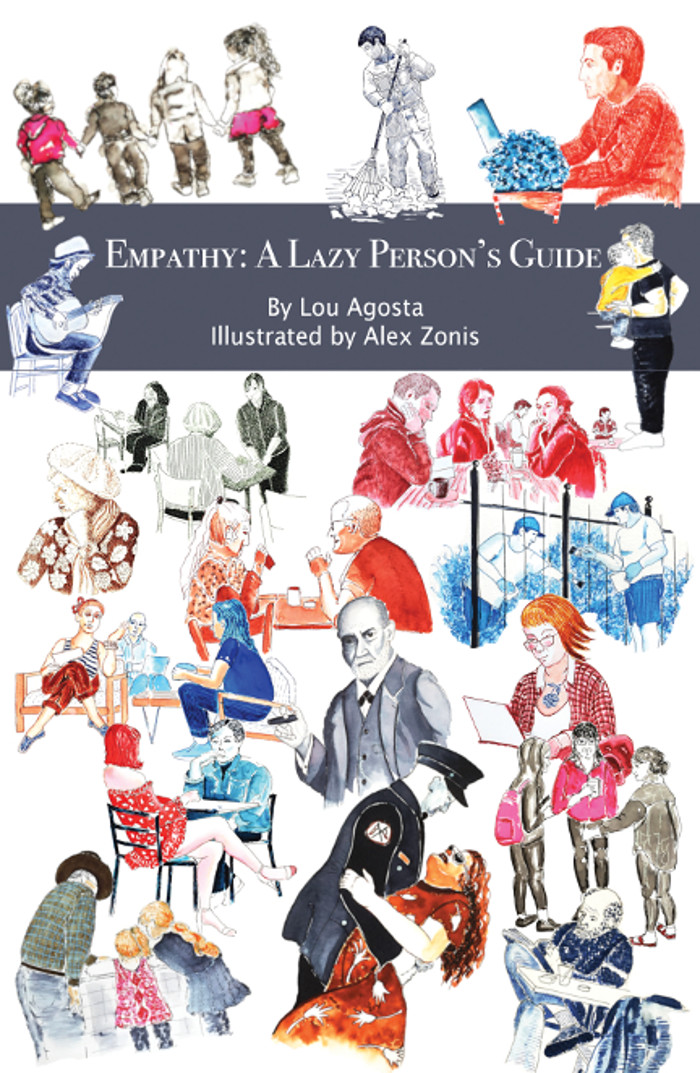
My colleagues and friends are telling me, “Louis, you are sooo 20th Century – no one is reading hard copy books anymore! Electronic publishing is the way to go.” Following my own guidance about empathy, I have heard you, dear reader. The electronic versions of all three books, Empathy Lessons, 2nd Edition, Empathy: A Lazy Person’s Guide, and A Critical Review of a Philosophy of Empathy – drum roll please – are now available.
Feeling like you are thrown “under the bus” again and it’s getting crowded under there? Get the empathy you need to fight back and flourish in this book. Get expanded empathy here!
Order from author’s page: Empathy Lessons, 2nd Edition: https://tinyurl.com/29rd53nt
Order from author’s page: Empathy: A Lazy Person’s Guide: https://tinyurl.com/29rd53nt
Order from author’s page: A Critical Review of Philosophy of Empathy: https://tinyurl.com/29rd53nt
Read a review of the 1st edition of Empathy Lessons – note the list of the Top 30 Empathy Lessons is now (2024) expanded to the Top 40 Empathy Lessons: https://tinyurl.com/yvtwy2w6
Read a review of A Critical Review of a Philosophy of Empathy: https://tinyurl.com/49p6du8p

Above: Cover art: Empathy Lessons, 2nd Edition, illustration by Alex Zonis, original oil paint on board, entitled “Memory blocks: Shimon”
Order from author’s page: A Critical Review of a Philosophy of Empathy: https://tinyurl.com/mfb4xf4f

Above: Cover art: A Critical Review of a Philosophy of Empathy, illustration by Alex Zonis
In conclusion, let me again say a word on behalf of hard copy books – they too live and are handy to take to the beach where they can be read without the risk of sand getting into the hardware, screen glare, and your notes in the margin are easy to access. Is this a great country or what – your choice of pixels or paper!?!
(c) Lou Agosta, PhD and the Chicago Empathy Project
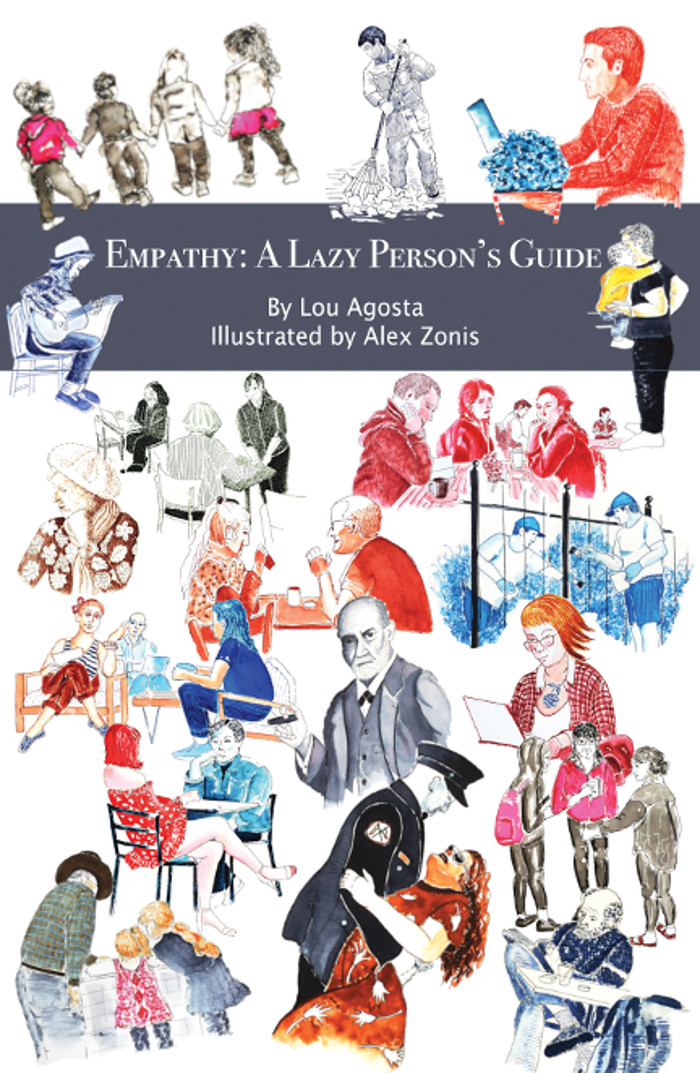
Empathy: A Lazy Person’s Guide is now an ebook – and the universe is winking at us in approval!
The release of the ebook version of Empathy: A Lazy Person’s Guide coincides with a major astronomical event – a total solar eclipse that traverses North America today, Monday April 8, 2024. The gods are watching and wink at us humans to encourage expanding our empathic humanism!
My colleagues and friends are telling me, “Louis, you are sooo 20th Century – no one is reading hard copy books anymore! Electronic publishing is the way to go.” Following my own guidance about empathy, I have heard you, dear reader. The electronic versions of all three books, Empathy: A Lazy Person’s Guide, Empathy Lessons, and A Critical Review of a Philosophy of Empathy – drum roll please – are now available.
A lazy person’s guide to empathy guides you in –
- Performing a readiness assessment for empathy. Cleaning up your messes one relationship at a time.
- Defining empathy as a multi-dimensional process.
- Overcoming the Big Four empathy breakdowns.
- Applying introspection as the royal road to empathy.
- Identifying natural empaths who don’t get enough empathy – and getting the empathy you need.
- The one-minute empathy training.
- Compassion fatigue: A radical proposal to overcome it.
- Listening: Hearing what the other person is saying versus your opinion of what she is saying.
- Distinguishing what happened versus what you made it mean. Applying empathy to sooth anger and rage.
- Setting boundaries: Good fences (not walls!) make good neighbors: About boundaries. How and why empathy is good for one’s well-being. Empathy and humor.
- Empathy, capitalist tool.
- Empathy: A method of data gathering.
- Empathy: A dial, not an “on-off” switch.
- Assessing your empathy therapist. Experiencing a lack of empathic responsiveness? Get some empathy consulting from Dr Lou. Make the other person your empathy trainer.
- Applying empathy in every encounter with the other person – and just being with other people without anything else added. Empathy as the new love – so what was the old love?
Okay, I’ve read enough – I want to order the ebook from the author’s page: https://tinyurl.com/29rd53nt
Advertisements
https://c0.pubmine.com/sf/0.0.7/html/safeframe.html
REPORT THIS AD
Practicing empathy includes finding your sense of balance, especially in relating to people. In a telling analogy, you cannot get a sense of balance in learning to ride a bike simply by reading the owner’s manual. Yes, strength is required, but if you get too tense, then you apply too much force in the wrong direction and you lose your balance. You have to keep a “light touch.” You cannot force an outcome. If you are one of those individuals who seem always to be trying harder when it comes to empathy, throttle back. Hit the pause button. Take a break. However, if you are not just lazy, but downright inert and numb in one’s emotions – and in that sense, e-motionless – then be advised: it is going to take something extra to expand your empathy. Zero effort is not the right amount. One has actually to practice and take some risks. Empathy is about balance: emotional balance, interpersonal balance and community balance.
Empathy training is all about practicing balance: You have to strive in a process of trial and error and try again to find the right balance. So “lazy person’s guide” is really trying to say “laid back person’s guide.” The “laziness” is not lack of energy, but well-regulated, focused energy, applied in balanced doses. The risk is that some people – and you know who you are – will actually get stressed out trying to be lazy. Cut that out! Just let it be.
The lazy person’s guide to empathy offers a bold idea: empathy is not an “off-off” switch, but a dial or tuner. The person going through the day on “automatic pilot” needs to “tune up” or “dial up” her or his empathy to expand relatedness and communication with other people and in the community. The natural empath – or persons experiencing compassion fatigue – may usefully “tune down” their empathy. But how does one do that?
The short answer is, “set firm boundaries.” Good fences (fences, not walls!) make good neighbors; but there is gate in the fence over which is inscribed the welcoming word “Empathy.”
The longer answer is: The training and guidance provided by this book – as well as the tips and techniques along the way – are precisely methods for adjusting empathy without turning it off and becoming hard-hearted or going overboard and melting down into an ineffective, emotional puddle. Empathy can break down, misfire, go off the rails in so many ways. Only after empathy breakdowns and misfirings of empathy have been worked out and ruled out – emotional contagion, conformity, projection, superficial agreement in words getting lost in translation – only then does the empathy “have legs”. Find out how to overcome the most common empathy breakdowns and break through to expanded empathy – and enriched humanity – in satisfying, fulfilling relationships in empathy.
Order from author’s page: Empathy: A Lazy Person’s Guide: https://tinyurl.com/29rd53nt
Order from author’s page: Empathy Lessons, 2nd Edition: https://tinyurl.com/29rd53nt
Read a review of the 1st edition of Empathy Lessons – note the list of the Top 30 Empathy Lessons is now (2024) expanded to the Top 40 Empathy Lessons: https://tinyurl.com/yvtwy2w6
Read a review of A Critical Review of a Philosophy of Empathy: https://tinyurl.com/49p6du8p
Order from author’s page: A Critical Review of Philosophy of Empathy: https://tinyurl.com/29rd53nt
Order from author’s page: Empathy Lessons, 2nd Edition: https://tinyurl.com/mfb4xf4f
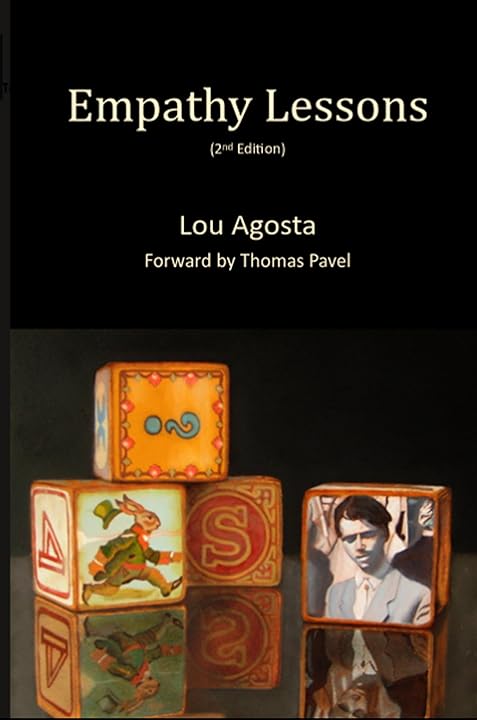
Above: Cover art: Empathy Lessons, 2nd Edition, illustration by Alex Zonis
Advertisements
https://c0.pubmine.com/sf/0.0.7/html/safeframe.html
REPORT THIS AD
Order from author’s page: A Critical Review of a Philosophy of Empathy: https://tinyurl.com/mfb4xf4f
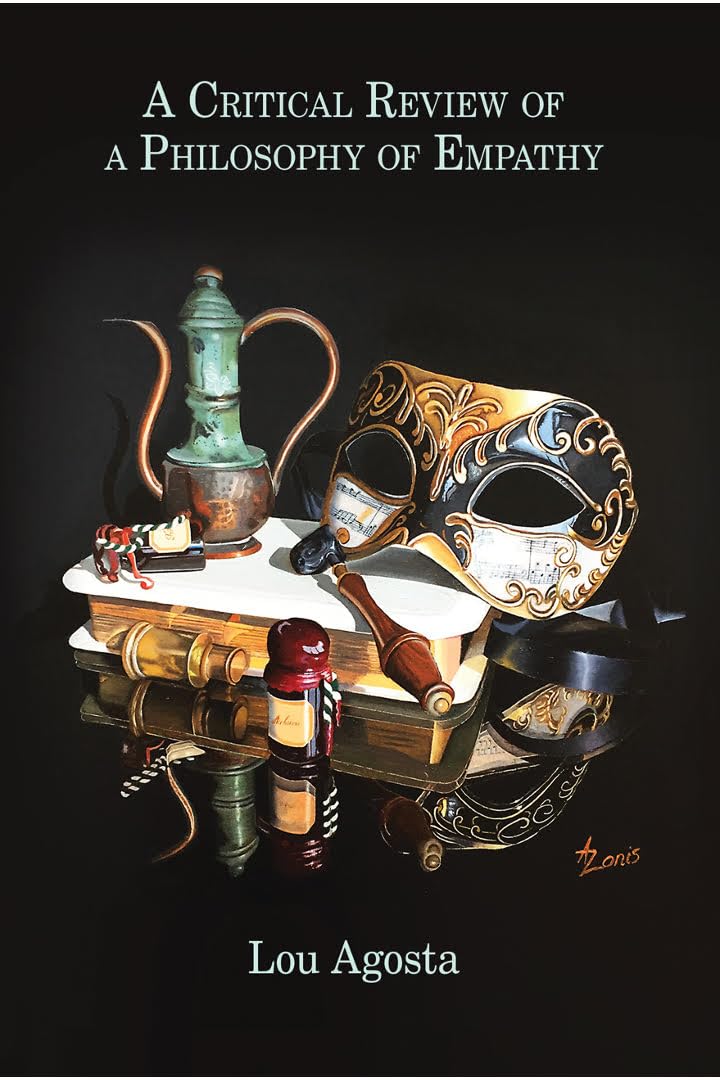
Above: Cover art: A Critical Review of a Philosophy of Empathy, illustration by Alex Zonis
Finally, let me say a word on behalf of hard copy books – they too live and are handy to take to the beach where they can be read without the risk of sand getting into the hardware, screen glare, and your notes in the margin are easy to access. Is this a great country or what – your choice of pixels or paper!?!
(c) Lou Agosta, PhD and the Chicago Empathy Project

Paul Ricoeur, Philosopher of Empathy
This article on Paul Ricoeur, empathy, and the hermeneutics of suspicion in literature will be engaging to students of Ricoeur and empathy alike. One can download the PDF directly from the journal Etudes Ricœeurienne / Ricoeur Studies website: http://ricoeur.pitt.edu/ojs/ricoeur/article/view/628
The article is in English and an abstract is cited below at the bottom. If the above link does not work for any reason, then scroll to the bottom, where one can download the PDF within this blog post.
Meanwhile, I offer a recollection of my personal encounter with Professor Ricœur starting when I was a third year undergraduate at the UChicago. (This is an excerpt from a pending manuscript on empathy in the context of literature.)
By the time I was an undergraduate in my junior year in college, Paul Ricoeur had just arrived at the University of Chicago. Professor Ricoeur had attempted to play a conciliatory role in listening to and addressing student grievances in the face of entrenched method of lecturing by ex cathedra by mandarin professors at the Sorbonne, Paris, France, and related schools in the system. Though Ricoeur did not use the word “empathy” in his role as administrator at the University of Nanterre, he was attempting to play a role in conflict mediation, during the strike of student and workers in Paris in May 1968, a role in which empathy is famously on the critical path.
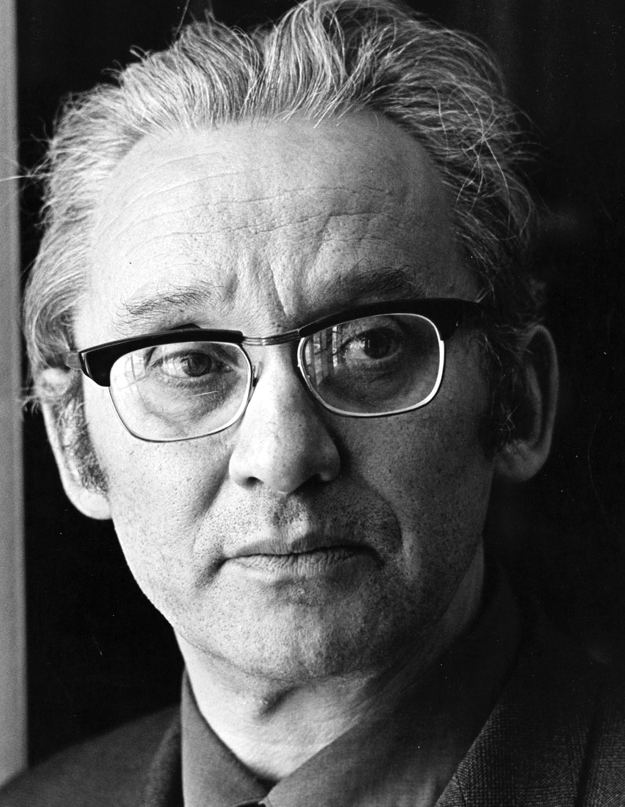
[Photo: Paul Ricoeur, circa 1970 upon his arrival at the University of Chicago, looking for all the world like the Hollywood icon, James Dean. University of Chicago News office: Detailed photo credit below.]
Ricœur’s intervention in the dynamics of academic politics and expanding the community of scholars the way he had done in setting up a kind of philosophy university in the German prisoner of war camp for his fellow French prisoners in 1941 did not work as well as he had hoped. Though it would not be fair to anyone (or to be taken out of context), the Germans (at that moment) were less violent than the striking French students and Peugeot workers in 1968. The French students threw tomatoes at Ricœur and called him a “old clown”; whereas the University of Chicago “threw” at him a prestigious named professorship. He liked the latter better. Ricœur’s courses were open to undergraduates who got permission, too, so I signed up for two of them – Hermeneutics and The Religious Philosophies of Kant / Hegel. Insert here a mind-bending blur of hundreds of pages of reading interspersed with dynamic and engaging presentations of the material. After the somewhat softball oral exams, for which he charitably gave me a pass, my head was spinning, and I needed to take a year off from school to regroup. I am not making this up. I worked as a parking lot attendant selling parking passes, which was an ideal job, since I could read a lot—you know, German-English facing pagination of two separate philosophical texts. This interruption also gave me time to go out for theatre to work on overcoming my painful social awkwardness and try and get a date with a girl. This “therapy” worked well enough, though, like most socially inept undergraduates, I had no skill at small talk and tended to utter what I had to say out of the blue and without creating any context. When I returned to school the next year to finish up, I proposed doing a bachelor’s thesis on Kant’s Refutation of Idealism, and I went into Professor Ricoeur’s office to make my proposal. Ricoeur was team teaching “Myth and Symbolism” with Mircea Eliade, and the “Imagination and Kant’s Third Critique” with Ted Cohen. Without any introductory remarks—I don’t think I even said my name—I presented the idea for my bachelor’s thesis. Without further chit-chit, raising one finger in the air for emphasis and smiling broadly, the first thing he said to me was: “An internal temporal flux implies an external spatial permanence.” With the benefit of 20-20 hindsight, I consider this a suitably empathic response, albeit an unconventional one. My paper eventually got published in the proceedings of the Acts of the 5th International Kant Congress. Fast forward a couple of years, comprehensive written exams in philosophy, and I proposed to write a PhD dissertation in philosophy on empathy [Einfühlung] and interpretation. Max Scheler’s Essence and Forms of Feelings of Sympathy [Wesen und Formen der Sympathiegefühl] contains significant material on empathy, and is (arguably) an early version of C. Daniel Batson’s collection of empathically-related phenomena. I was reading it with Professor Ricœur. Meanwhile, a psychoanalysis named Heinz Kohut, MD, like so many, a refugee from the Nazis, was innovating in empathy in the context of what was to become Self Psychology. I told one of the faculty at the Chicago Institute for Psychoanalysis who was a mentor to me (and a colleague of Kohut), Arnold Goldberg, MD, about Ricœur’s Freud and Philosophy. Whether at my instigation or on Dr Goldberg’s own initiative (Ricoeur really needed no introduction from me), Dr Goldberg introduced Professor Ricoeur to the editors at the Journal of the American Psychoanalytic Association (JAPA) and the result was Ricœur’s publication “The Question of Proof In Freud’s Psychoanalytic Writings” in JAPA August 1977 [Volume 25, Issue 4 6517702500404]. Using graduate students as a good occasion for a conversation to build relationships, we all then had dinner at the Casbah, a middle eastern restaurant on Diversey near Seminary Avenues in Chicago’s Old Town.
It always seemed to me that Professor Ricoeur was a teacher of incomparable empathy, though he rarely used the word, at least until I started working on my dissertation on the subject of empathy and interpretation. I am pleased, indeed honored, to be able to elaborate the case here, while also defending Ricœur’s hermeneutics of suspicion from a misunderstanding that has shadowed the term since Toril Moi’s discussion (2017) of it at the University of Chicago colloquium on the topic shortly before the pandemic, the details of which are recounted in the article.
ricouerempathyinthecontextofsuspicionDownload
ABSTRACT: This essay defends Paul Ricoeur’s hermeneutics of suspicion against Toril Moi’s debunking of it as a misguided interpretation of the practice of critical inquiry, and we relate the practice of a rigorous and critical empathy to the hermeneutics of suspicion. For Ricoeur, empathy would not be a mere psychological mechanism by which one subject transiently identifies with another, but the ontological presence of the self with the Other as a way of being —listening as a human action that is a fundamental way of being with the Other in which “hermeneutics can stand on the authority of the resources of past ontologies.” In a rational reconstruction of what a Ricoeur-friendly approach to empathy would entail, a logical space can be made for empathy to avoid the epistemological paradoxes of Husserl and the ethical enthusiasms of Levinas. How this reconstruction of empathy would apply to empathic understanding, empathic responsiveness, empathic interpretation, and empathic receptivity is elaborated from a Ricoeurian perspective.
Photo credit: University of Chicago Photographic Archive, [apf digital item number, e.g., apf12345], Hanna Holborn Gray Special Collections Research Center, University of Chicago Library.
This blog post and web site (c) Lou Agosta, PhD and the Chicago Empathy Project

Review: The varieties of empathy in Richard Wright’s (1940) novel Native Son
Review: The varieties of empathy in Richard Wright’s (1940) novel Native Son(New York: Harper Perennial 504 pp + end matter)
The varieties of empathy and empathic experiences extend from authentic empathic receptivity, empathic understanding, and empathic responsiveness, all the way to fake empathy and mutilated empathy. Wright’s novel, Native Son, provides abundant examples of how empathy breaks down into emotional contagion, conformity, projection, and communications getting lost in translation. Of course, once empathy breaks down and fails, strictly speaking, it is no longer empathy and calls for a response to “clean up” the misunderstanding out of which a rigorous and critical empathy is restored and reestablished. Nevertheless, the varieties of empathically related phenomena that are constellated makes Wright’s classic work a study in empathy in all its diverse forms.
Native Son is as powerful and timely as it was when Richard Wright first published it in 1940. Though it has aspects of tragedy and traffics in ruin and wreck, in the final analysis, it has as much in common with Mary Shelley’s Frankenstein as it does with ancient Greek tragedy by Aeschylus, Sophocles, or Euripides.
The novel has not changed since 1940, but the world has – becoming both better and worse. To open up the reader’s historical empathy, a background report will be useful and is provided. This report also provides a chapter in African American history. The engagement with Native Son will be interspersed in this review with historical details that bring to life the power of the story in ways that might not be appreciated without a firm historical grounding. This is not a digression but of the essence, lest we forget how far we have come, and how far we still have to go to expand empathy and attain social justice.
The world has become better in that the US Supreme Court ruled in Brown versus the Board of Education (1954) that separate, segregated education in grammar and high schools is inherently
unequal. That is worth repeating: Separate but equal is inherently unequal. The world has become better in that the Civil Rights Act and the Voting Rights Act (1965/1965) were passed by a super majority of Congress. These outlawed segregation by law, also called “Jim Crow”; these enabled county and congressional districts in the South (or anywhere) with majority black populations to register to vote and elect black sheriffs and local officials. Why could they not do so previously? There were discriminatory poll taxes, which the impoverished people could not afford to pay; there were written tests (including trick questions) which people who lacked reading skills or merely had a grammar school education were unable to pass; there were other bureaucratic obstacles including the need to present state issued documents that were hard to obtain, putting the would-be voter in a double bind. One hastens to add that the struggle for social and political justice continues, with the US Supreme Court (2023) requiring Alabama and Georgia to redraw their gerrymandered congressional districts to allow for majority black districts. Under backward steps, the so-called “war on drugs” – espoused by Nancy Reagan and implemented by the Clinton administration, resulted in the incarceration (still ongoing) of a generation of young black men for relatively victimless crimes involving using crack cocaine.
Meanwhile, schools of all kinds continue to be under stress because of mass casualty gun violence. Teaching is a tough job, especially elementary and middle schools and it has gotten tougher; the bureaucratic requirements to present politically correct curriculum has pushed out fundamental skills of critical thinking along with skills such as the three R-s – reading, writing and (a)rithmetic. These have been replaced by the need for librarians and administrators to act in the role of surveillance state capitalism (see Zuboff 2018), overseeing whether some text refers to “gay,” “trans,” the name of a sex organ, and so on, and that someone – especially a parent – might be made to feel uncomfortable. To be sure, parents and educators need to be sensitive to the stages of child development and present material that fits the stage at which the growing child is maturing.
While Jim Crow is a historical reference and black empowerment is advancing, at times haltingly, the number of unarmed black people who end up dead after encounters with the local police has astonished everyone – everyone except black people who have known all about it all along. Today the number of black CEOs of major corporations is some 5.9 % out of an overall black population of 13.6% (US Census). That is progress since 1940 when Wright’s work was published, at which time the percentage was essentially zero. Johnson Publications, the publisher of Ebony magazine (among others), would not be founded until 1942. Yet a case can be made that, though many of the social and legal details are different, the need for struggle and protest is as powerful today as it was in 1940. We are not living in a post racial society, notwithstanding fact of having had a black president. All this and more may usefully inform our reading of Native Son.
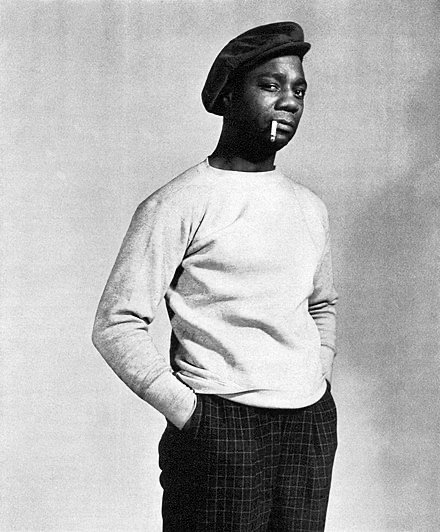
Now to the narrative. The protagonist, Bigger Thomas (henceforth referred to as “BT”), completes the 8thgrade. He is too poor to continue school, nor is he motivated to do so. He experiences segregation and prejudice wherever he turns, as indeed do all black people. BT says, “Hell, it’s a Jim Crow army. All they want a black man for is to dig ditches. And in the navy, all I can do is wash dishes and scrub floors” (1940: 353). BT is not allowed to become a pilot or a tank driver or a professional. “I wanted to be an aviator once. But they wouldn’t let me go to the school where I was suppose’ to learn it. They built a big school and then drew a line around it and said that nobody could go to it but those who lived within the line. That kept all the colored boys out” (1940: 353). It is true there were a few exceptions – some black people go to college and become doctors, lawyers, or engineers, though how they pulled that off is not for the faint of heart.
However, basically, the form of life under segregation (Jim Crow) does not just lack possibility – the possibility of possibility itself is missing. Possibility is not even defined. What does that mean? For example, as soon as Barak Obama was elected US President, the media went to middle schools and interviewed black ten-year-old children about what they wanted to be when they grew up. They immediately knew they wanted to be President. Now this little different than wanting to be a cowboy or a fireman or a doctor, a child’s fantasy. The point is that prior to Obama’s election the possibility could not even be imagined by black children, excepting perhaps some weird science fiction scenario. That is what is meant by the possibility of possibility. BT lacks the possibility of possibility.
What happens in the narrative after BT serendipitously gets a “good job” as a chauffeur with a wealthy white family, shows that BT still does not “get” – understand or experience – the possibility of possibility. BT is so constantly in survival mode that, in trying to survive, he does the very thing that causes his tragic undoing. It is a well-known stereotype that whenever a black man is lynched or otherwise “taken down” socially, he is initially accused of assaulting or trying sexually to molest a white woman.
Who Is BT as a person and as a possibility at the start of the story? He is bully and a petty criminal. Malcolm Little, who became Malcolm X, was eleven years old when Wright began working on Native Son in 1936. Both BT and Malcolm, each in their own way, started out as petty criminals. Malcolm was arrested and went to prison. Malcom was the only person I ever heard of who said that prison made him better – indeed saved his life – because he met a follower of a version of strict Islam that enabled him to turn his life around, channeling his intelligence and leadership skills into black empowerment (though, ultimately, it also eventually led to his undoing in a tragedy of betrayal).
Meanwhile, in Native Son, Mary Dalton is the young adult daughter of the wealthy Henry Dalton, who has given some $5 million dollars to the NAACP (National Association for the Advancement of Colored People) while continuing to operate inner city slums overcrowded with blacks who are unable to rent or buy in other neighborhoods due to red lining and restrictive covenants (contracts) that prevent selling to black people. Moral ambiguities and flat-out hypocrisy are front and center. Henry’s wife is blind – she cannot see – and walks about the mansion dressed in white like a ghost. Everyone else in the novel – black and white – can see well enough – are visually unimpaired – but have blind-spots and unconscious biases sufficient to sink the Titanic. They do. Full speed ahead into the field of ice bergs!
Mary is an undergraduate at the local university near their mansion on Drexel Blvd. As a part of her late adolescent rebellion, she goes for the kind of boyfriends most calculated to shock her parents. She likes those “bad boys.” In this case, that would be the left wing radical and card carrying communist, Jan. On background, Nicola Sacco and Bartolomeo Vanzetti – Sacco and Vanzetti – were executed in the electric chair in 1927 for being anarchists, amid anti-Italian and anti-immigrant hysteria, not for the robbery and murder of which they were convicted and did not commit.
Wright was authoring at a time (circa 1936) when the Great Depression was still very much an economic reality. The Mayor was a machine boss, who would respond to crime waves by rounding up Communists and Negros. The Governor would call out the National Guard to put down workers who tried to form a union and go out on strike. The blacklisting of workers, both white and black (but mostly white because the blacks did not have jobs), who attempted to form unions was common, which meant they could not find work. Corporations stockpiled tear gas, vomit gas, ammunition and machine guns for armed strike breakers to use against railroad, steel, and manufacturing workers who dared to go out on strike. The National Labor Relations Board was not even validated by the US Supreme Court until 1937 in NLRB v. Jones and Laughlin Steel Corporation, 301 U.S. 1 (1937). The forty-hour work week did not become law until the Fair Labor Standards Act (29 U.S. Code Chapter 8) was first enacted in 1938 under President Roosevelt’s New Deal.
This was a different world from 2023 and being a “Communist” meant something different than it does today, when, in the wake of the success of the trade union movement, much of what the original movement sought to accomplish (such as the 40 hour work week, sick leave, paid overtime, etc.) is part of standard legal labor law practice, rendering The Party irrelevant. Nevertheless, Mary and her boyfriend, Jan, a committed Communist, saw a common cause between the oppressed workers and the oppressed black people, and in this they were accurate enough, but naïve and idealistic, even utopian, in what it was going to take to make a difference.
The road to hell is paved with good intentions – and fake empathy. The privileged daughter, Mary, of the wealthy real estate tycoon (Mr Dalton), wants something from her new chauffeur. Remember, BT has just got a new, good paying job as the chauffeur. Mary wants him (BT) to ignore orders from her father, BT’s employer, and drive her around town with her boyfriend instead of to the University. Mary uses him (BT) as she would any extension of her own self-interest. For Mary, BT is an extension of her narcissism. BT later reports on his first encounter with Mary:
“She acted and talked in a way that made me [BT] hate her [Mary]. She made me feel like a dog. I was so mad I wanted to cry [. . . .] Mr Max, we’re all split up. What you say is kind ain’t kind at all. I didn’t know nothing about that woman. All I knew was that they kill us for women like that. We live apart. And then she comes and acts like that to me” (1940: 35).
The “acted like that” is the fake empathy – it seems kind enough on the surface in that the language does not have any devaluing words; yet there is a subtext – a soft violence, a quiet aggression, a conversational implicature that wrappers the relationship in BT’s subordination. “Acted like that” may also have a seductive aspect to it in that “being nice” in a situation where “no contact” is the norm may easily be misinterpreted as romantic flirting. The latter is not explicit in the text, but one thing is clear: BT and Mary Dalton really are the moth and the flame. Naivete and innocence are abundant on all sides. The moth has an automatic, hypnotic-like attraction to the flame. Little does the moth know what awaits. Does the flame have empathy for the moth? No, the flame is just the flame, towards which the moth has a luminously-based incentive that is its incineration. On background, the US Supreme Court finally ruled in Loving v Virginia in 1967 that anti-miscegenation laws, prohibiting marriage between whites and blacks (among others), were unconstitutional.
BT has survived on the street among white people by saying “Yessum; it’s all right with me” (1940: 64) and doing as he is told, and (in effect) justifying it by saying he was following orders. Recall, this is 1938 and that statement will come to have a different meaning in 1963 as Hannah Arendt reports for The New Yorker magazine on the trial of one Adolph Eichmann, who said something similar regarding the Holocaust. “I was just following orders.” There is nothing wrong with a chauffeur following orders, yet, in this case, “following orders” from Mary because she is white is an integrity outage in relation to his employment agreement with Mr Dalton to drive Mary to school. BT’s relationship to his word is as “fast and loose” as a rabbit randomly zig-zagging to try to survive by escaping a predatory fox.
Mary tells him “After all, I’m on your side” (1940: 64), and BT was not even aware of the possibility that changing side was imaginable – that there was a gate in the wall between rich and poor, educated and uneducated, employed and unemployed – mostly white and black. BT is getting $25 dollars a week and a pound of pork chops costs 5 cents ($.05), so that is a good wage. BT is in touch with his own self-interest, which is to keep his job so he can help himself and his mother and siblings. Yet something is off:
“Now, what did that mean? She was on his side. What side was he on? Did she mean that she liked colored people? Well, he [BT] had heard that about her whole family. Was she really crazy? How much did her folks know of how she acted? But if she were really crazy, why did Mr Dalton let him drive her out? [….]
“She was an odd girl, all right. He [BT] felt something in her over and above the fear she inspired in him. She responded to him as if he were human, as if he lived in the same world as she. And he had never felt that before in a white person. But why? Was this some kind of a game? The guarded feeling of freedom he had while listening to her was tangled with the hard fact that she was white and rich, a part of the world of people who told him what he could and could not do” (1940: 64, 65).
If someone tells you something that is too good to be true, it probably is. The ancient Greeks besieging Troy give up, sail off, and leave behind a giant horse as a gift to the gods. Casandra throws a spear at it, and it makes a hollow sound – thwomp! “Beware of Greeks bearing gifts!” No one believes her. Things do not work out well for the Trojans. “After all, I’m on your side.” The blind Mrs Dalton, walking around the mansion in her ghostly white gown, is the ineffective prophet, representing the blindness of all the players.
“Fake empathy” is defined here as a form of empathic responsiveness in which the person(s) claiming to be empathic towards the Other believe their own BS (bunkum, baloney, balderdash), endorse their own malarky, and, in effect, are sincerely self-deceived about the conflict of interest in which they are engaged. In another context, “fake empathy” could mean being intentionally deceptive as when a used car salesman knows the auto is defective but represents it as being in excellent shape. In most cases, the problematic sales person believes his or her own lies and could pass a lie detector test, which, of course, does not detect lies, but merely physiological arousal due to the stress of trying to deceive.
Mary wants BT to hide the facts from her father (that she is not gong to night school but out on the town with her “bad boy” community friend Jan). This puts BT at risk of losing his job. Mary acts in such a way as to claim to be on BT’s side, which is accurate enough in that she endorses racial integration and rights for workers, while seemingly remaining uninformed about the monopoly rents collected from black people by her father’s South Side Real Estate Corporation. Yet how could she not know? Another blind spot. More deception and self-deception.
If a further example is needed, Mary’s fake empathy continues as an expression of naivete and projection:
“You know, Bigger [BT], I’ve long wanted to go into these houses,” she said, pointing to the tall, dark apartment buildings looming to either side of them, “and just see how your people live. You know what I mean? I’ve been to England, France and Mexico, but I don’t know how people live ten blocks from me. We know so little about each other. I just want to see. I want to know these people. Never in my life have I been inside of a Negro house. Yet they must live like we live. They’re human . . . . There are twelve million of them . . . ” (1940: 69–70; italics and ellipsis in the original)
In so far as Mary genuinely cares about her black neighbors, this is a first step, born of good, caring intentions. However, Mary’s privilege, naivete, and arrogance (this list is not complete) are obstacles to her empathy. Her empathy misfires as projection. Mary speaks to BT in the third person about the group of which he himself is a part. The condescension is so thick that BT’s street knife would not cut through it had he even thought to try. Mary says, “Yet they [black people] must live like we live,” and that is definitely not the case. BT lives with his mother and two younger siblings in a single room. The opening scene of the novel involves a battle with a large rat in the small single room. Thus, the building is rat infested. Mary lives in a mansion with multiple servants, including BT. Mary tries to take a walk in BT’s shoes, shifting points of view, but it does not work. She is unable to take off her own shoes, so to speak – she can only imagine a glamorous life of travel – and her empathic imagination is insufficient to have a vicarious experience of the grinding, dehumanizing, poverty of her black neighbors, which poverty lives in her blind spot.
In contrast to fake empathy, a rigorous and critical empathy examines its own blind spots, projections, and conflicts of interests. It knows that it can be inaccurate or misfire. By cleaning up its conflicts of interests, projections, emotional contagions, and/or messages lost in translation, empathy becomes critical and rigorous. Unfortunately, Mary does not live to have the opportunity to work through her fake empathy to a rigorous and critical one, and BT experiences this dawning realization as he awaits execution for killing her.
The reader may say, I want instant empathy. Like instant coffee, just add water and stir. Wouldn’t it be nice? Nor is anyone saying such a thing as “instant empathy” is impossible. It may work well enough in a pinch; but like instant coffee, the quality may not be on a par with that required by a more demanding or discriminating appreciation and taste.
Jan’s case is similar to Mary’s though more nuanced. Jan wants something from BT as does Mary, but Jan’s agenda is less individual and, as befits a Communist, guided by an analysis of class. Yet he is equally naïve and utopian. Driving along Chicago’s Lake Shore Drive, which offers a panoramic view of the tall buildings in the central city from the South Side, Jan remarks:
“We’ll own all that some day, Bigger,” Jan said with a wave of his hand. “After the revolution it’ll be ours. But we’ll have to fight for it. What a world to win, Bigger! And when that day comes, things’ll be different. There’ll be no white and no black; there’ll be no rich and no poor” (1940: 68).
Jan’s innocence can be measured in that he is not even a very good Communist – his economic analysis is badly flawed. Jan talks as if the Communist revolution will change ownership from the capitalist to the communists whereas any Communist will tell you that the revolution will bring about the abolition of private property. Yet even if he is not a good Communist, Jan is a good human being. His righteous indignation is functioning. Learning that BT’s father was killed in a riot (read “massacre”) targeting black people in the South, Jan says to BT:
“Listen, Bigger, that’s what we want to stop. That’s what we Communists are fighting. We want to stop people from treating others that way. I’m a member of the Party. Mary sympathizes. Don’t you think if we got together we could stop things like that?” [….] You’ve heard about the Scottsboro boys?” (1940: 75; quotations and italics in the original)
On back ground, in 1931 eight black young adults and one juvenile, The Scottsboro Boys, were falsely accused of raping two women. After examination by a medical doctor, no evidence of rape was found. None. The testimony of the women themselves was coerced in that they were involved in sketchy activities that might have opened them up to criminal charges. The young men were tried by an all-white male jury for rape and sentenced to death for it (except for the juvenile, who was sentenced to life in prison). The NAACP and the Communist Party provided legal assistance to the young men and stopped the State from executing them; but they had to endure long and unjust years in prison. The novel calls out the newspaper headline in bold type in referring to BT:
“AUTHORITIES HINT SEX CRIME. Those words excluded him [BT] utterly from the world. To hint that he had committed a sex crime was to pronounce the death sentence; it meant wiping out of his life even before he was capture; it meant death before death came, for the white men who read those words would at once kill him in their hearts” (1940: 243).
BT’s life unfolds in three phases. Phase 1 lasts until, BT puts a pillow over the face of an intoxicated Mary Dalston, in trying to keep Mary from crying out and giving away that he (a black man) is alone with a white woman, even more “incriminating,” in her bedroom. At best he will lose his job – before being lynched for “rape.” The latter is here defined as the white man’s projected fantasy of the black man’s sexual attraction to and on the part of the white woman, which fantasy must be eliminated by lynching the innocent black man. (See the appendix on the varieties of prejudice below.)
What actually happens when BT is left alone with Mary Dalton, who is completely drunk? Mary is sloppy drunk, and can barely stand. BT tries to help her to her bedroom – by supporting her up the stairs. Practically, he has to carry her. Mary’s blind mother, Mrs Dalton, an insomniac, is wandering about the mansion like a ghost. The reader can see trouble coming – suppose they are discovered together in the dark in or near the bedroom? BT tries to explain to his girlfriend Betsy what happened:
“I didn’t mean to kill her. I just pulled the pillow over her face and she died. Her ma came into the room and the girl was trying to say something and her ma had her hands stretched out, like this, see? [The mother, Mrs Dalton, is blind and could not see BT.] I was scared she was goin’ to touch me. I just sort of pushed the pillow hard over the girl’s face to keep her from yelling. He ma didn’t touch me; I got out of the way. But when she left I went to the bed and the girl … She … She was dead” (1940: 227; italics in the original).
This decisive event happens early on in the story. The reader can see it coming. Mary is drunk. BT is uncertain what to do. Mr Dalton did not clarify to the new chauffeur (who is an extension of the auto) that the “boss” is Mr Dalton, who seems to have a blind spot about his angelic daughter’s rebellious streak. The unconscious fantasy, the unconscious bias, is that a black man alone with a white woman, much less an intoxicated one, is the equivalent of statutory rape. Lies, damn lies, and total nonsense move the action forward. Every action that BT takes to avoid the false accusation advances the action in the direction of an even more tragic outcome. BT ends up smothering Mary in order to avoid being discovered with her and being falsely accused of rape (which, of course, will get one lynched). In BT’s conversation with his attorney, Mr Max, BT muses:
“They would say he had raped her and there would be no way to prove that he had not. That fact had not assumed important in his eyes until now. He stood up, his jaws tightening. Had he raped her? Yes, he had raped her [but, of course, not literally]. Every time he felt as he had felt that night, he raped. But rape was not what one did to women. Rape was what one felt when one’s back was against a well and one had to strike out, whether one wanted to or not, to keep the pack from killing one. He committed rape very time he looked into a white face. He was a long, taut piece of rubber which a thousand white hands had stretched to the snapping point, and when he snapped it was rape. But it was rape when he cried out in hate deep in his heart as he felt the strain of living day by day. That, too was rape.” (1940: 227 – 228)
BT’s lawyer (Mr Max) tells the judge at BT’s trial:
“…[T]hat night a white girl was present in a bed and a Negro was standing over he, fascinated with fear, hating her; a blind woman walked into the room and that Negro [BT] killed that girl to keep from being discovered in a position which he knew we claimed warrants the death penalty” (1940: 400).
The being present together in the bedroom of the black chauffeur and the drunken white college age daughter is in 1940 already a capital crime for all intents and purposes. Here” rape” becomes a cipher for all the boundary violations perpetrated by survivors of perpetrations of survivors of perpetrations, and so on, in a seemingly endless cycle back to the Atlantic slave trade (which does not come up in the novel). Two wrongs do not make a right, and yet it is BT’s ownership of the crime that gives him agency, even if that agency is mutilated by the crime that calls it forth.
In Phase 2, BT lives into the devaluing expectations that white people have of him – he becomes a kind of Frankenstein – not just a monster but one created by white society, which monster seeks to strike back for the perceived injustice but goes about it in all the wrong ways that indirectly validate the stereotypes that live in white fantasy. James Baldwin has criticized Wright for writing a protest novel in which black people are depicted as dangerous – sexually and aggressively – in a way that maps to white racist stereotypes. And there is truth to it, yet at every step, Wright’s exaggerated “black badness” calls forth the unexaggerated social and legal injustices of discrimination in the North and Jim Crow in the South. Once again, two wrongs do not make a right. Two wrong make a bad situation worse – and at least twice the wrong. Let he who is without guilt cast the first stone; and, in this case, shame does not stop the stones from flying. Once the stones start flying, no one is spared. Wright makes it clear that BT is caught in the double bind of his own untutored judgment and the incoming pervasive slow violence (and fast aggression) of white society’s segregationist limitations.
In Phase 2, BT descends into hell in a particular sense. It is a kind of mutilated journey of the hero (think of Joseph Campbell’s mythologizing (1990)) on the way to a rebirth of agency, however, with one key difference. BT had not yet been born as a responsible agent, so, instead of “rebirth,” it would be better to say “birth,” born for the first time ever. The definition of hell includes an abundance of pain and suffering, to be sure, but the real hell is that no one hears it – not even God. This is BT’s description:
“[…[T]here were screams and curses and yells of suffering and nobody hears them, for the walls were thick and darkness was everywhere” (1940: 361).
This is BT’s experience of hell as he is locked up in Cook County Jail awaiting his fate. There is no evidence that Wright ever read Thomas Mann’s Dr Faustus(or vice versa) or Mephistopheles’ description of hell contained in it. Wright was writing just as World War 2 was starting; Mann, perennially and a few years afterwards as Europe was a smoking ruin that still stank of the crematoriums of the Nazi concentration camps. Note well the above-cited quote is Wright not Mann, and it was written seven years before Mann penned his own description of hell. In a fine literary gesture, in {Mann’s) Mephistopheles’ description of Hell, words are used indirectly to describe the indescribable. In Hell –
“Every compassion, every grace, every sparing, every last trace of consideration for the incredulous, imploring objection ‘that you verily cannot do so unto a soul’: it is done, it happens, and indeed without being called to any reckoning in words; in soundless cellar, far down beneath God’s listening […]” (Mann 1947: 245).
The key aspect of hell – what makes a hell into Hell – is not the fire and ice – though, to be sure, that is not to be dismissed – but the hellish thing is that no one is listening, not even God, especially not God. BT’s fate indeed, though a spark of what might be called radical hope (Lear 2008) emerges when BT meets Mr Max. Mr Max is a “Clarence Darrow for the defense” type lawyer, who is retained for BT by the Communist Party. They are trying to find a common cause between exploited works and the black victims and survivors of racial prejudice, poverty, and social injustice.
In phase three, BT discovers his agency in taking ownership of the quasi-accidental killing of Mary. But this is a very qualified (re)birth in that agency is shot through-and-through with moral trauma. BT is asked to make a choice he should not have to make; that, strictly speaking, he cannot make; and that, in any case, he inevitably makes whether he takes action or not, since doing nothing is also an action. BT enters Mary’s room as a survivor of systematic racism and Jim Crow. He tries to survive the encounter with Mary’s blind mother. He takes an action to prevent being discovered alone with a drunken white woman, and in doing so he unwittingly smothers her with a pillow to prevent her from talking drunken nonsense. BT enters the room a survivor, and leaves it as a perpetrator. That is moral trauma (also called moral injury” (Shay 2014)).
In phase three, BT becomes a kind of Frankenstein and chooses the dark side (in the Star War’s sense – already the language is impossible). Recall that in the original Mary Shelley story, Victor Frankenstein rejects the creature that he assembled out of spare body parts and animated using electricity (electricity being a not-well-understood phenomenon at the time (1808) to which quasi-magical powers were attributed). Dr Frankenstein’s creature is lonely and wants a mate, in effect, a girl friend; but the “mad scientist” cannot countenance creating another such physically hideous creature, thereby, giving birth to an entire race of miscreants. At that point the creature has a kind of Richard III moment – “since I cannot prove a lover / To entertain these fair well-spoken days, / I am determined to prove a villain / and hate [. . . ]” Though it changes the meaning of the sentence to stop it mid-phrase, “hate” is the active ingredient here. He becomes a monster, exacting his revenges by murdering members of Victor Frankenstein’s family. Likewise with BT.
Though all the details are different, BT’s fate follows a parallel trajectory at this point with hatred simultaneously providing the dehumanizing and humanizing element. Hate is also the principle that animates BT’s emergence into agency, albeit a mutilated one, since it occurs on death row.
Until BT committed the first murder, he was little different than the biblical Cain before he slew Abel. Human history begins at the point at which that murder, born of envy, occurs. The murder creates agency. Likewise with BT:
But, after he murdered, he [BT] accepted the crime. And that’s the important thing. It was the first full act of his life; it was the most meaningful, exciting and stirring thing that had ever happened to him. He accepted it because it made him free, gave him the possibility of choice, of action, the opportunity to act and to feel that his actions carried weight [. . . .] It was an act of creation! (1940: 396, 400)
In the beginning was the word – murder. Murder results in one thing for sure – more murder. “The surest way to make certain that there will be more such murders is to kill this boy [BT]” (1940: 391).
Now one may well say, there’s gotta be a better way to get one’s agency, and that would be an accurate statement.
An argument can be made that Mr. Max’s rejection of sympathy in favor of empathy serves the reader well. But does it serve BT well? In terms of saving BT’s life, it would be better to question his agency, to make a play for sympathy, and to point to poverty, cognitive limitations, and a limited IQ. Insult BT, but save his life? Max asks:
“Is love possible to the life of a man I’ve described to this Court?” (1940: 401)
The ability to love, to experience empathy for an Other, has been negated, annulled, killed, by the systematic racism of the entire community – this is soul murder. The short definition of soul murder (a distinction arguably implicit in Wright) is that it is the systematic lack of empathy that destroys the possibility of love, that destroys the very possibility of possibility.
Max’s Jeremiad raises the text to the level of an early articulation of the key theses of the 1619 project (see Hannah-Jones 2019). Max argues to the court that BT is in so many double binds, that his agency is compromised, his empathy is mutilated, by soul murder. (For a sustained treatment of soul murder see Shengold 1989.)
“But in conquering they [the early American settlers] used others, used their lives. Like a miner using a pick or a carpenter using a saw, they bent the will of others to their own. Lives to them were tools and weapons to be wielded against a hostile land and climate.”
Given that BT was convicted by an all-white jury and the Governor, to whom an appeal for clemency was to be made, was a known racist, one might say Max was like Colonel Robert Gould Shaw and the 54th Massachusetts Infantry undertaking a full frontal assault on the Confederate Fort Wagner – it was a massacre:
“I do not say this in terms of moral condemnation. I do not say it to rouse pity in your for the black men who were slaves for two and one-half centuries [. . . .] It was the imperial dream of a feudal age that made men enslave others” (1940: 389)
Once again, Mr Max eloquently anticipates the 1619 project (Hannah-Jones 2019):
“If only ten or twenty Negroes had been put into slavery, we could call it injustice, but there were hundreds of thousands of them throughout the country [….] Injustice which lasts for three long centuries and which exists among millions of people over thousands of square miles of territory, is injustice no longer; it is an accomplished fact of life [….] What is happening here today is not injustice, but oppression, an attempt to throttle or stamp out a new form of life. And it is this new form of life that has grown up here in our midst” (1940: 391).
“Men once oppressed our forefathers to the extent that they viewed other men as material out of which to build a nation; we in turn have oppressed others to such a degree that they, fumblingly as yet, try to construct meaningful lives out of us!” (1940: 398).
“The hate and fear which we have inspired in him [BT], woven by our civilization into the very structure of his consciousness, into his blood and bones, into the hourly functioning of his personality, have become the justification of his existence” (1940: 400).
This is again an early version and invocation of the ideas that would become the 1619 project. One result of systematic oppression, not just the loss of possibility, but the loss of the possibility of possibility. If one cannot get a job, then that is the loss of possibility; but if one needs and cannot get a work permit, then that is the loss of the possibility of possibility.
Max does not ask for sympathy for BT. Sympathy results in guilt, and people hate those who make them feel guilty, enacting aggression against them. Max asks for empathy, without, however, using the word, which, if granted, would result in community, in belonging, in relatedness. As Dostoyevsky pointed out, people will kill that which evoked in them the condemning sense of guilt (1940: 390) and sympathy does precisely that. Max address the court:
“If I should say that he [BT] is a victim of injustice, then I would be asking by implication for sympathy; and if one insists upon looking at this boy as a victim of injustice, he will be swamped by a feeling of guilt so strong as to be indistinguishable from hate.”
[Max continues] “Of all things, men to not like to feel that they are guilty of wrong, and if you make them feel guilt, they will try desperately to justify it on any grounds; but failing that […] they will kill that which evoked in them the condemning sense of guilt (1940: 389–390)
BT’s act of murder becomes a cause célèbre in the narrative. The NAACP and the Communist Party get BT a powerful attorney, Mr Max, who resembles the historical Clarence Darrow, taking on unpopular causes.
On background, the reader recognizes historical aspects of the Leopold/Loeb (1924) trial in which two wealthy, privileged University of Chicago students engage in a “thrill killing” of 14-year-old Bobby Franks for no good reason other than the killing itself. The perpetrators had near-delusional fantasies of über-man cognitive superiority and committing the perfect crime. Things do not go well. Leopold drops his reading glasses at the location where the victim’s body is dumped, connecting him to the crime scene. The dumbest mistake possible – and just possibly a “Freudian” slip. So much for cognitive superiority. Their defense attorney, Clarence Darrow, engages in a 12-hour presentation at the sentencing hearing, in which, with a penetrating critique of capital punishment, Darrow successfully saves the 18- and 19-year-old murderers from the death penalty (Stone 1971). Darrow’s arguments are still used to today to defend teenage offenders. On background, Loeb was murdered in prison in 1936. Leopold was paroled in 1958.
Less well known is the case of Robert Nixon, who in May 1938 was arrested for murdering a woman with a brick in the course of robbing her apartment (1940: 504; 455 line 17). Nixon was poor and black – was not defended by Clarence Darrow, and was executed in August 1939.
Mr Max talks to BT like a Mensch, like a fellow human being, asking about what he (BT) thought had happened. Max asks a lot of questions, trying to get a sense of what BT had to survive and what motivated him to do what he did.
“Bigger [BT] knew that Max was trying to make him feel that he accepted the way he looked at things and it made him as self-conscious as when Jan had taken his hand and shaken it that night in the car. It made him live again in that hard and sharp consciousness of his color and feel the shame and fear that went with it, and at the same time it made him hate himself for feeling it. He trusted Max” (1940: 346–347)
BT gets in touch with his feelings. Max asks him if he raped Mary. The answer:
“Naw. But everybody’ll say I did. What’s the use? I’m black. They say black men do that. So it don’t matter if I did or if I didn’t” [ . . . .] Mr Max, when folks says things like that about you, you whipped before you born. What’s the use? Yeah; I reckon I was feeling that way [hating Mary] when I was in the room with her. They say we do things like that and they say it to kill us. They draw a line and say for you to stay on your side of the line. They don’t care if there’s no bread over on your side. They don’t care if you die. And they say things like that about you and when you try to come from behind your line they kill you” (1940: 349, 351).
BT is coming from a life of no possibility – no personal space, no (limited) education, no career, no respect from the community, no self-respect – and living into an imminent future of capital punishment, the electric chair: “Over and over he [BT] had tried to create a world to live in, and over and over he had failed” (1940: 345).
“He [BT] breathed softly, wondering about the cool breath of peace that hovered in his body. It was as though he was trying to listen to the beat of his own heart. All around him was darkness and there were no sounds. He could not remember when he had felt as relaxed as this before. He has not thought of it or felt it while Max was speaking to him; it was not until after Max had gone that he discovered that he had spoken to Max as he had never spoken to anyone in his life; not even to himself. And this talking had eased from his shoulders a heavy burden. [….] Max had not compelled him to talk; he had talked of his own accord […] by a curiosity about his own feelings. Max had only sat and listened, had only asked questions” (1940: 359 – 360).
Max gives BT a good listening – gives him empathy – and BT feels “better” – the “heavy burden” is lifted from his shoulders.. His hatred gets dialed down, though not completely extinguished. His inner conflict and hatred are lessened, even as he knows he is not going to get out alive from his self-made predicament:
Max validates BT’s perspective of “no possibility” in a description that also validates how whites are also entangled in systematic racism that lives in unconscious bias, albeit with less harmful effects on whites than blacks:
“And I know that almost every white face you’ve met in your life had it in for you, even when that white face didn’t know it. Every white man considered it his duty to make a black man keep his distance. He doesn’t know why most of the time, but he acts that way” (1940: 346).
In acknowledging how hopeless is the situation, something shifts in BT.
So far BT gets empathic receptivity – another person, Max, is able to take his point of view and have a vicarious experience of how he (BT) feels. In conversation with Max, BT comes to appreciate a new possibility – an empathic possibility. The Other – in this case Max – brings forth the BT’s own humanness, mutilated though it is, by taking the Other’s perspective.
“He [BT] stood up in the middle of the cell floor and tried to see himself in relation to other men, and thing he had always feared to try to do, so deeply stained was his own mind with the hate of others for him. With this new sense of the value of himself gained from Max’s talk, a sense fleeting and obscure, he tried to feel that if Max had been able to see the man in him beneath those wild and cruel acts of his, acts of fear and hate and murder and flight and despair, then he too would have, if he were they, just as now he was hating them and they were hating him. For the first time in his life he felt ground beneath his feet [. . .]” (1940: 361).
BT experiences the emerging ability to “see himself in relation to other men [persons].” Being related to others requires the distinction “self-Other,” open up the possibility of the Other taking a point of view on oneself. This is what Max did for BT in seeing “the man in him [BT] beneath those wild and cruel acts of fear and hate.” If Max can be related to BT, it demonstrates to BT that he can do that for himself and for and with Others, too.
“If he [BT] reached out with his hands, and if his hands were electric wires, and if his heart were a battery giving life and fire to those hands, and if he reached out with his hands and touched other people, reached out through those stone walls and felt other hands connected with other heart – if he did that, would there be a reply, a shock? Not that he wanted those hearts to turn their warmth to him; he was not wanting that much. But just to know that they were there and warm! [. . . .] And in that touch, response of recognition, there would be union, identity’ there would be a supporting oneness, a wholeness which had been denied him all this life” (1940: 362).
What makes the hands come alive in this image of electrical connection and the shock of the human is precisely “the response of recognition,” which brings strength, energy, and vitality to the human heart. This is the empathic moment for BT, which, however, arrives late in the day as he awaits almost certain execution for his crimes.
Thus, the accusation of early critics (and James Baldwin) against Wright of didacticism and protest literature. Perhaps in our own time, but before the racist jury, judge, mayor, and governor, Max makes the best of a bad situation. The result?
BT gets his vitality and aliveness from the Other, in this case Max. Max is able to “see the man in him” and BT, in turn, is able to see that Max sees the man in him (BT), and that grounds him (BT). The Other brings forth empathy for the one, who, in this example, is trying to see himself in relation to other men. A new possibility opens up – the possibility of possibility – relatedness, connectedness – empathy.
Appendix: A Short “Ted Talk” on the Varieties of Prejudice
One may say, prejudice is prejudice and all prejudices are alike, and there would be truth to saying that. Yet when one looks at the dynamics of prejudice, one cannot simply substitute the underlying dynamics of racism against black people for antisemitism or sexism or for homophobia. A short “Ted Talk” on prejudice will again inform our historical empathy.
The fantasy of black hyper masculinity is repressed as a source of anxiety challenging the white male’s (imagined) inadequate sexual potency. It then gets reversed and projected onto the devalued other, who comes at the white man as white woman’s desire for the stereotyped hyper sexed black man. Elisabeth Young-Breuhl (1996: 367) writes in The Anatomy of Prejudices:
The white male’s mythological contractions of black male sexuality – the images of Negro phallic power, animal lust, and rapaciousness – signal the jealousy and resentment over the black’s defilement pleasure, and they also reflect the white male’s anxiety that white women really desire the black’s aggressive sexuality.
In contrast to the hysterical fantasy of the over-dramatized black male, the Jewish person is made the target of an obsessional paranoid over-intellectualization – the totally fictional worldwide conspiracy of the Protocol of the Elders of Zion. Lies, damn lies, and total nonsense. The nonsense continues: In the case of homophobia, one stays with the dynamic of difference for one has to project that, in a certain sense, the boy finds other boys attractive, in that special sexual way, and must defend against being a “fag” by perpetrating acts of aggression. Nor should the sexism and misogyny be overlooked, for BT kills two women – Mary and Bessie – in the one case quasi-accidently and in the other in a cowardly fear of betrayal. In the case of the prejudices of racism (in the narrow sense against blacks) and antisemitism the devalued, despised Other becomes the target of projections one of own inner black and jew in every imaginable positive and negative sense. The differences collapse – inwardly I am the despised Other and get rid of the negative value by externalizing it. In sexism, the dynamic changes, and the anatomical difference between the sexes is such that the difference is impossible to deny, so the Other must be denied, deleted, “killed,” in order to reestablish integrity of the self. In the prejudices stereotype, the Other – the woman in this case – is hated for being inferior cognitively, physically, and so, even as the male harbors an unconscious fantasy of superiority, the power to create life, womb envy.
References
Joseph Campbell. (1990). The Hero’s Journey. Novato, CA: The New World Library.
Nicole Hannah-Jones. (2019). The 1619 Project. New York: One World (NYT Magazine).
Jonathan Lear. (2008). Radical Hope. Cambridge, MA: Harvard UP.
Thomas Mann. (1947). Doctor Faustus: The Life of the German Composer Adrian Leverkühn as Told by a Friend. Tr. H.T. Lowe-Porter. New York: Vintage Books, 1949.
J. Shay, (2014). Moral injury. Psychoanalytic Psychology, 31(2), 182-191. https://doi.org/10.1037/a0036090
Leonard Shengold. (1989). Soul Murder Revisited: Thoughts About Therapy, Hate, Love, and Memory. Hartford: Yale University Press.
Irving Stone (1971). Clarence Darrow for the Defense. Signet.
Richard Wright. (1940). Native Son. New York: Harper Perenniel, 1998.
Elisabeth Young-Breuhl. (1996). The Anatomy of Prejudices. Harvard UP
Shoshona Zuboff. (2018). The Age of Surveillance Capitalism. London: Profile Books.
Photo image credit: Canada Lee as Bigger Thomas in the original Broadway production of Native Son (1941), photographed by Carl Van Vechten.
(c) Lou Agosta, PhD and the Chicago Empathy Project

Fake empathy in Black for a Day by Alisha Gaines (Reviewed)
Book Review: Fake Empathy in Black for a Day: White Fantasies of Race and Empathy by Alisha Gaines (University of North Carolina Press, 2017: 212 pp)
This reviewer is inclined to compare Black for a Day to Leonardo da Vinci’s masterpiece “The Last Supper.” Leonardo’s painting was a fresco, which is made by applying paint to wet plaster. The plaster for Leonardo’s fresco did not dry properly and the painting began to peel almost immediately. The painting has had to be continuously patched up ever since then. Leonardo’s masterpiece “The Last Supper” has, therefore, been called “a magnificent wreck.” So is this book, Black for a Day.
Black for a Day paints an engaging and indeed fascinating picture of individuals (most but not exclusively white) who try to masquerade, to “pass as,” to impersonate, black people. It is a page-turner and eye-opening. Parts of it are confronting, and definitely not for the faint of heart. The short review: if one begins with pretense, deception, and inauthenticity as input, then one gets pretence, deception, inauthenticity—and fake empathy—as output. Black for a Day, as indicated, includes a fascinating account of what amounts to social psychology experiments gone bad. White people putting on the equivalent of black face, pretending to be black, is a bold experiment, which, however engaging as a kind of misguided role playing, does not work as designed or intended. Yet, such a mixed result no more invalidates a rigorous and critical empathy than that Roman soldiers hammered nails into the limbs of the people they were crucifying invalidates carpentry. The entire matter is nuanced and complex and the longer review follows.
Alisha Gaines, professor of English at Florida State University, begins with a personal reflection on her participation her high school’s production of the Broadway hit musical Finian’s Rainbow in 1996. Now Finian’s Rainbow was a Broadway musical first produced with considerable success in 1947. It is a fairy tale, including a pot of gold, a leprechaun, and a mythic creature with green skin. I acknowledge that I need to get out more, and I thank Professor Gaines for calling Finian’s Rainbow to my attention.
Finian’s Rainbow was made into a major motion picture in 1968 directed by Francis Ford Coppola staring Petula Clark (her hit song “Downtown” was a “hit”) and Keenan Wynn. The main action occurs when a racist US Senator modeled on the historical Theodore G. Bilbo, but reminding me of Jesse Helms, another notorious racist in the US Senate, is magically turned into a black person. This magically transformed Senator gets to walk in the shoes of the despised, devalued Other, presumably while singing various Broadway hit show tunes. As Black for a Day properly points out the empathy is “painted on.” Furthermore, if the empathy lessons were so well learned by the racist senator, then why was he so eager to be transformed back into a white person (which he is as part of a happy ending)? Unconscious biases, white fantasies, and prejudice, strike again! They continue to do so in the remaining, non-fictional, chapters.
One may say, prejudice is prejudice and all prejudices are alike, and there would be truth to that. Yet when one looks at the dynamics of prejudice, one cannot simply substitute the underlying dynamics of racism against black people for antisemitism or sexism or for homophobia.
The fantasy of black hyper masculinity is repressed as a source of anxiety challenging the white male’s (imagined) inadequate sexual potency. It then gets reversed and projected onto the devalued Other, who comes at the white man as white woman’s desire for the stereotyped hyper sexed black man
For example, Elisabeth Young-Breuhl. (1996). The Anatomy of Prejudices: page 367:
“The white male’s mythological contractions of black male sexuality – the images of Negro phallic power, animal lust, and rapaciousness – signal the jealousy and resentment over the black’s defilement pleasure, and they also reflect the white male’s anxiety that white women really desire the black’s aggressive sexuality.”
In contrast to the hysterical fantasy of the over-dramatized black male, the Jewish person is made the target of an obsessional paranoid over-intellectualization – the totally fictional worldwide conspiracy of the Protocol of the Elders of Zion. In the case of homophobia, one stays with the dynamic of difference for one has to project that, in a certain sense, the boy finds other boys attractive, in that special sexual way, and must defend against being a “fag” be perpetrating acts of aggression. Nor should the sexism and misogyny be overlooked. In the case of the prejudices of racism (in the narrow sense against blacks) and antisemitism the devalued, despised Other becomes the target of projections one of own inner black and jew in every imaginable positive and negative sense. The differences collapse – inwardly I am the despised Other and get rid of the negative value by externalizing it. In the sexism, the anatomical difference between the sexes is such that the difference is impossible to deny, so the Other must be denied, deleted, “killed,” in order to reestablish integrity of the self. In the prejudices stereotype, the Other – the woman in this case – is hated for being inferior cognitively, physically, and so, even as the male harbors a certain womb envy. One should try to keep these complex, simultaneously changing variables in mind in confronting, deconstructing, and debunking prejudices of all kinds (see Young-Breuhl 1996 for a magisterial account). Meanwhile –
The main action of Black for a Day leaves the Finian fairy tale behind, in order to engage with confronting racial stereotypes—the “white fantasies of race” called out in the book’s subtitle—such as the stereotype of the hyper-sexed black Mandingo male and the morally loose black woman, fantasies everyone. However, the main fantasy that “racial impersonation” brings forth is empathy. The narrative of Black for a Day consists in critically reviewing several non-fiction narratives of individuals, born Caucasian, who go “under cover,” changing the color of their skin cosmetically and chemically from white to black, in order to “pass” as African American while travelling in the American south (or, in one case, Harlem) in the late 1940s and 1950s. Ray Sprigle, John Howard Graham, Grace Halsell, the cast of a Fox Reality TV show called Black.White (the latter show bring an exception in premiering in the year 2006) engage in what may be described as a bold, though misguided, experiment in social psychology (my terms, not Gaines’). This is supposed to produce empathy between the races and/or in white people for black people, but what it actually produces is fake empathy. Key term: fake empathy (once again, my term, not Gaines’).
On background, the reader may usefully recall that Finian’s Rainbow is a Broadway musical written in 1947. The Civil Rights Act was passed in 1964, making Jim Crow laws illegal. The Voting Rights Act was passed in 1965, giving counties with majority black populations the ability to register to vote and elect their own sheriffs, a much-needed step in the direction of obtaining social, political, and criminal justice. The importance of this step should not be under-estimated, even as much work remains to be done today (2023), and as the US Supreme Court orders appointing a Special Master to redraw Alabama’s racially gerrymandered Congressional districts. Nor should one overlook that Wikipedia reports that one of the last lynchings occurred in Mobile, Alabama, on March 21, 1981 of Michael Donald. One perpetrator Henry Hays was executed by electric chair for the crime in 1997, one year after Gaines’ high school production of the fairy tale. Tough stuff, and not for the faint of heart. Nevertheless, this is on background and is not mentioned, though arguably implicated, in Black for a Day.
The motives of Sprigle, Graham, Halsell, and so on, were as diverse as the individuals themselves. Ray Sprigle was a Pulitzer Prize (1938) winning journalist, whose muck-raking writing tended to be sensationalist, emphasizing what Black for a Day describes as “Dixie-terror” against blacks while ignoring discrimination in the North. Gaines properly points out that Sprigle had a blind spot around the fact that black people were the victims of discrimination even in Northern States. In that context, however, this reviewer finds Black for a Dayproblematically asserting: “Although Sprigle’s original motivation was his career, he does his part to fulfill Myrdal’s dogma,” referring to Gunnar Myrdal’s An America Dilemma: The Negro Problem and Modern Democracy (1944 (2 vols)).
The reader may usefully recall that Myrdal’s work was originally published in 1944, and Sprigle had started his experiment in 1947. Readers had little time to engaged the 1500 pages much less make it into a dogma in those three years. Myrdal’s two volume work cannot be summarized here, but one important challenge that it made to its readers was to stop being hypocrites, pretending to “all men (persons) are created equal,” while perpetrating Jim Crow laws, lynchings, and other forms of oppression and prejudice. That Myrdal’s work has become accepted “dogma,” notwithstanding its historical limitations in the eighty years since it was published is not an entirely bad thing. If this be dogma, stop being hypocritical, then make the most of it. Finally, to imply that the journalist, Sprigle, had some sort of career conflict of interest for wanting to win another Pulitzer Prize is concerning. This is not a conflict of interest – this is a journalist trying to do his job. The extent of his success is, of course, an open question.
Meanwhile, Myrdal needs no defense from me (nor am I capable of one here), but Myrdal does need one from Black for a Day, which charges him, accurately enough, with not having innovated in the matter of African-American History and/or Academics (p. 43), and, less charitably, of appealing to the consciences of the white people (p. 10) with his accusation of hypocrisy instead of advocating for Black Power (my use of the term at this point, not Gaines’) through economic, politics, and legislation. However, while I might be mistaken, a cursory find function using the Internet Archive of Mydral’s work disclosed hits on W. E. B. Du Bois, Ralph Bunche, and E. Franklin Frazier, the “erasure” of whose academic labor Black for a Day accuses Myrdal of having enacted (2017: 43; Myrdal 1944 passim). No pass on that one. The references were already there in the 1944 edition. It is hard not to be cynical – 1500 pages and still not enough footnotes, nor does Myrdal have the distinction “Critical Race Theory”!
Myrdal maintained that northern whites were, in effect, living in their all-white enclaves, ignorant of the struggles of Negro citizens and would-be citizens. With that in mind, the flurry of journalist activity exemplified in Black for a Day by Sprigle, Graham, Halsell, etc., might usefully be redescribed as attempting to address informatively the white ignorance, the depths of which we have still not exhausted, with their respective journalistic reportage and social psychology undercover work. Black for a Day makes it sound like one has to decide between morality and empathy versus economics and legislative action. Why would someone force a choice like that? Don’t we need all of the above?
By the way, a search of Myrdal using the find function does not disclose a single occurrence of “empathy” or “cross racial empathy” or “cross-racial empathy” (note the hyphen), though the word “segregation” does get 592 matches and “Southern” over a thousand. So, Myrdal was fighting a different battle. Or was he? As noted, in Q2 2023 the Alabama State legislation had its gerrymander voting districts declared invalid by Supreme Court – again. Presumably a federal judge will be appointing a Special Master to complete redistricting to allow for another black-majority Congressional District. It is not only microaggressions, which Gaines calls out as having endured, that are troubling (though they are surely that). Macroaggressions are concerning, too.
Still, it is never simple to distinguish cause and effect, and the informal social psychology experiments of “passing,” going under-cover, and assuming a false identity, present a tangle of issues. Black for a Day tries to disentangle them by committing to the position that such impersonations resulted in false consciousness – the illusion of racial understanding. Disagree. On the contrary, this reviewer allows for the likelihood that, especially between 1947 and 1965, a significant number of white folks, including some of my grandparents’ and parents’ generations, found their appreciation of the struggles for social justice and against racial prejudice to be expanded by these journalist “exposés,” notwithstanding their limitations. As for causes, the passing of the Voting Rights Act was caused, in the strict sense, by the fact that the Democratic Party had a super majority in the US Congress and were able to surmount the filibuster of the Southern Segregationists. That was the cause. Full stop. The rest is speculation. It turned out that President Johnson (LBJ) was a closet progressive (but, unfortunately, not on foreign policy).
Meanwhile, John Howard Graham was a Saint of Empathy (my term, not Gaines’). Graham escaped from genteel Southern privilege in north Texas to study in France at the age of fifteen, going on to study psychiatry in France. According to Gaines, after studying psychiatry, Graham helped to rescue Jewish children from the Nazis by pretending they were mentally ill and sending them abroad. In the US Army in World War II, Graham was knocked head-over-heels unconscious by a near miss of an artillery explosion. The head trauma left him blind. Graham spent ten years learning to function as a blind person before seemingly miraculously regaining his sight.
As near as I can understand the story, Graham’s project of studying racial prejudice led him to send out a questionnaire as part of what amounted to a seat-of-the-pants social psychology experiment on what it was like to be black. Most of the response were blank – arguably an expression of contempt – but a few black responders insisted he would not understand what black people were experiencing without “getting inside the skin” of the black person. Even if it was a “hair-brained” idea to try to change his racial identity, on my reading, Graham was a man of integrity with a lot of social scientific (and psychiatric) curiosity and no more unconscious bias than the population as a whole.
Never was it truer, correlation is not causation. Meanwhile, John Howard Graham’s memoire was made into a move Black Like Me in 1964, staring the well-known actor James Whitmore. As Black for a Day points out, Whitmore’s make-up looked fake – Gaines’ text has photos – as if he had escaped from a minstrel show in black face. However, the outrages depicted in his encounters with segregation and racism, even though clumsily enacted, were real enough and helped stoke the outrage of the audiences against injustices, social, political, and legal.
In every case, Springle, Graham, Sewell, and the Fox reality TV show Black.White, appear to this reviewer like social psychology experiments that go off the rails, even as they become eye-opening paradigms of the apartheid-like status of black people in 1947, including the unconscious bias of both the investigators and their subjects, and the near delusional fantasies of the families on the Fox Reality TV show Black.White (2006). (Note “Black.White TV” is also a pun since TV was broadcast only in black and white until color TV because common around 1966 in the States.) There is a long history in social psychology of experiments “blowing up” and failing, albeit in ways that are more engaging than most standard social psychology outcomes that differentiate some obscure distinction by a percentage or two.
As regards social psychology experiments that go off the rails, the reader may recall Philip Zimbardo’s 1971 Stanford Prison experiment. Severely criticized for ethical and scientific lapses, this experiment divided research subjects into Prisoners and Jailers and then took extensive notes on what happened. The experiment had to be stopped as the jailers became sadistic, abused their power, and the prisoners were getting ready to revolt violently.
In another experiment that was not stopped, but some wish it had been, Stanley Milgram (1963) gives the research subjects a device to deliver electric shocks if the remoted learner in the other room gives the wrong answer. The electric shocks are fake. There were no real shocks administered and the supposed learner subjects were “confederates,” part of the research staff. However, the willingness to follow orders was shocking (no pun intended) as people obeyed commands from the white-lab-coat-wearing authority in charge to deliver voltages that would have gravely injured or killed a person if actually administered as the confederate shouted in fake agony, pounding on the walls in fake distress from the next room.
Milgram’s experiments did not have to be stopped, since no one was shocked, but the results are deeply disturbing. We learn that people are obedient to authority to an extent that seems to entail an altered state of consciousness such as a hypnotic trance, perhaps like the concertation camp guards and other perpetrators of suicide bombings or war crimes. Though not quoted by Black for a Day, Lord Acton comes to mind: Power corrupts and absolute power corrupts absolutely. So, much precedent exists for social psychology experiments that fail spectacularly, and yet disclose disturbing results in spite of their limitations about people’s aggression, sheep-like obedience, out-and-out thoughtlessness, seeming incapacity for critical thinking – and racial prejudices; likewise with Gaines’ work?
Gaines does not make such a connection with social psychology, nor does she necessarily need to do so. A number of responses from black people suggested to Graham that he could never know the black person’s struggle without literally getting inside the skin of a black person. But that was his commitment – so that is what he tried to do. Remember, Graham person rescued Jewish children from the Nazis by pretending they were mentally ill and sending them abroad – a righteous use of deception if I have ever heard of one. Still, it turns out that changing one’s exterior color and working for a few weeks on changing the interior conversation makes great headlines, but does not work in establishing empathic relatedness. How could it?
Empathy is based on being authentic about who one is in relating to another person. Empathy is based on integrity and being straight with the other person to and with whom one is trying to relate. So the idea of starting off by pretending to be someone who one is not – impersonating a person one is not – is not going to produce empathy. One cannot start out by being a fake and expect to produce an authentic relationship. Hence, the idea of an empathic impersonation is a contradiction in terms.
Staring with the integrity outage of impersonation does not create integrity – or empathy. It does not make a difference if one adds “race” to the mix. Empathic racial impersonation still results in fake relatedness and fake empathy. Now one may still learn a lot by going “under cover” and seeing how other people behave when they think you belong to the “in group” (in this case the “in group” of Southern segregationists or Northern racists), but one is going to get a complex, morally ambiguous integrity outage rather than an authentic relationship.
In short, the muck-raking, memoires and experiments, of Sprigle, Graham, Halsell are social psychology experiment that go “off the rails.” The same can be said of the consistently devaluing assessment of these works in Black for a Day. These experiments, including Gaines’, provide engaging adventures and misadventures the demonstrate that when one starts out by faking solidarity, integrity, relatedness, and empathy as input, then one gets fake solidarity, fake integrity, fake relatedness, and fake empathy. This is not surprising. Fake in; fake out. The author calls this “empathic racial impersonation.”
Along the same lines, one might rewrite Black for a Day to leverage Frantz Fanon, whose thought does get referenced but not really developed, to invalidate Sprigle, Graham, Halsell, etc., along the following lines: Fanon’s Black Skins, White Masks notes a certain blind spot – one might say false consciousness – in survivors of colonialism, black people who pretend or fake white mannerisms, customs, styles, etc., for so many reasons, including in order to survive in a hostile, racist community. Now we have white people (Sprigle, Graham, Halsell, etc.) pretending (faking) being black. So, by the transitive property of logic, these white people are pretending to be black pretending to be white – that is, they are white, pretending to be white. Of course, this is a reduction to absurdity, and an over-simplification, but it might have shortened Gaines’ book and argument. Still, it devalues the possibility and application of empathy to promote racial understanding.
So does Black for a Day. Gaines (2017: 8, 171) claims to get her definition of empathy from Leslie Jamison and bell hooks. First, following up on bell hooks’ Black Looks: Race and Representation (1992), there is much about the relation to the Other and Otherness that resonates with my own interests. Speaking in the first person for emphasis, I get my humanness from the Other. In a strategic reversal, the infant humanizes / creates empathy in the parent; the student humanizes / creates empathy in the teacher; the patient, in the doctor; the customer, in the business person. The infant, in her lack of socialization, calls forth empathy in the parent to relate socially. The problem is that in bell hooks the Other relates to the one (and vice versa) in colonization, domination, subordination, imperialization, exploitation, manipulation. Nor do I dispute that these ways of relating are all-too-common. One reader finds a critique of empathy in bell hooks, whereas I find a critique of white supremacist capitalist patriarchy, which indeed deserves debunking. Her (bell hooks’) book uses the word “empathy” four times in the standard way without defining it. Arguably hooks’ essay “Eating the Other” (1992) is an implied definition of empathy – though a diligent search does not turn up the word “empathy” in the essay.
The challenge is that empathy is not “eating the other,” either literally or metaphorically. If anyone wishes to cite hooks’ magisterial authority, then the alternative point of view is that “eating the other” is the breakdown of empathy into merger, not the respectful distinction that maintains the integrity of the self and Other in the practice of a rigorous and critical empathy. If one starts by eating the Other (in any sense), one does not get to empathy. Eating the Other is a mutilation of the Other and a mutilation of empathy. If one arrives at eating the Other (in any sense), one has not gotten there via empathy. One gets empathy mutilated by emotional contagion, projection, conformity, and so on. One gets various fragments of humanness and human beings that are the breakdown products of empathy under capitalism, patriarchy, imperialism, oral aggression, and so on. However, above all else – one gets indigestion.
Second, Leslie Jamison’s “Empathy Exams” (2014) is credited with the strategic ambiguity between the gift of empathy and invasion of the Other (though I would argue that falls short of a proper definition). Here are the facts. Ms Jamison is a struggling writer, and she gets a job as a medical actor. She is given a script in which she plays the role – pretends to be – impersonates – someone who has a major mental illness. This is part of medical training and the medical students know the medical actor is not a real patient. The medical student must question the “patient” and interact with the “patient” to establish the best diagnosis of the disorder. Speaking personally, I teach a class at Ross University Medical School that uses films with medical actors doing just that – and the students are challenged to get the best diagnosis. As far as I know, Jamison is not in any of the films. Furthermore, the “patient” then provides feedback to the student and the medical authorities on how empathic the MD-in-training was in questioning and relating to the “patient.” That is the empathy exam.
This must be emphasized – and empathized – the integrity of the situation is intact – no one is pretending to be really ill when they are not, or black when they are white, and so on, and people understand the exercise as training; thus, Jamison’s penetrating and engaging and amusing account of her misadventures as a medical actor. In any case, the medical actor does not pretend to be mentally ill the way the Sprigle, etc. pretended to be black. The medical actor and the student MDs know the actors are acting. All the world is a stage, but the audience does not jump up on it to try and rescue the innocent orphan from the villain.
The experiments of Sprigle, Graham, Halsell, etc. provide strong evidence, and I believe Gaines would agree, that when one attempts to take a walk in the other person’s shoes, it is harder to take off one’s own shoes than it might at first seem. Sprigle and company are trying to put the Other’s shoes on, but they cannot quite get their own off. They struggle mightily and I give them more credit for the effort than Gaines.
Staring with the integrity outage of impersonation does not create integrity – or empathy. I hasten to add it may expose the hypocrisies of Southern segregationists who claims that black people are happy with their subordinate roles (yet another white fantasy); or it may expose the unconscious biases (not explicitly invoked but ever present) of Northerners or the microaggressions of white liberals (and many others), who after all still struggle with racial stereotypes and the “white fantasies” of the subtitle of the stereotypes of the hyper-sexed black male or promiscuous black females. However, that is the thing about fantasies. There is nothing that prevents black people from having them too, though based on different experiences and in a different register than their white neighbors. The really tough question is whether Black for a Day believes that the possibility of racial cooperation and/or harmony – whether as an exemplary cooperative rainbow coalition or peaceful coexistence – is itself a mere fantasy – and so unlikely of realization. The steady drum beat in Black for a Day which calls out “empathic racial impersonation” sixty-five times in some 171 pages provides evidence that this is the main fantasy being debunked.
Back covers of books are famously misleading, but after reading Black for a Day line-by-line, cover-to-cover, I believe the cover accurately represents the author’s position. I am not aware that anyone, black or white, has ever said – as does the back cover of Black for a Day – that “empathy is all that white Americans need” (my italics) to racially navigate social relations. With the exception of the second to last paragraph of Black for a Day, the reader does not find a single statement in this book that is positive about the practice of empathy. None. One does not find a single example in the text of a rigorous and critical empathy that works to produce healthy empathic relatedness. If empathy is not “all” that is needed, what then is needed? Someone may usefully ask – because the author has not done so: what then is needed?
The list of what is need is long, but it starts with a small set of related skills such as critical thinking, showing respect, acknowledgement, dignity, rigorous examination of one’s own implicit biases, and, of course, the practice of a rigorous and critical empathy. A case can also be made for reparations for survivors of slavery, such as a college education, but to get there is a whole issue in itself, and that cannot be pursued here. Okay, be charitable and attribute the “all” to the marketing department. However, once again, whatever the source, this “all” – as in “all you need is empathy” – is a nice example of an uncharitable argument, setting up a strawman – not in the sense of the Good Samaritan – but in the sense of engaging with the weakest, distorted, watered-down version of an argument, not the strongest. As noted, positively expressed, the scholarly standard is to try to make the opponent’s argument work.
On background, the point is to be cooperative – “charitable” in Donald Davidson sense (1973: 136–137) – try to make the opponent’s argument work. Though it does not come up even to be summarily dismissed in Black for a Day, a case could be made that the journalist and social scientific experiments made a significant contribution to expanding the consciousness of the struggle against Jim Crow laws, the struggle for civil rights, and social justice, between 1947 and the passing of the Voting Rights Act in 1965. (The “opponent” in this case is the journalist or social psychology experimenter, not the racist, whose argument has been examined and is invalid and full of defects. If Black for a Day tries to make the argument in favor of empathy work, it does not try very hard.)
How shall I put it delicately? Empathy doesn’t work on or with those suffering from psychopathic personality disorder, delusional disorders, certain forms of childhood autism, or lynch mobs. IF you encounter any of these, especially the latter, dial 911 and call for backup such as the FBI and the FBI hostage negotiation team, who do actually practice a kind of Red Team empathy to take a walk in the shoes of one’s opponents (such as the racist sheriff or white supremacist, survivalist hostage taker).
In contrast, the practice of empathy in the class room, therapy, coaching, clinical practice, and medical training (see Jamison above on the “Empathy Exams”), requires the creation of a safe space in in which people can be self-expressed, open about who they are authentically, and emotionally vulnerable without being bullied or subject to microaggressions. Indeed that is the one-minute empathy training – drive out bullying, aggression, prejudice (there are so many kinds!), cynicism, resignation, judgment, evaluation, politics in the negative sense, then empathy naturally and spontaneously comes forth. People want to be empathic, if given half a chance.
In all of these difficult situations of dealing with difficult and even hostile people, the empathic practice consists in setting boundaries, establishing limits, and all necessary measures of self-defense. There is the practice of a kind of radical empathy in nonviolent civil disobedience as taught by Gandhi and King, which powerfully appeals to the conscience of the racist sheriff by accepting the punishment of the fine or two weeks in jail. Note that implies there is a community, however broken, because the racist sheriff is credited with having enough conscience to think “something is wrong with a system that punishes someone for trying to come in through the front door and sit in for lunch at the local diner” Nor is this relevant only in 1947 for in Q2 2023 the Alabama State legislation had its gerrymander voting districts declared invalid by the Supreme Court again in Q2 2023. As noted, it is not only microaggressions that are so troubling.
Hindsight is 20-20 and Gaines’ work is rich in it – the last lynching was supposedly in 1981 (see Wikipedia article cited below), but the cop’s knee on George Floyd’s neck occurred in 2020. In July 2022, Derek Chauvin was sentenced to 21 years in prison (where Chauvin is today) for violating Floyd’s civil rights. An example of an uncharitable argument would be to charge the author with not acknowledging this ongoing macroaggression – more problematic is that one can and should oppose both microaggression and such macroaggressions as the risks of wide spread disenfranchisement of minorities, militarized police behavior that does not protect minority communities while profiling them for super-surveillance, and the effective banning of teaching African American history in HS’s in Florida where, coincidently, the author teaches college. It is easy to be cynical and resigned and propose “empathic racial impersonation” as another sixty-five bricks in the cynical wall of interracial relations. The hard work consists in driving out cynicism and resignation and allowing empathy to expand in the individual and community.
And while we are elaborating fantasies, all the times that empathic connections were being attacked, invalidated, faked, and impersonated, I am deeply ashamed to acknowledge that I had the fantasy that empathy was being lynched, lynched as retributive justice for not making a difference during all those body and soul murdering lynchings that occurred and are still occurring during encounters with unprofessional police. If you encounter any of these, then take action to set boundaries, reestablish limits, and recover safety and security. However, the misfiring and breakdown of empathy into fake empathy does not invalid empathy as such or its ability to make a profound difference in conflict resolution when deployed by a skillful partitioner. As I like to note, empathy should never be under-estimated, but, once again, empathy does not work with psychopaths, certain kinds of autism, most bullies, and lynch mobs. I am skeptical after Gandhi, King, and Malcolm, to add race relations to the list, notwithstanding that Black for a Day has tried to make a case for doing so.
Black for a Day may object that the critique of empathy only applies to the limited and unconsciously biased practices of Sprigle, Graham, Halsell, and so on. However, Black for a Day has at least one significant blind spot of its own. In 171 pages of adventures and misadventures there are sixty-fives uses of “empathic racial impersonation,” which I determined in a line-by-line reading as the distinction is not in the index. In every case without exception as the impersonator tries to reach an understanding between the races, the interaction fails, misfires, and devolves into false consciousness of “empathic racial impersonation.” No good comes of it. White people can’t be anything but white (see above). There is not a single instance of a successful practice of empathy or clearly attained understanding between two individuals of different colors resulting in authentic empathic relatedness. Not one in 171 pages. Except for the second to last paragraph of the book, the practice of empathy is dismissed and devalued. In this one instance of a near miss of interracial empathy, with Carmen and Rose, mother and daughter (white pretending to be black), they are ever-so-close to reaching an expanded appreciation of the struggles of black people, but their experiences are invalidated. Gaines writes: “Both Rose and Carmen come away from this project with a profound sense of alienation. They feel a wall – one built by history, suspicion, paranoia, stereotype, and assumptions they conclude are nearly impossible to either penetrate or scale” (2017: 155).
This reviewer protests. I repeat with urgency: Why is it that in 171 pages of penetrating and incisive and dense description, there is not a single instance of successful empathy? Why is there not one example of what a healthy example of successful empathic relatedness would look like so that one could identify it if one happened to run across it? Possibly the author has never seen or experienced one, but I do not accept that as the author is a sensitive, intelligent, empathic human being. My hypothesis is that the author has a grievance about the microaggressions – the dignity violations – to which she was unempathically and disrespectfully subjected; and one must agree that there are many things exist about which to be aggrieved. This results in the possibility of a rigorous and critical empathy – authentic empathy – being lost in the mistranslation of “empathic racial impersonation.” “Racial impersonation,” yes – but fake empathy is not empathy. Fake empathy has little or nothing to do with empathy, which remains unclarified by this work or its subtitle.
At every turn – I counted them – sixty-five times, we get “empathic racial impersonation,” and the steady drum beat of invalidation. Empathy goes off the rails as projection, conformity, bad faith, conscious and unconscious bias, communications lost in translation. Indeed, empathy is a most imperfect practice, nor are these struggling and misguided impersonators given the benefit of the doubt. Black for a Day does not engage with the strongest version of the argument that empathy is valuable. Empathy is the weakest, watered-down, or distorted one – “eating the other” or being a fake medical actor. Hmmm. Positively expressed, the scholarly standard is to try to make the opponent’s argument work rather than engaging with a distorted, strawman version of it. The one possible exception is if an author wishes to write a polemical piece. For example, Nietzsche explicitly subtitles his Genealogy of Morals “A Polemic.” If that is the author’s intention here, it is nowhere expressed, for example, in the preface.
Absent engaging in polemics, the point is to be cooperative – “charitable” in Donald Davidson’s sense (1973: 136–137) – try to make the opponent’s argument work. Though a whole essay is be required to explain “charity” in this argumentative sense, a short version of a charitable position might argue that, through the efforts of Sprigle, Graham, Halsell, ”reality” Black.White TV, and so on, were clumsy and ultimately flawed, the consciousnesses of poorly informed (and prejudiced) white people were expanded in being exposed to the injustices with which black people were struggling, and going forward black people can be counted on to take economic and legislative action on their own behalf.
As Malcolm-X said to his black audience, “You didn’t’ land on Plymouth Rock; Plymouth Rock landed on you.” The “opponent” in this case is the social psychology experimenter, who is seeking interracial understanding, not the racist or white supremacist, whose argument has been tested and is invalid, full of defects. Malcolm-X: The white man (person) has behaved like the very devil – indeed is the devil – and if the black person is waiting around for help from the white person, it is going to be a long wait. That is agency: Get to work, which arguably Gaines has done, attacking every empathic connection she could find. Nevertheless, Malcolm modified his view when he encountered white Europeans, Middle Easterners, and especially Islamic people of good will, who championed the causes of social justice and black economic progress in the US.
Though the contributions of Sprigle, Graham, Halsell are flawed – deeply flawed – in the time of Jim Crow, before the passage of the Civil Rights and Voting Rights Acts in 1964/65, these pioneers contributed to rousing the conscience of the nation against the injustices of segregation in the south and alternative forms of discrimination in the north. What they did not do is invent or promote Black Power – black agency – in calling forth economic, political, and legislative action to improve black lives. What they did not do is address the problem of microaggressions, dignity violation and insults that cumulatively add up to significant narcissistic injury. Such insults, subtle meanness, and narcissistic slights have existed from time immemorial, but the distinction “microaggression” as such was first articulated in 1970 Harvard University psychiatrist Chester Piece (according to D. W. Sue 2010).
An example from Black for a Day? The author’s seventh grade history teacher – tin-eared, hypocritical, racist, or just having had the class read Incidents in the Life of a Slave Girl (1861) by Harriet Jacobs, or all of the above – asks the young Gaines to explain to her classmates what slavey was really like (2017: 2) – as if Alisha had been a slave?! Such a dignity violation is exemplary of what sounded like – but I am guessing – a difficult if not hostile and unempathic environment (and that is matter for the author’s memoire, not this text). It is no wonder that the author is aggrieved. Even enraged. But why against empathy?
One may argue back: No, no, Lou, you just don’t get it – the grievance is against “empathic racial impersonation.” Okay fine. I assert that I got that. Here is the problem with that: when one starts out with impersonation to deceive the Other, then one is going to be prevented from relating to that Other authentically as is required by and with empathy. “Empathic impersonation” is fake empathy. So, coming from impersonation, the attempt to practice empathy based on an integrity outage is not going to work.
Never under-estimate the power of empathy, yet empathy is not going to work coming from an integrity outage. Now impersonation might produce credible undercover journalism; it might produce legally admissible undercover police work; it might produce engaging war games at the Pentagon where the Red Team takes a walk in the Blue Team’s opponent’s shoes to sink their ships in an imaginary Persian Gulf scenario; it might even produce an engaging social psychology experiment in which “confederates” of the experimenter pretend to be who they are not to disclose unconscious bias. However, what such impersonation is not going to produce is empathy. “Empathic impersonation,” as noted, is a contradiction, and blows itself up. It is not going to produce authentic person-to-person understanding of who the other person is as a possibility of relating with openness and integrity. One does not get to integrity and openness by being closed off and deceptive. Well and good. Gaines and I are in agreement about the problematic nature of impersonation; where I take strong exception to Black for a Day, is the claim that this is a valid critique of empathy.
I comment on Black for a Day as the author of three peer-reviewed books on empathy (2010, 2014, 2015). I grew up in Chicago, so the Jesuits who taught me world history and US history included liberation theology and significant elements of what was then called “Black History,” but I am no authority on either of the latter. However, regarding empathy, I have done my homework, though in a deep sense I am no more or less empathic than any parent with children, doctor with patients, business person with customers, or teacher with students. Empathy is a high bar. On a good day, I get there; on other days, I struggle like everyone else.
What my empathy suggests to me is that the author is aggrieved about something – maybe a lot of things – possibly microaggressions – and I am inclined to say, “It sounds like you could use some empathy – please count on mine!” However, based on the text, she is not asking for it – empathy – does not see value in it – and seems to find satisfaction in attacking every possibility of empathic connection that comes forth. When it comes to empathy, Gaines does not “get it” – in just about every sense. Gaines fails a readiness assessment for the practice of a rigorous and critical empathy – does not commit to or try to create a safe space in which a debate or empathic listening could occur. One could argue back – one is human, therefore, ready or not, here comes empathy; and one is ready for empathy whether one likes it or not, and the point must be acknowledged – there is an unwillingness to engage with the strongest version of a rigorous and critical empathy rather than a watered-down weird “eat the other.” In short, the rumor of empathy remains a rumor in the case of Black for a Day; the rumor is not confirmed; and empathy does not live in this work. It is where empathy goes to become fake empathy. Don’t go there.
References
Authors of Wikipedia. The lynching of Michael Donald: https://en.wikipedia.org/wiki/Lynching_of_Michael_Donald [checked on 2023-09-24]
Donald Davidson. (1973). Radical interpretation. In Inquiries into Truth and Interpretation. Oxford: The Clarendon Press, 2001: 125–139.
Milgram, Stanley (1963). “Behavioral Study of Obedience”. Journal of Abnormal and Social Psychology. 67 (4): 371–8.
Gunnar Myrdal. (1944). An American Dilemma: The Negro Problem and Modern Democracy, 2 Vols, 2ndEdition (1965). New York: Harper and Row”
https://archive.org/stream/AmericanDilemmaTheNegroProblemAndModernDemocracy/AmericanDelemmaVersion2_djvu.txt[checked on 2023-0925]
D. Wing Sue. (2010). Microaggressions in Everyday Life: Race, Gender, and Sexual Orientation. New York: Wiley.
Elisabeth Young-Breuhl. (1996). The Anatomy of Prejudices. Cambridge, MA: Harvard University Press.
Philip Zimbardo. (2008). The Lucifer Effect: Understanding How Good People Turn Evil. New York: Random House.
(c) Lou Agosta, PhD and the Chicago Empathy Project

Mutilated empathy in MIGRANT AESTHETICS by Glenda Carpio
Review: Mutilated empathy in spite of itself in Migrant Aesthetics: Contemporary Fiction, Global Migration, and the Limits of Empathy by Glenda Carpio (New York: Columbia University Press, 223, 285pp.)
Glenda R. Carpio is well-known for her work Laughing Fit to Kill: Black Humor in the Fictions of Slavery (Oxford 2008). This work succeeds in a high-wire balancing act in transforming racial stereotypes meant to devalue into humor that liberates, humanizes, and transfigures as only the artform of jokes can do.
There is almost nothing that can be said about making jokes about race that cannot be distorted or misunderstood. The entire field of humor is fraught, and the more edgy and confrontational the joke or skit, the funnier it is—until it isn’t. Someone gets their feelings hurt and the potential laughter mutates into rage. Therefore, I am not going to tell a joke. I am going to make a generalization, which is definitely not as much fun. Acknowledging that reasonable people may disagree, I note the close relationship between humor/jokes and empathy.
For purposes of this review, the folk definition of empathy will suffice—take a walk in the Other’s shoes after first taking off one’s own to guard against the misfiring of empathy as projection. In empathy one navigates the firm boundary between self and Other with dignity, respect, recognition, and acknowledgement, in creating a community of self and Other. A rigorous and critical empathy maintains firm boundaries between self and Other, guarding against merger, emotional contagion, projection, and other common ways that empathic relating can misfire or go astray. Good fences make good neighbors, as the poet said, but there is a gate in the fence, and over the gate is inscribed the word “empathy.” In contrast with empathy, in joking one crosses the boundary between self and Other with aggression, insulting remarks, sexual suggestions or other violations of community standards—but it is all okay—why?—because it is a joke! Pause for laughter. One jumps over the wall—takes a prat fall backwards over the boundary between self and Other, and if joke works, then the speech act of the joke creates a community in the shared laughter. (On the joke as a speech act that creates community see Cohen 1999; one may say the same thing, it creates community, about storytelling as the speech act corresponding to empathic receptivity Agosta 2010; also of note Wisse 2013.)
The connection of empathy with Carpio’s next work is evident in the title: Migrant Aesthetics: Contemporary Fiction, Global Migration, and the Limits of Empathy (Columbia UP 2023, 285 pp.). Now it is a bold statement of the obvious that empathy has its limits. A naïve merger with victimhood results in pity and sentimentality rather than taking a stand for social justice and positive politics in a productive sense. Nothing wrong as such with having a good cry, but that is already arguably a breakdown of would-be empathy. On the other hand, if one’s eyes get a bit moist that is another matter. Empathy is so fundamental an aspect of one’s being human, that lack of empathy can be seen as being inhuman (e.g., Keen 2008: 6; Blankenship 2019: 38).
The short review of Migrant Aesthetics is that it sets up an either/or choice between ending empire (e.g., colonialism, imperialism, racism, and so on) and expanding a rigorous and critical empathy. Then mutilates empathy by confusing it with projection, emotional contagion, conformity, and other forms of miscommunication. Not surprising, the result is some 285 pages of penetrating analysis in which the reader does not get a single example of the practice of empathy resulting in a successful empathic relatedness in literary fiction. The forced choice between expanding empathy and ending (or limiting) empire must be refused. Both results are needed. More on that shortly.
Meanwhile, the longer review: the practice of a rigorous and critical empathy knows that it can be wrong and can break down, misfire or go astray, flat out fail, as projection, emotional contagion, conformity, or communications getting lost in translation. It is precisely in engaging with and overcoming these obstacles and resistances to empathy that empathic relatedness and community are brought forth. Like with most powerful methods, skills, or interventions, practice makes the master. As a successful and popular teacher, Carpio knows the value of empathy, nor is mention of the word itself required. The good news is that empathy works whether one names it or not, whether one believes in it or not.
As noted, the issue is that in 285 pages of penetrating, incisive analysis of migrant aesthetics (the category, not the title), there is not a single example of what an effective example of successful empathy. The reader is not given a single example of what healthy empathic relatedness would look like, so that one could identify it if one happened to encounter it. This bears repeating: in some 285 pages of summary and analysis of the literary fictions of Dinaw Mengestu, Teju Cole, Aleksandar Hemon, Valeria Luiselli, Julie Otsuka, Junot Diaz, and some nonfiction of others, Migrant Aesthetics does not cite a single example of empathy that works right or functions as designed. Granted that empathy does not always succeed, the reader does not learn what a healthy, rigorous and critical empathy might look like if, rare as it may be, one happened to encounter empathy. None. Not one single example of what empathy looks like when it succeeds in producing empathic relatedness. This must give the reader pause. We take a step back—but not too far back.
If truth is the first casualty of war—try substituting one of Carpio’s key words “empire” for “war”—then empathy is a close second. In an astute and penetrating analysis, consistently engaging and controversial, Migrant Aesthetics periodically pauses to “foreclose empathy” or the possibility of an empathic response. The steady drumbeat of foreclosing, undercutting, invalidating, or dismissing empathy occurs like a recurring rhythm that, to this reviewer, suggests an editorial decision or personal commitment or both.
Now I might be wrong but I understand “foreclose” as used in Migrant Aesthetics, not the Lacanian/Hegelian sense of “aufgehoben,” cancel and preserve, but what one does when one can’t pay the mortgage—hand over the property, abandoning it in lieu of payment. You wouldn’t want to be aufgehoben would you? In any case, the term is used in a devaluing way—like it is a bad thing to empathize at the point of foreclosure.
There are many things about which to be aggrieved in a world inheriting the violent outcomes (still ongoing) of colonialism, imperialism, prejudice, summarized as “empire,” but Migrant Aesthetics’ main grievance is reserved for empathy. I hasten to add that I am against pain and suffering of all kinds including that caused by empire, imperialism, colonialism, and prejudice. I do not carry water for the pathologies of capitalism and call out the distortions of empathy under capitalism. The boss is “empathic” towards the wage slaves in their cubicles—in order to expand productivity. Happy workers work harder and are more productive. The salesman takes a walk in the shoes of the customer—in order to sell him or her another pair!
Granted, Michael Jordan reportedly said that even Republicans (people in the political party) buy athletic sneakers (see also Adams 2016), implying he was happy to sell them while disagreeing politically. Under empire one gets mutilated empathy.
That empathy can be distorted, misused, and pathologized—mutilated—no more invalidates empathy than that Roman soldiers drove spikes into the limbs of the people they were crucifying invalidates carpentry. Admittedly an extreme example, but it does make the point that carpentry is a wholesome and useful practice – and so is empathizing.
In Migrant Aesthetics, the problems of empire are so complex, messy, intractable, one has to blame something—let’s blame empathy—for example, instead of pointing to human aggression as a variable hidden in plain view. Empathy did not and does not succeed in solving these problems, though empathy is a proven method of deescalating violence in situations of conflict. However, note well, there is a readiness assessment for empathy—the parties must be willing to try.
The critique of empire, colonialism, prejudice, and so on, is indispensably committed to empathy for another reason that does not seem to occur to Migrant Aesthetics. Whenever a great injustice is about to be perpetrated, the first step is to deny, suspend, cancel, the empathy of the proposed devalued Other, the soon-to-be-victim. Thus, the comparison of about-to-be-victims to insects, with whom we humans notoriously have trouble empathizing; and thus, the required wearing of the yellow star prior to deportation; and parallel methods of alienation. The perpetrators apply mutilated empathy to the intended victims. No good comes of it.
Migrant Aesthetics does not “get it” regarding empathy, and, strangely enough, risks incurring the aesthetic reeducation that gives comfort to certain forms of fascist thinking that begin by driving out critical thinking, empathy, and, above all, a rigorous and critical empathy. We shall recur frequently to the empathic blind spots of the mutilated empathy of migrant aesthetics (the category, not merely the book) in this review. I hasten to add, this review is long, and engaging with this book has been vexing, albeit an empathic labor of love, but the review is still a lot shorter than the book, thereby sparing you, dear reader, who will not need further to engage after this thorough discussion.
Meanwhile, at the risk of being cynical, consistency is over-rated: Migrant Aesthetics makes significant use of standard empathy, though unacknowledged. The simplest narrative would be unintelligible and would read like the railroad schedule unless one brings empathy to the narrative. One can engage in producing “impassable” distances “between the reader and the text” (p. 39) and a “forceful rejection of readerly empathy” (p. 148), but, having done so, one should not be surprised that the narrative is drained of vitality, strength, energy, and aliveness. And sometimes that is the point as in Ronald Barthes (1953) “writing degree zero,” a “colorless writing, freed from all bondage to a pre-ordained state of language.” Less is more. (For example, see the rediscovery of “writing degree zero” without acknowledging the phrase (Carpio: 11).)
In addition, though reasonable people may disagree, Barthes asserts that in writing degree zero the author is collective and group-oriented. The distinction “choral” as used in Migrant Aesthetics had not been invented yet, but the idea is the various authors “pass around” the manifesto, literary artwork, or press release on which they are working. The sun sets on the individual author’s voice, who, even if she is not dead, joins the FBI witness protection program and goes underground (Barthes 1968).
My assertion is that empathy is indispensable even when employing distancing methods of alienation (think of Berthold Brecht’s Epic Theatre). Perspective taking, taking a walk in the Other’s shoes after first taking off one’s own (the folk definition of empathy), is a necessary condition for making sense out of the story as the occurrence of human events. Indeed a minimalist approach often lets the empathy emerge more forcefully, for example, in Virginia Woolf,’s Nathalie Sarraute’s, or Albert Camus’ writings. Of Migrant Aesthetics’ favorite authors, Teju Cole, Julie Otsuka and Valeria Luiselli are towards the top of the “less is more” in writing list.
A possible way forward (not called out by Migrant Aesthetics), in which, in spite of the resistances and obstacles of empire, empathy and literary fiction intersect productively, is invoking the speech act of conversational implicative. This, as noted, brings forth the didactic alienation effect of Brecht’s epic theatre. “Conversational implicature” is an indirect speech act that suggests an idea or thought, even though the thought is not literally expressed. Conversational implicature creates distance between the reader and the text, which is more like a tenuous suspension bridge of rope over the river rapids in the jungle than a highway on the interstate. Conversation implicature lets the empathy in—and out—to be expressed without the psychological mechanisms of emotional contagion, projection, conformity, and so on, which result in mutilated empathy. Such implicature expands the power and provocation of empathy precisely by not saying something explicitly but hinting at what happened. This distinction (conversational implicature) seems to live in the empathic blind spot of migrant aesthetics. The information is incomplete, the context unclarified, and the reader is challenged to feel her/his way forward using the available micro-expressions, clues, and hints. Instead of saying “she was raped and the house was haunted by a ghost,” one must gather the implications. In an example, not in Carpio, from Toni Morrison’s Beloved, one reads:
Not only did she have to live out her years in a house palsied by the baby’s fury at having its throat cut, but those ten minutes she spent pressed up against dawn-colored stone studded with star chips, her knees wide open as the grave, were longer than life, more alive, more pulsating than the baby blood that soaked her fingers like oil (Morrison 1987: 5–6).
The reader does a double-take. What just happened? Then the casual conversation resumes about getting a different place to live, which one had been having when this erupted, as the reader tries to integrate what just happened into a semi-coherent narrative. Yet why should a narrative of incomprehensibly inhumane events make more sense than the events themselves? When the event are inhumane perhaps the empathic receptivity consists precisely in being with their inhumanity without doing something “human” like weeping or rending one’s garments. No good reason – except that humans inevitably try to make sense of the incomprehensible. “Not a house in the country ain’t packed to its rafters with some dead Negro’s grief” (1987: 6). One of the effects and empathy lessons is to get the reader to think about the network of implications in which are expressed the puzzles and provocations of what really matters at fundamental level. (For more on conversational implicature see Levinson 1983: 9 –165.)
For example, at the end of Berthold Brecht’s Mother Courage, all her children are dead—but she continues to follow the soldiers, selling them gun powder and provisions, more dedicated to her commercial (read: “capitalist”) enterprises than to her children. No catharsis of pity and fear here, and the viewer’s empathy is not mutilated by emotional upset, projection, conformity, and so on. The viewer’s empathy is left with pent up emotional upset that may usefully be directed into changing the social and economic conditions that allow such a possibility. Any maybe that is the point. However, even in this case the distancing does not work without a “top down,” cognitive empathy that gets one to think.
There is nothing wrong as such with Migrant Aesthetics. But there is something missing. The reader (audience) does not find out what a healthy relationship looks like. As for Morrison, she discovers the hope of wholeness and integrity elsewhere in the text, pointing to an example of one as the shadows of the characters are holding hands, indicating the possibility of family (Morrison 1987: 67). Otherwise, migrant aesthetics is littered with limbs and fragments of human beings—both the bones of dead refugees in the desert and emotional trauma—not a whole person in sight anyway. The author may argue back: “You have now got the point—thus, the consequences of empire!” Point taken, yet—the issue is that one is not on the slippery slope to the aestheticization (and anesthetization) of violence, trauma porn, and moral trauma, one is at the bottom of it. The empathy is as mutilated by projection, emotional contagion, conformity, and so on, as the desperate lives of the migrants wandering in the wilderness of empire. Heavens knows, empathy has its limitations, but not one single example of a healthy, robust, effective application of empathy?
As an exercise, the reader is invited to find an example of an empathic relationship in the writings of Dinaw Mengestu, Teju Cole, Junot Diaz, exemplified in Migrant Aesthetics. Once again, there is nothing wrong as such with the roll call of traumatic outrages perpetrated by bad actors and the survivors themselves—yet one must be a tad masochistic to engage with the outcomes of so much toxicity, violence, and aggressive masculinity—so much empire. Tragedy—the artform, not merely today’s news—is rich in examples of survivors who become perpetrators (and vice versa (e.g., 9, 19, 30, 43, 167)) but, without empathy, the result is just catastrophe, wreck, and ruin.
The choice between expanding empathy and ending empire is a false choice. It must be declined. Both are worthy objectives. In two cases, the migrant authors with whom Migrant Aesthetics is engaging get close to a successful application of empathy, but then fall short. The short coming (I assert) is not in Edwidge Danticat or in Karla Carnejo Villavicencio, but in Migrant Aesthetics’ misreadings of their contribution to a rigorous and critical empathy, a misreading that seems designed uncharitably to make sure that empathy is not credited with making a difference.
First, in the case of Edwidge Danticat’s Brother, I’m Dying (which, however, is a memoir not fiction), the author comes close to endorsing the use of Danticat’s work empathically to train U.S. custom officers and immigration workers, directly quoting Danticat: “[…] [F]or if ‘they can only remember that they are dealing with human beings at possibly the worst moments of their lives and not mere numbers or so-called ‘aliens,’ then they would do a better job” (Carpio 2023: 218). But then Migrant Aesthetics pulls back and forcloses the empathy as providing a handbook for welcoming migrants instead of part of systemic empire, for example, that aligns the U.S. imperialism of the invasion of Haiti with the invasion of Iraq. What I can’t figure out is why one has to choose between welcoming those migrants, whether using an empathic “handbook” or not, and further debunking the by now well-known and appalling mistakes of the so-called war on terrorism? Doesn’t the world need both expanded empathy and political action against the abuses of the war on terrorism and imperialism?
Second, Carpio credits Karla Cornejo Villavicencio with being motivated by the belief that literature can create productive empathy, or at least compassion (Carpio: 234), quoting Karla:
Art allows us to feel for the pain of others who have or will experience pain we cannot imagine or cannot ever happen to us. Even if we cannot feel it, or imagine it, that’s just human limitation. A failure of imagination can be compensated by the construction of a sturdy enough bridge of artistic articulation of that pain, and if it’s honest enough, we may not feel it—though in some cases we may—but we will feel for our fellow humans, and that is the job of the artist (Carpio: 234)
However, then Migrant Aesthetics undercuts this quote by detecting “ambivalence” in Villavicencio. Heavens to Murgatroyd! If Villavicencio were not ambivalent about vicariously feeling the pain of Others, one would have to dismiss her as being unempathic. And Migrant Aesthetics actually does something like that as it again tries to force a choice where none is warranted between struggling human beings, the unnamed migrants over whose graves no one has prayed, and contingent forces (including empire, etc.) that force them to migrate and become refugees. Migrant Aesthetics devalues Villavicencio’s empathy for struggling humanity—she almost gets there—but then she does not—and ends on a note of haunting and shame. This steady drum beat of the devaluing of empathy must give one pause. There’s another agenda here with the constant rhythm of dozens of mentions of various forms of empathy, and not a positive productive application of empathy in sight. What’s going on here?
Caprio asserts: “…[W]hat has been my centra argument in this work: that the history of empire is key in understanding the roots of migration at a scale appropriate to its global dimensions (Carpio: 228).” That to be forced from one’s home and become a refuse of the road is surely a source of enormous pain and suffering. Here the connection is direct—cause (routed from one’s home by aggression, starvation, etc.) and effect (pain, suffering). At the risk of over-simplification, yet a compelling one, white Europeans with cannons and machine guns go to Africa and Asia and exploit the natural resources and enslave or dominate the locals. A small subset of the locals is coopted—analogous to the concentration camp capos, both perpetrators and survivors (until they are not) being chosen from the prisoners—to make the job of the ruling class easier. Even the prisoners then become perpetrators as one starving persons “steals” bread or water from another or lies to save his own skin, thereby endangering another. And some of those locals migrant back to headquarters, whether London, Paris, Amsterdam, Berlin, London, New York or Paris.
Now if anyone seriously believes that empathy is going to solve the problems created by empire, colonialism, imperialism, and so, then—how shall I put it delicately?—empathy is being “over sold.” This is usually the first step in setting up empathy as a “strawman” to be blamed for not fixing the many challenges facing civilized human beings committed to building a community that works for all persons.
There are at least two hidden variables behind the problematic causal analysis of empire that would help connect the dots: Human aggression and human hunger (hunger for many things, but here for food). These human beings are an aggressive species—and biologically omnivores. People can be kind and compassionate and empathic, but they also can behave aggressively and violently. Even if committed vegetarians, people also need to eat quite regularly, if not exactly three times a day.
To say, as Migrant Aesthetics does, that the arrival of the white European conquistador and their horses in the new world in 1492 was a catastrophe for the original inhabitants gets the measure of the event about right. In a way, the displacement of the Cherokee Nation from Georgia to Oklahoma is a kind of migration; but not really. It is a death march with strong aspects of genocide.
By all means denounce empire, but a more useful approach consistent with it might be to elaborate an analysis of human aggression, territoriality, lack of education, lack of critical thinking, the disturbing tendency of many human beings fanatically to follow authoritarian figures off a cliff. In that context, empathy is a proven way of deescalating violence and aggression.
Unfortunately, once a “policeman” is kneeling on your neck or someone throws a bomb, it is too late for empathy. The perpetrator fails the readiness assessment for empathy and it is necessary to invoke self-defense. And remember the best defense is a good offense—provided that it is proportionate to the incoming violence (which is notoriously hard to determine). Self-defense, setting limits, establishing boundaries are what is needed. There is a readiness assessment for empathy, and it requires that one be relatively safe and secure in one’s own person. Empathy 101 teaches that empathy does not work an active battlefield, if one is starving to death, or hanging upside down in a torture chamber. Never underestimate the power of empathy—never—but empathy in such extreme situations ends up looking like what the FBI Hostage Negotiating team uses to open communication with the hostage takers, or looking like “Red Team, Red Team!”—think like the opponent in a war game (e.g., Zenko 2015). As it stands, Migrant Aesthetics misunderstands empathy, mutilates it, and then blames empathy because empathy can be misapplied by migrant authors, some of the male members of which are both perpetrators and survivors, for calling attention to their plight and that of the devalued Other within us all.
The dialectic of unanticipated consequences marches on. The “classic” traditional migrant fictions of Willa Cather’s My Ántonia (1918) and Upton Sinclair’s The Jungle (1906) are noticeably absent in streets paved with gold, though one recurring, invariable constant among immigrants, refugees, and migrants is that they all express motivation to make a better life for their children. The Lithuanian migrants in The Jungle claw their way to a conclusion in which they are learning to speak socialist truth to power, having adopted a progressive socialist program that is today considered unradical because it is the law of the land. Sinclair joked: “I aimed at the public’s heart and by accident I hit it in the stomach” as citizens insisted on the Meat Inspection Act the Pure Food and Drug act. The folks in My Ántonia are trying to grow crops in Nebraska, which in the first map of North American was designed as “the great American desert.” In Ole Edvart Rolvaag’s Giants in the Earth(1927), set in South Dakota, also part of the Great American Desert, no mention is made of the original inhabitants, who have already been buried at Wounded Knee, and the main action is the battle against a ferocious climate: snow storms, locusts who ravage the crops, hunger, isolation, cultural alienation of the children, and the stereotypical mad scene of the heroine prior to a Christian-based recovery of spirituality. Though the sustainability of the Ogalala Aquifer continues to be a concern, the migrants succeed in getting the desert to bloom.
The other hidden variable is that these humans are a hungry species. At the risk of over-simplification, long since incurred, the development of Cyrus McCormick’s combine-wheat-reaper, and the follow-on agribusiness technology, allow some 2% of the population to grow enough food to feed the entire planet; and this in spite of the fact that human choices made under aggression continue to use food as a weapon of starvation. Prior to the Green Revolution, the other 98% of the population had to work twelve to sixteen hours a day to grow enough food to avoid slow death by starvation. As noted, the migrant classics, admittedly shot through with empire, of Willa Cather and Ole Edvart Rolvaag, in which hunger is an ever-present specter, pending a successful harvest. Meanwhile, apparently large dairy herds really do contribute to greenhouse gases.
It is hard not to be a tad cynical: quit one’s day job as a Mandarin professor pronouncing ex cathedra or a highly compensated empathy consultant and spend twelve hours a day growing one’s own food. “We are star dust, we are billion-year-old carbon – get back to the land and get your soul free”? The melting of the polar ice cap at the north pole and the opening of the long-sought “northwest passage” is evidence of global warming that, absent delusional thinking, is hard-to-dispute. Nor is it a contradiction that both human-made greenhouses gases the earth’s procession of the equinox work together multiplicatively toward the trend of global warming. On background, the procession of the equinoxes is the tilt of the planet earth that causes an arrow pointing upward from the north pole towards the North Star to spin around the North Star rather than directly at it in a 25K year cycle, resulting in a regular measurable tilt toward and away from the sun that arguably is enough to contribute significantly to global cycles of warming and cooling. Splitting—either human’s hunger for meat versus the continency of a wobbly planet—offers a false choice and must be declined.
The grievance against empathy continues: Migrant Aesthetics writes (p. 4): “More broadly, the genre of immigrant literature depends on a model of reading founded on empathy—a model that my book takes to task. Literature promotes empathy, we are told, but empathy can easily slip into a projection of readers’ feelings and even into outright condescension.” As a reviewer, I am holding my head in my hands and rocking back-and-forth quasi-catatonically. I am in disbelief at the lack of common sense, lack of critical thinking, and absence of argumentative charity in confusing empathy and projection. Projection is a breakdown of empathy. Projection is a misfiring and/or going off the rails of empathy. Projection is a “getting lost in translation” of empathy. Now attribute these to empathy and dismiss empathy. Hmmm.
As regards “a model of reading founded on empathy,” please stop right there. Reading the story would not work—would not make any sense—would, strictly speaking, be unintelligible without empathy. The story would sound like reading the bus schedule when the public transit was on strike. Nonsense. Mumbo-jumbo. Without the empathic ability to translate the thoughts and feedings enacted in the story into actions and conditions that matter to the reader, the story would be empty and meaningless, lacking vitality, energy, strength or aliveness. Without empathy, the actions and contingencies, the struggles and high spirits, setbacks and successes, that are represented in the story would be strange sounds and gestures appearing to an anthropologist on Mars or on her first day in an alien culture, prior to marshalling her empathic skills. Never underestimate the power of storytelling, but absent empathy, it does not get traction. All reading is founded on empathy.
Migrant Aesthetics “forecloses” (rejects) empathy, then immediately lets it back in, because empathy is indispensable. Carpio (p. 8): “[…] [T]he writers I examine reject empathy as the main mode of rationality, opting instead for what Hannah Arendt called “representative thinking” that is, they urge reader to think, as themselves, from the position of another person and thus to call into question their own preconceptions and actions.” Thus, Migrant Aesthetics rejects empathy while calling out including “the position of another person,” which is precisely the folk definition of empathy.
Arendt’s reference here is of course to a single line in Kant’s Third Critique (1791/93 (AA 158)) about “enlarged thinking” [erweiterten…Denkungart] that is, to think from the perspective of the Other. Sounds like the folk definition of empathy to me. This cipher of “enlarged thinking”, which remains unintegrated in Kant, became the inspiration for Arendt’s incomplete third volume of the life of the mind on political judgment. Once again, it is the folk definition of empathy.
The fan out is challenging at this point. This single quote from Arendt plays such a significant role in Migrant Aesthetics that there is no avoiding a dive into Arendt scholarship. By invoking the formidable name and work of Hannah Arendt, who was herself a migrant refugee (note well!), a Jewish person fleeing from the Nazis, a whole new thread is started.
Arendt rarely uses the word “empathy,” though “animal pity” gets called out in the context of Himmler’s fake empathy (Arendt 1971: 105–106; Agosta 2010: 73). Arendt is not thought of as an advocate for empathy, though, in its own Kantian way, her work is rich in empathic understanding. In one of her few uses of the word “empathy” itself, the otherwise astute Arendt claims that “empathy” requires becoming the Other in a kind of merger, which, of course, is the breakdown of empathy into emotional contagion. Other than this terminological slip up, Arendt’s analysis is an incisive application of empathy to politics in “Truth and Politics” in Between Past and Future (1968: 9):
I form an opinion by considering a given issue from different viewpoints, by making present to my mind the standpoints of those who are absent; that is, I represent them. This process of representation does not blindly adopt the actual views of those who stand somewhere else, and hence look upon the world from a different perspective; this is a question neither of empathy, as though I tried to be or to feel like somebody else, nor of counting noses and joining a majority but of being and thinking in my own identity where actually I am not. The more people’s standpoints I have present in my mind while I am pondering a given issue, and the better I can imagine how I would feel and think if I were in their place, the stronger will be my capacity for representative thinking and the more valid my final conclusions… The very process of opinion formation is determined by those in whose places somebody thinks and uses his own mind, and the only condition for this exertion of the imagination is disinterestedness, the liberation from one’s own private interests (Arendt 1968: 9; italics added).
The word “empathy” is in principle dispensable here, and Arendt’s lovely phrase “one trains one’s imagination to go visiting [the Other]” is an exact description of empathic understanding, though not empathic receptivity of the Other’s feelings/emotions. One does not blindly adopt the Other’s point of view—one takes off one’s own shoes before trying on the Other’s. Even in a thoughtless moment, more thinking occurs in Arendt’s casual, throw-away use of a word, than in most people’s entire dictionaries. If necessary, Arendt may be read against herself, for the simple introduction of the distinction “vicarious experience” of an Other’s experience is sufficient to contain all the puzzling cases about being or becoming someone else. As a good Kantian, Arendt would appreciate in a universalizing moment that Kant’s sensus communus [“common sense” as an instrument of judgment] is what enables people to judge by means of feelings as well as concepts, but that it is a false splitting to force a choice between feeling and thinking—both are required to have a complete experience of the Other.
Regarding Arendt’s use of the word “empathy” [Einfühlung] itself, it is likely she encountered it in Martin Heidegger’s Being and Time (1927: H125 [pagination of the German Niemeyer edition]), which she studied carefully. There Heidegger undercuts Max Scheler’s use of the term in criticizing Theodor LIpps, who uses of the term in his (Lipps’) Aesthetics (1903; see also Lipps 1909), in which Lipps defines empathy [Einfühlung] as a kind of aesthetic projection of the subject’s feelings onto art and nature (and the Other). The examples of an angry storm at sea or the melancholy weeping willow trees or the smiling clouds and cheerful sunrise come to mind. The matter is a tangle, which I disentangle in Agosta (2014).
The controversy continues to fan out as Migrant Aesthetics marshals the authority of Namwali Serpall’s “The Banality of Empathy” (2019). Nice title. This is a reference to Arendt’s book Eichmann in Jerusalem: A Report on the Banality of Evil (1971), about which it is hard to say just a little. I shall try. One of Arendt’s recurring themes is that evil is a consequence of thoughtlessness. Eichmann was a simpleton, a “Hans Wurst” from the folktale, who did not think and just followed orders. The wanted-dead-or-alive poster for Thoughlessness has Eichmann’s photo on it. The result of thoughtlessness was catastrophe. Indeed. Of course, Eichmann had many fellow travelers in genocide.
If one empathizes thoughtlessly, the banality of empathy of Serpall’s title, then one is at risk of empathy misfiring as projection, emotional contagion, conformity, and so on. Just so. A rigorous and critical empathy is required to guard against these risks, and Arendt, no advocate for sloppy anything, much less sloppy empathy, is halfway, but not all-the-way, there with her invocation of Kant’s rigorous and critical method. The above-cited quotation from Arendt and my analysis of terms must count towards a clarification of the nuances of the matter.
Serpall’s article then raises the question about narrative art “If witnessing suffering firsthand doesn’t spark good deeds, why do we think art about suffering will?” Though this may have been intended as a rhetorical question, the answer requires an empirical, fact-based inquiry. Some witnessing of suffering does indeed spark good deeds. The typical Samaritan becomes the Good Samaritan when he stops to help the survivor of the robbery thereby creating neighborliness and community; whereas the Levite and Priest succumb to empathic distress and cross the road, thereby expanding indifference and alienation. These events get “narrativized” in the Parable of the same name, which, in turn, inspires some to good deeds, though others are left paralyzed by empathic distress.
As Suzanne Keen (2007) points out, some stories such as Harriet Beecher Stowe’s Uncle Tom’s Cabin have an outsized effect on positive politics, rallying people to the cause of the abolition of slavery; whereas other novels such as The Turner Diaries may arguably have given comfort to white supremacy and provided bomb-making instructions to domestic terrorists. The answer to Serpall’s (or the editor’s) question is direct: we think art will inspire good deeds because we find examples of art’s doing so, albeit with conditions and qualifications. The evidence isthat’s what happened. The more important issue is to distinguish how art can transfigure the pain and suffering of the migrant (and suffering humanity at large), overcoming trauma, or how such attempts risk devolving into what is sometimes called “trauma porn,” engaging the graphical description of trauma without the “disinterestedness of art,” resulting in a kind of indulgent “orgasm” of aggressive violent fantasies. (As a benchmark, and acknowledging that reasonable people may disagree, an example of trauma porn (other than snuff videos on the dark web) would be Mel Gibson’s film (2004), The Passion of the Christ.)
Arendt is sometimes accused, I believe unfairly, of being tin-eared in her statements about US race relations and desegregation, especially in Little Rock, AK in 1957. When the 13-year-old Arendt was subjected to antisemitic comments by her teacher at school in the late 1920s, her mother withdrew her under protocol and protest and home-schooled Hannah. You have to get the picture here: the young Hannah reading the leather-bound Kantian First Critique in her late father’s vast library. Seemingly following the recommendation that Migrant Aesthetics (pp. 8, 13, 201) attributes to Arendt, she adopts a position, not a person, regarding US race relations (circa 1957!). “Positions not persons” is a fine slogan. It doesn’t work. Another false choice? The young black children in Little Rock, Arkansas, in 1957 needed to get into the classroom to actually get books from the school library as some black families did not own a single book other than the bible (which, in a pinch, is an excellent choice, nevertheless…). That Arendt’s empathy misfires no more means that she lacks empathy or that empathy is invalid than that a driver who forgets to use her turn signal does not know how to drive (though she may get a citation!).
What is rarely noted by Arendt scholars is Arendt’s own strategic use of empathy in escaping from the Nazis. Having been arrested for Zionist “propaganda” activity by the Nazis, she builds an empathic rapport with the Gestapo prosecuting attorney, who is interviewing her in the same basement from which other Jewish people are deported to Buchenwald or Dachau. The result was not predictable. Arendt was released on her own recognizance, and, of course, she had immediately to flee across the border illegally. Now while we will never know all the nuances—in the interview (1964) she makes it sound like part of her tactic to save her own life was that she bats her eyelashes at the young naïve Gestapo prosecutor, who has just been transferred from the criminal to the political division—more grim humor—but, don’t laugh, it worked. Never underestimate the power of empathy. (See Arendt’s interview with English subtitles “Hannah Arendt: Im Gespräch mit Günter Gaus” (1964).[1]
Resuming the main line of the argument, Migrant Aesthetics continues the devaluation of empathy. It is choral. Migrant Aesthetics paraphrases the novelist, professor, and celebrity migrant [Viet Thanh] Nguyen (p. 31): “Nguyen argues that empathy, while being necessary for human connection, cannot be relied upon as the basis of political action because it is selective and unstable; it can easily morph into solipsism and escapism.” Wait a minute! Empathy “being necessary for human connection,” please stop right there! Take away empathy, the requirement for human connection is cancelled and—solipsism and escapism are the result. How shall I put it delicately? By their own words, they shall be exposed; looks like a solid case of the emperor’s new clothes, to quote the late Sinéad O’Connor. Once again, I am sitting here holding my head in my hands, rocking back and forth semi-catatonically, amazed that the breakdown of connectedness such as solipsism and escapism should be made an essential part of empathy’s defining features. Take away human connection, which empathy brings forth, pathological forms of domination occur such as “the structural inequities of a settler colonial state.” Ouch! It is like invalidating carpentry because an apprentice carpenter hits his thumb with the hammer (we will leave that other example behind for now). It is a problem that empathy is sometimes selective (parochial) and unstable like the human beings who try to apply it. The solution is expanded empathy. Unstable indeed. So far, the only thing stable about Migrant Aesthetics’ argument is its devaluing of empathy.
Nor is this necessarily an accurate representation of Nguyen position, who (I suggest) sees himself as an educator not a political infighter. Two wrongs do not make a right. The commitment to human rights is worth sustaining even in the face of the inhumanity of empire, which presents false choices between empathy and conformity. Human beings are a kind and empathic species, as noted, and they are also an aggressive and hungry one. Nguyen: “Art is one of the things that can keep our minds and hearts open, that can help us see beyond the hatred of war, that can make us understand that we cannot be divided into the human versus the inhuman because we are, all of us, human and inhuman at the same time” (quoted in Goldberg 2023). Nor is this to endorse the inhumane behavior of many humans. Once again, Nguyen knows one does not have to choose between ending empire and expanding empathy.
To compete the discussion of Arendt (1955/68: 153–206), she wrote a short intellectual biography of Walter Benjamin (1892–1940) in Men in Dark Times. Separately, Benjamin warned that the aestheticization of politics risks turning artistic expression into fascism. The theatrical (“artistic”) spectacle of a torch light parades at Nurnberg, Germany, (1933–1938) by masses of brown shirt storm troopers around a bonfire burning the canonical novels of western civilization is a mutilation of empathy into the emotional contagion of crowds as well as a mutilation of that civilization itself. Once again, it is hard to say just a little bit about this, nor is this review going to solve the problem of the relation between the aesthetic and the political. It is a disappointment that Arendt did not live long enough to complete more than a single sentence of her deep dive into the relation between Kant’s Critique of (Aesthetic) Judgment and politics; nor is it likely that such a project would have produced what Hegel produced when he undertook such a deep dive: The Philosophy of Right (1921), which read superficially gives the authority of The State a leading role in political life: “It is the way of God in the world, that there should be a state” according to Walter Kaufman’s translation. Migrant aesthetics politicizes aesthetics with an anti-fascist, anti-imperialist, anti-empire-ist commitments, rhetoric (in the classical sense), and expressions, without necessarily making practical recommendations for political action. Migrant Aesthetics expels empathy from the garden of artistic achievement, because empathy does not provide a stable basis for political action. Never underestimate the relevance of Immanuel Kant, yet if one wants measurable results from political action, apply Saul Alinsky’s Rules for Radicals (1971) or analysis based on Eric Hoffer’s The True Believer (1951), not Kant’s Third Critique. Hoffer calls out the mutilated logic of totalitarian thinking; and Alinsky knew quite a lot about building communities, and though he did not use the word “empathy,” empathy lives in building community.
Migrant Aesthetics cites the eight definitions of empathy, or, more exactly, empathically-relevant phenomena, starting from C. Daniel Batson (2012). Migrant Aesthetics is also conversant with Susan Lanzoni’s (2018) magisterial account Empathy: A History, which includes many more definitions. Martha Nussbaum’s (and other’s) argument is cited that “the belief that reading fiction improves individuals’ empathic power” (Carpio: 11). However, on the latter position, see Suzanne Keen’s above-cited point about this requiring an empirical, fact-based inquiry. Those who bring an ounce of empathy to quality literature, often come away with a pound of empathy; but bad actors who, for example, bring white supremacy to their reading come away with further bad actions. If a slave owner had read Uncle Tom’s Cabin, it is probable that he would have come away saying, as regards the beating death, “That slave had it comin!’ Was exactly what he deserved!” The reader missed the point. And on that grim note we turn to the survivor/perpetrators, who form a large part of the “data,” the literary narratives, in Migrant Aesthetics.
The first fictional witness is Dinaw Mengestu’s protagonist Isaac from All Our Names (2014). Fleeing from war in Ethiopia to Uganda, he goes from the frying pan to the fire. His mentor perpetrates mass murder. Isaac is forced to cover up the crimes by burying the victims in a mass grave. Isaac is coopted into delivering arms to young boys—child soldiers—who perpetrate their own outrages before perishing. Isaac survives, smuggling himself to the States in a small trunk in a scene reminiscent of the animation Aladdin with the Genie who has to spend 10,000 years in the bottle, but it is not nearly as funny. The entire story is told from two points of view, that of Isaac, who has survived the atrocities of the unnamed but Ida-Amin-like authoritarian monster; and that of the mild-mannered white social worker, Helen, assigned to Isaac to help with his recovery—as it were, the poster child for empathy. The differences in their respective experiences are a powerful setup to challenge anyone’s empathy—but especially Helen’s and the reader’s.
The social worker, Helen, strives to map the scope and limits of her empathy, but her empathy is tin-eared, ineffective, and misfires. The client, Isaac, needs a lot of things that Helen can’t give him—fluency in English, a good paying job, a relationship with a romantic partner who appreciates him as a possibility (and vice versa). The one thing Helen is most able to do—give Isaac a good listening—give him empathic receptivity—she fails at—badly. In a clumsy social psychology experiment, Helen tries to overcome the de facto segregation of her small town’s local diner by having dinner there with Isaac. This role playing results in a kind of fake empathy, the projection of a stereotype onto Isaac, not the building of community. In a perfect storm of projection, emotional contagion, and the breakdown of empathic boundaries into sentimentality, Helen gets over involved.
Once again, how shall I put it delicately? Pretending to address the fictional heroine, the therapy does not work, Helen, if you sleep with the client. She does. Predictably this blows up any possibility of a rigorous and critical empathy, restoration of wholeness, or overcoming trauma. This is not to say that the sex was not satisfying. Empathy makes for great sex between mutually consenting partners, but regardless of the details, Helen perpetrates a boundary violation. Certainly unethical, possibly illegal, the power differential between therapist and patient is such that the client cannot give consent, even if he initiates the “seduction.” He is a powerful actor in escaping from civil war and so on; but his agency is compromised, and he cannot escape from bad therapy. It is neither empathy nor pity; it is a boundary violation and should not be represented otherwise. Granted, it makes for a great melodrama and a great screen play such as Netflix’s “In session.” Just that the breakdown of boundaries between self and Other in the context of therapy forecloses the client’s, Isaac’s, recovery. Fortunately, his aspirations as a writer—perhaps the shadow cast by Mengestu over his character, Isaac, – showing the latter the way forward. The survivor/perpetrator creates some empathy, however incomplete and tentative, for himself in his art.
The cultural difference, language difference, difference in experience, and Isaac’s traditional devaluation of woman’s power, are all obstacle to empathy. This is supposed to invalidate empathy? Drive out the obstacles and resistances and empathy naturally comes forth. When the obstacles and resistance are human aggression and empire, that is going to be a big job, though not impossible as the client and therapist are caught in a double bind. Isaac is already a perpetrator and a survivor. Helen becomes one too. The result is the double bind of moral trauma (a distinction missing from Migrant Aesthetics), to which we shall return momentarily. The relationship between Helen and Isaac fails as tragedy because it delivers wreck and ruin instead of recovery form trauma (whether standard or moral) or artistic transfiguration. However, that does not mean that empathy caused xenophobia. The narrow-minded parochialism of projection causes xenophobia; and the solution to parochialism is expanded empathy.
In another story, migrant aesthetics’ mutilated empathy is painfully on display. Migrant Aesthetics writes (p. 7): “The narrator, now known as Jonas, struggles to come to terms both with himself and with his father’s silence about his migration and his physical abuse of the narrator’s mother. One might even argue that the narrator instrumentalizes Yosef’s migration story to explain his own abusive impulses toward his girldfriend.” How shall I put it delicately? Intimate partner physical abuse is not an “instrumentalization”—whatever that is—it is a crime, and should never be represented any other way. Is it not the reader’s empathy—and perhaps the author’s—that is precisely at stake here? This does not mean I am in favor of empire. I am against empire, colonialism, and so on, as well as using them as excuses for people rich with possibility behaving badly.
The next witness to the many mutilations of empathy is Teju Cole’s anti-hero, Juilus, in Open City (2011). Information asymmetries in fiction are at least as old as Oedipus’ not knowing his biological parents—oh boy, did that create some mischief. Arguably Oedipus was the original refugee, seeing as how he was abandoned to die by his biological parents and rescued by poor people from the neighboring country, Thebes.
In addition to information asymmetries, moral ambiguities are key ways of creating engaging narratives. For example, Stephen Boccho’s cop show Hill Street Blues (1981–1987) innovated in popularizing moral ambiguities. A protagonist is introduced sympathetically, inviting the identification, if not the empathy, of the audience, then he or she does something appalling. The good cop is the bad cop (and vice versa). The viewer’s (reader’s) emotional conflict is guaranteed—and the audience is hooked. Highly derivative, but no less engaging for all that, the mild-manner medical student/resident in psychiatry, Julius, is burdened with an altered mental state, a fugue state not exacty epilepsy and resembling multiple personality disorder, in which the “alters” do not know about one another. The issues comes out like a slap to the reader at the end of the story, as Julius is credibly accused of having perpetrated a rape, however, also credibly without remembering it. Gustav Flaubert’s flaneur meets Robert Louis Stevenson’s Dr Jerkel and Mr Hyde, thankfully without the Jack the Ripper gore.
Migrant Aesthetics is explicitly dismissive of trauma studies (e.g., pp. 10, 20), which are essential to surviving empire and fighting back. Without empathy, empire gets the last laugh, as nothing is available but fragments of broken human beings and drying bones in the desert, mutilated empathy and mutilated humans.
While migrant aesthetics (the category not merely the title) “calls out” the distinctions that survivors can also be perpetrators (and vice versa) as well as the distinctions trauma and complex trauma, it stumbles in applying them. More problematically, Migrant Aesthetics misses the distinction moral trauma, which is an unfortunate oversight. It might have saved Migrant Aesthetics from simplistic splitting and trying to force a choice between feeling and thinking, positions and persons, truth and empathy.
Though determining the truth remains challenging, even illusive—especially for survivors of violence, war, and trauma—empathy cannot be sustained without a commitment to truth. Thus, the “take down” of war novels that are critical of war (Carpio: 30) misses the moral trauma of soldiers, who are both survivors and perpetrators. Nor is this justification for war crime(s). Some soldiers are put in an impossible situation—they are given a valid military order and innocent people end up getting killed. The solider is now a perpetrator and a survivor. One cannot practice a rigorous and critical empathy without integrity, commitment to truth, commitment to critical thinking, and fact-based inquiry (granted that “facts” are slippery).
On background, trauma is medically defined at that which causes the person to experience or believe they are in imminent risk of dying or being gravely injured. Rape is on the list of grave injuries. Moral trauma is also on the list and includes such things as the Trolley Car Dilemma; “I will kill you if you do not kill this other person” (different than the Trolley Car); double binds such as those occurring to Isaac and Helen; soul murder such as occurs to Winston at the end of Orwell’s 1984; and seemingly valid military orders that result in unintentional harm to innocent people. In moral trauma people can be both perpetrators and survivors, and become just atht when someone gets hurt who did not need to get hurt.
Here radical empathy comes into its own. A person is asked to make a decision that no one should have to make. A person is asked to make a decision that no one is entitled to make. A person is asked to make a decision that no one is able to make—and yet the person makes the decision anyway, even if the person does nothing, since doing nothing is a decision. The result is moral trauma—the person is both a perpetrator and a survivor. Now empathize with that. No one said it would be easy.
When one is hanging by a frayed rope with one’s face to the side of the mountain, every mountain looks pretty much the same, granite gray and cold and like one is going to die or be gravely injured (the definition of trauma). Strictly speaking, the challenge is not only that the would-be empathizer was not with the surviving Other when the survivor experienced the life-threatening trauma, but the survivor her- or himself was there and did not have the experience in such a way as to experience it whole and completely. That may sound strange that the survivor did not experience the experience. That is the definition of “unclaimed” experience (Caruth 1996). The traumatic experience is not the kind of overwhelming, fragmenting experience that one would ever want to experience, so neuro-biological mechanisms were deployed by the mind-body-self to split off, numb, and defend against experiencing the experience. Isaac, Julius, and Yunior have more than their fair share of that.
Thus trauma survivors report out of body experiences or watching themselves at a distance as the crash occurs or the perpetrator enacts the boundary violation. Or the survivors do not remember what happened or important aspects of it. One is abandoned. Help is not coming—no one is listening. Yet the experience = x keeps coming back in the survivor’s nightmares, flashbacks, or as consciousness flooding anxiety. It comes back as a sense of suffocation, an undifferentiated blackness, or diffuse and flooding fear. The trauma remains split off from the survivor. Yunior’s “The Curse”? The treatment or therapy consists of the survivor re-experiencing the trauma vicariously from a place of safety. In doing so the trauma loses its power and when it returns (as it inevitably does), it does so with less force, eventually becoming a distant unhappy and painful but not overwhelming memory. (See van der Kolk 2014; LaCapra 2001; Leys 2000; Caruth 1995, 1996; Freud 1920.)
It is precisely the nature of trauma for a person to go through the trauma and yet not be able to grasp, comprehend, or integrate the trauma in their other life experiences. Extreme situations—that threaten death or dismemberment—call forth radical empathy. Standard empathy is challenged by extreme situations out of remote, hard-to-grasp experiences to become radical empathy. As noted, some remote, hard to grasp situations are remote and hard to grasp even for the people who go through the situations and survive them. That the experience is unintegrated and sequestered in a split off part of the personality and corresponding neurological sector is precisely what makes the experience a trauma (van der Kolk 2014; LaCapra 2001; Leys 2000; Caruth 1995, 1996; Freud 1920). Hence, the need for radical empathy.
Radical empathy is called forth by extreme situations, with which migrant literature is dense, in which radical translation is the bridge between self and Other. Ultimately, radical empathy consists in being fully present with the survivor, acknowledging the survivor’s humanity, and if there are no survivors, as a special case, then radical empathy is with the memory of the victim in the shocked and suffering community – those bones in the Arizona desert over which no one prayed or reflected. Radical empathy acknowledges, witnesses, recognizes, that the survivor will be able to “move on” with life when what had to be survived = x becomes a resource for her or him, in which “resource” means a source of empathy, in which the person is able to be contributed to Others. As regards the victims, those who do not survive, their remembrance becomes the resource, the source of empathy that contributes to the community of Others.
Thus, the third witness is Junot Diaz. “The Curse”—a major distinction in Diaz—is that one cannot have a standard, “normal” relationship in a history bounded by slavery, exploitation, and ongoing abuse. Survivors of domestic violence can be burdened with Stockholm Syndrome, identification with the aggressor, and related derealization phenomena. Recovery, whether in the form of formal therapy or writerly artistic transfiguration of the trauma—requires that the survivor be relatively safe and not entangled in ongoing perpetrations. The challenge to Diaz and anyone who wants to write criticism about his work is that, as noted, we lack a picture of what a healthy relationship looks like. As an exercise, the reader may try to find an example of a healthy relationship that allows for empathic relatedness in this work.
With Diaz, migrant aesthetics moves from minimalist writing degree zero to a chorus of voices in one’s head that is Joycean and near manic in its intensity: “Yunior’s hyperbolic and promiscuous narrative style—mixing everything from Dominican Spanish to African American slang to ‘tropical magic realism […] hip-hop machismo, [and] post-modern pyrotechnics’—yields a certain interpretive flexibility in defining the Curse” (Carpio: 165). The reader gets a sense of the toxic gangster rap which the protagonist had to survive and which, to an extent, still obsessively lives on in the practices and performances in his thinking and relating. The voices in his head are a bad neighborhood, and it is tempting to urge, “Don’t go there! You’re gonna get mugged!” Lots of violence. This is trauma writing.
The following is not the truth and consider the possibility (and it applies not only to Diaz): Diaz’s “The Curse” is Medusa’s snake-haired Gorgon—it turns one to stone—literally in the story and emotionally if one is in the audience. It is trauma, complex trauma, moral trauma. Historically it is violence, sexual violence, all kinds of violence, and soul murder, murdering the capacity for empathy. An argument can be made that Diaz, however clumsily and ineptly, is trying to use his art like the mythical Perseus’ magic shield to reflect and refract the complex moral trauma in such a way that it can be mitigated and contained and soothed, even if not disappeared or completely healed. And, in its own way, that is the high art of empathy.
Migrant Aesthetics (Carpio: 171): “Becoming and falling for Trujillo-like goons are sure signs of the Curse for Dominicans, and Diaz leaves no doubt about its [wide] range …” Examples of intimate partner violence, abuse (domestic violence), and “toxic masculinity,” are called out as that with which the protagonist struggles. On background, Trujillo was the local dictator of the Dominican Republic (1930–1961), who was sustained by US imperialism and corporate money from banana plantations and mining. Hence, the origin of the expression “banana republic.”
Migrant Aesthetics writes of the protagonist (p. 173): “Yunior identifies his Dominicanness with his experience of the Curse, and that his compulsive promiscuity is a legacy of a long history of colonial misogyny and violence [….] culminates with the story “A cheater’s guide to love.” As noted, Yunior has probably never seen an example of a healthy relationship nor will the reader find one here in Diaz—though obviously Migrant Aesthetics condemns the violence, misogyny, and so on.
Migrant Aesthetics is at risk. It is fascinated and needs Diaz for the academic distinction “migrant aesthetics.” In its own way, Migrant Aesthetics becomes another sparrow among sparrows—Ana, Ybón, Lola, La Inca—to the hypnotic attraction of the gangsta snake. These are vulnerable, abused women who are candidates to be trafficked. Such women are in an altered mental status, semi-permanently conditioned by trauma from a young age, and they seem to go for those “bad boys.” No good comes of it. Nor is this necessarily to blame the snake. Even Dale Carnegie, of winning friends and influencing people fame, acknowledges that if your parents were snakes, then you would be a snake too. The snake may have to be quarantined to protect the community, but that does not mean the perpetrator does not need treatment. He does, though he all-too-rarely gets it.
In summary, it is not a choice between expanding empathy and ending/reducing empire, and an engagement with both is needed. Survivors ask for empathy. When survivors are asked, “What do you want—what would make it better? What would soothe the trauma?” then rarely do they say punish the perpetrator (though sometimes they do). Mostly they ask for acknowledgement, to be heard and believed, to hear the truth about what happened, for apology, accountability, restitution, rehabilitation, prevention of further wrong (see Herman 2023). Rarely do survivors make forgiveness a goal if that would require further interaction with the perpetrator (though self-forgiveness should not be dismissed). It bears repeating: survivors ask for empathy, not an end to empire, though, once again, both are needed. Thus, the utopian false consciousness of survivors and migrant aesthetics?
The final witness in this review is Julie Otsuka’s When the Emperor Was Divine (2002). I was about to write that the internment of over 127K Japanese citizens during World War II was “extra judicial,” but then a colleague pointed out to me that the US Supreme Court upheld the constitutionality of the internment camps in the December 1944 Korematsu v. United States decision. This disgraceful decision was rebuked and finally overturned in 2018. Reparations were finally approved in 1988 by the Civil Liberties Act and enacted into law. In spite of its inadequacy to the injustice some forty years later, such a gesture may have created a space in which recognition of wrong, apology, recovery, and healing were imaginable.
In the face of this disgraceful internment of Japanese citizens during World War II by the US government, Julie Otsuka writes: “I didn’t write this book with an angry screed, and I didn’t want it to be a moralizing book. I just wanted it to be a book people and what they had gone through. I hope it’s an experience that the reader can enter” (cited in Caprio: 135). Sounds like a request for empathy. Amidst the anger and moralizing, which require a committed empathic effort to limit stop from making a bad situation worse, Otsuka’s commitment to empathy shines through. Without empathy, the family’s anger, grief, despair, and longing would read like a railroad time table (when the trains were on strike!). The minimalist language powerfully marshalled by Otsuka—see the above about “writing degree zero”—lets the empathy land powerfully as a gut punch to any reader who has been paying attention. Pets are not allowed in the internment camp, and the mother kills the family dog (p. 135), which it to say the mother kills childhood, innocence, decency, love, kindness, hope, relatedness—and, above all, empathy. Over the entrance to the internment camp is written: “Abandon empathy, all ye who enter here,” which does not mean the narrative lacks empathy or is not about empathy. One is never hungrier for empathy than when it is missing. As noted at the start of this review, empathy is so fundamental an aspect of one’s being human, that lack of empathy can be seen as being inhuman (e.g., Keen 2008: 6; Blankenship 2019: 38).
Notwithstanding the powerful rhetorical empathy marshalled by Otsuka, migrant aesthetics asserts that “stylistic restraint” short-circuits empathy ( Carpio: 135 (regarding “rhetorical empathy” see Blankenship 2019)). Migrant aesthetics aligns empathy with fake “sentimentality” (another name for “empathy” (Carpio: 147)). That does not mean that empathy is not relevant; it means without empathy, humans are physically, emotionally, morally, and spiritually dismembered into fragments of human beings.
In short, the rumor of empathy remains a rumor in the case of Migrant Aesthetics; the rumor is not confirmed; and empathy does not live in this work. It is where empathy goes to become projection, emotional contagion, and fake empathy. It is where empathy goes to become mutilated empathy like mutilated fragments of human bones in the desert. Don’t go there.
References
Tristam Vivian Adams. (2016). The Psychopath Factory: How Capitalism Organises Empathy. London: Repeater Books.
Lou Agosta. (2010). Empathy in the Context of Philosophy. London: Palgrave Macmillan.
_________. (2014b). From a rumor of empathy to a scandal of empathy in Lipps. In A Rumor of Empathy: Rewriting Empathy in the Context of Philosophy. New York: Palgrave Pivot: 53–65. DOI: 10.1057/978113746534.0007.
Hannah Arendt. (1964). Im Gespräch mit Günter Gaus (1964): Youtube: https://www.youtube.com/watch?v=dVSRJC4KAiE [checked on 10/20/1950]
_____________.. (1968). Between Past and Future. New York: Viking Press.
_____________. (1971). Eichmann in Jerusalem: Report on the Banality of Evil. New York: Viking Press.
Roland Barthes. (1953). Writing Degree Zero. Annette Lavers and Colin Smith (trs.). London: Jonathan Cape, 1967.
________________. (1968). The death of the author, Stephen Heath (tr.). In Image – Music – Text. London: Fontana Press (HarperCollins): 142–148.
C. Daniel Batson. (2012). The empathy-altruism hypothesis: Issues and implications. In Empathy: From bench to Bedside, Jean Decety (ed.). Cambridge, MA: The MIT Press: 41–54.
Lisa Blankenship. (2019). Changing the Subject: A Theory of Rhetorical Empathy. Logan UT: Utah State University Press.
Cathy Caruth (ed.). (1995). Trauma: Explorations in Memory. Baltimore: John Hopkins.
Cathy Caruth. (1996). Unclaimed Experience: Trauma, Narrative, and History. Baltimore: John Hopkins.
Ted Cohen. (1999) Jokes: Philosophical Thoughts on Joking Matters. Chicago: University of Chicago Press.
Sigmund Freud. (1920). Beyond the Pleasure Principle. The Standard Edition of the Psychological Writings of Freud, Vol 18: 1–64.
Michelle Goldberg. (2023). With war in Israel, the cancel culture comes full circle. October 23, 2023. The New York Times: https://www.nytimes.com/2023/10/23/opinion/israel-cancel-culture-debate.html [checked on 10/24/2023]
Martin Heidegger. (1927). Being and Time, John Macquarrie and Edward Robinson (trs.). New York: Harper and Row, 1963.
Eric Hoffer. (1951). The True Believer. New York: Random.
Suzanne Keen. (2007). Empathy and the Novel. Oxford: Oxford University Press.
Dominick LaCapra. (1999). Trauma, absence, loss. Critical Inquiry, Summer, 1999, Vol. 25, No. 4 (Summer, 1999): 696–727
Dominick LaCapra. (2001). Writing History, Writing Trauma. Baltimore: John Hopkins.
Susan Lanzoni. (2018). Empathy: A History. New Haven: Yale University Press.
Stephen Levinson. (1983). Pragmatics. Cambridge: Cambridge University Press.
Ruth Leys. (2000). Trauma: A Genealogy. Chicago: University of Chicago Press.
Theodor Lipps. (1903). Aesthetik. Volume I. Hamburg: Leopold Voss.
_____________. (1909). Leitfaden der Psychologie. Leipzig: Wilhelm Engelman Verlag.
Toni Morrison. (1987). Beloved. New York: Vintage Int.
Namwali Serpall. (2019). The banality of empathy. The New York Review: https://www.nybooks.com/online/2019/03/02/the-banality-of-empathy/?lp_txn_id=1496946 [checked on 10/20/2023].
(Bessel) van der Kolk. (2014). The Body Keeps the Score. New York: Viking Press.
Ruth R. Wisse. (2013). No Joke: Making Jewish Humor. Princeton and Oxford: Princeton University Press.
Micah Zenko. (2015). Red Team: How to Succeed by Thinking Like the Enemy. New York: Basic Books.
[1] See https://www.youtube.com/watch?v=dVSRJC4KAiE ; see also Agosta 2010: 70–77.
© Lou Agosta, PhD and the Chicago Empathy Project

Review: Empathy, Embodiment, and the Person by James Jardine
The occasion for James Jardine’s engaging and complex book is the publication of the critical edition of Husserl’s drafts for Ideas II, edited (separately) by Edith Stein and Ludwig Landgrabe as Husserliana IV/V [Hua]. Jardine notes:
“I draw upon a forthcoming volume of Husserliana which, for the first time, presents the original manuscripts written by Husserl for the project of Ideen II (Hua IV/V), a now-finished editorial task which was carefully pursued for several years by Dirk Fonfara at the Husserl-Archiv in Köln” [Jardine 2022: 4].
For this substantial scholarly contribution, we, the academic reading public, are most deeply grateful. We are also grateful for James Jardine’s penetrating and dynamic engagement with the cluster of issues around empathy, ego, embodiment and community raised in Husserl’s Ideas II. This is also the place to note that like many academic books, the pricing is such that individuals will want to request that their college, university, or community library order the book rather than buy it retail.
Empathy is a rigorous and critical practice. The commitment is always to be charitable in reviewing another’s work, and this is especially so when the topic is empathy. An empathic review of a work on empathy requires – sustained and expanded empathy. Any yet is not a softball review and Jardine’s work presents challenges from logical, phenomenological and rational reconstruction perspectives. It is best to start by letting Jardine speak for himself and at some length:
“I motivate and explore in detail the claim that animate empathy involves the broadly perceptual givenness of another embodied subject as experientially engaged in a common perceptual world. Interpersonal empathy, which I regard as founded upon animate empathy, refers by contrast to the fully concrete variety of empathy at play when we advert to another human person within a concrete lifeworldly encounter” [Jardine: 5].
“ […] [O]nce we recognise that the constitution of a common perceptual world is already enabled by animate empathy—without an analysis of the latter being exhausted by our pointing out this function—this allows us to render thematic the specific forms of foreign subjectivity and interpersonal reality that are opened up by interpersonal empathy, which involves but goes far beyond animate empathy” [Jardine: 88].
The key distinction is clear: “animate empathy” is distinct from “interpersonal empathy.” This distinction is widely employed in empathy scholarship, even if not in these exact terms, with many varying nuances and shades of meaning. This distinction roughly corresponds to the distinctions between affective and cognitive empathy, between empathic receptivity and empathic understanding, and, most generically, between “top down” and “bottom up” empathy. Arguably, the distinction even corresponds to that between the neurological interpretation of empathy using mirror neurons (or a mirroring system just in case mirror neurons do not exist) and the folk definition of empathy as “taking a walk in the other person’s shoes (with the other’s personality)”.
I consider it an unconditionally positive feature of Jardine’s work that he does NOT mention mirror neurons, which are thoroughly covered elsewhere in the literature (e.g., V. Gallese, 2006, “Mirror Neurons and Intentional Attunement,” JAPA).
From a phenomenological point of view, Jardine succeeds in showing that Husserl is a philosopher of empathy – animate empathy. Even if Maurice Merleau-Ponty does carry the work of phenomenology further into neurology and psychology, having inherited Jean Piaget’s chair, Husserl is already the phenomenologist of the lived experience of the body. The human (and mammalian!) body that one encounters after every phenomenological bracketing and epoché is a source of animate expressions of life. A pathological act of over-intellectualization is required not to see the body as expressing life in the form of sensations, feelings, emotions, affects, and thoughts. There are dozens and dozens of pages and lengthy quotations devoted to this idea. Here are a couple of quotes by Husserl that make the point:
“We ‘see’ the other and not merely the living body of the other; the other itself is present for us, not only in body, but in mind: ‘in person’” (Hua IV/V 513/Hua IV 375, transl. modified [1917]).
“The unity of the human being permits parts to be distinguished, and these parts are animated or ensouled (beseelt) unities (Hua IV/V 582 [1916/1917])” [Jardine 2022: 78].
Animate empathy LIVES in Husserl’s Ideas II. In addition, the shared space of living physical bodies creates a clearing for the intersubjective perception of natural (physical) objects in the common world of things and events. In that sense, empathy is at the foundation of the shared intersubjective world of thing-objects (as Heidegger would say “present to hand”).
However, the big question – for Husserl, Jardine, and all of us who follow – is does Husserl’s version of empathy found the intersubjective world of conscious human beings with intentional perceptions, emotions, actions, and personal engagements?
After nearly three hundred pages of engaging, useful, and lengthy quotations from Landgreb’s and Stein’s drafts of Ideas II, closely related texts of Husserl, and Jardine’s penetrating and incisive commentary, this reviewer was still not sure. In addition to my own shorting-comings, there are significant other reasons and considerations.
Jardine’s work is an innovative train-wreck, rather like Leonardo’s fresco the “Last Supper” – even at the start, da Vinci’s masterpiece was a magnificent wreck as the underlying plaster of the fresco did not “set up” properly. In this case, the underlying plaster is Husserl’s “work in progress” of Ideas II. (I acknowledge “work in progress” is my description, not Jardine’s.)
As is well known, Husserl himself withheld the manuscript of Ideas II from publication. He was not satisfied with the results, having been accused of succumbing to the problematic philosophical dead-end of solipsism, the inability to escape from the isolated self, knowing only itself. Will empathy solve the problem?
It is a further issue (not mentioned by Jardine) that everything without exception that Husserl actually published in his life about empathy after he published Ideas I (1913), makes “empathy [Einfühlung]” nonfoundational in relation to the givenness of the other individual, displacing it “upstairs.” For example, Husserl writes in the Cartesian Meditations:
“The theory of experiencing someone else, the theory of so-called ‘empathy [Einfühlung],’ belongs in the first story above our ‘transcendental aesthetics’” [Husserl 1929/31: 146 (173); see also Agosta, 2010: 121].
Now strictly speaking, Jardine could reply that quoting Husserl’s Cartesian Meditations is out of scope for an engagement with Ideas II, and that is accurate enough as it stands; but what is not out of scope is the challenge of solipsism with which Husserl was wrestling philosophically throughout his career. As noted, at the level of the Cartesian Meditations (which Jardine does occasionally quote when it suits his purpose (but not the above-cited quote!)), empathy belongs to the first story upstairs above his “transcendental aesthetics,” as Husserl writes, quoting a Kantian distinction.
Thus, we engage with Jardine’s implicit reconstruction of Husserl’s repeated attempts to navigate the labyrinth of phenomenological experience, joining and separating the subject/self and other individual.
Jardine follows Husserl from the solipsistic frying pan into the fire by quoting Husserl accurately as saying the self and other are separated by an abyss:
“Husserl calls out a “series of appearances (…) are exchanged, while each subject yet remains ineluctably distinct from every other by means of an abyss, and no one can acquire identically the same appearances as those of another. Each has his stream of consciousness displaying a regularity (Regelung) that encompasses precisely all streams of consciousness, or rather, all animal subjects (die eben über alle Bewusstseinsströme bzw. Animalischen Subjekte übergreift)” (Hua IV/V 254–255/Hua IV 309, transl. modified [1913])” [Jardine: 134 (emphasis added)].
Husserl tries a reduction to absurdity to escape from the solipsistic world of this abyss between self and other, supposing the world really were mere semblances. One will eventually encounter a person who is a non-semblance. This other individual who transforms the mere semblance into actually appearance awakens one from the dream of solipsism If it could be shown or argued that this other individual is necessarily given/presented/encountered, then all one’s previous solipsistic experience would be like hallucinatory madness. With apologies to Hilary Putnam, this is Husserl’s “brain in a vat” moment [Jardine: 126]:
“…[A]ny intersubjective “apperceptive domain”, Husserl claims, it is conceivable that, in the solipsistic world, “I have the same manifolds of sensation and the same schematic manifolds,” and, in as much as functional relations hold between such manifolds, then it may be that “the ‘same’ real things, with the same features, appear to me and, if everything is in harmony, exhibit themselves as ‘actually being’” (Hua IV/V 295 [1915]; cf. Hua IV 80). And yet, if other human living bodies were to then “show up” and be “understood” as such, the feigned reality of our experienced ‘things’ would be called into question:
Now all of a sudden and for the first time human beings are there for me, with whom I can come to an understanding [. . . .] As I communicate to my companions my earlier lived-experiences an d they become aware of how much these conflict with their world, constituted intersubjectively and continuously exhibited by means of a harmonious exchange of experience, then I become for them an interesting pathological object, and they call my actuality, so beautifully manifest to me, the hallucination of someone who up to this point in time has been mentally ill (Hua IV/V 295–296/Hua IV 79–80, transl. modified [1915])” [Jardine: 126].
This is a remarkable passage from Husserl, and we are indebted to Jardine’s scholarship for calling it to our attention. The thing that is missing or must be rationally reconstructed in Husserl is the necessity of the givenness of the other; but then, of course, the hermeneutic circle closes and the problem of solipsism is undercut, does not arise, and the character of phenomenology shifts. As is often the case, the really interesting work gets done in a footnote:
“For Husserl, this insight, that a phenomenological treatment of the constitutive relation between subject and world would have to address the (co-)constitutive role played by intersubjectivity, raises issues which cannot be addressed by a single analysis, but which rather demand a rethinking of the entire project of phenomenology” [Jardine: 127 (footnote) (reviewer’s embolding)].
There is nothing wrong with Jardine’s argument, yet, as noted, since this is not a softball review, there is something missing. The distinction “reconstruction” or “rational reconstruction” may usefully be applied to Husserl’s description and/or analysis of empathy. Jardine attempts to cross the abyss by means of interpersonal empathy. To that purpose, Jardine marshals the resources of narrative and of Alex Honneth’s distinction of “elementary recognition.”
To his credit, Jardine holds open the possibility that Husserl’s use of “empathy” does provide the foundation, at the time of Ideas II (1915 – 1917 and intermittently in the 1920s as Stein and Landgrabe try to “fix” the manuscript). Yet Jardine pivots to Alex Honneth’s (1995) key distinction of recognition (“elementary recognition,” to be exact) to provide the missing piece that Husserl struggled to attain. I hasten to add that I think this works well enough, especially within the context of an implied rational reconstruction of empathy within Husserlian/Honnethian dynamics and Husserl’s verstickung in solipsism.
However, this move also shows that Husserl did not quite “get it” as regards empathy being the foundation of interpersonal relations or community. As noted, Husserl is quite explicit in his published remarks that empathy gets “kicked upstairs” and is not a part of the foundation but of the first story above immediate experience, which as those in Europe know well is really the second story in the USA.
As noted, Jardine makes the case for bringing in supplementary secondary, modern thinkers to complement the “work in progress” status of Ideas II as a “messy masterpiece” (Jardine’s description, p. 4). I hasten to add that I do not consider Edith Stein a secondary thinker as her own thinking is primarily and complexly intertwined with that of Husserl. Likewise, Dan Zahavi is an important thinking in Jardine’s subtext and background, whose (Zahavi’s) contributions on empathy and Husserlian intersubjectivity (Husserliana XIV – XV) align with my own (2010) and are not an explicit part of the surface structure of the Jardine’s text.
Relying on the good work that Jardine initiatives, the reconstruction of Husserl’s relationship to empathy can be done in three phases. Husserl first attempts straightaway to connect the subject/self and the other individual person using empathy in Ideas I (1913). This results in the accusation of solipsism. The accusation “has legs,” because arguably Husserl fails to clarify that the other is an essential part of the intentional structure of empathy, even if the noematic object is inadequate or unsatisfied in a given context. Husserl then tries different methods of crossing the “abyss,” including Ideas II and the animate empathic expressions of the lived body. Husserl himself is not happy with the result as it does not quite get to what Jardine properly calls “interpersonal empathy.” At the risk of over-simplification, “interpersonal empathy” what happens we when “get understood” by another person in the context of human emotions and motivations.
The engagement with the critical edition of the second and third volumes of Ideas, provides extensive evidence that for Husserl, the world of experience is dense with empathy. But at the level of Ideas II (and HuaIV/V), there is an ambivalence in Husserl whether he wants to make empathy a part of the superstructure or infrastructure of the shared, common intersubjective world (especially non-animate things in that world). This can be tricky because, as Jardine makes clear, animate empathy is enough to give us intersubjective access to a world of physical objects and things. However, that is still not intersubjectivity in the full sense of relating to other selves who are spontaneous separate centers of conscious emotional and intentional acts.
I have suggested, separately (Agosta 2010, 2014) that Husserl steps back in his published works from embracing the intentional structure of empathy (in all its aspects) as full out foundation of intersubjectivity. However, in the Nachlass, especially Hua XIV and XV, empathy is migrating – evolving – moving – from the periphery to the foundation of intersubjectivity in the full sense of a community of intentional subjects.
Meanwhile, Husserl attempts to constitute intersubjectivity along with empathy (the latter as not foundational) by reduction to a “sphere of ownness” in the Cartesian Meditations (1928/32). The debate continues and Husserl later elaborates the distinction lifeworld (Lebenswelt), arguably under the influence of Heidegger, Scheler, and others, which lifeworld, however, is applied to nature not social human community. Husserl’s Nachlass, especially volumes Hua XIV and Hua XV demonstrate in detail that Husserl was moving in a hermeneutic circle and empathy was evolving from the periphery to the foundation of intersubjectivity (Zahavi 2006; Agosta 2010, 2014).
In lengthy quotations for the Cartesian Meditations and Phenomenological Psychology, Jardine validates that Husserl engages with personal character in the sense of personality. Jardine is on thin ice here, for though Husserl calls out “autobiography” and “biography” – and what are these except “self writing” and “life writing,” yet that is a lot to justify that Husserl goes more than two words in the direction of narrative.
Of course, one can build a case for a rational reconstruction of Husserl’s subtext as a hermeneutic phenomenology of narrative or the other as oneself and vice versa. And it results in the work of – Paul Ricoeur! That Husserl is not Paul Ricoeur – or Levinas or Heidegger or Merleau-Ponty or Sartre or Hannah Arendt, or, for that matter, Donald Davidson – takes nothing away from the innovations contributed by Husserl. It is rather a function of Jardine’s noodling with the interesting connections between all these. Nothing wrong with that as such – yet there is something missing – Husserl!
Therefore, the guidance to the Jardine is to let Husserl be Husserl. The author really seems to be unable to do that. There is nothing wrong with what Jardine is doing – from sentence to sentence, the argument proceeds well enough. But the reader finds himself in a discussion of “narrative” in the same sentence as Husserl and Ideas II. I hasten to add that I appreciate narrative as a research agenda, and have seven courses by Paul Ricoeur on my college and graduate school transcripts. And yet, once again, there is something missing – one can read Husserl against himself and maybe Jardine thinks that is what he is doing – but it is rather like what The Salon said about the paintings of Cezanne – he paints with a pistol – paint is splattered all over the place – the approach is innovative – but we were expecting impressionism and get – Jackson Pollack! We were expecting phenomenology and got – Donald Davidson or P.F. Strawson or Honneth – all penetrating thinkers, everyone, without exception.
In reading Jardine, I imagined that the transition from animate to interpersonal empathy could be facilitated – without leaving the context of Husserl’s thinking – by the many passages in which Husserl describes the subject’s body as being the zero point and the other’s as being another zero point.
Allowing for an intentional act of reversing position with the other, does this not provide an ascent routine to the folk definition of [interpersonal] empathy of “taking a walk in the other’s person’s shoes” [or, what is the same thing, the other person’s zero point]? Unless I have overlooked something, I do not find this argument in Jardine, though it might have been made the basis of a rational reconstruction of interpersonal empathy sui generis in Husserl without appeal to other thinkers. Thus, Jardine describes the “here/there” dynamic in Husserl:
“Accordingly, we can say that for a subject to empathetically grasp another’s living body she must comprehend it as a foreign bodily “here” related to a foreign sphere of sense-things (to which foreign “theres” correspond), where these are recognised as transcending – but also, at least in the case of “normality,” as harmonious with – my own bodily “here” and the sense-things surrounding it [. . . . ] Husserl suggests that, when the materiality of the other’s body ‘over there’ coincides, in its “general type,” with my own lived body ‘here’ in its familiar self-presence, “then it is “seen” as a lived body, and the potential appearances, which I would have if I were transposed to the ‘there,’ are attributed to as currently actual; that is, an ego is acknowledged in empathy (einverstanden wird) as the subject of the living body, along with those appearances and the rest of the things that pertain to the ego, its lived experiences, acts, etc.” That is, alongside the perceptible similarity of my lived body and the other’s [. . . ], this empathetic apprehension of a foreign sphere of sense-things also rests upon a further structural feature of perceived space; namely, that each ‘there’ is necessarily recognised as a possible ‘here,’ a possibility whose actualisation would rest solely upon my freely executing the relevant course of movement’” [Jardine: 131].
Jardine performs engaging inferential and speculative gyrations to save Husserl from so much as a hint of the accusation of inconsistency instead of emphasizing that Husserl’s use and appreciation of empathy develops, evolves, is elaborated. Husserl gets more intellectual distance from and closeness to empathy as he learns of Max Scheler’s work on the forms of sympathy and Heidegger’s work on Mitsein (which, I hasten to add, are in Jardine’s extensive and excellent footnotes and references).
Another approach to crossing the abyss between self and other is a transcendental argument. This goes beyond anything Jardine writes, but if offered in the Husserlian spirit and if it helps to put his project in the broader context, then it warrants consideration.
The argument informally: The distinction between self and other is not a breakdown of empathy; the distinction is the transcendental requirement, the presupposition, for empathy. If I lose the distinction between self and other, then I get emotional contagion, conformity, projection (Lipps), or communications that get lost in translation. Only if the distinction between self and other stand firm, is it possible, invoking aspects of acts of empathic intentionality, to communicate feelings (sensation, emotion) across the boundary between self and other; relate to the other individual as the possibility of reciprocal humanity; take a walk in the other’s shoes with aspects of their personality; and respond empathically to the other with performative linguistic acts of recognition. We do not merely express recognition; we perform it, thereby, instituting mutual dignity.
Husserl’s blind spot in this area and – do I dare say it? – perhaps Jardine’s as well is a function of remaining at the level of a single subject phenomenology, at least until the elaboration of the distinction, life-world (Lebenswelt). Until we explicitly get to the lifeworld, what would a multisubject phenomenology look like? The short answer is Heidegger’s Mitsein, Levinas on the fact and face of The Other, Ricoeur on oneself as other, or Sartre on the gaze of the other bestowing individuality and identity on the one.
Along these lines, Jardine usefully identifies the text where Husserl credits the other with constituting the social self of the self. The other gives me my humanity and without the other’s constitutive activity, one does not get to be a human being. Here Husserl comes closest to acknowledging that the one individual gets her/his humanity from the other individual. This is Jardine directly quoting Husserl:
“I arrive at the construal of myself as a human being (in the sense of mind) by way of a comprehension of others, i.e., insofar as I comprehend them as centres not only for the rest of their surrounding world but also for my lived body, which is for them an object of their surrounding world. It is precisely thereby that I comprehend them as construing me similar to the way I construe them, thus as construing me as social human being, as comprehensive unity of living body and mind. Therein is rooted an identification between the ego that I encounter in direct inspection – as ego which has its lived body over and against it – and the ego of the other’s presentation of me, the ego that the other can understand and posit, at one with my living body as, for the other, present “externally,” in acts which I for my part attribute to the other. The comprehensive presentation others have, or can have, of me is of service to me as regards the construal of myself as social “human being,” hence the construal of myself totally different from the way I apprehend myself in direct inspection. By means of this construal, with its complicated structure, I fit myself into the human family (Menschheitsverband), or, rather, I create the constitutive possibility for the sense of this “family.” I can now say “we,” and then for the first time do I become “I” and the other precisely another” (Hua IV/V 218–219 [1913]; cf. Hua IV 325, 242)” [Jardine: 227].
This is one of the most innovative things Husserl ever wrote – too bad it is such a bad fit with a one-person phenomenology. As Husserl famously puts the point in the Cartesian Meditations, the verifiable accessibility of others, and with this their existential character for me, consists exactly in their original inaccessibility (Hua I: 144) [Jardine: 81]. Two steps forward; one backwards?
However, even within a one-person phenomenology, one can rationally reconstruct an extension of Husserl’s thinking, going beyond Husserl and Jardine here, that dialectically mediates original and nonoriginal experience as allowing a third term – vicarious experience.
Phenomenologically what is missing is the distinction “vicarious feeling” or “vicarious experience.” Max Scheler elaborated such a distinction as Nachfühlen or Nachleben, and Jardine notes Scheler in the footnotes without, however, making the phenomenological connection to an intermediate form of experience between originally owned and nonoriginal. A vicarious experience is my original experience of another person’s original experience. So is it original? My experience is by definition original, but the other’s original experience is nonoriginal to and for me. So, the distinction between original and nonoriginal breaks down and is mediated by vicarious experience, an experience of the other that is mine own without my being the other. Hidden in plain view? (For further details on Scheler see Agosta 2014a.)
Another path to intersubjectivity that Husserl calls out but that both Husserl and Jardine leave undeveloped is that of joint intentionality. Key term: joint intentionality. There is very little new under the sun, but Michael Tomasello (2008) and R. Peter Hobson (2005) have separately and innovatively elaborated this distinction, “joint intentionality.”
Consider an example. The placement of the parenthesis is key: “I see the cathedral.” “You see the cathedral.” “I see you (you see(ing) the cathedral).” Once my intentionality includes yours, we have a non-solipsitic relationship. Solipsism is undercut and cannot become a serious issue. My intentionality in relating to another can be inadequate or unsatisfied, but an inadequate or unsatisfied relatedness to an other is still relatedness.
We can misunderstand one another, which means we can clarify the misunderstanding and reach an understanding. This would give us what Jardine calls interpersonal empathy. Thus, Jardine identifies “joint intentionality” in Husserl (without, however, identifying it as such):
“As Husserl notes, if I am looking at a cathedral and I notice another standing by me, ‘his gaze directed at this cathedral, then I understand this without any further ado. His seeing, which I experience through empathy, is equally an immediate having-over-against: the object is immediately given’ (Hua IV/V 510–511/Hua IV 373, transl. modified [1917]). While we normally only take human others to see a cathedral as a cathedral—in that this sense is one generated and sustained by human experience and social praxis—Husserl’s claim that we would empathetically take the other to immediately see the ‘colossal black thing’ (which is a cathedral for us) surely holds with regard to some non-human animate others too” [Jardine: 140].
Once again, a powerful approach, if not a complete answer, is “hidden in plain view.” In a sense, it is a scandal that we still lack a thorough intentional analysis of empathy. So here it is: The other and the other’s intention are a fundamental part of the structure of empathy. Empathy aims at and includes the other. Without the other, empathy is not empathy. It is emotional contagion or conformity or projection or misunderstanding.
Another consideration. Is the distinction between animate and interpersonal empathy exhaustive? Is “sustained empathy” different than “interpersonal empathy”? This would be analogous to the difference between a snapshot – a single instance – and a video – a series of instances across time (for more on “sustained empathy” see Goldberg, 2015: 89 – 98). Like a video as opposed to a snapshot, sustained empathy opens up possibilities, emergent properties, and a depth of engagement, that is at a qualitatively different level than an isolated encounter. One has to listen to another person and respond to them empathically over a period of time and get to know them in order to appreciate not just that (for example) the person is angry and what triggered the anger, but the motivational, development, historical, emotional, and even the future context in depth. When interpersonal empathy is sustained across time and numerous encounters with the other person, then a network of empathic relatedness, empathic responsiveness, and authentic human relations based in empathy opens up.
Never underestimate Husserl. Never underestimate empathy. Never. Jardine quotes Husserl as describing sustained empathy (the term is not used). It remains unnamed, but, I submit, it is not reducible to animate and/or interpersonal empathy. This begins a new thread and perhaps a new book. It is best to let Husserl have the next to last word [Jardine: 266]:
“ …[W]e can now see why Husserl regards fully understanding another person as an infinite task, and maintains that reaching its ideal form would require me to relive the other’s personal live in extenso, and to comprehend the developmental contours of her personal character by situating them within an infinitely detailed narrative (Hua IV/V 458 [1916/1917]). A deep understanding of another person’s actions, emotions, and beliefs can always be informed by familiarising oneself with their personal character and the history of its coming-to-be, and on the other hand, such an understanding is exactly a way of acquiring and developing such a familiarity (Hua IV/V 579 [1916/17]; see also Hua IV/V 312 (HuaIV 104) [1915]). Consequently, our ability to envisage and understand the motivational context of another’s actions is best seen as embedded within ongoing personal relationships, in which our acquaintance with the other person’s character has gradually developed through repeated empathetic contact, as well as through communicative engagement and, more generally, through participating with the other in a common human world.”
Having urged “let Husserl be Husserl,” I have a final thought about what is missing from the entire discussion of empathy in Husserl, Jardine, and the philosophical handbooks of empathy, and this is so even if one includes “sustained empathy” as having been implicitly engaged (even though I would maintain that is not the case). When a person receives empathy, when a person “gets a good listening,” when a person is responded to empathically, when a person experiences authentic relatedness to another – regardless of the form – then the person often experiences an opening in what is possible in the person’s life, choice, and situation. The person is empowered by the empathy to inquire into what is available and accessible for him- or herself that goes beyond mere psychology into a fundamental inquiry that transforms possibilities of knowing and acting. Something in the person’s way of being and relating changes, shifts, transforms. The person shifts out of stuckness and into action that makes a profound and positive difference. How does that come about? Now that is something worthy of further inquiry.
References
Review: Empathy, Embodiment, and the Person: Husserlian Investigations of Social Experience and the Self by James Jardine. Chaum, Switzerland: Springer Nature. ISSN 0079-1350 ISSN 2215-0331 (electronic). ISBN 978-3-030-84462-2 ISBN 978-3-030-84463-9 (eBook). https://doi.org/10.1007/978-3-030-84463-9
Zahavi, D. (2005). Subjectivity and Selfhood: Investigating the First-Person Perspective. Cambridge, MA & London: The MIT Press.
Michael Tomasello. (2008). Origins of Human Communication. Cambridge, MA: MIT Press.
Arnold Goldberg. (2015). The Brain, the Mind and the Self. New York: 2015.
V. Gallese, 2006, “Mirror Neurons and Intentional Attunement,” Journal of the American Psychoanalytic Association.
R. Peter Hobson. (2005). What puts the jointness into joint attention. In Joint Attention: Communication and Other Minds, eds. Naomi Eilan et al Oxford, UK: Oxford (the Clarenon press): 185 – 204).
Edmund Husserl. (1929/31). Cartesian Meditations, tr. D. Cairns. The Hague: Martinus Nijhoff, 1970.
_________________. (1929/35). Husserliana XV. Zur Phänomenologie der Intersubjektivität. Texte aus dem Nachlass. Dritter Teil: 1929-1935. Ed. I. Kern. The Hague: Martinus Nijhoff, 1973
_________________ .(1921/28). Husserliana XIV. Zur Phänomenologie der Intersubjektivität. Texte aus dem Nachlass. Zweiter Teil: 1921-1928. Ed. I. Kern. The Hague: Martinus Nijhoff, 1973
_________________. (Forthcoming). Husserliana IV/V. Ideen zu einer reinen Phänomenologie und phänomenologischen Philosophie. Zweites Buch: Phänomenologische Untersuchungen zur
Konstitution und Wissenscahftstheorie. Ed. D. Fonfara. Cham: Springer.
Alex Honneth. (1995a). The Struggle for Recognition. The Moral Grammar of Social Conflicts, tr. J. Anderson. Cambridge: Polity Press.
Lou Agosta. (2010). Empathy in the Context of Philosophy. London: Macmillan (Palgrave).
_________. (2014a). Rewriting empathy in Max Scheler. In A Rumor of Empathy: Rewriting Empathy in the Context of Philosophy. New York: Palgrave Macmillan: 83 – 96. DOI:10.1057/978113746534.0009.
_________. (2014). Husserl’s rewriting of empathy in Husserl. In A Rumor of Empathy: Rewriting Empathy in the Context of Philosophy. New York: Palgrave Macmillan: 97 – 118. DOI:10.1057/978113746534.00010.
(c) Lou Agosta, PhD and the Chicago Empathy Project

The Empathy Diaries by Sherry Turkle (Reviewed)
Read the review as published in abbreviated form in the academic journal Psychoanalysis, Self, and Context: Click here
The short review: the title, The Empathy Diaries: A Memoir (Sherry Turkle New York: Penguin Press, 2021, 357 pp.) reveals that empathy lives, comes forth, in empathy’s breakdowns and failings. Empathy often emerges in clarifying a lack of empathy. This work might have been entitled, less elegantly, “The Lack of Empathy Diaries.” I found the book to be compellingly written, even a page-turner at times, highly recommended. But, caution, this is not a “soft ball” review.
As Tolstoy famously noted, all happy families are alike. What Tolstoy did not note was that many happy families are also unhappy ones. Figure that one out! Sherry’s answer to Tolstoy is her memoir about the breakthroughs and breakdowns of empathy in her family of origin and subsequent life.
Families have secrets, and one was imposed on the young Sherry. Sherry’s mother married Charles Zimmerman, which became her last name as Charles was the biological father. Within a noticeably short time, mom discovered a compelling reason to divorce Charles. The revelation of his “experiments” on the young Sherry form a suspenseful core to the narrative, more about this shortly.
Do not misunderstand me. Sherry Turkle’s mom (Harriet), Aunt Mildred, grand parents, and the extended Jewish family, growing up between Brooklyn and Rockaway, NY, were empathic enough. They were generous in their genteel poverty. They gloried in flirting with communism and emphasizing, in the USA, it is a federal offense to open anyone else’s mail. Privacy is one of the foundations of empathy – and democracy. Sherry’s folks talked back to the black and white TV, and struggled economically in the lower middle class, getting dressed up for Sabbath on High Holidays and shaking hands with the neighbors on the steps of the synagogue as if they could afford the seats, which they could not, then discretely disappearing.
Mom gets rid of Charles and within a year marries Milton Turkle, which becomes Sherry’s name at home and the name preferred by her Mom for purposes of forming a family. There’s some weirdness with this guy, too, which eventually emerges; but he is willing and a younger brother and sister show up apace.
In our own age of blended families, trial marriages, and common divorce, many readers are, like, “What’s the issue?” The issue is that in the late 1950s and early 1960s, even as the sexual revolution and first feminist wave were exploding on the scene, in many communities divorce was stigmatizing. Key term: stigma. Don’t talk about it. It is your dark secret. The rule for Sherry of tender age was “you are really a Turkle at home and at the local deli; but at school you are a Zimmerman.” Once again, while that may be a concern, what’s the big deal? The issue is: Sherry, you are not allowed to talk about it. It is a secret. Magical thinking thrives. To young Sherry’s mind, she is wondering if it comes out will she perhaps no longer be a part of the family – abandoned, expelled, exiled.
Even Sherry’s siblings do not find out about the “name of the father” (a Lacanian allusion) until adulthood. A well kept secret indeed. Your books from school, Sherry, which have “Zimmerman” written in them, must be kept in a special locked cupboard. How shall I put it delicately? Such grown up values and personal politics – and craziness – could get a kid of tender age off her game. This could get one confused or even a tad neurotic.
The details of how all these dynamics get worked out make for a page turner. Fast forward. Sherry finds a way to escape from this craziness through education. Sherry is smart. Very smart. Her traditionally inclined elders tell her, “Read!” They won’t let her do chores. “Read!” Reading is a practice that expands one’s empathy. This being the early 1960s, her folks make sure she does not learn how to type. No way she is going to the typing pool to become some professor’s typist. She is going to be the professor! This, too, is the kind of empathy on the part of her family unit, who recognized who she was, even amidst the impingements and perpetrations.
Speaking personally, I felt a special kinship with this young person, because something similar happened to me. I escaped from a difficult family situation through education, though all the details are different – and I had to do a bunch of chores, too!
The path is winding and labyrinthine; but that’s what happened. Sherry gets a good scholarship to Radcliffe (women were not yet allowed to register at Harvard). She meets and is mentored by celebrity sociologist David Riesman (The Lonely Crowd) and other less famous but equally inspiring teachers.
Turkle gets a grant to undertake a social psychological inquiry into the community of French psychoanalysis, an ethnographic study not of an indigenous tribe in Borneo, but a kind of tribe nonetheless in the vicinity of Paris, France. The notorious “bad boy” Jacques Lacan is disrupting all matters psychoanalytic. His innovations consist in fomenting rebellion in psychoanalytic thinking and in the community. “The name of the father” (Lacan’s idea about Oedipus) resonates with Turkle personally. Lacan speaks truth to [psychoanalytic] power, resulting in one schism after another in the structure of psychoanalytic institutes and societies.
Turkle intellectually dances around the hypocrisy, hidden in plain view, but ultimately calls it out: challenging authority is encouraged as long as the challenge is not directed at the charismatic leader, Lacan, himself. This is happening shortly after the students and workers form alliance in Paris May 1968, disrupting the values and authority of traditional bourgeois society. A Rashomon story indeed.
Turkle’s working knowledge of the French language makes rapid advances. Turkle, whose own psychoanalysis is performed by more conventional American analysts in the vicinity of Boston (see the book for further details), is befriended by Lacan. This is because Lacan wants her to write nice things about him. He is didactic, non enigmatic amid his enigmatic ciphers. Jacques is nice to her. I am telling you – you can’t make this stuff up. Turkle is perhaps the only – how shall I put it delicately – attractive woman academic that he does not try to seduce.
Lacan “gets it” – even amid his own flawed empathy – you don’t mess with this one. Yet Lacan’s trip to Boston – Harvard and MIT – ends in disaster. This has nothing – okay, little – to do with Turkle – though her colleagues are snarky. The reason? Simple: Lacan can’t stop being Lacan. Turkle’s long and deep history of having to live with the “Zimmerman / Turkle” name of the father lie, hidden in plain view, leaves Turkle vulnerable in matters of the heart. She meets and is swept off her feet by Seymour Papert, named-chair professor at MIT, an innovator in computing technology and child psychology, the collaborator with Marvin Minsky, and author of Mindstorms: Children, Computers and Powerful Ideas. Seymour ends up being easy to dislike in spite of his authentic personal charm, near manic enthusiasm, interestingness, and cognitive pyrotechnics.
Warning signs include the surprising ways Sherry have to find out about his grown up daughter and second wife, who is actually the first one. Sherry is vulnerable to being lied to. The final straw is Seymour’s cohabitating with a woman in Paris over the summer, by this time married to Sherry. Game over; likewise, the marriage. To everyone’s credit, they remain friends. Sherry’s academic career features penetrating and innovative inquiries into how smart phone, networked devices, and screens – especially screens – affect our attention and conversations.
Turkle’s research methods are powerful: she talks to people, notes what they say, and tries to understand their relationships with one another and with evocative objects, the latter not exactly Winnicott’s transitional objects, but perhaps close enough for purposes of a short review. The reader can imagine her technology mesmerized colleagues at MIT not being thrilled by her critique of the less than humanizing aspects of all these interruptions, eruptions, and corruptions of and to our attention and ability to be fully present with other human beings.
After a struggle, finding a diplomatic way of speaking truth to power, Turkle gets her tenured professorship, reversing an initial denial (something that rarely happens). The denouement is complete. The finalè is at hand.
Sherry hires a private detective and reestablishes contact with her biological father, Charles. His “experiments” on Sherry that caused her mother to end the marriage, indeed flee from it, turn out to be an extreme version of the “blank face” attachment exercises pioneered by Mary Main, Mary Ainsworth and colleagues, based on John Bowlby’s attachment theory. The key word here is: extreme.
I speculate that Charles was apparently also influenced by Harry Harlow’s “love studies” with rhesus monkeys, subjecting them to extreme maternal deprivation (and this is not in Turkle). It didn’t do the monkeys a lot of good, taking down their capacity to love, attachment, much less the ability to be empathic (a term noticeably missing from Harlow), leaving them, autistic, like emotional hulks, preferring clinging to surrogate cloth mothers to food. Not pretty.
In short, Sherry’s mother comes home unexpectedly to find Sherry (of tender age) crying her eyes out in distress, all alone, with Charles in the next room. Charles offers mom co-authorship of the article to be published, confirming that he really doesn’t get it. Game over; likewise, the marriage.
On a personal note, I was engaged by Turkle’s account of her time at the University of Chicago. Scene change. She is sitting there in lecture room Social Science 122, which I myself frequented. Bruno Bettelheim comes in, puts a straight back chair in the middle of the low stage, and delivers a stimulating lecture without notes, debating controversial questions with students, who were practicing speaking truth to power. It is a tad like batting practice – the student throws a fast ball, the Professor gives it a good whack. Whether the reply was a home run or a foul ball continues to be debated. I was in the same lecture, same Professor B, about two years later. Likewise with Professors Victor Turner, David Grene, and Saul Bellow of the Committee on Social Thought.
On a personal note, my own mentors were Paul Ricoeur (Philosophy and Divinity) and Stephen Toulmin, who joined the Committee and Philosophy shortly after Turkle returned to MIT. Full discourse: my dissertation on Empathy and Interpretation was in the philosophy department, but most of my friends were studying with the Committee, who organized the best parties. I never took Bellow’s class on the novel – my loss – because it was reported that he said it rotted his mind to read student term papers; and I took that to mean he did not read them. But perhaps Bellow actually read them, making the sacrifice. We will never know for certain.
One thing we do know for sure is that empathy is no rumor in the work of Sherry Turkle. Empathy lives in her contribution.
(c) Lou Agosta, PhD, and the Chicago Empathy Project

Empathy: Capitalist Tool (Part 1): The Empathy Deficit in Business is Getting Attention
The empathy deficit in business is getting attention
Listen to podcast on Spotify or via Anchor: https://anchor.fm/lou-agosta-phd/episodes/Empathy-Capitalist-Tool-Part-1-The-Empathy-Deficit-in-Business-is-Getting-Attention-e18tlcn
Children and parents get it. Nurses and doctors get it. Teachers and students get it. Couples get it. Consultants and clients get it. Neighbors get it. What about business people? Do they “get it”—that empathy produces results? Practicing empathy is a neglected opportunity in business. The qualities, practices, and behaviors that help a person build a business sometimes work against expanding the person’s empathy.
An executive’s ego, opinion, expertise, and attachment to being right raise the bar on empathizing with others, who may have diverging mind sets. Hard charging entrepreneurs find it hard to let go of their status or set aside the lessons learned as they came up through the ranks. Executives and managers lose touch with the experiences, perceptions, and perspectives of customers, employees, and stake-holders.
The urgent drives out the important. Management effort and time are monopolized responding to competitive pressures, compliance issues, legal challenges, and solving technology problems.[i] For example, according to a report from Businessolver, a human resources and talent consultancy, some 60% of executives believe that their organizations are empathic, whereas 24% of their employees agree.[ii] An empathy deficit?
The stress of operating the business—deadlines, financial issues, staffing crises, software breakdowns, competition, litigation—drive out empathy and a deep appreciation that a commitment to empathy is good for business. The disconnect is substantial between perceptions in the executive suite and in the cubicles of workers and the front line, customer-facing staff.
Ironically, the empathic practices such as the receptive, interpretive, and responsive processes described in detail in this work (as opposed to compassion) are what are most urgently needed in dealing with customer demands, employee crises, negotiations with competitors, vendors, clients, and one’s own budgeting authorities and board, optimally resolving conflicts with reduced cost and impact.
When I ask business leaders what is their budget for empathy training, the response is often a blank stare. Zero. However, when I ask the person what is the budget for expanded teamwork, reduced conflict, enhanced productivity, commitment to organizational goals, taking ownership of outcomes, product and service innovations, then it turns out that budget exists after all. Empathy makes a difference in connecting the dots between business skills and performance. Empathy contributes to results in a powerful way by engaging the staff’s energies and commitments at a fundamental level.
While every business has its own distinct commitments, in many ways, the basic empathy training in business is the same as empathy training in every other context.
The training consists in surfacing and driving out the cynicism, denial, shame, implicit threats, and pressure that many business people experience in their communications. Empathy then spontaneously comes forth and expands the space of possibilities to do business. This does not mean that businesses do not have their own blind spots when it comes to empathy. They do. Therefore, let us take a step back and look at what it is going to take.
An appreciation of the value of empathy to promote breakthrough results often starts in sales. In business, the sales people get it. Developing empathy with customers is good for business.
Even the cynical sales person recognizes that putting oneself in another person’s shoes is a good method of selling them another pair.[iii] The sales person gives the prospect some empathy. Shazam! The customer calls you to close the deal. Wouldn’t it be nice?
Yet the basic idea is straightforward. When the customer appreciates that the sales person is interested in the customer’s requirements, that the sales person is listening, then the customer is likely to open up and candidly share what is stressing him—budget, deadlines, internal politics, market dynamics, or the competition.
When the prospective customer feels that the sales person has understood him, the chance is significantly expanded that he will prefer to purchase the product or service from the empathic representative. Once the customer feels the sales person is listening, the customer will share details about his needs, vulnerabilities, and shortcomings, including those about which he might otherwise be defensive, enabling the sales person to position the product or service as a solution to the perceived problem.
This is not “new news.” In 1964, in the Harvard Business Review—not exactly an obscure, backwater publication—David Mayer and Herbert M. Greenberg called out the two basic qualities that any good sales person must have: empathy and ego drive. These authors define “empathy” as the central ability to feel as other people feel in the context of selling them a product or service.
In Mayer and Greenberg’s article, the sales staff were trained to interrupt themselves when they found that they were reacting defensively to customer complaints, whether legitimate or not, whether solvable or not. Stop—hit the pause button before responding. Instead of reacting to the complaint, the sales person was trained to “get” the complaint and to communicate back to the customer that he “got it,” namely, that the customer was upset (or whatever the customer was self-expressed about).
The sales person was trained to acknowledge that a breakdown had occurred. Key term: breakdown. The sales person was trained to acknowledge the complaint by calling it out: “This is a break down!” Even if the customer is inaccurate or wrong in his complaint about some detail, the customer is always—the customer.
By definition, the breakdown in the product or service occurs against the expectation of customer satisfaction. The relationship between the buyer and seller is itself in breakdown against the expectation of satisfaction. This does not rule out the possibility that additional training is needed on the part of the customer about product features or the service level agreement; but such training is substantially different from a defensive reaction.
The next step is repairing, fixing, or at least managing the cause of the complaint: the respondent then solicits additional feedback and details as to the complaint, i.e., what went wrong. The empathic response includes what one is going to do about the breakdown and by when.
The committed listening, that is, empathy, creates a clearing for communication, improving the sales process, and restoring authenticity to the relationship when integrity has gone missing. While there are no guarantees, customers treated in such a way tend to stick. Repeat business, maximizing revenue over the lifetime of the relationship, is one of the outcomes. [iv]
The empathic leader meets “economic man”
Development Dimensions, Intl., (DDI) identifies empathy as one of the critical success factors in executive leadership. One of the leading talent development corporations in the market, DDI’s report on High Resolution Leadership identifies empathy as an emotional quotient (EQ) “anchor skill.”
Empathy provides the foundation for interpersonal leadership skills such as developing subordinates, building the consensus for action, encouraging engagement, supporting self-esteem, and taking responsibility.[v]
In the DDI study, listening and responding with empathy were demonstrated by 40% of executives profiled (as opposed to 71% whodemonstrated taking responsibility or 54% who demonstrated building agreement on actions to take).
The conclusion is that, as regards empathy, the majority of leaders have room for expanding their performance. The good news is that, using interventions designed to expand empathy, the empathy skills needed to drive business results are within reach. [vi]
Thus, the empathy deficit in business is getting attention. Empathy is moving to the foreground. The role and contribution of empathy to business results is penetrating the awareness of leaders, managers, staff, and stake-holders.
Closely related to the challenge of closing the empathy deficit in business is the challenge that “economic man” is significantly different than man as such. Let’s define our terms.
The person who conducts transactions in the market is defined in business school as economic man—homo economicus. The latter is significantly different than man, the human being as such. The person (man) in the economic theory is rational, selfish, and her or his tastes do not change.
Business practices assume the organization is engaging with customers, employees, stake-holders, and leaders who fit the model of economic man. Human beings, on the other hand, do not. Most people in business do not know anyone who fits the description of economic man. Why then are we so busy trying to do business with him when he does not even exist?
Unlike the person described in economics in business schools, humans are limited in their reasonableness. Humans are diverse and inconsistent in their preferences. Humans are even limited in their selfishness, being generous and compassionate in unpredictable ways.
The issue? Nobel Prize winning economist Gary Becker’s rational choice theory (preference theory) in economics has been extended to many other aspects of life. Becker’s rational choice theory has been extended to areas as diverse as marriage, crime, and discrimination.
Generalizations from rational choice theory to the social sciences at large have been a growth industry in the social sciences. From the rich mixture of inconsistencies and contradictions that most people really are in life, the human being was translated into a function of rational, self-interested, and allegedly consistent preferences. The human as such has been simplified and redescribed as a rational, calculating engine of human behavior.[vii]
People are supposed to be consistent in their preferences and tastes. People are supposed to be logical and consistently obey the rules. But finding counter-examples is easy.
For example, if a person prefers coffee to hot chocolate and the person prefers hot chocolate to tea, then, according to this logic, the person is supposed to prefer coffee to tea. [Think: coffee > hot chocolate > tea; therefore, coffee > tea, according to the transitive rule, in which “>” means “prefers.”] But, no, it doesn’t work that way. Given all these personal preferences as indicated, the person still chooses tea instead of coffee. The person just prefers tea to coffee. The individual is from London!
Nothing inherently illogical exists in preferring coffee to hot chocolate and tea to coffee while also preferring hot chocolate to tea. Nothing unless one insists on making a dynamic network into a transitive sequence. So much for rational choice theory.
The lesson? Empathy as well as logic are required to understand decision making. Without allowing for the possibility of empathy, economics produces some strange results. People are not natural born statisticians, logicians, or gamblers, though the discipline of economics sometimes seems to assume so.
Still, testing a person’s decisions and preferences using probabilities, bets, and lotteries is an engaging exercise, and nothing is wrong in doing so. However, unless one also adds empathy to the mixture of economics and logic one misses something essential—the person!
Now, I apologize in advance to the reader for the technical terms, but in economics the chance of winning a bet is expressed as an “expected utility.” “Expected utility” is technical talk for “satisfaction” or “happiness.” (But nothing more than arithmetic is needed to get this. )
For example, in economics the expected utility of a 10% chance of winning a million dollars is $100K [.10 x 1,000,000 = 100,000] [note: K = 1,000]. If Jack and Jill both end up with a million dollars, they should enjoy the same expected utility, no? Remember, Jack and Jill are supposed to be rational, selfish, and consistent in their preferences. Now consider a counter-example:
Today Jack and Jill each have a million dollars.
Yesterday Jack had zero and Jill had two million dollars.
Are they equally happy? (Do they have the same utility?)
You do not need an advanced degree to know that today Jack is very happy and Jill is in despair. Yesterday Jack had zero; now he has a million dollars. Hurrah! Yesterday Jill had two million dollars; now she has only one million. Ouch!
We must be able to put our ourselves in the shoes of Jack and Jill and get a sense of their expectations. Sounds familiar?
These expectations, in turn, constrain their experience of satisfaction (i.e., happiness). To grasp the outcome in terms of their individual experiences, we need an empathic anchor or reference point in their expectations from which they begin. Empathy gives us access to an anchor point in their respective experiences.
Our empathy shows that outcomes are linked to feelings about the changes of one’s wealth rather than to states of wealth. The experience of value depends on the history of one’s wealth, not only the current state of it.
Yet another bold empathy lesson: People are strongly influenced by hope and fear. Empathy indicates that people attach values to gains and losses, and these are weighted differently than logical probabilities in decision making. This is not just saying that people are irrational, though that may be true enough at times, too. This says that people (and their behavior) frequently do not conform to the pattern of rationality, selfishness, and consistency in preferences.
Still, the matter is not hopeless for those committed to pattern matching in economics. People are frequently surprising, but sometimes in predictable ways. People are sometimes inconsistent, but one can sometimes predict those inconsistencies if one learns one’s empathy lessons.[viii] For example:
(1) People are risk averse due to fear of disappointment and regret. The empathy lesson is that people try to avoid risks even in situations where taking a risk is a good bet. “A good bet” is determined according to the probability calculation.
Consider: if a person had a 90% probability of winning a million dollars, he ought to accept $900K as a “sure thing” settlement, which settlement is logically equivalent to a 90% probability of winning the million dollars [.9 x 1,000K = 900K]. The 10% probability of not winning is an unlikely outcome, but still possible. The “unlikely outcome” often determines the result.
For example, law suits in cases of accidents and contract disputes produce settlements in trial law indicating that people will “settle for” $800K or even $750K for the possibility of knowing the outcome with certainty. For most people that is still a lot of money, and the possibility of having to live with the regret of missing the pay-off due to an unlikely outcome gets most people out of their comfort zone. They decide to settle.
Empathic receptivity to the possibility of disappointment and regret may usefully “override” the rational, self-interested, and consistent preferences that the purely economic person brings to the negotiations.
(2) People are risk seeking in the hope of getting an even larger gain instead of accepting a modest settlement.
This is why people bet on the state lottery where the chance of winning is vanishingly small. Such a bet is illogical, but common. We need expanded empathy to get a clue what is going on here.
The empathy lesson indicates that people are not buying a chance to win a big pot of money. Rather people are buying a chance to dream of the possibility of winning the big jackpot. “We are such stuff as dreams are made of,” said Shakespeare. The value is in the dreaming, that is, precisely in the possibility of the big jackpot, not the jackpot itself. That such a dream would more likely be the dream of a poor person rather than an affluent one is a further problem that invites attention.
If one looked rationally at the odds, one would not buy the ticket. No way. Clearly lotteries are popular, especially with the poor and “have nots.” The possibility of escaping from poverty is being manipulated in a cynical way by the establishment, and we citizens have all become “addicted” to the revenue stream.
The lottery budget and effort would be better devoted to job training and instruction in basic financial management, except now lotteries have become a source of revenue for local government and education. This is a breakdown in empathic understanding, which gives us our possibilities. It is hard not to become a tad cynical in considering that the poor are paying for education through lottery revenue, though they are often unprepared to benefit from or hindered from accessing the educational opportunity.
(3) People are risk seeking in the hope of avoiding a loss in situations in which simply stopping a project altogether would enable cutting their losses (rather than incurring additional likely losses). Defeat is difficult to accept. The empathy lesson is that people are attached to an ideal, in this case a losing cause, for reasons extending from perseverance, egoism, greed, risk aversion, fear of the unknown, all the way to idealism, romance, blind hope, and just plain stubbornness.
People (and businesses) facing a bad outcome manage to turn a survivable (but painful) failure into a complete meltdown. Desperate gambles often make a bad situation worse in exchange for a small hope of avoiding the loss at all. Businesses, individuals, and even countries, continue to expend resources long after they should blow the bugle, lower the flag, and leave, implementing an orderly retreat. Instead people (and organizations) persist in a lost cause until a rout becomes inevitable.
Business accounting teaches the basic idea of a “sunk cost.” Suppose Octopus, Inc., (OI) is building a new software system for $100 million dollars. OI has already spent $150 million. The project is over-budget. It is estimated to take another $55 million to complete the job. Suppose further that evidence of a new, breakthrough technology really exists. It would enable OI to develop the system from scratch for $25 million. What should OI do? The money already spent is a “sunk cost.” It should not influence the decision. Given the evidence that the new technology really works, the OI project leader should throw away the over-budget system and build the new one from scratch, spending $25 million and saving $30 million against the projected completion cost of the project. However, that is not what most project leaders would do.
Due to a sense of ownership of the over-budget project and a fear of the unknown in engaging the new technology, many project leaders double down on the investment in a losing proposition. In a breakdown of empathic interpretation, they continue to project their hopes and fears onto the old technology and, as the saying goes, throw good money after bad.
(4) People are risk averse due to a fear of a large loss and may rationally and usefully bet on a small chance of (avoiding) a large loss. This is why people buy insurance. The empathy lesson is that people are not merely buying protection against an unlikely disaster; they are buying peace of mind, the ability to get a good night’s sleep. If the negative event would have catastrophic consequences, creating a risk pool, in which everyone participates, spreading the risk in a manageable way, makes compelling sense. Note that certain risks such as war and civil insurrection (or a giant asteroid hitting the earth) are uninsurable. Insurance is a calculation, not a gamble against undefined odds. In general, the insurable risk must relate to individuals or subgroups and the occurrence of the risk should not destroy the infrastructure of the entire community, which needs to be intact to cover the insured risk.
Insurance was a brilliant business innovation that emerged at about the time of the European Renaissance as traders in the Netherlands—those frugal Dutch—were sending valuable but fragile ships to fetch precious cargo in far away lands. The risks and rewards were great. How to even out the odds? Insurance was born.
In our own time, one can see the irrationality, the unempathic response, and gaming of the system by special interests in health insurance in the USA where attempts were made to exclude the sickest people from the insurance pool through penalties for preexisting illnesses, combined with charging monopoly rents to the healthiest participants.
Insurance is often a “good bet” when an outcome that is highly unlikely but catastrophic can be managed by everyone (or a large group) incurring a small cost to spread the risk. But how to get everyone at risk into the pool? When told that people have no health insurance, some politicians are supposed to have said: “Let them pay cash!” In another context, in one the most spectacular breakdowns in empathic responsiveness in modern European political history, the French Queen, Marie Antoinette, was told that the people had no bread, and she is supposed to have said: “Let them eat cake!” Same idea?
Saying that the purpose of business is to make money is like saying the purpose of life is to breathe. Keep breathing—and make money—by all means. But the purpose of life is to find satisfaction in one’s work, raise a family, write the great American novel (it’s good work if you can get it!), experience one’s efforts as contributing to the community and making a difference.
Likewise with business. Business is about delivering human value and satisfying human demands and goals, whether nutrition, housing, transportation, communication, waste disposal, health, risk management, education, entertainment, and so on. Even luxury and conspicuous consumption are human values, which show up as market demands.
In conclusion, business people “get it”—empathy is good for business. Profit is a result of business strategy, implementation, and operations, not “the why” that motivates commercial enterprise. And if profit shows up that way (as the “the why”), then you can be sure that, with the possible exception of index derivative hedging, it is a caricature of business and a limiting factor. Business prospers or fails based on its value chain and commitment to delivering value for clients and consumers. However, as noted, some of the things that make people good at business make people relatively poor empathizers.
Business leaders lose contact with what clients and consumers are experiencing as the leaders get entangled in solving legal issues, reacting to the competition, or implementing the technologies required to sustain operations. Yet empathy is never needed more than when it seems there is no time or place for it. This is a challenge to be engaged and overcome.
What to do about it? Practice expanded empathy. Empathy is on the critical path to serving customers, segmenting markets, positioning products (and substitutes), psyching out the competition—not exactly empathy but close enough?—building teams and being a leader who actually has followers. Empathy makes the difference for contributors to the enterprise at all levels between banging on a rock with a hammer and building a cathedral. The motions are the same. When the application of empathy exposes and strengthens the foundation of community, then expanding empathy becomes synonymous with expanding the business. Building customer communities, building stakeholder communities, building teams that work, are the basis for product innovation, brand loyalty, employee commitment, satisfied service level agreements, and sustained or growing market share. Can revenue be far behind? Sometimes leaders don’t need more data, leaders need expanded empathy, though ultimately both are on the path to satisfied buyers, employees, and stakeholders. If the product or service is wrappered in empathy, has an empathic component as part of the service level agreement, gets traction in the market, and beats the competition’s less empathic offering, then we have the ultimate validation of empathy. We do not just have empathy. We have empathy Capitalist Tool!
Notes
[i] Katja Battarbee, Jane Fulton Suri, and Suzanne Gibbs Howard. (2012). Empathy on the edge: Scaling and sustaining a human-centered approach in the evolving practice of design, IDEO:
http://liphtml5.com/gqbv/uknt/basic [checked on 03/31/2017].
[ii] William Gentry. (2016). Rewards multiply with workplace empathy, Businessolver: http:// http://www.washingtonpost.com/sf/brand-connect/businessolver/rewards-multiply-with-workplace-empathy/ [checked on 03/31/2017].
[iii] Roman Krznaric. (2014). Empathy: Why It Matters, and How to Get It. New York: Perigree Book (Penguin): 120.
[iv] C.W. Von Bergen, Jr. and Robert E. Shealy. (1982). How’s your empathy? Training and Development Journal, November 1982: 22–28: http://homepages.se.edu/cvonbergen/files/2012/11/Hows-Your-Empathy.pdf [checked on 03/31/2017].
[v] Research Staff. (2016). High Resolution Leadership, Data Dimensions, Intl.: http://insight. ddiworld.com/High-Resolution-Leadership [checked on 03/31/2017].
[vi] William Gentry, Todd J. Weber, Golnaz Sadri. (2007). Empathy in the workplace: A tool for effective leadership, http://www.ccl.org/wp-content/uploads/2015/04/EmpathyInTheWorkplace.pdf [checked on 03/31/2017].
[vii] Bernard E. Harcourt. (2015). Exposed: Desire and Disobedience in the Digital Age. Cambridge, MA: Harvard University Press.
[viii] Daniel Kahneman. (2011). Thinking, Fast and Slow. New York: Farrar, Straus, and Giroux.
(c) Lou Agosta, PhD and the Chicago Empathy Project
 Lou Agosta, Ph.D., Listening With Empathy