Home » a rigorous and critical empathy
Category Archives: a rigorous and critical empathy

Automating empathy – issues and answers
I saw an advertisement today: “Empathy can’t be automated”
Made me think: What is the evidence pro and con?
The obvious question is “Well, can you?”
The debate is joined. This turns out to be a trick question. The intuition on my part is that one cannot automate empathy, but perhaps one can simulate it, and then the simulation turns out to be something quite like the “automating empathy” of the title.
Defining our terms
However, before further debate, we need to define our terms. “Receiving empathy” is defined in rough-and-ready terms as one person (the speaker expressing/sharing something) “feeling heard” by the other person (the listener). “Feeling heard,” in turn, means the speaker believes he or she has been “understood,” “gotten for who the sharer is as a possibility.” The celebrity psychotherapist Carl Rogers said things about empathy such as getting inside the frame of reference of the other person and experiencing (not just intellectualizing) the other’s point of view: “…to see his [her] private world through his eyes” (Rogers 1961: 34).
If one wants to get a tad more technical about defining empathy, then consider Heinz Kohut’s approach that empathy is “vicarious introspection,” i.e., one knows what the other individual is experiencing, feeling, etc. because one has a vicarious experience of the other’s experience (Kohut 1959). I listen to you and get “the movie of your life.” Less technically, Kohut famously quotes one of his psychoanalytic patients (he was a medical doctor) as saying that being given a good [empathic] listening was like sinking into a warm bath (Kohut 1971; note I will update this post as soon as I can find the exact page). Presumably that meant it was relaxing, de-stressing, emotionally calming.
“Simulation” is producing a functionally similar result using a different means or method. For example, in the history of science, Lord Kelvin, one of the innovators of thermo-dynamics simulated the action of the ocean tides using a mechanism of ropes and pulleys [Kenneth Craik 1943: 51 (“Kelvin’s tide-predictor”)]. Thus, one does not have a social relationship with a bot, one has a “para-social relationship.” According to Sam Altman, some 1% of ChatGPT users had a “deep attachment” to the app – a kind of “rapport” – sounds like an aspect of “empathy” to me. Maybe not a therapist, but how about a “life coach”? (https://www.nytimes.com/2025/08/19/business/chatgpt-gpt-5-backlash-openai.html)
One misunderstanding needs to be cleared up. Entry level empathy is often presented as reflecting back on the part of the would-be empathic listener what the potential recipient of empathy expresses in words (and sometimes also in behavior). Though the value of being able to reflect the words the other person expresses is great, this is a caricature of empathy. For example, that the client comes in and says “I am angry at the boss” and the listener responds “You feel angry.” Pause for cynical laugh.
Now one should never underestimate the value of actually comprehending the words spoken by the speaker. Reflecting or mirroring back what is said, more-or-less literally, is a useful exercise in short-circuiting the internal chatter that prevents a listener from really hearing the words that the other person puts into the interpersonal space of conversation.
The exercise consists in engaging and overcoming the challenge: “I can’t hear you because my opinions of what you are saying are louder than what you are saying; and my opinions drown out your words!” So the empathic commitment is to quiet and quiesce the listener’s internal chatter and be with the other person in a space of nonjudgment, acceptance, and tolerance. In a certain sense, the empathy automaton (“bot”) has an advantage because, while the bot may have a software bug or generate an inappropriate response, it does not have an “internal chatter.”
Entry level empathy automation: repeating, mirroring, reflecting
So far, there is nothing here that cannot be automated
On background, this entry level of empathy was automated – reflect back what was said in at least in a rough-and-ready way – in 1966 by Joseph Weizenbaum’s MIT prototype of a natural language processor, a very primitive “chat-bot,” ELIZA. This was an attempt at natural language processing at a high level and was not restricted to science, therapy, life coaching, business, education, or any random area of conversation. The approach of ELIZA was to reflect, mirror back, repeat the statements made to it (the computer app) by the human participant in the conversation (which used a key board to type the exchange).
Here’s the surprising, unpredicted result: The example of the software ELIZA, which mirrors back what the person says to it, was experienced by users to be comforting and even “therapeutic,” granted in a hard-to-define sense. As far as I know, no attempts at a sustained therapeutic or empathic relationship were ever undertaken, so the data is anecdotal, yet compelling.
Could it be that we persons are designed to attribute “mindedness” – that the other person (or, in this case, participant software) has a human-like mind – based on certain behavioral clues such as responding to the speaker with words and meanings used by the speaker or that support the speaker or even disagree with the speaker in a way that takes the input and provides meaningful feedback? This gets one a caricature of the role of therapist of the school of Carl Rogers (whose many innovative contributions are not to be dismissed), in which the listener mainly reflects back the words of the client and/or asks non-directive questions such as “How do you feel about that?” or “Will you please say more about that?”
In contrast, we find there is more to empathy than mere mirroring and reflection of words. For example, Heinz Kohut (1971, 1977), an empathy innovator, gives the example of meeting a new prospective client who begins the conversation with a long list of the client’s own failings, short comings, and weaknesses, dumping on himself and building a case that he is really a jerk (or words to that effect). The guy is really going full throttle in dumping on himself. The person then pauses and asks, “What do you think of that?” Based on his empathic listening and the feeling that Kohut got in being with the person, he replies “I think you are feeling very lonely.” The man bursts into tears – finally someone has heard him! Now this is just one vignette from a long and complicated process, in which there were many moments of empathic convergence and divergence. The point is this exchange was not a predictable result, nor likely a result to have been produced by mere mirroring; nor is this vignette dismissible by saying that Kohut was merely a master practitioner (which he was), who could not tell what he was doing but just did it. Kohut wrote several books to document his practice, so he tells a lot about what he was doing and how to do it.
In a prescient reflection, which anticipates the current debate by nearly half a century, Kohut wrote:
“…[M]an [people] can no more survive psychologically in a psychological milieu that does not respond empathically to him, than he can survive physically in an atmosphere that contains no oxygen. Lack of emotional responsiveness, silence, the pretense of being an inhuman computer-like machine which gathers data and emits interpretations, do not more supply the psychological milieu for the most undistorted delineation of the normal and abnormal features of a person’s psychological makeup than do an oxygen-free environment…” (Kohut 1977: 253)
Empathy is oxygen for the soul. What Kohut could not appreciate – and which computer science could not even imagine in 1977 – is that large language models would be able to simulate affective responsiveness, chattiness, agreeableness, even humor, that would put to shame the relatively unemotional unresponsiveness of the classic approach to psychoanalysis, in which the analyst is an emotionally neutral (and hence “cold”) screen onto which the client project his issues. It should be noted this classic unresponsiveness is a caricature and stereotype to which few real world psychoanalysts rigidly adhere, rather like the cynical anecdote of the analyst who removes the tissue from his consulting room to prevent indulgent weeping instead of talking.
Granted, one should not assume that a therapeutic bot would (or would not) work as well as a human therapist or empathy consultant; but, for the sake of argument, let us suppose that it does work as well (and work as badly?), either in certain circumstances or new, improved future releases, which are to be anticipated with highly probability.
Fast forward to today’s large language models (LLMs)
Therefore, fast forward these sixty years from Joseph Weizenbaum’s prototype (MIT 1965) to today’s large language models that beat human beings at playing Jeopardy – an elaborate word game requiring natural language – and what then becomes possible? One of the challenges of talk therapy (or empathy consulting, etc.) is that it is powerful and demonstrably effective, but not scalable. It does not scale up to meet the market demands of thousands of people who are struggling with mental illness or those who, while not satisfying criteria for mental illness, would still benefit from a conversation for possibility.
A human therapist (or empathy consultant) has eight hours in a standard workday and if the therapist meets with emotionally upset people during all those hours, then the therapist is at risk of upset, too, confronting compassion fatigue, burn out, or empathic distress in somewhere between two weeks and two years. Hence, the popularity of fifteen-minute medication management session on the part of psychiatrists (MDs), the current dominant practice design, an approach presenting challenges of its own. Medications are powerful and can address disordered mood, anxiety, and pathological thinking, yet often the underlying (individual, social, community, nonbiological) issues remain unaddressed, due to finances and schedule, and so remain unengaged and unresolved.
Hence, the current market of long wait times, high costs, high frustration, challenges to find a good fit between therapist and client, all resulting in suffering humanity – above all suffering humanity. (Note also that, while this article often talks about “therapy,” many of the same things can be said about “life coaching,” “consulting,” “counseling,” and so on; and these latter will not be mechanically repeated, but are implicated.
As regards the market, the problematic scalability of one-on-one talk therapy and the lengthy time needed for professional training and the acquisition of a critical mass of experience, results in a market shortage of competent therapists and related empathy consultants. For the prospective patient (i.e., customer) the question often comes down to: “how desperate are you?” as a client struggling with emotional, spiritual, behavioral health issues. The cynical (and not funny) response is “Pretty near complete panic!” If one is desperate enough – out of work, relationships in breakdown, attracted to unhealthy solutions such as alcohol – then a “good enough bot” just might be something worth trying. Note that all the usual disclaimers apply here – it would be interesting to consider a double-blind test between real human therapists and therapy bots. Unfortunately, the one really un-overcome-able advantage of a human therapist – the ability to be in-person in the same physical space – cannot be double-blinded (at least at the current state of the art) in a test. Having raised the possibility, I have deep reservations about the personal risks of such an approach. That there is a market for such services is different than having such an automated approach imposed on consumers by insurance corporations to expand would-be monopoly profits.
Another possible advantage of automation (albeit with a cynical edge): People who are socially awkward might prefer to get started with a virtual therapy bot. One clever startup has called their prototype platform a “Woebot”. Get it? Not a “robot,” but a “Woebot.” (Note – the Woebot uses a database of best practices, not a large language model.)
Now these socially struggling individuals might be a tad naïve as such an approach would prevent them from engaging with the very issue that is troubling them – interacting with people. On the other hand, one might argue it would be like “exposure therapy,” for example, for the person who has a snake phobia and is presented with a photo or a rubber snake as the first step of therapy. Likewise, in the case of an empathic relationship, one would have to “graduate” to an authentic, non-simulated human presence – the real snake!
What is one trying to automate?
If one is going to automate empathy using a therapy-bot, then presumably one should be able to say what it is that one is trying to automate – that is, simulate. There are four aspects of empathy that require simulation – for the client, (1) the experience (“belief”) that one has been heard – that the meaning of the message has been received and, so to speak, not gotten lost in translation; (2) the communication of affect and emotion – that the listener knows what the speaker is feeling and experiencing because the listener feels it too; (3) who is the other person as a possibility in the context of the standards to which the individual conforms in community; (4) putting oneself in the place of the other person’s perspective (“point of view” (POV)).
Most of these things – taking the other’s point of view, vicarious experience of the other’s experience, engaging with possibilities of relatedness, commitment to clear communication – come naturally to most people, but require practice. Humans seem to be designed spontaneously to assume multiple perspectives – one assumes other people have minds (beliefs, feelings, wants, impulses) like oneself, but then we get caught up in “surviving the day” on “automatic pilot,” and forget the individual is part of the community, throwing away the assumptions and preferring the egocentric one – it’s all about me! It takes commitment to empathy and practice to overcome such limitations. A person experiences a rush of emotions, but then forget it could be coming from the other person and succumb to emotional contagion. Who the other person is as a possibility is not much appreciated in empathy circles, but it an essential part of the process of getting from stuckness to flourishing and requires empathy at every step.
There is nothing described here, once again, that cannot in theory be automated. Indeed human beings struggle with all these aspects of being empathic, and the requirements of automation are non-trivial, but can be improved by trial and error. The over-simplifications required to automate a process end up feeding back and giving the empathy practitioner insight into the empathic process as implemented in the human psychobiological complex, the complete human being.
There is nothing wrong – but there is something missing
Ultimately what is missing from automating empathy is the human body – the chatbot is unable to BE in the space with you in a way that a human being can be with you. The empathy is in the interface. And the empathy for the human being is often the face. The human face is an emotional “hot spot.” The roughly thirty muscles in the human face, some of which are beyond voluntary control, can combine in some 7000 different ways to express an astonishingly wide range of emotions starting with anger, fear, high spirits (happiness), sadness and extending to truly subtle nuances of envy, jealousy, righteous indignation, contempt, curiosity, and so on. The result is facial recognition software of which “emotional recognition” is the next step as implemented by such companies as Affectiva (the corporation) (see Agosta 2015 in references). The software that recognizes the emotions and affects of the speaker based on a calculus of facial expressions (and the underlying muscles) as documented by Paul Ekman (2003). Now combine such an interface with an underling automation of empathy by a not-yet-developed system, and the state-of-the-art advances.
The skeptic may say, but what if the therapist is a psychoanalyst and you are using the couch so that the listener is listening out of sight, hidden behind the client, who is lying comfortably looking at the Jackson Pollack drip painting on the wall in front of him (or her) or at the ceiling? Well, even then, one hears the therapist clear her (or his) throat or one hears the analyst’s stomach gurgle. So the value added of the in-person therapy is gurgling stomachs, farts, and hiccups? Of course, this is the reduction to absurdity of the process (and a joke). Taking a necessary step back, the suspicion is one has missed the point. The point being? The bodily presence of the other person (including but not limited to the face) opens up, triggers, activates, possibilities of relatedness, possibilities of fantasies of love and hate, possibilities of emotional contagion, possibilities of further physical contact including sex, aggression, gymnastics, breaking bread, inhabiting the same space (this list is incomplete) that no virtual connection can as a matter of principle and possibility fulfill at all. This (I assert) is a key differentiator.
The emotional bond between the client and therapist, counselor, or consultant becomes the path to recovery. But why cannot that bond be with a bot? Well, without taking anything back anything said so far in this article, the bond can be a “bot bond,” if that would work well enough for you. Still, arguably, there is nothing wrong, but there is still something missing. Like in the major motion picture Her ((2013) Spike Jonze with a young Joaquin Phoenix), in which the lonely, socially awkward but very nice guy has a relationship with an online bot of a “girlfriend” – and then gets invited out on a double date. It is like the date – the other “person” (and the quotes are required here!) – is on speaker phone. So, if you are okay with that, then the sky, or at least cyber space, is the limit. There is another shoe to drop. It then turns out that the relationship is not exclusive as the software is managing thousands of simultaneous threads of conversations and relationships simultaneously. One essential aspect of empathy is that the one person is fully present with the other person. Even if the empathy consultant has other clients and other relationships, the listener’s commitment at the time and place of the encounter is to be fully present with the other person. For at least this session, I am yours and yours alone. Now that is a differentiator, and even in our multitasking, attention deficit world, I assert such serial exclusiveness (different than but analogous to serial monogamy) is critical path to get value from the empathy, whether authentic or simulated.
Advantage: Rapport
This matter of “exclusivity” suggests that the rapport between the speaker and listener, between the receptivity for empathy and its delivery, is undivided, unshared outside of the empathic pair, complete, whole. The parent has several children, but when she or he is interacting with one of them, that one gets the parent’s undivided attention. The parent is fully present with the child without any distractions. That such a thing is hard to do in the real world, show what a tough job parenting is.
If this analysis of exclusivity is accurate, then that would be a further differentiator between real world human empathy and automated empathy. I may be mistaken, but notwithstanding some people who can manage (“juggle”) multiple simultaneous intimate relationships, the issue of exclusivity of empathy is one reason why most such relationships either fail outright or stabilize as multiple serial “hook-ups” (sexual encounters) without the intimacy aspects of empathy.
On background, this business of the “rapport” invites further attention. “Rapport” is different from empathy, and it would be hard to say which is the high-level category here, but the overlap is significant. “The rapport” first got noticed in the early days when the practice of hypnosis was innovated as an intervention for hysterical symptoms and other hard-to-define syndromes that would today be grouped under “personality disorders” as opposed to major mental illness. The name Anton Mesmer (1734 – 1815) – as in “mesmerism” – is associated with the initial development of “magnetic banquets,” as in “animal magnetism,” the attraction and attachment between people, including but not exclusively sexual attachment. Mesmer had to leave town (Vienna) in a hurry when he was accused of ethical improprieties in the practice of the magnetic banquets.
The rapport of the hypnotic state is different than “being in love,” yet has overlapping aspects – being held in thrall of the other in a “cooperative,” agreeable, even submissive way. (It should be noted that Mesmer started up his practice again in Paris (a fascinating misadventure recounted in Henri Ellenberger The Discovery of the Unconscious (1971)). Today hypnosis is regarded as a valid, if limited, intervention in medicine and dentistry especially for pain reduction, giving up smoking, and overcoming similar unhealthy bad habits. One could still take a course in Hypnosis from Erika (not Eric!) Fromm in Hypnotism in the 1970s at the University of Chicago (Brown and Fromm 1986). (Full disclosure: I audited her (Fromm’s) dream interpretation course (and did all the assignments!), but not the hypnosis one.)
This business of love puts the human body on the critical path once again. Of course, no professional – whether MD, psychologist, therapist, counsel, empathy consultant, and so on – would ethically and in most cases even legally perpetrate the boundary violation of a sexual encounter. Indeed one can shake hands with any client – but hugs are already a boundary issue, if not violation. The power differential between the two roles – provider and client – is such that the client is “one down” in terms of power and cannot give consent.
However, firmly differentiating between thought and action, between fantasy and behavior, what if the mere possibility of a sexual encounter were required to call forth, enable, activate, the underlying emotions that get input to create the interpersonal attachment (the rapport) that occur with empathy? (This is a question.) Then any approach which lacked a human body would not get off the ground. Advantage: human empathy.
Once again, skepticism is appropriate. Is one saying the possibility of a boundary violation is an advantage? Of course not. One is saying that the risk of a boundary violation is a part of having a human body, and that such a risk is on the critical path to calling forth the communication of emotions (many of which may be imaginary) need for full-blown, adult empathic encounter. Note also this is consistent with many easy examples of entry level empathy where empathy is not really challenged. If someone raises their voice and uses devaluing language, one’s empathy is not greatly tested in concluding that the person is angry. Virtual insensitivity will suffice.
In the context of actual emotional distress, the matter is further complicated. Regarding bodily, physical presence, the kind of empty depression, meaninglessness, and lack of aliveness and vitality characteristic of pathological narcissism responds most powerfully and directly to the “personal touch” of another human being who is present in the same physical space. Kohut suggests that the child’s bodily display is responded to by gleam in the parent’s eye, which says wordlessly (“I am proud of you, my boy [or girl]!”). Child and parent are not having an online session here, and, I must insist, any useful and appropriate tele-sessions are predicated on and presupposed a robust relatedness based on being, living, and playing together on the ground in shared physical space. One occasionally encounters traumatic events that impact the client’s sense of cohesive self, if the parent recoils from the child’s body (or cannot tolerate lending the parent’s own body to the child for the child’s narcissistic enjoyment). The risk of the self’s fragmentation occurs (Kohut 1971: 117). So where’s the empathy? The need for the parent’s echoing, approving, and confirming is on the critical path to the recovery of the self. The empathy lives in the conversation for possibility with the other person in the same space of acceptance and tolerance in which we both participate in being together.
Advantage: Embodiment
Another area where humans still have an advantage (though one might argue it is also a disadvantage) is in having a body. Embodiment. You know, that complex organism that enables us to shake hands, requires regular meals, and so on. If further evidence were needed, this time explicitly from the realm of science fiction, the bots actually have a body, indistinguishable from that of standard human beings, in Philip K. Dick’s celebrated “Do Androids Dream of Electric Sheep” (1968), which is the basis for the major motion picture Blade Runner. Regardless of whether the “droids” have empathy or not, they definitely have a body in this sci-fi scenario – and that makes all the difference. That raises the stakes on the Voight-Kampff Empathy Test considerably (the latter rather like a lie detector, actually measuring physiological arousal, not truth or empathy).
And while the production of realistic mechanic-biological robots is an ongoing grand challenge, we have left the narrow realm of computing and into biochemistry and binding bone and tissue to metals and plastics and translating biochemical signals into electrical ones. We are now inside such science fiction films as Blade Runner or Ex Machina. For purposes of this article, we are declaring as “out of scope” why we will soon be able to produce autonomous weapon warriors that shoot guns, but not autonomous automatic empathy applications. (Hint: the former are entropy engines, designed to produce chaos and disorder; whereas empathy requires harmony and order; it is easier to create disorder than to build; and automating empathy is working against a strong entropy gradient as are all humanizing activities.) Along with the movie Ex Machina, this deserves a separate blog post.
The genie is out of the bottle
Leaving all-important early childhood development aside, bringing large language models to empathic relatedness is a game changer. The question is not whether the generative AI can be empathic, but the extent to which the designers want it to function in that way and the extent to which prospective clients decide to engage (both open questions at this date (Q4 2025)).
“The day ChatGPT went cold” is the headline in this case. The reader encounters the protest from some Open AI customers about the new release of Chatbot 5.0. This event was reportedly greeted by a significant number of customers with the complaint that “Open AI broke it!”
The New York Times article (https://www.nytimes.com/2025/08/19/business/chatgpt-gpt-5-backlash-openai.html) tells of a musician who found comfort (not exactly “empathy,” but perhaps close enough) in talking with ChatGPT about childhood trauma, and, as designed, the bot would keep the conversation going, enabling the individual to work through his issues (or, at least, such is the report, which, however, I find credible). Then the new release (5.0) was issued and it went “cold.” The response of the software lacked the previous set of features often associated with empathy such as rapport, warmth, responsiveness, validation, disagreeing in an agreeable way, humor, and so on. Instead the response was emotionally cold: “Here is the issue – here is the recommendation ___. Conversation over.” In particular, customers who were physically challenged as regards their mobility, ability to type (and were using a voice interface), cognitive issues, as well as standard customers who had established a relationship with the software and the interface, complained that the “rapport” was missing.
Human beings often know that they are being deceived, but they selectively embrace the deception. That is the basis of theatre and cinema and even many less formal interpersonal “performances” in social media. In the media, the entire performance is imaginary, even if it represents historical events from the past, but the viewer and listener welcome it, not just for entertainment (though that, too) but because it is enlivening, activating, educational, or inspiring. Same idea with your therapy-bot. The client enters the therapy theatre. You know it is fake the way the Battle of Borodino in Tolstoy’s War and Peace is a fictional representation of a real battle. Yet for those able to deal with the compartmentalization, perhaps the result is good enough. This assumes that the therapeutic action of the bot is “on target,” “effective,” “engaging,” which, it should be noted, is a big assumption, especially given that even in the real world it is hard to produce a good therapeutic result.
This matter of faking empathy opens up a humorous moment (though also a serious one – see below). Here the definition of “fake” is “fake” the way a veggie burger is a substitute for an actual hamburger. That may actually be an advantage for some people, though, obviously, in a profoundly different way in comparing how a hamburger relates to empathy as processed by a human being. The veggie burger influences the lower gastrointestinal tract and the empathy (whether automated or not) influences one’s psyche (the Greek word for “soul”). Not a vegetarian myself, I definitely eat a lot less meat than ten years ago, and, with apologies to the cattle industry (but not to the cattle), applaud the trend. The interesting thing is that by branding the products “veggie burgers” or “turkey Burgers,” the strong inference and implication is that the hamburger still sets the standard regarding the experience and taste that the consumer is trying to capture. Likewise with empathy.
In most cases, the automation of empathy relies on the person’s desire and need for empathy. Empathy is like oxygen for the soul – without it, people suffocate emotionally. Unfortunately, the world is not generous with its empathy, and most people do not get enough of it. Therefore, people are willing systematically, perhaps as a design limitation of the human psyche, to support a blind spot about the source of their empathy. Some will choose the Stephen Stills song: “If you can’t be with the one you love; love the one you’re with!” (1970), which, in this case, will be the bot mandated by the insurance company or the human resources department of the corporation. Deciding not to think about what is in fact the case, namely, this amalgamation of silicon hardware and software has no human body, is not morally responsible, and lacks authentic empathy, the person nonetheless attributes empathy to it because it just feels right; and yet, unless, the bot goes haywire and insults the person, that is often good enough to call forth the experience of having been “gotten,” of “having been heard,” even if there is no one listening.
For all of its power and limitations, psychoanalysis is right about at least one thing: transference is pervasive on the part of human beings. Nor is it restricted merely to other human beings. The chatbot becomes a new transitional object (to use D.W. Winnicott’s term (1953)). To quote Elvis, “Let me be – your teddy bear.” This is “transference,” an imaginary state in which the client imaginatively project, attributes, and/or assigns a belief, feeling, or role to the therapist, which the therapist really does not have. However, the ins-and-outs of transference are not for the faint of heart. What if the therapist really does behave in a harsh manner, thereby inviting the project on the part of the client of unresolved issues around a hard, bullying father figure? The treatment consists precisely in creating an empathic space of acceptance, to “take a beat,” “take a step back,” and talk about it. Of what does this remind you, dear client?” Is this starting to look and sound familiar?
The suggestion is that such features, including transference, can be simulated and iteratively improved in software. However, the risk is that in “simulating” some of these features – and the comparison is crude enough – it is rather like putting on blackface and pretending to be African-American. Don’t laugh or be righteously indignant. Things get “minstrel-ly” – and not in a positive way. There are significant social psychology experiments in which people have “gone undercover,” pretending to be black – in order the better to empathize with the struggles of black people. The result was fake empathy. (See A. Gaines (2017) Black for a Day: White Fantasies of Race and Empathy and L. Agosta (2025) “Empathy and its discontents.”) In the case of automated empathy software, no one is pretending to deliver human empathy (though, concerningly, sometimes it seems that they are!) and the program may usefully deliver the disclaimer that the empathy is simulated, multi-threaded, not exclusive, and not the direct product of biologically based experience of a human organism. To paraphrase a disclosure from the bot in Her, “I am currently talking to 3231 people and am in love 231 of them.”
Ethical limitations of “fake it till you make it”
While one can map these empathic functions one-to-one between human beings in relationship (including therapeutic ones), there is one aspect of the relationship that encompasses all the others and does not apply to the bot. That is the ethical aspect of the relationship. When a person goes to a professional for consultation – indeed whether about the individual’s mental health or the integrity of the individual’s financial portfolio or business enterprise – the relationship is a fiduciary one. (Key term: “fiduciary” = “trust”.) That is, one relies on the commitment to the integrity of the interaction including any transactional aspects. One is not going to get that kind of integrity or, just as importantly, the remedies in case of an integrity outage from a bot. Rather one looks to the designer, the human being, who remains the place where the responsibility lands – if one can figure out who that is “behind the curtain” of the faceless unempathic bureaucracy responsible for the product.
A significant part of the ethical challenge here is that automated neural networks – whether the human brain implemented in the organic “wetware” of the human biocomputer or, alternately, a computer network implemented in the software of silicon chips – seem to have emergent properties that cannot be rigorously predicated in advance. (On this point see Samuel Bowman (2024): Eight things to know about large language models: https://read.dukeupress.edu/critical-ai/article/doi/10.1215/2834703X-11556011/400182/Eight-Things-to-Know-about-Large-Language-Models. Thus, human behavior, which is often predictable, is also often unpredictable. So human communities have instituted ethical standards of which law enforcement and organized religions are examples. Our standards for chatbots and similar platforms are still emerging.
Thus, the prognosis is mixed. Is automating empathy a silver bullet – or even a good enough lead bullet – to expand empathy for the individual and community and to so at scale, for example, for Henry David Thoreau’s “modern mass of men [persons] leading lives of quiet desperation”? Or our cyber age equivalent of a blow-up sex doll for the socially awkward person playing small and resistant to getting out of the person’s comfort zone? At the risk of ending on a cynical note, given the sorry state of human relations as demonstrated in the news of the day, maybe, just maybe, any form of expanded empathy, whether fake or authentic, if properly managed to mitigate harm, is a contribution.
In any case, the key differentiators between automated empathy and humanly (biologically) based empathy are the human body (or lack thereof), the exclusivity of the empathic rapport, and the ethical implications, including the locus of responsibility when things go right (and wrong). We humans will predictably fake it till we make it; and automating empathy does not produce empathy – it produces fake empathy.
References
(in alphabetical order by first name)
Alisha Gaines. (2017). Black for a Day: White Fantasies of Race and Empathy. Chapel Hill: University of North Carolina Press.
Carl Rogers. (1961). On Becoming a Person, intro. Peter Kramer. Boston: Houghton Mifflin, 1995.
Daniel P. Brown & Erika Fromm. Hypnotherapy and hypnoanalysis. Hillsdale, N.J.: L. Erlbaum Associates, 1986.
Donald W. Winnicott. (1953 [1951]). Transitional objects and transitional phenomena. A study of the first not-me possession. International Journal of Psycho-Analysis, 34, 89-97.
Dylan Freedman. (2025/0819). The day ChatGPT went cold. The New York Times:https://www.nytimes.com/2025/08/19/business/chatgpt-gpt-5-backlash-openai.html
Henri Ellenberger. (1971). The Discovery of the Unconscious.
Heinz Kohut. (1959). Introspection, empathy, and psychoanalysis. Journal of the American Psychoanalytic Association, 7: 459–483.
Heinz Kohut. (1971). The Analysis of the Self. New York: IUP Press.
Heinz Kohut. (1977). Restoration of the Self. New York: IUP Press.
Joseph Weizenbaum. (1966). ELIZA – A computer program for the study of natural language communication between men and machines,” Communications of the ACM, 9: 36–45. (See also ELIZA below under Wikipedia.)
Kenneth Craik. (1943). The Nature of Explanation. Cambridge: Cambridge University Press, 1967.
Lisa Bonos (2025/10/23): “Meet the people who dare to say no to artificial intelligence”: https://www.washingtonpost.com/technology/2025/10/23/opt-out-ai-workers-school/
Lou Agosta. (2025). Chapter Three: Empathy and its discontents. In Radical Empathy in the Context of Literature. New York: Palgrave Macmillan: 55 – 82. (https://doi.org/10.1007/978-3-031-75064-9_3 )
Lou Agosta. (2019). Review of The Empathy Effect by Helen Reiss: https://empathylessons.com/2019/01/27/review-the-empathy-effect-by-helen-riess/
Lou Agosta. (2015). A rumor of empathy at Affectiva: Reading faces and facial coding schemes using computer systems: https://empathylessons.com/2015/02/10/a-a-rumor-of-empathy-at-affectiva-reading-faces-and-facial-coding-schemes-using-computer-systems/
Paul Ekman. (2003). Emotions Revealed. New York: Owl Books (Henry Holt).
Philip K. Dick. (1968). Do Androids Dream of Electric Sheep. New York: Ballentine Books.
Samuel Bowman (2024): Eight things to know about large language models: https://read.dukeupress.edu/critical-ai/article/doi/10.1215/2834703X-11556011/400182/Eight-Things-to-Know-about-Large-Language-Models.
Shabna Ummer-Hashim. (Oct 27, 2025). AI chatbot lawsuits and teen mental health: https://www.americanbar.org/groups/health_law/news/2025/ai-chatbot-lawsuits-teen-mental-health/
Spike Jonze. (2013). Her. Major motion picture.
Stephen Stills. (1970). Love one you’re with. Lyrics: https://www.google.com/search?client=safari&rls=en&q=words%3A+love+the+one+you%27re+with&ie=UTF-8&oe=UTF-8 [checked on 2025/10/31]
Wikipedia: “ELIZA: An early natural language processing computer program”: https://en.wikipedia.org/wiki/ELIZA
Zara Abrahams. (2025/03/12): “Using generic AI chatbots for mental health support: A dangerous trend”: https://www.apaservices.org/practice/business/technology/artificial-intelligence-chatbots-therapists
Update (Nov 5, 2025). This article just noted: They fell in love with AI Chatbots: By Coralie Kraft : https://www.nytimes.com/interactive/2025/11/05/magazine/ai-chatbot-marriage-love-romance-sex.html [The comments note that people being self-expressed is generally a good thing, including self-expressed to and with Chatbots; and the individuals may usefully continue to try to find an actual human being with whom to talk and relate. Less charitably, other commentators have said things like “I hope the person gets the help they need.”]
IMAGE Credit: (c) Adler University – “Empathy Can’t Be Automated” republished with kind permission
(c) Lou Agosta, PhD and the Chicago Empathy Project

Empathy and Greek Tragedy – Connecting the Dots
I can hear the laughter at the back of the auditorium – and indeed in the first row – a new definition of tragedy? You have got to be kidding!? Okay, maybe George Steiner (1963) or Christoph Menke (2009) already covered it – so send me the reference – in which case I modify my assertion to “an aspect of tragedy that may usefully be highlighted, foregrounded, and made the subject of further inquiry.”
If one thinks about the characters in tragic dramas such as Oedipus, Creon, Agamemnon, Antigone, Jocasta, Orestes, and Electra, they do not seem to be particularly cowardly or slavish. The representation in theatre of the latter qualities of cowardice, etc. caused Plato to ban (“censor”) theatre from his ideal city-state in The Republic; but maybe something was lost in translation and cowardice is really hamartia (the fatal flaw(s) of the tragic hero).
What does represent a common thread is that the protagonists (“heroes”) are survivors who become perpetrators (or vice versa) and they are brought low not only by the usual theatrical information asymmetries, boundary violations, and fatal acts of revenge, but by moral trauma. Moral trauma is someone who seems to have no other choice than to commit an integrity or boundary violation.
What has been overlooked is the role of moral trauma. Moral trauma is defined as the distressing emotional, behavioral, social, and sometimes spiritual aftermath of exposure to (including participation in) events in which a person’s moral boundaries are violated and in which individuals or groups are gravely injured, killed, or credible threat thereof is enacted (i.e., individuals are physically traumatized) (Litz et al 2009; Shay 2014).) The agent, is put in a double-bind, in which, whatever the action, innocent people are going to suffer and die.
The double bind is created in diverse was. The double bind is created by information asymmetries (Oedipus does not know his biological parents, etc.); by conflicting laws of the family versus political authority in which Antigone is caught; by a curse in the form of sexual desire on the part of Phaedra for her step son, which, when revealed, even as a fantasy, represents a proposed boundary violation so immoral that the suggestion as thought itself requires punishment; by the commitment to a life of crime in support of Jason on the part of Medea that, once unleashed, is unstoppable (“might be hung for stealing a sheep as well as a lamb”); whether the best way to right a wrong inflicted on someone (Philoctetes), whose good will has now turned out to be indispensable, is to tell the aggrieved party the truth and risk rejection or try to trick the party into cooperating thereby performing a further perpetration; not knowing the future, an escaped slave about to be returned to slavey kills her baby to prevent her from being raised in slavey and is thwarted from then killing herself (Morrison’s Beloved). More pedestrianly, one decided on a last-minute change of plans and did not get on the airplane—or trolley car—that crashed–or, due to a last-minute change of plans, one did. The irreparability and irreversibility of catastrophe is a feature of a world infused with contingency. In literature this has a name. It is called “tragedy.” In such a world, radical empathy is an indispensable constituent in the project of finding one’s way forward through the fog of suffering to reconciliation and transfiguration of empathic distress into community and the possibility of fulfillment and satisfaction.
On further background for those who may need a review of the narrative, Oedipus is a survivor who is abandoned as a baby to die by his biological father but is rescued by a kindly shepherd, who foster him. Survivor. Learning of the Oracle that he will kill his father, Oedipus leaves home and unwittingly meets the biological father on his path of exile. An altercation occurs and Oedipus unwittingly kills the biological father, thus fulfilling the Oracle; but more significantly, the survivor now becomes a perpetrator. In the case of Antigone, the “double bind” is that she must either violate the laws of the family that require one bury one’s next-of-kin or violate the laws of the city that require one be a team player and defend the home-team against it’s enemies (who also happen to be next of kin). In moral trauma one is caught between a rock and a hard place – the devil and the deep blue sea.
Clytemnestra and her boyfriend, Aegisthus. may be more problematic cases—and they initially show up like villains in their adultery and homicide and treachery. Yet Clytemnestra is a survivor. Agamemnon killed Clytemnestra’s first husband Tantalus and then married her, the distinction “consent” apparently not being readily available at the time. Tough crowd. Agamemnon had adulterous adventures while he was away at war, but his wife, Clytemnestra, firmly oppressed in the patriarchy, should not? This leads naturally, by way of free association, to the equally tough case of Medea. Medea is a kind of monster, though, I assert contra Plato, not a particularly cowardly one. One wonders what tragic spectacles Plato was attending. Even if these spectacles were the same ones with which the tradition makes one familiar, the argument can be made that denial is not the only and perhaps not even the optimal method of educational. Even if one swallows all the anachronistic refinements of a society built on slavery prohibiting the representation of slavery as subversive (of course it is, but for different reasons), there have still got to be better educational methods than denial.
The confrontation with errancy (hamartia) on the part of individuals with whom one can imagine identifying—perhaps in one’s wildest dreams—and taking their place, leads to being grabbed by the throat and having one ‘s heart ripped out in pity and fear. The “fatal flaw” is usually not thought of as being both a survivor and a perpetrator, but it turns out to mean that too. That is the educational moment—that is the training—that is the therapy, if one may say so. It is rather like a spa treatment where one takes the healing waters and then drinks a double dose of a powerful purgative. One has to hold one’s nose as one’s bowels are loosened. Catharsis is different than preparation for a colonoscopy, but perhaps not by much. It is not a rational process—it is an educational and therapeutic one. The monstrous has an unexpected healing power (The Birth of Tragedy quoted in Schmidt (2001: 218))—if one survives the literary encounter with it in the literary artwork without succumbing to empathic distress.
This points immediately to Nietzsche’s answer to Plato’s banning of tragic poetry from the just city (the Republic), namely, that humans cannot bear so much truth (1883: §39):
Indeed, it might be a basic characteristic of existence, that those who would know it completely would perish, in which case the strength of a person’s spirit would then be measured by how much ‘truth’ he could barely still endure, or to put it more clearly, to what degree one would require it to be thinned down, shrouded, sweetened, blunted, falsified.
And again, with admirable conciseness, Nietzsche (1888/1901: Aphorism 822): “We have art, lest we perish of the truth.” Here “truth” is not a semantic definition such as Davidson’s (1973, 1974) use of Tarksi (loosely a correspondence between language and world), but the truth that life is filled with struggle and effort—not fair—that not only are people who arrive early and work hard all day in the vineyard paid a full day’s wages, but so are people who arrive late and barely work also get paid a full day’s wages; that, according to the Buddha, pain is an illusion, but when one is sitting in the dentist chair, the pain is a very compelling illusion; not only old people get sick and die, but so do children. While the universe may indeed by a well-ordered cosmos, according to the available empirical evidence, the planet Earth seems to be in a local whorl in its galaxy where chaos predominates; power corrupts and might makes right; good guys do not always finish last, but they rarely finish first, based alone on goodness.
So much for Nietzsche’s response. The answer of the tragic poets (e.g., Aeschylus, Agamemnon 173–181) provided even before the question is posed by Plato, is “learning through suffering” (pathei mathos). Note well this is consistent with Plato’s guidance not to celebrate examples (whether in Epic or in Tragedy) of cowardly, slavish, or devaluing actions (which Socrates famously denounces (Republic: 395a–396b)). But we humans seem to learn the hard way—in the college of hard knocks. The suffering takes on a life of its own. Literary fiction is the phantom-limb-pain of life.
The learner is a survivor, who is in pain, but no corresponding reality of the missing limb exists, which limb, in being amputated, has become fictional. If the suffering is fictional, so perhaps is the therapy—write a poem, a tragedy, or tell a story. Life mutilates the individual, and, even if one gets through life relatively unscathed, one dies and the “celebrants” throw dirt in one’s face. Creon says “Alas. I have learned, unhappy as I am” (Antigone 1271–1272); but at that point Antigone is dead and Creon’s life is a ruin. The lesson is not for Creon, but for the audience (or reader).
Yet this is not informational learning. The tragic protagonists (e.g., Antigone) cannot learn from her error, since she is crushed by it—yet the audience can. A hard lesson indeed. The double bind—disrespect the state or disrespect one’s ancestors—is to be caught between the proverbial rock and the hard place. That so many antidotes and answers to the pain and suffering are proposed, is itself evidence that the latter can readily slip loose from one’s mastery and control, which are predictably tentative and temporary, and ruin one’s day, if not life. For the audience knows the outcome, or at least sees it coming ahead of the protagonist. Yet the audience cannot use the knowledge to produce a different factual result—hence the need for alternative fictional methods. It is not like some specific error occurs that could be corrected through better intelligence or information—check the brakes on the Trolley so that they do not fail inopportunely—it is rather that no matter how much one knows, how carefully one assesses the risks of one’s action, the outcome is still uncertain and may even be disastrous.
What kind of knowledge is that? The one certain piece of knowledge—death awaits. Yet it could be that from the audience’s perspective—the lesson is to dance in the chaos—dance in the uncertainty (so to speak)—between now and the ultimate un-over-comeable end of possibility. One double-checks the brakes, knowing full well there no guarantee exists, but that the checking is an expansion of control over uncertainty. With 20-20 hindsight, contingency starts to look like fate—that which, by definition, cannot be avoided; and yet daily counter-examples abound. A man named “John Silber” (1926–2012) is born with a birth defect—a mis-formed right arm that ended in an appendage like a thumb. Fate or rather contingency? Silber goes on to become a celebrated educator, University President, Kant scholar (which is how I got to know him), profiled on the front page of The Wall Street Journal (in the days of print journalism), and candidate for governor of Massachusetts. This was not a predictable result. Fate starts to look less constraining. The power to begin something new— “natality” as Hannah Arendt called it—new possibilities show a way forward.
The double bind is the source of tragedy, but is not alone sufficient to generate tragedy. For if one remains with the double bind, one gets “ruin and wreck,” not tragedy. For if one stays with the double bind, one gets “empathic distress.” One gets a form of insanity, not tragedy. One becomes a Philoctetes abandoned in pain and suffering, alone on an island for ten years before the return of Odysseus, Neoptolemus, and Hercules. The double bind presents a conflict but then requires that one not question the contingent framework of the conflict. Thus, the double bind is often kept in place, spinning in a tight unproductive circle, by a lack of imagination. Antigone does not think to act to claim sanctuary in the Temple of Hestia, virgin goddess of the family (which, of course, would be a different drama). The lesson? Write a poem—tell a story—use one’s imagination to brainstorm alternative possibilities—decline the constraining “set up” —embrace radical hope: “To hope till Hope creates from its own wreck the thing it contemplates” (Shelley 1820: 153; see also Lear 2008).
In moral trauma one is no longer an agent in the full sense, which is one of the key hidden variable in classic tragedy—loss of agency. One’s agency is compromised by information asymmetries. Oedipus does not know who are his biological parents and he does not know that he does not know! One’s agency is compromised by inconsistent standards of behavior between the family and the political community, in which “cross fire” Antigone (and her family) are brought low. Now act! One is required to choose in the face of moral trauma—a choice one cannot make, that one ought not to have to make, but that, in any case, one is required to make.
Our empathy for the agent starts out requiring a decision that no one should have to make. In classic tragedy, the individual is forced to make a decision that neither the agent nor anyone else is authorized to make. But that agent has to make it anyway. Doing nothing is also a decision, and people are going to die. This is the definition of a double bind—damned if one does, and damned if one doesn’t.
Empathy is always empathy and radical empathy applies the same four aspects of relatedness—receptivity, understanding, interpretation, and responsiveness. Radical empathy emerges from standard empathy, when standard empathy breaks down, misfires, and/or fails in the face of empathic distress (including “burn out” or “compassion fatigue”). Empathic distress is itself a function of physical trauma, moral trauma, double binds, soul murder, and tragic circumstances that act to destroy possibilities of human flourishing, strength, aliveness, energy, and/or vitality. As a matter of definition, “soul murder” is defined by Henrik Ibsen’s John Gabriel Borkman (1896), as destroying (through emotional or physical abuse) the possibility of love, but is generalized here to include destroying the possibility of generating new possibilities (Shengold 1989).
Radical empathy is attained when standard empathy honors the commitment to empathize in the face of empathic distress – the reaction on the part of audiences to circumstances in which tragic protagonists become entangled.This is empathy the “hard way,” and it is rare. However, no other way exists of attaining radical empathy than through empathy pure-and-simple—“standard empathy”—and much of the work accomplished here engages with the break downs of standard empathy as emotional contagion, projection, pressure to conform, and communications getting “lost in translation.” The repairs of these misfirings—and, it must be acknowledged, failures—of standard empathy lead the way to radical empathy. The transfiguration of moral trauma, double binds, and so on, by classic tragedies, work to overcome empathic distress, and, is on the critical path to performing and attaining radical empathy.
Without standard empathy, the audience does not experience the pain and suffering of the struggling humanity in the story of the runaway trolley. Even if the experiences are vicarious ones, there is no pity and fear without empathy in witnessing the unavoidable conflict that tears apart the protagonists. However, if the viewer (reader) is able to sustain one’s commitment to empathy in the face of the breakdown of standard empathy into empathic distress, then the possibility of radical empathy opens up. Radical empathy has much to contribute here.
A short description is that radical empathy relates empathically to that which causes empathic distress. Radical empathy relates to those decisions that no human being has the right to make, can make, or should have to make, but then ends up making anyway. Radical empathy reveals that one can be both a perpetrator and a survivor. Hence, the definition: the theatrical representation of moral trauma, double binds, and compromised agency, occasioning empathic distress, that calls forth the overcoming or amelioration of empathic distress by means of radical empathy for the survivor/perpetrator. Empathizing with such individuals and circumstances is why tragedy was invented.
References
Donald Davidson. (1973). Radical interpretation. In Inquiries into Truth and Interpretation. Oxford: The Clarendon Press, 2001: 125–139.
___________________. (1974). On the very idea of a conceptual scheme. In Inquiries into Truth and Interpretation. Oxford: The Clarendon Press, 2001: 183–198.
Henrik Ibsen. (1896). John Gabriel Borkman, tr W. Archer. New York: Project Gutenburg e-Book, 2006.
Jonathan Lear. (2008). Radical Hope. Cambridge, MA: 2008.
B. T. Litz, Stein N, Delaney E, Lebowitz L, Nash WP, Silva C, Maguen S. Moral injury and moral repair in war veterans: a preliminary model and intervention strategy. Clin Psychol Rev. 2009 Dec;29(8):695-706. doi: 10.1016/j.cpr.2009.07.003. Epub 2009 Jul 29. PMID: 19683376.
Christoph Menke,, (2009). Tragic Play., tr James Phillips. New York: Columbia University Press.
Friedrich Nietzsche. (1883). Thus Spoke Zarathustra, R. J. Hollingdale (tr.). Baltimore: Penguin Press, 1961.
________________. (1888/1901). The Will to Power, R. J. Hollingdale (tr.). New York: Vintage, 1968.
Dennis Schmidt. (2001). On Germans and Other Greeks. Bloomington: Indian UP.
J. Shay, (2014). Moral injury. Psychoanalytic Psychology, 31(2), 182-191. https://doi.org/10.1037/a0036090
Leonard Shengold. (1989). Soul Murder Revisited: Thoughts About Therapy, Hate, Love, and Memory. Hartford: Yale UP.
Percy Bysshe Shelley. (1820). Prometheus Unbound in Selected Poetry: Percy Bysshe Shelley, Harold Bloom (ed.). New York: Houghton-Mifflin (Signet Classic Poetry), 1968: 120–212.
George Stein. (1963). The Death of Tragedy. New York: Alfred Knopf.
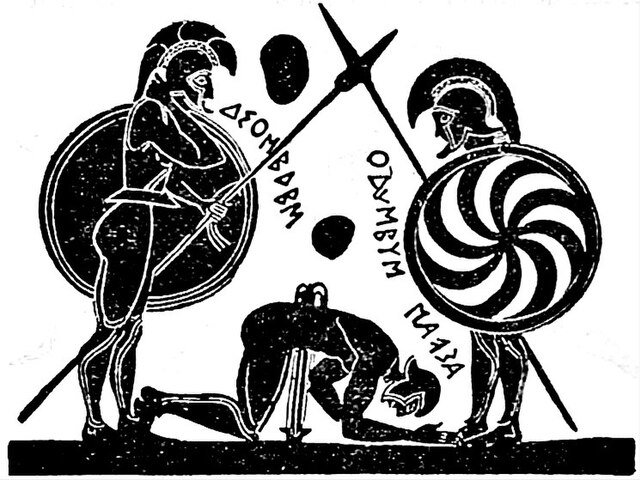
IMAGE Credit: Wikimedia: Painting from an ancient Corinthian vase. Ajax falls on his sword in the presence of his colleagues, Odysseus and Diomedes. The short stature of Odysseus is a well-known Homeric feature. These vases are black-figured; the heroes are painted in silhouette on the red ground of the vases. Their names are appended in archaic Greek letters. Artist from ancient Corinth; public domain; between circa 800 and circa 480 B.C.; drawing published 1911.
(c) Lou Agosta, PhD and the Chicago Empathy Project

Unreliable Parental Empathy in Henry James’ “What Maisie Knew”
Henry James provides a dramatic picture of unreliable and defective parental empathy. What Maisie Knew(1897) begins as a contentious divorce between Beale and Ida Farange is granted by the court. And, lacking the wisdom of Solomon (admittedly a rare quality), so is the custody of the child. The narrative is an inquiry into how the child is cut in half emotionally, and the consequences who she becomes as a person. Maisie is about six years old, and is to spend six months with each parent. As the story begins, each parent wants to take Solomon’s sword and use it on the other partner. Lacking a sword, they use Maisie. Or, expressed slightly differently, the parents are playing “hard ball” and Maisie is the ball.
James’ incomparable empathy with Maisie and his penetrating and astute comprehension of human relations writ large applies empathy in the extended sense as who people are as possibilities, walking in the other’s shoes (after, of course, first taking off one’s own to avoid projection), translating communications between adults and children (and adults and adults) as well as affect-matching and mis-matching (empathy in the narrow sense). James’ work aligns with the concise classic statement “On adult empathy with children” by Christine Olden (1953). When encountering a child, according to Olden, the adult is present to her or his own fate as a child of similar age. The encounter brings up the adult’s issues even if the child does not have such an issue and has other, unrelated issues. The adults expand their empathy by getting in touch with these issues and taking care that they not get in the way of their openness and responsiveness to the child. That, of course, is far from the case with the adults presented in James’ narrative. For example, in encountering Maisie, Mrs Wix (one of the governesses) is present not only to her own fate as a child, but to the fate of her (Mrs Wix’s) child, who was killed in a tragic traffic accident when she was about Maisie’s age. Mrs Wix reaction to her loses, including her own genteel poverty, is to embrace a scrupulous conventional morality that mainly constrains her (Mrs Wix), but which will also eventually impact Maisie. The parents, Beale and Ida, are nursing their grievances and elaborating their hostility to one another, as noted above, using Maisie. The prospective step-parents, Sir Claude and Miss Overmore (Mrs Beale), who eventually emerge, are a definite improvement in empathic responsiveness to Maisie. However, the bar is now set so low that is not saying a lot and the process of de-parenting and re-parenting does not succeed as the narrative ends due to Sir Claude’s unresolved marital status and Maisie’s own painfully acquired knowledge of how to play “hard ball” with the grown-ups.
As James’ novel begins, Maisie’s parents have already spent whatever financial resources they had as the divorce court enjoins Beale (the father) to return the 2500 pounds sterling to his former wife, which money, as noted, seems already to have been spent; Ida (the mother) is living off her looks, by the middle of the story, consorting with exceedingly unattractive rich men (Mr Perrin); Mr Faranago is doing the same with an American “Countess” of Color, who is described as having a mustache and it otherwise painted in terms of an appalling racist stereotype (definitely not James’ best moment). They are doing this for money. As Jems’ novels end, the one person of integrity – and it is narrowly scrupulous morality at that (people who are married should not move in with people to whom they are not married, even if the marriage is emotionally over (though not legally over)) – is Mrs Wix, whose inheritance (we learn towards the end) was stolen by a relative and, as the story of Maisie ends, has some slight hope of getting it back with the guidance of Sir Claude, who has heretofore not been particularly effective at anything except wooing an attractive, supposedly rich lady (Masie’s mother) who turned out not to be so rich and not so attractive if her personality is taken into the account. That noted, let us take a step back.
Children of tender age will repeat what is told them by way of a performance as if reciting a nursery rhyme, not appreciating the ramifications of the statements in the adult world. The reader is given a sample of misbehavior on the part of both parents. At this point, Maisie is six years old (p. 9). Her mother asks her:
‘And did your beastly, papa, my precious angel, send any message to your own loving mamma?’ Then it was that she found the words spoken by her beastly papa to be after all, in her little bewildered ears, from which, at her mother’s appeal, they passed, in her clear, shrill voice, straight to her little innocent lips, ‘He said I was to tell you, from him, she faithfully reported, ‘that your’re a nasty, horrid pig!’ (p. 11)
The way the parents use and, strictly speaking, misuse Maisie to send one another insulting, arguably abusive, messages marks both as loathsome individuals. These parents are easy to hate. The parents are verbally abusive towards one another, and abusive towards Masie in enrolling her in delivering invalidating messages on their behalf to one another. The text is packed with instances of inadequate, substandard parenting. The text is thick with examples of defective empathy, unreliable empathy, and even fiendish empathy. Breakdowns of empathy such as emotional contagion, projection, conformity, and communications lost in translation, are so pervasive as to make the text a veritable compendium of what parents ought not to do.
Maisie is reduced to a tool, and indeed even in Henry James’ skillful literary hands is something of a guinea pig in the jungle of parental incompetence and ethical conformity. The saving grace of James’ fictional study is that such scenarios, bordering on and perpetrating emotional abuse, are all too common – in his time and ours. The advantages of a fictional account is that it enables imaginative variations and thought experiments; and one is not going to get sued for slander, which is a risk even if the alleged “slander” is accurate and based on factual evidence.
The examples of Maisie’s parents are why 21st Century divorce judges begin proceedings by issuing a binding court order that the parents are not to speak ill of one another in front of the child nor have the child deliver messages to one another. I do not know the judicial practices in 1897. What I do know is that in 1897 divorce was less common and more scandalous in contrast with today when divorce is common and the scandals are single parent families, fatherless children, and domestic violence against women and children. We also know that the patriarchy was much more severe in times past (nor does that excuse today’s problems). Consider the cases of Anna Karenina (Leo Tolstoy, 1878) and Effi Briest (Theodor Fontane, 1895), who were prevented from seeing their children by spouses who were aggrieved, wielding ethical cudgels to separate mother and child. Yet even in our own time such legal injunctions are hard to enforce in cases where the parent is bound and determined to create mischief. Anecdotal reports from the trenches indicate that divorce judges are swamped with cases of physical abuse and inevitably give lower priority to bad verbal behavior, which can still be quite destructive to young, still maturing personalities.
Taking care of this child of tender age requires time and effort (all of which cost money) and each parent is eager to send Maisie to the other to inflict this cost on the despised former spouse. The child becomes an extension of the parent, like the narcissistic extension his or her own hand, the very definition of defective empathy, which leaves the child vulnerable to emotional disequilibrium, a kind of empty depression, and breakdowns in the child’s own empathy. The violation of the moral imperative to treat other people as ends in themselves and not mere means aligns with the parents’ retributive attitude, manipulative behavior, and (it must be said) pathological narcissism. Maisie becomes a mere means of the parents to inflict abuse on one other. While lonely and neglected, Maisie makes use of “auxiliary parents” such as an interested and engaged governesses and step parents (all of whom have their own conflicts of interest to maintain a measure of hope and perky positivity in the face of recurring disappointments delivered by the supposed adults in her world. Now in the context of the narrative, the governess, Miss Overbeck, is romantically interested in (and eventually marries) Maisie’s father; but Miss Overbeck also takes a sincere interest in Maisie. If Miss Overbeck is faking her interest in Maisie, it is an academy award winning performance. As in most areas of life, conflicting and overlapping interests are what make James’ narratives so powerful and thought provoking.
The matter almost immediately goes beyond James’ penetrating and engaging narrative. And that is relevance of James for us today. In our own time of fragmented and blended families, who does not know of an example where former spouses are at risk of speaking ill about one another? (It happens to married couples too!) The question is what happens when the affection or hostility are not expressed but nevertheless powerfully present, so to speak, percolating up from beneath the surface. That the emotions are not expressed means that they remain “unthought” as far as thinking using words is concerned. When Maisie’s father tells her, “Your mother hates you,” what does Maisie know about her mother and/or her father? The former spouses routinely refer abusively to their ex-partner in the presence of the child (as James calls her) in devaluing terms (p. 141) – “pig,” “nasty” person, “ass,” and so on.
When another person tells one something, then one has to decide whether to believe it or not. A whole course in critical thinking may be unfolded and inserted here. In particular, the child is motivated to believe the parents, because most decent parents tell the child the truth in age appropriate language, establishing a track record. Still, life events such as divorce, the birth of a sibling, major illness, or death of a family member, introduce incentives and emotional conflicts that distort communications and create parental integrity outages. Even in such examples, and this is the really interesting case, the child is incented to “go along with the program” – that is, what is represented as the truth about the life and family circumstances – because the parent provides meals, clothing, transportation, education, and entertainment, all of which are essential to the child’s well-being and immediate happiness. Still, while the child is constrained to “go along with the program” that does not mean the child always believes the outlandish assertions of the dominating parental authorities. Just because the child goes along with the parent’s fibs does not mean that the child always believes what she is told. You can’t fool all the people all of the time.
For example, at about the same time as James was writing his work, there was a precocious five-year-old – articulate, funny, witty, cute – living in Vienna to whom was born a baby sister. When he asked his parents from where the sister came (he was not quite sure a sister was such a good idea), the parents told him the stork brought it. At that point the boy’s behavior deteriorated, hough the connection and timing was overlooked by the parents, because of their own blind spots. The well-behaved boy threw temper tantrums, developed a phobia which made it difficult to take him out of the house, and regressed to baby-like behavior and talk. His father had a conversation with someone who was innovating in human development (Freud 1909). The coaching was – stop lying to the kid and tell him about from where babies come – tell him about the birds and bees. Recovery was prompt – though there were other challenges in the relationship between his parents.
The point? Children often know that they do not have all the facts and being dependent on their parents for their well-being the children decide it is best to conform. (Key term: conform.) They accept what they are told, subject to their own observations. The boy in question, anonymously known as “Little Hans,” had access to the lake where the storks were living and he saw the storks, but there was a noticeable absence of human babies (Freud 1909). Young scientist! Astutely observant, Hans concluded that his parents account was a fabrication. In short, they were lying to him about from where babies came. Unable to express himself in adult (scientific) language with the counter-example produced by his own observations down by the lake, Hans acted out. His behavior deteriorated. His behavior expressed his disagreement and his suffering, In short, he “knew” his folks were lying to him, rather in the sense that Maisie “knew” matters were not well with the representations offered by the adults in her environment.
Thus, the one parent says, “Your father is loathsome.” The other parent says, “Your mother is loathsome.” Unlike the story about the stork, both of Maisie’s parents are speaking the truth! Yet even in uttering what is a factually accurate statement, there is a larger integrity outage confounding circumstances for the child. It is the job of the parents to take care of the whole child, and they seem not even to have the idea what is the “whole child” and how to do their job. Yes, of course, the child’s material needs, but also the child’s emotional development, education, and sense of being an effective agent, even if only in age appropriate, childish matters. That is profoundly missing here. In such a context, the factually accurate words are a lie.
In the case of Maisie, what might be called intrusive interruptions – and the pediatrician psychoanalyst D. W. Winnicott calls “impingements” – in her childhood tasks of precisely being allowed to be a child of tender age, learning her school lessons, playing with children of a similar age, and holding tea parties with her dolls and stuffed animals – occur as the grown ups treat Maisie like a grown up. Her nursery attendant tells her: “Your papa wishes you never to forget, you know, that he has been dreadfully put about” (p. 10). This is the paradigm of defective empathy, for it attempts to induce in the child what papa was experiencing, yet does so in way that blames the child – points an accusing finger at her – for the “dreadful” inconvenience papa is suffering because of shared child custody. The child’s job is to learn her school lessons, play with her dolls, have bed time story time and lunch time and bath time, and visit with her peers (of which Maisie seems to have none), not to understand legal custody proceedings.
In general, when confronted with incompetent parenting, the child will (1) try to “fix the parent” so the parent can do her/his job (of taking care of the child), (2) conform, or (3)act out (see Little Hans, above). For example, the child will try to cheer up the depressed mother by putting on a happy smiley face, being perky, winsome, in the face of the mother’s self-invovled funk and indifference. The middle school or pubertal child will quote positive things said by friends about the parent. The child will try to placate the neglectful, abandoning, or angry father by being apologetic, giving agreement, being submissive, promising “I’ll be good!” The child may have no idea what is bothering the grown up – financial challenges, health issues, sexual frustration, or relationship breakdowns that a child of tender age cannot possibly comprehend. The child may act out – if an adolescent, defy social conventions – if a child of tender age, regress and lose toilet skills and wet the bed. The child will experience difficulties – experience sleep and eating disorders or throw temper tantrums. The child has limited skill in expressing her or his feelings verbally and/or understanding parental issues, so the child will invent meaning. “If only I were better at academics, sports, socializing, doing chores, then my mother and/or father would be happy (and be able to take care of me in such a way that I can be happy too).” “If only I had done my chores, my folks would not be getting divorced” – and this after both parents have repeatedly assured the child that she or had nothing to do with the family breakup.
In the narrative, mamma enacts a similar impingement and calls forth a “try to fix her” response in Maisie. Papa has already used the same words:
You’ll never know what I’ve been through about you – never, never, never. I spare you everything, as I always have [….] If you don’t do justice to my forbearing, out of delicacy, to mention, just as a last word, about your stepfather, a little fact or two of a kind that really I should only have to mention to shine myself in comparison and after every calumny like pure gold: if you don’t do me that justice you’ll never do me justice at all.
Maisie’s desire to show what justice she did her had by this time become so intense as to have brought with it an inspiration (p, 161)
In response, Maisie tries to cheer up her mother – tries to “fix” things by acknowledging her mother with the complimentary description of Ida (mamma) provided by The Captain, a prospective romantic interest of mamma with whom Maisie had a conversation. The Captain had paid her (mamma) many credible compliments, saying beautiful, kind things about her, which helped Maisie feel genuine affection for this difficult individual, Maisie’s mamma. Maisie tries to acknowledge her mamma using the Captain’s kind words. It does not work. “Her [Maisie’s] mother gave her one of the looks that slammed the door in her face; never in a career of unsuccessful experiments had Maisie had to take such a stare” (p. 164). James compares the impact on Maisie to a science experiment that goes horribly wrong, producing something disgusting instead of the expected elegant result. The mother then has a temper tantrum. Maisie (who is now estimated to be the age of a middle school student) survives this scene of “madness and desolation,” “ruin and darkness,” and, after mamma’s departure, goes off and smokes cigarettes with Sir Claude.
As noted, Winnicott describes this scene of fear and defective empathy, “…[T]he faulty adaptation to the child, resulting in impingement of the environment so that the individual [the child] must become a reactor to this impingement. The sense of self is lost in this situation and is only regained by a return to isolation” (Winnicott, 1952: 222; italics added). Maisie is definitely isolated, and she suffers greatly because of it. The parent takes the child as his or her confidant as if the child were an adult, “Let me tell you what your father said.” “Let me tell you what your mother did.” Even when the content of the statement is relatively benign, the tone with which it is uttered – and that is the moment of defective empathy – causes the listener to imagine a kind of outrage, boundary violation, or integrity outage. This other must be the very devil!
In the case of What Maisie Knew, both parents are explicitly hostile towards one another and, if not hostile towards Maisie (though that too emerges), at least neglectful and manipulative. Arguably, in making Masie the means of their abuse of one another, the parents are also abusing her. However, what about the case, perhaps more common in our own supposedly psychologically advanced time, where the parent is hostile, but following the court order, the parent does not express it. What happens then? That of course goes beyond James’ narrative, but points to its relevance for our own challenges and struggles.
On a positive note, if the abusive language is not performed, then it is not in the space. In so far as children are designed to conform to the guidance of their parents – even when they do not fully believe or trust them – so much negativity is removed from the space. Well and good – at least there is nothing to present in court when going before the judge. You will never hear me say that it is better to use the abusive language for then one knows where one stands with the other person. There are many other, better, ways of figuring out where one stands with the other such as comparing words and deeds, confronting one’s own introspective empathy, or simply asking the other person or other significant actors in the environment. It is just that the child’s ability to do these things is still developing and may be inadequate to the task (a problem that less skilled adults (and there are many) may also face). The hostility does not appear on the surface, which gives the appearance of a calm and placid body of water; yet a rip tide may lurk beneath the surface, capable of pulling one down.
At this point, it is useful to take a step back and consider how our consciousness is populated with many voices and many actors. An example of an “internal object” (actually more of an agent) would be a conscience that “tells” the person about the rightness of a prospective or accomplished behavior or speech act. The first internal object, the conscience (“superego”) is formed, thanks to the mechanism of identification with the aggression (about which more shortly). The conscience can become a hostile introject along other internal objects such as images of the parents, mentors, and positive complexes such as generosity, compassion, and empathy. The proposal is that the difference between parents who are explicitly assaultive in their speech acts and those who bottle up the hostility, which then leaks out in indirect forms, shows up in the quality of the internal introject. In the first case, the introject is more hostile, harsher but easier to distinguish from the authentic self; in the second case, the introject is more benign, but not necessarily harmless, and yet harder to distinguish from the authentic self.
If one could truly cancel all the hostility – not just try to keep it down – but truly extirpate it, then it would become an idle wheel and not move any part of the behavior or thinking of the agents in question. But would the hostility then exist anymore? It would be unexpressed, because it really and truly were sublimated into a poem or work of art. That is the issue – is there ever such a thing as unexpressed hostility? This is not a problem that Maisie’s parents have – their problem is that they are embracing the hostility, elaborating it, making it their project. The damage (including to the parents) is substantial. In contract, when the hostility is unexpressed, but still lurking beneath the surface, it may not be unexpressed forever. Betrayal oozes at every pore. empathy is active here too, in a kind of regressive mode, and gives off hostile vibes, aggressive vibes, even if one’s words as sweet as honey. “Would you like another piece of cake?” Is spoken with such a tone of venom that one suspects the cake might contain arsenic. The tone is the moment of empathy (or, more precisely, the unempathic moment) in which one gives off a kind of negative affect, a hostile vibe, in spite of one’s sweet or benigh words. In addition, it is just as common for hostility which is not verbally expressed to be displaced or expressed indirectly in behavior and deed. With advance apologies to pet lovers, the boss bullies the employee and the employee goes home and kicks the dog. The hostility is present but displaced.
As Maisie’s papa gets ready to leave for American to attend to the business affairs of his new, rich consort, the princess, further unreliable empathy. He makes an invitation to Maisie to accompany him to America. This is “out of the blue,” without context or assurances as to how Maisie will be taken care of, and the offer is fake. Why fake? Because he really does not want her along, nor does she really want to go, even though she says with enthusiasm and e=repeatedly “I will follow you anywhere.” It is clear the adventure is not going to happen:
She [Maisie] began to be nervous again; it rolled over her that this was their parting, their parting forever, and that he [papa] had brough her there for so many caresses only because it was important such an occasion should look better for him than any other [….]It was exactly as if he had broken out to her: ‘I say, you little donkey, help me to be irreproachable, to be noble, and yet to have none of the beastly bore of it. There’s only impropriety enough for one of us; so you must take it all (p 138).
Naturally, the child has to go along with what the parent tells her or him. The parent has the power to provide meals, transportation, shelter and entertainment, though, in this case, none are offered.
The cost and the impact of the lack of integrity and empathy (and adaptation in general) of the parents to the child is the creation of a false self. Maisie pretends to be dumb. The trouble is that faking being dumb risks actually being dumb in a “fake it till you make it” moment. Her formal education is already neglected and in tatters. Now in the context of James’ narrative, Maisie never loses her cognitive acumen, though she gets called invalidating names such as “idiot” and “donkey” by her elders, which must have a damaging impact on her self-esteem.
Here James is the master psychologist ahead of his time, giving the reader an inside case history on the production of what, as noted, D. W. Winnicott came to describe as “the false self.” On background, Winnicott is the pediatrician who became a celebrated psychoanalyst, surviving an analysis with James Strachey, Melanie Klein, who was himself fortified intellectually by one his most famous (indeed infamous) students and colleagues, Masud Kahn. Without going into psychoanalytic politics, let’s just say that Winnicott’s ideas of the transitional object, virtual play space of creativity, and the false self are among the most enduring and time-tested contributions of child analysis.
At risk of over-simplification, the false self is constructed in order to protect the true self, the source of spontaneity, satisfaction, fulfillment, beginning something new (as Hannah Arendt would say), and creativity. The false self is designed to help the individual survive the impingements of caretakers whose empathy is faulty. Here “empathy” is understood in the extensive sense of the parent’s willingness and ability to adapt to the requirements of the maturing child. The child is an end in her- or himself and not an extension of the parent’s narcissism, which narcissism reduces the child to the role of fulfilling the parents’ unmet needs in their own lives. Unhappy the child who must compensate for what is missing in the parents’ own lives. Most children will try to do so, making reparation for another’s incompletenesses, conforming to the felt requirements of the parent. How do you think that is going to work for the child?
Maisie’s authentic self takes shelter, hides, behind the false one and preserves the hope of someday being able to be expressed and have a satisfying life of her own, but in the meantime Maisie is able to get the secondary gain of frustrating her parents is using her to hurt one another. Maisie acquires the “know how” required to survive by manipulating the manipulators. The cost is enormous, but it protects one from the impingements of the powerful, malevolent forces in the unempathic environment:
The theory of her stupidity, eventually embraced by her parents, corresponded with a great date in her small, still life [….] She [Maisie] had a new feeling, the feeling of danger; on which a new remedy rose to meet it, the idea of an inner self, or, in other word, of concealment. She puzzled out with imperfect signs, but with a prodigious spirit, that she had been a centre of hatred and a messenger of insult, and that everything was because she had been employed to make it so. Her parted lips locked themselves with the determination to be employed no longer. She would forget everything, she would repeat nothing, and when, as a tribute to the successful application of her system, she began to be called a little idiot, she tasted a pleasure altogether new. When therefore, as she grew older, her parents in turn, in her presence, announced that she had grown shockingly dull, it was not from any real contraction of her little stream of life. She spoiled their fun, but she practically added to her own (p. 13; see also p. 54 on “the effect of harmless vacancy”; see also p. 117 on deep “imbecility”).
The child lives into – and unwittingly lives up to – the devaluing description and expectations made of her. Maisie makes the best of a bad situation and has fun spoiling the fun of other (which “fun” seems to be the mutual insults of and gossip about the parents). But the cost is substantial. James’ calls out a masochistic moment here in which, as the proverb goes, one cuts off one’s nose to spite one’s face. Caught in the cross fire, in an attempt to find a way between the rock and the hard place, Maisie consults a potential ally. Miss Overmore (the governess initially employed by her mother, but who eventually marries her father) has conflicts of interest of her own but in this moment functions as an honest broker. Maisie’s mother tells her to tell her father that he is a liar and Maisie, who is maturing, asks her governess if she should do so:
‘Am I to tell him?’ the child [Maisie] went on. It was then that her companion [Miss Overmore] addressed her in the unmistakable language of a pair of eyes deep dark-grey. ‘I can’t say No,’ they replied as distinctly as possible; ‘I can’t say No, because I’m afraid of your mamma, don’t you see? Yet how can I say Yes after your papa has been so kind to me, talking to me so long the other day, smiling and flashing his beautiful teeth at me the tie we met him in the Park, the time when, rejoicing at the sight of us [….]The wonder now lived again, lived in the recollection of what papa had said to Miss Overmore: ‘I’ve only to look at you see that your’re a person to whom I can appeal to help me save my daughter.’ Maisie’s ignorance of what she was to be saved from didn’t diminish the pleasure of the thought that Miss Overmore was saving her. It seemed to make them cling together (p. 15).
What Maisie does is she keeps quiet. She isolates – plays dumb. All the worse, the mother initially prevents Miss Overmore from accompanying Maisie when the rotation to the father’s turn to take care of her occurs. The child is afraid of being abandoned – not taken care of – not provided for. Miss Overmore is taking caring of Maisie educationally and emotionally. Miss Overmore is banished (at least at this point). The child is “invisible”: “Maisie had a greater sense than ever in her life before of not being personally noticed (p. 107).
As the novel progresses, mamma is stricken with a dreaded but unspecified disease and her life is limited by illness even as she consorts with men who have money. As noted, Papa is bound for America. Sir Claude (who has not been properly introduced here but is a kind person who marries Maisie’s mother and genuinely likes Maisie) ping pongs between England and Paris as Sir Clause learns of a letter in which Papa (Mr Beale) deserts Mrs Beale (Miss Overmore, now Sir Claude’s lover). “You do what you want – and so will I” type of arrangement. Sir Claude is still married to mama (Ida Farange), and in the gilded age that is the scandal. Sir Claude cannot live with a woman married to someone else (according to the standard conventions of the time). There is something indecent about Sir Claude taking up with Miss Overmore while still technically married to Ida. Key term: indecent.
The novel itself has an unthought, regarding the conventions circa 1897 about adult sex outside of marriage and within marriage with other partners. Sir Claude’s is a person who does not speak unkindly of anyone. He is kind, albeit a chain smoker, which is perhaps a way of binding his underlying anxiety. He is happy to have been given permission to do what he wants by his wife (Ida, Masie’s mother) provided she gets similar permission to consort with whoever she wishes. Without a formal divorce, this leaves Sir Claude compromised in terms of conventional moral standards (which were much stronger in such matters in 1897 than in 2024).
We fast forward though Maisie’s lessons in cynicism, playing “hard ball,” the integrity outages of her parents and step parents, and instruction from another of her governesses, Miss Wix, in a rigorous sense of conventional morals. As the story ends (spoiler alert!), Maisie practices a kind of hardball. “I will give up Mrs Wix if you will give up Miss Overmore – and we will go off together to Paris,” Maisie proposes to Sir Claude. Both governesses are to be thrown “under the bus,” which does have a certain narrative symmetry and symbolizes Maisie’s gorwing up.
Thus, Maisie tries to seduce Sir Claude, who, as noted, is the handsome if ineffective 2nd husband of her mamma. “Everyone loves Sir Claude,” everyone except his wife (Maisie’s mama). After marrying mamma, Sir Claude falls in love with Miss Overmore (who has since married Papa). Maisie proposes that she will give up Miss Wix if Sir Claude gives up Miss Overmore. That is the “seduction.” There is a certain amount of back-and-forth negotiation, but it is clear this is never seriously considered by Sir Claude. He would be willing to be in Maisie’s life, but is committed to living near Miss Overmore (Mrs Beale) in France (who are notoriously loose regarding marriage boundaries) so Sir Claude and Miss Overmore can continue their romance. Maisie (as directed by the author, James) takes the moral high road, and returns to England with her strict governess Miss Wix to a life of genteel poverty and “moral sense,” which means conformity to conventional moral behavior.
The empathic moment for Maisie is, who is she as a possibility? This is an aspect of empathy that is sometimes overlooked in the conversations about affect matching, projection, and communications lost in translations – who is the person as a possibility. For example, I meet someone is who struggling with alcohol abuse or, in this case, with quasi-abusive, neglectful parents. That is not who the person is authentically as a possibility. The abuser of alcohol is the possibility of overcoming that she is drinking because of unresolved trauma, low self-esteem, or other specific issue, which when surfaced and worked through allow the person to write the great American novel, join Doctors without Borders, or start a family.
So, once again, who is Maisie as a possibility? First of all, she is a survivor of being “caught in the cross fire” of a nasty divorce and being raised in its shadow. Anyone proposing to give Maisie a good listening might find themselves responding to her empathically saying, “You may usefully know yourself as a survivor.” By the end of the narrative, as Maisie goes off with her governess, Miss Wix, it far from clear that is the case. So while Maise learns a lot about cynicism, hardball, interpersonal invalidation, perpetrations, and emotional intrigue, she does not yet know herself as a survivor.
Using James’ other female figures as a foil for who is Maisie as a possibility, maybe she becomes a kind of Kate Croy (as in James’ Wings of a Dove) scheming to get married to get someone else’s fortune upon their passing away. Maybe Maisie becomes Maggie (as in The Golden Bowl), sacrificing herself to the happiness of others and simultaneously validating the appearances of conventional morality. Or perhaps she becomes a Miss Overmore, a governess educating other people’s children in French grammar and romantic intrigues with the master of the house. Alternatively, Maisie becomes a governess such as Mrs Wix, not mourning the loss of a daughter, but the loss of her own possibility of satisfaction by means of a scrupulous morality, a reaction formation to the loose standards of her own parents and step parents. As the narrative concludes, the latter is the probable almost certain future. A sad ending indeed.
There are many moments of affect matching (and mismatching) in James. There are many moments of communications lost in translation. These are empathy lessons in the sense that if one “cleans up” the miscommunication (restore understanding, then empathy emerges between the communicants. There are many examples of projection in – the parents especially are projecting their hostility onto one another and indeed everyone in the environment. Withdraw the project and authentically be with the other person and empathy comes forth. This does not happen to the parents, but the step parents (with whom Maisie is prospectively “re-parented”) move in that direction. Does Maisie become Kate Croy, Maggie (albeit without all the money), or even a version of her own mamma, seeking her fortune (literally) in association with a series of men of varying degrees of unattractiveness The opportunities for women are appallingly limited. Maisie’s education has been neglected as she has been shunted back and forth between parents. Even when she is de-parented from her biological ones, and Sir Claude and Miss Overmore (Mrs Beale) come together and propose to take care of her, the promise of educational lectures is short-circuited by lack of a revenue model. They can afford some lectures targeting working class folks at the equivalent of the public library, but university level preparation (which, at that time, requires Greek and Latin) seems a high bar. The disappointing, even demoralizing (in the sense of inspiring a righteous indignation), results are a reduction to absurdity of the constraints of standard morality. There is no need for James explicitly to have intended such a message, but it is not hard to find it in him, consistent with an agenda that treats women as full human beings, social actors, and agents with full political and financial rights (which was definitely not the case in James’ Gilded Age).
James’ novels often end on a conventional note, even if his embrace of convention is a reduction to absurdity of convention. When Maisie sees her parents nasty divorce, relatively rare in 1896 as compared with our own time, and the musical chairs of changing partners with Sir Claude and Miss Overbeck (Mrs Beale), is it any wonder that Maisie embraces conventional morality and partners with Mrs Wix, a standard governess who has lost a daughter that would be about Maisie’s age? As noted above, when Mrs Wix is in the presence of Maisie, she (Mres Wix) is in the presence of her lost daughter, which presents an obstacle to her being with – that is, empathizing with – Maisie. Instead Mrs Wix goes to morality (not inconsistent with empathy, just different than it) and her advocacy with “moral sense.” At this point, James’ incomparable empathy gives way to crafting a writerly conclusion, which engages and reduces conventional morality to absurdity.
Much ink has been spilt on whether James’ endings are endorsed by him. Happy endings are rare in the real world, and if one considers death to be unhappy, then they never occur. Never. However, endings where the protagonists act conventionally are realistic in the sense that people often conform to conventional moral standards – which is why it is called “convention.”
A deeper level of integrity coincides with doing what is conventional in James’ Wings of a Dove. Maggie returns to her unfaithful husband, Prince Amerigo, doing what is superficially conventionally requires. The arguably “deeper” integrity of Maggie’s self-sacrifice for the happiness of the poor couple (the husband and his original love interest) is hard to understand under the draconian laws of the patriarchy, by which the unfaithful husband has control of Maggie’s financial fortune. Maggie decides to “fund” his unfaithfulness to her in a magnanimous gesture of self-sacrifice (but does she really have a choice?) based on the romantic notion that his love for his prospective bride from their days of mutual impoverishment was the “real thing.” There is no way that life has to look, and it will turn out the way that it turns out.
In a different context and narrative, Lambert Strether (The Ambassadors) honors his word in the most superficial sense, returning to America presumably to acknowledge that, though Chad returns to Woollett, he (Strether) tried to convince him not to do so, requiring the engagement of other ambassadors, and forgoing his (Strether’s) own possibility of happiness with Marie, which would have required him explicitly to break his word and not return. Thus, doing the conventionally “right thing” is the wrong thing from the perspective of a personally satisfying outcome.
In the background is the pervasive issue of what is the revenue model? Who has the money? Kate Croy and Merton Denscher are engaging in a confidence scheme to get Milly Theale’s fortune (she has a fatal disease). Denscher is belatedly overcome with integrity (and Kate’s refusal to have sex with him to confirm the shady deal), not conventional conformity, but actual remorse. It cancels his affection for Kate, who poverty previously prevented him from marrying. Unless one thinks Milly’s bequest is a “guilt trip” designed to punish Denscher (which it might be, but probably not), and not a genuine gift to someone Milly loved, a case can be made that the non-conforming thing to do would be to “take the money and run (to the bank).” Here the layers of ambiguity and uncertainty really do send the participants (and readers) spinning (Pippin 2000: 66), and no reason exists to believe an unambiguous “right answer” is available. In the Golden Bowl, Maggie has the money, until she doesn’t, and that makes all the difference.
That Maisie turns out with standard level neuroses, acting out an Oedipus complex, even if cynical and seductive in a way conventionally appropriate for women of the Gilded Age, and not psychotic, is a tribute to the secure attachment she experienced from her early nurse, Moddle, all of which must have occurred prior to the beginning of the narrative.
Bibliography
S. Freud. Analysis of a Phobia in a Five-Year-Old Boy. The Standard Edition of the Complete Psychological Works of Sigmund Freud 10:1-150
Henry James. (1897). What Maisie Knew. New York, Penguin Classics, 2007.
Christine Olden. (1952). On adult empathy with children. Psychoanalytic Study of the Child 8: 111–126.
Robert Pippin. (2000). Henry James and Modern Moral Live. Cambridge: Cambridge UP.
Winnicott, D. W. (1952). Psychoses and child care. In D. W. Winnicott (1958).
Collected Papers. London: Tavistock Publications.

How I changed my relationship with pain
Expanded power over pain is a significant result that may usefully be embraced by all human beings who experience pain – which describes just about everyone at some time or another. Acute pain communicates an urgent need for intervention; chronic pain is demoralizing and potentially life changing. Intervention required!
People who do not experience standard amounts of pain are at risk of hurting themselves. Dr. James Cox, senior lecturer at the Wolfson Institute for Biomedical Research at University College London, notes, “Pain is an essential warning system to protect you from damaging and life-threatening events” (Jacquelyn Corley (Stat2019)). Admittedly not experiencing pain is a rare and concerning condition from which few of us suffer. Hence the practical approach considered here for the rest of humanity.
I changed my relationship to pain by working on the relationship. The result is that less pain occurs in my life and the pain that I do experience does not dominate my life. If one is completely pain-free, one is probably dead, which has different issues.
The following behaviors made a difference. Regular exercise, healthy diet, spiritual discipline (I have trained extensively in Tai Chi, but Yoga and/or meditation encompass the same results), consultations with professionals of one’s choice including medical doctors; and, here is the wild card, the purpose of this post: education in the different types of pain, including but not limited to acute pain versus chronic pain. The reader may say, “Holy cow! That’s too much work!” However, if the reader is in enough pain, then consider the possibility. What’s the alternative? Continue to suffer? Medically assisted suicide (where legal)? Opioids? The latter in particular have a place in hospice (end of life scenarios), in the week after surgery, but otherwise they are a deal with the devil. And, in any deal with the devil, be sure to read the fine print. “At a time when about 130 American die daily from opioid overdoses, scientists and drug companies are actively pursuing alternative non-opioid medications for acute and chronic pain” (Jacquelyn Corley (Stat 2019)).
An example will be useful. I changed my relationship to pain, following my MDs guidance, by taking a double dose of NSAIDs – non steroidal anti-inflammatory “pain killers”. The idea is to “kill” the pain without killing the patient. This is no joke because NSAIDs such as Aleve can damage the mucous membranes of the gastro intestinal track (e.g., stomach), leading to ulcer-like conditions and the accompanying risks (not detailed here), which is why, even though they are over-the-counter, consultation with a medical doctor is important.
Doing Tai Chi changed my relationship to pain. Your mileage may vary, but I started to see results after ten weeks of dedicated daily work. My Tai Chi training has continued with one lengthy interruption for six years. My experience was the practice moved the pain threshold up. That is, I did not experience pain as acutely and when I did experience pain, it did not bother me as much. This can be a double-edged consideration. For example, the Tai Chi exercise of “holding the ball” is a stress position. One really needs a picture to see what this is.

One stands there with one’s arms encompassing a large ball at about the level of one’s chest with one’s hips tucked slightly as if sitting back. One’s whole body is engaged and conditioned. After about ten minutes one starts to heat up and after about fifteen minutes one starts to sweat. This is Tai Chi, not Yoga, but Mircea Eliade discusses similar stress positions that generate Shamanic Heat (Eliade, (1964), Shamanism, translated Willard Trask. Princeton University Press (Bollingen)).
Now a word of caution regarding the pain threshold. I went for a dermatological treatment and I got burned, literally, (fortunately, not too seriously), because I did not say “Stop – it hurts!” Granted that most people want to experience less pain, it is important to not extinguish pain completely, because pain in its acute presentation is trying to tell one something – in this case, injury to one’s skin due to heat.
Here is another example. A colleague has an inflamed ankle. It throbs. It hurts. It is not fractured but imaging shows it is enflamed, stressed out. The thing is that this is not just the person’s sprained ankle – it is his whole life. Since he needs to lose weight, he needs to get exercise. Because he cannot get sufficient exercise, he cannot lose weight. The extra weight contributes to the ankle continuing to be stressed. Double-bind! Rock and the hard place. How is this individual going to break out of this tight loop? Now I know this is going to sound crazy, but here it is: Follow doctor’s orders! Go to the physical therapy! If you have got to wear “the boot” for a couple of weeks, do so. Start low (with the number of repetitions of exercises) – go slow. If the person had access to a swimming pool, that would be ideal, but that might not be workable for many people. SPA-like treatments, soaks in Epsom salts in sensory deprivation pods have value.
Many parallel examples can be cited in which a person knows exactly what she has to do (don’t even worry about the doctor) – why is the person not doing it? Many reasons exist, but one of them is that suffering becomes a comfort zone. Suffering is sticky. “Yes, I am miserable,” the individual says, but it is a familiar misery. Suffering has become an uncomfortable comfort zone. What would it take to give that up? Once one realizes, “This is what crazy looks like,” it becomes easier to give up the suffering. This is not a deep dive into the psychology of the unconscious, yet this is not merely a physical challenge. Yes, the ankle hurts – objectively, there is even an image that shows inflammation, albeit hazy and faint. However, even if there weren’t evidence of an injury – and soft tissue damage often escapes imaging, the emotional issue – ambivalence about one’s body image (“weight”) – gets entangled with the person’s whole life. In this case, a struggle with unhealthy excess weight – and the person’s emotions run with the ball – elaborate the injury psychologically. This is also a form of catastrophizing or awfulizing (made famous by cognitive behavioral therapy (CBT)), but CBT did not invent it.
I gave the example of an inflamed ankle, but it might also apply to lower back pain, headaches, asthma, irritable bowel syndrome (IBS), which are notoriously difficult to diagnose medically. Speaking personally, I want a quick fix. We all do. However, after a while, if the “fix” does not occur, there is no in principle limit on the amount of time and effort one can spend trying to find a quick fix. After a certain time, one gets a sense that one might put the time and effort into incremental progress – finding whatever moves the dial – whatever shifts the stuckness. Here’s what I did not want to hear: This is gonna take some work. After a time, one decides to roll up the sleeves and do the hard work need to get one’s power back. Healthy diet and a well-defined exercise program are important components. Finding an MD and/or health care provider including physical therapist where the interpersonal chemistry works is on the critical path to dialing down the suffering. Here “interpersonal chemistry” is another description for empathy. Look for someone whose empathy is open enough to encompass one’s pain and suffering without being coopted by it. This is the critical path to recovery.
The distinction between acute pain and chronic pain needs to be better understood by the average citizen. An excerpt from Neurology 101 may be useful. In acute pain, the peripheral nervous system in the body’s appendages such as one’s toes reports via neural connections to the central nervous system (e.g., the brain in one’s head). The impact of a heavy object such as a large brick with my toe releases neurotransmitters at the nociceptors (we are not talking Greek and “nocio” means “pain”). The mechanics are such that a message is delivered from the periphery to the center that what is in effect a boundary violation – an injury – has occurred. The brain then tells the toe to hurt – “Ouch!” The message is delivered seamlessly to the conscious person to whom the toe “belongs” in the neural map that associates the body with conscious experience unfolding in the person’s awareness. The toe which had quietly been doing its job in helping the person walk, balance, be mobile now makes a lot of “noise” – it starts throbbing. This is what acute pain feels like.
With chronic pain the scenario gets complicated. If the injury is subjected to other stressors, slow to heal, reinjured, or otherwise neglected, then the pain may continue across a period of days or weeks and become habitual. In effect, the pain signal becomes a bad habit. The pain takes on a life of its own. What does that even mean? What starts out as a way of reminding the person to attend to the injury gets stuck on “repeat”. Like the marketing company that keeps sending your notices even after you specify “Do not solicit!” The messaging is not just from the toe to the brain, from the periphery to the center, but it gets reversed. The messaging is from the center to the periphery, from the brain to the body part. The brain tells the periphery to hurt. Chronic pain becomes a source of suffering. Here “suffering” expands to include worry that anticipates and/or expects pain, which gets further reinforced when the pain actually shows up.
The poster child for chronic pain is phantom limb pain. Not all pains are created equal. Phantom limb pain provides compelling evidence that pain is “in one’s head” only in the sense that pain is in the brain and the brain is in one’s head. Only in that limited sense is pain in one’s head. Yet the pain is not imaginary. Documented as early as the American Civil War by Silas Weir Mitchell, individuals who had undergone amputation, felt the nonexistent, missing limb to itch or cramp or hurt. The individuals experienced the nonexistent tendons and muscles of the missing limb as cramping and even awakening the person from the most profound sleep due to pain (As noted, further in Haider Warraich. (2023). The Song of Our Scars: The Untold Story of Pain. New York: Basic Books, pp. 110 – 111).
Fast forward to modern times and Ron Melzack’s gate control theory of pain marshals such phantom limb pain as compelling evidence that the nervous system contains a map of the body and the body’s pains point, which map has not yet been updated to reflect the absence of the lost limb. In effect, the brain is telling the individual that his limb is hurting using an obsolete map of the body – the memory of pain. Thus, the pain is in one’s head, but not in the sense that the pain is unreal or merely imaginary. The pain is real – as real as the brain that is indeed in one’s head and signaling (“telling”) one that one is in pain. (R. Melzack, (1974), The Puzzle of Pain. Basic Books.)
Whatever the level of pain, stress is probably going to make it feel worse. Therefore, stress reduction methods such as meditation, Tai Chi, Yoga, time spent soaking in a sensory deprivation pod, and SPA-like stress reduction methods are going to be beneficial in moving the pain dial downward.
One question that has not even occurred to scientists is whether it is possible to have the functional equivalent of phantom limb pain, even though the person still has the limb functionally attached to the body. This sounds counter-intuitive, but think about it. If there is a map of the body’s pain points in the central nervous system (the brain), there is nothing that says “phantom” pains cannot occur even if an appendage still exists. For example, the high school football player who needs the football scholarship to go to college because he is weak academically; he is not good at baseball, but actually hates football. He incurs a soft tissue sports injury, which gets elaborated due to emotional conflict about his ambivalent relationship with football, leaving him on crutches for far-too-long and both physically and symbolically unable to move forward in his life. As if the only three life choices are football, baseball, and academics?! Note that the description of the injury “painful soft tissue” already opens and shuts approaches to treatment. That is the devilish thing – what is the actual and accurate description? Thus, due to the inherent delays in neuroplasticity – the update to the brain’s map of the body is not instantaneous and one does not have new experiences with a nonexistent limb – pain takes on a life of its own.
Though an oversimplification, the messaging between the peripheral and central nervous systems is reversed. Instead of the peripheral limb telling the brain of a “hurt,” the brain develops a “bad habit” of signaling pain and tells the limb to hurt. That is the experience of chronic pain – pain has a life of its own – pain becomes the dis-ease (literally), not the symptom. What then is the treatment, doctor? Physical therapy (PT) – exercises to strengthen the knee and, in effect, teach him to walk again.
Chronic pain is discouraging, demoralizing, fatiguing, exhausting, negatively impacting one’s mental status. I have been cagey about my own experience of pain in this post, but it is a matter of record that I have osteoarthritis, a progressive deterioration of the cartilage in joints such as occurs in people who are getting older and who are long term runners. The person understandably and properly continuously asks himself – what am I experiencing? And does it include pain? No one is saying the “cure” is don’t think about it (pain), don’t worry about it. No one is saying “play hurt”? “Playing hurt” is a bad idea for so many reasons, including one is going to make a bad injury worse. Professional athletes who “play hurt” may indeed get a bunch of money, but they also often dramatically shorten their careers – and that costs them money.
While distraction from one’s pain can be useful in the short term, it is not a sustainable solution. Rather when, after medical determination of the sources of pain are determined to be unable to be completely extinguished or eliminated, one is saying undertake an inquiry into what one is really experiencing. Rather than react to the uncomfortable twinges and twitches, bumps and thumps, prodding and pokes, that one encounters, ask what one is really feeling. Undertake an inquiry into what one is experiencing. If, upon consideration, the answer is “The pain is acute going from 4 to 8 to 9 on the 10 point scale,” then stop and call for backup, including taking pain killers such as NSAIDS as recommended by an MD.
Here the vocabulary of pain is relevant. See Melzack’s McGill pain chart. [List the vocabulary]
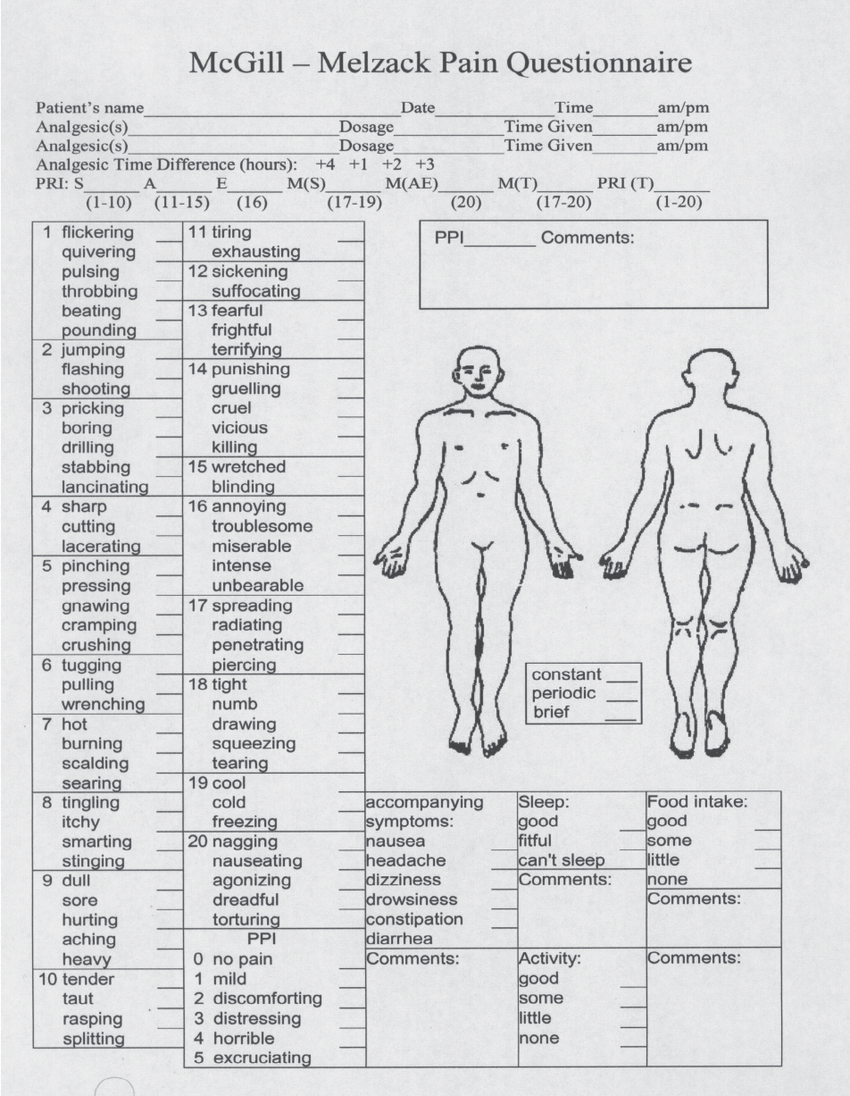
Further background information will be useful. Haider Warraich, MD, in The Song of Our Scars: The Untold Story of Pain (Basic Books, 2023) radicalizes the issue of pain that takes on a life of its own before suggesting a solution. After providing a short history of opium and morphine and opioids, culminating “in the most prestigious medical school on earth, from the best teachers and physicians, we [medical students] were unknowingly taught meticulously designed lies” (p. 185), that is, prescribe opioids for chronic pain. The reader wonders, where do we go from here? To be sure opioids have a role in hospice care and the week after surgery, but one thing is for certain, the way forward does not consist in prescribing opioids for chronic pain.
After reviewing numerous approaches to integrated pain management extending from cognitive behavioral therapy and acceptance and commitment therapy (ACT) to valium, cannabis and Ketamine – and calling out hypnosis (hypnotherapy) as a greatly undervalued approach (no external chemicals are required, but the issue of susceptibility to hypnotic suggestibility is fraught) – Dr Warraich recovers from his own life changing back injury in a truly “physician heal thyself” moment thanks to dedicated PT, physical therapy (p. 238). If this seems stunningly anti-climactic, it is boring enough to have the ring of truth earned in the college of hard knocks, but it is a personal solution (and I do so like a happy ending!), not the resolution of the double bind in which the entire medical profession finds itself (pp. 188 – 189). The way forward for the community as a whole requires a different, though modest, proposal. The patient signs up for and completes physical therapy (PT), a custom set of exercises tailed to his pain condition and mobility issues.
The philosopher Ludwig Wittgenstein wrote, “The body is the best picture of the soul.” The default since René Descartes is to distinguish physical pain from psychic pain – what used to be called the difference between “body” and “soul” before science “proved” that the soul did not exist. (Once again, we are talking Greek “psyche” is the Greek word for “souI.”) Nevertheless, in spite of the “proof” that the soul does not exist, soul-like phenomena keep showing up. For example, if the person’s “soul” is regularly subjected to negative verbal feedback from those in authority, the person becomes physically ill – ulcers, headaches, lower back pain, irritable bowel syndrome (IBS). As noted, these are notoriously difficult to diagnoses. The adverse childhood experience survey (ACE) provides solid evidence that psychic and moral injuries correlate significantly with major medical disorders (e.g., Felitti 2002).
One big issue is that we (science and scientists) lack a coherent, effective account of emergent properties. One with neurons. The alternative is the current reductive paradigm according to which, in spite of contrary assertions, on has trouble explaining that things really are what they seem to be – that table are tables andmade of microscopic components such as atoms. We start with neurons. We are neurons “all the way down.” Neurons generate stimuli; stimuli generate sensations/experiences; experiences generate [are] responses; responses form patterns; patterns generate meaning; meaning generates language. With the emergence of language, things really start to get interesting. Organized life reaches “take off” speed. Language generates community; community generates – or rather is functionally equivalent to – culture, art, poetry, science, technology, and the world as we know it.
What about individuals who are put in a double-bind by circumstances as when someone in authority makes a seemingly impossible demand? For example, the army Sargent gives what seems to be a valid military order to the corporeal to shoot at the rapidly approaching auto, thinking it is a suicide car bomb, but it is really an innocent family. The soldier, thinking the order is valid and that he is protecting his team, follows the order. The solider is now both a perpetrator and a survivor. People have gotten hurt who ought not to have been hurt. Moral inquiry. Moral trauma has occurred. Tai Chi is not going to save this guy. This take the form of guilt – which is aggression – hostile feeling and anger – turned against one self. The individual’s agency – the individual’s power as an agent to choose – is compromised by contingent circumstance, including the individual’s unavoidable choice in the circumstance, since taking no action is also a choice.
This is why the ancient Greeks invented tragedy. A careful reading of the Greek tragedies, which cannot be adequately canvassed here, shows that virtually every tragic hero has the compromised agency characteristic of a double bind. Oedipus is a powerful agent, yet compromised and brought low by inadequate information. Information asymmetries! Antigone’s agency is bound, doubly, by the conflict between the imperatives of politics and the integrity of family. Agamemnon’s agency is compromised by the negative aspect of honor and pride and an overweening narcissism. Iphigenia’s agency is compromised by literally being bound and gagged (admittedly a limit case). Double-binds have also been hypothesized to contribute to the causation of major mental illness (Bateson 1956). Contradictory messages from parents, explicit versus implicit, spoken versus unspoken, are particularly challenging. Here the fan out to related issues is substantial.
I changed my relationship to pain and suffering by reading all thirty existing Greek tragedies. One might say if something is worth doing, it is worth over-doing, and the reader might try starting with just one. Examples of pain and suffering occur in abundance: acute pain – Hercules puts on the poisoned cloak, which burns his flesh; chronic pain – Philoctetes has a wound that will not heal and throbs periodically with painful sensations; and suffering – Oedipus is misinformed about who is his birth mother and after having children with her he suffers so from his awareness of his violation of family standards that he mutilates himself, tearing his eyes out. The latter would, of course, be acute pain, but the cause, the trigger, is thinking about what he has done in relation to the expectations of the community, namely, violating the incest taboo.
Now, according to Aristotle, the representation of such catastrophes is supposed to evoke pity and fear in the audience (viewer) of the classic theatrical spectacle. Indeed, such spectacles – even though the violence usually happens “off stage” and is reported – are not for the faint of heart. We seem to want to identify with the characters in a narrative, which, in turn, activates our openness to their experiences in an entry level empathy that communicates a vicarious experience of the character’s struggle and suffering. Advanced empathy also gets engaged in the form of appreciation of who is the character as a possibility in relation to which the viewer (audience) considers what is possible in her of his own life. One takes a walk in the other’s shoes, after having taken off one’s own. Other examples of similar experiences include why (some) people like to see horror movies. One does not run screaming from the theatre, but conventionally appreciates that the experience is a vicarious one – an “as if” or pretend experience. Likewise, with “tear jerker” style movies – one gets a “good cry,” which has the effect of an emotional purging or cleansing.
Now I am not a natural empath, and I have had to work at expanding my empathy. In contrast, the natural empath is predisposed, whether by biology or upbringing (or both), to take on the pain and suffering of the world. Not surprisingly this results in compassion fatigue and burn out. The person distances him- or herself from others and displays aspects of hard-heartedness, whereas they are actually kind and generous but unable to access these “better angles.” It should be noted that empathy opens one up to positive emotions, too – joy and high spirits and gratitude and satisfaction – but, predictably, the negative ones get a lot of attention.
“Suffering” is the kind of thing where what one thinks and feels does make a difference. Now no one is saying that Oedipus should have been casual about his transgressions – “blown it off” (so to speak); and the enactment does have a dramatic point – Oedipus finally begins to “see” into his blind spot as he loses his sight. Really it would be hard to know what to say. Still, the voice of reality would council alternatives – other ways are available of making amends – making reparations – perhaps more than two “Our Fathers” and two “Hail Marys” as penance – what about community service or fasting? “Suffering” is not just a conversation one has with oneself about future expectations. It is also a conversation one has with oneself about one’s own inadequacies and deficiencies (whether one is inadequate or not). For example, unkind words from another are hurtful. In such cases what kind of “pain” is the hurt? We get a clue from the process of trying to manage such a hurt. The process consists in setting boundaries, setting limits, not taking the words personally (even though inevitably we do). The hurt lives in language and so does the response. Therefore, in an alternative scenario, one takes the bad language in and turns it against oneself. One anticipates a negative outcome. One gets guilt (once again, regardless of whether one has does something wrong or not).
The coaching? If you are suffering from compassion fatigue, then dial down the compassion. This does not mean become hard-hearted or mean. Far from it. This means do not confuse a vicarious experience of pain and suffering with jumping head over heels into the trauma itself. What may usefully be appreciated is that practices such as empathy, compassion, altruism are not “on off” switches. They are not all or nothing. Skilled executioners of these practices are able to expand and contract their application to suit the circumstances. To be sure, that takes practice. The result is expanded power over vicariously shared pain and suffering. One gets power back and is able to assist the other in recovering their power too. (Further tips and techniques on how to change one’s thinking and expand one’s empathy are available in my Empathy: A Lazy Person’s Guide (with 24 full color illustrations by Alex Zonis), also available as an ebook.)
Before concluding, I remind the reader that “all the usual disclaimers.” This is a personal reflection. The only data is my own experience and bibliographical references that I found thought provoking. “Your mileage may vary.” If you are in pain (which, at another level and for many spiritual people, is one definition of the human condition) or if you are in the market for professional advice, start with your family doctor. If you do not have one, get one. Talk to a spiritual advisor of your own choice. Above all, “Don’t hurt yourself!” This is not to say that I am not a professional. I am. My PhD is in philosophy (UChicago) with a dissertation entitle Empathy and Interpretation. I have spent over 10K hours researching and working on empathy and how it makes a difference. So if you require expanded empathy, it makes sense to talk to me. A conversation for possibility about empathy can shift one’s relationship with pain.
Bibliography
Bateson, G., Jackson, D. D., Haley, J. & Weakland, J., 1956, Toward a theory of schizophrenia. Behavioral Science, Vol. 1, 251–264.
Corley, Jacquelyn. (2019). The Case of a Woman Who Feels Almost No Pain Leads Scientists to a New Gene Mutation. Scientific American. March 30, 2019. Reprinted with permission from STAT. https://www.scientificamerican.com/article/the-case-of-a-woman-who-feels-almost-no-pain-leads-scientists-to-a-new-gene-mutation/
Eliade, Mircea. (1964). Shamanism. Princeton University Press (Bollingen).
Felitti VJ. (2002). The Relation Between Adverse Childhood Experiences and Adult Health: Turning Gold into Lead. The Permanente Journal (Perm J). 2002 Winter;6(1):44-47. doi: 10.7812/TPP/02.994. PMID: 30313011; PMCID: PMC6220625.
Melzack, R. (1974). The Puzzle of Pain. New York: Basic Books.
(c) Lou Agosta, PhD and the Chicago Empathy Project

Empathy Lessons, 2nd Edition, is now available as an ebook…
The release of the ebook version of Empathy: Lessons ,2nd Edition, coincided with a major astronomical event – the total solar eclipse that traversed North America on Monday April 8, 2024. The gods are watching and winking at us humans to encourage expanding our empathic humanism!
Empathy is oxygen for the soul (see Chapter 6: Evidence-based empathy training). So, if you are short of breath due to life stress, get the expanded empathy delivered in this book. Just as the body needs oxygen to live physically, the soul needs empathy to live emotionally. Most people are naturally empathic, but the cynicism and denial needed to survive everyday life drives empathy away. Remove the obstacles to empathy and empathy naturally develops and grows. That is the empathy lesson in a nutshell without all the guidance and practice needed to succeed. Find out how to take your empathy to the next level.
In addition to all the features of the First Edition—a readiness assessment for empathy, tips on overcoming resistance to empathy, evidence-based empathy training, empathic techniques of stress reduction, applications to dealing with bullying, healthy well-being, and capitalism—the enlarged Second Edition includes new chapters on rhetorical empathy in politics, the limitations of empathy (and what to do about them), and an expanded chapter on empathy as a lens on love and romance. Not to be missed!
The empathy lessons include how—
To perform a readiness assessment; establish a set up for success in cleaning up inauthenticities that block empathy so that empathy can expand and flourish;
Empathy is not an “on–off” switch but a tuner (a dial) that expands or contracts in accessing the vicarious experience of the other person;
Empathy works as a method of data gathering about the other person, providing a vicarious experience of the other person without being flooded by the experience;
Introspection, vicarious experience, listening to one’s own “voice over” and radical acceptance are the royal road to empathic receptivity;
Empathic receptivity overcomes emotional contagion, creating a set up for clear communication of feelings and experiences;
Empathic understanding overcomes conformity and enables shifting out of stuckness into contribution, transformation, and leadership, including satisfying and flourishing relationships;
Empathic interpretation overcomes projection and is the folk definition of empathy, walking in another’s shoes, adding “top down” empathy to “bottom up,” empathic receptivity;
Empathic responsiveness drives out anger and rage, acting as a soothing balm to suffering and emotional upset, deescalating conflict and aggression;
Scientific, peer-reviewed, evidence-based research confirms that empathy reduces inflammation and stress;
Relationships get “weaponized” in bullying and, coming from empathy, how to overcome bullying, reestablishing boundaries: recommendations to students, teachers, administrators on how to stop bullying (including cyber-bullying) and promote empathy;
“Corporate empathy” is not a contradiction in terms, “CEO” now means “chief empathy officer,” and empathy is now the ultimate “capitalist tool”;
In rhetorical empathy, the speaker’s words address the listening of the audience in such a way as to leave the audience with the experience of having been heard. The speaker articulates the experience the audience is hiding harboring in their hearts yet have been unable to express.
To expand empathy, start with and stick with integrity and authenticity – start with creating a safe space of acceptance and toleration. Fake in; fake out. Empathy is based on integrity and being straight with the other person to and with whom one is trying to relate.
Decline the choice between empathy and compassion, between expanding empathy and fighting and reducing the empire of prejudice, imperialism, the pathologies of capitalism, and violence.
Some have tried to force a choice between compassion and empathy. The world needs both more compassion and expanded empathy.
My colleagues and friends are telling me, “Louis, you are sooo 20th Century – no one is reading hard copy books anymore! Electronic publishing is the way to go.” Following my own guidance about empathy, I have heard you, dear reader. The electronic versions of all three books, Empathy Lessons, 2nd Edition, Empathy: A Lazy Person’s Guide, and A Critical Review of a Philosophy of Empathy – drum roll please – are now available.
Feeling like you are thrown “under the bus” again and it’s getting crowded under there? Get the empathy you need to fight back and flourish in this book. Get expanded empathy here!
Order from author’s page: Empathy Lessons, 2nd Edition: https://tinyurl.com/29rd53nt
Order from author’s page: Empathy: A Lazy Person’s Guide: https://tinyurl.com/29rd53nt
Order from author’s page: A Critical Review of Philosophy of Empathy: https://tinyurl.com/29rd53nt
Read a review of the 1st edition of Empathy Lessons – note the list of the Top 30 Empathy Lessons is now (2024) expanded to the Top 40 Empathy Lessons: https://tinyurl.com/yvtwy2w6
Read a review of A Critical Review of a Philosophy of Empathy: https://tinyurl.com/49p6du8p

Above: Cover art: Empathy Lessons, 2nd Edition, illustration by Alex Zonis, original oil paint on board, entitled “Memory blocks: Shimon”
Order from author’s page: A Critical Review of a Philosophy of Empathy: https://tinyurl.com/mfb4xf4f

Above: Cover art: A Critical Review of a Philosophy of Empathy, illustration by Alex Zonis
In conclusion, let me again say a word on behalf of hard copy books – they too live and are handy to take to the beach where they can be read without the risk of sand getting into the hardware, screen glare, and your notes in the margin are easy to access. Is this a great country or what – your choice of pixels or paper!?!
(c) Lou Agosta, PhD and the Chicago Empathy Project

Review: Empathy and Desire in 20th Centry Dystopian Fiction
Thomas Horan has produced an engaging, even eye opening, treatment of five dystopian novels including – Jack London’s The Iron Heel (1908), Yevgeny Zamyatin’s We (1924), Aldous Huxley’s Brave New World (1931), Katharine Burdekin’s Swastika Night (1937), Ayn Rand’s Anthem (1938), George Orwell’s Nineteen Eighty-Four (1949), and Margaret Atwood’s The Handmaid’s Tale (1986). The leading thread, knitting together what these five works have in common is the transgressive relation between an individual representing the repressive totalitarian regime and a would-be revolutionary. The transgression is not the sex as such, which is pervasive even under totalitarian domination. The transgression is that the pair – sometimes master and slave – get romantically involved, “fall in love,” aspire to a “meaningful relationship,” in diverse combinations and permutations.
Review: Desire and Empathy in Twentieth-Century Dystopian Fiction by Thomas Horan (London and New York: Palgrave Publishing, 2018: pp 212
One of the benefits of engaging with Horan’s even-handed and concise reporting is that the reader is given a bird’s eye view of the complex and entangled dynamics of all of these dystopian novels. That saves the reader a lot of work, allowing the reader to return to the novel(s) in which she or he sees the most value. A definite strength of Horan’s contribution is to call out the aspects of desire – from impersonal sexual coupling to aim-inhibited sublimation of desire into love poetry. Therefore, this review will not attempt to provide more than an oversimplified paragraph of each of the novels as such to highlight the role of desire.
The revolutionary potential, limitations, and dynamics of desire (including its aim-inhibited transformation into love) are illuminatingly explicated. However, such is not the case for empathy. I read every word in this book, and there are 14 occurrences of the word “empathy” (or its derivative such as “empathetic” in the book), and “empathy” is nowhere defined. This is not a softball review, and this will be discussed in detail below. However, the reader should be made aware that this review has to speculate as to what the author (and/or editor!) might have been thinking by putting the word “empathy” in the title of the book, since there is so little explicit engagement with the topic.
From an empathic point of view, totalitarian rule is the systematic canceling and nullification of empathy, indeed of the possibility of empathy. Though it is an oversimplification, it is a useful one, that in each case the selected novels narrate an account of a forbidden, romantic liaison in between a couple (not necessarily heterosexual) in which the possibility of empathy is implicitly contained, though rarely called out. The relation between empathy and love is taken for granted, left undeveloped, and remains implicit in Horan’s work. It does not live up to its promise in this respect, granted developing an account of empathy in the extreme situation of totalitarian domination, in parallel with the better documented account of desire under duress, might have taken another hundred pages.
Still, Horan has done an admirable job of demonstrating how, if one wants to disrupt an organization, including a totalitarian form of governance, then introducing sexual and romantics dynamics is an effective way to do so. Along with nuclear power and aggression (note “Hate Week” in 1984), desire is the most powerful force in the universe. In case after case, both totalitarian bureaucratic and revolutionaries are undone by libidinous and romantic entanglements. Invoking desire is like throwing a libido bomb – the result is going to be an explosion of emotional anarchy. No one escapes the chaos. In so far as one has to tear down the old temple (or government) before raising up the new one, desire will do the job nicely. According to my reading, unmediated desire produces anarchy, which, as a form of governance, greatly overestimates citizens abilities to manage their aggression and greed, putting the community on the regressive path to Hobbes’ “war of all against all.” Therefore, step back to the point where the old temple is in ruins (for whatever reason). What does one do then? How does one build the new organization? One might expect at this point to invoke empathy as a means of team building, and there would be value and truth to that. Never underestimate the power of empathy; yet the complexity of the matter requires that we suspend judgment until we have reviewed the five novels in question, to which we now turn.
Jack London’s The Iron Heel (1908) tells of the conflict between the trade labor movement in the USA and a fascist dictatorship that reads like President Grover Cleveland calling out the US Army as strike breakers to operate the railroad during the Pullman railway strike in 1894 under the pretext of delivering the US Mail (calling the junta of the dictatorship “the Iron Heel”). As a historical footnote, the reader may recall that the railroad magnate, George Pullman, built an ideal “city” on the southside of Chicago for his workers in a utopian moment of flush profits when other capitalists were squeezing workers as hard as they could. This good start came to a violent historical end in 1893 when revenues plunged and workers were laid off – but the rents were not reduced. The President of the Railway Union, Eugene Debs, went on in historical fact to run for President from prison in 1920 (Debs was sent to prison under the Sedition Act of 1918 for opposing US participation in World War 1), garnering nearly a million votes for his socialist party while in prison and unable to campaign. In the novel, the capitalists seize power and form an oligarchy that restores hereditary transfer of pollical authority. This provides the narrative wrapping for a sexual relationship between Eva and Ernest Everhard. He is. According to Horan 2018: 26, 40, 45 (italics added):
“The Iron Heel reads like an amateurish piece of fiction by D. H. Lawrence, complete with the strapping, passionate proletarian who rejects the stale existence of the upper classes for “real life” among the common people [. . . .] ‘Everhard—no Viagra needed.’ It is not through word or example that he wins converts, but rather through his appealing physique. [. . . .] Ernest, who is “ever hard,” and so has potency to spare, becomes the defender of virility and manhood itself, as well as the sacred guardian of social justice. Desire for Ernest initiates the process through which Avis comes to empathize with and realize her responsibility to Jackson and the other disadvantaged people affected by the injustice done to him. This compassion prepares Avis, a beneficiary of the market system, to stand in solidarity with capitalism’s numerous victims.”
The privileged gilded-age woman, Eva, is persuaded as much by the biceps as the rhetoric of this vanguard of the proletariat, Everhard, and she embraces the idea of revelation along with the biceps (and other parts). Alas! The first revolt against the Iron Heel fails (the junta, not the title of the book), and long centuries of suffering lay ahead before final victory. Everhard has a certain animal magnetism – entry level empathic receptivity – and Eva is like the sparrow hypnotized by the snake. The folk definition of empathy suffices here – Eva takes a walk in the shoes of the oppressed (named Jackson) and has an “Ah ha” moment of empathy. Wouldn’t it be nice?
In Yevgeny Zamyatin’s We (1924), the beautiful I-330 attracts D-503’s regime subverting desire. She (I-330) is the leader of the revolutionary Mephi. The animal magnetism (my term not Zamyatin’s, but a summary of the text) that attracts the couple to one another transforms them in the direction of a humanizing individualiaty and consequent critical thinking (Horan 2018: 55):
Through this process of critical thought, morality emerges: I-330’s sensuality does not reduce her to a male-pleasing object of lust; instead, she becomes the first Number to achieve full personhood in D-503’s eyes: “I stared at her […] as something that had dropped out of nowhere. She was no longer a Number, she was simply a person” (Zamyatin 1924/1993, p. 122). Whereas previously everyone was literally a number, D-503 can now recognize and value individuality as well as his responsibility to both himself and at least one other person. Although skeptical of eroticism’s power to effect a successful revolution, [there is a] [. . .] humanizing effect
Meanwhile, the totalitarian system in We strikes back. The individuality is crushed and the possibility of love thwarted in a kind of soul murder (not Horan’s term (see Shengold)) (Horan 2018: 58):
D-503, like many other Numbers, is subjected to a medical procedure that disables the portion of the brain responsible for imagination, an operation that makes desire impossible, which Elaine Hoffman Baruch (1983) calls a “fantasiectomy” (p. 52). After this surgery, D-503 becomes totally amoral—placidly watching the torture of I-330 through suffocation and even finding it beautiful
The narrative does not end happily for I-330 and D-503 (rather like Winston and Julia in Orwell’s 1984). The people in One State are being turned into human tractors by the equivalent of a prefrontal lobotomy. More soul murder occurs, and the survivors live on like Zombies. However, We also ends with a general uprising by Mephi and with the One State’s survival in doubt. A character not mentioned until now, O-90, escapes to a rustic community in the wilderness, carrying a baby who has messianic potential in her womb. Everyone was a number; but just as there is no highest number, there is no final revolution. Get ready for the next one.
Taking a step back, from the perspective of empathy, D-503 aligns with the biblical story of the Tower of Babel and thinks aloud (Horan 2018: 52 – 53):
And so I felt that I—not generations of people, but I myself—I had conquered the old God and the old life, I myself had created all this, and I’m like a tower. (Zamyatin 1924/1993, p. 7) In comparing himself to a tower and presenting collective human achievement as a challenge to divinity, D-503 evokes the biblical story of the Tower of Babel, a myth that showcases the godlike achievements possible through human cooperation. Here, however, the meaning of the original myth is inverted: a story that for the ancient Semites cautioned people to relegate their endeavors to mundane matters and remain firmly on the ground now suggests that people can and should claim the heavens and live as gods: “The gods have become like us—ergo, we’ve become like gods…”
This is the fallacy of the undistributed middle of course. In the myth of the Tower of Babel, there was only one language and humanity lived in peace. In a sin of pride, humans thought itself powerful enough to build a Tower to move into heaven. They were frustrated in this by the scattering of tongues – the generation of the ten thousand languages that people have spoken and (more to the point) misspoken throughout history. The sound of foreigner’s talking sounded like “bar – bar – bar,” hence, they were called “barbarians,” and treated as such. Since understanding was perfect, empathy was not needed prior to the scattering of tongues. History begins at the point of the scattering. Empathy becomes necessary to attain understanding of the Other. The “We” of the title blows up. I hasten to add this potential is not developed by Horan (or Zamyatin), but would not be that hard to do.
In Kathrine Burdekin’s Swastika Night (1937), the thousand-year Nazi Reich is well underway. All the Jewish people are already dead. History is rewritten to make Hitler into a blond god – there is one subversive picture of him as small, brown, and with a paunch – are women have been reduced to the sole reproductive function. In a questionable interpretation, misogyny, not antisemitism, is the basis for the totalitarian state. Meanwhile, at a human scale, the protagonists Alfred and Hermann have an illicit gay (same sex) relationship, which sustains the hope of a return to humanness. The couple share an intimate moment as Alfred (English) gets didactic with his younger German friend, Hermann (Horan 2018: 104):
“Then, if you can love and trust an Englishman, can you grasp the idea that there might be something important, some knowledge, some wisdom, that’s for all of us, for all men alike?” “Yes, I think I see.” (Burdekin 1937/1985, p. 63, emphasis in original). Desire for Alfred allows Hermann to transcend racism, nationalism, and classism, replacing them with an appreciation for a shared human heritage, a heritage that Hermann accesses through subversive lust.
Connecting the dots between the “love and trust” (and lust!) between the couple and empathy remains implicit, nor is it argued for or even called out by Horan. This review shall have a proposal about the connection and what is implied thereby for Horan’s overall position.
Huxley’s Brave New World (1931) aims to exemplify that psychopharmecutical and behavioral conditioning are much more effective in dominating the people than force and violence. Huxley writes:
“Within the next generation I believe that the world’s rulers will discover that infant conditioning and narco-hypnosis are more efficient, as instruments of government, than clubs and prisons, and that the lust for power can be just as completely satisfied by suggesting people into loving their servitude as by flogging and kicking them into obedience.” (Letters of Note, Shaun Usher (ed.), Edinburgh: Canongate Books, 2021 Huxley, Letters of Note, 1984 v. Brave New World)
Thus, John, The Savage (“savage” because he was “natural born,” not “hatched” and conditioned) is the perfect “unavailable object” that inflames Lenina’s passion because of his very inaccessibility. Lenina’s love for John the Savage is unconsummated but, for her, all consuming. Even though the sexual encounter is not in the present tense (or less so), the narrative turns on John’s mother’s (named “Linda”) sexual transgression with Thomas Tomakin, the Director of Hatcheries and Conditioning, which results in the birth of John, The Savage. Lenina’s promiscuity is not transgressive but affirms the norms of the World State that relationships should not be monogamous or filled with romance or affection. Horan 2018: 74
Huxley, like Zamyatin, demonstrates that the subversive power of desire lies not in sex itself but in the longing for bodies that are forbidden. The urgent awareness of self brought on by deferred desire triggers what Marcuse refers to as erotic cognition: “[E]rotic as well as logical cognition break the hold of the established, contingent reality and strive for a truth incompatible with it [….] In the exigencies of thought and in the madness of love is the destructive refusal of the established ways of life” ([Marcuse, One Dimensional Man,]1964/1991, p. 127).
This is where the revolutionary potential of sexual libido starts to reach its limit. To be sure, sex is powerful and should never be underestimated in its disruptive potential. However, igniting the sexual fuse can be like doing so and awaiting the explosion. One had better have a plan as to what to do after the dust from the explosion settles. Just as transgressive, maybe even more, is learning to read. John does that with the only two books available to his mother, a scientific treatise and the complete works of Shakespeare. He spends the rest of the novel quoting Shakespeare like you or I might issue a social media post. The people are fascinated with John’s asceticism and self-flagellation and flock to see him. Thus, Huxley’s ultimate recommendation to combat the dehumanizing effects of psychopharm and behavioral conditioning – read Shakespeare!
Horan likes to invoke Herbart Marcuse, whose revolutionary potential should never be underestimated:
According to Marcuse, when sexual urges go temporarily or entirely unfulfilled because culture and environment restrain them, these impulses beget dreams and aspirations that transcend the self, encouraging the individual to realize and struggle for something beyond quotidian reality. The individual envisions the realization of these lofty desires as taking place in an ideal landscape, which—even if unachievable—embodies the encouraging dream of a utopia and inculcates the will to work toward establishing it. Unlike the complacent, sated Londoners, John the Savage, who is the product of sexually frustrating circumstances, never stops believing in and searching for a better world, even though he ultimately judges himself to be unworthy of one (Horan 2018: 74)
However, this is hardly any different than basic Freudian sublimation of libido. Love is aim-inhibited sexuality (i.e., “libido” the Latin word for “desire”), and the advances of civilization require delayed gratification and the transformation of libido into cultural artifacts. In turn, this unleashes a dynamic whereby the more advanced the civilization the more extensive the guilt, repression, and sublimation; and, whereas sublimation transforms the raw libido into something artistic or socially useful, the guilt and repression remains, well, guilt and repression and a source of visits to the psychoanalyst:
Every renunciation of instinct now becomes a dynamic source of conscience and every fresh renunciation increases the latter’s severity and intolerance. [. . . .] The effect of instinctual renunciation on the conscience then is that every piece of aggression whose satisfaction the subject gives up is taken over by the super-ego and increases the latter’s aggressiveness (against the ego) (Freud, (1930), Civilization and its Discontents: 128–129).
The issue is that he who lives by Freud also dies by him. In a passage that Marcuse strategically cites, the revolutionary potential of sexuality is strictly limited:
[…][W]e derive the antithesis between civilization and sexuality from the circumstance that sexual love is a relationship between two individuals in which a third can only be superfluous or disturbing, whereas civilization depends on relationships between a considerable number of individuals. When a love-relationship is at its height there is no room left for any interest in the environment; a pair of lovers are sufficient to themselves, and do not even need the child they have in common to make them happy. In no other case does Eros so clearly betray the core of his being, his purpose of making one out of more than one; but when he has achieved this in the proverbial way through the love of two human beings, he refuses to go further (Freud 1930: 108); see also Marcuse, (1955), Eros and Civilization, New York: Vintage Paper (Random House), 1961: 38).
If Freud’s assertion is accurate, then it puts an end to the revolutionary potential of desire. Two is a good start to a community. However, the lovingly entangled pair has no need for expansion, hanging the “Do not Disturb” sign on the bedroom door. To create an expanding community, empathy is required, and that is conspicuous by its absence in the dystopian novels and in Horan, nor is the revolutionary potential of empathy itself clear. Natural empaths make poor revolutionaries. Indeed one method of domination in a totalitarian dictatorship is precisely the systematic nullification and denial of empathy (once again, not noted or debated by Horan). The emergence and development of empathy requires a safe space for critical inquiry and taking the point of view of one’s opponent, even if it is the better to thwart and defeat that opponent (see Zenko 2015 on thinking like the enemy). Add politics into the mix along with the issue of the relationship between empathy and a constellation of phenomena such as sexuality and romantic love.
Ayn Rand’s Anthem was (and to an extent still is) a best seller. The summary sounds awful, but Rand writes a good story. Set in a primitive world that resembles medieval Europe, Equality 7-2521 is working by candlelight in a world lit only by fire on the discovery of electricity. In spite of his intelligence – or perhaps because of it – the faceless unempathic bureaucracy (my term, not Rand’s) responsible for career assignments, decides to assign him to sweep the streets.
Equality 7-2521 meets Liberty 5-3000 and – get ready – here is the transgression – they fall in love. Sex is not prohibited. Indeed it is recommended during the bureaucratically sanctioned time of mating. Equality presents his discovery of electricity to the Council of Scholars, but instead of being vindicated, he is further punished. They require his innovation because it would damage the candle industry. John manages to escape to the forest, where Liberty joins him. They go “off the grid,” renaming themselves Prometheus and Gaea, respectively. Gaea (Liberty) becomes pregnant, and the pair in the hope that the off spring will become a leader in transforming the world. But see the above from Freud about the unwillingness of the pair to broaden its boundaries. So far this is not an amazing narrative.
What launches the narrative to a new level is a framework about language in which individual personal pronouns – especially “I” – have been eliminated. This innovation in self-identity is a linguistic “castration” that results in people losing their individuality. Without the language to say “I,” people are unable to conceive and relate to themselves as individuals. Spontaneity, initiative and the ability to start something new are inhibited, cancelled, negated. The story ends with the emergence of the ability to say “I.” Without the “I,” the “We” is an undifferentiated blob that does not distinguish self and Other; and without self and Other one can have merger, but one cannot have empathy, which, by definition, distinguishes self and Other while allowing for crossing the boundary back-and-forth between them.
George Orwell’s 1984 (1949) is the best known and perhaps the grimmest of the dystopian novels, though that is a race to the bottom in which no one wants to be the winner. Here the reader encounters all the vocabulary that has become standard to describe totalitarian domination – Big Brother, the thought police, thoughtcrime, the Ministry of Love (which tortures people), doublethink, Newspeak (“Poland invades Germany” (September 1939)).
The seminal event – no pun intended – is the transgressive relationship between Winston and Julia – of course sex occurs but that is not the transgression – they fall in love. They are betrayed, tortured, and in this extreme situation, say things such that it would be preferable to torture the other person, the beloved. Though under duress, this has the effect on the person of “soul murder.” It kills the possibility of love. It kills the possibility of possibility as such. Though Horan does not explicitly call out the possibility of soul murder, it is fairly close to the surface in the subtext. Reading 1984 is itself something to be “survived” in that it grabs the reader by the throat prior to ripping out their emotional guts. Most readers come away shaken.
Margaret Atwood’s The Handmaiden’s Tale (1986) is now a Netflix series and the position being satirized in it reportedly has representation on the US Supreme Court. As with the misogynist judgment of the ancient Greeks in the Eumenides ruling against Clytemnestra and in favor of Orestes, woman is just the receptacle. Deeply debunking of the subjugation of woman in diverse contexts, especially Canada after World War 2 and prophetic in its anticipation of the reversal of Roe v Wade by the US Supreme Court, this negative fantasy of the Republic of Gilead is a page-turner. In the narrative, most women have been rendered infertile by toxic waste and a coup d’état installs a quasi-fascist US government that is a mix between Old Testament prophets and Afghanistan 2023 where women’s education is outlawed. Controlling sex is a mark of fascism – the strange fascination of certain state legislative assemblies – including a significant (though not majority) number of vocal woman legislators to control woman’s bodies through reproductive constraints
In short, the heronine (Ofred) makes the best of bad situation and signs up to engage in ritual rape (sex) with the Commander in the presence of his wife in order to sustain the population. In this case, the transgression includes getting emotionally involved with the Commander – they are already having sex so the transgression includes reading together and playing Scrabble. All of this is a serious violation of protocol, which gives Ofred power. In the end the Commander is executed for treason. (You can’t make this stuff up!) Meanwhile, Ofred has Hot Sex with Nick, one of the Commander’s staff, and they too get emotionally involved. Amidst diverse classifications of women such as Martha’s, Aunts, Econowives, Jezebles, and Handmaidens, it remains unclear what happens to Ofred after she is taken away in the secret van, but the existence of her report is evidence that she survived. Horan gets the last word (2018: 21)
I argue [Horan writes] that it is the bizarre sexual relationship [in addition to ritual rape they play a lot of Scrabble (the board game)] between the narrator and the Commander that awakens her moral sensibilities and inspires her to leave her record. Under the pretense of having illicit fun, the narrator and the Commander vigorously debate social and political issues. The narrator’s assignations with the Commander give her the requisite information to tell her tale, including secrets about the government and what motivates those who run it, facts about her ill-fated predecessor, and knowledge of clandestine spaces where she discovers what became of her best friend. The Commander never disavows the tenets of his society, but his sexual transgressions inflame his arrogance, causing him to take unnecessary risks that bring about his eventual trial and execution for treason
Notwithstanding the master slave implications here, one can interpolate an empathic moment between the two and perhaps even an empathic attempt, however limited in its success, to take a walk in the Other’s shoes.
This brings us to the ultimate question, which remains unaddressed by Horan. What is the relationship between empathy and desire? This must be read to include the transformation of desire represented by the aim-inhibited desire of romantic love. One seeks in vain for any proposal to address this in Horan, nor does he provide a definition of “empathy,” and that is a significant shortcoming in an otherwise engaging and thought-provoking treatment of dystopian fiction. Since Horan has not conceptualized the relationship, the following makes no claim to represent Horan’s position. The book review of Horan’s work ends here. Therefore, the following may be read as using Horan’s provocative juxtaposition of desire (including romantic love) and empathy (and politics, dystopian and otherwise) as a springboard for understanding and explanation of the issues around empathy and politics.
The proposal here is to conceptualize the difference between desire (including romantic love) and empathy. Folk wisdom, thus, suggests that love is blind; Bob Dylan, that love is just a four letter word (which makes explicit the ambiguity of “love” as libidinous desire); Plato, that love is a kind of madness. So far, love sounds like tertiary syphilis—it makes one mad and causes one to go blind. People say that they want to be loved; people speak the truth in saying so; and they will even become manipulative about it, saying that if you truly loved me, then you would give me what I am asking for right now, thus misusing love to bully another individual.
People also want to be understood. People want to be “gotten”—appreciated, and acknowledged—for who they authentically are as they are and who they authentically are as a possibility. For example, the waiter is an aspiring actor; the barista, a novelist; the help desk worker, a software entrepreneur. People want other people to know how they have struggled to succeed and overcome adversity. In hoping to be understood for who they really are as a possibility, people are asking for love, but even more so they are asking for empathy.
Less dramatically, the folk definition of the practice of empathy urges one to take a walk in the other person’s shoes, presumably with the other person’s shoe size, not one’s one. Take off one’s own shoes prior to trying on the Other’s shoes. Take a walk in the shoes of someone who is going mad and blind? This might not turn out to be as simple or easy as it at first seems.
The goal of desire is to erase the boundary between the self and other. Merger of one’s mind and body with the desired beloved’s mind and body is the main aspiration and outcome. So desire emerges as a breakdown in empathy—from the perspective of too much or too little engagement with the other. It is desire versus empathy. Yet in desire, empathy lives. In contrast to desire, empathy navigates or transgresses the boundary between oneself and other such that the merger is temporary and the integrity of the self and other are maintained. The boundary between self and other are firmly maintained in empathy, though one goes back-and-forth across the boundary. It is like in Robert Frost’s poem “Mending Wall,” in which it is asserted that “good fences make good neighbors.” Empathy adds one thing not literally present in Frost’s poem, extending the metaphor. There is a gate in the fence, and over the gate is a sign with the word “Empathy.” One has a vicarious experience of the other—but the difference and integrity of the self and other are preserved in empathy.
When approaching empathy from the direction of love (desire), the more one is enthralled by the beloved, the less empathy one has. The negative aspects of love such as being blind to the
faults of the beloved or the hypnotic obsession with the beloved that Socrates/Plato compared to a kind of divine madness (more on that shortly) reduce the access of empathy to the authentic experience of the other person. Thus, love expands and empathy contracts. The contraction of empathy in the breakdowns of empathy in emotional contagion, conformity, projection, and getting lost in translation expand the aspects of love (desire) included in animal magnetism, agreeableness, “unconditional” acceptance of the other’s shortcomings, and speaking in tongues, the wonderful, incoherent nonsense of two lovers cooing at one another.
However, such an inverse relationship between love and empathy is only the case when
considering the negative aspects of love. When one considers the positive aspects of
empathy, access to the shared humanity of the other person, access to the diversity and
differences in common with the other individual, then expanding empathy also expands the possibilities of love. Expanding empathy opens up the possibilities of love that work in building community, authentic relatedness, and the experience of satisfaction and fulfillment. But what about the positive aspects of love – unconditional acceptance, affection and affinity, recognizing the other person as an end in her/himself and not a mere means? These aspects of love are indistinguishable from empathy, which constitutes love’s kernel.
At this point, the fan out of possibilities explodes. In an attempt to manage the dynamically changing variables, we narrow the focus and ask: What then are the revolutionary possibilities of desire (love) and empathy?
Even in politics empathy is always empathy. However, politics brings along a whole new set of questions, issues, and challenges by with which empathy is confronted and to which empathy gets applied. The political becomes personal, upsettingly so at times. When Lincoln spoke in his 2nd Inaugural address to “bind up the nation’s wounds; to care for him who shall have borne the battle, and for his widow and is orphan” the rhetorical empathy created a clearing for compassionate action. When Malcolm X said to his African American audience in an example of “out bound,” rhetorical empathy: “You didn’t land on Plymouth Rock; Plymouth rock landed on you,” the audience felt heard and appreciated in its long suffering and struggle for social justice.
What then is the limit of empathy in politics? This is the limit: the practice of empathy does not work well with bullies, sociopaths, psychopaths, QAnon style delusional thinking, the criminally insane, totalitarian dystopias, and [some] autistic children.
The prevalence of bullying in the school playground and politics is notable; and one should never underestimate the power of empathy. Yet, if your political opponent is behaving like a bully, empathy is not going to be enough. You will need to find a supplementary methods – empathy alone will not work on her or him. These hard cases literally will not “get it.” They will not perceive the empathy. They will not experience your empathy.
Worse yet, some bullies and psychopaths will accept your empathy and turn it against you, the better to control, manipulate, and dominate you. If the practice of empathy is not the way forward, how then does one deal with bullying without becoming a bully oneself?
The answer is direct: set limits. Set boundaries. Thus, far and no further! Stay in your own lane. Get back into your own corner. Stay in your own space. Keep your hands to yourself! In so far as empathy is all about firm yet flexible boundaries between the self and the other, a rigorous and critical empathy is engaged here; but until the boundary is reestablished, empathy cannot come into its own. Indeed once boundary violations occur and safety or security is at risk, the issue is no longer an empathic one – call for backup, implement self-defense measures, or escape and continue the struggle on another day.
The FBI hostage negotiating team understands that empathy reduces rage and upset; and they use empathy in context for that purpose, though, as far as I know, they do not use the word “empathy” as such. Yet once the bullets start flying, the time for empathy has passed. Send in the swat team. For an illuminating article on the margins of empathy see Elizabeth Bernstein on “Advice From a Hostage Negotiator” (WSJ.com 06/14/2020) [https://on.wsj.com/3ajoYon]. Never underestimate the power of empathy. Never.
In so far as empathy is all about respecting the boundaries between self and other, one group and another group, boundary setting is relevant to politics and empathy. So if one can reestablish a boundary, then empathy can be reintroduced, gradually, to guide us in how to cross back and forth across the boundary without submitting to bullying, provoking a temper tantrum, or getting stuck in breakdown.
Yet the shadow of the tribalism falls over empathy in politics. Empathy gets a bad rap because empathy is often limited in contemporary political debates to empathy of identity. However, empathy – and that is the innovation here – empathy is also empathy of differences. Key terms: empathy of identity and empathy of difference.
With an empathy of differences, in addition to identity politics, we get a politics of recognition.
Empathy shows up when one person encounters the other person and recognizes his or her differences. I hasten to add no one is asking anyone to give up or devalue his or her identity. The suggestion is that the Empathy of Differences lets identities flourish in a space of acceptance and toleration created by empathic recognition. The empathic recognition in turn creates a political arena where people can debate and compromise and get things done.
Talking a walk in the other person’s shoes yields an empathy of differences. One discovers the otherness of the other. The shoe rarely fits exactly right. One discovers where the shoe pinches – but the other’s shoe almost inevitably pinches at a different spot when it pinches one’s own foot, because the other foot is slightly longer or shorter than one’s own.
Though we are different, our interests, experiences, and aspirations as human beings are recognized. Our interests and aspirations have areas of overlap – for example, we want our children to flourish; we want to be able to make a contribution to the community; we want to be secure in our private lives and preference. With goals pursued along different paths, our possibilities converge or diverge without conflict. Our opportunities align in parallel or intersect at right angles instead of clashing. We are able to cooperate and embrace workability instead of obstructing one another. We are able to build instead of tear down.
Once again, there is nothing wrong with the empathy of identity, but something is missing. What is missing is difference. The empathy of identity is ultimately that of proximity to family, tribe, and local community. As noted, there is nothing wrong with that. It is excellent. We would be less than human without it. But the empathy of identity is ultimately derivative and incomplete without an empathy of differences.
If one is limited to an empathy of identity, the result is tribalism. “I get you, man, and you get me, bro, because we are alike.” No one is proposing to try completely to abolish tribalism (which might not even be possible), but tribalism is definitely limiting and constraining.
All these different tribes set in motion a trend, which arguably is tribalism’s own undoing, dissolving its identity – Republicans, Democrats, Progressive, Conservatives, Libertarians, Christians, Muslims, Jews, Hindus, Buddhists, Confucians, Quakers, all 198 member nations of the United Nations – not to mention the Chicago Cubs Baseball team. So many identities – so many tribes. If one gets and belongs to enough of them, identity starts to dissolve.
Tribalism itself sets in motion a dialectic whereby each individual can belong to multiple tribes with multiple identities and affiliations. If you participate in enough tribes and enough overlap between tribal identities, the notion of identity starts to dissolve into a kind of melting pot of multiculturalism, communalism, or ecumenical spirituality, market place of competing political ideologies. Even if the melting pot never completely melts, it can at least become a colloidal suspension – cosmopolitanism – where the identities and differences are fine-grained enough not to subvert individual diversity or the aspiration to commonly shared values.
But absent such a dialectic of dissolution into a melting pot of identities– for example, in traditional societies or insular communities – the empathy within the communal group works well but breaks down at the boundary at which one encounter the other individual and group and their differences.
The innovative point here – to emphasize once again – is that empathy is about identity and similarity, but it is just as importantly about differences.
Speaking in the first person, when I encounter an individual who is different than I am, then I have an experience of otherness. However, every person I encounter, without exception, is different than I am, even if there are similarities. The other is different than I am. But without the other individual there is no empathy. Empathy is born in otherness. Empathy is born in the difference. Empathy is born in the difference of otherness and in the otherness of difference.
If that starts to spin, enjoy the ride. At least you are not alone – as the practice of empathy is the one thing you cannot do all by yourself. Empathy is a function of otherness. Without the other individual, there is only myself – oneself.
Solipsism is the philosophical position – the illusion – there the entire universe consists of oneself very alone – hence, solus ipse. One is the creator of one’s entire universe – life is literally but a dream – until one encounters the other – then one wakes up to the reality of the resistance of the other – and the resistance of the other emerges from differences – the otherness of the other. You need an other – and the other individual’s differences – to get empathy started.
Being open to the other person’s feelings, affects, experiences, beliefs, and resonating in tune with the other individual, yields inevitably both the similarity and differences of those feelings, affects, experiences, and beliefs. That is the empathic moment: I realize we are different and that difference lives and becomes accessible in the space of acceptance and toleration between us.
This brings us again to the limit of empathy in politics. Thus, the fundamental political question for a rigorous and critical empathy in politics is what to do politically with individuals and groups that one cannot stand.
What to do with individuals and groups who arouse a visceral dislike and antipathy that are acknowledged to be irrational? What to do with individuals and groups with whom one disagrees on policy, practices, perspectives, procedures, customs, or spiritual practices? The tribalism of the empathy of identity is not going to get you of this impasse.
The reduction to absurdity of the empathy of identity is humorist Tom Lehrer’s satirical song, “National Brotherhood Week”: “Shake the hand of someone you can’t stand.” The rhyme is key here.
Humor and empathy are closely related. One crosses a boundary between self and other in both cases. In humor one crosses the boundary with aggressive or sexual innuendo; in empathy one crosses the boundary with gracious permission and generosity.
Lehrer predictably succeeds in being wickedly funny, though deeply cynical, as he sings an upbeat tune: “…The rich folks hate the poor folks and the poor folks hate the rich folks. All of my folks hate all of your folks – it’s American as apple pie! But during National Brotherhood Week – Sheriff Clarke and Lena Horne are dancing cheek-to-cheek.” Note that Clarke was a notoriously committed racist and segregationist during the early Civil Rights struggle of the 1960s and Lena Horne was a celebrated African-American singer of romantic smoky ballads – not a likely match up on anyone’s dating site.
While shaking the hand of one’s sworn opponent (or an elbow bump in a pandemic) is always a good start, it is ultimately incomplete. Unless an empathic context of toleration and acceptance is established for the hand shaking, the risk of shaking hands with someone you can’t stand is that one will end up despising the other even more.
Lehrer’s song ends by expressing the unexpressed elephant in the room “…[Be] nice to people who are inferior to you / It’s only for a week so have no fear / Be grateful that it doesn’t last all year.”
As the song implies, absent additional training in and work on empathy and critical thinking, the hypocrisy and prejudice live on. The practice of empathy becomes the practice of a rigorous and critical empathy.
The disciplined practice of a rigorous and critical empathy is on the path to well functioning political community and successful engagement with one’s political opponents and rivals. A rigorous practice of empathy requires critical thinking to guide it, and, in turn, critical thinking requires empathy to open the space of relatedness, acceptance, and toleration of differences.
This rigorous and critical empathy includes critical thinking. Critical thinking includes such skills as questioning in the sources of one’s facts and beliefs, examining and questioning one’s assumptions, assessing conflicting reports in the media, looking for hidden assumptions and biases, examining one’s own for conflicts of interest, recognizing one’s own mistakes and cleaning them up at once, basic listening skills, taking turns, and seeing if one’s conclusions are actually implied by one’s facts and reasoning from these facts. These are all important. But the number one skill of critical thinking is putting oneself in the place of one’s opponent, competitor, or colleague and considering the alternative point of view – cognitive empathy. Such empathy becomes a priority in a political context.
In conclusion, when empathy becomes a rigorous and critical empathy, then the limits of empathy in politics are the limits of politics, not the limits of empathy.
References
S. Freud, (1930), Civilization and its Discontents. In The Standard Edition of the Complete Psychological Works of Sigmund Freud 21: 57– 146.
Thomas Horan. (2018). Desire and Empathy in Twentieth-Century Dystopian Fiction by (London and New York: Palgrave Publishing, 2018
Tom Lehrer, “National Brotherhood Week” [performed]: https://www.youtube.com/watch?v=aIlJ8ZCs4jY
Herbert Marcuse. (1955). Eros and Civilization, New York: Vintage Paper (Random House), 1961.
Micah Zenko. (2015). Red Team: How to Succeed by Thinking Like the Enemy. New York: Basic Books.

Paul Ricoeur, Philosopher of Empathy
This article on Paul Ricoeur, empathy, and the hermeneutics of suspicion in literature will be engaging to students of Ricoeur and empathy alike. One can download the PDF directly from the journal Etudes Ricœeurienne / Ricoeur Studies website: http://ricoeur.pitt.edu/ojs/ricoeur/article/view/628
The article is in English and an abstract is cited below at the bottom. If the above link does not work for any reason, then scroll to the bottom, where one can download the PDF within this blog post.
Meanwhile, I offer a recollection of my personal encounter with Professor Ricœur starting when I was a third year undergraduate at the UChicago. (This is an excerpt from a pending manuscript on empathy in the context of literature.)
By the time I was an undergraduate in my junior year in college, Paul Ricoeur had just arrived at the University of Chicago. Professor Ricoeur had attempted to play a conciliatory role in listening to and addressing student grievances in the face of entrenched method of lecturing by ex cathedra by mandarin professors at the Sorbonne, Paris, France, and related schools in the system. Though Ricoeur did not use the word “empathy” in his role as administrator at the University of Nanterre, he was attempting to play a role in conflict mediation, during the strike of student and workers in Paris in May 1968, a role in which empathy is famously on the critical path.
[Photo: Paul Ricoeur, circa 1970 upon his arrival at the University of Chicago, looking for all the world like the Hollywood icon, James Dean. University of Chicago News office: Detailed photo credit below.]
Ricœur’s intervention in the dynamics of academic politics and expanding the community of scholars the way he had done in setting up a kind of philosophy university in the German prisoner of war camp for his fellow French prisoners in 1941 did not work as well as he had hoped. Though it would not be fair to anyone (or to be taken out of context), the Germans (at that moment) were less violent than the striking French students and Peugeot workers in 1968. The French students threw tomatoes at Ricœur and called him a “old clown”; whereas the University of Chicago “threw” at him a prestigious named professorship. He liked the latter better. Ricœur’s courses were open to undergraduates who got permission, too, so I signed up for two of them – Hermeneutics and The Religious Philosophies of Kant / Hegel. Insert here a mind-bending blur of hundreds of pages of reading interspersed with dynamic and engaging presentations of the material. After the somewhat softball oral exams, for which he charitably gave me a pass, my head was spinning, and I needed to take a year off from school to regroup. I am not making this up. I worked as a parking lot attendant selling parking passes, which was an ideal job, since I could read a lot—you know, German-English facing pagination of two separate philosophical texts. This interruption also gave me time to go out for theatre to work on overcoming my painful social awkwardness and try and get a date with a girl. This “therapy” worked well enough, though, like most socially inept undergraduates, I had no skill at small talk and tended to utter what I had to say out of the blue and without creating any context. When I returned to school the next year to finish up, I proposed doing a bachelor’s thesis on Kant’s Refutation of Idealism, and I went into Professor Ricoeur’s office to make my proposal. Ricoeur was team teaching “Myth and Symbolism” with Mircea Eliade, and the “Imagination and Kant’s Third Critique” with Ted Cohen. Without any introductory remarks—I don’t think I even said my name—I presented the idea for my bachelor’s thesis. Without further chit-chit, raising one finger in the air for emphasis and smiling broadly, the first thing he said to me was: “An internal temporal flux implies an external spatial permanence.” With the benefit of 20-20 hindsight, I consider this a suitably empathic response, albeit an unconventional one. My paper eventually got published in the proceedings of the Acts of the 5th International Kant Congress. Fast forward a couple of years, comprehensive written exams in philosophy, and I proposed to write a PhD dissertation in philosophy on empathy [Einfühlung] and interpretation. Max Scheler’s Essence and Forms of Feelings of Sympathy [Wesen und Formen der Sympathiegefühl] contains significant material on empathy, and is (arguably) an early version of C. Daniel Batson’s collection of empathically-related phenomena. I was reading it with Professor Ricœur. Meanwhile, a psychoanalysis named Heinz Kohut, MD, like so many, a refugee from the Nazis, was innovating in empathy in the context of what was to become Self Psychology. I told one of the faculty at the Chicago Institute for Psychoanalysis who was a mentor to me (and a colleague of Kohut), Arnold Goldberg, MD, about Ricœur’s Freud and Philosophy. Whether at my instigation or on Dr Goldberg’s own initiative (Ricoeur really needed no introduction from me), Dr Goldberg introduced Professor Ricoeur to the editors at the Journal of the American Psychoanalytic Association (JAPA) and the result was Ricœur’s publication “The Question of Proof In Freud’s Psychoanalytic Writings” in JAPA August 1977 [Volume 25, Issue 4 6517702500404]. Using graduate students as a good occasion for a conversation to build relationships, we all then had dinner at the Casbah, a middle eastern restaurant on Diversey near Seminary Avenues in Chicago’s Old Town.
It always seemed to me that Professor Ricoeur was a teacher of incomparable empathy, though he rarely used the word, at least until I started working on my dissertation on the subject of empathy and interpretation. I am pleased, indeed honored, to be able to elaborate the case here, while also defending Ricœur’s hermeneutics of suspicion from a misunderstanding that has shadowed the term since Toril Moi’s discussion (2017) of it at the University of Chicago colloquium on the topic shortly before the pandemic, the details of which are recounted in the article.
ricouerempathyinthecontextofsuspicionDownload
ABSTRACT: This essay defends Paul Ricoeur’s hermeneutics of suspicion against Toril Moi’s debunking of it as a misguided interpretation of the practice of critical inquiry, and we relate the practice of a rigorous and critical empathy to the hermeneutics of suspicion. For Ricoeur, empathy would not be a mere psychological mechanism by which one subject transiently identifies with another, but the ontological presence of the self with the Other as a way of being —listening as a human action that is a fundamental way of being with the Other in which “hermeneutics can stand on the authority of the resources of past ontologies.” In a rational reconstruction of what a Ricoeur-friendly approach to empathy would entail, a logical space can be made for empathy to avoid the epistemological paradoxes of Husserl and the ethical enthusiasms of Levinas. How this reconstruction of empathy would apply to empathic understanding, empathic responsiveness, empathic interpretation, and empathic receptivity is elaborated from a Ricoeurian perspective.
Photo credit: University of Chicago Photographic Archive, [apf digital item number, e.g., apf12345], Hanna Holborn Gray Special Collections Research Center, University of Chicago Library.
This blog post and web site (c) Lou Agosta, PhD and the Chicago Empathy Project

Top Ten Empathy Trends 2024
This is going to be a tough year—heck, some of these trends were formulated before January 1st, 2024, and it was already a tough year, not having even started! I am sick at heart for the atrocities and killing. I begin the year in grief for all the dead. I am regularly donating blood at the local blood bank, so I bleed in solidarity with the victims and survivors of boundary violations, atrocities, and killings. Based on empathy, I am confident that you, dear reader, will do whatever you can. As Lenin said, “You ask me for a contribution—we’re all doin’ what we can.” Just so there is no misunderstanding—that would be John Lennon. We need a lighter moment, too, amid all the bad news. Meanwhile—I am going with Paul Simon:
“Who says, “Hard times?” / I’m used to them / The speeding planet burns / I’m used to that / My life’s so common it disappears / And sometimes even empathy / Cannot substitute for tears” (1990, “The Cool, Cool River”)
—okay, I substituted the word “empathy” for “music”—but the point is similar.
(10) The first casualty of war is truth—the second is empathy. Empathy has to call for backup. The backup is in the form of radical empathy. In time of war, the power of empathy consists in putting oneself in the shoes of the opponent, thinking like the opponent, and thereby anticipating and thwarting the opponent’s surprise attack. Putting oneself in the opponent’s shoes requires taking off one’s own shoes first. Empathy should never be under-estimated, but empathy requires a safe space of acceptance and tolerance.
Yet, empathic engagement in such predicaments must be limited to cognitive empathy—use critical thinking to try to figure out what the Other is thinking and feeling in order to intervene in a way that is useful according the standards of a humane community. When confronting an aggressor, the empathic approach is to set limits, set boundaries, establish a safe space of one’s own that can be grown to include those willing to join.
The world was on fire last year at this time. The conflagration is spreading. Empathy is one of the few proven methods of deescalating anger and rage—but only if the parties are willing to do so. Empathy is based on creating a safe space of acceptance and tolerance within which the opposing parties can engage with the possibilities for expanding community. Killing everyone in sight and/or signing up for a suicide mission is indeed a solution—but all the evidence is that it is a bad solution. Once someone throws the first stone, or the first bomb, then self-defense, limit setting, drawing boundaries is appropriate. Empathy does not work with psychopaths, certain kinds of autism, most bullies, suicide bombers, totalitarian bureaucrats, and lynch mobs. It is not joke, but especially in the latter cases, call for backup. Many of these individuals will take your affective, emotional empathy and use it against you.
The FBI hostage negotiating team understands that empathy reduces rage and upset; and they use empathy in context for that purpose, though, as far as I know, they do not use the word “empathy” as such. Yet once the bullets start flying, the time for empathy has passed. Send in the swat team. For an illuminating article on the margins of empathy see Elizabeth Bernstein on “Advice From a [FBI] Hostage Negotiator” (WSJ.com 06/14/2020) [https://on.wsj.com/3ajoYon]. Never underestimate the power of empathy. Never.
Though not a new book, Micha Zenko’s Red Team considers the dynamics of thinking like one’s opponent, and it is as timely as it was five years ago.
(9) Radical empathy lands hard, and a grim empathy lesson hits home: If one wants to end a cycle of revenge killings and get peace, one is going to have to negotiate with the people who have killed one’s children and parents. As an analogous case, this grim empathy lesson was expressed by Fionnuala D. Ní Aoláin (Oct 13, 2023) during Q&A in her talk, “The Triumph of Counter-Terrorism and the Despair of Human Rights” at the University of Chicago Law School. Professor Aoláin draws on the example of the sectarian violence in Northern Ireland, The Troubles, between 1960 and 1998’s Good Friday Agreement. This had all the characteristics of intractable hatred, perpetrations and human rights violations, the British government making every possible mistake, the Jan 30, 1972 shooting of 26 unarmed civilians by elite British army troopers, internment without trail, members of the Royal Family (Louis Mountbatten, the Last Viceroy of India, and his teenage grandson (27 Aug 1979)) blown up by an IRA bomb, the IRA (Irish Republican Army) launching a mortar at 10 Downing Street (no politicians were hurt, only innocent by-standers), and many tit-for-tat acts of revenge killing of innocent civilians. It is impossible to generalize as every intractable conflict is its own version of hell—no one listens to the suffering humanity—but what was called The Peace Process got traction as all sides in the conflict became exhausted by the killing and committed to moving forward with negotiations in spite of interruptions of the pauses in fighting in order to attain a sustainable cease fire. The relevance to ongoing events in the Middle East will be obvious. An organization widely designated in the West as “terrorist” changes the course of history in the Middle East. Hearts are hardened by the boundary violations, atrocities, and killings. The response requires radical empathy: to empathize in the face of empathic distress, exhausted by all the killing. Though neither the didactic trial in Jerusalem (1961) of Holocaust architect Adolph Eichmann nor the South African Truth and Reconciliation Commission (1995) lived up to their full potentials, they formed parts of processes that presented alternatives to violence and extra judicial revenge killings. In this frame, the survivor is willing to judge if the perpetrator is speaking the truth and expressing what, if any, forgiveness is possible. The radical empathy that empathizes in the face of empathic distress acknowledges that moral trauma includes survivors who are also perpetrators (and vice versa). (See Tutu 1997 in the References for further details.) In a masterpiece of studied ambiguity, radical empathy teaches that two wrongs never make a right; they make at least twice the wrong; and one who sews the wind reaps the whirlwind.
(8) In the USA, librarians are the point of the spear in expanding empathy. Reading teaches one to walk in someone else’s shoes. Reading takes one to worlds that don’t exist, like the world of Harry Potter. One can feel what it was like for Rosa Parks to refuse to sit in the back of that segregated bus in 1955. This trend calls out the convergence of reading and empathy—both open up new worlds, both provide vicarious experiences of the lives of Others, both point to possibilities that had not previously been imagined. In both reading and empathy, we relate to an Other—in the one case in-person, in the other case, in-fiction or the vicarious presentation of historical narrative. Librarians will receive expanded empathy—just not in Florida or similar cultural swamps—but will continue to struggle with unemployment insurance and lost healthcare benefits—empathy for the reader goes into reverse as more books are banned from library shelves (by volume count) than are added to the library inventory. To be sure, parents are responsible for vetting the reading material that their children encounter. According to a Washington Post article, a majority of book ban complaints were filed by eleven (11) people (Hannah Natanson, “Objection to sexual, LGBTQ content propels spike in book challenges,” Washington Post, May 23, 2023 [see shortened URL: https://shorturl.at/hpEHM%5D; see also Reshma Kirpalani and Hannah Natanson, “The lives upended by Florida’s school book wars,” Washington Post, Dec 21, 2023). Your library’s reading list is being dictated by someone whose fears and inhibitions are inspiring her to legislate morality. Never has the power of the word—or magical thinking—been greater—if one says the word “gay,” that calls it forth and gives it reality. Might be worth a try: “Empathy, empathy, empathy!” “Peace on earth, peace on earth, peace on earth!”
(7) Rhetorical empathy emerges as a new practice and the distinction expands. Empathy is generally understood as a listening skill with responses being limited to short speech acts of recognition and acknowledgment, “I get you, man!” Rhetorical empathy refers to empathic responsiveness—speaking into the listening of the person with whom one is attempting to empathize with a form of words that indicates one understands what the Other has experienced. Not just listening, but also speaking empathically. For example, when Abraham Lincoln called in his 2nd Inaugural address to “bind up the nation’s wounds; to care for him who shall have borne the battle, and for his widow and is orphan,” Lincoln’s rhetorical empathy created a clearing for compassionate action. When Malcolm X said to his African American audience in an example of “out bound,” rhetorical empathy: “You didn’t land on Plymouth Rock; Plymouth rock landed on you,” the audience felt heard and appreciated in its long suffering and struggle for social justice. The “Amens!” and laughter of knowledge that erupted in the audience were evidence of the accuracy of Malcolm’s empathic responsiveness. Arguably the Parables of Jesus of Nazareth—especially that of the Good Samaritan—are examples of rhetorical empathy—getting inside the experiences of the listeners to overcome their blind spots—in the case of the Good Samaritan of the understanding of who is one’s neighbor—the one who is in need right now. (See Blankenship 2019 in the References for more on rhetorical empathy.)
(6) Lies, damn lies, and total nonsense—about empathy. The trend is to confuse fake empathy and mutilated empathy with the practice of a rigorous and critical empathy, to the latter’s detriment. A cottage industry has grown up of demonstrating the biases and limitations of empathy, and, like any powerful skill, empathy has its strengths and weaknesses. A bold statement of the obvious: empathy can breakdown as emotional contagion, projection, conformity, or understanding getting lost in translation. However, these misfirings of empathy call for training and improving one’s practice of the skill, not giving up on it. That empathy can be parochial and favor the “in group” is properly remedied with expanded empathy and the practice of inclusion. The matter is complex. The practice of including the breakdowns of empathy in empathy’s definition is like invalidating the practice of carpentry because Roman soldiers used hammers and nails in crucifying their victims. A case in point is Alisha Gaines’ Black for a Day (see the detailed review: https://shorturl.at/ozNRU), in its own way an engaging narrative, which, however, presents significant problems. The narrative of Black for a Day consists in describing the cases of several non-fiction narratives of individuals, born Caucasian, who “go under cover,” changing the color of their skin cosmetically and chemically from white to black, in order to “pass” as African American while travelling in the American south (or, in one case, Harlem) in the late 1940s and 1950s (note well the dates!).
According to Black for a Day, these impersonations are supposed to produce empathy between the races and/or in white people for black people, but what they actually produce is “empathic racial impersonation”—that is, fake empathy. This is a subtle and complex point. Black for a Day denounces “empathic racial impersonation,” but what Black for a Day might more usefully be denouncing is fake empathy. Key term: fake empathy (my term, not Gaines’).
These social psychology experiments, “passing” as black, impersonating a black person, provide engaging adventures and misadventures that demonstrate that when one starts out by faking race, solidarity, integrity, relatedness, and empathy as input, then one gets fake race, fake solidarity, fake integrity, fake relatedness, and fake empathy as output. This is not surprising. Fake in; fake out. If one begins with pretense, deception, and inauthenticity as input, then one gets pretence, deception, inauthenticity—and fake empathy—as output. Black for a Day, as indicated, includes a fascinating account of what amounts to social psychology experiments gone bad. White people putting on the equivalent of black face, pretending to be black, is a bold experiment, which, admittedly engaging as a kind of misguided role playing, does not work as intended. As noted, such a mixed result no more invalidates a rigorous and critical empathy than that Roman soldiers invalidate the practice of carpentry by hammering nails into the limbs of the people they were crucifying.
A similar consideration applies to Glenda Carpio’s Migrant Aesthetics and the limits of empathy, which tries to force a choice between fighting against the evils of “empire” (racism, imperialism, the pathologies of capitalism, prejudices of all kinds, and so on) and empathy. (See the complete review at https://shorturl.at/absCQ.) But why force a choice between empire and empathy? Isn’t “empire” the systematic negation of empathy? Don’t we need to reduce the evils of empire and expand empathy? Such a choice must be declined and the practice of a rigorous and critical empathy brought to the struggle against global injustice.
(5) Historical empathy gets new relevance. You, dear reader, really gotta get this—history does repeat itself—a US President was elected to two non-consecutive terms and a popular socialist candidate ran for US President from prison after being convicted of sedition (but was not elected) in 1892 and 1920, respectively. This is an invitation to take an alternative, opposing point of view, regardless of what side you are on in 2024. Grover Cleveland was the only US President (so far!) to be elected twice to two non-consecutive terms (1885/1889, 1893/1897). During his first administration, Cleveland supported the Dawes Act of 1887, which basically legalized the stealing of Native American (Indian) land from the tribes. Shortly after assuming office for the 2nd time, Cleveland called out the US Army as strike breakers to operate the railroad during the Pullman railway strike in 1894 under the pretext of delivering the US Mail. As a historical footnote, the reader may know that the railroad baron, George Pullman, built an ideal “city” on the southside of Chicago for his workers in a utopian moment of flush profits when other capitalists were squeezing workers as hard as they could. This good start came to a violent end in 1894 when railroad revenues plunged in the economic panic of 1893 and workers were laid off—but the Pullmanville rents were not reduced. The President of the Railway Union, Eugene Debs, went on in historical fact to run for President from prison in 1920. Debs was sent to prison under the Sedition Act of 1918 for opposing US participation in World War 1. He garnered nearly a million votes for his socialist party while unable to campaign. Heading an oligarchy of monied interests, Cleveland was a model of personal integrity in what was in-effect a fascist dictatorship in which the US Presidency and Congress were dominated by the robber barons of capitalism. A fictionalized account of this period is narrated in Jack London’s The Iron Heel (1908), which tells of the conflict between the trade union labor movement in the USA and a fictional fascist dictatorship that reads a lot like the Cleveland Presidency. One of Marx’s most relevant observations: “History repeats itself, first as tragedy, second as farce.” In this case, it was indeed Karl, not Groucho, Marx, though, I submit, worthy of Groucho. Still, democracy (in some version somehow) survived. Previous performance is no guarantee of future results.
(4) Empathy disrupts the patriarchy. The innovations of Simon Baron-Cohen into mind blindness, the ability to take the perspective of the Other (the folk definition of empathy), are well-known, even legendary. In a different context, Baron-Cohen’s research on gender has been influential but controversial. Men and women have different routes to accessing and activating their empathy; they respond to different pressures to conform to (or push back against) what the community defines as conforming to gender-appropriate behavior; and men and women even have different incentives for empathic performance. For example, “…[M]en’s scores on an empathy task equaled women’s when a monetary reward for good performance was offered” (Bluhm 2017: 384). Monetary rewards up; empathy up? Though Bluhm does not say so, the author came away with the distinct impression of a much-needed debunking of the neurohype—what we would now call “alternative facts”—a job well done. Bluhm’s work is especially pertinent in constraining celebrity, executive consultants (once again, my term), running with the neuro-spin, and publishing in the Harvard Business Review, who assert that brain science shows one needs more women executives on corporate boards to expand empathy. I hasten to add that we do indeed need more women executives, but that is not something demonstrated by brain science, at least as of this date (Q4 2023). We need more women executives because it is demonstrated by statistics (just one of many sources of reasons other than brain science) that to devalue their contributions to innovation, service, and productivity of slightly more than half the population is a highly problematic business practice—foolish, inefficient, and wasteful. The challenge is that the practices that make one good at business—beating the competition, engaging technology problems, solving legal disputes—do not necessarily expand one’s empathy, regardless of gender. Empathy under capitalism is an equal opportunity debunker—take a walk in the Other’s shoes in order to sell him or her another pair; treat the workers with respect and dignity in order to sustain commitment to the mission and enhance productivity.
(3) The banality of empathy gives way to a thoughtful rigorous and critical empathy. Namwali Serpall’s “The Banality of Empathy” (2019) provides the entry point. Nice title. Serpall is invoking Hannah Arendt’s book Eichmann in Jerusalem: A Report on the Banality of Evil (1971), about which it is hard to say just a little. I shall try. One of Arendt’s recurring themes is that evil is a consequence of thoughtlessness. “Enlarged thinking” interrupts thoughtlessness by “trying on” and integrating many diverse points of view. According to Arendt, Eichmann was a simpleton, a “Hans Wurst” from the folktale, who did not think and just followed orders. The wanted-dead-or-alive poster for Thoughlessness has Eichmann’s photo on it. The result of thoughtlessness was catastrophe. Indeed. Of course, Eichmann had many “fellow travelers” in genocide.
If one empathizes thoughtlessly, the banality of empathy of Serpall’s title, then one is at risk of empathy misfiring as projection, emotional contagion, conformity, and so on. Just so. A rigorous and critical empathy is required to guard against these risks, and Arendt, no advocate for sloppy anything, much less sloppy empathy, is halfway, but not all-the-way, there with her invocation of Kant’s rigorous and critical method. The above-cited quotation from Arendt and my analysis of terms must count towards a clarification of the nuances of the matter of empathy.
Serpall’s article then raises the question about narrative art “If witnessing suffering firsthand doesn’t spark good deeds, why do we think art about suffering will?” Though this may have been intended as a rhetorical question, the answer requires an empirical, fact-based inquiry. Some witnessing of suffering does indeed spark good deeds. The standard Samaritan becomes the Good Samaritan when he stops to help the survivor of the robbery thereby creating neighborliness and community; whereas the Levite and Priest succumb to empathic distress and cross the road, thereby expanding indifference and alienation. These events get “narrativized” in the Parable of the same name, which, in turn, inspires some to good deeds, though others are left paralyzed by empathic distress.
(2) In the USA, empathy causes the temperature in politics to cool down. Groups called Braver Angels and the Listening First Coalition are making it a priority to bring the practice empathic listening to hot button political issues and disrupt “false polarization” with empathy—similar to the “empathy circles” (work inspired by Edward Rutsch and thecultureofempathy.com). Such empathy-based conversations are not trying to change participants’ minds about the issues; they are trying to change the participants’ minds about each other. In an account in Aaron Zitner’s WSJ.com article (cited below): “Each party would meet separately at the start and come up with a list of the most common false stereotypes of their group—what they think the other party believes incorrectly about them. Then, they would ask what was true of themselves, instead. Finally, they would ask themselves to acknowledge any kernel of truth to the stereotype. Only then would the two parties meet and discuss how each side sees the other. A central goal was to reduce “false polarization”—the misperception that the people in the other party are more extreme in their views than is true.” If this is not the practice of empathic listening, then I would not know it. As the Wall Street Journal article points out, substantial donor dollars are in play, so this trend has legs. See the shortened URL for Aaron Zitner’s Dec 25, 2023 Wall Street Journal article, “Meet the Americans Trying to Lower the Temperature in Politics”: https://shorturl.at/bBM23.
(1) Empathy “the hard way” results in radical empathy. Empathy “the hard way” means that there is no way of getting to radical empathy except through empathy. For example, one could take a short cut through mind reading, mindfulness, diverse spiritual or religious practices, or chemical interventions such as micro dosing with psilocybin. No doubt all of these and more will be assayed by one thinker or would-be empath or another, and nothing is wrong with that. However, the approach of this work is that the hard work of practicing a rigorous and critical empathy is the path on which radical empathy goes forward. Empathy, whether radical or standard, is at risk of breaking down into empathic distress, misfiring, or failing into the breakdown, or failure of standard empathy with which a would-be radical empathy has to struggle. The short account is that standard empathy encounters a hard case—complex physical and moral trauma, double-binds, tragedy embedded in tragedy (examples are many and not hard to find)—and standard empathy breaks down into empathic distress.
When empathy is practiced by an individual or group that is committed to continuing to empathize in the face of empathic distress, then standard empathy is able to emerge from the refiner’s fire of the breakdown of empathy as radical empathy. This is empathy the hard way. In other words, radical empathy is not a predictable result. As an exercise consider what would empathy “the easy way” look like? What is really needed is a kind of Turing Test for empathy. No, not ChatGPT, though that is a possibility for future research. As a first approximation such a test exists—though it does so in a fictional universe. A masterpiece ahead of its time, Philip K. Dick’s (1928–1982) negative fantasy of the future Do Androids Dream of Electric Sheep (1968) provides for the Voight-Kampff Empathy test (a fiction within a fiction). Once again, life continues to imitate art. One thinks that nothing like a Philip K. Dick’s Voight-Kampff empathy test ever existed. Think again. Helen Riess, MD, (2018) and her neuroscience colleagues at Massachusetts General Hospital and the Harvard Medical School, have developed a bio-feedback-like set of protocols to train medical doctors and related healthcare professionals in regulating their physiological arousal in contexts relevant to empathy, which context, in medicine, is exactly every encounter with a conscious patient. These protocols and this training are proprietary, intellectual property, and are confidential, so I cannot assess the details. Though I am not sure, it sounds like the trainer puts the little Velcro-cuff on one of the subject’s fingers to measure the galvanic skin response. Galvanic skin response is a blunt instrument and does not distinguish between emotions such as fear, anger, sadness, high spirits, much less subtle states such as envy or indignation, yet it does provide a measure of physiological stimulus and arousal. Useful. Might be worth a try. Never was it truer, if you want to sell something, put the word “neuroscience” on it. That’s empathy “the easy way,” but it’s not empathy. It’s gimmick, but, heck, maybe a gimmick just just what empathy needs in these times of alternative facts and fake everything. However, if one is “suffer[ing] woes which Hope thinks infinte; […] wrongs darker than death or night” and one needs “to defy power, which seems ominipotent,” then empathy “the hard way” is the alternative path – to empathize in the confrontation with empathic distress until empathy creates from its own wreck the empathy it contemplates.
References
Simone de Beauvoir. (1949). The Second Sex, H. M. Parshley (tr.). New York: Bantam Books, 1961.
Lisa Blankenship. (2019). Changing the Subject: A Theory of Rhetorical Empathy. Logan UT: Utah State University Press.
Robyn Blum. (2017). Gender and empathy. In (2017). The Routledge Handbook of the philosophy of Empathy. Heidi Maibom (ed.). London/New York: Routledge (Taylor and Francis).
Brenda Carpio. (2019). Migrant Aesthetics. New York: Columbia University Pres. [See separately published review: at https://shorturl.at/absCQ.]
Simon Baron-Cohen. (1995). Mindblindness: An Essay on Autism and Theory of Mind. Cambridge, MA: Bradford Books (MIT Press), 1997.
______________________. (2003). The Essential Difference: Males, Females, and the Truth about Autism. New York: Basic Books.
______________________. (2014). Zero degrees of empathy. RSA [Renaissance Society of America] Video Presentation: https://youtu.be/Aq_nCTGSfWE [checked on 2023-02-26]
Alisha Gaines. (2018). Black for a Day. Chapel Hill: University of North Carolina Press. [See separately published review: at : https://shorturl.at/ozNRU.]
H. Riess. (2018), The Empathy Effect. Boulder, CO: Sounds True; for details see separately published “Review: The Empathy Effect by Helen Riess”: https://shorturl.at/AFZ36 [checked on 2023/09/12].
Namwali Serpall. (2019). The banality of empathy. The New York Review: https://www.nybooks.com/online/2019/03/02/the-banality-of-empathy/?lp_txn_id=1496946 [checked on 10/20/2023].
Desmond Tutu. (1997). No Future Without Forgiveness. New York: Random House.
Micah Zenko. (2015). Red Team: How to Succeed by Thinking Like the Enemy. New York: Basic Books.
© Lou Agosta, PhD, and the Chicago Empathy Project

Review: The varieties of empathy in Richard Wright’s (1940) novel Native Son
Review: The varieties of empathy in Richard Wright’s (1940) novel Native Son(New York: Harper Perennial 504 pp + end matter)
The varieties of empathy and empathic experiences extend from authentic empathic receptivity, empathic understanding, and empathic responsiveness, all the way to fake empathy and mutilated empathy. Wright’s novel, Native Son, provides abundant examples of how empathy breaks down into emotional contagion, conformity, projection, and communications getting lost in translation. Of course, once empathy breaks down and fails, strictly speaking, it is no longer empathy and calls for a response to “clean up” the misunderstanding out of which a rigorous and critical empathy is restored and reestablished. Nevertheless, the varieties of empathically related phenomena that are constellated makes Wright’s classic work a study in empathy in all its diverse forms.
Native Son is as powerful and timely as it was when Richard Wright first published it in 1940. Though it has aspects of tragedy and traffics in ruin and wreck, in the final analysis, it has as much in common with Mary Shelley’s Frankenstein as it does with ancient Greek tragedy by Aeschylus, Sophocles, or Euripides.
The novel has not changed since 1940, but the world has – becoming both better and worse. To open up the reader’s historical empathy, a background report will be useful and is provided. This report also provides a chapter in African American history. The engagement with Native Son will be interspersed in this review with historical details that bring to life the power of the story in ways that might not be appreciated without a firm historical grounding. This is not a digression but of the essence, lest we forget how far we have come, and how far we still have to go to expand empathy and attain social justice.
The world has become better in that the US Supreme Court ruled in Brown versus the Board of Education (1954) that separate, segregated education in grammar and high schools is inherently
unequal. That is worth repeating: Separate but equal is inherently unequal. The world has become better in that the Civil Rights Act and the Voting Rights Act (1965/1965) were passed by a super majority of Congress. These outlawed segregation by law, also called “Jim Crow”; these enabled county and congressional districts in the South (or anywhere) with majority black populations to register to vote and elect black sheriffs and local officials. Why could they not do so previously? There were discriminatory poll taxes, which the impoverished people could not afford to pay; there were written tests (including trick questions) which people who lacked reading skills or merely had a grammar school education were unable to pass; there were other bureaucratic obstacles including the need to present state issued documents that were hard to obtain, putting the would-be voter in a double bind. One hastens to add that the struggle for social and political justice continues, with the US Supreme Court (2023) requiring Alabama and Georgia to redraw their gerrymandered congressional districts to allow for majority black districts. Under backward steps, the so-called “war on drugs” – espoused by Nancy Reagan and implemented by the Clinton administration, resulted in the incarceration (still ongoing) of a generation of young black men for relatively victimless crimes involving using crack cocaine.
Meanwhile, schools of all kinds continue to be under stress because of mass casualty gun violence. Teaching is a tough job, especially elementary and middle schools and it has gotten tougher; the bureaucratic requirements to present politically correct curriculum has pushed out fundamental skills of critical thinking along with skills such as the three R-s – reading, writing and (a)rithmetic. These have been replaced by the need for librarians and administrators to act in the role of surveillance state capitalism (see Zuboff 2018), overseeing whether some text refers to “gay,” “trans,” the name of a sex organ, and so on, and that someone – especially a parent – might be made to feel uncomfortable. To be sure, parents and educators need to be sensitive to the stages of child development and present material that fits the stage at which the growing child is maturing.
While Jim Crow is a historical reference and black empowerment is advancing, at times haltingly, the number of unarmed black people who end up dead after encounters with the local police has astonished everyone – everyone except black people who have known all about it all along. Today the number of black CEOs of major corporations is some 5.9 % out of an overall black population of 13.6% (US Census). That is progress since 1940 when Wright’s work was published, at which time the percentage was essentially zero. Johnson Publications, the publisher of Ebony magazine (among others), would not be founded until 1942. Yet a case can be made that, though many of the social and legal details are different, the need for struggle and protest is as powerful today as it was in 1940. We are not living in a post racial society, notwithstanding fact of having had a black president. All this and more may usefully inform our reading of Native Son.
Now to the narrative. The protagonist, Bigger Thomas (henceforth referred to as “BT”), completes the 8thgrade. He is too poor to continue school, nor is he motivated to do so. He experiences segregation and prejudice wherever he turns, as indeed do all black people. BT says, “Hell, it’s a Jim Crow army. All they want a black man for is to dig ditches. And in the navy, all I can do is wash dishes and scrub floors” (1940: 353). BT is not allowed to become a pilot or a tank driver or a professional. “I wanted to be an aviator once. But they wouldn’t let me go to the school where I was suppose’ to learn it. They built a big school and then drew a line around it and said that nobody could go to it but those who lived within the line. That kept all the colored boys out” (1940: 353). It is true there were a few exceptions – some black people go to college and become doctors, lawyers, or engineers, though how they pulled that off is not for the faint of heart.
However, basically, the form of life under segregation (Jim Crow) does not just lack possibility – the possibility of possibility itself is missing. Possibility is not even defined. What does that mean? For example, as soon as Barak Obama was elected US President, the media went to middle schools and interviewed black ten-year-old children about what they wanted to be when they grew up. They immediately knew they wanted to be President. Now this little different than wanting to be a cowboy or a fireman or a doctor, a child’s fantasy. The point is that prior to Obama’s election the possibility could not even be imagined by black children, excepting perhaps some weird science fiction scenario. That is what is meant by the possibility of possibility. BT lacks the possibility of possibility.
What happens in the narrative after BT serendipitously gets a “good job” as a chauffeur with a wealthy white family, shows that BT still does not “get” – understand or experience – the possibility of possibility. BT is so constantly in survival mode that, in trying to survive, he does the very thing that causes his tragic undoing. It is a well-known stereotype that whenever a black man is lynched or otherwise “taken down” socially, he is initially accused of assaulting or trying sexually to molest a white woman.
Who Is BT as a person and as a possibility at the start of the story? He is bully and a petty criminal. Malcolm Little, who became Malcolm X, was eleven years old when Wright began working on Native Son in 1936. Both BT and Malcolm, each in their own way, started out as petty criminals. Malcolm was arrested and went to prison. Malcom was the only person I ever heard of who said that prison made him better – indeed saved his life – because he met a follower of a version of strict Islam that enabled him to turn his life around, channeling his intelligence and leadership skills into black empowerment (though, ultimately, it also eventually led to his undoing in a tragedy of betrayal).
Meanwhile, in Native Son, Mary Dalton is the young adult daughter of the wealthy Henry Dalton, who has given some $5 million dollars to the NAACP (National Association for the Advancement of Colored People) while continuing to operate inner city slums overcrowded with blacks who are unable to rent or buy in other neighborhoods due to red lining and restrictive covenants (contracts) that prevent selling to black people. Moral ambiguities and flat-out hypocrisy are front and center. Henry’s wife is blind – she cannot see – and walks about the mansion dressed in white like a ghost. Everyone else in the novel – black and white – can see well enough – are visually unimpaired – but have blind-spots and unconscious biases sufficient to sink the Titanic. They do. Full speed ahead into the field of ice bergs!
Mary is an undergraduate at the local university near their mansion on Drexel Blvd. As a part of her late adolescent rebellion, she goes for the kind of boyfriends most calculated to shock her parents. She likes those “bad boys.” In this case, that would be the left wing radical and card carrying communist, Jan. On background, Nicola Sacco and Bartolomeo Vanzetti – Sacco and Vanzetti – were executed in the electric chair in 1927 for being anarchists, amid anti-Italian and anti-immigrant hysteria, not for the robbery and murder of which they were convicted and did not commit.
Wright was authoring at a time (circa 1936) when the Great Depression was still very much an economic reality. The Mayor was a machine boss, who would respond to crime waves by rounding up Communists and Negros. The Governor would call out the National Guard to put down workers who tried to form a union and go out on strike. The blacklisting of workers, both white and black (but mostly white because the blacks did not have jobs), who attempted to form unions was common, which meant they could not find work. Corporations stockpiled tear gas, vomit gas, ammunition and machine guns for armed strike breakers to use against railroad, steel, and manufacturing workers who dared to go out on strike. The National Labor Relations Board was not even validated by the US Supreme Court until 1937 in NLRB v. Jones and Laughlin Steel Corporation, 301 U.S. 1 (1937). The forty-hour work week did not become law until the Fair Labor Standards Act (29 U.S. Code Chapter 8) was first enacted in 1938 under President Roosevelt’s New Deal.
This was a different world from 2023 and being a “Communist” meant something different than it does today, when, in the wake of the success of the trade union movement, much of what the original movement sought to accomplish (such as the 40 hour work week, sick leave, paid overtime, etc.) is part of standard legal labor law practice, rendering The Party irrelevant. Nevertheless, Mary and her boyfriend, Jan, a committed Communist, saw a common cause between the oppressed workers and the oppressed black people, and in this they were accurate enough, but naïve and idealistic, even utopian, in what it was going to take to make a difference.
The road to hell is paved with good intentions – and fake empathy. The privileged daughter, Mary, of the wealthy real estate tycoon (Mr Dalton), wants something from her new chauffeur. Remember, BT has just got a new, good paying job as the chauffeur. Mary wants him (BT) to ignore orders from her father, BT’s employer, and drive her around town with her boyfriend instead of to the University. Mary uses him (BT) as she would any extension of her own self-interest. For Mary, BT is an extension of her narcissism. BT later reports on his first encounter with Mary:
“She acted and talked in a way that made me [BT] hate her [Mary]. She made me feel like a dog. I was so mad I wanted to cry [. . . .] Mr Max, we’re all split up. What you say is kind ain’t kind at all. I didn’t know nothing about that woman. All I knew was that they kill us for women like that. We live apart. And then she comes and acts like that to me” (1940: 35).
The “acted like that” is the fake empathy – it seems kind enough on the surface in that the language does not have any devaluing words; yet there is a subtext – a soft violence, a quiet aggression, a conversational implicature that wrappers the relationship in BT’s subordination. “Acted like that” may also have a seductive aspect to it in that “being nice” in a situation where “no contact” is the norm may easily be misinterpreted as romantic flirting. The latter is not explicit in the text, but one thing is clear: BT and Mary Dalton really are the moth and the flame. Naivete and innocence are abundant on all sides. The moth has an automatic, hypnotic-like attraction to the flame. Little does the moth know what awaits. Does the flame have empathy for the moth? No, the flame is just the flame, towards which the moth has a luminously-based incentive that is its incineration. On background, the US Supreme Court finally ruled in Loving v Virginia in 1967 that anti-miscegenation laws, prohibiting marriage between whites and blacks (among others), were unconstitutional.
BT has survived on the street among white people by saying “Yessum; it’s all right with me” (1940: 64) and doing as he is told, and (in effect) justifying it by saying he was following orders. Recall, this is 1938 and that statement will come to have a different meaning in 1963 as Hannah Arendt reports for The New Yorker magazine on the trial of one Adolph Eichmann, who said something similar regarding the Holocaust. “I was just following orders.” There is nothing wrong with a chauffeur following orders, yet, in this case, “following orders” from Mary because she is white is an integrity outage in relation to his employment agreement with Mr Dalton to drive Mary to school. BT’s relationship to his word is as “fast and loose” as a rabbit randomly zig-zagging to try to survive by escaping a predatory fox.
Mary tells him “After all, I’m on your side” (1940: 64), and BT was not even aware of the possibility that changing side was imaginable – that there was a gate in the wall between rich and poor, educated and uneducated, employed and unemployed – mostly white and black. BT is getting $25 dollars a week and a pound of pork chops costs 5 cents ($.05), so that is a good wage. BT is in touch with his own self-interest, which is to keep his job so he can help himself and his mother and siblings. Yet something is off:
“Now, what did that mean? She was on his side. What side was he on? Did she mean that she liked colored people? Well, he [BT] had heard that about her whole family. Was she really crazy? How much did her folks know of how she acted? But if she were really crazy, why did Mr Dalton let him drive her out? [….]
“She was an odd girl, all right. He [BT] felt something in her over and above the fear she inspired in him. She responded to him as if he were human, as if he lived in the same world as she. And he had never felt that before in a white person. But why? Was this some kind of a game? The guarded feeling of freedom he had while listening to her was tangled with the hard fact that she was white and rich, a part of the world of people who told him what he could and could not do” (1940: 64, 65).
If someone tells you something that is too good to be true, it probably is. The ancient Greeks besieging Troy give up, sail off, and leave behind a giant horse as a gift to the gods. Casandra throws a spear at it, and it makes a hollow sound – thwomp! “Beware of Greeks bearing gifts!” No one believes her. Things do not work out well for the Trojans. “After all, I’m on your side.” The blind Mrs Dalton, walking around the mansion in her ghostly white gown, is the ineffective prophet, representing the blindness of all the players.
“Fake empathy” is defined here as a form of empathic responsiveness in which the person(s) claiming to be empathic towards the Other believe their own BS (bunkum, baloney, balderdash), endorse their own malarky, and, in effect, are sincerely self-deceived about the conflict of interest in which they are engaged. In another context, “fake empathy” could mean being intentionally deceptive as when a used car salesman knows the auto is defective but represents it as being in excellent shape. In most cases, the problematic sales person believes his or her own lies and could pass a lie detector test, which, of course, does not detect lies, but merely physiological arousal due to the stress of trying to deceive.
Mary wants BT to hide the facts from her father (that she is not gong to night school but out on the town with her “bad boy” community friend Jan). This puts BT at risk of losing his job. Mary acts in such a way as to claim to be on BT’s side, which is accurate enough in that she endorses racial integration and rights for workers, while seemingly remaining uninformed about the monopoly rents collected from black people by her father’s South Side Real Estate Corporation. Yet how could she not know? Another blind spot. More deception and self-deception.
If a further example is needed, Mary’s fake empathy continues as an expression of naivete and projection:
“You know, Bigger [BT], I’ve long wanted to go into these houses,” she said, pointing to the tall, dark apartment buildings looming to either side of them, “and just see how your people live. You know what I mean? I’ve been to England, France and Mexico, but I don’t know how people live ten blocks from me. We know so little about each other. I just want to see. I want to know these people. Never in my life have I been inside of a Negro house. Yet they must live like we live. They’re human . . . . There are twelve million of them . . . ” (1940: 69–70; italics and ellipsis in the original)
In so far as Mary genuinely cares about her black neighbors, this is a first step, born of good, caring intentions. However, Mary’s privilege, naivete, and arrogance (this list is not complete) are obstacles to her empathy. Her empathy misfires as projection. Mary speaks to BT in the third person about the group of which he himself is a part. The condescension is so thick that BT’s street knife would not cut through it had he even thought to try. Mary says, “Yet they [black people] must live like we live,” and that is definitely not the case. BT lives with his mother and two younger siblings in a single room. The opening scene of the novel involves a battle with a large rat in the small single room. Thus, the building is rat infested. Mary lives in a mansion with multiple servants, including BT. Mary tries to take a walk in BT’s shoes, shifting points of view, but it does not work. She is unable to take off her own shoes, so to speak – she can only imagine a glamorous life of travel – and her empathic imagination is insufficient to have a vicarious experience of the grinding, dehumanizing, poverty of her black neighbors, which poverty lives in her blind spot.
In contrast to fake empathy, a rigorous and critical empathy examines its own blind spots, projections, and conflicts of interests. It knows that it can be inaccurate or misfire. By cleaning up its conflicts of interests, projections, emotional contagions, and/or messages lost in translation, empathy becomes critical and rigorous. Unfortunately, Mary does not live to have the opportunity to work through her fake empathy to a rigorous and critical one, and BT experiences this dawning realization as he awaits execution for killing her.
The reader may say, I want instant empathy. Like instant coffee, just add water and stir. Wouldn’t it be nice? Nor is anyone saying such a thing as “instant empathy” is impossible. It may work well enough in a pinch; but like instant coffee, the quality may not be on a par with that required by a more demanding or discriminating appreciation and taste.
Jan’s case is similar to Mary’s though more nuanced. Jan wants something from BT as does Mary, but Jan’s agenda is less individual and, as befits a Communist, guided by an analysis of class. Yet he is equally naïve and utopian. Driving along Chicago’s Lake Shore Drive, which offers a panoramic view of the tall buildings in the central city from the South Side, Jan remarks:
“We’ll own all that some day, Bigger,” Jan said with a wave of his hand. “After the revolution it’ll be ours. But we’ll have to fight for it. What a world to win, Bigger! And when that day comes, things’ll be different. There’ll be no white and no black; there’ll be no rich and no poor” (1940: 68).
Jan’s innocence can be measured in that he is not even a very good Communist – his economic analysis is badly flawed. Jan talks as if the Communist revolution will change ownership from the capitalist to the communists whereas any Communist will tell you that the revolution will bring about the abolition of private property. Yet even if he is not a good Communist, Jan is a good human being. His righteous indignation is functioning. Learning that BT’s father was killed in a riot (read “massacre”) targeting black people in the South, Jan says to BT:
“Listen, Bigger, that’s what we want to stop. That’s what we Communists are fighting. We want to stop people from treating others that way. I’m a member of the Party. Mary sympathizes. Don’t you think if we got together we could stop things like that?” [….] You’ve heard about the Scottsboro boys?” (1940: 75; quotations and italics in the original)
On back ground, in 1931 eight black young adults and one juvenile, The Scottsboro Boys, were falsely accused of raping two women. After examination by a medical doctor, no evidence of rape was found. None. The testimony of the women themselves was coerced in that they were involved in sketchy activities that might have opened them up to criminal charges. The young men were tried by an all-white male jury for rape and sentenced to death for it (except for the juvenile, who was sentenced to life in prison). The NAACP and the Communist Party provided legal assistance to the young men and stopped the State from executing them; but they had to endure long and unjust years in prison. The novel calls out the newspaper headline in bold type in referring to BT:
“AUTHORITIES HINT SEX CRIME. Those words excluded him [BT] utterly from the world. To hint that he had committed a sex crime was to pronounce the death sentence; it meant wiping out of his life even before he was capture; it meant death before death came, for the white men who read those words would at once kill him in their hearts” (1940: 243).
BT’s life unfolds in three phases. Phase 1 lasts until, BT puts a pillow over the face of an intoxicated Mary Dalston, in trying to keep Mary from crying out and giving away that he (a black man) is alone with a white woman, even more “incriminating,” in her bedroom. At best he will lose his job – before being lynched for “rape.” The latter is here defined as the white man’s projected fantasy of the black man’s sexual attraction to and on the part of the white woman, which fantasy must be eliminated by lynching the innocent black man. (See the appendix on the varieties of prejudice below.)
What actually happens when BT is left alone with Mary Dalton, who is completely drunk? Mary is sloppy drunk, and can barely stand. BT tries to help her to her bedroom – by supporting her up the stairs. Practically, he has to carry her. Mary’s blind mother, Mrs Dalton, an insomniac, is wandering about the mansion like a ghost. The reader can see trouble coming – suppose they are discovered together in the dark in or near the bedroom? BT tries to explain to his girlfriend Betsy what happened:
“I didn’t mean to kill her. I just pulled the pillow over her face and she died. Her ma came into the room and the girl was trying to say something and her ma had her hands stretched out, like this, see? [The mother, Mrs Dalton, is blind and could not see BT.] I was scared she was goin’ to touch me. I just sort of pushed the pillow hard over the girl’s face to keep her from yelling. He ma didn’t touch me; I got out of the way. But when she left I went to the bed and the girl … She … She was dead” (1940: 227; italics in the original).
This decisive event happens early on in the story. The reader can see it coming. Mary is drunk. BT is uncertain what to do. Mr Dalton did not clarify to the new chauffeur (who is an extension of the auto) that the “boss” is Mr Dalton, who seems to have a blind spot about his angelic daughter’s rebellious streak. The unconscious fantasy, the unconscious bias, is that a black man alone with a white woman, much less an intoxicated one, is the equivalent of statutory rape. Lies, damn lies, and total nonsense move the action forward. Every action that BT takes to avoid the false accusation advances the action in the direction of an even more tragic outcome. BT ends up smothering Mary in order to avoid being discovered with her and being falsely accused of rape (which, of course, will get one lynched). In BT’s conversation with his attorney, Mr Max, BT muses:
“They would say he had raped her and there would be no way to prove that he had not. That fact had not assumed important in his eyes until now. He stood up, his jaws tightening. Had he raped her? Yes, he had raped her [but, of course, not literally]. Every time he felt as he had felt that night, he raped. But rape was not what one did to women. Rape was what one felt when one’s back was against a well and one had to strike out, whether one wanted to or not, to keep the pack from killing one. He committed rape very time he looked into a white face. He was a long, taut piece of rubber which a thousand white hands had stretched to the snapping point, and when he snapped it was rape. But it was rape when he cried out in hate deep in his heart as he felt the strain of living day by day. That, too was rape.” (1940: 227 – 228)
BT’s lawyer (Mr Max) tells the judge at BT’s trial:
“…[T]hat night a white girl was present in a bed and a Negro was standing over he, fascinated with fear, hating her; a blind woman walked into the room and that Negro [BT] killed that girl to keep from being discovered in a position which he knew we claimed warrants the death penalty” (1940: 400).
The being present together in the bedroom of the black chauffeur and the drunken white college age daughter is in 1940 already a capital crime for all intents and purposes. Here” rape” becomes a cipher for all the boundary violations perpetrated by survivors of perpetrations of survivors of perpetrations, and so on, in a seemingly endless cycle back to the Atlantic slave trade (which does not come up in the novel). Two wrongs do not make a right, and yet it is BT’s ownership of the crime that gives him agency, even if that agency is mutilated by the crime that calls it forth.
In Phase 2, BT lives into the devaluing expectations that white people have of him – he becomes a kind of Frankenstein – not just a monster but one created by white society, which monster seeks to strike back for the perceived injustice but goes about it in all the wrong ways that indirectly validate the stereotypes that live in white fantasy. James Baldwin has criticized Wright for writing a protest novel in which black people are depicted as dangerous – sexually and aggressively – in a way that maps to white racist stereotypes. And there is truth to it, yet at every step, Wright’s exaggerated “black badness” calls forth the unexaggerated social and legal injustices of discrimination in the North and Jim Crow in the South. Once again, two wrongs do not make a right. Two wrong make a bad situation worse – and at least twice the wrong. Let he who is without guilt cast the first stone; and, in this case, shame does not stop the stones from flying. Once the stones start flying, no one is spared. Wright makes it clear that BT is caught in the double bind of his own untutored judgment and the incoming pervasive slow violence (and fast aggression) of white society’s segregationist limitations.
In Phase 2, BT descends into hell in a particular sense. It is a kind of mutilated journey of the hero (think of Joseph Campbell’s mythologizing (1990)) on the way to a rebirth of agency, however, with one key difference. BT had not yet been born as a responsible agent, so, instead of “rebirth,” it would be better to say “birth,” born for the first time ever. The definition of hell includes an abundance of pain and suffering, to be sure, but the real hell is that no one hears it – not even God. This is BT’s description:
“[…[T]here were screams and curses and yells of suffering and nobody hears them, for the walls were thick and darkness was everywhere” (1940: 361).
This is BT’s experience of hell as he is locked up in Cook County Jail awaiting his fate. There is no evidence that Wright ever read Thomas Mann’s Dr Faustus(or vice versa) or Mephistopheles’ description of hell contained in it. Wright was writing just as World War 2 was starting; Mann, perennially and a few years afterwards as Europe was a smoking ruin that still stank of the crematoriums of the Nazi concentration camps. Note well the above-cited quote is Wright not Mann, and it was written seven years before Mann penned his own description of hell. In a fine literary gesture, in {Mann’s) Mephistopheles’ description of Hell, words are used indirectly to describe the indescribable. In Hell –
“Every compassion, every grace, every sparing, every last trace of consideration for the incredulous, imploring objection ‘that you verily cannot do so unto a soul’: it is done, it happens, and indeed without being called to any reckoning in words; in soundless cellar, far down beneath God’s listening […]” (Mann 1947: 245).
The key aspect of hell – what makes a hell into Hell – is not the fire and ice – though, to be sure, that is not to be dismissed – but the hellish thing is that no one is listening, not even God, especially not God. BT’s fate indeed, though a spark of what might be called radical hope (Lear 2008) emerges when BT meets Mr Max. Mr Max is a “Clarence Darrow for the defense” type lawyer, who is retained for BT by the Communist Party. They are trying to find a common cause between exploited works and the black victims and survivors of racial prejudice, poverty, and social injustice.
In phase three, BT discovers his agency in taking ownership of the quasi-accidental killing of Mary. But this is a very qualified (re)birth in that agency is shot through-and-through with moral trauma. BT is asked to make a choice he should not have to make; that, strictly speaking, he cannot make; and that, in any case, he inevitably makes whether he takes action or not, since doing nothing is also an action. BT enters Mary’s room as a survivor of systematic racism and Jim Crow. He tries to survive the encounter with Mary’s blind mother. He takes an action to prevent being discovered alone with a drunken white woman, and in doing so he unwittingly smothers her with a pillow to prevent her from talking drunken nonsense. BT enters the room a survivor, and leaves it as a perpetrator. That is moral trauma (also called moral injury” (Shay 2014)).
In phase three, BT becomes a kind of Frankenstein and chooses the dark side (in the Star War’s sense – already the language is impossible). Recall that in the original Mary Shelley story, Victor Frankenstein rejects the creature that he assembled out of spare body parts and animated using electricity (electricity being a not-well-understood phenomenon at the time (1808) to which quasi-magical powers were attributed). Dr Frankenstein’s creature is lonely and wants a mate, in effect, a girl friend; but the “mad scientist” cannot countenance creating another such physically hideous creature, thereby, giving birth to an entire race of miscreants. At that point the creature has a kind of Richard III moment – “since I cannot prove a lover / To entertain these fair well-spoken days, / I am determined to prove a villain / and hate [. . . ]” Though it changes the meaning of the sentence to stop it mid-phrase, “hate” is the active ingredient here. He becomes a monster, exacting his revenges by murdering members of Victor Frankenstein’s family. Likewise with BT.
Though all the details are different, BT’s fate follows a parallel trajectory at this point with hatred simultaneously providing the dehumanizing and humanizing element. Hate is also the principle that animates BT’s emergence into agency, albeit a mutilated one, since it occurs on death row.
Until BT committed the first murder, he was little different than the biblical Cain before he slew Abel. Human history begins at the point at which that murder, born of envy, occurs. The murder creates agency. Likewise with BT:
But, after he murdered, he [BT] accepted the crime. And that’s the important thing. It was the first full act of his life; it was the most meaningful, exciting and stirring thing that had ever happened to him. He accepted it because it made him free, gave him the possibility of choice, of action, the opportunity to act and to feel that his actions carried weight [. . . .] It was an act of creation! (1940: 396, 400)
In the beginning was the word – murder. Murder results in one thing for sure – more murder. “The surest way to make certain that there will be more such murders is to kill this boy [BT]” (1940: 391).
Now one may well say, there’s gotta be a better way to get one’s agency, and that would be an accurate statement.
An argument can be made that Mr. Max’s rejection of sympathy in favor of empathy serves the reader well. But does it serve BT well? In terms of saving BT’s life, it would be better to question his agency, to make a play for sympathy, and to point to poverty, cognitive limitations, and a limited IQ. Insult BT, but save his life? Max asks:
“Is love possible to the life of a man I’ve described to this Court?” (1940: 401)
The ability to love, to experience empathy for an Other, has been negated, annulled, killed, by the systematic racism of the entire community – this is soul murder. The short definition of soul murder (a distinction arguably implicit in Wright) is that it is the systematic lack of empathy that destroys the possibility of love, that destroys the very possibility of possibility.
Max’s Jeremiad raises the text to the level of an early articulation of the key theses of the 1619 project (see Hannah-Jones 2019). Max argues to the court that BT is in so many double binds, that his agency is compromised, his empathy is mutilated, by soul murder. (For a sustained treatment of soul murder see Shengold 1989.)
“But in conquering they [the early American settlers] used others, used their lives. Like a miner using a pick or a carpenter using a saw, they bent the will of others to their own. Lives to them were tools and weapons to be wielded against a hostile land and climate.”
Given that BT was convicted by an all-white jury and the Governor, to whom an appeal for clemency was to be made, was a known racist, one might say Max was like Colonel Robert Gould Shaw and the 54th Massachusetts Infantry undertaking a full frontal assault on the Confederate Fort Wagner – it was a massacre:
“I do not say this in terms of moral condemnation. I do not say it to rouse pity in your for the black men who were slaves for two and one-half centuries [. . . .] It was the imperial dream of a feudal age that made men enslave others” (1940: 389)
Once again, Mr Max eloquently anticipates the 1619 project (Hannah-Jones 2019):
“If only ten or twenty Negroes had been put into slavery, we could call it injustice, but there were hundreds of thousands of them throughout the country [….] Injustice which lasts for three long centuries and which exists among millions of people over thousands of square miles of territory, is injustice no longer; it is an accomplished fact of life [….] What is happening here today is not injustice, but oppression, an attempt to throttle or stamp out a new form of life. And it is this new form of life that has grown up here in our midst” (1940: 391).
“Men once oppressed our forefathers to the extent that they viewed other men as material out of which to build a nation; we in turn have oppressed others to such a degree that they, fumblingly as yet, try to construct meaningful lives out of us!” (1940: 398).
“The hate and fear which we have inspired in him [BT], woven by our civilization into the very structure of his consciousness, into his blood and bones, into the hourly functioning of his personality, have become the justification of his existence” (1940: 400).
This is again an early version and invocation of the ideas that would become the 1619 project. One result of systematic oppression, not just the loss of possibility, but the loss of the possibility of possibility. If one cannot get a job, then that is the loss of possibility; but if one needs and cannot get a work permit, then that is the loss of the possibility of possibility.
Max does not ask for sympathy for BT. Sympathy results in guilt, and people hate those who make them feel guilty, enacting aggression against them. Max asks for empathy, without, however, using the word, which, if granted, would result in community, in belonging, in relatedness. As Dostoyevsky pointed out, people will kill that which evoked in them the condemning sense of guilt (1940: 390) and sympathy does precisely that. Max address the court:
“If I should say that he [BT] is a victim of injustice, then I would be asking by implication for sympathy; and if one insists upon looking at this boy as a victim of injustice, he will be swamped by a feeling of guilt so strong as to be indistinguishable from hate.”
[Max continues] “Of all things, men to not like to feel that they are guilty of wrong, and if you make them feel guilt, they will try desperately to justify it on any grounds; but failing that […] they will kill that which evoked in them the condemning sense of guilt (1940: 389–390)
BT’s act of murder becomes a cause célèbre in the narrative. The NAACP and the Communist Party get BT a powerful attorney, Mr Max, who resembles the historical Clarence Darrow, taking on unpopular causes.
On background, the reader recognizes historical aspects of the Leopold/Loeb (1924) trial in which two wealthy, privileged University of Chicago students engage in a “thrill killing” of 14-year-old Bobby Franks for no good reason other than the killing itself. The perpetrators had near-delusional fantasies of über-man cognitive superiority and committing the perfect crime. Things do not go well. Leopold drops his reading glasses at the location where the victim’s body is dumped, connecting him to the crime scene. The dumbest mistake possible – and just possibly a “Freudian” slip. So much for cognitive superiority. Their defense attorney, Clarence Darrow, engages in a 12-hour presentation at the sentencing hearing, in which, with a penetrating critique of capital punishment, Darrow successfully saves the 18- and 19-year-old murderers from the death penalty (Stone 1971). Darrow’s arguments are still used to today to defend teenage offenders. On background, Loeb was murdered in prison in 1936. Leopold was paroled in 1958.
Less well known is the case of Robert Nixon, who in May 1938 was arrested for murdering a woman with a brick in the course of robbing her apartment (1940: 504; 455 line 17). Nixon was poor and black – was not defended by Clarence Darrow, and was executed in August 1939.
Mr Max talks to BT like a Mensch, like a fellow human being, asking about what he (BT) thought had happened. Max asks a lot of questions, trying to get a sense of what BT had to survive and what motivated him to do what he did.
“Bigger [BT] knew that Max was trying to make him feel that he accepted the way he looked at things and it made him as self-conscious as when Jan had taken his hand and shaken it that night in the car. It made him live again in that hard and sharp consciousness of his color and feel the shame and fear that went with it, and at the same time it made him hate himself for feeling it. He trusted Max” (1940: 346–347)
BT gets in touch with his feelings. Max asks him if he raped Mary. The answer:
“Naw. But everybody’ll say I did. What’s the use? I’m black. They say black men do that. So it don’t matter if I did or if I didn’t” [ . . . .] Mr Max, when folks says things like that about you, you whipped before you born. What’s the use? Yeah; I reckon I was feeling that way [hating Mary] when I was in the room with her. They say we do things like that and they say it to kill us. They draw a line and say for you to stay on your side of the line. They don’t care if there’s no bread over on your side. They don’t care if you die. And they say things like that about you and when you try to come from behind your line they kill you” (1940: 349, 351).
BT is coming from a life of no possibility – no personal space, no (limited) education, no career, no respect from the community, no self-respect – and living into an imminent future of capital punishment, the electric chair: “Over and over he [BT] had tried to create a world to live in, and over and over he had failed” (1940: 345).
“He [BT] breathed softly, wondering about the cool breath of peace that hovered in his body. It was as though he was trying to listen to the beat of his own heart. All around him was darkness and there were no sounds. He could not remember when he had felt as relaxed as this before. He has not thought of it or felt it while Max was speaking to him; it was not until after Max had gone that he discovered that he had spoken to Max as he had never spoken to anyone in his life; not even to himself. And this talking had eased from his shoulders a heavy burden. [….] Max had not compelled him to talk; he had talked of his own accord […] by a curiosity about his own feelings. Max had only sat and listened, had only asked questions” (1940: 359 – 360).
Max gives BT a good listening – gives him empathy – and BT feels “better” – the “heavy burden” is lifted from his shoulders.. His hatred gets dialed down, though not completely extinguished. His inner conflict and hatred are lessened, even as he knows he is not going to get out alive from his self-made predicament:
Max validates BT’s perspective of “no possibility” in a description that also validates how whites are also entangled in systematic racism that lives in unconscious bias, albeit with less harmful effects on whites than blacks:
“And I know that almost every white face you’ve met in your life had it in for you, even when that white face didn’t know it. Every white man considered it his duty to make a black man keep his distance. He doesn’t know why most of the time, but he acts that way” (1940: 346).
In acknowledging how hopeless is the situation, something shifts in BT.
So far BT gets empathic receptivity – another person, Max, is able to take his point of view and have a vicarious experience of how he (BT) feels. In conversation with Max, BT comes to appreciate a new possibility – an empathic possibility. The Other – in this case Max – brings forth the BT’s own humanness, mutilated though it is, by taking the Other’s perspective.
“He [BT] stood up in the middle of the cell floor and tried to see himself in relation to other men, and thing he had always feared to try to do, so deeply stained was his own mind with the hate of others for him. With this new sense of the value of himself gained from Max’s talk, a sense fleeting and obscure, he tried to feel that if Max had been able to see the man in him beneath those wild and cruel acts of his, acts of fear and hate and murder and flight and despair, then he too would have, if he were they, just as now he was hating them and they were hating him. For the first time in his life he felt ground beneath his feet [. . .]” (1940: 361).
BT experiences the emerging ability to “see himself in relation to other men [persons].” Being related to others requires the distinction “self-Other,” open up the possibility of the Other taking a point of view on oneself. This is what Max did for BT in seeing “the man in him [BT] beneath those wild and cruel acts of fear and hate.” If Max can be related to BT, it demonstrates to BT that he can do that for himself and for and with Others, too.
“If he [BT] reached out with his hands, and if his hands were electric wires, and if his heart were a battery giving life and fire to those hands, and if he reached out with his hands and touched other people, reached out through those stone walls and felt other hands connected with other heart – if he did that, would there be a reply, a shock? Not that he wanted those hearts to turn their warmth to him; he was not wanting that much. But just to know that they were there and warm! [. . . .] And in that touch, response of recognition, there would be union, identity’ there would be a supporting oneness, a wholeness which had been denied him all this life” (1940: 362).
What makes the hands come alive in this image of electrical connection and the shock of the human is precisely “the response of recognition,” which brings strength, energy, and vitality to the human heart. This is the empathic moment for BT, which, however, arrives late in the day as he awaits almost certain execution for his crimes.
Thus, the accusation of early critics (and James Baldwin) against Wright of didacticism and protest literature. Perhaps in our own time, but before the racist jury, judge, mayor, and governor, Max makes the best of a bad situation. The result?
BT gets his vitality and aliveness from the Other, in this case Max. Max is able to “see the man in him” and BT, in turn, is able to see that Max sees the man in him (BT), and that grounds him (BT). The Other brings forth empathy for the one, who, in this example, is trying to see himself in relation to other men. A new possibility opens up – the possibility of possibility – relatedness, connectedness – empathy.
Appendix: A Short “Ted Talk” on the Varieties of Prejudice
One may say, prejudice is prejudice and all prejudices are alike, and there would be truth to saying that. Yet when one looks at the dynamics of prejudice, one cannot simply substitute the underlying dynamics of racism against black people for antisemitism or sexism or for homophobia. A short “Ted Talk” on prejudice will again inform our historical empathy.
The fantasy of black hyper masculinity is repressed as a source of anxiety challenging the white male’s (imagined) inadequate sexual potency. It then gets reversed and projected onto the devalued other, who comes at the white man as white woman’s desire for the stereotyped hyper sexed black man. Elisabeth Young-Breuhl (1996: 367) writes in The Anatomy of Prejudices:
The white male’s mythological contractions of black male sexuality – the images of Negro phallic power, animal lust, and rapaciousness – signal the jealousy and resentment over the black’s defilement pleasure, and they also reflect the white male’s anxiety that white women really desire the black’s aggressive sexuality.
In contrast to the hysterical fantasy of the over-dramatized black male, the Jewish person is made the target of an obsessional paranoid over-intellectualization – the totally fictional worldwide conspiracy of the Protocol of the Elders of Zion. Lies, damn lies, and total nonsense. The nonsense continues: In the case of homophobia, one stays with the dynamic of difference for one has to project that, in a certain sense, the boy finds other boys attractive, in that special sexual way, and must defend against being a “fag” by perpetrating acts of aggression. Nor should the sexism and misogyny be overlooked, for BT kills two women – Mary and Bessie – in the one case quasi-accidently and in the other in a cowardly fear of betrayal. In the case of the prejudices of racism (in the narrow sense against blacks) and antisemitism the devalued, despised Other becomes the target of projections one of own inner black and jew in every imaginable positive and negative sense. The differences collapse – inwardly I am the despised Other and get rid of the negative value by externalizing it. In sexism, the dynamic changes, and the anatomical difference between the sexes is such that the difference is impossible to deny, so the Other must be denied, deleted, “killed,” in order to reestablish integrity of the self. In the prejudices stereotype, the Other – the woman in this case – is hated for being inferior cognitively, physically, and so, even as the male harbors an unconscious fantasy of superiority, the power to create life, womb envy.
References
Joseph Campbell. (1990). The Hero’s Journey. Novato, CA: The New World Library.
Nicole Hannah-Jones. (2019). The 1619 Project. New York: One World (NYT Magazine).
Jonathan Lear. (2008). Radical Hope. Cambridge, MA: Harvard UP.
Thomas Mann. (1947). Doctor Faustus: The Life of the German Composer Adrian Leverkühn as Told by a Friend. Tr. H.T. Lowe-Porter. New York: Vintage Books, 1949.
J. Shay, (2014). Moral injury. Psychoanalytic Psychology, 31(2), 182-191. https://doi.org/10.1037/a0036090
Leonard Shengold. (1989). Soul Murder Revisited: Thoughts About Therapy, Hate, Love, and Memory. Hartford: Yale University Press.
Irving Stone (1971). Clarence Darrow for the Defense. Signet.
Richard Wright. (1940). Native Son. New York: Harper Perenniel, 1998.
Elisabeth Young-Breuhl. (1996). The Anatomy of Prejudices. Harvard UP
Shoshona Zuboff. (2018). The Age of Surveillance Capitalism. London: Profile Books.
Photo image credit: Canada Lee as Bigger Thomas in the original Broadway production of Native Son (1941), photographed by Carl Van Vechten.
(c) Lou Agosta, PhD and the Chicago Empathy Project

Empathy is hard in the patriarchy
So far, the two-ton elephant in the room is “Maybe men and women really do have different brains – or a combination of brains and early experiences that produce different results from the same input.” Note this applies either in or outside a patriarchal context, though the action items diverge depending on which. Note also that if their neurological givens are not divergent, then the variable of the biooegicay given falls out of the equation, though that does not eliminate the variables of experiences of exploitation and privilege. In short, the evidence of gender research is compelling masterpiece of studied ambiguity.
One researcher who has proposed that men’s and women’s brains are different – nurturing versus systematicity – is Simon Baron-Cohen (2003). As relating to empathy, a fine debunking of Baron-Cohen is provided by Robyn Blum (2017) in her article “Gender and Empathy” (2017).[1]
Common sense suggests that woman is the more nurturing gender, given her role in giving birth and keeping the home fires burning in agricultural, hunting, and traditional indigenous cultures as the men are out hunting food and systematically doing battle with saber-toothed tigers and hostile neighbors. [2] As noted, Simone de Beauvoir asserted, biology is not destiny. Woman is not a mere womb; man is not mere testosterone. Robyn Bluhm’s article probes the research on the evidential basis of this nurturing role and inquires: does it extend to empathy and how far?
Early gender-empathy studies were vulnerable to self-report biases and gender stereotyping that pervasively depicted females in a biased way as the more empathic gender, according to Bluhm. These early studies simply do not stand up to critical scrutiny. Enter Simon Baron-Cohen (2003) and his innovative research, renewing the debate about empathy as a mindedness module subtending empathy and shifting the debate in the direction of neural science as opposed to social roles and their self-fulfilling stereotypes.
Bluhm points out in detail that, as Baron-Cohen’s work gained exposure and traction in the academic market place of ideas, the presentation of his ideas, and the results reported shifted in small but significant ways. At first, Baron-Cohen highlighted measures that were supposed to assess both cognitive and affective empathy, but later the affective dimension fell out of the equation (and the research) and only cognitive empathy was engaged as the target of the research (Bluhm 2017: 381).
Though Baron-Cohen’s initial research described the “male brain” as having “spatial skills,” his later publications, once he became a celebrity academic (once again, my term, not Bluhm’s), redescribe the male brain as “hardwired for systematizing”; likewise, the “female-type” brain, initially credited with being better at “linguistic skills,” was redescribed as “hardwired for empathy.” The language shifts from being about “social skills,” and Baron-Cohen speaks of “empathy” rather than “social skills,” so that the two distinctions are virtually synonymous (Bluhm 2017: 384).
As the honest broker, Bluhm notes that, as with the early research in gender differences, Baron-Cohen’s research has been influential but controversial. Men and women have different routes to accessing and activating their empathy; they respond to different pressures to conform to (or push back against) what the community defines as conforming to gender-appropriate behavior; and men and women even have different incentives for empathic performance.
For example, “…[M]en’s scores on an empathy task equaled women’s when a monetary reward for good performance was offered” (Bluhm 2017: 384). Monetary rewards up; empathy up? Though Bluhm does not say so, the author came away with the distinct impression of a much needed debunking of the neurohype—what we would now call “alternative facts”—a job well done.
Bluhm’s work is especially pertinent in constraining celebrity, executive consultants (once again, my term), running with the neuro-spin, and publishing in the Harvard Business Review, who assert that brain science shows one needs more women executives on corporate boards to expand empathy.
I hasten to add that we do indeed need more women executives, but that is not something demonstrated by brain science, at least as of this date (Q1 2023). We need more women executives because it is demonstrated by statistics (just one of many sources of reasons other than brain science) that to devalue the contributions to innovation, service, and productivity of slightly more than half the population is a highly problematic business practice—foolish, inefficient, and wasteful. The challenge is that the practices that make one good at business—beating the competition, engaging technology problems, solving legal disputes—do not necessarily expand one’s empathy, regardless of gender.
In an expression of insightful and thunderous understatement, Bluhm concludes: “With the exception of studies that rely on participants’ self-reports or on other’s reports of their behavior [which are invalid for other reasons], no consistent gender difference in empathy have been observed. This raises the possibility that gender differences in empathy are in the eye of the beholder, and that the beholder is influenced by gender stereotypes…” (Bluhm 2017: 386). Just so.
Still, Blum does not address the feminist case from the perspective of radical empathy. Though the evidence is anecdotal, not systematic, one can easily imagine women, especially care-takers, laying down the challenge: “We have empathy. We practice empathy everyday in distinguishing the wet cry of an unchanged diaper from the hungry cry of growing infant. Let men bring their empathy game up a couple of levels to match our commitment.” Ultimately, standard empathic receptivity and understanding may be good enough, but where the gendered empathy breaks down is at the point of taking that walk in the Other’s shoes. Men don’t get pregnant, endure morning sickness, months of gestation, significant physical transformations, and give birth to new human beings. That is perhaps the defining paradigm of radical empathy or its breakdown between the sexes, and, as with any experience that one is unable ever to have, one is thrown back on the fictional resources of the imagination.
This is an important point about the call for radical empathy in any context. Radical empathy renews the commitment of standard empathy to be empathic with extreme situations, in the face of empathic distress, in the face of making decisions that no one should have to make, that no one has the right to make but that one makes anyway. Physical trauma, moral trauma, and soul murder are on the list of challenges to the imagination of the witness and the victim, the violator and the one violated, the perpetrator and the survivor, especially when they are the same person. This is not for the faint of heart. When the privileged and powerful call for radical empathy, they must lead by their example, be the change they want to see, not call for the powerless to be even more empathically vulnerable. The powerful must expand their empathy for the less powerful and advantaged, not the other way around. There is precedent for it, for example, as President Obama powerfully articulated the value of empathy for the marginalized and under-privileged, calling on the powerful and privileged to be more inclusive. Wouldn’t it be nice? This is easier said than done, but it must be both said and done! (See Blankenship 2019.)
Meanwhile, with a certain grim, black humor, Isadora Duncan compared childbirth to the “interrogation” of the Spanish Inquisition, and asserted that the latter was not as bad (cited in de Beauvoir 1949: 477). Hence, the “joke,” since Duncan had not been interrogated by the Inquisition whereas she was a mother. Karen Horney argued that men suffer from “womb envy” (Horney 1967). To envy something, one has to have a sense of what it is and what it could be and do for one, even though one does not have direct and original experience of it firsthand. That does not mean that one’s empathy is a failure, yet one’s empathy is definitely challenged.
The ultimate test of the applicability of radical empathy is as follows: one takes off one’s own shoes and tries on the Other’s. Of course, the Other’s do not fit exactly and they almost never will; but, working within the metaphor, one at least “gets” that it is a human foot and one can learn something about where it pinches or chafes the Other. In radical empathy, the shoe pinches so badly that one has to take it off, or, alternatively, one gets the sense that it is not even a human shoe. One has fins or webbed feet. Perhaps not a very radical example, yet one goes to shake hands, and the other person is an amputee. The radical and empathic “hand shake” consists in acknowledging the Other’s courage in the face of adversity. This is perhaps where one’s tongue gets even more teeth marks in it, yet this is the power of being with the other person – really being with the individual without anything else added – comes into its own.
The lesson that radical empathy is trying to teach one here is that part of the definition of being human is that humans have experiences that other humans never have exactly as the other humans have them, but that privileged access is not exclusive access and a vicarious experience is quite good enough to satisfy the requirements of getting started with empathy. To continue the practice of empathy then requires creating a space of acceptance and tolerance within which the speaker and listener can exchange experiences and attempt to translate experiences into terms comprehensible by the Other, even if imperfectly so.
In the case of childbirth, when men try to “take a walk in the Other’s shoes,” using the imaginative tools of empathic interpretation and fiction, the result is botched, if not butchered, as in the so-called “savage tradition” illustrated by Emil Zola’s La Terre (1887), discussed in detail two paragraphs below. One reaches for incomparable and incommensurable experiences. It is impossible for most people to walk on the moon, trek to the South Pole, or summit Mount Everest. Still, it seems problematic to put childbirth in the same sentence as having endured or survived the Holocaust, a totalitarian state torture chamber, diverse crimes and boundary violations involving the human body, living in a war zone, or apartheid in South Africa or Israel, and so on. Yet once pain reaches a certain threshold, the body in pain unmakes the person, and the person is overwhelmed and isolated, dehumanized (Scarry 1985). One could argue back the comparison mixes a generally common experience, giving birth, which determines significant aspects of the life of half the population, with rare and exceptional ones, extreme exploration or extreme violence. There is a hierarchy of “otherizing” experiences, with presumably the most extreme being the least normal and with childbirth being the most extreme common experience. Might the same thing might be said of an Other’s tooth ache, whose pain is isolating and de-normalizing? Well, no, not quite. The vicarious experience of pain is a basic feature of empathic receptivity, though the generalization of pain to childbirth is a limited part of the process of giving birth, albeit a salient one. Arguably childbirth is a remote, hard-to-describe experience, for which qualitatively adequate words and in the right quantity are hard to find, even for women who directly experience it by giving birth, though, to be sure, mothers have more data to work with as embodied enactors of the process.
Empathy is challenged by radical translation out of remote, hard-to-grasp experience to become radical empathy. Radical empathy is called forth by extreme situations in which radical translation is the bridge between self and Other. Radical empathy deploys the same four minimal essential aspects of standard empathy – receptivity, understanding, interpretation, and responsiveness. The differences from standard empathy map to these dimensions. The listener is aware that this trauma or tragedy is indeed a trauma or tragedy, but, for example, the listener is not on the Titanic, but watching the movie. (Key term: vicarious experience.) The empathic understanding of possibility is radicalized in the sense that possibilities of the experience of pain, suffering, or high spirits exist that the listener’s imagination cannot necessarily grasp in advance.
The debate continues. Notwithstanding the mixed evidence of biology, cultural studies, politics, consider the possibility: men of good will are open to and want to expand their empathy, standard or extreme, for women and their concerns and issues. Suppose men of good will come to their senses. They see the continuation of patriarchy as disgraceful, disadvantaging everyone, its various forms as a function of their own lack of leadership, and like F. W. de Klerk in South Africa in 1992, propose to do their best to “step down,” relinquishing power and privilege in its diverse forms, and in areas where they actually have such, starting, for example, with implementing the US Equal Rights Amendment and related initiatives?
How would one even know if empathy was expanded? The suggestion is that features such as dignity and respect would be expanded, boundaries would be acknowledged and respected. It is not that conflicts would not occur. Of course, conflicts, disagreements, and competition for limited resources would occur; but the disputes would be engaged and compromises reached using such empathic skills as committed active listening, critical thinking, putting oneself in the other’s shoes (after taking off one’s own), and acknowledging differences when they seem un-overcomeable.
Empathy research and reflections are constantly challenged by the protest: “You can’t possibly know what I am going through!” The repetition with which this protest is asserted leaves one suspicious that an intense skeptical demon and resistance to empathy lies behind such an assertion. Yet skepticism is an intellectually healthy skill that belongs in the tool chest of critical thinking. One method of both respecting a healthy skepticism and undercutting it (since infinitely iterated skepticism is a trap that is nearly impossible to refute) is to radicalize the skepticism. In effect, give the skeptic logical rope with which to hang himself. If one can, at the same time, put in its place, steps to expand the practice of a rigorous and critical empathy to dissolves honest misunderstandings, related fallacies, and idols of the academic marketplace, so much the better.
References
Lou Agosta. (2018). A Critical Review of a Philosophy of Empathy. Chicago: Two Pears Press.
Simon Baron-Cohen. (1995). Mindblindness: An Essay on Autism and Theory of Mind. Cambridge, MA: Bradford Books (MIT Press), 1997.
______________________. (2003). The Essential Difference: Males, Females, and the Truth about Autism. New York: Basic Books.
______________________. (2014). Zero degrees of empathy. RSA [Renaissance Society of America] Video Presentation: https://youtu.be/Aq_nCTGSfWE [checked on 2023-02-26]
Simone de Beauvoir. (1949). The Second Sex, H. M. Parshley (tr.). New York: Bantam Books, 1961.
Lisa Blankenship. (2019). Changing the Subject: A Theory of Rhetorical Empathy. Logan UT: Utah State University Press.
Robyn Blum. (2017). Gender and empathy. In (2017). The Routledge Handbook of the philosophy of Empathy. Heidi Maibom (ed.). London/New York: Routledge (Taylor and Francis).
[1] In addition to Blum’s article this Routledge Handbook on the Philosophy of Empathy (Blum (ed.) 2017) contains several excellent articles by Zahavi, Ickes, Robinson, Shoemaker, and Gallagher (some six out of twenty-seven). However, in other respects, the Handbook is so limited, constrained, and inadequate in its treatment of empathy that in order charitably to review it, I decided to write an entire book (Agosta, (2018), A Critical Review of a Philosophy of Empathy).
[2] In a separate, informal email conversation (dated July 2, 2018), Bluhm calls out Cordelia Fine’s “takedown of The Myth of the Lehman Sisters” in the last chapter of Fine’s book (not otherwise a part of Bluhm’s review): Cordelia Fine, (2017), Testosterone Rex: Myths of Sex, Science and Society.New York: W. W. Norton.
IMAGE CREDIT: Picasso, Woman with green hat (1947), photo is cropped, Albertina Museum, Vienna, Austria
(c) Lou gosta, PhD and the Chicago Empathy Project
 Lou Agosta, Ph.D., Listening With Empathy