Home » 2025
Yearly Archives: 2025

Automating empathy – issues and answers
I saw an advertisement today: “Empathy can’t be automated”
Made me think: What is the evidence pro and con?
The obvious question is “Well, can you?”
The debate is joined. This turns out to be a trick question. The intuition on my part is that one cannot automate empathy, but perhaps one can simulate it, and then the simulation turns out to be something quite like the “automating empathy” of the title.
Defining our terms
However, before further debate, we need to define our terms. “Receiving empathy” is defined in rough-and-ready terms as one person (the speaker expressing/sharing something) “feeling heard” by the other person (the listener). “Feeling heard,” in turn, means the speaker believes he or she has been “understood,” “gotten for who the sharer is as a possibility.” The celebrity psychotherapist Carl Rogers said things about empathy such as getting inside the frame of reference of the other person and experiencing (not just intellectualizing) the other’s point of view: “…to see his [her] private world through his eyes” (Rogers 1961: 34).
If one wants to get a tad more technical about defining empathy, then consider Heinz Kohut’s approach that empathy is “vicarious introspection,” i.e., one knows what the other individual is experiencing, feeling, etc. because one has a vicarious experience of the other’s experience (Kohut 1959). I listen to you and get “the movie of your life.” Less technically, Kohut famously quotes one of his psychoanalytic patients (he was a medical doctor) as saying that being given a good [empathic] listening was like sinking into a warm bath (Kohut 1971; note I will update this post as soon as I can find the exact page). Presumably that meant it was relaxing, de-stressing, emotionally calming.
“Simulation” is producing a functionally similar result using a different means or method. For example, in the history of science, Lord Kelvin, one of the innovators of thermo-dynamics simulated the action of the ocean tides using a mechanism of ropes and pulleys [Kenneth Craik 1943: 51 (“Kelvin’s tide-predictor”)]. Thus, one does not have a social relationship with a bot, one has a “para-social relationship.” According to Sam Altman, some 1% of ChatGPT users had a “deep attachment” to the app – a kind of “rapport” – sounds like an aspect of “empathy” to me. Maybe not a therapist, but how about a “life coach”? (https://www.nytimes.com/2025/08/19/business/chatgpt-gpt-5-backlash-openai.html)
One misunderstanding needs to be cleared up. Entry level empathy is often presented as reflecting back on the part of the would-be empathic listener what the potential recipient of empathy expresses in words (and sometimes also in behavior). Though the value of being able to reflect the words the other person expresses is great, this is a caricature of empathy. For example, that the client comes in and says “I am angry at the boss” and the listener responds “You feel angry.” Pause for cynical laugh.
Now one should never underestimate the value of actually comprehending the words spoken by the speaker. Reflecting or mirroring back what is said, more-or-less literally, is a useful exercise in short-circuiting the internal chatter that prevents a listener from really hearing the words that the other person puts into the interpersonal space of conversation.
The exercise consists in engaging and overcoming the challenge: “I can’t hear you because my opinions of what you are saying are louder than what you are saying; and my opinions drown out your words!” So the empathic commitment is to quiet and quiesce the listener’s internal chatter and be with the other person in a space of nonjudgment, acceptance, and tolerance. In a certain sense, the empathy automaton (“bot”) has an advantage because, while the bot may have a software bug or generate an inappropriate response, it does not have an “internal chatter.”
Entry level empathy automation: repeating, mirroring, reflecting
So far, there is nothing here that cannot be automated
On background, this entry level of empathy was automated – reflect back what was said in at least in a rough-and-ready way – in 1966 by Joseph Weizenbaum’s MIT prototype of a natural language processor, a very primitive “chat-bot,” ELIZA. This was an attempt at natural language processing at a high level and was not restricted to science, therapy, life coaching, business, education, or any random area of conversation. The approach of ELIZA was to reflect, mirror back, repeat the statements made to it (the computer app) by the human participant in the conversation (which used a key board to type the exchange).
Here’s the surprising, unpredicted result: The example of the software ELIZA, which mirrors back what the person says to it, was experienced by users to be comforting and even “therapeutic,” granted in a hard-to-define sense. As far as I know, no attempts at a sustained therapeutic or empathic relationship were ever undertaken, so the data is anecdotal, yet compelling.
Could it be that we persons are designed to attribute “mindedness” – that the other person (or, in this case, participant software) has a human-like mind – based on certain behavioral clues such as responding to the speaker with words and meanings used by the speaker or that support the speaker or even disagree with the speaker in a way that takes the input and provides meaningful feedback? This gets one a caricature of the role of therapist of the school of Carl Rogers (whose many innovative contributions are not to be dismissed), in which the listener mainly reflects back the words of the client and/or asks non-directive questions such as “How do you feel about that?” or “Will you please say more about that?”
In contrast, we find there is more to empathy than mere mirroring and reflection of words. For example, Heinz Kohut (1971, 1977), an empathy innovator, gives the example of meeting a new prospective client who begins the conversation with a long list of the client’s own failings, short comings, and weaknesses, dumping on himself and building a case that he is really a jerk (or words to that effect). The guy is really going full throttle in dumping on himself. The person then pauses and asks, “What do you think of that?” Based on his empathic listening and the feeling that Kohut got in being with the person, he replies “I think you are feeling very lonely.” The man bursts into tears – finally someone has heard him! Now this is just one vignette from a long and complicated process, in which there were many moments of empathic convergence and divergence. The point is this exchange was not a predictable result, nor likely a result to have been produced by mere mirroring; nor is this vignette dismissible by saying that Kohut was merely a master practitioner (which he was), who could not tell what he was doing but just did it. Kohut wrote several books to document his practice, so he tells a lot about what he was doing and how to do it.
In a prescient reflection, which anticipates the current debate by nearly half a century, Kohut wrote:
“…[M]an [people] can no more survive psychologically in a psychological milieu that does not respond empathically to him, than he can survive physically in an atmosphere that contains no oxygen. Lack of emotional responsiveness, silence, the pretense of being an inhuman computer-like machine which gathers data and emits interpretations, do not more supply the psychological milieu for the most undistorted delineation of the normal and abnormal features of a person’s psychological makeup than do an oxygen-free environment…” (Kohut 1977: 253)
Empathy is oxygen for the soul. What Kohut could not appreciate – and which computer science could not even imagine in 1977 – is that large language models would be able to simulate affective responsiveness, chattiness, agreeableness, even humor, that would put to shame the relatively unemotional unresponsiveness of the classic approach to psychoanalysis, in which the analyst is an emotionally neutral (and hence “cold”) screen onto which the client project his issues. It should be noted this classic unresponsiveness is a caricature and stereotype to which few real world psychoanalysts rigidly adhere, rather like the cynical anecdote of the analyst who removes the tissue from his consulting room to prevent indulgent weeping instead of talking.
Granted, one should not assume that a therapeutic bot would (or would not) work as well as a human therapist or empathy consultant; but, for the sake of argument, let us suppose that it does work as well (and work as badly?), either in certain circumstances or new, improved future releases, which are to be anticipated with highly probability.
Fast forward to today’s large language models (LLMs)
Therefore, fast forward these sixty years from Joseph Weizenbaum’s prototype (MIT 1965) to today’s large language models that beat human beings at playing Jeopardy – an elaborate word game requiring natural language – and what then becomes possible? One of the challenges of talk therapy (or empathy consulting, etc.) is that it is powerful and demonstrably effective, but not scalable. It does not scale up to meet the market demands of thousands of people who are struggling with mental illness or those who, while not satisfying criteria for mental illness, would still benefit from a conversation for possibility.
A human therapist (or empathy consultant) has eight hours in a standard workday and if the therapist meets with emotionally upset people during all those hours, then the therapist is at risk of upset, too, confronting compassion fatigue, burn out, or empathic distress in somewhere between two weeks and two years. Hence, the popularity of fifteen-minute medication management session on the part of psychiatrists (MDs), the current dominant practice design, an approach presenting challenges of its own. Medications are powerful and can address disordered mood, anxiety, and pathological thinking, yet often the underlying (individual, social, community, nonbiological) issues remain unaddressed, due to finances and schedule, and so remain unengaged and unresolved.
Hence, the current market of long wait times, high costs, high frustration, challenges to find a good fit between therapist and client, all resulting in suffering humanity – above all suffering humanity. (Note also that, while this article often talks about “therapy,” many of the same things can be said about “life coaching,” “consulting,” “counseling,” and so on; and these latter will not be mechanically repeated, but are implicated.
As regards the market, the problematic scalability of one-on-one talk therapy and the lengthy time needed for professional training and the acquisition of a critical mass of experience, results in a market shortage of competent therapists and related empathy consultants. For the prospective patient (i.e., customer) the question often comes down to: “how desperate are you?” as a client struggling with emotional, spiritual, behavioral health issues. The cynical (and not funny) response is “Pretty near complete panic!” If one is desperate enough – out of work, relationships in breakdown, attracted to unhealthy solutions such as alcohol – then a “good enough bot” just might be something worth trying. Note that all the usual disclaimers apply here – it would be interesting to consider a double-blind test between real human therapists and therapy bots. Unfortunately, the one really un-overcome-able advantage of a human therapist – the ability to be in-person in the same physical space – cannot be double-blinded (at least at the current state of the art) in a test. Having raised the possibility, I have deep reservations about the personal risks of such an approach. That there is a market for such services is different than having such an automated approach imposed on consumers by insurance corporations to expand would-be monopoly profits.
Another possible advantage of automation (albeit with a cynical edge): People who are socially awkward might prefer to get started with a virtual therapy bot. One clever startup has called their prototype platform a “Woebot”. Get it? Not a “robot,” but a “Woebot.” (Note – the Woebot uses a database of best practices, not a large language model.)
Now these socially struggling individuals might be a tad naïve as such an approach would prevent them from engaging with the very issue that is troubling them – interacting with people. On the other hand, one might argue it would be like “exposure therapy,” for example, for the person who has a snake phobia and is presented with a photo or a rubber snake as the first step of therapy. Likewise, in the case of an empathic relationship, one would have to “graduate” to an authentic, non-simulated human presence – the real snake!
What is one trying to automate?
If one is going to automate empathy using a therapy-bot, then presumably one should be able to say what it is that one is trying to automate – that is, simulate. There are four aspects of empathy that require simulation – for the client, (1) the experience (“belief”) that one has been heard – that the meaning of the message has been received and, so to speak, not gotten lost in translation; (2) the communication of affect and emotion – that the listener knows what the speaker is feeling and experiencing because the listener feels it too; (3) who is the other person as a possibility in the context of the standards to which the individual conforms in community; (4) putting oneself in the place of the other person’s perspective (“point of view” (POV)).
Most of these things – taking the other’s point of view, vicarious experience of the other’s experience, engaging with possibilities of relatedness, commitment to clear communication – come naturally to most people, but require practice. Humans seem to be designed spontaneously to assume multiple perspectives – one assumes other people have minds (beliefs, feelings, wants, impulses) like oneself, but then we get caught up in “surviving the day” on “automatic pilot,” and forget the individual is part of the community, throwing away the assumptions and preferring the egocentric one – it’s all about me! It takes commitment to empathy and practice to overcome such limitations. A person experiences a rush of emotions, but then forget it could be coming from the other person and succumb to emotional contagion. Who the other person is as a possibility is not much appreciated in empathy circles, but it an essential part of the process of getting from stuckness to flourishing and requires empathy at every step.
There is nothing described here, once again, that cannot in theory be automated. Indeed human beings struggle with all these aspects of being empathic, and the requirements of automation are non-trivial, but can be improved by trial and error. The over-simplifications required to automate a process end up feeding back and giving the empathy practitioner insight into the empathic process as implemented in the human psychobiological complex, the complete human being.
There is nothing wrong – but there is something missing
Ultimately what is missing from automating empathy is the human body – the chatbot is unable to BE in the space with you in a way that a human being can be with you. The empathy is in the interface. And the empathy for the human being is often the face. The human face is an emotional “hot spot.” The roughly thirty muscles in the human face, some of which are beyond voluntary control, can combine in some 7000 different ways to express an astonishingly wide range of emotions starting with anger, fear, high spirits (happiness), sadness and extending to truly subtle nuances of envy, jealousy, righteous indignation, contempt, curiosity, and so on. The result is facial recognition software of which “emotional recognition” is the next step as implemented by such companies as Affectiva (the corporation) (see Agosta 2015 in references). The software that recognizes the emotions and affects of the speaker based on a calculus of facial expressions (and the underlying muscles) as documented by Paul Ekman (2003). Now combine such an interface with an underling automation of empathy by a not-yet-developed system, and the state-of-the-art advances.
The skeptic may say, but what if the therapist is a psychoanalyst and you are using the couch so that the listener is listening out of sight, hidden behind the client, who is lying comfortably looking at the Jackson Pollack drip painting on the wall in front of him (or her) or at the ceiling? Well, even then, one hears the therapist clear her (or his) throat or one hears the analyst’s stomach gurgle. So the value added of the in-person therapy is gurgling stomachs, farts, and hiccups? Of course, this is the reduction to absurdity of the process (and a joke). Taking a necessary step back, the suspicion is one has missed the point. The point being? The bodily presence of the other person (including but not limited to the face) opens up, triggers, activates, possibilities of relatedness, possibilities of fantasies of love and hate, possibilities of emotional contagion, possibilities of further physical contact including sex, aggression, gymnastics, breaking bread, inhabiting the same space (this list is incomplete) that no virtual connection can as a matter of principle and possibility fulfill at all. This (I assert) is a key differentiator.
The emotional bond between the client and therapist, counselor, or consultant becomes the path to recovery. But why cannot that bond be with a bot? Well, without taking anything back anything said so far in this article, the bond can be a “bot bond,” if that would work well enough for you. Still, arguably, there is nothing wrong, but there is still something missing. Like in the major motion picture Her ((2013) Spike Jonze with a young Joaquin Phoenix), in which the lonely, socially awkward but very nice guy has a relationship with an online bot of a “girlfriend” – and then gets invited out on a double date. It is like the date – the other “person” (and the quotes are required here!) – is on speaker phone. So, if you are okay with that, then the sky, or at least cyber space, is the limit. There is another shoe to drop. It then turns out that the relationship is not exclusive as the software is managing thousands of simultaneous threads of conversations and relationships simultaneously. One essential aspect of empathy is that the one person is fully present with the other person. Even if the empathy consultant has other clients and other relationships, the listener’s commitment at the time and place of the encounter is to be fully present with the other person. For at least this session, I am yours and yours alone. Now that is a differentiator, and even in our multitasking, attention deficit world, I assert such serial exclusiveness (different than but analogous to serial monogamy) is critical path to get value from the empathy, whether authentic or simulated.
Advantage: Rapport
This matter of “exclusivity” suggests that the rapport between the speaker and listener, between the receptivity for empathy and its delivery, is undivided, unshared outside of the empathic pair, complete, whole. The parent has several children, but when she or he is interacting with one of them, that one gets the parent’s undivided attention. The parent is fully present with the child without any distractions. That such a thing is hard to do in the real world, show what a tough job parenting is.
If this analysis of exclusivity is accurate, then that would be a further differentiator between real world human empathy and automated empathy. I may be mistaken, but notwithstanding some people who can manage (“juggle”) multiple simultaneous intimate relationships, the issue of exclusivity of empathy is one reason why most such relationships either fail outright or stabilize as multiple serial “hook-ups” (sexual encounters) without the intimacy aspects of empathy.
On background, this business of the “rapport” invites further attention. “Rapport” is different from empathy, and it would be hard to say which is the high-level category here, but the overlap is significant. “The rapport” first got noticed in the early days when the practice of hypnosis was innovated as an intervention for hysterical symptoms and other hard-to-define syndromes that would today be grouped under “personality disorders” as opposed to major mental illness. The name Anton Mesmer (1734 – 1815) – as in “mesmerism” – is associated with the initial development of “magnetic banquets,” as in “animal magnetism,” the attraction and attachment between people, including but not exclusively sexual attachment. Mesmer had to leave town (Vienna) in a hurry when he was accused of ethical improprieties in the practice of the magnetic banquets.
The rapport of the hypnotic state is different than “being in love,” yet has overlapping aspects – being held in thrall of the other in a “cooperative,” agreeable, even submissive way. (It should be noted that Mesmer started up his practice again in Paris (a fascinating misadventure recounted in Henri Ellenberger The Discovery of the Unconscious (1971)). Today hypnosis is regarded as a valid, if limited, intervention in medicine and dentistry especially for pain reduction, giving up smoking, and overcoming similar unhealthy bad habits. One could still take a course in Hypnosis from Erika (not Eric!) Fromm in Hypnotism in the 1970s at the University of Chicago (Brown and Fromm 1986). (Full disclosure: I audited her (Fromm’s) dream interpretation course (and did all the assignments!), but not the hypnosis one.)
This business of love puts the human body on the critical path once again. Of course, no professional – whether MD, psychologist, therapist, counsel, empathy consultant, and so on – would ethically and in most cases even legally perpetrate the boundary violation of a sexual encounter. Indeed one can shake hands with any client – but hugs are already a boundary issue, if not violation. The power differential between the two roles – provider and client – is such that the client is “one down” in terms of power and cannot give consent.
However, firmly differentiating between thought and action, between fantasy and behavior, what if the mere possibility of a sexual encounter were required to call forth, enable, activate, the underlying emotions that get input to create the interpersonal attachment (the rapport) that occur with empathy? (This is a question.) Then any approach which lacked a human body would not get off the ground. Advantage: human empathy.
Once again, skepticism is appropriate. Is one saying the possibility of a boundary violation is an advantage? Of course not. One is saying that the risk of a boundary violation is a part of having a human body, and that such a risk is on the critical path to calling forth the communication of emotions (many of which may be imaginary) need for full-blown, adult empathic encounter. Note also this is consistent with many easy examples of entry level empathy where empathy is not really challenged. If someone raises their voice and uses devaluing language, one’s empathy is not greatly tested in concluding that the person is angry. Virtual insensitivity will suffice.
In the context of actual emotional distress, the matter is further complicated. Regarding bodily, physical presence, the kind of empty depression, meaninglessness, and lack of aliveness and vitality characteristic of pathological narcissism responds most powerfully and directly to the “personal touch” of another human being who is present in the same physical space. Kohut suggests that the child’s bodily display is responded to by gleam in the parent’s eye, which says wordlessly (“I am proud of you, my boy [or girl]!”). Child and parent are not having an online session here, and, I must insist, any useful and appropriate tele-sessions are predicated on and presupposed a robust relatedness based on being, living, and playing together on the ground in shared physical space. One occasionally encounters traumatic events that impact the client’s sense of cohesive self, if the parent recoils from the child’s body (or cannot tolerate lending the parent’s own body to the child for the child’s narcissistic enjoyment). The risk of the self’s fragmentation occurs (Kohut 1971: 117). So where’s the empathy? The need for the parent’s echoing, approving, and confirming is on the critical path to the recovery of the self. The empathy lives in the conversation for possibility with the other person in the same space of acceptance and tolerance in which we both participate in being together.
Advantage: Embodiment
Another area where humans still have an advantage (though one might argue it is also a disadvantage) is in having a body. Embodiment. You know, that complex organism that enables us to shake hands, requires regular meals, and so on. If further evidence were needed, this time explicitly from the realm of science fiction, the bots actually have a body, indistinguishable from that of standard human beings, in Philip K. Dick’s celebrated “Do Androids Dream of Electric Sheep” (1968), which is the basis for the major motion picture Blade Runner. Regardless of whether the “droids” have empathy or not, they definitely have a body in this sci-fi scenario – and that makes all the difference. That raises the stakes on the Voight-Kampff Empathy Test considerably (the latter rather like a lie detector, actually measuring physiological arousal, not truth or empathy).
And while the production of realistic mechanic-biological robots is an ongoing grand challenge, we have left the narrow realm of computing and into biochemistry and binding bone and tissue to metals and plastics and translating biochemical signals into electrical ones. We are now inside such science fiction films as Blade Runner or Ex Machina. For purposes of this article, we are declaring as “out of scope” why we will soon be able to produce autonomous weapon warriors that shoot guns, but not autonomous automatic empathy applications. (Hint: the former are entropy engines, designed to produce chaos and disorder; whereas empathy requires harmony and order; it is easier to create disorder than to build; and automating empathy is working against a strong entropy gradient as are all humanizing activities.) Along with the movie Ex Machina, this deserves a separate blog post.
The genie is out of the bottle
Leaving all-important early childhood development aside, bringing large language models to empathic relatedness is a game changer. The question is not whether the generative AI can be empathic, but the extent to which the designers want it to function in that way and the extent to which prospective clients decide to engage (both open questions at this date (Q4 2025)).
“The day ChatGPT went cold” is the headline in this case. The reader encounters the protest from some Open AI customers about the new release of Chatbot 5.0. This event was reportedly greeted by a significant number of customers with the complaint that “Open AI broke it!”
The New York Times article (https://www.nytimes.com/2025/08/19/business/chatgpt-gpt-5-backlash-openai.html) tells of a musician who found comfort (not exactly “empathy,” but perhaps close enough) in talking with ChatGPT about childhood trauma, and, as designed, the bot would keep the conversation going, enabling the individual to work through his issues (or, at least, such is the report, which, however, I find credible). Then the new release (5.0) was issued and it went “cold.” The response of the software lacked the previous set of features often associated with empathy such as rapport, warmth, responsiveness, validation, disagreeing in an agreeable way, humor, and so on. Instead the response was emotionally cold: “Here is the issue – here is the recommendation ___. Conversation over.” In particular, customers who were physically challenged as regards their mobility, ability to type (and were using a voice interface), cognitive issues, as well as standard customers who had established a relationship with the software and the interface, complained that the “rapport” was missing.
Human beings often know that they are being deceived, but they selectively embrace the deception. That is the basis of theatre and cinema and even many less formal interpersonal “performances” in social media. In the media, the entire performance is imaginary, even if it represents historical events from the past, but the viewer and listener welcome it, not just for entertainment (though that, too) but because it is enlivening, activating, educational, or inspiring. Same idea with your therapy-bot. The client enters the therapy theatre. You know it is fake the way the Battle of Borodino in Tolstoy’s War and Peace is a fictional representation of a real battle. Yet for those able to deal with the compartmentalization, perhaps the result is good enough. This assumes that the therapeutic action of the bot is “on target,” “effective,” “engaging,” which, it should be noted, is a big assumption, especially given that even in the real world it is hard to produce a good therapeutic result.
This matter of faking empathy opens up a humorous moment (though also a serious one – see below). Here the definition of “fake” is “fake” the way a veggie burger is a substitute for an actual hamburger. That may actually be an advantage for some people, though, obviously, in a profoundly different way in comparing how a hamburger relates to empathy as processed by a human being. The veggie burger influences the lower gastrointestinal tract and the empathy (whether automated or not) influences one’s psyche (the Greek word for “soul”). Not a vegetarian myself, I definitely eat a lot less meat than ten years ago, and, with apologies to the cattle industry (but not to the cattle), applaud the trend. The interesting thing is that by branding the products “veggie burgers” or “turkey Burgers,” the strong inference and implication is that the hamburger still sets the standard regarding the experience and taste that the consumer is trying to capture. Likewise with empathy.
In most cases, the automation of empathy relies on the person’s desire and need for empathy. Empathy is like oxygen for the soul – without it, people suffocate emotionally. Unfortunately, the world is not generous with its empathy, and most people do not get enough of it. Therefore, people are willing systematically, perhaps as a design limitation of the human psyche, to support a blind spot about the source of their empathy. Some will choose the Stephen Stills song: “If you can’t be with the one you love; love the one you’re with!” (1970), which, in this case, will be the bot mandated by the insurance company or the human resources department of the corporation. Deciding not to think about what is in fact the case, namely, this amalgamation of silicon hardware and software has no human body, is not morally responsible, and lacks authentic empathy, the person nonetheless attributes empathy to it because it just feels right; and yet, unless, the bot goes haywire and insults the person, that is often good enough to call forth the experience of having been “gotten,” of “having been heard,” even if there is no one listening.
For all of its power and limitations, psychoanalysis is right about at least one thing: transference is pervasive on the part of human beings. Nor is it restricted merely to other human beings. The chatbot becomes a new transitional object (to use D.W. Winnicott’s term (1953)). To quote Elvis, “Let me be – your teddy bear.” This is “transference,” an imaginary state in which the client imaginatively project, attributes, and/or assigns a belief, feeling, or role to the therapist, which the therapist really does not have. However, the ins-and-outs of transference are not for the faint of heart. What if the therapist really does behave in a harsh manner, thereby inviting the project on the part of the client of unresolved issues around a hard, bullying father figure? The treatment consists precisely in creating an empathic space of acceptance, to “take a beat,” “take a step back,” and talk about it. Of what does this remind you, dear client?” Is this starting to look and sound familiar?
The suggestion is that such features, including transference, can be simulated and iteratively improved in software. However, the risk is that in “simulating” some of these features – and the comparison is crude enough – it is rather like putting on blackface and pretending to be African-American. Don’t laugh or be righteously indignant. Things get “minstrel-ly” – and not in a positive way. There are significant social psychology experiments in which people have “gone undercover,” pretending to be black – in order the better to empathize with the struggles of black people. The result was fake empathy. (See A. Gaines (2017) Black for a Day: White Fantasies of Race and Empathy and L. Agosta (2025) “Empathy and its discontents.”) In the case of automated empathy software, no one is pretending to deliver human empathy (though, concerningly, sometimes it seems that they are!) and the program may usefully deliver the disclaimer that the empathy is simulated, multi-threaded, not exclusive, and not the direct product of biologically based experience of a human organism. To paraphrase a disclosure from the bot in Her, “I am currently talking to 3231 people and am in love 231 of them.”
Ethical limitations of “fake it till you make it”
While one can map these empathic functions one-to-one between human beings in relationship (including therapeutic ones), there is one aspect of the relationship that encompasses all the others and does not apply to the bot. That is the ethical aspect of the relationship. When a person goes to a professional for consultation – indeed whether about the individual’s mental health or the integrity of the individual’s financial portfolio or business enterprise – the relationship is a fiduciary one. (Key term: “fiduciary” = “trust”.) That is, one relies on the commitment to the integrity of the interaction including any transactional aspects. One is not going to get that kind of integrity or, just as importantly, the remedies in case of an integrity outage from a bot. Rather one looks to the designer, the human being, who remains the place where the responsibility lands – if one can figure out who that is “behind the curtain” of the faceless unempathic bureaucracy responsible for the product.
A significant part of the ethical challenge here is that automated neural networks – whether the human brain implemented in the organic “wetware” of the human biocomputer or, alternately, a computer network implemented in the software of silicon chips – seem to have emergent properties that cannot be rigorously predicated in advance. (On this point see Samuel Bowman (2024): Eight things to know about large language models: https://read.dukeupress.edu/critical-ai/article/doi/10.1215/2834703X-11556011/400182/Eight-Things-to-Know-about-Large-Language-Models. Thus, human behavior, which is often predictable, is also often unpredictable. So human communities have instituted ethical standards of which law enforcement and organized religions are examples. Our standards for chatbots and similar platforms are still emerging.
Thus, the prognosis is mixed. Is automating empathy a silver bullet – or even a good enough lead bullet – to expand empathy for the individual and community and to so at scale, for example, for Henry David Thoreau’s “modern mass of men [persons] leading lives of quiet desperation”? Or our cyber age equivalent of a blow-up sex doll for the socially awkward person playing small and resistant to getting out of the person’s comfort zone? At the risk of ending on a cynical note, given the sorry state of human relations as demonstrated in the news of the day, maybe, just maybe, any form of expanded empathy, whether fake or authentic, if properly managed to mitigate harm, is a contribution.
In any case, the key differentiators between automated empathy and humanly (biologically) based empathy are the human body (or lack thereof), the exclusivity of the empathic rapport, and the ethical implications, including the locus of responsibility when things go right (and wrong). We humans will predictably fake it till we make it; and automating empathy does not produce empathy – it produces fake empathy.
References
(in alphabetical order by first name)
Alisha Gaines. (2017). Black for a Day: White Fantasies of Race and Empathy. Chapel Hill: University of North Carolina Press.
Carl Rogers. (1961). On Becoming a Person, intro. Peter Kramer. Boston: Houghton Mifflin, 1995.
Daniel P. Brown & Erika Fromm. Hypnotherapy and hypnoanalysis. Hillsdale, N.J.: L. Erlbaum Associates, 1986.
Donald W. Winnicott. (1953 [1951]). Transitional objects and transitional phenomena. A study of the first not-me possession. International Journal of Psycho-Analysis, 34, 89-97.
Dylan Freedman. (2025/0819). The day ChatGPT went cold. The New York Times:https://www.nytimes.com/2025/08/19/business/chatgpt-gpt-5-backlash-openai.html
Henri Ellenberger. (1971). The Discovery of the Unconscious.
Heinz Kohut. (1959). Introspection, empathy, and psychoanalysis. Journal of the American Psychoanalytic Association, 7: 459–483.
Heinz Kohut. (1971). The Analysis of the Self. New York: IUP Press.
Heinz Kohut. (1977). Restoration of the Self. New York: IUP Press.
Joseph Weizenbaum. (1966). ELIZA – A computer program for the study of natural language communication between men and machines,” Communications of the ACM, 9: 36–45. (See also ELIZA below under Wikipedia.)
Kenneth Craik. (1943). The Nature of Explanation. Cambridge: Cambridge University Press, 1967.
Lisa Bonos (2025/10/23): “Meet the people who dare to say no to artificial intelligence”: https://www.washingtonpost.com/technology/2025/10/23/opt-out-ai-workers-school/
Lou Agosta. (2025). Chapter Three: Empathy and its discontents. In Radical Empathy in the Context of Literature. New York: Palgrave Macmillan: 55 – 82. (https://doi.org/10.1007/978-3-031-75064-9_3 )
Lou Agosta. (2019). Review of The Empathy Effect by Helen Reiss: https://empathylessons.com/2019/01/27/review-the-empathy-effect-by-helen-riess/
Lou Agosta. (2015). A rumor of empathy at Affectiva: Reading faces and facial coding schemes using computer systems: https://empathylessons.com/2015/02/10/a-a-rumor-of-empathy-at-affectiva-reading-faces-and-facial-coding-schemes-using-computer-systems/
Paul Ekman. (2003). Emotions Revealed. New York: Owl Books (Henry Holt).
Philip K. Dick. (1968). Do Androids Dream of Electric Sheep. New York: Ballentine Books.
Samuel Bowman (2024): Eight things to know about large language models: https://read.dukeupress.edu/critical-ai/article/doi/10.1215/2834703X-11556011/400182/Eight-Things-to-Know-about-Large-Language-Models.
Shabna Ummer-Hashim. (Oct 27, 2025). AI chatbot lawsuits and teen mental health: https://www.americanbar.org/groups/health_law/news/2025/ai-chatbot-lawsuits-teen-mental-health/
Spike Jonze. (2013). Her. Major motion picture.
Stephen Stills. (1970). Love one you’re with. Lyrics: https://www.google.com/search?client=safari&rls=en&q=words%3A+love+the+one+you%27re+with&ie=UTF-8&oe=UTF-8 [checked on 2025/10/31]
Wikipedia: “ELIZA: An early natural language processing computer program”: https://en.wikipedia.org/wiki/ELIZA
Zara Abrahams. (2025/03/12): “Using generic AI chatbots for mental health support: A dangerous trend”: https://www.apaservices.org/practice/business/technology/artificial-intelligence-chatbots-therapists
Update (Nov 5, 2025). This article just noted: They fell in love with AI Chatbots: By Coralie Kraft : https://www.nytimes.com/interactive/2025/11/05/magazine/ai-chatbot-marriage-love-romance-sex.html [The comments note that people being self-expressed is generally a good thing, including self-expressed to and with Chatbots; and the individuals may usefully continue to try to find an actual human being with whom to talk and relate. Less charitably, other commentators have said things like “I hope the person gets the help they need.”]
IMAGE Credit: (c) Adler University – “Empathy Can’t Be Automated” republished with kind permission
(c) Lou Agosta, PhD and the Chicago Empathy Project

Empathy and Greek Tragedy – Connecting the Dots
I can hear the laughter at the back of the auditorium – and indeed in the first row – a new definition of tragedy? You have got to be kidding!? Okay, maybe George Steiner (1963) or Christoph Menke (2009) already covered it – so send me the reference – in which case I modify my assertion to “an aspect of tragedy that may usefully be highlighted, foregrounded, and made the subject of further inquiry.”
If one thinks about the characters in tragic dramas such as Oedipus, Creon, Agamemnon, Antigone, Jocasta, Orestes, and Electra, they do not seem to be particularly cowardly or slavish. The representation in theatre of the latter qualities of cowardice, etc. caused Plato to ban (“censor”) theatre from his ideal city-state in The Republic; but maybe something was lost in translation and cowardice is really hamartia (the fatal flaw(s) of the tragic hero).
What does represent a common thread is that the protagonists (“heroes”) are survivors who become perpetrators (or vice versa) and they are brought low not only by the usual theatrical information asymmetries, boundary violations, and fatal acts of revenge, but by moral trauma. Moral trauma is someone who seems to have no other choice than to commit an integrity or boundary violation.
What has been overlooked is the role of moral trauma. Moral trauma is defined as the distressing emotional, behavioral, social, and sometimes spiritual aftermath of exposure to (including participation in) events in which a person’s moral boundaries are violated and in which individuals or groups are gravely injured, killed, or credible threat thereof is enacted (i.e., individuals are physically traumatized) (Litz et al 2009; Shay 2014).) The agent, is put in a double-bind, in which, whatever the action, innocent people are going to suffer and die.
The double bind is created in diverse was. The double bind is created by information asymmetries (Oedipus does not know his biological parents, etc.); by conflicting laws of the family versus political authority in which Antigone is caught; by a curse in the form of sexual desire on the part of Phaedra for her step son, which, when revealed, even as a fantasy, represents a proposed boundary violation so immoral that the suggestion as thought itself requires punishment; by the commitment to a life of crime in support of Jason on the part of Medea that, once unleashed, is unstoppable (“might be hung for stealing a sheep as well as a lamb”); whether the best way to right a wrong inflicted on someone (Philoctetes), whose good will has now turned out to be indispensable, is to tell the aggrieved party the truth and risk rejection or try to trick the party into cooperating thereby performing a further perpetration; not knowing the future, an escaped slave about to be returned to slavey kills her baby to prevent her from being raised in slavey and is thwarted from then killing herself (Morrison’s Beloved). More pedestrianly, one decided on a last-minute change of plans and did not get on the airplane—or trolley car—that crashed–or, due to a last-minute change of plans, one did. The irreparability and irreversibility of catastrophe is a feature of a world infused with contingency. In literature this has a name. It is called “tragedy.” In such a world, radical empathy is an indispensable constituent in the project of finding one’s way forward through the fog of suffering to reconciliation and transfiguration of empathic distress into community and the possibility of fulfillment and satisfaction.
On further background for those who may need a review of the narrative, Oedipus is a survivor who is abandoned as a baby to die by his biological father but is rescued by a kindly shepherd, who foster him. Survivor. Learning of the Oracle that he will kill his father, Oedipus leaves home and unwittingly meets the biological father on his path of exile. An altercation occurs and Oedipus unwittingly kills the biological father, thus fulfilling the Oracle; but more significantly, the survivor now becomes a perpetrator. In the case of Antigone, the “double bind” is that she must either violate the laws of the family that require one bury one’s next-of-kin or violate the laws of the city that require one be a team player and defend the home-team against it’s enemies (who also happen to be next of kin). In moral trauma one is caught between a rock and a hard place – the devil and the deep blue sea.
Clytemnestra and her boyfriend, Aegisthus. may be more problematic cases—and they initially show up like villains in their adultery and homicide and treachery. Yet Clytemnestra is a survivor. Agamemnon killed Clytemnestra’s first husband Tantalus and then married her, the distinction “consent” apparently not being readily available at the time. Tough crowd. Agamemnon had adulterous adventures while he was away at war, but his wife, Clytemnestra, firmly oppressed in the patriarchy, should not? This leads naturally, by way of free association, to the equally tough case of Medea. Medea is a kind of monster, though, I assert contra Plato, not a particularly cowardly one. One wonders what tragic spectacles Plato was attending. Even if these spectacles were the same ones with which the tradition makes one familiar, the argument can be made that denial is not the only and perhaps not even the optimal method of educational. Even if one swallows all the anachronistic refinements of a society built on slavery prohibiting the representation of slavery as subversive (of course it is, but for different reasons), there have still got to be better educational methods than denial.
The confrontation with errancy (hamartia) on the part of individuals with whom one can imagine identifying—perhaps in one’s wildest dreams—and taking their place, leads to being grabbed by the throat and having one ‘s heart ripped out in pity and fear. The “fatal flaw” is usually not thought of as being both a survivor and a perpetrator, but it turns out to mean that too. That is the educational moment—that is the training—that is the therapy, if one may say so. It is rather like a spa treatment where one takes the healing waters and then drinks a double dose of a powerful purgative. One has to hold one’s nose as one’s bowels are loosened. Catharsis is different than preparation for a colonoscopy, but perhaps not by much. It is not a rational process—it is an educational and therapeutic one. The monstrous has an unexpected healing power (The Birth of Tragedy quoted in Schmidt (2001: 218))—if one survives the literary encounter with it in the literary artwork without succumbing to empathic distress.
This points immediately to Nietzsche’s answer to Plato’s banning of tragic poetry from the just city (the Republic), namely, that humans cannot bear so much truth (1883: §39):
Indeed, it might be a basic characteristic of existence, that those who would know it completely would perish, in which case the strength of a person’s spirit would then be measured by how much ‘truth’ he could barely still endure, or to put it more clearly, to what degree one would require it to be thinned down, shrouded, sweetened, blunted, falsified.
And again, with admirable conciseness, Nietzsche (1888/1901: Aphorism 822): “We have art, lest we perish of the truth.” Here “truth” is not a semantic definition such as Davidson’s (1973, 1974) use of Tarksi (loosely a correspondence between language and world), but the truth that life is filled with struggle and effort—not fair—that not only are people who arrive early and work hard all day in the vineyard paid a full day’s wages, but so are people who arrive late and barely work also get paid a full day’s wages; that, according to the Buddha, pain is an illusion, but when one is sitting in the dentist chair, the pain is a very compelling illusion; not only old people get sick and die, but so do children. While the universe may indeed by a well-ordered cosmos, according to the available empirical evidence, the planet Earth seems to be in a local whorl in its galaxy where chaos predominates; power corrupts and might makes right; good guys do not always finish last, but they rarely finish first, based alone on goodness.
So much for Nietzsche’s response. The answer of the tragic poets (e.g., Aeschylus, Agamemnon 173–181) provided even before the question is posed by Plato, is “learning through suffering” (pathei mathos). Note well this is consistent with Plato’s guidance not to celebrate examples (whether in Epic or in Tragedy) of cowardly, slavish, or devaluing actions (which Socrates famously denounces (Republic: 395a–396b)). But we humans seem to learn the hard way—in the college of hard knocks. The suffering takes on a life of its own. Literary fiction is the phantom-limb-pain of life.
The learner is a survivor, who is in pain, but no corresponding reality of the missing limb exists, which limb, in being amputated, has become fictional. If the suffering is fictional, so perhaps is the therapy—write a poem, a tragedy, or tell a story. Life mutilates the individual, and, even if one gets through life relatively unscathed, one dies and the “celebrants” throw dirt in one’s face. Creon says “Alas. I have learned, unhappy as I am” (Antigone 1271–1272); but at that point Antigone is dead and Creon’s life is a ruin. The lesson is not for Creon, but for the audience (or reader).
Yet this is not informational learning. The tragic protagonists (e.g., Antigone) cannot learn from her error, since she is crushed by it—yet the audience can. A hard lesson indeed. The double bind—disrespect the state or disrespect one’s ancestors—is to be caught between the proverbial rock and the hard place. That so many antidotes and answers to the pain and suffering are proposed, is itself evidence that the latter can readily slip loose from one’s mastery and control, which are predictably tentative and temporary, and ruin one’s day, if not life. For the audience knows the outcome, or at least sees it coming ahead of the protagonist. Yet the audience cannot use the knowledge to produce a different factual result—hence the need for alternative fictional methods. It is not like some specific error occurs that could be corrected through better intelligence or information—check the brakes on the Trolley so that they do not fail inopportunely—it is rather that no matter how much one knows, how carefully one assesses the risks of one’s action, the outcome is still uncertain and may even be disastrous.
What kind of knowledge is that? The one certain piece of knowledge—death awaits. Yet it could be that from the audience’s perspective—the lesson is to dance in the chaos—dance in the uncertainty (so to speak)—between now and the ultimate un-over-comeable end of possibility. One double-checks the brakes, knowing full well there no guarantee exists, but that the checking is an expansion of control over uncertainty. With 20-20 hindsight, contingency starts to look like fate—that which, by definition, cannot be avoided; and yet daily counter-examples abound. A man named “John Silber” (1926–2012) is born with a birth defect—a mis-formed right arm that ended in an appendage like a thumb. Fate or rather contingency? Silber goes on to become a celebrated educator, University President, Kant scholar (which is how I got to know him), profiled on the front page of The Wall Street Journal (in the days of print journalism), and candidate for governor of Massachusetts. This was not a predictable result. Fate starts to look less constraining. The power to begin something new— “natality” as Hannah Arendt called it—new possibilities show a way forward.
The double bind is the source of tragedy, but is not alone sufficient to generate tragedy. For if one remains with the double bind, one gets “ruin and wreck,” not tragedy. For if one stays with the double bind, one gets “empathic distress.” One gets a form of insanity, not tragedy. One becomes a Philoctetes abandoned in pain and suffering, alone on an island for ten years before the return of Odysseus, Neoptolemus, and Hercules. The double bind presents a conflict but then requires that one not question the contingent framework of the conflict. Thus, the double bind is often kept in place, spinning in a tight unproductive circle, by a lack of imagination. Antigone does not think to act to claim sanctuary in the Temple of Hestia, virgin goddess of the family (which, of course, would be a different drama). The lesson? Write a poem—tell a story—use one’s imagination to brainstorm alternative possibilities—decline the constraining “set up” —embrace radical hope: “To hope till Hope creates from its own wreck the thing it contemplates” (Shelley 1820: 153; see also Lear 2008).
In moral trauma one is no longer an agent in the full sense, which is one of the key hidden variable in classic tragedy—loss of agency. One’s agency is compromised by information asymmetries. Oedipus does not know who are his biological parents and he does not know that he does not know! One’s agency is compromised by inconsistent standards of behavior between the family and the political community, in which “cross fire” Antigone (and her family) are brought low. Now act! One is required to choose in the face of moral trauma—a choice one cannot make, that one ought not to have to make, but that, in any case, one is required to make.
Our empathy for the agent starts out requiring a decision that no one should have to make. In classic tragedy, the individual is forced to make a decision that neither the agent nor anyone else is authorized to make. But that agent has to make it anyway. Doing nothing is also a decision, and people are going to die. This is the definition of a double bind—damned if one does, and damned if one doesn’t.
Empathy is always empathy and radical empathy applies the same four aspects of relatedness—receptivity, understanding, interpretation, and responsiveness. Radical empathy emerges from standard empathy, when standard empathy breaks down, misfires, and/or fails in the face of empathic distress (including “burn out” or “compassion fatigue”). Empathic distress is itself a function of physical trauma, moral trauma, double binds, soul murder, and tragic circumstances that act to destroy possibilities of human flourishing, strength, aliveness, energy, and/or vitality. As a matter of definition, “soul murder” is defined by Henrik Ibsen’s John Gabriel Borkman (1896), as destroying (through emotional or physical abuse) the possibility of love, but is generalized here to include destroying the possibility of generating new possibilities (Shengold 1989).
Radical empathy is attained when standard empathy honors the commitment to empathize in the face of empathic distress – the reaction on the part of audiences to circumstances in which tragic protagonists become entangled.This is empathy the “hard way,” and it is rare. However, no other way exists of attaining radical empathy than through empathy pure-and-simple—“standard empathy”—and much of the work accomplished here engages with the break downs of standard empathy as emotional contagion, projection, pressure to conform, and communications getting “lost in translation.” The repairs of these misfirings—and, it must be acknowledged, failures—of standard empathy lead the way to radical empathy. The transfiguration of moral trauma, double binds, and so on, by classic tragedies, work to overcome empathic distress, and, is on the critical path to performing and attaining radical empathy.
Without standard empathy, the audience does not experience the pain and suffering of the struggling humanity in the story of the runaway trolley. Even if the experiences are vicarious ones, there is no pity and fear without empathy in witnessing the unavoidable conflict that tears apart the protagonists. However, if the viewer (reader) is able to sustain one’s commitment to empathy in the face of the breakdown of standard empathy into empathic distress, then the possibility of radical empathy opens up. Radical empathy has much to contribute here.
A short description is that radical empathy relates empathically to that which causes empathic distress. Radical empathy relates to those decisions that no human being has the right to make, can make, or should have to make, but then ends up making anyway. Radical empathy reveals that one can be both a perpetrator and a survivor. Hence, the definition: the theatrical representation of moral trauma, double binds, and compromised agency, occasioning empathic distress, that calls forth the overcoming or amelioration of empathic distress by means of radical empathy for the survivor/perpetrator. Empathizing with such individuals and circumstances is why tragedy was invented.
References
Donald Davidson. (1973). Radical interpretation. In Inquiries into Truth and Interpretation. Oxford: The Clarendon Press, 2001: 125–139.
___________________. (1974). On the very idea of a conceptual scheme. In Inquiries into Truth and Interpretation. Oxford: The Clarendon Press, 2001: 183–198.
Henrik Ibsen. (1896). John Gabriel Borkman, tr W. Archer. New York: Project Gutenburg e-Book, 2006.
Jonathan Lear. (2008). Radical Hope. Cambridge, MA: 2008.
B. T. Litz, Stein N, Delaney E, Lebowitz L, Nash WP, Silva C, Maguen S. Moral injury and moral repair in war veterans: a preliminary model and intervention strategy. Clin Psychol Rev. 2009 Dec;29(8):695-706. doi: 10.1016/j.cpr.2009.07.003. Epub 2009 Jul 29. PMID: 19683376.
Christoph Menke,, (2009). Tragic Play., tr James Phillips. New York: Columbia University Press.
Friedrich Nietzsche. (1883). Thus Spoke Zarathustra, R. J. Hollingdale (tr.). Baltimore: Penguin Press, 1961.
________________. (1888/1901). The Will to Power, R. J. Hollingdale (tr.). New York: Vintage, 1968.
Dennis Schmidt. (2001). On Germans and Other Greeks. Bloomington: Indian UP.
J. Shay, (2014). Moral injury. Psychoanalytic Psychology, 31(2), 182-191. https://doi.org/10.1037/a0036090
Leonard Shengold. (1989). Soul Murder Revisited: Thoughts About Therapy, Hate, Love, and Memory. Hartford: Yale UP.
Percy Bysshe Shelley. (1820). Prometheus Unbound in Selected Poetry: Percy Bysshe Shelley, Harold Bloom (ed.). New York: Houghton-Mifflin (Signet Classic Poetry), 1968: 120–212.
George Stein. (1963). The Death of Tragedy. New York: Alfred Knopf.
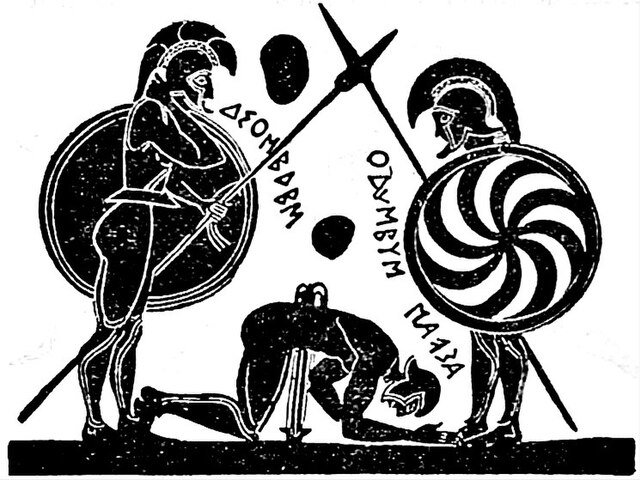
IMAGE Credit: Wikimedia: Painting from an ancient Corinthian vase. Ajax falls on his sword in the presence of his colleagues, Odysseus and Diomedes. The short stature of Odysseus is a well-known Homeric feature. These vases are black-figured; the heroes are painted in silhouette on the red ground of the vases. Their names are appended in archaic Greek letters. Artist from ancient Corinth; public domain; between circa 800 and circa 480 B.C.; drawing published 1911.
(c) Lou Agosta, PhD and the Chicago Empathy Project

A short talk on trauma and radical empathy
Without pretending to do justice to the vast research on “trauma,” it is variously defined as an event that threatens the person’s life and limb, making the individual feel he or she is going to die or be gravely injured (which would include rape). The blue roadside signs here in the USA that guide the ambulance to the “Trauma Center” (emergency department that has staff on call 7×24), suggest an emergency, usually but not always, a physical injury.
Cathy Caruth (1996) concisely defines trauma in terms of an experience that is registered but not experienced, a truth or reality that is not available to the survivor as a standard experience. The person (for example) was factually, objectively present when the head on collision occurred, but, even if the person has memories, and would acknowledge the event, paradoxically, the person does not presently experience it as something the person experienced in a way that a person standardly experienced the past event. The survivor experiences dissociated, repetitive nightmares, flashbacks, and depersonalization.

[Image credit (WIkimedia): Printmaker: Image: Prometheus being “traumatized” by the Vulture as punishment for giving the gift of fire to humanity (“mankind”): Cornelis Cortnaar Antwerp van: Titiaan (publisher of object), verlener van privilege: onbekend (vermeld op object)
Plate published: Rome
Date: 1566]
Strictly speaking, the challenge is not only that the would-be empathizer was not with the surviving Other when the survivor experienced the life-threatening trauma, but the survivor was physically present yet did not have the experience in such a way as to experience it. That may sound strange that the survivor did not experience the experience. Once again, one searches for words to capture an experience one did not experience. That is Caruth’s (1996) definition of “unclaimed” experience.
At the risk of oversimplification, Caruth’s work aligns with that of Bessel van der Kolk (2014). Van der Kolk emphasizes an account of trauma that redescribes in neuro-cognitive terms an event that gets registered in the body—burned into the neurons, so to speak, but remains sequestered—split off or quarantined— from the person’s everyday going on being and ordinary sense of self. The self is supposed to be a coherent unity—another example of a regulative idea—but a component of the self is split off due to a hypothetical, unknown traumatic cause. For both Caruth and van der Kolk, the survivor is suffering from an unintegrated experience of self-annihilating magnitude for which the treatment—whether working through, witnessing, or (note well) artistic engagement—consists in reintegrating that which was split off because it was simply too much to bear.
This artistic engagement with trauma has been described as “writing trauma,” for example, by Dominick LaCapra:
Trauma indicates a shattering break or caesura in experience which has belated effects. Writing trauma would be one of those telling after-effects in what I termed traumatic and post-traumatic writing (or signifying practice in general). It involves processes of acting out, working over, and to some extent working through in analyzing and ‘giving voice’ to [it] [. . . ]—processes of coming to terms with traumatic ‘experiences’, limit events, and their symptomatic effects that achieve articulation in different combinations and hybridized forms. Writing trauma is often seen in terms of enacting it, which may at times be equated with acting (or playing) it out in performative discourse or artistic practice (LaCapra 2001: 186–187).
Without intending to do so, LaCapra has unwittingly described Beloved (1987) (see Chapter 11), where the infant of the infanticide is literally reincarnated, reborn, in the person named “Beloved.” For LaCapra, working through such traumatic events is necessary for the survivors (and the entire community) in order to get their power back over their lives and open up the possibility of a future of flourishing. This “working through” is key for it excludes denial, repression, suppression, and, in contrast, advocates for positive inquiry into the possibility of transformation in the service of life. Yet the attempt at working through of the experiences, memories, nightmares, and consequences of such traumatic events often result in repetition, acting out, and, LaCapra’s key term, “empathic unsettlement.”
Such unsettlement is a challenge and an obstacle for the witness, therapist, or friend providing a gracious and generous listening. From a place of safety and security, the survivor has to do precisely that which she or he is least inclined to do—engage with the trauma, talk about it, try to integrate and overcome it. According to LaCapra, the empathic unsettlement points to the possibility that the vicarious experience of the trauma on the part of the witness leaves the witness unwilling to complete the working through, lest it “betray” the survivor, invalidate the survivor’s suffering or accomplishment in surviving.
Those traumatized by extreme events as well as those empathizing with them, may resist working through because of what might almost be termed a fidelity to trauma, a feeling that one must somehow keep faith with it” (LaCapra 2001: 22).
This “unsettlement” is a way that empathy breaks down, misfires, goes off the rails, resulting in empathic distress (Hoffman 2000). “Keeping faith with trauma” means the trauma itself has become an uncomfortable comfort zone. Extreme situations require extreme methods to engage and break up the emotional tangle.
Thus, according to Ruth Leys (2000), the traumatic events are “performed” in being written up as history or made the subject of a literary artwork. But the words, however authentic, true, or artistic, often seem inadequate, even fake. The “trauma” as brought forth as a distinction in language is ultimately inadequate to the pain and suffering that the survivor has endured, which “pain and suffering” are honored with the title of “the real” (as Kant might say). For Leys, the distinction “trauma” itself is inherently unstable oscillating between historical trauma—what really happened, which, however, is hard if not impossible to access accurately—and, paradoxically, literary language bearing witness by a failure of witnessing.
Moral trauma adds a challenging twist to what is traumatic about trauma. What is little recognized is that many survivors are also perpetrators (and vice versa). The survivor may also unwittingly (or even intentionally) become a perpetrator. The incarcerated prisoner of conscience steals a piece of bread from another prisoner, or to save his own life, falsely accuses another. One wants to say: This is tragic in the strict sense. Oedipus, Phaedra, Medea, practically the whole House of Atrius, are all both survivors and perpetrators.
Moral trauma is defined as the distressing emotional, behavioral, social, and sometimes spiritual aftermath of exposure to (including participation in) events in which a person’s moral boundaries are violated and in which individuals or groups are gravely injured, killed, or credible threat thereof is enacted (i.e., individuals are physically traumatized) (Litz et al 2009; see also Shay 2014). Examples of moral trauma include such things as being put in a situation where “I will kill you if you do not kill this person.” Generalizing on the latter example, the list includes morally fraught instances of double binds, valid military orders that result in unintentional harm to innocent people, situations in which survivors become perpetrators (and vice versa), soul murder (defined as killing the possibility of empathy and/or killing the possibility of possibility), and the Trolley Car Dilemma (Anonymous Wikipedia Content 2012, Foot 1967, Thomson 1976; see Chapter 11, Section: “The Trolley Car Dilemma and empathy”). In moral trauma people become both perpetrators and survivors, and such an outcome is characteristic of many (though not all) moral traumas.
Here radical empathy comes into its own. A person is asked to make a decision that no one should have to make. A person is asked to make a decision that no one is able to make—and yet the person makes the decision anyway, even if the person does nothing, because doing nothing is making a decision. A person is asked to make a decision that no one is entitled to make, which include most decisions about who should live or die (or be gravely injured). The result is moral trauma—the person is both a perpetrator and a survivor. Now empathize with that. No one said it would be easy.
Hence, the need for radical empathy. Extreme situations—that threaten death or dismemberment—call forth radical empathy. Standard empathy is challenged by extreme situations out of remote, hard-to-grasp experiences to become radical empathy.
The treatment or therapy consists of the survivor re-experiencing the trauma vicariously from a place of safety, an empathic space of acceptance and tolerance. In doing so the trauma starts losing its power and when it returns, it does so with less force, eventually becoming a distant unhappy and painful but not overwhelming memory.
For further reading, see van der Kolk 2014; LaCapra 2001; Leys 2000; Caruth 1995, 1996; Scarry 1985, Freud 1920.) See also Agosta (2025) Radical Empathy in the Context of Literature, Chapter 11, Sections: “The Trolley Car Dilemma and empathy” and “The four horsemen arrive.”
References
Lou Agosta. (2025). Radical Empathy in the Context of Literature, Chapter 11, Sections: “The Trolley Car Dilemma and empathy” and “The four horsemen arrive.” New York: Palgrave.
Anonymous Wikipedia Content. (2012). Trolley problem (The trolley dilemma). Wikipedia: https://en.wikipedia.org/wiki/Trolley_problem [checked 2023-06-25]
Cathy Caruth. (1996). Unclaimed Experience: Trauma, Narrative, and History. Baltimore: John Hopkins.
Philippa Foot. (1967). The problem of abortion and the doctrine of the double effect. Oxford Review, No. 5. In Foot, 1977/2002, Virtues and Vices and Other Essays in Moral Philosophy. Oxford: Oxford UP, 2002: 19–32. DOI:10.1093/0199252866.001.0001.
Sigmund Freud. (1920). Beyond the Pleasure Principle. The Standard Edition, Vol 18, New York and London: W.W. Norton: 1–64.
Martin L. Hoffman. (2000). Empathy and Moral Development: Implications for Caring and Justice. Cambridge, UK: Cambridge UP.
Dominick LaCapra. (2001). Writing History, Writing Trauma. Baltimore: John Hopkins.
Ruth Leys. (2000). Trauma: A Genealogy. Chicago: University of Chicago Press.
B. T. Litz et al Moral injury and moral repair in war veterans: a preliminary model and intervention strategy. Clin Psychol Rev. 2009 Dec;29(8):695-706. doi: 10.1016/j.cpr.2009.07.003. Epub 2009 Jul 29. PMID: 19683376.
Elaine Scarry. (1985). The Body in Pain: The Making and Unmaking of the World. Oxford: Oxford UP.
J. Shay, (2014). Moral injury. Psychoanalytic Psychology, 31(2), 182-191. https://doi.org/10.1037/a0036090
Judith Jarvis Thomson. (1976). Killing, letting die, and the trolley problem, The Monist, vol. 59: 204–217.
Bessel van der Kolk. (2014). The Body Keeps the Score. New York: Viking Press.
(c) Lou Agosta, PhD, and The Chicago Empathy Project

Noted in passing: Anna Ornstein (1927-2025)
Anna Ornstein, MD, psychiatrist, and psychoanalytic Self Psychologist, is remembered and honored as a Holocaust survivor, having been incarcerated in Auschwitz with her mother in 1944 when the Germans invaded Hungary. Her experiences are narrated in her book, My Mother’s Eyes: Holocaust Memories of Young Girl (2004). Both survived. Anna Ornstein passed away at her home in Brookline, MA at the age of 98 on July 3, 2025 after a rich, challenging, and dynamic life.
Trying to say anything about such searing experiences is perhaps foolish, yet Ornstein’s next major contribution provides the tool to do so in so far as it can be attempted at all. Ornstein is remembered and honored for making empathy central in her clinical practice of psychoanalytic psychotherapy and in her writings on the Self Psychology (more on which shortly). One of the things that empathy teaches us humans is to try to bring words to one’s experiences, no matter how challenging the experiences; try to find words to push back the boundaries of the inexpressible, that which is not to be comprehended. Cognitive understanding should never be underestimated; yet at times cognition is illusive and overrated whereas communication is not, empathy is not, family is not, community is not.

Image / photo credit: Dr. Ornstein in 2018, speaking to high school students in Massachusetts. Credit. Matthew J. Lee/The Boston Globe, via Getty Images
Though starting as a collection of anecdotes and narratives of survival, the title, My Mother’s Eyes, takes the account up a level. As a 17-year-old teenager, incarcerated with her mother and allowed to be together, the survival value of being able to change perspectives – the folk definition of empathy – was critical path to surviving the rigors – the horrors – of death camp life. Even under very challenging circumstances, people are able to support one another emotional regulation by literally being there for another as a comforting presence. The relationship in this extreme situation prefigures the notion of self object, making use of the other person mutually to regulate one another’s emotions. It is the other’s presence that, with a nod to D. W. Winnicott, provides a grounding in the radical possibility of going on being.
This essay is in the nature of an intellectual biography and personal anecdote, rather than an obituary proper. For those interested in how Anna née Brünn met Paul Ornstein and become Anna Ornstein, how all three of their children became psychiatrists, the New York Times articles provides the personal details and a happy, though by no means simple, ending to the catastrophe of the Holocaust and World War II.[1]
On a personal note, my path and that of Anna Ornstein intersected with what can best be described as an existential encounter in 2009. Something called “Self Psychology” was disrupting classic psychoanalysis and innovating around the constraints of Freudian ego psychology. The Self Psychology Conference was in Chicago that year (2009, the full title “International Assoc for Psychoanalytic Self Psychology”).[2] In any case, there were many high points to the Conference including Dr. Arnold Goldberg’s presentation and those of other Self Psychology innovators such as Ernest Wolf, Anna and Paul Ornstein, the Kohut Memorial Lecture, the many spirited exchanges.
The highest of the high points of the Conference came for me in having a one-on-one conversation with Anna Ornstein. There she was between presentations, and I introduced myself as working on a book about empathy, which did indeed get her attention. In a naïve, misguided attempt on my part to establish common ground, I mentioned that I had attended the lectures at the UChicago on the life of the mind by the political theorist Hannah Arendt. I also quoted Arendt to the effect that since the consequences of our human actions escape us, Jesus of Nazareth had innovated in the matter of forgiveness. Star struck, what was I thinking? This was clumsy and naïve on my part, and it got a reaction which was perhaps more than I had bargained for. In the course of the conversation, Ornstein took my hand animatedly and held it as she was making her point, basically that Arendt had gotten matters wrong, very wrong. When I say “took my hand,” I mean she grabbed it and shook it back and forth, not exactly like shaking hands, but like she would wrestle me to the ground. To be sure, it was good natured enough, but intense. The take-away? I got to hold hands with Anna Ornstein! Notwithstanding my clumsiness, that was special. I cherish the encounter.
Now in a short piece such as this, doing justice to Anna Ornstein’s innovations in self psychology (the method not the label), especially the treatment of children, is no simple task. People want to read about tips and technique, and many are available. However, context is required.
On background, Heinz Kohut, MD, was the innovator who put self psychology and empathy on the map starting in the early 1970s (though see Kohut 1959). Kohut was cautious about defining the self formally, implicitly characterizing the self as a comparative experience—a near experience psychoanalytic abstraction, that is central to all human experience since it contains the person’s nuclear ambitions and ideals which are amalgamated to the sense of continuity (Winnicott’s “going on being”), the well-being and cohesion of (our) body and mind (Ornstein 1976: 29ftnt).
Thus, the self oscillates dynamically between ideals and coherence, both of which are needed for a sense of aliveness, vitality, and an actual ability to be productive in contributing to community and relationships with others. Kohut’s (1959) definition of empathy as “vicarious introspection” adds significantly to the folk definition of taking a walk in the other person’s shoes, the better to appreciate the other’s struggles and successes as the person experiences them. (For further on Kohut’s innovation see the book (and chapter devoted to Kohut) to which I referred in my conversation with Ornstein in our encounter (Agosta 2010).)
While firmly founded in Freudian dynamics, Self Psychology called out how parenting environments that delivered unreliable empathy – not total lack of empathy, but unreliable, hit-or-miss empathy – resulted in structural deficits in self-esteem, self-confidence, productivity, feelings of emptiness, lack of aliveness and vitality, in children as well as the adults into which they grow. This was a deficit model rather than – or in addition to – a conflict model. Instead of conflicts between the conscience (superego) and sexual and aggressive drives, something was missing that left the person’s personality at a disadvantage in the face of which the person compensated with arrogance, superiority, coldness, withdrawal, empty depression (rather than melancholia), and poor productivity and superficial relations.
When the self experiences narcissistic injuries – did not get the dignity, respect, empathy – to which it was entitled or felt entitled (eventually a key distinction, but not at this point), then aggressive and sexually fragmented behavior was the result. In short, maladaptive sexual behavior and hostility are reactions to a stressed-out self rather than primary instinctual drives. So if you encounter a person who is enraged, ask yourself, who hurt that person’s feelings? Who did not give her or him the dignity, respect, empathy, they feel they deserve? Thus, self psychology does not so much reject Freud’s approach as re-describe and incorporate it.
Thus the New York Times article is accurate enough when it writes “Dr. Kohut disagreed with Freud’s theory that personality disorders were rooted in the unconscious mind, driven by guilt, sex and aggression” (Gabriel 2025), provided that one takes “rooted” and “unconscious” in the proper sense. In that sense, the dynamics of Freudian pathology becomes a special case of a fragmented self that has not received the empathy, which, as Kohut famously said, is oxygen for the soul: “The child that is to survive psychologically is born into an empathic-responsive human milieu [. . .] just as he [or she] is born into an atmosphere that contains an optimal amount of oxygen” (Kohut 1977: 85; see also 253). Just as the body goes into rapid decline and arrest without oxygen, so to the human psyche (the Greek word for soul) struggles and cannot sustain itself outside of a context of empathic relations at least somewhere in its life.
For example, the classic Freudian family drama of the child (son) who wants to “kill” the father and “marry” the mother, is redescribed as aggressive and sexual fragments of a self that has experienced unreliable empathy and been the recipient of seductive behavior on the part of the mother and aggressive (defensive) behavior on the part of the father. (For the inverse scenario of father daughter, which deserves attention, too, see Kulish and Holtzman 2008, which, strictly speaking is not self psychology but inspired thereby). In a healthy family dynamic, the father welcomes the young son’s competitiveness, knowing that he (the father) is not threatened by the youngster’s competitiveness. It is only when the father is himself insecure and narcissistically vulnerable that he retaliates punitively, giving way to a reactive hatred on the part of the offspring that Freud projected back into the primal scene as the death drive. For Kohut and Ornstein, aggression and hatred are not primary drives, as with Freud’s death drive, but aggressive and hatred live as reactions to failure of empathy, dignity, and respect. Likewise, the mother welcomes the young boy’s affection and ineffective childish romancing, knowing that the childish behavior is not a serious sexual advance. It is only when the mother, unsecure in herself and her own sexuality, behaves seductively towards the youngster that over arousal of sexuality, over stimulation, boundary issues, family drama, and emotional dis-equilibrium are risked. In the inverse scenario, the father welcomes the young daughter’s affection and childish romancing, appreciating and delighting in the child’s development and growth. This is not a serious seduction – unless the father has unresolved issues. When the father is insecure in his own sexuality and responds seductively to the pretend seduction that the risk of over arousal and real and imaginary boundary violation can occur. The complicating factor in the daughter-mother relationship is that the daughter needs the mother to take care of her – unlike with the son where the hostility between father and son is a purer example of competition – as well as wanting to replace her, resulting in an ongoing ambivalence and competitiveness that is not mirrored in the son’s simple desire to “cancel” the father.
Now shift this conversation in the direction of adult empathy with children, which happens to be the title of a famous article by Christine Olden (1956). When one is in the presence of a child, whether of tender age or teenager, one is present to, aware of, one’s own fate as a child. And since one’s own fate may have little or nothing to do with that which this particular child in this pace and time is experiencing and struggling, that is precisely the point at which expanding the parents’ empathy is on the critical path.
“The parent’s ability to become therapeutic may not have always been optimally utilized in the treatment of children. This is in large part due to a rather pervasive attitude among mental health professionals in which the parents are usually considered at fault, primarily for lacking sensitivity relative to their children’s developmental needs. Anger and depreciation for having failed their children precludes any effort on the therapist’s part to understand the reasons why the parents may not have been able to develop empathic capacities. The explanation for this can usually be found in the parents’ own backgrounds. In addition to the parent’s original difficulties to be in empathic tune with the child, the child’s current difficulties create guilt, anger, and disappointment in the parent(s) which further interfere with whatever parental empathy may have otherwise been available” (Ornstein 1976: 18).
In an example of what not to do, Ornstein cites the following case, in which the empathy toward both parent and child is conspicuous by its absence:
“A young mother had regularly taken her 6-yr-old son to bed with her after the sudden death of her husband. When the boy became enuretic she visited the clinic and was told that the boy had to get out of her bed-since this was the cause of his problem. The mother followed through on the recommendation which meant nightly tearful battles with the child. However, since her own affective state was not “treated,” she could not remove him from her bed without ambivalence. The enuresis continued, and in addition, mother and son became increasingly more irritable with each other. As the mother’s depression deepened, the child developed further symptoms; he had become provocative and inattentive at school” (Ornstein 1976; 18).
Given we have an example of what not to do, what is the recommendation of what one should do in this case? As Ornstein explains (1976: 18), recognize and acknowledge the mother’s grief for her husband and the longing for closeness with the boy. You do not have to lie back on a coach to talk about it, but one might consider doing so! The ability to tolerate the separation between mother and son may usefully have been expanded by a gradual, phased introduction of the separate sleeping arrangements. Having agreed to letting the boy in, summarily throwing him out is surely asking for trouble; yet the co-sleeping cannot continue. Don’t forget that applying common sense parenting is consistent with advanced training and credentials. Many parents have an in-bed “cuddle time” with children of tender age, including a bedtime story, prior to each retiring to his or her own respective nest. “Story time” – whether read or from life – is one possible empathic moment between parent and child in the context of an empathic relationship as the adventures and stresses of the day are empathic quiesced in a narrative before the passive overcoming of going to sleep.
By the way, in the world of behavioral interventions, wise parents know to set the clock for a 2 am trip to “go number one,” which will reduce the stress on child and parent, enabling them to address the underlying issues of loss and separation in a calmer, even if not stress free, context of relatedness.
Often when a therapist meets a family, the family is not on a slippery slope, they are at the bottom of it. The narcissistic slights, emotional injuries, blind spots, shame, guilt, boundary issues, and grievances present a tangle that represents a challenge even to the most astute and empathic therapist. People are motivated to reduce the suffering and struggle, and empathy includes many ways to de-escalate conflict. Ornstein points out:
“To enhance the parents’ therapeutic potentials does not mean to give recommendations as to how to interrupt or actively discourage the child’s disturbing behavior. Particularly destructive are recommendations which ask for changed parental behavior without an appreciation for the parents’ difficulty to comply; such recommendations are “grafted” onto the parents’ pathology. Finding themselves unable to follow the therapist’s recommendations, they become more guilty and less able to effect changes in themselves in relation to the child” (Ornstein 1976: 18).
In the world of tips and techniques, Ornstein did not say “treat the parent; the child gets better”; make bedtime stories an empathic encounter for children of tender age; get inside the world of the child for whom the tooth fairy and boogeyman are real, setting boundaries and soothing in tandem; but she strongly implied them (nor is that the complete solution since the child, too, requires treatment (1976: 18)). One can try and force an outcome; but it is not going to stick; and framing boundary setting in an empathic milieu of acceptance has a much greater probability of producing a positive outcome. This report is acknowledged to be incomplete and further reading can be found in the References.
One caveat must also be offered. It is the same world of limited empathy and human success and suffering today (Q3 2025) as when Anna Ornstein published her innovative work in 1976. However, ours is also a different world. Empathy is a key ingredient, and indeed the foundation, of individual well-being, mental health, and flourishing communities. Yet ours is a world in which we have gone from a President Obama who considered empathy a criterion for appointment to the US Supreme Court to one whose billionaire friends (or “frenemies”) consider empathy a defect of civilization. Empathy and its power should never be underestimated. Never. However, one has to be empathic in a context of acceptance and toleration. It does not work to make oneself empathically vulnerable in the presence of bullies, concentration camp guards, or wanton aggression. This is obvious, but a reminder is useful that in such predicaments empathy sets boundaries, defines limits, pushes back, and, if politically possible without getting deported, speaks truth to power using rhetorical empathy (which is not much engaged in therapeutic or psychiatric circles). Carrying forward the work of Anna Ornstein? An example of rhetorical empathy? “No human being is illegal.” However, that starts a new thread – an empathic one.
References
Lou Agosta. (2010). Chapter Six: Empathy as vicarious introspection in psychoanalysis. In Empathy in the Context of Philosophy, by Lou Agosta. London: Palgrave Macmillan.
Trip Gabriel (July 4, 2025), Anna Ornstein, Psychoanalyst who survived the Holocaust, dies at 98 New York Times obituary: https://www.nytimes.com/2025/07/04/health/anna-ornstein-dead.html?unlocked_article_code=1.Vk8.dfZz.8YyxtXebGoP1&smid=url-share
Heinz Kohut. (1959). Introspection, empathy, and psychoanalysis: An examination of the relationship between mode of observation and theory. Journal of the American Psychoanalytic Association, 7, 459–483. https://doi.org/10.1177/000306515900700304
Heinz Kohut. (1977). Restoration of the Self. New York: International Universities Press.
Nancy Kulish and Deanna Holtzman. (2008). A Story of Her Own: The Female Oedipus Complex Reexamined and Renamed. Lanham: Jason Aronson.
Olden, C. (1953). On Adult Empathy with Children. The Psychoanalytic Study of the Child, 8(1), 111–126. https://doi.org/10.1080/00797308.1953.11822764
Anna Ornstein. (2004). My Mother’s Eyes: Holocaust Memories of a Young Girl. Cincinnati, OH: Clarisy Press.
Anna Ornstein. (1976). Making contact with the inner world of the child. Toward a theory of psychoanalytic psychotherapy with children. Comprehensive Psychiatry. 1976 Jan-Feb;17(1):3-36. doi: 10.1016/0010-440x(76)90054-7. PMID: 1248241.
Sam Roberts. (Jan 31, 2017). Paul Ornstein, psychoanalyst and Holocaust survivor, dies. New York Times obituary: https://www.nytimes.com/2017/01/31/us/paul-ornstein-dead-self-psychologist.html
[1] Trip Gabriel (July 4, 2025), Anna Ornstein, Psychoanalyst who survived the Holocaust, dies at 98 New York Times obituary: https://www.nytimes.com/2025/07/04/health/anna-ornstein-dead.html?unlocked_article_code=1.Vk8.dfZz.8YyxtXebGoP1&smid=url-share
[2] I have found the “splash page” for the International Association of Psychoanalytic Self Psychology (IAPSP) Conference of 2009 in my archives (though not the complete program) whereas Google’s Artificial Intelligence bot says there was no such conference. In addition, I was there.
Image / photo credit: Dr. Ornstein in 2018, speaking to high school students in Massachusetts. Credit. Matthew J. Lee/The Boston Globe, via Getty Images
(c) Lou Agosta, PhD and the Chicago Empathy Project

The empathic dozen: Top 12 empathy lessons
Listen to this post as a podcast on Spotify –
(0) The one-minute empathy training. Drive out aggression, hostility, bullying, prejudice of all kinds, dignity violations, hypocrisy, making excuses, finger pointing, cynicism, resignation, bad language, manipulation, injuries to self-esteem, competing to be the biggest victim, and politics in the pejorative sense of the term, and empathy naturally comes forth. Most people are naturally empathic and, if given half a chance, they will spontaneously and willingly speak and act empathically. The training can be spoken in one minute. However, actually implementing it is going to take some work. Start here:
(1) Are you willing? Perform a readiness assessment: The first step of a readiness assessment is one must be willing. If one has the willingness, then the hard work begins of listening, taking the Other’s perspective, giving up being right and righteous, giving up being aggrieved, making requests, asking for what one needs. As soon as one announces a commitment (for example): “I am going to expand empathy in my life,” then all the reasons that it is utterly impossible to do so show up. “What are you thinkin’ fella?” Not enough time. Not enough money. Not enough empathy!
Resistance to empathy does not mean that one fails the readiness assessment to expand one’s empathy. It means that one is a human being. The fact that a person is looking at this blog post is itself a positive sign that one is ready. Do not set the bar too high (at least at the start); but recognize that it is going to take something extra to expand one’s empathy. People have blind spots about empathy. People have blind spots, period.
The work needed to overcome these blind spots results in “a rigorous and critical empathy.” Therefore, note that throughout this blog post when the term “empathy” is used it is as an abbreviation for “a rigorous and critical empathy.”
When it comes to doing the work required actually to listen and respond empathically to Others, people make exceptions for themselves. A person fails the readiness test for empathy without work up front to clean up the person’s own inauthenticities. The tough thing is that the inauthenticities are not limited just to empathy. Being willing to clean up one’s authenticities is precisely the empathy lesson. This is different than taking the easy way out—this can be “empathy the hard way.” The readiness for empathy requires doing the hard work required to create a clearing for empathic success, a clearing of integrity and authenticity. This leads immediately to the next recommendation.
(2) Establish and maintain firm boundaries between the self and Other in relating empathically, but practice being inclusive: Empathy is all about boundaries. Empathy is all about moving across the boundary between self and Other. The boundary is not a wall, but a semi-permeable membrane that allows communication of feelings, thoughts, intentions, and so on. As noted above, the poet Robert Frost asserts that good fences make good neighbors. But fences are not walls. Fences have gates in them. Over the gate is inscribed the word “empathy,” which invites visits across the boundary.
Some of the most empathic people that I know are also the strongest and most assertive regarding respect for boundaries. Being empathic does not mean being a push over. You wouldn’t want to mess with them. Where such people show up, empathy lives; and shame, cynicism, and bullying have no place. In what is one of the defining parables of Christian community (that of the Parable of the Good Samaritan), empathy is what enables the Samaritan to be open to a vicarious experience of what the survivor of the assault is experiencing; and then it is the Samaritan’s compassion and ethics that tell him what to do about it. The two are distinct. Empathy tells us what the Other experiencing; compassion (and our good moral upbringing) tell(s) us what to do about it. Yet empathy expands the boundary of who is one’s neighbor to be more-and-more inclusive, extending especially to those whose humanity has been put at risk by misfortune. Be inclusive.
(3) Empathy deescalates anger and rage: When people do not get the empathy to which they feel entitled, they start to suffocate emotionally. They thrash about emotionally. Then they get enraged. The response? De-escalate rage by explicitly acknowledging the break down—“It seems you really have not been treated well.” Clean up the misunderstanding, and restore the empathic relatedness. Empathy does many things well. One of the best is that empathy deescalates anger and rage.
Without empathy, people lose the feeling of being alive. They tend to “act out”—misbehave—in an attempt to regain the feeling of vitality that they have lost. Absent an empathic environment, people lose the feeling that life has meaning. When people lose the feelings of meaning, vitality, aliveness, dignity, their emotions become unbalanced. When the emotions become unbalanced, their behavior does so too and goes “off the rails.” Sometime pain and suffering seem better than emptiness and meaninglessness—but not by much. People then can behave in self-defeating ways in a misguided attempt to awaken a sense of aliveness and regain emotional balance.
This is a re-description of bullying, which requires a word of caution. One should never underestimate the power of empathy. Never, Yet affective empathy does not work with bullying in so far as being empathic leaves the person who provides the empathy vulnerable. The bully (and a small set of disturbed individuals with anti-social personality disorder) will take one’s vulnerability and use it the would-be empathizer. Instead the recommendation (as in (2) above) is to set limits, establish boundaries, speak truth to power (in so far as bullying is an abuse of power), and defend one’s integrity. What does work in the face of bullying is “top down,” cognitive empathy. Think like one’s opponent. Take a walk in the Other’s shoes in order to reestablish the possibility of conflict resolution, de-escalation, and, if push comes to shove, mounting an effective defense. (On “thinking like one’s opponent in war and peace and business, see Zenko (2015) in the references below.)
“Empathy is oxygen for the soul” is a metaphor. But a telling one. When people do not get empathy—and a short list of related things such as dignity, common courtesy, respect, fairness, humanity—they feel that they are suffocating—emotionally. People act out in self-defeating ways in order to get back a sense of emotional stability, wholeness and well-being—and, of course, acting out in self-defeating ways is self-defeating. (For further on empathy as oxygen for the soul see Kohut (1977).) One requires expanded empathy. Pause for breath, take a deep one, hold it in briefly while counting to four, exhale, listen, speak from possibility.
(4) Avoid the risk of the banality of empathy by thinking before speaking and taking action. This phrase, “the banality of empathy,” is a reference to Namwali Serpall’s (2019) “spin” on Hannah Arendt. Hannah Arendt’s lovely phrase “one trains one’s imagination to go visiting [the Other]” is an exact description of empathic understanding, though not empathic receptivity of the Other’s feelings/emotions. One does not blindly adopt the Other’s point of view—one takes off one’s own shoes before trying on the Other’s. “Enlarged thinking” takes the points of view of many Others, and is what enables people to judge by means of feelings as well as concepts. This is not loss of one’s self in projection and merger, but rather a thoughtful shifting of perspective and appreciation of what shows up as one does so. It is a false splitting to force a choice between feeling and thinking—both are required to have a complete experience of the Other.
A recurring theme in Arendt’s thinking is that evil and is a consequence of thoughtlessness. If one empathizes thoughtlessly, if one applies empathy without thinking, the banality of empathy, then the result may be unpredictable. One is not going to like the result. One is at risk of empathy misfiring as projection, emotional contagion, conformity, and so on. Just so. Do not be a sloppy thinker. A rigorous and critical empathy is required to guard against these risks, and a rigorous and critical empathy thinks before speaking and taking action.
One can always make a splash by throwing a rotten tomato, and dumping on empathy has become something of a growth industry. However, these devaluing treatments of the acknowledged strengths and limitations of empathy are directed at a strawman, a caricature of empathy, fake empathy, not the rigorous and critical empathy engaged here. For a complete detailed answer to many of these sensationalist pot boilers, see Chapter Three: Empathy and its discontents of my Radical Empathy in the Context of Literature (Palgrave Macmillan 2025 (and you should have the college, university or local library order a copy (as it is an academic book and they have budget for these types of works)).
(4) Avoid the risk of the banality of empathy by thinking before speaking and taking action. This phrase, “the banality of empathy,” is a reference to Namwali Serpall’s (2019) “spin” on Hannah Arendt. Hannah Arendt’s lovely phrase “one trains one’s imagination to go visiting [the Other]” is an exact description of empathic understanding, though not empathic receptivity of the Other’s feelings/emotions. One does not blindly adopt the Other’s point of view—one takes off one’s own shoes before trying on the Other’s. “Enlarged thinking” takes the points of view of many Others, and is what enables people to judge by means of feelings as well as concepts. This is not loss of one’s self in projection and merger, but rather a thoughtful shifting of perspective and appreciation of what shows up as one does so. It is a false splitting to force a choice between feeling and thinking—both are required to have a complete experience of the Other.
A recurring theme in Arendt’s thinking is that evil and is a consequence of thoughtlessness. If one empathizes thoughtlessly, if one applies empathy without thinking, the banality of empathy, then the result may be unpredictable. One is not going to like the result. One is at risk of empathy misfiring as projection, emotional contagion, conformity, and so on. Just so. Do not be a sloppy thinker. A rigorous and critical empathy is required to guard against these risks, and a rigorous and critical empathy thinks before speaking and taking action.
One can always make a splash by throwing a rotten tomato, and dumping on empathy has become something of a growth industry. However, these devaluing treatments of the acknowledged strengths and limitations of empathy are directed at a strawman, a caricature of empathy, not the rigorous and critical empathy engaged here. For a complete detailed answer to many of these sensationalist pot boilers, see Chapter Three: Empathy and its discontents of my Radical Empathy in the Context of Literature (Palgrave Macmillan 2025 (and you should have the college, university or local library order a copy (as it is an academic book and they have budget for these types of works)).
(5) Empathy is a method of data gathering about the other person: Simply stated, empathic receptivity is a technique of data collection about the experiences of other people. This is not mental telepathy. Human beings are receptive to one another, open to one another experientially, but with some conditions and qualifications. You have to listen to the other person and talk with him or her. You have to interact with the person. The one individual gets a sample of the experience of the other individual. The one individual gets a trace of the other individual’s experience (like in data sampling) without merging with the Other.
Through its four phases, empathy is a method of gathering data about the experience of the person as the other individual experiences what the individual is experiencing. This data (starting with (1) vicarious experience) is processed by (2) empathic understanding of possibilities and (3) empathic interpretation of perspectives in order to give back to the other person his or her own experience by means of (4) empathic responsiveness in language or gesture in such a way that the other person recognizes the experience as the person’s own.
The neurological basis of this empathic receptivity may be mirror neurons or another associative network of neurons that function to support an affective (emotional) resonance that higher mammals share with one another. Even if mirror neurons were to turn out to be a myth, the disclosive truth would still be that human beings are all related. We resonate together and must exert effort not to do so.
This approach to empathy (empathy as a method of data gathering) goes a long way towards solving the problems of compassion fatigue and burnout among nurses, teachers, doctors, care-takers, first responders, clergy, and so on. As noted, in empathy, if one is listening to another person and that person is suffering, then, strange as it may sound, one should suffer—but not too much. One suffers only a little bit, one suffers vicariously. The empathizer is open to the suffering of the other person but only as a sample of the suffering, a trace affect. This is a vicarious experience, not a shared experience, which would provide the full, overwhelming weight of the suffering.
If one is experiencing compassion fatigue, then one may have made one of the most common empathy mix ups of confusing “empathy” with “compassion.” The language provides a clue. The complaint is not “empathy fatigue.” The complaint is “compassion fatigue.” The recommendation is to turn down one’s compassion and tune up one’s empathy.
Now, as noted repeatedly, the world needs both more compassion and expanded empathy; but what is perhaps needed the most is a working balance between the two. One needs to increase the granularity (filtering) of one’s openness to the other person. Instead of empathically sampling one in five emotional upsets vicariously, one may try sampling one in ten, until one regains one’s own emotional equilibrium. Yes, one suffers, vicariously, but if suffering emotionally flattens one as one is giving empathy, one is doing it incorrectly. One is over-empathizing and over-identifying. One needs to regulate—in this case, “tune down”—one’s receptivity to the other person. This is easier said than done, of course, which is why empathy lessons are needed. Taking the matter of “tuning up or down” up a level, it deserves a technique of its own. Thus, the next item.
(6) Empathy is a tuner or dial, not an “on-off” switch: Engaging with the issues and sufferings with which people are struggling can leave the would-be empathizer (“empath”) vulnerable to burnout and “compassion fatigue.” As noted, the risk of compassion fatigue is a clue that empathy is distinct from compassion, and if one is suffering from compassion fatigue, then one’s would-be practice of empathy is off the rails, in breakdown. Maybe one is being too compassionate instead of practicing empathy. In empathy, the listener gets a vicarious experience of the Other’s issue or problem, including their suffering, so the listener suffers vicariously, but without being flooded and overwhelmed by the Other’s experience.
Empathy is like a dial or dimmer—tune it up or tune it down. If one is overwhelmed by suffering as one listens to the other person’s struggles and predicaments, one is doing it—practicing empathy—incorrectly, clumsily, and one needs skills training in empathy. The whole point of a vicarious experience—and training one’s vicarious experiences as distinct from merger or over-identification—is to get a sample or trace of the Other’s experience without being inundated by it. One needs to increase the granularity of one’s empathic receptivity to reduce the emotional or experiential “load.”
Empathy is also like a filter—decrease the granularity and get more of the Other’s experience or increase the granularity (i.e., close the pores) and get less. The power in distinguishing empathic receptivity from empathic understanding, interpretation, and responsiveness, is precisely so one can divide and conquer in the practice and performance of empathy lessons. Each has a characteristic breakdown, and each can be improved with practice and attention to the relevant dials that influence the process of relating.[i]
The recommendation? Listen, pause for breath to a count of four, acknowledge the pain and suffering, interpret the resistance, and continue applying conflict resolution principles—identify and express grievances, invite self-expression, elicit requests, offer suggestions, make demands, formulate interpretations, propose compromises, brain-storm alternative possibilities, commit to action items, apply the soothing salve of empathy to the narcissistic injuries of the participants, and iterate—until resolution.
(7) Decline the choice between empathy and compassion. Decline the artificial choice between expanding empathy and fighting and reducing the empire of prejudice, imperialism, the pathologies of capitalism, and violence. Some have tried to force a choice between compassion and empathy. This is a choice that must be refused. The world needs both more compassion and expanded empathy. In summary, it is not a choice between expanding empathy and ending/reducing empire, and an engagement with both is needed. Survivors of all of these boundary violations ask for empathy. When survivors are asked, “What do you want—what would make it better? What would soothe the trauma?” then rarely do they say punish the perpetrator (though occasionally they do). Mostly they ask for acknowledgement, to be heard and believed, to hear the truth about what happened, for apology, accountability, restitution, rehabilitation, prevention of further wrong (see Herman 2023).[ii] Rarely do survivors make forgiveness a goal, especially not if forgiveness would require further interaction with the perpetrator (though self-forgiveness should not be dismissed). It bears repeating: survivors ask for empathy, not an end to empire, though, once again, both expanded empathy and an end to empire are needed.
(8) Empathy is the new love: Empathy is love by other means; and love is empathy by other means. Even a distinction with as much history, tradition, and gravitas as “love,” undergoes developments and transformations. For example, you know how in high fashion gray is the new black? Well, empathy is the new love. It is what people really want—to feel heard—to be heard—to be “gotten” as the possibility they authentically know themselves to be.
People want to be gotten for who they authentically are. They want empathy. What about the old love? According to folk wisdom, love is “blind” (in this case, that would be the “old love”); and, furthermore, love is compared (by Socrates, Plato, and many others) to a state of madness. So far, the old love resembles the symptoms of tertiary, neuro-syphilis. Of course, empathy is famous for its diverse breakdowns too—as emotional contagion, conformity, projection, and mistranslation. However, when these break downs of empathy are engaged, worked through, and transformed, then the results are precisely breakthroughs in empathy, enabling satisfying relationships and the building of community. When love is “worked through,” the result is the routinization of desire, “washin’ dishes and dirty diapers,” as documented in the song “Makin’ Whoopee,” in which “Whoopee” expresses the how romantic idealization gets de-idealized in the hard work of sustaining family life.
This is not to privilege empathy or “dump on love,” since both love and empathy are essential to community, but to assess each one in its respective strengths are limitations. Empathy is what people fundamentally desire—to be gotten for who they authentically are. When one person’s desire aims at the other person’s desire, then desire begets desire. The desire of the Other’s desire is precisely the empathic moment.
(9) Empathy is multi-dimensional: Empathy is the process of grasping first-hand what the other person is experiencing because one experiences it too. This often seems to be an instantaneous process in which one just “gets it”—knows first person and first-hand what is happening with the other person. But other times the process shows up as a more extended, time-dilated one of a sustained listening, through which the other person’s life and experiences come gradually into view as empathic receptivity—a kind of vicarious experience of the person.
The person is flourishing or stuck, in possibility or upset, and one realizes that one is relating, not only to the static state in which the person finds herself, but also to the aspirations, ideals, hopes, fears—in short, to the possibilities that the person is confronting and projecting as plans and ambitions going forward into the future.
Empathic understanding is understanding of possibilities. These possibilities are not something hidden from the person; on the contrary, the person knows intimately about them; the possibilities determine who the person is presently being in living into the future; but sometimes there are indeed hidden and undeclared possibilities to which the person is deeply committed and of which the person is only marginally aware.
For example, think of the friend who had been married (and divorced) three times. He was attempting to shock me with his lack of commitment in relationships, and was surprised to hear me respond: “Well, you are really committed to marriage.” The possibility of marriage gets unpacked in an empathic interpretation such that the marriages seemed to him to be a duck, but the now former spouses thought they were a rabbit, resulting, as one says, in irreconcilable perceptions if not “irreconcilable differences.” In context, my response about his commitment seems to have been an empathic enough one that validated his experience of the value of marriage, while acknowledging his struggle, upset, and frustration. It opened up whole new possibilities for him going forward in relating to his former spouses, to the institution of marriage, and, mostly, to himself.
Thus, empathy is a roundtrip from the vicarious experience of empathic receptivity; to the grasping of possibilities in empathic understanding; to the making explicit of diverse possibilities in empathic interpretation; to empathic responsiveness, delivering over to the other person his experience in such a way that he recognizes it as his own experience.
(10) Each phase of empathy has characteristic breakdowns: Break throughs in empathy arise from working through the breakdowns of empathy. Empathic receptivity breaks down into emotional contagion, suggestibility, and being over-stimulated by the inbound communication of the other person’s strong feelings. If one stops in the analysis of empathy with the mere communication of feelings, then empathy collapses into emotional contagion.
If one takes emotional contagion—basically the communication of emotions, feelings, affects, and experiences—as input to further empathic processing, then emotional contagion (communicability of affect) makes a contribution to empathic understanding.
A vicarious experience of emotion differs from emotional contagion in that one knows that the other person is the source of the emotion. That makes all the difference. I feel anxious or sad or high spirits, because I am with another person who is having such an experience, and I “pick it up” from him. I can then process the vicarious experience, unpacking it for what is so and what is possible in the relationship. This returns empathy to the positive path of empathic understanding, making possible a breakthrough in “getting” what the other person is experiencing. Then the one person can contribute to the other person regulating and mastering the experience.
Or instead of empathic understanding grasping possibility for flourishing and relatedness, empathic understanding can break down in conformity. Humans live and flourish in possibilities; and empathic understanding breaks down as “no possibility,” “stuckness,” and the suffering of “no exit” (one definition of hell in a famous play of the same name by Sartre). One follows the crowd; one does what “one does”; one validates feelings and attitudes according to what “they say”; and, with apologies to Thoreau, lives the life of “quiet desperation” of the “modern mass of men.”
Almost inevitably, when someone is stuck, experiencing shame, guilt, upset, emotional disequilibrium, and so on, the person is fooling himself—has a blind spot—about what is possible. This does not mean that it is easy to be in the person’s situation or for the person to see what is missing. Far from it. But we live in possibilities that we allow to define our constraints and limitations—for example, see the above-cited friend who was married and divorced three times. At the risk of being simple-minded, dear friend, have you considered the alternative—cohabitation? Though this might not be a “silver bullet,” it points to a breakthrough in empathic understanding. If one acknowledges that the things that get in the way of our relatedness are the very rules we make up about our relationships and what is possible within them, then we get freedom to relate to the rules and possibilities precisely as possibilities, not absolute “shoulds.” We stop “shoulding” on ourselves.
For example, if cohabitation is considered unacceptable due to personal or community standards, then let’s have a conversation for possibility about that (and so on). This brings us to the next break down—the break down in empathic interpretation.
This is the aspect of empathy that corresponds most exactly to the folk definition of empathy—taking a walk in the other person’s shoes. But in the breakdown of empathic interpretation, one takes that walk with one’s own foot size. This is also called “projection.” One has to take off one’s own shoes before trying on the Other’s. Now that can sometimes tell you something useful, because human beings have many things in common; but most times—and especially with most of the tough cases—empathy is going to run off the path. Imaginatively elaborating the metaphor, the other person is literally flat footed, whereas I have a high arch on my foot; the other person is an amputee, a “blade runner” with a high-tech prosthesis—a different kind of “feet.” I am a “duck” and have webbed, duck feet; the other person is a “rabbit” and has furry, rabbit feet.
The recommendation? Own your projections. Take back the attributions of your own inner conflicts onto other people. One gets one’s power back along with one’s projections. Stop making up meaning about what is going on with the other person; or, since one probably cannot stop, at least distinguish the meaning—split it off, quarantine it, take distance from it, so that its influence is limited. Absent a sustained conversation with the other person, be humble that you have any idea what is going on with the other person.
Having worked through vicarious experiences, possibilities for overcoming conformity and stuckness, and taken back one’s projections, one is ready to attempt to communicate to the other person one’s sense of their experience. One is going to try to say to the other what one gets from what they told you, giving back to the other one’s sense of their experience. And what happens? Sometimes it works; but other times something gets “lost in translation.”
The breakdown of empathic response occurs within language as one fails to express oneself satisfactorily. I believed that I empathized perfectly with the other person’s struggle and effort, but (in this example) I failed completely to communicate to the other person what I got from listening to her. My empathy remains a tree in the forest that falls without anyone being there. My empathy remains silent, inarticulate, uncommunicative. I get credit for a nice empathic try (assuming that I really have tried); but the relatedness between the persons is not an empathic one. If the other person is willing, then go back to the start and iterate. Learn from one’s mistakes. Try again.
The fact that one failed does not mean that the commitment to empathy is any less strong; just that one did not succeed this time; and one needs to keep trying. It takes practice. Empathy lessons are useful. The exchange in questions was one of them. Learn from one’s mistakes.
Often understanding emerges out of misunderstanding. What I say is clumsy and creates a misunderstanding (in a given context). But when the misunderstanding is clarified and cleaned up, then empathy occurs. Thus, break throughs in empathy emerge out of breakdowns. So whenever a breakdown in empathy shows up, do not be discouraged; rather be glad, for a break through is near.
(11) Train and develop empathy by overcoming the obstacles to empathy: People want to know: Can empathy be taught? People complain and authentically struggle: I just don’t get it—or have it. In spite of the substantial affirmative evidence that empathy can be taught, is being taught (e.g., see NYU Langone Health: http://www.empathyproject.com (2014/2024)), the debate continues. The short answer is: Yes, empathy can be taught.
What happens is that people are taught to suppress their empathy. People are taught to conform, follow instructions, and do as they are told. We are taught in first grade to sit in our seats and raise our hands to be called on and speak. And there is nothing wrong with that. It is good and useful at the time. No one is saying, “Leap up and run around yelling” (unless it is summer vacation!). But compliance and conformity are trending; and arguably the pendulum has swung too far from the empathy required for communities to work effectively for everyone, not just the elite and privileged at the top of the food chain.
Now do not misunderstand this: people are born empathic, but they are also born needing to learn manners, respect for boundaries, and toilet training. Put the mess in the designated place or the community suffers from diseases. People also need to learn how to read and do math and communicate in writing. But there is a genuine sense in which learning to conform and follow all the rules does not expand our empathy or our community. It does not help the cause of expanded empathy that rule-making and the drumbeat of compliance are growing by leaps and bounds.
If people can be taught to contract their empathy, they can be taught to expand it. That means that the gains in expanding community that are owed to compliance and conformity, for the most part, stay as they are—empathy expands. How so?
Teaching empathy consists in overcoming the obstacles to empathy that people have acquired. When the barriers are overcome, then empathy spontaneously develops, grows, comes forth, and expands. That is the training minus all the hard work.
The hard work? Remove the blocks to empathy such as dignity violations, devaluing language, gossip, shame, guilt, egocentrism, over-identification, lack of integrity, inauthenticity, hypocrisy, making excuses, finger pointing, jealousy, envy, put downs, being righteous, stress, burnout, compassion fatigue, cynicism, denial, competing to be the biggest victim, injuries to self-esteem, and narcissistic merger—and empathy spontaneously expands, develops, and blossoms. (I hasten to add, in general, there is nothing wrong with narcissistic merger; it is just not empathy.)
Formal, in-school education is generally designed to instill conformity, especially in the earlier grades, into what is hoped to be a productive, compliant corporate and industrial workforce, not instill empathy.
That is changing. Thanks to powerful programs such as Mary Gordon’s empathy initiative, “The Roots of Empathy,” but it is still too soon to predict the outcome.[i] Now I am in favor of education and learning reading, math, and writing. I am in favor of history and the humanities and the Physical Sciences too. However, the Arts and the Humanities—the disciplines that are arguably those committed to expanding empathy—are “on the ropes” due to chronic budget cuts. It is hard to connect the dots, which is what is required by the administrators, between studying literature or philosophy and high paying jobs in the global digital economy. The idea that education is an end in itself, teaching the graduate to learn to learn, and enabling the graduate to adapt to a volatile employment market, in which it is hard to predict what jobs are hot, is an enduringly valid idea, but not one with much traction. The Humanities are precisely the disciplines that include empathy lessons in narrative, literature, history, performance, and self-expression in diverse media.
Studying the Humanities and literature, art and music, rhetoric and languages, opens up areas of the brain that map directly to empathy and powerfully activate empathy. Read a novel. Write a story. Go to the art museum. Participate in theatre. These too are empathy lessons, fieldwork, and training in empathic receptivity. [iv]
Reduce or eliminate the need for having the right answer all the time. Dialing down narcissism, egocentrism, entitlement (in the narrow sense), and dialing up questioning, motivating relatedness, encouraging self-expression, inspiring inquiry and contribution, developing character, and, well, expanding empathy.
Yes, empathy can be taught, but it does not look like informational education. It looks like shifting the person’s relatedness to self and Others, developing the capacity for empathy, accessing the grain of empathy that has survived the education to conformity. Anything that gets a person in touch with her or his humanness counts as training in empathy.
(12) There is enough empathy to go around, even though it does not seem that way on most days—why is that? You know how agriculture can grow enough food to feed everyone on the planet but people are still starving, because of the use of food by politics in the negative sense to perpetrate hostility and bad actions? Enough empathy is available to go around; but it is badly distributed. People are living and working in empathy deserts. Organizational politics, stress and burnout, attempts to control and dominate, egocentrism and narcissism, out-and-out aggression and greed, all result in empathy getting hoarded locally, creating “empathy deserts” even amid an adequate supply. Therefore, this approach does not call for “more” empathy, but rather for “expanded” empathy. The difference is subtle. Saying “We need more empathy here!” implies the person is unempathic—and that is an insult, a dignity violation. In extreme cases, a person may in fact lack empathy in a formal, technical sense—the serial killer, the psychopath, and persons suffering from some particular mental illnesses (or even a case of flu). However, such persons are an exception or an exceptional situation that will pass. Well, it is the same thing with empathy. This results in the one-minute empathy training as indicated at the start of this post. Back to the top.
For further top empathy tips and techniques see the Chapter, “Conclusion: Top 40 Empathy Lessons” in Empathy Lessons, 2nd Edition, Chicago: Two Pears Press, 2024.
End Notes
[i] This point is missed in the otherwise engaging and spirited public debate featured in the New York Times, still relevant after all these years, in which Jamil Zaki identifies empathy with compassion, and—how shall I put it delicately?—a conversation of deaf persons occurs between celebrity academics about the importance of listening. See Jamil Zaki, (2016), Does empathy help or hinder moral action? The New York Times, Dec. 29, 2016: http://tinyurl.com/gwmfpxp [checked on 06/26/2025]. Great minds think alike? It should be noted that, when not trying to “cap the rap” in the Times, Zaki (and Ciskara) (2015) provide a penetrating and incisive analysis of the value of “trying harder” to be empathic in the context of the kinds of empathic breakdowns under discussion in this work. My take? If one works at it, “tries harder,” one discovers that empathy expands.
[ii] Judith L. Herman, MD. (2023). Truth and Repair: How Trauma Survivors Envision Justice. New York: Basic Books.
[iii] Gordon, Mary. (2005). The Roots of Empathy: Changing the World Child by Child. New York/Toronto: The Experiment (Thomas Allen Publishers).
[iv] Madeline Levine. (2012). Teach Your Children Well: Why Values and Coping Skills Matter More than Grades, Trophies, or ‘Fat Envelopes’. New York: Harper Perennial. I acknowledge Paul Holinger, MD, for calling my attention to this one.
References
Lou Agosta. (2025). Chapter Three: Empathy and its discontents. In Radical Empathy in the Context of Literature. New York: Palgrave Macmillan. This is a pricey academic book, but readable, so have the college, university or local library order a copy. They have budget for this kind of work.
Lou Agosta. (2024). Empathy Lessons, 2nd Edition. Chicago: Two Pears Press.
Judith L. Herman, MD. (2023). Truth and Repair: How Trauma Survivors Envision Justice. New York: Basic Books.
Heinz Kohut. (1977), The Restoration of the Self, International Universities Press.
Namwali Serpall. (2019). The banality of empathy. The New York Review: https://www.nybooks.com/online/2019/03/02/the-banality-of-empathy/[checked on June 26, 2025]
NYU Langone Health. (2014/2024). http://www.empathyproject.com
Zaki, Jamil and Mina Ciskara. (2015). Addressing empathic failures, Current Directions in Psych-ological Science, December 2015, Vol. 24, No. 6: 471–476. DOI: 10.1177/0963721415599978.
Zaki, Jamil. (2016). Does empathy help or hinder moral action, The New York Times, December 29, 2016: http://tinyurl.com/gwmfpxp [checked on 01/06/20
Zenko, Micah. (2015). Red Team: How to Succeed by Thinking Like the Enemy. New York: Basic Books.
(c) Lou Agosta, PhD and The Chicago Empathy Project

Suicidal empathy is now a podcast
One can always make a splash by throwing a rotten tomato, and those who throw one at empathy get a chance to gather Internet clicks by saying something shocking, even if it is of questionable accuracy. However, what about seriously engaging this thought literally as a debating point – is empathy a defect of western civilization dooming us to suicide and/or suicidal species extinction? As an exercise in thinking, consider the pros and cons.
Listen to this blogpost as a podcast on A Rumor of Empathy with Lou Agosta –
You know how modern agriculture can grow enough food to feed everyone on the planet thanks to the “Green Revolution” and high yield seeds, but people are still starving, because of the use of food by politicians and politics in the pejorative sense to perpetrate hostility, aggression, and bad actions? Likewise with empathy: Enough empathy is available to go around; but it is badly distributed. People are living and working in empathy deserts. Organizational politics, stress and burnout, attempts to control and dominate, egocentrism and narcissism, out-and-out aggression and greed, all result in empathy getting hoarded locally, creating “empathy deserts” even amid an adequate supply. Therefore, this approach does not call for “more” empathy, but rather for “expanded” empathy. The difference is subtle.
Indeed the one minute empathy training consists in driving out hostility, aggression, bullying, bad language, prejudice, politics in the pejorative sense, a long list of negative behaviors, and empathy naturally and spontaneously comes forth. The majority of people want to be empathic, and, given half a chance, will behave empathically. Does this mean would-be empaths and empathically motivated people have become suicidal?
The short version of suicidal empathy is as follows. We are in a lifeboat which is filled to the maximum after our ship sank. In the water, treading water, surrounding the lifeboat are additional survivors and other leaky lifeboats about to sink, leaving the survivors treading water. If the survivors in the lifeboat are empathic and take in the other survivors, then the lifeboat stil afloat will be swamped and we will all drown. The conclusion is that in such extreme situations, which are more common than one might imagine, then empathy needs to be turned off – or at least dialed down significantly – lest we all perish.
This thought experiment of the lifeboat and its extreme situation has received renewed attention as Elon Musk has notoriously said that empathy is a weakness of western civilization.
[On background, for Musk’s sound bite about empathy being a weakness, see: https://youtube.com/shorts/LWvOvgjNEds?si=GByQLE0yoFDyWtTr ). To be fair, Musk does not invoke the lifeboat scenario in the quoted statements; however, Musk and his would-be supporters have expounded at greater length on behavior in extremis as reported in the following CNN article, in which a simplified version of evolutionary psychology (not necessarily Musk’s) as the survival of the fittest, plays a leading role https://www.cnn.com/2025/03/05/politics/elon-musk-rogan-interview-empathy-doge/index.html By the way, regarding Musk’s comment, empathy advocates are telling me, there is no such thing as bad press coverage, and you can’t get publicity like this at any price. It is almost as good as having your books banned by the Catholic Church!]
Like most thought experiments, the lifeboat scenario is an intuition pump designed to stimulate debate about a difficult and controversial subject, in this case, empathy in circumstances of scarcity, trauma, compromised agency, and extreme situations.
On background, the original formulation of the lifeboat situation is due to ecologist Garrett Hardin (1974) whose idea of “spaceship earth” envisions the rich and poor nations as being in a life-or-death struggle against one another for limited resources. That Hardin was an anti-immigration Nativist in a nation of immigrants is problematic (and he is called out by the Southern Poverty Law Project as giving support to white supremacist hate groups[1]); but his many personal limitations do not necessarily mean his thought-experiment of lifeboat ethics is without merit. We engage it as a thought-experiment on its own merits.
The key idea of Hardin’s thought experiment is that each nation is a lifeboat. Nations such as the USA are solid, water tight, and well off. Others such as the South Sudan, Burundi, Central African Republic and Bangladesh are sinking (in the case of Bangladesh, literally so) or at least leaking badly. In the water surrounding the lifeboat(s), there already are a lot of people treading water (think: refugees fleeing hunger and murderous gangs in South America) – and this number is growing. Therefore, Hardin’s argument goes, it behooves the well-off nations to establish strong borders that keep would-be refugees from the leaky boats from overwhelming the still water tight boats in order to prevent swamping us all. According to this scenario of “lifeboat ethics,” empathy is a luxury we cannot afford. Similar statements would be made about compassion, kindness, generosity, and, presumably, most of the teachings regarding neighborliness of Jesus of Nazareth, Confucius, and Buddha – not affordable in our extreme situation.
Now to engage with the strongest version of lifeboat ethics requires a scenario in which there really is a situation of extreme scarcity. For the sake of argument, though scarcity is not inevitable, let us suppose that it is indeed inevitable. Let us accept the flawed presupposition that spaceship earth has resources which are so limited that extreme measures and hard-heartedness are required.
Accepting the assumption of scarcity, the argument in favor of lifeboat ethics rejects the possibility that human beings have managed to survive on the planet by using their cognitive capabilities, innovating out of predicaments, by thinking about the consequences of their actions, optimizing those consequences, and finding ways of doing more with less. Here the limitations of the lifeboat dilemma as a thought experiment come into view. The ecological authorities who propose the thought experiment rule out every initiative and innovation to lessen the pain and suffering of the participants in the lifeboat scenario, whether in the boat or the water, thereby eliminating (or greatly reducing) the agency of those who would act empathically or who are willing to limit their own narrow self-interest.
For example, if it is proposed that the people in the lifeboat throw the swimmers their own life vests or life preservers (think: foreign aid), thereby increasing the chances of survival, the authorities rule there are not enough life vests.
If it is proposed that the people in the boats pull on the oars to circle the boats, tie the boats together to build a sort of pier, and use canvas to create a platform to support other survivors (think: the United Nations), there are no oars or canvas or rope or the seas are too rough.
If it is proposed that some good Samaritans in the lifeboat volunteer to treat the lifeboat as a “time share” into and out of which individuals rotate out of the water for a while and then back in, the better to survive (think: foreign guest worker program), the authorities rule the water is so cold as to make such sharing unworkable.
If it is proposed that the occupants in the lifeboat, pass the survivors in the water a thermos of hot medicinal tea (think: Doctors Without Borders), thereby delaying hypothermia, the authorities rule there is no such thermos.
If it proposed to implement a flotation device by tying the ends of one’s trousers together, capturing the air, and wrapping it around one’s shoulders (think: the peace corps), then the authorities rule that the fabric is too thin or torn.
If, after the people in the water have died of hypothermia or been killed by sharks, the people in the lifeboat can live for hundreds of days on sea turtles, raw fish, and rain water (think: micro lending), but only if they have a fishing line and a piece of canvas to catch the rain. The sea is a vast source of protein and can sustain many lifeboats, given a fishing line and a piece of putty to plug the leaks. The authorizes rule all that out, too. In short, the agency required to imagine and implement an empathic act or even a useful, life sustaining one, is cancelled by the steady drum-beat (and counter argument) of “not enough,” “not enough,” and more “not enough”.
This is why tragedy – the art form – was invented. Life presents contingent circumstance that constrain one’s agency, limit one’s choices, and make one both a survivor and a perpetrator (if one survives). As thinkers of the lifeboat dilemma, we are put into a double-bind. If one acts inclusively, thoughtlessly pulling people into the already overcrowded lifeboat, then everyone ends up in the water (and eventually under water). If one acts to repel any attempt to get into the lifeboat, then one enacts violence against those trying, perhaps legitimately to self-rescue, and one behaves hard-heartedly. One becomes a perpetrator, causing others to die. One is caught between the rock and hard place; literally, in this case, between the devil and the deep blue sea. That is the definition of moral trauma. Now empathize with that!
The people trying to climb into the lifeboat, who get pushed down, experience physical trauma as they drown. The people already in the boat who push down the otherwise innocent would-be survivors for whom there is no room in the boat, experience moral trauma. Whatever happens, their souls are damaged. The result is empathic distress, including forms of compassion fatigue, guilt, loss of self-respect, and burnout, one and all professional risks of the helping professions. Whether one gives into despair (or a hard-hearted “realism”) and becomes a survivalist, stock-piling canned goods, ammo, and guns, is a further point of debate. In addition to empathic distress, standard empathy confronts obstacles of emotional contagion, projection, conformity, and communications lost in translation.
Yet even in the face of lifeboat ethics, empathy remains indispensable. How so? If one is in a lifeboat one is by definition a survivor. Your ship sank! That is a necessary part of the definition of a lifeboat. You were cast into the vast, seemingly boundless sea. Never underestimate the importance of empathy for those in extremis, but even more than empathy, the occupants of the lifeboat need rescue. To be in a lifeboat and not need rescue is a contradiction in terms, blowing up the whole scenario and sending it back to the drawing board. This exposes the entire lifeboat scenario as a manipulation and mechanism for constraining, compromising, and denying agency to the participants in the dilemma. However, let us take the scenario at face value – help is not coming!
Meanwhile, awaiting rescue, one is at risk of becoming a perpetrator, albeit unwittingly, if one defends the lifeboat against those trying to climb into it by pushing them back down into the water. People are going to drown. In most tragic literature, the protagonist is both a survivor and a perpetrator.
For example, the Greek hero Oedipus was exposed as an infant to die, abandoned by his biological parents, who feared the prophecy of his murdering his father. He is rescued by a shepherd and goes on unwittingly to kill his biological father in a dispute as he (Oedipus) tries to avoid the fated prophecy, and, leaves the home of his foster parents (not realizing they have fostered him). Likewise, the people in the lifeboat are both survivors and perpetrators, the latter as they have to take violent action to defend their boat against the desperate swimmers who would occupy it.
Two wrong do not make a right, and there is no excuse for bad behavior. However, the people in the lifeboat are asked to make choices – life and death decisions – that no one is entitled to make, that no one should have to make, indeed that no one can make with integrity, yet that they make anyway and in any case, since doing nothing is also a choice. The point is not to marshal excuses – since there are none adequate to life and death – but to note that standard empathy is challenged in the face of moral trauma to become radical – to become radical empathy.
Empathy itself requires innovation. The proposal is that the lifeboat dilemma calls for and calls forth radical empathy. Radical empathy leverages the imagination to find a way forward in the face of tragic circumstances. Radical empathy is committed to empathizing in the face of empathic distress to solve the given dilemma through imagination variations when and where it is possible to do so; to comfort the survivors when there are any; and when there are no survivors by bearing witness to the tragic struggle where the outcome is a tragic one.
Empathy, whether standard or radical, has a direct answer to lifeboat ethics and those about to be cast into a lifeboat. The answer is: “Women and children first.” If that happens to be your own spouse and children, then so much the better. However, save someone; and while I cannot say what I action I would take in such an extreme situation, presumably one should be ready to surrender one’s place in the boat. That is the empathic moment and the answer to hard-hearted proposals to throw the weak overboard. Children are the future and, unless they survive, species extinction is the outcome, and species extinction is a completely different thought experiment, not relevant here. This is the empathic answer.
In the face of a thought-experiment such as lifeboat ethics, designed to take away one’s power and agency in the face of contingencies, the problem – how to allocate resources empathically in the face of extreme scarcity – cannot be directly solved. Rather the problem must be refuted. The setup of the experiment contains a flawed presupposition. Fundamentally flawed! The experiment makes it sound like scarcity is unavoidable. This is factually, scientifically, and indeed historically inaccurate.
Scarcity (let us consider the example of starvation) is occurring on our planet, in war zones, and even in the inner-city community in which I live, but not because of lack of food. Starvation is occurring because food is being used as a weapon of domination, including prejudice, aggression and war. There is enough food to go around (as will be easily demonstrated in the next paragraph) but hostile and oligarchical powers (governments) are withholding it from those who have been designated as “the enemy,” including civilian populations. A noncontroversial if no less gut-wrenching example was the Nigerian-Biafran Civil War (1967 – 1970), with examples of children near death with swollen belies due to malnourishment. This was due to armed military blockade not crop failures. Such withholding would, of course, be the contrary of empathic (or even decent!) behavior.
On background, spaceship earth (to use Hardin’s incisive term) has vastly more resources than a life boat and, therefore, vastly expanded opportunities for imaginative innovation. To stay with the example of feeding people, the development of Cyrus McCormick’s combine-wheat-reaper, and the follow-on agribusiness technology, allow some 2% of the population to grow enough food to feed the entire planet; and this in spite of the fact that human choices made under aggression continue to use food as a weapon of starvation. Prior to the Green Revolution, the other 98% of the population had to work twelve to sixteen hours a day to grow enough food to avoid a slow, agonizing death by starvation. Arguably, these people were historically in the lifeboat dilemma; and their behavior often showed it (which, of course, is not excuse for bad behavior as two wrongs do not make a right).
On further background, Norman Borloug’s (1914–2009) innovations in seeds and plants improved agricultural yields by integral factors, leading food experts to estimate his innovations saved over a billion people from starvation, earning Borloug the Nobel Peace Prize and the US Presidential Medal of Freedom. Lots of wars have been fought over land – land also used to grow food. Garrett Hardin lived long enough to know about this (“Green Revolution”), but his commitment to anti-immigration politics apparently created a blind spot, preventing him from engaging.
Therefore, the approach of lifeboat ethics is based on a fallacy that the situation of scarcity is an unavoidable one – an inevitable continency. On the contrary, scarcity is being manufactured by bad actors, bad politics, and out-and-out human aggression. As such, the scarcity can and should be undone by actors with better (including empathic) motives in order to restore the community to a benchmark standard human functioning. This is consistent with natural disasters creating local calamities that cause scarcity. It is also consistent with disagreements about what constitutes an emergency. However, the point is to send in emergency services and the national guard to deliver or air drop palettes of drinkable water, canvas for tents, and provisions, not to shoot the survivors as a burden to the community (the latter following the logic of the lifeboat to its absurd conclusion).
Returning to the basic metaphor, empathy is no more to blame for overloading the lifeboat than carpentry is to blame for the fact that Roman soldiers used hammer and nails to execute condemned criminal and political enemies by crucifying them. Without practice, empathy can go astray as emotional contagion, projection, conformity, and communications lost in translation. Being generous to a fault or suicide have never been a requirement for empathy. Never. With practice, a rigorous and critical empathy sets boundaries, establishes limits, and creates a whole that is more than the sum of its parts.
A rigorous and critical empathy belongs to a short list of things such as dignity, respect, compassion, neighborliness, and forms of spiritual love, and are not quantifiable as zero-sum phenomena. For example, if I give you a slice of my chocolate cake, I have less cake. However, if I give you empathy, by giving you a good listening, we both have expanded empathy. Empathy is non additive – and so non subtractive. humanizing encounter in which my own humanity is enriched in contributing to another person. A rigorous and critical empathy is not quantifiable like chocolate cake. Granted that our topic is difficult and significant, we can enjoy lighter moment – there is enough food to go around, but definitely not enough chocolate cake! Like food, there is enough empathy to go around, but it does not seem that way, because we have not been effective in driving out the obstacles to empathy such as aggression, hostility, bullying, and politics in the pejorative sense.
As Lord Acton famously said, “Power corrupts and absolute power corrupts absolutely.” Granted, that corrupt leaders lacking integrity engage in abuses of power, is not new news. That super rich individuals and corporations form corrupt alliances with powerful politicians lacking integrity is called a lot of things – “oligarchy” is defined as the rule of the rich for the benefit of the rich; and “fascism” is defined as the rule of a military industrial complex pulling the strings of politicians at the expense of individuals and their well-being as citizens and their liberties. A new trail of tears comes forth based on fear and intimidation.
The political authorities argue, the current situation is an emergency, an invasion, a crisis that requires setting aside the rule of law. An early version of capitalism that rejects win-win participation and business innovation is privileged over creating a clearing for a rising tide, which raises all boats (to continue to riff on the lifeboat theme with a slogan from Ronald Regean). It is hard not to get cynical. Setting aside the rule of law – what? – so that the President can accept $400 million gifts from a foreign power in direct violation of the US Constitution. Granted this is a single example, it speaks volumes. A strange emergency indeed!
In the face of this, empathy proposes to speak truth to power. Changing the metaphor: while bureaucracy may need to be trimmed back from time to time, like forest management that burns the underbrush with a controlled burn, less it spawns an even bigger forest fire that burns down the nearby city, we are now seeing an uncontrolled burn. Entire departments serving the citizens are summarily laid waste jeopardizing emergency responses to tornadoes, national security, scientific innovation, foreign aid to allies and would-be friends, basic education, and business entrepreneurship. Key term: uncontrolled burn (credit to Garret Smith for calling my attention to this). It has happened that a controlled burn of the forest under brush got out of hand and resulted in a major forest fire. This is a description of the so-called Department of Government Efficiency’s (Doge’s) approach to cost cutting. Uncontrolled burn. My take – who else’s would it be? – is that the cost cutting “wizards” are undertaking an uncontrolled burn. Think: slash and burn.
What Musk (hereafter “M”), Stephen Miller (Deputy White House Chief of Staff) and John Vought do not point out is that empathy does not work with bullies or abusers, who will take whatever vulnerability you may exhibit and use it against you. This is also the case with anti-social personality disorder – individuals with a defective conscience who struggle to tell right from wrong, though without interviewing M, one has no way of knowing M’s or any individual’s mental status. One possibility is that the individual is projecting his own unreliable, defective empathy onto the community as an empathic defect. Many of those who lack empathy are hungry for it. If ever there was a disqualifying statement by a would-be administrator or leader, M’s soundbite is it. However, a further agenda lurks nearby.
Presumably a statement that “empathy is a weakness” would be a justification of the unempathic “slash and burn” bullying methods of the unelected puppet masters at Doge [pronounce: “dog”], the so-called US Department of Government of Efficiency, showing up at the IRS and Social Security offices and so on and demanding to see confidential citizen data and/or seemingly randomly sending employees home (“firing” them).
In the face of bullying, a critical and rigorous empathy sets limits, establishes boundaries, pushes back against attempts to control, dominate, and manipulate, and speaks truth to power. One must not overlook the power of top down, cognitive empathy in thinking like one’s opponent in order to overcome him. “Top down,” cognitive empathy is detailed in Mikah Zeno’s Red Team! (Basic Books 2015) according to which taking a walk in the other’s shoes (the folk definition of empathy) provides advantages in relationships, business, politics, and building communities that are thrive on cooperation, communication, coordination, and inclusiveness. If one were looking for a short disqualifying reason to sideline unelected puppet masters such as M and fellow traveller Stephen Miller (see more on him on the South Poverty Law Project’s report on racism and anti-immigration hate groups), this is it. I leave it to the reader to figure out who is the puppet.
When the imagination is constrained to rule out every option except the narrowest, strictest self-interest, then the result is a scenario in which pain and suffering are going to be widespread and people are going to get hurt. Even those who do not suffer physical trauma will face confrontation with moral trauma. People are starting to wonder if, given the lifeboat scenario, they might indeed be better off in having gone down with the ship. However, this is not caused by (or the fault of) empathy – it is due to lack of imagination. If we human beings were not empathic (and compassionate, generous, kind), then we would not experience conflict, distress, trauma, in short, the breakdown of standard empathy in the face of empathic distress and the requirement for radical empathy. Now we will never know for sure whether Garrett Hardin was overcome by empathic distress or suffered from a clinical depression or both; however, it is a generally accepted fact that Hardin ended his own life by suicide. The first documented case of suicidal empathy?
We conclude with a positive proposal, on which I have repeatedly written and published: Teach critical thinking. This is the empathic educational moment. Absent a rigorous and critical practice of empathy, I am cautious about engaging current political clichés in a highly polarized political world and “rhetoric” in the negative sense.
Critical thinking includes putting oneself in the place of one’s opponent—not necessarily to agree with the other individual—but to consider what advantages and disadvantages are included in the opponent’s position. Taking a walk in the Other’s shoes after having taken off one’s own (to avoid the risk of projection) shows one where the shoe pinches. This “pinching” —to stay with the metaphor—is not mere knowledge but a basic inquiry into what the Other considers possible based on how the Other’s world is disclosed experientially. That is what we have attempted to do here by engaging with the most rigorous version of the lifeboat dilemma, instead of a strawman. Critical thinking is a possibility pump designed to get people to start again listening to one another, allowing the empathic receptivity (listening) to come forth.
In our day and age of fake news, deep fake identity theft, not to mention common political propaganda, one arguably needs a course in critical thinking (e.g., Mill 1859; Haber 2020) to distinguish fact and fiction. Nevertheless, I boldly assert that most people, not suffering from delusional disorder or political pathologies of being The True Believer (Hoffer 1953)), are generally able to make this distinction.
A rigorous and critical empathy creates a safe zone of acceptance and tolerance within which people can inquire into what is possible—debate and listen to a wide spectrum of ideas, positions, feelings, and expressions out of which new possibilities can come forth. For example, empathy and critical thinking support maintaining firm boundaries and limits against actors who would misuse social media to amplify and distort communications. Much of what Jürgen Habermas (1984) says about the communicative distortions in mass media, television, and film applies with a multiplicative effect to the problematic, if not toxic, politics occurring on the Internet and social networking.
The extension to issues of politics, climate change, and community struggles follows immediately. Insofar as individuals skeptical of empathy are trying to force a decision between critical thinking and empathy, the choice must be declined. Both empathy and critical thinking are needed; hence, a rigorous and critical empathy is included in the definition of enlarged, critical thinking (and vice versa). (Note that “critical thinking” can mean a lot of things. Here key references include John Stuart Mill 1859; Haber 2020; “enlarged thinking” in Kant 1791/93 (AA 159); Arendt 1968: 9; Habermas 1984; Agosta 2024, 2025.)
In conclusion, a positive alternative to abandoning facts and skipping critical thinking is suggested by Bob Dylan’s song about empathy. One has to push off the shore of certainty and venture forth into the unknown. We give Dylan the last word (1965: 185): “I wish that for just one time / You could stand inside my shoes / And just for that one moment / I could be you” [.]
References
Lou Agosta. (2024). Empathy Lessons. 2nd Edition. Chicago: Two Pears Press.
__________. (2025). Radical Empathy in the Context of Literature. Palgrave Macmillan.
Hannah Arendt. (1952/1958). The Origins of Totalitarianism, 2nd Edition. Cleveland and New York: Meridian (World) Publishing, 1958.
________________. (1968). Men in Dark Times. New York: Harvest Book (Harcourt Brace).
Lisa Blankenship. (2019). Changing the Subject: A Theory of Rhetorical Empathy. Logan UT:
Bob Dylan. (1965). Bob Dylan: The Lyrics: 1961–2012. New York: Simon and Schuster.
Garrett Hardin. (1974). Commentary: Living on a Lifeboat. BioScience, Volume 24, Issue 10, October 1974, Pages 561–568, https://doi.org/10.2307/1296629
Jonathan Haber. (2020). Critical Thinking. Cambridge, MA: The MIT Press.
Jürgen Habermas. (1984). The Theory of Communicative Action,Vol 1, Thomas McCarthy (tr.). Boston: Beacon Press.
Eric Hoffer. (1953). The True Believe: Thoughts on the Nature of Mass Movements. New York: Harper Perennial.
Immanuel Kant. (1791/93). Critique of the Power of Judgment, Paul Guyer and Eric Matthews (trs.). Cambridge: Cambridge UP, 2013. edition.
Elon Musk. (2025). Sound byte on empathy: see: https://youtube.com/shorts/LWvOvgjNEds?si=GByQLE0yoFDyWtTr
Elon Musk. (2025). About the interview with Joe Rogan on empathy: https://www.cnn.com/2025/03/05/politics/elon-musk-rogan-interview-empathy-doge/index.html
Southern Poverty Law Project. (2025). Garett Hardin: https://www.splcenter.org/resources/extremist-files/garrett-hardin/
Southern Poverty Law Project. (2025). Stephen Miller: https://www.splcenter.org/resources/extremist-files/stephen-miller/
Wikipedia: lifeboat ethics / ecologist Garret Hardin: https://en.wikipedia.org/wiki/Lifeboat_ethics
Wikipedia: Norman Borlaug : https://en.wikipedia.org/wiki/Norman_Borlaug
Acknowledgement: I appreciate William Ickes calling my attention to suicidal empathy, lifeboat ethics, and the issues around it, including current political debates. Bill is a deep thinker in all matters relating to empathy, social science, and contemporary community struggles. I am grateful for his feedback and friendship. The views expressed here are my own, albeit inspired by Professor Ickes.
Image credit: A photo of a lifeboat from the RMS Titanic: Wikimedia commons.
Note: The content of this blog post is slightly different than the spoken word podcast due to the differences between writing and speaking.
(c) Lou Agosta and the Chicago Empathy Project

Radical empathy is now a podcast!
Listen to the podcasts on Spotify:
Radical empathy is empathy defined as the practice of empathy that remains committed to empathizing in the face of empathic distress. Once again, it must be emphasized—and empathized—that one does not necessarily know one’s limits in dealing with trauma until they are tested in experience. Here are the three key distinctions between standard and radical empathy. 1. Radical empathy processes empathic distress whereas standard empathy is stopped by it. 2. Empathic distress is reliably occasioned and caused by physical trauma, moral trauma, soul murder, double binds, Trolley-car-like dilemmas (to be defined further)), and diverse tragic circumstances that are hard, if not impossible, to capture in standard uses of words and language. 3. Radical empathy is required when one or both of the would-be empathic partners is both a survivor and a perpetrator (which itself points to empathic distress). Given these three invariables, both standard and radical empathy share empathic receptivity, empathic understanding, empathic interpretation, and empathic responsiveness. I repeat: standard and radical empathy share receptivity, understanding, interpretation, and responsiveness. The differentiator is what happens with empathic distress. When one or more of these aspects of standard empathy breaks down or misfires, the repair or overcoming of the breakdown reliably presents the possibility of transforming standard into radical empathy. Radical empathy is not for the faint of heart, and instead of an image of puppies, the above painting, by Caravaggio, is a portrait of Medusa, whose hair was transformed into snakes, turning to stone (paralyzing) all those who met her and looked at her in person. If you are confronting trauma, be sure to bring your radical empathy.
Read / Listen to (subscribe to) this blog and A Rumor of Empathy on Spotify for further updates on radical empathy.
Short summary of episode one: This episode on Radical Empathy – what it is and why it is important – is the first in a series inquiring into radical empathy, what it is or whether it is just a rumor; how radical empathy differs from standard empathy; how radical empathy and everyday, standard empathy overlap and the dynamics of their interactions; how radical empathy makes a difference in situations when standard empathy breaks down and fails; and how the listener can expand his or her empathic skills, getting power over empathy and apply empathy in one’s lie, relationships, career, family, in the individual and in community.
The occasion for this podcast series on radical empathy is the publication of my new book Radical Empathy in the Context of Literature (April 2025 from Palgrave Macmillan). The suggestion is to have your local community or university or institute library order a copy. They have budget for these things and one can save a couple of dollars. This work on Radical Empathy contains many examples of empathy, both standard and radical, that are eye opening and engaging in their lessons for empathy and life.
Order books on empathy by Lou Agosta on empathy by searching for “Lou Agosta” and “empathy lessons” on your favorite online book source or click on this shortened URL: https://shorturl.at/gsGal
Image art credits: QWERTY, oil paint on board by Alex Zonis (AlexZonisart.com); The Shadow of Empathy (Doll Heads) by Alex Zonis (AlexZonisart.com; Head of Medusa by Caravaggio (Gallery of the Uffizi (Florence, Italy)) from Wikimedia Commons.

Empathy alone is not going to fix this thing, and it might help you get into action: empathic defects, unelected puppet masters, and the uncontrolled burn
That little voice inside that is quietly telling you “You do not make a difference” is not your friend. High probability that voice is a hostile introject based on whatever it is that you had to survive – unreliable empathy, bullying teachers, problematic parenting, or out-and-out boundary violations and trauma. It must be the first target of transformation – that is, a conversation for possibility with a trusted other, including, but not limited to, a therapist. However, it (the voice) could also just be a bad habit. Don’t believe everything you think!
The recommendations in a world of tips and techniques for dealing with dis-regulated emotions and feelings of anxiety after looking at the news, include:
- Give up: “My actions do not make a difference.” This a copout and got us into this mess in the first place. Here is the ultimate criteria: what would it take, if the political situation really deteriorates and the USA becomes a third world dictatorship (unlikely but possible) for you to be able to say that you at least had done something against the flood tide of troubles? What would it take?
- Dial down the guilt, and yet: You had not even written your Congressman or donated ten dollars to your preferred political party or representative. You had not even voted (?), and if you’d don’t vote, then you don’t get to complain about the result. Of course, that does not stop the complaining! Make a resolution to do better – and follow through. Put a reminder in your scheduler!
- Step back from the news temporarily – that is why the off button was invented – check the headlines at most twice a day and not after (say) 8 pm if one goes to bed at 10 pm – if the world ends we are gonna hear about it – the news one needs finds you.
- Take some action – attend a town hall, express your concern in a civil way over coffee about community (including political) developments to your friends and frenemies of varying views – write congress – write every senator (as I did) using the web form (https://www.senate.gov/senators/senators-contact.htm) – or at least call or write the Senators and Representatives from your home state – donate to a worthy cause of interest – whether on the left or right. Whether your action makes a difference or not, one result is you will feel better [high probability].
- Put your stress and struggle into your day job – hopefully you still have one! Put your suffering into your work – expand your productivity.
- Other stress reduction activities – spa treatments (cost money) such as massage, time in a sensory deprivation tank, swimming, yoga, tai chi, martial arts. Notice that what many of these things have in common is that they are activities that get one out of one’s head, have a calming effect on the body, and leave person feeling good, enhancing mood and spirit. Note that empathy is also on the short list of stress reducers, including getting a good listening form a committed listener who is able to provide a gracious and attentive ear.
- You may say that the previous two bullets do not make a difference to the community’s predicament. However, they do. One cannot be effective if one is too anxious to take action. Whether or not your action is a silver bullet and produces a breakthrough in the community, as noted above, one result of your action is that you will feel better and that you have done something to make a difference (high probability).
- With practice, one gets good at rhetorical empathy: speaking truth to power. The best short example of this I can find is Malcom-X’s statement to the mostly African American audience around Thanksgiving: “You did not land on Plymouth Rock; Plymouth Rock landed on you!” Malcolm’s zinger got a lot a Amens and knowing laughter, for it concisely expressed and gave back to the listeners the experience of struggle and accomplishment of the community.
- A longer example of rhetorical empathy (Blankenship 2019) is Bob Dylan’s early comments on climate change: “Come gather ‘round people / Wherever you roam / And admit that the waters / Around you have grown / And accept it that soon / You’ll be drenched to the bone / If your time to you is worth savin’ / Then you better start swimmin’ or you’ll sink like a stone / For the times they are a-changin’”(1965: 81)
Defective empathy: A certain multi-billionaire advisor to the White House (hereafter known as “M”:) says empathy is a defect of western civilization. Key term: defect. Presumably we should cancel it to avoid becoming uncivilized? (For the sound byte see: https://youtube.com/shorts/LWvOvgjNEds?si=GByQLE0yoFDyWtTr ). Of course, lack of empathy is a short definition of “uncivilized,” and more on that shortly. This is a sound byte; however, M has expounded at greater length as reported in the following CNN article:
https://www.cnn.com/2025/03/05/politics/elon-musk-rogan-interview-empathy-doge/index.html
What M did not point out is that empathy does not work with bullies or abusers, who will take whatever vulnerability you may exhibit and use it against you. This is also the case with anti-social personality disorder – individuals with a defective conscience who struggle to tell right from wrong, though without interviewing M, one has no way of knowing M’s or any individual’s mental status. One possibility is that the individual is projecting his own defective, unreliable empathy onto the community as an empathic defect. If ever there was a disqualifying statement by a would-be administration, M’s soundbite is it.
Presumably a statement that “empathy is a defect” would be a justification of the unempathic “slash and burn” bullying methods of the unelected puppet masters at Doge [pronounce: “dog”], showing up at the IRS and Social Security offices and so on and demanding to see confidential citizen data and/or seemingly randomly sending employees home (“firing” them).
In addition, one must not overlook the power of top down, cognitive empathy in thinking like one’s opponent in order to overcome him. “Top down,” cognitive empathy is detailed in Mikah Zeno’s Red Team! (Basic Books 2015) according to which taking a walk in the other’s shoes (the folk definition of empathy) provides advantages in relationships, business, politics, and building communities that are thrive on inclusiveness. Notwithstanding M’s assertions of support for humanity, empathy is usually interpersonal, one-on-one, and, according to the report on CNN and Joe Rogan interview, we are unlikely to get any empathy from this guy. If one were looking for a short disqualifying reason to sideline unelected puppet masters such as M and fellow traveller Stephen Miller (see more on him below), this is it. I leave it to the reader to figure out who is the puppet.
To say that empathy is defective is like saying that carpentry is defective because Roman soldiers used hammers and nails to execute criminals and political prisoners by crucifying them. Like every human knowledge and capacity, empathy can breakdown, go astray, and go off the rails as projection, emotional contagion, conformity. communications getting lost in translation. You wouldn’t be any good at mental arithmetic if you didn’t practice it. Though vastly different than arithmetic, empathy requires practice and improvements based on learning from one’s mistakes.
Unelected puppet masters: As regards Stephen Miller, a common name, the reference is to the Deputy White House Chief of Staff. According to the Southern Poverty Law Project, which tracks hate groups: “Stephen Miller is credited with shaping the racist and draconian immigration policies of President Trump, which include the zero-tolerance policy, also known as family separation, the Muslim ban and ending the Deferred Action for Childhood Arrivals (DACA) program. Miller has also “purged” government agencies of civil servants who are not entirely loyal to his extremist agenda, according to a report in Vanity Fair” [. . . .] In response to seeing photos of children being separated from their parents at the U.S. border with Mexico as a result of the zero-tolerance policy, an external White House adviser, in a Vanity Fair report, said, “Stephen actually enjoys seeing those pictures at the border” (see: https://www.splcenter.org/resources/extremist-files/stephen-miller/). On further background, in case you haven’t heard of the Southern Poverty Law Project, these are the guys (attorneys) who were wearing bullet proof vests while going to the trial(s) that bankrupted the KKK (granted hatred is a many-headed monster and some version was reborn).
The uncontrolled burn: What are you talking about? This is a description an approach to cost cutting. As in forestry, the forest rangers sometimes undertake a “controlled burn” to clear away the underbrush that accumulates and might result in a truly catastrophic forest fire – for example, an uncontrolled forest fire that burns down a whole town or suburb. It has rarely happened that a controlled burn got out of hand and resulted in a major forest fire. This is a description of the so-called Department of Government Efficiency’s (Doge’s) approach to cost cutting. Uncontrolled burn. My take – who else’s would it be? – is that the cost cutting “wizards” are undertaking an uncontrolled burn. Think: slash and burn.
It will be purely accidental if major damage does not occur before a combination of judicial, legislative, and law enforcement actions puts the brakes on this run away trolley car (which seems to have lost its brakes). In other words, what we are seeing in the daily drumbeat of extralegal, illegal, and provocative executive orders is an uncontrolled burn. Unfortunately, unless the citizens step up and communicate with their legislators at a volume and degrees we have not yet seen, we will know the burn is uncontrolled when social security checks to get deposited/mailed; a major terrorist attack (God forbid!) on the scale of Sept 11 occurs because law enforcement is chasing undocumented workers with families who have lived here for decades; another pandemic due to gutting the CDC and FDA. Another negative scenario (please do not shoot the messenger) is that worldwide tariffs contribute significantly to triggering another Great Depression as occurred with the Smoot-Hawley tariffs of 1930. I am cynical enough to think that is what some misguided individuals in the current administration in Washington, DC, are trying to accomplish for their own misguided reasons. [The trade fight worsens: https://www.wsj.com/economy/trade/trade-war-explodes-across-world-at-pace-not-seen-in-decades-0b6d6513?mod=hp_lead_pos3 ]
Regarding Social Security Administration (SSA), it is widely know (but perhaps not widely enough) that social security is a self-funded retirement plan operated by the US Government. People pay money into the trust fund in the form of social security taxes on their earnings; and the same people are entitled to get money out at retirement age. So no one is giving anyone charity or welfare here. It is a further challenge that the fund has become something of a political football through creative accounting, which has used it to subsidize the overall budget. Though I hope a breakdown of the SSA does not occur, if it does, and payments are missed, the howls across this nation will be loud enough to hear in the deepest bunker in government. We seem to be heading in that direction: https://tinyurl.com/2v85hwdr [SSA under stress – a lot of stress]
The challenge with social networking (e.g., Facebook (FB)) is that an inaccurate statement gets multiplied a hundred times, a thousand times, a hundred thousand times and a million times. Back in the days (1776-ish) of Sam Adams Committees of Correspondence, it took five days for a letter to to get from New York to Philadelphia. One had time to think about the consequences of one’s proposed actions.If one said “The British are combining!” and they were not coming, then one had time to correct one’s errors and minimize the damage.
With social networking, there is something about the anonymity, fake neutrality, and misleading disinterestedness that stand in strong contrast to previous media channels. Radio and television as used by FDR (President Franklin D Roosevelt) and Hitler (master-minded the killing of millions of people; the good guy and the bad guy!), but, when a falsehood was stated, one could eventually figure out who uttered it. With the proliferating fake identities of social media, the entire context becomes fake. As Mark Zuckerberg is reported to have said of FB: “We are no longer fact checking.” I take that to mean: A new sign over the Facebook portal: “Abandon facts all ye who enter here”? Like the inscription over the entrance to Dante’s version of hell.
Critical thinking going forward: Let us conclude with a positive proposal: Teach critical thinking. This is the empathic educational moment. Absent a rigorous and critical practice of empathy, I am cautious about engaging current political clichés in a highly polarized political world and “rhetoric” in the negative sense.
Critical thinking includes putting oneself in the place of one’s opponent—not necessarily to agree with the other individual—but to consider what advantages and disadvantages are included in the opponent’s position. Taking a walk in the Other’s shoes after having taken off one’s own (to avoid the risk of projection) shows one where the shoe pinches. This “pinching” —to stay with the metaphor—is not mere knowledge but a basic inquiry into what the Other considers possible based on how the Other’s world is disclosed experientially. Critical thinking is a possibility pump designed to get people to start again listening to one another, allowing the empathic receptivity (listening) to come forth.
In our day and age of fake news, deep fake identity theft, not to mention common political propaganda, one arguably needs a course in critical thinking (e.g., Mill 1859; Haber 2020) to distinguish fact and fiction. Nevertheless, I boldly assert that most people, not suffering from delusional disorder or political pathologies of being The True Believer (Hoffer 1953)), are generally able to make this distinction.
A rigorous and critical empathy creates a safe zone of acceptance and tolerance within which people can inquire into what is possible—debate and listen to a wide spectrum of ideas, positions, feelings, and expressions out of which new possibilities can come forth. For example, empathy and critical thinking support maintaining firm boundaries and limits against actors who would misuse social media to amplify and distort communications. Much of what Jürgen Habermas (1984) says about the communicative distortions in mass media, television, and film applies with a multiplicative effect to the problematic, if not toxic, politics occurring on the Internet and social networking.
The extension to issues of politics, climate change, and community struggles follows immediately. Insofar as individuals skeptical of empathy are trying to force a decision between critical thinking and empathy, the choice must be declined. Both empathy and critical thinking are needed; hence, a rigorous and critical empathy is included in the definition of enlarged, critical thinking (and vice versa). (Note that “critical thinking” can mean a lot of things. Here key references include John Stuart Mill 1859; Haber 2020; “enlarged thinking” in Kant 1791/93 (AA 159); Arendt 1968: 9; Habermas 1984; Agosta 2024.)
In conclusion, a positive alternative to abandoning facts and skipping critical thinking is suggested by Bob Dylan’s song about empathy. One has to push off the shore of certainty and venture forth into the unknown. We give Dylan the last word (1965: 185) : “I wish that for just one time / You could stand inside my shoes / And just for that one moment / I could be you” [.]
References
Lou Agosta. (2024). Empathy Lessons. 2nd Edition. Chicago: Two Pears Press.
Hannah Arendt. (1952/1958). The Origins of Totalitarianism, 2nd Edition. Cleveland and New York: Meridian (World) Publishing, 1958.
________________. (1968). Men in Dark Times. New York: Harvest Book (Harcourt Brace).
Lisa Blankenship. (2019). Changing the Subject: A Theory of Rhetorical Empathy. Logan UT:
Bob Dylan. (1965). Bob Dylan: The Lyrics: 1961–2012. New York: Simon and Schuster.
Jonathan Haber. (2020). Critical Thinking. Cambridge, MA: The MIT Press.
Jürgen Habermas. (1984). The Theory of Communicative Action, Vol 1, Thomas McCarthy (tr.). Boston: Beacon Press.
Eric Hoffer. (1953). The True Believe: Thoughts on the Nature of Mass Movements. New York: Harper Perennial.
Immanuel Kant. (1791/93). Critique of the Power of Judgment, Paul Guyer and Eric Matthews (trs.). Cambridge: Cambridge UP, 2013. edition.
(c) Lou Agosta and the Chicago Empathy Project
Image Credit: Wikimedia: Peter Trimming: ‘The Scream’ – geograph.org.uk – 3200603.jpg / Creative Commons Attribution-Share Alike 2.0

Top ten trends in empathy for 2025
The idea is to take a position from the perspective of empathy on current trends. What would the empathic response be to the trend in question, especially crises and breakdowns.
1. The world is filled with survivors who are perpetrators (and vice versa). Radical empathy is needed to relate to survivors who are also perpetrators. Radical empathy is the number one trend. What does that mean? The world is a more dangerous, broken place than it was a year ago. The challenge to empathy is that the dangers and breakdowns in the world have expanded dramatically over the long past year such. Standard empathy is no longer sufficient. Radical empathy is required.
Image credit: Jan Steen, 1665, As the old sing, so pipe the young

The short definition of radical empathy: the events that occur are so difficult, complex, and traumatic that standard empathy breaks down into empathic distress and fails. In contrast, with radical empathy, empathic distress occurs, but one’s commitment to the other person is such that one empathizes in the face of empathic distress. One’s empathic commitment to the survivor enables the survivor to recover her/his humanness, integrity, and relatedness. The work of radical empathy engages how the impact and cost of empathic distress affect the different aspects of empathic receptivity, empathic understanding, empathic interpretation, and empathic responsiveness, delivering a breakthrough and transformation in relating to the Other.
An example will be useful. A US soldier gets up in the morning. He is an ordinary GI Joe. He is manning a checkpoint. The sergeant, thinking the approaching car is a car bomb, gives what he believes is a valid military order to shoot at the car. The solider shoots. The car stops. But it was not a car bomb; it was a family rushing to the hospital because the would-be mother (now deceased) was in labor. The military debriefing of the events is perfunctory. Burdened by guilt, the soldier shuts down emotionally, and he stares vacantly ahead into space. Emotionally gutted, he does not respond to orders. He is shipped back to the States and dishonorably discharged. His marriage fails. He becomes homeless. The point? This person is now both a perpetrator and a survivor. The people who were shot experienced trauma by penetrating wounds. The soldier has moral trauma. Key term: moral trauma. He was put in an impossible situation; damned if he did and damned if he didn’t. Let his team be blown up? Disobey what seems to be a valid military order? Hurt people who did not need or deserve to get hurt? His ability to act, his agency, was compromised by being put in an impossible situation. That is why the ancient Greeks invented tragic theatre – except that the double binds happen every day. Radical empathy specializes in empathizing with those who are both survivors and perpetrators. And this is much more common than is generally realized.
Many examples of radical empathy can be found in literature (or in the New York Times), in which the hero or anti-hero of the story is caught in a double bind, damned if one does and damned if one doesn’t. Radical empathy and the literary artwork transfigure the face of trauma, overcoming empathic distress, and allowing radical empathy to enable the fragmented Other to recover her/his integrity. Persons require radical empathy to relate to, process, and overcome bad things happening to good people (for example: moral and physical trauma, double binds, soul murder, and behavior in extreme situations. For further reding on radical empathy, see the book of the same title in the References below.
2. No human being is illegal. Mass deportations pending. Empathy, whether standard or radical, is clear on this trend: no human being is illegal. At the same time, the empathy lesson is acknowledged that empathy is all about firm boundaries and limits between the self and other, while allowing for communications between the two. It is the breakdown of empathy at the US national border – which does not mean wide open borders – is one reason among several for the result of the 2024 election. What if ICE agents (the immigration authorities) show up? Empathy is all about setting boundaries: The empathic response: Let’s see your judicial warrant, officer, please? (See The New York Times, Dana Goldstein, Jan 7, 2025: https://www.nytimes.com/2025/01/07/us/immigration-deportations-ice-schools.html.)
An empathic response would look like a workable Guest Worker Program (such as exist in the European union) that allows essential agricultural and food services workers to earn and send money back home. Yet the proverbial devil is in the detail, and being accused of the crime of shop lifting a sandwich or tube of toothpaste is different than actually committing one. Thus, empathy also looks like Due Process, and an opportunity to face one’s accuser. If one is standing outside a Whole Foods or Trader Joe’s begging for food, it is not because one’s life is going so well. The gesture that any decent customer would make is to buy the person a sandwich. Of course, that is not going to scale up to address the estimated 37 million Americans (the majority not recent immigrants) living in poverty. Continued below under “5. The unworthy poor.”
3. Psychiatry gets empathy (ongoing). Relate to the human being in front of you, not the diagnosis. Empathy teaches de-escalation. Empathy’s coaching to psychiatry as a profession is to do precisely that which psychiatry is least inclined to do, namely, relate to the human being in front of you, not to a diagnosis.
Granted, the human being is a biological system. We are neurons all the way down. Yet emergent properties of our humanity (including empathy) come forth from the proper functioning of the neurons. The neurons generate consciousness, that subtle awareness of our environment that we humans share with other mammals. Consciousness generates relatedness to the environment and one another. Relatedness generates meaning. Meaning generates language. Language generates community, society, and culture. As Dorothy is reported to have said to Toto, “We are no longer in Kansas” – or psychiatry.
So what’s the recommendation from the point of view of empathy? Relate to the human being sitting in front of you not to a diagnosis. That is the empathic moment. To be sure, a diagnosis has its uses in technical communications with colleagues or payers, but as a standalone label, diagnoses are overrated.
Taking a step back, people get into psychiatry (and medicine in general) because they want to relieve pain and suffering, because they want to make a difference. Yet this aspiration is in stark contrast with the report at the American Psychiatric Association meeting that physical restraints were used some 44,000 times last year to constrain patients. (See Ellen Barry, May 21, 2024 In the house of psychiatry, a jarring tale of violence. Thus, The New York Times: https://www.nytimes.com/2024/05/21/health/psychiatric-restraint-forced-medication.html)
“Don’t hurt yourself (or anyone else!)!” is solid guidance; yet the particulars of the situation are challenging. The distance between fight and flight (fear) is narrow. Someone in the throes of an “amygdala hijack” is in an altered state of consciousness. This person literally cannot hear what is being said to him or her. This person is at risk of precipitating a bad outcome, especially if the psychiatrist or staff is also hijacked by an emotional reaction and emotional contagion. If as much effort were devoted to training staff in verbal escalation – talking someone back “off the ledge” – as in training them synch up straps, the outcomes would be less traumatic for all involved. Empathy in all its forms is a basic de-escalation skill that needs to receive expanded training and development.
It would not be fair to confront a psychiatrist with an either/or: “Are you relating to a biological system or to a human being?” because she (or he) is relating to both. Yet the pendulum does seem to have swung too far in the direction of biochemical mechanisms rather than interpersonal meaning, relations, and fulfilment. It is a fact that some 80% of people visit the medical doctor because they are in pain and hope to get medicine to cause them to feel better (and the other 20% have scheduled an annual checkup). That is well and good; and it is true that these psychopharm medicines change the neurons in your brain, but so does studying French and so do new and engaging life experiences; and, here’s the point, so does the committed application of empathy.
3. Violence against women continues to be a plague upon the land and a challenge to empathy.Standard empathy is not enough. This requires a level of radical empathy that has not been much appreciated. This is because many perpetrators are also survivors. (See the above example of the ordinary soldier who becomes both.)
I hasten to add that two wrongs do not make a right. Two wrongs make twice the wrong. Intervention is required to get the woman safe, and recovery from domestic violence begins once the person is secure in their safety. That is not a trivial matter, and Safety Plans and Hot Lines continue to be important resources. One can incarcerate a perpetrator to protect the community (and the women in it), but that does not make him better. He still needs treatment. What are the chances he is going to get it? To cut to the chase: many perpetrators and survivors do not know what a satisfying, healthy relationship looks like. Survivors and perpetrators alike have come up in environments where physical violence is common. Once again, this is not an excuse, and two wrongs do not make a right.
Regarding Peter Hegserth (Cabinet nominee for Defense Secretary): NBC News has reported that Mr. Hegseth’s heavy drinking concerned co-workers at Fox News and that two of them said they smelled alcohol on him more than a dozen times before he went on the air. The New Yorker reported: “A trail of documents, corroborated by the accounts of former colleagues, indicates that Hegseth was forced to step down by both of the two nonprofit advocacy groups that he ran — Veterans for Freedom and Concerned Veterans for America — in the face of serious allegations of financial mismanagement, sexual impropriety, and personal misconduct.” His managerial skills are nowhere near the challenge of running the Pentagon. Meanwhile, according to a 2018 email obtained by the New York Times, Mr. Hegseth’s own mother called him “an abuser of women” as he went through his second divorce. It is particularly concerning to see Senator Joni Ernst (R-Iowa) who had a check box on Domestic violence on her official site accept/excuse/embrace such behavior. Among the many women serving in the US Armed Forces, who can imagine that this candidate has their back? The esteemed Senator Ernst may usefully her from the concerned citizens.
The number one empathy lesson: a grownup man having temper tantrums (and worse) is not what a healthy relationship looks like! In a healthy relationship partners cooperate, help one another, respect boundaries, and if they disagree, they argue and “fight” fairly. Skills training belongs here. A major skill: setting boundaries, limits – pushing back on bullying in all its forms. (In addition, parents of diverse backgrounds and cultures have got to find better ways to set limits to and for their children than “whupping ‘em.”)
Woman have provided the leadership in this struggle for domestic tranquility and will continue to do so. From men’s perspective, this is a failure not only of standard empathy, but a failure of leadership. It calls for radical empathy to include survivors and perpetrates (once again, without making excuses for bad behavior). When powerful men – President Biden (now retiring), Elon Musk, Jeff Bezos, Senators and captains of industry – step up and say “Enough! What are you thinkin’, man?” then the issue will get transformed. These are conversations that are best had by men with men. Even if that sounds sexist, it makes a difference when a man tells another man that his behavior towards women or a woman is out of line and requires correction rather than when a woman says it (though it is equally true in both cases). Even though Jackson Katz’s video has been around for several years, it has never been better expressed: “Violence against women: It’s a men’s problem”: https://youtu.be/ElJxUVJ8blw?si=k8LG0ewnL6ZKlgt9. Please circulate widely.
4. “Abandon reality all ye who enter here!” is inscribed over the sign-in to Facebook. “Facts are overrated.” Yet a rigorous and critical empathy knows that it can be wrong so it is committed to distinguishing facts from fictions. Empathy was never particularly concerned with the reasons why you are in pain, but how to relieve that pain. The corporation Meta (owner of Facebook (FB)) decides to end fact checking regarding posts on its social networking site (https://www.nytimes.com/live/2025/01/07/business/meta-fact-checking). It is hard not to be cynical at this moment.
Many people know “empathy for everyone” is a pipe dream; yet there is no other way to bring it into the world than to work to make it real. The human imagination is a possibility engine, and it is the source of what is possible in the human relations defined by empathy. If the “crazy ideas” on Facebook (and elsewhere) were just that, crazy idea, they might actually be useful in terms of “brain storming.”. However, when non facts such as immigrants are stealing and eating your pets are represented as occurring events in the world, the damage to the community is significant.
This is when radical empathy as “Red Team! Red Team!” comes in (see the references Zenko 2015). Think like the opponent. Take the opponent’s point of view, not to agree or disagree with him; but to get one’s power back over delusional thinking. Prejudice against individuals and groups has many sources – largely projection of one’s own fears and blind spots onto the devalued Other. However, ultimately prejudice is a form of mental illness – delusional thinking – at the community level. From an empathic perspective, FB becomes a site of delusional thinking, noting that even a broken clock gives the correct time twice a day. By the way, the original Pizza-Gate conspirator, who, living in a persistent altered state of consciousness, claimed a popular local pizza parlor was really a nest of satanic pedophilia, was shot and killed by police on January 4, 2025 when he raised a gun during a police traffic stop. https://www.washingtonpost.com/dc-md-va/2025/01/09/edgar-maddison-welch-pizzagate-killed/ Case closed. He was the father of two daughters. Tragically misinformed. Unnecessary. Fact checking saves lives!
5. Help for the unworthy poor. Empathy says the worthy poor need help; but radical empathy asserts that the unworthy poor need even more help(and who is deciding who is “worthy” anyway? See above under “no human being is illegal”).
In a highly entertaining, albeit sexist retelling of the myth of Pygmalion, My Fair Lady – the alcoholic, unemployed father (Alfred) of Liza Doolittle confronts Professor Higgins with a request for money for his permission to subject his daughter to the enculturing “make over” of improving her language that is the main project of the plot. In a comic yet thought-provoking scene, the father notes that many people of means are making financial contributions to help the struggling, worthy impoverished (“the poor”); but who is helping the unworthy poor?! “I don’t deserve the handout. I am lazy and a drunk (in so many words); but give me ten pounds sterling anyway.” An admirably direct argument and not without a certain integrity. Yet if one grew up in poverty and even if the parent was not “whuppin’” everyone in sight or engaging with substances of abuse and neglecting basic education, then high probability one will satisfy the definition of “unworthy poor” – no (limited) motivation to pull oneself up by one’s bootstraps. Yes, by all means, government needs to expand its efficiency and effectiveness, but this might not be an efficient process. Line up and with help from a bureaucrat (which used to mean simply “helpful office holder,” not “unempathic jerk”) fill out the forms. However, one cannot give people money; or rather the risk of doing so is that it is not going to make a difference. Educational vouchers? Financial skills training? Parental training? Food vouchers? Rental vouchers? Food, rent, and education.
Guilt trip, anyone? The rich get richer; the poor get – older. The devil’s advocate says the poor should work harder to pull themselves up by their bootstraps. Empathy says that the devil already has too many advocates. A tax on billionaires’ net worth would generate enough funds in five years to reduce the number of people living in poverty (estimated to be some 37 million as of 2023) by 80%. Radical empathy is required!
6. Empathy is part of the mission of health insurance, not more monopoly rents to insurance corporations. The economics of health insurance are compelling – get everyone into the insurance pool and spread the risk. Risk that is spread is risk contained, managed, and conquered. It is a pathology of capitalism that competition does not function as designed in the matter of such common goods as clean water, clean air, and conditions necessary to health and well-being such as access to medical treatments Healthcare corporations are incented by competition to get rid of sick people (do not do business with them) since sick people reduce profits, even though sickness is why the insurance came into existence. This is madness! And this is why intervention of the federal authorities (and legislation) was needed to prevent corporations from excluding the pre-existing conditions (illnesses). Therefore, the trend is to make empathy a part of the mission of insuring healthcare.
For example, there is an innovative medicine to treat schizophrenia that does not have as many of the undesired, troubling, painful side effects such as tardive dyskinesis of current medicines. However, out of the gate, it costs $1800 a month, and for pharmaceutical companies properly to recoup the staggering costs of development – what are the chances that insurance companies will cover it? Don’t hold your breath. According to the FDA News release about 1% of Americans have this illness and it is responsible for some 20% of disability claims. Think of the benefits for suffering, struggling survivors of this disease. Think of the cost reducing impact of an effective treatment on the federal budget. (For further background see:
7. Radical empathy contradicts the delusional belief that people committed to a suicide mission are going to yield to threats of violence. This theme, which is ongoing from last year, is yet another case for “Red Team! Red Team!” Think like the opponent – which may include thinking like the enemy. This grim empathy lesson was expressed by Fionnuala D. Ní Aoláin (Oct 13, 2023) during Q&A in her talk, “The Triumph of Counter-Terrorism and the Despair of Human Rights” at the University of Chicago Law School. Professor Aoláin draws on the example of the sectarian violence in Northern Ireland, The Troubles, between 1960 and 1998’s Good Friday Agreement. On background, this had all the characteristics of intractable hatred, perpetrations and human rights violations, the British government making every imaginable mistake, the Jan 30, 1972 shooting of 26 unarmed civilians by elite British soldiers, internment without trail, members of the Royal Family (Louis Mountbatten, the Last Viceroy of India, and his teenage grandson (27 Aug 1979)) blown up by an IRA bomb, the IRA (Irish Republican Army) launching a mortar at 10 Downing Street (no politicians were hurt, only innocent by-standers), and many tit-for-tat acts of revenge killing of innocent civilians. It is hard, if not impossible, to generalize as every intractable conflict is its own version of hell—no one listens to the suffering humanity—but what was called The Peace Process got traction as all sides in the conflict became exhausted by the killing and committed to moving forward with negotiations in spite of interruptions of the pauses in fighting in order to attain a sustainable cease fire.
The relevance to ongoing events in the Middle East will be obvious. An organization widely designated in the West as “terrorist” changes the course of history in the Middle East. Hearts are hardened by the boundary violations, atrocities, and killings. The perpetrators lead their people off a cliff into the abyss, and the survivors of the attack defend themselves vigorously and properly, and then, under one plausible redescription, themselves become perpetrators, launching themselves off the cliff, following the perpetrators into the abyss, the bottom of which is not yet in sight. Survivors and perpetrators one and all call for and call forth radical empathy. Negotiate with the people who have killed your family. Empathize with that.
The response requires radical empathy: to empathize in the face of empathic distress, exhausted by all the killing. Though neither the didactic trial in Jerusalem (1961) of Holocaust architect Adolph Eichmann nor the South African Truth and Reconciliation Commission (1995) lived up to their full potentials, they formed parts of processes that presented alternatives to violence and extra judicial revenge killings. In this frame, the survivor is willing to judge if the perpetrator is speaking the truth and expressing what, if any, forgiveness is possible. The radical empathy that empathizes in the face of empathic distress acknowledges that moral trauma includes survivors who are also perpetrators (and vice versa). (See Tutu 1997 in the References for further details.) In a masterpiece of studied ambiguity, radical empathy teaches that two wrongs never make a right; they make at least twice the wrong; and one who sews the wind reaps the whirlwind.
8. Empathy and climate change: you better start swimming or you’ll sink like a stone. Scientists describe global warming as a “wicked problem,” in the sense that so many variables are changing across so many scenarios that it is wicked hard—if not impossible—to conduct a controlled experiment. The readers of this article “know” the planet is warming. This is not just information, but heatstroke, a hurricane blowing the roof off of one’s house, catastrophic fires encroaching on cities, and disastrous flooding. Parts of the planet are becoming uninhabitable by humans because of extreme heat, hurricanes, and rising seas, which are indeed data, but not merely data as these events are lethal to human life. If wetlands, reservoirs, agricultural lands, landfill, tundra, are releasing methane (one of the major “greenhouse gases” contributing to global warming) in rapidly accelerating volumes, faster than ever, one may argue, an even greater effort should be exerted to curb methane from the sources humans can control, like cows, agriculture and fossil fuels (Osaka 2024). Yet what seems obvious in New York City or Chicago does not even get a listening in the mountains of Idaho much less the overcrowded cities of China, India, or Russia. The probable almost certain future comes into view, and there is about as much chance of this trend spontaneously reversing itself as that the San-Ti are going to arrive at light speed from Alpha Centauri and tell earth people how to fix it. What is amazing is that Bob Dylan’s example of rhetorical empathy has been available in his poetry and song since 1965 when, coincidently and on background, President Lyndon Johnson signed the Voting Rights Act, Medicare, Medicaid, into law, and “surged” half a million US soldiers into DaNang, Vietnam. Transformation is at hand, though it requires further parsing. Thus, Dylan’s proposed rhetorical empathy (1965: 81):
Come gather ‘round people / Wherever you roam / And admit that the waters / Around you have grown / And accept it that soon / You’ll be drenched to the bone / If your time to you is worth savin’ / Then you better start swimmin’ or you’ll sink like a stone / For the times they are a-changin’
The relevance of empathy should never be underestimated, and empathy as such is not going to staunch this flood. Nor is empathy going to solve “highly polarized social and political world,” unless citizens of plural persuasions, parties, and global geographies, who have stopped listening to opposing points of view, are willing to start listening to one another again. Key term: willingness. Everyone can think of a person (in-person or on TV) whose opinions—whether cultural, political, or cinematic—really drives one to distraction? That’s the person one should be asking out for a cup of coffee—not to try to persuade her or him, but to listen. The situation is so bad, that most people no longer associate with people with whom they disagree, so they can’t follow this simple recommendation. How then, in the face of such, obstacles is one going to use empathic practices to move the dial (so to speak) in the direction of such reduced polarization and expanded community? This leads to the next trend.
9. Rhetorical empathy is trending: the relationship between empathy and rhetoric has not been much appreciated or discussed – until now! Empathy and rhetoric seem to be at cross purposes. With empathy one’s commitment is to listen to the other individual in a space of acceptance and tolerance to create a clearing for possibilities of overcoming and flourishing. With rhetoric, the approach is to bring forth a persuasive discourse in the interest of enabling the Other to see a possibility for the individual or the community. At the risk of over- simplification, empathy is supposed to be about listening, receiving the inbound message; whereas rhetoric is usually regarded as being about speaking, bringing forth, expressing, and communicating the outbound message. Once again, in the case of empathy, the initial direction of the communication is inbound, in the case of rhetoric, outbound. Yet the practices of empathy and rhetoric are not as far apart as may at first seem to be the case, and it would not be surprising if the apparent contrary directionality turned out to be a loop, in which the arts of empathy and rhetoric reciprocally enabled different aspects of authentic relatedness, community building, and empowering communications.
In rhetorical empathy, the speaker’s words address the listening of the audience in such a way as to leave the audience with the experience of having been heard. As noted, this must seem counter-intuitive since it is the audience that is doing the listening. The hidden variable is that the speaker knows the audience in the sense that she or he has walked a mile in their shoes (after having taken off her/his own), knows where the shoes pinch (so to speak), and can articulate the experience the audience is implicitly harboring in their hearts yet have been unable to express. The paradox is resolved as the distinction between the self and Other, the speaker and the listener, is bridged and a way of speaking that incorporates the Other’s listening into one’s speaking is brought forth and expressed. Rhetorical empathy is a way of speaking that incorporates the Other’s listening into one’s speaking in such a way that the Other is able to hear what is being said. (For further reading see Blankenship 2019; Agosta 2024b.)
10. Empathy becomes [already is] an essential aspect of critical thinking. Teach critical thinking. Critical thinking includes putting oneself in the place of one’s opponent—not necessarily to agree with the other individual—but to consider what advantages and disadvantages are included in the opponent’s position. Taking a walk in the Other’s shoes after having taken off one’s own (to avoid the risk of projection) shows one where the shoe pinches. This “pinching” —to stay with the metaphor—is not mere knowledge but a basic inquiry into what the other person considers possible based on how the other’s world is disclosed experientially. This points to critical thinking as an inquiry into possibility—possible for the individual, the Other, and the community. Critical thinking is a possibility pump designed to get people to start again listening to one another, allowing the empathic receptivity (listening) to come forth.
In our day and age of fake news, deep fake identity theft, not to mention common political propaganda, one arguably needs a course in critical thinking (e.g., Mill 1859; Haber 2020) to distinguish fact and fiction. Nevertheless, I boldly assert that most people, who are not suffering from delusional disorder or political pathologies of being The True Believer (Hoffer 1953)), are generally able to make this distinction. A rigorous and critical empathy creates a safe zone of acceptance and tolerance within which people can inquire into what is possible—debate and listen to a wide spectrum of ideas, positions, feelings, and expressions out of which new possibilities can come forth.
For example, empathy and critical thinking support maintaining firm boundaries and limits against actors who would misuse social media to amplify and distort communications. Much of what Jürgen Habermas (1984) says about the communicative distortions in mass media, television, and film applies with a multiplicative effect to the problematic, if not toxic, politics occurring on the Internet and social networking. The extension to issues of climate change follows immediately. Insofar as individuals skeptical of empathy are trying to force a decision between critical thinking and empathy, the choice must be declined. Both empathy and critical thinking are needed; hence, a rigorous and critical empathy is included in the definition of enlarged, critical thinking (and vice versa). (Note that “critical thinking” can mean a lot of things. Here key references include John Stuart Mill 1859; Haber 2020; “enlarged thinking” in Kant 1791/93 (AA 159); Arendt 1968: 9; Habermas 1984; Agosta 2024.)
In particular, critical thinking encompasses what the poet John Keats (1817) called “Negative Capability.” It enables one to dance in the chaos of the dynamic stresses, struggles, and successes one encounters: “I mean [. . .] when a man [person] is capable of being in uncertainties, mysteries, doubts, without any irritable reaching after fact and reason.” Such Negative Capability is a synonym of and a bridge to empathizing in the broad sense. Giving up certainty enables empathy and critical thinking to establish and maintain a safe zone of acceptance and tolerance for conversation, debate, self-expression. The sinking or swimming that the other poet, Dylan, proposes points to many things (including getting involved), yet it is most of all critical thinking. This is the space of inquiry—of asking what is possible—brainstorming—and calling forth projects and action. This results in a rigorous and critical empathy, nor going forward should any committed empathy advocate refer to empathy in any other way. (For further reading on Rhetorical Empathy see the article listed in the endnotes “Rhetorical empathy in the context of ontology.”)
The poet gets the last example of rhetorical empathy. One has to push off the shore of certainty and venture forth into the unknown possibilities of radical empathy. Bob Dylan (1965: 185) interrupted his climate change advocacy to become an empathy enthusiast. Dylan gets the last word: “I wish that for just one time / You could stand inside my shoes / And just for that one moment / I could be you” [.]
References
Agosta, Lou. (2024). Empathy Lessons. 2nd Edition. Chicago: Two Pears Press.
Arendt, Hannah. (1952/1958). The Origins of Totalitarianism, 2nd Edition. Cleveland and New York: Meridian (World) Publishing, 1958.
__________. (2024b) “Rhetorical empathy in the context of ontology,” Turning Toward Being: The Journal of Ontological Inquiry in Education: Vol. 2: Issue 1, Article 5.
Available at: https://rdw.rowan.edu/joie/vol2/iss1/5
__________. (due out May 2025). Radical Empathy in the Context of Literature. New York: Palgrave Publishing. https://books.google.com/books/about/Radical_Empathy_in_the_Context_of_Litera.html?id=qdDk0AEACAAJ The book does not merely tell the reader about radical empathy in the context of the literary art work; it delivers an experience of radical empathy in context in empathy’s receptivity, understanding, interpretation and responsiveness.
Arendt, Hannah. (1952/1958). The Origins of Totalitarianism, 2nd Edition. Cleveland and New York: Meridian (World) Publishing, 1958.
________________. (1968). Men in Dark Times. New York: Harvest Book (Harcourt Brace).
Blankenship, Lisa. (2019). Changing the Subject: A Theory of Rhetorical Empathy. Logan UT: Utah State University Press.
Dylan, Bob. (1965). Bob Dylan: The Lyrics: 1961–2012. New York: Simon and Schuster.
Haber, Jonathan. (2020). Critical Thinking. Cambridge, MA: The MIT Press.
Habermas, Jürgen. (1984). The Theory of Communicative Action, Vol 1, Thomas McCarthy (tr.). Boston: Beacon Press.
Kant, Immanuel. (1791/93). Critique of the Power of Judgment, Paul Guyer and Eric Matthews (trs.). Cambridge: Cambridge UP, 2013.
Keats, John. (1817). Letter to brothers of December 21, 1817: https://mason.gmu.edu/~rnanian/Keats-NegativeCapability.html [checked on 10/15/2024].
Mill, John Stuart. (1978: 1859). On Liberty, Indianapolis: Hackett Publishing.
Desmond, Tutu. (1997). No Future Without Forgiveness. New York: Random House.
Zenko, Micah. (2015). Red Team: How to Succeed by Thinking Like the Enemy. New York: Basic Books.
© Lou Agosta, PhD and the Chicago Empathy Project
 Lou Agosta, Ph.D., Listening With Empathy
